




Abstract
Over the past decade, U.S. immigration enforcement policies have increasingly targeted unauthorized immigrants residing in the U.S. interior, many of whom are the parents of U.S.-citizen children. Heightened immigration enforcement may affect student achievement through stress, income effects, or student mobility. I use one immigration enforcement policy, Secure Communities, to examine this relationship. I use the staggered activation of Secure Communities across counties to measure its relationship with average achievement for Hispanic students, as well as non-Hispanic Black and White students. I find that the activation of Secure Communities was associated with decreases in average achievement for Hispanic students in English Language Arts as well as Black students in English Language Arts and math. Similarly, I find that increases in removals are associated with decreases in achievement for Hispanic and Black students. I note that the timing of rollout is potentially correlated with other county trends affecting results.
Keywords
Introduction
Between 2007 and 2013, immigration enforcement increased dramatically in the U.S. interior (Figure 1). From 2003 to 2006, an average of 9,000 individuals were removed from the U.S. interior each month. Between 2007 and 2013, that average nearly doubled: Almost 17,000 individuals were removed from the U.S. interior each month. This increase was accomplished primarily through partnerships between local law enforcement and Immigrations and Custom Enforcement (ICE). Between 2003 and 2006, ICE issued fewer than 1,000 detainers or immigration holds of individuals in law enforcement custody per month. Between 2007 and 2013, ICE issued an average of 19,000 detainers per month (Figure 2). Between Fiscal Year 2008 and 2011, transfers from local and state law enforcement custody accounted for 85% of ICE arrests in the U.S. interior (Capps, Chishti, Gelatt, Bolter, & Ruiz Soto, 2018).

Pattern of removals.

Pattern of detainers issued.
One partnership between local law enforcement and ICE was the Secure Communities program, “the largest expansion of local involvement in immigration enforcement in the nation’s history” (Cox & Miles, 2013, p. 93). Despite Secure Communities’ stated purpose to reduce crime by removing criminal aliens, two previous evaluations found no effects of Secure Communities on crime rates in activated jurisdictions (Miles & Cox, 2014; Treyger, Chalfin, & Loeffler, 2014). 1 However, the rollout of Secure Communities did affect children, increasing parent-child separations among deportees from Guatemala, Honduras, and El Salvador (Amuedo-Dorantes, Pozo, & Puttitanun, 2015). Approximately 37% of individuals arrested via Secure Communities report having U.S.-citizen children (Kohli, Markowitz, & Chavez, 2011). It is likely, however, that the enactment of Secure Communities affected the well-being of children who did not experience parent-child separations. Residing in a community with rising levels of detentions and removals increases stress and fear for both unauthorized parents and their children. These rising levels of stress and fear are likely to affect other child outcomes, including children’s performance in school.
Stress and fear associated with immigration enforcement are likely greatest for the 5.1 million U.S.-resident children who are estimated to have at least one unauthorized immigrant parent (Passel & Taylor, 2010). Beyond children of unauthorized immigrants, the children of authorized immigrants may also feel stress and fear if these policies increase hostility toward immigrants. A broader population of children may be affected if they are exposed to immigration enforcement. Although the extent of children’s exposure to immigration enforcement is unknown, nearly 40% of respondents in a recent survey of Latino adults reported knowing someone who had been detained or removed (Vargas, Ju’arez, Sanchez, & Livaudais, 2018). Hispanic children are the largest subgroup likely affected. About one quarter of Hispanic children are estimated to have an unauthorized parent (Clarke & Guzman, 2016), and Hispanic children with foreign-born parents account for 53% of the 17.5 million Hispanic children in the United States (Murphey, Guzman, & Torres, 2014).
This article is the first to examine the relationship between immigration enforcement and student achievement using administrative test score data from all U.S. counties. I use the staggered rollout of Secure Communities to study the relationship between immigration enforcement policy and county-level average Hispanic achievement during the 2008–2009 through 2012–2013 school years. 2 I find that the activation of Secure Communities was associated with decreases in the average achievement of Hispanic students in English Language Arts (ELA), although not in math. I also examine how increases in removals correlate with student achievement and find that, as removals increased in a county, the average achievement of Hispanic students declined in ELA and math.
However, I am unable to separate estimates of the effects of Secure Communities from other county-level trends. I find that the activation of Secure Communities is associated with a decrease in the average achievement and enrollment of non-Hispanic Black students. These results are surprisingly robust and larger than would be anticipated if they were spillover effects alone. I present evidence suggesting that these results may be the result of differential prior trends in counties based on timing of activation. I also find that the activation of Secure Communities was correlated with county characteristics other than those previously known. I conclude that the timing of rollout is likely correlated with other unobserved county characteristics trending during this period.
Theoretical Framework
Immigration enforcement policies may decrease achievement for Hispanic students, particularly Hispanic students with immigrant parents, through several mechanisms. Most prominently, immigration enforcement policies likely affect the academic performance of children of immigrants by increasing child and parent fear and stress. Both children experiencing a parental detention or removal as well as children not experiencing a parental detention or removal but with an unauthorized parent exhibit higher levels of child distress and anxiety (Allen, Cisneros, & Tellez, 2015; Zayas, Aguilar-Gaxiola, Yoon, & Rey, 2015). Unauthorized parents describe constant worry over detection by immigration officials (Menjivar & Abrego, 2012; Nguyen & Gill, 2015), worry which is likely translated to children. Additionally, children of authorized immigrants may experience an increase in stress and anxiety. First, some children of authorized immigrant parents may be confused over their parents’ immigration status (Dreby, 2012). Second, authorized immigrants are subject to removal in certain circumstances. Thus, it is not surprising that Secure Communities specifically increased mental health distress among Hispanic immigrants living with noncitizen family members (Wang & Kaushal, 2018). Both child and parent stress are likely to negatively affect children’s academic achievement.
Increases in immigration enforcement also could affect student achievement through losses of income and benefits. Families experiencing a detention or removal also typically lose family income (Capps, Castañeda, Chaudry, & Santos, 2007; Dreby, 2012, 2015; Koball et al., 2015). This negative income shock spills over to create housing and childcare instability (Dreby, 2012, 2015; Rugh & Hall, 2016). However, families with unauthorized members not experiencing a detention or removal may also experience a decrease in resources if members reduce employment (Amuedo-Dorantes, Arenas-Arroyo, & Sevilla, 2018; East, Luck, Mansour, & Velasquez, 2018) or their interaction with social service agencies (Alsan & Yang, 2018; Potochnick, Chen, & Perreira, 2016; Vargas, 2015; Vargas & Pirog, 2016; Watson, 2014). Recent work finds that Secure Communities decreased Hispanic families’ participation with the Supplemental Nutrition Assistance Program and the Affordable Care Act, as well as reduced employment for noncitizen men with lower levels of education (Alsan & Yang, 2018; East et al., 2018). Decreases in resources affect children’s educational achievement by reducing their family’s ability to invest in children or further increasing family stress (Conger & Donnellan, 2007).
Additionally, newly enacted immigration enforcement policies may increase community stress, which could affect Hispanic and non-Hispanic students. An emerging body of research suggests that increases in community-level stress reduce test performance. One type of community stress, community violence, has been found to lower student test scores in Mexico, Brazil, New York City, Chicago, and Washington, D.C. (Burdick-Will, 2018; Gershenson & Tekin, 2018; Michaelsen & Salardi, 2013; Monteiro & Rocha, 2017; Orraca-Romano, 2017; Sharkey, 2010; Sharkey, Schwartz, Ellen, & Lacoe, 2014). Immigration enforcement has been termed a type of “legal violence,” to recognize that it is perpetrated through law but has harmful spillovers onto communities (Menjivar & Abrego, 2012). Other types of “legal violence,” particularly “broken windows”–style policing, also have negative effects on student achievement, although these effects have been previously found only for Black boys (Legewie & Fagan, 2019). Since the main targets of Secure Communities were Hispanic immigrants, increases in racial profiling by local law enforcement may affect Hispanic as well as non-Hispanic Black youth.
However, even in the face of falling achievement for individual children, immigration enforcement policies may increase measured average achievement by Hispanic students if newly implemented immigration enforcement policies lead to families with unauthorized members migrating or withdrawing children from school. Following increases in immigration enforcement, children of unauthorized immigrants are more likely to leave school (Amuedo-Dorantes & Lopez, 2015) and the activation of a different type of partnership between ICE and local law enforcement, 287(g) programs, decreased Hispanic enrollment in affected counties (Dee & Murphy, 2018). Considering that the children of unauthorized parents likely perform below other Hispanic children, in part because they belong to a more vulnerable, lower income population, removing them from the school system may increase the average levels of performance for Hispanic students. This increase would be artificial because the most vulnerable Hispanic children are no longer being tested.
Immigration enforcement is also not implemented randomly. If areas with increases in immigration enforcement are experiencing other local trends, results may reflect those trends rather than immigration enforcement. For Secure Communities, previous studies have shown that the timing of rollout was related to the size of the Hispanic population, a county’s distance from the Mexican border, and a county’s previous partnerships between local law enforcement and ICE (Cox & Miles, 2013).
Prior Research
Parental legal vulnerability due to unauthorized immigration status has been consistently associated with worse child outcomes on multiple dimensions (see Brabeck, Lykes, & Hunter, 2014, for a review). In the short term, having an unauthorized parent has been associated with parent reports of worsened child emotional well-being and school performance, as well as lower test performance (Brabeck, Sibley, Taubin, & Murcia, 2015; Brabeck & Xu, 2010). In the long term, children of authorized immigrant parents from Mexico attain a year of education more than children of unauthorized immigrant parents from Mexico (Bean, Leach, Brown, Bachmeier, & Hipp, 2011). However, children of unauthorized parents may be disadvantaged for multiple reasons beyond their exposure to immigration enforcement; indeed, their parents, as a result of immigration status, have poorer access to well-paid jobs and social services (Yoshikawa, 2011).
A growing body of evidence suggests that immigration enforcement negatively affects student outcomes. In the wake of workplace raids, children with an arrested parent miss school, and many parents report declines in grades over the following 6 months (Chaudry et al., 2010). Using quasi-experimental methods to approach this question, Amuedo-Dorantes and Lopez (2015) find that increases in immigration enforcement raise the likelihood that students whose parents are likely unauthorized immigrants drop out of school. They find that effects are concentrated primarily among younger students, with the children of likely unauthorized immigrants aged 6 to 13 years more likely to repeat grades and drop out of school in the wake of immigration enforcement policies. The activation of 287(g) programs specifically decreased the school enrollment of Hispanic students (Dee & Murphy, 2018), although it is unclear whether this decrease is the result of migration or dropping out.
Immigration enforcement policies may differ in effects based on strength or type of treatment, as well as age of student. Recent work suggests that worksite raids have large negative effects on school-level achievement (Zuniga, 2018). Other forthcoming work suggests large negative effects of community ICE arrests on high school attendance (Kirksey, Beltran, Freeman, & Karawan, 2018). ICE arrests, particularly worksite raids, may create more community trauma and therefore produce larger effects than more diffuse forms of immigration enforcement. In contrast, the number of ICE apprehensions at the nearest Enforcement and Removal Operations office appears associated with an increase in the attendance of kindergarten through third-grade students (Sattin-Bajaj & Kirksey, 2019).
Distinguishing between these types of immigration enforcement efforts, as well as measuring the impacts of partnerships between ICE and local law enforcement, is important because the majority of ICE arrests are not direct arrests but custody transfers. Between October of 2008 and December of 2013, approximately 60% of ICE arrests in the U.S. interior resulted from ICE assuming custody of an individual from a local jail or under a 287(g) program (TRAC Immigration, 2018). In contrast, during this same period, only 15% of arrests were made directly by ICE.
Background
Secure Communities required law enforcement agencies to automatically submit fingerprints of arrested individuals to the Department of Homeland Security’s Automated Biometric Identification System (IDENT). If a potential match was identified, additional data matching and prioritization occurred at the Law Enforcement Support Center, a centralized ICE location. If the match was determined to be a potentially removable alien, Law Enforcement Support Center notified an ICE field office within 4 hours and then could issue a detainer against the individual (Kohli et al., 2011; Rosenblum & Kandel, 2011). A detainer requests that local law enforcement hold the arrested individual for up to 48 hours for transfer into ICE custody. According to data from Syracuse’s Transitional Records Access Clearinghouse, Secure Communities was responsible for more than 600,000 removals from the United States between 2009 and 2018.
Secure Communities was rolled out county-by-county across the United States between 2008 and 2013, as shown in Figure 3. 3 As previously stated, multiple factors are known to correlate with the timing of Secure Communities. Secure Communities was also implemented gradually because of resource constraints (Cox & Miles, 2013).

Staggered implementation of Secure Communities.
During this period, Secure Communities was not the only partnership between ICE and local law enforcement. 287(g) Programs were first authorized as part of the 1996 Illegal Immigration Reform and Immigrant Responsibility Act, although the first 287(g) agreement was not implemented until 2002 (Rosenblum & Kandel, 2011). In 287(g) programs, ICE enters into agreements allowing state and local law enforcement to act as immigration enforcement agents. Under these arrangements, ICE provides training and other capacities to state and local law enforcement agents. In return, state and local law enforcement agents are able to question individuals about their immigration status and to issue detainers. Importantly, local law enforcement had to apply to participate in 287(g) programs. In part because these programs are more resource intensive for ICE than for Secure Communities, they were implemented in a small set of jurisdictions (fewer than half of the local law enforcement agencies that ever applied to participate).
Although Secure Communities was eventually activated in all U.S. counties, local law enforcement responded to the program in different ways. In early activating counties, ICE originally established memorandums of understanding with local law enforcement. Some states and counties asked to opt out of participation, which originally appeared to be an option. However, in January 2012, an internal ICE memo was released that made explicit that Secure Communities was a mandatory program. By 2014, increasing criticism by immigration advocates resulted in the Obama administration replacing Secure Communities with the Priority Enforcement Program. Under this program, localities had more control over their level of cooperation (Capps et al., 2018). At the same time, the Obama administration also limited enforcement priorities to individuals with more serious criminal convictions and recent entries. These changes, coupled with local policies limiting cooperation with ICE, led to a reduction in interior enforcement (Capps et al., 2018).
Several studies have used the rollout of Secure Communities to examine its effects on crime, public benefit receipt, and employment (Alsan & Yang, 2018; Cox & Miles, 2013; East et al., 2018). Although the activation of Secure Communities had no relationship with crime patterns (Cox & Miles, 2013), it decreased Supplemental Nutrition Assistance Program and Affordable Care Act receipt for households with Hispanic heads (Alsan & Yang, 2018) and decreased employment for noncitizen men, particularly low-skilled noncitizen men, as well as some citizen men (East et al., 2018).
In this article, I initially use a similar strategy to examine the association of this rollout with educational achievement, as well as student enrollment. Both prior studies suggest short-term negative impacts of Secure Communities on families, in terms of reduced income and benefits, which may lead to longer term negative impacts on educational attainment. I do find that the activation of Secure Communities, as well as increases in removals, are associated with decreases in achievement. However, I note prior trends in student enrollment, as well as possibly student achievement, that may alternatively explain relationships between Secure Communities and educational outcomes.
Data
I use newly available measures of average county achievement for Hispanic, White, and Black students from the Stanford Education Data Archive (SEDA; Reardon, Ho, et al., 2017). These data were constructed using the results of federally mandated Grade 3 to 8 math and ELA tests in school years 2008–2009 through 2012–2013. Under No Child Left Behind, all states are required to test Grade 3 to 8 students annually in reading and math. However, as each state is allowed to designate its own test, results were not previously comparable across states. As described in Reardon, Kalogrides, and Ho et al. (2017), SEDA has linked state achievement tests to states’ National Assessment of Educational Progress results, which allows researchers to directly contrast student achievement in counties and districts across the United States for the first time.
Average achievement for student subgroups is measured for a particular grade, year, county, and subject if there are at least 20 students in that subgroup tested (in that grade, year, county, and subject). Additionally, SEDA does not include information on some grade, year, county, and subject observations if students took different tests within the state-subject-grade-year, if states had participation lower than 95% within a certain year or if insufficient data were reported to EDFacts (Fahle et al., 2017). The first of these conditions results in a differing number of observations for ELA and math achievement: In California, Virginia, and Texas, students take end-of-course, rather than end-of-grade, assessments in seventh- and eighth-grade math. I exclude both subjects if the grade-year-county observation is missing one subject. Subgroups are mutually exclusive: Students are classified as either Hispanic, White, or Black, meaning that Hispanic and White or Hispanic and Black students would be classified as Hispanic. SEDA provides several different versions of county averages; I use estimates of county averages standardized within subject and grade, measured in national student-level SD units. Additionally, SEDA also provides estimates of standard errors of average achievement measures, which I use to calculate precision weights. SEDA also makes available counts of students who took achievement tests by different subgroups.
One concern might be that first- and second-generation Hispanic students are less likely to take state tests and that state test results therefore do not capture the scores of students most likely to be affected by immigration enforcement policies. Indeed, No Child Left Behind exempts English Language Learner (ELL) students from testing in ELA during their first year in school; however, ELL students are required to test in math during their first year. After the first year, states are required to include ELL students in state tests, but ELL students are allowed to test in their own language. In 2012–2013, ten states allowed ELL students to test in a language other than English for accountability purposes, with nine of those states allowing Spanish-speaking ELL students to test in Spanish for math and five states allowing Spanish-speaking ELL students to test in Spanish for ELA (Boyle, August, Tabaku, Cole, & Simpson-Baird, 2015). In SEDA, all state assessments, including Spanish-language assessments, are included in calculations used to estimate county averages.
Information on precise testing dates, which I needed to determine whether Secure Communities was activated prior to students testing in that county, is unavailable in SEDA. Therefore, I collected state testing windows for the 2008–2009 through 2012–2013 school years using state department of education websites and through communication with state education administrators. State testing windows vary widely in length: Although some states prescribe that all students test on a single day in a particular subject, other states allow school districts to schedule tests at any point over several months. The majority of testing windows begin in spring; however, a few states test in the fall on material that students covered in the previous academic year (personal communication with education officials in Maine, Michigan, and Vermont). I combine information on state testing windows with publicly available information from ICE on the dates of Secure Communities activation to create my main variable of interest. I treat Secure Communities as active for that school year if Secure Communities was active prior to the beginning of the state’s testing window for that particular school year.
The patterns of achievement following Secure Communities activation may vary based on the operation of the program within a particular county. Through a Freedom of Information Act request to ICE, I obtained counts of submissions, matches, and removals associated with Secure Communities by county and month. Submissions refers to the number of fingerprint submissions to IDENT per month, indicating the number of individuals arrested per month in a particular county. Matches refers to the number of fingerprint submissions identified as potentially removable aliens per month in a particular county. I supplement this information with publicly available data from the Transitional Records Access Clearinghouse’s Immigration Project at Syracuse University.
SEDA only includes information beginning in 2008–2009, the same school year that the first counties were activated for Secure Communities. Therefore, in some supplementary analyses, I use as the outcome variable student enrollment counts from the National Center for Education Statistics’ Common Core of Data (CCD) Public Elementary/Secondary School Universe Survey, which contains comprehensive information on enrollment and staffing within all K–12 public schools. I use CCD school enrollment counts, disaggregated by race/ethnicity and aggregated to the county level, from 2003–2004 through 2013–2014, which provide me with multiple years prior to the activation of Secure Communities.
Analytic Plan
To estimate the relationship between Secure Communities and average achievement, I use weighted least squares models with county, year, and grade fixed effects to account for any persistent differences between counties, nation-wide policy changes in particular years, and performance differences between grades. During this time period, several states instituted statewide immigration policies, including requiring the use of E-Verify or passing state omnibus laws. These policies may be related both to other immigration enforcement policies and student achievement. I, therefore, also include state-by-year fixed effects to control for statewide policy changes in a particular year.
I also control for several county-level time-varying characteristics to account for timing of activation being related to specific county characteristics. Prior work suggests that the timing of Secure Communities implementation was correlated with the total population, size of the Hispanic population, location near the border with Mexico, and presence of a 287(g) agreement (Cox & Miles, 2013). I therefore include time-varying controls for the size of the total and Hispanic populations as well as a control for an active 287(g) agreement. Because counties on the border with Mexico were early in the rollout, likely due to purposeful selection on the part of ICE, I exclude all counties located on the border with Mexico. My regression model is summarized below:

where Avg is the average achievement of Hispanic students in grade i in county j in year t; SC is an indicator for the activation of Secure Communities prior to the beginning of the testing window in that county in year t; 287(g) is an indicator for the activation of a 287(g) program prior to the beginning of the testing window in that county in year t; Num is the number of tested Hispanic students in a particular grade i, county j, and year t observation; Tot is the total number of tested students in a particular grade i, county j, and year t observation; φ is a county fixed effect; γ is a grade fixed effect; η is a year fixed effect; and σ is a state-by-year fixed effect. I run separate models for average achievement in ELA and math. I cluster standard errors at the county level. I weight by the precision of the estimated county average, which is the inverse of the standard error of average achievement squared for grade i in county j in year t in ELA or math. 4
I estimate the same models with different dependent variables, substituting the average achievement of non-Hispanic White students and the average achievement of non-Hispanic Black students in ELA and math for the average achievement of Hispanic students. In all models, I include only counties that have measures of average achievement for Hispanic students, non-Hispanic Black students, and non-Hispanic White students in that grade, year, and subject.
I also examine the relationship between removals per school year and student achievement. Models are similar to my main models, except that the main predictor variable of interest is removals that school year prior to the beginning of the testing window. I scale removals by the size of the foreign-born Hispanic population in the county using 5-year estimates from 2005 to 2009 from the American Community Survey. I again cluster standard errors at the county level and weight by the precision of the estimated county average.
Because I only have information on average achievement at the county level, any relationship detected may result from shifts in student enrollment as well as effects on testing students. I, therefore, examine how the activation of Secure Communities related to the enrollment of Hispanic, non-Hispanic Black, and non-Hispanic White students, using the number of tested students in each subgroup per grade from the SEDA data. I also estimate these models using enrollment counts in Grades 3 to 8 from the CCD, except that I treat Secure Communities as activated during that school year if Secure Communities was activated prior to October 20 (when CCD enrollment counts are required to be reported). Models are similar to those examining achievement, except that I do not control for enrollment variables. I again cluster standard errors at the county level.
Results
Descriptive Statistics
Table 1 presents descriptive information on academic test taking for the subset of counties used in the main analysis. Average ELA and math achievement for all students, as measured in standard deviation units, is only slightly above 0 at 0.04. Average ELA achievement for Hispanic students is about a third of a standard deviation below average ELA achievement for all students, and average math achievement for Hispanic students is about a quarter of a standard deviation below average math achievement for all students. Average ELA achievement for non-Hispanic Black students is 41% of a standard deviation lower than average ELA achievement for all students, and average math achievement for non-Hispanic Black students is 46% of a standard deviation below average math achievement for all students. In contrast, average ELA and math achievement for non-Hispanic White students is about a quarter of a standard deviation above average ELA and math achievement for all students.
Descriptives of SEDA Data
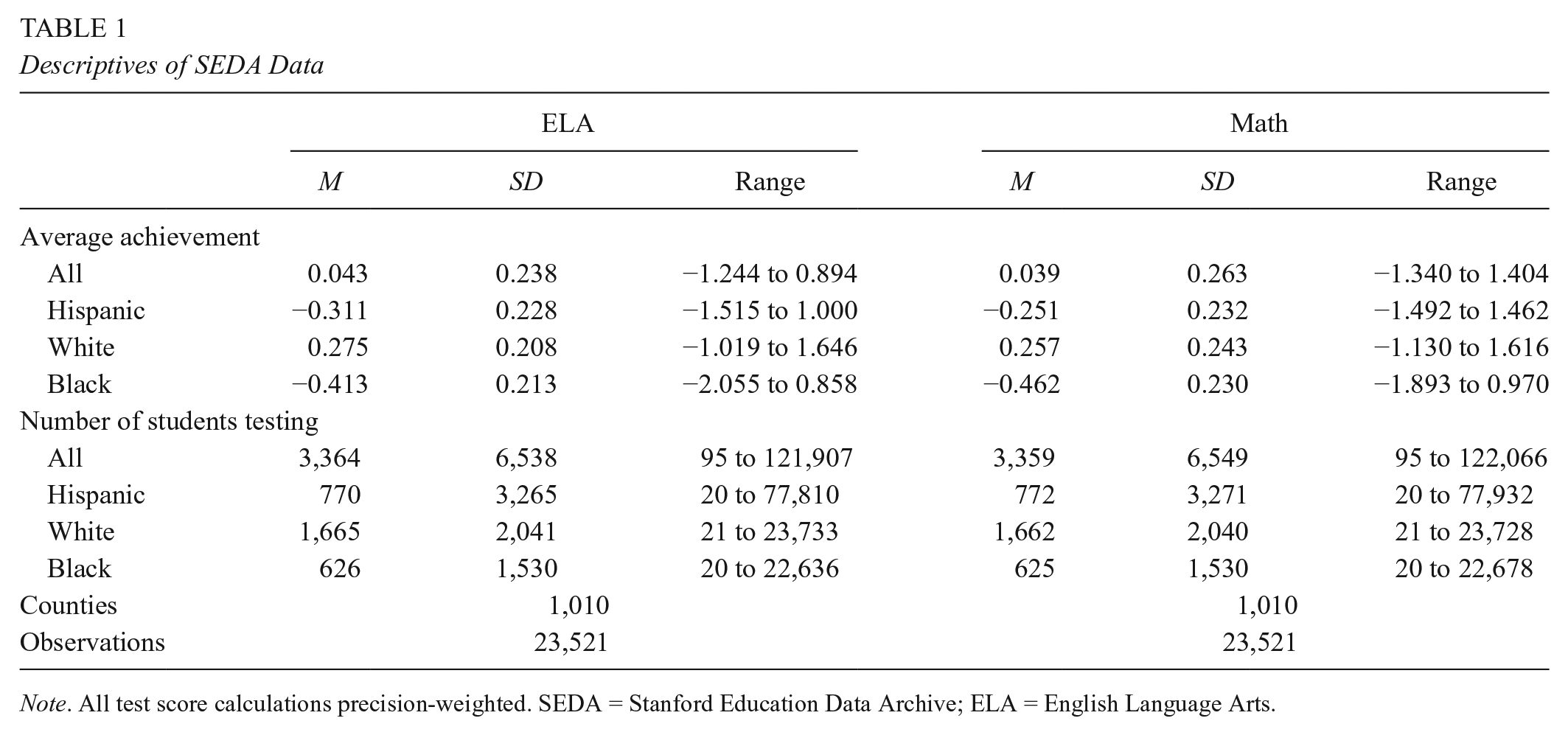
Note. All test score calculations precision-weighted. SEDA = Stanford Education Data Archive; ELA = English Language Arts.
Table 2 presents information from Figure 3 in tabulated form, as well as information on counties’ applications for 287(g) programs. I again restrict to my subset of counties of interest in main models. As shown, although few counties in my sample were activated for Secure Communities prior to testing beginning in 2008–2009, the counties that were activated early tended to be larger and contain more Hispanic students than later activating counties. Similarly, although counties that had applied to participate in 287(g) programs prior to October 2008 were a relatively small share of counties, those that applied and were eventually approved for participation (as well as those that later withdrew their applications) had larger total populations, as well as larger Hispanic student populations.
Other County Characteristics
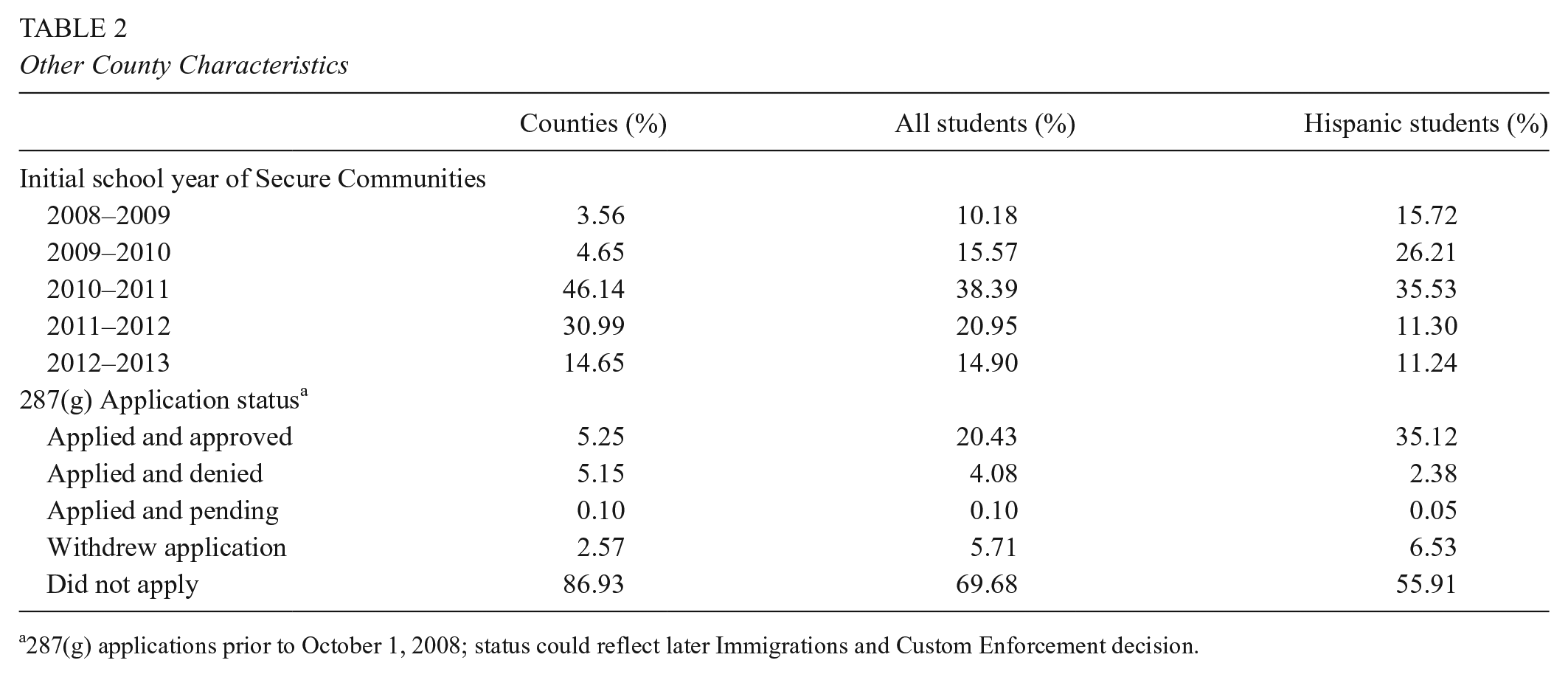
287(g) applications prior to October 1, 2008; status could reflect later Immigrations and Custom Enforcement decision.
Figure 4 shows the number of removals resulting from Secure Communities for each county through the beginning of the testing period for 2012–2013. Although a few areas had high numbers of removals associated with the program, the majority of counties had fewer than 100 removals during this period. High levels of removals were concentrated in more populous areas; high levels of removals were also more common in southern and western states. The 48 counties with more than 1,000 removals during this time period were in California, Arizona, Texas, Florida, Georgia, Nevada, North Carolina, Utah, Virginia, Oklahoma, and Tennessee, with the majority in California and Texas.

Removals associated with Secure Communities.
Main Findings
As shown in Table 3, I find that the activation of Secure Communities is associated with reduced average achievement for Hispanic students in ELA. I find no change in average achievement for Hispanic students in math. The activation of Secure Communities is also associated with decreased academic achievement in ELA for a county’s Hispanic students by approximately 0.009 standard deviations. Although the relation with math is not statistically significant, coefficients are also negative and of a similar size: 0.007 standard deviations.
Relationship Between Secure Communities and Average Achievement

Note. Precision-weighted regressions include grade, year, state-by-year, and county fixed effects. Robust standard errors, clustered at the county level, are in parentheses. ELA = English Language Arts.
p < .1. **p < .05. ***p < .01.
Table 3 also presents results for non-Hispanic White and Black students. The activation of Secure Communities is also associated with reductions in non-Hispanic Black students’ average achievement in ELA by 0.012 standard deviations. Although results are only marginally significant, the activation of Secure Communities is also associated with a decline in math achievement for non-Hispanic Black students. The activation of Secure Communities appears to have no relationship with the achievement of White students in either ELA or math.
I split results by younger (Grades 3–5) and older (Grades 6–8) students. Older students are likely more aware of their parents’ immigration status or more subject to policing, themselves. In Table 4, I detect no relationship between the activation of Secure Communities and the achievement of Hispanic students in Grades 3 to 5; in Table 5, it appears that any relationship is driven by Hispanic students in Grades 6 to 8. The pattern for Black students less clear: The activation of Secure Communities is associated with a marginally significant decline in Black ELA achievement in early grades, but the association with math achievement is a precisely measured 0. In contrast, the activation of Secure Communities is associated with a decrease in Black achievement in both ELA and math in Grades 6 to 8, although the decrease again is only marginally significant.
Relationship Between Secure Communities and Average Achievement in Grades 3 to 5

Note. Precision-weighted regressions include grade, year, state-by-year, and county fixed effects. Robust standard errors, clustered at the county level, are in parentheses. ELA = English Language Arts.
p < .1. **p < .05. ***p < .01.
Relationship Between Secure Communities and Average Achievement in Grades 6 to 8
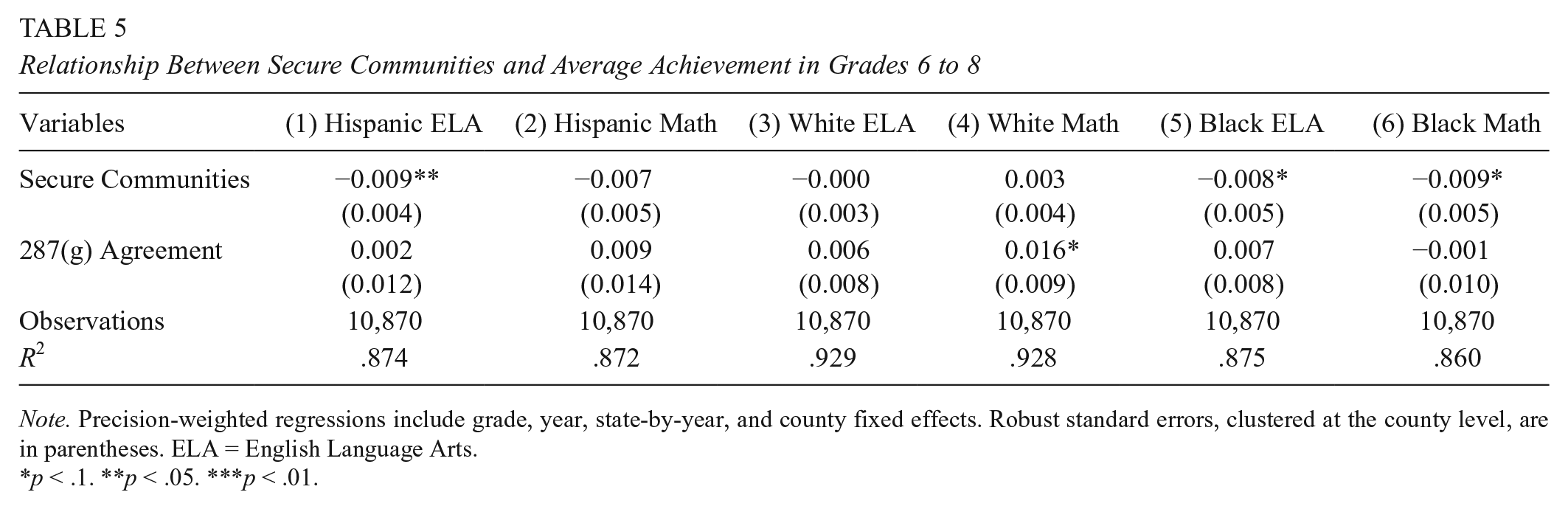
Note. Precision-weighted regressions include grade, year, state-by-year, and county fixed effects. Robust standard errors, clustered at the county level, are in parentheses. ELA = English Language Arts.
p < .1. **p < .05. ***p < .01.
As Secure Communities continues, families may become more aware of its activation or be exposed to greater numbers of immigration-related arrests. In Table 6, I split Secure Communities into three indicators representing the first year of program activation, the second year of program activation, and three or more years of program activation. As shown, the association appears to increase for Hispanic students in the second year of the program, although the relationship is only marginally significant in ELA.
Separating Secure Communities by Year

Note. Precision-weighted regressions include grade, year, state-by-year, and county fixed effects. Robust standard errors, clustered at the county level, are in parentheses. SC = Secure Communities; ELA = English Language Arts.
p < .1. **p < .05. ***p < .01.
Robustness Checks
Sampling Decisions
In main models, I restrict to counties that have average achievement measures for Hispanic, White, and Black students, which excludes a large number of counties primarily because of the smaller number of counties with at least 20 Black students testing in a grade-year observation. This limits the generalizability of results. In Table 7, I show results for a larger set of counties, which have average achievement measures for both Hispanic and non-Hispanic White students. I reach similar results, finding that Secure Communities is associated with a decrease in ELA achievement for Hispanic students of about 0.008 standard deviations, with no relationship between Secure Communities and the achievement of non-Hispanic White students. Similarly, in Table 8, I show results for all counties with measures of either math or ELA achievement. Here, results for Hispanic students are not as precisely measured, but I continue to find that activation of Secure Communities is associated with a decrease in ELA achievement by 0.007 standard deviations. I also continue to find similar results for Black students; Secure Communities is associated with a reduction in Black students’ ELA achievement by 0.010 standard deviations. Taken together, these results show that the set of findings in the main models are generalizable to the larger set of counties.
Relationship Between Secure Communities and Average Achievement in Counties With Hispanic and White Test Scores

Note. Precision-weighted regressions include grade, year, state-by-year, and county fixed effects. Robust standard errors, clustered at the county level, are in parentheses. ELA = English Language Arts.
p < .1. **p < .05. ***p < .01.
Relationship Between Secure Communities and Average Achievement in All Counties

Note. Precision-weighted regressions include grade, year, state-by-year, and county fixed effects. Robust standard errors, clustered at the county level, are in parentheses. ELA = English Language Arts.
p < .1. **p < .05. ***p < .01.
Altering Time-Varying Controls
In main models, beyond fixed effects, I control for the time-varying size of the total and Hispanic populations in a particular grade, year, and county. As shown in Table 9, results are mostly robust to dropping these controls, controlling for the percentage of students Hispanic and Black rather than the total Hispanic student population, and using the natural log of the total and Hispanic populations as controls. Results are also robust to controlling for the unemployment rate during the past school year.
Robustness of Results to Varying Controls

Note. Precision-weighted regressions include grade, year, state-by-year, and county fixed effects. Robust standard errors, clustered at the county level, are in parentheses. ELA = English Language Arts.
p < .1. **p < .05. ***p < .01.
Potential Mechanisms
The activation of Secure Communities might affect average achievement by either affecting students’ performance on tests or changing the composition of students within schools. To determine whether Secure Communities is associated with student composition, I substitute the log of the number of students who take ELA or math tests as the outcome variable and estimate similar models. As shown in Table 10, the activation of Secure Communities has no relationship with the number of Hispanic students testing in either ELA or math. However, the activation of Secure Communities is negatively associated with the number of non-Hispanic Black students testing in both ELA and math. I estimate the same models using information from the CCD, which allows me to include more years of data prior to Secure Communities activation (see Table 11). Here, I aggregate school enrollment counts to the county level using county information in the Public Elementary/Secondary School Universe Survey files. While not precisely measured, the estimated relationship between Secure Communities and Black enrollment is large and negative in Model (5), which uses data from the same years available in SEDA (2008–2009 through 2012–2013). However, when I add more years of data (2003–2004 through 2013–2014), that association disappears. Therefore, it seems unlikely that decreasing enrollment for Black students is the mechanism through which Secure Communities is related to changes in Black achievement in ELA or math.
Relationship Between Secure Communities and Number of Hispanic, Black, and White Students Using SEDA

Note. Regressions control for grade, year, state-by-year, and county fixed effects. Robust standard errors, clustered at the county level, are in parentheses. SEDA = Stanford Education Data Archive; ELA = English Language Arts.
p < .1. **p < .05. ***p < .01.
Relationship Between Secure Communities and Number of Hispanic, Black, and White Students Using CCD

Note. Regressions control for year, state-by-year, and county fixed effects. Robust standard errors, clustered at the county-level, in parentheses. CCD = Common Core of Data.
p < .1. **p < .05. ***p < .01.
If Secure Communities affected performance on exams, one mechanism through which it likely operated was by increasing stress in a community. I would expect stress to increase as removals increase within a community. Table 12 presents models using the rate of removals of the foreign-born Hispanic population as the key predictor of interest. Increases in removals within a county are associated with reduced average achievement in ELA for both Hispanic and non-Hispanic Black students. A one percentage point increase in removals in a county corresponded to decreases in average Hispanic achievement in ELA and math by 0.006 to 0.007 standard deviations. A one percentage point increase in removals is also associated with a decrease in average achievement in ELA for non-Hispanic Black students by 0.005 standard deviations. I again check for the robustness of these results to varying controls (Table 13). Results are fairly robust to varying controls (particularly for ELA).
Association Between Yearly Removals and Average Achievement

Note. Precision-weighted regressions include grade, year, state-by-year, and county fixed effects. Robust standard errors, clustered at the county level, are in parentheses. ELA = English Language Arts.
p < .1. **p < .05. ***p < .01.
Robustness of Results for Yearly Removals to Varying Controls

Note. Precision-weighted regressions include grade, year, state-by-year, and county fixed effects. Robust standard errors, clustered at the county level, are in parentheses. ELA = English Language Arts.
p < .1. **p < .05. ***p < .01.
Removals may be staggered from when an individual is initially arrested and transferred into ICE custody. I therefore also examine the association between cumulative measures of removals (as a share of the foreign-born Hispanic population) and student test scores. This cumulative approach means that I can no longer control for county, state-by-year, and year fixed effects; however, I continue to use grade fixed effects and instead control for 2009 test scores to account for prior achievement in that county. Table 14 shows that counties with higher rates of removals over the course of Secure Communities experienced larger declines in ELA test scores by 2012–2013. If a county were to move from 0% of the foreign-born Hispanic population removed to 100% of the foreign-born Hispanic population removed, test scores for Hispanic students in ELA are predicted to decline by 0.412 standard deviations.
Association Between Cumulative Removals, as a Share of the Foreign-Born Hispanic Population, and Test Scores

Note. Precision-weighted regressions control for grade fixed effects and 2009 test scores. Robust standard errors, clustered at the county level, are in parentheses. ELA = English Language Arts.
p < .1. **p < .05. ***p < .01.
Higher numbers of removals could indicate that law enforcement was cooperating with ICE by honoring detainers issued. Although I do not observe how many detainers were honored per county, I do observe both fingerprint match and removal counts, which allows me to construct the rate of removals per fingerprint match. Counties that have higher rates of removals per fingerprint match likely have higher cooperation rates with ICE (Pedroza, 2019). I again use cumulative measures (from 2008 through 2013) of both removals and fingerprint matches and calculate the rate of removals per fingerprint match through 2013. Although evidence is only suggestive, Table 15 shows that counties with higher rates of removals per fingerprint match over the course of Secure Communities experienced larger declines in ELA test scores by 2012–2013. If a county were to move from 0% of matches removed to 100% of matches removed, test scores for Hispanic students in ELA are predicted to decline by 0.128 standard deviations.
Association Between Local Cooperation With Immigrations and Custom Enforcement and Test Scores
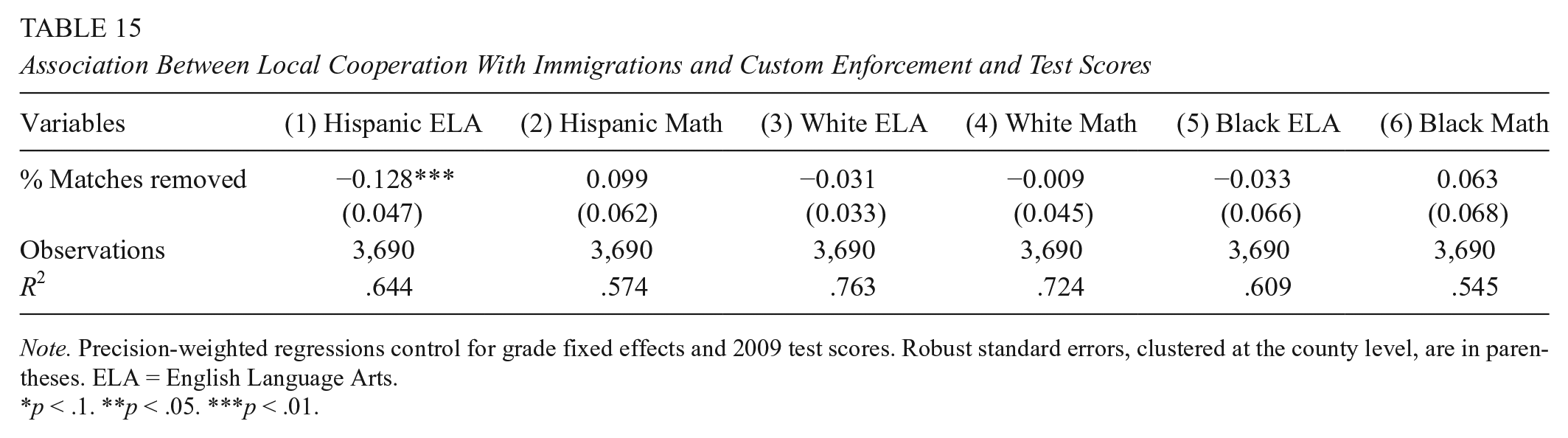
Note. Precision-weighted regressions control for grade fixed effects and 2009 test scores. Robust standard errors, clustered at the county level, are in parentheses. ELA = English Language Arts.
p < .1. **p < .05. ***p < .01.
Threats to Validity
Check for Prior Trends
It is possible that other changes over time in counties implementing Secure Communities affected students’ test scores, unrelated to the rollout of the program. I check for this possibility by running a specification in which I include two leading indicators of Secure Communities. Significant estimates from these regressions would suggest that any relationship observed between the activation of Secure Communities and achievement may have been instead the result of differing pre-trends between activating and nonactivating counties. As shown in Table 16, coefficients on leading indicators of Secure Communities do not reach statistical significance. However, coefficients on leading indicators, although not significant at conventional levels, are negative and large in models for Black students’ ELA scores. This suggests prior negative trends for Black students that could bias estimates of effects of Secure Communities’ activation. In particular, it appears that Black students’ scores in ELA were already declining during this time period, prior to the initiation of Secure Communities.
Check for Prior Trends on Achievement for Secure Communities

Note. Precision-weighted regressions include grade, year, state-by-year, and county fixed effects. Robust standard errors, clustered at the county level, are in parentheses. SC = Secure Communities; ELA = English Language Arts.
p < .1. **p < .05. ***p < .01.
I conduct a similar analysis substituting the number of test takers in ELA and math as the outcome. As shown in Table 17, leading indicators of Secure Communities do not reach statistical significance in models for the numbers of Hispanic or White test takers. However, the number of Black students testing in ELA and math appear to be trending downward prior to the activation of Secure Communities. This further suggests that any relationship between Secure Communities and the enrollment of Black students may reflect preexisting trends, rather than result from the activation of Secure Communities.
Check for Prior Trends on Enrollment for Secure Communities
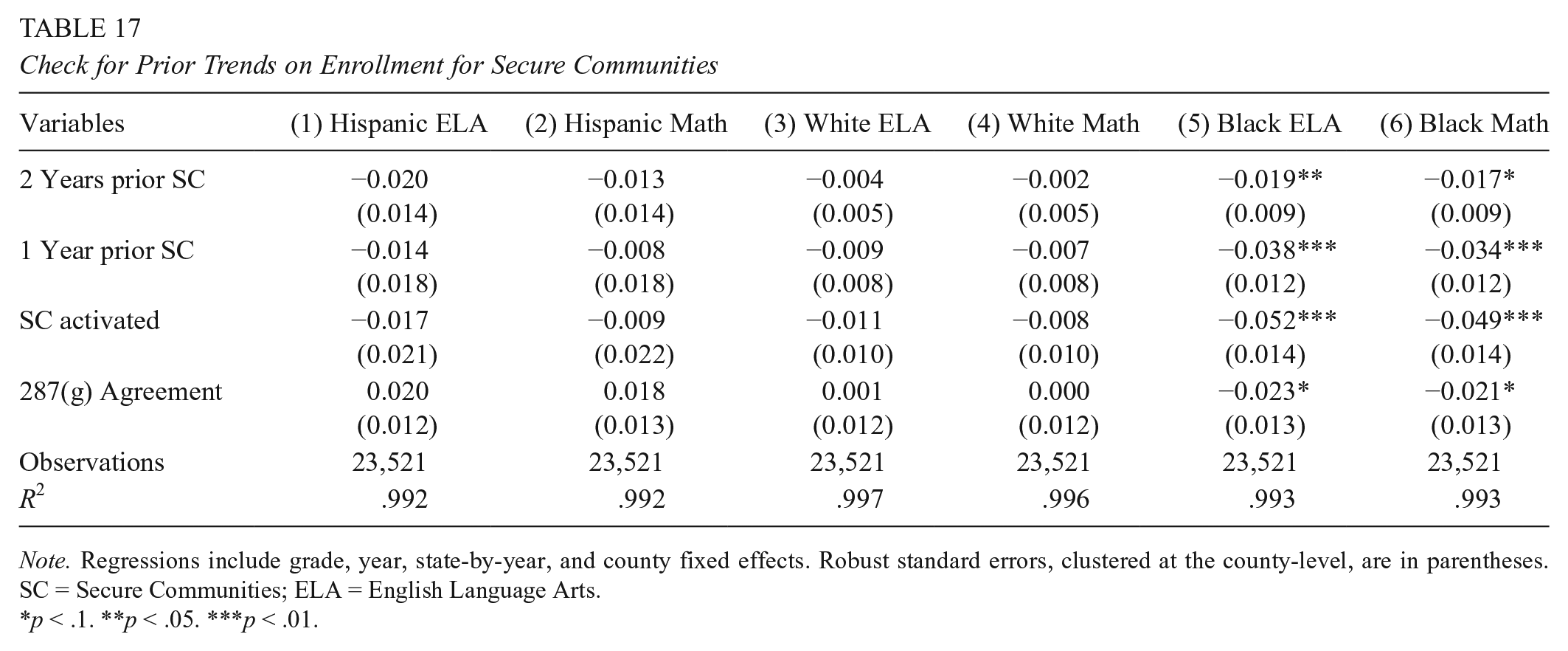
Note. Regressions include grade, year, state-by-year, and county fixed effects. Robust standard errors, clustered at the county-level, are in parentheses. SC = Secure Communities; ELA = English Language Arts.
p < .1. **p < .05. ***p < .01.
Endogeneity of Rollout
As previously stated, prior work finds that the timing of Secure Communities’ activation was related to several county-level characteristics, including location along the border with Mexico, activation of a 287(g) program, share of the population that is Hispanic, and overall size of the population (Cox & Miles, 2013). In predicting the rollout of Secure Communities, Cox and Miles (2013) also include controls for location on the Gulf of Mexico, fraction of the population noncitizen, violent crime rate, property crime rate, income per capita, fraction in poverty, fraction of vote for Republican candidate in 2004, and count of local anti-immigrant legislation.
I am unable to reproduce Cox and Miles (2013) exactly for several reasons. First, I do not have access to counts of local anti-immigrant legislation. Second, the USA Counties file Cox and Miles (2013) used is no longer available online; instead, I use data from “USA Counties: 2011.” Unfortunately, “USA Counties: 2011” does not contain data for Puerto Rico or other territories, which I believe to be included in Cox and Miles (2013). Third, the coding of several variables is unclear. However, with these limitations, I estimate similar models predicting Secure Communities activation. 5 Following Cox and Miles (2013), I use Cox hazard models; I have data on all counties’ activation dates, so there is no right censoring.
As shown in Table 18, which reports hazard ratios, I also find that the timing of Secure Communities is correlated with location along the border with Mexico, percentage of the population identified as Hispanic, total population, and active 287(g) agreements. However, the percentage of the population identified as Black and the percentage of votes for a Republican candidate in 2004 are also correlated with later Secure Communities activation. Finally, I detect a relationship between percentage of the population in poverty and later Secure Communities activation. This suggests that there may be other key county differences correlated with timing of activation that could also affect other county trends during this period.
Predicting Activation of Secure Communities

Note. The table reports hazard ratios, with standard errors in parentheses.
p < .1. **p < .05. ***p < .01.
I examine not only the relationship between timing of activation and prior 287(g) agreement but also the relationship between timing of activation and application for a 287(g) agreement. In Models (2) and (3), I not only control for approved 287(g) agreements but also add indicators for counties that applied but were denied approval for a 287(g) program, applied but later withdrew the application for a 287(g) program, and had a pending application for a 287(g) program (with as of yet unresolved application status; Pedroza, 2018). I identify counties using only applications prior to the beginning of the Secure Communities rollout. I find that counties that applied for but were denied participation in 287(g) programs or had applications pending were likely to have Secure Communities activated earlier. This result suggests that there may be other factors known to ICE about county preferences for immigration enforcement that predict activation of Secure Communities. An early rollout of Secure Communities might reflect a strong desire by county officials to cooperate with ICE, and any observed relationship between Secure Communities and student achievement may be driven by a county’s interest in cooperating with ICE.
Another threat to validity would be if the rollout of Secure Communities was correlated with other county trends unrelated to the program. Cox and Miles (2013) also find no relationship between the change in the share of the population identified as Hispanic and timing of Secure Communities activation. In Model (3), I reach similar results but find that areas that increased in the share of the population in poverty between 2000 and 2009 activated Secure Communities earlier. This suggests that counties hardest hit by the Great Recession may have also experienced earlier activation of Secure Communities; if counties activated earlier for Secure Communities were experiencing economic decline at steeper rates than counties activated later for Secure Communities, any observed association between Secure Communities and student outcomes might instead be a function of economic factors within that county.
Varying Treatment of 287(g) Programs
In contrast to Secure Communities, to participate in 287(g) programs, local law enforcement had to apply and be approved by ICE. ICE then provided training, and subsequently local law enforcement were empowered to act as immigration agents. Although I control for 287(g) program activation in main models, this likely does not sufficiently account for endogeneity in the rollout of Secure Communities related to 287(g) programs because I also find that counties applying for a 287(g) program but denied by ICE were likely to activate Secure Communities earlier. Counties may apply for 287(g) programs because of trends that are related to immigration, such as increasing levels of anti-immigrant animus or increasing crime levels in immigrant communities. These trends are likely to also affect student achievement. To examine the possibility that changing attitudes or actions toward immigrants are driving the results, I alternatively exclude all counties that were ever approved for a 287(g) agreement (Table 19) or that ever applied for a 287(g) agreement (Table 20). Estimates of the relationship between Secure Communities and achievement no longer reach conventional levels of statistical significance but are similar in size for Hispanic students in ELA, although reduced for Black students in ELA and math.
Relationship Between Secure Communities and Average Achievement Excluding All Counties Approved for 287(g) Programs

Note. Precision-weighted regressions include grade, year, state-by-year, and county fixed effects. Robust standard errors, clustered at the county level, are in parentheses. ELA = English Language Arts.
p < .1. **p < .05. ***p < .01.
Relationship Between Secure Communities and Average Achievement Excluding All Counties That Ever Applied for 287(g) Programs

Note. Precision-weighted regressions include grade, year, state-by-year, and county fixed effects. Robust standard errors, clustered at the county-level, are in parentheses. ELA = English Language Arts.
p < .1. **p < .05. ***p < .01.
Discussion
In prior work, immigration enforcement in the form of worksite raids negatively affects children’s performance in schools (Capps et al., 2007; Zuniga, 2018); parental unauthorized status and experiences with immigration enforcement have also been associated with parental reports of lower academic achievement (Brabeck et al., 2015; Brabeck & Xu, 2010). This study builds on these prior findings by examining the relationship of the Secure Communities program, a nationwide immigration enforcement program, with student achievement. I find that the activation of this program was associated with decreases in average Hispanic achievement in ELA, as well as in average non-Hispanic Black achievement. These decreases are small, at around 1% of a standard deviation, and appear to be primarily concentrated among middle-grade students (Grades 6–8).
These findings build on prior work in multiple ways. This article is the first to use administrative test score data for all counties across the United States to examine the relationship of immigration enforcement policy with student achievement. I use the rollout of Secure Communities and control for consistent characteristics of counties that might be correlated with lower student achievement. Doing so, I find that increases in immigration enforcement are associated with reduced academic achievement. Additionally, I find some evidence for an interaction between Secure Communities’ activation and cooperation by local law enforcement: First, increases in removals in a county are associated with drops in student achievement in ELA for Hispanic and non-Hispanic Black students. The size of the decrease is rather large: Moving from 0% to 10% of the likely affected population (foreign-born Hispanic individuals) would result in drops in achievement of approximately 6% to 7% of a standard deviation. This is also true when I examine the relationship between cumulative removals in a county and student achievement. Second, counties with higher rates of removals per fingerprint match experience larger declines in ELA test scores for Hispanic students. Third, results are less robust to excluding counties that applied to participate in 287(g) programs, suggesting that results are being driven by counties that were interested in collaborating with ICE.
I also find new factors predicting rollout of Secure Communities. Although previous work found that an active 287(g) agreement was associated with earlier activation, I note that even applying for a 287(g) program is associated with earlier activation. ICE may have other, unobserved information it leveraged when determining which counties to activate. These preferences may relate to other unobserved county trends that are also affecting achievement during this time period, such as increases in local anti-immigrant animus.
Further evidence of other characteristics trending with Secure Communities are declines in achievement and enrollment for Black students. I consistently find a negative association between the activation of Secure Communities and achievement and enrollment for Black students; this decrease in achievement is as large as the decrease for Hispanic students. Although some Black students also have immigrant family members, this population is not large and unlikely to be driving these results. I also find that enrollment for Black students is trending downward in counties prior to Secure Communities activation, suggesting that the timing of activation is correlated with other county characteristics affecting achievement and enrollment for Black students. Although I do not find similar trends for Hispanic students, this pattern for Black students suggests that timing of activation may relate to other county trends preceding the activation of Secure Communities. I additionally find that Secure Communities was activated earlier in counties increasing in poverty between 2000 and 2009, suggesting that Secure Communities may have been activated first in counties hit harder by the Great Recession. Using more years of prior data could help account for differential trends: When I use multiple prior years of enrollment data, I no longer detect this downward trend in Black enrollment with the activation of Secure Communities. It is not possible to examine more years of achievement because the data from SEDA do not start until 2008–2009, the year when the rollout of Secure Communities began.
Conclusion
The Obama administration halted Secure Communities in favor of the Priority Enforcement Program, partially in response to criticism that Secure Communities did not achieve its stated purpose of targeting serious criminal offenders. However, the current administration has revived Secure Communities, as well as proposed redefining criminal alien to include a broader population of immigrants (Capps et al., 2018). Federal officials have also examined the citizenship of some naturalized citizens for potential fraud, leaving naturalized citizens also vulnerable to removal. In this climate, understanding the multiple impacts of intensified immigration enforcement is important.
Understanding the impacts of immigration enforcement is particularly challenging for several reasons. First, the population most likely affected is hard to identify, meaning that effects must be detected using a larger population (for whom effects are more likely to be diffuse). Second, immigration enforcement policies are not randomly assigned to areas, and more intense immigration enforcement is likely correlated with other local characteristics. In this context, the rollout of a national program like Secure Communities, the activation of which was determined by national rather than local priorities, seems plausibly exogenous. However, I present evidence that characteristics of counties other than those previously known were also used by ICE to determine timing of activation.
Secure Communities is associated with reduced achievement in ELA for Hispanic students. These results appear to be concentrated among middle school students and depend on the level of cooperation between local law enforcement and ICE, as counties experiencing higher levels of removals have larger decreases in achievement. When assessing these results, it is important to remember that Secure Communities is a relatively low-touch program; in contrast, worksite raids, an intense form of treatment, appear to create substantial community stress, with potentially large spillover effects on achievement.
Footnotes
Acknowledgements
This work has been supported (in part) by award #83-17-01 from the Russell Sage Foundation and the William T. Grant Foundation. Any opinions expressed are those of the author alone and should not be construed as representing the opinions of either foundation. This research was also supported by the Institute of Education Sciences, U.S. Department of Education, through Grant R305B170002 to the University of Virginia (Principal Investigator: Sara Rimm-Kaufman). The opinions expressed are those of the authors and do not represent views of the institute or the U.S. Department of Education. Earlier versions of this paper were presented at the Population Association of America Annual Conference (Chicago, April 2017), the annual fall research conference of the Association for Public Policy Analysis and Management (Chicago, November 2017), and the annual conference of the Association for Education Finance and Policy (Portland, March 2018). The author thanks discussants and audience members at those sessions for their feedback. The author also thanks the editor and anonymous reviewers for their constructive comments.

Notes
Author
LAURA BELLOWS is an IES postdoctoral fellow with the Curry School of Education and Human Development at the University of Virginia. Dr. Bellows’s work focuses on how U.S. social policies relate to child outcomes.