




Abstract
Socioeconomic achievement gaps have long been a central focus of educational research. However, not much is known about how (and why) between-district gaps vary among states, even though states are a primary organizational level in the decentralized education system in the United States. Using data from the Stanford Education Data Archive (SEDA), this study describes state-level socioeconomic achievement gradients and the growth of these gradients from Grades 3 to 8. We also examine state-level correlates of the gradients and their growth, including school system funding equity, preschool enrollment patterns, the distribution of teachers, income inequality, and segregation. We find that socioeconomic gradients and their growth rates vary considerably among states, and that between-district income segregation is positively associated with the socioeconomic achievement gradient.
Keywords
Introduction
The association between family socioeconomic status (SES) and children’s academic performance—the socioeconomic achievement gap—is large and has grown in the United States in the past few decades (Hanushek, Peterson, Talpey, & Woessmann, 2019; Reardon, 2011b). 1 This is likely due, at least in part, both to widening income inequality and to an increased focus on educational success as central to economic success. In combination, these trends have led to increases in economic segregation (Owens, 2016; Reardon, Bischoff, Owens, & Townsend, 2018) and growing disparities in parental investments in children’s education (Duncan & Murnane, 2011; Kornrich & Furstenberg, 2013). As a result, rich and poor children today grow up in families and neighborhoods that provide very different levels of educational opportunities and supports than was the case 50 years ago. These socioeconomic disparities and the corresponding socioeconomic achievement gap are key features of today’s landscape of educational opportunity.
A great deal of literature on socioeconomic disparities in educational outcomes has focused on family, neighborhood, and school factors shaping achievement gaps (Reardon, 2011b; Sirin, 2005). This is true of much of the literature in the sociology of education since the Coleman report (Coleman et al., 1966). The role of school district context, and of between-district inequality and the state-level forces that shape such inequality, has been less central in the sociological literature, however. This is less true in the economics and public policy literatures, where there is considerable scholarship on the role of state and local school funding distribution policies and early childhood education policies. Some of this literature suggests that state-level policies are important in shaping local educational contexts and educational inequality (Jackson, Johnson, & Persico, 2016; Lafortune, Rothstein, & Schanzenbach, 2018; Valentino, 2018; Wong, Cook, Barnett, & Jung, 2008). This is unsurprising. States are key organizational levels in the decentralized education system in the United States. They set policy, distribute the large majority of public school funds, license teachers, and oversee curricula and accountability. Districts in turn have considerable leeway in allocating funds, assigning teachers and students to schools, and setting local priorities and foci. Both states and districts play roles in determining the availability and quality of preschool programs, which affect students’ school readiness. Furthermore, between-district income segregation has grown in recent decades (Owens, 2016; Owens, Reardon, & Jencks, 2016), implying that between-district resource differences may become increasingly salient in shaping socioeconomic disparities in educational opportunities.
Consequently, it is useful to investigate whether and how state-level processes and contexts shape between-district academic outcome disparities. State processes play a role in moderating the effects of family and community differences in socioeconomic resources, given that states operate as a primary political division for the distribution of socioeconomic and educational resources. As such, they may function to equalize or exacerbate the achievement disparities that result from differences in family and community socioeconomic resources.
In this article, we examine how state-level policies and contexts are associated with between-district socioeconomic achievement gradients. We first define a state’s socioeconomic achievement gradient as the average difference in test scores between two districts that differ by 1 SD of average parental socioeconomic status. For each state, we compute both the gradient in Grade 3 and the average within-cohort change in the gradient, per grade, from Grades 3 to 8. Together, these two statistics provide information on the extent of between-district inequality of educational opportunity in elementary school and the extent to which inequality grows through the end of middle school. Second, we describe the bivariate distribution of these measures, noting the degree to which they vary and covary across states. Third, we examine how the two measures are associated with aspects of states’ education system inequity, economic inequality, and between-district racial and economic segregation in each state.
This study extends prior research on the socioeconomic achievement gap in several ways. First, using test score data from every public school district in the United States, it provides a detailed description of between-district socioeconomic achievement gradients in each state from Grades 3 to 8. This provides information not just on the degree of between-district inequality in each state but on when this inequality arises and how it grows across grade levels. Second, it provides suggestive evidence about the role that several key state characteristics may play in shaping between-district educational inequality. In doing so, it draws attention to structural features of state educational systems and patterns of segregation, and sheds light on the way that larger policy regimes and residential patterns are associated with educational inequality.
Background and Conceptual Framework
We are interested here in the between-district association of average test performance and average socioeconomic status. To make this concrete, suppose we have two equally high- and two equally low-SES districts, one of each in both States A and B, and all four with the same racial/ethnic demographic makeup. We are interested in whether the achievement gap between the high- and low-SES districts in state A differs from that in State B, and if so, what state features might account for this difference. Note that our emphasis on the between-district SES–achievement association differs from the more commonly studied association between individual students’ academic performance and their family SES.
We consider several state characteristics that may exacerbate or reduce such between district differences in academic achievement: (1) inequality in school funding among school districts; (2) inequality in the distribution of effective teachers (proxied by measures of the proportion of novice and high-absence teachers) among districts; (3) inequality in children’s access to high-quality preschool environments; (4) between-district economic segregation; and (5) state-level economic inequality. Some of these are features of states’ preschool and K–12 education systems; others are features of states’ economic contexts. We discuss each of these state characteristics and their potential relationship to between-district academic achievement differences below.
Inequality in School Funding
If higher school funding leads to higher academic outcomes, then states with more unequal funding should also, all else equal, have more unequal academic outcomes. Early, primarily correlational, research showed that per pupil school spending was largely uncorrelated with academic achievement (Hanushek, 2003). But recent studies using more rigorous quasi-experimental methods to estimate the effects of school funding consistently find that school funding positively affects students’ academic performance and graduation rates (see Jackson, 2018, for a review of this literature). Several studies focusing on the effect of school finance reforms (SFRs) designed to equalize funding among richer and poorer school districts have found that the reforms improved numerous educational outcomes, including test scores (LaFortune et al., 2018), educational attainment (Candelaria & Shores, 2015; Hyman, 2017), and wages (Jackson et al., 2016). Moreover, the impact of these reforms was often stronger among low-income families and in low-income districts (Jackson et al., 2016; Lafortune et al., 2018). These findings imply that additional state-level funding can play a significant role in increasing student achievement and that more equitable funding regimes may help equalize educational outcomes.
That said, school funding is not strongly correlated with school district socioeconomic status in most states. Prior to the 1970s, most states had highly unequal funding policies that relied partly on local property tax revenue to fund schools (Kozol, 1967, 1991). Because of the large differences in property values in different communities, schools in poor communities typically received far less funding than those in affluent communities. Beginning in the 1970s, however, several forces have led to greater within-state equity in school finance policies, including both court-mandated and legislatively initiated school finance reforms (SFRs) (Jackson et al., 2016). Since then, each state has legislated at least one finance reform intended to weaken the association between local property values and per pupil public education spending (Hoxby, 2001). As a result, school funding inequality is low in many states; this limited variation in funding inequality may make it difficult to observe any association between funding inequity and between-district achievement inequality.
Unequal Access to Effective Teachers
A large body of research shows that teachers can have sizeable impacts on student outcomes but vary substantially in their effectiveness (Chetty, Friedman, & Rockoff, 2014; Goldhaber, 2007; Hanushek & Rivkin, 2010; Kane, Rockoff, & Staiger, 2008). Given this, we would expect that school districts with a larger proportion of effective teachers will have higher average test scores and larger average score growth rates, and that states where the most effective teachers are concentrated in affluent districts will have steeper between-district SES achievement gradients—and these gradients will grow faster from Grades 3 to 8—than in those where the average teacher effectiveness is uncorrelated with district socioeconomic conditions.
Teacher effectiveness measures are not broadly available or comparable, however. Instead, we use two proxy measures of teacher effectiveness: teacher experience and teacher absenteeism rates. Although teacher experience is only modestly correlated with teacher effectiveness after the first few years of a teacher’s career, most teachers become substantially more effective after their first few years of teaching (Papay & Kraft, 2015; Rockoff, 2004). We would expect greater between-district achievement disparities, then, in states in which novice teachers are concentrated in low-income districts. Likewise, teacher absenteeism has modest negative impacts on student learning (Clotfelter, Ladd, & Vigdor, 2009; Miller, Murnane, & Willett, 2008). Again, we would expect larger between-district SES achievement gradients and faster growth of the gradients from Grades 3 to 8 in states where teacher absenteeism rates are higher in lower SES districts.
Unequal Access to High-Quality Preschool Programs
Access to high-quality preschool programs has long-term benefits for children, including improved educational outcomes as well as later adult outcomes and earnings (Heckman, Pinto, & Savelyev, 2013; Johnson & Jackson, 2017; Magnuson & Duncan, 2016). But preschool enrollment rates are lower, on average, among low-income students than higher income students. Indeed, one key argument in favor of expanding public preschool programs is that achievement gaps are partly driven by the lower preschool enrollment rates of low-income children (Magnuson, Meyers, & Waldfogel, 2007; Magnuson & Waldfogel, 2016). A second argument is that, because preschool programs are particularly effective for low-income children, expanding their access to preschool might substantially reduce achievement gaps (Burchinal, Vandergrift, Pianta, & Mashburn, 2010; Diamond, Barnett, Thomas, & Munro, 2007; Duncan & Sojourner, 2013; Elder & Lubotsky, 2009; Magnuson & Waldfogel, 2005; Wong et al., 2008). As a result of both of these factors, we might expect that states where the disparity between high- and low-income communities in access to high-quality preschool is small, later disparities in children’s academic outcomes will be small as well.
Two factors might work against this, however. First, there is considerable—though not universal—evidence that the academic effects of preschool enrollment fade by second or third grade (Barnett, 2011; Camilli, Vargas, Ryan, & Barnett, 2010; Hill, Gormley, & Adelstein, 2015; Magnuson & Duncan, 2016; Magnuson, Ruhm, & Waldfogel, 2007; Pianta, Barnett, Burchinal, & Thornburg, 2009). As a result, differences in preschool enrollment rates may have little discernable effect on disparities in academic achievement in the later elementary or middle school grades. Moreover, even if socioeconomic differences in preschool enrollment rates are associated with the between-district socioeconomic achievement gradient in elementary school, we do not expect that they will be related to the growth of the gradient after elementary school.
Second, equalizing preschool enrollment patterns does not necessarily mean that children in low- and high-income communities have access to preschool programs of equal quality. Indeed, Valentino (2018) finds that public preschool programs serving low-income, Black, and Hispanic students are of systematically lower quality on a number of dimensions than public preschool programs in the same state serving White and higher income children. Had Valentino’s study included data on private preschool programs as well, the quality disparities would likely have been even larger. Given the evidence that preschool effects tend to fade and that preschool quality is unevenly distributed, even within public preschool programs, greater equality in preschool enrollment patterns within a state may not necessarily lead to more between-district equality in educational outcomes, though that is the intended effect of policies designed to expand public preschool access.
Between-District Economic Inequality and Segregation
Income inequality has been increasing in the United States for four decades (Piketty & Saez, 2003). When income inequality is high, the disparity in economic resources—as well as political power and social capital—between the richest and poorest families is large. This may lead to larger achievement gaps between children in high- and low-income families, given the large disparities in resources that families can deploy to provide educational opportunities for their children (Reardon, 2011b).
Income inequality also shapes the degree of economic segregation between school districts (Reardon & Bischoff, 2011). As income inequality has risen, so has economic segregation, particularly among families with children (Owens, 2016). Consequently, school districts have become increasingly economically segregated in recent decades (Owens et al., 2016). The growth of between-district income inequality and income segregation implies that both poverty and affluence may be highly concentrated in some districts. Because district boundaries partly determine students’ access to educational resources, this may shape disparities in students’ educational opportunities (McCoy, Connors, Morris, Yoshikawa, & Friedman-Krauss, 2015; Siegel-Hawley, 2013). For example, segregation may affect local labor markets; it may lead to greater sorting of teachers among school districts. In a state with little economic segregation among districts, teachers may be largely indifferent to where they teach, leading to only a weak association between teacher characteristics and school district socioeconomic status. But in a state with high segregation, teachers may regard the decision of where to teach as more salient, which would lead to greater sorting of teachers among districts and a potentially stronger association between district socioeconomic status and teacher effectiveness. Mechanisms like this might lead segregation to exacerbate between-district achievement gaps.
That said, it is not obvious that segregation will exacerbate the association between district socioeconomic status and achievement. If the average achievement in a school district is simply a function of that district’s characteristics and composition, then there is no reason to expect segregation to have any independent effect on district achievement or the gradient. Segregation certainly shapes the socioeconomic composition of a community and leads to greater variability in district average socioeconomic status, but that alone does not imply that the relationship between achievement and socioeconomic status would be stronger when segregation is higher. Thus, it is an open question whether segregation exacerbates the between-district socioeconomic achievement gradient.
Research Questions and Hypotheses
In this article, we first estimate the between-district socioeconomic achievement gradient in third grade in each state and the rate at which each state’s gradient changes from third to eighth grade. Following a description of these gradients, we examine how state-level characteristics are associated with both (a) socioeconomic achievement gradients in Grade 3 and (b) the change in the socioeconomic achievement gradient across grades?
Although this study is primarily descriptive in nature, our discussion above suggests several hypotheses. First, we hypothesize that measures of between-district inequality and segregation—between-district income segregation and state-level income inequality—may be positively associated with between-district SES achievement gradients at Grade 3 and with the growth of the SES achievement gradient from Grades 3 to 8. The discussion above, however, leaves open the possibility that segregation may not be associated with the gradient or its growth.
Second, we expect that measures of state-level school system inequity—differences in preschool enrollment by income, differences in funding between high- and low-SES districts, and differences in the distribution of novice and high-absence teachers among high- and low-SES districts—may be positively associated with SES achievement gradients at Grade 3 and especially with the growth of the gradient from Grades 3 to 8. We do not, however, expect preschool enrollment patterns to be associated with the change in gradients from Grades 3 to 8, since any preschool effects on the gradient may be fully realized by Grade 3. Other measures of inequity in school resources, however, may have a continued effect and so would be associated with the growth of the gradient from Grades 3 to 8.
Data and Models
Data
We use test score data from the Stanford Education Data Archive (SEDA), which includes estimates of average test scores by district, subject, grade, and year for nearly all U.S. school districts (Fahle et al., 2018). The data include average scores on math and English/language arts (ELA) tests in Grades 3 to 8 from the 2008–2009 academic year through the 2015–2016 academic year. We standardize the SEDA average test score estimates within each grade–year–subject relative to the national student-level test score distribution; this scaling implies that all the estimates we produce are interpreted in grade–year–subject specific standard deviation units. 2 For each school district, SEDA contains as many as 96 estimates (6 grades, 8 years, and 2 subjects) of average test scores. In some cases, estimates are missing because not all students in a given state–year–grade–subject took the same test; because some states did not administer standardized tests in 2014–2015; because of high opt out rates in some state–year–grades; and because of missingness in states’ reported test data in some state–grade–year–subjects (for detail, see Fahle et al., 2018). In total, we use 885,280 mean score estimates from 10,954 school districts (an average of 81 estimates per district) in 49 states. 3
The SEDA data also include a measure of the average family SES in each school district in its covariate data set. This is a composite measure of SES, defined as the first principal component of the median income, the percent of adults with a bachelor’s degree or higher, the percentage of households with 5- to 17-year-olds in poverty, the SNAP (Supplemental Nutrition Assistance Program) receipt rate, the percentage of single mother–headed households, and the employment rate among adults aged 25 to 64 years in the district. We compute SES from American Community Survey (ACS) data from 2006 to 2010 and 2011 to 2015; then, average the two estimates to obtain a measure of average school district SES in the years 2006 to 2015. Based on sampling error information in the ACS, we construct standard errors for the SES measures; using these standard errors, we construct Empirical Bayes (EB) shrunken estimates of SES. We use these EB estimates of district SES in our regression models to obtain unbiased estimates of the SES achievement gradient in each state (because of measurement error in the SES variable, using the unshrunken SES values would lead to some modest attenuation of the gradients).
For state-level moderators of SES achievement gradients, we use four measures of state-level school system inequity. First is a measure of the difference in preschool enrollment between high- and low-income students. Ideally, we would like district-level preschool enrollment rates from which we could compute between-district enrollment gradients. But district-level preschool enrollment data are not available. Instead, we use ACS Public Use Microdata Sample data to estimate the difference in preschool enrollment rates between 4-year-olds in the highest and lowest income quintiles in the state. Higher values indicate higher inequity in early education access.
Second is a measure of between-district funding disparities. We regress district log per pupil revenue on school district SES. The coefficient on SES in this model describes the extent to which high-SES districts have more (or less) funding per pupil than low-SES districts. Again, higher values indicate greater inequity in school funding.
Third and fourth are two proxy measures of the distribution of effective teachers, one measuring the distribution of experienced teachers and one measuring the distribution of teacher absenteeism across districts. We obtain measures of the proportion of teachers with more than 2 years of experience and measures of the proportion of teachers who are absent less than 10 days/year from the Civil Rights Data Collection data. As above, we regress each of these on district SES to obtain coefficients that reflect the association between each proxy for teacher effectiveness and district SES. And as above, higher values indicate greater inequity in the distribution of experienced teachers and teachers with low absenteeism rates.
In addition, we include in the models two measures of state-level economic inequality: between-district income segregation and state-level income inequality. For segregation, we use 2006 to 2010 ACS data to compute the rank-order variance ratio index (R) of income segregation (Reardon, 2011a), using the method described by Reardon et al. (2018) to construct unbiased estimates of income segregation in each state. Higher value indicates higher between-district income segregation. To measure income inequality, we use the Gini coefficient, a measure of how unequally distributed household incomes are. We obtain state-level Gini coefficients from the ACS data for the years 2012 to 2016.
Finally, we construct a measure of the difference in average racial composition between high-SES and low-SES districts in each state. We use this measure as a control variable in our models, to eliminate confounds due to differences between states in their racial composition and in the association between race and SES. We construct this measure for each state by regressing the percentage of White residents in a district on district average SES. The slope of the regression line indicates the strength of the association between racial composition and SES in the state. A higher value on this variable indicates that White students are disproportionately concentrated in the highest SES districts in the state.
Table 1 includes descriptive statistics for the measures we use.
Descriptive Statistics, District and State Sample Characteristics

Models
Before describing the full model that we use to estimate the associations between state characteristics and SES gradients, we describe a simpler model to provide intuition into the model. Suppose we have a single cohort of students progressing through grades within a district. We can express their average test scores in grade

where

We use the superscript * here to indicate that the parameters describe the bivariate associations between SES and
Next, suppose district average test scores are functions of both district SES and a vector of other district-level covariates (

Next suppose that we can express the intercepts and

Now, substituting (4) into (3), we have

Given the linearity in Equation (2), the partial derivative of (5) with respect to

Equation (6) implies that both the state-specific
In practice, we do not simply compute

where
The key parameters of interest in the model are
Results
Figure 1 describes overall association of district socioeconomic status with average test scores in Grade 3 (top figure) and with the average growth rate of test scores per grade in Grades 3 to 8 (bottom figure). Each gray bubble in the two plots represent one of the roughly 11,000 districts in the United States in our data. Overall, there is a strong positive (national) SES achievement gradient in Grade 3. The relationship between district SES and average test score growth is also positive, although the association is much weaker (see Reardon, 2019). The positive association between average test score growth and district SES implies that the (national) SES achievement gradient grows steeper from Grades 3 to 8 (because achievement grows more in high- than low-SES districts).

District mean achievement and achievement growth rate, by district socioeconomic status (SES).
There is considerable variation in the strength of these bivariate relationships among states, however. The top panel of Figure 1, for example, highlights districts in Kentucky and California; the SES achievement gradient is much weaker in Kentucky than in California. Similarly, the relationship between district SES and test score growth is strong and positive in Florida, but flat in South Carolina (see bottom panel of Figure 1). This indicates that the SES achievement gradient grows steeper from Grades 3 to 8 in Florida but remains constant across grades in South Carolina. The large differences among states in the SES–achievement association and its growth across grades suggest that state-level factors may aggravate or ameliorate between-district inequality of educational opportunity.
Figures 2 and 3 present the distribution of the SES gradients at Grade 3 and their growth per grade in each state. 7 Each line represents the 95% confidence interval for the parameter, with the point estimate in the middle. State-specific point estimates of gradients and their growth are included in Appendix A. Figure 2 shows that the gradients have a median value of 0.232 in Grade 3: in the median state a 1 SD difference in district SES is associated with a difference in average test scores of 0.232 SDs (which corresponds, roughly, to two thirds of a grade level in test scores). South Carolina has the steepest estimated state-level SES achievement gradient (0.367), followed by Nebraska (0.352), Connecticut (0.340), and Alaska (0.336). Other than Nevada, whose gradient is very imprecisely estimated, Kentucky has the weakest association between district SES and test scores (0.118, less than one third as steep as in South Carolina), followed by Oklahoma (0.128) and Missouri (0.131). In no state (except for Nevada, whose gradient is very imprecisely estimated), does the 95% confidence interval on the Grade 3 gradient include 0.

State socioeconomic status (SES) achievement gradients at Grade 3.

State socioeconomic status (SES) achievement gradient growth rates, Grades 3 to 8.
One might wonder how the estimated SES achievement gradients shown in Figure 2 compare to estimates of the student-level achievement gap between high- and low-SES students. We do not have student-level family SES measures needed to compute this, but we can compute the achievement gap between poor and nonpoor students (as measured by free lunch eligibility) in each state in Grade 4 from NAEP data. This is not a perfect comparison, for several reasons: SES and free lunch eligibility measure somewhat different dimensions of socioeconomic conditions; the SES achievement gradient is measured in Grade 3, while the free lunch eligibility gap is measured in Grade 4; and both are measured with error (though both have reliabilities >.80). Nonetheless, the (measurement error corrected) correlation between the two measures is 0.49 (see Appendix B). This suggests that the district SES achievement gradient carries a considerable amount of information about the student-level association as well.
Figure 3 shows that in most—but not all—states, the SES achievement gradient grows from Grades 3 to 8. In about two thirds of states (32 out of 49 states), the estimated rate of change in the SES gradient is positive and its 95% confidence interval does not include 0; most of the other states have positive point estimates whose confidence interval includes 0, though six states have negative point estimates; for two of these states (South Dakota and Arizona), the point estimate is negative (−0.011 and −0.006, respectively) and the confidence interval does not include 0. The gradient grows the most rapidly in Delaware (0.038), Vermont (0.032), New Hampshire (0.028), New York (0.027), and Florida (0.027) (though Delaware’s growth rate is very imprecisely estimated).
Figure 4 plots the growth in SES achievement gradients from Grade 3 through Grade 8 against state-level SES achievement gradients at Grade 3; the red dashed lines—defined by the medians of the two measures—divide the figure into quadrants. States in the upper right quadrant (including VT, MA, NJ, NY, PA, RI, and MN; mostly wealthy states in the Northeast) have high SES achievement gradients in Grade 3 and above average growth rates from Grades 3 to 8, implying that they will have very high gradients in Grade 8. Conversely, those in the lower left (KY, TN, OK, NV, TX, AR, MS, and NM) have low Grade 3 gradients, and below average rates of change in their gradients (in some cases, negative) from Grades 3 to 8; these states will have the lowest SES achievement gradients in Grade 8. The other two quadrants include states with shallow initial gradients but above average growth rates (upper left) and states with steep initial gradients but slow growth rates (lower right). Note that the bivariate correlation (disattenuated to account for measurement error in both measures) between Grade 3 SES achievement gradients and the growth rate of these gradients is −0.189. That is, the extent to which states provide equal educational opportunities for children in high- and low-income districts during early childhood and elementary school is slightly negatively correlated with the extent to which they provide equalizing opportunities in the late elementary and middle school years.
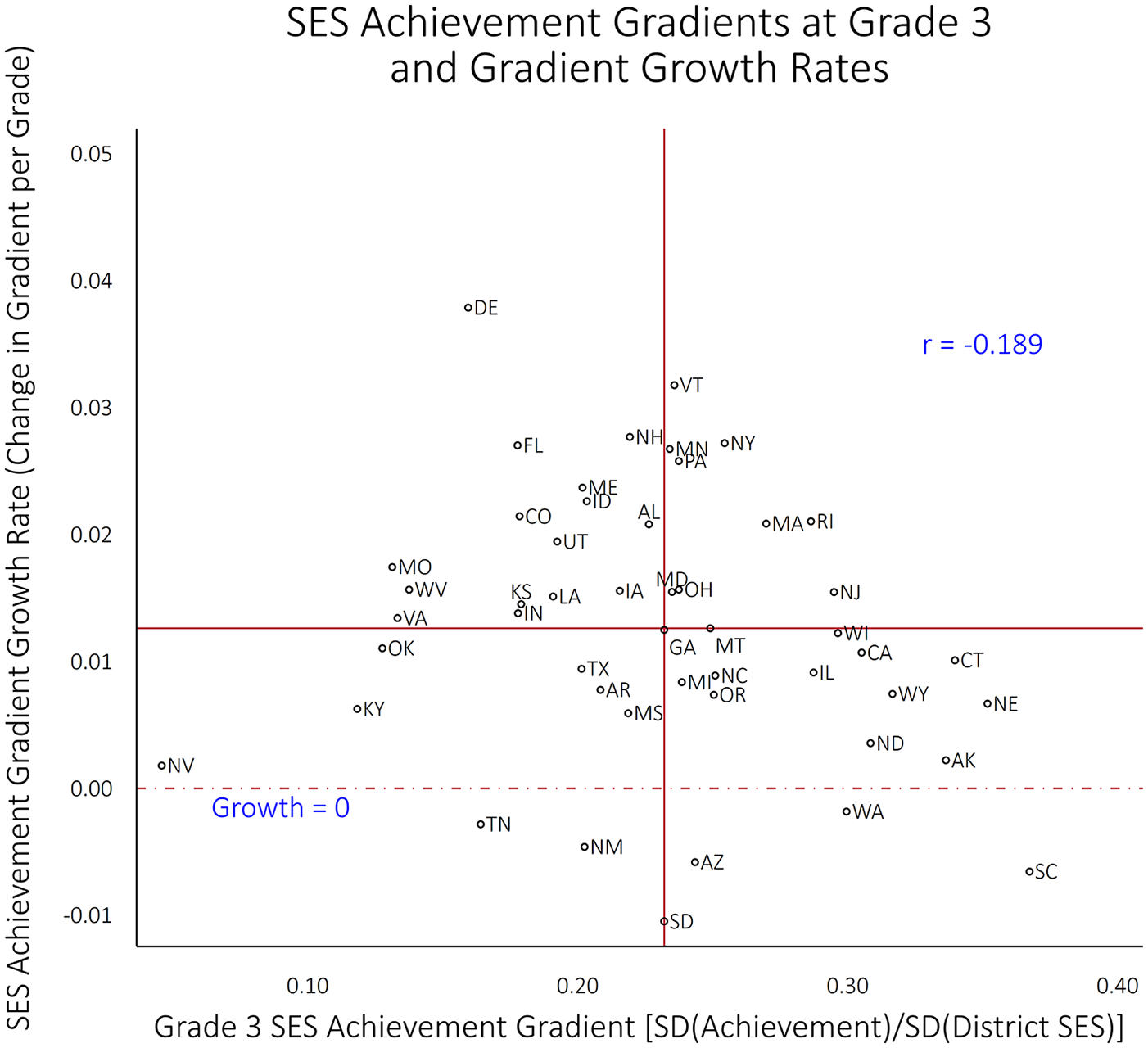
Socioeconomic status (SES) achievement gradients at Grade 3 and gradient growth rates.
Figure 5 shows how both average test scores and SES achievement gradients change in each state from Grades 3 to 8, with four panels highlighting different aspects of the patterns. The first (upper left) panel presents SES achievement gradients against average achievement in Grade 3. The second (upper right) panel plots these measures in Grade 8. The third (lower left) panel shows each state’s change in both the SES achievement gradient and average achievement from Grades 3 to 8. Here, dashed lines at 0 on each axis divide the figure into four quadrants. In the upper left quadrant are states where average achievement declines and the SES achievement gradient grows steeper from Grades 3 to 8—places where both equity and achievement declined across grades. In the lower right quadrant are states where both achievement and equity improve across grades.

Change of achievement and socioeconomic status (SES) achievement gradient from Grades 3 to 8, by state.
The fourth panel displays the data from the top two panels in a single plot, with arrows describing each state’s movement in both the achievement and equity gradient dimensions from Grades 3 to 8. Arrows pointing right indicate an increase in average achievement from Grades 3 to 8; those pointing left indicate a decrease in average achievement in Grade 8 compared with Grade 3. Movement along the vertical axis reflects changes in the SES achievement gradient in the state. Arrows pointing upward reflect an increase in between-district inequality from Grades 3 to 8; those pointing downward indicate a decrease in between-district inequality. Note that the estimates used to produce Figure 5 are shown in Appendix A.
One of the striking patterns in Figure 5 is that only a handful of states (SC, NM, SD, WA, AZ, and TN) fall into the lower right quadrant in the third panel, moving in the direction of both increasing achievement and increasing between-district equality. In contrast, roughly half of the states fall into the opposite quadrant, exhibiting both declining achievement and equity. Indeed, there is a strong correlation between changes in achievement and changes in SES achievement gradients: States that have higher average growth rates tend to have lower rates of increase (or declines) in the SES achievement gradient (
That said, Figure 5 also shows that by eighth grade, only a few states (TN and KY, and to a lesser degree MO and IN) have both above average achievement and relatively low SES achievement gradients. The states with the most desirable achievement patterns in third grade (high achievement and low SES achievement gradients—those in the lower right part of the first panel) tend to move up and to the left in the figure by Grade 8, becoming both more unequal and lower achieving. Conversely, those with the opposite patterns in Grade 3 (low achievement and high SES achievement gradients) tend to move the right in the figure by eighth grade. The result is that both average achievement and SES achievement gradients vary less among states in Grade 8 than in Grade 3.
This pattern is reflected in Table 2, which reports the estimated (disattenuated) correlations among four state-level parameters of interest (the average achievement in Grade 3, the SES achievement gradient in Grade 3; the average annual growth rate in test scores from Grades 3 to 8, and the average annual change in the SES achievement gradient from Grades 3 to 8). States with higher average Grade 3 test scores tend to have lower SES achievement gradients in third grade (
Correlations and Standard Deviations, Achievement and Socioeconomic Status (SES) Achievement Gradient Parameters

Note. Diagonal terms indicate the standard deviation of the measure across states; off-diagonal terms indicate estimated correlations.
Tables 3 and 4 show how the SES achievement gradient and its average annual change from Grades 3 to 8 are associated with our covariates. Table 3 reports bivariate relationships of our covariates with SES gradients at Grade 3 and their growth across grades. Both the preschool enrollment difference and the funding gradient are weakly negatively associated (
Bivariate Correlations of State Covariates With SES Achievement Gradient and Gradient Growth

Note. SES = socioeconomic status.
p < .1. *p < .05. **p < .01. ***p < .001.
Hierarchical Linear Model Parameter Estimates

Note. SE = standard error; SES = socioeconomic status.
p < .10. *p < .05. **p < .01. ***p < .001.
Table 4 reports the estimates from our hierarchical linear models. Model 1 includes no state-level covariates and describes the means and variances of the SES achievement gradients and their growth rates. The SES achievement gradient has a mean of 0.239 and a SD of 0.055 among states. The growth of the gradients has a mean of 0.010 and a SD of 0.007. These patterns of variation are reflected above in Figures 2 and 3.
Models 2 and 3 in Table 4 each include different sets of covariates. The measures of between-district inequality (Model 3) explain roughly the same amount of the variance in SES gradients and their growth rates as do the measures of school system inequity (Model 2): each model explains 17% to 29% of the variance in both SES achievement gradients and the rate of change of the gradients. The model containing all the measures (Model 4) explains 29% and 25% of the variances, respectively.
The coefficient estimates from Model 4 describe the partial associations of the state covariates with the SES achievement gradient and its growth. Notably, between-district income segregation is the only state characteristic that is positively associated (
The race–SES association also has a marginally significant positive relationship (
In contrast to the between-district inequality variables, none of the measures of school system inequity are significantly associated with either the SES achievement gradient or its growth from Grades 3 to 8 in the full model. 8
Discussion
Do states vary in the extent to which differences between districts in socioeconomic status are associated with differences between districts in educational outcomes? Or is the pattern of association between socioeconomic context and academic outcomes stable across states? Our analysis suggests that state contexts do play a role in shaping the socioeconomic equality of educational outcomes, though the mechanisms are not completely clear from our analyses.
We find substantial variation among states in the SES achievement gradient, and in its growth across grades. The gradient is three times steeper in the states with the strongest association between district SES and average achievement than in those with the weakest association. Moreover, the degree to which the gradients change from Grades 3 to 8 varies considerably. In some states, there is no significant change in gradient; in others—such as Delaware, Vermont, Florida, New York, and New Hampshire—the gradient nearly doubles in 5 years. These patterns suggest that state-level features of the educational system shape the relationship between educational opportunity and socioeconomic context. This finding is important because it suggests state policies may be an important lever for improving educational equity.
Not only do some state contexts appear to produce more equitable patterns of achievement but our results indicate it is possible—though uncommon—for states to improve achievement at the same time as they temper the association between socioeconomic conditions and achievement. In third grade, there are several states where achievement is high and the SES achievement gradient is low. And states where the SES achievement declines or remains stable from Grades 3 to 8 generally have increasing achievement at the same time. Tennessee and Kentucky, in particular, have both very high eighth grade achievement in their average SES districts and among the very weakest SES achievement gradients in the United States they serve as existence proofs that the goals of equity and high achievement are compatible.
Our study does not, however, identify specific causes or policy levers that might be used to reduce inequality. Three specific policy levers—recruiting experienced, lower absent teachers to low-income districts, providing additional funding to low-income districts, and expanding access/enrollment in preschool for low-income students—have been widely suggested as ways of reducing socioeconomic disparities in educational outcomes. We do not find evidence, however, that these factors are associated with the strength of the SES achievement gradient. To be clear, this does not mean these factors do not matter or might not be effective. Our study does not provide causal estimates of the effects of these state policies; it merely says that there is no clear correlational association between funding regimes, preschool enrollment patterns, or teacher experience and absenteeism patterns and the between-district SES achievement gradient. Other studies with a strong causal warrant provide much clearer evidence about the effects of their effects.
We do find that SES achievement gradients are steeper in states that are more economically segregated. This finding is in some ways quite striking. It suggests that economic segregation is associated with SES achievement gaps in some ways other than simply through the way it shapes local economic context. The finding that segregation is associated with steeper SES achievement gradients is particularly troubling given recent trends of increasing economic segregation (Reardon et al., 2018).
It is not exactly clear, however, what mechanisms might drive this association. One possibility is that there are nonlinear effects of socioeconomic context on educational opportunity, so that educational outcomes are not particularly sensitive to small differences in district context for districts with near-average SES, but that the effects of extreme socioeconomic advantage and extreme disadvantage are both very strong. This might be the case if there are threshold effects or tipping point effects, so that there is a point where community disadvantage becomes so extreme that it dramatically limits all students’ opportunities, or a point where advantage becomes so extreme that it expands all students’ educational success. This would manifest itself as a nonlinear pattern of association between average achievement and average SES, but such a pattern is not evident in the data (see Figure 1).
Another possibility is that segregation patterns are correlated with the unequal distribution of some other educational resource. For example, it may be that teacher labor markets operate differently under high levels of segregation than low segregation, leading to much more between-district sorting of teachers in highly segregated states, in ways that are not captured by our measures of teacher experience and absenteeism gradients. Teachers may be relatively indifferent to where they teach when districts differ little in economic or racial composition, but more sensitive to location when districts differ substantially. If so, the correlation of district SES and teacher quality may be more pronounced in highly segregated states than in less segregated states. Of course, this is not the only possible explanation or mechanism but it is one type of mechanism that would explain the strong association we find between segregation and the strength of the SES achievement gradient. Other explanations might involve outsize between-district differences in political power under conditions of high economic segregation or differences in public and private noneducational investments in rich and poor districts under conditions of high segregation.
Although the descriptive aspects of this study clearly show substantial variation among states in their between-district socioeconomic achievement gradients, the correlational aspects of the study have several important limitations. First, some of the measures do not capture key features of state policies and contexts. For example, the measure of preschool enrollment differences is noisy (because it is based on sample data) and does not capture differences in preschool quality. The measure of funding does not capture differences in how funds are used. The measures of teacher effectiveness are weak proxies for true effectiveness. Second, the study is primarily descriptive and exploratory; our design does not provide a warrant for causal interpretations of the correlations we report. Third, our ability to statistical control for potential state-level confounders is limited by the small number of degrees of freedom in the study. With only 49 states in the study, we are limited in the number of variables we can control for in the multivariate models.
Nonetheless, the study does provide clear evidence that the association between local socioeconomic conditions and educational opportunities differs considerably across states. This finding suggests that state policies or state contexts may exacerbate or ameliorate educational inequality; they may do so partly by shaping levels of between-district segregation. Future research might fruitfully examine a wider range of state policies—including health care policies, child care funding policies, and other nonschooling policies—to determine what strategic policy interventions might lead to more equal educational opportunities. Rather than expect each local school or district to address the challenges of inequality, particularly in highly segregated states, we might more reasonably ask states to play a larger role.
Footnotes
Appendix A
Achievement and SES Achievement Gradient Parameter Estimates, by State

| State | Grade 3 Achievement | Grade 3 SES Gradient | Grade 8 Achievement | Grade 8 SES Gradient | Achievement Growth | SES Gradient Growth |
|---|---|---|---|---|---|---|
| AK | −0.3319 | 0.3364 | −0.1652 | 0.3475 | 0.0333 | 0.0022 |
| AL | −0.0420 | 0.2264 | −0.0995 | 0.3304 | −0.0115 | 0.0208 |
| AR | 0.0465 | 0.2084 | −0.1123 | 0.2473 | −0.0318 | 0.0078 |
| AZ | −0.2446 | 0.2435 | −0.0689 | 0.2144 | 0.0351 | −0.0058 |
| CA | −0.3236 | 0.3052 | −0.2059 | 0.3587 | 0.0235 | 0.0107 |
| CO | 0.0027 | 0.1785 | −0.0749 | 0.2856 | −0.0155 | 0.0214 |
| CT | −0.0393 | 0.3397 | −0.0784 | 0.3902 | −0.0078 | 0.0101 |
| DE | 0.0670 | 0.1595 | −0.0788 | 0.3488 | −0.0291 | 0.0379 |
| FL | 0.2056 | 0.1777 | −0.0037 | 0.3129 | −0.0419 | 0.0270 |
| GA | 0.0393 | 0.2320 | 0.0035 | 0.2945 | −0.0072 | 0.0125 |
| IA | −0.0120 | 0.2156 | −0.0685 | 0.2934 | −0.0113 | 0.0156 |
| ID | −0.1369 | 0.2034 | −0.0513 | 0.3165 | 0.0171 | 0.0226 |
| IL | −0.0492 | 0.2874 | −0.0975 | 0.3330 | −0.0097 | 0.0091 |
| IN | 0.1379 | 0.1779 | 0.1003 | 0.2469 | −0.0075 | 0.0138 |
| KS | 0.1031 | 0.1790 | −0.0523 | 0.2516 | −0.0311 | 0.0145 |
| KY | 0.1188 | 0.1184 | 0.0811 | 0.1496 | −0.0075 | 0.0063 |
| LA | −0.1582 | 0.1909 | −0.1169 | 0.2665 | 0.0083 | 0.0151 |
| MA | 0.2224 | 0.2698 | 0.0722 | 0.3741 | −0.0301 | 0.0209 |
| MD | 0.0651 | 0.2349 | −0.0756 | 0.3123 | −0.0282 | 0.0155 |
| ME | 0.1065 | 0.2018 | 0.0467 | 0.3203 | −0.0120 | 0.0237 |
| MI | −0.0829 | 0.2386 | −0.0541 | 0.2804 | 0.0058 | 0.0084 |
| MN | 0.1066 | 0.2341 | −0.0707 | 0.3678 | −0.0355 | 0.0267 |
| MO | 0.0562 | 0.1313 | 0.0126 | 0.2185 | −0.0087 | 0.0174 |
| MS | −0.1007 | 0.2187 | −0.0856 | 0.2483 | 0.0030 | 0.0059 |
| MT | −0.0018 | 0.2491 | 0.0097 | 0.3122 | 0.0023 | 0.0126 |
| NC | 0.2052 | 0.2510 | 0.0807 | 0.2954 | −0.0249 | 0.0089 |
| ND | −0.1145 | 0.3085 | −0.1713 | 0.3263 | −0.0113 | 0.0036 |
| NE | −0.2203 | 0.3518 | −0.1264 | 0.3851 | 0.0188 | 0.0067 |
| NH | 0.1499 | 0.2193 | −0.0298 | 0.3578 | −0.0360 | 0.0277 |
| NJ | 0.0009 | 0.2950 | 0.0447 | 0.3723 | 0.0088 | 0.0155 |
| NM | −0.2625 | 0.2025 | −0.2283 | 0.1794 | 0.0068 | −0.0046 |
| NV | −0.2066 | 0.0459 | −0.1647 | 0.0549 | 0.0084 | 0.0018 |
| NY | −0.0116 | 0.2544 | −0.2041 | 0.3905 | −0.0385 | 0.0272 |
| OH | 0.1555 | 0.2375 | 0.0952 | 0.3158 | −0.0121 | 0.0157 |
| OK | −0.1513 | 0.1277 | −0.1309 | 0.1829 | 0.0041 | 0.0110 |
| OR | −0.1612 | 0.2504 | −0.0481 | 0.2873 | 0.0226 | 0.0074 |
| PA | 0.1593 | 0.2374 | 0.0249 | 0.3664 | −0.0269 | 0.0258 |
| RI | 0.0448 | 0.2864 | −0.0322 | 0.3916 | −0.0154 | 0.0210 |
| SC | −0.0005 | 0.3674 | 0.0027 | 0.3346 | 0.0006 | −0.0066 |
| SD | −0.0752 | 0.2320 | −0.0223 | 0.1796 | 0.0106 | −0.0105 |
| TN | −0.1078 | 0.1641 | 0.0927 | 0.1499 | 0.0401 | −0.0028 |
| TX | −0.0991 | 0.2014 | −0.0265 | 0.2485 | 0.0145 | 0.0094 |
| UT | −0.0771 | 0.1924 | −0.0405 | 0.2896 | 0.0073 | 0.0194 |
| VA | 0.0894 | 0.1333 | −0.0645 | 0.2004 | −0.0308 | 0.0134 |
| VT | 0.0688 | 0.2358 | 0.0089 | 0.3947 | −0.0120 | 0.0318 |
| WA | −0.0782 | 0.2996 | −0.0034 | 0.2904 | 0.0150 | −0.0018 |
| WI | −0.0439 | 0.2964 | 0.0045 | 0.3575 | 0.0097 | 0.0122 |
| WV | −0.1305 | 0.1375 | −0.1362 | 0.2158 | −0.0011 | 0.0157 |
| WY | −0.0964 | 0.3166 | −0.0609 | 0.3538 | 0.0071 | 0.0074 |
| Min | −0.3319 | 0.0459 | −0.2283 | 0.0549 | −0.0419 | −0.0105 |
| Max | 0.2224 | 0.3674 | 0.1003 | 0.3947 | 0.0401 | 0.0379 |
Appendix B
Appendix C
Notes
Authors
HEEWON JANG is a PhD student in the Graduate School of Education at Stanford University. Her research interests include segregation, educational inequality, achievement gaps, and educational policy.
SEAN F. REARDON is the endowed professor of poverty and inequality in education and is professor (by courtesy) of sociology at Stanford University. His research focuses on the causes, patterns, trends, and consequences of social and educational inequality, the effects of educational policy on educational and social inequality, and in applied statistical methods for educational research.