




Abstract
Interactive app books are increasingly part of young children’s literacy ecosystem. However, most previous studies examined buddy reading with traditional print books or CD-ROM books. Little is known about whether and how buddy reading with app books might be related to subsequent individual reading. To address this, informed by multimodal literacy and sociocultural theories, we investigated how 53 kindergarteners’ (ages 5–6 years) buddy reading behaviors were related to their subsequent individual reading behaviors and comprehension outcomes while reading app books. Multivariate mixed response analysis yielded these findings: (1) buddy reading monitoring behaviors (asked questions, drew attention to book content, debated, or negotiated) were associated with higher inference/critical thinking and vocabulary meaning generation scores; (2) buddies who read in triads had lower individual-prompted retelling scores than buddies who read in dyads. The findings highlight the importance of promoting monitoring during buddy reading and paying attention to group size.
Introduction
Multimodal digital texts, such as interactive app books on iPad, are increasingly being used both at home and in school with young children (Blackwell, Wartella, Lauricella, & Robb, 2015; Kabali et al., 2015; Rideout, 2017; Shuler, 2012). Interactive app books integrate multiple modes of information (e.g., images, sounds, and animations) and contain features (e.g., hotspots, navigation, etc.) that can be activated by touching the screen. Reading app books involves strategically using multiple modes of information and features, across diverse pathways, to make meaning with them; and thus, it differs from reading traditional print texts (Christ, Wang, Chiu, & Cho, 2019; Kress, 2010; Wolfe & Flewitt, 2010). Consider the transcript below, in which two kindergarteners, Benny and Gail (all names are pseudonyms), read the interactive iPad app book Barnyard Dance together.
[Episode 1. Benny and Gail buddy reading Barnyard Dance.]
iPad: (Reads aloud) Stand with the donkey. Slide with the sheep. Scramble with the little chicks—cheep, cheep, cheep!
Benny: (Presses the chicks in the illustration)
iPad: (Hotspot activates chicks running in all directions)
Benny: Look it! (Pointing to the chicks running)
Gail: Wait, wait—stop a sec! (She’s leaning in and wanting her partner to let her press the chicks)
Benny: (Moves back so Gail can have a turn pressing the hotspot)
Gail: (Presses the chicks)
iPad: (Hotspot activates chicks running in all directions again)
Benny: (Moves the iPad back toward him] Slide [drags the arrow under the text “Slide with the sheep.”)
iPad: (Sliding the arrow activates the sheep appearing on the page)
Gail: (Pressing the chicks again)
iPad: (Hotspot activates chicks running in all directions again)
Gail: Hey, look it—they’re falling down on the ground! (She’s just noticed that as all the chicks run, one chick falls over onto his head each time)
In this episode, Benny and Gail listen to the iPad reading the text aloud (Line 1), activate hotspots (Lines 2, 3, 7, 8–12), and discuss their actions (Lines 3, 5, 13). The multimodal information and interactive nature of the app book (Kucirkova, 2017) add complexity to the buddy reading dynamics (i.e., three-way transactions among the text, Benny, and Gail), which is not salient in buddy reading of traditional print texts.
However, most existing studies examine children’s buddy reading with traditional print books (e.g., Caserta-Henry, 1996; Flint, 2010; Mathes, Howard, Allen, & Fuchs, 1998; Sáenz, Fuchs, & Fuchs, 2005; Vaughn, Klingner, & Bryant, 2001). Only a handful explore young children buddy reading of multimodal digital books (e.g., Brown, 2016; Christ, Wang, & Erdemir, 2018; Korat & Shamir, 2012; Shamir, 2009; Shamir, Korat, & Barbi, 2008; Trushell & Maitland, 2005; Trushell, Maitland, & Burrell, 2003). Furthermore, those studies either examine just children’s behaviors during buddy reading with multimodal app books (e.g., Brown, 2016; Christ et al., 2018; Trushell et al., 2003; Trushell & Maitland, 2005) or compare children’s comprehension outcomes across different reading conditions—for example, reading CD-ROM books with buddies versus reading print books individually (Korat & Shamir, 2012; Shamir, 2009), or reading CD-ROM books with buddies versus reading CD-ROM books individually (Shamir & Korat, 2007; Shamir et al., 2008).
No previous study explores the potential relations between reading behaviors during buddy reading and subsequent behaviors and outcomes during the same children’s subsequent individual reading with interactive app books. Understanding these potential relations could inform instruction and guided practice to improve young children’s app book reading. This is important because young children often use digital book features and information modes ineffectively (de Jong & Bus, 2003, 2004; Lefever-Davis & Pearman, 2005), even after receiving instruction on how to use them (Christ et al., 2019).
To address these issues, we investigate the following research question: How are a young child’s reading behaviors during buddy reading (e.g., reading mode selection, sequential/nonsequential reading, hotspot use, use of modalities, use of monitoring) related to his or her subsequent individual reading behaviors and comprehension outcomes (prompted retelling, inference/critical thinking, vocabulary meaning generation)?
Theoretical Framework
Our study is grounded in the multimodal literacy theory (Jewitt & Kress, 2003; Kress, 2010) as well as in the Vygotskian sociocultural theory (Cobb, 1996; Cole & Wertsch, 1996). The multimodal literacy theory, which de-emphasizes the centrality of text and language and considers multiple modes of communication, informs us about the strategic and diverse pathways that young children use to make meaning with interactive app books while buddy reading (e.g., Christ et al., 2019). The traditional print literacy practices (reading and writing), which foreground visual modes (e.g., print, illustrations) for accessing text, are privileged in school settings (Kress, 1997). In contrast, reading multimodal digital texts involves visual, auditory, and action modes (e.g., activating hotspots), thus resulting in more complex transactions between the reader and the text (Christ et al., 2018; Kucirkova, 2017; Wohlwend, 2010). As illustrated in Episode 1, the interactive features allow multiple pathways for reading, which require more decision making. For example, the user needs to decide the following: Should I pay attention only to listening to the text read-aloud or activate hotspot animations while listening? Which hotspots should I press? Should I press them once, or multiple times? Such complex decisions can enrich the reading experience but can also potentially result in distraction (e.g., off-task behaviors) or misunderstanding of the text (e.g., due to use of misleading or incongruent hotspots, etc.).
While the multimodal literacy theory informs our fine-grained analysis of reading behaviors with interactive app books, Vygotskian sociocultural theory offers insights to understand the social dynamics in the buddy reading context. Sociocultural theory emphasizes the social and cultural nature of learning and development as stated by Vygotsky (1978): Every function in the child’s cultural development appears twice: first, on the social level, and later, on the individual level; first, between people (interpsychological) and then inside the child (intrapsychological). This applies equally to voluntary attention, to logical memory, and to the formation of concepts. All the higher functions originate as actual relationships between individuals. (p. 57)
Thus, we speculate that reading in a social context, such as app book buddy reading, may help readers extend and transform their reading behaviors and outcomes. Furthermore, this externalization of their behaviors may lead to their eventual internalization of these behaviors (Cobb, 1996; Cole & Wertsch, 1996; Kozulin, 2003).
Two mechanisms possibly contribute to these processes: (1) modeling (i.e., showing one another a way to make meaning with the text) and (2) scaffolding (i.e., supporting one another to engage in those processes) (Vygotsky, 1978). These mechanisms are evident in Episode 1, Benny first models how to use the hotspots for Gail (Lines 2 and 9) and how to monitor what was happening in the text by drawing her attention to animation that the hotspot activated—the chicks running around (Line 4). Subsequently, Gail also uses the chick hotspot (Lines 7, 11) and monitors by drawing Benny’s attention to one chick who stumbles onto his head (Line 13). However, such social processing is not unproblematic. For example, instead of effectively monitoring the change in the chicks’ behavior (Line 13), Gail could have not engaged with Benny or the hotspots at all (e.g., Meisinger, Schwanenflugel, Bradley, & Stahl, 2004). In fact, several studies identify the potential pitfalls of group dynamics, such as the effects of the free rider (a group member does not participate), status differential (a group member exerts more control and agency, limiting those for the other members), and ganging up (e.g., two group members exclude the efforts of a third member), which can lead to frustration, reduced or low-level on-task behavior, and poor learning outcomes (Barron, 2003; Meisinger et al., 2004; Salomon & Globerson, 1989).
Aligning with the multimodal literacy theory, we focus on fine-grained analysis of a child’s reading behaviors (e.g., pressing a hotspot, turning a page, etc.) to capture the complexity of the dynamic transactions between a reader and an interactive app book’s features and information modes. Furthermore, informed by Sociocultural theory in the buddy reading context, we also focus on aspects of the social dynamics between children reading together, such as monitoring meaning while reading (e.g., asking a buddy a question, drawing a buddy’s attention to the book, etc.). Therefore, our study tests whether children’s behaviors interacting with interactive app books and with buddies are related to their subsequent individual reading behaviors and outcomes.
Buddy Reading With Multimodal Digital Books
Consistent with our sociocultural theoretical framework, some empirical research shows that young children can engage in effective reading behaviors with multimodal digital books in the context of buddy reading. For example, most buddy reading groups of 8- to 10-year-olds read all the pages in a CD-ROM book and read them sequentially (Trushell et al., 2003; Trushell & Maitland, 2005). Also, buddies reading e-readers together use digital features effectively, such as 7- to 8-year-olds replaying the text or using dictionary support when needed (Brown, 2016). Five- to six-year-olds ask their buddies to activate hotspots that align with or extend the story in app books (Christ et al., 2018). Eight- to 10-year-olds choose congruent over incongruent hotspots to activate in CD-ROM books (Trushell et al., 2003). Additionally, young children (ages 5–8 years) engage in multiple kinds of effective monitoring while reading e-readers or app books together, such as asking questions, drawing a buddy’s attention to specific information in the book, or debating and negotiating meaning (Brown, 2016; Christ et al., 2018). Finally, when reading e-readers or app books with buddies, young children (ages 5–8 years) engage in text-based, extra-textual, and higher order discussions related to the story (Brown, 2016; Christ et al., 2018). All these effective reading behaviors may facilitate young children’s internalization of effective reading behaviors when reading individually and better reading comprehension outcomes. Yet this conjecture has not previously been empirically tested.
However, not all buddy reading behaviors are equally effective. There are a “range of reading behaviors” reported by Trushell, Burrell, and Maitland (2001, p. 391). For example, groups of 8- to 10-year-olds sometimes choose not to read sequentially, skip pages altogether, or use more incongruent than congruent hotspots when reading CD-ROM books (Trushell et al., 2001; Trushell & Maitland, 2005). Also, 5- to 6-year-old children sometimes focus on searching and activating the hotspots without listening to the text, and at other times, they listen to the text but do not activate the hotspots while reading app books (Christ et al., 2018). We hypothesize that these kinds of behaviors will not support the internalization of more effective individual reading behaviors or outcomes. However, this is still an open question.
Despite the inconsistent use of effective reading behaviors across buddy reading groups, most studies show better comprehension outcomes for children when they buddy read CD-ROM books as compared with reading print books individually (Korat & Shamir, 2012; Shamir, 2009) or CD-ROM books individually (Shamir et al., 2008). For example, young children have better vocabulary meaning generation and word reading outcomes when they engage in a buddy reading intervention with CD-ROM books as compared with their regular classroom literacy program with print books (Korat & Shamir, 2012; Shamir, 2009). Also, young children have better phonological awareness, word recognition, and story comprehension outcomes when they engage in a buddy reading intervention with CD-ROM books as compared with an individual reading intervention with CD-ROM books (Shamir et al., 2008). Only one study shows no differences in children’s outcomes for word recognition, phonological awareness, or emergent writing assessment tasks across conditions in which children read CD-ROM books individually versus with buddies, and in this study, both groups make significant improvements across these tasks (Shamir & Korat, 2007). These differences in findings may be due to children working together differently (e.g., what behaviors they use or how well they collaborate).
Only one study explores the more fine-grained relations between reading behaviors during buddy reading and comprehension outcomes (Shamir, 2009). Shamir found that activating the dictionary during buddy reading is linked to better vocabulary outcomes. However, when children activate phonological support for word recognition, or animation hotspots, their vocabulary outcomes are significantly worse. Additionally, she found that buddy reading behaviors, such as asking questions, initiating a behavior with the digital features, or engaging in commenting about the book, are related to better story comprehension outcomes.
In summary, these limited existing studies show that buddy reading with multimodal digital texts can support effective reading behaviors and outcomes in the buddy reading context (Brown, 2016; Christ et al., 2018; Shamir, 2009; Shamir et al., 2008; Trushell & Maitland, 2005). However, there is a lack of more fine-grained analysis to capture the complex reading behaviors during buddy reading and how these relate to later reading behaviors and outcomes in the individual reading context. Furthermore, previous research primarily focuses on buddy reading with CD-ROM or e-reader books (Brown, 2016; Shamir, 2009; Shamir et al., 2008; Trushell & Maitland, 2005). Only a few studies use buddy reading with app books (Christ et al., 2018; Christ, Wang, Chiu, & Strekalova-Hughes, 2019). App book reading behaviors may differ from those of CD-ROM books, given that the former uses a touch screen and the latter a mouse (Roskos, Burstein, Shang, & Gray, 2014). Our study addresses the aforementioned needs to extend existing research by testing the potential connections between buddy reading behaviors and subsequent individual reading behaviors and outcomes with app books.
Method
This study is part of a broader research project that was modeled on Clay’s (1966) seminal work on concepts about print, in which she studied how children develop concepts about print in the context of regular classroom reading instruction. Since we could not find a context in which kindergarteners were already reading high-quality iPad app books regularly, our yearlong study included whole-class instruction for each of 12 app books. These were grouped into four units, each 3 weeks in length. Each week, in addition to whole-class instruction (see details in “Whole Class Shared Reading Instruction” below), children were also given two 15-minute opportunities to practice reading the same app book with their buddy (see “Buddy Reading Sessions”). At the end of each unit, children read a new app book individually and their comprehension was tested (see “Individual Reading and Assessment Sessions”). In the broader research project, the classroom instruction that we designed was not intended as an intervention but rather to provide normal classroom instruction with high-quality app books in the classroom to allow children to develop ways to engage with app books. For the present study, we focus on children’s buddy reading and individual reading sessions.
Participants
Fifty-three kindergarteners between the ages of 5 and 6 years participated from across four classrooms in two schools across two U.S. states. To attain a broader sample of children, all children in the four classrooms were invited to participate, regardless of language or other learning needs. Following our institutional review board–approved procedures, we obtained both parental permission and the verbal assent from the 53 participants. The demographics of the participants in each of the four classes are listed in Table 1. As shown in the table, our participants were linguistically, culturally, and socioeconomically diverse.
Demographics of the Participants

Note. ESL = English as a second language; SES = socioeconomic status; M = male; F = female.
Materials
Sixteen app books were selected for the study. Twelve were used for whole-class instruction and buddy reading and four for individual reading and comprehension assessment. Using research-based guidelines, we selected app books that had the following characteristics: (1) high interactivity, (2) congruent hotspots that supported children’s meaning making, (3) user-friendly features, (4) developmental appropriateness, and (5) good narrative/illustration quality (Christ et al., 2019; Morgan, 2013; Zipke, 2014). All were commercially published, to increase the ecological validity of our findings.
App books were organized into four units that focused on similar digital features. Each unit had three books used for instruction and buddy reading and one used for individual reading and assessment. Table 2 presents the book titles and information about the automatic animations, navigation options, hotspots, and any other features represented in each unit. Features across all books and units were used as control variables in the analysis to reduce omitted variable bias (Kennedy, 2008).
App Book Features by Unit

Designates a book for individual reading and comprehension testing.
Procedures and Data Collection
Whole-Class Shared Reading Instruction
As mentioned above, we intended to study children’s app book reading in an authentic context across time following the example of Clay’s (1966) seminal work on concepts about print. Since we were unable to identify any schools that were already teaching strategic app book reading behaviors with app books, we developed lesson plans for instruction and trained research assistants, who were former early childhood classroom teachers, to implement them across the kindergarten year. Twelve lessons were organized into units of three similar app books (see Materials section). Each lesson included 30 minutes of whole-class shared reading instruction during which a research assistant presented an app book on a large screen using a document camera (so her finger movements could be seen by the children). They directly taught children three kinds of strategies: (1) how to use digital features in the book effectively, such as choosing congruent hotspots and using navigation features to progress through the book sequentially and reread; (2) literacy strategies, such as how to monitor their understanding while reading, how to make an inference, and so on; (3) how to use the digital features strategically to deepen their understandings, such as using a hotspot to support vocabulary meaning generation. These lessons were interactive and included the research assistant first modeling these and then having children come up to the app book to practice as the research assistant scaffolded their attempts (i.e., guided practice). This approach aligns with guidelines for integrating digital texts into literacy instruction (Christ et al., 2019). These lessons are not used as a data source, but rather, they provided a meaningful context within which we collected our data.
Buddy Reading Sessions
After each whole-class app book reading lesson, children were provided two 15-minute sessions to practice reading the same app book. This usually occurred with two buddies forming a reading dyad. Dyad decisions were made by the classroom teachers, based on their beliefs about which children would work well together. The dyads were mostly static throughout the project. However, sometimes student absences led the teacher to arrange three children in a buddy reading triad. Across all 547 video-recorded buddy reading events, 477 (87%) involved dyads and just 41 (7.5%) involved triads. Among the 53 participants, most (74%) read in dyads for more than 80% of all their buddy reading events. Far fewer (24%) read in dyads 60% to 70% of all their buddy reading events. Just one student read in a dyad 35% of all her buddy reading events.
During the buddy reading sessions, students were asked to follow these rules: Place the iPad in the middle, take turns to read together, talk to your buddy about what you read. Teachers and research assistants mostly provided technical support or re-enforced the rules. Each dyad’s or triad’s reading during a session was considered an event, and was video-recorded for analysis. There were 547 buddy reading events in all, totaling about 137 hours of video data.
Individual Reading and Assessment Sessions
At the end of each unit (i.e., four times), each child individually read a novel app book (i.e., one that the child had not read previously), after which a comprehension assessment protocol was administered to assess unprompted retelling, prompted retelling, vocabulary meaning generation, and inference/critical thinking responses (see Figure 1 for an example). In all, 212 individual reading sessions and subsequent assessment protocol administrations were video-recorded for analysis, totaling approximately 106 hours of video.

Individual comprehension assessment protocol for “But Not the Hippopotamus.”
Data Coding
Buddy Reading Behaviors
Buddy reading behaviors were coded and used as predictor variables. Codes for reading behaviors were based on our earlier qualitative work and included reading mode selection, sequential versus nonsequential progression through the app book, hotspot use, use of modalities, and use of monitoring (Christ et al., 2018; Christ et al., 2019). The unit of analysis for coding was the buddy reading group. For example, hotspot use was coded as mostly (1) infrequent (i.e., hotspots are accessed by either buddy on less than 20% of pages), (2) each buddy took a turn on each page, (3) buddies pressed hotspots simultaneously on each page, or (4) one buddy pressed hotspots on most pages, but the other buddy did not. That is, the codes reflected the behaviors of the group as a whole (see Table 3, column 2).
Reading Behaviors

Individual Reading Behaviors
Individual reading behaviors were used as mediator variables. That is, we tested whether buddy reading behaviors were linked to individual reading behaviors; then, in turn, we tested how they were linked to individual reading outcomes. We used codes for individual reading behaviors that we developed in our previous work (Christ et al., 2019), which also aligned with the behaviors coded during buddy reading (i.e., reading mode selection, sequential vs. nonsequential progression through the app book, hotspot use, use of modalities, use of monitoring). However, these codes were defined based on the individual reading context (see Table 3, column 3).
Individual Reading Outcomes
Individual reading outcomes were dependent variables and treated as outcome variables for both buddy and individual reading behaviors. Codes for individual reading outcomes were based on our previous work (Christ et al., 2019). Three comprehension outcomes were coded. Retelling was coded using a retelling rubric (see Figure 2). Inference/critical thinking and vocabulary meaning generation were both coded on categorical scales (see Figure 3).

Retelling rubric for “But Not the Hippopotamus.”
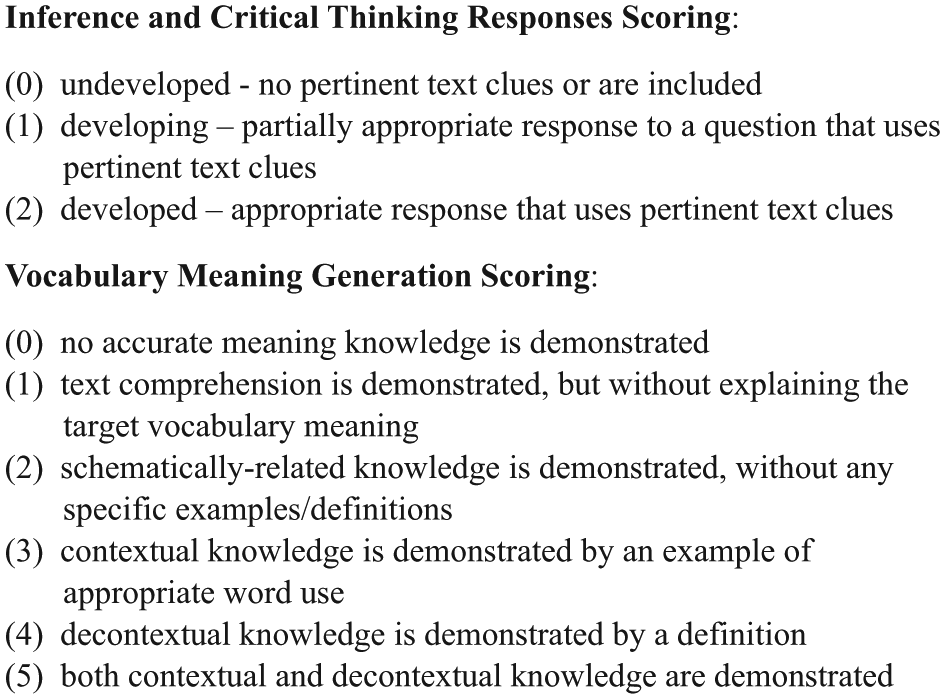
Individual reading outcomes scoring.
Control Variables
Control variables were included to reduce omitted variable bias (Kennedy, 2008). These included child demographics, preexisting early literacy skills, classroom in which child was taught, time (i.e., date on which each data point was collected), and app book digital features. Additionally, we controlled for whether children worked in dyads or triads. All control variables are presented in Table 4.
Summary Statistics

Note. α = Krippendorf’s alpha; n/s = not applicable.
Coder Training and Intercoder Reliability
Rigorous coder training was undertaken. Then, two coders separately coded all the data. Differences were discussed to establish consensus codes, which were used for analyses. Interrater reliability was high (see Table 4, last two columns).
Data Analysis
Analyzing the data for this study required addressing outcome and explanatory variable issues (see Table 5). Outcome issues included nested data, discrete outcomes, infrequent outcomes, and multiple types of outcomes. As behaviors by the same student (nested data) likely resembled one another more than those by different students, an ordinary least squares regression underestimates the standard errors, so we used a multilevel analysis (Goldstein, 2011; also known as hierarchical linear modeling, Bryk & Raudenbush, 1992). For discrete outcomes, ordinary least squares regressions can bias the standard errors, so we used a logit regression to model them correctly (Kennedy, 2008). As logistic regression is biased for infrequent events or for small samples, we removed this bias with King and Zeng’s (2001) logit correction. Also, multiple types of outcomes (discrete vs. continuous) can have correlated residuals that underestimate standard errors, which we addressed with a multivariate outcome, mixed response model (Goldstein, 2011).
Addressing Each Analytic Difficulty With Statistical Discourse Analysis
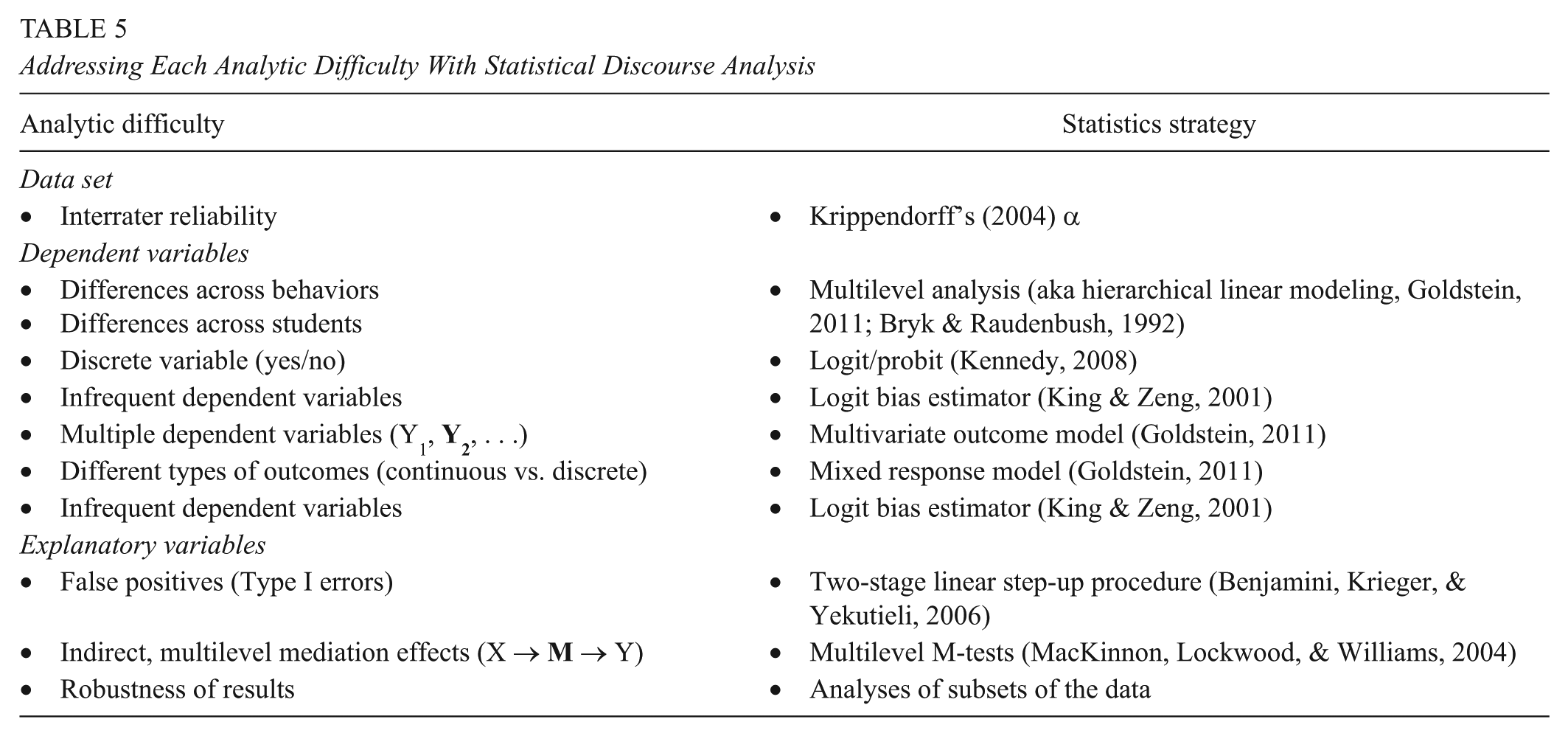
Explanatory variable issues included many hypotheses without false positives, multilevel indirect effects, and robustness procedures. As testing many hypotheses increases the likelihood of a false positive, we reduced their likelihood with the two-stage linear step-up procedure, which outperformed 13 other methods in computer simulations (Benjamini et al., 2006). To test for multilevel, indirect mediation effects, especially small ones, and to adjust for nonnormal distributions, we used a multilevel M-test (MacKinnon et al., 2004). To test the robustness of our results, we modeled each outcome separately and analyzed subsets of the data (Kennedy, 2008).
We tested our explanatory model with a multilevel, multivariate outcome, mixed response analysis (Goldstein, 2011). An alpha level of .05 was used for all analyses.
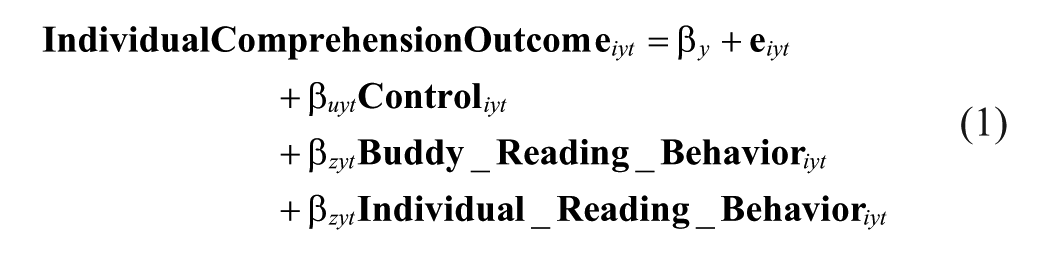
The
Results
The result revealed that one particular kind of buddy reading behavior was significantly related to multiple individual reading comprehension outcomes (see the results of the multivariate mixed response model in Figure 4 and Table 6; summary statistics in Table 4). Buddy reading monitoring behaviors (e.g., asked questions, drew attention to app book content, debated, or negotiated the book content) were associated with higher scores for vocabulary meaning generation and inference/critical thinking when children read app books individually.

Path diagram of final model showing relations among numbers of children in a group, buddy reading behaviors, individual reading behaviors, and individual outcome variables with standardized regression coefficients.
Summary of Four Multilevel, Multivariate Outcomes, Mixed Response Models of Vocabulary Meaning Generation, Prompted Retelling and Inference/Critical Thinking Showing Unstandardized Regression Coefficients (With Standard Errors)

Note. Each model includes a fixed constant term.
p < .05. **p < .01. ***p < .001.
Children who used monitoring 10% more during buddy reading than the average had 3% higher vocabulary meaning generation scores when they read app books individually (0.03 = 10% × 1.308 × 1/5 levels of vocabulary meaning generation; see regression coefficient 1.308 in Table 6, vocabulary panel, model 4). Consider Larry’s use of monitoring while he buddy read with Sadie in Episode 2.
[Episode 2. Larry and Sadie Buddy Reading The Artist Mortimer]
Larry: (turns the page)
iPad: (reads aloud) Then a forest fire (this is what the artist painted).
Larry: (Touches the deer hotspot)
iPad: (Hotspot activates the deer moving, trying to run away from the fire)
Larry: Look at the deer. (Touches the deer again)
iPad: (Hotspot activates the deer moving, trying to run away from the fire)
Larry: Look at the deer.
Sadie: (Laughs)
Larry: Uh oh (Laughs and keeps touching the deer).
iPad: (Hotspot activates the deer moving, trying to run away from the fire)
Sadie: Wait, wait. (Touches the artist) I wanna see it (move).
iPad: (The artist is an automatic animation hotspot, so the artist continues painting as he had been previously—no new animation occurs when he is pressed)
Larry: (Moving Sadie’s hand away from the iPad) Let’s watch the little man. (Touches the artist, laughs)
Sadie: The deer is funny, right?
Larry: (Keeps touching the man in white) No, the little man (is).
Sadie: And the deer. (Touches the deer)
iPad: (Hotspot activates the deer moving, trying to run away from the fire)
Larry: No (meaning “the deer is not funny”). (Laughs, and touches the artist again)
Larry engaged in monitoring by drawing attention to the book content (Lines 5, 7) and debating the book content, such as what was funny in the book, with his buddy Sadie (Lines 14–18).
Furthermore, nearly one third (31%) of this link between buddy reading monitoring and individual reading outcomes showed an indirect effect via individual children’s use of relevant hotspots (multilevel M-test z = 2.929; p = .003). That is, children who monitored 10% more during buddy reading than the average were 1% more likely to use relevant hotspots during individual app book reading. Children’s monitoring during buddy reading accounted for more than 7% of the variance in their vocabulary meaning generation scores when they read individually (.07 = .475 − .400; Table 6, vocabulary panel, Models 2 and 3). This was the case for Larry when he individually read the app book But Not the Hippopotamus at the end of the unit. When Larry was asked what the word cavort meant, he initially said “I don’t know.” However, then he used a relevant hotspot (a frog and hog that when activated showed them cavorting in the mud) and subsequently generated a meaningful definition—”playing” and “jumping”—which reflected a Level 4 score out of 5 (see Figure 3 for scoring information).
In contrast, Max and Phillip did not engage in monitoring during buddy reading, as illustrated in Episode 3.
[Episode 3. Max and Phillip Buddy Reading The Artist Mortimer]
iPad: (reading the page) . . . whatever he puts on the canvas . . .
Max: (touches Mortimer)
Phillip: (touches the shoes)
Max: (touches the shoes)
Phillip: (touches the corner to turn the page)
Max: (moves Phillip’s hand away from the iPad) No. (touches the shoes and the ocean)
Phillip: (turns the page)
Max: No! (turns back to the previous page
iPad: (starts reading) Mortimer is an artist . . .
Max: (touches the ocean and shoes) Why did you do that? (touches the shoes continuously, and turns the page)
iPad: (reads the page) And walked away with the water.
Max: (touches the hotspots)
Phillip: (touches the hotspots)
Max: (moves Phillip’s hand away from the iPad) No. (continues touching the hotspots)
Their buddy reading session was predominantly either parallel turns in which they each did their own separate engagement with the book (Lines 2–5) or arguing about how they would engage with the books (Lines 6–8, 10, 12–14). They did not engage in any monitoring. When later reading individually, neither was able to use a relevant hotspot or generate a meaning for the target word during testing.
Children who monitored their comprehension more during buddy reading also had better subsequent inference/critical thinking scores after individual reading. However, the strength of this positive link is smaller with each subsequent use. That is, log(monitoring) accounted for more variance than simple, linear monitoring (see diminishing marginal returns, Kennedy, 2008). Children’s monitoring during buddy reading accounted for 2% of the variance in their inference/critical thinking scores when they read individually (Table 6, inference/critical thinking panel, Model 3). For example, Marcus, who actively engaged in monitoring during his buddy reading sessions, provided a developed inferential response. For example, when asked why the hippo did not want to join the other animals, Marcus said, “I think she’s shy.” When asked why he thought that, he replied “It [the text] says he wouldn’t do it [i.e., join the other animals].” This earned him a top score of 3/3 (see Figure 3 for scoring).
Furthermore, the prompted retelling scores of children who read with buddies in triads (i.e., three children per group) averaged 17 points lower than those reading in dyads, accounting for 2% of its variance (−17.380; Table 6, prompted retelling panel, Model 2; .02 ~ .058 − .042; see Models 1 and 2). Episode 4 shows common patterns in triad buddy reading events.
[Episode 4. Larry, Danielle, and Phillip Triad Reading X Is for X-Ray—Phillip is sitting in the middle while Larry on the left and Danielle on the right.]
Larry: (tries to pull the iPad closer)
Danielle: No! (pulling the iPad closer) We have to put it in front of Phillip! I can’t see! (makes the iPad stand and pushes it toward her buddies)
Larry: That is not the middle. (pulls the iPad closer and tries to make it stand) You wanna see, Danielle? (places it further away from her) Right here.
Danielle: (pulls it a little closer)
Phillip: (pulls it a little closer) No, keep it here.
Larry: No, here so we all . . . (adjusts the iPad)
Danielle: (turns the page)
Larry: (gasps)
Danielle: (touches the box hotspot)
Phillip: (touches the box hotspot)
Danielle: A toy!
Larry: (touches the box hotspot)
Phillip: A toy! A gorilla!
Larry: (laughs)
Phillip: A gorilla! (imitates the gorilla’s pose) Doing this!
Danielle: (touches the box hotspot and turns the page)
Phillip: Look it, look it!
Danielle: Bunny! (touches the bunny hotspot)
Phillip: (imitating the gorilla on the previous page) Gorilla doing this.
Danielle: (turns the page and touches the bug hotspot, laughs, then turns the page
Phillip: (start touching the piggy bank hotspot, laughs) Wow! What!
Larry: (pulls the iPad closer)
Danielle: Larry! (places the iPad back to where it was)
Although the three children were engaged with the book content part of time (Lines 7–21), Danielle had to fight to have the iPad placed so that she could see it well (Lines 1–6; Lines 21–23). Also, each child had fewer turns to interact with the iPad, particularly its content, as compared with when children read in dyads (e.g., Episode 1). Such ineffective behaviors were common among triads. Danielle, who read in triads for 35% of her buddy reading sessions, had a low score for retelling when she later read individually.
The regression results also revealed other significant results (see Table 6). For example, listening comprehension pretest scores significantly predicted vocabulary meaning generation and prompted retelling outcomes of individual reading. Also, app book features were significantly related to reading outcomes. However, these results are not discussed here because they are beyond the scope of this article. Furthermore, they are the primary focus of separate articles (Christ et al., 2019; Christ et al., 2019).
Discussion
In the following sections, we discuss our two major findings: (1) Monitoring during buddy reading is linked to better individual reading behaviors and outcomes and (2) children reading in triads have lower individual reading retelling scores than children reading in dyads. Then, we discuss implications for classroom practice and app book design.
Monitoring
The first major result shows that young children’s monitoring behaviors during app book buddy reading link to their subsequent effective individual reading behaviors (using relevant hotspots) and individual comprehension outcomes (vocabulary meaning generation and inference/critical thinking responses). Sociocultural theory suggests two possible mechanisms that contribute to this process—modeling and scaffolding (Vygotsky, 1978). Our findings suggest that scaffolding is the social mechanism for buddy reading, because monitoring necessitates buddies engaging together (asking questions, drawing attention to app book content, and debating or negotiating the book’s meaning), and results in children transforming and internalizing effective reading behaviors and outcomes that they apply to individual reading (Cobb, 1996; Kozulin, 2003). This also aligns with the conclusion of other researchers about small group collaboration, which shows that exchanging explanations and applying help received (i.e., scaffolding interactions) significantly predict students’ learning (Webb & Farivar, 1999; Webb & Mastergeorge, 2003; Webb, Nemer, & Ing, 2006; Webb & Palincsar, 1996).
There are two aspects of our study that likely supported monitoring. First, monitoring was modeled during whole-class instruction and likely influenced monitoring behaviors during buddy and individual reading, although we did not statistically test this in our study. Second, children were encouraged to help their partner make meaning with the book during buddy reading. However, despite these supports, it is important to note that not all buddies were monitored while reading together. So it seems the benefits of buddy reading are reaped by those who engage in specific effective behaviors, like monitoring.
In contrast, other buddy reading behaviors (i.e., selection of reading mode, sequential vs. nonsequential reading, hotspot use, or use of modalities), which a buddy models but does not discuss (as discussion about use of these features is coded as “negotiating”—i.e., a form of monitoring), are not linked to later individual reading behaviors. Although observational learning through modeling is an important social learning mechanism (Bandura, 1977), our data set suggests that passive watching alone (just watching a buddy engage in an effective behavior) is insufficient to support transforming and internalizing effective reading behaviors or outcomes so that they are applied to subsequent individual reading. Cultural differences in paying attention and observation in social interaction might explain the result (Rogoff et al., 2014; Silva, Correa-Chávez, & Rogoff, 2010). Rogoff and her team’s work show that middle-class American families focus more on children’s active engagement while Mexican families tend to enculturate their children by encouraging intentional observation.
Furthermore, our finding that monitoring during buddy reading supports the transformation and internalization of effective app book reading behaviors and outcomes in individual reading underscores the importance of young children’s use of both visual and action modes (Wohlwend, 2010), in alignment with the multimodal literacy theory. For example, when a buddy wants to draw her buddy’s attention to a hotspot, she often presses and activates the animation hotspot while telling the other child what to view. For example, in Episode 1, Benny presses the chicks to activate a hotspot and then exclaims “Look it!” (Lines 2–4). Similarly, in Episode 2, Larry activates the deer hotspot and tells his buddy, “Look at the deer.” Likewise, when two children negotiate or debate content, they frequently activate hotspots as part of their negotiation. For example, in Episode 2, when Larry and Sadie debate which was funnier—the little man or the deer—they each in turn activate the hotspots they think is funniest to persuade their buddy (Lines 14–18).
In sum, our findings provide direct empirical evidence for the transformation and internalization of the strategic reading behaviors from the socially supported buddy reading context to the individual reading context (Cobb, 1996; Kozulin, 2003; Vygotsky, 1978). This occurs through scaffolding, in the form of monitoring behaviors, using both visual and action modes.
Dyads Versus Triads
The second main result reveals that children reading with buddies in triads have significantly lower retelling scores as compared with those children reading with buddies in dyads. Although there are many studies that have examined collaborative group composition and its effect on learning (e.g., Webb, Nemer, & Zuniga, 2002; Wilkinson & Fung, 2002), surprisingly few studies investigate the effect of group size (e.g., Kooloos et al., 2011), and none examine dyads versus triads. While researchers suggest that the optimal group size in collaborative learning is not fixed (Kooloos et al., 2011), groups of four to six people are thought to promote positive interdependence and interaction and provide sufficient diversity of opinions and backgrounds (Lohman & Finkelstein, 2000; McLean, Van Wyk, Peters-Futre, & Higgins-Opitz, 2006; Miflin, 2004).
Based on our findings, we believe that the behaviors of the buddy reading groups are probably more important than the group size. We conjecture that since dynamic transactions between buddies and the multimodal digital books are critical (e.g., monitoring, turns interacting with the app book features, etc.), the triads may provide fewer opportunities for such transactions and, thus, yield poorer outcomes. Even in terms of being physically situated near the iPad, when triads work together, one or more child is at a farther distance from the iPad as compared with the dyads who share the book in between them. We see such limitations in Episode 4, in which Danielle spent several turns negotiating the placement of the iPad with Larry and Phillip—thus, resulting in less time and opportunity to focus on reading and discussing the content of the book. Alternatively, since our buddy reading events and instruction were designed with buddy reading dyads in mind, it may have been that our design of these sessions better fostered dyad versus triad reading, not that triads are necessarily less effective than dyads in all cases. Further research is needed to explore these possibilities.
Implications for Classroom Practice and App Book Design
The implications of our findings for classroom practice and app book design are threefold. First, teachers should encourage, model, and scaffold young children’s monitoring behaviors during buddy reading, since these are related to better individual reading outcomes. These additional supports for buddy reading monitoring behaviors might also help address the “range of reading behaviors” found in our study as well as in previous research (Trushell et al., 2001, p. 391). This is critical given that buddy reading only supports better outcomes to the extent that effective behaviors, such as monitoring, are used. Future research is needed in this area to identify the most effective methods of increasing monitoring during buddy reading.
Second, it might be beneficial to group children in dyads, particularly when using the methods and instruction that we provided for buddy reading. Benefits of reading in dyads, based on our data, include allowing children to be close to the iPad and have more opportunity to interact with it and with their buddy. However, we offer this suggestion with caution, since our buddy reading task design and instruction were intended for dyads. Other buddy reading methods and instruction might yield better results for children reading in triads. Furthermore, our study does not use experimental design to test the effect of dyads versus triads grouping. Future research is needed to better understand the effects of group size on buddy reading behaviors and outcomes.
Third, related to our findings, we suggest that app designers consider developing a buddy reading mode. It might facilitate device placement and turn-taking, thus reducing the difficulties experienced by children reading in triads in this study. Additionally, this mode might offer prompts to scaffold buddies’ monitoring while they read together. These features may better support working together on tablets (Yuill, Rogers, & Rick, 2013).
Limitations and Future Research Directions
Our research has several limitations, which also suggest directions for future research. First, our research only focuses on the relation between buddy reading behaviors and individual reading behaviors and outcomes related to comprehension. Future research might also explore how buddy reading behaviors may be linked to other kinds of individual reading behaviors and outcomes, such as for phonological development, concepts about print, word recognition, or fluency.
Second, we code children’s use of features and monitoring during buddy reading but not the kinds of dialogic talk or comprehension talk in which children engage. Given the benefits of dialogic talk (Mercer & Howe, 2012), future research might explore whether or how buddy reading behaviors, such as text-based, extra-textual, and higher order talk that have been identified in previous qualitative research (Brown, 2016; Christ, Wang, & Chiu, 2015), may be related to subsequent individual reading behaviors and outcomes. Unfortunately, doing this kind of analysis justice is not possible, in addition to our main research focus, given the space limitations of this article.
Third, future research might engage in conversation analysis both qualitatively and using statistical discourse analysis (e.g., Christ, Chiu, & Wang, 2014) to better understand how earlier conversation turns affect later turns. This could help identify other conversation moves that are related to better individual reading outcomes.
Fourth, due to the constraints of the classrooms in which we situate our research, we are not able to test how different types of group compositions (e.g., homogeneous vs. heterogeneous grouping, gender, size, etc.) affect reading behaviors with app books. Further research on this issue using experimental design might more broadly inform teachers’ grouping decisions.
Finally, while there was probably a relation between teachers’ modeling and guided practice during whole-class instruction and our coded behaviors during buddy and individual reading, we did not statistically test how teachers’ behaviors predict students’ behaviors and outcomes. This would be an intervention study and is beyond the scope of our present article. However, we believe it is important to explore the relations between the whole-class instruction and buddy reading sessions in the future to inform teaching practices.
Conclusion
We investigated the relations between the app book reading behaviors during buddy reading and subsequent individual reading behaviors and comprehension outcomes. We found that monitoring during buddy reading (i.e., asking questions, drawing attention to app book content, and debating or negotiating the book’s meaning) was linked to better individual reading behaviors (congruent hotspot use) and outcomes (vocabulary meaning generation and inference/critical thinking). These findings suggest that teachers should support monitoring behaviors during buddy reading. Additionally, we found that children reading in triads had lower retelling scores after individual reading than children reading in dyads. We cautiously suggest that children might benefit from being grouped in dyads when methods and instruction like ours are used. However, future research is needed to better understand the effects of group size on buddy reading and subsequent individual reading behaviors and comprehension. Finally, we suggest that app developers consider designing a buddy reading mode that scaffolds readers’ engagement (e.g., taking turns, device placement) and prompts them to monitor while they read together. To extend our work, we suggest that future research broaden the focal reading outcome variables, deepen the examination of buddy conversations, use design experiment to study the effects of group size and composition, and investigate the relationship between teacher instruction and students’ reading behaviors.
Footnotes
Acknowledgements
We are grateful for the support of the Spencer Foundation Small Grant and the International Literacy Association’s Elva Knight Grant.

Authors
X. CHRISTINE WANG is an associate professor of early childhood education and Director of Fisher-Price Endowed Early Childhood Research Center at State University of New York at Buffalo. Her primary research interests include children’s learning and collaboration in technology-rich environments, young children’s science inquiry and digital literacy, and early childhood education in international contexts.
TANYA CHRIST is an associate professor of reading and language arts at Oakland University. Her research focuses on early childhood vocabulary, comprehension, and digital literacies learning; issues of educational access and equity; and teacher education.
MING MING CHIU is chair professor of analytics and diversity in the Special Education and Counseling Department and director of the Assessment Research Centre at The Education University of Hong Kong. He invented statistics methods to analyze conversations (statistical discourse analysis) and to analyze how ideas spread through a population (multilevel diffusion analysis) and applies these methods to analyze classroom conversations, the academic achievement of more than 500,000 students in 65 countries, and corruption in the music and banking industries.
EKATERINA STREKALOVA-HUGHES is an assistant professor in the Division of Teacher Education and Curriculum Studies at University of Missouri–Kansas City. Her research focuses on culturally sustaining practices and teaching for young children with refugee status and their families.