




Abstract
Students from higher–socioeconomic status (SES) backgrounds show a persistent advantage in academic outcomes over lower-SES students. It is possible that students’ beliefs about academic ability, or mindsets, play some role in contributing to these disparities. Data from a recent nationally representative sample of ninth-grade students in U.S. public schools provided evidence that higher SES was associated with fewer fixed beliefs about academic ability (a group difference of .22 standard deviations). Also, there was a negative association between a fixed mindset and grades that was similar regardless of a student’s SES. Finally, student mindsets were a significant but small factor in explaining the existing relationship between SES and achievement. Altogether, mindsets appear to be associated with socioeconomic circumstances and academic achievement; however, the vast majority of the existing socioeconomic achievement gap in the U.S. is likely driven by the root causes of inequality.
Socioeconomic Status (SES) and Psychological Factors
A growing number of theoretical perspectives suggest that socioeconomic indicators, such as parental education and a family’s financial resources, may influence academic achievement in part through psychological mechanisms (Diemer, Mistry, Wadsworth, López, & Reimers, 2013; Kraus & Stephens, 2012; Stephens, Markus, & Phillips, 2014). That is, higher SES may guide students toward particular ways of seeing themselves and the world around them (i.e., “mindsets”) that increase their likelihood of persisting and succeeding academically. Small-scale studies have supported the possibility that socioeconomic contexts influence young people’s mindsets (Croizet & Claire, 1998; Destin, 2017; Destin, Rheinschmidt-Same, & Richeson, 2017; Jury, Smeding, Court, & Darnon, 2015; Stephens, Hamedani, & Destin, 2014). The complex combination of a family’s financial resources, neighborhood surroundings, life experiences, social networks, and other aspects of daily life that are related to SES appear to systematically shape the lens through which people navigate and understand their place in the world. For example, young people in higher-SES contexts are more likely than those in lower-SES contexts to regularly interact with adults whose life paths were associated with high educational attainment, which increases the salience of such pathways for their own possible futures (Oyserman & Lewis, 2017). Importantly, evidence also demonstrates that such psychological factors are strong determinants of the academic motivation and achievement of young people, especially in contexts where socioeconomic resources and other supports are limited. In field experiments including students from a diverse range of socioeconomic backgrounds, lower-SES students show higher school motivation after being led to feel that opportunities for success and advancement are available to them rather than feeling that opportunities are out of reach and socioeconomic advancement is unlikely (Browman, Destin, Carswell, & Svoboda, 2017; Destin, 2017; Destin & Oyserman, 2009, 2010).
As a growing number of small-scale studies demonstrate significant causal effects of specific psychological factors on academic outcomes, it becomes increasingly necessary to understand how broader, overarching psychological factors may be sensitive to socioeconomic circumstances and the extent to which they are related to academic outcomes for students at scale. However, a national study of such psychological factors is required to evaluate whether they should be considered alongside structural factors (i.e., school resources, family and neighborhood characteristics, etc.) as an important contributor to the socioeconomic achievement gap. The current research uses new data to examine the relationships between SES, mindsets, and student grades in a nationally representative sample of American adolescents.
Mindset
One psychological factor that has been shown to predict academic achievement is a student’s mindset—the belief that levels of intelligence are stable and unable to change (i.e., fixed mindset) versus the belief that intelligence is malleable and able to develop (i.e., growth mindset; Dweck, 2006). The negative relationship between a fixed mindset and academic achievement is documented in cross-sectional, longitudinal, and experimental studies across various developmental periods, albeit usually with relatively small samples of participants (Blackwell, Trzesniewski, & Dweck, 2007; Yeager & Dweck, 2012). Students with more of a fixed mindset tend to avoid challenge and relent when faced with academic difficulty, leading to lower academic achievement relative to students with more of a growth mindset.
Mindsets, themselves, however, are not fixed entities but rather are continually influenced by messages and experiences in a person’s context (Cimpian, Arce, Markman, & Dweck, 2007; Haimovitz & Dweck, 2016; O’Rourke, Haimovitz, Ballweber, Dweck, & Popović, 2014; Paunesku et al., 2015; Yeager et al., 2016), meaning that they are likely to be sensitive to SES. As described earlier, socioeconomic contexts shape young people’s experiences and various aspects of how they understand themselves and opportunities available to them. Likewise, SES might guide the development of students’ broader fixed or growth mindsets in systematic ways with consequences for academic outcomes. Specifically, the experiences of students in contexts with more socioeconomic resources may signal that more opportunities for growth and development are available to them than the experiences of students in contexts with fewer socioeconomic resources. For example, students in higher-SES contexts may be more likely than students in lower-SES contexts to witness as peers or near peers leverage more sources of available support and resources to overcome academic challenges. That is, experiences in higher-SES contexts may be less likely to lead to the development and maintenance of a fixed mindset than lower-SES contexts. On the other hand, higher-SES students might attribute their relative academic success to innate ability, which would be associated with the development of a more fixed mindset. As a result, the overall association between SES and mindset remains in question.
Moreover, as students from different backgrounds interact with different environments, opportunities, and risks, the educational consequences of fixed-mindset beliefs may differ for lower- and higher-SES students. For instance, a fixed mindset may be more detrimental for academic outcomes of students in lower-SES contexts with greater educational barriers to overcome, or mindset might matter less in lower-SES contexts where educational opportunities that support learning are constrained.
Existing research to answer these questions about the potential relationship between SES, mindset, and academic achievement in the United States is limited. Studies of small, nonrepresentative samples; related psychological factors; and international populations have provided initial suggestions that higher SES may predict a greater likelihood that students in the United States express a growth mindset. In one study, Aelenei, Lewis, and Oyserman (2017) showed that higher education levels were connected to more positive beliefs about difficulty, which have been conceptually and empirically associated with mindsets about intelligence (Fisher & Oyserman, 2017). In another study, Claro, Paunesku, and Dweck (2016) analyzed the connections between SES, mindset, and achievement test scores among a national sample of high school students in Chile. They showed a negative relationship between fixed mindset and SES among this population. The study also found that more of a fixed mindset was associated with lower achievement test scores and that the relationship between mindset and achievement was stronger for students from lower-SES backgrounds than for students from higher-SES backgrounds. On the other hand, Hwang, Reyes, and Eccles (2016) addressed similar questions using a nationally representative sample of high school students in the United States and observed somewhat different relationships. They found that higher SES was associated with more of a fixed mathematics mindset, with negative consequences for achievement test scores, and no statistically significant interaction between SES and mindset. Although the authors highlight limitations of the available single-item mindset measure in their data, which was not one of the items used in the original mindset studies, these results suggest the need for additional research, especially for academic outcomes related directly to school performance. The current study will help to build upon this limited and somewhat conflicting initial body of evidence to more clearly describe the potential relationships between SES, mindset, and grades in school.
Research Questions
In order to clarify and contextualize this mixed evidence, we use a nationally representative study to examine potential relationships between SES, academic mindsets, and academic achievement (grades) during the critical transition into high school. Specifically, our research questions are as follows:
Is there a connection between SES and mindset such that access to greater socioeconomic resources is associated with less of a fixed mindset on average?
Are SES and mindset associated with achievement, and does the mindset–achievement association vary by SES?
To what extent do observed differences in mindset between students from different socioeconomic backgrounds explain (i.e., mediate) the SES achievement gap in the United States?
Method
Study Data
The National Study of Learning Mindsets is a new nationally representative survey of U.S. public high school students in ninth grade that is unique in including measures of academic mindset, indicators of SES, and student grades from administrative records (Yeager et al., 2019). The data were collected during the 2015–2016 school year from ninth-grade students in a national probability sample of 76 regular U.S. public high schools, and an analysis of the recruited sample showed it was broadly representative of the population (Gopalan & Tipton, 2018). The national study included an individual-level randomized growth mindset experiment, and 16,281 initial participants were randomized to either a learning mindset program or a control condition. We limited consideration to students who were randomly assigned to the control condition and not influenced by the learning mindset program and who attended schools that provided administrative grades records in eighth and ninth grades (4,828 students in 61 schools). 1 Control group participants were similar to participants in the treatment group and full sample on all key measures (see Supplemental Table S1 online). We also included secondary analyses including free- or reduced-price-lunch (FRL) eligibility as an alternative measure of SES among a reduced sample of 2,872 students from 40 schools where the variable was available.
Key Measures
SES
SES was evaluated with two separate measures. For the primary measure, participants were asked, “To the best of your knowledge, what is the highest level of education earned by your mother?” Maternal education was included as the primary measure of SES because participants can provide an accurate assessment and it is consistently related to academic outcomes (see Entwisle & Astone, 1994). Participants selected one of eight responses. Theoretically, research on the psychology of SES prioritizes college education as a key socializing cultural experience with psychological implications for individuals and families (Stephens, Markus, et al., 2014). Our preregistered coding scheme distinguished mothers with at least a bachelor’s degree from all others. SES was coded as 1 if the mother completed a bachelor’s degree or higher (19% BA, 12% MA, 3% doctorate) and 0 if the student did not report a mother with at least a bachelor’s degree (10% did not finish high school, 18% finished high school but did not attend college, 12% took college courses but did not earn a degree, 8% earned an associate’s degree, 18% did not know). Supporting the validity of categorizing students who selected do not know as lower SES, these students tended to be similar to those with non–college graduate mothers in terms of FRL eligibility, grade point average (GPA), and fixed mindset. Omitting these cases did not influence reported results (see Supplemental Material online).
Following best practices (Diemer et al., 2013), we also conducted analyses using a secondary measure of SES among a subsample of participants where the data were available. For the secondary measure of SES, FRL status for each student was collected from the school, and SES was coded as 0 if they were FRL eligible and 1 if they were not eligible for FRL. FRL provides a validated proxy for home financial resources from administrative data (Domina et al., 2018), and the two measures of SES were positively but not perfectly correlated (Pearson = 0.356, tetrachoric = 0.560).
Fixed mindset
Fixed mindset was measured with a two-item scale that has been used in prior research with small and large samples of participants (Paunesku et al., 2015; Yeager et al., 2016). Survey items were administered to students prior to the first student session, near the beginning of the first semester (85% of the sample; average date of September 20) or second semester (15% of the sample; average date of January 26) of ninth grade. Participants responded on a scale from 1 (strongly disagree) to 6 (strongly agree) to two statements: “You have a certain amount of intelligence and you really can’t do much to change it” and “Your intelligence is something about you that you can’t change very much.” The correlation between these two items was .68 (Cronbach’s alpha = .81). An average score was computed for each participant. As in other research, the scale used fixed-mindset items in order to avoid a potential acquiescence bias whereby participants respond positively to the positively worded growth-mindset items (Paunesku et al., 2015; Yeager et al., 2016).
Academic achievement
Student average grades in their core academic classes (mathematics, language arts, science, and social studies) throughout ninth grade were collected from school administrative records as the measure of academic achievement. Grades ranged from 0 (F) to 4.3 (A+) grade points, with an average of 2.60 in the sample. Twenty-five percent of students had an average near A (greater than 3.5), 33% of students had an average near B (2.5–3.5), 26% of students had an average near C (between 1.5 and 2.5), and 16% of students had a D or F average (less than 1.5). Grades in core classes during eighth grade were also collected as a measure of prior academic achievement. The mean value was 2.82: 28% near A, 38% near B, 24% near C, and 9% D or F average.
Missing Data
Within study schools providing administrative grades records, 3% of the 4,995 control condition students eligible for our analyses were excluded from primary analyses due to missing data on at least one of the following: fixed mindset (0.4%), maternal education (2.9%), or Grade 9 GPA (0.2%). Omitted cases did not differ significantly from included cases in fixed mindset, difference = 0.11, t(4974) = 1.048, p = .29; or maternal education, difference = 0.01, z = 0.057, p = .95; but they did differ in GPA, Grade 8 difference = −0.45, t(4969) = −6.426, p < .01; Grade 9 difference = −0.53, t(4984) = −6.37, p < .01.
For secondary analyses including FRL eligibility as the measure of SES, there were 2,969 potentially eligible control students in schools providing this information. Of these, 3% of participants were missing information on at least one of the following: fixed mindset (0.3%), maternal education (2.8%), or Grade 9 GPA (0.2%). Omitted cases did not differ significantly in mindset, difference = 0.19, t(2957) = 1.324, p = .19; or likelihood of maternal education, difference = −0.04, z = −0.34, p = .74; but differed in GPA, Grade 8 difference = −0.43, t(2945) = −4.570, p < .01; Grade 9 difference = −0.58, t(2960) = −5.235, p < .01.
In the analysis sample, 1% of students were missing information on covariates: either eighth-grade grades or demographic information. We included these cases in regression analyses by imputing school mean values and including an indicator variable for missingness, and we included them in structural equation modeling using full-information maximum-likelihood estimation.
Analysis Plan
Analyses use data from 4,828 participants and employ survey weights to produce estimates that generalize to the population of Grade 9 students in regular public high schools in the United States (see Table 1 for descriptive statistics). Data from the National Study of Learning Mindsets strongly match other sources of nationally representative data in regard to our key measures of SES, mindset, and academic achievement (see Supplemental Table S2 online). Due to the lack of prior analyses of the relationships between these variables in any single nationally representative data set, we focus our analysis plan on establishing the basic unconditional relationships. We also include analyses with standard sociodemographic controls (i.e., gender and race-ethnicity) and evaluate one potential indirect effect of SES on achievement through mindset. However, our primary aim is to describe the fundamental relationships between important variables in national data as an important first step before any relationships can be further interrogated with an assortment of possible student-, school-, and neighborhood-level covariates and various mediating processes in future research. We preregistered our study aims and analysis plan at aspredicted.org (AsPredicted No. 4609; https://aspredicted.org/dk2qu.pdf) following pilot analyses of small, limited data sets prior to the release of the full data set.
Descriptive Statistics of the Two Analytic Samples (Unweighted)

Note. FRL = free or reduced-price lunch; GPA = grade point average.
Results
Primary analyses considered the maternal education variable as the indicator of SES, available in the full analytic sample. Secondary analyses replicated and extended these analyses to include both SES measures within the sample of schools and students with eligibility information for the National School Lunch Program. Bivariate correlations between all key variables are reported in Table 2 for both the primary (below diagonal) and secondary (above diagonal) samples. The relationships between (a) each indicator of SES and mindset and (b) mindset and achievement were then evaluated in models with and without basic sociodemographic statistical controls (gender and race-ethnicity).
Bivariate Correlations Between Study Variables
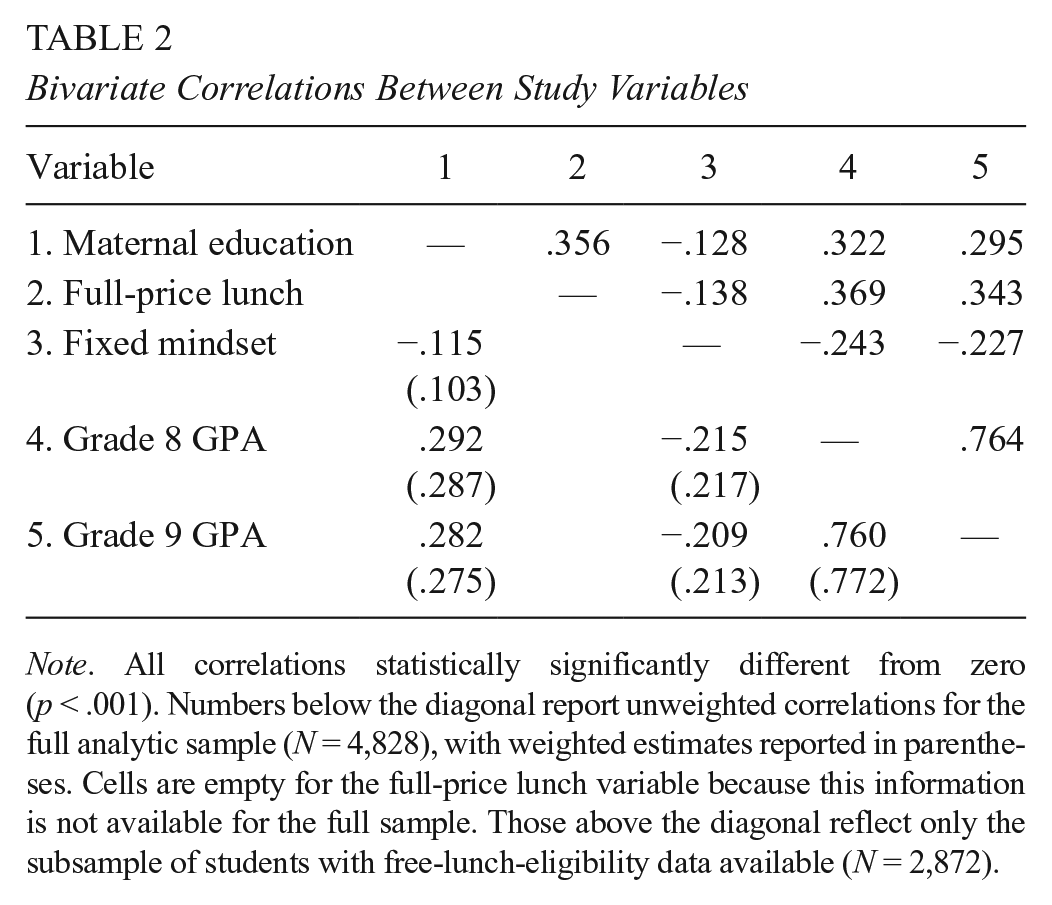
Note. All correlations statistically significantly different from zero (p < .001). Numbers below the diagonal report unweighted correlations for the full analytic sample (N = 4,828), with weighted estimates reported in parentheses. Cells are empty for the full-price lunch variable because this information is not available for the full sample. Those above the diagonal reflect only the subsample of students with free-lunch-eligibility data available (N = 2,872).
Mindset and SES
In order to address our first research question, we evaluated the potential relationship between SES and mindset.
1. Is there a connection between SES and mindset such that access to greater resources is associated with less of a fixed mindset on average?
As shown in Table 2, pairwise correlations indicated that higher SES was associated with less of a fixed mindset than was lower SES. Descriptively, participants whose mothers completed a college education were .22 standard deviations lower in fixed mindset than participants whose mothers did not complete a college education (see Figure 1).

Students from high SES backgrounds express less of a fixed mindset on average than students from low SES backgrounds by .22 standard deviations. Intervals represent +/-1 standard error.
We then estimated this association in multilevel models that account for the clustering of students within schools (see Table 3). Variance estimates from an empty model (not reported) showed that 3% of the variation in the outcome occurred between schools. In the multilevel models of mindset, we centered student-level SES on the school mean. Doing so allowed us to isolate the student-level contribution of SES on achievement, separate from the school-level effect of SES. 2 On average, students with higher SES had fixed mindset scores .19 standard deviations (0.250/1.306) lower than students with lower SES (Model 1). SES differences in mindset were half as large (.10 SD = 0.130/1.306) when comparing students with similar prior GPA (Model 2), suggesting that prior academic success explains a portion of the difference in mindset by SES. Results were similar when controlling for student gender and race-ethnicity (Model 3). We observed a similar pattern of results in the FRL subsample for both the primary maternal education measure (Models 4–6) and the secondary FRL SES measure (Models 7–9). However, parameters were less precisely estimated in the smaller FRL subsample, and they were not statistically different from zero or the estimates in the full sample when including control variables. 3
Estimates From Multilevel Regression Models Predicting Fixed Mindset

Note. Selected estimates (and standard errors) for models of mindset. Models 1 through 3 use the main analytic sample and are weighted to be nationally representative. Models 4 through 9 use the subsample of schools providing FRL information and are unweighted. Independent variables are school-mean centered. Demographic covariates include gender and indicators for Asian, African American, Hispanic, or Other (White is the race-ethnicity reference category). Observations with missing information for Grade 8 GPA or demographic variables imputed with school mean value and an indicator for missing value included in the model (estimates not reported). FRL = free or reduced-price lunch; GPA = grade point average.
p < .10. *p < .05.
Mindset, SES, and Academic Achievement
Our next set of analyses addressed Research Question 2 to evaluate the relationship between SES, mindset, and academic achievement.
2. Are SES and mindset associated with achievement, and does the mindset–achievement association vary by SES?
In line with previous studies, students with lower fixed-mindset scores also had higher academic achievement during ninth grade. The average ninth-grade GPA for students with a more fixed mindset (above the midpoint of the scale) was C+ (2.29, SE = 0.08; n = 1,200), whereas for students with a less fixed mindset (below the midpoint), it was B– (2.76, SE = 0.08; n = 3,213). This raw difference represents approximately half of the observed standard deviation in the outcome.
To explore this association, we specified a series of multilevel models (students nested within schools) of ninth-grade academic GPA as a function of fixed mindset and SES (Table 4). We controlled for prior achievement in all models to focus on differences in high school outcomes for previously similar students. Results from the main sample support several conclusions. First, as suggested by prior research, there was an SES difference in ninth-grade performance conditional on prior grades. Higher-SES students received higher grades by 0.11 grade points (Model 1). Second, both SES and mindset were independent predictors of academic performance, with SES being a more important predictor (Model 2). The estimated difference between a student 1 standard deviation below and above the mean for fixed mindset was approximately half of the estimated difference between higher- and lower-SES students. Moreover, despite the documented association between SES and mindset, the SES coefficient was similar controlling or without controlling for mindset.
Estimates From Multilevel Models Predicting Ninth-Grade GPA

Note. Selected estimates (and standard errors) for models of Grade 9 GPA. Models 1 through 4 use the main analytic sample and are weighted to be nationally representative. Models 5 through 12 use the subsample of schools providing FRL information and are unweighted. Independent variables are school-mean centered. Demographic covariates include gender and indicators for Asian, African American, Hispanic, or Other (White is the race-ethnicity reference category). Observations with missing information for Grade 8 GPA or demographic variables imputed with school mean value and an indicator for missing value included in the model (estimates not reported). FRL = free or reduced-price lunch; GPA = grade point average.
p < .10. *p < .05.
In addition to the independent associations of SES and mindset with grades, socioeconomic background might also shape the academic consequences of a student’s mindset, and some prior research concludes that mindset is a stronger predictor of achievement for lower-SES students than for higher-SES students (e.g., Claro et al., 2016). We found no significant evidence of such an interaction between SES and mindset in predicting achievement (Model 3). In other words, as shown in Figure 2, a lower fixed-mindset score was related to higher achievement similarly for both lower- and higher-SES students. Moreover, as before, results are similar when also controlling for gender and race-ethnicity (Model 4).

A less fixed mindset is associated with higher GPA for low and high SES students (marginal predicted means from Model 3 in Table 4). Fixed mindset is plotted at 1 standard deviation below and above the mean, and intervals represent +/-1 standard error.
We found similar results in models of ninth-grade GPA for both SES measures in the FRL sample (Models 5–12). The estimate for the interaction between FRL-measured SES and mindset was meaningful in size, implying stronger mindset associations for lower-SES students but marginal in statistical significance. This was partly explained by more positive SES–mindset interactions in the particular subsample of schools that provided FRL information (see Model 7). In supplemental models that consider both measures simultaneously (not shown), we found independent predictive effects of both SES measures and no evidence of interactions between the two.
Mediation of the SES Gap in Achievement by Mindset
Finally, we used structural equation modeling to evaluate the extent to which mindset explains the relationship between SES and academic achievement.
3. To what extent do observed differences in mindset between students from different socioeconomic backgrounds explain (i.e., mediate) the SES achievement gap in the United States?
As shown in Figure 3, we observed a significant indirect effect from maternal education through mindset to academic achievement during ninth grade. The relationship remained significant when taking into account the influence of prior achievement on current achievement. This analysis of the national sample of ninth-grade students provided the opportunity to not only test if there is any role of mindset in the relationship between SES and student achievement but also to quantify and contextualize its role in the socioeconomic achievement gap in the United States. The unconditional estimate indicates that mindset mediates 7% of the relationship between SES and academic achievement. Conditioning on prior achievement more credibly isolates academic processes when the mindset measure was collected, but it also may control away influences of SES and mindset on academic performance that operate prior to high school. When taking prior achievement into account, mindset explains a smaller, but significant, 2% of the difference in academic achievement by SES. Results were comparable in secondary analyses using FRL as an indicator of SES. The analyses indicate that mindset is a part of the socioeconomic disparity in academic achievement while also documenting its small, unique contribution to the persistent pattern on a national scale. 4
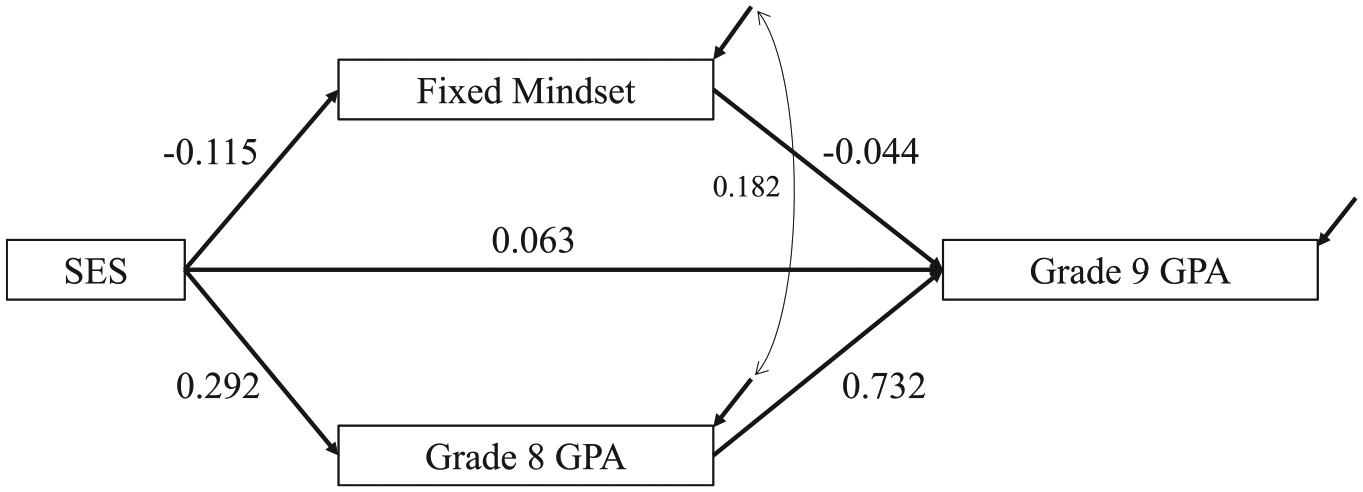
Structural equation model showing significant mediating role of growth mindset in relationship between SES and academic achievement. All coefficients are standardized estimates and all paths are statistically significant at p < 0.001. N = 4,828, RMSEA < .01
Discussion
The study provides valuable insight into the connections between SES, mindset, and student grades in a national probability sample of American adolescents. Students from higher-SES backgrounds were likely to express less of a fixed mindset than students from lower-SES backgrounds, even when controlling for students’ prior academic achievement. The connection between mindset and academic achievement was significant and consistent across students from different socioeconomic backgrounds. That is, both lower- and higher-SES students seem to do better in school when they report less of a fixed mindset. Further, SES had an indirect effect on academic achievement through mindset, such that mindset explained an estimated 2% to 7% of the relationship between SES and achievement. This is a small fraction, and if unobserved variables explain more of the association between mindset and grades, then these estimates may represent an upper bound. Rather, a host of root causes, such as structural factors and educational opportunities that accompany greater SES and influence schools, neighborhoods, and broader communities, remain likely to provide important explanations for the academic advantages of higher-SES students. In other words, while having less of a fixed mindset can be beneficial for students and may help to reduce inequality, mindsets and related psychological factors of students themselves are not the primary explanation for a deep history of existing educational inequality in the United States (for more detail on the persistence and complexity of socioeconomic inequality in education, see Carnevale, Fasules, Quinn, & Campbell, 2019).
The results align with existing studies that suggest a relationship between SES and psychological factors, like mindset, in convenience and international samples (Aelenei et al., 2017; Claro et al., 2016). We advance these studies by providing estimates among a U.S. sample and demonstrating that within this context, the connection between mindset and academic achievement is consistent for students from diverse socioeconomic backgrounds. Our analysis of the connection between mindset and achievement among a national sample also contributes to the ongoing discourse regarding the significance of mindset in predicting academic outcomes (Sisk, Burgoyne, Sun, Butler, & Macnamara, 2018). Our mediation analysis in particular reinforces the argument that mindsets are a significant factor in explaining academic achievement; however, the extent to which mindsets explain disparities is modest and comparable to any other number of single, isolated factors. Instead, complex patterns of achievement can be best explained by a broad combination of interconnected factors spanning the structural and psychological levels, including mindset.
The current study also contributes to an evolving understanding of the connection between SES and psychological factors with particular attention to the meaning of different indicators of SES (see Diemer et al., 2013). Our primary measure of maternal education is related to measures that have been the focus of other research, such as income (e.g., Claro et al., 2016), but may capture aspects of the socioeconomic environment that extend beyond financial resources. A maternal education–focused connection to mindset may have more to do with the educational challenges and opportunities that children have witnessed in their parents’ lives, for instance. In regard to the connection between mindset and achievement, different indicators of SES appear to show different patterns in moderating the relationship. Specifically, prior research focused on financial resources, like income (and to a lesser degree, our secondary analyses of FRL status), suggests that less of a fixed mindset may be especially important for achievement among students who are lower in the economic aspects of SES. When we focus our analysis on maternal education, however, mindset appears to be equally consequential for students whose parents have completed various levels of education. This distinction suggests that mindset may be more important to maintaining achievement when students face financial challenges at home but equally important whether or not the mother has completed a college education. One weakness in the available data is that they do not include an indicator of paternal education. However, maternal education has been a strong and consistent predictor of academic outcomes and related psychological factors in other research (e.g., Entwisle & Astone, 1994), and the current analyses also include the secondary measure of SES to provide a more complete picture.
In order to build upon the descriptive aims of the current research, future research remains necessary to disentangle the processes through which different aspects of a socioeconomic environment shape students’ academic outlooks. In other words, future analyses and studies remain necessary to determine how the connection between SES and mindsets emerges and develops. What are the experiences in higher-SES contexts that tend to lead students toward perceiving their intelligence as more malleable and approaching challenges in school as opportunities for growth? What are the experiences in lower-SES contexts that tend to lead students toward perceiving their intelligence as more fixed and finding less meaning in challenges in school? For example, higher-SES students might be more likely to witness as people in their lives enjoy promotions and opportunities to advance their careers sometimes as a result of taking on risks and challenges. On the other hand, concentrated poverty and residential isolation may reduce the likelihood that lower-SES students witness socioeconomic mobility or opportunities for positive change in people’s life circumstances rather than serious consequences for even minor risks or mistakes.
Future research is also necessary to expand the understanding of factors and experiences that support resilience and adaptive mindsets despite challenging socioeconomic circumstances (Spencer et al., 2015). The relationships that we observed in the data are telling of overall trends, but they are not deterministic. There is wide variation in the experiences of young people in their homes, neighborhoods, and schools, even among those who appear to have similar levels of socioeconomic resources (Destin et al., 2017). Therefore, there are an enormous number of different ways that having more or fewer financial resources may be experienced by young people and come to shape their beliefs about how the world operates. An emphasis on such variation within SES might shed greater light on the unique ways that a lower-SES background fosters the development of valuable developmental assets and strengths that are not often recognized in academic settings (Lee, 2009, 2017). This perspective can also inform the analysis and interpretation of experiments showing the types of experiences that effectively influence student mindsets in a variety of socioeconomic contexts.
Taken together, the findings of this national study provide a clearer understanding of the modest connection between SES and mindsets while also contextualizing the importance of mindset in analyzing broad trends in academic achievement. Having less of a fixed mindset can be advantageous for students regardless of certain socioeconomic circumstances, and psychological experiences designed to increase growth mindset can be a cost-effective way to improve school outcomes (Haimovitz & Dweck, 2016; O’Rourke et al., 2014; Paunesku et al., 2015; see Sisk et al., 2018, for suggestive evidence that growth-mindset experiences show larger effects for lower-SES students). Mindsets alone, however, cannot explain socioeconomic disparities in education and are unlikely to fully eliminate disparities, especially without further consideration of school contexts. These results provide further evidence that important psychological characteristics of young people are shaped by everyday contexts and experiences, which are often linked to SES. Therefore, the most effective initiatives to influence mindsets, academic outcomes, and even educational inequality are likely to be those that include attention to factors at multiple levels of a student’s environment.
Supplemental Material
SES_Mindset_AERA_revision2_supplementary_SUBMITTED – Supplemental material for Do Student Mindsets Differ by Socioeconomic Status and Explain Disparities in Academic Achievement in the United States?
Supplemental material, SES_Mindset_AERA_revision2_supplementary_SUBMITTED for Do Student Mindsets Differ by Socioeconomic Status and Explain Disparities in Academic Achievement in the United States? by Mesmin Destin, Paul Hanselman, Jenny Buontempo, Elizabeth Tipton and David S. Yeager in AERA Open
Footnotes
Acknowledgements
This research was supported in part by the Mindset Scholars Network, the Raikes Foundation, and the Eunice Kennedy Shriver National Institute of Child Health and Human Development (P2CHD042849; R01 HD084772). The content is solely the responsibility of the authors and does not necessarily represent the official views of the National Institutes of Health.
Notes

Authors
MESMIN DESTIN is an associate professor at Northwestern University. His interests include socioeconomic status, academic achievement, and inequality.
PAUL HANSELMAN is an assistant professor at University of California, Irvine. His interests include schooling, inequality, and interventions.
JENNY BUONTEMPO is a database administrator at University of Texas at Austin. Her interests include gender; science, technology, mathematics, and engineering disparities; and classroom environments.
ELIZABETH TIPTON is an associate professor at Northwestern University. Her interests include statistical methods, large randomized trials, and generalizability.
DAVID S. YEAGER is an associate professor at University of Texas at Austin. His interests include social-cognitive development, motivation, and psychological interventions.
References
Supplementary Material
Please find the following supplemental material available below.
For Open Access articles published under a Creative Commons License, all supplemental material carries the same license as the article it is associated with.
For non-Open Access articles published, all supplemental material carries a non-exclusive license, and permission requests for re-use of supplemental material or any part of supplemental material shall be sent directly to the copyright owner as specified in the copyright notice associated with the article.
