




Abstract
Many community college students express a desire to transfer to a 4-year institution, but few achieve that goal. In this article, we examine what conditions lead to successful student transfer and which serve as barriers. Drawing on data from a longitudinal qualitative study of 61 transfer-intending students in Texas and using qualitative comparative analysis, we investigate the student-level conditions and experiences that contribute to successful or unsuccessful transfer to a 4-year institution. We find that there is no single condition that can predict success. Instead, we describe how factors such as social capital, students’ family background, and advising supports interact with one another to determine student success or failure in the transfer process. We identify specific pathways to transfer, with implications for policies and programs that can help bolster students in the face of potential barriers. We provide suggestions for policy, practice, and future research.
Keywords
Community college students are an important and growing population and often come from communities underrepresented in higher education. Over 42% of all students, 56% of Hispanic students, and 48.5% of Black students begin their postsecondary careers at a community college (Shapiro et al., 2017). Preparing students for transfer to a 4-year institution constitutes one of community colleges’ many educational roles (Grubb, 1991). Over 80% of community college students desire to transfer to a 4-year institution; however, within 6 years, less than 35% of students will achieve that goal (Jenkins & Fink, 2016). Multiple studies over the past two decades have investigated transfers from 2- to 4-year institutions, with a focus on the factors that predict student transfer to a 4-year college or university (Crisp & Nuñez, 2014; Cuseo, 1998; Doyle, 2009; Shaw & London, 2001; Wassmer, Moore, & Shulock, 2004). These studies have identified student and institutional characteristics that are associated with successful transfer. Community colleges with student populations that are younger, with higher socioeconomic status and better academic preparation, have higher transfer rates (Wassmer et al., 2004). Being female, having dependents, or enrolling in a certificate program rather than a degree program reduces probability of transfer (Crisp & Nuñez, 2014). The culture of transfer at the community college can also influence student experiences and outcomes (Shaw & London, 2001).
However, to date, few studies have used qualitative data from a large sample of students to examine which student experiences or conditions (e.g., strong advising, financial supports) contribute to transfer. In particular, while quantitative analyses and individual case studies suggest some conditions associated with successful transfer, researchers and policy makers require an understanding of the combinations of particular supports and barriers that lead to a particular transfer outcome. In other words, we understand little about how these factors work in conjunction—how they combine and interact to shape students’ outcomes or the multiple pathways that could lead to transfer. Not only can a qualitative approach illuminate which factors are associated with transfer outcomes, but it can also provide a “thick description” of how these factors manifest in different ways and how they interact to generate the outcome, thus providing more concrete suggestions for institutional improvement and policy.
Drawing on data from a longitudinal qualitative study of a diverse group of 61 transfer-intending students in Texas, this article investigates the student-level conditions and experiences that contribute to a transfer to a 4-year institution. Using qualitative comparative analysis (QCA; Ragin, 1987), we ask: what combinations of conditions, if any, are necessary and sufficient for successful transfer? We find that there is no single condition that can predict success; instead, factors such as students’ family background or advising supports interact, in different ways, to determine student success or failure in the transfer process. Our work offers a more complex but also more realistic picture of transfer. We identify some pathways to transfer, with implications for policies and programs that can help bolster students in the face of potential barriers. Given that so many community college students express a desire to transfer to a 4-year institution but so few of these students achieve that goal (Jenkins & Fink, 2016), learning what conditions lead to successful student transfer—and which serve as barriers—may help craft interventions and policies to ensure more students meet their educational goals.
Background
Social Capital and Transfer
To frame our work, we draw on social capital theory. Traditional views of social and cultural capital perceive capital as a possession held and valued by high-status members of society (Bourdieu, 1997; McDonough, 1997). Social capital includes information gained through social networks or social ties (e.g., “who students know”) that can help them with their goals. Cultural capital includes the tastes, preferences, and ideas that shape their behaviors (Bourdieu, 1997). If individuals possess capital that is valued by their society, they can further solidify their prestige and social position within society and receive corresponding rewards in terms of college access or jobs (McDonough, 1997). In terms of college attainment, students’ social capital can help them learn about and use the resources that are available to them to access the best universities possible (Perna, 2006; Tierney & Venegas, 2006). For community college students intending to transfer to a 4-year institution, having parents or other relatives who have themselves transferred from a community college to a 4-year institution might provide a useful form of social capital.
At the same time, researchers have critiqued traditional social and cultural capital theories, asking “Whose culture has capital?” and emphasizing asset-based views of capital among marginalized groups (Esteban-Guitart & Moll, 2014; Moll, Amanti, Neff, & Gonzalez, 1992; Yosso, 2005). For example, research has shown how groups that are typically thought not to have high amounts of social or cultural capital in fact do, through familial supports, validation, in-kind supports (e.g., child care, housing), and resiliency (Nora, 2001). Asset-based approaches to capital are less concerned with what society values but instead consider the resources and knowledge that individuals and their networks bring to the table and how this cultural wealth helps them navigate society and achieve their goals (Rios-Aguilar, Kiyama, Gravitt, & Moll, 2011).
For some students, college-going or obtaining a bachelor’s degree is an expectation, sometimes since birth, that they will attend college, reinforced by family, peers, and school staff (McDonough, 1997). For others, they may not have immediate family members who attended college, but they can tap into a wider network of extended family members to seek information about college (Jabbar, Serrata, Epstein, & Sánchez, 2017). These resources help students to navigate higher education and learn about the norms and processes. Students may try to “use” their social capital in similar ways, but capital may have disparate impacts due to social positioning and structural inequities (Bell, 2009). At the same time, social capital is not deterministic. Institutions interact with students’ social capital and play a role in shaping students’ outcomes, for better or worse.
As open-access institutions, community colleges are also more likely to attract and enroll nontraditional college students, an increasingly growing student population. Nontraditional students are more likely to have entered college later in life, have dependents, work full- or part-time, and have other major out-of-school commitments that become competing priorities—thus, increased risk factors for stopping out (Choy, 2002). Without social capital supports, these students may have a more difficult time navigating the transfer process.
Institutional Factors for Transfer
Advising support can interact with what students bring from their communities, helping to complement that support or to support students further (Starobin, Smith, & Santos Laanan, 2016). A lack of institutional support can also set students back in their trajectories (Allen, Smith, & Muehleck, 2013; Bahr, 2008). If a student received contradictory advice regarding transfer from different advisors and subsequently recalibrated their transfer and degree goals midway through the transfer process, following their advisors’ advice could lead to a delay in transfer, regardless of their social capital (Allen et al., 2013). Tinto and Pusser (2006) described two types of academic advising: formal, which includes structured sit-down meetings with advisors, and informal, “the sharing of accumulated knowledge that goes on within a campus among and between faculty, staff, and students” (p. 6). Students’ access to informal advising may be contingent on their social capital (Karp, O’Gara, & Hughes, 2008).
Although community colleges often provide their students with services and support, students must know that the resources exist to use them (Karp et al., 2008). Despite earlier research on the “cooling out” hypothesis—which posited that community colleges, through their agents (including academic advisors), chill students’ higher education ambitions (Clark, 1960)—more recent research does not support this hypothesis (Bahr, 2008). Students who receive advising and institutional support are more likely to persist in their enrollment (Hatch & Garcia, 2017). Advising can contribute to student engagement and shore up students’ capital (Karp et al., 2008). At the same time, poor advising, or a lack of advising, can set students back in their trajectories. Because community college students are more likely to come from populations underrepresented in higher education (Ma & Baum, 2016), academic advising is crucial to ensure that students are knowledgeable about and can access university resources, especially if these students do not possess the kinds of capital that higher education institutions reward (Karp et al., 2008).
College students whose parents are unfamiliar with higher education may have less access to information about college funding than that of their peers whose parents or close relatives graduated from college (Deil-Amen & Rosenbaum, 2003; Wells, 2009). However, students can receive information about funding options from financial aid officers (Borus, 1995; Haynes & Bush, 2011; Lange & Stone, 2001), who are responsible for educating students about the administrative processes required to disburse aid to students (Campbell, Deil-Amen, & Rios-Aguilar, 2015). Students of color and low-income students tend to overestimate the costs of attending college (Grodsky & Jones, 2007). Financial aid officers may thus help dispel student misconceptions related to paying for college and provide information about loans, grants, or scholarships. Therefore, strong and accurate information about financial aid from institutions can counteract a lack of financial support or knowledge on the students’ part and thus may aid transfer.
Social and Psychological Factors and Transfer
Students’ transfer paths are also shaped by cognitive and psychological factors. Students who are resilient, who “respond positively to challenges,” have better outcomes (Yeager & Dweck, 2012, p. 302). The 4-year college application process can open students up to the possibility of rejection and feelings of inadequacy (Lareau & Weininger, 2008). Although community colleges usually require an application for admission, they are open-access institutions that typically do not reject students from the school (Fonte, 1997). Four-year institutions, however, often have a complex application process requiring students to complete multiple steps, such as writing application essays, acquiring letters of recommendation, and sending transcripts to the destination institutions (Klasik, 2012). Research about the college application process, mostly focusing on high school students applying to institutions of higher education, indicated that students who successfully completed the college application process are more likely than unsuccessful applicants to possess social and cultural capital and have parents with college experience (Dumais & Ward, 2010; Klasik, 2012; Lareau & Wininger, 2008; Roderick, Coca, & Nagaoka, 2011).
Students, even those who are successful at community colleges, may be intimidated about the process of applying to a 4-year institution (Lareau & Wininger, 2008). The 4-year college application process is complex and daunting even for high school students, who would not be required to juggle college transcripts, letters of recommendation, and the outside-of-school commitments that many community college students experience (Lareau & Wininger, 2008). Applications for 4-year institutions may include many more requirements (e.g., letters of recommendation, essays) than applications to community colleges. Those who complete applications and eventually matriculate to a 4-year institution, despite facing numerous academic or personal hurdles along the way, may demonstrate navigational capital—the ability to navigate unfavorable environments and social institutions that have historically underserved them (Yosso, 2005). Furthermore, students who feel as though they belong at a 4-year institution (Yeager et al., 2016), through either the presence of a family history of college-going or the confidence in their own abilities to succeed in higher education, may be less intimidated by the process.
The literature thus suggests a range of factors that may influence whether a community college student successfully transfers to a 4-year institution—from social capital, which can help students interpret the signals that they receive from institutions to successfully navigate the transfer path, to psychological factors, advising supports, life events outside of school, major obligations, and financial aid knowledge or resources. However, these studies typically examine one or two factors at a time, rather than how they work in combination. Our study examines how these various factors, or conditions, interact to shape transfer outcomes.
Data and Methodology
Data Collection
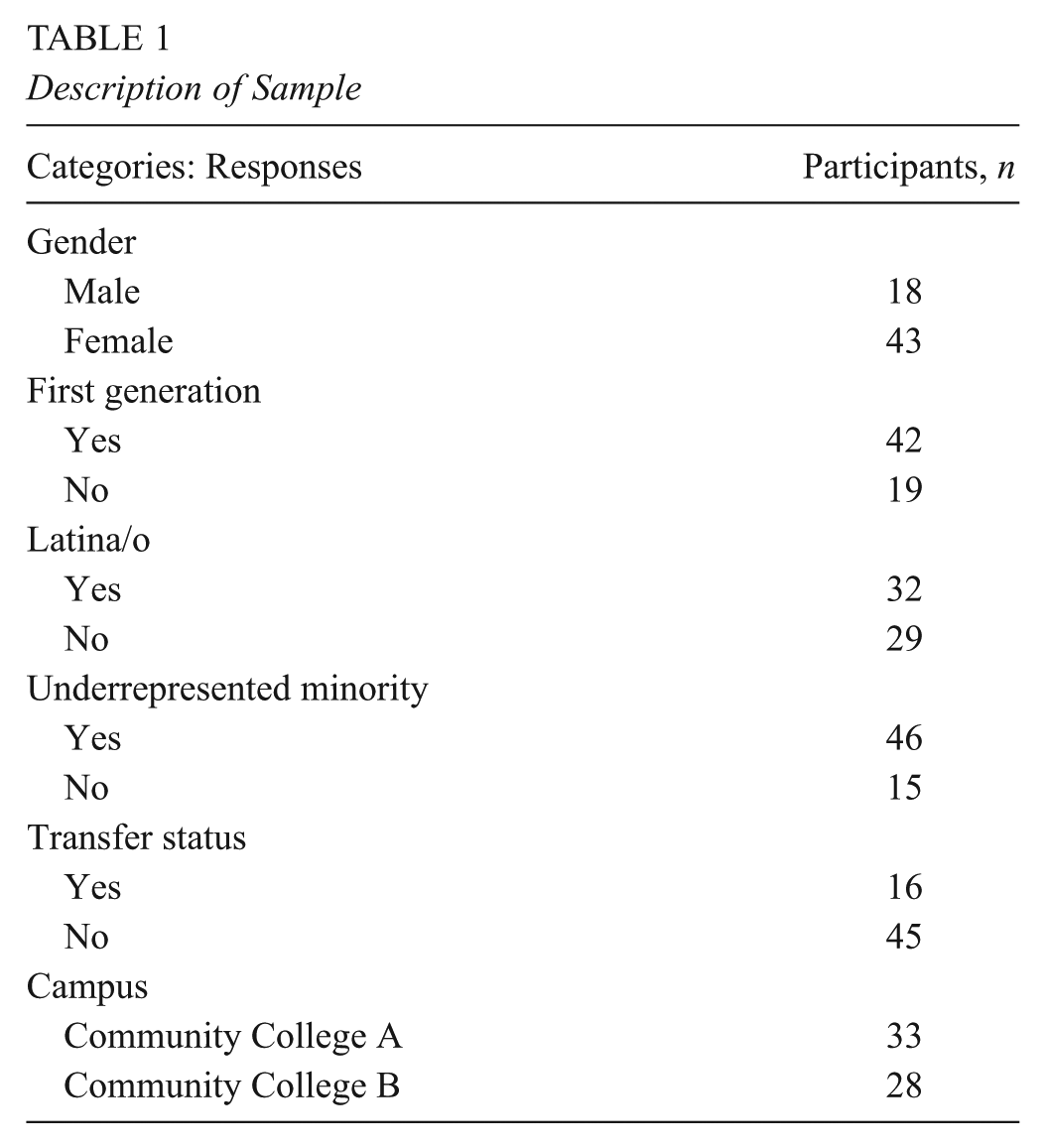
To explore the conditions associated with transfer from the perspectives of students, we draw on longitudinal interview data (over 2 years) from 61 students in Central Texas. We selected two public community college systems located in metro areas within Central Texas. (See Appendix A for a description of sites and sampling approach.) See Table 1 for a description of our sample.
Description of Sample
Interviews were semistructured (Patton, 1990), following a protocol, and lasted 1 hour. All interviews were recorded and transcribed. We asked students about their educational and family backgrounds, their community college experience, their transfer plans, and the supports and barriers that they perceived along the way.
Data Analysis
To analyze our data, we used QCA, which allowed us to systematically explore the combinations of conditions that led to transfer. This approach, which has not been used frequently in educational research (for exceptions, see Coburn, Russell, Kaufman, & Stein, 2012; Trujillo & Woulfin, 2014), serves as a “middle ground” between in-depth case study research, which highlights complexity, and research that can describe broad patterns and generalities (e.g., quantitative methods) (Ragin, 1987).
Furthermore, QCA has different aims than other kinds of research. Rather than a “variable-oriented analysis,” QCA is a “case-oriented analysis,” the aim of which is to understand the conditions that lead to a particular outcome for a small set of cases (the outcome in our study is transfer to a 4-year institution). In quantitative analysis, “independent variables compete with each other to explain variation,” and “each causal variable is considered sufficient, by itself, for the outcome or some increment in the outcome . . . regardless of the values of the other causal variables” (Ragin, 1987, p. 33). In contrast, QCA treats causation as a combination of conditions (Ragin, 1987). These conditions do not compete with one another; rather, they combine to link to the outcomes. There may be multiple paths to the outcome, and this diversity and difference among cases is important to uncover the various paths to successful transfer. Drawing on in-depth knowledge of the cases, researchers use that information to identify conditions and how they work together to give rise to an outcome.
In QCA, strong analysis is rooted in the qualitative data. Therefore, we began by coding all of the data in Dedoose using a hybrid coding method (Miles, Huberman, & Saldaña, 2013). We then created detailed seven- to 10-page memos for each student, which focused on the conditions related to their transfer outcome, identifying supports that the student experienced (from themselves, friends, family, institutions), as well as barriers or hurdles that they faced during their time in higher education. (See Appendix B for a description of our coding process.)
We used fsQCA software (Ragin & Davey, 2016) to conduct the analysis. We tested for both positive and negative outcomes (successful transfer and unsuccessful transfer). (See Appendix C for more details on QCA.)
Findings
Overall, we found that 16 of the 61 students (26.22%) in our sample had successfully transferred during the period of study. This percentage is consistent with national averages of community college transfer (Jenkins & Fink, 2016). See Tables 2 and 3 for details on combinations of successful and unsuccessful transfer. Some of these students encountered similar barriers but with very different outcomes, due in part to social capital and other resources. We also found that, for some students, the logistics of transfer were a barrier, as well as the fact that “life happens,” or major life events outside of school, could alter students’ plans. Family supports could serve as either a barrier or a support, depending on the context, and we found differences in types of family support (e.g., direct guidance with college applications vs. general encouragement and moral support).
Truth Table Solution for Successful Transfer Status

Note. Solution coverage: 87.5%. Solution consistency: 100%.
Truth Table Solution for Unsuccessful Transfer Status

Note. Solution coverage: 91.11%. Solution consistency: 100%.
We also found that students all appeared to be attempting to use their varying sources of social capital in the same way, but these efforts had disparate impacts because of where people were socially positioned and what experiences they had with higher education. This prompted our interest in teasing out the specific combinations of conditions that could, for example, overcome low social capital or help to counter a major life event. We found nine configurations (combinations of conditions) that led to transfer success. Next, we illustrated these configurations and how conditions counteracted one another to help students achieve their goals. Generally, we found that strong social capital as traditionally defined was not sufficient for transfer success, although in many cases it did help, and that other factors, such as strong advising, helped counteract a student’s lack of strong social capital in some cases.
Strong Social Capital and Transfer Success: Typical Paths
Social capital is important for facilitating higher education transitions (McDonough, 1997; Starobin et al., 2016). In our analysis, we used a narrow definition of social capital that captured students’ abilities to access information about higher education from social ties (e.g., family or friends) that were external to an institution of higher education. We found that most students who transferred possessed strong social capital, had no major life events (e.g., birth of a child, divorce), knew how to finance college, and were not intimidated by applying to a 4-year institution. The most common pathway to successful transfer, which covered 5 students (30% of cases), included students who had the following: strong social capital that they could use for help with the transfer process, advising support, no major event in their lives that affected their transfer process, family members who were supportive of their transfer goals, no significant pressures on their time other than their school responsibilities, possession of detailed knowledge about how to fund their college education, and a lack of intimidation by the transfer process. In this sense, the most common pathway to success reflects what researchers, policy makers, and practitioners would expect: students with the most supports and advantages succeeded in reaching their goals.
One student who illustrated this pattern, Abraham,
1
was a second-generation college student, originally from a Middle Eastern country. His father had transferred from a community college to the University of Texas at Dallas, so Abraham had an in-house resource with whom to speak about transfer. Abraham relied heavily on his father for information about transfer: The first person I talked to was my dad. He went to [University of Texas at Dallas], he knows the stuff, so he gave me some pointers. But, then he told me, “You have got to go down to UT and talk to them.” . . . He even took me down there.
Abraham had no qualms about asking his advisors for help with the transfer process, either at his community college or at his top transfer choice, the University of Texas at Austin (hereafter UT Austin). Abraham and his father visited the admissions center at UT Austin multiple times and spoke with an advisor in Abraham’s preferred STEM major (science, technology, engineering, and math). Abraham lived with his family, helped them with household expenses, and received emotional support from them as well. His dad, he said, told him that he could “do anything” and not to “think that anything is impossible.” Abraham reported a thorough understanding of college financing, collected a number of scholarships, applied for financial aid at his destination institutions, and was knowledgeable about differences in costs at public and private institutions. Because of his preparation and information gathering, he was not at all intimidated by the application process.
Yet, not all paths to transfer were so straightforward. Another student, Jenna, who is Black, successfully transferred to Texas A&M–San Antonio with a combination of conditions similar to those of Abraham: As a second-generation college student whose mother worked in the higher education sector, Jenna had strong social capital. She had no major life events during her time at the community college, was well informed about finances, and was not intimidated by the transfer process. Unlike Abraham, however, she had major out-of-school obligations, felt that she did not belong at a 4-year institution, and demonstrated a high level of resilience. Her age and her somewhat turbulent journey through higher education contributed to her sense of nonbelonging. She told us, “I didn’t do [college] the right way where you go to high school then go to college. . . . When you’re fresh out of high school, college is scary, so I am reliving that even at twenty-eight.” Jenna described her experiences starting at Texas A&M–San Antonio as “comfortable.” Her experiences there, a smaller institution reminiscent of the community college campus that she had previously attended, helped to mitigate her fear of college. Jenna is a single mother and works full-time to support her family. Her grades in high school were not especially strong, so she made a conscious commitment to return to higher education after some time off. Although she talked about her educational trajectory as “the wrong way” and experienced more setbacks and out-of-school obligations than some of the other students, she used her resources and drew on her resilience to successfully transfer.
Lack of Social Capital and Transfer Success: More Complex Paths
Although the most common configurations included the presence of strong social capital, there were several cases where students did not have strong social capital, according to the traditional perspective, but were still able to transfer successfully, due to other supports. Among the four configurations (representing four students) leading to success without the presence of strong social capital, we noted some patterns. First, all of these students had general family support. Therefore, even if no one in their families went to college and could provide specific advice or information regarding transfer or higher education, their general and in-kind support and their validation—forms of community cultural wealth—helped students transfer in combination with strong advising, clear financial information, or the lack of a life event during the study period.
In three of these four configurations, students had strong advising, which may also have helped to offset a lack of strong social capital. For example, Lara was a first-generation Latina transfer student who ultimately attended a small private university in San Antonio, Our Lady of the Lake. She had been admitted to that institution right out of high school but went to community college “for a bit of a parachute.” She did not have a strong sense of belonging in a 4-year university and wanted to “learn about the college experience . . . and know what to expect” when she got to the university. She did not have strong social capital and relied primarily on counselors and her professors for guidance. Her community college adviser was a key interlocutor about her decision to transfer, and she followed his advice regarding which university to attend. While her family members could not provide detailed information or advice about college, they were very supportive: My mom supports me very much. She told me to keep going, keep doing what I’m doing. She’s pretty much my biggest supporter when it comes to going to college. My dad’s a different story. He usually says nothing about it. He just helps me go to school. He’s a silent type.
Lara did not have major out-of-school obligations—she was single, without children, and worked only part-time. She did note that she had a lot of intimidation about the application process when she was in high school due, in part, to a feeling that she did not belong: When I first came to Our Lady of the Lake, I was a little nervous because I’m the first in my immediate family to go to a university. . . . I was thinking, “Okay, how do I do this? How do I do that? . . . What if I’m subpar to what they believe? What if I’m considered low standards?” I was nervous on the whole application process so I would mess things up. . . . They were mistakes I could have avoided easily if I was just calm.
Lara was able to overcome these fears through her experience at the community college and was able to successfully transfer—despite lacking strong social capital—through a combination of factors, including strong family support, strong advising, and a lack of external obligations.
Other students without strong social capital were able to transfer due to a combination of supports, despite major life events and setbacks. Ivette, for example, was a first-generation Latina college student who did not have siblings or family to rely on for support navigating higher education. Despite their lack of direct experience with higher education, her family was generally supportive of her goals: “They were always there to encourage me and motivate me to continue pushing forward and not give up on school. Even when certain things come up in life, it gets a little hectic.” Indeed, things did “get a little hectic” for Ivette. She experienced several major life events during her 6 years at community college prior to successfully transferring to the University of Texas at San Antonio. In addition to working two part-time jobs, which totaled more than 40 hours per week, Ivette took on a great deal of caretaking needs for her family, including her grandmother as well as her sister and niece.
Despite these major responsibilities and setbacks, she was able to successfully transfer, in part due to her strong resiliency, family support, and access to strong advising. She described the advising supports that she received at the community college: I think me looking up the information on my own, that probably would have postponed my transfer for a bit. . . . It helps to have people to go to ask certain questions, whether it is about financial aid, classes, GPA, anything like that. They have done a lot to make that transition easier.
Our interpretation of these cases is an optimistic one: that students’ backgrounds are not deterministic; that institutions can play a role in providing information and advising that can help boost students who have fewer advantages; and that general family support and validation—even if no one in the family went to college or can provide specific advice—can serve as a source of community cultural wealth that still helps students achieve their goals. These are less common paths, but the fact that they exist gives us hope that there are many routes to successful transfer.
Paths to Success Regardless of Social Capital
Although social capital appeared to be a deeply relevant condition in positive and negative transfer outcomes, there were two configurations, representing three cases, that demonstrated successful transfer regardless of the presence or absence of social capital. In two cases, even with the absence of familial supports and a sense of not belonging in higher education, students were able to transfer when they had accurate financial information, a lack of intimidation about the process of applying, and resiliency. For example, Sofia, a first-generation Latina student with mental health struggles and minimal familial support, successfully transferred but had difficulty adjusting to the social and academic rigors of the 4-year institution. Sofia’s lack of intimidation regarding the admissions process and her nuanced understanding of financial aid, including scholarships and cost of attendance, positively influenced her transfer to a 4-year institution. During high school, Sofia had been accepted to an out-of-state institution but had to decline her offer due to insufficient financial aid. Discussing this decision, she said, “Since out-of-state fees and all the other fees and I didn’t get any scholarships, $40,000 is something I couldn’t agree to.” The community college that she attended instead gave her a more competitive financial package, so she “went there for a year because it was a full-year scholarship.” When she described her ideal university experience, she told us, “It would be nice to have a full scholarship or to not have loans for my undergrad, because I know when I go to medical school it’s going to be really expensive.” Although she ultimately transferred to UT Austin, she had also been accepted to a private out-of-state school but declined that offer due to high tuition, even offset by financial aid. However, upon reaching UT Austin, she experienced mental health challenges and imposter syndrome, raising questions about her continued success.
In the second configuration where social capital did not play a role, one student was able to transfer despite lacking strong advising and a feeling that he did not belong in higher education. Those conditions were supported by a lack of a major life event, the absence of significant out-of-school obligations, and no feelings of being intimidated by the transfer process. In this case, the presence of strong financial supports and resilience also played a role in the student’s outcome. Francisco, a first-generation Latino student, successfully transferred to UT Austin after 4 years of enrollment at a community college.
Francisco navigated the transfer process with little guidance from advisers at the community college, whom he described as generally unhelpful: “For the most part, they don’t help at all. At all. They leave you with more questions than answers.” Despite few positive experiences with academic advisors and feeling “on his own,” Francisco conducted his own research on the transfer process and capitalized on rare instances of “personalized” advising that he received to gather information on the transfer process. Francisco had some knowledge of tuition costs and scholarship opportunities. Francisco also demonstrated personal and academic resilience. He identified as a high school dropout but persisted through remedial math, the infamous gatekeeper for many students, and this even gave his self-confidence a boost when he realized he was “pretty good” at math. Francisco did not experience any major life events, have significant out-of-school obligations, or note any intimidation about the transfer process that may have influenced his transfer trajectory.
Failure to Transfer: Lack of Social Capital
Earlier we discussed the important role that social capital played in facilitating transfer success. Now we turn to the conditions associated with a failure to transfer: the negative outcome.
Students who did not transfer often lacked social capital to help them with the transfer process, usually because they were first-generation college students and were unable to access useful information about transfer. For example, Tanya, a White first-generation college student in her midforties, lacked strong social capital and experienced difficulties with advising, coupled with problems navigating bureaucracies at the community college and her transfer destination. Tanya was on the cusp of matriculating at a 4-year institution but had the following experience when actually starting classes: I will tell you that’s probably the worst advising experience I’ve ever had. . . . I took out a formal complaint against the advisor because I was accepted. I had my financial aid in place. . . . I have everything in place on their degree plan. . . . She pretty much refused to put me inside the psychology program. She says, “You need to take sociology . . . in order to be able to take any other classes.” . . . I went there probably eight times. I have probably 30 emails back and forth with her as far as how am I supposed to do this if you don’t have these classes available? I can’t sign up for them. . . . She was like, “Well, I can’t hold your hand through this process.” . . . I was like, “But I can’t register without you.” I said, “Your system blocks me from registering.”
Despite this experience, which prevented her from enrolling at a 4-year institution, Tanya was resilient and had a strong sense of belonging in college. She had attended many other community colleges and had previously received two associates’ degrees and multiple certificates but had yet to enroll and matriculate at a 4-year institution. She was also the mother of two children. Tanya felt that she deserved to attend a 4-year institution due to her diverse life experiences. Five other students who did not transfer shared the same combination of conditions—low social capital, poor advising, resilience, and a sense of belonging in college.
Other students without social capital who did not transfer experienced a combination of lack of family support, a sense of intimidation about the application process to a 4-year institution, no evident resilience, and no sense of belonging in college. Steve, a first-generation White veteran student who did not transfer, shares this set of conditions with two other students. Steve joined the military after one semester at an out-of-state community college when he had difficulty paying for college and his own living expenses. Steve is a first-generation veteran college student whose family is actively unsupportive of his college-going goals. He said, “I remember my dad at one point telling me, ‘You don’t need college.’ Because he didn’t. He made it. But, it was a different time.” His father did not understand why Steve wanted to get a college degree. Steve received college funding through his military benefits, but as a nontraditional student, Steve was very concerned about how his experience would be different at a 4-year institution than it would be for younger students and that he would stand out because of his age (late twenties). In Steve’s case, the lack of familial support, whether in-kind, financial, or through validating messages, inhibited his ability to transfer to a 4-year institution.
Failing to Transfer Despite Strong Social Capital
When we examine the negative outcome, the failure to transfer, we find many cases where students had strong social capital but were unsuccessful in transferring due to other factors, including a lack of financial support or information, a major life event, or a lack of strong advising.
A lack of financial support or adequate information on the costs of higher education set a number of people back (six students), even when they had access to good information from their social networks about navigating higher education. Several students were simply unaware of how they would pay for college, despite having family members or friends who provided information about transfer. One White student, Lee, went to community college instead of a 4-year university due to financial aid: “I was gonna go to Texas Tech, but my financial aid package was nothing pretty much . . . not enough to start my education off.” He noted that “if it was cheaper,” he “would go to a 4-year university.” Students like Lee had “heard that” private schools were expensive and some “more than just your average private-school cost,” he but had not done research—“I haven’t really actually looked online.” Most of these students reported being concerned about costs but relied primarily on posted tuition rates to estimate costs, rather than considering financial aid or scholarships.
In other cases, “life” happened to students, and without a strong sense of resilience, even students with strong social capital were unable to successfully transfer. Marta, a Latina second-generation college student who had been accepted to Baylor University, ended up delaying transfer to stay closer to her family, as her parents had health issues and became ill. She had strong social capital, including family members who went to college and many of extended family members with experience at elite universities. She wanted to become a doctor, and she had mentors who were doctors to help her make decisions about her major, transfer destination, and pathway to the career.
Although Marta’s familial network provided a rich college knowledge base, her duty to family took precedence over her educational plans. As such, when her parents fell ill, she put her transfer goal on hold to take care of them and began considering less selective institutions close by as transfer destinations. In this case, the commitment to family became an unintended barrier to a positive transfer outcome. Ultimately, these changes in her plan could affect the transferability of her coursework, thus delaying her graduation when she ultimately transferred.
Finally, in the third configuration that included social capital but led to a failure to transfer, we see that a lack of advising can work alongside a lack of resilience to counteract supports such as strong social capital and even a strong sense of belonging in college. For example, one student, Xavier, an international student from Mexico, planned to transfer to UT Austin. His sister already attended UT Austin and advised him, helping him to avoid the mistakes that she had made. Xavier noted, “Luckily for me, I have that secondhand experience.” In addition, he notes that his sister told him “what things she already did. . . . She doesn’t really understand much of my field [science] at all actually, but she knows procedures, who to talk with.” Despite this strong social capital, including a family of engineers (his desired major), he ultimately did not transfer. He noted that it was difficult to access resources: “Honestly, I think even though there’s a lot of resources available, they’re not easily obtained.” He also noted, “I did talk to an advisor, probably a couple times, but I don’t honestly find them very useful.” Similarly, another student with strong social capital, an African American woman whose parents both went to college, also failed to transfer. Weak advising set her back, despite her strong sense of belonging in higher education. When asked what her source for academic advising is, she answered, “Myself . . . I don’t bother [at the community college]. I have better things than to wait four hours before I get to somebody. So I just do it myself.” While she did seek out information from 4-year universities, being on her own as far as transfer-related advising may have set her back in reaching her goals.
While lack of social capital appears as a condition in many of our cases of transfer failure, a lack of and/or presence of other significant conditions appeared to negatively affect a student’s transfer journey, despite having strong social capital. It is also important to note that in many of these cases, strong familial support was generally present.
Transfer Failure Regardless of Social Capital
In other cases, as with the positive outcome, students failed to transfer regardless of whether they had strong social capital. Major out-of-school obligations paired with intimidation about the transfer application process could result in an unsuccessful transfer outcome for students. Lucia, for instance, is a nontraditional Latina student who returned to community college after a 20-year absence. Although she was determined to complete a bachelor’s degree and had strong familial supports, life happened. Between Year 1 and Year 2, Lucia and her husband fostered a toddler with major medical needs and were in the process of formalizing the adoption. While Lucia still planned to continue her studies and subsequently transfer to a university, her intimidation about the process weighed on her.
Other students’ intimidation about the transfer process, while combated with strong resilience, still resulted in failure to transfer. For example, Ester, a first-generation Latina student, was resilient, as evidenced by her ability to overcome a chaotic childhood and defy the odds stacked against her as a teenage mother. Yet it was her confusion about the transfer process that delayed her transfer. When asked what questions she still had, she stated, “Basically, like applying. I know all the information is on the website, but it’s still confusing to me.”
Even students who had strong advising and a strong sense of belonging could be derailed in their plans to transfer when they had a lack of financial supports and/or information. For example, Nora, a first-generation White student of Middle Eastern descent, described favorable advising conditions, which included interactions with advisers at the community college and her intended transfer institution. For Nora, “education is like life,” and she believed that she was university bound. However, her lack of financial information may indicate a barrier in the transfer process, as she did not have a clear understanding of college affordability.
Discussion and Conclusion
Our study sought to understand how various factors interact to shape community college students’ transfer outcomes. By examining the combinations of conditions that lead to transfer success and failure and illustrating these pathways with examples from our cases, we find that social capital is not deterministic for transfer success. Indeed, there are many forms of social capital, and these can interact with institutional supports and life events in ways that create successful pathways or make transfer more difficult. Although a number of students in our study who did transfer successfully possessed social capital regarding the college transfer process, social capital was not the only factor that could explain transfer success; it worked in combination with other conditions. Four students in the study transferred successfully despite having weak social capital to utilize for help with transfer. What this group of students had in common, however, was at least one strong source of support, most commonly from their families or from academic advisors (Allen et al., 2013; Hatch & Garcia, 2017; Karp et al., 2008; Tinto & Pusser, 2006). Even major life events were insufficient to stop some students from pursuing their transfer goals. Similarly, not feeling a sense of belonging in college did not hinder transfer success when other conditions were present to counteract it. Social capital can certainly contribute to a successful transfer experience, but students are not destined to fail to meet their goal of transferring due to their social class and familial college knowledge; other factors can work together to ensure successful transfer.
These findings also support using a more nuanced understanding of social capital as it relates to transfer (Yosso, 2005). In particular, students in our study demonstrated a high level of navigational capital, the skills used to work within institutions to achieve particular goals, as well as family capital, even if they were the first in their family to go to college. Because so many of our students who transferred had social capital, we generally confirm that parental experience with college helps with attending a 4-year institution through transfer (Dumais & Ward, 2010; Klasik, 2012; Lareau & Wininger, 2008; Roderick et al., 2011). However, because our findings also indicate that social capital does not determine transfer success, avoiding a deficit narrative and looking more closely at other forms of capital that students do possess may be a fruitful line of inquiry for future studies on this topic. Although traditional and community cultural wealth approaches to social capital are often seen in conflict with one another, we view these as complementary in that our work seeks to use antideficit frameworks for identifying other forms of capital that students possess, while acknowledging the very real structural inequalities that may ultimately “value” these forms of capital differently and lead to differential outcomes for students.
However, significant out-of-school obligations, intimidation about applying to college, and lack of financial knowledge about funding higher education could lead to a failure to transfer. The lack of time and lack of knowledge, whether these gaps are financial or advising related, were significant factors in the failure to transfer among our sample of students. Regardless of students’ social capital, higher education requires a substantial investment of time. To successfully transfer, students must meet with advisors, discover how to pay for college, and complete financial aid applications. This becomes more challenging for students with other responsibilities, such as working full-time or caring for family. Institutional agents should be conscious of and take seriously students’ limited time.
Fortunately, however, providing students with easy-to-access and clear information can counteract many of these conditions. Students might delay transferring from a community college to a 4-year institution because they worry about a sharp increase in costs. Increased communication from institutions or nonprofits about financing college and dispelling any myths about college affordability, as well as providing more financial supports, might contribute to higher rates of transfer, particularly for first-generation college students. Financial aid knowledge provided an important addendum to students’ transfer journeys and allowed them to make informed decisions within their college choice sets, as Sofia’s and Francisco’s stories show. However, contrary to existing research, neither of them mentioned financial aid officers as key sources of information (Borus, 1995; Haynes & Bush, 2011; Lange & Stone, 2001).
Advising more closely targeted to students’ goals could also increase students’ transfer rates. Our findings indicate that strong advising is an excellent way to supplement existing sources of capital and can help or hinder students’ paths to transfer success but that it works in combination with other factors to shape student outcomes. Advising seemed to be the most helpful to our students when it connected them to university resources (Bahr, 2008; Karp et al., 2008). Although advising did help some of our students transfer, the advising experiences of others—such as Xavier, who visited advisors occasionally but did not find them useful—show that not all advising interactions are created equal.
We found that having an academic sense of belonging and a lack of intimidation were relevant conditions for successful transfer outcomes, which supports the need for exposure to the college-planning process for students early on, but these social-psychological factors were not consistently part of successful pathways or combinations. The frequent lack of intimidation for those who did successfully transfer reflects findings in the literature about the difficulty of the 4-year college application process (Dumais & Ward, 2010; Klasik, 2012; Lareau & Wininger, 2008; Roderick et al., 2011). Many unsuccessful transfer students, such as Steve, did express a lack of belonging and intimidation about the college process. In high school, college counselors can support students in gaining confidence and valuable college knowledge by providing supports through the college application and financial aid process. At the postsecondary level, institutional supports can include interventions that address the psychosocial factors (sense of belonging, intimidation about the process, resiliency) that contribute to positive transfer outcomes.
Our study also found that family support appeared consistently in condition sets that led to successful transfer, even in the absence of strong social capital, which is consistent with prior research. When students did not have strong social capital, they often had general family support, even if their family members were unable to offer concrete supports or advice related to college-going or transfer. Our findings thus support prior research that suggests that family support is beneficial to transfer-intending students, even if that support does not include passing on information or strategies, as traditional approaches to capital might indicate (Bers & Galowich, 2002; Nora, 2001). For example, Lara was a first-generation college student, and her story shows that her family’s encouragement of her transfer plans—her mother was her “biggest supporter”—was crucial to her transfer success. Even though she felt a sense that she did not belong in college, her family supports helped her to overcome anxiety related to transfer. At the same time, there were exceptions, where family pressures served as obligations that hindered students’ movement forward toward transfer. For example, some students described shared or sole caretaker responsibilities for aging or sick family members, while others assumed head-of-household financial duties that compromised their transfer outcome. However, on the whole, as students leverage and lean on the support of families, we recommend the inclusion of families in the transfer process, at both community colleges and 4-year institutions.
While our work provides insights into some of these dynamics, qualitative research cannot generalize to a population. Our sample of 61 students in Texas is limited in that we might observe different dynamics at other institutions and in states with different policies and supports. Given that our work does not control or account for individual student background characteristics (e.g., race/ethnicity), we cannot describe how pathways varied by group. Instead, our work focuses on the resources to which students have access, rather than the particular identity or other category to which they belong. Furthermore, students who participated in our study might be more motivated or organized than the average community college student at those institutions, reflecting a kind of sampling bias. However, qualitative research instead seeks to “generalize” to theory, helping to identify relationships among factors and illuminate areas for further study. Indeed, to our knowledge, no prior research has examined how social capital interacts with these other factors (e.g., “life happening,” advising supports, general family support) in the community college context and how that shapes students’ paths to transfer success or failure.
While our study suggests that students can successfully transfer in spite of adverse advising systems and institutional barriers, we also acknowledge the role of the institution and policy in advancing transfer outcomes. With the support of state policies, community colleges could create more robust partnerships with 4-year institutions to ensure that transfer students are connected with financial aid and academic advising supports prior to departure from the community college. Conversely, 4-year institutions have a shared responsibility to create programming that provides targeted advising, financial literacy, and access to campus resources to inform and empower transfer students. Last, institutions must respond to the call to make campuses more inclusive spaces for students of color. This imperative has clear implications on sense of belonging and academic success (Hurtado & Carer, 1997).
Footnotes
Appendix A: Texas and Institutional Context
Texas has a decentralized state higher education policy context; this frequently means that determining which courses will transfer to another institution and how those courses will apply to degree plans is a complex and confusing endeavor (Hodara, Martinez-Wenzl, Stevens, & Mazzeo, 2017). According to the Texas Higher Education Coordinating Board (2018a), there are 37 public 4-year institutions and 82 public 2-year institutions in Texas, some of which belong to a larger university system. Within the Central Texas region, there are public, state flagship, private, and community college institutions (2018b). The two community colleges in our sample are large institutions with >30,000 students apiece. Students identifying as White (44% at Community College A and 28% at Community College B) or Latinx (32% at Community College A and 56% at Community College B) compose the two largest racial and ethnic groups at each college, with ≤10% students identifying as Black or Asian.
After selecting our sites, we worked with staff to recruit students who had expressed to researchers that they intended to transfer to 4-year institutions within the next 12 months. We interviewed all students in fall 2015 and then interviewed all but two again in fall 2016 to see how their plans had progressed (the two students who were unavailable for interviews completed a survey instead). To recruit students, we emailed college listservs, attended transfer events, and handed out flyers. We sought to recruit a diverse pool of students, including but not limited to racial minorities and those who were the first in their families to attend college.
Appendix B: Coding Process
To develop the categories of conditions that would be included in the analysis, we started by reviewing our qualitative data, examining common themes among particular cases of students who were successful in transferring and those who were not. We discussed what these students had in common, as well as how they differed, the barriers that they experienced in the transfer process, and how they overcame each barrier, if at all. We also examined what supports were beneficial for them. We thus hypothesized the potential pathways to transfer (e.g., Coburn et al., 2012) and developed a coding scheme for our focal conditions.
Five coders were trained, coding one transcript at a time as a group, until we had resolved major issues. We then used Dedoose’s built-in intercoder reliability tool to achieve consistency. Once we had satisfactory agreement on several interviews, we proceeded with independent coding.
We identified several themes, or conditions, that appeared to influence transfer students’ trajectories: (a) social/cultural capital, including family financial support and general support; (b) institutional and advising supports; (c) particular issues facing nontraditional students (major life events and out-of-school obligations); and (4) psychological factors (resiliency, sense of belonging in college, and intimidation about the process). We drew on these themes to determine which conditions we would examine and then conducted another round of coding for the presence or absence of these conditions (see Appendix Table A1 for a list and description of each condition). Each student was coded as either having the condition (0) or not having it (1), a crisp set analysis (Ragin, 1987). While QCA may appear to “quantify” qualitative data, given that the resulting codes are binary; emerge from rich, in-depth underlying qualitative data; and are informed by, and in dialogue with, researchers’ knowledge of the cases. Together, these conditions can help us understand how noninstitutional supports might counteract a lack of institutional supports. We can see how a major life event that could throw someone off course does or does not depending on how it combines with other factors.
We then made case-level matrices, with three coders coding for the presence or absence of each condition and including evidence (i.e., quotes or field notes) to support each determination. Each entry was double-coded, and we met as a team to resolve any discrepancies.
Appendix C: QCA Approach
With traditional case study research, it can be difficult to qualitatively analyze a large number of cases. There exist few methods for sample sizes that are “in between” small-N and large-N studies (e.g., >2 but <200 cases). In our case, identifying themes and conditions leading to transfer among our 61 students’ trajectories would have been difficult to identify purely through coding and analysis of themes. At the same time, our sample size was not large enough for typical quantitative analyses.
We elaborate on the approach that we took to implement QCA. We first constructed a truth table (see Appendix Table A2), which showed each possible combination of conditions, with the associated outcome, and the number of instances in which we see that particular path or set of conditions. The QCA software then allows us to generate a solution, which lists every path to each outcome (Trujillo & Woulfin, 2014), by performing a Boolean minimization procedure. After constructing a truth table, which showed each possible combination of conditions with the associated outcome, we removed all rows where there was no instance observed in the data. Next, we determined which combinations were subsets of the outcome by examining the consistency score. The consistency score indicates the extent to which “a given condition or configuration of conditions leads to consistent outcomes (all negative or all positive)” (Coburn et al., 2012, p. 152). Scores <75% are considered very inconsistent. Following the typical procedure, we assigned a 1 to the outcome for any consistency level that was >.80 and 0 otherwise. To obtain a solution in QCA, which lists every path to each outcome, the software performs a Boolean minimization procedure, where, for example, “if two Boolean expressions differ in only one causal condition yet produce the same outcome, then the causal condition that distinguishes the two expressions can be considered irrelevant and can be removed to create a simpler, combined expression” (Ragin, 1987, p. 93). This process is repeated “until no further reductions are possible” (Trujillo & Woulfin, 2014, p. 280). During this process, we specified how each condition was supposed to contribute to the outcome. For example, strong social capital would be positively associated with successful transfer, while a major life event would be negatively associated with transfer success.
The software provides three types of analyses: complex, parsimonious, and intermediate (Ragin, 2010). Here, we report results based on the intermediate solution, which allows for some complexity (not overly simplified) but is parsimonious enough to see patterns. The results indicate which combinations of conditions led to a particular outcome (transfer success or failure), as well as the coverage and consistency of that outcome. Coverage indicates the number of cases that were explained by a particular configuration, while consistency shows the extent to which that combination of conditions led to the outcome or was a subset of the outcome (Ragin & Davey, 2016).
See Coburn et al. (2012) and Trujillo and Woulfin (2014) for a more detailed description of this method.
Acknowledgements
We thank the Greater Texas Foundation for generous support of this research. We also thank Sarah Woulfin, Jonathan Turk, Uri Treisman, and David Yaeger for feedback prior drafts and presentations. We acknowledge Eliza Epstein, Wes Edwards, Joanna Sanchez, and Catherine Hartman for their research support.
We acknowledge Eliza Epstein, Joanna Sánchez, Catherine Hartman, Wes Edwards, and Marisol Garza for their research assistance. Data collection and analysis were supported by the Greater Texas Foundation Faculty Fellows program. We also acknowledge infrastructure support from the Population Research Center at The University of Texas, supported by a grant from the Eunice Kennedy Shriver National Institute of Child Health and Human Development (P2CHD042849).
Notes
Authors
HURIYA JABBAR is an assistant professor in the education policy and leadership department at the University of Texas at Austin. Her research examines school choice, market-based reforms, and decision making across K–12 and higher education contexts.
SARALYN MCKINNON-CROWLEY is a doctoral student in education policy and leadership at the University of Texas at Austin. Her research primarily examines informational disparities in higher education as they manifest through the community college transfer experience and undergraduate financial aid.
CARMEN SERRATA is an administrator at Our Lady of the Lake University, San Antonio, Texas. Her research interests include college access, college readiness, and family engagement across the P-20 pipeline.