




Abstract
A growing body of research has documented extensive credit loss among transfer students. However, the field lacks theoretically driven and empirically supported frameworks that can guide credit loss research and reforms. We developed and tested a novel framework designed to address this gap using unique administrative credit loss data from Texas. Our results demonstrate how the likelihood of credit loss varies across course characteristics, majors, pretransfer academics, student characteristics, and sending and receiving institutions. Additionally, we disentangled general credit loss from major credit loss and examined how they vary across institutions, majors, and the combination of both. The extensive variation in credit loss among universities in particular underscores the need for future research and reform.
Introduction
Whether community colleges serve as an efficient and effective pathway to the baccalaureate hinges on their ability to support the transfer of students and credits to universities. Roughly 80% of community college students intend to earn a bachelor's degree within 5 years (Community College Center for Student Engagement, 2017). Of the one third who transfer (National Student Clearinghouse, 2024), a large proportion lose some credits earned at the community college. National estimates suggest that two thirds of transfer students lose at least some credits and 40% lose all of them (Simone, 2014). The threat of credit loss has led to state reforms to mitigate it, including common-course numbering, general-education curricula, statewide articulation agreements, and guaranteed-transfer associate degrees (Education Commission of the States [ECS], 2022).
However, research on the effectiveness of these strategies is mixed. Although some studies have suggested that policies such as statewide articulation agreements (which mandate how credits apply across institutions in a state) or core curricula (which define a set of fully transferrable lower-division courses) promote the transfer of students and/or credits (Anderson et al., 2006; Boatman & Soliz, 2018; Spencer, 2021), others have found limited effects of statewide policies on these outcomes (Gross & Goldhaber, 2009; LaSota & Zumeta, 2016; Roksa & Keith, 2008). In turn, researchers and reformers increasingly highlight the role of institutional policies, practices, and culture in shaping the transfer of students and credits across institutions.
Although there is theoretical justification for emphasizing the role of institutions in shaping the transfer of students and credits, the primary causes of credit loss generally and the role of institutions in mitigating or exacerbating credit loss specifically remain insufficiently explored. There are five primary gaps in the literature. First, course-level data on credit loss are rarely collected by states, limiting research on credit loss overall. Second, no research on credit loss has examined or sufficiently controlled for the pretransfer courses students completed, despite their obvious bearing on credit loss. Third, quantitative research on credit loss has only been able to assess general credit loss (GCL), where credits fail to transfer between institutions at all, despite the known issue of major credit loss (MCL), where credits transfer but do not apply to the student's major (Giani et al., In press; Kadlec & Gupta, 2014). Fourth, limited research has examined the extent to which credit loss varies across institutions, particularly when controlling for factors that influence credit loss that may be articulated in a conceptual framework. Finally, conceptual frameworks have not been developed specifically to guide the study of credit loss.
This study addressed these gaps by using novel administrative data capturing credit loss. Beginning in 2020, the Texas Higher Education Coordinating Board (THECB) began collecting student-by-course-level data on every credit that was lost by students who transferred from community colleges to public universities in the state. These data allowed us to examine the relationship between course characteristics and credit loss and to more properly control for pretransfer courses in our analyses. In addition, these data indicated the reason credits were lost, enabling us to disentangle MCL from GCL. After reviewing the literature on student transfer, we developed and then tested a novel conceptual framework by applying it to Texas's statewide credit-loss data covering vertical transfer students. Thus, we produced some of the first estimates of how credit loss varies across public institutions, controlling for a range of factors theorized to relate to credit loss.
Our results align with prior literature but also reveal novel evidence of predictors of credit loss. In regard to the former, courses in the institution's core curriculum were less likely to be lost, and students transferring into selective major groups such as engineering and math/computer science were more likely to experience credit loss. We also showed that credit loss varies meaningfully across community colleges, even when controlling for student and course characteristics, supporting reform efforts to strengthen pretransfer pathways. However, we found that distance education and hybrid and dual-credit courses are more likely to be lost, even when controlling for the specific course students completed, despite no obvious policy mechanism that can explain these patterns . Credit loss varies more across universities than sending community colleges, particularly in regard to MCL. This evidence suggests the need for examining university policies, practices, and cultures that shape credit loss, particularly the denial of course applicability toward specific major requirements.
This paper proceeds as follows. We first review existing literature on credit loss, including the methods used to measure credit loss. We then offer a novel conceptual framework to examine the predictors of credit loss, where we identify seven key factors (and interactions between them) theorized to shape credit loss. We then describe our methods for examining credit loss, applying this conceptual framework to analyses of total, major, and general credit loss using Texas administrative data. We conclude by discussing how our findings can both stimulate future research on the causes and consequences of credit loss and inform new institutional policies and strategies to minimize the loss of credits for transfer students.
Prior Literature on Credit Loss
Historically, limited access to detailed data about credit transferability has hindered the direct measurement of credit loss. As a proxy, researchers examined excess credit accumulation among baccalaureate recipients, typically comparing credits accumulated (rather than individual courses because courses can confer different amounts of credit) among vertical transfer and native students (i.e., those who began at a 4-year institution). Using Texas state administrative data, Cullinane (2014) found that baccalaureate recipients who began at a community college attempted, on average, 150 degree-bearing credits (i.e., not developmental education) compared with 142 credits among native 4-year students—at least two fewer courses. Estimates from other states reached similar conclusions, illustrating that 2-year college entrants accrued between 8 and 10 more excess credits than similar 4-year college entrants (Fink et al., 2018; Xu et al., 2016).
Although existing research has suggested that vertical transfer students accumulate two to three excess courses worth of credits at the time of baccalaureate attainment, this is a rough estimate for credit loss experienced by transfer students. For example, transfer students may take additional elective courses at their transfer destination, change their majors, or repeat courses to improve their grade-point average (GPA) to facilitate transfer into a more selective major, all of which could contribute to excess credit accumulation without credit loss (Liu et al., 2021; Schudde et al., 2023). Perhaps the most important limitation of research that relied on excess credit accumulation as a proxy for credit loss was its focus on baccalaureate recipients, a restriction that was necessary to calculate excess credits. Students who never earned a degree were excluded from these calculations, which is problematic because credit loss may deter students from baccalaureate attainment. Given the low rates of bachelor's degree completion among vertical transfer students, excess credit accumulation among baccalaureate recipients may not be a strong proxy for credit loss.
In the past decade, postsecondary transcript data collected as part of the Beginning Postsecondary Students Longitudinal Study (BPS) and some state administrative data have allowed researchers to measure credit loss more directly (Giani, 2019; Government Accountability Office [GAO], 2017; Monaghan & Attewell, 2015; Simone, 2014; Spencer, 2022). Specifically, BPS collected postsecondary transcripts that included an indicator of whether a pretransfer course could be transferred to the destination institution. Importantly, this data allowed for the examination of how credit loss varies across types of transfer pathways, such as traditional vertical transfer from public 2-year to public 4-year schools versus lateral transfer (i.e., 2-year to 2-year and 4-year to 4-year schools) or transfer across sectors (i.e., private not-for-profit to public and private for-profit to public schools). According to the GAO (2017), traditional vertical transfer students lose ~20% of their credits, whereas transfers to and from for-profit institutions (whether 2- or 4-year schools) typically lose >90% of their credits. Similarly, Simone (2014) found that lateral transfers tended to result in the loss of more credits than 2-year to 4-year school transfers in multivariate analyses controlling for other predictors of credit loss.
Estimates from data sources, to date, remain a rough proxy for credit loss. Some courses may be accepted by an institution for credit but do not apply toward the student's major or facilitate progress toward a degree (Fink et al., 2018; Kadlec & Gupta, 2014). The GAO (2017) report specified that its “analysis does not address the reasons why credits were not accepted” and that credits accepted by the institution but inapplicable to the student's major were likely excluded from credit-loss calculations using these data (p. 15). Although the importance of MCL has been underscored in prior research, to our knowledge, the existing literature using BPS data (GAO, 2017; Monaghan & Attewell, 2015; Simone, 2014) or state administrative data, such as Giani’s (2019) study examining credit loss among students transferring from community colleges to public universities in Hawaii and North Carolina, has not systematically measured MCL or distinguished between MCL and GCL, where GCL refers to courses that the institution does not accept for credit on transfer. The lack of information on why (and how) credits are lost limits the accuracy of estimates of credit loss overall. Additionally, because universities may have considerable autonomy over the applicability of credits to specific major requirements, universities may have more influence over MCL (compared with community colleges), which is obscured in current measures.
Given these data limitations and the associated challenges with operationalizing credit loss, research on the predictors of credit loss is sparse. To our knowledge, Richardson and Knight's (2024) examination of credit loss among engineering transfer students at one university is the only study, apart from Giani’s (2019) analysis of administrative data from Hawaii and North Carolina, that has statistically examined predictors of credit loss.
Credit-Loss Conceptual Framework
The dearth of research on the correlates of credit loss has hindered the field's development of conceptual frameworks. Therefore, we developed a novel conceptual framework synthesizing literature on factors that influence transfer-student outcomes, such as the likelihood of transfer, persistence and attainment of transfer students, and degree efficiency (e.g., excess credit accumulation and time to degree). We drew on Giani’s (2019) review of the literature and empirical estimates of factors that influence credit loss, additional studies on credit loss (GAO, 2017; Monaghan & Attewell, 2015; Simone, 2014; Spencer, 2022), and research on factors that influence student transfer success overall. We identified seven key factors and described the mechanisms through which they may contribute to credit loss (or credit transferability): (a) course characteristics, (b) major pathways and programs of study, (c) pretransfer academics, (d) student characteristics, (e) sending institution policies and practices, (f) receiving institution policies and practices, and (g) state and system policies. The following subsections elaborate on each component of our conceptual framework, which informs our analytic models.
Course Characteristics
First, whether a credit can transfer depends on the characteristics of the course. Although this seems obvious, there are a number of ways to measure course characteristics, and different approaches affect our ability to predict credit transfer and to estimate institutional influence on credit applicability. College courses are often divided into three categories: academic, technical/workforce, and noncredit or personal enrichment (D’Amico et al., 2017; Xu & Ran, 2020). Academic courses are those in academic subjects that are offered by both 2- and 4-year institutions, such as English, mathematics, and the sciences. Technical/workforce courses are those aligned with what historically has been referred to as vocational education, career and technical education, or workforce programs offered at community and technical colleges. Although these courses can confer college credit, in general, that credit is applicable only to the program of study at the community or technical college level given that public universities seldom have programs in these technical fields. Noncredit courses include a variety of courses that tend to be offered to students for personal enrichment, most often taken by adult learners outside of a credit-bearing program (Xu & Ran, 2020). Generally speaking, academic courses are designed to be transferrable, technical courses are occasionally transferrable (although typically toward an applied baccalaureate), and noncredit courses are nontransferable (Kuneyl, 2022).
Within the category of academic courses designed for transfer, the characteristics of a course may influence its transferability. There are two particularly salient components of course characteristics: the content of the course and its method of delivery. The former can be understood at different levels of granularity. At the coarsest level, courses can be categorized into broad subjects such as business, humanities and liberal arts, and STEM (i.e., science, technology, engineering, and mathematics). These categories align loosely with different colleges typically found on university campuses (Bastedo, 2011). A more refined categorization identifies the specific subject of the course (e.g., engineering, English, or chemistry), typically identified by course prefixes (e.g., “ENGR,”“ENGL,”“CHEM”). The most precise measurement of course content is the specific course completed, typically identified by combining a course prefix with a course number (e.g., “ENGL 302” or “CHEM 408”). We hypothesized that using more granular measures of course content would improve the accuracy of our predictions.
In addition to proxies for course content, the method of a course's delivery could influence its transferability. Courses can be offered in person, online, or in a hybrid modality, where perceived differences in the quality of online/hybrid versus in-person courses may influence university decisions about whether to accept courses for transfer (Xu & Jaggars, 2014). Courses also can be taken by college students or through dual-credit or dual-enrollment courses taken by high school students (An & Taylor, 2019). As with course modality, stakeholders’ perceptions that dual-credit courses are “less rigorous” could lead to their denial for transfer credit (Duncheon & Relles, 2020). Finally, although not a course delivery characteristic per se, in states with a transferable core, courses that are part of that core should be more likely to transfer.
Majors and Programs of Study
Credit loss is likely to vary across the majors or programs of study students transfer into, particularly in states or higher education systems without policies that mandate credit transferability in specific major pathways. Indeed, excess credit rates among transfer students vary across majors (Cullinane, 2014). Many transfer students report that their pretransfer credits do not apply credits to their chosen major at their destination university (Hodara et al., 2016; Kadlec & Gupta, 2014), the phenomenon of MCL noted previously and elaborated on below.
There are three primary reasons we anticipate variation in credit loss across majors. First, academic departments are primarily responsible for developing majors and determining the curricular requirements that comprise them. Although central university administrations shape curricular requirements (Bastedo, 2011) and state-level policies such as core curricula and guaranteed-transfer associate degrees may constrain departmental autonomy over majors, faculty remain powerful influencers of program requirements and credit transferability (Schmidtlein & Berdahl, 2011; Schudde et al., 2021). Selective majors that restrict access to transfer students with aligned prerequisite courses can force transfer students to enroll in programs other than their intended major, contributing to credit loss (Musoba et al., 2018).
Second, some transfer pathways are more commonly traversed than others, and research has suggested that pathways with higher transfer rates are targeted for reforms aimed at facilitating credit transfer. Hodara et al. (2017) examined how the City University of New York system, the University of California system, and state administrators in Washington State implemented transfer policy reforms specifying premajor coursework for transfer students. In each case, to understand and mitigate credit loss, leaders targeted their most popular majors. In addition, majors with higher transfer rates result in greater opportunities (and needs) for universities and departments to determine the applicability of pretransfer coursework to major requirements.
Third, majors vary in terms of the rigidity versus flexibility of the courses that comprise the program of study (Heileman et al., 2018; Jarratt et al., 2024; Kizilcec et al., 2023). This variation can be analyzed both in the design of majors and in the empirical paths students traverse through them. The structural complexity of majors is characterized by sequences of prerequisite courses, gateway courses early in a major, and bottleneck courses that must be passed to advance into certain upper-division courses (Heileman et al., 2018). The timing and sequence of course taking in a major can reveal similarity in students’ curricular pathways, referred to as path homogeneity (Jarratt et al., 2024; Kizilcec et al., 2023). Although we are not aware of studies empirically linking the rigidity versus flexibility of majors to credit loss, more structured pathways at the community college level may promote transfer and university completion rates (Baker, 2016; Baker et al., 2023). However, majors with greater path homogeneity (i.e., less flexibility) at the university level also could relate to higher levels of credit loss (Jarratt et al., 2024).
Pretransfer Academics
Students’ pretransfer academic experiences may shape their risk of credit loss. Apart from the specific courses students completed prior to transfer, the most salient pretransfer academic characteristics are students’ academic performance, total credits, and credentials they earned. In regard to academic performance, both individual course grades and overall pretransfer GPA may influence credit loss. Receiving institutions may set grade standards for credit transfer that are higher than the grade needed to pass the course and receive credit, implying that these courses may transfer as passed credit but not apply toward specific degree requirements (Bicak et al., 2023). Students’ pretransfer GPA may influence which universities and majors they are admitted to (Bleemer & Mehta, 2022). Students with lower pretransfer GPAs therefore may have to enroll in institutions or majors that were not their first choice. If their pretransfer course taking was informed by their intended destination institution and major, this could result in students enrolling in institutions and majors where they are more likely to experience credit loss.
The number of credits students earn before transfer also may influence their risk of credit loss. In general, community colleges do not offer many upper-division courses that students complete in their junior and senior years of a baccalaureate program. If students earn large numbers of credits before transfer (e.g., >60), they increase their likelihood of accruing credits that will not transfer or apply to major requirements. Indeed, Giani (2019) found that students with 76–90 or 91–105 credits had more than twice the odds of experiencing any credit loss than students who completed 1–15 credits, and these two groups lost 17 and 27 more credits on average, respectively, than students in the 1–15 credit group. However, students with 16–30 and 31–45 credits had lower estimated odds of any credit loss than those in the 1–15 credit group, suggesting the possibility of a nonlinear relationship between pretransfer credits and credit loss.
Pretransfer credential attainment also may predict the magnitude of credit loss students experience. To date, 35 states have policies that guarantee that students who complete an associate degree prior to transfer can transfer and apply all of the courses in the associate degree enter into the university with junior standing and be exempt from any additional lower-division course requirements (ECS, 2022). In those contexts, students who completed an eligible associate degree, took no additional pretransfer courses, and transferred to a public university should experience no credit loss. Even without statewide policies, universities and community colleges may establish bilateral policies that provide similar guarantees to students who earn eligible associate degrees prior to transfer (Bailey et al., 2017). In contrast, other sub-baccalaureate credentials, such as certificates conferred by community colleges, tend not to be included in transfer guarantees and are therefore unlikely to shield students from credit loss. Students also may earn “procedural” credentials that signify completing certain milestones, such as the state's core curriculum, which may mitigate their risk of credit loss (Bailey et al., 2017).
Student Characteristics
Although research on how credit loss varies across student populations is limited, theoretical frameworks and empirical findings have suggested the possibility of unequal credit transfer across racial/ethnic, socioeconomic, gender, and age groups. Vertical transfer rates among community college entrants are plagued by persistent demographic inequities. Black and Latino/a students are less likely to transfer than White and Asian students, a phenomenon described as the racial transfer gap (Chase et al., 2012; Crisp & Nuñez, 2014; Wood et al., 2011). Low-socioeconomic-status students, as measured by Pell Grant eligibility and parental education, transfer at lower rates than their higher-socioeconomic-status peers (Dougherty & Kienzl, 2006; Dowd et al., 2008; Wood et al., 2011). Although some studies have suggested no relationship between gender and vertical transfer (Wood et al., 2011), among vertical transfer students, women are more likely to complete bachelor's degrees (Wang, 2009). Gender differences in the navigation of the transfer process may be indicative of differences in credit loss, although this has yet to be explored in the literature. Older students also appear more likely to face challenges in navigating transfer (Ishitani, 2008; Rosenberg, 2016).
Laanan et al. (2010) advanced the framework of transfer-student capital to move beyond the historical focus on the “transfer shock” experienced by vertical transfer students and to highlight how knowledge, experience, and connections developed pretransfer may help students navigate transfer. Researchers have not established an empirical link between transfer-student capital and credit loss, but Laanan et al. (2010) hypothesized that transfer-student capital comprised knowledge of topics such as “understanding credit-transfer agreements between colleges” (p. 177). An important component of credit transfer and applicability is understanding that these decisions often occur at the discretion of university faculty and that credit-denial decisions can be appealed (Schudde & Jabbar, 2024). Students rely heavily on family and peers in developing transfer-student capital, which can include that informal knowledge about how and when to inquire about credit transfer; sociodemographic inequalities may shape access to this information through personal networks (Jabbar et al., 2020; Maliszewski Lukszo & Hayes, 2020). Racial/ethnic and socioeconomic inequalities in transfer-student capital therefore may translate into racial/ethnic and socioeconomic inequalities in credit loss.
Sending Institutions
Credit-loss rates vary considerably across types of sending institution. Students who transfer from a private for-profit institution to a public institution lost 94% of their credits, on average, compared with 37% for students transferring between public institutions (GAO, 2017). Disaggregating by institutional control and sector reveals even starker differences. Students transferring from a 2-year private for-profit to a 2-year public school lost 97% of their credits compared with 22% for students who took the traditional vertical transfer route between public 2- and 4-year institutions (GAO, 2017). Largely, credit-loss rates are inversely related to how often students traverse that transfer path. Thus, public 2- to 4-year school transfer students may experience lower credit loss given community colleges’ long-held role as facilitators of vertical transfer (Kisker et al., 2023); yet, even within this pathway, credit transfer is not optimized.
Although the GAO (2017) study documented considerable variation in credit-loss rates across types of sending institutions, it did not examine variation in credit loss among sending institutions of the same type. Unfortunately, some community college practices may exacerbate credit loss. A common practice of community colleges is to encourage students to focus on completing their general education requirements before choosing a major to maximize flexibility (Bailey et al., 2015), yet, community college students who take large numbers of pretransfer entry-level courses (100- or 200-level courses) accumulate more excess credits (Fink et al., 2018). If students attempt lower-division courses that are misaligned with their eventual major, they risk losing those credits (Schudde et al., 2024). Such evidence contributes to critiques of the “cafeteria model” of community college program and course offerings, which enables selection from an array of pathways and dizzying set of possible courses (Bailey et al., 2015).
In contrast, the “guided pathways” movement describes community college practices to promote student success and, ideally, mitigate credit loss (Bailey et al., 2015). These practices include early advising to facilitate major and course selection, creating program plans or default sequences of courses aligned with majors, limiting the number of choices and course substitutions in the default plans, and developing “metamajors” to align general education coursework for similar broad fields to avoid credit loss across majors within that broad field. The reforms aim to help students choose a pathway more quickly and confidently and to minimize deviations that may otherwise contribute to credit loss (Jenkins & Cho, 2013).
Credit loss also may vary across sending institutions because of the absence or presence of articulation agreements and transfer partnerships between sending and receiving institutions (Jenkins et al., 2014). Effective transfer partnerships tend to create “clear programmatic pathways” combined with “tailored transfer advising” (Fink & Jenkins, 2017, p. 301). Community college transfer administrators are often tasked with fostering and maintaining relationships with partner universities while overseeing student-facing staff who guide transfer-intending students (Schudde & Jabbar, 2024). Although state policy may guarantee that courses in the core curriculum transfer and apply across all public institutions, whether courses apply to specific major requirements at the receiving institution may depend on the existence of those formal partnerships and agreements with the community college.
Receiving Institutions
Even for similar students who transfer from the same institution with identical pretransfer academic characteristics, their destination institution predicts their likelihood and magnitude of credit loss (Giani, 2019). Universities hold varying articulation agreements with their partner institutions and also may face different statewide policies or, even in the same state, may differentially implement those policies (Schudde & Jabbar, 2024). Thus, receiving institutions may vary in their rates of credit loss among transfer students because of how they implement state policy, their institutional transfer policies and practices, and their transfer culture.
University faculty and administrators, who are chiefly responsible for creating degree plans and determining how transfer credits articulate with degree requirements, exert “disproportionate influence” over enacting transfer policy and practice (Schudde et al., 2021, p. 80; Schudde & Jabbar, 2024). University faculty councils severely limited the implementation of statewide policy in Texas that mandated the applicability of credits within specific fields of study, arguing that the policy threatened “the authority and responsibility of higher education faculty to design curriculum” (Schudde et al., 2021, p. 71). University actors in other contexts also stymie state policies that limit their institutional autonomy over how credits transfer and apply to specific majors, contributing to varied implementation (Logue, 2018; Senie, 2016).
Given dynamics in the transfer field, developing a transfer-receptive culture at universities may be particularly important to promote transfer-student success. Transfer-receptive culture comprises university strategies such as the prioritization of transfer students in undergraduate admissions, outreach and information dissemination to prospective transfer students, and dedication of resources and supports to facilitate transfer student success (Jain et al., 2011). The extent to which universities are willing to partner with community colleges to develop transfer pathways is essential to highly effective transfer partnerships (Fink & Jenkins, 2017). However, universities perceived as the most selective—those focused on “prestige maximization”—often hold the most power to thwart efforts to facilitate credit transferability (Schudde et al., 2021; Winston, 1999, p. 16). Thus, whereas some university stakeholders seek to subvert statewide transfer mandates and stymie the transfer and applicability of pretransfer credits, transfer-receptive cultures at others may promote the vertical transfer of both students and credits.
State and System Policy
Although this study focused on the role of institutions within a single state, states also adopt policies to facilitate the transfer of credits between institutions and programs. They vary in their prescriptiveness and granularity (ECS, 2022), but the lack of detailed credit-loss data has hindered research on which policies effectively mitigate credit loss. Nevertheless, institutional influences on credit loss are shaped by state policies that govern higher education.
State coordinating or governing boards may adopt a transferable core of lower-division courses, and 38 states have done so (ECS, 2022). States vary in their approach to the transferable core. In some states, students must complete the entire core to ensure that all core courses will transfer; in others, any course completed in the core will transfer regardless of whether students completed the core (Schudde et al., 2023). States also vary in whether institutions can require additional general studies courses beyond the core curriculum. For example, Alabama requires institutions to do so, whereas in California completing the core curriculum means students “completed all lower division general education requirements” (California Code, Education Code §66720, https://codes.findlaw.com/ca/education-code/). Research has suggested a positive relationship between accrual of pretransfer core courses and degree attainment, although results are mixed regarding whether pretransfer core credits decrease time to a bachelor's degree (Boatman & Soliz, 2018; Schudde et al., 2023).
After nearly a century of concerns about common course numbering, where lower-division courses share course numbers across institutions (Rogers & Williams, 1935), 20 states and many systems (particularly 2-year sectors) adopted common course numbering and statewide articulation agreements to facilitate credit transfer (ECS, 2022). Statewide articulation agreements do not require common course numbers—institutions can maintain different course numbers and still articulate courses across institutions. However, common course numbers can eliminate the need for one-to-one course articulation. Although common course numbering has not been explicitly linked to credit loss, students in states with common course numbering—particularly low-income students—appear more likely to transfer (LaSota & Zumeta, 2016). Evidence on the effects of statewide articulation policies is mixed, although recent studies have linked statewide articulation agreements with credit accumulation and timely degree completion (Roksa, 2009; Roksa & Keith, 2008; Spencer & Monday, 2024; Worsham et al., 2021).
The most stringent state course transferability policy is the guaranteed-transfer associate degree. Whereas the transferable core curriculum generally includes 30–45 credits, associate degrees typically include 60 credits. In states with guaranteed-transfer associate degrees, students who complete the degree before transferring should have all 60 credits transfer and apply to their baccalaureate program and transfer as juniors, leaving only 60 remaining credits to complete their baccalaureate. To date, 35 states have implemented statewide guaranteed transfer of associate degrees (ECS, 2022). Evidence suggests that California's associate degrees for transfer increased baccalaureate attainment, but exclusively through increasing transfer rates rather than transfer efficiency, as measured by credits accumulated at the time of bachelor’s degree receipt (Baker et al., 2023).
Despite the ubiquity of state policies to facilitate credit transfer, research on their effectiveness—especially as related to credit loss—is mixed or absent. Although research has suggested that statewide policies are essential for facilitating transfer-student success, there is a dearth of evidence for specific policies to reliably reduce credit loss during transfer.
Interaction of Factors That Shape Credit Loss
Earlier we described the components of the conceptual framework in terms of their independent relationship with credit loss. However, given the complex higher education ecosystem, we anticipate that credit transferability is shaped by an interplay of the components. For example, whether courses are accepted for transfer depends on the combination of the major students transfer into, the university's degree plan for that major, and articulation agreements between the sending and receiving institutions for that pathway. In this study, we explored several of these interactions (e.g., intersection of major and sending/receiving institutions). However, we could not fully test all possible interactions and encourage further research in this area.
Research Questions
In this study, we examined predictors of credit loss, asking three research questions:
How do course characteristics, pretransfer academics, student characteristics, majors, sending institution, and receiving institution predict the probability that courses are lost during vertical transfer, and how do the relationships vary across credit-loss type?
How do course characteristics, pretransfer academics, student characteristics, majors, and sending and receiving institutions predict the number of credits lost, and how does this vary across types of credit loss?
To what extent does institutional variation in credit loss depend on the major students are transferring into and the type of credit loss students experience?
Methods
We leveraged statewide longitudinal data from the Texas Education Research Center, including newly available data on credit loss among community college transfer students. We used descriptive and inferential statistics to understand predictors of credit loss.
State Context
Colleges and universities in Texas are overseen by the THECB, which ensures the implementation of policies passed by the Texas Legislature and develops its own policies to supplement state legislation. However, individual community college and university campuses are governed by systems that often exert greater influence over academic policy at institutions within the system. All public community colleges offer academic courses aligned with THECB's Academic Course Guide Manual (ACGM) and use common course numbering, ensuring the transferability of courses across institutions. Public universities are not required to use common course numbering but must indicate how their lower-division courses align with other institutions through the Texas Common Course Numbering System. Texas is one of 38 states that has adopted a transferrable core curriculum (Texas Administrative Code, Title 19, §4.28, https://www.hhs.texas.gov/regulations/policies-rules/texas-administrative-code), and institutions choose the courses that comprise their core curriculum. Texas has a policy called field-of-study curriculum (FOS), which delineates courses students can take in a given field beyond the core curriculum that must apply toward that major at destination institutions. However, FOSs do not exist in all majors, and institutions have resisted implementation of FOS requirements (Schudde et al., 2021). Texas also does not have guaranteed-transfer associate degrees that require universities to accept and apply all associate degree credits toward a baccalaureate and confer junior standing, despite recent efforts (e.g. Texas Direct, which should allow students to combine core and FOS courses toward a transferrable associate degree).
Data and Sample
The Texas Education Research Center, a clearinghouse at the University of Texas at Austin, maintains K–12 records from the Texas Education Agency, postsecondary information from THECB, and labor-market outcomes from the Texas Workforce Commission. Accessing the data requires researchers to submit a proposal to the Education Research Center Advisory Board, which meets quarterly to review proposals and approve researchers’ use of Education Research Center data for proposed studies. We relied on THECB data, which included all students enrolled in any Texas postsecondary institution. The data included student demographics, institutional enrollment information, degrees and credentials awarded, and transcript measures such as course enrollment and completion, associated credit hours, and grades.
Our analysis hinged on the newly collected transfer report data submitted by representatives at public universities (e.g., registrars and institutional researchers). The transfer report lists ACGM courses denied for transfer and the institution's reported reason. To be included in the transfer report, transfer students must (a) be first-time vertical transfer students transitioning from a public 2-year institution to a public 4-year institution in Texas, (b) have lost at least one credit-bearing lower-division course listed in the ACGM (i.e., students experiencing zero credit loss, 17% of our sample, are not included in the transfer report but are included in our analyses), and (c) maintain the same major from the time of transfer application until the official census date of university enrollment (the 12th class day for long semesters). Students who attended multiple community colleges before transferring to a university still would be included as long as it was their first transfer to a university. Transfer students who are admitted under a different major or as undeclared would not be included in the report, which is a limitation of the data. However, students who changed majors at the community college are included, provided that their major did not change between university application and enrollment. Students who only completed dual-credit courses from a community college before applying for university admission are considered first-time students rather than transfers and are not included in the report. We relied on the first available transfer report data from fall of 2020 through spring 2022 data, the most recent report at the time our analyses commenced.
The transfer report's inclusion of the credit-denial reason offers advantages over other data traditionally used to study credit loss and transfer outcomes because we could better understand the type of credit loss students experienced. Institutions reported denying credits for one of five reasons, with the percentage of courses in our sample lost for each reason indicated in parentheses (see Appendix A, Table A1, in the online version of the journal for more details): (a) credits outside student's major at time of matriculation (48.6%), (b) grades below institution’s/program’s minimum grade requirement (14.3%), (c) course was repeated and only one instance could be transferred (17.0%), (d) exceeded maximum transferable hours (based on institutional preference, but there is a state maximum of 66 credit-hours for transfer; 8.9%), or (e) any other reason (11.3%).
Our analytic sample drew from the population of Texas community college entrants between 2010 and 2020 who transferred to a public university for the first time between fall 2020 and spring 2022. College transcript data were not available before 2010, requiring us to delimit the sample to fall 2020–spring 2022 transfer students who started college after 2010. We focused on transfer students who completed at least one pretransfer academic course to align with the intended student sample in the transfer report (technical credits do not transfer toward academic baccalaureates at Texas public universities by law). Our final analytic sample included 28,969 transfer students. For course-level analyses, our sample included all pretransfer academic courses, totaling k = 495,512 course records (on average, 17 courses per student). Courses that did not confer academic credit, including technical, developmental education (e.g., remedial math), and student success courses, were excluded from students’ pretransfer course records and were not included in credit-loss calculations because these credits were not transferrable toward academic bachelor's degrees at public universities. A small fraction of the remaining course records were dropped in our analyses because of missing data (1,151 course records, or 0.2%).
Variable Construction
We used the transfer report's measures of course credits lost and reason codes to create three dichotomous course-level outcomes: any credit loss, major credit loss, and general credit loss. Any credit loss (ACL) indicates whether the given course failed to transfer or apply for any reason. Major credit loss (MCL) indicates that the course transferred to the institution but did not apply to the major declared on transfer. General credit loss (GCL) indicates that a course did not transfer to the institution for any other reason apart from MCL. For student-level analyses, we created three parallel student-level continuous measures of credit loss. Total credits lost (TCL) is the sum of credits students lost for any reason. Major credits lost (MCL) is the sum of students’ credits that transferred but did not apply to their major. General credits lost (GCL) is the sum of students’ credits that did not transfer for any other reason.
Our independent variables were aligned with our proposed conceptual framework of credit loss. Course characteristics included variables that indicated delivery characteristics of each college-level course, such as the course's instructional type (e.g., lecture, lab, or seminar), its instructional mode (e.g., in person, online, or hybrid), and whether it was a dual-credit course. Additionally, we included an indicator of whether the course was part of the institution's core curriculum. We controlled for these course characteristics in all models.
We captured the content of the course in four ways. First, we referred to the coarsest grouping as broad course subject, which placed all course subjects into one of eight groups: (a) business, (b) education, (c) humanities, liberal arts, and general studies, (d) health, (e) industry, agriculture, manufacturing, and construction, (f) service oriented, (g) social and behavioral sciences, and (h) STEM. Second, we captured specific course subject using the subject of the course aligned with the ACGM, which describes all lower-division academic courses that may be offered by all public postsecondary institutions in Texas. Each course subject receives a four-letter prefix (e.g., “GOVT” for government). Third, unique course combined the four-letter course prefix with the four-digit course number (e.g., “GOVT 2306”), indicating the exact course taken. Fourth, we created course-by-major pairs by combining unique courses with the major students transferred into at the university (e.g., GOVT 2306 taken by a student majoring in government). We defined majors by four-digit Classification of Instructional Program (CIP) codes.
As discussed in Appendix B in the online version of the journal, we fit a series of logistic regression models with these different controls for course content. The results of these models showed that controlling for unique courses resulted in improved model fit compared with controlling for course subjects (broad or specific), although it takes up more degrees of freedom. Relying on course-by-major pairs in the model, in contrast, worsened the adjusted R2. Informed by these tests, we ultimately controlled for unique courses in our preferred models. In addition to this statistical rationale, controlling for unique courses strengthened our interpretations of the relationship between other variables in the model and credit loss, particularly when estimating how credit loss varies across institutions. Including unique courses in the model implies that our estimates of between-institution credit loss are controlling for the specific courses students completed prior to transfer. Doing so increases the likelihood that the institutional variation in credit loss we estimate is due to institutional policies and practices because sending colleges vary in their recommended course sequences (Schudde et al., 2025). In contrast, alternative model specifications that control, for example, for the broad subject of the course, risk conflating differences in institutional policies and practices with differences in the courses students take within subjects across institutions.
Student demographic measures included age, race/ethnicity, gender, and low-income status. Age is a continuous variable, and we also included a quadratic term for age to capture nonlinear relationships between age and credit loss. The THECB captures race/ethnicity following the U.S. Census reporting format, where students self-report their racial identity from the options American Indian/Native American, Asian, Black, Native Hawaiian/Pacific Islander, White, or multiracial and separately report whether they are ethnically Hispanic/Latino/a. We created a single race/ethnicity variable where students identifying as Hispanic/Latino/a were defined as one group and all others were deemed non-Hispanic/Latino/a. For our analysis, we further classified the latter under Asian, Black, White, and other. The last category combined American Indian/Native American, Native Hawaiian/Pacific Islander, and multiracial given the small number of students in each of these categories. Students reported gender as a binary variable: male or female. Economic disadvantage is a dichotomous indicator from the THECB that captures multiple measures, such as falling below the federal poverty line or Pell Grant eligibility.
We measured pretransfer academic characteristics using the number of credits completed prior to transfer, pretransfer GPA, pretransfer credentials, and variables related to students’ temporal pathways through higher education. We categorized pretransfer credits into bins of 15 credits that roughly corresponded to semesters of coursework for full-time students. These bins were (a) 1–15 credits, (b) 16–30 credits, (c) 31–45 credits, (d) 46–60 credits (the modal case and reference group in the statistical models), (e) 61–75 credits, (f) 76–90 credits, and (g) >90 credits. Pretransfer GPA is a continuous variable measured on a 0.00–4.00 scale. We constructed the pretransfer credits and GPA variables from the transcript data capturing courses, credit hours, and grades associated with courses students completed at the community college before vertical transfer. Pretransfer credentials included whether the student earned an associate degree prior to transfer (even though Texas does not have guaranteed associate degrees for transfer) as well as indicators for whether students completed the institution's core curriculum or an FOS pathway. We also controlled for the year students began in higher education (from 2010 through 2021) because that may have influenced the degree plans they could transfer into at the university; the semester a course was taken because that could influence its transferability; and the semester the student transferred from the community college to the university to account for temporal changes in university policy and practice that may have influenced credit loss.
To provide actionable evidence regarding how majors predict credit loss, we created indicators of major based on two-digit CIP codes of the major declared at the university, organized into 13 broad bins, following Baker (2018) and Jenkins et al. (2017).
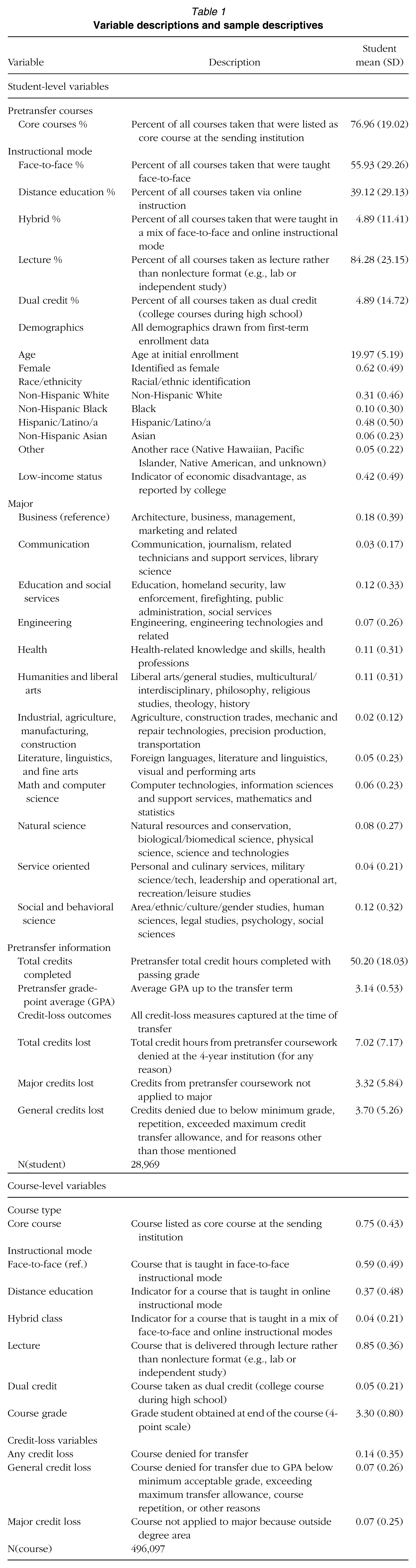
Finally, we included fixed effects for sending and receiving institutions in most models, apart from models where universities were treated as a random effect (discussed below). These fixed effects captured institutional variation in policies and practices that could influence credit transferability, such as academic advising, policies that require certain numbers of credits to be taken at the receiving institution, and major-specific credit requirements at the institution. Although understanding how characteristics of institutions influence credit loss is important, our relatively small sample of institutions (54 community colleges and 35 universities) limited the feasibility of controlling for institutional covariates. For example, the selectivity of universities may be correlated with credit loss, but the number of Texas universities in different selectivity tiers is too small to have sufficient statistical power for us to examine this relationship. We discuss the implications of this limitation after presenting our results. Because all colleges in our sample were in Texas, they were all subject to the same state transfer policies, which was the final component of our conceptual framework. We therefore did not examine in this study how state policies influence credit transferability. Table 1 contains variable definitions and descriptive statistics (student-level variables, followed by course-level variables). In Appendix A in the online version of the journal, we also present descriptive patterns of credit loss by student characteristics (see Table A2 in the online version of the journal).
Variable descriptions and sample descriptives
Statistical Modeling
To address Research Question (RQ) 1, our primary analytic approach was to use logistic regression to explore the relationship between components of our conceptual framework and the likelihood that courses were lost during transfer. One drawback of logistic regression is that the parameter estimates take the form of logits (log odds) or odds ratios, which are harder to interpret than percentage point (pp) changes in the outcome that would be produced through linear probability models. Logistic regression is our preferred statistical method because estimates from linear models performed on dichotomous outcomes may be misleading or inaccurate if the outcome is rare (Hellevik, 2009; von Hippel, 2015). Because 13.9% of courses in our sample were lost for any reason and 6.7% and 7.2% were lost due to MCL and GCL, respectively, linear regressions may produce misleading results (see Appendix C in the online version of the journal for alternative specifications run as linear models). To facilitate interpretation, we converted the logit estimates into average marginal effects (AMEs), which can be interpreted as pp change in the outcome. We used the following model:

where the outcome is the log odds of whether course i taken by student j transferring into major k from community college l to university m in time t was lost. We examined three dichotomous course-level outcomes—ACL, MCL, and GCL—to address RQ1. In all models,
To address RQ2, we examined how components of our conceptual framework predict total credits lost (TCL) and credits lost due to MCL and GCL. First, we fit a similar statistical model as Equation (1) but to student-level cumulative credit-loss outcomes where the sample is unique students rather than courses. The equation for this model is

where the outcome is a continuous measure of student-level credit loss (i.e., TCL, MCL, or GCL) for student i transferring to major k from community college l to university m in time t. The unique course fixed effect αi from the previous model was removed from this student-level analysis. To examine the influence of course characteristics within the context of a student-level model, we created student-level versions of the course variables that represent the proportion of pretransfer courses students completed with different characteristics (e.g., core courses and dual-credit courses).
To address RQ3, we fit separate multilevel regressions for subgroups of students in different majors to the student-level credit-loss outcomes. The two-level equation is

In this model, we similarly estimated continuous outcomes of student-level credit loss (TCL, MCL, or GCL) but with a few important differences. First, we removed the university fixed effects from the previous model (
Limitations
We note limitations of the study that readers should bear in mind. First, although THECB validates the data institutions submit on the transfer report, it is difficult to assess data reliability given their relative novelty. Institutions may have an incentive to underreport the magnitude of credit loss, which may imply that our results represent conservative estimates. The THECB provided a standardized template for the transfer report, but institutions may vary in the reason codes they selected for lost credits. We are more confident in our estimates of TCL compared with our estimates of GCL versus MCL given possible institutional differences in reporting GCL versus MCL. Second, the sample was restricted to first-time vertical transfer students from community colleges to public universities who did not change their major between transfer application and enrollment (per reporting requirements). This subset of transfer students likely has a lower risk of credit loss than reverse or lateral transfer students, those transferring from or to private institutions, and those changing majors on transfer (GAO, 2017). Thus, we caution against generalizing results to all transfer students. Third, we could not test all theorized relationships in our conceptual framework, such as the role of transfer-student capital (unobservable in the state data), state policy (given that all the institutions in our sample were governed by the same policies), or all possible interactions between framework components (because those combinations are myriad). Fourth, we were able to examine credit loss but not excess credit accumulation given that we did not observe students’ post-transfer experiences long enough to estimate the number of excess credits they accumulated at the time of degree. Even students with low levels of credit loss could accumulate excess credits due to factors such as taking additional courses to improve grades or changing majors after transfer, which future research should explore. Fifth, although our study was the first to examine empirically how credit loss varies across both sending and receiving institutions, we did not examine how specific institutional policies, programs, and characteristics predict credit loss. Collecting and linking quantitative and qualitative data on those institutional characteristics to credit-loss data would be necessary to explore mechanisms. Finally, our results are correlational and do not support causal claims regarding factors that increase or decrease credit loss.
Results
To address RQ1, Table 2 presents the full results from the logistic regressions of course-level credit-loss outcomes. For ease of interpretation, we present AMEs rather than log-odds or odd ratios; AMEs can be interpreted as the change in predicted probability for a one-unit change in the independent variable (holding other independent variables at their mean). To address RQ2, Table 3 presents results from ordinary least squares models of student-level outcomes—total, general, and major credits lost. Although we ran separate course- and student-level models to address separate RQs, we organized our findings based on the components of our conceptual framework, describing results for both sets of models (RQ1 and RQ2) in each section, before exploring variation across majors and institutions (RQ3). At a high level, estimates from the models of course-level outcomes should be interpreted as the relationship between a variable in the model and the probability that a course was lost, whereas estimates from the models of student-level outcomes should be interpreted as relationships between variables and the number of credits students lost.
Predictors of course-level credit loss: marginal effects from logistic regression models
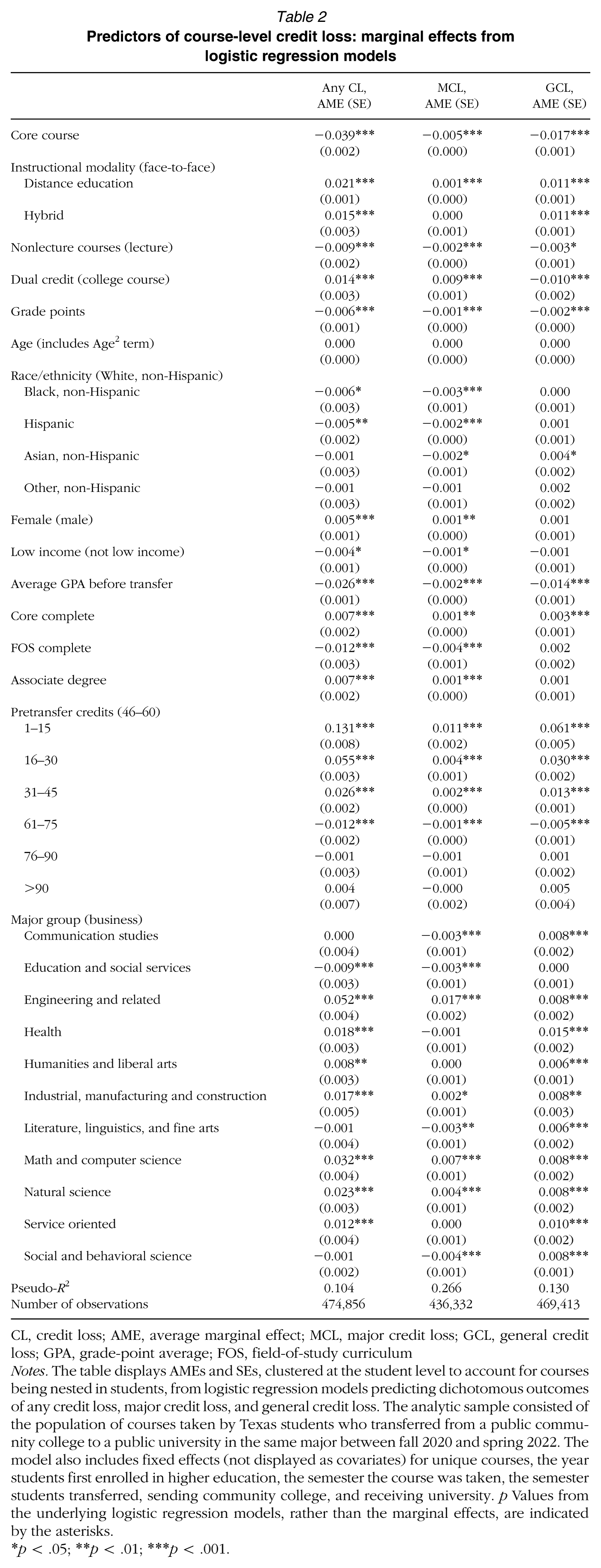
CL, credit loss; AME, average marginal effect; MCL, major credit loss; GCL, general credit loss; GPA, grade-point average; FOS, field-of-study curriculum
Notes. The table displays AMEs and SEs, clustered at the student level to account for courses being nested in students, from logistic regression models predicting dichotomous outcomes of any credit loss, major credit loss, and general credit loss. The analytic sample consisted of the population of courses taken by Texas students who transferred from a public community college to a public university in the same major between fall 2020 and spring 2022. The model also includes fixed effects (not displayed as covariates) for unique courses, the year students first enrolled in higher education, the semester the course was taken, the semester students transferred, sending community college, and receiving university. p Values from the underlying logistic regression models, rather than the marginal effects, are indicated by the asterisks.
*p < .05; **p < .01; ***p < .001.
Predictors of student-level credit loss outcomes: ordinary least squares regression
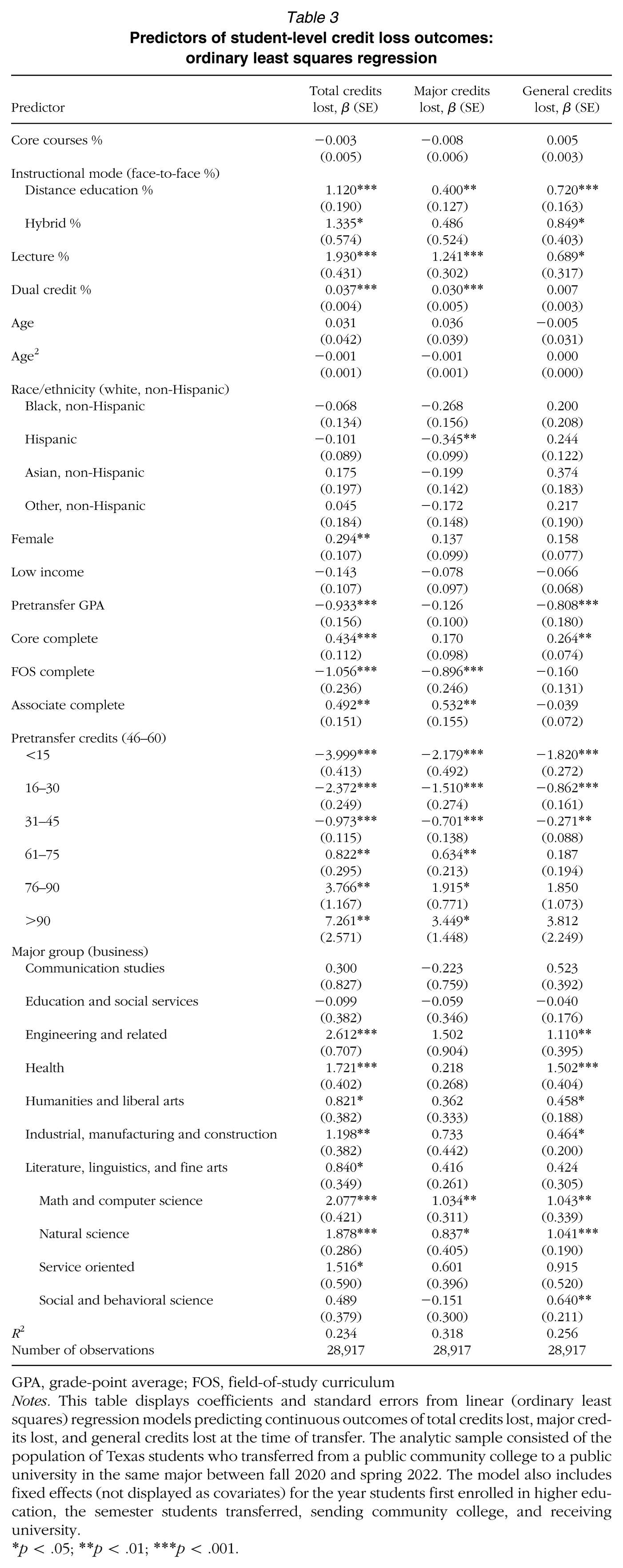
GPA, grade-point average; FOS, field-of-study curriculum
Notes. This table displays coefficients and standard errors from linear (ordinary least squares) regression models predicting continuous outcomes of total credits lost, major credits lost, and general credits lost at the time of transfer. The analytic sample consisted of the population of Texas students who transferred from a public community college to a public university in the same major between fall 2020 and spring 2022. The model also includes fixed effects (not displayed as covariates) for the year students first enrolled in higher education, the semester students transferred, sending community college, and receiving university.
*p < .05; **p < .01; ***p < .001.
How Do Components of Our Conceptual Framework Relate to Credit Loss?
Course Characteristics
Credit loss varies meaningfully across courses. Even when using unique course fixed effects, characteristics of a pretransfer course significantly predicted its probability of credit loss. Designation as a core course was negatively associated with all three course-level credit-loss indicators, suggesting that core courses are less likely to be lost than noncore courses (see Table 2). Core status is associated with a 3.8 pp decrease in the probability that a course will be lost (AME = −.038; SE = .002; p < .001). At the student level, the percentage of courses students completed in the core curriculum was not related to the number of total, general, or major credits lost (see Table 3). Conversely, courses taken as distance education or hybrid courses were more likely to be lost—compared with face-to-face courses—in all course-level models and were significantly related to credits lost in student-level models, although hybrid courses were not significantly related to MCL. Dual-credit courses were significantly more likely to be lost for any reason compared with non-dual-credit courses. In the student-level analysis, each additional percent of courses completed as dual credit was associated with a .04 and .03 credit increase in TCL and MCL, respectively, but was not significantly associated with GCL. Nonlecture courses (e.g., labs and seminars) were less likely to be lost than lecture courses. Finally, the grade students received in the course was inversely related to credit loss. Each additional point on a 0–4 grade-point scale was associated with a 0.6 pp decrease in the probability of any credit loss.
Student Demographic Characteristics
We found limited evidence of disparities in the probabilities of credit loss at the course level across demographic groups when controlling for all other measures. In the course-level models, there was no significant relationship between race/ethnicity and GCL, but we found some evidence that courses completed by Black and Hispanic students—compared with White students—had slightly lower probabilities of any credit loss and MCL. Courses completed by women appeared somewhat more likely to be subject to any credit loss and MCL compared with courses taken by men, whereas courses completed by low-income students (compared with non-low-income peers) were less likely to experience any credit loss or MCL.
In the student-level analyses of credits lost, all but two of the 18 estimates of demographic variables were not significant. The only significant racial/ethnic indicator was for Hispanic students in predicting credits lost due to MCL, where identifying as Hispanic (vs. White) was associated with losing .35 fewer credits due to MCL (β = −.345; SE = .099; p < 0.01). Identifying as female also appeared positively related to TCL, where it was associated with a .29 credit increase in TCL but did not appear significantly related to GCL or MCL.
Pretransfer Academics
In contrast to demographics, many of students’ pretransfer academic characteristics were substantively and significantly related to credit loss. In the course-level models, each 1-point increase in GPA on a 4-point scale corresponded with a 2.6, 0.2, and 1.4 pp decrease in the predicted probabilities, respectively, of ACL, MCL, and GCL. In the student-level models, a 1-point increase in GPA was associated with a 0.93 credit decrease in TCL and a 0.81 credit decrease in GCL. Completing the core curriculum or an associate degree before transfer was related to greater total credit loss, whereas completing a FOS pathway was inversely related to TCL (and MCL in particular). This pattern carried into the student-level models as well. The number of credits students completed before transfer also was found to significantly relate to credit loss, but the patterns are reversed between the course- and student-level models. In the course-level model, the more credits a student earned prior to transfer, the less likely a given courses credit was to be lost. In the student-level model, the more pretransfer credits students earned, the greater their amount of credit loss (particularly TCL). Thus, completing additional pretransfer courses may decrease the probability that each individual course is lost while simultaneously increasing the total amount of credit loss a student is likely to experience.
Majors
We found significant variation across major groups in both the probability that courses were lost and, for students, the amount of credits lost. For example, courses taken by students in education and social services had a significantly lower probability of ACL (and MCL) compared with courses among business majors, the reference group and modal major (see Table 2). In contrast, courses completed by students transferring into every other major group (except social and behavioral science) had significantly higher probabilities of ACL than business majors. Courses completed by students majoring in engineering; industrial, manufacturing, and construction; math and computer science; and natural science were more likely to be lost across ACL, MCL, and GCL compared with courses completed by business students.
We found similar patterns in the student-level analyses of credits lost (see Table 3). Students majoring in engineering fields; health; humanities; industrial, manufacturing, and construction; math and computer science; and natural science were all estimated to have higher TCLs and GCLs than business students, with math and computer science and natural science majors also experiencing higher MCLs. For example, compared with business, students who majored in math and computer science lost an estimated 2.1 additional credits to TCLs, driven by an estimated 1 credit lost to each MCL and GCL.
Community Colleges
To illuminate variation in credit loss across colleges, we showed the relationships between sending/receiving institutions and TCL in Figure 1 and between sending/receiving institutions and both MCL and GCL in Figure 2. The figures present estimates obtained from institutional fixed effects included in our student-level models. Appendix C in the online version of the journal presents similar figures from the course-level models; we focus on the student-level models here to minimize redundancy.
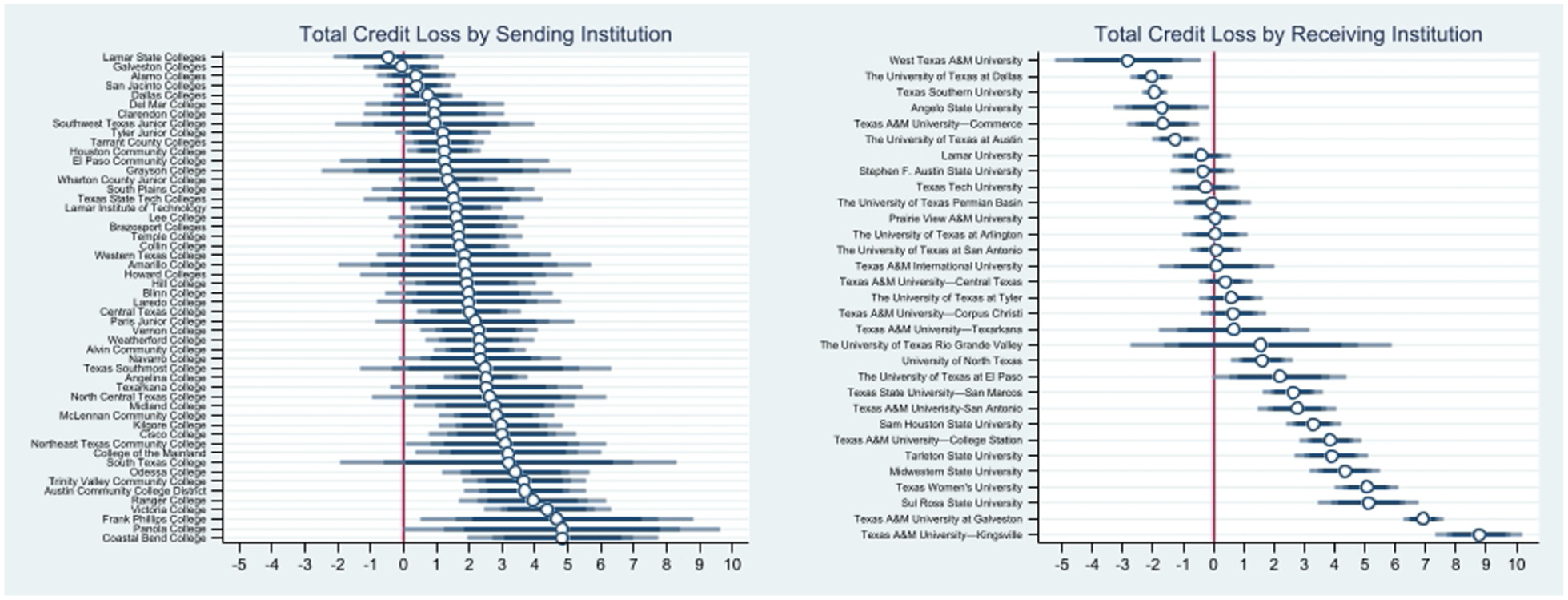
Variation in total credit loss across sending and receiving institutions.
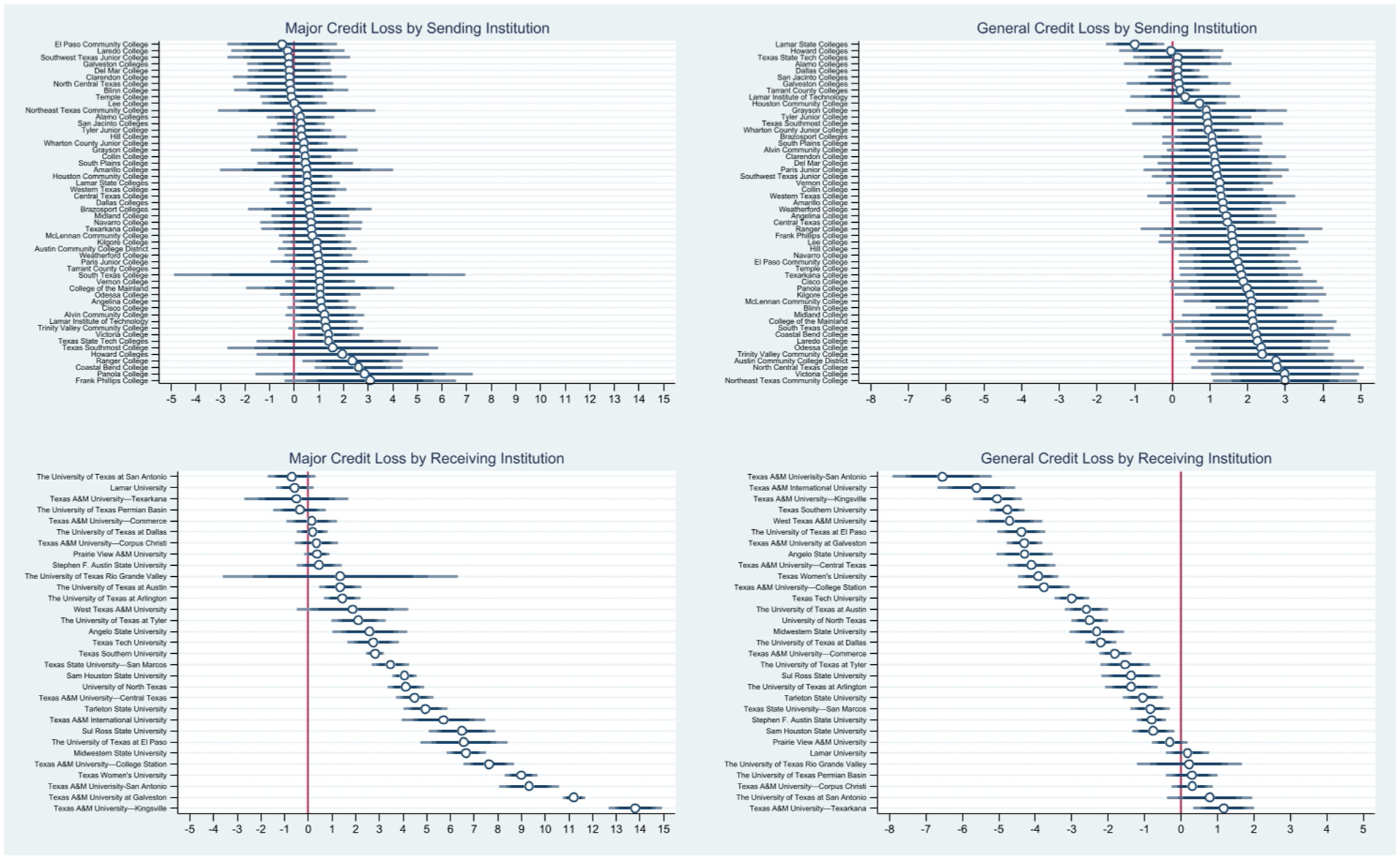
Variation in major credit loss and general credit loss across sending and receiving institutions.
In the leftmost panel of Figure 1, we illustrate significant differences in students’ TCL across sending college. Roughly half the community colleges have significantly higher TCLs compared with the modal transfer-sending college, as evidenced by the confidence intervals not crossing the vertical red line. Controlling for other variables in the model, the results suggest that transferring from a community college with one of the highest TCL estimates results in students losing roughly 5 more credits compared with transferring from the modal sending college.
However, these differences between community colleges are less pronounced for students’ MCL and GCL (see top two panels of Figure 2), which isn't surprising because TCL is a cumulative measure of MCL and GCL. In both models, the range of community college fixed effects is only about 3 credits. Roughly half the fixed-effect estimates from the GCL model appear significantly different from the modal sending college (top-right quadrant), but very few of the estimates are statistically significant in the MCL model (top-left quadrant). The results suggest a stronger relationship between sending college and students’ GCL than MCL.
Universities
The variation between universities in TCL, MCL, and GCL is substantial. In Figure 1 (left panel), the difference between universities with the highest and lowest TCL estimates is ~12 credits, roughly equivalent to four courses. For six universities, students have significantly lower TCLs than the reference university, whereas students experienced higher average TCLs at 12 universities. There are fewer universities than community colleges, which contributes to more observations (i.e., students) within each institution and increased precision in the estimates. However, the figure suggests that there is greater variation in students’ TCLs across universities than across community colleges.
These patterns are starker for MCL and GCL. Figure 2 (lower-right quadrant) shows that most universities have MCL estimates that are significantly different from students’ average MCLs at the reference university (no overlap with the red line) and at other universities (no overlap with another estimate's confidence interval). The difference in MCLs between the universities with the lowest and highest estimates is ~15 credits, equivalent to five courses or a semester of full-time coursework. Although universities’ variation in GCLs is not quite as extreme, the difference in students’ average GCLs across universities with the highest and lowest estimates is roughly 8 credits, compared with 3 credits for the range of community college estimates.
How Did the Influence of Institutions Vary Across Types of Credit Loss and Majors?
The prior analyses highlighted pronounced between-university variation in credit loss. To address RQ3, we further explored this variation by fitting separate multilevel models to all three student-level credit-loss variables, delimiting models to subsamples of students based on their major area of concentration. The models controlled for community college fixed effects but treated universities as a random variable, which allowed us to estimate the magnitude of between-university variation for each major by credit-loss type combination. Table 4 provides the ICC estimates from the models, which can be interpreted as the amount of unexplained variation in credit loss accounted for by universities. Because the models are not “empty” (i.e., they include covariates), the value of the ICC in a given model is less important than the relative magnitude of the ICCs across models for understanding variation in credit loss across universities and majors.
Intraclass correlation coefficients from multilevel student-level models of credit loss types by major group
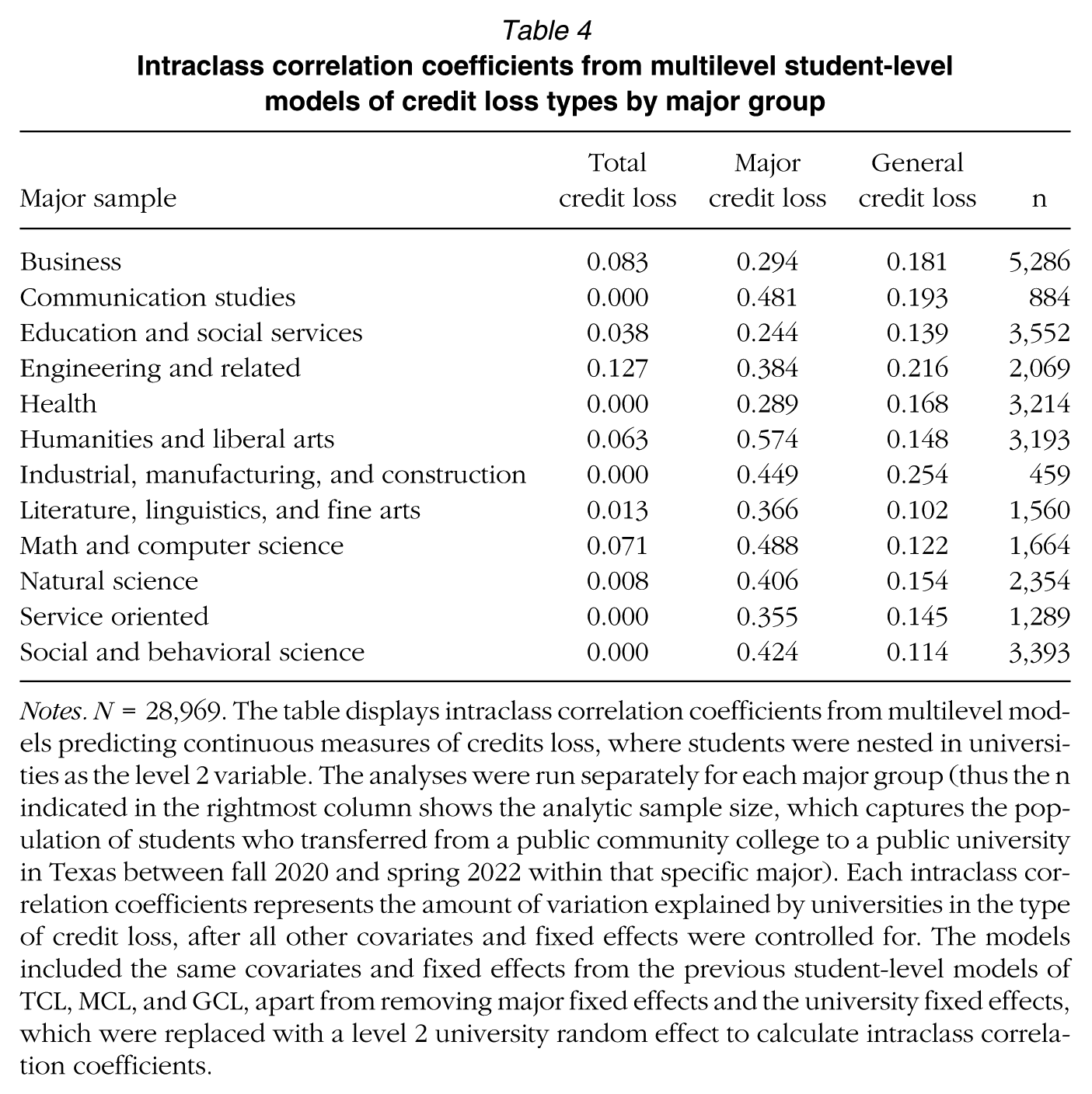
Notes. N = 28,969. The table displays intraclass correlation coefficients from multilevel models predicting continuous measures of credits loss, where students were nested in universities as the level 2 variable. The analyses were run separately for each major group (thus the n indicated in the rightmost column shows the analytic sample size, which captures the population of students who transferred from a public community college to a public university in Texas between fall 2020 and spring 2022 within that specific major). Each intraclass correlation coefficients represents the amount of variation explained by universities in the type of credit loss, after all other covariates and fixed effects were controlled for. The models included the same covariates and fixed effects from the previous student-level models of TCL, MCL, and GCL, apart from removing major fixed effects and the university fixed effects, which were replaced with a level 2 university random effect to calculate intraclass correlation coefficients.
We note three key findings from Table 4. First, there was greater between-university variation in MCLs and GCLs than TCLs in the observed major subgroups of students. Indeed, for some majors, universities explain zero variation in students’ TCLs. Second, the ICC estimates for MCLs were larger than those for GCLs, likely due to program variation across universities in whether courses apply to the major. Third, there was considerable variation across major groups in the extent that the university explains credit loss. For example, the degree of between-university variation in MCLs was twice as large for students transferring into humanities and liberal arts (ICC = 0.574) compared with education and social services (ICC = 0.244). Universities explained roughly 2.5 times as much variation in GCLs for students transferring into industrial, manufacturing, and construction majors (ICC = 0.254) compared with literature, linguistics, and fine arts (ICC = 0.102). Overall, the results suggested that observed variation in the number of credits lost across universities depends both on type of credit loss and the major pathway.
Discussion
In the past decade, growing research illuminated credit loss during the transfer process, correlates of credit loss, and how credit loss shapes subsequent college outcomes (e.g., Giani, 2019; Giani et al., In press; Monaghan & Attewell, 2015; Simone, 2014; Spencer, 2022). However, data limitations have made it difficult to accurately measure credit loss—particularly the phenomenon of major credit loss (Hodara et al., 2017; Kadlec & Gupta, 2014)—and the existing literature lacked conceptual frameworks explicating credit-loss mechanisms. To address these limitations, we proposed and tested a novel conceptual framework drawing on prior research and theory related to student and credit transfer. We described seven key factors that may predict credit loss: (a) pretransfer course characteristics, (b) major pathway, (c) pretransfer academics, (d) student characteristics, (e) sending institution policies/practices, (f) receiving institution policies/practices, and (g) state and system policies/practices. Although our empirical analyses could not test all components given data limitations (e.g., lack of measures on transfer-student capital) and the analytic sample (e.g., a single-state sample with no variation in state policy), we were otherwise able to build comprehensive models aligned with the conceptual framework. The framework itself also can guide future research using different data sources.
Overall, our empirical results support our hypotheses that components of the conceptual framework relate to credit loss, with one exception. We found modest differences between demographic groups in their probability of losing credits, and when differences were significant, students from historically marginalized groups were estimated to have lower probabilities of credit loss. Given prior evidence of inequities in vertical transfer (Chase et al., 2012; Crisp & Nuñez, 2014; Dougherty & Kienzl, 2006; Dowd et al., 2008; Wood et al., 2011), some caveats should be borne in mind, however. First, our focal sample comprised vertical transfer students who were positively selected because they navigated the transfer process—not to mention that it focused on students who maintained their major across institutions and therefore likely differed from the analytic samples in prior research. Even within this positively selected group of vertical transfer students, we caution against interpreting the results as evidence of equity in credit transfer. For example, students from historically marginalized backgrounds may be more likely to enroll in courses, majors, or institutions with higher rates of credit loss, which would mean that inequalities in credit transfer across demographic groups may exist but would not be apparent using models controlling for courses, majors, and institutions. For these reasons, we encourage future researchers to examine potential inequities in credit loss.
Apart from this exception, all other components of the framework related to credit loss. Our results underscore the importance of accounting for unique courses completed given the variation in credit loss across unique courses in the same subject. Course characteristics also shaped their transferability, at times in unexpected ways. We found that courses taken in online/hybrid formats were more likely to be denied credit than in-person courses. We are not aware of state or institutional policies that relate to how course modality or delivery influences credit loss—both state policy and articulation agreements typically stipulate that identical courses should receive identical credit transferability decisions regardless of course modality. Similarly, dual-credit courses were more likely to be lost and contributed to students’ cumulative TCL and MCL. This may occur because students’ selection of dual-credit courses occurs during high school, likely before determining their major, or due to faculty discretion. Courses misaligned with a destination major likely will not apply toward that program; faculty have considerable discretion over credits that apply toward a major (Bailey et al., 2015; Schudde & Jabbar, 2024). Future research should examine how stakeholders’ perceptions of nontraditional course delivery formats or dual-credit courses—for example, perceptions of “rigor”—influence decisions to accept or apply transfer credits (Duncheon & Relles, 2020; Xu & Jaggars, 2014).
Even controlling for courses completed, students’ probability of credit loss (and the variation in credit loss across universities) depended on their major. In this study, we primarily analyzed broad major areas and found that STEM pathways—specifically engineering, math and computer science, and natural science—had high rates of credit loss, particularly compared with the most common transfer major (business). More research is needed to examine the mechanisms for credit loss across majors. Transfer-relevant personnel at colleges and universities describe credit transfer processes according to the rigidity or flexibility of students’ majors (Schudde et al., 2025). For this reason, examining path homogeneity among students traversing majors may be a promising line of future inquiry on credit loss (Heileman et al., 2018; Jarratt et al., 2024; Kizilcec et al., 2023). The extent to which majors require within-major courses versus nonmajor courses also may explain credit loss and should be explored in future research.
Pretransfer academic characteristics also predicted students’ credit loss, although some estimated relationships did not align with our hypotheses. Higher pretransfer GPA and FOS completion were negatively correlated with credit loss, as anticipated. However, completing fewer credits (1–15), the core curriculum, and an associate degree all were associated with greater credit loss. Students in Texas report mixed messages between community colleges and prospective universities, where community colleges encourage more pretransfer credits (e.g., completing the core and/or an associate degree) and prospective universities suggest transferring sooner to avoid credit loss (Schudde & Jabbar, 2024). In states with guaranteed-transfer associate degrees, pretransfer associate degrees may minimize credit loss, but such a policy is not implemented in Texas (ECS, 2022). Although it is not clear why students who completed fewer credits or the core appear more likely to experience credit loss, it is possible that core completers accrue more than its 42-credit limit. The positive link between core credits and student success diminishes after 42 credits, at which point students may “over-accrue” core courses (Schudde et al., 2023).
Among our most important contributions is novel evidence of institutional variation in credit loss. The effects of state policy on transfer-student outcomes appear mixed (e.g., Anderson et al., 2006; Baker, 2016; Baker et al., 2023; Boatman & Soliz, 2018; Gross & Goldhaber, 2009; LaSota & Zumeta, 2016; Roksa & Keith, 2008; Spencer, 2021), contributing to the growing emphasis on reforming institutional policy and practice—particularly at community colleges—to improve community college transfer and baccalaureate completion rates (Bailey et al., 2015). Although warranted, our results suggest that credit loss is more heavily influenced by universities than community colleges, particularly for specific types of credit loss.
Although this study could not capture the institutional mechanisms contributing to credit loss, we consider possible mechanisms that should be explored in future research. University personnel can stymy well-intentioned transfer reforms (Schudde & Jabbar, 2024; Schudde et al., 2021). Examining the institutional transfer logics of university personnel may unpack their rationales for credit denial and how they vary across institutions and departments (Schudde et al., 2025). Universities also vary in the rigidity versus flexibility of their degree plans, contributing to differences in credit loss. Universities with highly prescriptive degree plans may exacerbate credit loss, an insight that aligns with research on path homogeneity (Heileman et al., 2018; Jarratt et al., 2024; Kizilcec et al., 2023). Finally, faculty members within departments often evaluate credits for transfer and application to specific major requirements (Schudde et al., 2025), yet, the time and effort faculty dedicate to credit transfer evaluation likely vary (based on priorities, expectations, and professional development), which may contribute to additional variation in credit loss across departments and institutions. Understanding how universities’ policies, practices, and institutional cultures contribute to credit loss—both overall and within specific major pathways—is a critical area for future inquiry, particularly qualitative studies examining these phenomena, ideally in various state contexts.
Implications for Policy and Practice
We conclude with three key implications for policy implementation, program design, and student advising. Existing transfer policies likely need to be optimized, refined, and more fully implemented. Despite the centrality of policies such as core curriculum and transfer pathways (e.g., FOS) in state policy, students and college personnel are often unfamiliar with or misunderstand these policies, limiting their benefits (Schudde & Jabbar, 2024). States and institutions must ensure that advisors, faculty members, and administrators understand the design of these policies, potentially through training. State and institutional policies should clarify that courses taken online/hybrid or as dual credit should be as likely to transfer as identical courses taken in traditional formats. State policies also could clarify minimum grades needed to transfer to minimize ambiguity and institutional variation in these polices.
Much of the reform at community colleges has focused on revamping academic programs, such as by creating metamajors that allow students flexibility in course taking within programs comprising the metamajor (Jenkins & Cho, 2013). However, the benefits of these community college reforms are limited when universities adopt rigid programs of study (Jarratt et al., 2024; Kizilcec et al., 2023). Although course requirements are necessary to distinguish majors from each other, flexibility in course requirements—particularly for nonmajor courses—likely mitigates credit loss. In majors with high rates of credit loss, both statewide and at particular universities, course requirements may need to be reassessed. Faculty within these departments must play an active role in these efforts.
Finally, given the complexity inherent in navigating transfer, students need early and effective advising to ensure that they understand why their courses will transfer or not. This is particularly critical given the growth in high school students completing college-level coursework. States such as Texas have begun to mandate that high school students accumulating large numbers of dual-credit courses receive academic advising from the college providing the dual-credit courses. Students also need advising about how the credits they are accumulating are aligned with programs at transfer destinations they are considering. Partnerships between community colleges and universities are critical to ensure that students receive this advising.
Supplemental Material
sj-docx-1-aer-10.3102_00028312251409063 – Supplemental material for Toward a Comprehensive Model Predicting Credit Loss in Vertical Transfer
Supplemental material, sj-docx-1-aer-10.3102_00028312251409063 for Toward a Comprehensive Model Predicting Credit Loss in Vertical Transfer by Matt S. Giani, Lauren Schudde and Tasneem Sultana in American Educational Research Journal
Footnotes
Acknowledgements
The authors thank Wonsun Ryu and Catalina Vasquez for their research support, Melissa Humphries and Christina Zavala for their guidance in using the Texas Higher Education Coordinating Board's credit-loss data used in this study, and Laura Brennan, Molly Gully, Jaslyn Rose, Michael Kelly, Alexis Karlson, Stephanie Perez, and Ann-Marie Scarborough for their collaboration.
Author Note
The conclusions of this research do not necessarily reflect the opinion or official position of the Texas Education Research Center, the Texas Education Agency, the Texas Higher Education Coordinating Board, the Texas Workforce Commission, or the State of Texas.
Funding
This research was made possible through generous support from the Greater Texas Foundation and through Eunice Kennedy Shriver National Institute of Child Health and Human Development grants (P2CHD042849 and T32HD007081).

M
L
T
References
Supplementary Material
Please find the following supplemental material available below.
For Open Access articles published under a Creative Commons License, all supplemental material carries the same license as the article it is associated with.
For non-Open Access articles published, all supplemental material carries a non-exclusive license, and permission requests for re-use of supplemental material or any part of supplemental material shall be sent directly to the copyright owner as specified in the copyright notice associated with the article.
