




Abstract
This mixed methods study explored elementary students’ (N = 263) writing enjoyment, their perceptions of teacher writing enjoyment, self-regulation, and grades. In the quantitative strand, we examined how student perceptions of teacher writing enjoyment and student writing enjoyment relate to student writing self-regulation and writing grades using structural equation modeling. Findings revealed a positive relationship among student-perceived teacher writing enjoyment, student writing enjoyment, and student writing self-regulation and grades. In the qualitative strand, we explored responses of students with high or low writing enjoyment ratings to understand aspects of the instructional environment that contribute to students’ affective experiences with writing. Much of what determines students’ enjoyment of or aversion to writing fell in to one of two categories, regardless of the degree to which they enjoy writing: writing preferences (e.g., topic/genre selection, writing environment) or mood and motivation (e.g., student mood at the time of writing, self-efficacy for writing).
When we asked elementary students to draw a picture of a recent writing experience and how that experience made them feel, joy was a prominent feature within the responses of many students (Zumbrunn, Ekholm, Stringer, McKnight, & DeBusk-Lane, 2017). Whereas some children represented themselves writing with beaming smiles, others included hearts, balloons, or grinning teachers with phrases such as, “Yay, I get to write!” in their drawings. Broadly, enjoyment in academic contexts has been linked with behavioral engagement (Pekrun & Linnenbrink-Garcia, 2012; Sinatra, Heddy, & Lombardi, 2015), self-regulated learning, problem solving (Goetz, Hall, Frenzel, & Pekrun, 2006), and achievement (Pekrun, Lichtenfeld, Marsh, Murayama, & Goetz, 2017). However, academic enjoyment can be domain-specific (Goetz, Pekrun, Hall, & Haag, 2006), and little research has explicitly investigated the relationships between student enjoyment of writing and writing outcomes. Further, intended or not, teachers send messages—both implicit and explicit—about their own beliefs in the classroom, and students’ perceptions of these messages are often tied to student motivation and engagement (Skinner & Belmont, 1993). Indeed, students have clear perceptions about their teachers’ beliefs about writing, and research highlights the potential of students’ perceptions of teacher enthusiasm to serve as a catalyst for writing enjoyment (Patrick, Hisley, & Kempler, 2000; Zumbrunn, 2016; Zumbrunn et al., 2017).
Given the potential malleability of academic emotions (Pekrun, Goetz, Frenzel, Barchfeld, & Perry, 2011; Schutz, Hong, Cross, & Osbon, 2006), the purpose of this mixed methods study was to better understand what students enjoy about writing and test links between students’ perceptions of writing enjoyment—both their own and their teachers’—and their writing behaviors and success. In the quantitative phase of the study, we test a specific model in which student writing enjoyment serves as a potential mediator in the relationship between student perceptions of teacher enthusiasm and two outcomes—writing grades and writing self-regulation. In the qualitative phase of the study, we investigate other factors that contribute to students’ affective experiences of writing. We propose that a better understanding of student writing enjoyment will provide valuable insight into how students experience writing in the classroom, which can inform how teachers structure their writing classrooms.
Enjoyment in the Classroom
Students experience a range of discrete emotions during learning activities, and according to the control-value theory of academic emotions, students’ emotions are proximally determined by their cognitive appraisals of academic material and other factors within the learning context (Pekrun, 2006; Pekrun, Frenzel, Goetz, & Perry, 2007). The positive, activating emotion of enjoyment is at the heart of student learning behavior and success (Frenzel, 2014; Pekrun, Goetz, Titz, & Perry, 2002). For example, in a longitudinal study of middle school–age students, Goetz, Hall, et al. (2006) found a strong positive relationship between students’ academic enjoyment and their use of learning strategies. Similarly, Pekrun and colleagues (2017) found a positive reciprocal relationship between math enjoyment and math grades in a 5-year longitudinal study of secondary students.
Teacher enjoyment is critical in the classroom as well. Findings show linkages between teachers’ enjoyment and their instructional practices (Frenzel, 2014). Exploring the nature of teacher enjoyment, Frenzel, Goetz, Stephens, and Jacob (2009) found that “joyful” teachers delivered more quality instruction in the classroom than their colleagues who reported lower ratings of instructional enjoyment. Findings also indicated that students observed a difference between teachers displaying varying levels of enjoyment during instruction. Through the processes of appreciation-oriented modeling and value induction, students’ perceptions of teacher enjoyment can play a role in their own enjoyment of learning in the classroom (Frenzel, Goetz, Lüdtke, Pekrun, & Sutton, 2009).
In line with social-cognitive frameworks of emotion, cognition, and motivation (Bandura, 1986; Pekrun, 2006), teacher enjoyment expressed through observable enthusiastic behaviors can induce student enjoyment (Frenzel, Goetz, Lüdtke et al., 2009; Frenzel, Becker-Kurz, Pekrun, Goetz, & Lüdtke, 2018; Hatfield, Cacioppo, & Rapson, 1994; Meyer & Turner, 2007; Pekrun et al., 2007). For example, Patrick et al. (2000) found that students who received instruction from teachers with high levels of enthusiasm reported greater motivation for class material than students who received instruction from teachers with low levels of enthusiasm. Similarly, teacher enjoyment has been found to be positively associated with student enjoyment of mathematics in middle school students (Frenzel, Goetz, Lüdtke et al., 2009).
Student Writing Enjoyment
Positive emotions, like enjoyment, may be particularly important in cognitively taxing tasks, such as academic writing. Writing is often a prolonged and self-sustained endeavor that requires a great deal of self-regulation (Graham & Harris, 2000; Hayes & Flower, 1986; Zimmerman & Riesemberg, 1997), and positive emotional experiences while writing may help sustain such self-regulatory behaviors (Boekaerts & Corno, 2005; Goetz, Hall, et al., 2006; Graham, 2018;) and thereby improve writing performance. Consistent with these propositions, the extant literature mostly suggests a positive relationship between enjoyment of writing and writing achievement, though findings across studies are mixed. A line of research conducted by Graham and colleagues with elementary students (Graham, Berninger, & Abbott, 2012; Graham, Berninger, & Fan, 2007; Graham, Harris, Kiuhara, & Fishman, 2017) has found that students who report more enjoyment of writing tend to write longer and higher-quality texts. Although similar results have been found with older students (Bruning, Dempsey, Kauffman, McKim, & Zumbrunn, 2013; Clark & Douglas, 2011), Olinghouse and Graham (2009) found the relationship between writing enjoyment and writing proficiency to be nonsignificant in a study with elementary students. These contradictory findings cloud our understanding of the relationship between student writing enjoyment and writing success. Further, we are aware of no writing research that has quantitatively investigated the extent to which students’ affective experiences regarding writing are related to their self-regulatory behaviors.
Teacher educators and writing instructors have long heralded the importance of teachers’ enthusiasm for writing (e.g., Calkins, 1983; Elbow, 1998), arguing that enthusiastic teachers will produce enthusiastic writers. Several qualitative studies provide evidence to support this claim. A series of studies conducted by Pressley and colleagues (e.g., Pressley, Gaskins, Solic, & Collins, 2006; Pressley, Mohan, Bogaert, & Fingeret, 2005; Pressley, Raphael, Gallagher, & DiBella, 2004; see also Graham & Perin, 2007, for commentary on these studies) examining the instructional practices of exemplary writing teachers found that the most effective teachers were enthusiastic about writing and strove to create a positive writing environment in their classrooms. In a qualitative study conducted by Kaufman (2009) examining how students reacted to a teacher’s writing modeling, one student wrote of her instructor, “[he] is passionate about the language arts. He makes me want to create and share my writing” (p. 345), which attests that enthusiasm for writing can be contagious. Inversely, a teacher’s lack of enthusiasm may dampen students’ enjoyment of writing. In an observational study of preservice teachers, Street (2003) described how one preservice teacher consistently seemed “miserable” (p. 45) when teaching writing, which led students to be uninterested in their writing tasks. Although the findings of these qualitative studies consistently indicate a positive relationship between teacher and student writing enjoyment across a range of grade levels, the lack of quantitative research makes it difficult to estimate the magnitude of the relationship between these constructs. Moreover, we know very little about other factors that may contribute to students’ affective experiences while writing.
Purpose of the Study
The purpose of our study was to further investigate writing enjoyment. Given the social context of writing, we specifically investigated students’ perceptions of teacher writing enjoyment as a predictor of student writing enjoyment. And because there is no consensus in the literature regarding which factors most strongly contribute to students’ writing enjoyment, we called on children’s voices to explore additional elements that contribute to writing enjoyment. To do this, we used a concurrent embedded mixed methods design that enabled us to examine both quantitative and qualitative aspects of students’ writing enjoyment (Creswell & Plano Clark, 2011). We selected this design (QUAN[qual]) because it provided the opportunity to statistically test the relationship and provide a rich account of factors within the writing classroom within a single study.
In the quantitative strand of this study, we tested the direct and indirect roles of elementary student perceptions of teacher writing enjoyment and student writing enjoyment on student writing outcomes using structural equation modeling. Outcomes for this study included student writing self-regulation, operationally defined as the extent to which students plan, revise, and persist in their writing, and student writing grades, operationally defined as teacher perceptions of student writing achievement. As outlined in Figure 1, we hypothesized that students’ perceptions of their teachers’ writing enjoyment would positively relate to their writing enjoyment, self-regulation, and grades. Further, based on Keller, Hoy, Goetz, and Frenzel’s (2016) supposition that motivational variables likely mediate the path between teacher enthusiasm and student grades, we hypothesized that perceptions of instructional enthusiasm would relate indirectly to writing outcomes via student enjoyment of writing.

Hypothesized relationship between teacher writing enjoyment, student writing enjoyment, self-regulation, and grades.
The purpose of the qualitative strand of the study was to deepen our understanding of the aspects of the writing classroom environment that potentially inform student writing enjoyment. After collecting qualitative written response data of the classroom ecological factors related to student writing enjoyment, we used purposive sampling to identify students with either high or low ratings of writing enjoyment from the quantitative data. We then explored student perceptions of what makes writing either an enjoyable or aversive experience for children within these two groups.
Quantitative Strand Method
Participants
Participants in the quantitative strand of the study included 221 fifth-grade students attending four elementary schools in a large Southeastern public school district. The sample included both males (n = 110) and females (n = 111) who identified as White (48%), Hispanic (23%), Black/African American (22%), Asian (3%), or American Indian/Alaska Native (1%); about 3% of the students identified as two or more races. Approximately 11% of the students received special education services, 10% received gifted education services, 8% received English language learner (ELL) services, and 47% qualified for free or reduced-price lunch.
Data Sources
Quantitative data included both student and instructor measures collected using an online survey platform. Information related to scoring and psychometric properties is discussed for each scale separately. Descriptive statistics and factor loadings for all scales used are presented in Table 1.
Reliability Indices, Means, and Standard Deviations of All Variables

Note. Teacher and student writing enjoyment were measured on a 1 to 4 scale. Self-regulation was measured on a 1 to 10 scale. Grades were coded into three categories: A = 3, B = 2, and C and below = 1. Total N = 221. CFA = confirmatory factor analysis.
Perceptions of Teacher Writing Enjoyment
The Perceptions of Teacher Writing Enjoyment Scale (PTWES; Zumbrunn, 2014) is a three-item scale that asks students to rate their perceptions of their teacher’s enjoyment for teaching writing on a scale of 1 (almost never) to 4 (almost always). Items were written to reflect the degree to which students perceive their teachers to enjoy teaching writing. A sample question from the scale is “My teachers enjoy teaching writing to my class.” All items are available in Table 2. The PTWES demonstrates acceptable reliability of scores with a Cronbach’s alpha of .78.
Indicator Items for All Latent Variables

Student Writing Enjoyment
The Liking Writing Scale (LWS; Bruning et al., 2013) is a four-item scale constructed to gauge students’ writing enjoyment on scale of 1 (almost never) to 4 (almost always). A sample item from the scale is “I like writing.” All items for this scale are available in Table 2. The LWS demonstrates acceptable reliability of scores with a Cronbach’s alpha of .81.
Student Writing Self-Regulation
The Teacher-Reported Student Writing Self-Regulation Measure (TRSWSR; Zumbrunn, 2014) is a three-item scale asking teachers to make professional judgements of their students’ capacity for self-regulation when writing. Specifically, the scale prompts teachers to rate each of their students’ frequency of planning, revising, and persisting when writing on a scale of 1 (never) to 10 (always). This brief measure reflects teachers’ observations of students’ self-regulation behaviors critical for effective writing (Zimmerman & Risemberg, 1997). Teachers’ reports of student writing self-regulation are potentially more accurate than students’ reflections of their own strategic behaviors (Wolters, Benzon, & Arroyo-Giner, 2011). All items for this scale are available in Table 2. The TRSWSR demonstrates acceptable reliability of scores with a Cronbach’s alpha of .92.
Student Writing Grades
Students’ quarterly writing grades were collected to serve as a proxy for student writing achievement. Grades were reported using the following grading scale: A (excellent; 90%–100%), B (very good; 80%–89%), C (satisfactory; 70%–79%), D (minimal progress; 60%–69%), and F (failing; below 60%). Due to limited variation at the bottom of the grading scale, student grades were coded into four categories: A = 4, B = 3, C = 2, D and below = 1. Figure 2 presents a frequency histogram of the distribution of each grade category in our sample. Recognizing the limitations of using writing grades as a sole measure of writing achievement, we used grades together with the TRSWSR measure described previously and accounted for the covariance between teachers’ assigned grades and their rating of students’ self-regulation.

Observed distribution of writing grades.
Data Collection
All data were collected during the fall semester. Specifically, data were collected approximately 3 months after the school year commenced to provide adequate time for students to have opportunities to write and teachers to observe their student writers. To ensure that our methodology was developmentally appropriate for elementary students, all instructions for the PTWES and LWS were provided to students in both written and audio formats, and both measures included pictorial representations of the response options (i.e., pictures of cups almost empty and almost full to represent almost never and almost always, respectively). Participants were able to replay directions and questions as often as needed. Each student completed the online scales independently; however, classroom teachers made accommodations based on students’ individual needs (e.g., type dictated responses). Teachers were free to complete the TRSWSR measure at their convenience. Approximately 1 month after initial data were collected for all other variables in the study, quarterly writing grades were reported for each student by classroom teachers.
Data Analysis
Structural equation modeling (SEM) was used to investigate the relationship between student perceptions of teacher writing enjoyment, student writing enjoyment, teacher-reported student self-regulation, and writing grades. The model, as shown in Figure 2, included two primary outcomes: students’ writing self-regulation, as reported by their teachers in Time Period 1, and writing grades, as reported by teachers at the end of the first marking period. Perceived teacher writing enjoyment was included as a predictor of student self-regulation and writing grades as well as a predictor of student writing enjoyment, which was also included as a predictor of both writing outcomes.
The analysis used three latent measures (perceived teacher enjoyment, student enjoyment, and self-regulation) composed of observed indicators that were collected from the writing surveys. Teacher writing enjoyment was measured using the three-item PTWES, self-regulation using the three-item TRSWSR scale, and student writing enjoyment was measured using the four-item LWS. Table 2 includes the items used as indicators for each latent variable, and Table 1 reports reliability indices, means, and standard deviations for each latent measure.
Model estimation and missing data
Data analysis was conducted using Mplus Version 7.11 (Muthén & Muthén, 2015) with the robust maximum likelihood estimator (MLR), which provides robust standard error estimates. Because students were nested within teachers, we used the Mplus “Complex” option, with teacher ID as the clustering variable. This option adjusts standard error estimates using a sandwich estimator to account for clustering (Muthén & Muthén, 2015). Such an approach is preferable to multilevel modeling when researchers want to account for dependencies within the data but have no hypotheses regarding higher level units (McNeish, Stapleton, & Silverman, 2017).
To address potential bias due to missing data, full information maximum likelihood (FIML) was used by applying the MLR estimator in Mplus. This option is preferable to listwise deletion, the default missing data approach using maximum likelihood, in that it requires the data need only be missing at random, as opposed to missing completely at random, which is a much more stringent assumption (Allison, 2002). Using FIML, all observed data contribute to the estimation process, and results using FIML have been shown to be equivalent to those obtained by other standard missing data techniques, such as multiple imputation (Allison, 2002). Overall, rates of missingness were low for the student-provided survey questions, with more than 95% of students responding for all items. Additionally, over 95% of students had a reported writing grade. Missingness was higher for the teacher-reported measure of writing self-regulation, with about 50% of responses missing. Further investigation into patterns of missingness in the teacher-reported measure of self-regulation indicated that about half of the participating teachers did not rate any students (i.e., there was 100% missingness for these teachers). Across teachers who did not have 100% missingness, the average rate of missingness was 7.2% and ranged from 0% to 16%. Several teachers in the study reported not having enough time to complete TSRWSR measures for their students, and the patterns of missingness we found are consistent with this explanation.
Although missingness on the TSRWSR measure is likely due to constraints on teacher time and therefore is likely not attributable to student characteristics, we also investigated patterns between student-level variables and missingness on the TSRWSR measure. To do so, we examined bivariate correlations between student-level variables and a dummy variable indicating missingness on the TSRWSR measure as well as bivariate correlations between student-level variables and observed TSRWSR scores. This approach allowed us to more closely investigate relations among observed and missing values (Enders, 2010). The student-level variables we used in these analyses were drawn from a larger set of variables on which we had data for these students and included several of students’ beliefs about writing, themselves as writers, and their writing environment. Variables that had bivariate correlations with absolute values greater than .1 with the observed TSRWSR observed scores were included in all subsequent analyses as auxiliary variables. Auxiliary variables are variables that are not part of the substantive model but are included in the analysis to aid in missing data estimation procedures (Collins, Schafer, & Kam, 2001). Our approach led to the inclusion of 15 auxiliary variables.
To estimate the structural equation model described previously, bootstrap estimation using the “Bootstrap” option in Mplus was used with 1,000 replications. Significance for the bootstrap estimates was obtained using 95% confidence intervals based on the distribution of the bootstrap results, as opposed to the standard calculation of p values, which assumes a normal distribution of indirect effect estimates and is typically not advised (Kline, 2016). Since bootstrapped estimates of indirect effects are not possible when using a sandwich estimator to account for clustering, these tests were performed without the “Complex” option. Estimates obtained from this estimation did not differ in terms of magnitude or significance and are available from the authors by request.
Findings: Quantitative Strand
The analysis proceeded in three steps: First, the measurement properties and overall fit of the model was tested. All fit indices suggested good fit, χ2 (39) = 52.82, p = .07, RMSEA = .041, 90% CI [0.001, 0.065], Comparative Fit Index [CFI] = .980, Tucker-Lewis Index [TLI] = .972, standardized root mean square residual (SRMR) = .053, based on the thresholds recommended by Hu and Bentler (1999). Since all fit indices suggested strong model fit, the model was retained.
This prompted the second phase of analysis, analyzing the structural relationships between the variables. Results are presented graphically in Figure 3, and standardized beta estimates and explained variance are presented in Table 3. Overall, students who perceived their teachers having more enjoyment when teaching writing tended to have higher writing enjoyment scores (β = .30, p < .001). Further, students with higher writing enjoyment tended to receive higher self-regulation ratings from their teachers (β = .30, p < .001) as well as higher writing grades (β = .26, p < .001). The direct association between perceived teacher writing enjoyment and student self-regulation was not statistically significant (β = .08, p = .58), nor was the association between teacher writing enjoyment and student writing grades (β = –.05, p = .33).
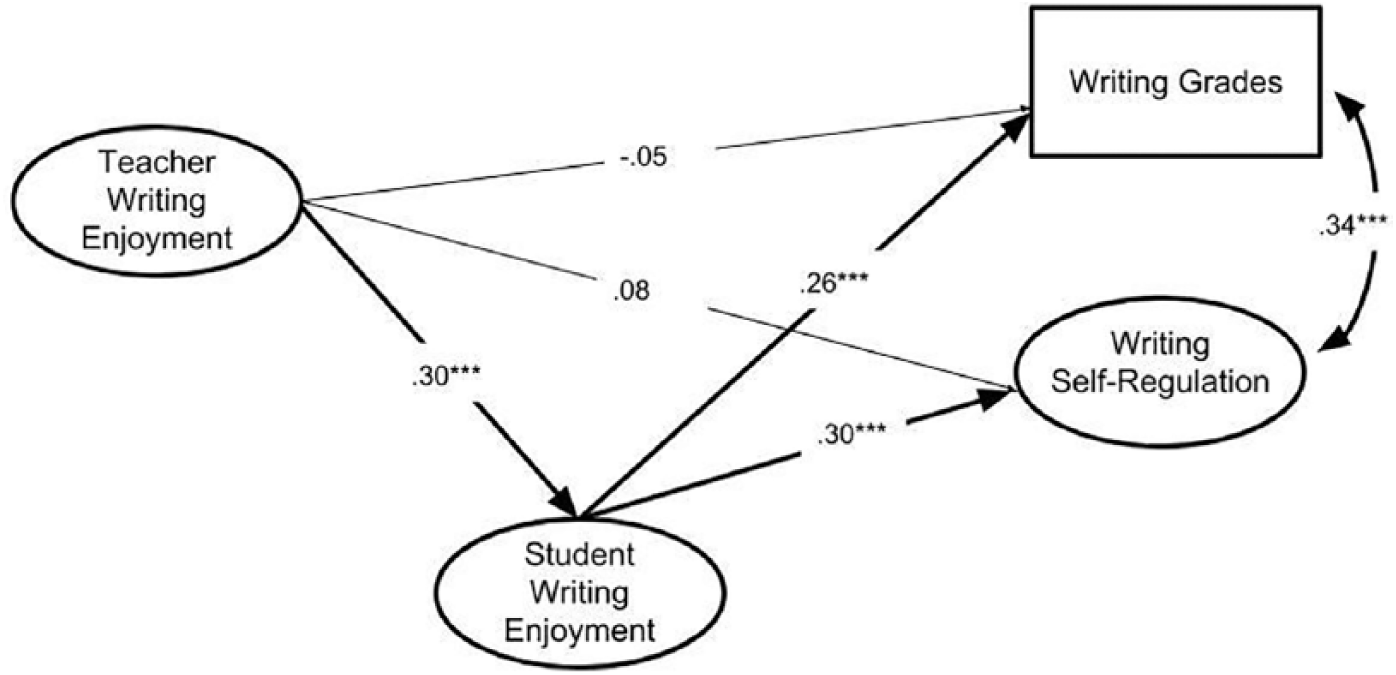
Structural equation modeling results for relationship between teacher writing enjoyment, student writing enjoyment, self-regulation, and grades.
Standardized Beta Coefficients for the Predictor Variables on Each Outcome Variable

Note. Total N = 221. The reported association between self-regulation and grades is a residual covariance.
p < .01. ***p < .001.
To examine the indirect effect of perceived teacher writing enthusiasm through student writing enjoyment, a bootstrap with 1,000 replications was used. Results indicated a significant indirect path from perceived enthusiasm to enjoyment to self-regulation, β = .09, 95% CI [.01, .17]. The total effect of perceived enthusiasm, however, including both direct and indirect paths, was not significant, β = .16, 95% CI [–.06, .38]. Thus, when the indirect effect of student writing enjoyment was included in the model, the direct effect of perceived teacher enthusiasm for writing on writing outcomes was no longer was significant.
The Need for Qualitative Data
The second goal of the current study was to explore factors contributing to students’ writing enjoyment. To do this, we asked children to describe what makes writing enjoyable and unenjoyable. Specifically, we were interested in exploring whether students who varied in writing enjoyment scores as measured by the LWS would provide similar or different responses when describing what makes writing enjoyable or unenjoyable. Having children respond to two easily interpretable open-ended questions enabled us to collect and analyze data from a greater number of children, which helped ensure saturation within the data.
Qualitative Strand Method
Participants
The sample for the qualitative strand of this study was purposefully sampled from results of the quantitative strand. Specifically, the sample included fifth graders from the quantitative strand with low writing enjoyment (LWE; those with predicted scores in the bottom quartile on the latent measure of writing enjoyment ranging from 1.75 to 2.75; n = 47) and high writing enjoyment (HWE; those with predicted scores in the top quartile on the latent measure of writing enjoyment ranging from 3.75 to 4.00; n = 63). The total qualitative sample (N = 110) was similar in demographic composition to the quantitative sample and included both males (n = 50) and females (n = 60) who identified as White (54%), Black/African American (21%), Hispanic (19%), Asian (3%), or as two or more races (4%). Approximately 13% of students received special education services, 10% received gifted education services, 5% received ELL services, and 50% qualified for free or reduced lunch status. Chi-square analyses were conducted to examine group equivalency among demographic variables for the LWE and HWE groups. The LWE and HWE groups did not differ in terms of ethnicity, free or reduced lunch status, or frequency of students receiving special education, gifted, or ELL services. However, the two writing enjoyment groups significantly differed in gender makeup, χ2(1) = 8.74, p < .01; more females were in the HWE group (n = 42) than the LWE group (n = 18).
Data Sources
Qualitative and quantitative data were collected concurrently. Using an online survey format, children were asked to respond to two open-ended questions: “When is writing fun?” (i.e., writing enjoyment) and “When is writing not fun?” (i.e., writing aversion). Instructions and questions were read aloud to participants, and students were able to replay them as often as needed. Responses were not limited by character count, word count, or time. Though students responded to the questions independently, classroom teachers could make accommodations based on students’ individual needs (e.g., type dictated responses).
Qualitative and Mixed Data Analysis
To explore when writing is and is not enjoyable for students, an exploratory descriptive qualitative investigation (Sandelowski, 2000) was conducted. Inductive qualitative data coding included several steps. First, two authors independently reviewed all student responses before coming together to discuss recurring patterns within the data. Using conventional content analysis (Corbin & Strauss, 2008), connections, contrasts, and comparisons between codes were explored to ensure that codes covered all data and were mutually exclusive. Once codes were assigned to each response and co-determined by both reviewers, each reviewer independently analyzed and coded all data using final codes. Reviewers then came back together to conference with one another and determine the final coding, reconciling all discrepancies to 100% agreement. Codes were then grouped into subcategories and categories to organize the data in meaningful ways (Patton, 2002). To explore differences in emerging subcategories and categories for writing enjoyment and writing aversion, the qualitative data were split into two separate data sets, one with responses to the question “When is writing fun?” and a second with responses to “When is writing not fun?” Table 4 provides categories, subcategories, and exemplar quotes for each prompt.
Qualitative Coding Categories, Subcategories, and Sample Responses

Similar to the procedures followed in Zumbrunn, Marrs, and Mewborn (2016), qualitative categorical data were transformed into numerical binary codes; student responses received a binary score of 1 if the response aligned with a structural code and a 0 if it did not. This procedure enabled a quantitative analysis of the qualitative data by determining the frequencies for each subcategory (Onwuegbuzie & Teddlie, 2003). Students’ responses often contained more than one reason to describe when writing is fun and/or not fun; thus, it was possible for responses to align with more than one subcategory. The number of subcategories aligning with each student response ranged from one to six. Some responses (4.5%) provided by the students were incomprehensible (e.g., “pen,” “yes”) or unrelated to the prompt (e.g., “when I get to play soccer,” “totally!!”) and therefore were not coded.
Finally, qualitative and quantitative data were mixed and compared using a joint display (Creswell & Plano Clark, 2011). Qualitative categories and subcategories were compared across writing enjoyment and writing aversion for students in each of the writing enjoyment groups (high and low). Chi-square analyses were conducted to investigate the association between qualitative responses and quantitative writing enjoyment scores. Specifically, we tested for differences in the frequencies of endorsement of each qualitative subcategory between students in the HWE group and the LWE group.
Findings: Qualitative Strand
In this section, we provide the overall patterns across the qualitative data for the full sample selected for this strand of the design, shown in Table 4, and then compare data by writing enjoyment group, as displayed in Table 5. Responses provided by students describing when they find writing enjoyable and not enjoyable primarily fell into two major categories: (a) preferences and (b) mood and motivation.
Qualitative Proportion of Codes by Writing Enjoyment Score for Writing Enjoyment and Writing Aversion

Note. Percentages represent the proportion of the participants whose response aligned with each structural category and subcategory. The five highest percentages for each column appear in bold. LWE = low writing enjoyment; HWE = high writing enjoyment.
Statistically significant group differences, p < .05, as determined by chi-square tests.
Preferences
Many of the qualitative responses children gave for what makes writing both enjoyable (69% of total responses) and unenjoyable (55% of total responses) aligned with the preferences qualitative category that emerged from the data. Student responses aligning with this category highlighted the range of preferences students have when it comes to writing. Subcategories that emerged included: topic/genre selection, autonomy, creativity, and environmental constraints.
Topic/genre selection
Children in this study were quite clear about the types of writing or writing assignments they prefer and those that they wish they did not have to complete. Not surprisingly, responses in the topic/genre subcategory (41.8% of responses for writing enjoyment and 28.2% of responses for writing aversion) highlight that many children enjoy writing about things that are interesting to them. For instance, children wrote that writing is fun “when it is about sports” or “when it’s an interesting topic like if you write about if you ruled the world that would be so fun [sic].” When asked to describe when writing is not fun, many of the reasons children gave began with “When we have to . . . ” and went on to say things like “write on boring subjects.” For example, one student discussed his dislike of writing “about subjects like science, history, or the importence [sic] of doing your homework.” Compared to their peers in the HWE group, more children in the LWE group lamented lengthy writing tasks.
Autonomy
Beyond preferences for different topics and genres of writing, students also reported the importance of maintaining autonomy over their writing. Qualitative responses aligning to the autonomy subcategory comprised 24.5% of the total responses for writing enjoyment and 28.2% of the responses for writing aversion. For writing enjoyment, most students provided a response that was positive but pointed out a desire for freedom in writing, such as “When I get to pick my own cool topic” or “Writing is fun when you write freely without anybody telling you what to write or what not to write.” Again, many student responses for writing aversion that fit in the autonomy subcategory also began with “When I/we have to . . . .” Students in the LWE group shared, “when I am forced to do it [write]” and “when the teachers tell you what you have to write.” Students in the HWE group echoed their LWE peers’ thoughts with responses such as “Writing is not fun when I am being forced to write” or “when I cant [sic] choose what I want to write.”
Creative writing opportunities
Some students reported that writing is more fun when they are able to be creative with what they write (13.6% of total responses), such as through opportunities to illustrate or add pictures to go along with their written text, use their imagination during the writing process, or express themselves. The creative writing opportunities subcategory only emerged within writing enjoyment data. Though students in both the LWE and HWE groups reported similar ideas related to creativity, students with LWE seemed to enjoy being able to use their imagination or “make something up” as they write while students in the HWE group focused on creativity as a means of expression. For instance, students with HWE shared examples such as “Writing poems is fun because I get to express my feelings, and inner soul that lies within me” and “[Writing] gives you a chance to express your feelings,” while students in the LWE group wrote shared “Writing is fun when I can write about adventurous things and scary things” and “Writing is fun when I get to make a lot of things up and imagine a lot of it.”
Writing environment constraints
The final subcategory to emerge in the preferences category related to environmental and time constraints that contribute to students’ enjoyment (5.5% of total responses for enjoyment) and aversion of writing (12.7% of responses for aversion). Some students noted that it was easier to write when they had ample time for writing or the room was quiet. Others reported disliking feeling rushed to write. For instance, one student in the LWE group wrote, “I think writing is not fun when you have a short amount of time.” Another responded, “I don’t like to write when I can’t focus on what I am writing about. That is not very fun.” Though not significant, different trends for writing enjoyment emerged between the HWE and LWE groups (15.9% and 8.5%, respectively). As with task preferences, students in both writing enjoyment groups provided similar reasons for how the environment can keep them from enjoying writing when their response aligned with this category. Students with high writing enjoyment, however, commented that a loud and distracting writing environment was aversive more than their peers in the LWE group. For example, one child in the HWE group wrote, “Writing is not fun when people are distracting you or when people aren’t doing their work and are goofing off.” Another reported, “Writing is only not enjoyable when people talk and interrupt my thoughts and ideas. Also, when we have to stop!;) [sic].”
Mood and Motivation
The second category to emerge from the qualitative data was mood and motivation. Responses aligning with this category made up 20% of student responses for the enjoyment data and 22% of responses for the aversion data. Subcategories that emerged within the mood and motivation category included: student mood, writing self-efficacy, and social aspects of writing.
Student mood
For some children in this study, writing enjoyment (10% of responses) and writing aversion (10% of responses) seemed to be facilitated by their mood at the time of writing. Students with both high and low writing enjoyment indicated that writing is more enjoyable for them when they feel calm and relaxed. Similarly, students in both the HWE and LWE groups indicated that writing is less enjoyable when they are in a bad mood, tired, or frustrated. For example, one student in the LWE group wrote that writing was unenjoyable “when my day is just not going well.” Expressing similar views, a child in the HWE group shared that writing was aversive “when I get frustrated or confused. I get that a lot.” Another wrote, “Writing is not fun when I have a bad day or when I feel sad.”
Writing self-efficacy
Students’ self-efficacy or their beliefs about their ability to write also emerged as an important mood and motivation subcategory for both writing enjoyment (7.3% of responses) and writing aversion (14.5% of responses). Though not statistically significant, a greater percentage of student responses from the HWE group endorsed this subcategory compared with the responses of their peers in the LWE group for both writing enjoyment (11.1% vs. 2.1%, respectively) and writing aversion (17.5% vs. 10.6%, respectively). Most (n = 9) of the student responses from the HWE group mentioned that their ability—or lack thereof—to come up with ideas for their writing played a role in their enjoyment of writing. For example, students wrote that writing is fun “anytime i [sic] can get really juicy details in my head and making peoples [sic] jaw drop” or “when I have many ideas, when writing is fun it feels good to write.” On the other hand, another child reported that writing is not enjoyable “when you have trouble writing and can’t go on anymore.”
Social aspects of writing
The subcategory for social aspects of writing only emerged within the data for enjoyment of writing. Responses within this subcategory referenced sharing writing with others, collaborating, receiving feedback, and the potential for “catching” positive emotions from others. Chi-square analyses indicated a significant difference in the number of student responses aligning with this subcategory between the HWE and LWE groups for writing enjoyment, χ2(1) = 6.44, p = .01. A closer look at the data showed that no students in the LWE group endorsed this subcategory, while nearly 13% of the responses from students in the HWE group aligned with the social subcategory. One child in the HWE group who endorsed this category shared, “When the teachers talk about writing and make [it] fun to do.” Another wrote, “Writing is fun when you are into it and your friends are excited about writing like you are.”
Discussion
Using both quantitative and qualitative data, this concurrent embedded mixed methods study furthers our understanding of elementary student writing enjoyment. In the quantitative strand, and in line with the control-value theory of learning (Pekrun, 2006; Pekrun et al., 2007), our findings suggest a moderate, positive relationship between student writing enjoyment and teacher-reported student writing self-regulation as well as between student writing enjoyment and grades. As predicted by Keller and colleagues (2016), we also found that the relationship between student perceptions of teachers’ writing enjoyment and student writing self-regulation and grades was no longer significant after including students’ writing enjoyment as an indirect effect. While others have found a positive relationship between perceived teacher enthusiasm and student affect (Frenzel, Goetz, Lüdtke, et al., 2009; Patrick et al., 2000), our findings extend this relationship to the domain of writing. The indirect relationship between students’ perceptions of their teachers’ enjoyment of teaching writing, writing self-regulation, and grades is unsurprising; it seems far-fetched that teachers’ excitement about writing in and of itself would directly lead students to write better. However, these findings do suggest that students’ perceptions of their teachers’ writing enjoyment has the potential to influence how they feel about writing. Taken together, the findings from the quantitative strand reinforce the importance of students’ enjoyment of writing as it appears to be a key mediator between teacher enjoyment of writing and students’ writing outcomes and behaviors.
In the qualitative strand, we explored other potential factors that contribute to student writing enjoyment. Overall, we identified several consistent themes from the responses of students across the high and low writing enjoyment groups. When describing what makes writing either fun or not fun, students in both groups most often mentioned the alignment between their writing preferences and writing tasks and/or assignments. Subcategories that emerged from the data in this preferences category related to topic choice, autonomy, creativity, and the environment. Consistent with self-determination theory (Ryan & Deci, 2002) and findings supporting the relationship between autonomy-supportive practices and student motivation (Reeve & Jang, 2006), our findings suggest that students enjoy writing more when they feel some ownership over a writing task, whether by picking their own topic or having the freedom to write expressively. Many students also discussed the impact the environment can have on their writing enjoyment. Indeed, students’ ability to focus among distractions can, even within motivating and productive classroom environments, impact writing enjoyment. Additionally, and in line with social-cognitive frameworks of learning, findings from other studies (Frenzel, Goetz, Lüdtke, et al., 2009; Frenzel et al., 2018; Hatfield et al., 1994), and our quantitative findings, some students shared ways in which their teachers make writing fun, suggesting that teachers’ positive feelings toward writing may be transferred to students.
The second major category to emerge from the qualitative data was mood and motivation. In this category, student responses aligned with subcategories relating to mood at the time of writing, writing self-efficacy, and the social aspects of writing. When students discussed their mood at the time of writing, they mentioned that writing was more enjoyable when they were not frustrated, when they were calm or relaxed, and when they were having a good day. Others shared that they do not enjoy writing because they are not confident in their writing ability. These findings suggest that students’ general affect or motivation at the time of writing may interact with students’ typical enjoyment of writing. According to the control-value theory of emotion (Pekrun, 2006), enjoyment is typically the result of high control appraisals (e.g., self-efficacy) and high value appraisals.
Finally, student responses highlighted that the social aspects of writing can foster writing enjoyment. For instance, some students specifically mentioned that being surrounded by others who were also excited about writing made writing more fun. These findings complement not only our quantitative results but also the findings of extant research in this area. Though evidence related to pleasant teacher emotions is sparse, others focusing on the idea of emotion transmission have found positive links between teacher and student enjoyment (Frenzel, Goetz, Lüdtke, et al., 2009; Frenzel et al., 2018). When students perceive their teachers to be enthusiastic about instructional content, these perceptions can mediate the relationship between teacher and student enjoyment of writing (Frenzel et al., 2018). Our findings—both quantitative and qualitative—add to the literature and provide evidence of emotion transmission in the writing classroom.
Though many similar thematic patterns emerged across the writing enjoyment groups, we also identified several notable between-group differences within the qualitative data, though only one was statistically significant. Specifically, only children with high writing enjoyment scores discussed the ways in which writing can be more fun because of its social aspects. It is possible that the social aspects of writing (e.g., enthusiastic teacher/peers, sharing writing with peers, seeking help and feedback from writing collaborators) become more important the more students enjoy writing. Previous research supports the notion that social interactions, such as collaborative learning, can facilitate student motivation and learning both generally (Järvelä, Volet, & Järvenoja, 2010) and in writing classrooms specifically (Yarrow & Topping, 2001) but that these social interactions may be most beneficial for high-ability students (Terwel, Gillies, van den Eeden, & Hoek, 2001). Compared with their peers who enjoy writing, it is possible that students who enjoy writing less also struggle more with writing and therefore focus on other aspects of the writing process they deem more pressing than the social aspects of writing.
Though no other chi-square analyses resulted in statistically significant differences in endorsement frequencies of qualitative subcategories between the writing enjoyment groups, more students in the HWE group cited reasons related to writing self-efficacy for why writing is enjoyable than their peers in the LWE group. Findings across several studies illustrate that self-efficacious writers are likely to write more often and persist through writing challenges than their less efficacious peers (Jones, 2008; Pajares, 2003; Zumbrunn, Bruning, Kauffman, & Hayes, 2010). Therefore, it comes as no surprise that writing might be more enjoyable when writers think they are able to succeed. However, findings such as these stress the need for teachers to be attuned to their personal influence on students’ emotions and motivation related to writing. Through their instructional decisions as well as the attitudes and values they communicate in the classroom, teachers send students important messages about how they should feel about writing (Zumbrunn, 2016; Zumbrunn et al., 2017).
Importantly, the HWE group consisted of significantly more girls than boys. It is possible that gender may play a role in the group differences found between students with high and low writing enjoyment scores and the influence of social aspects and self-efficacy on writing enjoyment. Others also have found that differences exist in writing affect and efficacy beliefs between girls and boys (Graham et al., 2007, 2012; Lee, 2013; Pajares, & Valiante, 1997, 1999, 2001; Shell, Colvin, & Bruning, 1995). In another study, Moje, Overby, Tysvaer, and Morris (2008) found that girls were more social than boys in the literacy practices they chose. However, Pajares, Valiante, and Cheung (2006) found gender effects in self-efficacy diminished after controlling for students’ gender orientation beliefs. Thus, how students are socialized may also play a role in their writing enjoyment. Further investigation is needed to understand the potential influences of social factors, self-efficacy, and gender on students’ writing enjoyment.
Practical Implications
Due to the correlational nature of this work, obvious implications for writing instruction and student writing success are difficult to extract. Nevertheless, our findings provide insight into potential antecedents and outcomes related to student writing enjoyment. Findings from both the quantitative and qualitative strands of our study highlight the interactions between individual writing beliefs and environmental or community dynamics. In both strands, social dynamics seemed to inform students’ enjoyment of writing. Evidence from the quantitative strand suggests that students who perceive their writing teachers as more enthusiastic enjoy writing more than their peers who believe their teachers are less enthusiastic during writing instruction. Though moderate, we find the relationship between perceived teacher enthusiasm and student writing enjoyment important for teachers of writing since there is potential for teachers to encourage students to enjoy writing more by modeling favorable perceptions of writing themselves (Bogner, Raphael, & Pressley, 2002). Our qualitative findings also suggest that contextual factors of the writing classroom can sway students’ enjoyment of writing. Students across both high and low enjoyment groups suggested that quiet, controlled environments with few distractions are more conducive to writing enjoyment than chaotic, loud, distracting environments. In addition to modeling positive views of writing, teachers can also strive to create classroom contexts that promote writing enjoyment.
Also related to social dynamics, our qualitative findings indicated that students in the HWE group discussed the social aspects of writing significantly more than students in the LWE group. Students in the HWE group described feeling excited about writing with and sharing their writing with their teacher and friends. They also appreciated being able to get help from others on writing assignments and mentioned peer feedback more often than teacher feedback. Of course, further investigation is needed to examine the effects of specific instructional choices on the writing motivation and success of writers that vary in writing enjoyment, but we believe that the more we know about and can foster writing enjoyment, the more equipped we are to facilitate motivated, self-regulated, and successful writers in our classrooms.
There are also important practical implications for the themes that emerged consistently across the groups. Consistent with research across the field (e.g., Clark & Douglas, 2011; Jeffery & Wilcox, 2014; Seban, 2012), our qualitative evidence from this study suggests that regardless of whether children enjoy writing or not, providing them choice and autonomy may encourage a more positive stance toward writing (Ryan & Deci, 2000). No doubt today’s writing instruction is constrained by a heavy standards-based educational climate, but there are ways for teachers to implement meaningful choice into the ways and things students write. For instance, some research suggests that allowing students the choice to write on digital platforms can lead to improved attitudes toward writing (e.g., Beck & Fetherston, 2003; Clark & Dugdale, 2009; McGrail & Davis, 2011). Allowing students to choose the topics they write about (Clark & Douglas, 2011) and providing more writing assignments that allow for subjectivity (Jeffery & Wilcox, 2014) may also positively influence students’ writing enjoyment.
Our findings also illustrate the importance of acknowledging student voice, particularly for uncovering ways that teachers might impact young writers within the classroom setting. Though our quantitative findings revealed that writing enjoyment was a positive and significant predictor of self-regulation and grades, they did not give voice to the students behind the statistical model. Asking children to tell us when writing is enjoyable and when it is not provided a more complete explanation of the statistical model. As highlighted in the introductory paragraph, asking students to draw a picture about their writing experiences also revealed how strong students’ emotions toward writing can be, both positive and negative (Zumbrunn et al., 2017). Giving students a voice in their learning has the potential for informing instructional practice, both related to writing and in general. Asking students to describe their feelings and experiences is a strategy that teachers might find beneficial for starting conversations about writing that could lead to improved emotions toward writing as well as improved writing performance.
Limitations and Future Research
Although asking students for their general perceptions of teacher enthusiasm allows for a more complete accounting of enthusiasm than simply counting enthusiastic behaviors (Keller et al., 2016), measuring teacher enthusiasm by asking students high-inference questions about their teacher is one potential limitation of this study. All of the teacher enthusiasm items used in this work required students to make inferences about perceived teacher enthusiasm rather than simply reporting displayed behaviors. For instance, the item, “my teachers enjoy teaching writing,” requires the student to infer, based on a teacher’s behavior, to what extent this is true. Students may differ in their ability to make accurate inferences about their teachers’ experienced enthusiasm or fail to pick up on certain indicators of enthusiasm because they do not match the students’ own expectations of enthusiastic behavior. Nevertheless, even if students’ perceptions of teacher writing enjoyment are inaccurate or otherwise biased, it is these perceptions that underpin students’ task appraisals and emotional experiences. That is, although there must be some concordance between teachers’ actual levels of writing enjoyment and students’ perceptions of it, student perceptions may be more relevant in eliciting subsequent emotions than teachers’ own perceptions of their writing enjoyment. Additional research measuring teacher enthusiasm is needed to validate ratings of students’ perceptions with complementary data such as classroom observations.
Further, because measures of teacher enthusiasm and student enjoyment were collected at the same time, it is important to stress that the link between teacher enthusiasm and student enjoyment is not causal. Prior work and theoretical propositions suggest that teachers’ increasing enthusiasm leads to greater student enjoyment (Frenzel et al., 2018; Graham & Perin, 2007), but we cannot definitively test such a causal relationship in a cross-sectional study such as this one. Future research collecting writing enjoyment data from both teachers and students at separate or multiple time points would allow for longitudinal analysis that could more clearly establish a directional path.
Additionally, the outcomes used here, writing grades and teacher-reported self-regulation, were provided only by classroom teachers. This study did not include independently scored student writing or other classroom learning artifacts that might offer additional perspectives and depth to understanding student writing success. Further, the TSRWRS scale had high levels of missingness due to some teachers reporting not having enough time to complete the scale for all students. Although we carefully investigated missingness patterns in the data and used rigorous statistical techniques to account for missing data in our modeling, it is still possible that this missingness may have introduced unanticipated bias in the TSRWRS measure.
There are also limitations to collecting qualitative data through students’ written responses; however, the use of a developmentally appropriate online survey made it possible for our team to collect responses from many children. We believe the methods used in this study showcase a feasible and effective way for researchers to incorporate more voices from participants in education research. However, data in the form of interviews, focus groups, and observations could provide a richer understanding of personal and contextual factors that may play a role in students’ writing enjoyment. The surprising findings related to differences between student responses within the high and low writing enjoyment groups will be an intriguing avenue for future research to explore using such methods.
Conclusions
Understanding the complex nature of student writing beliefs has potential for ensuring more positive writing experiences and improved writing success for students. This mixed methods study contributes to this body of literature by investigating indicators and outcomes related to student writing enjoyment. Findings provide evidence that children’s enjoyment of writing positively relates to their strategic writing behaviors as well as their writing grades. Findings also suggest a positive relationship between students’ perceptions of teachers’ instructional enthusiasm for writing and student writing enjoyment.
Teachers’ instructional behavior can send strong messages to students about what is—and perhaps should be—valued in the writing classroom (Zumbrunn, 2016). Encouragingly, our mixed methods findings suggest that teachers’ implicit and explicit behaviors and instructional choices in the classroom have the potential power to make the writing process enjoyable for their students. For many students, simple choices related to writing topic, genre, or style can make writing seem fun. Unfortunately, it seems that teachers can have equal power in making the writing process an unpleasant experience for students. Our findings suggest that the absence of choice can make writing seem daunting or like a chore. Similarly, subtle changes in the norms established to create the writing environment (e.g., noise level, behavioral expectations, etc.) can either foster or impede writing enjoyment and ultimately, the writing process for some children. We believe our findings point to the need to watch and listen a bit more closely to the young writers in our classrooms to understand the ways that they experience writing.
Footnotes
Acknowledgements
This research was supported by grants from the Virginia Commonwealth University Presidential Research Incentive Program and the Virginia Commonwealth University Foundation Langschultz Fund. The views expressed in this paper are those of the authors’ and do not necessarily reflect the views of the granting agencies.

Authors
SHARON ZUMBRUNN is an associate professor of educational psychology at Virginia Commonwealth University. Her research focuses on the development of student motivation and self-regulation.
SARAH MARRS is an assistant professor at Virginia Commonwealth University. Her research interests include writing motivation and students’ perceptions of feedback.
MICHAEL BRODA is an assistant professor of statistics and research methods at Virginia Commonwealth University. His research focuses on using advanced quantitative research approaches to inform practical challenges faced by schools, teachers, and students.
ERIC EKHOLM is a graduate student at Virginia Commonwealth University. His research uses advanced quantitative designs to understand student motivation.
MORGAN DEBUSK-LANE is a graduate student at Virginia Commonwealth University. His research interests include writing motivation and advanced quantitative research approaches.
LISA JACKSON is a PhD graduate from Virginia Commonwealth University. Her research interests include understanding student motivation in classrooms.