



Abstract
Asians are typically situated at the top of the STEM educational and career hierarchy and enjoy a host of material benefits as a result. Thus, their STEM lives are often considered problem-free. This article describes the role of race-based stereotypes in shaping the experiences of high-achieving Black and Asian STEM college students. Their experiences exposed the insidious presence of anti-Black and pro-Asian sentiment, operationalized through the frameworks of stereotype threat and stereotype lift. Stereotype threat and stereotype lift situate the racialized experiences of Black and Asian students as opposites, thereby ignoring their shared marginalization and responses to being stereotyped. I argue that both racial groups endure emotional distress because each group responds to its marginalization with an unrelenting motivation to succeed that imposes significant costs. I aim to demonstrate that Black and Asian college students are burdened with being stereotyped and judged unfairly, enduring sometimes debilitating consequences even while they are praised for fulfilling or defying stereotypes. Discussion includes coalition building among racial groups of color in STEM, serving in part to co-construct racialized psycho-social coping skills, and a strategy for more equitable material outcomes for Black STEMers.
Keywords
Introduction
In answering an interview question about impostor syndrome (i.e., a constant feeling of fraudulence despite traditional markers of academic achievement), Black 1 high-achieving STEM students vividly detailed their frequent anxiety that others have mistakenly overestimated their talents and abilities. The same students identified Asian students as those who would be least likely to experience this dilemma in STEM. However, research on impostor syndrome concludes that Asian students experience higher rates of this syndrome than their Black, White, and Latinx college peers (Cokley, McClain, Enciso, & Martinez, 2013). This discovery led me to extend my research beyond the educational and career trajectories of Black and Latinx students in STEM, which are saturated with multiple and dynamic forms of racialization (e.g., racial stereotypes, racial microaggressions; George Mwangi, Fries-Britt, Peralta, & Daoud, 2016; Robinson, McGee, Bentley, Houston, & Botchway, 2016), to include those of students of Asian descent (C. J. Lee, 2014; McGee, Thakore, & LaBlance, 2016).
It is true that high-achieving Asian and Black students have different experiences with marginalization, especially their material outcomes in and beyond their STEM education. Asian students are more likely than any other demographic group to earn baccalaureate degrees in science and engineering (S&E), and while Asian students’ share of S&E degrees earned has increased slightly over time, the share awarded to Black students has remained flat since 2000 (National Science Board, 2018). Black students are also more likely to carry more debt ($30,000 and up) than their Asian counterparts after earning a STEM PhD (National Science Foundation, 2017). Furthermore, Black students might have more difficulty paying off debt because they are consistently paid less than Asians in S&E fields (24% less at the bachelor’s degree level and 14% less at the doctoral level; National Science Board, 2018). Perhaps the most shocking material advantage that Asian Americans in the United States experience is a life expectancy at birth that is 11 years longer than that of African Americans (USA Life Expectancy, 2014a, 2014b).
Asians have their own struggles with racism in this country. Some Asians also project stereotypes about Black people learned in their home countries and reinforced here, namely, that they are better than Black people but not quite as good as White people (Tawa, Suyemoto, & Tauriac, 2012). Asians have been overrepresented in STEM education and industry since World War II (Xie & Goyette, 2003). Most North Americans are familiar with the stereotype of Asians’ “natural” STEM abilities. In turn, Blacks have commonly endorsed the notion that Asians are “perpetual foreigners” (Trytten, Lowe, & Walden, 2012).
In the United States, people of Asian heritage are commonly regarded as the “model minority” because of their high levels of educational achievement and high median household incomes (Cheryan & Monin, 2005). The model minority myth was manufactured in part as a divide-and-conquer strategy that pits Asians and Blacks against each other and helps maintain the social structure of White supremacy. The model minority myth involves a stereotype lift frame (Kay, Day, Zanna, & Nussbaum, 2013), whereas Black students have been mainly associated with stereotype threat (Aronson & Steele, 2005). Stereotype lift occurs when nontargets (e.g., Asian students in a STEM classroom) perform better in a stereotype-relevant testing situation (e.g., a STEM test) compared to a less stereotype-relevant testing situation (e.g., a non–STEM related task) or when downward comparisons are made with a denigrated outgroup (e.g., Black students in STEM). Stereotype threat refers to the risk of confirming negative stereotypes about an individual’s racial, ethnic, gender, or cultural group. The awareness that one’s behavior might be viewed through the lens of racial stereotypes, particularly when that one is Black or a woman in STEM, has been shown to harm the person’s academic trajectory (Ong, Wright, Espinosa, & Orfield, 2011). I contend that through the theoretical frames of stereotype threat and stereotype lift, the experiences and outcomes of high-achieving Black and Asian STEM college students have some commonalities as a consequence of how each group is stereotyped. This research study focuses on both groups of students’ responses to being stereotyped, which demonstrate eerie and toxic connections. Considering and assessing the racialized experiences of these two groups can tell us more about how stereotypes function in STEM classrooms to uphold and perpetuate racist ideology.
This study addresses the race-based stereotypes Black and Asian students confront in their upper-level STEM classrooms (see McGee, 2016, and McGee & Martin, 2011b, for a robust background and analysis of Black STEM students experiencing and responding to stereotype threat). I constructed two composite counternarratives, driven by critical race theory, which summarize the experiences of 23 Black students and 23 Asian students at six U.S. postsecondary institutions. The methodology introduces nuance into the presently understood structures of racialized classroom experiences, thereby creating new understanding of the operationalization of and response to this phenomenon. The two counternarratives draw on strikingly similar racialized incidents recalled by 14 of the 23 Black participants and 16 of the 23 Asian students in this study. Composite narratives use various forms of data to recount the racialized, sexualized, and classed experiences of people of color (Bell, 1992; Solórzano & Yosso, 2002) through narratives that intermingle the common voices of participants.
The terms Black genius and Asian fail are labels frequently used for these two racial groups in classroom situations. According to my interviewees, Black students who achieved grades superior to those of their White and Asian classmates were referred to as “freaks of nature,” “the smartest Black person I have met,” “Mensa-worthy,” or “cheaters.” Asian students who had scores comparable to or slightly lower than their classmates of any racial background, including other Asians, were judged to have experienced an Asian fail: a grade seen as failing by Asian standards. Little research has been done on the classroom experiences and reactions of racial groups that are traditionally presented as polar opposites. These experiences include race-conscious self-perceptions as students pursue a degree in a STEM field and how students try to minimize the bruise of being stereotyped. I find that contrary to the dominant narrative, the stressful effects of the two stereotypes in STEM classroom contexts are related in that both groups’ reactions to being stereotyped disrupt learning and participation. This research shows that high-achieving Black students seek to defy stereotypes of intellectual inferiority while Asian students strive to uphold the racial stereotype about their intellectual superiority, yet both racial groups expend extra labor—both materially and psychologically—as a result of being stereotyped and marginalized.
Positioning of the Literature: Asian STEM Success, Black STEM Failure
STEM higher education arose from a White male supremacist frame as the demands for the best and brightest resulted in a pipeline populated exclusively by White, apparently heterosexual, able-bodied Christian men of middle-class or elite socioeconomic status. Scientific racism, including eugenics, flourished in the late 19th and early 20th centuries and reflected socially constructed ideas of Black and brown genetic inferiority that socially, materially, and scientifically advanced White hegemony (Roberts, 2013). STEM university and other academic institutions were created for White middle- to upper-class men and originated in military occupations, where this group served as the foundation of sciences such as statistics and psychology (Guthrie, 2004). U.S. institutions of higher education acted on eugenic principles when they explicitly excluded underrepresented ethnic groups from participation in the production of scientific knowledge (Swartz, 2009). Most STEM college students remain White, male, and middle class, with the addition of some students of Asian descent (e.g., Chinese and Indian; National Science Board, 2012).
In 2015, among the 6.4 million workers employed in S&E occupations, 67% were White, which is close to the proportion (66%) in the U.S. population age 21 and older. Hispanics accounted for 6% of employment in S&E occupations, which is lower than their share of the working-age U.S. population (15%). Blacks accounted for 5% of S&E employment although they make up 12% of U.S. workers. Over the past 25 years or so, Asians have supplemented an aging White STEM workforce. In 1993, 84% of workers in S&E occupations were White. By 2015, this proportion had declined to 67%. Most of this decline was offset by an increase in the proportion of Asians and a slight increase of Hispanics in the STEM workforce (National Science Board, 2018).
Asians (defined broadly as persons of Asian descent), despite being 6% of U.S. population age 21 and older, account for 21% of S&E employees (National Science Board, 2018). In fact, compared with all other groups with S&E doctorate degrees, Asian men have the greatest share positions in research-intensive institutions with federal research support (National Science Foundation, 2015). The majority of Black employees (62%) in STEM jobs report experiencing discrimination at work, while only 44% of their Asian counterparts say the same (Pew Research Center, 2018). Perhaps this explains why Black STEM workers are much more likely than Asians to leave STEM altogether. In fact, 21% of Black STEM PhD holders leave the field as opposed to 14% of Asians (American Institutes for Research, 2014). Thus, while both Asian and Black students experience stereotyping, Asians reap much greater material advantages than their Black counterparts. Among Black, Hispanic, and White S&E degree holders, 20% to 26% work in the same broad field of their degree, compared to 37% among Asian S&E degree holders.
Because of how statistics on Asians are presented (i.e., lack of specificity about U.S.-born versus non–U.S. born Asians, Asian ethnicity, and other important differences), most statistics treat Asians as a monolith. So, given the lack of disaggregation of ethnic Asian groups and citizen/international distinction, it is difficult to report on statistics about Asians in STEM without reifying stereotypes.
Asian students are a unique non-White student group due to their overrepresentation and high academic performance in STEM, but they are often excluded from research studies or conflated with White students since both groups have comparable attrition rates (Lin, Kwan, Cheung, & Fiske, 2005). Prejudices against Asians have not been extensively examined because most psychological theories treat racialization simplistically, as if it involves only Blacks and Whites (Chou & Feagin, 2015). This confluence masks, ignores, and minimizes Asian students’ racialized experiences and the strategies they use to maintain success in STEM (Lord et al., 2009; McGee et al., 2017).
Asians’ relatively small population presence and the fact that their data are rarely disaggregated by ethnicity confound statistics that paint an idealized picture of Asians (Patel, 2010). Also obscured is the percentage of Asian U.S. citizens/permanent residents versus international students (García, Pujol-Ferran, & Reddy, 2013). The vast diversity among Asians in the United States is hidden, thus favoring the Asian ethnic groups that the stereotypes fit best, such as middle-class Koreans, Japanese, and Chinese. The limited characterizations of Asian peoples and cultures perpetuate the false assumption that race is not relevant to Asian Americans’ mental or physical health because racial discrimination and prejudice do not affect them. Furthermore, while Asian families tend to have higher mean family incomes than both Blacks and Whites, Asians also have higher mean family sizes and are more likely to live in multigenerational families (Takei, Sakamoto, & Powers, 2012). Asian people also face what Jane Hyun (2005) has called the “bamboo ceiling”: rising only so far through the ranks of employment.
The consequences of structural racism 2 that produce racial disparities in higher education affect Black students materially. Racism is more than blatant nefarious acts by individuals toward members of racial and ethnic groups. Because racism has institutional components, it is critical to consider racialized assumptions, policies, and practices embedded in academia. Understanding structural racism offers critical insights into the experiences and outcomes of students of color who navigate racist academic spaces (Bonilla-Silva, 1997). For example, Black college graduates have an average student loan balance of $52,726, compared to White graduates’ average student loan balance of $28,006 (Landivar, 2013). Another report shows that the 2013 median wealth (in terms of total assets) for White households was $134,008, in contrast to Black households’ $11,184, which shows that Blacks have significantly fewer resources to use when attempting upward mobility (Emmons & Noeth, 2015). The 2013 median wealth for Asian Americans was $91,440.
The fact that Asians in STEM earn more than Whites on average has often been used to deny claims that Whites benefit from White supremacy in America. Since Asians and Blacks are positioned differently in the ideologies and rationale for their oppression, it makes sense that their outcomes would be different; thus, the marginalization of Asians should be examined for how racism operates for racial groups positioned as model.
Racism in the STEM Classroom: Black Students’ Responses to Stereotype Threat
Studies have documented how racism operates in educational settings, including the systematic marginalization of historically underrepresented groups through practices (e.g., microaggressions, stereotyping) and policies that reveal rigid presuppositions (Sue et al., 2007). Two documented examples of racial microaggressions are a science teacher or a White student saying that a class will be difficult because so many Asian students are enrolled or that a Black student in the class got into the engineering program only because there were not enough “affirmative action students” (Pierce, 1974; Sue et al., 2007). Many STEM learning environments ignore the variability and vulnerability of both Black and Asian students and perpetuate stereotypes.
Racial stereotypes continue to be transmitted via social institutions, albeit with generational modifications (Steele, 1997). They are deeply embedded in the makeup of all social institutions, including schools and the people inside them (Steele & Aronson, 1995). Studies have documented stereotyping in various ways, such as via microaggressions (Harper, Patton, & Wooden, 2009; Nadal, 2011) and in educational practices and policies that systematically marginalize Black and other non-White students (DeCuir-Gunby, 2009; Skiba et al., 2011). An important consequence of the entrenchment of racial stereotypes in social institutions is that students are or feel themselves to be at risk of conforming to stereotypes about their social group.
Historically, STEM education research, curriculum design, and assessment have largely reflected a White, male, middle-class orientation, into which Asian students are assumed to acculturate with great ease and Black students only with difficulty (e.g., Mansfield, Welton, & Grogan, 2014). This limited perspective misrepresents reality and reinforces inequities for many Black STEM college students. A great deal of research has identified the negative consequences of stereotype threat. For example, it is well established as a factor in the relatively low performance of African Americans on standardized mathematics tests (e.g., Steele, 1997, 2010; Steele, Spencer, & Aronson, 2002). Black students who are aware of racial or gender stereotypes related to mathematics ability may experience heightened anxiety from fear that they will confirm those stereotypes, which can compromise their test performance (Aronson & Steele, 2005; Steele & Aronson, 1995; Steele et al., 2002).
The literature on race-based stereotypes in the United States overwhelmingly suggests that when high-achieving Black students face an abundance of stereotyped and racialized obstacles, they lose motivation, feel hopeless, and experience increased performance anxiety and stress, which typically leads to a decrease in test scores (Steele & Aronson, 1995; Steele et al., 2002). Stereotype threat is especially rampant in the highly racialized and gendered fields of STEM (Perna et al., 2009). However, racial stereotypes about Blacks in STEM fields are but one dimension of a larger narrative reported by STEM education researchers, which includes academic success despite acute, chronic, and structural adversity.
Part of my research has focused on what it means to “be Black” in the context of learning and achieving in STEM (McGee, 2016; McGee & Martin, 2011a, 2011b). This research shows that high-achieving STEM students rely on strategies to substantiate their intellectual and academic value to teachers, families, peers, and the larger educational community. Some high-achieving students can rearticulate the stereotypes and manage them on their own terms, at least to some degree. This strategy, which I call stereotype management, is a learned competency that enables Black and Latinx students to recognize and negotiate social-psychological threats to their identities in ways that aid their STEM achievement. Stereotype management has been employed to deflect stereotyping and other racial assaults (e.g., racial microaggressions, racial stereotypes) that are particularly prevalent in STEM fields. These students relied heavily on coping strategies that altered their authentic racial identities and caused turmoil. Thus, some students have learned to respond and cope with racialized situations in ways that protect their STEM identities but engender personal agony and the devaluation of parts of their racial or ethnic identity. Although stereotype management allowed for STEM success, these Black and Latinx students maintained an intense and perpetual state of awareness that their racial identities were undervalued and negatively conceptualized, and they continually sought to substantiate their intellectual and academic credibility (McGee, 2016).
Discrimination Beyond Black and White: Stereotype Lift
The literature that investigates racial stereotypes and discrimination in college settings has recently expanded to examine the process by which Asian students are stereotyped (Lord et al., 2009; Ponterotto, Utsey, & Pedersen, 2006). People of Asian descent experience discrimination in housing, employment, education, governmental service accommodations, and social relations (Sakai, 2000). Here is one example of a microaggression directed toward an Asian American student:
“Where are you from?”
“Kansas.”
“No, what does it say on your birth certificate? I mean, what kind of Asian are you?”
Recent studies have challenged the validity of the model minority stereotype by offering the counternarrative of Asian college students who do not fit conventional understandings of model minority status (i.e., high-achieving, seemingly assimilated into the White mainstream ideal; Cheryan & Monin, 2005; Gupta, Szymanski, & Leong, 2011).
A persistent stereotype is that Asian students are naturally talented in STEM subject areas (Walton & Cohen, 2003). Since Asian students are often stereotyped as intelligent, technologically savvy, and self-disciplined overachievers, they are said to benefit from testing situations where they are the majority racial group (stereotype lift). For example, Shih, Pittinsky, and Ambady (1999) found that when Asian students were prompted to think of themselves in terms of their Asian identity, they earned higher math scores than the Asian student participants who did not receive such a prompt. Thus, “positive” stereotypes can actually boost performance. Walton and Cohen (2003) wrote that “stereotype lift focuses on groups that are not typically associated with being stereotyped” (p. 464). Asian students also have been shown to benefit academically even when there is no specific reference to a negative stereotype (Walton & Cohen, 2003). However, recent research suggests that although educators and peers commonly hold positive stereotypes about Asians’ mathematical skills, making these stereotypes salient before tests can cause a student to “choke” under the pressure of high expectations. Other research found that Asians’ endorsement of the model minority stereotype leads to internalized racism and might contribute to increased psychological distress and more negative attitudes about seeking help (Gupta et al., 2011). Some high-achieving Asian STEMers strategically hide or minimize their successes, which may prevent hostile responses but can damage their self-concept (C. J. Lee, 2014). Moreover, this stereotype fails to acknowledge the structural discrimination that Asians and other non-Whites face in U.S. society (e.g., S. J. Lee, 2009). Additionally, regardless of the perceived positivity of this stereotype, it derives from the same racist ideologies that thwart the success of all marginalized student groups.
Thus, theories of stereotype lift do not account for all the ways Asians might respond to multiple forms of marginalization. The actual impact on Asian students’ lives, and not simply their academic outcomes in STEM, is not yet fully understood. Other stereotypical portrayals of Asians reveal some unflattering characteristics embedded within an approving frame, such as being perceived as cold yet competent, respected but unlikable, and lacking interpersonal social skills. The model minority myth reinforces these stereotypes and preserves both the resentment and the respect accorded to Asians. Analyzing the stories of Asian and Black STEM college students can unearth the destructive role of stereotypes in this context and, possibly, help to ameliorate them. In this article, I explore the following research questions:
Research Question 1: How does a select group of high-achieving Black and Asian STEM college students encounter racial stereotypes, if any, in their STEM college classrooms?
Research Question 2: How does each group respond or react to these racialized encounters?
Research Question 3: What are the commonalities, if any, in how each racialized group experiences and reacts to racial stereotypes?
Context and Method
The current study is part of a larger qualitative project, performed between 2010 and 2014, that examined the collegiate experiences and academic and career decisions of 61 Black, Latinx, and Asian advanced undergraduate STEM college students from six U.S. postsecondary institutions. At first, I sought to determine if the trajectories of Black students were different from those of students stereotyped as model minorities. The study participants included 23 Asian and 23 Black STEM college students. Critical race theory employs three main types of counterstories: (1) autobiographical, (2) biographical, and (3) composite stories. Composite counternarratives draw on multiple narratives along with other forms of data (e.g., previous literature, lived experience) to recount the experiences of minoritized people (Yosso, 2013). For this research, I employed the critical race methodology of composite counterstorytelling as my analytical framework, summarizing the separate experiences of Black and Asian high-achieving STEM students. Composite counterstorytelling recounts the racialized, sexualized, and class-specific experiences of people of color (Solórzano & Yosso, 2002). It allows full development of both the texture and structure of enduring a racialized experience and captures its highlights, including the meaning of those events at the time and subsequent reactions. Composite stories fall under the umbrella of phenomenology and adhere to its basic assumptions: “(1) Humans are social, dialogical beings; (2) humans are self-interpreting, i.e., hermeneutic activity is always already under way; (3) interpretation presupposes some shared understandings; and, (4) interpretation requires involvement in a dialogical relationship of the interpreter and the interpreted” (Wertz, Nosek, McNiesh, & Marlow, 2011, p. 5883).
I, with my two doctoral students and one postdoctoral researcher, interpreted students’ narratives through a history of researching and writing about the racialization of the marginalized (McGee, 2016; McGee et al., 2016). The thoughts, feelings, and incidents students experienced in the narrative come directly from data collected in interviews. Thus, through phenomenology, these composite stories offer unique perspectives on how Black and Asian high-achieving students attend to and make sense of their academic lives (Trytten et al., 2012). Because of the insidious quality of racial stereotypes, sometimes in the form of microaggressions, composite counterstorytelling offers a valuable tool for understanding the lived experiences of students of color and the acts of racism they face (Hubain, Allen, Harris, & Linder, 2016). This method allows scholars to utilize narrative and literary tools to give a voice to those who experience discrimination (Bell, 1992).
The participants were recruited with the assistance of minority S&E directors. They assisted in sending out emails to Black, Latinx, and Asian undergraduate STEM students who had a 3.0 GPA or higher.
Interviews
The interview protocol consisted of semistructured, open-ended questions and a two-page demographic questionnaire (Appendix). The open-ended questions were designed to elicit rich accounts of students’ experiences in their homes, schools, neighborhoods, and STEM classrooms. This study also explored their emerging identities—racial, STEM, and otherwise—and the interconnections and co-constructions of these identities that informed the students’ individual and collective sense of being of Asian or African descent in America. I interviewed all the Black participants, and my colleague, Dr. Sandra LaBlance, interviewed all the Asian students, due to her longstanding relationship with the academic Asian student community. We took measures to increase the internal reliability of the interview data, such as asking more than one question about a particular construct, which allowed us to observe any inconsistencies in responses.
Data Reduction and Analysis
Two doctoral students, one postdoctoral researcher, and the author did the coding. We all study higher education and employ race-based frames in our research. We relied on two methods of textual analysis: computer-aided (NVivo) and manual. Our analytic approach was phenomenological, focusing on the students’ subjective experiences and interpretations of their experience in STEM (Moustakas, 1994). The NVivo-performed textual analysis and the traditional reading of transcripts and memoing enabled a holistic approach of uncovering of participants’ perceptions and meaning-making regarding their academic experiences (Leech & Onwuegbuzie, 1998). First, we coded for all quotes and phrases related to stereotyping, STEM identity development, and career trajectories. We developed 14 index codes and 82 subcodes from the interviews. One index code that emerged repeatedly was stereotyping and responding to stereotyping. Thus, we narrowed the investigation to stereotyping and revised the coding process to focus on the ways Black and Asian students were stereotyped. What emerged was a list of codes related to microaggressions (e.g., classroom and faculty racial demographics, laboratory partners being chosen by way of racialized stereotypes), perceptions of the model minority (e.g., Asian students being called on more than their non-Asian peers) and anti–model minority (e.g., tokenism), perceptions related to well-being (academic and psychological) and to how each racial group was stereotyped, and the context of these experiences (e.g., course type, time in the semester, after a crucial exam). We examined the text segments associated with these codes and used highlighting and marginal notes to summarize and document potential questions, connections, and implications of the text for further analysis. We used comparison analysis to ensure consistent interpretation of the statements (Boeije, 2002). We then met seven times to discuss patterns in Black and Asian students’ experiences, where the classroom dynamics before and after exams had similar narratives. Tables 1 and 2 show the partial coding architecture for each composite character based on their racialized experiences.
Partial Coding Architecture for Asian Participants
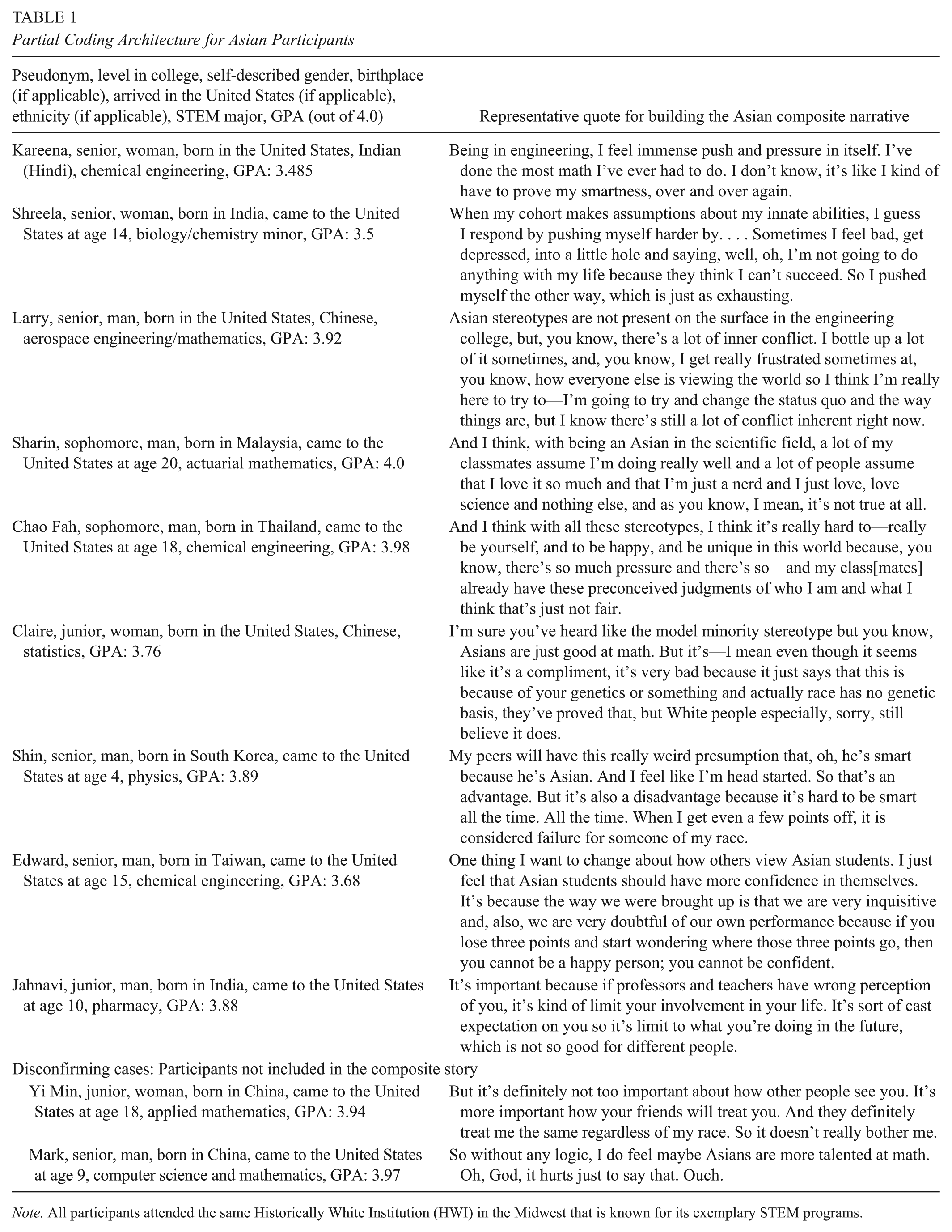
Note. All participants attended the same Historically White Institution (HWI) in the Midwest that is known for its exemplary STEM programs.
Partial Coding Architecture for Black Participants

Note. All participants self-identified as Black and/or African American racially, and some provided their ethnicities. The participants either attended a Historically White Institution (HWI) in the Southeastern region that is known for its exemplary engineering programs or one of two Historically Black Colleges and Universities (HBCUs), also in the Southeastern region. One HBCU is known for a significant number of Black engineering graduates and the other for a significant number of Black biology graduates. One student attended a Hispanic-Serving Institution (HSI), known for serving a significant number of low socioeconomic status, mostly working students, outside a large city.
Finally, we identified 4 of the 14 Black and 4 of the 14 Asian exemplar cases that incorporated the shared experiences of their racial groups. The two composite narratives emerged from our analysis of the exemplar cases. The composites draw on these experiences to reflect the racialized experiences of each group. They are grounded in actual experiences and empirical data and are contextualized in social situations that emerged in their classroom encounters.
Findings: Black Genius, Asian Fail
The findings reveal that high-achieving Black and Asian STEM college students react to racial stereotypes in unhealthy and debilitating ways. The composite narratives of Wang Yong and Leonard portray this phenomenon. The research sought to reveal what factors shaped these students’ academic and career decisions and how students’ prior, sometimes racialized experiences influenced their decisions. After a particularly difficult test, Black students who made high grades faced shock and awe from classmates, whereas similar grades by Asian students (high but not the highest in the class) were met with mockery and anecdotes about presumed failure in relation to their racial group. Leonard’s story is a composite of classroom experiences reported by 14 of the 23 Black participants, and Wang Yong’s narrative is similar to experiences that 16 of the 23 Asian students described. Other participants’ narratives addressed racial stereotypes and other forms of racial bias but did not detail this type of STEM classroom experience. Their stories exemplify the racial encounters and reactions that many high-achieving Black and Asian STEM students in this study endured.
Contradictory Stereotyping: One Black, One Asian
Students were asked to describe an unsettling STEM classroom experience. Their responses included the following essentials: classroom setting, reactions of others in the encounter, atmosphere of the class, time interval (recurring vs. one-time event), afterthoughts, and current reflections. The scene is a mathematics class on complex analysis at a predominantly White institution, in which the college of engineering has fairly equal numbers of White and Asian students and faculty. Leonard is an African American junior who is an electrical engineering major.
Leonard nervously awaits his grade on the second exam of the semester. As his professor passes out the graded exams, he speaks quietly to each student. When the professor arrives at Leonard’s desk, he raises his voice as if to make an announcement and says, “Leonard, excellent work. Your score is the second highest in the class.” Leonard catches a look he characterizes as “silent sympathy” from the only other Black student in the class, but his White and Asian male classmates wear expressions of disbelief. Sara—one of only three White female students in the class, which has no female students of color—turns to a student of Indian descent and proclaims, “Wow, this test was so hard. He has got to be some kind of genius.” Then she whispers loudly, “Like a Black genius. Whoa!” The Indian student nods submissively. This explanation also appears to make sense to the other students, whose looks of disbelief quickly change to approval. Even the teacher smiles in agreement. Leonard cannot speak. He wants to scream that he had studied his butt off, used the teaching assistant like a personal tutor, and been in late-night study groups with the same classmates who had just looked stunned. He thinks, “Is this really the only reason my classmates can think of that I might do better than them—that I’m a genius? That makes it sound like I have some fluke math gene that makes me not like ‘normal’ Black people. Why don’t I get credit for my dedication and drive?” Leonard’s second realization is sobering: He is grateful that no one accused him of cheating, as they had in previous STEM classes. Despite his frustration with the genius label, he feels pressure to maintain that facade in this class. From this day until the end of the semester, Leonard will pretend not to study, drop out of the study groups, and reduce his now discreet visits with the teaching assistant. As the semester ends, Leonard believes that his exam grades and final class grade have suffered as a result of these changes in his academic behavior and study habits. He says later, “I hated having the responsibility to fit within their narrow definition of Black achievement, but my hands were tied.”
Leonard perceived that his peers and the professor reacted in disbelief because his high score contradicted their racist stereotype of Black students’ intellectual incompetence and/or their stereotype of the lazy Black student who would not work as hard as Leonard did. To reconcile the reality of Leonard’s high achievement with the racist ideology of Black deficiency (either in intelligence or in terms of academic effort), his peers and professor ascribed his academic success to something extraordinary. Instead of assuming that Black students are as smart as anybody else or that Leonard had worked hard, like any other student, they designated Leonard an exception, a genius—just a fluke. Thus, they were able to preserve their racist ideology rather than feeling the need to reevaluate it. Instead of being open about the fact that he, like many of his Black peers, is capable of high achievement, Leonard felt trapped by his peers’ and his professor’s attitudes into perpetuating the myth of his exceptionality. Leonard went so far as to alter his behavior to fit the genius stereotype, which ultimately hurt his grades in the course.
Wang Yong, a junior aerospace engineering major, was born in China but moved to the United States at age 7. In his thermodynamics class, the professor has just announced that no one had scored over 92 on a midterm test.
As a teaching assistant silently passes back the exam papers, there are moans and groans throughout the classroom of about 20 White and Asian students, along with a few sighs of relief and one cheer. When the teaching assistant sets Wang Yong’s paper on his desk, a White male classmate snatches it up so quickly that Wang Yong barely glimpses his grade. The White student exclaims, “An 89?! The Asian dude got an 89!” A few students chuckle, while the Asian professor, who is in earshot, remains silent. The classmate hands Wang Yong his test and says, “This is like an Asian fail, right? Don’t go jump off a building or shoot yourself over it!” The White students erupt with laughter. Wang Yong looks to his Asian classmates for support, but they bury their heads, pretending not to hear the comment. Some even hide their tests. In an attempt to cover his shock, shame, and anger, he laughs too. Wang Yong’s grades in this class are typically around 95; he had studied just as diligently as always for this exam and is still proud of his grade, the second highest in the class. However, he becomes consumed by the thought that he might be perceived as a failure despite his achievements. While preparing for the final exam, Wang Yong didn’t sleep for 38 hours and forgot to eat or drink. A few hours after taking the final, he had to be hospitalized for exhaustion and dehydration. Wang Yong’s singular drive to succeed on the final, even at the cost of his health, was partly motivated by his classmate’s declaring that his test score of 89 was an Asian fail. This type of racialized experience had occurred repeatedly since he had entered college, and it was not the first time it had taken a toll on his mental and physical health. He secretly yearns to switch his major to journalism, in part to escape racialized notions of what he should achieve in his STEM classes and in part because he has always loved to write. However, he fears being ridiculed for his “accent” (an inflection only evident in comparison to typical American dialect) and being undervalued because of stereotypes associated with Chinese students’ allegedly limited abilities in reading and writing, so he stays in aerospace engineering.
Wang Yong, who represents the majority of Asian students’ encounters in this study, earned an A-minus or B-plus, yet his peers reacted with shock because this grade contradicted their racist stereotype of Asian students’ superior intellectual abilities, especially in mathematics. For his peers to reconcile the reality of Wang Yong’s normally varying academic performance over the course of the semester (which was still above average) with the stereotype of being a model minority, they called his performance on this test a failure. Instead of thinking, “Of course Asian students have fluctuations in their grades, like any other student,” they viewed Wang Yong’s exam grade as an exception—like Leonard’s grade, a fluke. Thus, they were able to preserve their ideology about Asians being model and did not have to reevaluate it. Because this ideology affected Wang Yong too, he was trapped into perpetuating the myth that he always had a model performance. His peers assumed that Wang Yong’s exam grade would cause him an unhealthy amount of pain and stress and that as a result, he might harm himself. Wang Yong said, however, that the harm he suffered was not caused by the grade but by the stereotyped response to it, which made him forgo his basic needs to eat, drink, and sleep. Thus, Wang Yong endured great physical and mental strain to uphold the performance mandated by the stereotype. He did score at or near the top on all remaining exams, and so for Wang Yong’s classmates, the minority model myth remained intact.
Prove the Stereotype Wrong, Prove the Stereotype Right
In this study, both racial groups endured the stress of being misrepresented. Black students are often stereotyped as more suited for non-STEM careers (e.g., social work, entertainment), while Asian students are assumed to be good candidates for STEM employment but not much else. As these and related findings show, some Black students who love STEM feel obligated to serial excelling in STEM, which saps their passion due to the strain of needing to prove themselves capable. For example, 8 of the 23 high-achieving Black students said they did not get a chance to develop a true affinity for their STEM disciplines because of the constant need to focus on proving they belonged in rigorous STEM classes and programs.
Ten of the 23 high-achieving Asian students in this study wanted to either change their major or pursue a second major in a non-STEM field, but they were discouraged by faculty (in both STEM and non-STEM disciplines), family members, and their own self-doubt about being intellectually capable of doing well in something other than STEM. The majority of Black students in this study were unsure if they could withstand the unrelenting force of racial stereotypes. Both groups endured stereotypes that created challenges to their mental and physical well-being and might compromise the long-term possibility of moving into and remaining in the STEM workforce, thereby limiting the innovation and creativity gained from diversifying STEM fields.
Discussion: The Stereotypes That Bind Us
These findings revealed how the strain of being stereotyped encumbered students, whether they were stereotyped for achievement or failure. Most students we interviewed had become consumed by the power of a racial stereotype at one point or another during college. The Asian students revealed that their perceived higher status in STEM did not soften the everyday slights, putdowns, and insults they experienced, which can be invalidating and deeply hurtful. The majority of Black participants tried to challenge the stereotypical assumptions about their lesser value as STEM high achievers by working unrelentingly. This added to the emotional distress, pain, and frustration associated with living and learning with racial stereotypes in STEM.
Finding the similarities in the experiences of these two stereotype-afflicted groups and using this knowledge to challenge the preservation of racialized STEM education should be one of the highest priorities for STEM higher education. Managing stereotypes means extra labor for students. Thus, Black, Asian, and other minoritized students (e.g., Latinx, Native American/Indigenous) will continue to battle being narrowly defined by a racial structure that manufactures persistent educational, social, political, and ideological inequities.
Notably, the term Asian fail did not make Wang Yong himself a failure; instead, it implied that his grade was viewed as a failure relative to the Asian stereotype. A White student, for example, could earn the same grade without encountering any such assumptions. Leonard’s score did not signify performance that other Black students could not achieve, but it was viewed as such by those holding stereotypical views on how Black students should perform. Both instances have roots in a long and thorny racial past. The genius label validated Leonard’s performance while reinforcing the erroneous belief that most Blacks cannot achieve at the same level as White and Asian students in high-level STEM courses. The Asian fail remark—and the laughter that followed it—upheld the mainstream perception that Asian students are innately capable of high performance in STEM courses.
The idealization of Asian students as naturally gifted in technical fields carries a cost for these young STEMers by artificially inflating their own and others’ expectations and narrowing their life choices. Many Asian students feel pressure from their families, peers, and institutions to study STEM and nothing else and excel even at great personal cost. Holding up Asian people this way has also facilitated implicit criticism of African Americans. This may be the most hazardous by-product of stereotype lift, and it constitutes a form of racism in and of itself. These frames invidiously set Blacks and Asians against each other, blinding society at large to the discrimination that both groups face (Tai & Kenyatta, 1999). The “racist love” that Asian students receive can lead to some Asians believing that they are indeed the “deserving” minority (Chin & Chan, 1972). We should think about how myths and biases are taken up by the very groups they victimize given that the consequences of internalizing stereotypes lead to increased oppression and marginalization.
In these stories, a faculty member either instigated the stereotyping of a student (Leonard, by singling out his performance and approving the class’s reaction) or passively approved it, without challenging the toxic notions put forth by students (Wang Yong). The professors’ failure to intervene against racist ideologies helped to perpetuate the problem systemically and institutionally. The role of the faculty members in each story greatly strengthened the impact on the students and legitimized the actions of students who were engaging in stereotyping. Of course, faculty members have most likely gone through the same racist educational structures themselves and are likely reproducing their own educational experiences.
Implications: STEM Student of Color Coalition?
Although high-achieving Black and Asian STEM students are both racialized, they seem to have limited opportunities to share, learn, and grow from their marginalization. Asian and Black students might appear to be at odds, in part because maintenance of the stereotypes pits Blacks and Asians against one another, but in reality, there is room for coalition building. Better understanding and conceptualization of how stereotype threat and lift create inequitable experiences can also illuminate collective racialization and marginalization, empathy, and the possibility of reducing or eliminating marginalization (Jennings, 1994; Kay et al., 2013). Also, this coalition-building effort absolutely must be financed by institutions of higher education, in particular STEM colleges. These institutions should also supply the material, political, emotional, and social energy to undertake this task. STEM institutional and industry leaders should also demand more equitable material STEM benefits (e.g., employment, educational outcomes, reduced educational debt), which will ultimately help build coalitions and increase STEM creativity and innovation by celebrating the diversity of STEM talent. This will also allow Black people to self-actualize their fullest potential in STEM and be rewarded for being in a place where racial diversity is celebrated and not just barely tolerated. It would help to dismantle the racial STEM hierarchy, in which international students, particularly of Asian and European descent, are at the top of the hierarchy and Black (and Latinx, Native American, and Pacific Islander) peoples are on the bottom (Martin, 2009).
Ironically, both Asian and Black students in the study said they feel the pressure to work twice as hard as White students. Thus, these high-achieving STEM students are aware of the role stereotypes play in shaping their academic and life experiences. The way each racial group is stereotyped, however, complicates any coalitions of these groups (Sexton, 2010). Structural racism foments tensions between these groups, particularly since society’s racial hierarchy privileges certain Asian groups over Blacks intellectually and socially (Wiley, 2003). Racial identity formation and stereotypes, resources, and competition overshadow the common interests of Black and Asian coalition-building efforts. But there is also a rich history of Afro-Asian solidarity and coalition building. As early as 1919, the International League of Darker Peoples was established, and in the 1930s, The Development of Our Own (TDOO) was a thriving Detroit-based antiracist political movement founded to advance Afro-Asian solidarity (Blain, 2018).
Underrepresentation of a student population in an educational context is usually defined through inputs into and outputs from the educational system, but student experiences are rarely considered. For Asian students, this can be particularly harmful because metrics commonly used to gauge academic success show that Asian students do well in STEM fields. However, the racist ideologies that confront Asian students in STEM classrooms have negative consequences for these students that the metrics cannot measure. By using a category of marginalized students of color, universities could address the experiences of all students who are educated in an ideologically racist system instead of ignoring the experiences of a group because they excel in the classroom.
It is useful to revisit Guinier and Torres’s (2002) multiracial political framework by assigning all Asian and Black students in this study to the racialized category of marginalized students of color. Guinier and Torres’s concept of political race is a multilayered political strategy that dramatically transforms the use of race from signifier of individual culpability and prejudice to early warning sign of larger injustices. It is a methodology for diagnosing systemic injustice and then organizing to resist it.
To the extent that individuals have common experiences of marginalization, those experiences often function as a diagnostic device to identify and interrogate system wide structures of power and inequality. When these experiences converge around a visible group, they can raise our awareness about that collective phenomenon. This consciousness, when it helps us identify structural inequalities, becomes a catalyst for changing those structures. (Guinier & Torres, 2002, p. 14)
Race can be manipulated to stigmatize and oppress, but as Guinier and Torres (2002) remind us, race can also be liberating. Being a person of color has meaning, not just in opposition to any person who is not Asian or Black “but in relation to others that are similarly situated” (Guinier & Torres, 2002, p. 4). Guinier and Torres’s use of political race also includes recognition of being forced to identify with a group in ways that yield unexpected liberties. Asian students appreciate the importance of friendship, commonality, solidarity, and connection, and they find solace in their Asian communities (Prashad, 2002). Similarly, Chatters, Taylor, and Jayakody (1994) provide compelling evidence that stories of Black success and resilience are powerful counternarratives because of the African American history of “fictive kinship,” which refers primarily to connection between members of the same or similar racial groups who are unrelated by blood or marriage but who share an ideological bond, often precipitated by social or economic relationships. Thus, sharing the success stories of some group members has the power to lift the entire group both psychologically and figuratively.
Political race is not just physical; it also calls attention to problems with the ways power and privilege are structured, namely, through stigma, discrimination, and prejudice. Political race places value in the student choosing to affiliate and self-identify as Asian/Asian American, Black/African American, Hispanic/Latinx, or Native American/Indigenous Peoples rather than as (marginalized) students of color as a way of making sense of how racial stereotypes and other forms of bias negatively affect them. Practically, how institutions form these coalitions depends on the racial and social climate, context, institutional commitment to equity and justice, current and future plans for diversifying STEM and the STEM professoriate, and financial considerations (revenue is needed for the revolution). However, my lack of specificity in this area should not serve as a deterrent; there is no higher education guide on how to build cross-racial college student coalitions of groups who are unified by oppression and marginalization. I also acknowledge the complicated nature of building and maintaining coalitions. Cross-racial coalitions in STEM higher education are a necessary step toward understanding the inequities that marginalized groups experience, and these groups might increase their racial equity by assisting each other. Future studies could focus on how Asian and Black STEM coalitions could and should manifest and flourish.
Conclusion
One important conclusion of this study is that although the details of how the two groups are perceived and stereotyped may differ, the response to being stereotyped is stress and strain. In both cases, a dominant group imposes and reinforces a preconceived notion about a minoritized group onto an individual. In both cases, the Black and Asian students feel pressure to conform to this stereotype and take action in response. For both groups, the student’s individuality and normal fluctuations in performance are invisible to the dominant group and replaced by preconceived notions of ability that have nothing to do with the student’s autonomy, reflecting only factors not under the student’s control. Both students suffer negative consequences because of being stereotyped. Perhaps most important, mechanisms to challenge the racist ideology either fail or are nonexistent in both cases.
All students in this study were STEM high achievers. The impact of racial stereotypes on their lives remains largely invisible. This research reveals the collective subjugation of these students, regardless of whether they are judged as highly competent or less than capable. Educators and researchers have much to gain from examining both the unique and shared forms of racialization of the two racial groups—and both groups have much to learn from each other.
Supplemental Material
DS_10.1177_2332858418816658 – Supplemental material for “Black Genius, Asian Fail”: The Detriment of Stereotype Lift and Stereotype Threat in High-Achieving Asian and Black STEM Students
Supplemental material, DS_10.1177_2332858418816658 for “Black Genius, Asian Fail”: The Detriment of Stereotype Lift and Stereotype Threat in High-Achieving Asian and Black STEM Students by Ebony McGee in AERA Open
Footnotes
Appendix
1.
The word Black with a capital B refers to people of the African diaspora. Lowercase black is simply a color. Capital B Black also denotes a statement of empowerment and a demand for respect (Chambers, 2014; Tharps, 2014)
2.
 define structural racism as a distributive system that determines the possibilities and constraints within which people of color are forced to act. The system involves the operation of racialized structural relationships that produce unequal distribution of material resources, such as jobs, income, housing, neighborhood conditions, and access to opportunities such as education and training.
Author
EBONY MCGEE, associate professor of diversity and STEM education at Vanderbilt University’s Peabody College, investigates what it means to be racially marginalized in the context of learning and achieving in STEM. In particular, she studies the racialized experiences and racial stereotypes affecting minoritized groups of color.
References
Supplementary Material
Please find the following supplemental material available below.
For Open Access articles published under a Creative Commons License, all supplemental material carries the same license as the article it is associated with.
For non-Open Access articles published, all supplemental material carries a non-exclusive license, and permission requests for re-use of supplemental material or any part of supplemental material shall be sent directly to the copyright owner as specified in the copyright notice associated with the article.
