




Abstract
We contribute to the school start time literature by using statewide student-level data from North Carolina to estimate start time effects for all students and for traditionally disadvantaged students. Descriptively, we found that urban high schools were likely to start very early or late. Later start times were associated with positive student engagement outcomes (reduced suspensions, higher course grades), especially for disadvantaged students. Achievement results were mixed, with positive and negative associations between start times and high school students’ test scores. Continued research is necessary to evaluate the efficacy of later start times as a scalable and cost-effective approach for boosting engagement and achievement.
Over the past two decades, states, school districts, and philanthropic groups have worked to improve the operation of high schools and the achievement of high school students through intensive whole school reforms, such as schools within schools, early college high schools, career academies, and school transformation programs. Many initiatives have targeted urban school districts, which typically enroll higher percentages of minority and economically disadvantaged students and face pressing challenges around student absences, disciplinary incidents, achievement scores, and graduation rates (Roderick, Nagaoka, & Coca, 2009; Rumberger & Thomas, 2000). Research evidence on the efficacy of these school reforms is mixed (Bloom & Unterman, 2014; Kahne, Sporte, de la Torre, & Easton, 2008; Zimmer, Henry, & Kho, 2017) and indicates that these efforts are often expensive and infeasible to scale to a larger population of high schools. For example, early college high schools return promising results but have higher per-pupil expenditures than do traditional public schools and require the participation of a college willing to host the school (Edmunds et al., 2017; Lauen, Fuller, Barrett, & Janda, 2017).
In a time of scarce resources for public education, states and school districts need inexpensive and scalable solutions to boost students’ engagement with and success in high school. One such solution may be starting high school later in the morning. Later school start times are supported by findings from sleep and health research (Carskadon, 2011; Carskadon, Acebo, & Jenni, 2004; Carskadon, Acebo, & Seifer, 2001; Landhuis, Poulton, Welch, & Hancox, 2008). Likewise, nascent work suggests that later school start times are positively associated with the school attendance, course grade, and test score outcomes of adolescents (Carrell, Maghakian, & West, 2011; Cortes, Bricker, & Rohlfs, 2012; Wahlstrom, 2002; Wahlstrom et al., 2014). Estimates from cost-benefit analyses indicate that the financial returns to delaying high school start times by 1 hour (returns for increased student achievement, graduation rates, and earnings) could be as much as 9 times larger than the costs to implement (Jacob & Rockoff, 2011) and that delays to school start times could add $83 billion to the U.S. economy over the next decade (Hafner, Stepanek, & Troxel, 2017).
While existing studies suggest benefits to later school start times, there are two important gaps in the literature that we address in the present study. First, previous work estimated the effects of school start times in a small number of schools. This focus is a product of studying school districts that make substantive start time changes or have meaningful variation in start times among students. However, by examining this specific population—composed of districts that chose to implement start time changes—this approach may not provide an assessment of start time effects that generalize to other populations. Studies that include more diverse settings across many school districts are needed. Second, despite research suggesting that socially and ethnically disadvantaged adolescents may be particularly vulnerable to a lack of sleep and its effects (El-Sheikh, Kelly, Buckhalt, & Benjamin-Hinnant, 2010; Hanson & Chen, 2010; McEwen & Gianaros, 2010), there has been little work regarding whether later school start times especially benefit disadvantaged student subgroups. This research is needed, since later school start times may represent a low-cost approach to narrow school engagement and achievement gaps.
In the present study, we use data from public high schools across all school districts in North Carolina to address these gaps in the school start time literature. Specifically, we ask the following questions:
Research Question 1: Do later high school start times predict students’ engagement with school and their achievement in school?
Research Question 2: Do later high school start times have larger impacts on the engagement and achievement outcomes of disadvantaged student subgroups?
In answering these questions, we leverage statewide student-level data on a range of outcomes, including absences, behavioral incidents, course grades, and test scores. With these analyses, we examine a diverse set of students and schools across urban and rural settings and contribute to research on high school effectiveness and potential mechanisms for more equitable outcomes for disadvantaged students.
Background
In 2014 the American Academy of Pediatrics issued a policy statement recommending that middle and high schools start no earlier than 8:3
The American Academy of Pediatrics’ policy statement is supported by sleep science and studies connecting sleep and later school start times to health and education outcomes for students. Regarding the science of sleep, many adolescents experience biological changes around the onset of puberty that affect the timing of their sleep. Specifically, the secretion of nocturnal melatonin—which aids falling asleep—is delayed; circadian rhythms shift to preference the evening; and the pressure to fall asleep accumulates more slowly (Carskadon, 2011; Carskadon et al., 2004; Jenni, Achermann, & Carskadon, 2005). All this results in a phase delay to adolescents’ sleep-wake cycle that makes it difficult to fall asleep before 11:00
Given these sleep findings, researchers have hypothesized that later school start times will lead to higher levels of engagement with and success in school. While the research evidence is limited, existing studies of school start times generally support this hypothesis. Students attending schools with later start times have fewer absences and tardies and higher grades in core academic subjects (Cortes et al., 2012; Wahlstrom, 2002; Wahlstrom et al., 2014). For example, in a study examining how Chicago high school students perform in morning versus afternoon classes, Cortes and colleagues (2012) found that students were absent approximately 6 more days per year in their first-period class. Likewise, a small number of studies showed that later school start times were associated with higher student achievement on standardized exams. Taking advantage of the random assignment of students to courses, Carrell and colleagues (2011) found that Air Force Academy freshmen placed into early-morning classes (starting before 8:0
Although the existing research is suggestive of benefits to later high school start times, there are important limitations to prior start time research. Previous studies generally focused on a small number of schools, and in some cases, the students in these studies were not high schoolers (Carrell et al., 2011; Edwards, 2012). Furthermore, some studies lacked comparison groups of students and/or schools that did not change start times. Together, this means that most sample sizes, in terms of the number of students or schools, are relatively small and may not be representative of larger populations of high school students. One major contribution of the present study is the use of statewide student-level data across a range of school engagement and achievement measures. This lets us estimate the associations between start times and academic outcomes for a diverse set of students and school contexts, including schools that have not elected to change start times.
Additionally, most prior studies focused on start time impacts for all students, without considering whether later start times disproportionately influenced disadvantaged student subgroups. There is reason to think that disadvantaged students may benefit more from later start times due to their increased vulnerability to a lack of sleep and its effects (El-Sheikh et al., 2010; Hanson & Chen, 2010; McEwen & Gianaros, 2010). To date, only Edwards (2012) directly examined start time impacts for disadvantaged students, with results indicating that later school start times particularly benefited the test scores of previously low-performing students. Our work builds on prior conceptual and empirical analyses by estimating whether later school start times are positively associated with the school engagement and achievement outcomes of disadvantaged students. Positive findings in these analyses would be especially relevant to urban high schools that educate disproportionate numbers of minority, economically disadvantaged, and low-performing students.
Data and Sample
The data for this study come from a longitudinal database of administrative files on all public school students in North Carolina, provided by the North Carolina Department of Public Instruction. These data include student-level files on demographics, absences, disciplinary incidents, classroom rosters, course grades, and test scores and school-level files on demographics, performance, personnel, and expenditures. In addition, this database includes the starting times of all public schools in the state of North Carolina, by school and year. From these data, we created the outcome measures, school start time indicators, and control variables that we used in analyses.
Research Sample
The analytic sample for this study included students attending traditional public high schools in North Carolina for the school years from 2011–2012 to 2014–2015. We excluded from our analyses students attending nontraditional high schools—for example, early-college high schools, alternative schools, vocational schools, and schools for special populations—since many of these students did not possess comparable outcome data and because nontraditional high schools often have very different school start times. Overall, our analytical sample included 410 unique high schools, 1,591 schools by year, and 770,623 individual students. 1
Outcome Measures
In this study, we leveraged student-level data to assess outcomes related to student engagement with school and student achievement. The school engagement outcomes that we examined are student absences, an indicator for being suspended in the current school year, average course grades on a 4-point scale, and course grades in first-period classes. We acknowledge that these outcomes are not traditional measures of student engagement with school—for example, affective measures of participation in classroom instruction or school activities and sports. However, we considered these to be proxies for engagement, since engaged students are likely those who attend school, behave appropriately and follow school rules, and pay attention in class and complete classroom assignments (related to course grades).
Absences measure the number of days that students did not attend school during a given school year, which can be for excused or unexcused reasons. We assessed student behavior with a dichotomous indicator, where 1 indicated that the student was suspended during the school year and where 0 indicated that the student was not suspended during the school year. In our analyses, we defined a suspended student as one who received an in-school or out-of-school suspension. Analyses considering these types of suspension, separately, returned comparable results. To assess course grades, we focused on the four main academic subject areas—mathematics, English, science, and social studies—and converted students’ numeric course grades into unweighted grade points on a 0–4 scale. This allowed us to examine how overall grade point average (GPA) varied with school start time. Because students may be most fatigued in the early morning, we also assessed how high school start times predict course grades (on a 4-point scale) in first-period classes.
For the student achievement outcomes, we assessed student test scores from end-of-course (EOC) exams in algebra I, biology, and English I/II and ACT composite scores. The EOC exams are statewide standardized tests taken by students as part of their high school graduation requirements. Approximately 70% of students take algebra I in high school (Grades 9–12) while the remaining 30% take the course during middle school; nearly all students take biology and English in Grades 9 to 12. For analyses, we standardized these EOC scores within subject and year to have a mean of 0 and a SD of 1. As part of North Carolina’s efforts to increase college going, beginning in 2011–2012 all high school juniors in the state take the ACT during a regular school day. We used the ACT composite score, on a scale from 0 to 36, as the outcome measure for these analyses.
Table 1 displays descriptive data on these engagement and achievement outcome measures for all students and contrasts the outcome measures for disadvantaged versus nondisadvantaged student subgroups. We defined the student disadvantage indicators as follows: minority students were those who identified as Black, Hispanic, American Indian, Asian, or multiracial; economically disadvantaged students were those who qualified for free or reduced-price school meals; and previously low-performing students were those who scored >1 SD below the statewide mean on their end-of-grade examinations in eighth grade.
Descriptive Data on Student Engagement and Achievement Outcomes
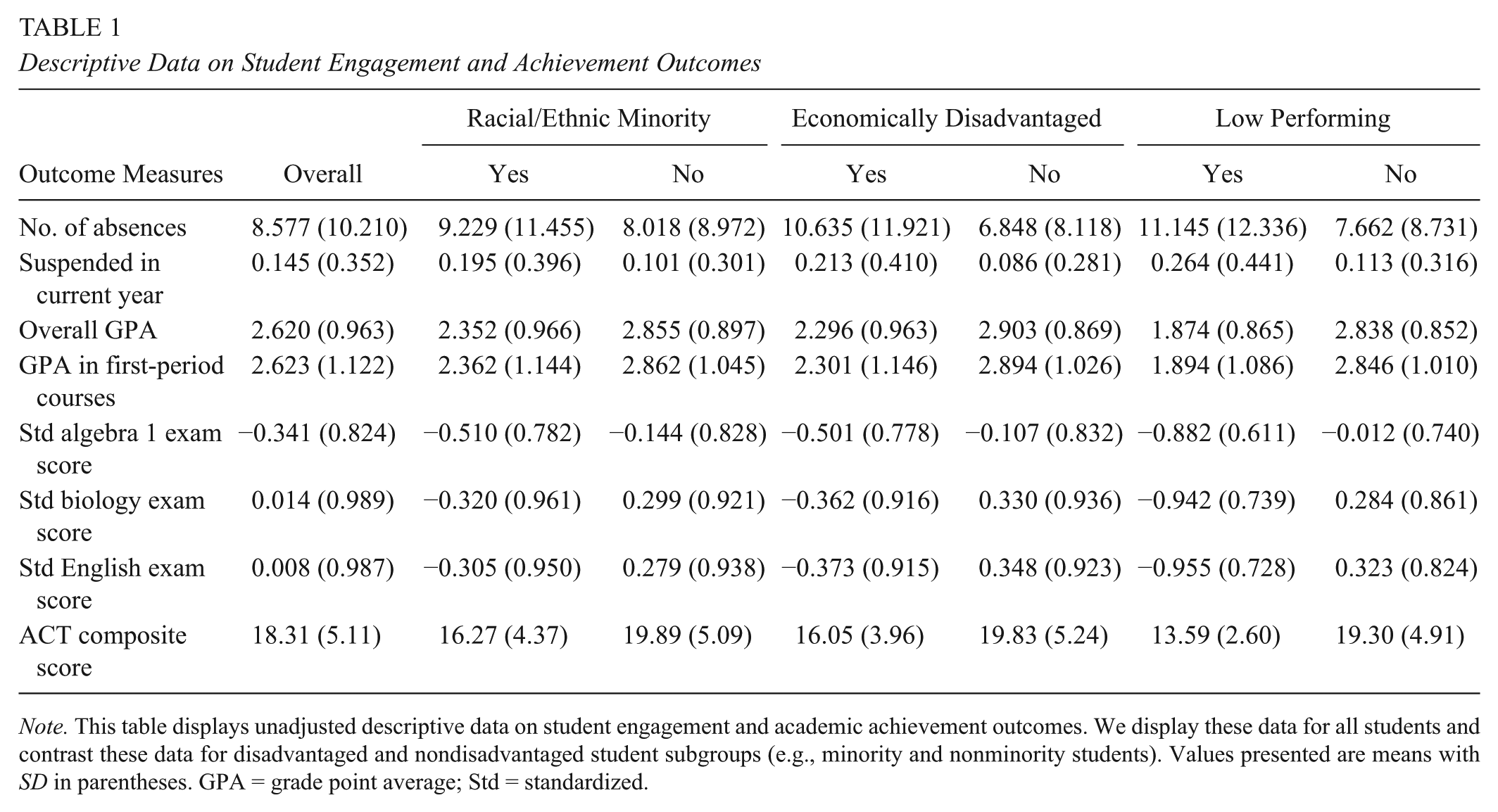
Note. This table displays unadjusted descriptive data on student engagement and academic achievement outcomes. We display these data for all students and contrast these data for disadvantaged and nondisadvantaged student subgroups (e.g., minority and nonminority students). Values presented are means with SD in parentheses. GPA = grade point average; Std = standardized.
Table 1 presents descriptive data on absences, suspensions, course grades, and test scores for all high school students. High school students averaged 8.5 absences per school year and had an average GPA of 2.62. Nearly 15% of high school students were suspended at least once (in or out of school) during the school year, and the average ACT score for high school juniors was 18.31. High school students had much lower algebra I exam scores, since higher-achieving students took the course in eighth grade. Table 1 illustrates that across all our school engagement and achievement outcomes racial/ethnic minority students, economically disadvantaged students, and previously low-performing students had worse outcomes than their nondisadvantaged peers. For example, economically disadvantaged students averaged 10.6 absences, while students who were not economically disadvantaged averaged 6.8 absences. Likewise, nearly 20% of minority students were suspended at least once during the school year, while only 10% of White students received a suspension during the school year. Overall, these descriptive data confirm findings from previous work and emphasize the need for school reforms that benefit disadvantaged student groups.
School Start Time Measures
To assess whether later school start times are associated with the engagement and achievement outcomes of high school students, we specified two sets of focal start time measures. First, we created a continuous measure of school start times that represented the number of hours past midnight that the school started (e.g., for a high school starting at 7:3
Table 2 displays descriptive data on high school start times in North Carolina and the characteristics of high schools starting in each of the four start time categories. Overall, the average high school start time was 8:0
High School Start Times in North Carolina

Note. This table displays school characteristics for all high schools in our sample and for high schools in each start time category. Values presented are means or counts.
Covariates
To better isolate the associations between school start times and student outcomes, we controlled for a rich set of student- and school-level covariates in all engagement and achievement models. At the student level, we included indicators for sex, race/ethnicity, limited English proficiency, economic disadvantage (i.e., qualifying for free or reduced-price school meals), giftedness (i.e., classified as academically or intellectually gifted by the school), disability (i.e., classified as a special education student by the school), and year fixed effects. Our school-level covariates include school size, urbanicity, total per-pupil expenditures, average teacher salary supplements, percentage of racial and ethnic minority students, and percentage of economically disadvantaged students. In addition to these covariates, our analyses of EOC test scores (algebra I, biology, and English I/II) controlled for students’ eighth-grade mathematics and reading scores, the average prior scores of students’ peers, and a set of classroom and teacher characteristics, including class size, teacher experience, whether the teacher was teaching infield, and whether the teacher had National Board Certification.
Analyses
To estimate the associations between high school start times and student engagement and achievement outcomes, we performed a series of linear regression models.
2
These analyses controlled for student and school covariates and clustered standard errors at the school level to account for the dependence in student outcomes within schools and because start times are assigned at the school level. We ran models with a continuous measure of school start times and models with a set of start time indicators to allow for nonlinear relationships between start times and student outcomes. Equation 1 displays this model specification. Here,

To determine if the effect of start times is different for different types of students, we estimated models in which we interacted the continuous start time measure with indicators for disadvantaged students (i.e., racial/ethnic minority, economically disadvantaged, and low-performing students) and indicators for nondisadvantaged students. These analyses did not include a main effect for school start time. For example, we interacted the start time measure with an indicator for low-performing students and an indicator for non-low-performing students. Rather than a single interaction, this approach provides separate estimates and tests of statistical significance for each student group. This makes it easier to assess whether later start times significantly benefit disadvantaged students. These analyses are relevant to policy efforts to narrow school engagement and achievement gaps and directly respond to prior work on disadvantaged students and sleep (El-Sheikh et al., 2010; Hanson & Chen, 2010; McEwen & Gianaros, 2010). Equation 2 displays this model specification with

A limitation of these analyses is that there may be unmeasured school or district characteristics associated with later start times that are also correlated with student outcomes. Some researchers attempted to address this concern by focusing on within-school start time changes (using a school fixed effect). However, of the 410 unique high schools in our analyses, only 23 changed start times during the study period. Of these 23 schools, only nine changed their start times by 30 minutes or more. Models with a school district fixed effect are another potential approach to address omitted variables that may bias coefficient estimates. In our sample, 44 school districts (with 278 unique high schools) had across-school variation in school start times. For these 44 districts, the average time difference between the earliest- and latest-starting high schools was 33 minutes, with a minimum difference of 5 minutes and a maximum difference of 2 hours. 4 The remaining 69 districts (with 132 high schools) did not have any variation in start times.
Given these details on within-school and within-district start time variation, our preferred analyses did not include fixed effects. The analyses depicted in Equations 1 and 2 allowed us to assess the extent to which statewide variation in high school start times predicted variation in student engagement and achievement for all students and for disadvantaged student subgroups. These models leveraged the strengths of the present study: access to statewide student-level data, the ability to examine a more diverse and generalizable set of schools and students, and the ability to estimate separate results for traditionally disadvantaged students. As a specification check, we estimated models with a school fixed effect and models with a school district fixed effect. We estimated these models—for all students and for disadvantaged student subgroups—with our continuous school start time measure. 5 Comparing these fixed effect results with those from our preferred analyses allowed us to assess the robustness of our main results. 6
Results
Do Later High School Start Times Predict Student Engagement With School and Their Achievement in School?
Table 3 presents results from models examining the associations between high school start times and student engagement with school. Across all students, there were no significant relationships between school start times and student absences or average course grades. Regarding disciplinary incidents, we found that students were less likely to be suspended in high schools that started later. A 1-hour delay in start times was associated with a 1.3–percentage point decrease in the probability of a student being suspended during the school year. This result was driven by high schools starting the latest: relative to a student attending a school that started before 7:3
Are Later School Start Times Associated With Student Engagement?

Note. This table displays results from models estimating the associations between high school start times and student engagement outcomes. Values are presented as β (SE). *p < .05. **p < .01.
In our analyses of student achievement, we found that later school start times did not predict higher student test scores. Table 4 displays statistically insignificant results for the algebra I EOC exam and for the ACT composite score. Results for the EOC exam in English I/II were nonsignificant for the continuous start time measure but showed that adjusted-average student achievement was lower, by 4% of a SD, in schools starting between 8:0
Are Later School Start Times Associated With Student Achievement?

Note. This table displays results from models estimating the associations between high school start times and student achievement outcomes. Values are presented as β (SE). EOC = end of course. *p < .05. **p < .01.
Do Later High School Start Times Have Larger Impacts on the Engagement and Achievement Outcomes of Disadvantaged Student Subgroups?
Results in Tables 3 and 4 show the associations between school start times and the student engagement and achievement outcomes across all high school students. These analyses provide a high-level policy-relevant assessment of school start time effects. However, these analyses may obscure benefits to later school start times for disadvantaged student subgroups. Therefore, we estimated separate models interacting our continuous school start time measure with indicators for disadvantaged (i.e., economically disadvantaged, minority, and previously low performing) and nondisadvantaged student groups. 8 These analyses were particularly relevant since disadvantaged students had lower levels of school engagement and achievement and were concentrated in urban school environments with early or late start times.
Table 5 indicates that later high school start times were associated with positive school engagement outcomes for disadvantaged students. Fixed effect results (Appendix Table A1) are comparable, especially for course grades. Interaction coefficients show that economically disadvantaged, minority, and previously low-performing students attending high schools that started later were less likely to be suspended and have higher course grades—overall and in first period—than their disadvantaged peers attending schools with earlier start times. For example, minority students attending a high school starting at 8:3
Do Later School Start Times Benefit the Engagement of Student Subgroups?
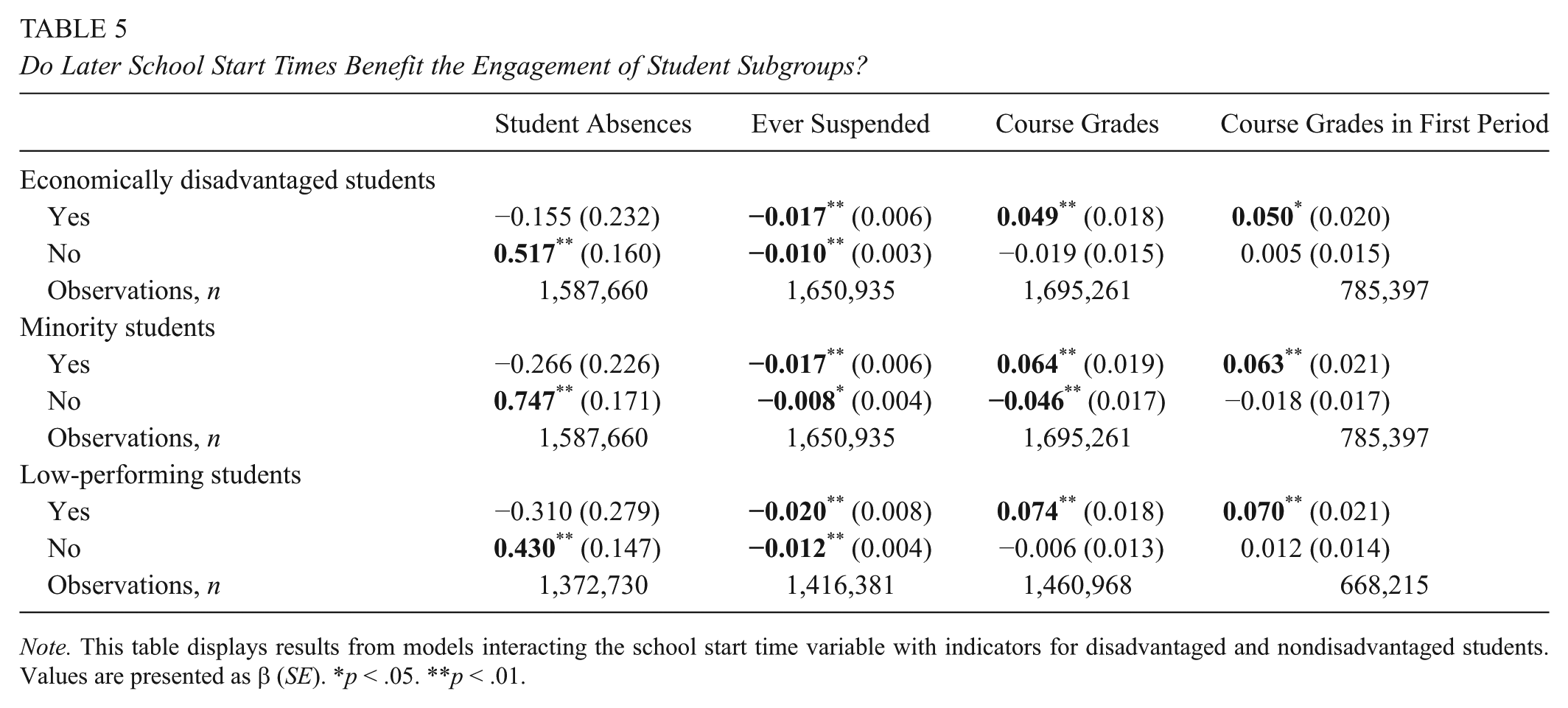
Note. This table displays results from models interacting the school start time variable with indicators for disadvantaged and nondisadvantaged students. Values are presented as β (SE). *p < .05. **p < .01.
While these results suggest that later start times benefited the school engagement outcomes of disadvantaged students, the estimates are less clear for their advantaged peers. Consistent with our previous results, Table 5 indicates that advantaged students were less likely to be suspended in high schools that start later. Conversely, a 1-hour delay to high school start times was associated with a greater number of absences for advantaged students—approximately one-half of a day more for students who were not economically disadvantaged or not low performing and three-quarters of a day more for nonminority students. It is unclear why advantaged students attending later starting high schools were absent more. It could be that later start times conflicted with parent work schedules (work starting at 8:3
Turning to measures of student achievement, Table 6 indicates that later high school start times predicted higher algebra I exam scores for economically disadvantaged, minority, and previously low-performing students. For example, economically disadvantaged students attending a high school that started at 8:3
Do Later Start Times Benefit the Achievement of Student Subgroups?

Note. This table displays results from models interacting the school start time variable with indicators for disadvantaged and nondisadvantaged students. EOC = end of course. Values are presented as β (SE). +p < 10. *p < .05. **p < .01.
Discussion
Due to the robust findings from sleep and health research, momentum is building behind later start times for high school students (Carskadon, 2011; Carskadon et al., 2001; Carskadon et al., 2004; Landhuis et al., 2008). Nascent education research generally supports these later start times; however, there have been only a few rigorous studies to date. Of these studies, only some focused on high school students—where the biological mechanisms for delayed sleep-wake cycles are strongest—and none leveraged statewide student-level data to assess start time impacts across diverse settings and for poor, minority, and low-performing students. There are unanswered questions regarding the generalizability of prior work and whether delayed start times may represent a cost-effective solution to boost the school engagement and achievement outcomes of students (particularly disadvantaged students).
Our findings address these gaps in the literature and present a mixed picture of the associations between high school start times and student outcomes. In our overall analyses (Tables 3 and 4), we found that students were less likely to be suspended during the school year in later-starting high schools—particularly in high schools starting at 8:3
When we separately assessed engagement and achievement outcomes for disadvantaged and advantaged students, we found several areas in which the results differed. Importantly, all three of these differences favored disadvantaged students. Beginning with absences, there was no relationship between school attendance and school start times for disadvantaged students. However, advantaged students missed more school days when they attended later-starting high schools. This may represent an area for continued research—replication studies, mixed-methods approaches—to confirm such a finding and explore reasons for the result. Similarly, we show that while course grades were unrelated to start times for advantaged students, their disadvantaged peers had slightly higher GPAs (overall and in first-period classes) when attending later-starting high schools. Regarding achievement, there was no return on delayed start times for advantaged students; however, disadvantaged students had higher algebra I scores in later-starting high schools. Not all of our analyses revealed differences in results across student subgroups. For disciplinary incidents, we found that disadvantaged and advantaged students were both less likely to be suspended in high schools that started later. Results also show that both student groups had lower biology scores in later-starting high schools.
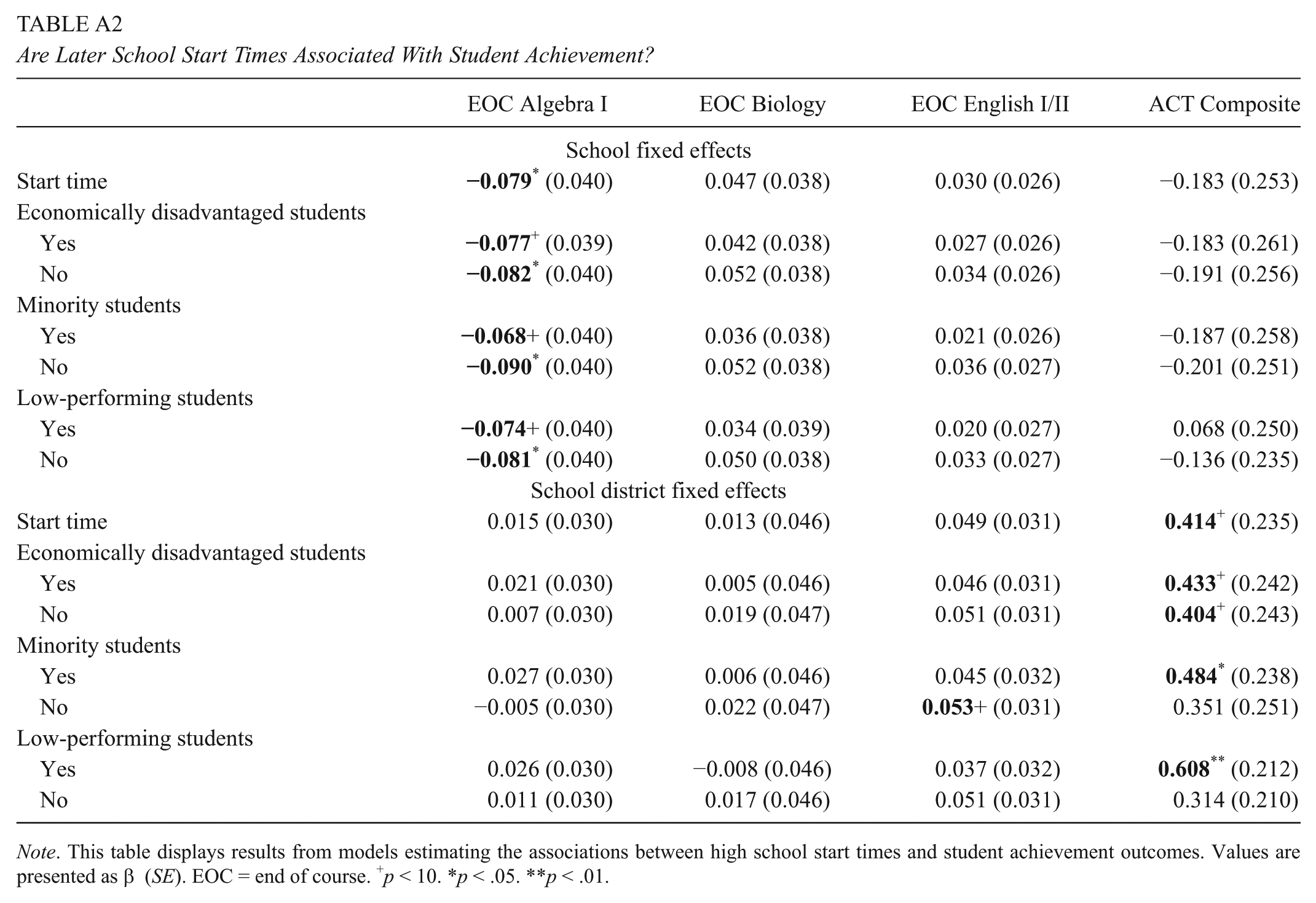
The limitations of the present study should be considered alongside its contributions. Our primary limitation concerns trade-offs between internal and external validity. By leveraging statewide student-level data, we assessed a diverse range of schools and students, which benefits the generalizability of our work. However, these results are not causal: they represent associations between later school start times and measures of student engagement and achievement. We controlled for a rich set of student and school covariates but acknowledge that there may be school and/or district characteristics associated with start times and student outcomes that we did not include in analyses. As such, we estimated specification checks that include a school fixed effect or a district fixed effect. Estimates from fixed effect models were often similar to those from our preferred models in direction and magnitude, with two main exceptions: first, fixed effect results in biology were statistically insignificant rather than negative; second, school fixed effect results in algebra I were negative rather than insignificant (Table 4) or positive for disadvantaged groups (Table 6). Given these concerns about internal validity, our study is not definitive on high school start times. Rather, it is one that uncovered several interesting results, particularly for disadvantaged students, and it encourages continued analyses to replicate the findings and extend our understanding of school start time impacts.
Moving forward, we believe that educational researchers need to catch up to the momentum behind delayed school start times and conduct a host of studies to support evidence-based school start time decisions. In particular, researchers should pair quantitative analyses with primary data collection to hear the voices of key constituent groups—parents, students, school personnel—influenced by start time changes. This may help districts and schools better implement delayed start times. Additionally, researchers should continue to focus on disadvantaged students and rigorously assess whether start times represent a policy approach to narrow school engagement and achievement gaps. If results remain promising, it will also be important to test mechanisms explaining why disadvantaged students particularly benefit from later start times. Finally, we encourage researchers to consider the potential for unintended consequences with school start time changes. For many districts, a delay in high school start times must be accompanied by earlier elementary or middle school start times to accommodate multiple busing runs and to lessen traffic congestion. While younger students may not experience phase delays in their sleep-wake cycles, schedule changes due to early school start times may still affect their health and academic outcomes. As such, continued research is needed to build an evidentiary base about start time impacts in elementary and middle schools.
Footnotes
Appendix
Are Later School Start Times Associated With Student Achievement?
| EOC Algebra I | EOC Biology | EOC English I/II | ACT Composite | |
|---|---|---|---|---|
| School fixed effects | ||||
| Start time | 0.047 (0.038) | 0.030 (0.026) | −0.183 (0.253) | |
| Economically disadvantaged students | ||||
| Yes | 0.042 (0.038) | 0.027 (0.026) | −0.183 (0.261) | |
| No | 0.052 (0.038) | 0.034 (0.026) | −0.191 (0.256) | |
| Minority students | ||||
| Yes | 0.036 (0.038) | 0.021 (0.026) | −0.187 (0.258) | |
| No | 0.052 (0.038) | 0.036 (0.027) | −0.201 (0.251) | |
| Low-performing students | ||||
| Yes | 0.034 (0.039) | 0.020 (0.027) | 0.068 (0.250) | |
| No | 0.050 (0.038) | 0.033 (0.027) | −0.136 (0.235) | |
| School district fixed effects | ||||
| Start time | 0.015 (0.030) | 0.013 (0.046) | 0.049 (0.031) | |
| Economically disadvantaged students | ||||
| Yes | 0.021 (0.030) | 0.005 (0.046) | 0.046 (0.031) | |
| No | 0.007 (0.030) | 0.019 (0.047) | 0.051 (0.031) | |
| Minority students | ||||
| Yes | 0.027 (0.030) | 0.006 (0.046) | 0.045 (0.032) | |
| No | −0.005 (0.030) | 0.022 (0.047) | 0.351 (0.251) | |
| Low-performing students | ||||
| Yes | 0.026 (0.030) | −0.008 (0.046) | 0.037 (0.032) | |
| No | 0.011 (0.030) | 0.017 (0.046) | 0.051 (0.031) | 0.314 (0.210) |
Note. This table displays results from models estimating the associations between high school start times and student achievement outcomes. Values are presented as β (SE). EOC = end of course. +p < 10. *p < .05. **p < .01.
Acknowledgements
We thank the North Carolina Department of Public Instruction for the provision of administrative data and the North Carolina General Assembly for its interest in this research.
Notes
Authors
KEVIN C. BASTIAN is a senior research associate in the Department of Public Policy at the University of North Carolina at Chapel Hill and an associate director of the Education Policy Initiative at Carolina. His research interests include educator preparation, educator effectiveness, educator learning, and education policy.
SARAH C. FULLER is a research assistant professor in the Department of Public Policy at the University of North Carolina at Chapel Hill. Her research interests include education policy and quantitative methods.