



Abstract
Abstract
China’s higher education system has experienced a profound process of restructuring and transformation from elite to mass higher education in the past decades. College students are struggling with an increasingly disconnected learning experience which is caused by a more competitive learning environment. Under these new circumstances, what is the nature of student engagement in China’s colleges and universities? How do different forms of student engagement affect undergraduates’ success in college? This empirical study examined self-reported data of 18,607 students from 55 Chinese colleges in Beijing through structural equation modeling. The main findings are: student learning experience in college is integrated; different forms of student engagement have a complex mechanism of impacting on each other and consequently directly and indirectly contribute to student gains in college. Findings indicate that institutions in China and other Asian countries need to capture a comprehensive picture of how students change through assessing student overall college experience from a variety of perspectives.
College Student Engagement
Student engagement, defined as the time and energy that students devote to educationally purposeful activities, has emerged in the U.S. over the past decade as the leading conceptual framework in institutional assessment and a major construct in higher education research. 3 Student engagement has also been confirmed as a key factor in desirable outcomes in higher education. 4 Studies on relationships between engagement and gains in college can help institutions understand the quality of student learning, as well as where learning occurs and what changes will enhance it. 5 The positive benefits of student engagement in educationally purposeful activities have been repeatedly demonstrated in research. In fact, Pascarella and Terenzini end their two-volume synthesis of the college effects literature with the conclusion that “the impact of college is largely determined by individual effort and involvement in the academic, interpersonal, and extracurricular offerings on a campus.” 6
As the theory and operationalization of engagement have matured, researchers have recommended studying engagement as a multifaceted construct. Engagement includes academic and social behaviors. It also encompasses the emotions that accompany academic and social involvement. Behavioral engagement in college refers to a wide variety of behaviors such as paying attention, doing academic work, expending effort; participating in class and extracurricular activities, being on-task participating in class and school; interacting with faculty and conducting undergraduate research. 7 Many studies on undergraduate student learning examined academic and social behavioral engagement by using data from the National Survey of Student Engagement (NSSE), 8 and College Student Experience Questionnaire (CSEQ). 9
Emotional engagement refers to positive and negative emotions such as being bored, interested, happy, angry; 10 identifying with one’s school; 11 and having a sense of belonging and value. 12 Students who are emotionally and socially healthy appear to have a greater chance of succeeding in college. 13
Student learning and personal development arises from the total experience of emotional and behavioral engagement in academic and social arenas. This conception conforms to the holistic philosophy of student development. It also fits the research literature. Summarizing what is known about the effects of college on students, Pascarella and Terenzini conclude that college outcomes are “interdependent, that learning is holistic rather than segmented, and that multiple forces operate in multiple settings to shape student learning and changes in ways that cross the ‘cognitive-affective’ divide”. 14 Based on a comprehensive review of empirical studies, they point out the complexity of how student academic and non-academic elements influence student growth in college. Although the various experiences and responses of the college experience are clearly interconnected and mutually shaping, according to Pascarella and Terenzini, we do not yet understand precisely how the interaction of individual characteristics, college conditions, and student engagement shape personal and academic development. As the authors argue, future studies should interpret multiple dimensions of student experience instead of narrowly focusing on single aspects of the environment or student behavior and need to focus more on explaining direct and indirect effects of college experience through causal modeling methods instead of predicting specific outcomes through regression methods.
Given the widespread agreement that development draws from behavioral and affective factors across interacting academic and social spheres, it is surprising to note that few empirical studies have examined combinations of engagement types. For example, little research has addressed the relationship of college students’ emotional and social well-being to retention and academic success. Studies that have considered these connections treat academic engagement and emotional engagement separately as predictors of student gains or compare their relative contribution to achievement. 15 One line of research investigated the relationship between academic and social integration, constructs at the center of Tinto’s theory of institutional departure. 16 The two forms of engagement may reinforce one another, while the specifics remain unclear. One study pointed out each form of integration positively and directly related to the other, while a second study suggested a positive academic-to-social integration effect only among men with the reverse relationship for women. 17 Even these few studies did not consider all four types of engagement. Therefore, more studies are needed that investigate how academic behavioral engagement, social behavioral engagement, academic emotional engagement, and social emotional engagement exert influence on each other, and how the combination of these various types of engagement collectively contributes to college student gains.
In addition, as with other student learning research, such studies would be extremely valuable in a non-US context where culturally-specific behavioral and emotional norms might require indigenous learning models. While numerous studies have focused on how engagement affects student gains in primarily a student population in the cultural and academic context of the United States, empirical studies on college student outside of Western higher education, for instance in Chinese higher education, are still thin.
College Student Learning in China
Significant changes have occurred in China’s higher education during the past several decades. Since the establishment of a socialist market economy in 1992, China’s higher education system has been undergoing a profound process of restructuring that was based upon the pragmatic ideology of the socialist market economy. The role of higher education was established as a response for building up China’s own innovation system in the era of the knowledge economy and as a mechanism of “making China prosperous through science and education” (kejiao xingguo).
Under such contexts China’s higher education has gone through the following remarkable reforms since the 1990s, including decentralization, injection of market forces and incentives to universities, and expansion and privatization. These reforms have resulted in far-reaching changes in virtually all aspects of Chinese higher education, such as establishment of new programs, increased private institutions, improved quality of faculty, diversified pedagogies, and so on (Li, 2005; Postiglione, 2003). 18 The enrollment of students in post-secondary education has expanded from approximately 12 million to 24 million students within the past decade. As China’s higher education system has become stratified into a dichotomized system consisting of an elite club of national prestigious research universities and a group of local, mostly private, 19 Chinese college students have become more diversified in terms of their socioeconomic backgrounds, learning styles, motivation to college education, and preparation for higher education. 20
These new circumstances have produced one main tendency of Chinese higher education that impacts student outcomes: the learning environment is becoming more competitive due to scarce of valued educational resources and good jobs. Dramatically heightened competition causes Chinese students, faculty, and parents in China to ascribe paramount importance to grades. In their single-minded pursuit of top grades in narrowly specialized majors, students have struggled with “the increasing fragmentation and disconnectedness of the learning process, of disciplines and knowledge, and of personal development.” 21 Under such changing circumstances and diversified students, it is necessary to examine relationships between student engagement and achievement.
Some studies that examined how student psychological factors influence college achievement in China showed that learning outcomes were largely determined by students’ attitudes toward learning, including motivation, initiative, and interest in academic subjects. 22 Some other empirical research examined the impact of classroom and out-of-classroom engagement on college gains. Bao 23 found that student learning time and learning behaviors, and extra-curricular engagement jointly influence student gains in knowledge, cognitive skills, and numbers of course failures. Hu and Lei 24 concluded that students who had more intensive in-classroom and out-of-classroom engagement tended to have higher evaluations of educational quality.
These studies demonstrated that emotional factors as well as behavior influenced Chinese students’ college achievement. However, these studies reviewed students’ college experience from separated and individual perspectives and failed to depict how college students’ holistic educational experience influences their college achievements. These studies also assumed that student engagement in different areas were separated and did not impact each other. Few empirical studies explored how student holistic experience influenced their achievement in college.
Purpose
This study aims to examine relationships among Chinese college student engagement and gains through testing two competing versions of a causal model derived from the theoretical and research literature. There are several important research questions to be answered by this study: (1) How different types of engagement impact to each other? (2) What are total, direct, and indirect effects of student engagement on student gains in college? (3) Do these effects vary among students from different backgrounds?
Research Method
Conceptual Model
The overall conceptual model used in this study is based on Astin’s 25 input-environment-output (I-E-O) model of college effects. “Students learn by becoming involved.” In his famous five basic postulates, Astin (1984) suggests that involvement requires the investment of psychological and physical energy in “objects” of one sort or another (such as tasks, people, activities). 26 According to this suggestion and the literature reviewed earlier, the conceptual model of this study features four types of college students’ experience: academic behavior engagement, academic emotional engagement, as well as social behavior engagement and social emotional engagement. Student gains are clustered into five categories: identity (I), cognitive skills (C), moral development (M), knowledge (K), and social skills (S).
In theoretical Model 1, the four types of engagement directly impact student gains in college and there are no mediating effects among the forms of engagement, that is, engagement does not indirectly contribute to student gains. In theoretical Model 2, the four types of engagement not only directly contribute to student gains in college, but also indirectly contribute to student gains via mediated effects through another engagement. This model is mainly based on Pascarella and Terenzini’s 27 analysis of how college affects student and on the body of evidence in the Chinese academic community indicating the correlation between measures of different engagement (Bao, 2010; Li & Liu, 2006; Zhang, Gao, & Xu, 2009). 28
Academic emotional engagement is a critical element for Chinese undergraduates and for other Asian college students with similar admission systems. In most Chinese colleges, students must choose their majors shortly after taking the National College Entrance Exam and are admitted to a major within a university. As a result, many students tend to disengage emotionally from the academic subjects they study. A national survey conducted in 2005 and 2007 by Peking University 29 showed that approximately 30% of college students disliked their majors. These findings underlie this study’s assumption that students’ emotionally engagement in their academic major is the most important element impacting the other three types of Chinese student engagement.
Previous work has reported a positive influence of extra-curricular involvement on student development in college. 30 For example, Kuh 31 discovered that extracurricular activities impact student five outcome domains such as personal competence, cognitive complexity, knowledge and academic skills, and so on. For Asian international students studying in the United States, engagement in extracurricular activities is considered an important social context in which to develop social networks, learn social skills, and develop beliefs and values. 32
No consistent empirical evidence indicates how extra-curricular engagement relates to academic learning behaviors. 33 According to evidence from interviews we conducted at Peking University regarding students’ academic identity, we assume that students’ extra-curricular engagement would impact their classroom learning behaviors. In the interviews, we found out that extra-curricular activities that students frequently participated in are often organized by their academic units, such as programs, departments or schools. Students who are more involved in these activities tend to feel more connected to their college experience and campus. For example, they learn more about the organizational and academic culture of their academic unit; they established more closed relationships with peers and faculty members in their academic units. Consequently, these students are more likely to establish a strong and positive academic identity. 34 This positive psychological attitude of an effective college member helps them focus academically and behave better in classroom learning. On the basis of this rationale, this study postulates a causal path from extra-curricular engagement to academic learning behaviors.
Studying social emotional involvement is also important in the Chinese context as well as the larger Asian context. As Chinese higher education is transforming to a mass higher education system, current students are experiencing sharply escalating pressures and resulting crises caused by more competition for financial aid, jobs, and other opportunities. Given that psychological health problems are caused by learning pressures and anxiety about competition for future jobs, we assumed that students’ academic emotional engagement and in- and out-of-classroom learning behaviors impact their psychological health.
The full latent causal model including the two conceptual models is presented in Figure 1. The solid lines represent the first (simple) conceptual models. The second conceptual model includes both the solid lines and the dashed lines. In the interest of clarity, the factor correlations and errors of measurement are not included in the figure.
Conceptual model

Participants
Stratified cluster sampling was employed in this study and the participating students were recruited from 54 colleges and universities, located in Beijing, China, to approximate a 10% sample of full time enrolled undergraduates. The response rate was 98%. 35 Field work for this study was conducted from December 2008 to January 2009. This study focused on examining juniors from four year institutions and excluded sampled students from other years in colleges or from community colleges. After deleting cases with missing variables, 18,607 valid cases were used in this study. Among these students, 24% were from national key universities, 35% from research universities, and 41% from ordinary teaching universities. Of this group, 43% were rural students and 58% percent urban students; 47% were male and 53% were female. 53% of students’ fathers had not received postsecondary education.
Instruments
The source of data for this study is student responses to the third edition of the Beijing College Student Development Annual Survey (SDAS). 36 The questionnaire was designed in 2006 by a research team of the Graduate School of Education at Peking University and was revised in 2007 and 2008. This process ensured that the questions on the survey were relevant and clear. As with all survey questionnaires, the BCSES relies on self reports from students to assess student behavioral and emotional factors associated with college outcomes. Zhu 37 concluded that the BCSES satisfies general conditions for the validity of self reports.
This questionnaire is consisted by 14 scalelets that included 97 items. Most survey items focused on students’ experience in four areas: (a) involvement in different types of in-class and out-of-class activities, (b) measures of a variety of emotions and values related to the college and the people on campus, (c) perceptions of various dimensions of the campus environment, (d) estimates of how much progress they have made toward a variety of desirable achievements gained in college.
Measurement
Students’ responses to all survey items were scored using a four-point scale. Fourteen survey items that were selected from the SDAS measured four types of student engagement: academic behavioral engagement (ABE), academic emotional engagement (AEE), extra-curricular engagement (EX-C), and social emotional engagement (SEE). Academic behavior engagement is measured by three items, including frequency of asking questions, participation in class discussion, academic interactions with faculty after class. Academic emotional engagement measures students’ feelings regarding their academic major, learning load and pressures. Extra-curricular engagement represents students’ social behavior engagement, including frequency of participating in student clubs, internships, part-time jobs, civic community services, and school arts performance. Social emotional engagement is measured by levels of feeling loneliness and isolated, as well as frequency of sleep problems. Behavioral engagement (both academic and extra-curricular) has a positive value, that is, a higher score indicates a higher level of engagement. Emotional engagement of both social and academic aspects has a negative value: that is, a higher score means a lower level of engagement. Student gains were measured by 22 items representing five latent variables including general education (knowledge), cognitive skills, social skills, identity development, and moral development.
Descriptive statistics of student engagement and gains are shown in Table 1, including means, standard deviations, and internal consistency estimates for the measured constructs. All Cronbach’s alpha estimates are higher than 0.70, with the exception of extra-curricular engagement and gains in self-identity. Appendix A contains items from the BCSES that contributed to the four types of engagement and student gains.
Data Analysis
Structural Equation Modeling (SEM) is employed to examine the total, direct, and indirect effects of student engagement on student achievement in college. All analyses are based on the Maximum Likelihood method with no consideration of the multivariate non-normality of the data. For a fullstructural equation it is critical that the measurement of each latent variable is psychometrically sound. 38 The first step of data analysis, therefore, is to test for the validity of the measurement model before evaluating the structural model. CFA procedures are used in testing the validity of the indicator variables. The second step is to use alternative model competing methods to evaluate two competing causal models for getting a more appropriate theoretical model.
Results
Measurement
Factor loadings of each indicator item to the latent constructs that are presented in Table 2 show that the survey items measure the latent variables quite well. All factor loading estimates are statistically significant at the 0.001 level. Among them, 8 estimates are lower than 0.55, but higher than 0.30, an indication of moderate strength possible signaling the need of content revision. The rest of the parameters are higher than 0.55 which is indicative of strong indicators.
Descriptive statistics for engagement and gains items
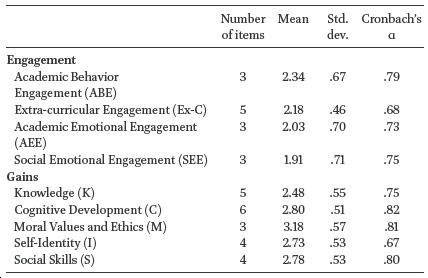
Note 1: All survey items were scored using a four-point scale. Mean=sum (total items)/the number of items.
Note 2: Academic and social emotional engagement was reversed scored, with a high score indicated emotional difficulties.
Model Assessment
This study tested two competing theoretical models. The selected goodness-of-fit statistics and the nested model comparison statistics show that Model 2 is the most appropriate model fit for the data. Table 3 presented selected goodness-of-fit statistics for the two models. The nested model comparison statistics reached the same conclusion given Model 2 has a statistically significant improvement than Model 1. The comparison data appears in Table 4.
Effects of Various Engagements on Gains
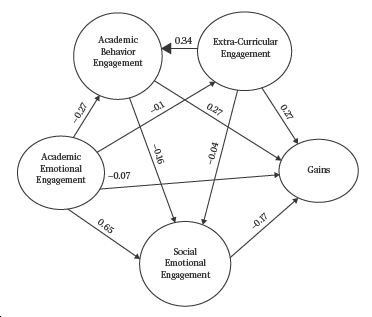
Figure 2 shows the path estimates of Model 1 and figure 3 represents the path estimate of Model 2. The direct, indirect, and total effects of each engagement on gains are presented in Tables 5 and 6.
Factor loading of each indicator item
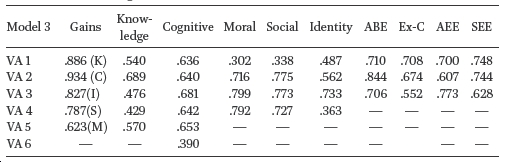
Note 1. All estimates are significant at the 0.001 level.
Note 2. ABE=Academic behavioral engagement; Ex-C=Extra-curricular engagement; AEE=Academic emotional engagement; SEE=Social emotional engagement.
Model goodness-of-fit summery

Nested model comparison

Note: * significant at the 0.001 level.
Table 5 summarizes the direct, indirect and total impacts of various engagements on student gains in colleges in the final model. Extra-curricular engagement is the most important factor that affects student gains in college. The direct effect of extra-curricular engagement is 0.274, while the indirect effect is 0.089. The total effects of extra-curricular engagement are 0.363.
Academic emotional engagement is the second most important element impacting student gains in college. The direct effect of academic emotional engagement on gains is -.0.069. Through its effects on the other three types of engagement, academic emotional engagement has an indirect effect of -0.209. The total effect of academic emotional engagement is -.0.277 (equal to -.0.069 plus -0.209). It should be noted that items measuring emotional engagement are actually problems of engagement (disengagement). Therefore, this negative causal relationship means if problems of academic emotional engagement go up by 1 standard deviation, student gains go down by 0.277 standard deviation.
Theoretical model 1

Final theoretical model
Standardized direct, indirect, and total effects
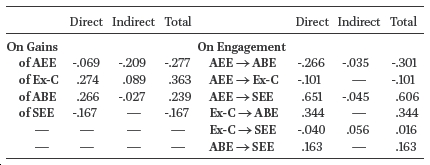
Note 1: All estimates are significant at the 0.001 level.
Note 2: ABE=Academic behavioral engagement; Ex-C=Extra-curricular engagement; AEE=Academic emotional engagement; SEE=Social emotional engagement.
Academic behavioral engagement is the third critical factor that influences student achievements. With a direct effect of 0.266 and an indirect engagement of -0.027, the total effects of academic behavioral engagement on gains are 0.239.
Social emotional engagement is the last important factor impacting student gains. Its direct and total effects on gains are the same, -0.167, since it does not have an indirect effect on gains. As with academic emotional engagement, the negative estimate means that if problems of social emotional engagement go up by 1 standard deviation, student gains go down by 0.167 standard deviations.
All other three types of engagement contribute to student social emotional engagement. Among them, academic emotional engagement is the most important, with a total effect of 0.606. Academic behavioral engagement and extra-curricular involvement follow, with total effects of 0.163 and 0.016, respectively. It needs to be noted that academic behavioral engagement has a positive relationship with problems of social emotional engagement: 0.163.
Table 6 presents standardized total (indirect) effects of different types of engagement on specific student specific achievements in five key areas: knowledge gains, cognitive skills, moral development, identity development, and social skills. These estimates achieved the same conclusion as that from Table 5. Student extra-curricular engagement is the most critical factor influencing the various student gains among four types of engagement, with a total effect range from 0.229-0.323. For example, the standardized total effect of extra-curricular engagement on knowledge gain is 0.323.
Standardized total effects of engagement on specific gains

Note 1: All estimates are statistically significant at the 0.001 level.
Note 2: There are no direct effects estimated.
Note 3: abe=Academic behavioral engagement; Ex-C=Extra-curricular engagement; ae= Academic emotional engagement; se=Social emotional engagement. Academic and social emotional engagement was reversed scored, with a high score. Indicating emotional difficulties.
The next important factor is student academic emotional engagement, impacting various gains from -0.260 to -0.175 standard deviations, which shows that the more intensive a student’s academic emotional engagement, the higher the level of gains in college. The data also illustrates that academic emotional engagement has impacts on student learning behaviors, social emotional engagement, and extra-curricular involvement.
The third critical factor is student academic behavioral engagement, with a range of the total effect from 0.223-0.150. Student social emotional engagement is the fourth important factor, influencing student gains from -0.156 to -0.105 standard deviations.
Equivalence Test for Institutional Type, Gender, and Region Groups
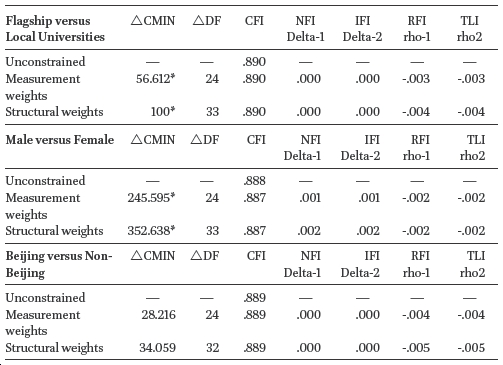
Table 7 summarizes the Chi-square changes and CFI values related to the series of three models of three multiple group comparisons, one between national universities and local colleges, one between male and female students, and the other between students from Beijing and non-Beijing regions. Given that Chi-square tests are sensitive to sample size and 18,607 samples are used in this study, the CFI difference approach seems more appropriate for equivalence tests. Based on the fact that the changes of CFI across institution types are zero, the model fit is equivalent across the national flagship universities and Beijing local colleges.
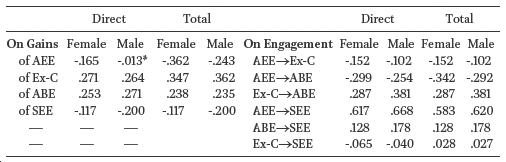
As to the gender group comparison, the changes of CFI related to measurement weights and structural weights are equal to 0.001. The model is not operating equivalently across the male and female groups. Standardized direct effects of various engagements are also varied across gender groups, which are reported in Table 8. The main difference across gender exists in three aspects. The path from academic emotional engagement to gains among male students is not statistically significant, but is significant for female students. For female student, academic emotional engagement is the most important element impacting their gains, while for male students extra-curricular engagement is the number one factor. Female and male students’ learning behaviors are impacted differently by extra-curricular participation and academic emotional engagement.
Multiple groups comparisons of chi-square and CFI values
Note: * significant at the 0.001 level.
Standardized direct and total effects across gender groups
Note: * not significant. All other values significant at the 0.001 level.
ABE=Academic behavioral engagement; Ex-C=Extra-curricular engagement; EE=Academic emotional engagement; SEE=Social emotional engagement.
Discussion
Most past research has focused on how an individual category of student engagement directly contributes to college student gains. Based on assumptions that a college student is a whole person whose experiences span both academic and social circumstances, the final theoretical model of this study confirmed the claim of past research studies that student achievement in college is impacted by students’ comprehensive and integrated experience on campus. More important, this study added to past research by portraying specific causal paths among different types of engagement. Each form of student engagement directly shapes their gains in college. In addition to these direct impacts on gains, the four types of engagement also indirectly impact student gains via complex causal paths among each other. Based on considerations of the direct effects and indirect effects of various types of engagement, this study reveals a more accurate relationship between student engagement and gains in college.
Extra-curricular engagement exercised more significant effects on student gains than the other types of engagement. This conclusion confirms the claim from other studies that student learning occurs both in-classroom and out-of-classroom. Furthermore, extra-curricular engagement impacts all five types of gains in college and is therefore the most notable among the four types of engagement. Even for gains in knowledge and cognitive development, extra-curricular engagement exercised more influence than academic engagement (behaviorally and emotionally). This is a new conclusion in the empirical research literature in the Chinese academic community. The data also show that extra-curricular engagement can significantly improve student academic behavioral engagement. If students are involved in more student clubs and school performances, as well as internship or community voluntary activities, their classroom participation generally become more active and their out-of-class academic interactions with faculty are more frequent. Extra-curricular engagement has a negative direct influence on problems of social emotional engagement. If a student has more extra-curricular participation, he or she experiences fewer problems of social emotional engagement. In addition, as a media factor between academic behavioral engagement and social emotional engagement, extra-curricular engagement can reduce unhealthy impact of academic behavioral engagement on social emotional engagement.
For Chinese students, the most notable finding was how academic emotional engagement impacts both the other types of engagement and gains. Academic emotional engagement contributes to gains both directly and indirectly. Its direct effect on gains is smaller than the other types of engagement. However, it is important to note that student emotional involvement in learning contributes indirectly to their gains in college. Its indirect impact on gains is much higher than its direct impact. The indirect effect of academic emotional engagement on gains is -0.209, while its direct impact is only -0.069. Through affecting the other three types of engagement, academic emotional engagement is the second important contributor to student gains in college. These results suggest that support for Chinese students should be focused on improving their interest in their assigned academic subjects rather than merely enhancing their learning behaviors in classroom. In addition to their degree of liking for what they learn, indicators of academic emotional engagement also include student learning pressures and learning motivation. This study found that the more students experience learning pressures and poor motivations, the lower achievement they will obtain.
Notably, academic behavioral engagement is positively related with problems of social emotional engagement. That means if a student has a higher level of learning behavioral engagement, her/his social emotional engagement will decrease. Students who are highly engaged in academic learning would more easily feel lonely, helpless, and angry than other students.
Multiple group analysis indicated that there is no variance of student engagement across national key universities and Beijing local college, as well as students originally from Beijing and non-Beijing regions. However, effects of female and males students’ engagement seem to be varied. For male students the effect of academic emotional engagement on gains is not statistically significant, while the path is significant for female students. Varied path among engagement and gains across gender groups indicated that male and female students learn in different ways. Academic emotional engagement impacts more on college gains of female students than that of male students. Female students tend to learn more from classroom learning engagement, while male students tend to learn more from their extra-curricular participation.
Practical Implications
The findings of this study have important implications for Chinese college and universities. The evidence is strong that student achievement in college is impacted by their overall experience on campus. Traditionally, Chinese universities’ dual administration systems have produced a segregated learning environment for their students. It is time for universities to reflect upon their incentive and assessment systems and for faculty and student affairs practitioners to work collaboratively across academic and student affairs to reduce the gap between academic and non-academic learning and development. Chinese institutions should ascribe to holistic student development principles and practices by promoting educationally purposively activities beyond the classroom.
Improving student emotional engagement with their learning subjects is critical for Chinese educational institutions at both tertiary and secondary levels. The admission system and major selection system in China need to be reformed in order to give students chances to understand both themselves and their intellectual interests and then to let them choose what they would like to learn (or, a minimum to revise an initial wrong choice). While debates regarding the Chinese national enrollment entrance test have been conducted mainly from perspectives of social justice and efficiency, future research needs to focus on examining how the selection mechanism impacts students’ emotional well-being and effective learning in college.
Offering more effective academic advising is another possible way to increase students’ emotional engagement in their majors. Out-of-classroom academic support is inadequate for Chinese college students. The findings regarding varied engagement across gender groups suggest that female and male students learn in different ways. Chinese (Asian) universities need to examine their practices and services and make changes to provide appropriate learning advisement and services for female students.
Limitations
This study has some limitations. First, this study employed limited indicators to measure student engagement. The limited indicators are unable to provide adequate information in understanding student entire experience in college. Second, some factors which influence student academic and social engagement may also affect one’s college gains. Therefore, the estimated effect of engagement will be biased due to lack of control of these unobserved individual characteristics such as ability, motivation, self-esteem, and etc. Thirdly, some other critical elements contributing to student gains such as faculty teaching performance and campus supportive services were excluded in the model. This study cannot demonstrate how these environmental factors might contribute to student engagement and to their college gains.
Conclusion
While we understand it is easy to jump into the fray of assessing undergraduate education in general, we do think it is worthwhile to understand effects of general education in China from a new perspective of student engagement and achievement. Through structural equation modeling with Amos, this study revealed that the portfolios of engagement contribute both jointly and independently to student gains in college. The multiple engagement portfolios have a complex process of direct and indirect effects on student gains in college. This study suggests that forms of engagement in college have different ways of impacting student gains. General education should not be limited in in-classroom courses. It would impact students more deeply if a systematic model is structured. Universities need to encourage a culture that supports general education, which should involve efforts from faculty, graduate students, advising staff, parents, and presidents of universities.
However, it would be a mistake to focus solely on these numbers and to risk drawing conclusions that development happens as a result of student engagement in one specific form of engagement, such as extra-curricular participation, rather than another form, such as curricular involvement. As Pascarella and Terenzini 39 stated, student college experience is an “integrated experience.”
Cautious suggestions for institutions can still be drawn from the findings. This study confirmed Pacarella and Terenzini’s conclusion that “students’ total level of campus engagement” mutually reinforces their gains in college. 40 In order to improve educational quality, institutions need to understand their students’ entire experience from a variety of perspectives rather than focusing on their learning behaviors in classroom. Out-of-classroom experiences in the form of extra-curricular participation, as well as emotional engagement in the academic and social context, are equally important for students in Chinese higher education. In addition to enhancing student learning behaviors in classroom, institutions of higher education along with secondary education institutions need to offer more stimulating experiences to students to enhance their learning.
Footnotes
3 G. D. Kuh, “The National Survey of Student Engagement: Conceptual and empirical foundations,” New directions in institutional research, no. 141 (2009).
4 A. W. Astin, What matters in college: Four critical years revisited (San Francisco: Jossey-Bass, 1993).
G. D. Kuh, “Assessing what really matters to student learning: Inside the National Survey of Student Engagement,” Change 33, no. 3 (2001).
——, “How are we doing at engaging students?,” About Campus 8, no. 1 (2003).
E. T. Pascarella and P. T. Terenzini, How college affects students: findings and insights from thirty years of research (San Francisco: Jossey-Bass Publishers, 2005).
5 T. W. Banta and G. D. Kuh, “A missing link in assessment: Collaboration between academic and student affairs professionals,” Change 30, no. 2 (1998): 40–46.
6 E. T. Pascarella and P. T. Terenzini, How college affects students: findings and insights from thirty years of research (San Francisco: Jossey-Bass Publishers, 2005), 602.
7 Connell, J. P., & Wellborn, J. G. (1991). Competence, autonomy, and relatedness: A motivational analysis of self-system processes. In M. R. Gunnar & L. A. Sroufe (Eds.), Self-processes in development: Minnesota Symposium on Child Psychology (Vol. 23, pp. 43-77). Hillsdale, NJ: Erlbaum; G. D. Kuh, “How are we doing at engaging students?” About Campus 8, no. 1 (2003); Q. P. Kong, 孔启平, “学生投入” 的概念内涵与投入[ J]。外国教育资料, 2000 (2): 72–76.
8 G. D. Kuh, et al., Student success in college: Creating conditions that matter (San Francisco: Jossey-Bass, 2005).
G. D. Kuh, “The National Survey of Student Engagement: Conceptual and empirical foundations,” New directions in institutional research, no. 141 (2009).
9 C. R. Pace, Measuring the quality of college student experiences: An account of the development and use of the college student experiences questionnaire (Los Angeles: Higher Education Research Institute, 1984).
10 Connell, J. P., & Wellborn, J. G. (1991). Competence, autonomy, and relatedness: A motivational analysis of self-system processes. In M. R. Gunnar & L. A. Sroufe (Eds.), Self-processes in development: Minnesota Symposium on Child Psychology (Vol. 23, pp. 43–77). Hillsdale, NJ: Erlbaum.
11 V. Tinto, Leaving college: Rethinking the causes and cures of student attrition. 2nd ed. (Chicago: University of Chicago Press, 1993).
12 L. L. Rendon, “Validating culturally diverse students: Toward a new model of learning and student development,” Innovative Higher Education 19, no. 1 (1994).
13 Corey L. M. Keyes and Jonathan Haidt, “Human Flourishing: The Study of ‘That Which Makes Life Worthwhile’,” in Flourishing: Positive Psychology and the Life Well-Lived, eds. C. L. M. Keyes and J. Haidt (Washington, DC: American Psychological Association Press, 2003).
M. E. Pritchard and G. S. Wilson, “Using emotional and social factors to predict student success,” Journal of College Student Development 44, no. 1 (2003).
14 E. T. Pascarella and P. T. Terenzini, How college affects students: findings and insights from thirty years of research (San Francisco: Jossey-Bass Publishers, 2005), 629.
15 E. A. Skinner and M. J. Belmont, “Motivation in the classroom: reciprocal effects of teacher behavior and student engagement across the school year,” Journal of Educational Psychology 85, no. 4 (1993).
Fredricks, J. A., P. C. Blumenfled, and Alison H. Paris, “School engagement: Potential of the concept, state of the evidence,” Review of Educational Research 74, no. 1 (2004).
16 V. Tinto, Leaving college: Rethinking the causes and cures of student attrition (Chicago: University of Chicago Press, 1987).
——, Leaving college: Rethinking the causes and cures of student attrition. 2nd ed. (Chicago: University of Chicago Press, 1993).
17 J. Braxton, A. Sullivan, and R. Johnson, “Appraising Tinto’s theory of college student departure,” in Higher education: Handbook of theory and research, ed. J. C. Smart (New York: Agathon, 1997).
18 C. Li, ed, Bridging Minds Across the Pacific (Lanham, Maryland: Lexington Books, 2005).
G. Postiglione, “Proposal for a study of the academic profession in China,” (2003).
19 Yan, F.Q.; Zhuo, X.H., & Yu, J. (2006). Massification of Chines higher education and Changes of higher education system. Higher Education Research, 27(8), pp. 1–7. [In Chinese].
20 W. Bao, 鲍威, “Kuozhao hou zhongguo xuesheng de shixi xingwei tezheng fenxi 扩招后中国高校学生的学习行为特征分析 [A Trait Analysis of Learning Behavior of University Students in China since the Enrolment Expansion],” Qinghua daxue jiaoyu yanjiu 清华大学教育研究 [Tsinghua Journal of Education] 30, no. 1 (2009).
21 P. J. D. Pan, G. H. Pan, C. Lee, and S. Chang, “University students’ perceptions of a holistic care course through cooperative learning: Implications for instructors and researchers,” Asia Pacific Educational Review 11 (2010): 199–209.
22 W. Li, and Ch. Liu, “An empirical study on correlation between learning behaviors and outcomes among college students,” Chinese Youth Study 11 (2006).
L. Y. Zhang, Q. Gao, and W. P. Xu, “An empirical study on mechanism of teaching quality of higher education,” Social Scientist 11 (2009). (In Chinese).
23 W. Bao, 鲍威, “Kuozhao hou zhongguo xuesheng de shixi xingwei tezheng fenxi 扩招后中国高校学生的学习行为特征分析 [A Trait Analysis of Learning Behavior of University Students in China since the Enrolment Expansion],” Qinghua daxue jiaoyu yanjiu 清华大学教育研究 [Tsinghua Journal of Education] 30, no. 1 (2009).
24 Z. X. Hu and B. Lei, 胡子祥, 雷斌, “daxuesh canyu yu gaodeng jiaoyu fuwu zhiliang yingxiang de shizheng yanjiu 大学生参与对高等教育服务质量影响的实证研究 [Relationships between student engagement and quality of higher education service],” Xiandai daxue jiaoyu 现代大学教育 [Mordent University Education] 3 (2008).
25 A. W. Astin, What matters in college: Four critical years revisited (San Francisco: Jossey-Bass, 1993).
26 E. T. Pascarella and P. T. Terenzini, How college affects students: findings and insights from thirty years of research (San Francisco: Jossey-Bass Publishers, 2005).
27 Ibid.
28 W. Bao, 鲍威, “Kuozhao hou zhongguo xuesheng de shixi xingwei tezheng fenxi 扩招后中国高校学生的学习行为特征分析 [A Trait Analysis of Learning Behavior of University Students in China since the Enrolment Expansion],” Qinghua daxue jiaoyu yanjiu 清华大学教育研究 [Tsinghua Journal of Education] 30, no. 1 (2009).
W. Li, and Ch. Liu, “An empirical study on correlation between learning behaviors and outcomes among college students,” Chinese Youth Study 11 (2006).
L. Y. Zhang, Q. Gao, and W. P. Xu, “An empirical study on mechanism of teaching quality of higher education,” Social Scientist 11 (2009). (In Chinese).
29 Peking University, Massification of higher education and labor market (Beijing, Peking University, 2007). (In Chinese).
30 A. W. Astin, What matters in college: Four critical years revisited (San Francisco: Jossey-Bass, 1993).
G. D. Kuh, “In their own words: What students learn outside the classroom,” American Educational Research Journal 30, no. 2 (1993).
A. F. Feldman, and J. L. Matjasko, “The role of school-based extracurricular activities in adolescent development: A comprehensive review and future directions,” Review of Educational Research 75, no. 2 (2005).
31 G. D. Kuh, “In their own words: What students learn outside the classroom,” American Educational Research Journal 30, no. 2 (1993).
32 T. Toyokawaa, and N. Toyokawab, “Extracurricular activities and the adjustment of Asian international students: A study of Japanese students.” International Journal of Intercultural Relations 26 (2002).
33 J. Braxton, A. Sullivan, and R. Johnson, “Appraising Tinto’s theory of college student departure,” in Higher education: Handbook of theory and research, ed. J. C. Smart (New York: Agathon, 1997).
34 R. Xu, T. Jiang, X. Luo, and X. Zhang. Junior college students’ academic identity: An empirical study in a Chinese research study (Beijing: Peking University, 2010). (In Chinese).
35 The high response rate of 98% resulted from several reasons. First, the involvement of university-based affiliates of the Beijing Municipal Commission in implementing survey administration within each participating institution. Second, institutional research is needed in Chinese higher education since massification. Institutes needs to improve their educational quality for increasing competition. Third, the research project offered free training for participating institutions in analyzing their institutional data. Fourth, the project provided financial stimulus for participated institutions according to numbers of valid questionnaires that returned.
36 Peking University, Annual Quality evaluation of Beijing higher education (Beijing: Peking University, 2008, 2009). (In Chinese).
37 H. Zhu, 朱红, “Gexinghua shendu fudao yu daxuesh fazhan de shizheng fenxi 个性化深度辅导与首都大学生发展的实证分析 [Individual Mentoring Service in Beijing Colleges: A New Mode of Student Affairs Professionals Interactions],” Beijing daxue jiaoyu pinglun 北京大学教育评论 [Peking University Education Review] 8, no. 1 (2010).
38 B. M. Byrne, Structural Equation Modeling with AMOS: Basic Concepts, Applications, and Programming (New York, Taylor & Francis Group, 2009).
39 E. T. Pascarella and P. T. Terenzini, How college affects students: findings and insights from thirty years of research (San Francisco: Jossey-Bass Publishers, 2005).
40 Ibid., 647.