




Abstract
Qualified science, technology, engineering, and mathematics (STEM) teachers are critical in the provision of high-quality STEM education for all students. Through descriptive and regression analysis, we document how demographic characteristics, qualifications, and turnover rates of a nationally representative sample of public school STEM teachers have changed from 1988 to 2012. Over this time period, STEM teachers are more likely to be female, attend selective colleges, have graduate degrees, and have STEM qualifications. Although STEM teachers are no more likely to turn over than other teachers, this masks differential rates between high- and low-poverty schools. Moreover, our results highlight the importance of recruiting qualified STEM teachers to work in high-poverty schools and providing supports to help them thrive and remain in the classroom.
Introduction
The mathematics and science performance of American students on national and international exams continues to lag in most grades, with gains that are made tending to be small in size or not persisting across cohorts of students (Kastberg, Chan, & Murray, 2016; Provasnik et al., 2016; “The nation’s report card: 2015 science results,” n.d.). In addition, gender and racial/ethnic gaps endure, particularly for high school students (“The nation’s report card: 2015 science results,” n.d.). The underperformance of American students on science and mathematics assessments is linked to concerns over the adequate supply of science, technology, engineering, and mathematics (STEM) professionals, particularly for women and racial/ethnic minorities who are underrepresented in degree attainment and employment in STEM occupations in all but the biological sciences (England & Li, 2006). The importance of academic performance for those entering careers in the STEM field (Riegle-Crumb, King, Grodsky, & Muller, 2012) points to the central role played by teachers in terms of shaping students’ mathematics and science reasoning, content knowledge, and professional aspirations.
The recruitment and retention of qualified STEM teachers is a critical component in the provision of a high-quality STEM education for all students. Although researchers have identified value-added measures of quality to be better predictors of student achievement on standardized tests than observable teacher credentials or qualifications (Aaronson, Barrow, & Sander, 2007; Harris & Sass, 2011), math and science stand out as subjects in which content knowledge is impactful (Clotfelter, Ladd, & Vigdor, 2010; Goldhaber & Brewer, 1997, 2000; Hill, 2007; Hill, Rowan, & Ball, 2005). Despite the promise of highly qualified math and science teachers, this segment of teachers remains the least prepared. In 2012, 29.9% of high school math teachers, 25.6% of biological sciences teachers, and 54% of physical science teachers did not have a major relevant to their teaching assignment, in contrast to only 20.6% of English teachers (Hill & Stearns, 2015). In addition, teachers with math or science degrees have historically turned over at twice the rate of teachers with other undergraduate degrees (Borman & Dowling, 2008), although, at least early in their careers, it tends to be the less effective teachers to exit teaching (Henry, Fortner, & Bastian, 2012).
As socializing agents, teachers not only support their students’ cognitive development but shape their motivations, aspirations, and social identities (Davis, 2003), all of which have a bearing on students’ professional ambitions. The literature on student–teacher relationships emphasizes the value of assignment to a teacher of one’s own race/ethnicity or gender, which is linked with higher scores on student achievement tests (Dee, 2004; Egalite, Kisida, & Winters, 2015; Yarnell & Bohrnstedt, 2018), higher ratings on subjective measures of academic performance (Dee, 2005; Fox, 2016; Gershenson, Holt, & Papageorge, 2016), receipt of other school services, such as assignment to the school’s gifted program (Grissom & Redding, 2016), and an increased likelihood of majoring in STEM or graduating with a STEM degree (Bottia, Stearns, Mickelson, Moller, & Valentino, 2015). However, STEM teachers have historically been more likely to identify as male and the racial composition generally mirrors that of the rest of the teaching workforce, with 83% of teachers identifying as White (Ingersoll & May, 2012; Ingersoll & Merrill, 2017).
Drawing on data from seven waves of the nationally representative Schools and Staffing Survey (SASS), we document how the demographic characteristics, qualifications, and turnover rates of a nationally representative sample of public school STEM teachers have changed from 1988 to 2012. In addition, we examine how the characteristics and turnover rates of STEM teachers differ across schools enrolling higher and lower concentrations of students living in poverty. We conclude our analysis by analyzing the organizational supports associated with lower STEM teacher turnover. Three research questions motivate this study:
(1) To what extent have the demographic characteristics and qualifications of STEM teachers changed from 1988 to 2012? How do these characteristics differ between high- and low-poverty schools?
(2) To what extent are STEM teachers more likely to turn over (move schools or leave the profession) than other teachers? To what extent do these turnover patterns differ in high- and low-poverty schools?
(3) What are the associations between teacher turnover and teacher qualifications? To what extent do organizational supports reduce the likelihood of turnover for STEM teachers?
In answering these questions, our work makes several contributions to this area of scholarly study. First, we document how demographic characteristics, qualifications, and turnover rates of a nationally representative sample of public school STEM teachers have changed over the last two decades. We find significant, and arguably positive, changes in the gender and race/ethnicity, the selectivity of undergraduate education, and the graduate degree and qualification of STEM teachers. We demonstrate how, despite these positive changes, there are still substantial differences between STEM teachers working in high- versus low-poverty schools. Moreover, we find that, even though STEM teachers are not more likely to turn over than other teachers, this overall pattern masks crucial differences between STEM teachers in high- versus low-poverty schools. To this point, we examine personal and school organizational characteristics that are associated with turnover and highlight the importance of recruiting qualified STEM teachers to work in high-poverty schools while providing high-quality supports to help them thrive and remain in the classroom.
Recruiting and Retaining High-Quality STEM Teachers
Emerging from the teacher quality literature (Chetty, Friedman, & Rockoff, 2014; Rivkin, Hanushek, & Kain, 2005; Rockoff, 2004) has been the recognition that the education policy community needs to more consciously recruit and retain qualified teachers, particularly teachers who work in underserved schools (Amrein-Beardsley, 2012; Darling-Hammond & Sykes, 2003). An array of policies has been dedicated toward these shared goals of improving teacher quality and narrowing teacher quality gaps. These policies have ranged from federal mandates regarding the qualifications of core subject teachers (Ramirez, 2004), the widespread adoption of alternative certification programs (Redding & Smith, 2016), and, more recently, policies aimed at retaining higher performing teachers (Cullen, Koedel, & Parsons, 2017). Given ongoing concerns regarding perceived shortages of STEM teachers (Sutcher, Darling-Hammond, & Carver-Thomas, 2016), these policies have either been explicitly targeted toward this segment of the teacher workforce or were poised to make the largest improvements in the qualifications of these teachers, given evidence of their historical under-qualification (Hill & Stearns, 2015).
Evidence from New York City suggests that the academic ability of beginning science and mathematics teachers might be improving (Lankford, Loeb, McEachin, Miller, & Wyckoff, 2014). Between 1999 and 2010, the standardized SAT score for new teachers in hard-to-staff subjects improved from 0.11 standard deviations to 0.36 standard deviations. However, the authors’ definition of hard-to-staff subjects not only includes mathematics and science but special and bilingual education as well. It remains to be seen how these results would generalize to a nationally representative sample of teachers or other measures of teacher academic ability, including those more strongly related to content knowledge, such as an in-field college major.
An additional concern with the establishment of a qualified STEM teacher workforce is these teachers’ retention, particularly the retention of the most qualified teachers. The general pattern in the research on teacher quality and attrition has been that the least effective teachers are more likely to leave teaching than more effective teachers (Boyd, Grossman, Lankford, Loeb, & Wyckoff, 2008; Goldhaber, Gross, & Player, 2011; Hanushek, Kain, & Rivkin, 2004; Henry, Bastian, & Fortner, 2011). This pattern appears to be strongest for high school STEM teachers. Henry, Fortner, and Bastian (2012) show that non-STEM teachers who leave teaching within their first five years are about a tenth of a standard deviation less effective than those individuals in their fifth year of teaching. In contrast, high school math teachers who remain in teaching for five years are between 12% and 16% of a standard deviation more effective than those who leave, depending on the subject. High school science teachers who remain in teaching for five years are between 14% and 33% of a standard deviation more effective than those who leave, depending on the subject. Although we rely on qualifications-based measures of teacher quality in this study, we consider the extent to which less qualified STEM teachers are also more likely to turn over.
The literature on STEM teacher turnover also suggests that these teachers may be particularly responsive to salary and/or working conditions. This point is made most strongly in Ingersoll and Perda’s (2010) study of math and science teacher shortages. Their results suggest that, similar to other teachers (Ladd, 2011; Simon & Johnson, 2015), working conditions such as principal leadership or the prevalence of disciplinary infractions matter for the retention of science and mathematics teachers (Ingersoll & May, 2012). In addition, for science teachers, a US$10,000 increase in the highest step in the district salary schedule is associated with a 15% reduction in the odds of science teacher turnover. For math teachers, teacher autonomy and professional development that is focused on either student discipline or mathematics are associated with lower odds of turnover.
A secondary finding from their work that we develop in greater detail indicates that high turnover rates in high-poverty and high-minority schools result in a “reshuffling” of science and mathematics teachers. We examine the extent to which STEM teachers are more likely to leave teaching or move schools when working in higher poverty schools and the ways in which various organizational supports may be particularly important across these different school contexts.
Data
SASS is administered by the National Center for Education Statistics (NCES) and includes more than 30,000 public school teachers every wave. This survey is a comprehensive data source on the characteristics of public school teachers and the schools in which they teach. Data on demographic characteristics and education variables is available for close to all years in which the survey was conducted. The teacher response rates range from 77.7% to 90.3%, with an average rate of 84.9%. Missing data are fairly high in the first two waves (over 6.0%) but drop down to 1.3% or lower in subsequent waves, with an average of 2.8%. Our analytic sample includes 42,010 STEM teachers, which we define as teachers who report their main teaching assignment as either mathematics and computer science or natural sciences. Data on turnover and STEM qualification are only available beginning in 2000 because of changes in the survey design. The turnover analysis includes data on 102,400 teachers, 19,130 of whom are STEM teachers. A limitation of the SASS data is that it relies on surveys of teachers and other school personnel, which are subject to nonresponse bias.
Measurement
All measures used in this study are described in greater detail in the online Appendix Table A1. Here, we briefly describe the measurement of teacher attrition, STEM teachers, and teacher and school characteristics.
Measures of Attrition
All measures used in this study are described in the online Appendix Table A1. The main dependent variable for this study comes from the principal report of teachers’ employment status in the follow-up year following the baseline survey year. Teachers are categorized as staying in the same school (stayers), moving schools (movers), or leaving teaching (leavers).
Defining STEM Teachers
STEM teachers are defined as teachers whose main teaching assignments are computer science, mathematics, or natural sciences such as physics, chemistry, and biology. 1 Other areas of technology and engineering are not well defined across the different waves of SASS and hence not included in our operationalization. We do not include vocational or career training in our definition of STEM teachers.
Measures of Teacher and School Characteristics
We include a number of teacher characteristics such as gender, race/ethnicity (White, Black, Hispanic, Asian, American Indian), age, salary, being a novice teacher (i.e., in their first three years in teaching), having a graduate degree, being uncertified, their undergraduate college selectivity using Barron’s Admissions Competitiveness Index, passing the content certification exam, and being a qualified STEM teacher. We use Barron’s selectivity as a proxy for college quality since it is widely used and recognized for this purpose. However, we note that there has been criticism of this index as a measure of college quality, particularly in terms of how many colleges have increased their ranking or have been re-classified as top-tiered institutions over the past 20 years without substantial evidence of improvements in instructional quality (Hess & Hochleitner, 2012). We categorize a STEM teacher as being qualified if their first or second major is in a STEM field or they have a state certification in a STEM subject.
In terms of school context, we consider several important characteristics associated with teacher turnover: the urbanicity of the school, the student enrollment size, whether it is a secondary or elementary level, the percentage of students with free and reduced-price lunch (FRPL) eligibility, percent minority, percent individualized education program (IEP), and percent limited English proficiency (LEP). 2 We also characterize the working conditions of the school using the level of student disciplinary problems, support to the teachers from the administrators, and the level of cooperative effort among the staff. Finally, we include variables related to teachers’ professional development (PD), including the receipt and usefulness of content-based and classroom management PD.
In some analyses, we separate our results for students enrolled in schools enrolling higher and lower concentrations of students living in poverty. A teacher is designated as working in a high-FRPL school when 50% or more students are eligible for free and/or reduced-price lunch. Low-FRPL schools have less than 50% of students eligible for FRPL. A limitation of using free and reduced-price lunch eligibility as a proxy for poverty over time relates to changes in the eligibility criteria. The most notable change over the course of our study is the Community Eligibility option, whereby districts could opt for all students to receive a free or subsidized lunch if more efficient. Snyder and Musu-Gillette (2015) describe how 38% of students were eligible for FRPL in the 2000–2001 school year compared to 50% in 2012–2013. Over this same period, the percentage of public school students living in poverty increased from 17% to 23%. When our main results are separated by schools enrolling a majority of minority students, the results tend to be of similar magnitude and level of significance.
Methods
This study includes both descriptive and regression analyses. In the descriptive analysis, we report on changes in STEM teachers’ gender, race/ethnicity (White, Black, Hispanic, Asian, and American Indian), teaching experience, education level, certification, college selectivity, content exam pass rates, and qualification in main teaching assignment, which is measured by whether the teacher majored in or was certified in a relevant subject. As the educational resources, including assignment to high-quality teachers, afforded to students attending high-poverty schools tend to lag behind more affluent schools (Goldhaber, Lavery, & Theobald, 2015), we separate our descriptive results between teachers working in high and low-FRPL schools.
In regression analysis, we first aim to understand the extent to which STEM teachers are predicted to turn over (i.e., move schools or leave teaching) at greater rates than non-STEM teachers and the degree to which STEM teacher turnover is elevated in high-FRPL schools. We first estimate a multinomial logistic regression model comparing stayers versus movers and leavers, respectively, conditioning on teacher and school characteristics. This multinomial logistic regression model can be expressed as
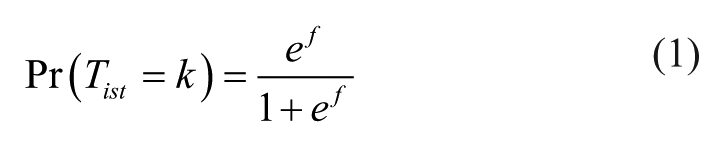
where
The second part of the regression analysis limits the sample to STEM teachers to identify the extent to which qualifications or school characteristics predict lower turnover rates. As the relationship between such characteristics and turnover is likely distinct in high- and low-FRPL schools, we estimate separate models for each school type.
Results
STEM Teacher Demographic Characteristics and Qualifications
The results from our descriptive analysis examining STEM teacher demographic characteristics and qualifications over time are presented in Figure 1 and Table 1. There have been notable changes in the demographic characteristics of STEM teachers between 1988 and 2012, particularly in terms of gender. In 1988, 43% of STEM teachers were female. By 2012, 64% of STEM teachers were female, a nearly 50% increase. The changes in STEM teachers’ race/ethnicity have been less dramatic, with the largest changes in terms of an increased share of Hispanic and Asian teachers. In 1988, 2% of STEM teachers identified as Hispanic compared to 6% in 2012. Over this same period, the percentage of Asian teachers increased from 1% to 3%. After slight increases in the share of Black STEM teachers until 2004, in 2012 only 6% of STEM teachers identified as Black. In comparison, the percent of high-FRPL and majority-minority schools have risen substantially from 10% to 42% and 18% to 38%, respectively, from 1988 to 2012 (results not shown; available upon request).
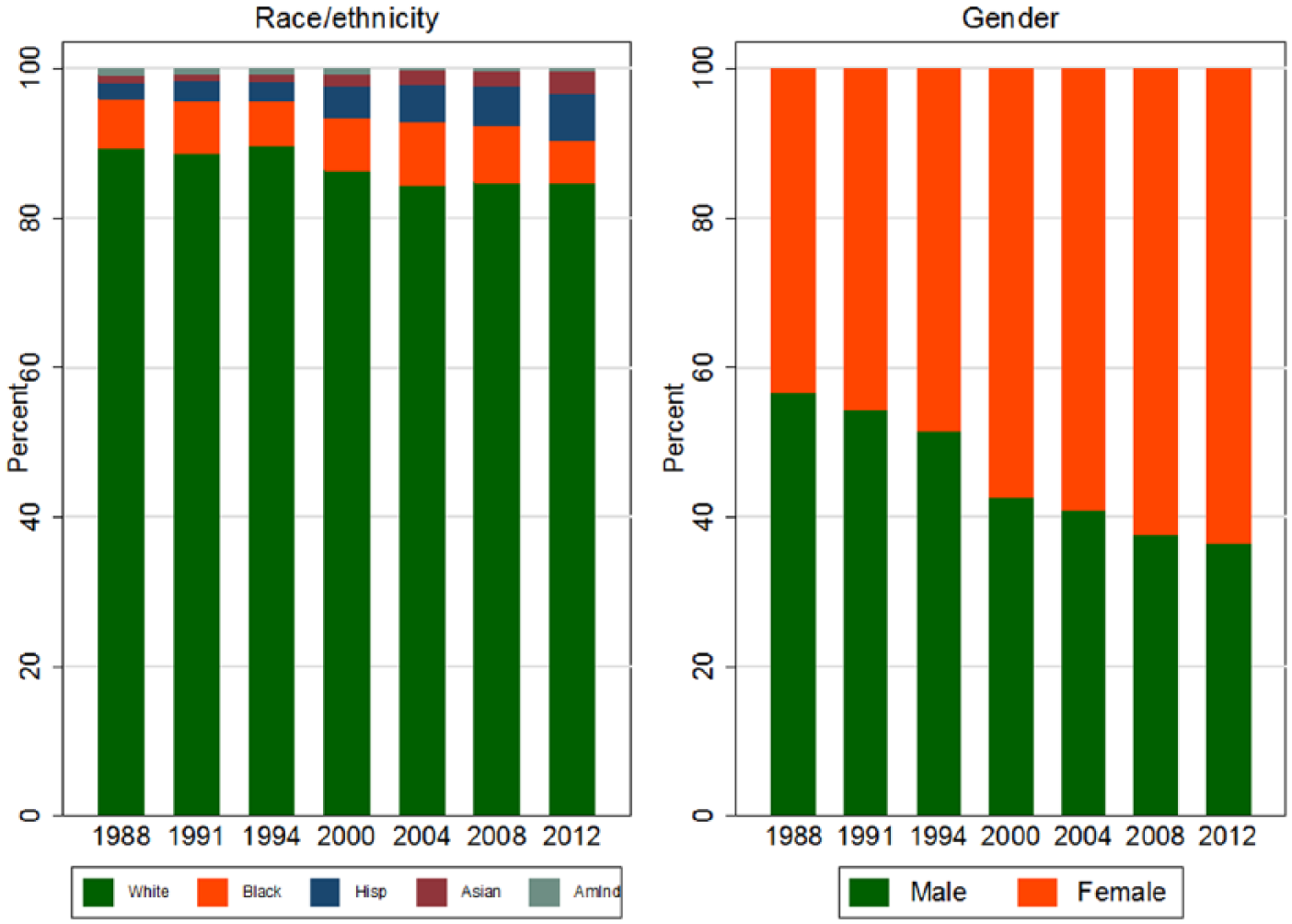
Proportion of STEM teachers by race/ethnicity and gender.
Descriptive Information of STEM Teachers

Notes. Nationally representative weights are employed. Sample sizes are weighted to the nearest 10 in accordance with NCES non-disclosure rule. Novice teachers have less than three years of teaching experience. STEM qualification includes having STEM as a first or second major field of study or is certified in STEM. PD is professional development. A 2 on PD content hours represents an average of 9–16 hours of PD. A 2 on useful PD content indicates “somewhat useful.”
Figure 2 provides a visual representation of changes in STEM teacher education and qualifications. In 1988, 51% of STEM teachers had a graduate degree compared to 57% in 2012. The improvements in college selectivity have been even more dramatic. Whereas only 13% of STEM teachers had attended a most or very selective college in 1988, 35% of STEM teachers attended such a college in 2012. We note that this shift in college selectivity is due, in part, to how many more colleges are ranked as top tiers in 2012 than in previous years. While as many as 10% of STEM teachers were uncertified in 2000, virtually no STEM teachers were uncertified in 2012. However, the increase in certified teachers did not necessitate that STEM teachers were becoming certified in a relevant subject. In 2012, 30% of STEM teachers still did not have either a college major or certification that was pertinent to their main teaching assignment.

Education and qualifications status for STEM teachers.
Next, we consider the extent to which STEM teacher demographic characteristics and qualifications differ in high- and low-FRPL schools. We limit this analysis to the 2004, 2008, and 2012 school years, as this is the period for which we have full data on teacher qualifications and is the focus of our turnover analysis. These results are presented in Table 2. In terms of teacher demographic characteristics in Panel B, the predominant pattern is that Black teachers are more concentrated in high-FRPL than low-FRPL schools. In 2012, 16% of teachers in high-FRPL schools identified as Black compared to only 4% in low-FRPL schools. In contrast, White teachers were more likely to teach in low-FRPL schools compared to high-FRPL schools. In 2012, 91% of teachers in low-FRPL schools identified as White compared to 71% in high-FRPL schools.
Descriptive Statistics of STEM Teachers by High- and Low-FRPL School Status

Notes. Nationally representative weights are employed. Sample sizes weighted to the nearest 10 in accordance with NCES non-disclosure rule. + p < 0.10, *p < 0.05, **p < 0.01
PD: professional development
In Panel C of Table 2, we see that the improvements in the education and qualifications of STEM teachers observed in Table 1 and Figure 2 have not resulted in consistent narrowing of teacher quality gaps between STEM teachers in high- and low-FRPL schools. STEM teachers working in high-FRPL schools are consistently less likely to have a graduate degree. In 2012, 55% of STEM teachers in low-FRPL schools had a graduate degree compared to 48% in high-FPRL schools. The gap between high- and low-poverty schools in terms of teacher selectivity has been less consistent. STEM teachers who attended a most selective college were more likely to teach in a high-FRPL than low-FRPL school in 2012 than 2004. In 2012, 16% of STEM teachers in low-FRPL attended a most selective college compared to 9% of STEM teachers in high-FRPL schools. While there were 8% more STEM teachers who attended a very selective college in 2004, this difference narrowed by 2008. Although there were no differences in teacher certification, between 12 and 13% more STEM teachers in low-FRPL were qualified compared to STEM teachers in high-FRPL schools. Lastly, STEM teachers in high-FRPL schools were also more likely to be a novice teacher, that is, in their first three years in teaching. In 2012, 16% of STEM teachers in high-FRPL schools were novice teachers compared to 10% of STEM teachers in low-FRPL schools.
We conclude our descriptive analysis with a brief examination of STEM teacher turnover patterns between high- and low-FRPL schools. While the specific rates with which STEM teachers move schools and leave teaching shift over time, STEM teachers are consistently more likely to turn over from high-FRPL schools. For instance, in 2012, 5% of STEM teachers move from low-poverty schools while 9% move from high-poverty schools. Seven percent of STEM teachers left teaching after working in a low-poverty school compared to 10% working in high-poverty schools.
These results are substantively similar when we consider high- and low-minority schools instead of FRPL status (see online Appendix Table A2). For instance, we observe that teachers working at high-minority schools are consistently less likely to be White and more likely to be novice teachers or without graduate degrees. One substantial difference is that teachers’ STEM qualification is not consistently significantly different between high- and low-minority schools. STEM teachers at high-minority schools generally do not have a STEM qualification compared to STEM teachers at low-minority schools, but this difference is only significant in 2008. In terms of turnover rates, the patterns of attrition for high- and low-minority schools are remarkably similar to the patterns for high- and low-poverty schools, that is to say teachers at high-minority schools are generally more likely to move and leave schools than teachers at low-minority schools.
Next, we examine turnover in more depth by considering whether or not STEM teachers are more likely to turn over than other teachers, including turnover from high-FRPL schools.
STEM Teacher Turnover
Results reported in Table 3 show no evidence to support the notion that STEM teachers are more likely to turn over than other teachers. Instead, STEM teachers have slightly lower odds of turnover than other teachers (OR = 0.92, p = 0.012), holding all else constant. Results from the multinomial logistic regression in Panels B and C indicate that this finding is driven by a lower risk of moving schools for STEM teachers than non-STEM teachers (rrr = 0.84, p = 0.003). We find no evidence of predicted differences between STEM and non-STEM teachers in terms of leaving teaching.
Logistic and Multinomial Logistic Regression of Teacher Turnover by Free and Reduced-price Lunch (FRPL) School Status
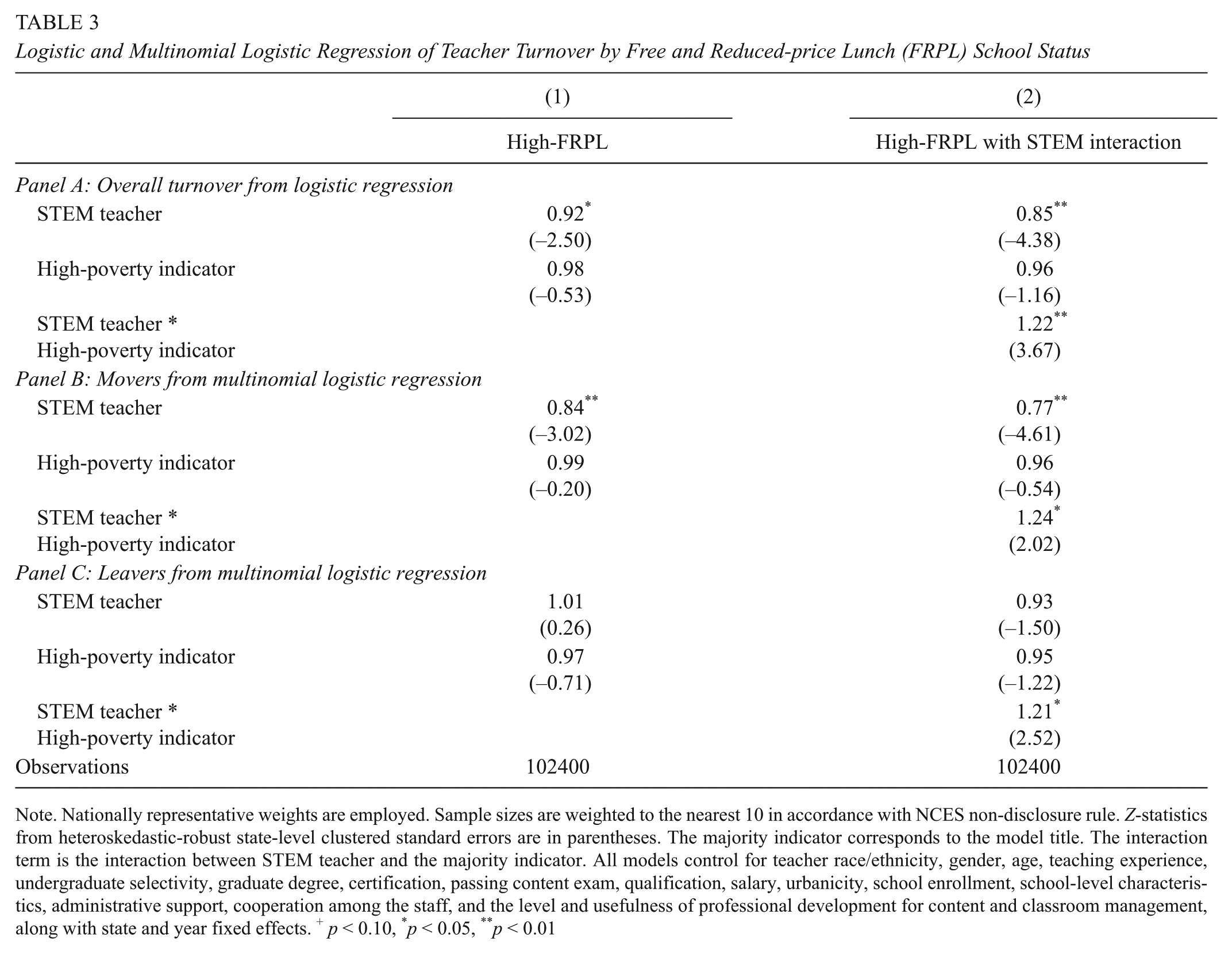
Note. Nationally representative weights are employed. Sample sizes are weighted to the nearest 10 in accordance with NCES non-disclosure rule. Z-statistics from heteroskedastic-robust state-level clustered standard errors are in parentheses. The majority indicator corresponds to the model title. The interaction term is the interaction between STEM teacher and the majority indicator. All models control for teacher race/ethnicity, gender, age, teaching experience, undergraduate selectivity, graduate degree, certification, passing content exam, qualification, salary, urbanicity, school enrollment, school-level characteristics, administrative support, cooperation among the staff, and the level and usefulness of professional development for content and classroom management, along with state and year fixed effects. + p < 0.10, *p < 0.05, **p < 0.01
When we introduce an interaction between STEM teachers and high-FRPL schools in column 2, we find distinct patterns in mobility across schools. Given the difficulty in interpreting odds ratios in interactive models, we plot the predicted probabilities of moving schools and leaving teaching in Figure 3, holding all other variables in the model at their mean. STEM and non-STEM teachers have a higher probability of moving from high-FRPL schools compared to low-FRPL schools. When working in a low-FRPL school, STEM teachers have a much lower predicted probability of moving schools than non-STEM teachers (4.6% versus 5.8%). We find no difference in STEM and non-STEM teachers’ predicted probability of leaving teaching among those working in low-FRPL schools. In addition to higher turnover rates in high-FRPL schools, STEM teachers are significantly more likely to leave teaching from these schools. A non-STEM teacher’s predicted probability of leaving teaching from a high-FRPL school is 7.3%, compared to 8.9% for a STEM teacher.

Probability of moving schools and leaving teaching for STEM and non-STEM teachers, by high- and low-FRPL schools
In comparison, when we focus on high- and low-minority schools, we observe that STEM teachers are less likely to turn over (see online Appendix Table A3). However, unlike teachers in high-poverty schools, we observe that teachers are generally more likely to turn over in high-minority schools. Similar to STEM teachers in high-poverty schools, STEM teachers in high-minority schools are more likely to turn over than STEM teachers in low-minority schools, although this turnover is driven more by teachers leaving the profession than moving schools (see Panels B and C in online Appendix Table A3). These analyses suggest that STEM teachers are particularly responsive to the conditions of the schools in which they work, whether leading to lower mobility from low-FRPL schools or higher rates of leaving from high-FRPL or high-minority schools.
Next, we examine teacher characteristics and school conditions predictive of turnover across low- and high-FRPL schools to identify correlates with turnover. The most relevant results are found in Table 4, with the full results from these models available in the online Appendix Table A4.
Multinomial Logistic Regression of Turnover for STEM Teachers by High- and Low-FRPL School Status

Note. Nationally representative weights are employed. Sample sizes weighted to the nearest 10 in accordance with the NCES non-disclosure rule. There are 13,280 observations in non-majority FRPL schools and 5850 observations in majority FRPL schools. The model controls for teacher characteristics, school-level characteristics, and organizational support, along with state and year fixed effects. Z-statistics from heteroskedastic-robust state-level clustered standard errors are in parentheses. + p < 0.10, * p < 0.05, ** p < 0.01
STEM teachers with a graduate degree are at greater risk of moving from high-FRPL schools, holding other variables in the model constant (rrr = 1.89, p < 0.001). We find no evidence that uncertified STEM teachers were more or less at risk of moving schools, although they had a much greater risk of leaving teaching than certified teachers, with a stronger relationship in low-FRPL schools (rrr = 3.27, p = 0.004) compared to high-FRPL schools (rrr = 2.70, p = 0.013). Passing the content certification exam was associated with a greater risk of moving from low-FRPL schools (rrr = 1.41, p = 0.006) but a reduced risk of leaving from low-FRPL schools (rrr = 0.67, p < 0.001). To the extent that content exams are a valid measure of teachers’ content knowledge, this finding suggests teachers with greater mathematics or science knowledge in low-FRPL schools are more likely to remain in the teaching profession. Holding all else constant, we find no evidence that qualified STEM teachers or those who attended a more selective college are at greater risk of moving schools or leaving teaching.
Supportive working conditions and availability of content-based PD were associated with a reduced risk of moving schools and leaving teaching. Teachers with more supportive administrators were less at risk of moving from low- and high-FRPL schools and less at risk of leaving teaching from a high-FRPL school. A standard deviation increase in administrative support is associated with a 20% decrease in the risk of moving from a low-FRPL school (p < 0.001), a 23% decrease in the risk of moving from a high-FRPL school (p < 0.001), and a 17% decrease in the risk of leaving teaching from a high-FRPL school (p = 0.022). Increasing intensity in the number of hours of content-based PD is associated with a 20% decrease in the risk of leaving teaching (p = 0.008). Results were even more pronounced when we compared teachers who received more than eight hours of content-based PD relative to those with zero or less than eight hours (rrr=0.56, p=0.002).
In comparison to analyses of high- and low-minority schools, these results are substantively similar (see online Appendix Table A5). For instance, we observe that STEM teachers with graduate degrees are more likely to move in high-minority schools but not low-minority schools and that STEM teachers without certification are more likely to leave the profession in high-minority schools. Similarly, teachers who passed the content certification exam are less likely to leave teaching in low-minority schools.
Discussion and Conclusion
Changes in the characteristics of STEM teachers from 1988 to 2012 have important implications for their students. First, we report drastic changes in the gender of STEM teachers. In 1988, 43% of STEM teachers were female. By 2012, 64% of STEM teachers were female. This shift from the majority of STEM teachers identifying as male to the majority identifying as female could play a role in narrowing gender gaps in science performance as well as the underrepresentation of women in most STEM fields. Recent evidence on gender representation in secondary schools suggests that female students’ assignment to a female teacher can improve self-efficacy and test performance (Paredes, 2014; Sansone, 2017). Although the research community is only beginning to understand possible long-run impacts of gender representation, Bottia, Stearns, Mickelson, Moller, and Valentino (2015) find the proportion of female high school math and science teachers to be associated with an increased likelihood that a female student declares and graduates with a STEM degree.
Second, STEM teachers are also more likely to have attended a selective college, have a graduate degree, and have a STEM qualification. Importantly, we show STEM teachers are no more likely to turn over than other teachers and these variables related to the education and qualification of STEM teachers are not predictive of greater risk of leaving teaching, suggesting that the recruitment of more qualified STEM teachers is not also leading to higher turnover rates as these teachers seek out other employment opportunities outside of education. Although we do not measure these teachers’ contribution to student learning, the importance of having a science or math teacher with a strong content knowledge base is promising (Clotfelter et al., 2010; Goldhaber & Brewer, 2000; Hill et al., 2005).
However, this overall pattern masks important differences in the qualifications and turnover of STEM teachers in high- versus low-FRPL schools. The improvements in the education and qualifications of STEM teachers have not resulted in consistent narrowing of teacher quality gaps between teachers in high- and low-FRPL schools. STEM teachers working in high-FRPL schools are consistently less likely to have a graduate degree, have a STEM qualification, and have attended a most selective college (although not a very selective college). In addition, STEM teachers in high-FRPL schools are also more likely to be in their first three years of teaching.
Although revealing, this analysis of the qualifications of STEM teachers does have its limitations. First, the content of the survey has changed over time, limiting the inferences we are able to make regarding the education, qualifications, and turnover of STEM teachers over the seven waves in which the survey was conducted. Second, this study relies on proxy measures for teacher content knowledge. Others have cautioned that using a degree as a measure for content knowledge overlooks the actual instructional practices used by these teachers (i.e., pedagogical content knowledge) or even subject matter content knowledge (Hill, 2007; Smith, Desimone, & Ueno, 2005). Third, the improvements in the qualifications of STEM teachers observed in this study do not indicate whether they result from more qualified teachers entering teaching or the exit of less qualified teachers. That being said, regression results find no relationship between teacher qualifications and leaving teaching, suggesting that the improvements have been driven by improved qualifications in new teachers, a notion supported by other research (Lankford et al., 2014; Master, Sun, & Loeb, 2018).
In addition to our findings on changes in the characteristics of STEM teachers over time, we also show a distinct pattern of STEM teacher turnover between high- and low-FRPL schools. STEM teachers are less likely to move from low-FRPL schools compared to other teachers, but are much more likely to leave teaching from high-FRPL schools. Our secondary analysis for teachers in high- and low-minority schools echoes these sentiments. When combined with evidence presented on disparities in the qualifications of STEM teachers in underserved schools, our results support the argument made by others, that there is a continued need to recruit qualified STEM teachers to work in high-FRPL schools and provide high-quality supports to help them thrive in the classroom (Amrein-Beardsley, 2012; Darling-Hammond & Sykes, 2003; Ingersoll & May, 2012; National Commission on Teaching and America’s Future, 1996). Still, it is worth noting that, given that the data used for this study are cross-sectional, they give no indication of the turnover of different cohorts of teachers throughout the course of their careers. This limitation is particularly relevant as we are unable to examine the degree to which STEM teachers move into low-FRPL schools as they gain more experience in the teaching profession.
Overall, our results suggest that efforts over the past decade and a half to restrict the number of uncertified teachers and recruit teachers from more selective universities have helped in improving the qualifications of the STEM teacher workforce. However, that these overall improvements in STEM teacher qualifications have not resulted in a consistent reduction in teacher quality gaps in high- versus low-poverty schools suggests a greater emphasis needs to be placed on recruiting STEM teachers to work in high-poverty schools and providing high-quality supports to improve their retention in these schools. However, the goal to recruit qualified STEM teachers to work in high-poverty schools and retain them once they enter the classroom has been elusive.
The case of the Math Immersion alternative certification program is a telling example (Boyd et al., 2012). The program was designed to meet shortages in certified math teachers in lower performing schools in New York City. The program succeeded in recruiting teachers who scored higher on most measures of academic ability compared to teachers prepared in a traditional university-based preparation program. Yet, on average, their students performed slightly worse on standardized tests than all other entry pathways in the district and they turned over at higher rates—42.1% had left the district after four years compared to 31.4% of traditionally prepared teachers.
On the other hand, there are robust findings that Teach for America (TFA) teachers have stronger academic qualifications and that their students make larger gains in math and science compared to students assigned to other teachers within the school (Henry et al., 2014; Xu, Hannaway, & Taylor, 2011). For example, Henry and colleagues (2014) found that students taught by TFA teachers gained between 15 to 64 additional days of schooling in elementary and middle grades math compared to in-state public undergraduate-prepared teachers. However, TFA teachers also leave teaching at high rates after their two-year commitment is over, with 80% having left teaching by the end of their third year (Redding & Henry, 2018). In short, there is evidence that alternative certification programs are able to recruit teachers with stronger academic abilities, but retention of these teachers has been and continues to be a challenge.
As there is insufficient evidence to gage the efficacy of other programs aimed at recruiting and retaining high-quality STEM teachers, particularly in historically underserved schools, we see this as an area for continued research. These preparation programs include those initiated at the local level, such as the UTeach Program at the University of Texas, Austin, as well as the National Science Foundation’s Robert Noyce Teacher Scholarship Program. More broadly, although we suggest that the improvements in teacher qualifications are, in part, attributable to changes in the preparation and certification of teachers beginning in the 2000s, there are likely broader labor market forces that shape who becomes a STEM teacher. Future research could more carefully examine the STEM teacher pipeline and aim to study how the oversupply of STEM graduates in some fields may explain the improved qualifications observed in this paper.
Supplemental Material
DS_10.1177_2332858418802790 – Supplemental material for Changes in the Demographics, Qualifications, and Turnover of American STEM Teachers, 1988–2012
Supplemental material, DS_10.1177_2332858418802790 for Changes in the Demographics, Qualifications, and Turnover of American STEM Teachers, 1988–2012 by Tuan D. Nguyen and Christopher Redding in AERA Open
Footnotes
Acknowledgements
We thank the editors and two anonymous reviewers for their constructive feedback and suggestions. All remaining errors are our own.
Funding
This research received no specific grant from any funding agency in the public, commercial, or not-for-profit sectors.
Notes

Authors
References
Supplementary Material
Please find the following supplemental material available below.
For Open Access articles published under a Creative Commons License, all supplemental material carries the same license as the article it is associated with.
For non-Open Access articles published, all supplemental material carries a non-exclusive license, and permission requests for re-use of supplemental material or any part of supplemental material shall be sent directly to the copyright owner as specified in the copyright notice associated with the article.
