




Abstract
The aim of this socioculturally informed study is to explore teachers’ insights into connected-learning activities and networks. An instructional approach based on design-oriented pedagogy (DOP) was employed for a teachers’ in-service project in Finland. An open-ended design task for the participating teachers and educators from kindergartens (N = 27) and primary schools (N = 2) involved designing and implementing a forest-related learning project with their own students or kindergarten children. A deductive content analysis of openly published project portfolios revealed that the teachers and educators harnessed learner interest as a basis for connecting with peers, family, external experts, and extended environments through diverse physical and digital information resources, tool-mediated activities, and the externalization of the learners’ evolving object-oriented ideas. Conclusions are drawn about extended learning networks and activities that afforded inquiry activities to emerge.
Keywords
Educational systems often fail to connect with the larger educational opportunities that exist outside of the classroom (Mueller, 2011). The interests, expertise, and networks that students have developed elsewhere are often irrelevant in school, and vice versa (Eckert, Goldman, & Wenger, 1997). Wells (2008) argued that in schooling the main drivers of participation are typically predetermined structured systems for instruction and assessment. With this closed-ended view, little or no attention is given to students’ diverse backgrounds, interests, and expertise, nor are they encouraged to show initiative and creativity in formulating questions and problems or in attempting to solve problems in collaboration (Wells, 2008). As long as the schools continue to disconnect content from context, information from application, learning from participation, and knowledge from experience, they will sever the essential connection that facilitates the learner in creating meaningful relations with the world (Barab et al., 1999).
Efforts to transform education call for moving from an industrial system toward organic, complex, and adaptive learning networks that evolve and connect students’ learning ecologies with multiple contexts and communities, their social practices, and tools (Ito et al., 2013; Kumpulainen & Sefton-Green, 2014; Loi & Dillon, 2006; Vartiainen, 2014). To enhance the creation of the new kinds of learning systems required in 21st-century societies, Ito and her colleagues (2013) argue for the need for connected learning that supports children and youth to link their formal learning with society, family, and community in an interest-driven and inquiry-oriented manner. Connected learning is realized when the learner is able pursue a personal interest with the support of peers, adults, teachers, and expert communities, and is in turn able to link this learning to academic achievement, career possibilities, or civic engagement (Ito et al., 2013).
While we have begun to have successful examples and studies of connected learning in schools (Liljeström, Enkenberg, & Pöllänen, 2014) and in universities (Vartiainen, 2014; Vartiainen, Pöllänen, Liljeström, Vanninen, & Enkenberg, 2016), we have less of an understanding of what it might mean in the context of early childhood and school beginners’ education. According to several studies (e.g., Ceppi & Zini, 2003; Clark, 2008; Venninen, Leinonen, Lipponen, & Ojala, 2013), children’s participation in early childhood education is typically depicted as problematic because educators do not consider children’s ideas and sayings, and do not encourage and engage them in shared decision-making. Our contribution to connected learning attempts to fill this gap in the existing research by focusing on the diverse ways in which teachers and educators from kindergarten and primary school (N = 29) have promoted children’s meaningful participation and inquiry across spaces.
In the following discussion, we introduce the theoretical background of this design-based research, beginning with the sociocultural roots of connected learning. Then, we continue with an instructional approach to design-oriented pedagogy (DOP), which was applied when designing and implementing the connected learning projects in practice. Conclusions are drawn about emerged learning activities and forms of participation that afforded interest-driven inquiries in extended learning environments and communities.
Design-Oriented Learning Systems
In this study, sociocultural theory provides a conceptual tool with which to investigate and promote connected learning. Sociocultural theory generally views learning and participation as systemic processes that connect the subjects (the actor or actors participating in the activity), the object of their activity, and the tools and resources that actors use as mediational means for acting on the object (Cole & Engeström, 1993; Vygotsky, 1978). Using this theoretical framework, connected learning can be viewed as participation in social practices mediated by different artifacts, tools, and environments (Kumpulainen & Sefton-Green, 2014).
Connected learning acknowledges that the students are members of multiple communities. In their home, school, and in their peer and pastime communities, the students have access to a variety of resources and tools for learning (Zimmerman & Bell, 2012). According to Wenger (1998), participation in community activities supports the development of skills and knowledge that go hand in hand with a growing sense of one’s self and identity. As children’s everyday participation in varied communities deeply influences their personal interests, goals, and identities, there is a clear need for models that support learners’ meaningful transitions between these different spheres of learning (Ito et al., 2013).
In many ways, connected learning overlaps with the core pedagogical principles of design-oriented pedagogy (Vartiainen, Liljeström, & Enkenberg, 2012), with an emphasis on production-centered learning and participation that contribute to a common purpose (Ito et al., 2013). In design-oriented learning, learners are supported to connect diverse tools, materials, artifacts, and people in terms of shared objects of activity (Hakkarainen & Paavola, 2009; Roth, 2001). These objects could be symbolic-material artifacts, such as questions and theories, or practices that arise from the phenomena of the real world (Hakkarainen, Paavola, Kangas, & Seitamaa-Hakkarainen, 2013). They provide students with opportunities to design and perform inquiries and make connections to their own interests and practices that represent the work of expert communities (Krajcik & Blumenfeld, 2006). In contrast to traditional school tasks, design objects are characterized by emergent goals and activities that are formed and modified during the course of pursuing them (Scardamalia, Bransford, Kozma, & Quellmalz, 2011).
Complex design objects also bring into play knowledge that is bound to real-life environments and situations (Vartiainen, 2014). The environments of the natural world offer unique encounters with dynamic, unstructured, and multisensory modes of information and full-bodied primary experiences through which learners may form place attachments as well as relationships with more experienced others (Chawla, 2007). Authentic environments are potential spaces for learning because they can mediate the different kinds of cultural traditions and discourses through which children participate in everyday life (Bang & Medin, 2010; Taverna, Waxman, Medin, Moscoloni, & Peralta, 2014; Washinawatok et al., 2017). According to Rajala and Akkerman (2017), the environments of the natural word can be produced in varied ways through these different discourses and social activities.
From the subject’s perspective, design-oriented learning emphasizes interaction within and between peers or teams, students and the teacher, external experts, and the community (Seitamaa-Hakkarainen, Viilo, & Hakkarainen, 2010). It aims to connect the learners to an ecological system that benefits from the existing networks that the students are already connected with (Moll, Amanti, Neff, & Gonzalez, 1992), stimulate a desire to explore the connections that others have access to (Facer, 2011), and offer the opportunity to co-create new affordance networks (Barab & Roth, 2006). When students pursue objects of their interest, drawing on those tools and resources that best respond to their needs, they are less likely to experience dissonance between the world of their informal community and the world of formal learning (Miller & Roehrig, 2016; Roth & Lee, 2004). Figure 1 presents a design-oriented learning system of interconnected elements that derive their full meaning in relation to each other (Vartiainen, 2014).

A design-oriented learning system (Vartiainen, 2014).
In design settings, students learn by co-creating an epistemic environment that affords their evolving activities of inquiry (Markauskaite & Goodyear, 2016). The students and teachers co-construct the contexts of learning in an iterative, that is, spiral and cyclic process. As new ideas and questions emerge, they initiate a deepening inquiry through which new tools, people, and resources are connected to the re-designed system. As diverse resources and knowledge are brought together, the subjects and the objects are likely to transform when the process advances through successive iterative stages. Consequently, teachers and educators no longer rely on pre-established, scripted environments and procedures to coax individuals into specific performances. Instead, the teachers orchestrate situations that allow for a variety of connections and modes of participation (Roth & Lee, 2004).
Zhang, Hong, Scardamalia, Teo, and Morley (2011) suggest that creative teaching can be best supported through a principle-based approach, which defines core pedagogical values and principles, but encourages and facilitates teachers’ reflective interpretation and contextual design. In relation to design-oriented learning systems, there are three main pedagogical principles (Vartiainen et al., 2012): (a) engaging learners in the pursuit of open-ended learning tasks (object); (b) working with diverse conceptual, material, and digital resources and tools that represent the phenomenon in question (tools and resources); and (c) facilitating interest-driven participation in generative communities (forms of social organization). When these core principles are actualized through collaborative design by teachers and students, novel learning activities and forms of participation are also likely to emerge.
Methodology and Data Sources
The present work is part of a long-term design-based study (DBR Collective, 2003) that aims to iteratively develop design-oriented learning environments and social practices that result in an improved pedagogical model and theoretical insights. Earlier publications have introduced the instructional model of DOP in more detail and have described case studies on its development process (Vartiainen, 2014). New, unanswered questions that have emerged from these earlier studies relate to the ways in which teachers could facilitate and implement extended participatory practices.
Research Context
The research context of this design experiment is an educational project for in-service teachers organized in the spring of 2015 at the University of Eastern Finland. In Finland, recent renewals of the core curriculums for early childhood, pre-primary, and basic education emphasize children’s active participation, the development of transversal (generic) competences, as well as collaborative phenomenon- and project-based studies situated in diverse learning environments (Finnish National Core Curriculum [FiNCC], 2016). The research project aimed to support teachers and educators in applying the new curriculums in practice and in implementing forest-related learning projects in a DOP framework.
The call for participation in the project was open for all the schools and kindergartens around the Savonlinna region. The project began with an open meeting in which DOP and possible affordance networks and tools were introduced to all interested parties. In this in-service project, the forest served as a joint, multifaceted object, as it is present in the everyday lives of the people living in the area. A great deal of forest environment, expertise, and information resources are also available in the region (e.g., forests, forest museums, forest researchers, domain expertise, and professionals). Emphasizing authentic and idea-centered activities, the loosely defined task of the teachers and educators was (a) to design, implement, and document a forest-related DOP learning project with their own pupils, and (b) to document and share the progress of the project in a manner of their choosing (e.g., observing, photographing, and videotaping the activities of the students and children in the project).
Core to our approach was that the in-service project was parallel to student learning activities. At the beginning of the DOP project, the teachers and the learners negotiated the learning task to be investigated. When the common task was articulated, the next phase was to map students’ own research questions as well as the resources, tools, and expertise that could be utilized when developing answers to them. The design phase was followed by data collection in extended learning environments and expert communities. The final phase was to organize and process the collected material as a digital artifact and publish it. Figure 2 presents the applied instructional model (Vartiainen et al., 2012) and the organization of the related networking meetings of the teachers, educators, researchers, and experts.

Instructional model (Vartiainen et al., 2012).
During the DOP project, five joint networking meetings with teachers, educators, researchers, and experts were organized. In dialoguing sessions, the teachers were encouraged to reflect on their own projects through different interests, questions, perspectives, people, places, artifacts, and the tools that were linked to them (see Figure 1) and to share the emerging ideas, connections, and challenges. The joint conceptualization of teachers’ experiences aimed to capture the emerging learning activities, with the intention of collaboratively ideating the scaffolding that may subsequently be implemented to facilitate student learning and participation. Moreover, teachers shared their projects at a national education conference (Interactive Technology in Education 2015 Conference, Finland) and in the OpenForest wiki environment (www.openmetsa.fi). OpenForest is an open learning environment where schools, experts, and anyone interested can participate in collective knowledge-sharing around forest-related phenomena.
In sum, the in-service project aimed to reflect connected learning (Ito et al., 2013) by emphasizing the openly networked, peer-supported, and production-oriented nature of learning and of teachers’ professional development. The pedagogical approach of DOP then provided concepts and a model from which to co-design and reflect on this kind of complex and context-specific learning project in practice.
Research Questions
In this study, the DOP learning system (Figure 1) provides a conceptual tool and a broad design framework for promoting connected learning. The frame also informs the instructional model (cf. Figure 2), which is focused particularly on teacher intentions and the ability to draw out students’ active agency. These previously presented models also provide a lens through which emerging learning activities and participation forms can be examined. The following research question is proposed and studied from the teacher’s perspective.
What kind of learning activities and forms of participation are mediated in kindergarten children’s and school students’ design-oriented learning projects?
Participants
One kindergarten as a whole, two teachers from two primary schools, and three teachers from a secondary school participated in the project. Recognizing that the sociocultural contexts of secondary schools and early education are quite different, the present analysis focuses on the insights of 29 adults who work with kindergarten children and pupils in the 1st through 2nd grades (Table 1).
Participants in the Study

In Finland, preschool is obligatory for six-year-olds, and compulsory education begins at the age of 7.
In Finland, teachers are highly trained. Class teachers must have a five-year master’s degree and kindergarten teachers are required to have a three-year bachelor’s degree. As noted by Heikka, Halttunen, and Waniganayake (2016), Finnish early childhood education (ECE) professionals typically work as small teams with qualifications from diverse disciplines. In this project, the kindergarten teachers (N = 9) and child care nurses and assistants (referred to here as “educators,” N = 18) were working in teams of three to four members. Two of the teams worked with preschoolers, four teams worked with groups of children aged 3–5 years, and two teams worked with two groups of children aged 1–3 years. In total, 11 projects were implemented and documented on the OpenForest portal (1 project per group or class of children).
No additional demographic details about the teachers or their students or kindergarten children were collected in any systematic manner, as the research data comprised openly published portfolios. Accordingly, the study was based on participative modes of research in which those who agreed to become involved in a study produced the data (Prosser & Loxley, 2008). Consent was obtained from the students’ guardians, partly because some of the material produced by the learners was published online.
The research group organizing the actualization of the project consisted of one researcher in education (PhD in educational science), one forestry expert (PhD in forest science), and one teacher–researcher (class teacher and PhD student in education). Also, one university lecturer in biology (PhD in biology) participated as a domain expert in one of the meetings as well as in one of the kindergarten forest trips.
Data Collection
The main data gathered in this study constitutes all the project portfolios (N = 11) produced by the participating teachers and educators, which have been openly published in the OpenForest wiki environment (see Attachment 1) (three project portfolios were also translated into English). For analytical purposes, all the published project portfolios in the wiki environment were converted to PDF format, consisting of a total of 300 pages including text, photos, and drawings. At this point, the video clips found on wiki were left out of the analysis. Although the school pupils and kindergarten children were part of the emerging learning systems, the main data of this study does not consist of the direct actions of the learners but focuses on teachers’ descriptions and interpretations of them.
Data Sources

Data Analysis
Data were analyzed using qualitative content analysis. The main focus was on text, but photos were also used to search for additional information. The unit of analysis was a shared idea or meaning (Chi, 1997), which typically included one or several sentences describing a change in learning activity or a reflection of it.
In the first phase of analysis, all the project portfolios (N = 11) were analyzed deductively. When developing familiarity with the data, the framework in Figure 1 allowed the analyst to depict the main elements, including the mentioned subjects (the group of children, their peers, teachers, family members, and experts), the objects of their activities (learning task, research questions), tools and resources used (e.g., books, the Internet), and the activities’ environments (e.g., forest, library, museum). The second phase involved developing categories by exploring the learning activities that teachers associated with these elements of the learning system, both deductively and inductively (Table 2). In particular, we focused on how the subjects, objects, tools, and environments (cf. Figure 1) were connected in the four main activities of the instructional model (articulating the design task, designing the contexts, collecting data, and constructing the solution; cf. Figure 2). The basic idea was to depict activities that fit into the deductive categorization and use those that did not to develop new categories inductively. After identifying the initial categories, similarities and differences among the initial categories were examined to develop the codebook. One researcher performed this stage of the analysis using Atlas.ti software.
Development of Categories (see Attachment 2)
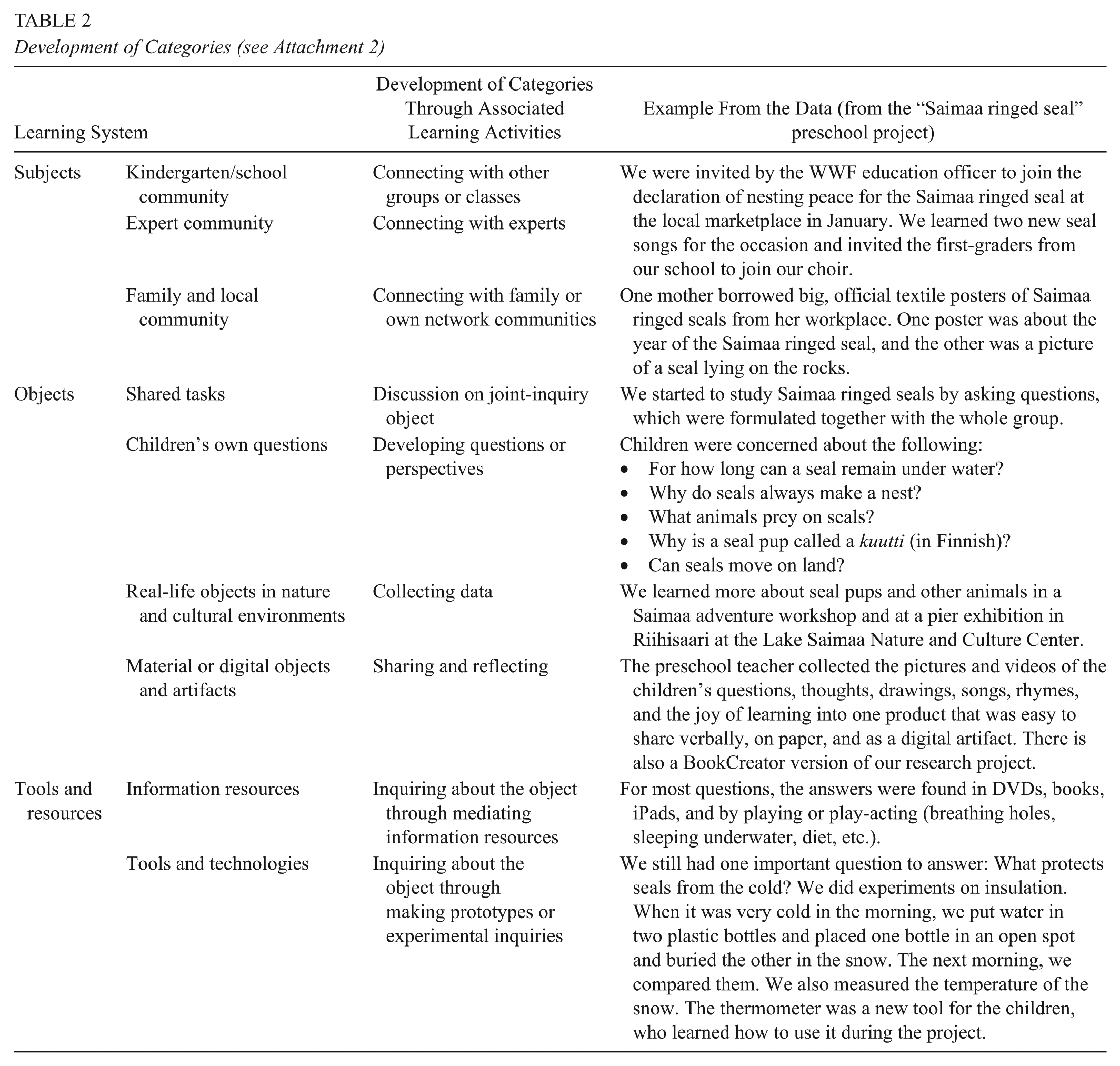
In the third analytical phase, two representative projects were selected for assessment of intercoder agreement (one kindergarten project and one school project). These two projects were viewed as representing, in textual form, the range of learning activities and forms of participation being investigated. As the first coder already had identified the meaningful units of analysis and segmented the textual data based on that, all codes, but not the segments, were removed when preparing the data for the second coder. After introducing the codebook to the second coder, who was already familiar with DOP and related theoretically driven insights guiding the analysis, the second coder coded the same 120 text segments. This represented 20.3% of the total 590 coded segments. The intercoding was performed by using web-based QCAmap software.
In the next phase, the differences and similarities between classifications were compared and discussed, and the needs for codebook development were negotiated, identified, and implemented among the coders. Then the resulting four categories and 22 subcategories (elaborated on in more detail in Attachment 2) were applied to the entire corpus of text to ensure coding consistency. This process of intercoder agreement and open access to the main data aimed to contribute to the reliability and trustworthiness of this study’s interpretations.
Codebook

The fourth phase involved co-occurrence analysis, in which we searched for codes for the “learning activities” that occurred in conjunction with the codes related to “extended learning communities” and “extended learning environments” by using the Atlas.ti co-occurrence tool (see Attachment 2). The meaning of a certain co-occurrence was studied further by rereading the original text segments and aggregating meaningful connections into abstract interpretations connecting design-oriented learning activities and environments.
Results
In this section, we provide more detailed descriptions of the object-oriented activities organized around four main phases of the DOP process (Figure 2). First, we show how the children were supported while addressing the joint object of inquiry and related knowledge-seeking questions. Second, we show how the children participated in designing their own inquiry activities. We also illuminate how a variety of information resources, tools, and expertise were connected when collecting data for answering the children’s questions. Then we show how the development of object-oriented ideas was made visible through various materials and bodily activities. Finally, we examine teachers’ reflections about the process of facilitating children’s participation and learning.
Developing Object-Oriented Questions
Detection and Cultivation of Interesting Questions
The analysis of the project portfolios revealed that all the kindergarten teachers emphasized the children’s firsthand experiences with the natural world. The children’s interest was discovered and harnessed to sustain inquiry activities by taking the children to a local forest environment several times. Instead of predefined learning tasks and outcomes, the natural environment became the object of inquiry and acquired meaning in terms of children’s on-site observations and questions.
The project with 1−3-year-old toddlers illustrated how the object of inquiry was discovered by observing and documenting children’s on-site activities in the forest. While the children explored their surroundings, the teachers observed the children’s initiatives, took pictures based on the children’s hints, and listened to their emerging questions. For them, the real-life environment served as a mediator of the children’s interest, as described by the toddlers’ teacher: “To find out what things were interesting to our kindergarten group in the forest, we decided to go into the forest to observe what objects small children focused on with their eyes, hands, and questions.”
The project with 3−5-year-olds showed how the teachers oriented children’s interests, questions, and interactions with the natural world through mediation resources (Figure 3). Through the pictures of forests and related joint discussions, the children themselves suggested a trip to the forest. When the children’s initiative inquiring about the trees was actualized, deeper questions surfaced, as the teacher explained: “After the first trip to the neighboring forest, the children started to get interested in how old the trees were and how they could find the answer.”

Developing interest and questions (Expedition to the forest project, group of children, 3−5 years).
The preschool group’s long-term learning project, focusing on Saimaa ringed seals, began from one child’s observation, as explained by the preschool teacher.
One girl was putting food between rocks close to the frozen lake and screamed with enthusiasm that she had seen a Saimaa ringed seal. Who knows whether that was true or not, but that was the starting point for our seal research.
Likewise, the project in the other preschool group began when one boy expressed a wish for robot cameras to observe nature. The teachers then connected this idea with a trail camera that was funded by the in-service project. Although these preschool projects might have originated from these children’s ideas, the iterative process engaged the whole group to develop deepening questions for inquiry through which tools, people, and resources were connected.
The primary-school project illustrated teachers’ deliberative attempt to create bridges between students’ own questions and the curriculum. The joint-inquiry object of the project was discovered during a trip to a forest museum, where the students were guided toward creating forest-related questions. After the visit, the question connecting with the broader thematic content of the curriculum was further elaborated on, as the teacher describes: “Particularly interesting and also relevant to the curriculum was the pupils’ question about how animals survive winter—a question that we took up in January.” When the joint object was found, the students developed additional questions and determined which animal they wanted to study in small groups.
Designing the Learning System and Connections
When the shared object and related research questions were negotiated, the teachers and children engaged in ideating about possible experts, tools, methods, or information resources that could provide answers to them. In kindergarten, this was actualized through joint discussions, as depicted in the following example reported by the teacher of the group of 3−5 year-olds: “Children’s reasoning on how we could find out which animals are living in our neighboring forest: by observing in the forest—from books—by asking the teacher—from TV—daddy can tell us—my grandpa knows; he hunts.” She continued by exemplifying how the kindergarten teachers used the children’s ideas to design the future activities: “On the whole, we have spent time in the woods doing every possible form of action; this means that the forest and animals were the driving forces in the group’s activities.”
The pupils in both of the two primary-school groups made written research plans that indicated the pupil’s own active role in designing and implementing future project activities. The pupils were also asked to negotiate working roles and rules for themselves, as explained by one of the primary teachers.
The groups wrote down all the research equipment they would need in the process. They also agreed on who would be responsible for bringing each tool and what tools they would need to ask for from the teacher. Binoculars, a book on flowers, notebooks and pens, a magnifying glass, a backpack, and smartphones were brought from home. Tablets, magnifying jars, and a shovel were ordered from the teacher.
With respect to tools, this example further illustrates the intent to use children’s own tools when collecting data from the forest.
Data Collection
Observing Real Objects With Multiple Senses and Tools
The analysis of the project portfolios further revealed the kinds of real objects, tools, and resources that were used when developing answers to children’s questions. In kindergarten, the groups made several field trips to the forest, where they observed real objects through multiple senses, as depicted by the teacher of children ages 3−5: “We got to know water by using different senses—what it tastes, smells, looks, feels, and sounds like.”
Observations of real objects were also mediated by the use of diverse tools and technologies, for example, spades, loupes, microscopes, and tablet computers. In kindergarten, the teachers used technology (iPads) mostly to document the children’s ideas and activities, whereas the students used iPads and smartphones for data collection, for example, taking photos, videos, notes, and coordinates (see Figure 4).

Tool-mediated data collection (Let’s go into the woods project, primary-school group).
The primary-school project illustrated how the ideas and questions developed in a museum environment created the need to explore a natural environment to search for answers. To observe winter birds, the students created their own physical and cognitive tools, as the teacher reported, One student found on YouTube a manual for a funny and ecological birdfeeder made of a milk carton. The group made two feeders, and the teacher brought a third wooden birdfeeder and three different kinds of seeds to the school. All three feeders were filled with different seeds, and the amounts were measured … The feeders were hung on a spruce tree outside the classroom so that we were able to observe the feeders from inside.
She further described how the students also made a record form for monitoring winter birds, on which the date, weather conditions, and all birds that visited the feeding station were recorded and tallied (Figure 5). As a result of manipulation of the surroundings with the help of their own tools, unseen aspects of bird life were revealed to the students, arousing great enthusiasm within the whole class.

Making experimental inquiries (Animals in winter project, primary-school group).
Collecting Data With Experts and With Expert Tools
The observation of real objects was also supported by expert communities. For example, two kindergarten groups went to a museum, and six went to a library. The toddlers’ kindergarten teacher explained how they harnessed the children’s observations of the natural world (rabbit tracks) to practice an information search with an external expert.
We made a data-collection trip by bus to Savonlinna Main Library, “Joeli.” During our visit, we searched for books with help from poem cards, played, got to see how books are borrowed and returned, and enjoyed a picnic with cookies and juice. We were given a lot of rabbit-related story and nonfiction books.
The project with children ages 3−5 illustrated how their questions, originating in their previous forest trips, drove interactions with external experts in another forest setting (Figure 6). Before the field trip, the children were guided toward developing object-oriented questions for the experts. The teacher and experts used these questions to organize the content and activities for the visit, tailoring them to the children’s needs, as depicted by the group’s teacher.
We had planned a field trip together with a forestry company to a logging site in Pahkaniemi, Enonkoski. The children had been forming questions on topics that were interesting to them. These questions had been sent to the experts before our field trip…. First, we examined the log piles, what kinds of trees there were, and we were told how we could find the ages of the trees, how old the trees were when they were cut down, and how old the oldest trees were. We also learned where the logs were going and what would be made out of them.

Observing real objects with an expert (Expedition to the forest project, group of children, 3−5 years).
Collecting Data and Information Resources From and With Own Networks and Tools
The preschool project exploring life in the forest illustrated how the expertise and resources from individual children’s networks became part of the learning resource for the whole group and beyond it. Two kindergarten groups traveled to the home state of one of the children and installed a trail camera there (Figure 7) with the support of the child’s father and two university researchers (a biologist and a forest scientist). This project further illustrated how the information received from the “robot camera,” which originated from one child’s aforementioned idea, became a mediator of object-oriented discussions with peers, experts, and families. When the children’s families joined the project in an interest-driven manner, the teacher said: “Parents and grandparents got interested in following the trail camera together with the children: participation!”
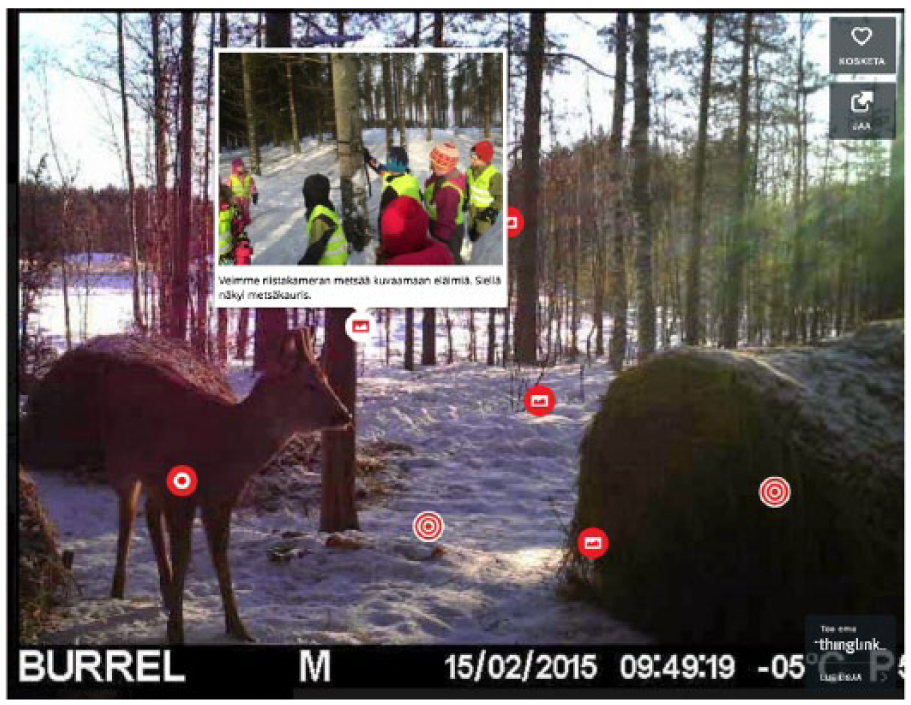
Collecting data from real objects (Observing the life of the forest with trail cameras project, preschool group).
Furthermore, the children’s inquiries also were supported by the various kinds of information resources found within the children’s own networks. Typically, these information resources represented real-life objects under investigations, for example, the trail-camera photos and rabbit’s foot received from the families. One preschool group also received expert resources from one mother’s workplace, as described by their teacher: “One mother borrowed big, official textile posters of Saimaa ringed seals from her workplace.” In all, these various connections with families’ everyday practices and expertise created extended resources for learning that would not have been possible in the classroom.
Sharing and Reflecting
Externalizing Object-Oriented Ideas and Thoughts
During the learning projects, the kindergarten children were encouraged to externalize object-oriented ideas through several material and bodily activities, such as drawing, singing, physically exercising, engaging in crafts, writing poems, and putting on drama plays (Figure 8). The teachers also used these externalized ideas to engage the children in discussing, reflecting on, and sharing their emerging thoughts and ideas with their peers. Furthermore, the interest evoked in the forest began to emerge during the children’s free play time, as described by the kindergarten teacher of the 1−3-year-olds.
As we were processing the life of a rabbit in many ways, the children started to play bunnies during visits to the forest and also during P.E. classes—they were jumping and eating tree bark or carrots like bunnies, and sleeping in their nests.
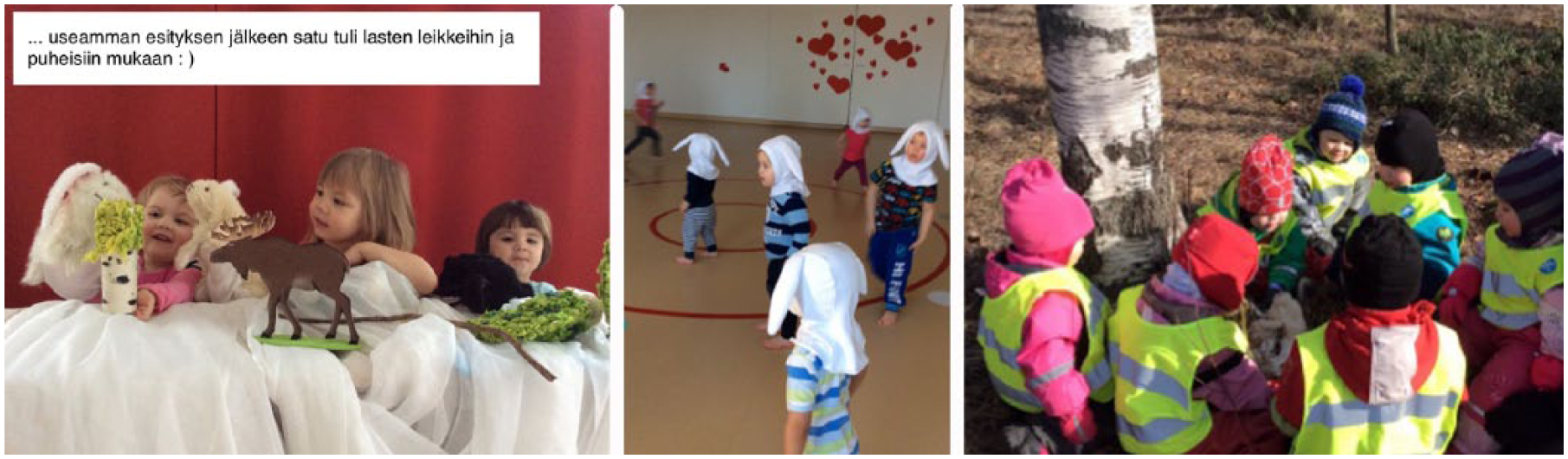
Inquiring objects through bodily activities (Life of a bunny project, group of 1−3-year-olds).
Connecting With Experts through Externalized Ideas and Thoughts
The analysis of the portfolio also revealed that the materialized activities also mediated interactions with the external experts. For example, before and after the expert interactions at the tree-felling site, the group of 3−5-year-olds was documenting its thinking processes through drawings, as explained by the teacher of the 3−5-year-olds (Figure 6), The children documented the research by drawing. First, they drew a picture of an old and a young tree, then they drew things they remembered from the field trip to the logging area, and at the end, after the research, they drew new pictures of the old and the young trees.
Some of these pictures were sent to the experts, to thank them. In this way, the development of object-oriented ideas was made visible for the teacher, experts, and families, as well as for the children themselves.
Connecting With Own Network Through Externalized Ideas and Thoughts
The materialized thoughts of the children also mediated connections with family members and the local community (Figure 9). This typically was done by presenting their projects to their families, as explained by the teacher of the preschool class, On Valentine’s Day, the children’s grandparents came for a visit. We also sang seal songs to them and showed them our winter landscapes depicting the Saimaa ringed seal’s nesting place. We asked [the grandparents] to help their grandchildren cut out the seal figure and told them about our seal research.
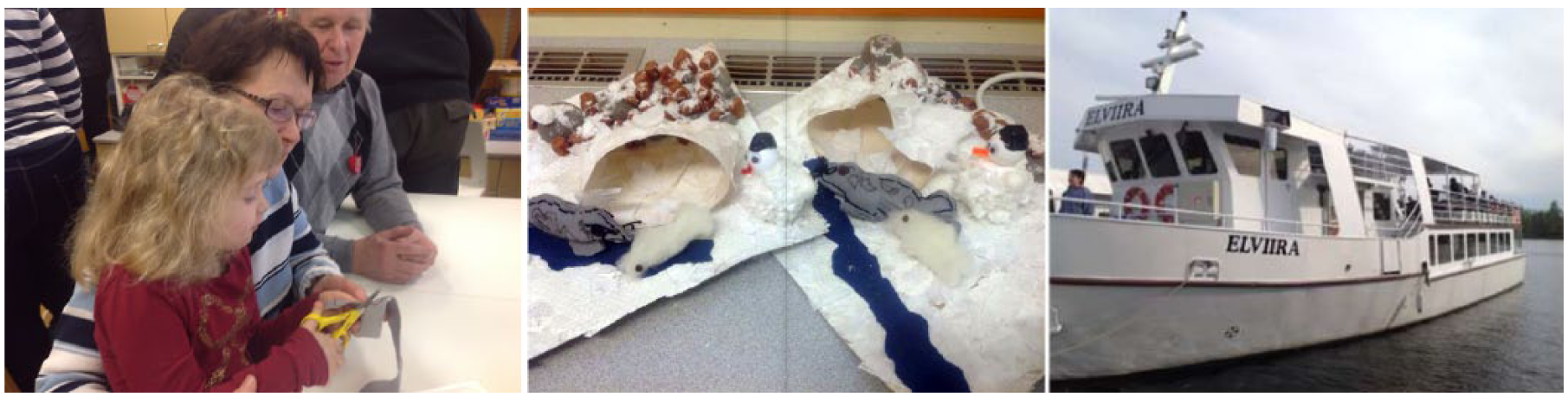
Connecting with family (Preschool group’s Saimaa ringed seal project).
In the kindergarten groups, the teachers mostly organized the collected multimedia data in the form of a digital book or presentation that told each group’s personal story of their learning process, complemented with recordings of children’s own questions, thoughts, and artifacts, as well as substance-specific knowledge discovered during the inquiries. For one group of preschoolers, the outcomes were created together with the children, as explained by the teacher: “In one group, we put together an artifact about deer using the ThingLink application. The children chose the facts and pictures for the work with some help from the teacher” (Figure 7). In the primary-school groups, the children produced digital books themselves, which were shared with their peer-supporter class of sixth-graders, as depicted by the primary-school class teacher, My pupils presented their own projects, meaning books made with the BookCreator application, to sixth-graders. The task was exciting, but the feedback was encouraging. Our plan is to present the books to the parents during spring semester and possibly even link them to our class blog.
While these digital books and presentations about the project mediated interactions with peers, family members, and other interested parties, they were also used as a mirror for evaluating the project together with the children. The teacher of the preschool class explains: “The evaluation took place by having conversations with the whole group, by looking at the pictures and videos taken during the project, and by thinking back on everything we had done.” Furthermore, the emerged project activities were reflected in terms of designing future activities together with the children.
Reflecting Interest, Participation, and Learning
Several teachers emphasized the learners’ own interest as key drivers of the emerging learning activities, as explained by the teacher who worked with children 3–5 years old: “Motivating the children and keeping up their interest was easy because the starting point was the children’s own interest. The children’s interest fed the adults as well, and by working together, we learned together.” However, one of the teachers found it challenging to actualize the children’s interest as a deepening inquiry learning project because there were only a few words and questions. One preschool teacher also said it was challenging to capture the children’s interest through joint discussions. The primary-school teachers explained their students’ interests through heterogeneity: “Those pupils who aren’t usually very interested in going to school or who suffer from learning disabilities also participated with enthusiasm during the whole project.”
The project also challenged the teachers to reflect on the complex relationship between guidance and participation, as explained by a teacher who worked with children 1–3 years old: “A small child needs a lot of guidance. Working with small children especially challenges us to think about how to realize the activities in a way that makes the child feel he/she is a part of them.” In this context, the iPads were used not only to document the children’s activities but also to support teachers’ reflections, as explained in the following: “As we were going through the footage, many situations could be seen in a new light; the child became more visible.”
When reflecting on the learning of skills and ways of coming to know, most of the teachers emphasized the development of general skills, such as creating self-confidence, sharing responsibilities, collaborating with peers in inquiry activities, searching for knowledge, and using technology. Domain-specific knowing and concepts were also connected to general skills, as explained by the teacher of a preschool group, During the project, we worked together and practiced communication skills, listened to others, and rehearsed and learned the seasons and months of the year, units of length and weight, new concepts (shoreline, breathing hole, and cracks in ice), and how to read the thermometer. During the research, we got to know ICT tools and services to some extent.
When pondering the outcomes of the learning project, the teachers and educators who worked in kindergarten explained that the in-service project did not require them to change much of their existing practices. According to the kindergarten teachers, documentation of the children’s activities was new, but the actual activities depicted belong to their everyday practice. The preschool teacher opined that the in-service project was successful in making early childhood working culture and practices visible to others, as well as in connecting the teachers of the kindergarten community: “We have all helped each other with different-themed research. Through these research objects, we have gone through something uniquely connecting, even pioneering, like brainstorming in the approaches of early childhood education.”
Discussion
The goal of the present study was to explore teachers’ insights into the kinds of activities and forms of participation that are mediated in early childhood and in school beginners’ learning projects. This study represents design-based research, where sociocultural theory informed our approach to conceptualizing connected learning and served as the lens through which we viewed the emerged networks of subjects, objects, and tools. The pedagogical approach of DOP was applied when designing and implementing connected-learning systems and projects in practice.
In order to examine and further advance the design-oriented approach to connected learning, an educational project for in-service teachers was organized. In line with the research on teachers’ professional development, the teachers’ in-service project was deeply situated in practice, and the focus was on enhancing students’ learning (see Whitcomb, Borko, & Liston, 2009). An open-ended design task for the teachers involved designing, implementing, and documenting a forest-related learning project with their students or kindergarten children. The “design” metaphor stressed the creative element of interpretive activities in which the teachers needed to contextualize instructional insights and collective resources in locally relevant ways (Säljö, 2010). The investigation of the designs, as constructed by participants, opened up opportunities to explore their perspectives on the elements in the educational model (Bielaczyc, 2013).
In this study, the forest served both as a rich learning environment as well as a boundary object that motived the shared activity between children, parents, experts, and community members (Akkerman & Bakker, 2011). The children’s interest in, and questions about, the shared object were harnessed and cultivated by various visits to forests and museums, highlighting the important role of contexts and the affordances provided by the environment when engaging the children in sustained pursuit of inquiry. As stated in previous research, understanding and engaging with children’s interests in the natural world also requires the acknowledgment of the cultural and social context of meaning making (Taverna et al., 2014; Washinawatok et al., 2017). Our analysis illuminated how the groups negotiated different objects of activity during the fieldtrips and how these activities produced forest-related learning systems in multiple distinct ways (see also Rajala & Akkerman, 2017). From this standpoint, the objects of the natural world became meaningful in relation to the social activity in which they were embedded.
From the subject’s perspective, the results of the study further illuminated the development of children’s agency. While previous research has revealed problems in children’s participation in early childhood education in Finland (Ceppi & Zini, 2003; Clark, 2008; Venninen et al., 2013), the results of the present study indicate deliberate efforts to put children’s ideas at the center of joint activities in a manner that was sensitive to their learning and development. The facilitation of deepening process participation (Wenger, 1998) began from teachers’ observations and documentation of toddlers’ full-bodied interactions with the natural world. Children’s gradual movement from peripheral participation to a more central role in designing the learning activities was indicated in joint negotiations with older kindergarten children as well as in the written inquiry plans of the 1st graders. As the children’s interest-driven activities and questions clearly had practical implications, the cultivation of the children’s active agency was evidenced (Lipponen & Kumpulainen, 2011).
Efforts to support such meaningful transitions and participation at the intersection of different spheres of learning was also displayed in the incorporation of tools, resources, and external expertise. Here, the affordance networks that children were already connected to in their everyday practices (Moll et al., 1992) were harnessed in educational settings through children’s own knowledge-seeking questions. Through the joint-inquiry activities, the affordances retrieved from the individual learners’ networks became part of the collective learning resources of the whole group. The widening learning systems included various kinds of material, physical, and communal resources, indicating that knowledge and knowing were not only associated with an individual person or authoritative resources, but with the whole community (Rajala, Hilppö, Lipponen, & Kumpulainen, 2013).
Our analysis of the emergent activities also foregrounds the role of material interaction with the environment and interaction between the subjects. The object-oriented ideas of the learners were actualized and made visible through diverse material, verbal, and bodily activities. Children’s activities were both minds on (working with ideas) and hands on (exploring, implementing, or prototyping ideas by creating materially embodied artifacts) (Seitamaa-Hakkarainen et al., 2010). The children’s materialized ideas also mediated their interactions with peers, other classes, external experts, and families. Also, linking socially and materially embodied activities to digital tools expanded the potential for production-centered learning and participation (Ito et al., 2013) and provided a means by which teachers could facilitate the development of ideas in emergent processes of inquiry.
The results of this study indicated that all the groups came to have their own specific networks of people, tools, and information resources, created in terms of their contextual needs and negotiated objects of learning. The iterative process of observing, designing, inquiring, and creating together with the children included various kinds of connections between the subjects, tools, resources, and the surrounding environment through which the objects and activity of the subjects were transformed. We can assume that without the teachers’ orchestration of the diverse conceptual, material, and social aspects of that process, the children’s deepening participation and engagement in the sustained inquiry processes would not have been possible (Viilo, Seitamaa-Hakkarainen, & Hakkarainen, 2011). Accordingly, recognition of the emergent learning activities and their relevance to the development of ideas and participation is essential when designing connected-learning projects. Table 3 summarizes the learning activities that emerged and their connection to extended learning environments and communities.
Teachers’ Insights Into Connected-Learning Activities and Forms of Participation
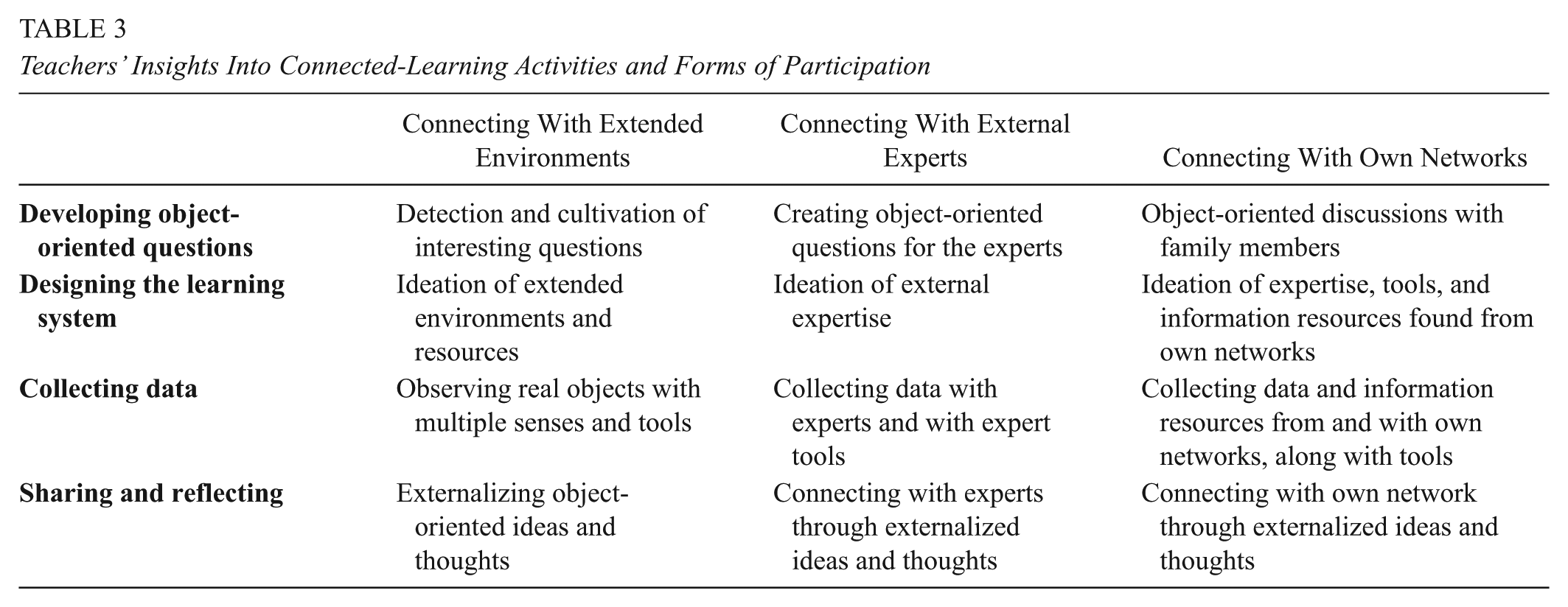
In terms of promoting connected learning (Ito et al., 2013) in the context of early childhood education, the three revised principles for facilitating an upcoming design can be capsulated as: (a) developing interest, ideas, and questions through context bound activities in nature and culture environments; (b) improving ideas though diverse conceptual, material, and social resources and tools that represent the phenomenon in question; and (c) translation of ideas in a material or digital form to be shared and co-developed together with peers, teachers, external experts, and the community.
The limitation of this study is that the interpretations of emerging learning activities were retrieved from teachers’ descriptions of the project and not from the direct actions of the teachers and their students or kindergarten children. In part, the success of the applied instructional model may also be explained by the fact that the emerging learning activities were connected with the existing teaching practices of the participants. However, the new Finnish curriculums have created the need for robust examples of connected-learning projects that could serve as design resources for other teachers, educators, and student teachers. Thus, the participation-led data collection employed in this study provided the teachers with opportunities to choose the most meaningful and preferred situations to be openly shared with other interested parties (Liljeström et al., 2014). Together, the outcomes from these kindergarten and primary-school learners’ projects, and the teachers’ insights into them, have provided complementary perspectives about the shared phenomena and learning activities involved, and have themselves become collective learning and teaching resources.
In this in-service project, participating teachers and educators from varying educational backgrounds were provided with opportunities to share their expertise and collaborate with their peers, researchers, and experts while designing, modeling, and practicing instructional strategies focused on student learning. Nevertheless, activities connecting the different school student groups and between the kindergarten and school were rather limited in extent. Thus, an interesting future step would be to pursue connected-learning projects that challenge school students and kindergarten children to go beyond dialogue by having a joint object of activity that they develop and externalize collaboratively (Hakkarainen & Paavola, 2009) in heterogeneous groups. There is also a need to examine connected learning in international networks. As noted by the Organisation for Economic Co-operation and Development (OECD, 2016), for example, promoting activities of inquiry that engage local teachers and their own learner groups to participate in global knowledge networks is particularly important for enhancing the skills and understanding needed in the increasingly globalized world.
Footnotes
Funding
The author(s) disclosed receipt of the following financial support for the research, authorship, and/or publication of this article: This study is supported by the Finnish Cultural Foundation and the “Forest as a Learning Environment: South Savo as a Key to Communal Forest Knowledge” Project (UEF, project no. A70133).
Authors
HENRIIKKA VARTIAINEN is a senior lecturer at the University of Eastern Finland. Her recent research interests include design-oriented pedagogy and participatory learning in extended environments and communities.
SAARA NISSINEN is an early stage researcher at the University of Eastern Finland. Her recent research interests include design-oriented pedagogy, connected learning, and international learning networks.
SINIKKA PÖLLÄNEN is a professor at Savonlinna campus of the School of Applied Educational Science and Teacher Education in the University of Eastern Finland. One of her recent research interests focuses on pedagogical models, especially on situated and authentic learning environments.
PETTERI VANNINEN is a coordinator at the University of Eastern Finland. His recent research interests include forest ecology, and extended environments and communities for learning.