



Abstract
This paper describes a participatory online culture – Connected Learning Massive Open Online Collaboration (CLMOOC) – and asks how its ethos of reciprocity and creative playfulness occurs. By analysing Twitter interactions over a four-week period, we conclude that this is due to the supportive nature of participants, who describe themselves as belonging to, or connected with, the community. We suggest that Gee’s concept of an affinity space is an appropriate model for CLMOOC and ask how this might be replicated in a higher education setting.
Introduction
In this paper we discuss opportunities for technology-enhanced learning in a globalised context by exploring learner experiences and interactions in the Connected Learning Massive Open Online Collaboration (CLMOOC) (CLMOOC, n.d.). This is an international online group of informal learners who stimulate each other to make digital artefacts and share them publicly with each other and which could be characterised as being a cMOOC. The usual distinction is made here between two types of Massive Open Online Courses (MOOCs): xMOOCs (based on university courses); and cMOOCS (connectivist learning involving groups of interested participants) (Bates, 2014). The use of xMOOCS by universities intends to encourage a global audience to connect with course content out of interest and typically without charge, but in the hope that some will go on to study with the institution more formally on a fee-paying basis. Participants in xMOOCS remain in the role of students, learning from instructor-designed content. These MOOCs are therefore both an opportunity for learning, and a marketing tool for many universities. In contrast, cMOOC participants learn from each other, and generate the content of their learning through dialogue around shared interest.
Viewed positively, MOOCS represent a democratisation of education access to high quality, low cost learning on a global scale (Sharrock, 2015). Looked at critically, they represent a consumerist ‘supersizing’ of education (Baggaley, 2014), with limited content that chunks learning into bite-sized gobbets interspersed with student interactions via social media platforms (Fischer, 2014). From a basis of initial enthusiasm, discussion of MOOCS first escalated to hype (The New York Times called 2012 ‘the year of the MOOC’ (Pappano, 2012)) before becoming more sceptical of claims for both the democratisation of access and the learning benefits (Fischer, 2014).
Taking a view at either end of the hype–cynicism spectrum risks underestimating the value that online learning can have (Fischer, 2014) as well as risking a failure to explore, in a research-evidenced way, the potential of MOOCs for engaging people in communities that, at best, provide an intellectually and socially stimulating context through which learning takes place. This research aims to examine this by evaluating learner interactions in one cMOOC. We end by suggesting that it is this latter type of MOOC which should be the focus of university educators.
The participatory culture of CLMOOC provides an online communal environment to engage learners and encourages them to share existing skills and to learn new ones via social media, including two closed groups in Google Plus and Facebook, and an open Twitter network. In this paper we focus mainly on CLMOOC Twitter interactions. Most, if not all, participants are educators as well as informal learners within CLMOOC. We argue that CLMOOC provides rich opportunities for learning: the community has evolved a participatory culture characterised by authenticity, creative playfulness and reciprocity. This research adds to a developing body of research focused on the use of Twitter as a medium for learning in formal and informal settings. While research into social media use for learning is a growing field (Bolat and O’Sullivan, 2017) there is still comparatively little research that explores the possibilities of Twitter for enhancing learning, particularly when the boundaries between formal and informal learning are blurred (McPherson et al., 2015). In addition, evidence of the educational benefits of social media use is, as yet, both limited and contested (Carpenter and Krutka, 2014; McPherson et al., 2015; Palmer, 2014).
Analysing CLMOOC participant experiences and exploring online interactions has provided data from which to explore the characteristics of effective participatory learning. From this analysis, we argue that effective online learning is most likely to take place where ‘affinity spaces’ (Gee, 2004) are created within which learning communities can evolve and in which learning takes place through participatory dialogue between and among people who, for whatever reason, come to feel a sense of shared endeavour and enjoyment.
What is CLMOOC?
CLMOOC was launched in 2013 by the USA National Writing Project (NWP) (National Writing Project, 2013) in order to support North American educators who wanted to explore the learning and design framework of connected learning. With support from the MacArthur Foundation (n.d.), and as part of NWP’s Educator Innovator initiative, it ran as a hosted, summer event from 2013–2015. According to the original facilitators, its design was influenced by cMOOCs such as changemooc (2013), a participatory course exploring researcher contributions to instructional technology, and etmooc (2013), a connectivist MOOC exploring aspects such as digital literacy, digital storytelling and digital citizenship. Also influential were online happenings such as DS106 (2012), which began in 2012 as an open online course focussed on digital storytelling and still continues today, with some members of CLMOOC also participating in its daily activities.
Activities in CLMOOC are arranged into iterative ‘make cycles’, which are open-ended invitations to create, remix and share artefacts with each other (Smith et al., 2016). Unlike courses arranged into weekly topics, these make cycles can be participated in at any time – as CLMOOC participants are fond of saying, you cannot be late to CLMOOC.
CLMOOC therefore has two interlinked backgrounds – first that of the cMOOCs that preceded it; and second the principles of connected learning and participatory culture that it adopts from the MacArthur Foundation. MacArthur’s Connected Learning Research Network focuses on learning that is socially connected, driven primarily by participant interest and based in principles of educational equity (MacArthur Foundation, 2018). It adopts a view of connected learning as founded on the idea that ‘meaningful and resilient forms of learning happen when a learner has a personal interest or passion that they are pursuing in a context of cultural affinity, social support, and shared purpose’ (MacArthur Foundation, 2018). CLMOOC was created to embody these elements of connected learning.
In 2016 the NWP decided to lend its support to another summer initiative, and some of the CLMOOC participants decided to continue to run it without formal institutional backing. CLMOOC now comprises a group of 20 or so volunteers who propose themes for short collaborations throughout the year, including a longer summer event, and a larger group of around 200 Twitter users who participate in collaborative activities without helping to organise them. Membership of the first group is fairly fluid, with different people taking the lead at different times, but there is a core group that help to facilitate the various learning events. This group is non-hierarchical: although some members have more online and educational experience than others, the ethos of the group is for those with more experience to encourage others to take the lead and to provide support and advice as appropriate. The use of Twitter is important to the interactions because the open nature of Twitter encapsulates the principles of connected learning that underpin CLMOOC.
What is connected learning?
Connected learning theory is an evolving theory based on the pedagogical theories of social constructivism and active learning. Although knowledge about connected learning is not necessary in order to engage with CLMOOC, the original cMOOC was structured around its six principles, and some members are keen to ensure that these are not forgotten. The principles themselves are clear and concise, so that educators can adopt them without the need to engage in academic research. There are three learning principles and three design principles, which we set out in Table 1.
The principles of connected learning theory.
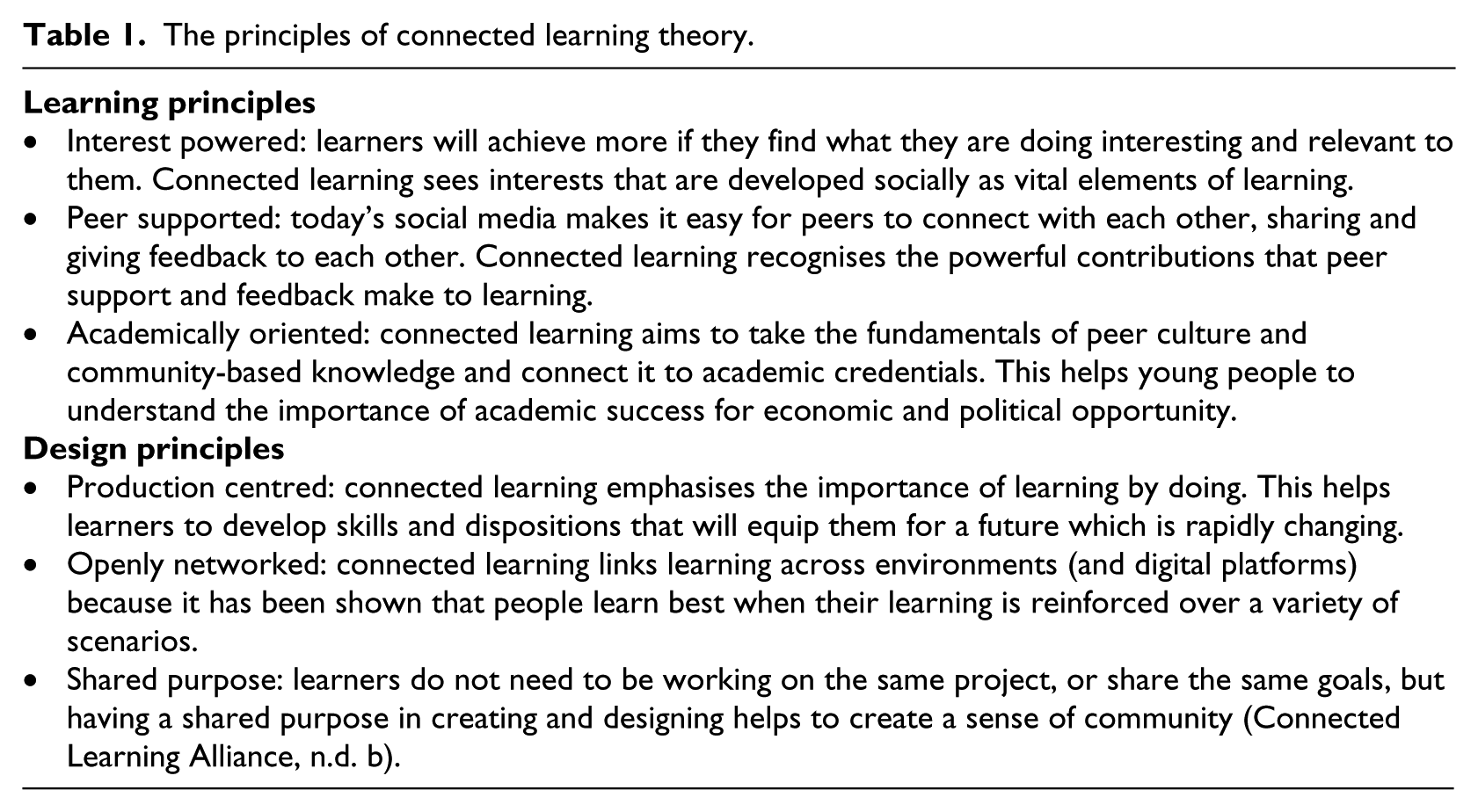
CLMOOC embodies these principles with its ethos of an openly networked group of practitioners who support each other and participate in creative, collaborative activities. The creative playfulness exhibited by participants might appear to be random but it is, in fact, a product of the principles of connected learning that underpin it. The immediacy of Twitter interactions helps to create an atmosphere conducive to this light-hearted yet serious spontaneity.
Social media use in higher education (HE)
Twitter is a platform primarily aimed at encouraging social connection but, like many forms of social media, its use in HE can encourage us to rethink what it means to be ‘an academic’ or ‘a student’, and what it means to learn (McPherson et al., 2015). Online learning is complex and is made more complex when forms of social media are used. Because most participants have used social media in informal settings, norms of participation and communication are developed that have characteristics of informality such as spontaneity, vicariousness and openness (McPherson et al., 2015). There is also a sense for users in which social media presence and connection is both intimate and public (Lee, 2017), sometimes shared with closed groups, sometimes open to a more global audience.
Despite the potential to create a strong sense of connectedness through online interaction, forms of social media have been used less by universities for learning and more for a range of outreach strategies (Palmer, 2014) or information delivery (Carpenter and Krutka, 2014). For example, it is commonplace now for universities to use social media for: connecting with actual and potential stakeholders (Palmer, 2014); marketing, branding and student recruitment (Bélanger et al., 2014; Peruta and Shields, 2017); issuing reminders about assignments and deadlines to students (Carpenter and Krutka, 2014); creating psychological connections and engagement with students (Bolat and O’Sullivan, 2017); and as a tool for recruiting research participants, and a platform for conducting research (Gelinas et al., 2017; Lee, 2017). However, it is less usual to see social media – particularly Twitter – used to mediate and encourage learning activities among students, or among academics, or among groups of academics and students learning together. What, then, is the potential for social media use in effective online learning? Before we can answer this question, we need to understand how learning happens in such situations. In order to do this, we next look at the literature that underpins the participatory culture of CLMOOC.
What makes a participatory culture?
A participatory culture is one which embraces the values of diversity and democracy through every aspect of our interactions with each other – one which assumes that we are capable of making decisions, collectively and individually, and that we should have the capacity to express ourselves through a broad range of different forms and practices (Jenkins et al., 2016: 2).
The participatory culture of CLMOOC is grounded in the six principles of connected learning and its three underlying educational values of equity, full participation and social connection (Connected Learning Alliance, n.d., a). Connected learning itself is grounded in the pedagogical literature surrounding participatory culture, in particular the work of Henry Jenkins (Jenkins, 1992; Jenkins et al., 2009, 2016).
Participatory culture
A participatory culture is a culture with relatively low barriers to artistic expression and civic engagement, strong support for creating and sharing creations, and some type of informal mentorship whereby experienced participants pass along knowledge to novices. In a participatory culture, members also believe their contributions matter and feel some degree of social connection with one another (at the least, members care about others’ opinions of what they have created) (Jenkins et al., 2009).
A participatory culture is not a new phenomenon – there have been, and still are, many communities that share knowledge and practices with each other. Some examples are fandom and quilting communities (Jenkins et al., 2016: 11) both of which create and depend upon deep ties that bind members of the community together. The term ‘participatory culture’ is relatively new, however – Jenkins first used it in 1992 to make a contrast between science-fiction fans who remixed materials and those who merely watched the programmes without engaging with the creative culture surrounding it (Jenkins, 1992). It was when he became involved in the MacArthur Foundation in 2005, however, that he realised the potential of adopting the principles of participatory culture as a pedagogy (Jenkins et al., 2016: 3). His White Paper, written for the MacArthur Foundation, emphasises the potential for educators of adopting the principles of participatory culture (Jenkins et al., 2009). Of particular relevance are the peer-to-peer mentoring and the scaffolding by more experienced members, both of which help participants to find their own ways of expressing themselves and to build up confidence in their abilities (Jenkins et al., 2016: 3).
As CLMOOC also has strong connections with the MacArthur Foundation, it is perhaps unsurprising that the principles and practices that Jenkins discusses in his academic work are, in many ways, those adopted by CLMOOC. In creative remix cultures such as quilting, ‘forms of creative expression were woven into the practices of everyday life’ (Jenkins et al., 2016: 8); in CLMOOC a culture of remix and reciprocity helps to reinforce participants’ existing skills and develop new ones.
As Jenkins et al. emphasise, it is important to be clear about the difference between a participatory culture such as CLMOOC, where participants engage in collaborative activities, and online platforms (such as Facebook and Twitter) that users can interact with (Jenkins et al., 2016: 12). Participation is not a solitary activity – you participate in an activity with other people (although this participation might not be synchronous). ‘Interactivity’, by contrast is a property of a technology (although, of course, there is an overlap between the two practices because we use interactive technologies in order to participate in activities with each other). This distinction is similar to the two types of MOOC – xMOOCs can be interacted with, whereas one participates in a cMOOC. This distinction will be seen to be fundamental to understanding why experiences such as CLMOOC can be so rewarding for participants.
Communities of practice and affinity spaces
Having considered the pedagogy that underpins CLMOOC, and identified the principles and practices of a participatory culture as being the relevant factors that make CLMOOC so supportive and collaborative, we now need to ask what type of entity is CLMOOC? Unlike other MOOCs, the second ‘C’ in CLMOOC does not stand for ‘course’, but for ‘collaboration’. So why did the collaborators choose this word rather than, for example, community? The answer for this has implications for how we understand formal, as well as informal, learning. We next identify two models which might apply to CLMOOC – communities of practice and affinity spaces – and consider each in turn.
Community of practice
A community of practice (CoP) is a group of people who come together because of common interests, goals, or knowledge, and who collaborate and interact with each other. It consists of three elements: mutual engagement; joint enterprise; and shared repertoire (Lave and Wenger, 1991; Wenger, 1999). Learning in a CoP is a social practice and a process of participation. Learners begin as apprentices and operate on the periphery of a CoP, and as they become gradually more competent they engage more. Learners at the centre of a CoP have made the transition from apprentice to master and participate fully in the collaborative activities (Lave and Wenger, 1991, 2002).
Jenkins suggests that Lave and Wenger’s view of participation is the same as his model, in that they both view participation as actually taking part in shared social practices, not merely interacting with an online platform or engaging with some content (Jenkins et al., 2016: 10–11). This is perhaps not surprising, as Jenkins was a graduate student in the Institute for Research on Learning where Lave and Wenger wrote their Situated Learning book.
However, Jenkins suggests that the concept of a CoP is not suitable for the types of participatory culture that he is interested in. The original researchers into situated learning were looking at face-to-face, professional communities such as butchers and tailors, and work would need to be done in order to make this suitable for educational and online settings (Jenkins et al., 2016, 6). That could be possible, but there is a further problem. CoP has become a buzzword for managers, and some of the original researchers into situated learning feel that the original concept has now been so watered down as to make it meaningless, or misappropriated (Jenkins et al., 2016, 6). For these reasons, it may be better not to use CoP in order to talk about CLMOOC.
Affinity spaces
Like Jenkins, Gee developed the concept of affinity spaces in response to some of the issues he identified as arising from Lave and Wenger’s CoP (see Gee, 2004: 70) and drawing from his work on discourses, cultures and digital literacies (see Gee, 2004; St. Clair and Phipps, 2008). Gee has concerns about some of the connotations of the concept of community, particularly with the associated ideas of ‘belongingness’ and membership – the flipside of which is a potential sense of exclusion and not belonging (Gee, 2004). Like Jenkins, he also has concerns that CoP is now used to cover ‘such a wide array of social forms that we may be missing the trees for the forest’ (Gee, 2004: 70). Instead, Gee suggests beginning not with the construct of community, but with the idea of spaces within which interactions and communications take place (Gee, 2004). These spaces may be physical or virtual but in order for them to evolve as an affinity space, certain characteristics need to be present.
Affinity spaces are based on voluntary interactions around a common endeavour with participants relating to each other based on shared interests and goals (Gee, 2004). Online affinity spaces in particular can enable interactions where participants’ identities, and therefore their interactions, are less bounded by culturally ascribed labels and normative expectations of gender, race, class, age or ability (Gee, 2004: 77). The affinity space is therefore defined not by notions of community, but by the social and discursive interactions which take place within the space. Patterns and forms of participation in affinity spaces tend to be many and various: central or peripheral; and loose or tight (Knobel, 2006:. 411): individual patterns of activity change as participants wish and as they interact or choose not to interact with the content and/or other participants.
Gee further characterises affinity spaces as beginning with some form of content, but this content becomes organised and transformed through participant interactions (Gee, 2004:.77). Learning is therefore social but also situated, occurring through both interactions and activity, with knowledge and learning distributed among participants (Albers et al., 2016: 223). Tacit knowledge is ‘honored’ (Gee, 2004: 78) and individual and distributed knowledge encouraged. Learning interactions also take place without hierarchy: participants come into the space with a variety of knowledge and experiences and any leadership of learning which emerges is ‘porous’, according to Gee, based around leading particular aspects of the shared endeavour or the content production. Leadership should not be apparent in the sense of having authority over the content or participants (Gee, 2004).
Gee’s characterisation of space for situated learning has helped develop understanding not just of the location and context for learning, but of how new media and new forms of literacy and interaction can support deep, effective and meaningful learning (Barden, 2016: 227). His work also helps us to consider how social media can enable negotiations of individual learner identity and forms of communication and knowledge sharing that, without the media, would be more difficult if not impossible (Albers et al., 2016). This interconnectedness – and the way in which identity can be less bounded by ‘traditional markers of subjectivity’ (Bommarito, 2014) – offers a potential for more equitable engagement with knowledge creation and distribution than is often the case in formal education. Gee’s work also prompts (re)consideration of the ways in which space may be a physical or virtual ‘place’ for learning where the space is characterised and defined through processes of social interactions and communicative language and acts.
These aspects also bring challenges. Creating equitable effective affinity spaces requires active participants to bring particular levels of social and linguistic skills: affinity spaces tend to assume a ‘high level of interconnectivity, flexibility and complexity’ from participant interactions (Bommarito, 2016: 409). If we return to CLMOOC as an example of a participative online culture, interaction via Twitter requires certain levels of linguistic and social skill and awareness of communicative nuance in order to negotiate not just meaning but also ways of being in the group. Tensions within affinity spaces need to be carefully responded to collaboratively and moved beyond to maintain a sense of collaboration and connectedness. Bommarito (2016) argues that Gee’s conception of affinity space does not adequately recognise the importance of a sense of ‘belongingness’ and the creation of ties to participants in both physical and virtual learning spaces. This sense of belonging and of relating to others is important in maintaining the space, the activities, and the sense of shared endeavour, and can be particularly important in resolving tension, and clarifying issues (Bommarito, 2016).
Summary
Based on the above discussion, we suggest that CLMOOC is a type of cMOOC in that content is generated by dialogue between members and not provided by an instructor. Members of CLMOOC view themselves as being part of a collaborative activity, rather than as being part of a community. It is founded on the principles of connected learning and participatory culture and is best conceptualised as an affinity space. If this characterisation is correct, then the social media spaces that CLMOOC participants inhabit, and Twitter in particular, should help to create an ethos of creative playfulness, and this was one of the questions our research set out to investigate.
Methodology and data collection
This research takes an autoethnographic approach. Sarah is a core member of CLMOOC and is researching learning in the community for her PhD. When she first considered using CLMOOC for her doctoral studies, she was a new member of that community. She initially envisaged analysing interactions and coding data in isolation and later conducting interviews with key members of CLMOOC in order to explore the initial findings in more depth. However, as time progressed, Sarah realised that she did not want to conduct research on CLMOOC, but with CLMOOC participants. As a consequence, the methodology evolved in order to best reflect the participatory nature of CLMOOC and in the light of Sarah’s ethical deliberations about researching through autoethnographic experiences that involve participants who have become friends.
Sarah chose to use a framework to code the data, but has adopted an iterative and reflexive stance, exploring her own meaning-making in terms of the data, while also giving CLMOOC participants opportunities to respond to her interpretations. Rather than privileging her voice as ‘the researcher’, she has encouraged CLMOOC participants with multiple opportunities to review her interpretations and thus their voices have become central.
Data collection
Since June 2015, when Sarah began capturing CLMOOC Twitter data, there have been more than 39,000 tweets to the CLMOOC hashtag (#CLMOOC). She captures the tweets using TAGS, which allows her to automatically save every CLMOOC tweet to a Google sheet (TAGS, n.d.). Rather than attempt to analyse all of these data, Sarah took the decision to look in detail at specific events and aspects of the discussions.
CLMOOC participants sometimes schedule hour-long Twitter chats. A group will devise a set of six or so questions, one participant will offer to facilitate, and will tweet out questions to the CMOOC hashtag at an agreed time for participants to answer. As part of the 2016 summer activity, participants organised four of these chats. In July 2016, at the beginning of the CLMOOC summer activities, Sarah also conducted a short survey of CLMOOC participants to find out about learner motivation and participation. In order to do this, she put a set of nine open questions into a Google Form and tweeted it to the CLMOOC hashtag as well as sharing it in the other CLMOOC social media spaces. Two questions that are particularly relevant were:
How much do you feel part of the #CLMOOC learning community?
How much do/did you want to be a part of the CLMOOC community?
In order to look more deeply at participation and non-participation in CLMOOC, she also sent a follow-up survey consisting of five open questions to some less active participants. One question is particularly relevant here:
How would you describe your motivations for originally joining CLMOOC? What were your goals and interests?
In addition to the data coding and the surveys, she also uses her blog to summarise her thoughts about the CLMOOC research, and asked participants to respond to her via the blog, or via any of the social media platforms CLMOOC participants use, including by private message (a feature of Twitter). She then uses these comments and discussions to reframe her thoughts, or to confirm that she was thinking about CLMOOC in a way that accords with other participants’ views.
Data analysis
In order to familiarise herself with the data (Braun and Clarke, 2006), Sarah downloaded the tweets from each of these chats to separate spreadsheets and hand-coded each one of them into one of four categories by using a combination of Veldhius-Diermanse et al.’s approach (Veldhuis-Diermanse et al., 2006) and Henri’s coding schema (Henri, 1992) (see Table 2). The categories for coding are: social/affective; cognitive; meta-cognitive; and ‘rest’ (for elements of the data that did not align with the other categories).
Combination of Veldhuis-Diermanse et al.’s (2006) and Henri’s (1992) coding schemas.
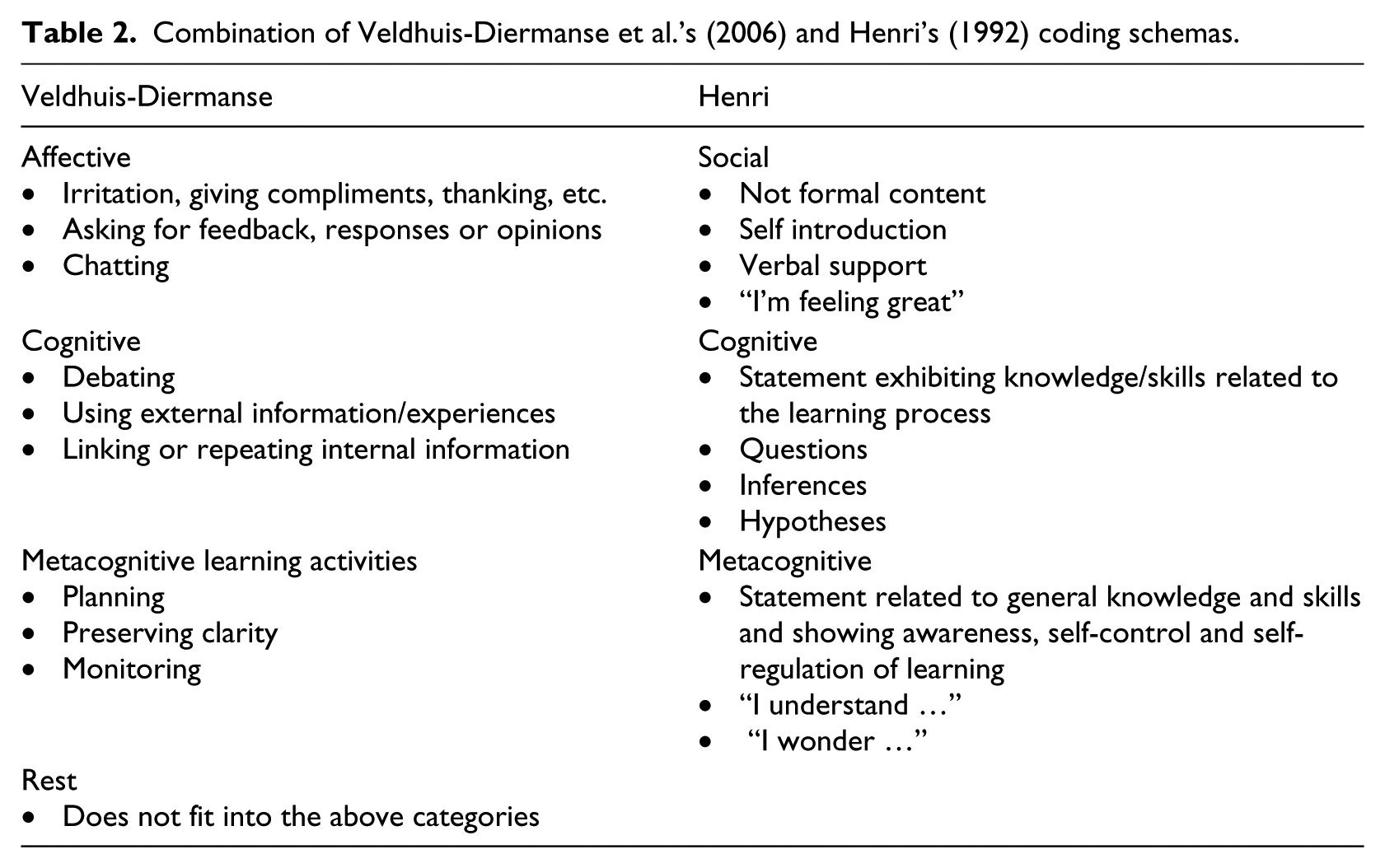
The initial approach to coding was quantitative by using the selection of codes from Veldhuis-Diermanse et al. (2006) and Henri (1992) to give a numeric account of the number of tweets in each category. After this, a qualitative approach was integrated into the method to enable emergent meaning-making to become an integral part of the process.
In coding the Twitter data, Sarah excluded retweets from the analysis. Since she was treating each tweet as a meaningful unit including retweets would have meant counting some units more than once. She also decided to exclude the official CLMOOC Twitter account as all this did was to repeat (without retweeting) the Tweet Chat questions, added nothing to the conversation. She then assigned one code to each tweet. This coding identified the number of occurrences assigned to each domain (affective/social, cognitive, and metacognitive). As can be seen from Table 3, there were a total of 1425 tweets over the four Twitter chats, of which 233 were retweets and 31 were by the @CLMOOC Twitter account. When these are removed, 1161 unique tweets remain. The number of Twitter chat participants varied each week, with some members taking part every week and others only joining the conversation for one week. In total there were 40 different participants across all four weeks.
Results of preliminary coding.
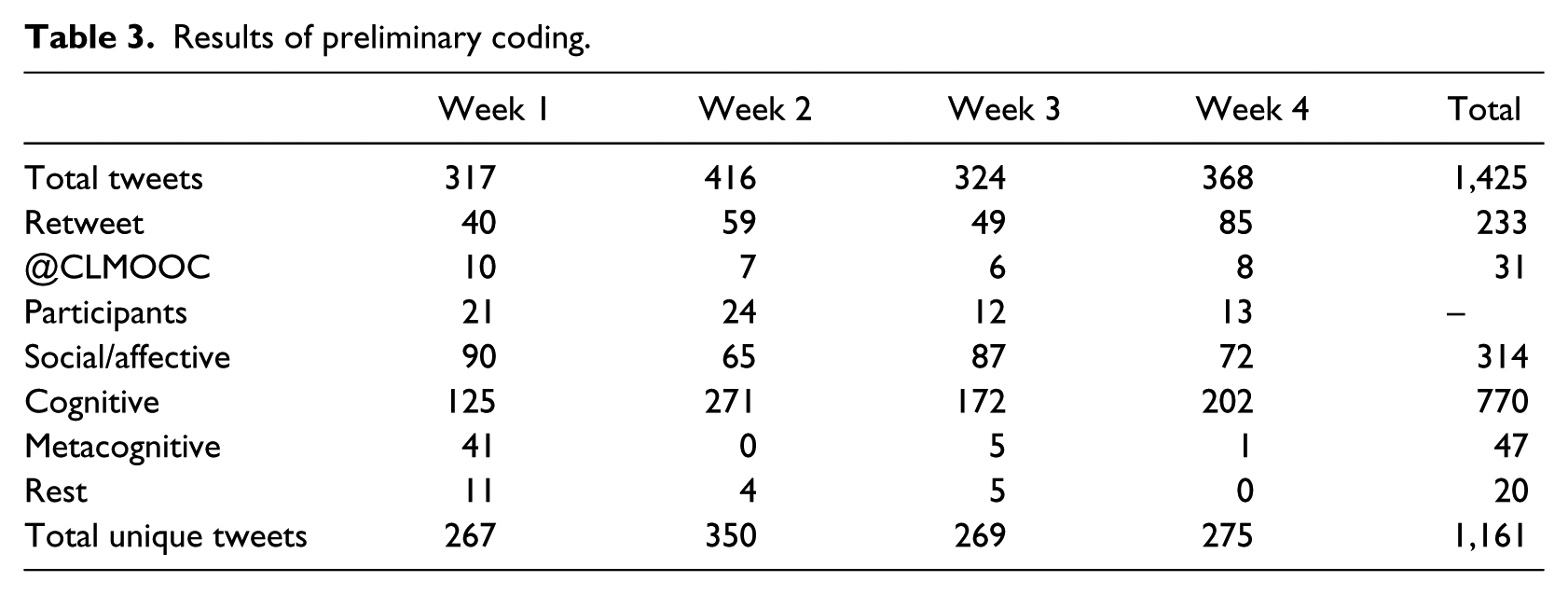
Table 3 also shows the numeric instances and highlights that most of the Twitter responses in the chats were either affective/social or cognitive. Metacognitive aspects were strongest in week one but sharply tailed off from week two to week four.
Social/affective tweets had a slightly more variable presence – stronger in week one as might be expected given the start of the chat with more social and affective connections being made, but overall remaining in a similar range between weeks two and four. The striking aspect is in the cognitive coding: fewer tweets of a cognitive nature in week one might not be unexpected, but these rise markedly in week two, and then fall in week three, rising again in week four. Overall, 66% of the tweets were cognitive in nature, and 27% were social/affective. Typically, the latter category of tweets was at the beginning and end of the tweet chats, where participants said hello and goodbye to each other, and the majority of tweets during the main body of the Twitter chats were cognitive in content.
The numeric data suggested that there could be rich comments and conversations happening throughout the four Twitter chats that were worthy of further analysis and these formed the basis of a thematic analysis.
Thematic analysis of CLMOOC data
The nature of each of the four Twitter chats depended to some extent on the questions asked by each of the facilitators. However, the following themes are consistent across all four weeks of CLMOOC chats: a sense of belonging and connectedness; creative playfulness; and reciprocity. These themes are also consistent across the survey data set. Each theme will be explored below, referring to both data sets to give a sense of the richness of the learning taking place through the domains of belonging/connectedness, creative playfulness, and reciprocity.
Belonging/connectedness
It is perhaps not surprising that, in a community formed around connected learning, there are many Twitter conversations about participants feeling that they belong to CLMOOC, feel connected to other participants and describe themselves as being made welcome by others. For example, one participant quotes Walt Whitman, saying that: “‘Every atom belonging to me as good belongs to you.’ We have same goals: be engaged, empathetic creators and be accepted” [Respondent 1, 14 July 2016]. Another emphasises the connections in CLMOOC which continue throughout the year, saying that: “the #clmooc community creates abiding #connections that abide far beyond the few formal weeks each summer” [Respondent 2, 28 July 2016]. One participant noted that the connections being made are the most important aspect of CLMOOC, writing that: “This is most valuable part of this group. Each year connections expand, many grow stronger. Think 5–10 years from now” [Respondent 3, 28 July 2016], while at the end of the final chat another participant reflects upon future connectedness, saying that they have made “stronger connections with some, new connections with others…many future options/opportunities. Thanks, all.” [Respondent 4, 28 July 2016].
The survey asked participants directly about their membership of the group, and so responses aligning with belonging are not unexpected. However, the strength of the feeling that belonging brings was evidence in the responses. Some members felt that CLMOOC was an important part of their everyday practice, with one participant responding that: “The CLMOOC Community is a MAJOR part of my life! I’ve been conducting biweekly face-to-face groups, year-round, since the very first CLMOOC over three years ago. Love, love, love this community…” [Respondent 10, 23 July 2016]. One respondent felt “very much at the centre of the CLMOOC” [Respondent 11, 23 July 2016], while others felt more peripheral, but still felt that they were a part of the space. It interested us to note that even those who felt that they lived at the edge of CLMOOC still identified with the participatory culture of CLMOOC, its values and practices. Four views that typified this sense were as follows:
(i) “I feel valued and included…” [Respondent 9, 23 July 2016]
(ii) “I think that I feel like an adopted child. Feel part, but not sure I am worthy…” [Respondent 12, 23 July 2016]
(iii) “I feel close to this community, although I don’t know many of the participants, but I share their interests and values” [Respondent 13, 23 July 2016]
(iv) “I feel like I operate on the edge (my choice), but need to see and understand the creativity, academic thoughts, and interconnections” [Respondent 14, 23 July 2016]
Creative playfulness
Another theme that emerges throughout the CLMOOC Twitter chats centres around play, creativity and creative playfulness. One participant was adamant about the importance of play to learning: “A tweet I got recently suggested that we were ‘hyperactive’ – that our play was…just play. And I said, ‘Get out of my sandbox’” [Respondent 5, 21July 2016]. Another participant puts a similar point in different way, saying that: “Playing is a deeply serious thing that creates connections in ways other things don’t. I believe in play!” [Respondent 6, 21 July 2016]. This person had remarked on the importance of play in a previous chat, saying that: “Yes! Play is a super important part of #clmooc for me. I find it reenergising!” [Respondent 6, quote 2, 14July 2016]. One person summed up the nature of CLMOOC, writing that they felt that they had “uncovered the seriousness of play in the remixes – the trust we have and the honour we give; & uncovered art and awe in our play” [Respondent 7, 21 July 2016], while another tweet noted the variety of types of creativity in CLMOOC, writing: “I saw so many creative people trying a variety of ways – print, music, visual media – to express themselves” [Respondent 6, quote 3, 14 July 2016].
The survey responses also give a strong sense of play and playfulness in learning. One participant highlighted the importance of the practices of CLMOOC to them, saying that: “… from the very first moment, I knew that CLMOOC was a wonderful opportunity which I was more excited about than I had been about anything since I discovered digital storytelling” [Respondent 15, 23July 2016], while for another it was the people as well as the participatory culture that made CLMOOC important to them, writing that: “There are lovely people and I love collaborative learning” [Respondent 16, 23 July 2016]. Another highlighted the affinity that they felt to other members of CLMOOC, writing that: “I wanted to interact with people I liked in previous moocs. I was (then) interested in participating in some creative activities” [Respondent 17, 13August 2016], and a further wrote that: “… it always seems like a fun party going on, and I just wish I had more time to participate” [Respondent 18, 23 July 2016]. Another commented that: “I think that learning becomes something different when we make” [Respondent 11, quote 2, 23 July 2016].
Reciprocity
A third theme centred on reciprocity and trust. For example, one participant talked about the generosity of other participants, saying that: “Some people have an amazing capacity to produce and share creative ideas; many are eager to help others” [Respondent 3, quote 2, 28 July 2016]. Another wrote: “Yes, I too loved how many reciprocations built off other’s work + how things kept layering outward” [Respondent 8, 21 July 2016]. One participant invented their own word for this relationship, saying that: “Everyone is being incredibly supportive and reciprocative (made up a word?). Not surprised but pleased” [Respondent 9, quote 2, 14 July 2016].
Survey respondents also noted the collaborative and reciprocal nature of CLMOOC. One respondent said that they had wanted to participate because: “I was intrigued by the idea of building knowledge collaboratively and fact that CLMOOC is based on principles of Connectivism” [Respondent 19, 13 August 2016]. Another commented on the ethos of CLMOOC, writing that: “You quickly learn about generosity and sharing, and the power of collaboration to take an idea and build, riff, remix off it in, turning the idea into a powerful collage created by many, not just one person” [Respondent 11, quote 2, 23 July 2016]. A further respondent also highlighted the importance of collaboration, saying that: “It’s unique. The change from ‘Course’ to ‘Collaboration’ for the final C was crucial. Everything that’s good in CLMOOC flows from truly embodying the deep meaning of that change. There have been other attempts – DS106, for example – but none were truly open and egalitarian the way CLMOOC has always been…” [Respondent 10, quote 2, 23 July 2016].
This was a small data set: in total there were 1161 tweets from 40 participants across the four Twitter chats analysed, 22 respondents to the first survey and a subset of five of these respondents to the follow up survey. However, the findings above do provide some evidence for our thesis and suggest that CLMOOC is participatory in its nature: with participants joining in with conversations and activities in a creative and playful manner because they identify with the collaborative, reciprocal nature of CLMOOC and see it as a space they have an affinity with.
Discussion: adopting creative playfulness and affinity spaces into HE
“This group gets my brain to connect in complex and creative ways. I can bring that to that classroom to help students be connected and creative” [Respondent 14, quote 2, 23 July 2016].
So, what can we learn from CLMOOC? Is it just an informal network of lifelong learners engaging with each other, or can its participatory practices of creative playfulness be used in a more formal setting? We think that they can. However, it is going to be vital that adopters wishing to use this creative playfulness understand what is going on, and do not merely copy the practices without understanding the ethos of a participatory culture.
In order to explain why this is so important, and to understand what is at stake if it is poorly implemented, we would like to return to the comparison we made at the beginning between two supposedly similar phenomena – the cMOOC and the xMOOC. xMOOCs are based on a behaviourist pedagogy, and have a transactional theory of knowledge – knowledge, according to this view, is something which experts (educators) give to learners, and assessment is something that is done by others to a student or a student’s assignment. Sarah has recently suggested in a blog post (Honeychurch, 2017) that xMOOCs are an example of cargo cult pedagogy – that what the original xMOOC developers did was to try to emulate the success of the early cMOOCs without understanding the pedagogical principles on which they were based. xMOOCs do open up university level education to a wide audience, but the learning experiences that they provide is limited. Both types of MOOC are open to all, but the former aim to deliver to a massive audience without thinking about the need for meaningful interactions, and so do not emulate the important aspects of the cMOOCs.
We further suggest that xMOOCs are not just pale copies of authentic learning experiences but should be viewed with care. They are, it has been argued, Trojan Horses of neoliberalism (Traxler and Lally, 2016: 1018) which conceal a model of student as consumer and the implicit belief that one size fits all when it comes to learning, teaching and assessment in HE. By contrast, cMOOCs such as CLMOOC give an alternative learning paradigm both to xMOOCs and much current practice in HE. cMOOCs are based on a pedagogy which emphasises the importance of participation for learning and understand the fundamentals of social constructivism – that people learn best when they construct understanding for themselves, rather than having it delivered to them by ‘experts’. In CLMOOC the creative artefacts are open, and it is obvious who has made each of them. Remixing others’ artefacts (with attribution) is encouraged and is seen as a form of homage. This is in stark contrast to much of current assessment practice in HE, where students are hidden behind a veil of anonymity. Of course, there might be good reasons for using anonymous marking, such as concerns about unconscious bias, but this is by no means proven. In fact, a recent study suggests that these concerns might be unfounded (Pitt and Winstone, 2018). Anonymous marking was, however, shown in this study to adversely affect students’ perceptions of fairness and the potential to learn from anonymous feedback, and this potential cost should be factored in when thinking about whether or not to mark anonymously.
The drive to increase class sizes without a corresponding increase in teaching staff puts pressure on teachers to design assessments that can be marked efficiently (often by graduate teaching assistants) and turned around quickly. There is a perception that there is no time or space to put in place authentic learning experiences such as those we see in CLMOOC. Despite the fact that academics know that one size definitely does not fit all when it comes to learning, teaching and assessment, so often the written essay becomes the default method of assessment because it is relatively cheap and easy to assess. To add insult to injury, ‘plagiarism checkers’ such as Turnitin are used because, although they merely check for similarity and will not catch the committed cheater, an automated process does not cost many staff hours, and offers some evidence that academic standards are being upheld. As well as all of these issues the use of Turnitin and high-stakes, summative assessment can be very stressful for students.
However, there are alternatives. Importantly, there are alternatives that can be implemented without creating an extra workload for staff. One that looks particularly promising is patchwork text (PT). This is a model of assessment that has been used successfully for professional Master’s courses. We suggest that it has a wider application than that.
One of the real strengths of CLMOOC and its make cycles is the lack of pressure there is on learners to make their artefacts perfect. Although participants do, indubitably, put time and effort into their creations, part of the process is learning to release creations quickly and get feedback from others, rather than needing to make them as perfect as possible before letting go of them. This is, to our minds, one of the biggest virtues of PT.
Patchwork Text
A Patchwork Text is basically a composite piece of writing created from several shorter, separate pieces written beforehand, the ‘patches’. It … [is] an innovative kind of assessment in which the character of the main or only assignment of a module is modified by being produced cumulatively and by containing different components (Owens, 2003: 109).
In this learning design students are given small pieces of work to produce – often in different formats. These pieces are given formative feedback by peers, and optionally by the tutor as well. At the end of the year, course or module, students select a pre-agreed number of these formative assignments (patches) and resubmit them (reworking them if they wish) with a reflective piece which stitches the patches together and explains why each patch has been chosen. This has many of the features we saw in CLMOOC. It can also be scaffolded by the tutor so as to allow students to take on more difficult tasks than they would usually do, as they have the opportunity to resubmit their better pieces and leave the unsuccessful ones to one side.
In addition, PT incorporates the advantages of peer review. As Nicol has shown, when students first submit their own work and then have the opportunity to give feedback on their peers’ work, they engage with their own work more critically, and are able to make evaluative judgements about it (as being better/worse, or just different from that of others). Current research suggests that this ability to make evaluative judgements underpins all graduate attributes and is therefore the most important skill to help learners to develop (Nicol et al., 2014; Tai et al., 2017). PT incorporates opportunities to make these evaluative judgements at many stages of the process – when sharing the initial patches, when peer reviewing those of others, when deciding which patches to resubmit, and when writing the reflective overview. In addition, as Parker notes, it has many other benefits – it is collaborative, it gives students autonomy, and it is inclusive (Parker, 2003: 227). As with many successful learning designs, PT therefore works on many levels at the same time.
Virtual peer assisted learning (VPAL)
Another possibility would be to use social media to recreate some of the elements of an affinity space in a closed space where, for example, junior students can talk about problems that they are having with their studies and other students, including senior students, can be on hand to answer these questions. For the last six years Sarah has been running a type of VPAL with colleagues by using Facebook groups (Honeychurch and Ahmed, 2016).
Initially she and her colleagues set up subject specific groups at induction for first year students in a couple of academic subjects (Mathematics and Computing Science) and asked senior students to join these groups. As these were so successful, they decided to extend this to other subjects, and now have groups across all years and all subjects in the College of Science and Engineering at the University of Glasgow. 1 At the end of each year these groups are now rolled over into the following year and new first year groups are created. Junior students can ask questions about campus life, ask for help with their formative assessments, and support each other. These affinity spaces are places that students can drop in and out of as they need or wish. Staff spend very little time monitoring the groups, as they are self-regulating, and other than the time it takes to roll over groups each year and create new ones it is in no way onerous. However, the benefits to students are considerable: students needing help with step-wise subjects can ask questions and get almost immediate answers from peers; students answering questions reinforce their own learning as they articulate it to others; and students without English as a first language have time to prepare their answers and to talk in a non-confrontational space – these spaces work in multiple ways for different types of student and have far surpassed our expectations of them. We would, however, emphasise that we are platform agnostic – while Facebook has worked for our learners, it might be that in other places or at other times other media would be more appropriate.
Some conclusions, and ways forward
Social media have changed the way that we interact with each other online, and opened us up, as educators and as learners, to new ways of teaching and learning. The immediacy of communications with platforms such as Twitter, combined with the informal norms that have developed there, mean that boundaries are more easily broken down, and people can quickly bond together over common interests.
CLMOOC shows us the possibility of creating affinity spaces for learners to work together, both formally and informally, and to support each other as they learn together. Importantly, experiences such as CLMOOC with its creative playfulness and participatory culture show us that learning can be serious, yet can also be enjoyable, and this is something that we can easily seek to emulate for our students. We have suggested a couple of ways in which to do this above, and we will continue to collaborate with our global community in order to use the lessons we are learning there and adapt them for use in HE.
Future research
This initial study was limited both in terms of the number of participants and the time period from which the data were taken. The next stage of this research project will be to extend the analysis to look at interactions between more of the CLMOOC participants over a longer period of time and see if the creative playfulness we found in our sample is replicated elsewhere in the community.
Another area of research that would be of interest to us would be to look at participant interactions in a similar online community, such as DS106, to see if participants there also behave in a similar manner to those in CLMOOC, and whether there are any other patterns of behaviour to be found there which would also be indicative of a participatory culture.
A third possibility that we think looks promising would be to take the principles of connected learning and use these to adapt and develop courses and learning materials in a more formal setting in HE. We indicated above that PT might lend itself to a connected learning approach, and we would suggest that this could be explored and evaluated. We would further suggest that other models of teaching, learning and assessment that use peer review would be possible candidates for evaluation.
A short glossary of social media tools and terms
Blog: a website, often written by one person or group of people and updated regularly, of personal comments and reflections written in a conversational style.
Facebook: an internet based social network where users can create profiles, upload files and photographs and keep up with friends and colleagues.
Google Plus: an internet based social network owned by Google. Used to create interest-based communities where users with a Google account can join and post files to the community which other members can comment on.
Hashtag: A word or phrase preceded by a ‘#’ used on social media platforms such as Twitter to identify messages on a particular topic.
Tweet: an instant message sent by using Twitter (see below). By default, these are public and can be seen by anybody without needing to be logged in to Twitter or having a Twitter profile.
Twitter: a social media platform designed for users to send short messages (tweets) to other users and groups of users. These messages are publicly visible by default. Only registered users can post messages, but unregistered users can read them.
Twitter chat: A public twitter conversation on a prearranged topic or topics where users post responses to questions by using an agreed hashtag (see above). Also called a Tweetchat.
Footnotes
Declaration of conflicting interests
The author(s) declared no potential conflicts of interest with respect to the research, authorship, and/or publication of this article.
Funding
The author(s) received no financial support for the research, authorship, and/or publication of this article.