




Abstract
Data from the Early Childhood Longitudinal Study Kindergarten Class of 2010–2011 were used to examine the implications of preschool and full-day kindergarten enrollment for the subsequent school absences of 2,056 children with disabilities. Results suggest that children with disabilities who went to preschool were absent less frequently in kindergarten, but these benefits did not persist through the end of first grade. Conversely, children with disabilities who attended full-day kindergarten programs were absent more frequently during the kindergarten year as compared with children in part-day programs, but these children experienced a sharper drop in absenteeism throughout the following school year resulting in no differences in school absences in first grade. No multiplicative benefits emerged for attending both preschool and full-day kindergarten. And even though these aforementioned benefits of preschool diminished rapidly, there were lingering academic benefits through the end of first grade because of improvements in earlier school attendance.
For numerous reasons, more and more families have been enrolling their children in preschool and/or full-day kindergarten programs. 1 No one reason stands out as the sole driver of this rise in enrollment. However, this surge in utilization correlates with a growing maternal workforce, changes to the labor market, changes in family structure, and increased policy dialogue on the benefits of early childhood education (Blau & Currie, 2004; Burchinal, 1999; Clark & Kirk, 2000; Spain & Bianchi, 1996; West, Denton, & Germino-Hausken, 2000; Yamauchi & Leigh, 2011). To put this growth into perspective, in 1995, approximately 55% of children between 3 and 5 years of age attended a formal center-based preschool program, whereas more than 60% attended in 2012 (Child Trends, 2014). As for enrollment in full-day kindergarten, approximately 50% to 55% of students in the United States attended full-day programs in 1998, and this jumped to more than 80% in 2010 (U.S. Department of Education, 2010, 2014).
Given this expansion in enrollment rates, it makes good sense that educational research has focused much of its attention on whether children academically benefit from attending these programs—after all, one of the primary goals of these early childhood programs is to ensure that children succeed in school. As for formal preschool programs, the findings are quite positive: attending preschool before the transition to kindergarten has been found to boost children’s early academic achievement and to reduce school absences (Ansari et al., 2017; Burger, 2010; Gottfried, 2015; Loeb, Bridges, Bassok, Fuller, & Rumberger, 2007; Loeb, Fuller, Kagan, & Carrol, 2004; Phillips et al., 2017; Vandell et al., 2010; Weiland & Yoshikawa, 2013). Attending full-day kindergarten is also supported in the existing literature as a positive influence on children’s reading and math outcomes (Amsden et al., 2005; Cannon, Jacknowitz, & Painter, 2006; DeCicca, 2007; Le, Kirby, Barney, Setodji, & Gershwin, 2006; Wolgemuth, Cobb, Winokur, Leech, & Ellerby, 2006; Zvoch, Reynolds, & Parker, 2008). That said, many of the existing evaluations also find the positive gains of attending preschool (Lipsey, Farran, & Hofer, 2015; Puma et al., 2012) or full-day kindergarten to be short-lived (Clark & Kirk, 2000; Cooper, Allen, Patall, & Dent, 2010), which is a phenomenon recognized as convergence.
Within this expansive body of research, some studies also have focused on heterogeneity, such as whether the academic benefits of attending such programs differ for low-income families (Zvoch et al., 2008; Loeb et al., 2007), English language learners (Cannon, Jacknowitz, & Painter, 2011), or children from immigrant families (Dhuey, 2011; Magnuson, Lahaie, & Waldfogel, 2006). Although the evidence in support of heterogeneity is somewhat mixed, little attention has been paid to the experiences of children with disabilities. This omission in the literature is a significant oversight given that this group composes approximately 12% of the student population in the United States, with estimates suggesting further growth in this share (Halfon, Houtrow, Larson, & Newache, 2012; Snyder & Dillow, 2012). Moreover, enrollment rates in preschool or full-day kindergarten programs mirror the enrollment rates of children without disabilities (Carlson, Bitterman, & Daley, 2010) in part due to the passage of the Education for All Handicapped Children Act of 1975 (now known as the Individuals With Disabilities Education Act [IDEA]), which required that children receive the “least restrictive” education possible. Hence, the lack of knowledge surrounding how the expansion of early childhood programs may or may not benefit children with disabilities is a critical oversight that requires closer attention.
Only a few known studies exist in this area that have considered the experiences of children with disabilities in preschool or kindergarten, but the results from the studies that do exist have been fairly positive. For example, Gottfried and Le (2016) found that children with disabilities who attended full-day kindergarten at the age of 5 demonstrated higher reading and math achievement test scores through the end of the school year as compared with children with disabilities in part-day kindergarten. Similar academic benefits have been documented in three known studies of preschool education for children with disabilities (Ansari, 2018; Phillips & Meloy, 2012; Weiland, 2016). If we take this limited literature at face value, there appear to be academic advantages—at least in the short term—of attending preschool and/or full-day kindergarten, similar to those experienced by children in the general population.
While these studies that have considered the benefits of preschool or kindergarten for children with disabilities are certainly informative and have pushed the education field forward, there is a growing need for researchers to consider outcomes beyond academic test scores (Phillips et al., 2017). To our knowledge, no study has considered whether children with disabilities who attended preschool and/or full-day kindergarten had differences in school absences as children transitioned to kindergarten and first grade, which we sought to address in this study. This is a necessary area of investigation given that (a) children with disabilities are more likely to be absent from school than other students (Chang & Davis, 2015), (b) schools are often viewed as the “great equalizer” (Downey, Von Hippel, & Broh, 2004), and (c) early school absenteeism is linked with less optimal developmental outcomes over time (Gershenson, 2016; Gottfried, 2014; Morrissey, Hutchison, & Winsler, 2014; Ready, 2010). That is, the more frequently children with disabilities are absent from school, the fewer opportunities schools have to equalize learning and opportunity gaps. Accordingly, we address the following research questions as part of our investigation:
Do children with disabilities who attend preschool at age 4 or full-day kindergarten have different school absence patterns in kindergarten compared to children with disabilities who attend informal care and/or part-day kindergarten?
To what extent do these differences (or lack thereof) of preschool or full-day kindergarten for children with disabilities persist through the end of first grade?
Do multiplicative differences arise based on experiencing both preschool and full-day kindergarten education for the school absences of children with disabilities?
A Focus on Absenteeism
Children in the earliest years of school are engaging in the highest levels of absence behavior compared with any other time in their elementary school education (Balfanz & Byrnes, 2012). For instance, roughly one quarter of kindergartners in the United States are missing at least 10% of the school year, a cutoff that labels them as “chronically absent” (Chang & Davis, 2015). After kindergarten and first grade, absences do not peak again to these alarming levels until middle school (Balfanz & Byrnes, 2012). Thus, our nation’s youngest schoolchildren are actually missing a significant portion of in-school time.
The consequences of young children’s missing so much time from school is staggering and widespread. Research suggests that when children miss school, they have lower achievement levels, higher levels of social disengagement, and greater chances of grade retention (Alexander, Entwisle, & Horsey, 1997; Broadhurst, Paton, & May-Chahal, 2005; Chen & Stevenson, 1995; Connell, Spencer, & Aber, 1994; Finn, 1993; Gershenson, 2016; Gottfried, 2009, 2010, 2011, 2014; Morrissey et al., 2014; Ready, 2010). Absenteeism results in deleterious outcomes in large part because it costs children valuable individualized and instructional time (Ansari & Purtell, 2017). Unfortunately, for children with disabilities, school absence rates are even higher (U.S. Department of Education, 2015), which puts this group of children at greater educational risk compared with children without disabilities.
When considering why children with disabilities might miss school, often-cited reasons are poor health or health-related reasons (i.e., speech pathologist appointment). However, Chang and Davis (2015) have urged researchers, practitioners, and policy makers not only to consider the individual health of children as the sole driver of school absences but to consider how broader school structures themselves might be related to children’s absences from school, especially among vulnerable populations. That is, the specific needs and educational experiences of children who have disabilities require much closer attention so that we can pinpoint potential points of intervention for these children and their families. And when considering both preschool and full-day kindergarten programs and the absences of children with disabilities, these early educational settings might prove to be an important factor for several reasons.
On the one hand, it seems feasible that attending preschool or full-day kindergarten programs, or both, might be associated with fewer absences for children with disabilities. One key reason might be rooted in access; for instance, it is in centers and schools where children and families can access disability services and instructional supports (Fenlon, 2005). In regard to preschool in particular, this may be one of the first opportunities for families to access these important and necessary services for their children. In regard to full-day kindergarten, families may be able to access these services for a much longer portion of the school day rather than having to seek out other services if their children were only in half-day kindergarten programs. In both of these scenarios, the care and school setting becomes a primary source of service for families. Thus, families might have a greater incentive to ensure that their children attend school more frequently in order to access disability supports and resources that may not otherwise be available. And when evaluating these benefits of attending preschool or full-day kindergarten programs, two points are worthy of consideration. First, if there are attendance benefits of preschool, it is plausible that its benefits diminish rapidly if there is overlap between the gains that result from being in preschool and then in full-day kindergarten (Bailey, Duncan, Odgers, & Wu, 2017). That is, short-term impacts are insufficient for generating long-term benefits if children in the comparison groups soon thereafter master these skills (e.g., positive school-going attitudes) or these services become accessible in kindergarten (e.g., access to disability services; Bailey et al., 2017). Conversely, if the underlying source of the benefits of preschool and full-day kindergarten do not overlap, then it is plausible that the combined benefits of both early childhood programs would be greater than their independent effects.
On the other hand, we must consider that absences might increase for children with disabilities in these settings. As noted in much of the early childhood education literature, the initial transition into a school-like setting and into school itself can be stressful for many children (Ladd & Price, 1987; Wildeneger, McIntyre, Fiese, & Eckert, 2008) as it involves leaving the home on a regular basis and interacting with new teachers and children (Bogart, Jones, & Jason, 1980). Children with disabilities might face additional physical, intellectual, or emotional challenges that might make the transition into formal educational spaces even more stressful (Janus, Lefort, Cameron, & Kopechanski, 2007; Kazak & Marvin, 1984; Ray, 2003). As one example, for children with emotional and behavioral disabilities, like separation anxiety, attending preschool or a full-day kindergarten program may prove to be especially taxing. Given the additional stressors that children with disabilities might face in these formal educational settings, anxiety about school may increase, leading to school refusal behavior and ultimately more absenteeism during the early school years (Gottfried, 2015). And even with the additional supports that children with disabilities might receive in the transition to kindergarten as mandated by IDEA, such as having a transition plan in place (IDEA, 2004), enrollment in either program (or both programs in conjunction) might nonetheless result in heightened levels of absenteeism due to added stressors that this group may experience.
Given that no study has considered the role of attending formal preschool, full-day kindergarten, or both on the absence patterns of children with disabilities, there is no evidence to suggest either direction to be more poignant than the other. Accordingly, our research objectives are fairly exploratory, and our hypotheses remained nondirectional. Despite the exploratory nature of our investigation, our study responds to recent critiques and suggestions in the literature that evaluations of early childhood programs move beyond standardized test score data as the primary outcome (e.g., Phillips et al., 2017). In doing so, our study can provide important insight into the direction of the effects of each (or both) of these early school experiences for the early absenteeism of children with disabilities and provide new directions for future investigation.
Methods
Data for the current investigation were drawn from the Early Childhood Longitudinal Study Kindergarten Class of 2010–2011 (ECLS-K: 2011), a nationally representative sample of children who entered kindergarten in the 2010–2011 school year. As part of the sampling frame, roughly 18,760 children in both part- and full-day kindergarten programs across 970 schools in the United States were enrolled into the study (for more sampling information, see Tourangeau et al., 2015). Within this broader national sample, 2,566 children were reported to have a disability by their parents (discussed in more detail below), of whom 2,056 were first-time kindergartners and participated in data collection through the end of first grade, thus constituting our study sample. Study participants were roughly 67 months of age at kindergarten entry and were largely male (63%). A large share of these children were White (61%), with a smaller share coming from Latino (21%), Black (10%), and Asian/other (8%) households. For other descriptives both for the overall sample and separated by program type, see Table 1.
Weighted Descriptive Statistics for the Early Childhood Longitudinal Study Kindergarten Class of 2010–2011 Sample of Children With Disabilities
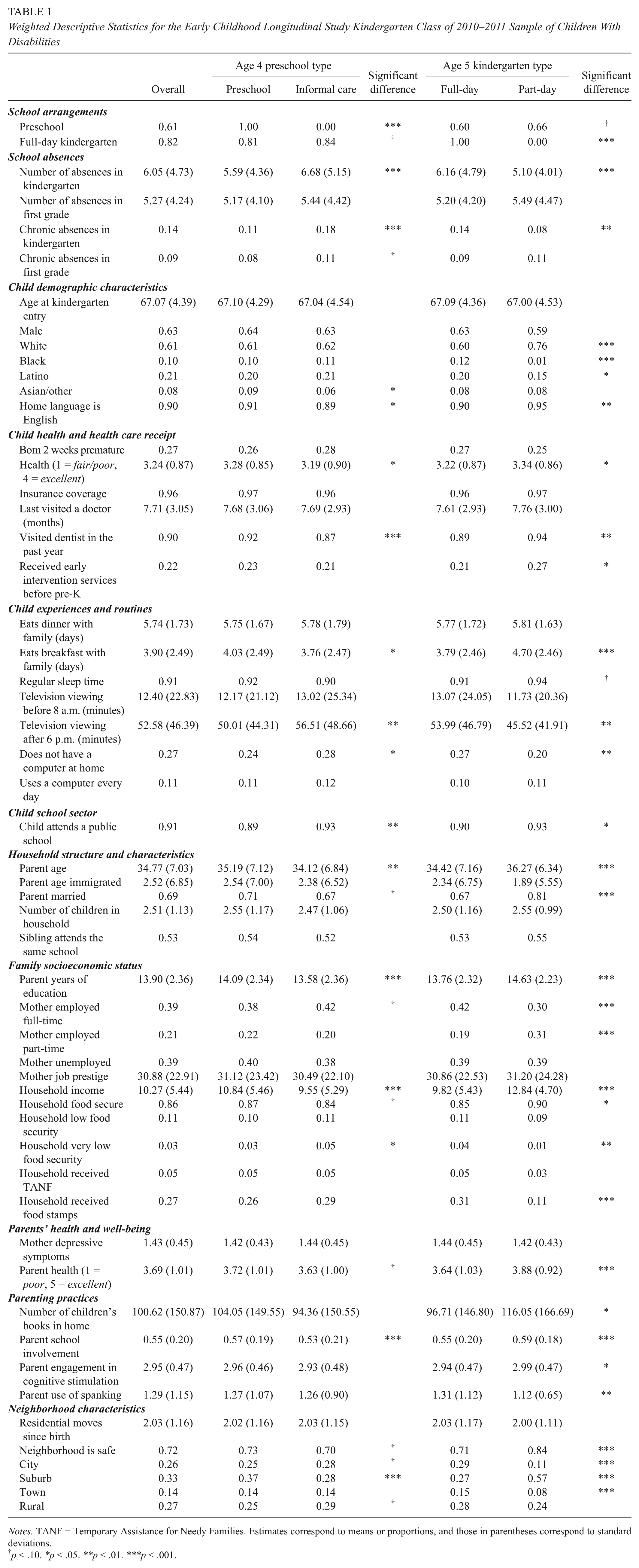
Notes. TANF = Temporary Assistance for Needy Families. Estimates correspond to means or proportions, and those in parentheses correspond to standard deviations.
p < .10. *p < .05. **p < .01. ***p < .001.
Measures
Child disability status
During the kindergarten school year, parents were asked a series of questions about their children, including their ability to pay attention and learn, overall behavior and ability to relate to adults and children, emotional and/or psychological difficulties, ability to communicate, difficulty in hearing and understanding speech, and eyesight. If parents indicated that their children had any issues or difficulties in response to any of the above questions, follow-up questions were asked to determine whether a professional had evaluated their children for that particular issue and whether a diagnosis was obtained. Children whose parents answered “yes” to at least one of the questions about diagnosis or therapy services were classified as having a disability (for more details, see Tourangeau et al., 2015). In terms of therapy services, of the 2,056 study participants who were included in our analytic sample, 1,865 had parents who answered “yes” or “no” to the question regarding their children’s receipt of therapy. Roughly 48% of these parents indicated that their children received therapy during the year before kindergarten. Follow-up questions about type of service were asked of those parents who answered yes to receipt of therapy services for their children (n = 880 to 890, depending on question about type of therapy). Among this subsample, 84% received speech/language therapy, 35% received occupational therapy, 26% received physical therapy, 14% received psychological services, 8% received vision services, and 6% received hearing services.
Kindergarten and first grade absences
During the spring of kindergarten and first grade, teachers were asked to “indicate the total number of absences for this child for the current school year.” Response options were based on a six-point scale (0 = no absences, 1 = 1 to 4 absences, 2 = 5 to 7 absences, 3 = 8 to 10 absences, 4 = 11 to 19 absences, and 5 = 20 or more absences). For our purposes, we recoded these scale values to equal the midpoint of the response options (e.g., 1 to 4 absences was recoded as 2.5 absences) as a means of providing a more interpretable metric of school absences. We also looked at a binary indicator of chronic absenteeism, defined as missing 11 or more days of the school year. Similar to prior studies with these data (Gottfried, 2014, 2015), we selected this threshold as an indicator for chronic absences because teacher reports of children’s school attendance were provided in March and not at the end of the year. Consequently, children who missed 11 or more days of school by this point in the year were likely at risk for being chronically absent by the end of the school year according to traditional standards (i.e., missing 10% of the school year, Balfanz & Byrnes, 2012).
Enrollment in preschool
As part of the parent interviews during the beginning of kindergarten, parents were asked, “Did [child] attend a day care center, nursery school, preschool, or prekindergarten program on a regular basis the year before [he or she] started kindergarten?” when children were 4 years of age. Preschool was defined as any of the following: day care center, nursery school, prekindergarten program, and Head Start. Overall, 61% of parents reported that their children regularly (defined as occurring at least weekly) attended one of the above arrangements during the year before kindergarten, with the remainder of children being cared for by relatives or their parents (for similar classifications, see Ansari & Crosnoe, 2015; Tucker-Drob, 2012).
Enrollment in full-day kindergarten
Based on teacher reports, children were classified as attending either a full-day (82%) or part-day (18%) kindergarten program during the 2010–2011 school year. Similar to other studies, including work done by Votruba-Drzal, Li-Grining, and Maldonado-Carreño (2008), we did not classify children in part-day programs into morning or afternoon classes.
Covariates
A major concern with studies on preschool and full-day kindergarten enrollment is that these early educational experiences are endogenous, which can undermine causal inference to be made about associations between children’s early school experiences and their school absences, as factors that select children into these arrangements might also influence their school absences. To address these issues of selection, we controlled for a rich set of covariates that were drawn from the kindergarten wave of data collection (see Table 1). These covariates were largely informed by the existing literature on parents’ selection of different early childhood programs (e.g., Coley, Votruba-Drzal, Collins, & Miller, 2014; Crosnoe, Purtell, Davis-Kean, Ansari, & Benner, 2016) and studies of absenteeism (e.g., Chang & Davis, 2015; Gottfried, 2015). And as can be seen in Table 1, each of these covariates was associated with children’s early school experiences.
At the child level, we adjusted for child demographic characteristics (age at kindergarten entry, gender, race/ethnicity, home language) along with indicators of health and health care receipt (premature birth status, parent report of child health, insurance coverage, receipt of medical care, and receipt of early intervention services for toddlers with developmental delays and disabilities prior to preschool entry). We also controlled for children’s other experiences and routines (days per week children ate breakfast and dinner with their families, sleep time, television viewing time, computer usage) and their school sector (public or private school). At the parent and family level, we controlled for household structure and characteristics (parent age, age parents immigrated to the United States, marital status, number of children in the household, number of siblings attending the same school as the study child) and families’ socioeconomic status (parents’ years of education, employment status, job prestige, household income, household food security, receipt of Temporary Assistance for Needy Families and food stamps). In addition, we controlled for variables that captured parents’ health and well-being (health, depressive symptoms [as measured with the Center for Epidemiological Studies–Depression scale; Radloff, 1977], parenting practices (number of children’s books in the home, school involvement, engagement in cognitive stimulation, use of spanking), and neighborhood characteristics (residential instability, neighborhood safety, and urbanicity).
Analytic Strategy
Our first set of analyses considered the associations between children’s participation in preschool, their enrollment in full-day kindergarten programs, and their school absences in kindergarten and first grade. To address this research question, we estimated a series of regression models in the Mplus program (version 7.4; Muthén & Muthén, 1998–2013). These models (a) accounted for dependence in child outcomes by including robust standard errors clustered at the school level, (b) were weighted to be nationally representative, and (c) employed full information maximum likelihood estimation to address missing data.
As a means of capturing whether there was evidence of convergence in the benefits of these educational arrangements, we created a difference score (first grade absenteeism – kindergarten absenteeism) that captured the regression slopes of preschool enrollment (vs. informal care) and full-day kindergarten (vs. part-day kindergarten) for children’s absenteeism between kindergarten and first grade (see also Ansari, 2018; Magnuson, Ruhm, & Waldfogel, 2007). To illustrate the meaning of this variable, consider the following examples. If we found a negative and statistically significant association between preschool enrollment and absenteeism in kindergarten and a positive and statistically significant association for the difference score, what this would suggest is that enrollment in preschool is associated with reductions in absenteeism at the end of kindergarten, but these benefits diminish over time. On the other hand, if we found a negative and statistically significant coefficient for preschool enrollment for absenteeism in kindergarten and no significant differences for the difference score, what this would indicate is that preschool participation is associated with reductions in absenteeism at the end of kindergarten, and these benefits persist through the end of first grade.
To determine whether there is a multiplicative benefit of these early school arrangements, we estimated additional models that included an interaction term (preschool × full-day kindergarten). The same set of linear probability models discussed above were reestimated for the binary indicator of chronic absenteeism and are presented, but convergence analyses were not estimated given the binary nature of the outcome. As a precaution, we also estimated logistic regression models for these binary indicators of chronic absenteeism in kindergarten and first grade, and our conclusions were the same as those reported below.
Results
Descriptives of and Predictors of Absenteeism
As can be seen in Table 1, national descriptives from the ECLS-K: 2011 reveal that children with disabilities missed approximately 6 days of school during the kindergarten year (SD = 4.73) and a little more than 5 days of school in first grade (SD = 4.24). During these early years, 14% and 9% of students with disabilities were considered to be chronically absent in kindergarten and first grade, respectively. When taken together, however, these descriptives suggest that children with disabilities were not frequently absent and were less likely to be absent and chronically absent as they transitioned from kindergarten to first grade (p < .001).
There were very few indicators that emerged as explanatory factors as to why children with disabilities were more (or less) likely to be absent during the early elementary school years (see Columns 2, 3, 5, and 6 of Table 2). The only consistent factors that emerged were within the domain of child health and health care receipt. Specifically, healthier children and children who had adequate medical care were less likely to be absent from school. Conversely, Latino children with disabilities were more likely to be absent (in kindergarten and first grade) and chronically absent (in first grade only) compared with White children. There were no consistent predictors for changes in absenteeism between kindergarten and first grade (see Column 4 of Table 2). Put another way, the reductions in absenteeism between kindergarten and first grade documented above were not concentrated among any subgroup of children with disabilities.
Multivariate Results of School Arrangements Predicting Children’s School Absences

Note. TANF = Temporary Assistance for Needy Families.
Interaction estimates were generated from a separate model. All continuous variables have been standardized to have a mean of 0 and standard deviation of 1, and therefore, all coefficients can be interpreted as effect sizes. Change estimates were also standardized to have a mean of 0 and standard deviation of 1 and thus do not equal the raw difference between the kindergarten and first-grade estimates.
p < .10. *p < .05. **p < .01. ***p < .001.
Benefits of Early School Settings for Absenteeism
Having established the national trends in school absences for children with disabilities along with its antecedents, we next considered whether children’s enrollment in preschool and full-day kindergarten programs had implications for children’s school absences (see Table 2). Results from this effort revealed that children with disabilities who attended preschool at age 4 were less likely to be absent in kindergarten, with an effect size (ES) of roughly 17% of standard deviation (p < .001), but these benefits were no longer present by the end of first grade. Convergence analyses confirmed that there was a significant reduction in the benefits of preschool between kindergarten and first grade for children’s school attendance (see Table 2). We find that this convergence occurs because children who participated in informal care experienced a sharper drop in absenteeism through the transition to first grade than children who participated in preschool (see Table 1). Practically speaking, children who participated in preschool at the age of 4 missed 0.82 fewer days of school in kindergarten compared with children who did not attend preschool.
When looking at models of chronic absenteeism, we found that children with disabilities who attended preschool at age 4 were roughly 6 percentage points less likely to be chronically absent in kindergarten (p < .01; see Table 2), which is sizable when considering that the base rate of chronic absenteeism during the year was 14%. Similar to children’s school absences when continuously measured, the benefits of preschool for chronic absenteeism documented in kindergarten did not persist through the end of first grade.
Next, when considering the implications of full- and part-day kindergarten programs, we documented no consistent differences for rates of chronic absenteeism but did find that children with disabilities enrolled in full-day programs were more likely to be absent than those who attended part-day programs (ES = 0.18, p < .01, roughly 0.86 days). Nonetheless, as can be seen in Table 2, there was a reversal by the end of first grade such that there were no longer any significant differences in children’s school attendance across full- and part-day programs. Although there were no longer any differences in children’s school attendance in first grade as a function of kindergarten type, the reversal itself was significant. This convergence occurred because children who attended full-day kindergarten experienced a drop in absenteeism over time, whereas children who participated in part-day kindergarten experienced a slight increase in school absences (see Table 1). And when looking at the multiplicative benefits of enrollment in preschool and full-day kindergarten, we found no evidence of moderation, suggesting that no specific combination of these early school arrangements was beneficial (or harmful) for children’s early school attendance patterns in kindergarten or first grade.
Supplemental Models Illustrating the Downstream Consequences of Absenteeism
To illustrate the downstream consequences of our findings, we estimated supplemental models that looked at the academic implications of missing school (a composite of math, reading, and science). Results from this effort revealed that children who were more frequently absent (ES = 0.09, p < .001) and chronically absent (ES = 0.20, p < .01) in kindergarten demonstrated less optimal academic skills through the end of first grade. And ultimately, because preschool attendees were less likely to be absent in kindergarten, they performed better academically in first grade (i.e., preschool enrollment → fewer absences in kindergarten → more optimal academic achievement; indirect ES = 0.02, p < .05).
Discussion
To date, there has been little research conducted on the educational experiences of children with disabilities, especially during the early childhood years as children start their formal educational careers. As part of this investigation, we sought to push the early childhood and educational fields forward by addressing some of these important gaps in the knowledge base with respect to the early school experiences of children with disabilities and their early school absences. In doing so, our study extended the existing research by illustrating the implications of enrollment in preschool, full-day kindergarten, or both for the early school attendance of young children with disabilities. Below, we discuss implications of this work.
First, results from this study reveal that children with disabilities who attended preschool at age 4 were less likely to be absent in kindergarten compared with children who did not have a formal educational experience during the year before kindergarten, which is similar to patterns documented for the general population (Gottfried, 2015). These results suggest that attending preschool might ease the transition to kindergarten, perhaps by providing families with access to disability services and instructional supports that families might not have otherwise accessed (Fenlon, 2005). One reason might be that, as mentioned above, IDEA provides transition services to children and their families (IDEA, 2004). The provision of these services might serve to benefit the transition to kindergarten, specifically in terms of reducing school absence behaviors. Hence, our study underscores the importance of children with disabilities attending preschool programs, given the potential role that it plays in both facilitating school transitions and providing access to services. A question remains for policy makers, however, about how to ensure that children who do not attend preschool programs can also receive early benefits through other means, such as social services.
Besides illustrating the benefits of preschool enrollment for the school attendance of children with disabilities, this study demonstrates that the benefits for these children almost immediately diminished through the transition to first grade, which contrasts with the sustained patterns found in the general population (Ansari & Gottfried, 2018). Again, with regard to IDEA (2004), understanding the role of transition services for those with disabilities is critical to developing important support systems for transitioning into kindergarten; any benefits might fade over time for this group given the critical role that these services play in helping children with disabilities, and their families, adjust to the first year of formal schooling.
Although this finding certainly fits within the broader patterns of convergence that have been documented in the early childhood literature when looking at academic outcomes (Phillips et al., 2017; Yoshikawa et al., 2013), it is nonetheless still surprising that the benefits of preschool reduced so dramatically and almost fully converged to zero between kindergarten and first grade (0.17 SD to 0.01 SD). This convergence in the benefits of preschool stemmed from the fact that non–preschool attendees “caught up” with their classmates who attended preschool. Put another way, non–preschool attendees demonstrated a much sharper drop in absenteeism between kindergarten and first grade than did children who had attended preschool at age 4. Perhaps it is those very services that children and families received access to at age 4 as a result of their enrollment in preschool that were then available to non–preschool attendees in kindergarten that resulted in this convergence. Although this study did not contain information about early intervention and transition services, an important direction from these findings would be to examine the role of receipt of early intervention, including IDEA-mandated transition plans, with respect to absenteeism. On the other hand, assuming that a policy aimed at providing services to families in preschool (to reduce absenteeism) will have long-lasting effects proves here to be insufficient for generating long-term impacts if these skills are mastered by children in the comparison groups or if these services are suddenly available to all families in kindergarten (for further discussion, see Bailey et al., 2017). Despite the rapidly converging benefits of preschool for school attendance, we still found that there were lingering academic benefits of preschool as a function of improvements in school attendance.
Second, as for full- versus part-day kindergarten, we found that children with disabilities were more likely to be absent during the kindergarten year if they attended full-day programs, which is consistent with Gottfried (2017). Even though these children were more likely to be absent, it is important to keep in mind that these students were in school for more time than students in part-day kindergarten. That is, children who were in full-day kindergarten still received more than double the education time. And it is also important to emphasize that, similar to the benefits of preschool enrollment at age 4, we found a strong reversal over time: By the end of first grade, there were no differences in the school absences of children who enrolled in either full- or part-day kindergarten. This reversal in rates of absenteeism across programs occurred in large part because children in part-day kindergarten programs showed an increase in absenteeism between kindergarten and first grade, whereas children in full-day programs demonstrated a drop in absenteeism during this same time frame. When discussing these reversals in both the benefits of preschool and the drawbacks of full-day kindergarten, it is important to acknowledge that outside of these early school experiences, there were no other child or family demographic characteristics that consistently explained changes in absenteeism over time. That is, the changes in the rates of absenteeism between kindergarten and first grade were not concentrated among any subgroup of children with disabilities. At the same time, however, we did find that Latino children with disabilities were consistently more likely to be absent and chronically absent as compared with White children with disabilities, which means that this group of children may be at particular risk, and understanding why they were more likely to be absent requires attention.
Third, we found no combined/multiplicative benefits of attending both preschool and full-day kindergarten. In the end, this may not be entirely surprising because prior research has suggested that some benefits of enrolling in multiple early childhood settings might overlap with each other in terms of developing skills and affecting outcomes (Claessens, 2012). In fact, Gottfried (2015) found that attending center-based preschool reduced absenteeism in kindergarten, though there were no benefits of attending center-based care before/after school during the kindergarten year. Our study falls into this same line. Although speculative, and as briefly discussed above, it might be the case that given the supports and resources that children with disabilities started receiving in preschool or given the school-going transitions to which these children began adapting in preschool, the benefits for school attendance may have been already actualized by the time children got to kindergarten. Hence, policy efforts aimed at reducing absenteeism via having children enroll in both preschool and full-day kindergarten might prove to be duplicative. Certainly, however, attending both preschool and full-day kindergarten has academic benefits (Gottfried & Le, 2016; Phillips & Meloy, 2012; Weiland, 2016), but not necessarily in regard to addressing absenteeism.
Despite these contributions to the literature, we readily acknowledge a number of limitations of our work. Most notably, this study did not involve random assignment. Instead, our analytic models adjusted for a wide range of family and child demographics that are regularly implicated in parents’ selection into preschool and full-day kindergarten (e.g., Coley et al., 2014; Crosnoe et al., 2016) and have been shown to be associated with children’s absenteeism (e.g., Chang & Davis, 2015; Gottfried, 2015). It is important to acknowledge that some aspects of human behavior—including absenteeism—are not easily randomized, which is why correlational and quasi-experimental research is necessary (for further discussion, see Gershoff, Sattler, & Ansari, 2017). Even so, the interpretation of our findings requires caution. Second, our broad definition of preschool enrollment at age 4 likely masks heterogeneity within these programs, and we could not determine whether the preschool program children attended provided special education services, all of which may ultimately result in smaller associations over time. It is also unfortunate that we were somewhat constrained by sample size, which precluded us from rigorously being able to consider within-group heterogeneity for children with disabilities. Thus, an important direction for future research is to consider whether specific programs (e.g., Head Start and programs funded under Section 619 of IDEA) are linked with better school attendance over time and whether children with specific disability classifications benefit more (or less) from these early school experiences.
Third, the absenteeism data available in ECLS-K: 2011 were based on teacher reports in March of each school year, which is certainly a limitation as it does not capture absenteeism through the end of the year. Despite this issue of timing, administrative records of end-of-year absences from the older ECLS-K find similar rates of absences per month (0.89 days missed per month; Gershenson, Jacknowitz, & Brannegan, 2017), as reported in this study (0.93 days missed per month), which minimizes this limitation. Fourth, although ECLS-K: 2011 is the most recent nationally representative sample of kindergartners, the rapidly changing landscape of public education more generally might mean that our findings are not representative of today’s patterns of participation and attendance and, therefore, replication is necessary. Finally, in this study, children were identified as having a disability by their parents in kindergarten. However, it remains possible that not all students with disabilities were identified at this period—some before and some after. For instance, it is likely that children who were not diagnosed during years prior to school entry (but did have a disability) have different early childhood experiences than those who were diagnosed, hence underscoring a direction worth examining with a data set containing both before- and after-school entry data on disability and disability service. In doing so, we can better understand the underlying reasons why preschool enrollment is linked with better school attendance in kindergarten. Thus, when taken together, future studies should look more carefully within the population of children with disabilities to more carefully capture periods (and types) of diagnosis and services.
In sum, our study was one of the first to consider the intersection of research on enrolling in multiple early childhood settings, school absenteeism, and children with disabilities. Given (a) the numerous previously raised academic benefits of enrolling in preschool and/or full-day kindergarten (b) the current absenteeism crisis especially affecting young children, and (c) that children with disabilities tend to miss more school than other children, our study brought to the surface new findings to address which factors might be influencing school absenteeism and over how much time. As families’ utilization of preschool and full-day kindergarten continues to increase (Child Trends, 2014; U.S. Department of Education, 2010), our work provides insight into how children with unique needs may benefit, and in what combination. Armed with this knowledge, policy makers and practitioners can continue to develop supports and resources to ensure that this group of children remains successful in school.
Footnotes
Acknowledgements
The lead author was supported by a grant from the Institute of Education Sciences, U.S. Department of Education (R305B130013, University of Virginia). Opinions reflect those of the authors and do not necessarily reflect those of the granting agencies.
Notes

Authors
ARYA ANSARI is a postdoctoral research associate in the Center for Advanced Study for Teaching and Learning at the University of Virginia. His research program is focused on understanding how contextual factors influence the early learning and development of children from disadvantaged backgrounds, with the aim of informing policies and intervention programs that can benefit such children.
MICHAEL A. GOTTFRIED is an associate professor in the Gevirtz Graduate School of Education at the University of California, Santa Barbara. His research focuses on attendance and truancy, early childhood education, and children with disabilities.