




Abstract
Recent research has shown that the age composition of preschool classrooms influences children’s early learning. Building on prior research, this study examines whether the association between classroom age composition and children’s learning and development vary based on classroom quality and teacher characteristics using a subset of the Family and Child Experiences Survey (FACES), a nationally representative sample of 3- and 4-year-old children attending Head Start (n = 2,829). Results revealed that the association between age composition and children’s academic skills was dependent on classroom quality and that classroom quality was less predictive of children’s skills in mixed-age classrooms. Teacher education but not experience also moderated the influence of age composition such that mixed-age classrooms taught by a teacher with higher education were not associated with decreased literacy gains among older children.
The growing recognition of early childhood as a critical developmental period that has lasting influences has led to the expansion of preschool education for 3- and 4-year-olds in the United States (Duncan & Magnuson, 2013). With this continued expansion, closer attention must be paid to the different ways in which design characteristics of these programs influence children’s school success. One such feature that has become commonplace across many programs, including Head Start—the nation’s largest federally funded preschool program—is mixed-age classes whereby programs serve children of different ages in the same classrooms. As of 2009, roughly 75% of all Head Start classrooms were mixed-age (Ansari, Purtell, & Gershoff, 2016).
Although mixed-age classrooms represent one of the most common models of education in preschool programs across the country, its efficacy with respect to facilitating children’s school readiness has been debated with limited, dated, and conflicting empirical support (Mason & Burns, 1996; Veenman, 1995). However, a recent national analysis of Head Start classrooms found sizeable negative associations between mixed-age education and 4-year-olds’ academic learning (Ansari et al., 2016). Surprisingly, we know little about how other classroom and teacher characteristics might modify the influence of age composition. As part of this study, we focus on features of preschool programs that have been central to the discourse on early childhood education as potential moderators, namely, classroom quality and teachers’ education and experience (Early et al., 2007; Hatfield, Burchinal, Pianta, & Sideris, 2016; Mashburn et al., 2008). Our goal is to examine how these classroom features modify associations between age composition and children’s learning and development in Head Start classrooms.
Theoretical Framework
Whether implemented for pedagogical or logistical reasons, mixed-age classrooms have a long history in preschool, and much of the initial support for this educational model comes from Vygotskian theory, which posits that children learn from their peers (Vygotsky, 1978). Indeed, mixed-age age classrooms provide younger children the opportunity to model behaviors their older peers exhibit and provide older students with opportunities to scaffold and teach their younger classmates (Lillard, 2016; Winsler et al., 2002). Mixed-age classrooms also provide students with a greater range of interactions, which is often argued to facilitate the development of a wide range of social skills, including empathy and self-regulation (Lillard, 2016). However, recent studies do not support the notion that mixed-age classrooms are beneficial for older children (Ansari et al., 2016; Moller et al., 2008). These documented negative associations between mixed-age classrooms and the learning of the older students in the classroom may in part be due to the additional challenges teachers may encounter when working with children of greater age diversity. For example, teaching enriching content to all students may be more challenging when children are at different points in development. When taken together, the theoretical and empirical evidence suggests that the potential positive influence of mixed-age classrooms on children’s development is far from universal, which is why understanding the conditions under which children benefit from these settings is imperative.
To explore these questions, we use a bioecological lens (Bronfenbrenner & Morris, 2006) and focus on interactions between children and their proximal classroom context. From this, we propose that children’s academic and social-behavioral development in the preschool years is shaped by both features of their preschool context and their own individual characteristics. Specifically, we focus on interactions between two contextual characteristics of the classroom: the ages of one’s classmates and the observed quality of the classroom and teacher (as defined by their qualifications). Importantly, we hypothesize that the influence of these interactions varies by children’s own age, which is recognized as a “person” characteristic (Bronfenbrenner & Morris, 2006) or a referent status in other peer effects research (Justice, Petscher, Schatschneider, & Mashburn, 2011). For example, a 3-year-old may be positively influenced by the presence of older, more skilled peers regardless of the quality of the classroom they are in, whereas a 4-year-old may need particular contextual supports to demonstrate academic growth when in a classroom with younger peers. Using this framework illuminates the potential role of children’s own age as a critical factor in the processes through which age composition and other classroom factors influence their early academic development.
Age Composition and Classroom Quality
One possibility is that the influence of mixed-age classrooms and children’s early learning and development depends on the quality of the classroom environment. To begin, there is substantial evidence that suggests that the classroom quality is an important feature of early childhood programs (Keys et al., 2013; Mashburn et al., 2008). In general, classroom quality focuses on two domains: structural quality and process quality. Current research suggests that structural quality, which includes factors such as leadership within the preschool, teacher qualifications, and child-adult ratios, is necessary but not enough to produce optimal environments for children to learn and develop in (Burchinal, 2017).
On the other hand, process quality, which captures teachers’ social, emotional, and instructional interactions with their students (Howes et al., 2008; Pianta et al., 2005), has been documented as a critical aspect of children’s early educational experiences (Pianta, La Paro, & Hamre, 2008). For example, a large-scale study of pre-kindergarten programs from across the country found that measures of process quality were more strongly associated with children’s gains in language, literacy, and social development compared with numerous indicators of structural quality (Howes et al., 2008). Because process quality captures the experiential aspect of preschool, including the instruction a child receives and the supportiveness of their teacher, it may modify the associations between age composition and children’s learning and development. Specifically, higher quality teacher-child interactions may be indicative of classrooms that are more effectively meeting the needs of young children of different ages (e.g., scaffolding, individual time), whereas lower quality classrooms may be indicative of teachers who are struggling. Thus, higher quality classrooms may alter children’s classrooms experiences in mixed-age classrooms, such as their interactions with their teachers and peers, which prior studies suggest has implications for children’s school success (Henry & Rickman, 2007; Howes et al., 2008; Justice, Logan, Lin, & Kaderavek, 2014; Mashburn, Justice, Downer, & Pianta, 2009).
In support of these notions, an exploratory study by Guo, Tompkins, Justice, and Petscher (2014) found that mixed-age preschool programs can be beneficial when coupled with high-quality teacher-child interactions. In this study, vocabulary development among 130 preschool children in 16 classrooms was examined. Children in classrooms with wider age variance demonstrated larger gains in vocabulary across the year. This association was stronger for the younger children in the classroom and notably, was stronger when the classroom was of higher quality. Presumably, children in high-quality classrooms have more opportunities to have meaningful interactions with their teacher and peers, both of which may enhance the experience of being in a mixed-age environment. The quality of the classroom may thus change the effects of age composition, although it has rarely been examined in this context. However, other related work from Tulsa’s pre-K programs has revealed that there is a large degree of variation in pre-K impacts more generally as a function of classroom instructional quality (Johnson, Markowitz, Hill, & Phillips, 2016), which supports the general notions discussed previously.
Age Composition and Teachers’ Education and Experience
Next, managing a classroom with children of different ages and meeting the diverse needs of children is a challenging task for teachers (Guo et al., 2014). Even so, it may be that teachers with more education and experience are better prepared for the challenge and have the expertise that enables them to manage the classroom effectively and implement activities and instruction that are beneficial for all children in the classroom. For example, older research has documented both positive and negative associations between mixed-age classrooms and various aspects of how children spent their time, including time spent in play and children’s engagement in conversation (Blasco, Bailey, & Burchinal, 1993; Goldman, 1981; Urberg & Kaplan, 1986; Winsler et al., 2002). Variations in these types of activities as well as other teacher-influenced classroom attributes, such as the amount of instructional time, may change the way age composition influences children’s development. Although preschool teachers’ education and experience have demonstrated few links to measures of classroom quality (Early et al., 2007), they have shown modest associations with growth in children’s learning and development (Howes et al., 2008). Furthermore, it may be that the skills gained through prior education and experience provide a specific boost for teachers in mixed-age classrooms. These teachers may have more specific strategies, not captured in global quality measures, that enable them to promote development among all children in the classroom such as ways to assign roles in group work that maximize the potential learning opportunities for children of different ages. In other words, teachers with more education and experience may be better equipped to create a positive, developmentally appropriate, mixed-age classroom than less educated and experienced teachers.
In particular, there are a number of aspects of teaching that are not well captured in current measures of quality but may be particularly important in mixed-age contexts (Burchinal, 2017). For example, teachers’ ability to differentiate their instruction to match student needs is an important aspect of children’s classroom experiences, but many teachers do not feel confident about their ability to do so effectively (Manship, Farber, Smith, & Drummond, 2016). The importance of differentiation may be magnified in mixed-age classrooms as children’s skills are likely to be more variable than in same-age classrooms. Accordingly, we hypothesize that teachers’ education and experience may change children’s experiences in mixed-age preschool settings because they may capture the degree to which teachers are more comfortable with specific practices, such as effective differentiation, that are especially necessary in the context of classrooms that are more age diverse.
The Current Study
In sum, the goal of the present investigation is to examine classroom quality, teacher experience, and teacher education as moderators of the associations between age composition and preschoolers’ academic gains and behavioral development. We build on the work of Ansari and colleagues (2016) and examine these associations in the Family and Child Experiences Survey (FACES) 2009 data set, a nationally representative sample of Head Start children and classrooms. In their work, Ansari and colleagues found that: (a) 4-year-olds in classrooms with a higher proportion of 3-year-olds experienced fewer gains in literacy and math skills compared with 4-year-olds in classrooms with fewer 3-year-olds, (b) age composition was neither beneficial nor harmful for 3-year-olds’ academic achievement, and (c) age composition was not associated with changes in 3- or 4-year-olds’ social-behavior development.
As part of the current study, we hypothesized that these direct influences of classroom age composition would vary based on the quality of preschool classrooms; specifically, the negative associations previously documented between higher proportions of 3-year-olds in the classroom and 4-year-olds’ academic gains would only be seen in classrooms of low quality. We also hypothesized that benefits may emerge for 3-year-olds in mixed-age classrooms when classrooms were of high quality as this may provide an opportunity for high-quality interactions with older and more skilled peers. With regards to teacher education and experience, we expected that the negative associations between age composition and 4-year-olds’ academic development would be reduced in classrooms with more educated and experienced teachers. Thus, when taken together, this study sought to examine specific, policy-amenable characteristics of mixed-age classrooms that may result in age composition being more or less promotive of children’s early learning and development. By examining a national sample of preschoolers, we are able to document the specific conditions under which mixed-age classrooms are most beneficial and least harmful to the development of preschoolers.
Method
We use data from the 2009 FACES cohort, which followed a nationally representative sample of 3,349 3- and 4-year-old first-time Head Start attendees across 486 classrooms. Children entered the study in the fall of 2009 and were followed through kindergarten. In total, FACES 2009 selected 60 programs, two centers per program, and up to three classrooms per center from all 50 states and the District of Columbia (for more sampling information, see Moiduddin, Aikens, Tarullo, West, & Xue, 2012). In the current study, we used data from the first two waves of data collection (fall 2009 and spring 2010) as we were interested in understanding how classroom characteristics were associated with children’s academic gains and behavioral change across one year of preschool. Children who left the program or switched classrooms between the fall and spring were excluded, resulting in a final sample of 2,829 children (see Table 1 for sample demographics and Table 2 for correlations among the focal variables).
Descriptive Statistics for Study Variables, by Age Cohort

p < .10. *p < .05. **p < .01. ***p < .001.
Correlation Matrix for the Focal Predictors, Moderators, and Outcomes

Note. Estimates to the left of the diagonal correspond to the correlation matrix for 4-year-olds, whereas estimates to the right of the diagonal correspond to the correlation matrix for 3-year-olds. All estimates were weighted to be nationally representative and estimated within the 50 imputed data sets.
Measures
Classroom age composition
During the fall of 2009, teachers reported how many children were in their classroom (M = 17.15, SD = 2.21). They also reported how many were 3 years of age or younger (M = 7.11, SD = 5.17), 4 years of age (M = 9.04, SD = 5.66), or 5 years of age (M = 1.00, SD = 1.81). These reports were for all children in the classroom, not just the children who were part of the FACES study. We dichotomized children as 3 years of age or younger or 4 years of age or older. Because there were only a small number of 5-year-olds, we included them with the 4-year-olds (for a similar method, see Moiduddin et al., 2012). We then divided the number of 3-year-olds by the class size to create our focal indicator of the proportion of 3-year-old children in each classroom.
Classroom quality
Trained data collectors observed all classrooms for at least four hours during the spring of the Head Start year. As part of these observations, Head Start classrooms were observed and rated on the Classroom Assessment Scoring System (CLASS; Pianta et al., 2008), a standardized observation measure of global classroom quality. The CLASS, which is based on four observation cycles and denotes the level of classroom quality on a 7-point Likert scale (1–2 = low to 6–7 = high), was used to measure three different aspects of teachers’ interactions with children, namely, teachers’ (a) Emotional Support (positive and negative climate, teacher sensitivity, and regard for student perspectives), (b) Classroom Organization (behavior management, productivity, and instructional learning formats), and (c) Instructional Support (concept development, quality of feedback, and language modeling). These dimensions of classroom quality are informed by existing theory (Pianta & Hamre, 2009) and empirically supported with validation studies and factor analyses of over 4,000 classrooms across the United States, yielding a similar three-factor structure solution (Hamre, Pianta, Mashburn, & Downer, 2007).
Given the fairly strong correlation across these three domains (rs = 0.49–0.74), for our focal analyses, we focus on the overall CLASS score as an indicator of the quality of teacher-child interactions (α = .80). As a precaution, however, we also estimated a series of models that looked at the three dimensions of the CLASS (i.e., emotional, organizational, and instructional support) as opposed to an overall composite. Additionally, because classroom quality has been shown to have nonlinear relations with children’s early learning (e.g., Anderson & Phillips, 2017; Burchinal et al., 2016), we also estimated models with nonlinear specifications that captured classrooms that were of lower (scores below 3.75), moderate (scores of 3.75–4.49), and higher quality (scores of 4.50 or greater). We also estimated models with quadratic terms included.
Teacher education and experience
In the fall of 2009, teachers reported on their level of education and the years they had been teaching. For education, we use three categories: no professional degree (referent in all analyses), associate’s degree, and bachelor’s degree and higher. Years of teaching experience was continuously measured. For teachers’ experience, we also estimated a separate set of models that considered potential thresholds (0 to <5 years, 5 to <9 years, 10 to 19 years, and 20+ years).
Children’s academic skills
Two dimensions of children’s academic skills were assessed at the beginning and end of the school year. First, children’s language and literacy skills were measured with the Peabody Picture Vocabulary Test (Dunn & Dunn, 1997), the Woodcock Johnson Letter-Word Identification, and the Woodcock Johnson Spelling Word (Woodcock, McGrew, & Mather, 2001). These assessments evaluated children’s verbal skills as well as their writing skills. Because each of the assessments was scored on different scales, we created standardized scores for each and averaged them to create a composite for language and literacy (Time 1 α = .65; Time 2 α = .68; for a similar approach with comparable reliability, see Duncan et al., 2015). Children’s math skills were based on their scores on the Woodcock Johnson Applied Problems subscale (Woodcock et al., 2001) and the Early Childhood Longitudinal Study-Birth Cohort (ECLS-B; Snow et al., 2007) math assessment (Time 1 α = .80; Time 2 α = .82). These assessments tapped into children’s classification, comparison, and shape recognition skills and were combined by the FACES 2009 data collection team.
It is important to note that children who came from non–English speaking homes were assessed with a language screener; those who failed the test were then assessed with the Spanish versions of the aforementioned assessments. For these children, we used their scores on the Spanish version of the assessments, and all analyses included an indicator of children’s language of assessment (82% English-English, 8% Spanish-Spanish, 10% Spanish- English).
Children’s social behavior
Teachers reported on children’s behavior problems and social skills at the beginning and end of the year using items from the Personal Maturity Scale (Entwisle, Alexander, Cadigan, & Pallis, 1987), Behavior Problems Index (Peterson & Zill, 1986), and Social Skills Rating System (Gresham & Elliott, 1990). Each of these reports was based on a 3-point Likert scale (0 = never to 2 = very often). Reports of children’s behavior problems (Time 1 α = .88; Time 2 α = .87) tapped into children’s aggressive, hyperactive, and withdrawn behaviors, whereas reports of children’s social skills (Time 1 α = .89; Time 2 α = .89) captured positive classroom behaviors (e.g., following directions, helping put things away).
Covariates
All models adjusted for children’s baseline skills; that is, we estimate whether classroom age composition was associated with changes in children’s school readiness outcomes, which is one of the strongest adjustments for omitted variable bias (National Institute of Child Health and Human Development Early Child Care Research Network & Duncan, 2003). We also adjusted for a theoretically relevant set of child-, household-, teacher-, and classroom-level variables. Child and household factors include: child gender, child race/ethnicity, child age at the start of school, months between the fall and spring assessments, language of assessment, mothers’ education, mothers’ age, mothers’ employment status, mothers’ marital status, mothers’ depressive symptoms, ratio of income to poverty, household size, and household language. We also controlled for classroom and teacher characteristics, namely: teacher-child ratios, adult-child ratios, class size, teachers’ depressive symptomology, average hours per week children were in school, multilingual classrooms (English only vs. English and Spanish), whether teachers’ education was in early childhood education, teachers’ benefits (e.g., paid vacation, sick leave), and teachers’ hourly salary.
Analysis Plan
All analyses were conducted using Stata (StataCorp, 2011). To address issues of missing data (5%–18%), we imputed 50 data sets through the chained equations method. Before doing so, however, we looked at the patterns of missing data and found that there were 151 missing data patterns for the 4-year-old cohort and 212 missing data patterns for the 3-year-old cohort, suggesting that data were not systematically missing (see also Chien & Mistry, 2013). Moreover, missing data patterns did not differ greatly across the two cohorts (all standardized mean differences were 10% of a standard deviation or less).
As part of our modeling strategy, we also used robust standard errors clustered at the classroom level to adjust for the nesting of children in classrooms. Clustered standard errors are one way to address the fact that there is independence of observations across clusters but children within clusters (in our case, classrooms) share some similarities that result in bias in the standard errors of coefficients (for examples of preschool research that uses this approach, see also Duncan et al., 2015; Weiland & Yoshikawa, 2014). All models also included longitudinal weights to address cross-wave attrition and ensure that the data were nationally representative. Finally, all continuous variables were standardized to have a mean of 0 and standard deviation of 1, and therefore, all estimates correspond to effect sizes (e.g., a Cohen’s d).
With the aforementioned specifications in mind, we estimated a series of regression models (one for each outcome) separately by age cohort. Because we hypothesized that the associations between age composition and children’s development were conditional on classroom quality and teacher experience and education, we conducted a series of additional models that included interaction terms between age composition and these focal moderators to predict children’s outcomes. If there was evidence for moderation, we interpreted the interaction by calculating the predicted outcome scores for different combinations of classroom age composition and the moderator, using standard deviation cut points. We then probed the interactions using simple slopes to determine whether the influences of the predictor varied significantly at different levels of the moderator.
Results
Table 1 provides sample descriptives and comparisons of children across age cohorts. Not surprisingly, 3-year-olds were in classrooms with a higher proportion of 3-year-old classmates. In terms of our focal moderators, 3-year-olds were more likely to have a teacher with an associate’s degree but less likely to have a teacher with a bachelor’s degree. No significant differences emerged in teacher experience or classroom quality. There were a number of significant differences between 3- and 4-year-old children on family demographic characteristic variables, including race/ethnicity and maternal education. These likely emerged because a requirement of FACES participation is that the child is enrolled in their first year of Head Start and families who enroll children at an earlier age are different from those who wait until the 4-year-old year (see also Puma et al., 2010). There were also differences on classroom characteristics, including child-teacher ratio and class size, likely due to differences in program requirements by child age. It is important to note that all nonfocal variables in Table 1 serve as covariates in all analyses.
Age Composition and Classroom Quality
We first replicated the associations between classroom age composition and children’s learning and development, which were presented by Ansari and colleagues (2016). As expected, we found that higher proportions of 3-year-olds in the classroom was negatively associated with 4-years-olds’ gains in both literacy and math throughout the school year (see Table 3). Age composition was not associated with 4-year-olds’ behavioral outcomes or any of the outcomes for 3-year-olds. We then examined direct associations between classroom quality and children’s outcomes and found only one significant association, namely, higher classroom quality was associated with higher social skills among 3-year-olds only.
Coefficient Estimates From Models Predicting Children’s Achievement and Behavior, by Age Cohort
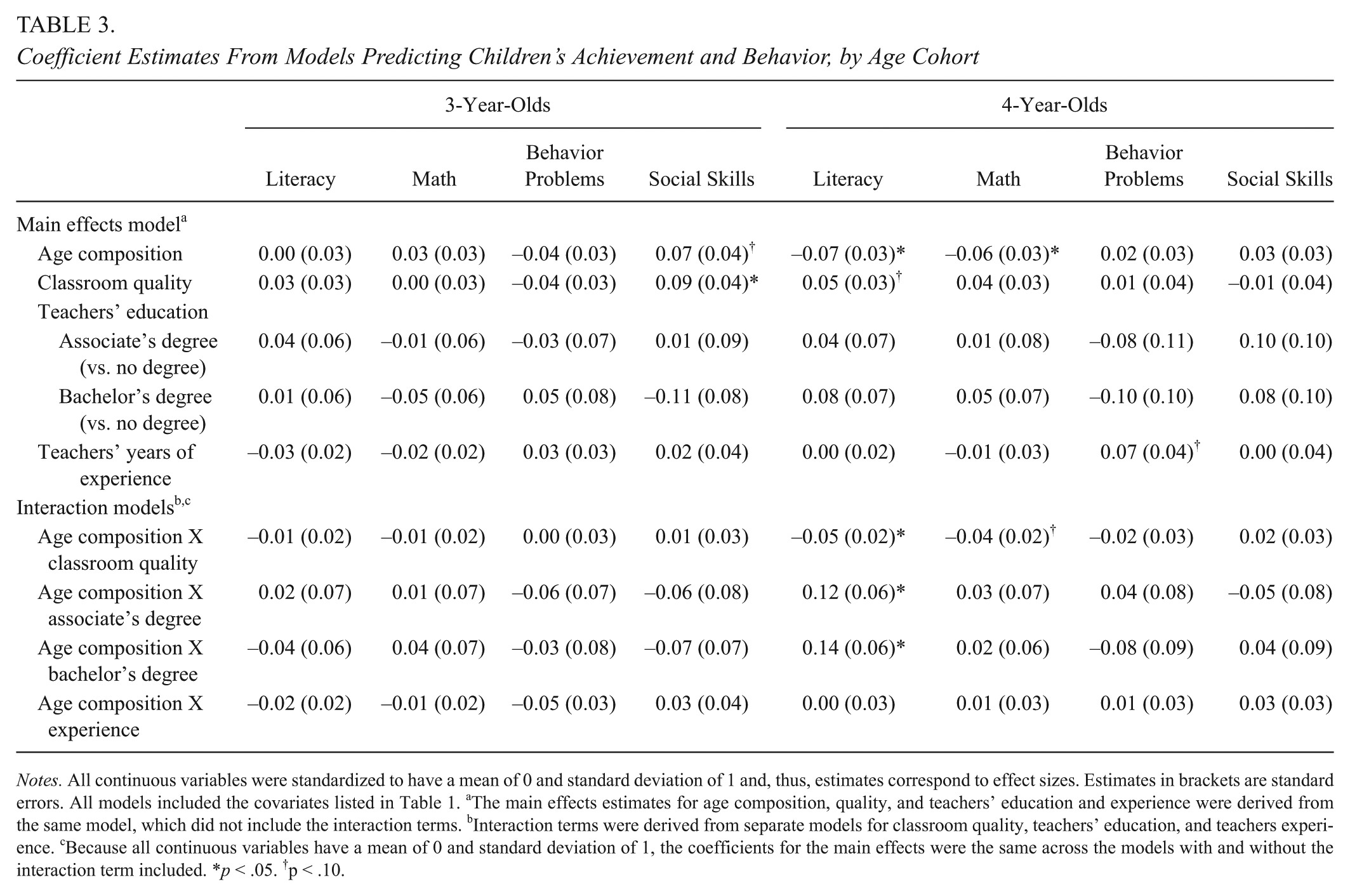
Notes. All continuous variables were standardized to have a mean of 0 and standard deviation of 1 and, thus, estimates correspond to effect sizes. Estimates in brackets are standard errors. All models included the covariates listed in Table 1. aThe main effects estimates for age composition, quality, and teachers’ education and experience were derived from the same model, which did not include the interaction terms. bInteraction terms were derived from separate models for classroom quality, teachers’ education, and teachers experience. cBecause all continuous variables have a mean of 0 and standard deviation of 1, the coefficients for the main effects were the same across the models with and without the interaction term included. *p < .05. †p < .10.
Our first focal analysis, also reported in Table 3, examined the interaction between age composition and classroom quality. These results revealed that the influence of classroom quality for children’s literacy skills was conditioned on age composition. As shown in Figure 1, calculation of simple slopes indicated that for 4-year-olds, classroom quality did not mitigate the negative influence of being in a classroom with a higher proportion of younger children. However, when 4-year-old children were in a classroom with few 3-year-olds, classroom quality was associated with greater gains in literacy. Similar, albeit marginal, patterns emerged for children’s math achievement. The interaction between age composition and classroom quality did not predict children’s behavior problems or social skills. As discussed previously, we also estimated a series of models that looked at the three dimensions of the CLASS (both simultaneously and separately) and found that our results were not driven by any one dimension of the measure. Results from our threshold and quadratic models also revealed no evidence of nonlinear effects (see Table 4).
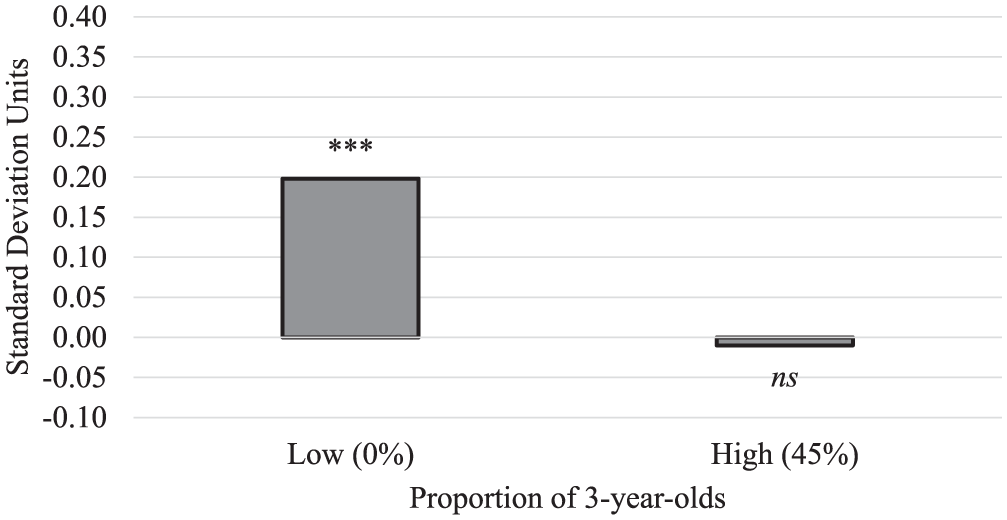
The literacy benefits for 4-year-olds of high quality (vs. low quality) teacher-child interactions across classrooms serving a low (0%) and high (45%) proportion of 3-year-olds.
Alternative Model Specifications From Models Predicting Children’s Achievement and Behavior, by Cohort

Notes. All continuous variables were standardized to have a mean of 0 and standard deviation of 1 and, thus, estimates correspond to effect sizes. Estimates in brackets are standard errors. All models included the covariates listed in Table 1. aBecause all continuous variables have a mean of 0 and standard deviation of 1, the coefficients for the main effects were the same across the models with and without the interaction (or quadratic) term included.
*p < .05. †p < .10.
Age Composition and Teacher Education and Experience
Next, we examined the relations among teacher education and experience, age composition, and children’s development across the Head Start year. Results from these analyses revealed no direct associations between teacher education and experience and any of our four outcomes of interest for either age cohort. However, moderation analyses revealed that the interaction between both teacher education variables (but not experience) and age composition were significantly associated with children’s gains in literacy but not math skills. Probing these interactions revealed a different pattern from the classroom quality interactions. As shown in Figure 2, we found that classroom age composition was not associated with 4-year-old’s early language and literacy development when teachers had either an associate’s degree or bachelor’s degree. However, when teachers had no advanced degree, 4-year-olds exhibited fewer language and literacy gains when there was a greater share of younger children in the classroom. In other words, classroom age composition was only associated with 4-year-olds’ language and literacy gains when the teacher did not have an advanced degree. There were no significant interactions between age composition and teacher education or experience for children’s problem behaviors and social skills. There were also no significant interactions between age composition and either teacher education or experience for the 3-year-old cohort of children. Finally, we found no evidence of nonlinear effects when looking at different thresholds of teachers’ experience (see Table 4).
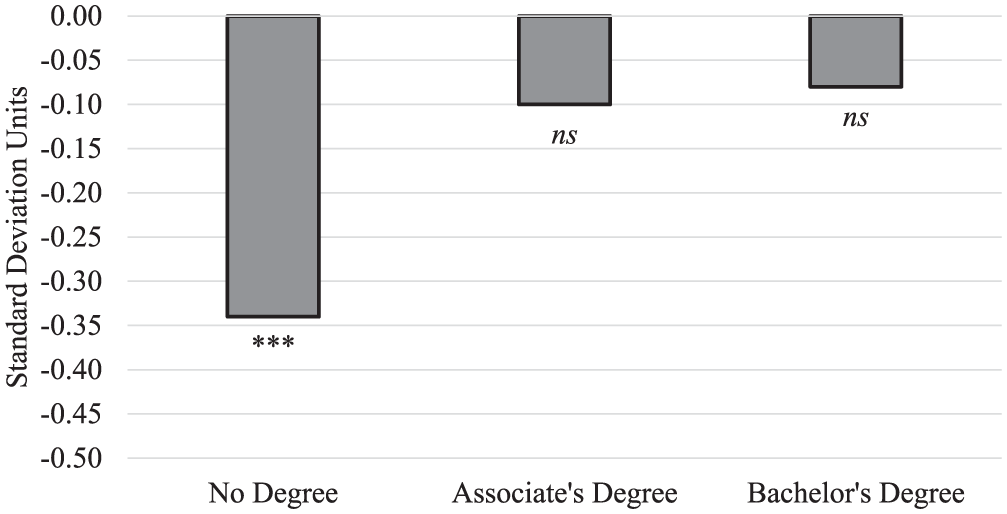
The associations of classroom age composition across different thresholds of teacher education for the literacy achievement of 4-year-olds in classrooms serving a low (0%) and high (45%) number of 3-year-olds.
Discussion
Mixed-age classrooms are common in preschool; in this national sample of Head Start programs, roughly three-quarters of classrooms had both 3- and 4-year-old children. Although we know that children’s classroom composition shapes their development (e.g., Henry & Rickman, 2007; Justice et al., 2014; Mashburn et al., 2009), we know relatively little about how other classroom characteristics influence these dynamics. In this study, we examined these complex relations and documented how the influence of the age of classroom peers varied based on children’s own age along with classroom quality and teachers’ education and experience. Our findings shed light on important ways in which interactions across classroom features influence children’s academic development and have important implications for understanding the conditions under which classroom age composition matters most. We discuss the take-home messages of our work in the following.
Age Composition and Classroom Quality
In our first set of analyses, we sought to understand how observed classroom quality moderates the influence of age composition on children’s early learning and development. Although there was a significant interaction between age composition and classroom quality, the influence was not consistent with our hypothesis. Specifically, we found that when a classroom had a relatively high proportion of 3-year-olds (45% or higher), 4-year-olds’ academic gains were smaller, even when the observed classroom quality was high. Higher classroom quality was associated with greater academic gains among 4-year-olds but only when there were no 3-year-olds in the classroom. Put another way, the influence of mixed-age classrooms on 4-year-olds was not buffered by classroom quality in this sample. Importantly, age composition had no influence on 3-year-olds’ academic gains regardless of classroom quality.
Although our hypothesis focused on the overall quality of children’s classrooms, we found similar patterns of findings when looking at the specific dimensions of the CLASS, which captured Emotional Support, Classroom Organization, and Instructional Support. Thus, our findings were not attributed to any one dimension of the classroom environment but rather, appear to be a function of overall classroom quality. Additionally, we examined quadratic and threshold specifications of the CLASS and found no evidence of direct or moderated nonlinear relations. The only other study we are aware of that examined interactions between classroom quality and age composition found that high scores on behavior management were associated with greater gains in children’s vocabulary skills when children were in mixed-age classrooms (Guo et al., 2014). However, this study only examined one dimension of the CLASS and was fairly small, so it is difficult to know whether this finding was specific to behavior management or if other aspects of classroom quality would show the same effect.
Although age composition influences overshadowed those related to classroom quality, there are important takeaway messages specific to these findings. First, and similar to other emerging studies in the educational literature (Keys et al., 2013; McCoy, Connors, Morris, Yoshikawa, & Friedman-Krauss, 2015; Weiland, Ulvestad, Sachs, & Yoshikawa, 2013), we found only small and either marginal or nonsignificant relations between the quality of teacher-child interactions and children’s academic and behavioral outcomes for both age cohorts. As recently summarized by Burchinal (2017), evidence suggests that associations between the CLASS and children’s outcomes are modest and may be due to measurement challenges; although CLASS observers often score within one point of another, they rarely get closer (or an exact match), which is problematic because the standard deviation of the CLASS is often 0.50 points, which means that even small differences between raters are quite meaningful in terms of CLASS scores. Second, our results also indicate that the influence of quality only significantly influenced 4-year-olds when there were no 3-year-olds in the classroom. Thus, future research should focus on understanding whether relations between quality and children’s development are stronger in same-age, as opposed to mixed-age, classrooms.
Age Composition and Teachers’ Education and Experience
Next, we found that teacher education but not experience buffered the negative association between age composition and 4-years-olds’ literacy gains. When teachers had an associate’s or bachelor’s degree, there was no significant association between mixed-age classrooms and 4-year-olds’ language and literacy skills. This suggests that education programs may provide teachers with skills and strategies that allow them to construct a classroom environment that is appropriate for both 3- and 4-year-olds. It is important to note that our classroom quality findings suggest that it is not the case that teachers with higher levels of education simply create higher quality classrooms and these buffer the influence of age composition. Future research should thus focus on understanding what specific skills and behaviors these higher educated teachers use that lead to more positive outcomes for 4-year-olds in mixed-age classrooms. For example, teachers may be relying on different grouping strategies within the classroom or using more differentiated literacy instruction techniques, which prior research suggests facilitates children’s early language and literacy development in the classroom (Connor, Morrison, Fishman, Schatschneider, & Underwood, 2007; McCoach, O’Connell, & Levitt, 2006).
From a practical perspective, this teacher education finding suggests that center directors should consider assigning their more highly educated teachers to the mixed-age classrooms at their center. Starting in 2013, the Head Start program has required that 50% of classroom teachers at each Head Start center have a bachelor’s or associate’s degree with either educational or work background in early childhood (Office of Head Start, 2008). In light of our findings and the fact that over 75% of Head Start classrooms are mixed-age, it is likely that this requirement (which was implemented after data in the paper were collected) will have positive influences on 4-year-olds in the Head Start program. Given these changes in policy, it is also of note that teacher experience did not show any moderating effects. This is in line with past research that has found teacher experience to be unrelated to both classroom quality (Pianta et al., 2005) and young children’s early learning (Croninger, Rice, Rathbun, & Nishio, 2007) and suggests that direct instruction to teachers may be critical to reducing the potential detrimental influences of mixed-age classrooms in the future.
When taken together, our results reveal that the previously documented negative influence of mixed-age classrooms on 4-year-olds’ literacy growth (Ansari et al., 2016) is not always present. The fact that higher teacher education but not teacher experience or observed classroom quality mitigates much of the negative influence of mixed-age classrooms on literacy is promising and suggests that more educated teachers are better able to structure their classroom environments in ways that are more beneficial to the older children in the classroom. For example, they may be more likely to assign the older children more complex roles in a group activity. Similarly, they may be better equipped to scaffold material to the wider range of skills present in mixed-age classrooms. Despite these promising findings, it is important to acknowledge that the same buffering pattern did not emerge for children’s math achievement; that is, 4-year-olds in classrooms with a greater number of younger classmates continued to make fewer gains in math regardless of their teachers’ qualifications. For these reasons, future research should explore other classroom and teacher characteristics that can reduce the influence of age composition on math development specifically and provide deeper insight into what can be done to boost children’s early math achievement in these types of classrooms. One potential explanation for these differences in our findings is that math is less often a focus in preschool classrooms as compared with language and literacy (Early et al., 2010). If a classroom has less math content or activities, then the few opportunities that are available might not be aligned with children’s individual needs, whereas the more frequent opportunities to practice language and literacy allows more educated teachers more opportunities to expose children to a broader range of content that might better be aligned with the needs of children of different ages.
Limitations and Conclusions
With the aforementioned contributions in mind, it is important to acknowledge that none of our focal interactions were associated with changes in children’s problem behaviors or social skills. This may be due to the fact that the magnitude of differences across age cohorts was larger for children’s academic skills (50%–85% of a standard deviation) compared with their social-behavioral skills (20%–40% of a standard deviation). Because of this similarity, it makes sense that age composition would not be a driver of children’s behavioral development, even when interacted with other classroom factors. Likewise, prior research has shown that young children’s academic skills are affected more by early care and education programs than their social behaviors (Forry, Davis, & Welti, 2013; Puma et al., 2010; Winsler et al., 2008). This may contribute to both the lack of significant interactions as well as the scant direct associations between classroom factors and children’s social behaviors. Nonetheless, these social-behavior measures are limited because they were based on teacher report and might not have captured behaviors most likely to be influenced by age composition. Thus, future work should incorporate more specific behavioral measures thought to be influenced by peers, such as empathy and leadership, and should rely on stronger measures that can better capture change in these behaviors.
Another primary limitation of our current work is that we cannot examine the specific practices that likely play a large role in determining whether mixed-age classrooms are settings that foster positive development for 3- and 4-year-old children. In addition to specific practices, it is also plausible that age composition operates quite differently when implemented in conjunction with different types of curricula. However, the current data do not allow us to test this hypothesis. Additionally, because of the nonexperimental nature of our study, we cannot rule out the possibility of alternative explanations. In particular, future studies should consider how teachers are assigned to classrooms of different ages to address potential selection bias. Lastly, our measure of age composition was based on teacher report as administrative report is not available in any existing national data set and the measure focuses on age in years, as opposed to months. Despite these limitations, our study is one of the first to examine the conditions under which mixed-age classrooms are associated with children’s early learning and development in Head Start programs across the nation. Given the high prevalence of mixed-age classrooms in the United States, this study represents a critical first step to understanding the factors that can be put into place to ensure that exposure to peers of different ages is a positive experience for all preschool-age children.
Footnotes
Acknowledgements
This research was supported by a grant from the American Educational Research Association, which receives funds for its AERA Grants Program from the National Science Foundation under NSF Grant No. DRL-0941014 and the Institute of Education Sciences, U.S. Department of Education (R305B130013, University of Virginia). Opinions reflect those of the author(s) and do not necessarily reflect those of the granting agencies.