




Abstract
College access programs (CAPs) aim to promote college readiness for adolescents, particularly those who may be the first in their family to go to college. Self-regulated learning is a critical component of college readiness. There is limited information about how self-regulated learning beliefs or intentions influence adolescent engagement in CAPs. Using the theory of planned behavior as a guiding framework, the purpose of this study was to examine direct and indirect effects of adolescent self-regulated learning beliefs (i.e., attitudes, norms, and perceived behavioral control) and intentions on participation in activities offered by a regional, federally funded CAP program (Gaining Early Awareness and Readiness for Undergraduate Programs; GEAR UP). Structural equation modeling was the analytic technique. We found positive relationships between self-regulated learning beliefs (perceived behavioral control), intentions, and GEAR UP participation. Implications and directions for future research on self-regulated learning within the context of CAP initiatives are discussed.
Keywords
Given the noted benefits of GEAR UP and other CAPs for adolescent participants, it is useful to determine mechanisms that contribute to programmatic success. One underlying mechanism hypothesized to contribute to variability in college readiness among adolescents is self-regulated learning. Self-regulated learning is an individual’s ability and motivation to self-monitor and control emotions, thoughts, and actions to attain one’s goals (Pintrich & De Groot, 1990; Ramdass & Zimmerman, 2011). Highly skilled self-regulated learners display many skills such as effective goal setting, implementing learning strategies, monitoring and assessing goal progress, seeking assistance when needed, expending more effort and persistence for learning, and setting new goals when prior goals are accomplished (Zimmerman & Schunk, 2008). These skills are seen as key indicators of college readiness (Conley, 2008, 2013). Students are taught elements of self-regulated learning at an early age, and by high school, they are expected to have a firm grasp on these skills (Ramdass & Zimmerman, 2011). Prior research has investigated the role of motivation, self-efficacy, and goal setting in self-regulated learning among adolescents (Nicol & Macfarlane-Dick, 2006; Pajares, 2008) and its effect on school engagement (Wang & Eccles, 2012). However, studies on self-regulated learning and its facilitation of CAP participation are scarce in the literature.
The purpose of this study is to examine relationships between middle and high school students’ self-regulated learning beliefs and intentions and their involvement in activities offered by a CAP (GEAR UP). The theory of planned behavior (TPB) provides the theoretical foundation for this work. TPB is a conceptual model that identifies behavioral attitudes, subjective norms, perceived behavioral control, and intentions as critical determinants of behavior engagement (Ajzen, 1991). Given the limited knowledge in this area of scholarship, we take an exploratory approach to answer the following research questions:
Research Question 1: What is the relationship between adolescent self-regulated learning behavioral beliefs (i.e., attitudes, norms, and perceived behavioral control) and student self-regulated learning intentions?
Research Question 2: Subsequently, what is the relationship between adolescent self-regulated learning beliefs and participation in GEAR UP?
Research Question 3: What is the relationship between self-regulated learning intentions and adolescent participation in GEAR UP?
Research Question 4: Do intentions serve as a mediator in the relationship between self-regulated learning attitudes, norms, perceived behavioral control, and adolescent participation in GEAR UP?
Literature Review
Effects of GEAR UP Participation on Academic Preparation and Achievement
GEAR UP programs provide students with access to activities, experiences, and people that can increase their college readiness and improve their chances of college enrollment, retention, and completion. Activities such as personalized mentoring and support, financial aid and scholarship assistance, provision of knowledge about the college experience through campus visitations, and college application assistance are essential components of GEAR UP programs (Perna, 2002; Sanchez, Lowman, & Hill, 2016; St. John, 2004; St. John, Fisher, Lee, Daun-Barnett, & Williams, 2008; St. John, Musoba, Simmons, Chung, & Schmit, 2004; St. John & Trent, 2008). Studies have found participation in CAPs provides students with access to college-bound courses and support from teachers, counselors, and college access program personnel during the college application process (Sedlacek & Sheu, 2006; St. John, Hu, & Fisher, 2011; St. John, Paulsen, & Starkey, 1996).
Other studies have investigated relationships between student GEAR UP participation and academic preparation. Beer, LeBlanc, and Miller (2008) found significant increases in GEAR UP student motivation, academic and study skills, and critical thinking skills pre- and postintervention. Likewise, Cates and Schaefle (2011) found positive relationships between student participation in GEAR UP advising and tutoring activities and the number of college preparatory courses completed. In the same study, student participation in advising and college campus visitation activities was associated with taking the PSAT during sophomore and junior years. Prior studies have found GEAR UP participants can gain experiences that increased their college aspirations and knowledge about the financial aid and college application process (Perna, Rowan-Kenyon, Bell, Thomas, & Li, 2008; Rowan-Kenyon, Bell, & Perna, 2008; Watt, Huerta, & Lozano, 2007).
In addition, a number of studies have documented that CAP participation leads to higher academic achievement and improved college entrance exam scores (ACT or SAT) (Beer et al., 2008; Morgan, Sinatra, & Eschenauer, 2015; Naraian, Brown, & Navarro, 2011; Watt et al., 2007; Yampolskaya, Massey, & Greenbaum, 2006). For example, Cabrera et al. (2006) found that sixth-grade students attending schools with no GEAR UP program reported higher reading achievement than students in schools with a GEAR UP program. However, Cabrera and colleagues found no significant differences in reading performance by the end of the seventh grade after GEAR UP implementation. The study findings regarding math achievement also support the positive impact of GEAR UP, with seventh-grade students enrolled at GEAR UP schools having higher math achievement compared to students in non–GEAR UP schools (no observed differences at baseline). Bausmith and France (2012) evaluated the impact of GEAR UP on student college readiness outcomes such as performance on preliminary scholastic aptitude tests (PSAT) and scholastic aptitude tests (SAT). They found significant increases in PSAT and SAT scoring from baseline (before program implementation) to up to three years after program implementation when comparing GEAR UP and non–GEAR UP schools.
Effects of College Readiness Skills and Behaviors on GEAR UP Participation
Past research has described the positive impact of GEAR UP participation on student academic achievement, academic skill development, and academic preparation. However, there is little knowledge about how college readiness skills and behaviors such as self-regulated learning influence the extent to which students utilize programs and services offered by GEAR UP. This study adds to the literature by examining GEAR UP participation as dosage, or a quantitative measure of the amount of programming received by participants in an intervention (Durlak & DuPre, 2008; Dusenbury, 2003). Durlak and DuPre (2008) completed a review of studies examining the effects of program implementation on outcomes. The meta-analysis reported that in 45 of 59 (76%) studies, the dosage level had a significant and positive relationship with at least half of all program outcomes.
Student participation in GEAR UP varies in frequency and quality due to its multiprogram design and reliance on voluntary involvement. GEAR UP provides programs during the school day, after school, on weekends, and during the summer. These programs range in duration from one session to extending over weeks or months (Swail & Perna, 2002). Shorter programs or events tend to focus on awareness and information sharing, whereas more extensive programs can spend more time on skill development. Greater dosage reflects students who have made a conscious decision to engage more with the GEAR UP program; therefore, it is essential to understand the factors that relate to a student’s decision to participate in GEAR UP (Perna, 2002; Swail, 2000).
Self-regulated learning and its influence on participation in GEAR UP programs are underexplored in existing literature. To address this void in knowledge, we assess the extent to which students’ beliefs and motivation to perform self-regulated learning strategies affect student overall time spent in formal activities offered by a GEAR UP program (i.e., dosage). Examination of participation as a dosage construct is also helpful for capturing variability in student engagement. This approach is useful for understanding which students are more likely to take advantage of the services provided by GEAR UP programs (i.e., take-up rates) and pointedly, whether student motivation for self-regulated learning affects the degree to which they take advantage of resources offered by GEAR UP. A nuanced understanding of intervention take-up helps determine if program participation fulfills unmet student needs.
College Readiness, Self-Regulated Learning, and GEAR UP Participation
Conley (2008, 2013) offers a developmental and behavioral perspective of college readiness. He postulates newly enrolled college students must possess and master skills in four areas to thrive on college campuses and avoid having to take remediation courses: (a) key cognitive strategies, (b) key content knowledge, (c) academic behaviors, and (d) contextual skills and awareness. Academic behaviors are of interest given the scope of this study. Students are considered to be college ready if they engage in academic behaviors in which they exhibit ownership for their learning and engage in strategies that promote their learning by monitoring, assessing, and evaluating their mastery over a subject area.
Likewise, self-regulated learning is an academic behavior that enables students to be attuned to and control their emotions, thoughts, and actions (Ramdass & Zimmerman, 2011). Highly effective self-regulated learners set goals, monitor and assess goal progress, set new goals, implement learning strategies, seek assistance, and expend more effort and persistence for learning (Zimmerman & Schunk, 2008). Self-regulated learning is an implicit programmatic focus of some CAPs. Self-regulated learning is a vital indicator of college readiness and a proximal behavior that enhances academic achievement (Mega, Ronconi, & De Beni, 2014; Pintrich, 2004) and an underlying component of individual autonomy, a known determinant of college success (Conley, 2013; Conley & French, 2014).
Research has consistently found that students who effectively self-regulate their learning are more likely to obtain high academic achievement in high school and college (Pintrich, 2004; Pintrich & De Groot, 1990; Zimmerman & Schunk, 2012). Self-regulated learning can also help college students balance emotions associated with learning and academic achievement. Mega et al. (2014) found self-regulated learning to mediate the relationship between emotional regulation and academic achievement among undergraduate students. Wolters and Hussain (2015) found self-regulated learning mediated the relationship between individual perseverance of effort (i.e., grit) and academic achievement among college students. In their study on the effects of completing a self-regulated learning course on college persistence, Bail, Zhang, and Tachiyama (2008) found course participants had significantly higher cumulative GPA four semesters after course enrollment than students not enrolled in the course. Additionally, Bail et al. found students enrolled in the self-regulated learning course were 13 times more likely to graduate from their institution than students in the comparison group.
These studies show that self-regulated learning promotes essential developmental and educational outcomes for students; however, research has not examined the relationship between self-regulated learning and CAP participation. This link can provide a nuanced understanding of factors that motivate students to have agency over engaging in metacognitive strategies and the extent to which they participate in programs intended to promote college readiness (Tanner, 2012). It is possible that students’ attitudes and beliefs around self-regulated learning influence engagement in CAP activities meant to develop such skills. Students may be more likely to participate in CAP activities if they perceive themselves as possessing abilities associated with a program activity. For instance, a student who is a high self-regulated learner may see GEAR UP as resource that cannot meet their learning needs. On the contrary, a low self-regulated learner may view GEAR UP as a resource that is disconnected from their personal or school experiences and choose to not engage in program activities. Understanding these connections can help CAPs shape their recruitment practices, selection of students, and program implementation.
The Theory of Planned Behavior
The theory of planned of behavior, a framework that posits intentions to be a key determinant of individual behavioral engagement, informed our study (Fishbein & Ajzen, 2010). Additionally, behavioral attitudes, subjective norms, and perceived behavioral control are determinants of intentions (Ajzen, 1991, 2005; Fishbein & Ajzen, 2010). This theoretical framework is often used to study health and voting behaviors (Albarracín, Johnson, Fishbein, & Muellerleile, 2001; Fishbein & Ajzen, 2010; Godin & Kok, 1996; Netemeyer & Burton, 1990; Netemeyer, Burton, & Johnston, 1991; Noonan, Kulbok, & Yan, 2011). This framework, however, has rarely been used to study behaviors that promote college readiness in education research.
According to the theory, behavioral attitudes are developed based on a person’s assessment of whether performing a behavior produces negative or positive consequences. This assessment is assumed to influence an individual’s affect toward and evaluation of (e.g., favorable vs. unfavorable) the behavior (Ajzen & Fishbein, 1980; Fishbein & Ajzen, 2010). Individuals who hold positive attitudes believe performing a behavior will produce favorable emotional responses, outcomes, or experiences. Thus, a person with favorable behavioral attitudes is more likely to form intentions to perform a behavior.
An individual’s perceived expectation of another person’s assessment of engaging in behavior is known as subjective norms. Subjective norms are a person’s evaluation of whether other individuals think they should or should not perform the behavior in question. Behavioral standards are formed based on a person’s understanding of whether others believe specific actions are right or wrong—or their normative beliefs. Motivation to comply, or the degree to which a person values the opinions and behavioral expectations of others, is a subdimension of subjective norms (Ajzen & Fishbein, 1980). It is assumed that a person will be more likely to form intentions to engage in behaviors if they are willing to comply with the perceived behavioral expectations of individuals viewed as important in his or her life.
Perceived behavioral control (PBC) is a person’s assessment of their perceived capability to engage in behaviors (Ajzen, 1991). An individual has to evaluate the ease or difficulty of performing actions required to produce outcomes based on available information, skills, and other resources available (Fishbein & Ajzen, 2010). PBC is critical for behavioral engagement for two reasons. First, the amount of effort one expends toward engaging in behavior is likely to increase with PBC. Second, it is considered a proxy for conditional factors that are beyond an individual’s control over whether or not the perceptions being measured to observe behavioral engagement are accurate (Ajzen, 1991). Therefore, the theory assumes that greater perceived behavioral control leads to a stronger effect on the intention-behavior relationship.
Intentions are a person’s plan and readiness to engage in a behavior and are affected by volition and effort (Ajzen, 1991). TPB considers that a person’s ability to perform actions is not always under their complete volitional control. TPB assumes that the stronger one’s behavioral plans, he or she is more likely engage in that behavior. Intentions are also believed to be stronger if a person has a more favorable attitude, their performance complies with the perceived behavioral norms of others, and the individual has a high degree of perceived behavioral control over the behavior (Fishbein & Ajzen, 2010).
Some behaviors may depend on nonmotivational factors such as the availability of resources and information. Therefore, if a person believes they have information and resources available to them to engage in behaviors that produce expected consequences, he or she or will be more likely to form behavioral intentions and translate them into actual behavioral performance (Ajzen, 1991). Behavioral plans are expected to increase their influence on behavioral performance to the extent that (a) a person has actual control to perform the behavior and (b) he or she is motivated to try (i.e., effort) (Ajzen, 1991).
Within the context of this study, we present the theory of planned behavior as a theoretical framework that can simultaneously specify and explain self-regulated learning as a key developmental characteristic essential for understanding college readiness among adolescents in CAPs. Our conceptual framework in Figure 1 illustrates relationships that factor into this study’s main research question.

Conceptual model examining effects of self-regulated learning beliefs and intentions on student participation in Gaining Early Awareness and Readiness for Undergraduate Programs (GEAR UP) activities.
In this study, attitudes are student feelings, thoughts, and actions about engaging in self-regulated learning. Attitudes is a value construct that reflects student affect and evaluation of engaging in self-regulated learning behavior. Subjective norms consist of students’ normative beliefs and motivation to comply with the norms they perceive significant others to hold about self-regulated learning. Normative beliefs are student perceptions of the expectations of others regarding their engagement in self-regulated learning behaviors. Motivation to comply is the likelihood that students will comply with the behavioral expectations of persons who may be influential in their learning, such as teachers, counselors, parents, and peers. Subjective norms are assumed to influence behavioral intentions, which in turn influence students’ participation in GEAR UP activities.
Perceived behavioral control is a student’s perceived capability to perform self-regulated learning behaviors. There is a relationship between PBC and participation in GEAR UP activities, and behavioral intentions are assumed to mediate this relationship. This path tests the possible connection between student self-efficacy and having control over performing self-regulated learning strategies and the degree to which students participate in GEAR UP activities. A motivational concept, intentions are the degree to which a student plans and is willing to engage in self-regulated learning. Intentions are posited to be a determinant of participation in GEAR UP activities. Finally, student intentions to engage in self-regulated learning may shape their perceptions of the consequences of participating in GEAR UP activities.
TPB is a theoretical framework that can provide a robust understanding of students’ perceived capability to perform self-regulated learning behaviors that facilitate college readiness. Also, it can investigate students’ affect and evaluation of performing self-regulated learning behaviors, their perceived expectations of others about performing self-regulated learning behaviors, and agency to be capable self-regulated learners and participate in intervention activities designed to enhance college readiness. Moreover, this framework can account for student experiences with barriers and opportunities that can affect these psychological processes in their pursuit of college readiness and college admission.
Methodology
Participants
GEAR UP is a federal college access grant that funds programs at higher education institutions to provide activities to cohorts of students in middle schools and high schools starting in seventh grade and continuing through their first year of college. Our study was conducted in middle schools and high schools that participated in a GEAR UP program housed at a Midwestern university. Eighth- and ninth-grade students completed a baseline survey (n = 118) and a follow-up survey (n = 96) during an academic semester. Table 1 displays the demographic characteristics of our sample. A higher proportion of students reported being African American, female, having an estimated family income of less than $40,000, and their mother having attained a bachelor’s degree or higher more often than fathers.
Study Sample Demographic Background Characteristics

Note. The information in the table was reported by study participants,
Study Design and Procedures
A nonexperimental panel survey design was executed to investigate this study’s research questions (Babbie, 1990, 2010). We administered baseline and follow-up surveys at the beginning and end of an academic trimester. Questionnaires were distributed to different students in three separate waves when the program’s cohort was in the eighth grade and concluded at the end of their ninth-grade year (spring 2013–winter 2014). For instance, Wave 1 surveys were administered and completed by 67 students in spring 2013 trimester. Wave 2 questionnaires were distributed and completed by 22 students in fall 2013 trimester. Finally, Wave 3 surveys were administered and completed by 29 students in winter 2014 trimester. One hundred and eighteen students completed the baseline survey, and 96 students completed the follow-up survey. School and district leadership at each GEAR UP school were contacted and presented with information about the study to obtain permission to conduct the study in person and on the school premises. Of the five eligible GEAR UP schools, two agreed to have data collection occur on site.
The GEAR UP director emailed recruitment letters to parents, and students were contacted by an email listserv. To reach parents not on the email listserv, arrangements were made with school personnel to recruit students in person (e.g., in classrooms, at assemblies) at the two schools. Potential study participants received a packet containing a parental consent form to take home for a parent/guardian to review and sign and were instructed to return it to a specified location on the school premises. To reach students in remaining GEAR UP schools, recruitment emails were sent to students (via listserv) and parents of students who participated in a GEAR UP summer program. Reminders about parental consent were emailed to parents using Qualtrics online survey software, through which parents provided consent and current contact information. The challenges of receiving buy-in from all GEAR UP schools resulted in an uneven sampling of students, with the majority of study participants attending a single school district (n = 96). Given these challenges as well as the characteristics of our sampling frame, data analysis and reported results are based on a subsample of students who attended this GEAR UP school. Of these students, 67 were in the eighth grade, and 29 were in ninth grade. We report data from the baseline survey data because the primary aim of this study was to understand whether self-regulated learning beliefs influenced students’ future participation in GEAR UP activities.
Measurement
Self-regulated learning was measured using items from the Academic Self-Efficacy for Self-Regulated Learning Scale (ASE-SRL) (Zimmerman, Bandura, & Martinez-Pons, 1992). The ASE-SRL scale was originally designed to assess eighth- and ninth-grade students’ perceived capability to develop and use a variety of SRL strategies such as planning and organizing academic activities, transforming instructional information using cognitive strategies to understand and remember class material, resisting distractions, and classroom participation.
Items from the ASE-SRL scale were adapted to reflect constructs in the theory of planned behavior given the importance of self-regulated learning in supporting student college readiness (Conley, 2008). Table 2 displays how 11 items from the ASE-SRL scale were adapted to represent students’ self-regulated learning attitudes, subjective norms, perceived behavioral control, and intentions. Table 3 shows overall means and standard deviations of SRL attitudes, subjective norms, perceived behavioral control, and intentions.
Self-Regulated Learning Behavior Questionnaire Items

Note. SRL = self-regulated learning; TC = teachers/counselors; PG = parent/guardian; CF = close friends; GU = Gaining Early Awareness and Readiness for Undergraduate Programs (GEAR UP) staff; ATT = attitudes; SN = subjective norm; PBC = perceived behavioral control; INT = intentions.
Means and Standard Deviations of SRL Behavior Baseline Items

Note. SRL = self-regulated learning.
Items were reverse-coded.
Adapted ASE-SRL measures resulted in 44 items representing self-regulated learning attitudes. SRL-Attitudes examined student evaluation and affect toward performing self-regulated learning behaviors. Each item and its accompanying attitudinal component was measured on a 7-point semantic differential scale with four bipolar adjective pairings (bad–good; not important–important; stressful–stress free; boring–exciting). For example, an item measuring a self-regulated learning attitude was “This semester, finishing homework assignments before they are due will be . . . ” (1 = bad to 7 = good; 1 = not important to 7 = important; 1 = stressful to 7 = stress free; 1 = boring to 7 = exciting). Adjective pairing for each SRL item was not reverse-coded in our analysis. Thus, higher scores indicated a positive attitude toward an SRL strategy, and lower scores indicated a negative attitude toward an SRL strategy.
SRL-Subjective Norms examined dimensions of normative beliefs and motivation to comply. Each dimension of subjective norms was represented by adapted items from the ASE-SRL scale for a total of 22 items that were measured using a summative 5-point Likert scale (1 = strongly agree to 5 = strongly disagree). Students responded to subjective norms questions corresponding to their teachers/counselors, parent/guardian, and close friends. These individuals were included based on results from survey pretesting of items with a representative sample in which students were asked to list specific persons that were influential to their learning. Parents, teachers, counselors, friends, and GEAR-UP program staff were identified as common referents and included in the study survey. These measures were reverse-coded in our analysis so that higher scores indicated higher normative beliefs and motivation to comply.
Self-efficacy and control served as dimensions of SRL-Perceived Behavioral Control for performing self-regulated learning behaviors. Similar to our subjective norms construct, each dimension was represented by adapted questions from the ASE-SRL scale for a total 22 items. A 5-point summative Likert scale was used to measure control (1 = full control to 5 = absolutely no control) and self-efficacy (1 = extremely likely to 5 = extremely unlikely). These measures were reverse-coded in our analysis so that higher scores indicated higher control and self-efficacy. Finally, intentions were measured by 11 items representing student plans to engage in self-regulated learning behavior on a summative 5-point Likert scale (1 = definitely to 5 = definitely not). These measures were also reverse-coded in our analysis so that higher scores reflect higher intention to engage in an SRL strategy.
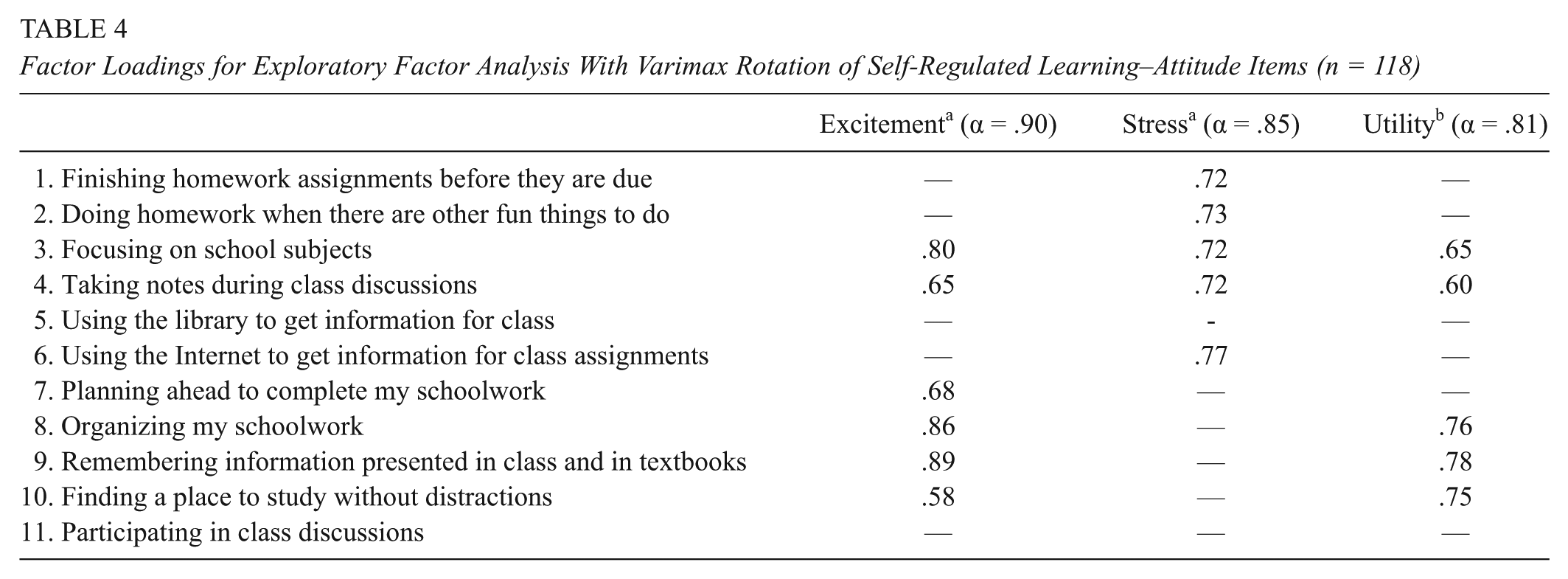
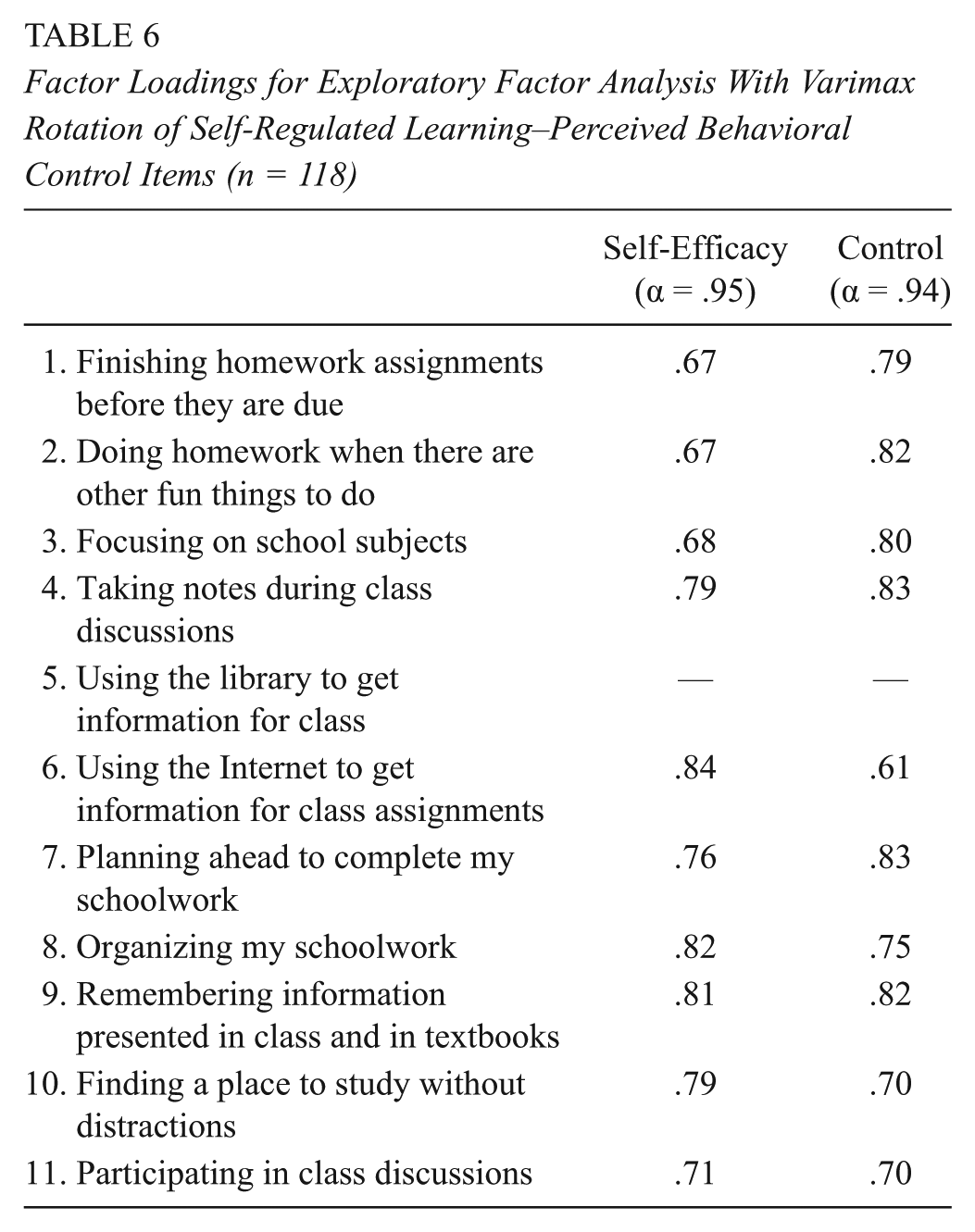
Given our sample size, exploratory factor analysis (EFA) was conducted to reduce the number of observed variables to be included in our measurement model. This strategy, known as isolated item parceling, allows for mean scores to each represent some other secondary factor (Hall, Snell, & Foust, 1999). Mean scores of each factor were computed for ease of interpretation in the study analysis and to regulate the number of parameters in our structural equation model. For instance, 10 factors emerged when 44 items were entered in our initial EFA assessing SRL-Attitudes. However, we had a strong prior theory that items representing these 10 factors were reflected by two subdimensions of SRL attitudes: affect and evaluation. Items that produced factor loadings less than .55 on these subdimensions were removed until a three-factor solution of utility, excitement, and stress was reached, and mean scores of these factors were computed. Factors of excitement and stress theoretically reflect the affective component of SRL attitudes, and utility reflects the evaluation component of SRL attitudes. This strategy was also performed for the subjective norms and perceived behavioral control latent constructs. Table 4 displays the observed items that were included in calculating factor mean scores of subdimensions (e.g., excitement, stress, and utility) of our attitude latent construct. Table 5 shows the observed items that were included in computing factor mean scores of subdimensions (e.g., normative beliefs and motivation to comply) with our subjective norm latent construct. Table 6 depicts the observed items that were included in computing factor mean scores of subdimensions (e.g., self-efficacy and control) of our perceived behavioral control latent construct.
Factor Loadings for Exploratory Factor Analysis With Varimax Rotation of Self-Regulated Learning–Attitude Items (n = 118)
Factor Loadings for Exploratory Factor Analysis With Varimax Rotation of Self-Regulated Learning–Subjective Norm Items (n =118)

Note. TC-NB = teacher counselor normative beliefs; TC-MC = teacher/counselor motivation to comply; PG-NB = parent/guardian normative belief; PG-MC = parent/guardian motivation to comply; CF-NB = close friend normative beliefs; CF-MC = close motivation to comply; GU-NB = Gaining Early Awareness and Readiness for Undergraduate Programs (GEAR UP) staff normative beliefs; GU-MC = GEAR UP staff motivation to comply.
Factor Loadings for Exploratory Factor Analysis With Varimax Rotation of Self-Regulated Learning–Perceived Behavioral Control Items (n = 118)
After, we performed confirmatory factor analysis (CFA) to assess whether these observed items represented self-regulated learning attitudes, subjective norms, and perceived behavioral control as latent constructs by examining their associations with each other when accounting for measurement error. Three observed variables were hypothesized to represent self-regulated learning behavior attitudes as a latent construct (utility, excitement, stress). Eight observed variables were hypothesized to serve as distinct dimensions of student subjective norms of self-regulated learning behavior as a latent construct: motivation to comply and perceived normative beliefs of each significant other referent. Two observed variables were hypothesized to represent student perceived behavioral control for self-regulated learning as a latent construct (control beliefs and efficacious beliefs).
Results for our hypothesized CFA model initially produced poor model fit. Modification indices suggested that adding five covariances to error terms on normative belief and motivation to comply observed variables among significant other referents. Given that GEAR UP is a school-based intervention where teachers and parents are at times involved in activities in classroom and community settings and each can be influential in the college readiness process (Conley, 2013; Perna & Kurban, 2013), these error terms were correlated. Table 7 displays the CFA parameter estimates measuring self-regulated learning attitudes, subjective norms, and perceived behavioral control as latent constructs (χ2/df = 1.51; Comparative Fit Index [CFI] = .96; root mean square error of approximation [RMSEA] = .07).
Modified CFA Coefficients of Self-Regulated Learning Observed and Latent Variables

Note. Standard errors for unstandardized estimates were calculated using bootstrapping; standard errors for standardized estimates are not provided by the statistical package when conducting CFA. CFA = confirmatory factor analysis; TC = teachers/counselors; PG = parent/guardian; CF = close friends; GU = Gaining Early Awareness and Readiness for Undergraduate Programs (GEAR UP) staff; β = standardized coefficient; SE = standard error of unstandardized coefficient; B = unstandardized coefficient.
p ≤ .001.
Significant relationships were found between the latent construct of self-regulated learning attitudes and its observed indicators of excitement, stress, and utility. The most reliable observed variable of self-regulated learning attitudes was excitement (β = 0.90). Likewise, motivation to comply and normative beliefs as observed variables of self-regulated learning for each significant other referent were significantly related to the subjective norms as a latent variable. The most reliable observed indicators of subjective norms were motivation to comply (β = 0.84) and normative beliefs (β = 0.89) of a parent or guardian. Finally, the relationship between the perceived behavioral control latent variable and self-efficacy observed variable was stronger than control beliefs for our sample (β = 1.01).
Table 8 displays GEAR UP participation, computed as the total time spent in activities provided by GEAR UP among the study sample during the study period. For each student, time in activity was measured by a decimal fraction. We computed the total number hours of participation to capture the maximum amount of student variation in time spent in GEAR UP activities. Student participation data were collected from sign-in sheets used to track student activity involvement. Students participated in campus visitation programs and in-school workshops during the study. The amount of time students participated in each activity was the metric used to measure participation as a continuous variable.
Average Time (Hours) Spent in GEAR UP Activities by Study Participants

Note. Sample size (N) reflects the number of cases used to compute mean participation. GEAR UP = Gaining Early Awareness and Readiness for Undergraduate Programs.
Gender, race and ethnicity, grade point average (GPA), and participation in free or reduced lunch were included as observed control variables in our analysis to see whether additional demographic characteristics explained student participation in GEAR UP activities aside from our primary variables of interest. Student participation in non-GEAR UP related school and community activities was included as a control variable. We included this variable to account for student involvement in activities that could influence the degree to which they participated in GEAR UP activities.
Power Analysis
This study was guided by Bentler and Chou’s (1987) recommended guidelines for determining sample size for our hypothesized structural equation modeling (SEM) model. Depending on model complexity, Bentler and Chou recommend 5 to 10 participants per parameter in a SEM to estimate a sample size that would yield significant parameter estimates. Given we had 31 parameters in our hypothesized SEM, we needed a sample size as low as 155 participants and as high as 310 participants to yield significant results. Sensitive to model complexity, this study also utilized MacCallum, Browne, and Sugawara’s (1996) ratio of degrees of freedom and sample size determination power analytic approach. We used a null hypothesis of close fit to determine if our implied SEM for self-regulated learning closely matched our observed data matrix (H0: εo ≤ .05). Sample size determination was calculated for a close fit power estimate of .80. Power analysis indicated that a sample size of 107 participants and a hypothesized SEM with 134 degrees of freedom was needed to achieve a close fit power estimate of .80.
Data Analysis
SEM was performed using the AMOS statistical package (Blunch, 2013) to examine direct and indirect effects of latent factors represented by observed variables for self-regulated learning beliefs and GEAR UP participation (Schumacker & Lomax, 1996). Figure 2 illustrates the hypothesized SEM for self-regulated learning analyzed for this study. Data analysis procedures of model specification, model identification, model estimation, evaluation of model fit, and model modification were performed. The hypothesized model assumed that intentions would partially mediate the relationship between self-regulated learning attitudes, subjective norms, perceived behavioral control, and student participation in GEAR UP activities. Analysis of our hypothesized model produced acceptable fit to observed data. However, parameter estimates of direct paths of attitudes and subjective norms on GEAR UP participation were not statistically significant. Model modification was conducted based on theoretical justification and modification indices. According to the theory of planned behavior, attitudes and subjective norms do not directly influence behavior. Thus, to align our modified SEM with this theoretical assumption, direct paths from attitudes and subjective norms were removed. Our reported results from the modified SEM are illustrated in Figure 3. Normality tests were conducted, and data were found to have a non-normal distribution. Bollen-Stine bootstrap sampling was performed to obtain more precise direct and indirect effect estimates and model fit with non-normal data (Kline, 2011). Expectation maximization (EM) algorithm was used to analyze missing data (Moon, 1996; Roth, 1994). Missing observations were imputed by predicted scores in a series of regressions where variables with missing data were regressed on available data for a particular case. The imputed data set was submitted to maximum likelihood estimation, where missing scores were computed based on parameters that were estimated during imputation over 25 iterations until a stable solution was reached.

Hypothesized structural equation modeling for self-regulated learning beliefs and intentions on GEAR UP participation.

Modified structural equation modeling for self-regulated learning and GEAR UP participation.
Results
Assessment of model fit indicates good fit was found between the implied self-regulated learning modified SEM and observed data (χ2/df = 1.34; CFI = .95; RMSEA = .06). Table 9 displays the standardized and unstandardized direct and indirect effect estimates. A positive direct effect was found between perceived behavioral control and self-regulated learning intentions (β = .42; p = .05). Likewise, a positive direct effect was observed between perceived behavioral control and GEAR UP participation (β = .32; p = .03). Direct effects of attitudes and subjective norms on intentions as well as intentions on GEAR UP participation were not statistically significant. Also, a direct effect of GPA on GEAR UP participation was statistically significant (β = .30; p ≤ .001). Indirect effects were estimated to test mediating relationships between antecedents of intentions and GEAR UP participation. Intentions, as an indirect effect on the relationship between perceived behavioral control and student participation in GEAR UP activities (β = −.09; p = .09), was statistically significant at a marginal level after controlling for demographic characteristics and participation in other school activities.
Self-Regulated Learning Effects on Intention and GEAR UP Participation

Note. GEAR UP = Gaining Early Awareness and Readiness for Undergraduate Programs; β = standardized coefficient; SE = standard error; B = unstandardized coefficient; GPA = grade point average; SES = socioeconomic status; PBC = perceived behavioral control.
p < .10. *p < .05. **p < .01. ***p < .001.
Discussion
Guided by the theory of planned behavior, we examined associations between self-regulated learning behavioral attitudes, subjective norms, perceived behavioral control, intentions, and participation in GEAR UP activities. From our modified SEM, we found perceived behavioral control directly influenced overall time students spent participating in GEAR UP activities in an academic semester. A direct effect was also observed between perceived behavioral control and self-regulated learning intentions. We also found intentions partially mediated the relationship between perceived behavioral control and GEAR UP participation.
These findings are significant because it suggests self-efficacy and control (as dimensions of perceived behavioral control) and motivation (i.e., intentions) to perform self-regulated learning behaviors as essential college readiness characteristics for explaining student utilization of activities offered by a college access program (i.e., take-up). The intention–perceived behavioral control relationship was strong and positive, suggesting that as adolescent self-regulated learning perceived behavior control increased, so did their intentions. Likewise, the perceived behavioral control–GEAR UP participation relationship was strong and positive, indicating that as adolescents’ perceived behavioral control increased, so did their participation in GEAR UP activities. In contrast, the relationship between perceived behavioral control and GEAR UP participation was negative when introducing intentions as an intervening variable. This suggests that planning to engage in self-regulated learning negatively influenced the relationship between perceived behavioral control and participation in GEAR UP.
These relationships complement existing research on factors that hinder and encourage learning among GEAR UP participants. For example, Jackson and Nutini (2002) found negative social support, community violence, and perceived experiences with racism and discrimination as impediments to GEAR UP student learning and contributors to low self-efficacy in math-related academic performance. In contrast, critical strengths and resources supporting student learning included family support for higher education attainment and achievement, high self-efficacy to cope with discrimination and regulate stress, and positive peer relationships. Our study findings provide insight into factors that can promote college access program participation in spite of the learning challenges observed in GEAR UP participant populations.
Indirect effects of subjective norms and attitudes on GEAR UP participation were not statistically significant. This may be due in part to the SEM modification process where direct paths from attitudes and subjective norms to GEAR UP participation were removed to better align our model with theoretical assumptions of TPB. Moreover, with self-regulated learning conceptualized as an individual skill, it may be difficult for parents, teachers, peers, or GEAR UP staff to convey self-regulated learning as normative behavior for students to interpret and use. Likewise, student self-regulated learning attitudes may not influence intentions or overall participation in GEAR UP activities because they may already have established emotional and evaluative orientations toward self-regulated learning based on prior experiences or outcomes from performing self-regulated learning behaviors.
We found an association between student grade point average and the time students spent participating in GEAR UP activities. This finding and our study’s focus on self-regulated learning in a predominately African American adolescent sample complements previous research by examining these relationships within the context of a CAP focused on improving college readiness. Prior studies have found self-efficacy and self-regulated learning to be critical in explaining academic achievement. Wang and Eccles (2012) discovered a decline in self-regulated learning among study participants from 7th grade to 12th grade, and this decrease was significantly related to reductions in GPA and school engagement. The authors concluded that students were more likely to academically succeed if they attended classes regularly, participated in class discussions, and performed self-regulated learning strategies to help themselves comprehend course material. Our study adds to this knowledge, demonstrating that GPA is an important characteristic to consider when seeking to understand participation in formal activities offered by a CAP.
Study results also show that adolescents from racial/ethnic and low-income backgrounds in our study believe they are highly capable of engaging in self-regulated learning and are academically successful. Our results are corroborated by studies examining significant differences in self-efficacy and self-regulated learning among students of racially and ethnically diverse backgrounds. Fong, Zientek, Yetkiner Ozel, and Phelps (2015) found African American students reported higher self-efficacy in self-regulated learning strategies than White and Hispanic students regardless of course grades. Additionally, high self-efficacy to perform self-regulated learning behavior predicted higher grades for White study participants, whereas high self-efficacy was associated with lower grades among Hispanic and African American students. Similarly, Matthews, Banerjee, and Lauermann (2014) investigated whether self-regulated learning mediated two dimensions of academic identity and mastery orientation for learning and if self-efficacy moderated this relationship. They found that self-regulated learning partially mediated the relationship between value and school belonging as dimensions of academic identity and mastery learning orientation. They also found academic self-efficacy was a significant moderator in these associations and it marginally moderated the relationship between belonging and self-regulated learning. Similarly, we observed in our study that self-efficacy and motivation play an essential role in self-regulated learning as a partial indirect effect on participation in college readiness activities offered by a CAP.
Overall, these results show that participation in GEAR UP activities was higher for study participants who were achieving academically and if they believed they were capable of performing self-regulated learning strategies. A vital contribution of this study lies in documenting associations between adolescent self-regulated learning and college readiness activity participation. Our findings indicate that self-regulated learning is a characteristic GEAR UP and other CAPs should consider when supporting student development and seek to understand the extent to which students take advantage of formal program activities.
Limitations and Directions for Future Research
Our study was limited in its ability to generalize findings to the broader GEAR UP student population due to our small sample size. In SEM, having a small sample size affects the asymptotic properties of estimates and goodness-of-fit tests (Fan, Thompson, & Wang, 1999). Although our SEM was less complex, sample size and power were issues in our study. Along with Quintana and Maxwell (1999), we recommend conducting future studies with a sample size of at least 200 participants. Having a larger sample size would have enhanced the precision of our covariances and our ability to generalize results to the GEAR UP population. Additionally, the convenience sampling technique used within a single GEAR UP program also limited our ability to generalize our findings. Despite our study’s attempts to assess self-regulated learning at multiple schools, we encountered obstacles in receiving buy-in from all of the schools working with GEAR UP at the time of the study, and this affected our ability to achieve a larger sample size. This challenge shows the importance of developing sound partnerships between schools, CAPs, and researchers when conducting applied research studies. Future studies should consider incorporating random sampling techniques and advanced quasi-experimental designs to assess treatment effects among participants in GEAR UP programs further.
Another drawback of our study is viewing participation as a continuous dosage variable of total time spent in GEAR UP activities. Assessing student participation in this manner treats all GEAR UP programming equally. Students may value certain types of GEAR UP program offerings differently depending on how the programs meet their personal and academic needs. Thus, future studies should explore relationships between self-regulated learning and particular types of GEAR UP activities students tend to gravitate toward. Assessing GEAR UP participation dosage as a categorical or continuous variable when examining its impact on student self-regulated learning would also be a useful area of future work.
A final limitation of our study is our inability to account for school personnel beliefs and expectations of students. With GEAR UP being an intervention dedicated to developing partnerships with schools and their personnel, school personnel perceptions of students as self-regulated learners may influence their willingness and availability to work with GEAR UP professional staff to provide programs and workshops to students at differing levels of achievement. Moreover, depending on their assessment of the academic and personal needs of their students, school administrators and teachers may use professional and individual judgment to assess which students would benefit most from receiving college readiness activities and pay particular attention to encouraging those students to participate in activities. Future studies should consider how teacher, parent, and peer expectations of students’ potential to be capable learners influence their support and sponsorship of students to take advantage of interventions designed to promote college readiness. This information could elucidate additional factors that drive participation in interventions beyond an adolescent’s volition and challenge how CAPs are structured and implemented in school settings to support students as self-regulated learners.
Conclusion
Despite these drawbacks, our exploratory study revealed that adolescent self-efficacy and control over performing self-regulated learning behaviors at baseline affected the time students spent participating in formal activities offered by a GEAR UP program. This knowledge contributes to ongoing research concerning how CAPs can support the college readiness and college pathways of their participants. We initially show self-regulated learning is a developmental characteristic embodied by adolescents and associates with whether students take up resources offered by CAPs such as GEAR UP. If disparities in college access are to be addressed, then strategies to implement outreach efforts that target students at different stages of their development as self-regulated learners must be a focus of CAPs. Finally, it remains imperative for CAPs to be judicious about how they assess whether activities offered are meeting the academic and developmental needs of students and conduct additional research that furthers knowledge about their effectiveness in developing the students they serve.
Footnotes
Acknowledgements
This work was made possible through support of the American Education Research Association Minority Research Fellowship. The opinions expressed in this publication are those of the authors and do not necessarily reflect the views of the sponsors.
Authors
JAMES M. ELLIS is a postdoctoral research fellow in the Department of Psychology and Neuroscience and Office of Undergraduate Education at the University of North Carolina at Chapel Hill. His research investigates college access and success of underrepresented students, and his expertise is in quantitative and qualitative methods as well as quasi-experimental designs.
LUMAS J. HELAIRE is the associate director of the Office of Academic and Multicultural Initiatives, and director of the Gaining Early Awareness and Recruitment for Undergraduate Programs (GEAR UP) at the University of Michigan. His professional and research expertise is centered on promoting positive development among urban youth, program design and construction, and urban school reform.