




Abstract
We use data from multiple national surveys to describe trends in private elementary school enrollment by family income from 1968 to 2013. We find several important trends. First, the private school enrollment rate of middle-income families declined substantially over the past five decades while that of high-income families remained quite stable. Second, there are notable differences in private school enrollment trends by race/ethnicity, urbanicity, and region of the country. Although racial/ethnic differences in private school enrollment are to a large extent explained by income differences, the urban/suburban and regional differences in private school enrollment patterns are large even among families with similar incomes. Factors contributing to these patterns may include trends in income inequality, private school costs and availability, and the perceived relative quality of local schooling options.
Introduction
Rising inequality may also have led to increasing economic segregation between public and private schools. There is, however, surprisingly little information about whether this has happened. This paper seeks to close this knowledge gap by describing trends over the past several decades in private school enrollment rates by children from high-, median-, and low-income families.
Background and Context
Parents send their children to private elementary schools for many reasons. In 2007, 31% reported that they did so to obtain a better academic program than that offered by available public schools. Thirty-six percent reported that they wanted their child’s school to provide instruction in a particular religion or value system. Eight percent reported that they wanted a small school, and 4% reported that they wanted a safer environment or better discipline than available public schools provided. 1
The effects of growing income inequality on patterns of private school enrollment are unclear. As families have become more aware of the remarkably high recent labor market payoffs to educational attainments and as private school tuitions have risen, private schooling may be one more way that high-income families seek to give their children an advantage in preparing for postsecondary education. With increasing wealth and income, relatively affluent families are increasingly able to afford the high tuitions that most nonsectarian and some religious private schools charge. They may also increasingly want to substitute payment of private school tuitions for the time they would otherwise spend in monitoring their child’s experiences in public schools.
On the other hand, increasing residential and school segregation by income may obviate the need to seek educational advantage through private schooling. In many states, the size of the local per student property tax base is a strong predictor of school district spending. Buying into suburban communities with high housing prices typically provides access to public schools perceived to be of high quality and to a variety of real or perceived amenities associated with having affluent neighbors. Since interest on mortgage payments is deductible from income in computing federal income tax liability and private school tuitions are not, residential moves may have financial advantages over sending children to private schools.
There are three groups of families for which increasing income inequality may have had an especially large impact on private school enrollment rates. The first are Black and Hispanic families. Reardon and Bischoff (2011) show that the increase in residential segregation by income was greater among Black families than among White families over the past three decades. Nonetheless, affluent Black and Hispanic families still live in much lower-income neighborhoods than equally affluent White families (Pattillo, 2013; Reardon, Fox, & Townsend, 2015; Sharkey, 2014). This may lead a larger percentage of affluent Black and Hispanic families to choose private schools for their children than equally affluent White families.
The second group are families living in cities. Many urban public schools struggle as they serve increasingly low-income student populations. Affluent families that choose to live in cities may find private schools an increasingly attractive educational option for their children.
The third are families living in the South. School districts in most Southern states are geographically large. Consequently, it is more difficult for affluent families to purchase high-quality public schooling for their child by moving to a school district with high housing prices than it is in parts of the country in which school districts are geographically small.
Given that less than 10% of American children attend a private elementary or secondary school, why should we care if gaps by family income in private school enrollment rates have grown? One reason is that if the private schools affluent families choose for their children provide a better education than the schools available to children from lower-income families, these choices pass on economic advantage to the next generation and undercut the potential for intergenerational economic mobility. Even if the instruction in the private schools that affluent parents choose is not better than that which public schools provide, the opportunity to build relationships with children from other affluent, well-connected families may confer long-term economic advantage.
Another reason to care about trends in private school enrollments by family income is that well-educated affluent parents that send their children to private schools may be less interested in devoting their time and their political and social capital to advocating for better public schools. 2
Finally, the mix of private schools in the United States has changed dramatically over the past half century. These changes, which we describe in the following, may have altered the role of private schools in educating children from different parts of the family income distribution.
Research Design
Data Sets
The ideal data set for answering our research questions would provide detailed information on the family incomes, demographic characteristics, residential locations, and elementary schooling choices of large representative samples of American children for every year over the past five decades. For children who attended a private school, the data set would indicate whether the school was Catholic, affiliated with another religion, or nonsectarian. It would also indicate the annual “sticker price” (published tuition and fees) each private school charged, the net annual cost that individual families paid, and the average amount the school spent each year in educating each student. 3
Unfortunately, no such ideal data set exists. This led us to use many nationally representative data sets, each of which contains information useful in addressing some of our questions. In describing the years for which particular data sets provide information on private elementary school enrollments, we use the calendar year pertaining to the beginning of the school year. The data sets include:
46 October Current Population Surveys (CPS), including education supplements, each providing information on a nationally representative sample of American households for one of the years from 1968 to 2013;
Four IPUMS data sets, each providing information on a nationally representative sample of households from one of the decennial Censuses of Population from 1969 to 1999;
Eight National Household Education Surveys (NHES), each of which provides information on a nationally representative sample of children enrolled in U.S schools in a particular year between 1992 and 2013;
Three National Center for Education Statistics (NCES) longitudinal data sets, each of which tracks over time a nationally representative sample of children in elementary school;
13 Private School Universe Surveys (PSS), each of which provides information on almost all private elementary and secondary schools in operation in the United States during a particular year, from 1989 to 2013;
Six surveys conducted for Phi Delta Kappan, each of which provides information on the attitudes toward local public schools of a nationally representative sample of adults for one of the years from 1982 to 1992.
We provide information on the characteristics of these data sets in the appendix.
Samples
The CPS and census survey households
Since our research questions concern the elementary schooling choices of families, we created samples from these data sets that included all children enrolled in any grade from one to eight in a public or private school. For ease of exposition, we refer to these as the elementary grades. The NCES longitudinal data sets are samples of children enrolled in school. We included all of the children in these data sets in our analytical samples. The NHES data sets are samples of children, including children who are homeschooled. Using these data sets, we estimated that the percentage of children of elementary school age who are homeschooled increased from 2.4% in 2000 to 3.0% in 2006. (Due to a change between 2006 and 2011 in the method of administering the NHES, the estimate of the homeschooling rate from the 2011 survey is not comparable with those from earlier administrations of the NHES.) To retain comparability with other data sets used in this study, we constructed analytic samples of NHES participants enrolled in either public or private elementary schools.
The unit of observation in each of the 13 PSS data sets is a private school. We used the PSS data sets to track trends in the number of private schools in operation in the United States and the number and percentage of American children enrolled in particular types of private school. We compared estimates of enrollment trends based on data from the PSS to those derived from responses to household surveys. Since 1995, trends in private school enrollments estimated from these data sources have been very similar. 4
Procedures
Preparing the many samples for analysis involved several steps. One was to verify the accuracy of information on key variables in the many data sets. A second was to create standard definitions for all variables. This was challenging because the questions about demographics, family income, and schooling choices for children varied among data sets and across years for the same survey. One example concerns racial and ethnic classifications. Prior to the 1980s, individuals could identify their race only as White, Black, or other. By the late 2000s, there were 25 racial self-identity categories.
Another step in data preparation was dealing with missing data on family income. As explained in the appendix, we used multiple imputation with 20 imputed data sets to fill in values of family income for respondents who did not complete the relevant survey question.
Measures
The variables used in our analyses include type of school attended, family income percentile, child race/ethnicity, and indicators of residential location.
School type
In the data sets that provide the requisite information (NHES, all NCES longitudinal data sets, and the 1994 and 1997 CPS), we coded school type as public or as one of three types of private school: Catholic, other religious, or nonsectarian. Some data sets (CPS 1979, 1985, 1988, and 1991; census 1969 and 1979) only distinguished church-related private schools (either Catholic or non-Catholic) from nonsectarian private schools. Others (CPS and census in other years) only distinguished private schools from public schools.
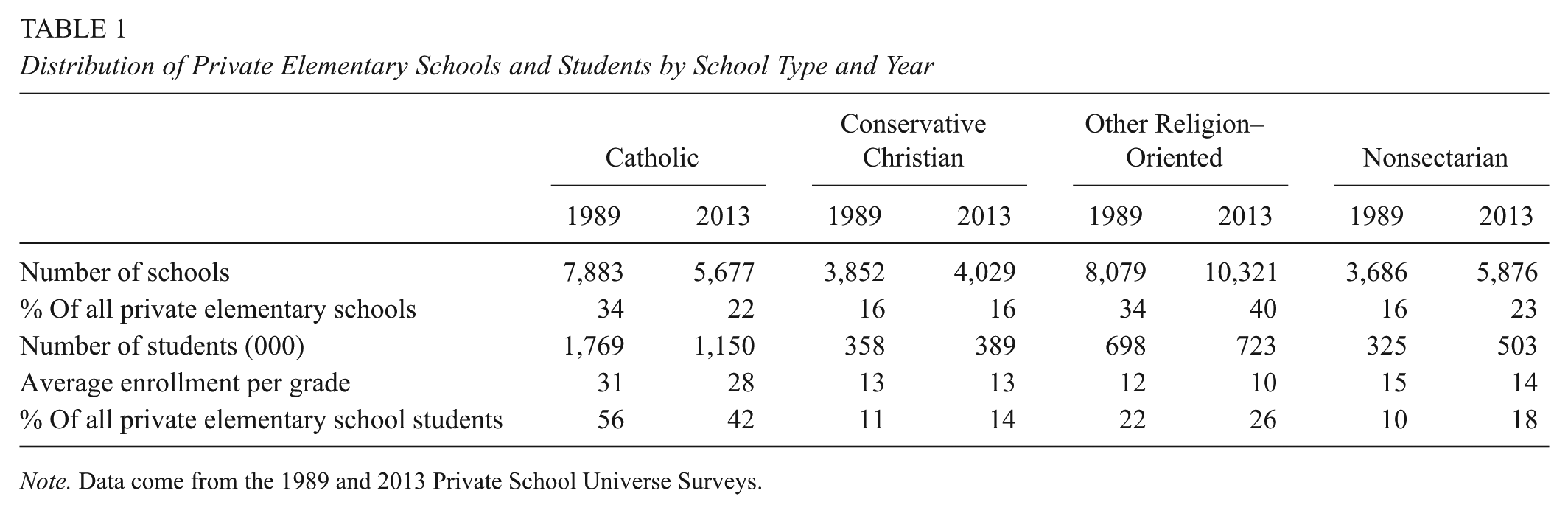
Unfortunately, the data sets that provide information on family incomes do not provide information on trends over time and location in the distribution of private schools. However, the PSS does provide this information. The PSS also allows us to distinguish conservative Christian schools from other schools in the non-Catholic religion-affiliated elementary school category, a distinction relevant in interpreting the evidence we report in the next section. 5 Table 1 provides descriptive statistics on the national distribution of private elementary schools and students in 1989 and 2013. Table 2 provides information on the distribution of each type of private school and enrolled students by region, locale type, and year.
Distribution of Private Elementary Schools and Students by School Type and Year
Note. Data come from the 1989 and 2013 Private School Universe Surveys.
Distribution of Private Elementary Schools and Enrolled Students by Region, Locale Type, and Year

Note. Data come from the 1989 and 2013 Private School Universe Surveys.
In 1989, one-third of the nation’s 23,500 private elementary schools were Catholic. These schools, almost half of which were located in cities, tended to be large relative to other private schools, with an average of 31 students per grade. In 1989, they served 56% of the nation’s private elementary school students. Twenty-four years later, only 22% of the 25,903 private elementary schools in the United States were Catholic, and they served only 42% of private elementary school students. The decline in the number of students attending Catholic elementary schools in Northeastern cities was particularly great, with enrollment falling from 282,746 in 1989 to 91,967 in 2013.
In 1989, half of the private elementary schools in the United States were associated with a religion other than Catholicism. One-third of these were conservative Christian schools. Both conservative Christian and other religion–affiliated elementary schools tended to be small, averaging 12 to 13 students per grade. Together, they served one-third of the private elementary school student population. Over the next 24 years, the number of conservative Christian elementary schools increased by 5%, with growth concentrated in the South. In 2013, almost half the students attending conservative Christian elementary schools lived in this region.
In 1989, 16% of private elementary schools were nonsectarian, and these schools served 10% of private elementary school students in the United States. Over the next 24 years, the number of nonsectarian private elementary schools increased by almost 60%, with growth concentrated in the Northeast. In 2013, they served 18% of the nation’s students enrolled in private elementary schools.
Family income percentile
Some surveys, such as the census, asked respondents to report the individual income for each family member and estimated family income from the sum of the reported individual incomes. Others asked parents to report into which of 10 to 18 prespecified ranges their family income fell. To obtain a metric that was common across years in constructing trends in private school enrollment rates for children in elementary school, we used the method described in the appendix to convert ordinal income categories into percentiles of the national distribution of incomes for families with children between the ages of 5 and 21 who were enrolled in Grades 1 to 8.
Our original plan was to report trends in private school enrollments by family income percentile from 1968 to 2015. However, as we explain in the appendix, CPS-based estimates of private school enrollment rates by family income for the years 2014 and 2015 are inconsistent with those from the larger American Community Survey. For that reason, we ended our CPS-based estimates with the year 2013.
Family race/ethnicity
We classified children in our analytic samples as belonging to one of four mutually exclusive racial/ethnic groups: non-Hispanic White (henceforth White), non-Hispanic Black (henceforth Black), Hispanic, or other. In our “Findings” section, we describe trends in the private school enrollment rates of children from different racial/ethnic groups whose families are in the top, middle, or bottom of the U.S. family income distribution, not the income distribution of families of a particular race/ethnicity. This is important to keep in mind because the income distributions of Black and Hispanic families lie to the left of the income distribution for White families. For example, in 1969, 2% of Black children and 4% of Hispanic children in elementary school lived in families with incomes that were in the top 10% of the national distribution of incomes of families with children in elementary school. The comparable figures for 2013 are 3% of Black children and 4% of Hispanic children. At the other end of the family income spectrum, in 1969, 28% of Black children and 16% of Hispanic students in elementary school lived in families in the bottom 10% of the national income distribution for all families with children in elementary school. In 2013, the comparable figures are 20% of Black students and 13% of Hispanic students.
Region
We classified children as living in one of four regions: Northeast, Midwest, South, and West. Over the half-century in which we examined private school enrollment patterns, the geographic distribution of American elementary school students changed, with the South and West gaining at the expense of the Northeast and Midwest. In 1969, 23% lived in the Northeast, 28% in the Midwest, 32% in the South, and 17% in the West. The comparable percentages for the year 2013 are 16%, 22%, 38%, and 24%, respectively.
City/suburb/rural
Between 1969 and 2013, the distribution of U.S. elementary school students among three types of locales, cities, suburbs, and rural areas, changed markedly, with suburbs gaining at the expense of cities and rural areas. In 1969, 30% lived in cities, 41% in suburbs, and 28% in rural areas. The comparable figures for 2013 are 22%, 60%, and 18%, respectively.
Data-Analytic Plan
The details of our analytic methods are described in the appendix. Here we provide a brief outline of the methods. We estimate the private school enrollment rate in each year, conditional on a family’s percentile rank in the income distribution, by fitting a polynomial logit model in which the outcome is a dichotomous variable assuming a value of 1 if a child in elementary school in the relevant year attended a private school and zero otherwise. The predictors include a polynomial function of a family’s percentile rank in the national income distribution of the families of children in elementary school. Fitting this model provides an estimate of the function that describes the association between the probability of private school enrollment and family income percentile in a particular school year. Using this estimated function, we compute the estimated proportion of students enrolled in private school in the relevant year at the 10th, 50th, and 90th percentiles of the income distribution. We refer to these family income percentiles as low, middle (or median), and high.
To estimate private school enrollment rates in each year by race/ethnicity, region, and urban/suburban location, we fit logit models on the relevant subpopulation data. To estimate the proportion of students enrolled in different types of private schools in each year, we fit polynomial multinomial logit models rather than simple logit models.
To estimate trends in private school enrollment rates by family income percentile, we fit regression models through the estimated data points. These models estimate the enrollment rate (or in one case, median tuition) as a polynomial function of school year, family income percentile, and their interactions. We base hypothesis tests regarding trends and differences in trends on the coefficients of the estimated regression models, reporting p values in parentheses. To illustrate our findings, we plot the fitted polynomial trends. To provide a sense of goodness of fit, we include the underlying estimated data points in the graphs. Throughout the description of our research findings, the private school enrollment rates we present are estimates based on the fitted regression models. To facilitate exposition, we omit the word estimated even though all are estimates generated by the analytical methods described previously and explained in greater detail in the appendix.
In addressing some questions, we report evidence from the 1968–1969 school year to the 2013–2014 school year (henceforth, 1968 to 2013). To make clear the time period for which we have evidence bearing on each question, we use the same horizontal scale representing time for all graphs. In some cases, such as trends in rates of enrollment in particular kinds of private schools by family income, the graphs illustrate that we have no evidence prior to 1987 or after 2011. To remove the effects of inflation on purchasing power, we express all family incomes and private school tuitions in 2015 dollars.
In reporting our results, we pay particular attention to changes in the size of the gap in private school enrollment rates between families at the 90th and 50th income percentiles (henceforth, the 90-50 gap). We do this because the growth in inequality in incomes among families with children of school age since the early 1980s has been overwhelmingly in the top half of the distribution (Stone et al., 2016). For example, among families with school-aged children, the 90th percentile income in 1979 ($124,250) was 2.03 times as large as the 50th percentile income ($61,118). In 2013, the comparable 90th percentile income ($183,959) was 2.70 times as large as the 50th percentile income ($68,256). 6 We report p values in parentheses from tests of null hypotheses that the 90-50 gaps were the same size in different years. We base all such tests on the estimated parameters of the regression models.
Findings
National Trends
The percentage of American elementary school students attending private elementary schools increased from 10% in 1948 to more than 15% in 1958. The percentage remained close to 15% through the mid-1960s but then fell back to 10% by the mid-1970s. The private elementary school enrollment rate remained between 9% and 11% for the rest of the 20th century. After 1999, the rate declined slowly but steadily, from 11% in 1999 to 9% in 2015. 7
Figure 1 displays fitted trends in private school enrollment rates over the period from 1968 to 2013 for all U.S. children enrolled in Grades 1 to 8 whose family incomes were at particular points in the national distribution. The figure illustrates the strong positive role of income in predicting private school enrollment rates. For example, in 1968, 18% of elementary school–aged children living in high-income families attended a private school, while the corresponding percentages for children from median- and low-income families are 12% and 5%, respectively. This pattern is no surprise because in the absence of scholarships, families must pay tuitions to send a child to a private school but not a public school. 8

Estimated total private school enrollment rate by family income percentile, 1968–2013, with fitted third-order polynomial regression line.
Figure 1 also illustrates that the income mix of children attending private elementary schools changed markedly over the past several decades. The proportion of children from middle-class families who attended private schools declined by almost half, while the proportion of children from affluent families attending private schools remained quite steady. As a result, the 90-50 gap in private elementary school enrollment rates grew from 5.5 percentage points in 1968 to 9.3 percentage points in 2013 (p < .001). To gain greater insight into trends in the schooling decisions of families from different parts of the income distribution, we now turn to enrollment trends by private school type.
National Trends by Private School Type
In 1965, 89% of American children who attended a private elementary school were enrolled in a Catholic school; in 2013, the comparable figure was 42%. In contrast, the percentage of private elementary school students who attended a non-Catholic religious elementary school increased from 8% in 1965 to 40% in 2013. During this same period, the percentage of private elementary school students enrolled in nonsectarian schools increased from 4% to 18%. 9 We now turn to enrollment trends by family income for the three mutually exclusive categories of private elementary schools that can be differentiated in national data, albeit in two cases beginning only in 1987.
The left panel of Figure 2 displays trends in rates of enrollment in private nonsectarian elementary schools by family income from 1969 to 2011. Only a small percentage of the nation’s elementary school students attend these schools, and a growing percentage who do come from relatively affluent families. In 1969, 1% of students from median-income families attended a private nonsectarian school, and the enrollment rate for children from middle-income families remained between 1% and 2% through 2011, the last year for which we have the relevant data.

Estimated elementary private school enrollment rate by family income percentile with fitted linear regression line for (a) nonsectarian schools, 1969–2011, (b) Catholic schools, 1987–2011, and (c) other religious schools, 1987–2011.
In 1969, the enrollment rate in private nonsectarian elementary schools for children from high-income families was only 2%, and consequently the 90-50 enrollment rate gap in these schools was only 1 percentage point. However, the enrollment rate in private nonsectarian elementary schools for children from high-income families increased slowly but steadily, reaching 6% in 201l. Consequently, the 90-50 gap in enrollment rates in private nonsectarian elementary schools in 2011 was almost 5 percentage points, more than three times the size of the comparable gap in 1969 (p < .001).
The middle panel of Figure 2 displays trends in enrollment rates in Catholic elementary schools by family income over the period from 1987 to 2011. Catholic school enrollment rates for students from families in the bottom half of the family-income distribution fell slowly but steadily over the 24-year period. The enrollment rate for middle-income families in 2011 was 3%, half the comparable enrollment rate in 1987.
In contrast, the Catholic school enrollment rate for high-income families declined by only 1 percentage point over the 25-year period, from 11% to 10%. As a result, the 90-50 gap in enrollment rates grew from 4 to almost 7 percentage points. Unfortunately, as a result of having only 11 data points to estimate Catholic school enrollment rate trends at each family income percentile, the slope differences displayed in Figure 2 are only suggestive; we cannot reject the null hypothesis that the 90-50 gap in 2011 is the same size as the 90-50 gap in 1987 (p = .18).
The right panel of Figure 2 illustrates that enrollment trends in non-Catholic religious elementary schools are quite different from those for the other two groups of private schools. Over the period 1987 to 2011, the enrollment rate in other religious elementary schools of children from median-income families increased from 3% to 4%, while that of children from high-income families declined from 6% to 5%. As a result, the 90-50 gap in enrollment rates in non-Catholic religious elementary schools in 2011 was half the size of the comparable gap in 1987. As with the Catholic school enrollment trends, these patterns are only suggestive. Due to a lack of power, we cannot reject the null hypothesis that the 90-50 gaps are the same size in the two years (p = .13).
In summary, the relatively stable private elementary school enrollment rate for children from high-income percentile families displayed in Figure 1 masks a shift from religious to nonsectarian schools over the past four decades. The declining private school enrollment rates for children from middle-income and low-income families displayed in Figure 1 are due to a decline in Catholic school enrollment rates for these groups. These declines were somewhat offset by increases in the enrollment rates of children from these groups in other religious private schools.
Trends for Subgroups of Families
Race/ethnicity
In 1959, enrollment rates in private elementary schools for White, Hispanic, and Black students were 16%, 13%, and 3%, respectively. 10 Over the next half-century, the private elementary school enrollment rate of White students declined slowly, with 11% enrolled in private elementary schools in 2013. During this same period, the comparable enrollment rate of Hispanic students declined quite rapidly while that of Black students increased slightly. In 2013, 5% of Black children and 3% of Hispanic children of elementary school age were enrolled in a private school. 11
It is not immediately clear to what extent the changes in private school enrollment rates by race are due to changes in each group’s income distribution or changes in private school enrollment conditional on income. Given that Black and Hispanic families were less concentrated in the bottom decile of the income distribution in 2013 than in 1969, we would expect their private school enrollment rates to rise if enrollment rates conditional on income remained constant. This is why it is important to examine trends in private school enrollment rates for Black and Hispanic students whose families were at particular points in the national family income distribution.
The left panel of Figure 3 displays trends in rates of enrollment in any type of private elementary school for Black students whose families were at the 10th, 50th, and 90th percentiles of the national family income distribution. In 1968, 2% of Black children from low-income families attended private elementary schools. This rate rose slowly over the next four decades, reaching 4% in 2013. The private school enrollment rate for Black children from middle-income families was quite steady over this time period, with a 2013 enrollment rate 1 point higher than the 5% enrollment rate in 1968. In contrast, the private school enrollment rate for Black students from high-income families increased from 11% in 1968 to more than 16% in the mid-1990s. Subsequently, this rate fell slightly, reaching 14% in 2013. The net effect of these trends is that the 90-50 gap in the private elementary school enrollment rate of Black students in 2013, 8 percentage points, was only slightly larger and not statistically different from the comparable gap of 6 points in 1968 (p = .32). 12 Note that the slow but steady increase in the private school enrollment rate for low-income Black students indicates that not all of the overall increase in the Black private school enrollment rate was due to changes in the Black family income distribution.
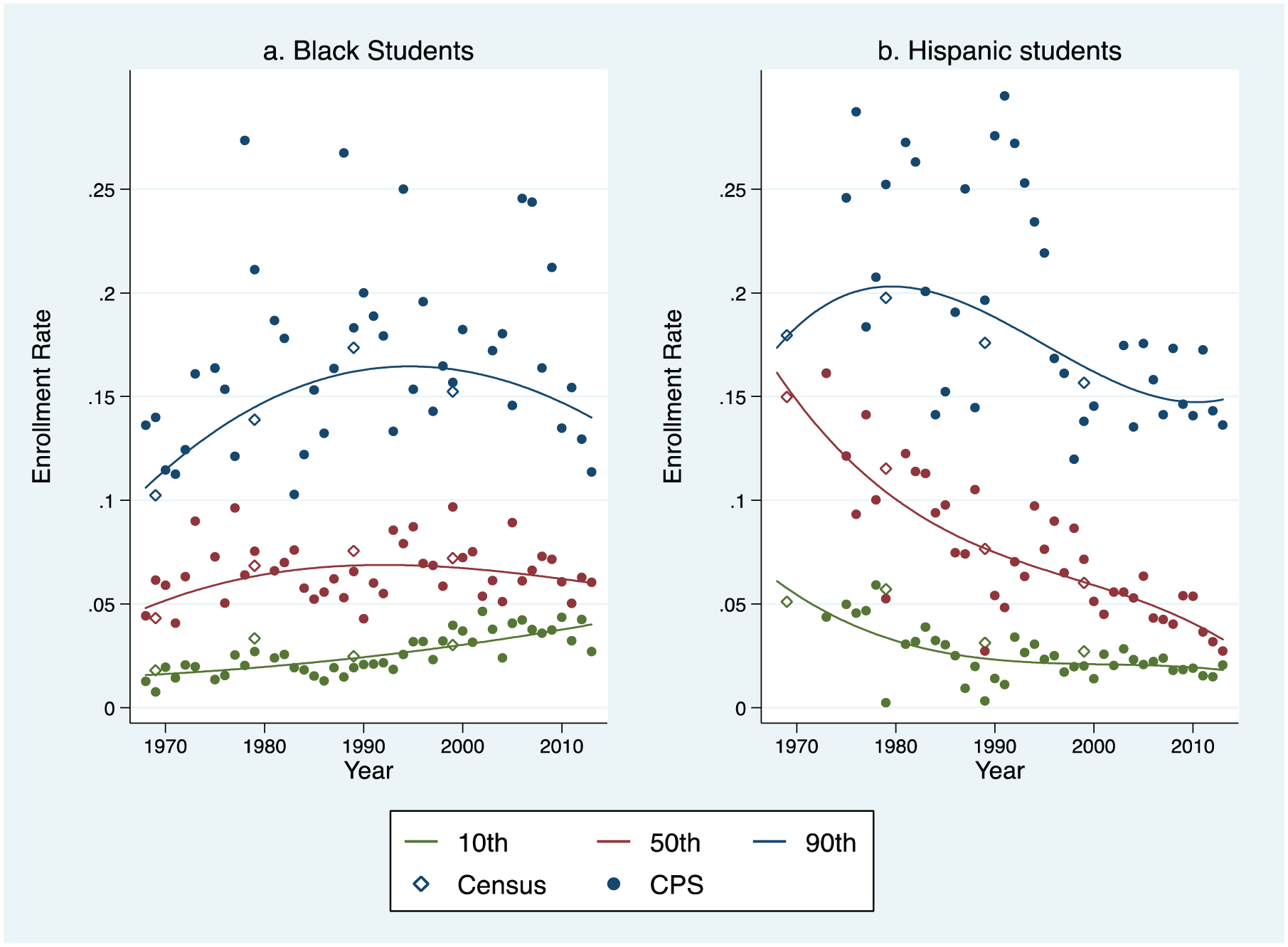
Estimated elementary private school enrollment rate by family income percentile, 1968–2013, with fitted third-order polynomial regression line for (a) Black and (b) Hispanic students.
The right panel of Figure 3 displays trends in private school enrollment rates by income from 1969 to 2013 for Hispanic children. Private school enrollment rates fell over this period for children from Hispanic families in all parts of the income distribution. The rate of decline was most rapid for children from middle-income Hispanic families, falling from 15% in 1969 to 3% in 2013. Since the decline was more modest for children from high-income Hispanic families (from 18% in 1969 to 15% in 2013), the 90-50 private school enrollment rate gap experienced a statistically significant increase from 3 points in 1969 to 12 points in 2013 (p < .001).
One question that the panels of Figure 3 prompt is whether private school enrollment rates for Black and Hispanic students from high-income families differ from those of non-Hispanic White students from equally high-income families. To address this question, we fitted regression models estimating trends in private school enrollment rates for Black, Hispanic, and White children from families in the 90th percentile of the family income distribution in the relevant year. In 1970, only 12% of children from high-income Black families attended a private elementary school compared to 18% of children from high-income White and Hispanic families. However, as illustrated by Figure 4, the racial/ethnic gaps in the private elementary school enrollment rates of children from high-income families narrowed after 1980. While we reject null hypotheses that the private school enrollment rates of children from the three high-income ethnic groups were equal in 1989, 1999, and 2009 (p < .05, p < .001, and p < .01, respectively), the differences were less than 3% in every year. In summary, differences in family income explain much but not all of the differences in private school enrollment rates for children from Black, Hispanic, and White families.

Estimated elementary private school enrollment rate, 1968–2013, by race, for students from families at the 90th percentile rank of the national family income distribution with fitted third-order polynomial regression line.
Urban/suburban
In 1968, 19% of children living in cities and 13% of those living in suburbs attended a private elementary school. 13 Over the next half-century, both percentages declined, as did the difference between the private elementary school enrollment rates of urban and suburban children. In 2013, the respective enrollment percentages were 10% and 8%.
The left panel of Figure 5 displays trends in private elementary school enrollment rates by income percentile for families living in cities. The pattern is a more vivid version of that displayed in Figure 1 for all American elementary school students. The private school enrollment rate for children from median-income families declined quite steadily from 20% in 1968 to 7% in 2013. This decline is linked to the closing of many urban Catholic schools over this time period. However, it is not clear how much this is due to changes in the demand for urban Catholic schools (stemming from changes in the religious and racial demographics of cities) and how much is due to changes in the ability of the Catholic Church to maintain urban schools with the same relatively low tuition rates that parishes had provided historically.

Estimated elementary private school enrollment rate by family income percentile, 1968–2013, with fitted third-order polynomial regression line for (a) children in urban areas and (b) children in suburban areas.
In 1968, 26% of elementary school–age children from high-income urban families attended a private school. Over the next two decades, the private school enrollment rate climbed slightly, reaching 30% in 1989. Since then, the private school enrollment rate has fallen to a rate of 24% in 2013, slightly lower than the 1968 rate. A result of these trends, especially the dramatic decline in the enrollment rate of children from middle-income families, is that the 90-50 gap in private school enrollment rates for children living in cities increased from 6 percentage points in 1968 to 17 points in 2013 (p < .001).
As the right panel of Figure 5 illustrates, the private elementary school enrollment rate for children from middle-income families living in suburbs fell quite steadily over the past several decades, from 11% enrolled in 1968 to 6% in 2013. The comparable enrollment rate for children from high-income suburban families remained quite steady at a level between 15% and 18% from 1968 until quite recently but fell in the years following the onset of the Great Recession. A result of this recent decline in the private school enrollment rate of high-income suburban families is that the 90-50 gap in private school enrollment rates was the same in 2013 as it had been in 1968—7 percentage points.
Region
In 1968, private elementary school enrollment rates were considerably higher in the Northeast and Midwest than the South and West. 14 In 2013, they were still higher, but the differences were much smaller. The reason is that private school enrollment rates in the Northeast and Midwest fell substantially while those in the South and Midwest held quite steady. The respective enrollment rates by region were 22%, 16%, 6%, and 8% in 1968 and 10%, 9%, 8%, and 7% in 2013. 15
The four panels of Figure 6 show trends in private school enrollment rates by income for students living in each of four regions. In 1968, more than 20% of children from median-income and high-income families in the Northeast attended private elementary schools, with the vast majority attending Catholic schools. Over the next 45 years, the percentage of children from median-income families in the Northeast attending private elementary schools declined steadily, falling to 9% in 2013. The private school enrollment rate for children from high-income families in the Northeast also fell during this period but more slowly. As a result, the 90-50 gap in private school enrollment rates in the Northeast increased from 2 to 5 percentage points (p = .103).

Estimated elementary private school enrollment rate by family income percentile, 1968–2013, with fitted third-order polynomial regression line for children in the (a) Northeast, (b) Midwest, (c) South, and (d) West.
Private school enrollment rates of children from high- and middle-income families in the Midwest fell by approximately the same amount between 1968 and 2013. As a result, the 90-50 enrollment rate gap in 2013 (6 points) was not significantly different from the 1968 gap of 8 percentage points (p = .47).
Trends in private elementary school enrollment rates in the South and West are quite different from those in the other two regions. The private school enrollment rate of children from median-income families in the South held quite steady between 1968 and 2013, with 6% of children attending private elementary schools in both the first and last years of this period. In contrast, the private elementary school enrollment rate of children from high-income families in the South increased from 14% in 1968 to 19% in 2013. As a result, the 14 percentage point gap in 2013 between the private school enrollment rates of children from high- and middle-income families in the South was twice as large as the comparable gap in 1968 (p < .001).
Trends in private school enrollment rates by income in the West are similar to those in the South, although more muted. The private school enrollment rate of children from median-income families in the West fell slightly, from 7% in 1968 to 5% in 2013. During this same period, the private school enrollment rate of children from high-income families in the West increased, and the 14% enrollment rate in 2013 was 3% higher than the comparable rate in 1968. A result of these trends is that the 90-50 enrollment rate gap experienced a statistically significant increase from 4 points in 1968 to 9 in 2013 (p < .001).
Explaining the Patterns
To summarize, we have described several striking patterns:
The gap between the private elementary school enrollment rates of children from high- and median-income families grew substantially between 1968 and 2013, especially during the last two decades of the 20th century. It grew largely because the private school enrollment rate of middle-income families declined considerably during that time period.
The growth in the 90-50 enrollment rate gap among students of private nonsectarian elementary schools has been particularly large and is almost entirely due to a substantial increase in the enrollment rate of children from high-income families.
Catholic elementary school enrollment rates have shown a substantial long-term decline, especially among children from low- and middle-income families. This accounts for much of the growth in the 90-50 gap in private school enrollment rates.
Conditional on family income, private school enrollment rates are much higher among families living in cities than among those living in suburbs, and the 90-50 gap grew more among urban families.
Private elementary school enrollment rates are lower for Black and Hispanic families than White families, but differences in income account for a large part of enrollment rate differences.
Private school enrollment trends are quite different in the South and West than in the Northeast and Midwest. In both of the former regions, the private school enrollment rates of children from high-income families increased while they declined in the other two regions. The 90-50 gap in private school enrollment rates increased much more in the South than other regions. 16
We frame explanations for these patterns in terms of a simple economic model of families. We assume that parents seek to maximize their family’s welfare subject to the constraints they face. Quality of their children’s education, as they define it, is one element of welfare. Relevant constraints include their family income and the cost and perceived quality of the public and private schools available to them. The cost of public schools depends on the price of housing in different communities. The cost of private schools is the net tuition and fees the parents would be charged. We want to emphasize that our potential explanations are hypotheses supported by descriptive evidence that we offer to motivate future research. We do not claim to present evidence of causation.
The decline in the number of Catholic schools and the increasing cost of those that remain contributed to the decline in the percentage of families sending their children to private elementary schools, especially among those of modest means. Between 1970 and 2010, the number of Catholic elementary schools in the United States declined 37%, and the number of students attending these schools fell 60%. In part, this was because inflation-adjusted tuition in Catholic elementary schools increased 570% (from $873 to $5,858). 17 During this period, the median real income of families with school-aged children increased only 33%, and that of families at the 10th percentile of the income distribution declined by 3%. Dynarski, Gruber, and Li (2009) show that the demand for Catholic elementary school education is more sensitive to price the lower a family’s income. The rapid tuition increases help explain why Catholic elementary schools increasingly serve students from relatively high-income families.
One factor contributing to the increasing cost and declining supply of Catholic schools is the decline in the number of clergy and members of religious orders who provided low-cost teaching services to Catholic schools. Between 1970 and 2016, the percentage of the staff of Catholic elementary schools who were clergy or members of religious orders fell from 48% to less than 3%. 18
Another factor contributing to the decline in Catholic school enrollments may have been the sexual abuse crisis, which was concentrated in the Northeast in the first decade of the 21st century. Publicity about this scandal may have led some parents to withdraw children from Catholic schools or make other choices for children entering school. Settling the court cases that arose from the abuses reduced the ability of many dioceses to subsidize their schools, a long-standing practice that had allowed parishes to keep tuitions well below average per student operating cost and offer substantial scholarships to students from low-income families. 19 Fallout from the crisis may have contributed to the 44% decline between 2001 and 2011 in the number of students attending Catholic elementary schools in the Northeast. As illustrated in Figure 7, this was a much more rapid enrollment decline than that experienced by Catholic elementary schools in other regions of the country during this decade or in the Northeast in the previous decade. 20
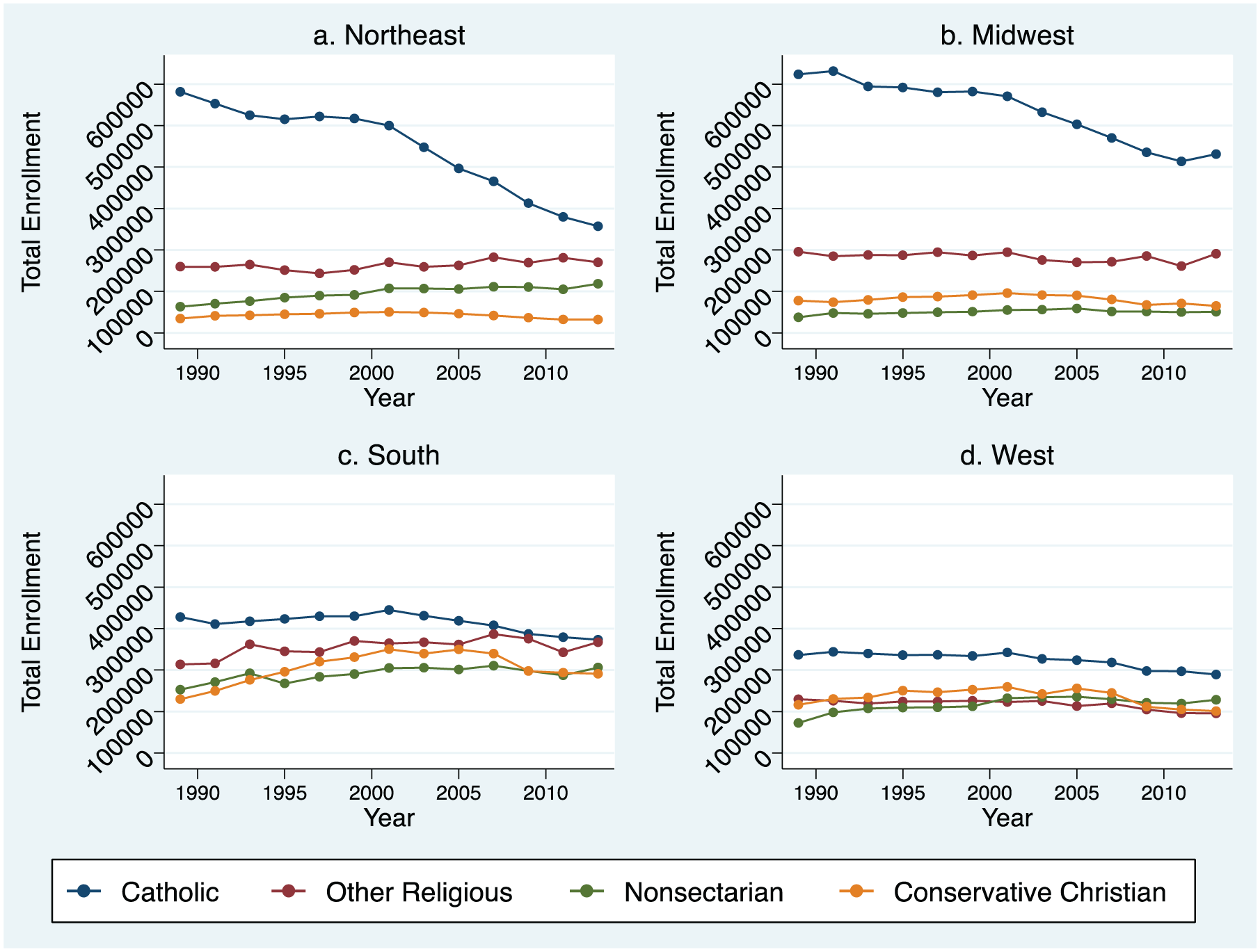
Elementary private school enrollment by private school type, 1989–2013, in the (a) Northeast, (b) Midwest, (c) South, and (d) West.
While tuitions at Catholic schools have increased especially rapidly in recent decades, tuitions in other types of private schools also increased more rapidly than the median income of families with children. Measured in 2015 dollars, the average full tuition in nonsectarian private elementary schools rose from $4,120 in 1979 to $22,611 in 2011. 21 Given the high tuitions in nonsectarian private elementary schools, it is not surprising that enrollment in these schools rose faster among students from high-income families than among those from low-income families or that the 90-50 enrollment gap increased substantially.
Tuitions have also increased substantially in non-Catholic religious elementary schools. In 1993, average full tuition (in 2015 dollars) in these schools was $3,896. In 2011, it was $9,134 (Snyder & Dillow, 2015, Table 205.50). Since the average income of high-income families increased by much more than that of median-income or low-income families during this period, it is surprising that 90-50 enrollment gap did not increase between 1987 and 2011. We return to this puzzle in the following, when we discuss differences across regions.
Another factor relevant to explaining trends in private school enrollments is the perceived quality of the public schools with which private schools compete. Nationwide, the gap between the average score of students in public schools and private schools on the Grade 4 National Assessment of Educational Progress mathematics assessment declined markedly between the 1990s and 2011 (Dynarski, 2016). This may explain why the percentage of elementary school students attending private schools declined slightly during this period.
A consequence of the increase in residential segregation by income over the past several decades, especially among families with school-aged children, is that urban public schools increasingly serve low-income student populations (Owens, 2016; Owens et al., 2016). Average mathematics and reading scores are considerably lower for students attending urban public schools than for those attending suburban public schools (Blagg, 2016). Student discipline problems are more frequent (Snyder, DeBrey, & Dillow, 2016, Table 230.10). Throughout the 1980s and early 1990s (the only period for which consistently coded data are available), a lower percentage of urban parents with children of school age rated their local public schools as A or B than suburban parents with the same income did. Moreover, as illustrated in Figure 8, a higher percentage of high-income suburban parents gave their local public schools a grade of A or “B” (on an A–F scale) than lower-income suburban parents (p < .01). This probably reflects the greater capacity of high-income parents to choose to live in suburban communities with high-quality public schools. In contrast, high-income parents living in cities did not rate their local public schools more favorably than lower-income urban parents did. 22 This helps to explain why high-income parents who choose to live in cities are more likely than those living in suburbs to send their children to private elementary schools. 23

Estimated proportion of urban and suburban families with children rating their local schools as an A or B, 1982–1992.
Differences across regions in the composition of private school enrollments help to explain differences in private school enrollment trends. Historically, Catholic school enrollment rates in the South and West were much lower than those in the Northeast and Midwest. Consequently, declining availability and increasing cost of Catholic elementary schools affected private school enrollment rates in the South and West less than those in the other two regions.
During the 1970s, efforts by the courts to desegregate public schools in the South resulted in White flight to private schools (Rossell, 1983). This contributed to the increase in the private school enrollment rate in the South during that decade, especially among White and high-income families. Reardon and Yun (2003) show that the private school enrollment rate of White children living in predominantly Black counties in the South remained high throughout the last three decades of the 20th century.
The disproportionate number of conservative Christians in the South may also play a role in explaining regional differences in private school enrollment rate trends. In the wake of Supreme Court decisions banning prayer in schools, many conservative Christians felt that public schools did not reflect their values (Cooper, 1984). This may explain why the percentage of median-income families living in the South who sent their children to non-Catholic religious elementary schools increased over the past several decades despite the marked increase in tuitions at these schools. Interestingly, the percentage of high-income families in the South who sent their children to non-Catholic religious elementary schools declined over this same period, and the 90-50 gap in enrollment rates in other religious elementary schools declined (p < .05). However, high-income Southern families increasingly sent their children to nonsectarian private schools (p < .01). This helps to explain why 90-50 gaps in private elementary school enrollment rates increased in the South between 1987 and 2011. 24
One other factor that may contribute to the trends in private school enrollment rates that we document are changes in the composition of families at each income percentile. For example, the percentage of Black children from low-income families that attended private schools increased slowly but steadily between 1968 and 2013. During this same period, the percentage of Black children living in families with incomes in the bottom 10% of the national family income distribution declined from 28% to 20%. Low-income Black families in 2013 may differ from low-income Black families in 1969 in unobserved dimensions relevant to school choice.
Implications of the Trends
Relative to residential mobility patterns, trends in private school enrollments play only a modest role in explaining increases in school segregation by income. The reason is that the percentage of American children attending private elementary schools has declined from 15% to less than 9% in recent decades. However, this role is not inconsequential. Over the past three decades, Catholic schools and nonsectarian private schools have increasingly served students from high-income families. These trends, especially among urban families and those living in the South and West, are one of several mechanisms through which increases in family income inequality have contributed to increases in school segregation by income.
It is more difficult to judge whether trends in private school enrollment rates by family income have contributed to increases in gaps in educational outcomes by family income. If average per student expenditure is an indicator of instructional quality, this may be the case. The reason is that the 90-50 enrollment rate gap has increased the most in nonsectarian elementary schools, which are more than twice as expensive, on average, as religious schools (Baker, 2009).
It is also the case that median-income parents who enrolled their child in a particular type of private elementary school paid less than high-income parents who did so. For example, the median tuition paid by a middle-income family that sent a child to a nonsectarian private school in 2001, the latest year for which we have the relevant data, was $2,100 less (in 2015 dollars) than that paid by high-income families. 25 Part of the difference may reflect scholarship aid to median-income families. However, it also reflects differences between the high-priced private schools that children from affluent families attend and the lower-priced and perhaps less effective private schools that students from lower-income families attend. Indeed, Braun, Jenkins, and Grigg (2006) and Lubienski and Lubienski (2014) document that differences in the effectiveness of private schools within each private school type are much greater than differences between the average effectiveness of each type of school. We know of no evidence about whether the more expensive private schools are more effective than the less expensive ones. Certainly, the school choices of affluent families indicate that they believe they are.
The limited available evidence on the average effectiveness of different types of private schools does not support a clear inference about whether trends in private school enrollments by family income have increased or decreased the size of income-related gaps in student achievement. Using data from the 2003 National Assessment of Educational Progress (NAEP), Braun et al. (2006) and Lubienski and Lubienski (2014) find that net of family background influences, the average mathematics and reading achievement of children enrolled in conservative Christian elementary schools was approximately one-half a standard deviation lower than that of demographically similar children enrolled in public schools. This is consistent with the very low average per student expenditure in these schools (Baker, 2009) and the weak average academic qualifications of their teaching staffs (Lubienski & Lubienski, 2014). Unfortunately, there is no systematic evidence on the reading and mathematics achievement net of family background influences for the 65% of children enrolled in non-Catholic religious private schools that are not conservative Christian schools.
Enrollment of students from high-income families in non-Catholic religious private schools declined in recent decades while that of students from middle-income and low-income families increased. The low average reading and mathematics achievement of children enrolled in conservative Christian academies suggests that these enrollment trends may have contributed to the increase in the reading and math test score gap between children from low- and high-income families, although the effects would likely be very modest given the small proportion of students in such schools.
On the other hand, trends in Catholic elementary school enrollments may have reduced income-related gaps in test scores. Using data from the period 1998 to 2004, Reardon, Cheadle, and Robinson (2009) report that by fifth grade, Catholic school students have math skills 3 to 4 months behind those of socioeconomically similar public school students who started kindergarten with the same level of initial skills. 26 Using NAEP data from 2003, Braun et al. (2006) and Lubienski and Lubienski (2014) report similar patterns. In recent decades, the percentage of children from low- and medium-income families who attend Catholic elementary schools has fallen rapidly while the percentage attending public schools has risen. If the change in the distribution of low- and middle-income students reflected movement from Catholic schools of average effectiveness to public schools of average effectiveness, this would have resulted in improved mathematics achievement for students from low- and middle-income families. However, we have no way to judge whether this assumption holds. Nor do we know if the relative performances of Catholic and public elementary schools have changed in the last dozen years.
We conclude by reminding the reader of the dramatic changes that have taken place in the distribution of private elementary school enrollments in the United States over the past 45 years. One illustration is that non-Catholic religious elementary schools today serve more students whose family incomes are in the bottom half of the distribution than Catholic elementary schools do. Another is the substantial increase in recent decades in the percentage of students from high-income families that attend private nonsectarian private schools. Much less is known about these groups of private schools than is known about Catholic schools, which historically were the dominant supplier of private school services in the United States and the subject of a great deal of research.
The key trends we document in this paper have, together, troubling implications for the segregation of low-income students. As a result of growing residential segregation by income, low-income families are increasingly concentrated in urban areas. In such places, one quarter of high-income families enroll their children in private schools; but a much smaller—and declining—proportion of middle- and low-income families in urban areas do so. This is in part a result of rising tuition and reduced availability of Catholic schools, which in the past enrolled many middle- and low-income students in urban areas. As a result, both urban public schools and urban private schools have less socioeconomic diversity today than they had several decades ago.
Higher income families increasingly live either in the suburbs or enroll their children in private schools. Moreover, the private schools their children attend are more likely to be expensive nonsectarian schools than was the case four decades ago. Together, these trends indicate an increasingly polarized pattern of school enrollment. As a result, American schools—both public and private—are increasingly segregated by income.
Footnotes
Appendix
The appendix provides details of the data and methods we used to produce the results reported in the text of our article. Additional details are available in the Online Appendix.
Acknowledgements
Many people and organizations provided information and support for this project. They include the Russell Sage Foundation, which provided a research grant. Robert Hauser and Rob Warren provided data files from the October Current Population Surveys (CPS) for the years 1968–2005 that they had cleaned and organized. These supplemented October CPS files that we purchased from Unicon. Kurt Bauman of the U.S. Census Bureau and Sarah Grady and Stephen Broughman of the U.S. Department of Education answered many questions about properties of particular data sets. Dale McDonald, PBVM, PhD, the director of public policy and educational research for the National Catholic Educational Association (NCEA), provided information on enrollment and staffing trends in NCEA schools. Sarah Lubienski explained definitions of school types used in her research. Sabino Kornrich provided data from his research. Joshua Starr answered questions about the Phi Delta Kappan polls of attitudes toward schools. Henry Braun, Kurt Bauman, Greg Duncan, Christopher Jencks, Ann Owens, and Tim Smeeding provided comments on earlier drafts. Anne Lamb, Bonnie Mackintosh, Preeya Mbekeani, Mallory Perry, and Marcus Waldman provided excellent research assistance.
1.
Authors’ tabulations of data from the 2007 National Household Education Survey (NHES).
2
Another possibility is that affluent parents who send their children to private schools may be less likely to vote in favor of the taxes needed to fund high-quality public education. We know of no evidence that directly addresses this hypothesis. However, Boustan, Ferreira, Winkler, and Zolt (2013) and  find that rising income inequality is associated with increases in spending on public education. They point out that this is consistent with a median voter model in which rising income inequality reduces the median voter’s tax share.
3.
4.
The estimates of private school enrollments from the first administrations of the Private School Universe Surveys (PSS; 1989, 1991, and 1993) were considerably higher than Current Population Surveys (CPS)–based estimates. explains that surveys of private schools conducted by the U.S. Department of Education during the 1970s and early 1980s also produced estimates higher than those obtained from the CPS (a household survey). We had hoped to use information from the PSS to estimate birth and death rates for different types of private schools. However, we concluded that our estimates were inaccurate because many private schools did not respond to the PSS questionnaire in some years.
5
The U.S. Department of Education classifies conservative Christian schools as those that have membership in at least one of four associations: Accelerated Christian Education, American Association of Christian Schools, Association of Christian Schools International, or Oral Roberts University Education Fellowship (Kena et al., 2016).
6.
Had we chosen to report private school enrollment trends for 95th income percentile families instead of those for 90th income percentile families, the patterns we describe would have been even more striking. We chose to report the 90th income percentile trends because they are less sensitive to limitations in the family income data and assumptions about the functional form of our estimating equations than the 95th income percentile trends are.
7.
Estimates of private school enrollment rates for the years prior to 1968 were taken from Bruno (1982, , p. 20). The authors estimated rates for subsequent years from October CPS data. In all of the statistics we report in this paper on the percentages of American elementary school students enrolled in private school, the denominator is the combined total number of students enrolled in either private or public schools. Excluded from the denominator is the number of students of elementary school age who are homeschooled.
8.
Families do pay for high-quality public schools by paying premiums for housing in relevant attendance zones.
9.
10.
Authors’ calculations from 1959 U.S. Census of Population data.
11.
Authors’ calculations from October 2013 CPS data.
12.
Part of the explanation for the recent decline in the private elementary school enrollment rate for children from high-income Black families lies in relatively long-lasting income and wealth shocks from the Great Recession that were greater, on average, than those experienced by White families (McKernan, Ratcliffe, Steuerle, & Zhang, 2013). However, the decline started before the onset of the Great Recession.
13.
Authors’ calculations from October 1968 CPS data.
14.
Authors’ calculations from October 1968 CPS data.
15.
Authors’ calculations from data from the 1968 and 2013 October CPS.
16.
For reasons of parsimony, we do not include in this paper evidence on trends in private school enrollment rates for secondary school students. These trends are quite similar to those for elementary school students, with the following qualifications. The percentage of high school students attending private schools has been consistently lower than that of elementary school students, but the difference has declined from four percentage points to one over the last half-century. The 90-50 gap in private school enrollment rates grew less among high school students than elementary school students. Finally, point estimates indicate that trends by family income in enrollment rates in particular types of private schools are somewhat different at the high school level than the elementary school level. However, the differences are primarily due to the small amount of data available to estimate these trends.
17.
Dale McDonald, PBVM, PhD, the director of public policy and educational research for the National Catholic Educational Association, provided these figures. They are for full tuition and do not reflect any discounts offered to low-income families or those with multiple children attending the school.
18.
Information provided by Dr. McDonald. MacGregor (2012) cites evidence that nuns teaching in Catholic schools in the 1940s were paid an average annual stipend of $335, equivalent to about $3,000 in 2010 dollars. In contrast, the median salary of lay teachers in Catholic elementary schools in 2015 was approximately $50,000 (National Catholic Educational Association, 2016).
19.
20.
Between 2001 and 2011, the number of students attending Catholic elementary schools declined by 27% in the Midwest and 19% in the South and West. Between 1991 and 2001, Catholic elementary school enrollment in the Northeast declined by 10%.
21.
Bruno (1982, Table 7, p. 27) provides the mean tuition in 1979 in current dollars. The tuition figure for 2011 came from Snyder and Dillow (2015, Table 205.50, pp. 118–119). These are estimates of full tuitions. Retrieved on May 4, 2017 from .
22.
See the appendix for a description of the data and the specification and estimated parameters of the model used to produce the results described in this paragraph.
23.
Another factor that may have contributed to the decline in the private school enrollment rate of children from median-income and low-income urban families after the mid-1990s is the increasing availability of charter schools in many cities. These are public schools that provide families with another schooling option free of tuition payments. Chakrabarti (2013) shows that the decisions of low-income families to enroll their children in a private school are very sensitive to modest costs such as paying for transportation, even when the schools charge no tuition. We know of only one study that examines the causal impact of greater charter school availability on private school enrollment rates. Using data from Michigan, do not find evidence supporting the substitution hypothesis.
24.
Authors’ analyses of data from those CPS and National Center for Education Statistics data sets containing information on enrollment in particular types of private schools by family income and region.
25.
See the appendix for a description of the data and methods that we used to estimate the difference between the median tuition middle-income and high-income parents paid to send a child to a private nonsectarian elementary school.
26.
In contrast, several studies (e.g., Coleman, Hoffer, & Kilgore, 1982; Evans & Schwab, 1995; Neal, 1997) find that Catholic high schools located in cities are more effective than urban public schools in enabling students to graduate and enroll in college.
Authors
RICHARD J. MURNANE is the Thompson Research Professor at the Harvard Graduate School of Education. His research interests include the impact of technological change on the skills needed to earn a good living and factors that contribute to and detract from provision of a high-quality education to all children.
SEAN F. REARDON is the Professor of Poverty and Inequality in Education at the Stanford Graduate School of Education. His research interests include early childhood education, equity and poverty, the sociology of education, and applied statistics in educational research.
References
Supplementary Material
Please find the following supplemental material available below.
For Open Access articles published under a Creative Commons License, all supplemental material carries the same license as the article it is associated with.
For non-Open Access articles published, all supplemental material carries a non-exclusive license, and permission requests for re-use of supplemental material or any part of supplemental material shall be sent directly to the copyright owner as specified in the copyright notice associated with the article.
