




Abstract
Researchers have examined racial and gender patterns of intergenerational education mobility, but less attention has been given to the ways that race and gender interact to further shape these relationships. Based on data from the General Social Survey, this study examined the trajectories of education mobility among Blacks and Whites by gender over the past century. Ordinary least squares and logistic regression models revealed three noteworthy patterns. First, Black men and women have closed substantial gaps with their White counterparts in intergenerational education mobility. At relatively low levels of parental education, these gains have been experienced equally among Black men and women. However, Black men are most disadvantaged at the highest levels of parental education relative to Black women and Whites in general. Finally, the advantages in education mobility experienced by White men in the early and midpart of the 20th century have largely eroded. White women, in contrast, have made steady gains in education mobility across a variety of parental education levels.
In modern societies that are ostensibly meritocratic—such as the United States—education attainment plays a crucial role in affording access to the resources (e.g., income, cultural capital, social ties) needed to live a flourishing life (Bourdieu, 1996; Massey, 2006). It should come as no surprise, then, that formal education is one of the primary institutions through which families pass on or acquire advantages across generations. For some families, this may involve maintaining high levels of education from one generation to the next, such as bachelor’s-educated parents working to ensure that their offspring also attain a bachelor’s degree. In other cases, this may involve pursuing higher levels of education, as is the case with families of first-generation college students. Given the importance that this process plays in modern societies, researchers from across the disciplinary spectrum have paid close attention to intergenerational patterns of educational attainment—or what will be referred to here as intergenerational education mobility.
Overall growth in intergenerational education mobility in the United States has stalled in recent decades as high school and college completion rates have flattened (Hout & Janus, 2011). As illustrated in Figure 1, Americans experienced several decades of consistent upward educational mobility (i.e., completing more years of education than their parents) during the mass expansion of the education system. Institutional changes—such as compulsory education laws, financial aid, the GI Bill, civil rights advances, affirmative action policies, job training requirements, and shifting market signals—worked to both incentivize and support an increase in the amount of time that Americans spend in formal education. However, by the 1970s birth cohort, the average educational mobility was <1 year and was only a third of a year among those who are now in their midtwenties to midthirties (i.e., 1980s cohort). In addition, this longitudinal pattern of mobility appears to have followed a process of maximally maintained inequality (Raftery & Hout, 1993) whereby, in the midst of mass expansion, those born to higher-educated parents have maintained a consistent distance from those whose parents attained lower levels of education. As shown in Figure 2, the percentage of respondents who attained a bachelor’s degree and had at least one bachelor’s-educated parent increased, peaked, and declined at nearly identical patterns relative to those whose parents had less than a bachelor’s degree or high school diploma.

Average respondent attainment, parental attainment, and mobility by decade birth cohort for 25- to 65-year-olds. Note. Author’s estimates based on General Social Survey Cumulative File, 1972–2014 (Smith, Marsden, Hout, & Kim, 2015).
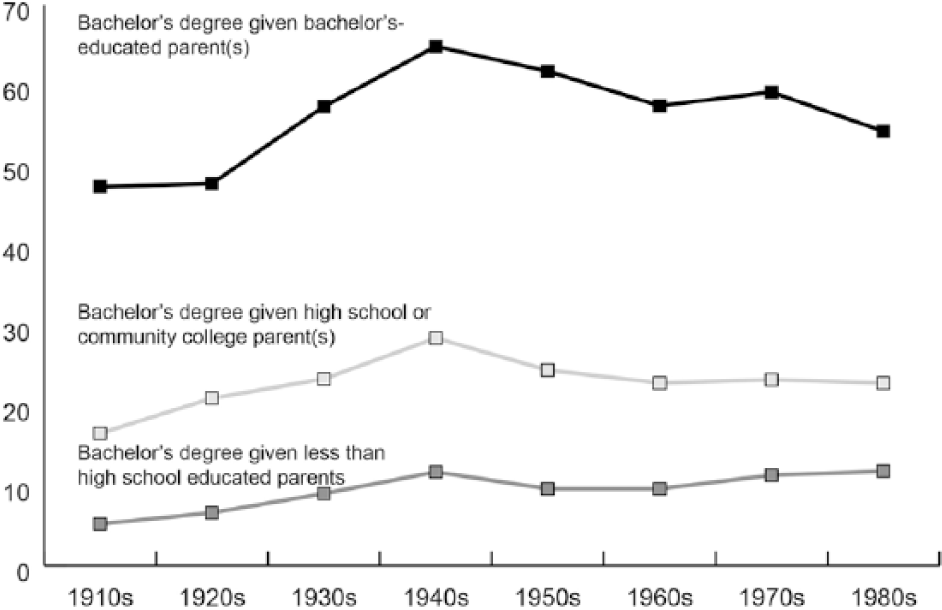
Probability of bachelor’s degree attainment given highest degree attained by either parent by decade birth cohort for 25- to 65-year-olds. Note. Author’s estimates based on General Social Survey Cumulative File, 1972–2014 (Smith, Marsden, Hout, & Kim, 2015).
Researchers have found important forms of group variation within these patterns and have given special attention to how such trends illuminate the understanding of changes to racial gaps in education attainment. Yet, while previous research has found that White Americans leverage their parental education advantages at higher rates than Black Americans (Grodsky, 2002; Long, Kelly, & Gamoran, 2012), there is little understanding of whether or not gender interacts with race to create unique intergenerational trajectories that have thus far been obscured by race- or gender-specific analyses. The present paper contributes to this area of the literature by expanding the scope of intergenerational education mobility analysis to include racial and gender interactions across time. Based on the General Social Survey’s (GSS’s) most recent cumulative data set (Smith, Marsden, Hout, & Kim, 2015), the analysis addresses the following questions:
Research Question 1: Are the patterns of intergenerational education mobility different for Black and White men and women across birth cohorts ranging from the 1910s to the 1980s?
Research Question 2: Do intergenerational education mobility patterns for these groups vary across different levels of parental education while holding constant a variety of family background characteristics?
Whereas previous researchers have (indirectly) found Black and White differences in intergenerational education mobility patterns, the central hypothesis in this study is that there are important gender variations within these racial categories that vary across time.
The intergenerational dimension to this issue is especially important given the degree to which the goal of social mobility has come to dominate the collective imagination about education and its role in legitimating winners and losers in society (Labaree, 1997). Indeed, it is through intergenerational processes that many policy makers believe that racial achievement gaps will ultimately close. For this goal to come to fruition, children of parents with relatively low levels of education attainment must experience positive educational growth, while those with relatively higher-educated parents must be able to sustain their parental attainments (i.e., a virtuous cycle; see Gamoran, 2001). This is especially true for marginalized groups who have historically been excluded from the higher levels of the education system. The following analysis seeks to examine these intergenerational patterns of education mobility over time at the intersections of race and gender. Such findings can provide policy makers and educators a more precise understanding of racial attainment gaps to address the ongoing struggle over educational inequality and the opportunities for advancement that hinge on its transformation.
Race, Gender, and the Intergenerational Transmission of Advantage in Education
There is a long tradition of work—much of it from sociology and economics—focusing on the processes of status attainment and intergenerational mobility through which family background characteristics differentially shape an individual’s education attainment trajectory (K. L. Alexander, Entwisle, & Olson, 2014; Blau & Duncan, 1967; Breen & Jonsson, 2005; Cameron & Heckman, 1998; Hout & Janus, 2011; Lareau, 2003; Sewell, Haller, & Ohlendorf, 1970; Torche, 2011). Conceptually, these models of attainment and mobility tend to assume that individuals acquire motivation and skills through disparate family contexts and then draw on these dispositions and skills to navigate structural barriers toward attainment outcomes. Previous research also suggests that the extent to which parents and their children are able to successfully convert advantages into educational gains is conditional on the class trajectory of the parents (e.g., new vs. stable middle class; Lawrence, 2016; Roksa & Potter, 2011).
An important facet of this body of work has been to examine the interactions between family background and race in the education attainment process (Kao & Thompson, 2003; Morgan, 2005). Cameron and Heckman (2001), for instance, found that racial and ethnic differences in college attendance were most strongly attributed to family income and parental education differences at the earliest stages of attainment trajectories. Furthermore, they found that when family background variables were considered, minority students were more likely than majority-White students to graduate high school and attend college. Conley (1999) also found that Black Americans had slightly higher odds of college completion than Whites, when controlling for family background characteristics such as wealth and education. When race alone was considered in bachelor’s degree attainment, however, Conley found that Black Americans were only 38% as likely as White Americans to acquire a college degree (p. 72).
While family background characteristics and practices evidently have a profound impact on securing educational advantages across racial groups, the rates at which Black students leverage their parental advantages appear to lag well behind those of White students with similar backgrounds (College Board, 1999; Grodsky, 2002). Bloome and Western (2011) did find greater educational mobility overall among Black men compared with White men in the 1966 and 1979 cohorts of the National Longitudinal Survey (i.e., NLS66 and NLSY79), but this was attributed to expanded high school access for Black students in the 1970s and 1980s. In a more temporally expansive analysis of family background, Long et al. (2012) found that parents’ education—as a predictor of White-Black education attainment differences—has increasingly worked to the advantage of Whites over time. In fact, the study concluded that middle-class status does not improve education attainment for Black Americans to nearly the same degree as White Americans.
A key outcome of Long and colleagues’ (2012) analysis was their rejection of the “virtuous cycle” hypothesis (Gamoran, 2001, 2015; Mare, 1995). The latter hypothesis assumes that Black and White parents pass on attained advantages (e.g., completing a bachelor’s degree) to their children in similar ways. Thus, as historically underrepresented and disenfranchised groups attain higher levels of education, the hypothesis assumes that they will pass these advantages on to their children. Instead of a virtuous cycle, however, Long and colleagues’ findings resonated with previous work focusing on the “perverse openness” of Black occupational mobility (Duncan, 1969; Featherman & Hauser, 1978; Hout, 1984), which found that the occupational advantages attained by Black fathers were not easily passed on to their sons. Rather, it is believed that Black families face unique forms of institutionalized oppression that makes the maintenance of middle-class status a complex challenge (Pattillo-McCoy, 1999).
When considered in the context of perverse openness, the findings of Long and colleagues (2012) suggest that the intersections of race, family background, and educational mobility follow similar patterns found in the literature on Black occupational mobility. That is, the educational successes of Black parents are not easily passed on to their children, given a variety of structural barriers not faced by White parents. The structural barriers unique to Black families can include those associated with student-teacher networks (Stanton-Salazar, 1997), constraints in neighborhoods (Pattillo-McCoy, 1999) and communities (Dornbusch, Ritter, & Steinberg, 1991), and a host of inequities faced in schools (for reviews, see Gosa & Alexander, 2007; Kao & Thompson, 2003).
Although the research literature suggests that intergenerational education mobility is a virtuous cycle for Whites and a cycle of perverse openness for Blacks (at least those of the middle class), there remains a sizable gap in our understanding of how, if at all, gender adds complexity to these processes. In particular, it is not clear if virtuous cycles or patterns of perverse openness similarly affect gender groups within racial categories. Although the literature lacks a direct testing of this question, there is good reason to believe that the racial contingencies in the intergenerational transmission of educational advantages unfold differently for men and women and that these dynamics are evolving over time. For example, Hout and Janus (2011, p. 173) found that upward educational mobility among men and women was the same through the 1970s, after which women’s upward mobility began to exceed that of men.
McDaniel, DiPrete, Buchmann, and Shwed (2011) argued Black women have an educational attainment advantage over their male counterparts due to changing incentives in the job market and transitional advantages (i.e., not delaying or dropping out). They found that this advantage was marginal up to the 1970s but expanded substantially after 1980. These diverging bachelor’s attainment trajectories for Black men and women suggest that their intergenerational patterns of education mobility may also be moving in different directions during this period. Another important finding from McDaniel et al. is the stagnation of education attainment for White men. For instance, while rates of bachelor’s attainment surged for White men and women between 1950 and 1970, these rates subsequently stalled for White men, whereas their female counterparts continued to make extraordinary gains. Many researchers note that these trends took shape during a period in which White men had strong material incentives to attain higher education (Appelbaum, Bernhardt, & Murnane, 2003, cited in McDaniel et al., 2011; see also Buchmann & DiPrete, 2006). Regardless, the advantage that White women experience over men with regard to college completion is primarily attributed to their superior academic performance across a range of parental education levels (Buchmann & DiPrete, 2006).
While much has been learned about women’s educational advantages over men (see DiPrete & Buchmann, 2013), researchers in this area of the literature have concluded that there is a significant gap in our understanding of how and why these gendered trends have taken form (Buchmann, DiPrete, & McDaniel, 2008; McDaniel et al., 2011). Examining trends in intergenerational education mobility may shed some light on this story. At present, however, the literature lacks a basic understanding of how patterns of intergenerational education mobility have evolved over time for men and women within Black and White groups—especially following the mass expansion of the education system. This study takes an initial step toward addressing this gap in the literature. In particular, I test whether gender and race interactions lead some groups toward patterns of perverse openness with respect to education attainment and others toward upward and/or stable forms of educational mobility (i.e., virtuous cycles).
Data and Methods
The following analysis uses data from the GSS 1972–2014 cumulative data file (Smith et al., 2015) to measure intergenerational education mobility by race and gender across time. The GSS is a longitudinal and cross-sectional survey conducted by the National Opinion Research Center (University of Chicago) that makes use of a full probability sampling of households in the United States. For much of the time between 1972 and 1990, the GSS was conducted annually, and since then, the survey has been administered every 2 years. The GSS oversampled Black respondents in 1982 and 1987 and includes an oversample weight (called “oversamp”) used in the analysis here. In total, the survey has been administered in 30 years and has a cumulative sample size of 59,599. The data set contains a core set of demographic, attitudinal, and behavioral variables in each wave and includes a variety of special topics (e.g., social network data) that appear in select years. In 2006, the GSS also began a panel sample that now has three waves of data, but only the original sample is included in the cumulative data file. The public-release GSS data sets are freely available for download at the GSS website. 1
The cumulative sample was cut down in a few ways for the present analysis. First, respondents who were <25 years old or >65 years old at the time of the survey were removed from the analytic sample. These decisions were made to minimize bias in the estimates of mobility and are consistent with previous analyses of intergenerational education mobility (Hout & Janus, 2011; Long et al., 2012). As noted by a reviewer, including respondents >65 years old may bias education mobility patterns upward, since education is correlated with life expectancy (Krueger, Tran, Hummer, & Chang, 2015; Olshansky et al., 2012). In addition, including respondents <25 years may capture some respondents who were still pursuing education attainment at the time of the survey. 2 After these omissions, it was also necessary to remove those born before 1910, since the analysis makes use of decade pools of birth cohorts and there were not enough respondents born prior to the latter time to be included in the analysis.
Next, since the analysis was focused on comparing Black and White men and women, respondents who were not coded as either Black or White and those who were coded as Hispanic were removed from the analysis. Since the GSS did not begin asking respondents if they identify as Hispanic until 2002, a proxy variable (“ethnic” in the GSS data set) was used to identify and remove respondents of Hispanic ancestral origins who completed the survey prior to 2002 (see Long et al., 2012). Finally, respondents with missing education attainment data were also removed. After these omissions, the final analytic sample size was 38,931.
Measures
To address the research questions, intergenerational education mobility was operationalized by subtracting the higher-attaining parent’s years of education (either “maeduc” and “paeduc” in the GSS) from the respondent’s highest year of education attained (“educ”). The resulting measure of educational mobility ranges from –20 to 20 and served as the dependent variable for the ordinary least squares regression (see next section). 3 Since mobility is conceptualized as the difference in years attained across generations, this means that a value of 0 reflects no intergenerational change, a positive value reflects upward mobility, and a negative value reflects downward mobility—regardless of the level of education attained by the respondent and parent(s). Thus, one should expect a strong negative correlation between parental education and mobility since lower levels of parental education allow for greater mobility, especially in the wake of educational expansion (see Mare, 1981). Conversely, respondents whose parents had higher levels of education faced a ceiling effect. Indeed, the bivariate correlation between these variables follows this expectation, r(38,929), –.649, p < .001. On its own, then, the measure should be interpreted with care since respondents can have the same mobility value but very different levels of attainment.
A variety of independent variables were used in the model. These include Black and male dummy variables, birth cohort, as well as the following measures of family background (GSS variable names in parentheses): higher-attaining parent’s years of education (“maeduc” or “paeduc”), father’s occupational prestige 4 (“paocc”), an ordinal measure of family income when the respondent was 16 years old (“incom16,” 1 = far below average to 5 = far above average), the respondent’s number of siblings (“sibs”), and a dummy variable to indicate whether the respondent was living with a single mother at the age of 16 years (“family16”). Controlling for these background variables allows for the estimation of educational mobility given similar occupations, incomes, and family structures, which is important due to racial differences in family background in the United States. Table 1 contains descriptive statistics for all variables used in the model.
Descriptive Statistics for Independent and Dependent Variables Before and After Multiple Imputation

The computed variables for higher-attaining parent’s years of education and the difference between respondent’s and parent’s education were not imputed. Instead, the individual variables were imputed, and the computed variables were created after imputation. b1 = far below average to 5 = far above average.
To avoid deleting respondents with missing data, multiple imputation was used to estimate missing values for the family background variables (Allison, 2002). Specifically, the Markov chain Monte Carlo method was used to generate five data sets in which missing values were imputed. The analysis was run with each imputed data set, and coefficients and standard errors were then pooled with Rubin’s rules for the reporting and interpretation of results. Table 1 lists the means, standard deviations, and sample sizes of the variables before and after imputation. 5
Plan of the Analysis
Building off the analytic strategy of Long et al. (2012), the primary objective of the analysis was to model changes in intergenerational education mobility with special attention to differences by race, gender, time, and levels of parental education while holding constant other family background characteristics. The model was then used to predict the expected mobility for Black men, Black women, White men, and White women over time and for different levels of parental education. In some instances, subsamples were used to test for group differences in intergenerational education mobility overall and for selected birth cohorts. These subsample tests do not offer direct tests of the full model estimates, but the model estimates of mobility by subgroup were nearly identical when the subsamples were used. The full ordinary least squares model was specified as follows:

where the difference in years of education attained across generations (Y) was modeled as a function of a constant (the estimate for White women’s total mobility across all birth cohorts), Black, male, and a Black × Male interaction term. Next, background variables were added for the number of years of education for the higher-attaining parent, father’s occupational prestige, family income at age 16 years (1 = far below average, 5 = far above average), siblings, and single mother to account for the family point of origin. The third block includes cohort and Cohort2 (decade pools ranging from 1910s [0] to 1980s [7]) along with gender and race interactions to allow gender and race differences to vary over time. Finally, the model allows for the parental education variable to vary by race, gender, race/gender, and cohort.
One challenge of attempting to model intergenerational education mobility over time is the changing distributions across birth cohorts. That is, having high school–educated parents in the 1940s was very different from having high school–educated parents in the 1980s. Thus, to account for these changes and add a robustness check to the primary model, the sample was partitioned into terciles to approximate relative groupings of low, medium, and high levels of parental education. 6 The terciles were created within each decade birth cohort; then, educational mobility was estimated within each tercile across all cohorts. The model was specified similar to the equation, only in this case parental education was excluded since the tercile groupings effectively control for this context. This approach was also used to estimate predicted probabilities of bachelor’s degree completion over time given relatively low, medium, and high levels of parental education.
Limitations
There are some notable limitations in the data used in this analysis. First, the GSS draws samples from noninstitutionalized adult households in the United States. It is thus possible that the attainment patterns across generations were overestimated for Black men given their overrepresentation in the prison system (M. Alexander, 2012), but previous research by McDaniel et al. (2011) suggests that this overestimation would be marginal. A more significant limitation relates to some of the subgroup sample sizes. Given the relatively small subgroup sizes for Black Americans born in the earliest (1910s) and most recent (1980s) birth cohorts, the additional disaggregation by gender makes some estimates potentially unreliable. For instance, there are 78 and 94 Black men and women in the 1910s cohort and 85 and 144 Black men and women in the 1980s birth cohort, respectively. Although these subgroup sizes are not necessarily problematic when the full model is run, large standard errors were observed for some subgroup tests when subsetting the data by years of parental education (discussed later). To address this limitation, some birth cohorts (e.g., 1970s and 1980s) were pooled together when testing for differences in predicted values at specific points in time.
Given some of the subgroup sample limitations noted earlier, it is reasonable to question whether the GSS is the best data set for the present analysis. Data sets collected through the National Center for Education Statistics, for example, may provide larger samples of Black students with higher-educated parents. However, the advantage of the GSS is that the cumulative data set allows for an analysis of intergenerational education mobility among the U.S. noninstitutionalized adult population over eight decades, whereas the National Center for Education Statistics data sets provide only perhaps four birth cohorts of high school students starting with the National Longitudinal Survey of 1972. Thus, despite some subgroup sample limitations, the GSS is an appropriate data set to estimate longer-term trends.
Results
Table 2 and Figure 3 present the differences between respondents’ average number of years attained and that of their higher-attaining parent (i.e., education mobility) for Black and White men and women across all cohorts without controlling for any variables. When each group is considered individually, the trends followed expected patterns based on the mass expansion of the education system discussed earlier. For instance, there was a gradual decline in educational mobility for each group as levels of parental education increased in the later cohorts. However, the racial and gender specificities of the trends may be counterintuitive. Most notably, for much of the time since the 1930s cohorts, Black women’s educational mobility consistently exceeded that of White women, and Black men’s mobility was at least as great as their White male counterparts. These mobility gains among Black women and men occurred in a context in which their parents’ levels of education were substantially lower than those of Whites (see Table 2).
Intergenerational Education Mobility Trends by Race, Gender, and Cohort
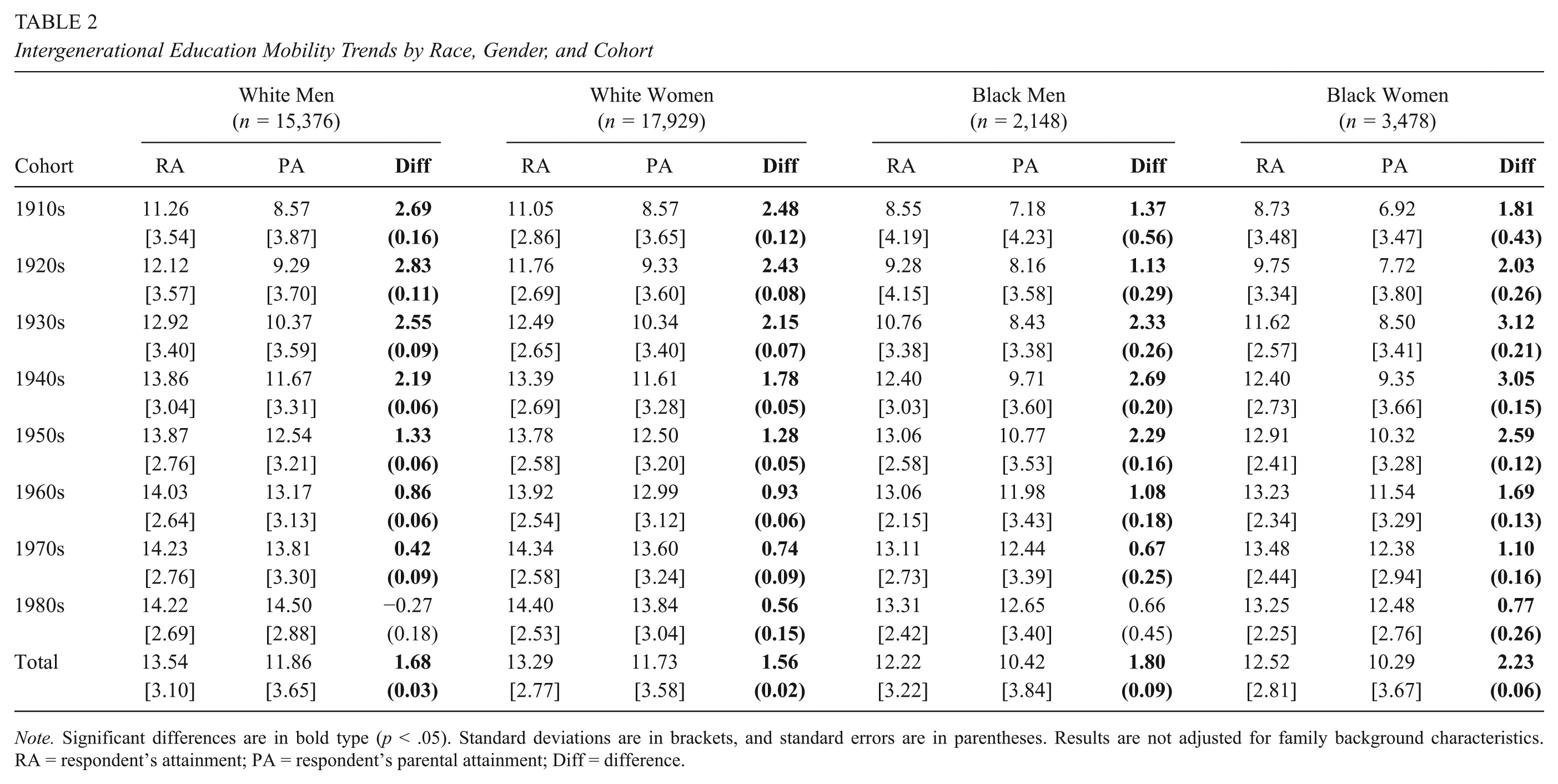
Note. Significant differences are in bold type (p < .05). Standard deviations are in brackets, and standard errors are in parentheses. Results are not adjusted for family background characteristics. RA = respondent’s attainment; PA = respondent’s parental attainment; Diff = difference.

Intergenerational education mobility trends by race, gender, and cohort. These results do not adjust for parental background characteristics. Note. Author’s estimates based on General Social Survey Cumulative File, 1972–2014 (Smith, Marsden, Hout, & Kim, 2015).
The observed differences in total mobility (see Total row in Table 2) among groups were significant, F(3, 38927) = 40.31, p < .001, with Black women (M = 2.23, SD = 3.54) experiencing the greatest education mobility as compared with Black men (M = 1.80, SD = 3.74, p < .001), White men (M = 1.69, SD = 3.48, p < .001), and White women (M = 1.56, SD = 3.22, p < .001). White men’s educational mobility peaked at 2.83 years in the 1920s cohort and then gradually declined to −0.27 by the 1980s cohort, t(1709) = 13.04, p < .001, as their parents’ attainment climbed steadily. White women followed a similar trend that peaked in the earliest decades but finished net positive at 0.56 years, t(2142) = 10.28, p < .001.
Black men’s and Black women’s educational mobility followed a different pattern than that of their White counterparts. For instance, Black men in the 1920s cohort were well behind Black women, t(394) = 2.35, p = .019, and White men and women. The highest observed mobility for Black men was found in the 1940s cohort (M = 2.70, SD = 3.70), but by the 1980s cohort, their average mobility had decreased to 0.66 years, t(494) = 4.54, p < .001. Black women, meanwhile, attained peak mobility in the 1930s cohort (M = 3.12, SD = 3.49), which declined to 0.77 years in the 1980s cohort, t(483) = 7.02, p < .001. While the mobility of Black women finished higher than that of White men, t(465) = 3.38, p < .001, in the 1980s cohort, they were statistically the same as White women and Black men.
The trends in Table 2 and Figure 3 are a useful point of departure, but a regression model allows for the estimation of these trends while including a range of family background characteristics. Table 3 presents the coefficients in four models, with the fourth model containing all covariates and interactions. Model 1 is simply the estimated mobility across all cohorts for White women (constant), Black women (Black + constant), White men (White + constant), and Black men (summation of all four coefficients). All coefficients in Model 1 were significant as anticipated in Table 2. After the family background covariates were included in Model 2, the Black, male, and Black × Male coefficients remained significant and retained the same direction of change.
Ordinary Least Squares Regression of Educational Mobility on Race, Gender, Birth Cohort, and Family Background (N = 38,931)

p < .10. *p < .05. **p < .01. ***p < .001.
In Model 3, the main effects of cohort and Cohort2 were significant and suggest positive linear and negative curvilinear trends, respectively. The Black and male cohort (including Cohort2) interactions were also significant (note: Male × Cohort, p = .073), but the three-way interactions were not. However, in Model 4, the latter three-way interactions were significant at the p < .10 level once the parental education interactions were included. While the two-way interactions between parental education and the cohort variables were not significant, all other parental education interactions in the model were significant—including the three-way interactions among parental education, Black, and male and the four-way interactions among parental education, Black, male, and cohort (and Cohort2).
White men, on average, have experienced greater overall mobility (i.e., across all cohorts) than White women, when controlling for all family background characteristics (p < .001, see Model 2). The interaction between White men and cohort in Model 3 of the White subsample was positive (p = .003) but appears to have evolved through a curvilinear-negative pattern over time (p = .003). In contrast, Black women experienced greater intergenerational education mobility than Black men when controlling for family background (p < .001). The Male × Cohort interaction was not significant in the Black subsample, however, which suggests no additional change beyond the main effects of being a (Black) man and in a particular cohort.
Within gender, Black women’s greater overall mobility over White women (see Table 2) persisted even when controlling for family background (p = .008)—albeit at a decreased level. The Black × Cohort interaction in this subsample was positive (p < .001) but curvilinear negative (p < .001). However, the statistically similar overall mobility between White and Black men shifted to the advantage of White men once controlling for family background (p < .001). The gap appears to have changed over time, though, as evidenced by the positive Black × Cohort (p < .001) and negative Black × Cohort2 (p < .001) interaction terms (in addition to the main effects).
The interaction terms in the model indicate that racial and gender gaps in educational mobility varied across different levels of parental education. Figure 4 illustrates the predicted intergenerational education mobility values for the four subgroups with parental education values of 10, 12, 14, and 16 years. The values for father’s occupation, number of siblings, and income are set to their respective means for each level of parental education (i.e., 10, 12, 14, and 16). For example, father’s occupation for those whose higher-attaining parent finished 16 years of education has a mean of 50.24, but the mean is 39.41 for those with 12 years of education.

Predicted education mobility for levels of parental education—(a) 10 years, (b) 12 years, (c) 14 years, and (d) 16 years—by race, gender, and cohort. Note. Author’s estimates based on General Social Survey Cumulative File, 1972–2014 (Smith, Marsden, Hout, & Kim, 2015).
At 10 years of parental education (see Figure 4a)—and holding other family background variables constant—gender did not appear to further differentiate mobility patterns for Black and White Americans. Black women maintained a consistent gap in mobility over their male counterparts, but the overall difference was not significant and did not change over time. White men and women in this subsample of parental education also shared similar overall mobility despite some evidence of changes over time. For instance, the Male × Cohort (p = .099) and Male × Cohort2 (p = .109) interactions suggested changes over time, but the coefficients were not significant at acceptable levels of certainty. Overall, then, there is little evidence of gender variation within racial groups at this level of parental education despite statistically significant changes between racial groups over time.
The patterns start to change when parental education is set to 12 years (see Figure 4b). Similar to Figure 4a, Black women maintained a statistically nonsignificant distance over Black men across all decade cohorts. However, the gap between Black women and men appears to have widened beginning with the 1960s cohorts. Indeed, Black women born during the 1960s to 1980s cohorts had higher expected mobility than their Black male counterparts (p = .016). White men, however, experienced higher mobility across all cohorts than White women (p = .001) but also lower expected mobility than White women between the 1960s and 1980s cohorts (p = .030). Thus, the evidence suggests that the advantage that White men of high school–educated parents had over White women for many decades gradually decreased to the point of being a disadvantaged position in terms of expected educational mobility. In addition, despite a sizable advantage over Black men in the earliest cohort (p = .003), the gap between White and Black men changed over time (p < .001) such that, by the midcentury cohorts, they had statistically identical levels of expected educational mobility.
Additional evidence emerged that intergenerational education mobility patterns diverged when parental education was set to postsecondary levels. This was especially true in the comparison of Black men and women. The divergence can be observed in Figure 4c and 4d, as nearly identical patterns of mobility were predicted until the 1960s cohort, when Black men began to fall away from the their female counterparts. However, the statistical evidence for this divergence was marginal due to the small cell counts for Black men and Black women with this level of parental education in the latest birth cohorts. Pooling respondents across birth cohorts allowed for an indirect test, however. When parental education is set to 16 years, for instance, Black men in the 1960s–1980s cohorts (combined) had lower mobility than Black women, but the standard error remained large relative to the coefficient (p = .070).
Among White Americans whose parents had 16 years of education (see Figure 4d), however, the overall gap between White men and women (p = .001) did not change significantly over time based on the Gender × Cohort interaction. However, by the 1980s cohort, White men’s educational mobility at this level of parental education was no longer different from White women’s. Across racial categories, it is worth noting that the difference between White women and Black women in Figure 4d—overall and over time—was not statistically significant. The sizable gap between Black men and White men, however, was statistically significant (p < .001) and did not change over time.
Relative Groupings of Parental Education
As noted, substantial changes in the distribution of educational attainment over time suggest that a relative grouping of parental education can deepen the analysis of intergenerational education mobility. Figure 5 illustrates the predicted educational mobility values for respondents of relatively low, medium, and high levels of parental education, respectively (see Appendix Table 1 for coefficients and standard errors). As with the predicted values in Figure 4, the values for father’s occupation, number of siblings, and income were set to their respective means for each tercile. It should be noted that the relative grouping model is not a perfect approximation of the primary model, since parental education is no longer allowed to vary. Nevertheless, the relative differences among groups should hold if the findings are robust.
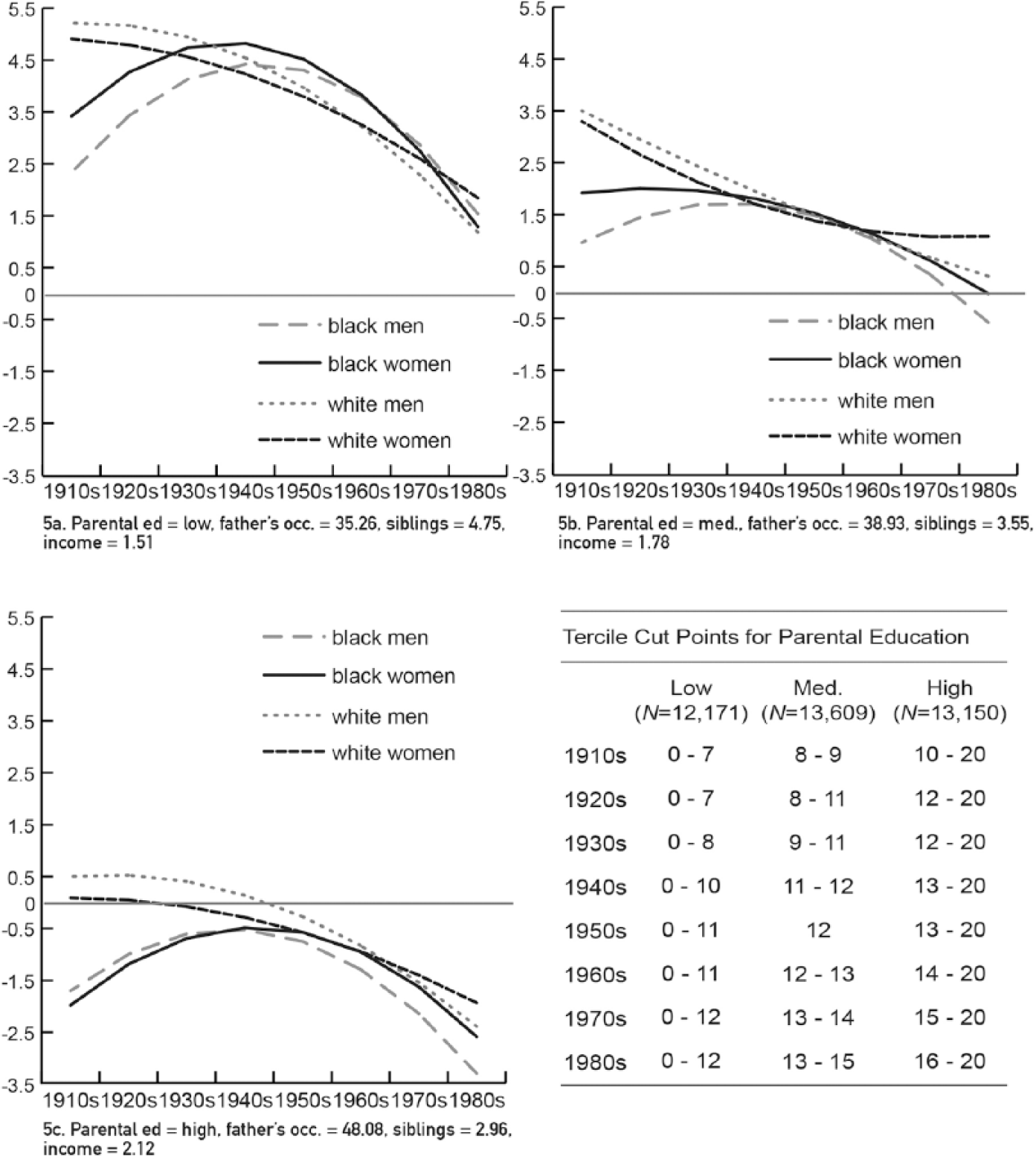
Predicted education mobility for (a) low, (b) medium, and (c) high parental education terciles by race, gender, and cohort. Note. Author’s estimates based on General Social Survey Cumulative File, 1972–2014 (Smith, Marsden, Hout, & Kim, 2015).
As in Figure 4a, gender did not appear to further differentiate racial differences in intergenerational education mobility among those born to parents with relatively low levels of education (see Figure 5a). There were some significant differences in particular point estimates (e.g., White men had lower expected mobility than White women in the 1980s cohort), but the primary finding once again was the gradual shift toward racial parity in expected educational mobility given relatively low levels of parental education. At the medium level of parental education (Figure 5b), there was also a gradual shift toward parity in the midcentury cohorts, but as in Figure 4b and 4c, there was evidence of divergence in the more recent cohorts. For instance, although White men had higher overall mobility than White women (p = .048), a curvilinear-negative trend (p = .015) ultimately led to lower average mobility by the 1970s cohort (p = .001). However, total mobility among Black men and women in the medium tercile was not significantly different overall and did not change over time.
The trends among those with relatively high parental education (Figure 5c) followed a similar pattern as those with high absolute parental education (i.e., 16 years; cf. Figure 4d). Most notably, although Black men’s and Black women’s expected mobility was not significantly different overall, Black men did have lower expected mobility in the 1960s–1980s cohort pool (p = .040). White men, meanwhile, had higher expected mobility overall (p < .001) but again followed a curvilinear-negative trend (p = .036) over time that resulted in the same expected mobility as White women by the later birth cohorts. Unlike the primary model, White women with relatively high levels of parental education did have significantly higher overall mobility than Black women (p < .001). However, the Black × Cohort and Black × Cohort2 coefficients indicated that the trend changed over time (p = .001 and p = .002, respectively) until Black and White women had the same (statistically) expected mobility in the most recent cohorts (i.e., 1960s onward).
Figure 6 offers a different perspective (see Appendix Table 2 for coefficients and standard errors). Instead of expected mobility, these figures illustrate the expected probabilities of bachelor’s degree completion for each group based on the relative levels of parental education. Once again, the overall trends are consistent with the findings from the primary model. At relatively low levels of parental education (Figure 6a), White men had a higher overall probability of bachelor’s degree completion as compared with White women, but by the most recent cohorts, the predicted values were statistically the same. The predicted probabilities for Black men and women were the same overall and remained that way across time.

Predicted probabilities of bachelor’s degree attainment given (a) low, (b) medium, and (c) high parental education terciles by race, gender, and cohort. Note. Author’s estimates based on General Social Survey Cumulative File, 1972–2014 (Smith, Marsden, Hout, & Kim, 2015).
Similar to Figures 4d and 5c, there is substantially more between-group variation in trends for bachelor’s degree completion based on relatively high levels of parental education (see Figure 6c). White men from this group experienced a higher overall likelihood of bachelor’s degree completion than White women, but a negative Male × Cohort interaction (p = .018) in the White subsample led to statistically similar probabilities in the most recent cohorts (42.0% and 48.4%, respectively). However, there is some evidence that Black men of relatively high parental education had lower overall likelihood of bachelor’s degree completion as compared with Black women (p = .051). As noted, when the 1960s–1980s birth cohorts were pooled, Black men had significantly lower probabilities in the more recent cohorts when compared with their female counterparts (p = .049).
Discussion and Implications
Three trends identified here warrant further discussion. First, Black men and women have closed substantial gaps with their White counterparts in intergenerational education mobility. At low levels of parental education, these gains have been experienced equally among Black men and women. Second, as levels of parental education increased, Black men appeared to grow more disadvantaged (i.e., perversely open) over time relative to all other comparable groups. This trend was most pronounced for those Black men born to parents with the equivalent of a bachelor’s degree. Finally, most of the advantages in education mobility that White men experienced in the early and midpart of the 20th century disappeared by the 1960s birth cohorts. The erosion of these advantages occurred because White men’s educational mobility has remained stagnant, while formerly excluded groups (especially White and Black women) have made steady gains.
In the early part of the 20th century, Black men and women born to high school–educated parents with average income, occupation, and family structure, on average, experienced a pattern of perverse openness. That is, the educational advantages accrued by Black men and women during this time were not easily passed on to their children. However, by the middle of the century, the latter groups experienced positive intergenerational growth in their average years of education attainment and had expected mobility values that were identical to their White counterparts (cf. Bloome & Western, 2011). Black and White men and women born to high school–educated parents in the 1980s experienced at least a year and a half of positive education mobility. In this sense, all groups born during the most recent cohort were expected to outperform their parents who were high school educated or less. Although this may not be a provoking finding, it is a remarkable change when considered in the historical context of the 20th century.
While all groups in the 1980s cohort were expected to experience positive educational growth when born to parents who were high school educated or less, Black and White men born to high school–educated parents appear to have lost ground to Black and White women since the 1960s cohorts. At this level of parental education, then, the primary educational mobility gap appears to be more strongly connected to gender than race. Thus, even though all groups are experiencing positive growth across generations, Black and White men born to high school–educated parents are increasingly disadvantaged relative to their female counterparts. This finding is generally consistent with widespread evidence of an expanding female advantage across a range of educational outcomes (Buchmann & DiPrete, 2006; DiPrete & Buchmann, 2013; McDaniel et al., 2011). The extent to which this advantage is having an impact on the disadvantages that women face in other contexts of social life (e.g., income) is a question that should be pursued in future research.
Although substantial gains toward equality were observed across all levels of parental education, there was some evidence that in recent decades Black men were distinctly disadvantaged at the postsecondary levels of parental education. Previous research has found that a middle-class family background no longer offers the same educational advantages to Black students as it did for White students (Long et al., 2012). The present findings suggest that it is Black men, in particular, who are experiencing a perverse openness when it comes to intergenerational education mobility at the highest levels of parental education. In fact, Black women experienced the greatest overall mobility (among any group) and, at the higher levels of parental education, did not have significantly different patterns of mobility than White women. In this sense, Black men and women born to higher-educated parents are now following disparate intergenerational cycles of mobility. Should this trend continue along its current path, Black men born to the middle class would face an increasingly difficult challenge in maintaining a virtuous cycle.
Previous research has documented how the forms of institutional discrimination and racism faced by Blacks overall can have a more negative impact on Black men inside and outside the education system (M. Alexander, 2012; Haskins, 2014; Neal & Rick, 2014; Skiba, Michael, Nardo, & Peterson, 2002). Thus, future researchers investigating these trends concerning Black men must proceed within a context of intersecting cultural dynamics and institutional environments with complicated historical developments (Choo & Ferree, 2010). It is plausible, for example, that these trends are shaped through gendered and raced peer expectations of masculinity (Ispa-Landa, 2013; Morris, 2012; Pattillo-McCoy, 1999). It is also plausible that racialized tracking structures within primary (Rist, 1970) and secondary (Harris, 2000; Lucas, 1999; Tyson, 2011) schools are having a differential impact on Black boys, as well as the gradual dismantling of affirmative action policies in higher education that have taken shape across the United States during the period in question (Hinrichs, 2012, 2014).
Prior literature has also established that gendered attainment gaps are largely attributable to women’s superior performance on measures of student achievement (Buchmann & DiPrete, 2006). It could be that women’s performance advantages in the education system are creating intergenerational separation. This does not appear to be the case for Black women and Black men at the lower levels of parental education, but it is certainly possible at the higher levels. These performance advantages, along with apparent differences in labor market incentives favoring Black women (Bound & Freeman, 1992; McDaniel et al., 2011), may also be having a unique impact on the education trajectories of Black men born to higher-educated parents. Addressing these speculations within a holistic analysis would make a significant contribution to our understanding of social inequality in the United States.
Another story that emerged from the findings was the steady disappearance of many intergenerational advantages once experienced by White men in education attainment. By the 1980s cohort, White men born to parents with lower levels of education (e.g., 12 years) shared the same expected mobility with Black men and fell behind that of Black and White women. At the higher levels of parental education (e.g., 16 years), White men did retain a considerable advantage over Black men, but this had more to do with the decline in mobility of the latter group after the 1960s birth cohort. These patterns of stagnant education mobility point to a unique situation for White men relative to their female counterparts. Indeed, White women were the only group to make steady gains across all cohorts and levels of parental education.
Much like the findings for Black men, future work on White men’s intergenerational education trajectories must examine these group-centered patterns within a complex and intersecting institutional environment—albeit one that obviously looks very different than it does for Black men. As noted, White women’s educational advantages over White men in education attainment are evidently due to their superior performance on measures of achievement (Buchmann & DiPrete, 2006). The data used in this study did not permit such an analysis, but they do confirm that White women’s gains in intergenerational education mobility are steadily increasing across multiple levels of parental education. In addition, not only are White women of high school–educated parents now experiencing greater educational mobility than White men, but if trends continue, they will exceed the mobility of their male counterparts at the postsecondary parental level of education, too.
Implications
The education system remains a very important institution for the normative goal of democratizing opportunities to attain the necessary conditions to flourish in modern societies (Massey, 2006). Paying attention to patterns of education mobility offers educators and policymakers a key barometer toward this end by indicating the extent to which group-specific patterns are progressing toward equality (e.g., a “virtuous cycle,” see Gamoran, 2001, 2015; Mare, 1995) or forms of perverse openness (Gosa & Alexander, 2007; Hout, 1984). While the findings here do not offer any concrete suggestions in the way of programmatic changes, they do provide insight into which groups are moving in desirable and undesirable directions relative to the normative goal of social mobility (Labaree, 1997).
The findings suggest that Black men and Black women born to parents with the lowest levels of education—and that Black women with the highest levels of parental education—now experience the same levels of education mobility relative to their White counterparts with the same family background characteristics. While it cannot be determined here if these gains are the result of any specific policy efforts, it can be concluded that changes in the normatively desirable direction have occurred. Gaining a better understanding of the social, cultural, and political conditions influencing these trends would be an important step in ensuring that they continue in the same direction and possibly open up new opportunities where trends are stagnant or moving in a downward direction. Most notably, Black men born to parents at the highest levels of education appear to face a perverse openness indicative of an imposing set of institutionalized barriers. The latter trend poses serious challenges for education and social policy.
With the exception of White women, in recent decades there has been a shift toward stagnation in the predicted patterns of intergenerational education mobility. While stagnation may not be problematic at the higher levels of parental education, this raises serious concerns at the lower levels of parental education, given the extent to which a college degree minimizes the direct effects of socioeconomic origins on socioeconomic destinations in the United States (Pfeffer & Hertel, 2015; Torche, 2011). Thus, policy makers should continue to focus efforts on promoting educational access and retention among first-generation college students. At the same time, specific efforts must be directed toward middle-class Black men, as this group does not appear to have maintained the same intergenerational gains as their female counterparts.
In a recent policy brief, Gamoran (2015) suggested a variety of strategies for reducing the racial and socio-economic inequality in education and addressing the perverse openness that is often observed among disadvantaged students. These suggestions include building strong research partnerships with school districts in an effort to identify and replicate successes at the local level. A key point that is stressed in the brief, though, is to move “beyond ‘what works’ to what works for whom and under what circumstances” (pp. 18–19). The findings here suggest that these types of policy interventions—especially those aimed at building and sustaining virtuous cycles—need to be attentive not only to racial and social class dynamics but also to gender. In addition, based on the bird’s-eye view of these findings, efforts to scale up successful interventions will likely encounter additional variables related to school organization (e.g., tracking), peer effects, and other factors known to shape educational trajectories. Indeed, researchers, parents, and educators face a great deal of complexity in working to build and sustain virtuous cycles. The evidence here suggests that meaningful gains are possible, but these advances are never fixed and, at least for certain groups, can reverse course over time.
Footnotes
Appendix
Logistic Regression of Bachelor’s Degree Attainment on Race, Gender, Birth Cohort, and Family Background, by Tercile

| Low Tercile (n = 12,171) |
Medium Tercile (n = 13,609) |
High Tercile (n = 13,150) |
||||
|---|---|---|---|---|---|---|
| B | SE | B | SE | B | SE | |
| (Constant) | −3.981 *** | 0.325 | −3.585 *** | 0.214 | −3.517 *** | 0.161 |
| Black | −0.631 | 0.699 | 0.562 | 0.572 | −0.112 | 0.556 |
| Male | 1.343 *** | 0.337 | 1.151 *** | 0.241 | 0.897 *** | 0.161 |
| Black × Male | −0.675 | 0.970 | −1.957 † | 1.009 | −0.841 | 0.783 |
| Father’s occupation | 0.022 *** | 0.004 | 0.021 *** | 0.002 | 0.033 *** | 0.002 |
| Single mother | −0.102 | 0.348 | 0.046 | 0.309 | −0.026 | 0.479 |
| Siblings | −0.134 *** | 0.012 | −0.140 *** | 0.010 | −0.121 *** | 0.009 |
| Income | 0.042 | 0.038 | 0.033 | 0.033 | 0.221 *** | 0.031 |
| Cohort | 0.490 *** | 0.139 | 0.701 *** | 0.099 | 0.622 *** | 0.069 |
| Cohort2 | −0.030 † | 0.017 | −0.056 *** | 0.013 | −0.053 *** | 0.009 |
| Black × Cohort | 0.457 | 0.342 | −0.167 | 0.287 | 0.020 | 0.285 |
| Black × Cohort2 | −0.071 † | 0.040 | 0.003 | 0.036 | −0.011 | 0.036 |
| Male × Cohort | −0.253 | 0.180 | −0.317 * | 0.133 | −0.221 * | 0.095 |
| Male × Cohort2 | 0.003 | 0.022 | 0.013 | 0.018 | 0.008 | 0.013 |
| Black × Male × Cohort | −0.054 | 0.486 | 0.611 | 0.503 | 0.156 | 0.413 |
| Black × Male × Cohort2 | 0.035 | 0.058 | −0.043 | 0.062 | −0.012 | 0.053 |
p < .10. *p < .05. ***p < .001.
Acknowledgements
I thank the editor and anonymous reviewers for their insightful critiques and suggestions during the peer review process. In addition, Joseph Waddington and You Geon Lee provided extended feedback that was crucial to the development of the manuscript. All errors are my own.
2.
To test for this bias, an ordinary least squares model was run after cutting respondents <30 years old. The results were nearly identical when coefficients and standard errors were compared. However, increasing the age cutoff to 30 years effectively eliminated the 1980s cohort for Black men and women. Thus, based on the nearly identical results, the cutoff remained at 25 years in the interest of retaining the most recent decade birth cohort.
3.
Because of the extreme range of education mobility from the mean (5–6 SD; see  ), the model was rerun after trimming the distribution down to 4 SDs above and below the mean. The model run on the trimmed sample did not meaningfully change any of the coefficients, standard errors, or p values—thus, the decision to retain the outliers in the analytic sample.
4.
The General Social Survey did not ask for mother’s occupation prior to 1994; thus, father’s occupation was used due to the interests in using the full cumulative data set. Long, Kelly, and Gamoran (2012) used the same approach with the 1972–2006 cumulative data set. The authors conducted a sensitivity analysis to assess their imputation of father’s occupation for single mother households and found the results to be nearly identical as compared with use of the highest parental occupation prestige among either parent for the 1994–2006 data sets when mother’s occupation was available (see p. 20, footnote 6).
5.
Not only were the means and standard deviations of the variables compared, but the imputed ordinary least squares coefficients and standard errors were also compared with those generated with the preimputed data. In general, the magnitude and direction of the coefficients were very similar to those in the imputed model. The most notable difference was that the standard errors for the parental education interactions (Model 4) decreased in the imputed model. As a result, some of the interactions that were not significant in the original model ended up significant in the imputed model even though the coefficients remained very similar.
6.
I am grateful to the editor and one of the anonymous reviewers for their suggestion to pursue this strategy.
Author
JOSEPH J. FERRARE is an assistant professor in the Department of Educational Policy Studies and Evaluation and Department of Sociology (secondary), University of Kentucky, 597 S. Upper St., Lexington, KY, 40506-001;