



Abstract
The literature shows that education can work to maintain social class status (wealth reproduction) or provide upward mobility (wealth production). Against this backdrop, we examine U.S. billionaires’ attendance rates at Ivy League universities, with a focus on origin of wealth and gender. Using data from The Forbes World’s Billionaires list (2010–2023) combined with information retrieved from Wikidata, we analyze a sample of 1,028 individuals. Of these, 26% attended an Ivy League school. Attendance was slightly higher for male heirs than for self-made men, despite their nearly identical rates of U.S. university attendance. Self-made women, however, showed much higher Ivy League attendance rates than female heirs. Our findings offer a descriptive account of billionaires’ educational backgrounds that carries theoretical implications: An Ivy League education may fulfill different functions according to wealth origin and gender, reinforcing privilege for some (male heirs) while acting as a tool of advancement for others (self-made women).
Keywords
Introduction
The extant literature on elites—broadly conceptualized as those who have control over not only vast resources but also their distribution and valuation (Bourdieu, 1986; Khan, 2012)—has shown that education functions both to facilitate entry into the elite and to keep out those without certain credentials (see Stevens et al., 2008). What matters in this process, though, is not the level of one’s education (Bukodi & Goldthorpe, 2011; Kaplan & Rauh, 2013; Lebaron & Dogan, 2016). Rather, it is the social status of the institution attended (Lucas, 2001; Stevens et al., 2008; Useem & Karabel, 1986).
This article examines attendance rates of U.S. billionaires at Ivy League universities, with particular attention to origin of wealth and gendered differences. The Ivy League refers to a group of eight schools in the Eastern United States: Brown University, Columbia University, Cornell University, Dartmouth College, Harvard University, University of Pennsylvania, Princeton University, and Yale University. As we discuss in the methodology section, we see the Ivy League as a sufficient, albeit imperfect, proxy for elite education. To construct a sample of billionaires, we used data from The Forbes World’s Billionaires list, from 2010 to 2023. We refer to these individuals as “billionaires-in-making” when they were at university, as they were probably not yet billionaires at the time of their studies.
Studying billionaires’ educational histories fills a crucial gap in the literature. Most quantitative studies of elites’ educational histories define the elite by their positions—as CEOs, top executives, board members, and so forth (i.e., Bühlmann et al., 2022; Hartmann, 2000; Salas-Díaz & Young, 2025). Yet, the very rich are not necessarily rich because they run large companies. They may, for example, have inherited wealth. This is especially true for women (Ischinsky & Tisch, 2022). Moreover, as Piketty (2014) has famously argued, capital returns from wealth have outpaced the growth rate of income—meaning that those who already have wealth are getting richer faster than those who are earning it (see also Hansen, 2014; Wolff & Zacharias, 2009). Since wealth in and of itself is associated with educational outcomes as well as labor market outcomes, home ownership, retirement, marriage and parenthood (for an overview, see Killewald et al., 2017), the lack of this kind of research on billionaires leaves a noticeable gap in our knowledge about how education and extreme wealth relate, especially when it comes to gender.
We start by reviewing the literature on the role of education in wealth reproduction and wealth production. We then focus on what we know about the gendered nuances at play. Following that, we present our methods and findings. In particular, we show that among male billionaires, Ivy League attendance is slightly higher for heirs than for the so-called self-made, despite nearly identical rates of U.S. university attendance. For the women, on the other hand, the self-made show much higher Ivy League attendance rates than heirs. These women match men in their U.S. university (but not Ivy League) attendance rates. We would like to point out that we use the term “self-made” because the Forbes data does; however, we remain critical of this term. We briefly discuss this later in our literature review but a more complete problematization of the term can be found elsewhere (Lillie & Tisch, 2025).
Our findings offer a descriptive account of billionaires’ educational backgrounds. They also carry theoretical implications. The findings suggest that an Ivy League education may play different roles according to one’s wealth origin and gender, participating in the reproduction of wealth for some (male heirs) and the production of wealth for others (self-made women). Such findings thus open the door to further exploring how educational credentialing relates to the gendered reproduction of wealth inequalities.
Education and Wealth (Re)Production
Education plays a dual role when it comes to social class. Although it often maintains status (wealth reproduction), it also holds moments of opportunity for upward mobility (wealth production). The following literature review discusses both of those roles and then turns to how this applies to women in particular. Overall, it shows that a seemingly similar educational path might take on different meanings for different kinds of billionaires—that is, for inheritors versus the self-made.
For the Inheritors
When it came to the reproduction of status, according to Bourdieu (1996), wealthy families realized that passing down economic resources was not enough to ensure their children’s position in society. So, they turned to prestigious educational degrees to mediate this process. Attending a prestigious institution in societies labelled as meritocratic signals not only talent and capability (Reeves & Friedman, 2024; Rivera, 2015), but also social polish and the potential for power and influence (Rivera, 2011). Such attendance thereby offers a seemingly objective, external stamp of approval in those societies that legitimizes wealth accumulation, particularly through inheritance (Bourdieu & de Saint Martin, 1978; Khan, 2011; Williams & Filippakou, 2010, to name a few studies of France, the United States, and the United Kingdom, respectively).
Education’s function in the reproduction of wealth and status for inheritors, at least in Western, capitalist countries, has been theorized as a “wormhole” (Nespor, 2014). The wormhole starts with the family. Wealthy families often not only normalize the idea of attending a prestigious institution (Mullen, 2009), but also instill in their children a way of being—an “incorporated cultural capital”—that is recognized and rewarded in the admissions process (Bourdieu, 1996). Family wealth then smooths the path to prestigious educational institutions (Useem & Karabel, 1986). For example, wealthy families can afford tuition fees for high-status secondary schools with connections to high-status universities (Cookson Jr. & Persell, 1985; Persell & Cookson Jr., 1985; Stevens, 2007), as well as for “extras” like tutors, entrance exam preparation, and extracurricular activities (Dräger, 2022; Müller et al., 2020; Pfeffer & Hällsten, 2012).
The wormhole then connects high-status institutions to personal wealth through the cultivation of valuable social networks (Bond, 2012; Neely, 2018) and prized personal characteristics (Friedman & Laurison, 2019; Stevens et al., 2008; Williams & Filippakou, 2010), as well as through recruitment into high-paying jobs (for longitudinal studies, see Katchadourian & Boli [1994] in the U.S. context, and Macmillan et al. [2015] in the UK context). The personal wealth that has been accumulated is then reinvested back into the education of one’s children, reactivating the wormhole for the next generation.
Thus, for inheritors, education plays a specific role through well-known mechanisms in the reproduction and legitimation of their wealth. It is perhaps no surprise that in the United States, according to Chetty et al. (2020), the children of families in the economic top 1% are 77 times more likely to attend an “Ivy-Plus” school (the Ivies plus Duke University, MIT, Stanford University, and the University of Chicago) than those of families in the economic bottom 20%. Although, it should be noted that these processes seem to take a different form for wealthy families looking beyond their national context and trying to launch their children into transnational futures (Lillie, 2021a, 2021b; Maxwell & Lillie, 2024).
For the Self-Made
The step from high-status institutions to personal wealth is also when educational institutions become part of the story of wealth production. In looking at upper-tail mobility rates—meaning, the fraction of students from bottom-quintile families who end up with top 1% earnings—Chetty et al. (2020) show that the highest rates are concentrated at wealthy, highly selective private universities, which also describes the Ivy League. One explanation is that a high-status credential, as we will explain, increases the chances of getting a high-paying job. This can lead to the creation of self-made billionaires.
“Self-made” is a term that we are highly critical of (for a full discussion, see Lillie & Tisch, 2025). The term is often applied to those who founded a business or seemingly built their fortune from the ground up (Korom et al., 2017; Scheuer & Slemrod, 2020). In the U.S. context, where meritocratic discourses prevail, self-made wealth is idealized as wealth that was earned through hard work and ambition, and therefore as wealth that is deserved (Gaztambide-Fernández, 2009; Ho, 2009; Khan, 2011).
This idealization carries problematic consequences. For one, it suggests that inequality is the natural outcome of some people having more talent and ambition than others—and therefore that inequality is fair (Andersen et al., 2021; Son Hing et al., 2019). For another, it allows the wealthy to claim moral legitimacy by suggesting that their wealth is warranted (Sherman, 2017). Finally, and most relevantly for this article, it rewards the paid labor typically done by men while ignoring the unpaid labor typically done by women, despite such labor sustaining wealthy families through childcare, civic engagement, and other activities (Ostrander, 1984; Sherman, 2017). In the methodology section of this article, we further reflect on using this label in our analysis and compare it to other academic conceptualizations of social mobility and wealth production.
For the purposes of this literature review, however, the concept of self-made wealth is relevant as it relates to the ability of high-status educational institutions to facilitate making large fortunes. Returning to where we left off—how a high-status education can lead to a high-paying job—one factor at play is a university campus environment that encourages particular career choices (Armstrong & Hamilton, 2013). On-campus recruitment events and the influence of peers at top-ranked American universities, for example, tend to funnel students into the high-wealth, high-status sectors of finance, consulting, and technology (Binder et al., 2016), as well as law and business (Schleef, 2000).
Another factor is the signaling function of degrees from prestigious universities. An analysis of almost 2,000 managers from both financial and non-financial firms in the United States shows that university prestige matters strongly in finance, and particularly in the high-paying subsector of private equity, more so than one’s functional background or length of education (Bühlmann et al., 2022). A degree from a highly-ranked university—more specifically, from Harvard, Princeton, Stanford, or Yale—is, in fact, how applicants for jobs at high-status American investment banks, law firms, and management consulting firms are first screened (Rivera, 2011). Perhaps unsurprisingly, employers who themselves attended those schools place the most emphasis on them, justified through the rhetoric of hiring people who would fit into the existing culture (Rivera, 2012).
It is, however, important to keep in mind that for billionaires, an important path to wealth accumulation is through business ownership and entrepreneurship. For those individuals, the story of entry into high-paying jobs may be less central, although some billionaire entrepreneurs, like Vivek Ramaswamy—also an Ivy League graduate—may have gotten their start there. Instead, it may be the social contacts made at such schools (Maclean et al., 2017), or the signaling of talent and potential that such credentialing offers (Rivera, 2011, 2015), that later leads to securing business investments.
Also, when thinking about upward mobility through high status universities, one needs to keep in mind that such universities have a long, ongoing tradition of primarily serving the wealthy (Chetty et al., 2020; Karabel, 2005). Those from less advantaged backgrounds have been shown to be marginalized to the periphery of these kinds of environments (Lillie, 2024; Reay et al., 2009; Reeves & Friedman, 2024). Such marginalization conceivably hinders one’s ability to take advantage of these institutions’ possibilities for upward mobility.
Where the Women Fit in
Gender dynamics are woven through the story of wealth (re)production told above. There is a gender-segregated labor market and a gender pay gap (Seehuus & Strømme, 2025), including in high paying sectors like finance (Roth, 2011). The most well-paid sector in the United States—the hedge fund industry—often excludes women through its hiring and mentorship practices and even seed funding choices (Neely, 2018). Top U.S. law firms are also less likely to hire women than men from the same social background (Rivera & Tilcsik, 2016). Hartmann describes how these hiring processes can work against women: Candidates for a board position must “be convincing within the first 20 seconds,” an impression based on such gendered characteristics as attire and mannerisms (2000, p. 252; see also Ren, 2024). Women also face barriers to business ownership and self-employment, both of which are a main driver of wealth accumulation (Waitkus & Minkus, 2021). All of this is exacerbated for mothers, who find themselves pushed out of high-paying careers not only by incompatible work–life structures and expectations, but also by discriminatory practices and assumptions (Lin & Neely, 2017; Neely, 2020) .
Given all of the disadvantages that women face in lucrative labor markets, it is perhaps no surprise that women join the economic top 1% more often through inheritance or marriage than through their own careers (Keister et al., 2021). They also become billionaires through inheritance more often than men do (Ischinsky & Tisch, 2022). However, even when it comes to inheritance, women are disadvantaged in comparison to men. Sons often receive assets that are of higher value, that have higher returns—for example, business equity versus real estate—and that are taxed lower than daughters do (Bessière, 2022; Bessière & Gollac, 2023; Tisch & Schechtl, 2024). When it comes to inheritance through marriage, although marriage can be economically favorable for women, divorce leaves men in a better financial position than women (Bessière & Gollac, 2023; Kapelle & Baxter, 2021). Even remarried women have been shown to have less wealth than those who remain in a first marriage (Nutz, 2022).
How do these gendered channels to extreme wealth intersect with education? In the United States, this story is complex. Much of the Ivy League initially educated only men. Of the Ivies, only Cornell University was open to women from its foundation, in 1891. As Karabel (2005) shows in his history of admissions at Harvard, Yale, and Princeton, at the turn of the 20th century, these schools typically admitted male students from a small selection of secondary schools that educated primarily the sons of white, Anglo-Saxon, Protestant families from the American northeast. The 1960s, however, ushered in a new era informed both by a need for universities to be more internationally competitive in the context of the Cold War (Labaree, 2016), and by social demands for higher education to become more diverse, including co-educational. Harvard, Princeton, and Yale, for example, ultimately agreed to coeducation when it was clear that admitting women was necessary to maintain their appeal and therefore their prestige (Malkiel, 2016).
Consequently, as Karen (1991) shows, from the 1960s to the mid-1980s—which is, in fact, when many of those in our sample were at university—women made substantial gains in their access to the Ivy League. Women comprised 23% of the Ivy League in 1960 and 43% in 1986 (compared to 37% and 51%, respectively, of all U.S. university enrollments). However, institutional inclusion does not necessarily translate to social inclusion. At Oxford and Cambridge, for instance, there has traditionally been a “social center” composed of white, wealthy men from a small set of private secondary schools (Reeves & Friedman, 2024).
This background on women in the Ivy League carries implications for all three groups of female billionaires in our study: the self-made, inheritors through parents, and inheritors through marriage. As already discussed, the funneling from prestigious universities into high-paying sectors may play a central role in wealth creation for female self-made billionaires, but such institutions also have a networking function, facilitating the creation of potentially powerful and wealthy contacts (Stevens et al., 2008). A study of women’s roles both as entrepreneurs seeking investment capital and as investors providing it suggests that in comparison to men, women have less social capital that can be activated in these processes (Brush et al., 2002). Being able to potentially convert the social capital accumulated at prestigious universities into the economic capital needed to fund successful businesses may help to propel women into extreme wealth of their own making.
For those who inherit through parents, the “wormhole” would have become most relevant once prestigious educational institutions opened their doors to women. Even then, it is unclear to what extent wealthy families would have invested in their daughters’ education versus their sons’—and, moreover, how a high-status education for girls would have been defined (May, 2023) or what effects it would have had. Research has found that although alumnae of prestigious girls’ schools in the United Kingdom have been successfully propelled into elite positions, this effect of schooling is less for them than for their male counterparts (Worth et al., 2023). One explanation that Worth et al. (2023) offer for this is a tension in British girls’ schooling between learning the formal curriculum and learning gendered social roles (see also Arnot, 1983).
Finally, for inheritors through marriage, it is again helpful to look at the British context. Women in the United Kingdom often entered the elite through marriage. For those women, especially those born in the mid-20th century, Oxford and Cambridge were important spaces for meeting future husbands (Worth & Reeves, 2024). It is possible that, like in the United Kingdom, high status U.S. universities also function as critical spaces where women meet future husbands who facilitate their social mobility.
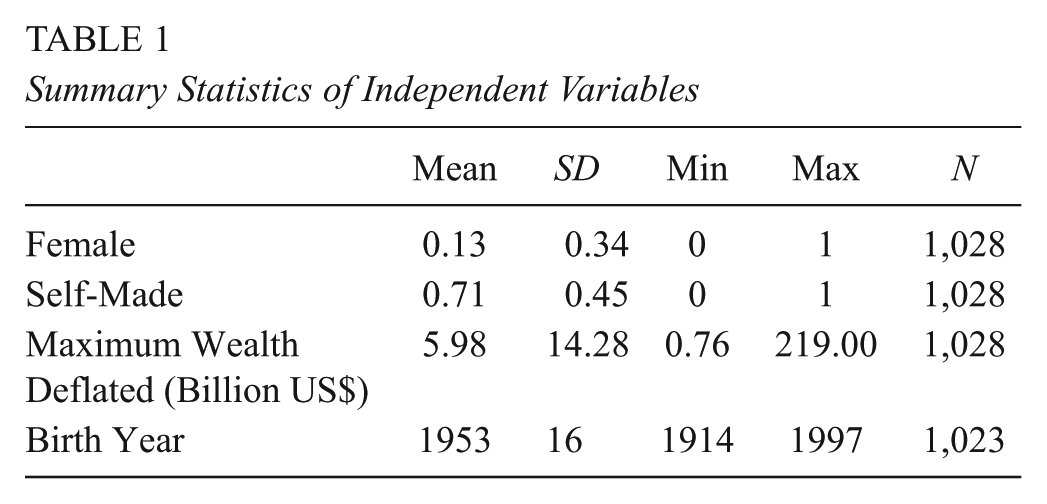
Overall, however, it is important to point out that very few women in the United States make it to the rank of billionaire. As Table 1 shows, only 13% of those in our sample are women. Moreover, as shown in another study of the Forbes 400 list, which focuses on American billionaires, women’s financial successes are consistently attributed more to others (parents and marriage partners) than to themselves, while for men’s successes, it is the reverse (Lillie & Tisch, 2025).
Summary Statistics of Independent Variables
Methodology
We constructed a dataset based on the Forbes World’s Billionaires list. This list is an annual global ranking of individuals (or sometimes families) estimated to have at least a net worth of US$1 billion by Forbes magazine, an American business magazine. Forbes has been publishing these rich lists since 1987 (Tsigos & Daly, 2020). According to Forbes, individual wealth figures are estimated using publicly available information on company shares, art collections, and real estate (Peterson-Withorn, 2018).
There are a number of limitations to using these kinds of lists. For one, the Forbes list may not be complete or entirely accurate. This is partly because of the reliance on public data and partly because the politics behind inclusion and asset valuation are unclear. As Raub et al. (2010) point out, it is very hard to assess the market value of a non-liquid asset, like a business, without actually selling it. For another, the Forbes data is somewhat misleading. Its categories of self-made and heir are not mutually exclusive; inherited wealth and privilege often facilitate the success of a new business. Finally, Forbes labeling may be biased. A study of the British Sunday Times Rich List, for example, traced 81% of entrants back to privileged backgrounds, despite the newspaper’s claim that 94% were “self-made” (Schimpfössl & Monteath, 2022).
Despite these limitations, quantitative studies of the wealthy have extensively relied on lists like Forbes for a number of reasons. First, they seem to be the most reliable source available (e.g., Beaverstock et al., 2004; Ischinsky & Tisch, 2022; Neumayer, 2004; Schneickert, 2018). Second, they are methodologically advantageous in terms of avoiding power issues between researcher and subject (Ellersgaard et al., 2022; Gaztambide-Fernández, 2009; Lillie & Ayling, 2021) and unpacking broader trends over time (Reeves & Friedman, 2024). Finally, although Forbes is a non-academic source, its classifications are sociologically relevant. Goffman’s (1974) “frame analysis,” for example, suggests that such labelling shapes not only self-identities but also public discourses (see Lillie & Tisch, 2025).
Other academic conceptualizations of social mobility and wealth production admittedly have advantages over the Forbes classifications of heir and self-made. For instance, the terms “dynastic” and “non-dynastic” importantly shift the unit of analysis to the family. “The big jump,” as another example, is more sensitive to structural conditions (to see how a relabeled Forbes’ list might look, see Lillie & Tisch, 2025). With this in mind, we approach Forbes’s labels as one particular way of classifying billionaires—and see our work as describing the educational history of U.S. billionaires according to those labels.
We identified all U.S. billionaires who appeared on the list from 2010–2023. Prior to 2010, the list focused on family wealth and therefore ranked primarily families rather than individuals. Additionally, the global financial crisis from mid-2007 to early 2009 created some aberrations in the Forbes Billionaires List. Starting our analysis from 2010 thus gives us a relatively stable sample of individual persons.
Excluding families (n = 5) from our dataset, our sample consists of 1,028 individuals. Using the Forbes website, Forbes magazines, and Wikidata, we gathered information on the demographic characteristics of those individuals. Wikidata is a multilingual, collaboratively maintained knowledge graph hosted by the Wikimedia Foundation. It contains machine-readable, structured data about a wide range of entities, including topics and people, each on a dedicated page (Vrandečić & Krötzsch, 2014). We were able to manually link 873 billionaires (85%) from our sample to their respective Wikidata page. We then extracted information from that page about the individual’s educational background and socio-demographics. Combining information provided by Wikidata and Forbes with manual research, we identified at least one higher educational institution for 95% of the billionaires in our dataset.
We focused on Ivy League attendance because the Ivy League is a recognizable and prestigious brand, particularly in the United States (Bühlmann et al., 2022). We understand that this choice may not perfectly align with national or world university ranking lists. For example, MIT (not Ivy League) may have a greater global presence than Brown University (Ivy League), given the former’s focus on engineering and technology and the latter’s focus on the liberal arts. Still, an Ivy League degree is largely seen as a high-status one that provides advantages in wealth (re)production, as discussed in the literature review. Therefore, although it is imperfect, the Ivy League acts as a sufficient proxy for elite education.
Variables
Forbes only lists one citizenship per billionaire on its list, which we used to select our sample of U.S. billionaires. We recognize, however, that many of the superrich are mobile, with several residencies, international networks, and offshore investments (Beaverstock et al., 2004; Harrington, 2016). We coded our sample of U.S. billionaires as Ivy League educated (= 1) or not (= 0). We also coded them as female (= 1) or male (= 0). Forbes did not use any other gender categories. Additionally, we created a variable indicating the birth year of each billionaire. For the five individuals whose birth year could not be determined, we used the mean birth year of the group corresponding to their gender, origin of wealth, and status as living or deceased.
We also created two wealth-related variables. One, origin of wealth, indicates whether the billionaire was classified by Forbes as self-made (= 1) or an heir (= 0). As already discussed, we are critical of the category “self-made” but use it because Forbes does. The other variable, personal wealth, indicates the amount of wealth the billionaire was estimated to own at the time they appeared on the Forbes list. We adjusted this amount for inflation using the reference year 2022. If a person appeared on the list in multiple years, we used the highest estimated value of their fortune.
Table 1 presents key summary statistics of our independent variables. It highlights that the billionaires in our sample are predominantly male (87%) and largely self-made (71%). The average amount of wealth is approximately US$6 billion and the mean birth year is 1953, indicating that the typical billionaire from our sample likely attended university in the early 1970s. Additionally, Table 1 shows that except for the variable indicating birth year, there are no missing values among the independent variables.
The missing information on educational background (5%) is not missing at random. Table 3 reveals that coverage rates are higher for male billionaires compared to female billionaires. This may be due to a societal “valorization” of men’s professional ambitions and “trivialization” of women’s, leading women in top corporate positions to manage their identities accordingly (Adamson & Johansson, 2021). When interpreting our results, then, Ivy League attendance may be detected more frequently among the groups for which we have more information. However, we assume that most U.S. billionaires seek to publicly disclose their Ivy League attendance, given its high status. Therefore, we assigned missing data on educational background the value of non-Ivy League educated (=0).
Descriptives of Ivy League Educated Billionaires
Within our sample, approximately 89% of billionaires pursued higher education in the United States, with nearly 26% having attended Ivy League institutions. Harvard stands out as the top institution, with over 11% of billionaires having studied there (Table 2). This supports work by Salas-Díaz and Young (2025) which finds that Harvard plays a central role in the education of a global sample of political, policymaking, economic, corporate, and third sector elites.
Attendance at U.S. Universities Overall and Ivy League Institutions in Particular

Figure 1 illustrates the relationship between Ivy League school attended, gender, and wealth origin. In this network graph, each node represents a billionaire, and the different colors of the ties represent which Ivy League school they attended. The color and shape of the nodes represent gender and origin of wealth, respectively. Two notable patterns emerge from this figure. First, as already noted, Harvard dominates the network. Second, there is an uneven gender distribution across Ivy League schools. Strikingly, no women in our sample attended Brown University or Dartmouth College.

Network of Ivy League Alumni Among U.S. Billionaires
Table 3 shows university attendance rates of our sample by gender (male vs. female) and origin of wealth (inherited vs. self-made). Self-made billionaires have somewhat higher attendance rates than heirs at both U.S. universities in general and Ivy League institutions in specific. Table 3 further shows that there are pronounced disparities between men and women in their educational backgrounds, particularly when it comes to Ivy League universities. The data shows that 91% of male billionaires attended American universities, compared to 73% of female billionaires. That gap widens substantially when looking at the Ivy League, with more than twice as many male billionaires (28%) having attended an Ivy League institution as female billionaires (13%).
Attendance at U.S. Universities Generally and Ivy League Institutions Specifically by Gender and Origin of Wealth (Separate Overview)

Note. Percentages are calculated based on the number of billionaires per group (Column N).
Two possible reasons for this finding were introduced in the literature review. First, while there has been a growing trend in the United States since the 1980s of women attending university (Bobbitt-Zeher, 2007), a large proportion of our sample studied before then. Moreover, many Ivy League institutions educated only men (no women) until the 1970s. Second, we are looking not at the total U.S. population but at a very specific sub-sample: U.S. billionaires. As we have noted, channels to extreme wealth vary by gender, with women becoming billionaires more often through inheritance, including through marriage, than men (Ischinsky & Tisch, 2022). For those women, an Ivy League education may be less central to the (re)production of their fortune. This finding then contrasts with that of Worth et al. (2023) in the British context, as previously discussed.
Table 4 further disaggregates Ivy League and university attendance by gender and origin of wealth. Among male U.S. billionaires, Ivy League attendance is somewhat higher for heirs (32%) than for the self-made (27%), despite nearly identical rates of U.S. university attendance (91%). This suggests that elite higher education plays a more prominent role in the reproduction of inherited wealth among men.
Attendance at U.S. Universities Generally and Ivy League Institutions Specifically by Gender and Origin of Wealth (Combined Overview)

Note. Percentages are calculated based on the number of billionaires per group (Column N).
For women, however, the pattern differs. Although both heirs and self-made female billionaires are less likely to have attended Ivy League institutions than their male counterparts, self-made women show much higher Ivy League attendance rates (18%) than female heirs (11%). Notably, the self-made women match men in their U.S. university attendance rates (91%), but not in Ivy League representation. This might be explained in part by the Ivy League being predominately male until the 1970s and in part by education potentially being less emphasized in the trajectories of heirs, which women predominately are (Ischinsky & Tisch, 2023).
These descriptive findings hint at an interesting theoretical point. Taken together, Tables 3 and 4 suggest that elite educational institutions may play different roles depending on both gender and the origin of wealth. For male heirs, they seem to confirm legitimacy and continuity of economic privilege, while for a small number of women, they might provide a chance to become part of the economic elite. This asymmetry suggests that elite education mediates rather than dissolves inequalities in access to financial power and resources. It also supports the broader argument that institutions like the Ivy League operate simultaneously as sites of privilege preservation and as selective gateways for those positioned to leverage educational capital under unequal conditions.
Discussion
To empirically examine how gender, wealth origin and Ivy League attendance are linked, we analyzed a novel data set composed of U.S. individuals who appear in the Forbes World’s Billionaires list between 2010 and 2023. We first showed that the rate of having attended Ivy League schools varies by gender as well as by origin of wealth. In a second step, we zoomed in further and discussed how patterns vary along origin of wealth by gender.
Methodologically, focusing on global billionaires moves the literature on elites and education in the direction of defining elites by their wealth rather than their position. Such an approach is critical given not only that capital returns from wealth have outpaced the growth rate of income (Piketty, 2014), but also that wealth is associated with several life outcomes as well as social and political power (Killewald et al., 2017). In doing so, our study complements existing research on corporate and political elites by providing a systematic description of the educational histories of those whose power derives primarily from financial assets, an angle that remains underexplored.
Our main descriptive finding is that Ivy League attendance is higher for heirs than self-made billionaires among men, but conversely higher for self-made billionaires than heirs among women. This speaks to a more theoretical point around the relationship between educational credentialing and the gendered reproduction of wealth. For men, an Ivy League education might play a role in the reproduction of wealth while for women, it might play a role in the production of wealth. Returning to the discussion in our literature review, this would connect such an education both to social class closure and to social class mobility—or, both to the perpetuation of inequalities and to possibilities for their disruption—depending on one’s gender. This underscores the theoretical relevance of our findings, suggesting that elite education is not a uniform mechanism but instead one that is socially situated and gender contingent.
Why might an Ivy League background still have a place in the trajectories of female self-made billionaires-in-making despite the setbacks that women face when it comes to earning their own wealth, as discussed in the literature review? Narrowly, one possibility is that such a background leads to social networks that can be converted into investment capital for a business (Maclean et al., 2017). Broadly, it might also be the case that such an educational experience helps prepare women to compete in “patrimonial” industries like hedge funds, where large fortunes can be made (Neely, 2018).
That female heirs are less likely to have attended Ivy League universities than female self-made billionaires also suggests a few things about those heirs. First, for women who inherit from their spouses, Ivy League universities may not have functioned as places for women to meet those spouses (cf. Worth & Reeves, 2024). Second, for women who inherit from their parents, this finding suggests that wealthy families invested less in their daughters’ education than in their sons’, given that male heirs are more likely to have attended Ivy League schools than male self-made billionaires. This reflects arguments in the UK context that advocacy around women’s education was classed, with the aristocracy being rather against it (Thane, 2004; see also Arnot, 1983). By extending this line of work to the U.S. context and contemporary billionaires, our findings add to the extant research on gendered investments in education and elite formation.
This article offers an initial empirical mapping of the place of the Ivy League in the trajectories of U.S. billionaires. It also leaves scope for further research. It would be useful, for instance, to trace individual paths from Ivy League to billionaire, to examine whether and how such paths were facilitated by those educational institutions. By demonstrating how elite universities seem to fulfill different functions across gender and wealth origin, this study contributes to a growing body of work calling for a relational and also intersectional understanding of education’s role in the (re)production of extreme wealth.
Footnotes
Acknowledgements
We are grateful to Eve Worth, Emma Ischinsky, François Schoenberger, and our anonymous reviewers for their very helpful feedback on this paper. Additionally, we presented an earlier version of this paper at a LIVES research seminar at the University of Lausanne and in the economic sociology research group at the MPIfG, and would like to thank the participants for their constructive comments.
Declaration of Conflicting Interests
The authors declared no potential conflicts of interest with respect to the research, authorship, and/or publication of this article.
Funding
The authors disclosed receipt of the following financial support for the research, authorship, and/or publication of this article: Funding support for this article was provided by the Deutsche Forschungsgemeinschaft (BE 2053/11-1).

Authors
KAREN LILLIE is a senior researcher at the Max Planck Institute for the Study of Societies, Paulstrasse 3, 50678 Köln, Germany; email:
CHARLOTTE DE ALWIS is a doctoral student at GESIS – Leibniz Institute for the Social Sciences, Square B6, 4-5, 68159 Mannheim, Germany; email:
DARIA TISCH is a senior researcher at the Max Planck Institute for the Study of Societies, Paulstrasse 3, 50678 Köln, Germany; email: