




Abstract
High school students from lower–socioeconomic status (SES) backgrounds are less likely to enroll in advanced mathematics and science courses compared to students from higher-SES backgrounds. The current longitudinal study draws on identity-based and expectancy-value theories of motivation to explain the SES and mathematics and science course-taking relationship. This was done by gathering reports from students and their parents about their expectations, values, and future identities for science, technology, engineering, and mathematics (STEM) topics beginning in middle school through age 20. Results showed that parental education predicted mathematics and science course taking in high school and college, and this relationship was partially mediated by students’ and parents’ future identity and motivational beliefs concerning mathematics and science. These findings suggest that psychological interventions may be useful for reducing social class gaps in STEM course taking, which has critical implications for the types of opportunities and careers available to students.
Background
Several potential mechanisms have been proposed to explain the relationship between SES and STEM course taking, including parents’ and students’ behaviors and motivational beliefs, cultural and social capital, and neighborhood and family characteristics (Coleman, 1987; Davis-Kean, 2005; Eccles et al., 1993; Horvat, Weiniger, & Lareau, 2003; Watkins, 1997). Research on broad neighborhood and family characteristics suggests that families with higher incomes and levels of education are more likely to live in neighborhoods with many opportunities for their students to learn both inside and outside of school, which helps to boost their students’ achievement (Coleman, 1987), and this higher academic achievement is associated with increased STEM course taking (Madigan, 1997; Schneider et al., 1998). Other research suggests that parents’ specific behaviors and home environment mediate the relationship between income and achievement (Yeung, Linver, & Brooks-Gunn, 2002). For example, an ethnographic study examining interactions between low-income parents and school personnel suggests that low-income parents are less likely to possess the necessary social capital, such as a social network with other parents, to effectively engage with the school personnel to provide support to their child (Horvat et al., 2003). Finally, research on parents’ and students’ motivational beliefs, for example, expectations for success in school (how well a parent thinks his or her child will do in school), has found these beliefs to be powerful predictors of students’ achievement (Halle, Kurtz-Costes, & Mahoney, 1997; Simpkins, Fredericks, & Eccles, 2012).
As others have posited (e.g., Bronfenbrenner, 1977; Eccles et al., 1993), these neighborhood, behavioral, and motivational factors interact with one another at both family and student levels to influence course choices and school achievement, and there are empirical findings to support those types of comprehensive models. Nevertheless, meta-analyses (Fan & Chen, 2001; Hill & Tyson, 2009) examining parental involvement (parents’ beliefs and behaviors at home and in school) and student achievement found that parental beliefs and attitudes, such as expectations—not behaviors, like helping with homework—are the largest and most consistent predictors of students’ outcomes. In addition, studies show that parents’ expectations relate to students’ expectations, which, in turn, also predict students’ achievement (Jodl, Michael, Malanchuk, Eccles, & Sameroff, 2001; Simpkins et al., 2012). Therefore, both parents’ and students’ beliefs may mediate the SES–achievement relationship.
Expectations represent only one type of motivational belief. Findings from expectancy-value theory (Eccles et al., 1983) show that both expectations and values are the most proximal predictors of achievement-related outcomes and choices, such as STEM course taking (Simpkins et al., 2006). Also, there is substantial evidence that values, such as a belief in the importance of a mathematics or science course for one’s life, are a more robust predictor of STEM choices in comparison to expectations (Andersen & Ward, 2014; Maltese & Tai, 2011; Simpkins et al., 2006; Updegraff, Eccles, Barber, & O’Brien, 1996). In related research on identity-based motivation, the types of possible future identities that individuals envision predict their goal-directed behaviors and attitudes; for example, students who see themselves as having a STEM-related career in the future (i.e., a STEM-dependent future identity) should have higher levels of STEM-related motivation and make choices that align with that future identity. Theoretically, certain past discussions assert that possessing a future identity should lead to higher expectations and value toward tasks that are associated with that future identity (e.g., Eccles, 2009). Alternatively, other theoretical discussions assert that a student first must possess high levels of expectations and values for tasks before developing a future identity (e.g., Hidi & Renninger, 2006). Overall, the links between expectations, values, and future identities remain largely untested, and an important contribution of the current study is that it begins to empirically examine the interrelationships between future identity and expectancy-value constructs.
Motivational Mechanisms
Expectancy-value theory
In Eccles’s expectancy-value theory, a student’s expectations for success and subjective task value are the most direct predictors of a student’s achievement motivation and choices (Eccles et al., 1983). Expectations for success refers to how well a student thinks he or she will do on an upcoming task, such as in science courses. These expectations predict a wide array of achievement outcomes, including mathematics and science course taking (Simpkins et al., 2006). Subjective task value refers to the perceived importance of the task, and Eccles’s theory proposes three categories of reasons for why a task could be viewed as important, including attainment value (how a task ties to one’s identity), intrinsic value (how interested an individual is in a task), and utility value (how a task relates to one’s life and future goals). 1 Similar to expectations, value also predicts an assortment of STEM-related outcomes, including course taking (Andersen & Ward, 2014; Maltese & Tai, 2011; Rozek, Hyde, Svoboda, Hulleman, & Harackiewicz, 2015; Simpkins et al., 2006; Updegraff et al., 1996).
As mentioned earlier, parents’ expectations for success and values for mathematics and science are related to their students’ expectations for success and values, and both predict STEM course taking (Jodl et al., 2001; Simpkins et al., 2012). In a 12-year longitudinal study, parents’ motivational beliefs, including expectations and importance of mathematics, predicted students’ beliefs, including expectations and subjective task value (a combination of attainment, utility, and intrinsic values), and these beliefs predicted mathematics course enrollment in high school. (Simpkins et al., 2012). Thus, both parents’ and students’ expectations and values about STEM are relevant when studying STEM preparation and choices.
Identity-based motivation
In addition to expectations and values, the types of future identities students possess matter for their achievement and achievement-related behavior. Future identities are an individual’s representations, wishes, or expectations of who they will be or want to be in the future (Oyserman & Destin, 2010). Therefore, if a student aspires to a STEM career (i.e., holds a future STEM identity), then he or she should be more likely to enroll in STEM courses in high school and college, given that those courses are necessary preparation for pursuing those types of careers and that desired future identity. Identity-based motivation theory posits that contextual factors, such as SES, and the ways that people interpret contextual information influence the types of future identities that come to mind (Markus & Nurius, 1986; Oyserman & Destin, 2010). Furthermore, a future identity will promote goal-directed behavior when that identity is cued in the moment and feels connected to one’s current behavior in a meaningful way (Oyserman & Destin, 2010; Oyserman, Destin, & Novin, 2015).
Recent research supports the assertion that future identities predict students’ school attitudes, behaviors, and achievement (Destin & Oyserman, 2010). For example, eighth graders who reported an education-dependent future identity (i.e., that they desired a career that requires a 4-year college degree and is thus dependent upon receiving a certain level of educational attainment) reported more effort, completed more homework, and earned higher grades as compared to students who possessed an education-independent future identity (i.e., that they desired a career that did not require a 4-year college degree). Additionally, intervention studies find that subtle manipulations, such as providing students with financial aid information, can increase students’ likelihood of having an education-dependent future identity as well as lead to improved academic achievement (Destin, 2013; Destin & Oyserman, 2009). Although no research exists on future identities and STEM course-taking choices, identity-based motivation theory suggests that if individuals have a STEM-dependent future identity (i.e., that they desired a career that requires a 4-year college STEM degree), they should take actions and make choices to help them obtain that STEM-related identity, such as increased enrollment in advanced mathematics and science courses, given that those courses are necessary preparation to reach these desired future identities.
Integrating Expectancy-Value and Identity-Based Theories of Motivation
Although empirical research has rarely examined explicit links between expectancy-value and identity-based motivation theories, theorists in both traditions have discussed the relationship between identity, expectations, and value, at least indirectly (Eccles, 2009; Eccles, Fredricks, & Baay, 2015; Markus & Nurius, 1986; Oyserman & Destin, 2010). In order to integrate these two theories, it is important to have a clear definition of future identity. For the purposes of this paper, we define a future identity as individuals’ aspirations for who they will be, which is consistent with definitions of identity within both theoretical perspectives (Eccles et al., 2015; Oyserman & Destin, 2010). Given that definition of future identity, we propose that there are bidirectional relationships between future identity and expectations and value, such that high levels of expectations or values can lead to a particular future identity, and holding a particular future identity can lead to higher expectations and value in a domain (see Figure 1). Below, we explore two possible models for how these variables are interrelated as well as review relevant support for these models in the current literature.
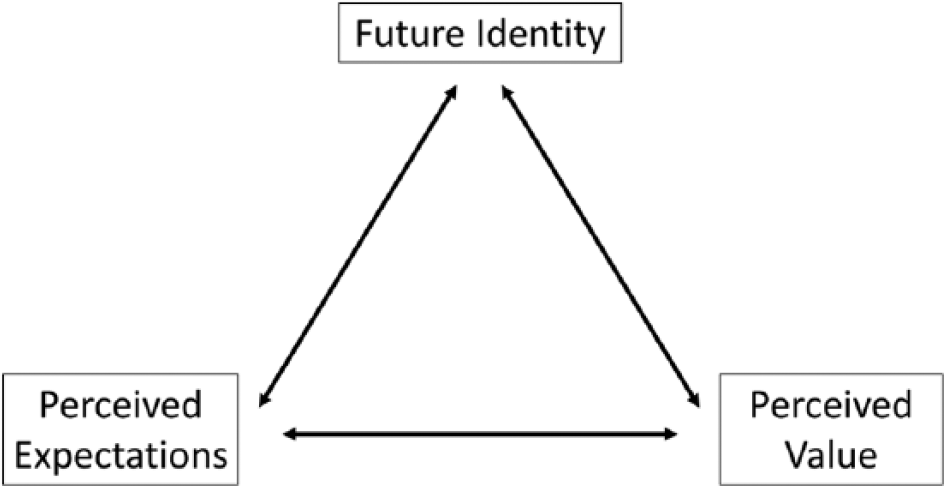
The hypothesized interrelationships between future identity, expectations, and value.
One possibility is that high levels of expectations or value or both lead to a particular future identity. Within the STEM domain, this could mean that one pathway to have a future STEM identity (i.e., aspirations to have a STEM career) is to develop either high expectations for success in STEM or to develop high value for STEM or both. Thus, if a student who receives all top grades and test scores in math and science classes in high school and takes all of the top-level courses available, then he or she is likely to have a future STEM identity just by virtue of being highly competent in the STEM domain. For such a high-expectations student, there is a clear pathway to a STEM career; therefore, that type of student is more likely to view himself or herself in a STEM role and to aspire to have STEM be a part of his or her life in the future. In addition, this could be true even if the student did not perceive STEM as being valuable. Alternatively, a student might develop a future STEM identity if he or she views STEM as extremely valuable, and this might be the case even if this student has low expectations for success in STEM (e.g., if the student is still developing his or her STEM skills and is not sure he or she can succeed in STEM). Altogether, a student should be most likely to take on a future STEM identity and most likely to persist in having a future STEM identity if he or she both values STEM and expects to succeed in STEM.
Research on the development of interest in academic topics supports this model. Specifically, Hidi and Renninger (2006) proposed a four-phase model of interest wherein interest in a domain, including interest in pursuing a future career in that domain, develops as students increase their value (including having positive affective experiences) and expectations (i.e., become competent) for that domain. Therefore, this model posits that expectations and value are influences on identity development, and high levels of both are required for an enduring future identity to emerge along with a persistent pattern of engagement with a topic (Renninger & Hidi, 2015).
A second possibility is the opposite: That is, a future identity might lead to higher levels of expectations and value instead of the other way around. Continuing with the STEM-related example, this means that if a student begins holding a future STEM identity because of contextual factors, the influence of others around him or her, or because of internal factors, then the student will begin to value STEM more and hold higher expectations for success. Eccles (2009) hypothesized that expectations and values have a role as mediators of the effects of identity, and studies by identity-based motivation researchers show some support for this assertion.
In one example, Destin and Oyserman (2009) devised an intervention that helped middle school students view college as affordable. The hypothesis was that if students viewed college as affordable, then they would be more likely to hold an education-dependent future identity, and this prompted future identity would lead to higher expectations for success in school. As compared to control group students, those in the intervention condition indeed expected higher grades in school and planned to expend more effort on homework. To specifically test if future identities mediated these effects, Destin (2016) ran two additional studies and measured future identities after the intervention and before students’ expectations. Results showed that the effects of the intervention on grade expectations were mediated by future identities. Additionally, the positive effects of the intervention on higher expectations for success in school were specific to low-SES students, who tend to hold lower expectations for success in general (e.g., Simpkins et al., 2006) and might be more affected by financial aid information. Overall, these studies show initial some support for the hypothesis that future identities play a causal role in promoting expectations, and the same is believed to be true for values (Oyserman & Destin, 2010).
Altogether, it may be that both models of influence between these variables are true and occur equally as students interact with a number of STEM-related tasks in their lives and in school. The current study begins to investigate the bidirectional relationships between expectancy-value and identity-based motivational variables by assessing some of these constructs across development and by examining how these motivational variables predict STEM preparation (i.e., course taking) in high school and college. Although future studies might assess specific causal pathways in more detail, this study is the first to exam all of these variables at once.
The Role of Parents
In addition to understanding how identity-based motivation and expectancy-value theories interact at the student level, it is also important to understand how key socializers impact these variables. Notably, parents’ beliefs and behaviors are likely to influence students’ future STEM identities, expectancies, and values (see Figure 2, Panel A). For instance, if parents provide opportunities for mathematics and science growth, believe that STEM topics are important or valuable for their students’ futures, and/or have high expectancies of success in the STEM domain for their students, then their students should be more likely to develop a STEM-dependent future identity, value STEM topics, and have high expectations for success in STEM since these thoughts will be cued and feel connected to their current behaviors. The alternative direction is also true in that if students have a STEM-dependent future identity, value STEM, and have high STEM expectations, then their parents will likely hold similar positive beliefs about STEM expectations and values for their student. Altogether, research that integrates both expectancy-value and identity-based motivation theories could allow for a more comprehensive understanding of the relevant mechanisms underlying the relationship between SES and STEM course taking.
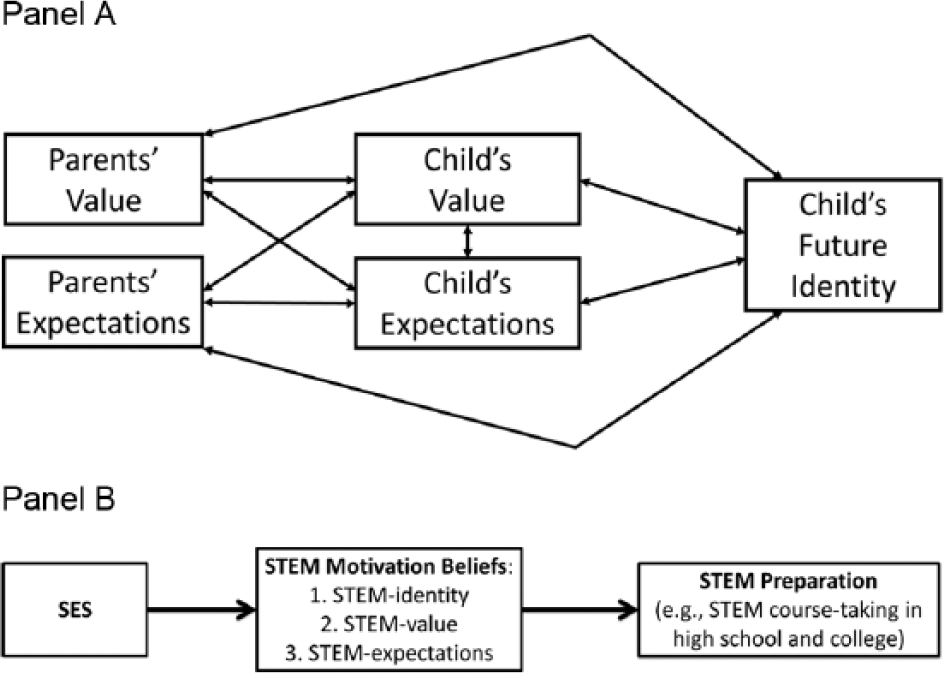
Theoretical models. Panel A: Theoretical model of the bidirectional influences of parental and child expectations, values, and future identities. Panel B: Theoretical model of how motivational beliefs mediate the effect of socioeconomic status on science, technology, engineering, and mathematics preparation.
Current Study
By following families starting in middle school and through high school and into college, we were able to not only study the predictors of high school STEM course taking, which is a critical period for STEM career development, but also analyze how STEM course taking in high school related to subsequent STEM choices, such as one’s course taking and career aspirations in college. In the current longitudinal study, we examined two main research questions using reports collected from 272 families (816 total respondents, including fathers, mothers, and students) about their identity-based and expectancy-value motivational beliefs as well as course-taking choices and career aspirations from middle school through age 20. Our primary hypothesis was that students’ and parents’ expectancies, values, and future identities would mediate part of the association between SES and STEM course taking (see Figure 2, Panel B). Specifically, we hypothesized that more parental education would predict higher levels of parents’ and students’ values and expectancies as well as a higher likelihood that the student would possess a STEM-dependent future identity. In particular, we predicted that the full set of expectancy-value and identity-based motivational beliefs together would mediate part of the association between parental education and STEM course taking.
A secondary hypothesis involved examining the relationships between parents’ and students’ expectations, values, and future STEM identities over time (see Figure 2, Panel A). This is an important first step because no prior research has examined how parental and student expectancy-value and identity-based motivational beliefs might be interrelated. We hypothesized that there would be a positive bidirectional relationships between expectancies, value, and future identities within and across time, such that higher levels of expectations and value would predict a higher likelihood of a STEM-dependent future identity and having a STEM-dependent future identity would be associated with higher expectations and value. Finally, we predicted that parent measures would predict student measures and vice versa.
To test these hypotheses, we utilized a longitudinal design that involved measures of motivational beliefs taken: post–seventh grade, including mothers’ aspirations for their students in mathematics, students’ expectations for their success in mathematics, and students’ value for mathematics; post–ninth grade, including students’ STEM-dependent or STEM-independent future identities; and post–12th grade, including measures of parents’ STEM utility value for their students and students’ STEM value. We used the seventh- and ninth-grade motivational measures to predict students’ mathematics and science course taking in 11th and 12th grades, which are the years when mathematics and science course taking are largely optional for students and thus reflect the critical choices they make about preparing themselves for STEM careers. Moving into college, we hypothesized that these motivational variables along with high school STEM course taking would predict parents’ STEM utility value for their students and students’ STEM value. Finally, we hypothesized that all of the motivational measures along with high school STEM course taking would predict college STEM course taking and college STEM career aspirations. Additionally, in the online supplementary analysis, we investigated how our model predicted specific advanced STEM course taking instead of all 11th- and 12th-grade STEM course taking since these advanced courses are hypothesized to be particularly powerful predictors of STEM achievement (e.g., Trusty, 2002).
Method
Participants
The sample consisted of families participating in a longitudinal study (for details on recruitment, see Hyde, Klein, Essex, & Clark, 1995). The original sample included 570 mothers and 550 husbands/partners in two cohorts with children who attended mostly different schools. A subsequent part of the research design included a randomized experiment in which a subset of the second cohort received an intervention (Harackiewicz, Rozek, Hulleman, & Hyde, 2012), and intervention group families were not included in the analyses reported here due to intervention effects on relevant study outcomes. When we further limit participants based on if families responded at least once during the four time points of interest, the result is the current sample: 272 families (fathers, mothers, and students) for a total of 816 respondents across four time points. We used full-information maximum likelihood to account for missing data for participants who responded to at least one of time points in the study.
The current sample had a similar number of girls and boys (53% girls, 47% boys), and the ethnicity breakdown (89% White, 2% African American, >1% Native American, >1% Hispanic, and 8% biracial or multiracial) reflected the makeup of the state in which data collection occurred (U.S. Census Bureau, 2006). A composite measure of parental education (response rate = 100%) was created by averaging mother’s level of education (M = 15.32, SD = 2.06) and father’s level of education (M = 15.15, SD = 2.27). In order to examine if attrition left a less representative sample, in terms of family SES, we tested to see if there was a difference in parental education between the current sample (M = 15.22, SD = 1.93) and the larger original sample (M = 15.11, SD = 1.98) and found no significant difference (p = .45). The parental education of the current sample showed that 53% of families averaged less than a 4-year college degree for their educational attainment, 20% reported having 4 years of college, and 27% reported some schooling beyond a 4-year college degree. Thus, although these data represent both high- and low-SES families, in terms of educational attainment, this sample overrepresents families with higher levels of educational attainment as compared to Wisconsin in general (66% of the population with less than a 4-year college degree, 26% with a 4-year degree, and 8% with an advanced degree; U.S. Census Bureau, 2003).
Measures
Families completed surveys via mail and on paper, administered by research assistants during at-home visits, or online at four time points in this study beginning after the students finished seventh grade and ending after their sophomore year of college. Differences in survey administration were due to convenience, and we find no significant differences due to administration method. For a complete description of our measures, including timing of assessment, example item, and type of respondent, refer to Table 1.
Summary of Measures and Items

Note. STEM = science, technology, engineering, and mathematics.
For students’ expectations for success in mathematics, the scale response options are not reported because they changed for each question. If you would like more information on this scale, please contact the first author.
Middle school measures
At the end of seventh grade, students’ expectations for success in mathematics were assessed with eight items (α = .91; response rate = 92%) that measured on a scale from 1 (not at all well) to 7 (very well) how well students expected to do in mathematics (Frome & Eccles, 1998). Students’ value for mathematics was assessed with two items (α = .67; response rate = 92%) that measured on a scale from 1 (not at all important) to 7 (very important) how important it is for them to learn mathematics presently and for the future. We refer to this measure as value and not a specific type of subjective task value (attainment, utility, or intrinsic) because it asks about importance more generally and, therefore, could represent a combination of the three subjective task values. Mothers’ aspirations for their students in mathematics was measured by asking mothers to report how far they would like their student to go in mathematics from 1 (less than high school algebra) to 5 (courses beyond calculus) (response rate = 91%). Because of the varied multiproject nature of the larger longitudinal study, questions were asked only about mathematics and to mothers and students in middle school, so we did not have science measures or father reports to use until later time points.
High school measures
STEM-dependent/STEM-independent future identities were assessed by asking students an open-ended question about their career aspirations after ninth grade (response rate = 83%). Their responses were content coded for careers that would require 4-year STEM degrees (e.g., nurse, engineer, etc.) compared to those that would not require a 4-year STEM career (e.g., athlete, police, lawyer, etc.), and 51% were STEM-dependent future identities and 49% were STEM-independent future identities. This measurement of future identities is consistent with previous research on identity-based motivation and future identities (e.g., Oyserman, Fryberg, & Yoder, 2007). High school STEM course taking was assessed by counting the number of semesters of 11th- and 12th-grade mathematics and sciences courses from students’ transcripts (response rate = 99%).
College measures
In the summer after 12th grade, parents’ STEM utility value for their students was assessed using four items (mother, α = .85; father, α = .83; response rate = 92%) on a scale from 1 (not at all useful) to 5 (very useful) that asked how useful STEM topics would be for their student. A composite parents’ STEM utility value for their student measure was created from the average of the responses from mothers and fathers. Students’ STEM value was also assessed using 7 items (α = .94; response rate = 90%) on a scale from 1 (strongly disagree) to 7 (strongly agree) that measured students’ importance for mathematics and science. Similar to students’ value for mathematics in seventh grade, we also refer to this measure as value because it assesses importance more generally.
College STEM course taking was assessed by asking students to report the number of mathematics or science semesters taken in college by the end of their sophomore year. The number of classes for mathematics and science were summed to create a total measure of college STEM course taking (response rate = 68%). College STEM career aspirations were assessed using an open-ended question. Responses were coded using O*NET (National Center for O*NET Development, n.d.) career codes, which classifies occupations on a set of knowledge requirements. We used the highest knowledge value from the STEM topic codes: biology, chemistry, physics, mathematics, and engineering/technology (response rate = 71%). For example, a mechanical engineer has a knowledge value score of 93 on engineering and technology, 81 on mathematics, and 73 on physics. Since 93 is the highest value, we used that for the college STEM career aspirations code.
Analysis Plan
Based on our theoretical model (Figure 2), a structural equation model (SEM) was estimated to investigate the relationship between SES, the mediators, and the outcomes (high school and college STEM course taking) in a single model. In the model, all variables at one time point were allowed to correlate and also predict all variables at subsequent time points. We examined if the total indirect effect of the parental education on high school and college course taking through all the motivational and identity variables was significant (Preacher & Hayes, 2008). Missing data were accounted for by using full-information maximum likelihood methods (Arbuckle, 1996).
In addition, we conducted a supplemental test of mediation by comparing our primary model with direct effects to a comparison model without direct effects (indirect effects–only model). Full reports on these supplemental tests are contained within the supplementary online material. Supplementary analyses include an identical SEM model with advanced STEM course taking in high school as a replacement for general high school STEM course taking since prior research suggests these advanced STEM courses are strong predictors of STEM choices in college (e.g., Trusty, 2002). In addition, we also reported the accompanying direct effects, indirect effects, and path model for the supplementary model in the appendices. As mentioned above, we report a supplemental test of mediation in the online supplementary materials where we estimate one primary model with all effects and the one primary model with only the indirect effects and compare model fits.
Results
Table 2 contains zero-order correlations and descriptive statistics for all variables. As shown in the correlation table, there is a significant direct effect of parental education on our main outcomes of interest: high school STEM course taking (r = .18, p < .01) and college course taking (r = .20, p < .01).
Zero-Order Correlations and Descriptive Statistics for Major Variables
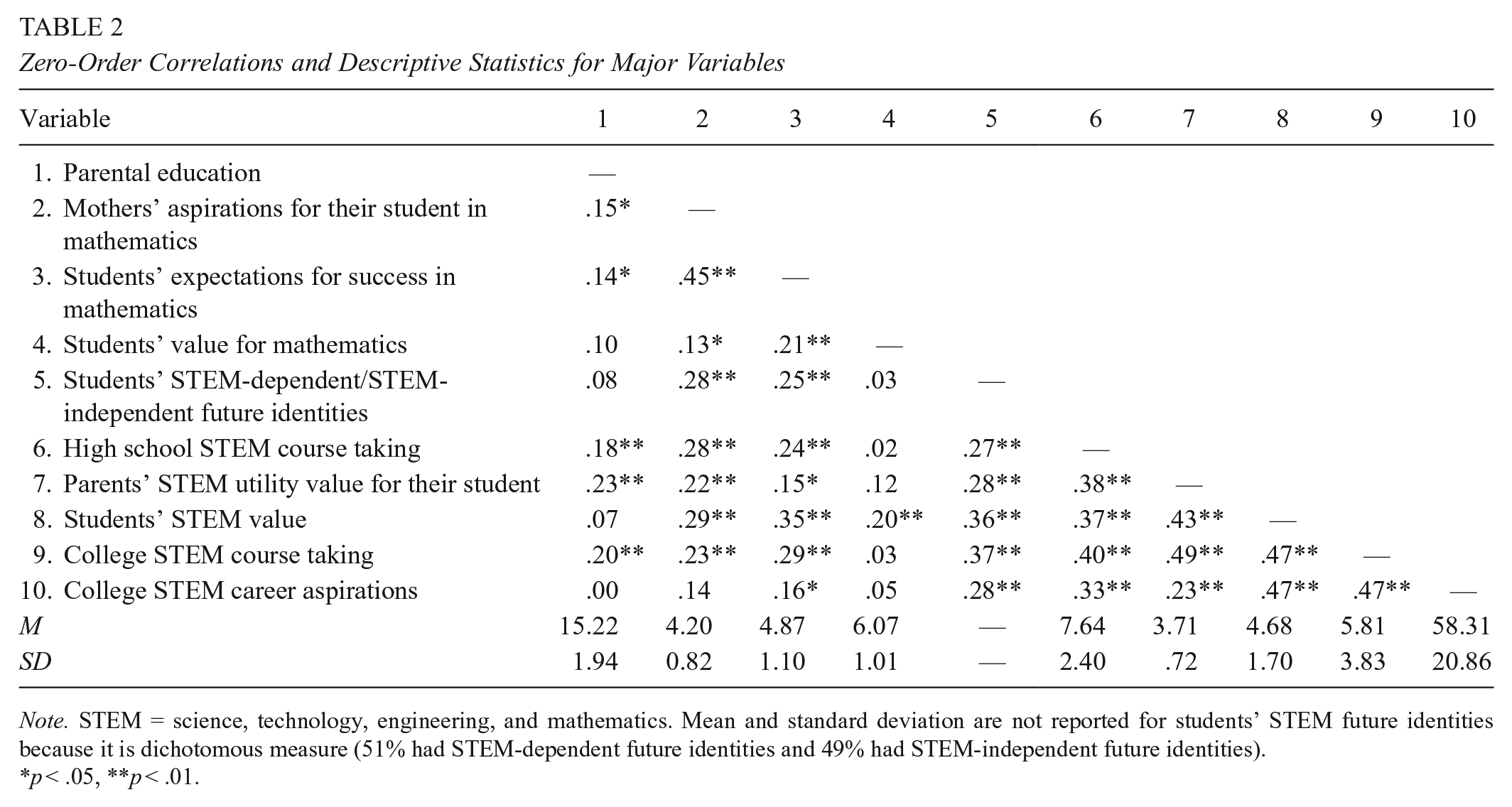
Note. STEM = science, technology, engineering, and mathematics. Mean and standard deviation are not reported for students’ STEM future identities because it is dichotomous measure (51% had STEM-dependent future identities and 49% had STEM-independent future identities).
p < .05, **p < .01.
Primary SEM
For our primary model, we investigated the relationship between parental education, motivational mediators, and STEM course taking. Overall, the model explained 14.7% of the variance in high school STEM course taking and 39.4% of the variance in college STEM course taking. The model was saturated, which does not allow for a meaningful test of model fit. See Figure 3 for the associated path model and Table 3 for a summary of the indirect effects. A table with all significant and nonsignificant direct effects can be found in the online supplementary material (Appendix A).
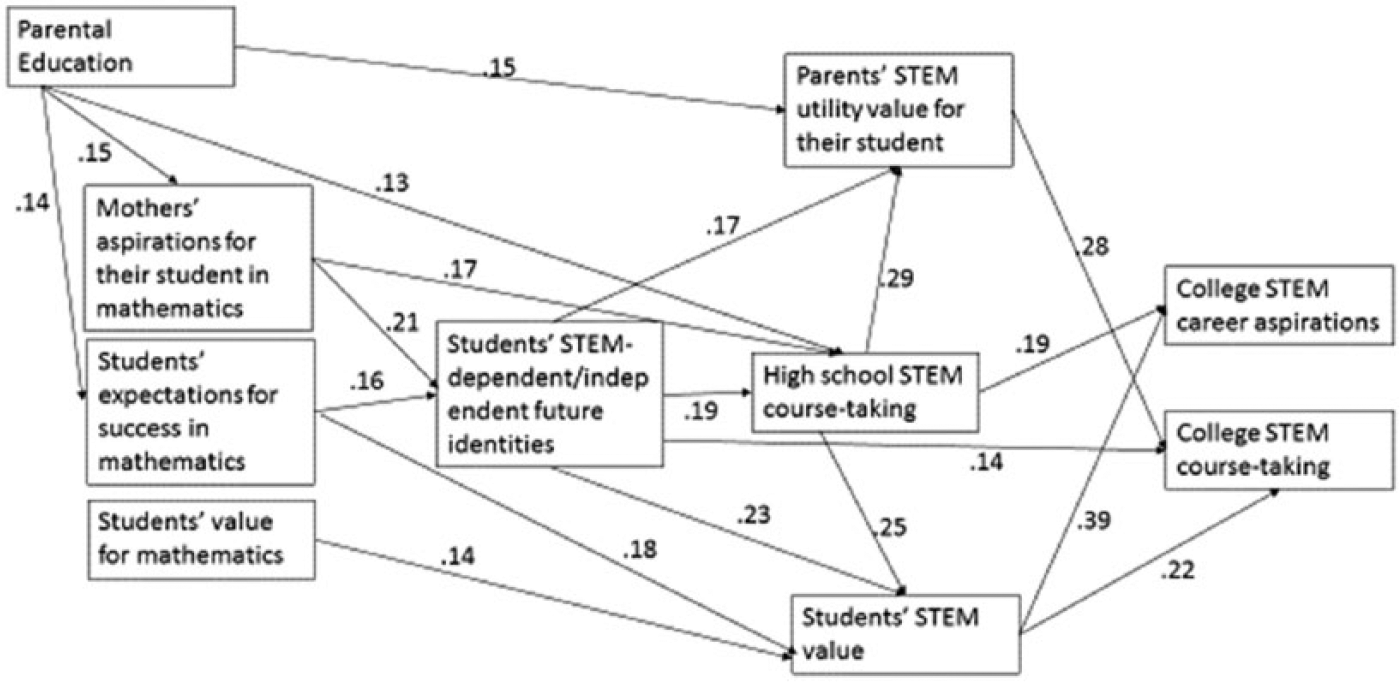
Primary empirical path model. Only significant paths are shown. The relationships between parental education and high school science, technology, engineering, and mathematics (STEM) course taking and college STEM course taking are mediated by mothers’ aspirations for their students in mathematics, students’ expectations for success in mathematics, students’ value for mathematics, students’ STEM-dependent/STEM-independent future identities, parents’ STEM utility value for their student, and students’ STEM value. Numbers represent standardized beta weights, and although all pathways are included in the model, only significant pathways are shown in the figure.
Association Between Parental Education, Students’ STEM-Dependent/STEM-Independent Future Identities, and STEM Educational Outcomes for the Primary Model

Note. STEM = science, technology, engineering, and mathematics. The first column shows the direct effects of the predictor (i.e., either parental education or students’ STEM future identities) on outcome variables without mediators (i.e., the correlation between parental education and STEM course-taking outcomes), the second column shows the direct effects of the predictors with mediating variables in the model, the third and fourth columns indicate the change in effect between the two models, and the fifth column indicates if the indirect effect of the predictor through the mediators on the outcomes is significant. For first three columns, the numbers represent standardized coefficients from the structural equation model. All indirect effects reported are significant; p values refer to the significance level of the zero-order effects and direct effects with mediating variables in the model.
p < .05, **p < .01, ***p < .001.
Direct effects on middle school and high school variables
Parental education was used to predict the three middle school mediators: mothers’ aspirations for their students in mathematics, students’ expectations for success in mathematics, and students’ value for mathematics. Parental education significantly predicted students’ expectations for success in mathematics (β = .14, p = .03) and mothers’ aspirations for their students in mathematics (β = .15, p = .02), such that parents with higher education were more likely to hold high aspirations in mathematics for their students and to have students who themselves possessed high expectations in mathematics.
Parental education and these middle school mediators were then used to predict the high school mediator, students’ STEM-dependent/STEM-independent future identities in ninth grade. Only mothers’ aspirations for their students in mathematics (β = .21, p < .01) and students’ expectations for success in mathematics (β = .16, p =.03) significantly predicted students’ STEM-dependent/STEM-independent future identities.
Last, parental education and these four mediators were then used to predict our first outcome variable: high school STEM course taking. Even with the mediators in the model, there was still a significant effect of parental education on high school STEM course taking (β = .13, p = .03), such that parents with more education were more likely to have students who took more STEM courses, which indicates that the mediators may account for only part of the SES effect on STEM course taking. In addition, mothers’ aspirations for their students in mathematics (β = .17, p = .01) and students’ STEM-dependent/STEM-independent future identities (β = .19, p < .01) significantly predicted high school STEM course taking, as hypothesized.
Indirect effects on high school STEM course taking
Because we hypothesized that parental education would relate to high school STEM course taking through all the motivational and identity mediators, we tested the total indirect effect of parental education on high school STEM course taking through the four mediators and found that there was a significant indirect effect of parental education on high school STEM course taking (z = 2.08, p = .04, β = .05). Although the direct effect of parental education on high school STEM course taking remained significant (with mediators, z = 2.24, p = .03, β = .13), the four mediators still accounted for a sizable portion of the relationship between parental education and STEM course taking (28%; see Table 3). Significant individual indirect effect pathways are reported in the supplemental section (Appendix B).
Direct effects on post–high school and college variables
We extended our model to post–high school measures and examined how parental education predicted parents’ STEM utility value for their students and students’ STEM value after 12th grade. Parental education significantly predicted parents’ STEM utility value for their students (β = .15, p < .01), such that parents with higher education were more likely to see the usefulness of STEM topics for their students. High school STEM course taking (β = .29, p < .001) positively predicted parents’ STEM utility value for their students and students’ STEM value (β = .25, p < .001). Students’ STEM-dependent/STEM-independent future identities also significantly predicted parents’ STEM utility value for their students (β = .17, p = .01) and students’ STEM value (β = .23, p < .001), such that a STEM-dependent future identity was associated with higher levels of parents’ STEM utility value for their students and students’ STEM value. Additionally, students’ expectations for success in mathematics (β = .18, p < .01) and students’ value for mathematics (β = .14, p = .02) were positively associated with students’ STEM value after 12th grade.
Finally, we estimated pathways to the college outcomes (college STEM course taking and STEM career aspirations) from parental education and all previous mediators, including those measured after 12th grade. College STEM course taking was significantly predicted by students’ STEM-dependent/STEM-independent future identities (β = .14, p = .03), parents’ STEM utility value for their students (β = .28, p < .001), and students’ STEM value (β = .22, p < .01). Only high school STEM course taking (β = .19, p = .01) and students’ STEM value (β = .39, p < .001) significantly predicted STEM career aspirations. Parental education was not a significant predictor of either college STEM course taking or college STEM career aspirations with the mediators in the model.
Indirect effects on college STEM course taking
Because we also hypothesized that parental education would relate to college STEM outcomes through all the motivational and identity mediators, we estimated the total indirect effect of parental education through all the mediating variables on high school and college STEM course taking. The total indirect effect of parental education on college STEM course taking through all the mediating variables was significant (z = 2.96, p < .01, β = .12). The direct effect of parental education on college STEM course taking was reduced (by 60%) compared to the model without mediators (Table 3), providing evidence for mediation of the effect of parental education on college STEM course taking through the high school and college motivational variables. We report specific significant individual indirect effects for the primary model in Appendix B.
Indirect effects of STEM identity on college STEM course taking
In addition, we were specifically interested if STEM-dependent/STEM-independent future identities had a significant effect on college STEM outcomes through parents’ STEM utility value for their students after 12th grade, students’ STEM value after 12th grade, and high school STEM course taking. Results confirm this with a significant total indirect effect of STEM-dependent/STEM-independent future identities on college STEM course taking (z = 3.99, p < .001, β = .15) with the mediators accounting for 62% of the direct effect (Table 3).
Discussion
On the basis of research that finds that low-SES students are less likely to take STEM courses in high school (e.g., Tyson et al., 2007), we investigated how SES (measured by years of parental education) relates to high school STEM course taking and college STEM course taking through the motivational beliefs of parents and students, including their expectations for success, beliefs about the importance/value of STEM, and STEM-related future identity. Results supported our hypothesis that the relationship between parental education and STEM course taking was partially mediated by the combination of these beliefs. Therefore, although other resource-based mechanisms, such as neighborhood opportunities, also may mediate part of the relationship between SES and STEM course taking, a psychological perspective that encompasses parents’ and students’ motivational beliefs is also important. This may especially be the case as a student progresses into high school and begins to develop his or her post–high school plans based on prior course enrollment. A high school student who expects to do well in STEM topics, who values STEM, and who also possesses a future identity that involves a STEM career should be more likely to opt into advanced STEM courses, placing the student on a trajectory toward more STEM opportunities, including majors and careers.
Strengths of this study include that we followed students through a long period of their development, starting in middle school and going through the transition to college, and that we collected measures from two distinct but related motivational models. Many studies follow students through high school, but we were able to show that course taking and motivational variables in high school are powerful predictors of important college outcomes, including course taking and career aspirations, which is especially significant because research has shown that increased STEM course taking early in college is associated with a higher likelihood of graduating with a STEM degree (Maltese & Tai, 2011).
Along with that, these findings can contribute to psychological theory by beginning to integrate two models of motivation and showing a bidirectional relationship between important constructs in these models. First, we found that expectations for success possessed by both the students and their parents may help shape their future identities in STEM, suggesting that competency in STEM may play a role in developing a STEM-dependent future identity. Second, results showed that subjective task value was a mediator of the effects of future identities on course taking. These results shed light on how expectations, values, and future identities might work together to influence students’ motivation, behavior, and career choices and demonstrate the likely complicated interrelated nature of expectancy-value and identity-based motivational constructs.
Limitations and Future Directions
One limitation of this study is that the sample is representative only of the racial diversity in the state of Wisconsin. Further, the sample was of higher SES than the national average because original study recruitment procedures focused on families with two working and cohabitating parents. Future research should examine the role of psychological processes in the relationship between parental education and STEM course-taking outcomes using more racially and economically diverse samples. Future research also should investigate the role of other related SES measures, such as income, occupational status, wealth, and assets, because these are additional significant predictors of educational outcomes. Additionally, experimental studies that directly manipulate different types of values, expectations, and future identities will be important for achieving a clear understanding for how these variables work together.
Because this study was part of a larger longitudinal project with varying goals, we did not have the same measures of value, expectations, and future identities across time, which limits our ability to test causal pathways in our longitudinal analysis. We also did not have measures of the specific types of value, which could be useful for better understanding the predictors and mediators of future identities. Finally, this study had measures only of math expectations and value in middle school, but we likely would have found that a measure about both math and science would have been a stronger predictor of subsequent variables, so future studies should make sure to have measures that assess both math and science attitudes to best answer questions related to STEM.
Building from these limitations, one new avenue of research is to explore the different possible directions of the relationship between students’ future identities and subjective task value and expectations for success. As mentioned in the introduction, it is possible that values and expectations might lead to future identities, and it is also possible that future identities may lead to increased value and expectations. In this study, we had strong measures only of value after future identities were measured and thus were able to assess only the second possibility for value. We did find support for value as a mediator of the effects of future identities. Conversely, we had measures only of expectations before future identities were measured, so we were able to see only that expectations predicted future identities and not vice versa.
A second future direction is to explore how the different types of value relate to future identities. In this study, we largely had only general measures of value that did not differentiate between attainment, intrinsic, and utility value, but there are reasons to believe that certain types of value might be more closely linked to future identities, either as an antecedent or a consequence. Eccles (2009) characterized attainment value as an assortment of collective and personal identities, suggesting that individuals who place high attainment value on an achievement task do so, at least partly, because they see that task as related to their identity. Thus, from this theoretical conceptualization, STEM future identities may be most closely linked to attainment value.
Although attainment value may be most closely linked to future identities by definition, there is reason to believe that any specific subjective task value (attainment, intrinsic, and utility) or a combination of them all may be closely related to future identities. That is, students may be equally likely develop a STEM-dependent future identity because it is related to whom they see themselves as (attainment value), because they enjoy STEM topics or are interested in them (intrinsic value), or because they see STEM as useful and relevant for a current or future goal (utility value). Moreover, any of those types of value might mediate effects of future identities. That is, an increase in any type of value due to a STEM identity might lead students to make choices that lead to positive educational outcomes, such as enrolling in additional STEM courses when given the choice. The research on value shows that all three types of value predict these types of educational outcomes (e.g., Hulleman & Harackiewicz, 2009; Simpkins et al., 2006), so it is critical that future research examine the relationship between specific task values and future identities as a way to tease apart which task values are most important as either antecedents or consequences of future identities.
Implications
Altogether, these results implicate motivational attitudes and beliefs, both from parents and students, in social class gaps on STEM preparation. In some ways, this is fortunate because these motivational variables are responsive to external interventions, including relatively brief and cost-effective interventions that can be fielded in schools. For example, student-centered value interventions have been very effective in enhancing students’ STEM motivation and achievement (e.g., Hulleman & Harackiewicz, 2009). These interventions ask students to write about the personal relevance of their classes in a brief writing exercise to be given a few times over the course of a semester. Similarly, identity-based interventions, which can be as simple as giving students information about the accessibility of college in order to cue a college-bound future identity, have been shown to increase students’ academic motivation over the long term as well (e.g., Destin & Oyserman, 2010; Oyserman, Bybee, & Terry, 2006). Furthermore, Harackiewicz et al. (2012) showed the efficacy of involving parents to promote students’ utility value with a parent-focused intervention. Parents were given information about the importance of STEM for their students and were encouraged to communicate this information. Results showed that students whose parents were in the utility value (UV) condition took more mathematics and science courses during their last 2 years of high school as compared to students in the control condition, and effects were mediated by changes in parents’ and students’ values (Rozek et al., 2015).
Overall, these psychological interventions represent a cost-effective method to boost STEM opportunities for all types of students. Many of the policy-oriented interventions, such as Moving to Opportunity (e.g., Chetty, Hendren, & Katz, 2015), early childhood programs (e.g., Barnett, 2011), and school lotteries (e.g., Deming, Hastings, Kane, & Staiger, 2011) are expensive and more difficult to implement. Although these more extensive interventions have broad effects beyond an increase in STEM course taking and achievement, brief social-psychological interventions have their place in education as a way to provide targeted help in important academic domains. In sum, motivational variables seem to play a critical role in students’ STEM attitudes and STEM preparation, and interventions that target these beliefs should be helpful in combating social class gaps in STEM fields.
Footnotes
Acknowledgements
We thank Corinne Boldt, Michael Herriges, Claire Johnson, Dan Lamanna, Alex Mehls, Jenni Petersen, and Jae Shin for their help conducting this research, and we thank the members of our advisory board (Jacquelynne Eccles, Adam Gamoran, Jo Handelsman, Jenefer Husman, Dominic Johann-Berkel, Ann Renninger, and Judith Smetana) for their guidance. We are most grateful to the families of the Wisconsin Study of Families and Work project for their participation over the years.
Funding
This research was supported by the National Science Foundation (Grant DRL 0814750) and by the Institute for Education Sciences, U.S. Department of Education through Award No. R305B090009 and Grant 144-NL14 to the University of Wisconsin-Madison. This research was also supported by U.S. Department of Education, Institute of Education Sciences Grant, Multidisciplinary Program in Education Sciences, Award No. R305B140042 to Northwestern University. The opinions expressed are those of the authors and do not represent views of the U.S. Department of Education.
Notes
Authors
RYAN C. SVOBODA is a PhD student in the School of Education and Social Policy at Northwestern University and a Multidisciplinary Program in Education Sciences Fellow through the Institute of Education Sciences. His research examines the interplay between identity, motivation, and emotion as pathways to support and promote student achievement.
CHRISTOPHER S. ROZEK is a postdoctoral scholar in the Department of Psychology at the University of Chicago and former Institute of Education Sciences predoctoral fellow. His research utilizes laboratory and field experimental studies, as well as longitudinal designs, to better understand the factors that influence motivation, performance, and interest development.
JANET S. HYDE is the Helen Thompson Woolley Professor of Psychology and Gender and Women’s Studies and the director of the Center for Research on Gender and Women at the University of Wisconsin-Madison. Her research falls in the areas of psychology of women, human sexuality, and gender role development.
JUDITH M. HARACKIEWICZ is the Paul R. Pintrich Professor of Psychology at the University of Wisconsin-Madison. Her research interests examine human motivation, specifically, intrinsic motivation, interest, and achievement motivation.
MESMIN DESTIN is an assistant professor of psychology and education and faculty fellow of the Institute for Policy Research at Northwestern University. His research investigates how identity and other social psychological factors contribute to socioeconomic disparities in academic motivation and achievement.
References
Supplementary Material
Please find the following supplemental material available below.
For Open Access articles published under a Creative Commons License, all supplemental material carries the same license as the article it is associated with.
For non-Open Access articles published, all supplemental material carries a non-exclusive license, and permission requests for re-use of supplemental material or any part of supplemental material shall be sent directly to the copyright owner as specified in the copyright notice associated with the article.
