




Abstract
The motivational impact of messages about how to interpret experienced difficulty with schoolwork was tested in two studies. Students read that experienced difficulty with schoolwork is a signal either of the importance or of the impossibility of succeeding in school, rated how much they agreed, and completed a difficult task (Raven’s Progressive Matrices). In the absence of reactance (Study 1, N = 93), students’ performance reflected an assimilation of the interpretation of experienced difficulty message to which they were randomly assigned. In the presence of conditions conducive to reactance (Study 2, N = 181), the effect on performance was more complex, reflecting contrast with or assimilation to message content depending on message acceptance. Contrast (rejecting the message) bolstered performance if the message was that experienced difficulty implies that the task is impossible, whereas assimilation (accepting the message) bolstered performance if the message was that experienced difficulty implies that the task is important.
Early adolescence is a time in which youth are particularly sensitive to the possibility that their autonomy is being undermined rather than supported (Chirkov & Ryan, 2001; Grandpre, Alvaro, Burgoon, Miller, & Hall, 2003; Miller, Burgoon, Grandpre, & Alvaro, 2006; Steinberg & Silverberg, 1986). It is also a time of increased risk, as youth attempt to make sense of what their experiences of ease and difficulty in academic, athletic, and social domains might mean for their possible future selves (Oyserman & James, 2009). Does experienced difficulty imply that schoolwork is not for them and that they should turn their attention to something else? This is an interpretation with risky consequences. Indeed, during adolescence, students report less effort and engagement with schoolwork, and withdrawal of effort and engagement increases risk of school failure (Barber & Olsen, 2004; Roeser, Eccles, & Freedman-Doan, 1999; Seidman, Allen, Aber, Mitchell, & Feindman, 1994). Low-income and minority adolescents may be particularly at risk for these effort-undermining interpretations, given the negative stereotypes about their groups’ potential for academic success (Fiske, Cuddy, & Glick, 2007).
The coupling of adolescents’ interest in autonomy with this increased risk presents a challenge for interventions aiming to encourage academic effort. Direct persuasion attempts run the risk of being challenged by teens seeking opportunities to demonstrate their independence from authority figures (e.g., Koepke & Denissen, 2012; Mazor & Enright, 1988; Steinberg & Silverberg, 1986) and social influence more generally (Hill & Holmbeck, 1986). How should concerned adults proceed? Should they try to intervene to convince adolescents that experiencing difficulty with schoolwork signals that schoolwork is important and worth the effort? Or should they remain silent and hope that students do not interpret their difficulty with schoolwork as signaling that schoolwork is impossible and not worth their energy? The answer may depend on the likelihood of student reactance in response to messages about how to interpret experienced difficulty at school. The current studies examine the motivational impact of messages about the interpretation of experienced difficulty with schoolwork in both the presence and the absence of reactance.
Reactance and Boomerang Effects
Psychological reactance theory predicts that a persuasive appeal, once perceived as a threat to one’s self-determined thought or behavior, will elicit motivation to restore this threatened freedom (Brehm, 1966). While initially considered an unmeasurable motivational state, recent efforts to unpack reactance have found underlying emotional and cognitive components (Dillard & Shen, 2005; Rains, 2013). This work identifies anger as the emotional response and counterargumentation (i.e., negative thoughts or critiques of the message) as the cognitive response underlying reactance.
When reactance occurs, restoring one’s threatened freedom may involve embracing the derogated attitude or performing the unsanctioned behavior (Brehm, 1966; Brehm & Brehm, 1981). This has been termed a “boomerang effect” (Byrne & Hart, 2009; Wicklund, 1974). Boomerang effects are common in the adolescent intervention literature; examples include interventions to increase exercise and healthy eating and to reduce risky behaviors, including risky sexual behavior, underage drinking, smoking, drug use, delinquency, and disordered eating patterns (Burgoon, Alvaro, Grandpre, & Voulodakis, 2002). For instance, exposure to tobacco-industry antismoking messages was documented to increase adolescents’ interest in smoking (Farrelly et al., 2002) and exposure to prevention messages from a recovered eating disorder patient increased teens’ perceptions that girls with eating disorders were pretty and in control of their lives (Schwartz, Thomas, Bohan, & Vartanian, 2007). Adolescents’ preexisting attitudes color their message perception; counterattitudinal messages are perceived as more biased, exaggerated, and manipulative (Shen, Monahan, Rhodes, & Roskos-Ewoldsen, 2009).
Teens commonly express reactance in response to adults’ attempts to influence their personal goals, rejecting adults’ suggestions or even endorsing their opposite to reassert autonomy (Brehm, 1966; Erikson, 1963; Lapsley & Yeager, 2012). As a result, researchers seek strategies to make messages persuasive without threatening autonomy (e.g., Aronson, Fried, & Good, 2002; Walton & Cohen, 2011; Yeager & Walton, 2011). Although message-undermining reactance has been well-documented in the domain of health and risk behavior (e.g., Dillard & Shen, 2005; Whitehead, 2005), it is understudied in the academic context (Ball & Goodboy, 2014). We suggest that messages promoting a particular way of thinking about effort at school have the potential to provoke reactance. The current study addresses a gap in the literature by considering how reactance may lead adolescents to reject helpful and endorse unhelpful messages about what their experienced difficulty with schoolwork implies for the importance (vs. impossibility) of succeeding in schoolwork. The intent of these messages is to bring to mind a lay theory of experienced difficulty, a concept that we articulate in the next sections.
Interpreting Experiences
In the current studies, we connect reactance to the lay theories people use to make sense of their observations and experiences. These everyday theories are cognitive knowledge structures that allow people to draw inferences and make predictions about themselves (Schwarz & Hippler, 1987) and their social world (Heider, 1958; Kruglanski, 1980; Ross, 1977). Lay theories exist across the wide array of human experience. Lay theories about how the mind works allow people to draw inferences about others’ beliefs and goals based on their observable behaviors (Gopnik & Wellman, 1992; Wellman, 1990). Lay theories about personality allow people to see patterns by linking visible behaviors to invisible underlying traits (Schneider, 1973). Lay theories about social groups allow people to differentiate among types of groups and to observe behavioral norms within groups (Lickel, Hamilton, & Sherman, 2001). While there is cultural variation in lay theories of attribution (Hong & Chiu, 2001; Hong, Morris, Chiu, & Benet-Martínez, 2000; Morris & Peng, 1994; Norenzayan, Choi, & Nisbett, 2002; Oyserman, in press), there is a universal need to make sense of one’s experiences, and lay theories provide a means to do so. Of particular importance for us are lay theories about what experienced difficulty means.
Lay Theories of Experienced Difficulty
A large body of work demonstrates that people are sensitive to their experienced difficulty and use contextual information to interpret the meaning of their difficulty. For instance, having difficulty coming up with examples can indicate that there are not many examples or, instead, that one is not an expert on the topic (Schwarz, 1998). Research has demonstrated the existence of many lay theories about what experienced difficulty means; which theory comes to mind depends on contextual cues. For example, researchers can create an experience of difficulty for participants by having people make longer than average lists (e.g., giving 12 examples of times one was assertive; Schwarz et al., 1991) or read difficult to process information (e.g., text with poor color-contrast or difficult-to-read font; Novemsky, Dhar, Schwarz, & Simonson, 2007). Results indicate that people rely on contextual information to determine which lay theory of difficulty should be used to interpret their experience. Consequently, experiences of difficulty in processing can be interpreted in widely varying ways: as a sign that a painting is more valuable, that a recipe is more time-consuming to make, or that an action is more useful (e.g., Labroo & Kim, 2009; Reber, Schwarz, & Winkielman, 2004; Song & Schwarz, 2008). Of interest to us in the current study is what experienced difficulty with schoolwork is taken to mean. We focus on two accessible lay theories that have been described in identity-based motivation theory (Oyserman, 2007, 2009, 2015). Specifically, experienced difficulty can imply that one is not good at a task and should move on to something else (experienced difficulty means impossibility), or that the task itself is important and worth the effort (experienced difficulty means importance).
The interpretation that students use to make sense of their experienced difficulty depends on which lay theory is temporarily accessible at the moment of judgment. Interventions targeting the accessibility of a lay theory for the interpretation of experienced difficulty suggest that this is the case. For example, low-income and minority students randomly assigned to group activities highlighting that experiencing difficulty in important tasks such as schoolwork is normal, performed better over time than students who attended school as usual (Oyserman, Bybee, & Terry, 2006; Oyserman, Terry, & Bybee, 2002). Parallel effects on performance and academic identities have been found with college students (Oyserman, Destin, & Novin, 2015; Smith & Oyserman, 2015). For instance, college students were prompted either to recall times that they interpreted difficulty with schoolwork as implying that the work was important to them or to recall the times that they interpreted difficulty as implying that the schoolwork was impossible for them. These students were willing to expend more effort on difficult tasks when they were led to believe that they experienced an interpretation of difficulty as importance relatively more or an interpretation of difficulty as impossibility relatively less than their peers (Smith & Oyserman, 2015). Finally, in additional work examining contextual effects on lay theory accessibility, college students were more likely to endorse the lay theory that experienced difficulty implies that schoolwork is important after being led to consider school as a success-likely context and their own desired possible selves (Oyserman et al., 2015).
Reactance and Interpretation of Difficulty
While intervention and priming studies demonstrate the ease with which students can be cued to use a particular lay theory of experienced difficulty, these and other motivational messages may be quite vulnerable to reactance if students experience the message or the context in which it is presented as autonomy limiting. Experienced choice or autonomy is a motivation-promoting factor (e.g., Deci & Ryan, 1985, 2000; Eccles, Early, Fraser, Belansky, & McCarthy, 1997; Vansteenkiste, Simons, Lens, Soenens, & Matos, 2005). When freedom to select is restricted, motivation to engage in a proffered activity suffers. For example, high school students who were given more autonomy (i.e., “you might” vs. “you have to”) to engage in physical activity both performed the activity better and were more likely to volunteer to continue participating (Vansteenkiste, Simons, Lens, Sheldon, & Deci, 2004). While prior work focused on the role of autonomy in students’ decisions to engage in a specific behavior, the same process is likely to occur if what is proffered is a way of thinking or lay theory.
The current studies consider the effect of an interpretation of experienced difficulty intervention when the likelihood of reactance is either low or high. When reactance is unlikely, students’ thinking and behavior should reflect the interpretation of difficulty made salient by a proffered message. Under these circumstances, reminding students that difficulty can signal task importance should improve motivation, and reminding students that difficulty can signal task impossibility should lower motivation. When reactance is likely, interventions can still attempt to bolster the chance that students faced with difficulty will endorse the idea that difficulty signals that school success is an important goal for oneself. However, it might be safer for interventions to attempt to leverage the fact that youth will likely have a reactant response.
If reactance occurs, then presenting the message that students should interpret experienced difficulty at school as a signal of schoolwork’s importance may provoke students to reject this interpretation, leaving students unlikely to work hard when they experience difficulty with assignments. Instead, these students may summon to mind effort-undermining interpretations of their experienced difficulty as implying that the tasks are impossible for them and that effort in school is identity-incongruent. This pattern has been found in the health domain, in which minority Americans perceived healthy lifestyle choices as effective ways to promote longevity, but not if they perceived engagement in healthy choices as identity-incongruent (Oyserman, Fryberg, & Yoder, 2007). In contrast, if students receive the message that experienced difficulty signals that school is not worth the effort, reactance may increase the likelihood that students will reject this message and work harder in the face of difficulty. In this case, reactance may actually be energizing and productive. Indeed, rejecting an undermining persuasive message can serve as an inoculation against making later judgments aligned with the rejected message (McGuire & Papageorgis, 1961; McGuire, 1964), suggesting that students who reject messages that experienced difficulty signals schoolwork’s impossibility may avoid falling victim to that interpretation in the future.
Current Studies
Two studies examined the motivational impact of messages about the interpretation of experienced difficulty with schoolwork. When presented in a context that does not threaten autonomy (Study 1), we predicted that students would assimilate messages of how to interpret experienced difficulty with schoolwork so that subsequent effort on an academic task would reflect the cued interpretation of experienced difficulty. When presented in a context conducive to reactance (Study 2), we predicted that many students would reject the message, resulting in a contrast effect so that subsequent effort on schoolwork would reflect the opposite of the cued interpretation of experienced difficulty. Consequently, in a context conducive to reactance, students’ performance would reflect their response to the message rather than the message content alone.
Study 1
Participants and Procedure
Seventh and eighth grade students (N = 93; 58% boys, Mage = 12.96, SD = 0.69) in five classes in a public school near Detroit participated in our 30-minute. “Middle School and Beyond” study. Most were African American (76%) or multiracial (20%; 4% other racial groups) and low income (71% of the student body received free or reduced lunch). Study approval was obtained from the University of Michigan’s Institutional Review Board. The study was conducted in Adolescent Life classes, which involve content related to positive academic and healthy lifestyle goals. Adolescent Life class was a context in which lay theories of experienced difficulty could easily be cued and, because the content provided should not have been experienced as surprising or unusual, it was unlikely that students would perceive our messages as a heavy-handed influence attempt.
At the start of class, students were given survey booklets with identical covers. Unbeknownst to them, the inside first page differed. It was either blank (control condition), or contained four statements implying that a feeling of difficulty can signal that success with schoolwork is an important goal (importance condition) or an impossible goal (impossibility condition). Students rated how much they agreed or disagreed with each statement (1 = strongly disagree to 6 = strongly agree). The Appendix provides the full materials. Example statements are: “You can use your feelings about working on a school task to tell you how important it is for you. If you keep working even when it feels hard, it’s probably important to you” (importance condition, n = 33); “Sometimes, working on a school task feels very difficult – impossible really. That’s okay, because finding out that you are not likely to be successful can be helpful for moving on to other tasks” (impossibility condition, n = 31). Students’ average level of agreement served as our measure of message endorsement (M = 4.09, SD = 1.34; Importance condition M = 5.08, SD = .68; Impossibility condition M = 3.02, SD = 1.02).
The dependent variable of interest was six items taken from Raven’s Progressive Matrices Test (1962). Each item showed a pattern of eight images and asked participants to choose how to complete the pattern from among eight options. Items were chosen such that the first three items (Set 1 MCorrect = 66.7%, SD = 38.1%) came from earlier in the full test and constituted the easier half of the task, while the last three items (Set 2 MCorrect = 42.3%, SD = 34.5%) came from later in the full test and constituted the more difficult half of the task.
After completing the Raven’s items, students rated how difficult it was for them to solve the problems (1 item) from 1 = extremely hard to 7 = extremely easy (M = 4.92, SD = 1.82) and provided their age, gender, race, and their expected grade in the Adolescent Life class in which the study was conducted.
Results and Discussion
Analyses proceeded in two steps. At step one, we asked whether any of the five potential control variables (age, gender, race, self-reported difficulty vs. ease in solving the Raven’s problems, and expected grade in the Adolescent Life class) influenced scores on the Raven’s items and so should be included as controls. At step two, we analyzed the effect of the interpretation of experienced difficulty message on performance including the controls identified in step one. Each step is detailed next.
Step one: We used linear regression to determine whether any of the five potential control variables should be used in our final analysis. There was no significant effect of age (p = .173), gender (p = .957), or race (p = .396, coded as African American, the largest racial group, vs. other racial groups) on performance. However, finding the Raven’s problems easier (b = 5.96, p = .001) and expecting to get a good grade in one’s Adolescent Life class (b = 2.56, p = .032) were related to improved performance, so we included these variables as controls in our final analyses.
Step two: We used analysis of covariance to test the predicted effect of interpretation of experienced difficulty message on performance including the controls identified in step one. Figure 1 shows the percentage of Raven’s problems correctly solved in Set 1 (easy problems) and Set 2 (difficult problems) by condition. As can be seen, accessible interpretation of experienced difficulty mattered if the task was difficult (Set 2), F(2, 88) = 3.32, p = .041, so that there was difficulty to interpret, but not when the task was easy (Set 1), F(2, 88) = 1.29, p = .280. Paired contrasts of Set 2 performance showed that students in the importance condition (MCorrect = 53.7%, SE = 5.6%) outperformed students in the impossibility condition (MCorrect = 34.4%, SE = 5.8%, p = .018, d = .61) and at trend-level outperformed students in the control condition (MCorrect = 37.8%, SE = 6.0%, p = .055, d = .50). The control and impossibility conditions did not differ from each other (p = .680). Interpretation of experienced difficulty condition did not affect Set 1 performance (p-values for paired contrasts ranged from .15 to .84).

Interpretation of experienced difficulty and task performance on easy and difficult problem sets.
In sum, message condition mattered. Students assigned to read statements implying that experienced difficulty with schoolwork means that success is impossible for them performed at the same level as students in the control condition who were not provided any message about what their experienced difficulty might mean. Students in both of these conditions underperformed compared with students assigned to read statements implying that experienced difficulty with schoolwork means that success is important for them. These results suggest that students assimilated the difficulty means importance message and, further, that this replaced what is an otherwise chronically accessible lay theory of experienced difficulty—that difficulty means impossibility.
Follow-up analyses examining mean message endorsement in the two interpretation conditions showed that students were more likely to endorse an interpretation of their experienced difficulty as implying schoolwork’s importance (M = 5.08, SD = .68), than an interpretation of experienced difficulty as implying schoolwork’s impossibility (M = 3.02, SD = 1.02). Thus, on average, students agreed that experienced difficulty with schoolwork implies importance and were neutral about whether experienced difficulty implies impossibility. To test whether students assimilated the lay theory they were guided to use or whether message endorsement moderated the effect of guided lay theory on performance, we added message endorsement to our analyses and used regression equations. Results replicated our prior finding: the main effect of guided lay theory on Raven’s performance was not moderated by message endorsement for either the easy (Set 1 b = 5.13, p = .622) or difficult (Set 2 b = 7.36, p = .446) problems.
Thus, in Study 1, the lay theory that was brought to mind affected performance, but the level of endorsement did not matter, suggesting that counterarguing did not occur and that students did not find the message to be heavy-handed or autonomy threatening. In Study 2, we create conditions conducive to reactance, predicting that students who reject a lay theory they are guided to consider will act in contrast to it, rather than assimilating it into their judgment.
Study 2
In Study 2, we asked whether conditions conducive to reactance would result in at least some students rejecting a presented interpretation of experienced difficulty message. To test our prediction, we used the same message materials as in Study 1 but presented them in a context in which they were more likely to be experienced as a heavy-handed influence attempt. Specifically, rather than presenting messages in a class setting conducive to assimilating a guided lay theory as we did in Study 1, in Study 2, we presented our messages in a physical education class in which students were not expecting to consider what experienced difficulty with schoolwork might mean for them. In doing so, we set conditions conducive to reactance in two ways. First, we limited students’ physical freedom by pulling them out of gym class. Second, we increased students’ sensitivity to our influence attempt by stopping students from doing something fun and physically engaging and, instead, making them sit quietly, read, and respond to difficult Raven’s problems. Sensitivity to influence attempt was enhanced by the mismatch between the physical education context and the academic message (e.g., Brehm, 1966; Rains, 2013).
Participants and Procedure
Sixth to eighth grade students at a school near Detroit, Michigan (N = 181; 53% boys; Mage = 12.13, SD = 0.90) participated in our “Middle School and Beyond” study. Most were African American (65%) or Caucasian American (20%, 13% other racial groups) and low income (77% eligible for free or reduced lunch). Study approval was received from the University of Michigan’s Institutional Review Board.
To create the possibility of reactance, students were taken from their physical education classes, stopped from engaging in physical activity, and instead asked to read and solve problems. Although the classroom context of Study 2 was quite different, the message content was identical to Study 1. Students received a questionnaire that contained four statements to read and rate, a difficult fifteen-item Raven’s Progressive Matrices task, and demographics (gender, age, grade level in school, race, and grade point average) in that order, as described next.
Message content was manipulated using the same statements as in Study 1 (see Appendix), with students being randomly assigned to read four statements in which experienced difficulty was interpreted as implying importance (importance condition, n = 89) or impossibility (impossibility condition, n = 92).
Message endorsement was also assessed the same way as in Study 1, by asking students to indicate how much they agreed or disagreed with each statement (1 = strongly disagree to 6 = strongly agree; M = 4.17, SD = 1.12; Importance condition M = 4.88, SD = .72; Impossibility condition M = 3.47, SD = .99).
Raven’s Progressive Matrices task performance was our dependent variable (Raven, 1962). We used the same dependent variable, performance on the Raven’s task, in both studies. To increase onerousness of the task, we included the first 15 items, rather than only six as in Study 1. Mean performance (M = 37.5%, SD = 25%, α = .82) was below even mean performance in the difficult problems in Study 1’s Set 2. Given that performance was low across all items, there was no set of problems that could be classified as “easy” for Study 2 participants; therefore, the percentage correct of the fifteen problems serves as our dependent variable.
After completing the Raven’s items, students rated how difficult it was for them to solve the problems (1 item) from 1 = extremely hard to 7 = extremely easy (M = 4.19, SD = 1.74), then provided their age, gender, race, and their grade point average in their classes overall.
Results and Discussion
As in Study 1, analyses proceeded in two steps. At step one we asked whether any of the five potential control variables (age, gender, race, self-reported difficulty vs. ease in solving the Raven’s problems, and expected grade point average) influenced scores on the Raven’s items and so should be included as controls. At step two, we analyzed the effect of the interpretation of experienced difficulty message on performance including the controls identified in step one. Each step is detailed next.
Step one: We used linear regression to examine the five potential control variables for inclusion in our final analysis. Neither age (p = .846), gender (p = .208), nor self-reported grade point average (p = .237) was associated with Raven’s performance. However, finding the Raven’s problems easier was related to improved performance (b = 3.28, p = .003), and identifying as African American (versus any other racial group) was related to lower performance (b = −11.44, p = .004), so we included these variables as controls in our final analyses.
Step two: We used linear regression to test the predicted interaction of message content and message endorsement on performance including the controls identified in step one. As posited by reactance theory, performance was predicted by the interaction between message content and message endorsement, b = 11.10, p = .013. To understand this interaction, we followed Aiken and West (1991) by unpacking this interaction into a series of linear regression equations comparing the effect of message content on performance among participants who accepted (M + 1.5 SD) versus rejected (M – 1.5 SD) the message.
As depicted graphically in Figure 2, students who endorsed the messages they read showed a pattern of performance that was consistent with Study 1, in which students assimilated the message that they received into judgment. Specifically, among message endorsers, students receiving a message that experienced difficulty occurs when school tasks are important outperformed (MCorrect = 39.6%) students receiving a message that experienced difficulty occurs when school tasks are impossible (MCorrect = 23.0%; t(162) = 2.06, p = .041).
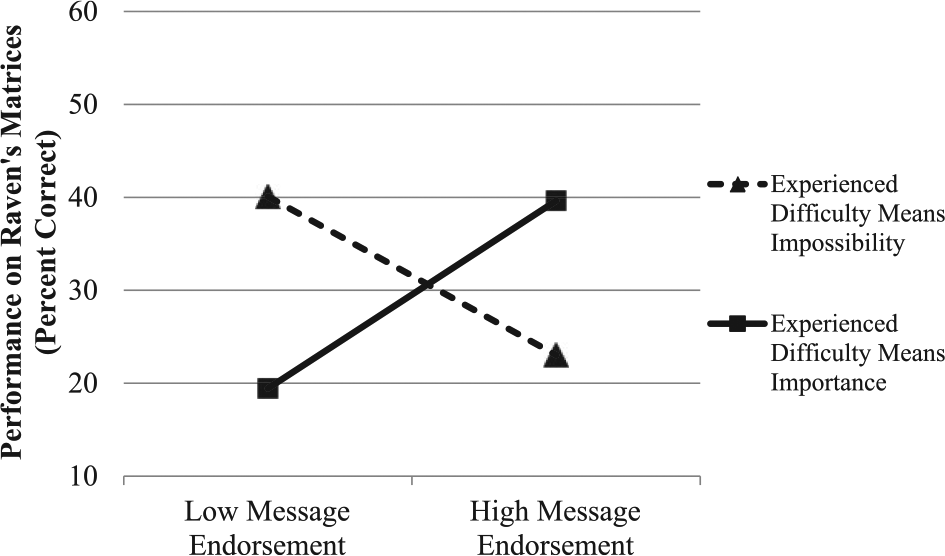
Consequences of the interaction between interpretation of experienced difficulty message and level of message endorsement for performance on the Raven’s Matrices task.
In contrast, as depicted graphically in Figure 2, the reverse pattern was found among students who demonstrated reactance by rejecting the message that they received. Students who received and rejected a message that experienced difficulty occurs when school tasks are important underperformed (MCorrect = 19.4%) relative to students receiving and rejecting a message that experienced difficulty occurs when school tasks are impossible (MCorrect = 40.1%); t(162) = −2.17, p = .031. Although the messages presented to students were identical across both studies, the impact of students’ endorsement of those messages reflects the different contexts in which the messages were received. Our results show that disagreeing with the intended persuasive message yielded a boomerang effect in Study 2, not Study 1. In Study 2, an ostensibly helpful message attempting to guide students to interpret experienced difficulty as importance undermined subsequent performance when rejected. In contrast, an ostensibly unhelpful message attempting to guide students to interpret experienced difficulty as impossibility bolstered subsequent performance when rejected.
Follow-up analyses combined Study 1 and 2 as a way of testing more directly the idea that it was not low endorsement per se but low endorsement in a context in which counterarguing was likely that yielded the boomerang pattern in Study 2. In these analyses, we asked whether low endorsement (using the means and standard deviations from Study 2) in Study 1 and in Study 2 produced different patterns of effects. These analyses included condition, mean endorsement, and their interaction along with control variables from each study, respectively, and are depicted graphically in Figure 3. Indeed, even when the mean and standard deviations from Study 2 were used to plot effects in Study 1, the impact of message endorsement on Raven’s performance differed across the two studies. In Study 2, low levels of message endorsement led to a reversal of message effects. In Study, 1 we did not find this crossover interaction. The effect of guided interpretation of difficulty was not significant at low levels of endorsement in Study 1, but there was never a reversal. These divergent patterns suggest that the conditions for reactance were set in Study 2, leading some students to reject and act in opposition to the persuasive message content that they received.

Differential effects of interpretation of experienced difficulty message on Raven’s performance at high and low levels of message endorsement, contrasting Study 1 (S1) and Study 2 (S2).
General Discussion
Well-meaning persuasive messaging attempts often fail, making things worse rather than better. One cause of failure is adolescents’ sensitivity to being told what to do and the reactance that is likely to ensue if they feel their autonomy is being curtailed. In situations that do not evoke reactance, as in Study 1, persuasive message content is assimilated into adolescents’ active lay theory or mindset, resulting in the intended effect. Indeed, students guided to consider the lay theory that experienced difficulty with schoolwork implies that schoolwork is important to them outperformed students guided to consider the lay theory that experienced difficulty with schoolwork implies that success with schoolwork is impossible for them. Students in the latter group did not differ from students in the control condition, highlighting the acute need for messages guiding students’ active lay theories and mindsets.
Taken alone, this outcome suggests that teachers and concerned adults would be wise to intervene with messages framing experienced difficulty as importance. However, the caveat is that our messages were received in a classroom context in which discussions of goals and academic effort were commonplace and so were unlikely to be perceived as manipulative or freedom limiting. To understand what happens when the influence attempt is experienced as more heavy-handed, in Study 2, we turned to physical education classes. In physical education class, students were unaccustomed to receiving messages about interpreting their experienced difficulty with schoolwork. We had them stop class and provided the same messaging materials used in Study 1. Students who accepted the message performed better if the message presented activated a lay theory that experienced difficulty with schoolwork signifies that the work is important for them. The reverse was true for students who rejected the presented message. They performed better if the message they rejected was that experienced difficulty with schoolwork signifies that success is impossible for them.
Limitations and Future Directions
Across the two studies, we used nearly identical study materials but varied the presence of autonomy-restricting conditions. Our results suggest that it is not the message content alone that matters. Even when using materials that work in settings that do not feel coercive, teachers can find that their messages boomerang in autonomy-restricting settings. However, a limitation of our current design is that we did not randomly assign students to conditions conducive to reactance versus no reactance within the same study. Future research that does so is needed to directly assess the size of the reactance effect. Hence caution is needed in interpreting our results.
That said, a strength of our method was that our presentation of the lay theory messages allowed us to capture each individual’s message endorsement. Again, a limitation of our method was that we could not capture the reactance process to examine the nature of students’ engagement with or counterarguing of the persuasive message. Our results are compatible with prior evidence that reactance is a consequence of message counterargumentation. Counterarguing can be beneficial if the persuasive message is undermining (e.g., Brucks, Armstrong, & Goldberg, 1988; Goldberg, Niedermeier, Bechtel, & Gorn, 2006; Slater et al., 1996, 1998). For example, counterargumentation has been successfully employed with elementary and middle school students to develop critical thinking about pro-alcohol and tobacco use media messages (Kupersmidt, Scull, & Austin, 2010; Kupersmidt, Scull, & Benson, 2012). Students rejecting the idea that experienced difficulty implies that schoolwork is not for them and thus not worth their effort may be generating arguments to the contrary, and these arguments may bolster subsequent effort.
Conclusion: Implications for Intervention
Our results document that under some conditions, messages guiding students to a lay theory about how to interpret difficulty will be assimilated and, in other cases, guided messaging will be rejected and contrasted against, yielding the opposite of the intended message. These results suggest a number of implications for intervention. First, it is not just the content of a message but how it is heard that matters. Second, it is not just the presence of a boomerang but what happens as a result that matters. Third, messaging attempts should consider how to support and benefit from students’ autonomy as active agents. Each of these implications is outlined next.
First, how a message is likely to be heard matters. Even the best intended messages, messages that have worked in other settings, could have boomerang effects if influence attempts are experienced as autonomy-limiting. Whether something feels heavy-handed and freedom reducing has to do with the immediate context—what students are expecting to experience, whether they trust the messenger, whether they feel safe in the context. We delivered a message that produced the intended effect in Adolescent Life classes but produced the opposite effect in physical education classes among students who counterargued. We are not suggesting which classes should be used for messaging about mindsets and lay theories; rather we are suggesting that teachers be mindful of what their setting implies. The pressure to maximize students’ instructional time may tempt instructors to push motivational interventions into nontraditional contexts. Our results imply that they may be more likely to evoke a boomerang effect in these settings.
Second, how a boomerang is handled matters for whether it supports or undermines teachers’ goals. Teachers who anticipate or find a boomerang effect can use it purposefully to elicit reactance against messages that guide students to consider an unproductive lay theory of what experienced difficulty implies. Once a message is rejected, message resistance increases over time (Sherman & Cohen, 2006); therefore, interventions that direct reactance toward motivation-undermining interpretations of difficulty may have staying power. Counterargumentation of unproductive lay theories or mindsets is useful for students confronted with messages implying that experienced difficulty signals that success is impossible and means that schoolwork is not for them (e.g., “Others may say that when schoolwork is hard, it’s impossible. What would you say to them?”). Counterargumentation of this unproductive interpretation of experienced difficulty may undermine its use as an interpretation for one’s own experience of difficulty. Similarly, interventions may direct students to counterargue an unproductive lay theory or mindset that experienced difficulty implies a lack of importance (e.g., “Others may say that they don’t believe that when schoolwork is hard, it’s important. What would you say to them?”).
Third, empowering students to exercise autonomy and generate their own arguments about what experienced difficulty implies offers an alternative approach. Offering students opportunities to practice considering what accessible lay theories and mindsets imply is helpful for both counterarguing unproductive lay theories and mindsets and for more deeply processing productive ones. When confronted with a productive interpretation of experienced difficulty, the goal is that students actively engage with the message (e.g., “If keeping going even when it is hard was easy to do, then there would be nothing to it. What makes you stand up to difficulty?”). For example, students could be asked to provide an example of a time that they were faced with a difficult task that was important and proved to be a worthwhile goal (a teacher might ask students, “Describe a time that something difficult was important to you and you kept trying until you succeeded”). Alternatively, students could be asked to write persuasive letters or record a video message to persuade younger students to use a productive lay theory or disregard an unproductive one, using examples from their own life (see Aronson et al., 2002, for an example of this method).
Taken as a whole, our results demonstrate that the effects of messages about what experienced difficulty implies for whether schoolwork is important or impossible depend on whether the message is experienced as freedom-limiting or not. In contexts in which they are unlikely to be counterargued, these messages are assimilated into downstream interpretations of experienced difficulty, improving performance if they activate a lay theory that difficulty implies importance, that the task is a “me” thing to do. In contrast, in contexts in which messages are likely to be counterargued, the same messages have the opposite effect. Even identical materials can produce the opposite effects—counterargumentation in contexts experienced as freedom-limiting and acceptance in contexts experienced as safe and trustworthy. If possible, interventions aimed at leveraging motivation and performance by guiding students’ lay theories of experienced difficulty should be subtle. If this is not possible, then interventions should attempt to leverage reactance by presenting alternative lay theories in a way that facilitates productive student engagement and counterargumentation.
Footnotes
Appendix . Message Content Manipulation
Difficulty Means Impossibility Condition
Difficulty Means Importance Condition
Acknowledgements
We thank participating schools and children; Mark Bornstein, Wendy Cortes, and Michael Joiner-Hill for assistance in data collection and coding; and the Self and Culture Lab. Data were collected while all the authors were at the University of Michigan.
Authors
KRISTEN ELMORE is a Postdoctoral Associate at the Bronfenbrenner Center for Translational Research at Cornell University. Her research examines the self, identity processes, and motivation in the domains of health and education.
DAPHNA OYSERMAN is the Dean’s Professor of Psychology and a Professor of Education and of Communication at the University of Southern California, as well as the Co-Director of the Dornsife Center for Mind and Society. Her research examines the situated nature of identity and self-concept and the role of identity-based motivation in cognitive processes and action, including effects on self-regulation and effective pursuit of important life goals.
GEORGE SMITH is a Harvard Strategic Data Project (SDP) Fellow working with the Huntsville City School District as a Data Strategist. His research focuses on school-based interventions to improve student motivation and academic achievement.
SHEIDA NOVIN is a Postdoctoral Researcher in the Psychology Department at Utrecht University. Her research focuses on cultural influences on cognition, emotion and behavior in adults and children.