




Abstract
Classroom disciplinary climate and its correlation to students’ performance is a widely debated issue. Policy reports tend to assume that classroom disruptions interfere with the learning experience. Empirical evidence for this assumption, however, which carefully distinguishes classroom climate from the school climate in general, is still wanting. This study examines the relation between student reports regarding disciplinary infractions to student achievement, with a special focus on classroom disruptions. Multilevel regressions were used to estimate the contribution of classroom and school disciplinary infractions on eighth-grade students’ test scores. Reports of disruptive behavior proved to correlate negatively with test scores, whereas the effect of other school and classroom characteristics, including teachers’ attitudes and school disciplinary policy, were insignificant (controlling for students’ prior achievements). We conclude that a disruptive classroom climate can hinder the learning process and lower the achievement of the entire class, regardless of the conduct of any particular student. Therefore, a special focus on disruptions in the classroom, in contradistinction with school disciplinary climate in general—which is lacking in most studies—emerges as instrumental to the understanding of how school climate relates to student achievement.
S
The current study focuses on a particular aspect of classroom climate—namely, classroom disciplinary climate, or the way that students perceive disciplinary practices in the classroom. This includes the students’ attitudes and behaviors, the stability of classroom rules, and the manner in which teachers address disciplinary problems (Cheema & Kitsantas, 2014; LePage, Darling-Hammond, & Akar, 2005). Our analysis focuses on disruptions during class and how these relate to student achievement.
Orderly classroom climate is generally considered to be a precondition for effective teaching and learning and, thus, to students’ academic achievement (Jennings & Greenberg, 2009; Ma & Willms, 2004). Class disruptions tend to interfere with students’ ability to follow lessons and are therefore a hindrance to the learning experience (Frenzel, Pekrun, & Goetz, 2007; Organization for Economic Co-operation and Development, 2010a). In addition, in classes with frequent student disruptions, teachers must spend time disciplining the students at the expense of teaching (Kyriakides & Creemers, 2009).
As one would expect, this correlation is substantiated by numerous studies (e.g., Dinkes, Cataldi, & Lin-Kelly, 2007; Gottfredson et al., 2000). We also see a consistency regarding this conclusion across various countries. Recently, Ning, Van Damme, Van Den Noortgate, Yang, and Gielen (2015) found that in 53 of the 65 countries that participated in 2009 Program for International Student Assessment (PISA), a better classroom disciplinary climate (as measured by school-level aggregated student reports of classroom infractions) is associated with higher reading performance in eighth-grade students. The same correlation has been confirmed in other countries as well (Ma, Jong, & Yuan, 2013; Ma & Klinger, 2000; Shin, Lee, & Kim, 2009). Ma and Willms (2004) investigated seven school-level disciplinary climate variables in the United States (including strictness of rules, teacher-student relations, and violent incidents) and found that classroom disruption exhibited the strongest correlation to achievement in all four subjects tested—math, science, reading, and history. Although the evidence that classroom infractions are related to student achievement is compelling, past studies that focused on disciplinary climate used aggregations of student reports at the school level while overlooking any variation in disruptions among classrooms within schools.
This oversight has drawn our attention because every classroom has a distinctive “personality,” or climate that reflects variability in interactions among students as well as between students and teachers (Anderson, 1970; Anderson, Stevens, Prawat, & Nickerson, 1988). The different norms prevailing in each classroom—for example, the educational goal structure set by the teacher and the level of perceived support that he or she offers to students—affect the level of student engagement, motivation, and discipline (Kaplan, Gheen, & Midgley, 2002; Ryan & Patrick, 2001; Vavrus & Cole, 2002). These norms also affect the manner in which teachers and students experience and react to disciplinary problems as they occur (Ames, 1991; Darling-Hammond & Bransford, 2005; Evertson & Weinstein, 2011; Good & Brophy, 2008; Metz, 1978; Murray-Chandler, 2009). Other studies addressing differences among classrooms have stressed classroom composition (ethnic, gender, socioeconomic) in relation to scholastic norms, motivation levels, and degree of disruptions (Creemers, 1994; De Fraine, Van Damme, Van Landeghem, Opdenakker, & Onghena, 2003; Lavy & Schlosser, 2011; Van Ewijka & Sleegers, 2010). In addition, teacher quality is recognized as a significant factor into student achievement (Hanushek, 2011; Hill & Rowe, 1996; Kane, McCaffrey, Miller, & Staiger, 2013; Jennings & DiPrete, 2010; Luyten, 2003). Thus, students who attend different classrooms in the same school may receive a very different education, in terms of the schooling experience and its outcomes.
Effectiveness studies carried out in primary and secondary schools in different countries suggest that when it comes to students’ achievement in terms of cognitive and affective outcomes, the classroom-specific factors are more significant than the overall school climate (Gottfried, 2012; Hill & Rowe, 1996; Kyriakides, Campbell, & Gagatsis, 2000; Kyriakides & Creemers, 2008; Lamb & Fullarton, 2002; Peetsma et al., 2006; Scheerens & Creemers, 1989; Yetişir, 2014). Nevertheless, most studies dealing with classroom infractions and student achievement have omitted the classroom level from the analysis, although variation among classrooms within the same school has been documented extensively. These studies have therefore drawn a partial picture with somewhat biased conclusions that seem to overestimate school effects (Martínez, 2012; Opdenakker & Van Damme, 2000).
The current study addresses this issue by analyzing aggregated reports of classroom disruptions at the classroom level. Because education systems have a hierarchical structure—students within classes, which are in turn within schools—researchers must examine, in addition to classroom characteristics, student and school characteristics (Raudenbush & Bryk, 2002). Therefore, in the current study, we have generated and analyzed a three-tiered data set. This is one of the first studies to empirically examine the relation between disciplinary infractions and achievement at all three levels—student, classroom, and school. Moreover, the study carefully controls for students’ prior achievements, which is important due to the possibility of selective distribution—that is, assigning students to schools or classrooms based on their past achievements.
Disciplinary Infractions and Educational Achievement
Disruptions in the Classroom and Student Achievements
A key assumption of educational research is that cognitive, motivational, and behavioral student outcomes are substantially shaped by the learning environment (Fraser & Fisher, 1982). Some studies suggest that distraction, noise, and disorder impede the learning process (Granström, 2006). Moreover, a few studies demonstrate the long-term effects of disciplinary climate on student motivation (Edman & Brazil, 2007; Fencl & Scheel, 2005). In a study of 900 students from Grades 9 to 12, Hadre, Crowson, Debacker, and White (2007) found that positive classroom climate is related to an increase in perceived learning ability. There is also evidence linking perceived classroom climate to student self-efficacy (McMahon, Wernsman, & Rose, 2009). These results explain >40% of the variance in math performance among students in the United States (Kitsantas, Cheema, & Ware, 2011).
Other empirical studies on the relation between classroom disruptions and achievement focus on peer effects. There is evidence that exposure to disruptive or aggressive behavior in class affects the students’ own behavioral patterns, which in turn impedes learning (Osher, Bear, Sprague, & Doyle, 2010; Thomas, Bierman, & the Conduct Problems Prevention Research Group, 2006). Other studies stress the effect of disruptions on available learning time: By effectively shortening class, disruptions hinder the learning process for students regardless of their personal conduct (Dinkes et al., 2007; Hoxby, 2000; Kinsler, 2013). Neidell and Waldfogel (2010) employed value-added models with school fixed-effects and found that due to a spillover effect, only a handful of unruly students may be sufficient for disrupting the academic progress of their classmates. Using domestic violence at home as an instrumental variable for disruptive behavior, Carrell and Hoekstra (2010) found that adding one more troubled boy to a classroom of 20 students reduced test scores by nearly 2 percentile points, and Figlio (2007) found the same decrease using the “femininity” of a boy’s name as an instrumental variable for disruptive behavior.
Disruptive behavior and disorder also interfere with teachers’ ability to teach effectively and are viewed as malfunctions of classroom management (Canter, Paige, Roth, Romero, & Carroll, 2004; Granström, 2006). Some argue that disciplinary infractions in class lead to negative attitudes on the teachers’ part toward the entire classroom, which harm student achievements (Byrne, 1994; Hastings & Bham 2003). A positive perception of classroom disciplinary climate improves teacher-student relationships (Cheema & Kitsantas, 2014), which do much to curb dropout rates and improve self-efficacy and confidence (Murray & Malmgren, 2005). Ma and Klinger (2000) found that school disciplinary climate, measured mainly by aggregated student reports, was the most important determinant of achievements among eighth graders in Canada. Moreover, the effect of disciplinary climate on achievement surpassed the effect of school socioeconomic status (SES) and individual student characteristics. These researchers suspect that this is due to the supportive relationship that tends to be established between teachers and students in a peaceful classroom environment—the kind of relationship that is conducive to academic performance.
In short, there is substantial empirical evidence for the negative correlation between classroom disruptions and middle school student achievement worldwide. Most of the available studies, however, consider only the average level of classroom disruptions in schools but do not take into account the variation among classrooms with regard to disruption levels. For example, Shin et al. (2009), using data from the 2003 PISA, found that relation patterns between student- and school-level predictors and achievements in mathematics differ among Japan, Korea, and the United States. School disciplinary climate, however, as measured by aggregated student reports of classroom disruptions, is a consistent predictor of math performance in all three countries (Shin et al., 2009). Another study (Ma et al., 2013) based on the 2009 PISA showed that in Hong Kong, Taipei, and Japan, classroom disciplinary climate has a positive effect on student performance in reading, mathematics, and science. Classroom disruptions are the school-level disciplinary variable with the strongest relationship to math, science, reading, and history achievements in the base year of the U.S. National Education Longitudinal Study (Ma & Willms, 2004).
Middle school students are an important target population to test the effect of classroom disruptions and are also the target population in the PISA and TIMSS (Trends in International Mathematics and Science Study) international tests. Although the social environment in a classroom affects students of all ages, it may be particularly important for young adolescent students who doubt their abilities to excel at their schoolwork and decrease their effort toward academics (Anderman & Maehr, 1994; Eccles et al., 1993; Eccles & Midgley, 1989; Ryan & Patrick, 2001). Therefore, middle school students can be an important target population to test the effect of classroom disruptions.
Student, Classroom, and School Characteristics Relating to the Level of Disruptions and Achievement
Because students are nested within classrooms, which are nested within schools, the investigation of the relation between classroom disciplinary climate and student achievement should consider student, classroom, and school characteristics that are related to classroom disruptions and to student achievement (Ma & Willms, 2004; Organization for Economic Co-operation and Development, 2010b; Rangvid, 2007).
Several factors have been found to correlate with disruptions and achievement. The first is the socioeconomic background of the students: Those from advantaged backgrounds tend to behave well and have higher achievements, while students from disadvantaged families and communities tend to rebel against school rules and regulations and have lower achievements (Gregory, Skiba, & Noguera, 2010; Hattie, 2009; Organization for Economic Co-operation and Development, 2010a). The better communication and cooperation of affluent students with authority in the classroom foster moral standards that are more conducive to exercising discipline over the entire classroom, and this has a positive influence on student achievement (Dreeben & Barr, 1988). Studies have also supported similar conclusions at schools: A high proportion of students from a privileged socioeconomic background at a given school leads to a climate that is conducive to learning (Barbieri & Scherer, 2012; Khoury-Kassabri, Astor, & Benbenishty, 2009).
Gender is also important in explaining the relation between classroom disciplinary climate and student academic achievement (Buchmann, DiPrete, & McDaniel, 2008; DiPrete & Buchmann, 2013; Frenzel et al., 2007). Boys tend to exhibit more disciplinary infractions and lower achievements (DiPrete & Buchmann, 2013; Van Houtte, 2004), plausibly due to good school behavior being associated with docility and submission to authority, which in a patriarchal society are associated with “femininity” and thus contrary to masculine identity (Adler, Kless, & Adler, 1992; Morris, 2008; Warrington, Younger, & Williams, 2000). Lavy and Schlosser (2011) used idiosyncratic variation in gender composition across adjacent cohorts within the same school to show that when the proportion of girls in a classroom increases by 10%, test scores increase by 4% to 5% of a standard deviation. The positive effect of girls appears to stem from better in-class behavior, since having a higher proportion of girls in the classroom reduces the amount of classroom disruption and violence.
Some studies found that in large schools there are more disciplinary infractions and lower achievements (Arum & Velez, 2012), and, as for classrooms, disruptions are said to mediate the negative correlation between class size and student achievement (Lazear, 1999). Class size was also suggested by Güzel and Berberoğlu (2005) as a confounding variable for the positive correlation found between students’ perceptions of classroom disciplinary climate and their reading scores in Brazil.
Last, schools with well-entrenched disciplinary rules and academic traditions are less likely to suffer from behavioral problems, and student achievement is correspondingly higher (Newhouse & Beegle, 2006; Opdenakker & Van Damme, 2006). Students’ perceptions of school disciplinary policy as clear, fair, and enforced and teachers’ attitudes as reasonable have also been found to encourage discipline and achievement (Arum, 2003; Arum & Velez, 2012; Benbenishty, Khoury-Kassabri, & Astor 2005; Esposito, 1999; Laufer & Har’el, 2003).
While the aforementioned factors are related to infractions and achievement among students, classrooms, and schools, the studies reviewed above tend to focus on only one of these levels of analysis. This highlights the need for a multilevel study that addresses student reports of disciplinary infractions in the classroom and in the school and that controls for other aspects of disciplinary climate (e.g., school policy or teachers’ attitudes) as well as for student, classroom, and school characteristics.
The Israeli Context
The Israeli population is ethnically heterogeneous. Arabs and Jews are highly segregated in the school system, as most Arab students attend Arabic-speaking schools and virtually all Jews attend Hebrew-speaking schools. The Hebrew-speaking school system consists of three main sectors: nonreligious public schools that are attended by about 55% of all Jewish students, religious public schools, and ultra-orthodox schools. As explained below, our data pertain to Jewish nonreligious schools. The study employs data on Israeli eighth-grade students.
Israel offers an interesting case study for the relation between disciplinary infractions and educational achievement. It has been argued that Israeli culture glorifies independence, defiance, and daring (Almog, 1997; Katriel, 1986). Almog (2004) describes Israeli education as informal and liberal: School uniforms are uncommon; students call teachers by their first names; and noisy classrooms are the norm. Not surprising, a study of 52 countries found that Israelis scored lowest in average regard for authority (Hofstede, 1994), and comparative studies showed that Israel is a leader in classroom disruptions (Arum & Velez, 2012; Kramarski & Mevarech, 2004).
In the late 1990s and early 21st century, legislation, directives, and public discourse tended to highlight individual rights and provide teachers with very few effective sanctions to enforce discipline in schools (Shavit & Blank, 2012). For example, the Student Rights Law, passed in 2000 and amended in 2004, makes it very difficult to expel or transfer students from a school and thus raised some concerns among teachers and parents who were worried that schools were losing control of discipline. Toward the end of the previous decade, the focus shifted from students’ rights to the reduction of disciplinary infractions through harsher regulations (Shavit & Blank, 2012). Several restrictions that had been imposed on school staff were lifted, and new guidelines were issued that provided teachers and schools more leeway in their handling of violent or undisciplined students (Ministry of Education, 2009, section 3.2.5).
The trend in Israel is not unique and seems to mirror processes occurring in other countries. A similar concern regarding an increase in violence, disciplinary infractions, and loss of school authority is evident in the United States and Europe (Anderson & Kincaid, 2005; Arum, 2003; Gregory et al., 2010; Kane, 2008; Kindiki, 2009; National School Climate Center, 2010). The title of a speech by a former Israeli minister of education, “Zero Tolerance to Violence in the Educational System” (Sa’ar, 2010), borrows from the “zero tolerance” policy deployed throughout the United States, illustrating how the current fashion in Israel is inspired by the global tendency to implement firmer policies within schools (Dinkes, 2007). Therefore, the Israeli data are valuable as a relatively extreme case of highly undisciplined schools yet one that reflects the international trend in terms of policy.
Study Objectives
The main research question in this study is whether classroom disruptions, as reported by students, are related to students’ achievement, controlling for prior achievement and other student, classroom, and school characteristics. Furthermore, how does this correlation compare with that between achievement and student reports of disciplinary infractions in schools? We hypothesize that a high level of reported classroom disruptions would be negatively correlated to student achievement—more so than infractions at school.
Method
Research Design
We constructed a data set consisting of students who were tested in national (standardized) tests in the fifth and eighth grades. Since 2002, the National Authority for Measurement and Evaluation (RAMA, in Hebrew) has conducted national achievement tests. The Hebrew acronym for the tests—MEITZAV—stands for “Indicators of School Effectiveness and Growth.” MEITZAV tests are administered to fifth- and eighth-grade pupils every year in four core subjects: language (Arabic or Hebrew), English, mathematics, and science. In schools where MEITZAV tests are taken, students in Grades 5–9 complete questionnaires regarding the climate and pedagogical environment of their homeroom classes and schools.
In addition to MEITZAV test scores and school climate questionnaires, students’ background information was obtained from Ministry of Education files, as was information on classroom and school characteristics, such as school size, school sector (nonreligious Jewish, religious Jewish, Arab), and classroom size.
With a unique identifier given by the Central Bureau of Statistics to each student and each school, we merged students’ background information as well as their classroom and school characteristics with their completed questionnaires and MEITZAV records to create the data set for this study. Next, we merged fifth-grade students’ records in 2006 with their records as eighth graders in 2009, thereby creating panel data with two time points.
Sampling Procedure
For the MEITZAV, all elementary and middle schools in Israel are grouped into four clusters of approximately equal size, with each cluster being a representative sample of all Israeli schools. Each year, two of the four clusters take the MEITZAV test and fill school climate questionnaires, and since 2007, each cluster has been tested in only two subjects: math and native language or science and English. Thus, as of 2007, about 25% of all fifth- and eighth-grade students have been tested in each subject. According to RAMA (2009), about 90% of students in the relevant clusters took the MEITZAV and completed the school climate questionnaires each year.
As noted, each cluster was tested every other year. Since MEITZAV was not designed as a panel study, for most students we cannot merge fifth- and eighth-grade test scores. For example, a school tested in 2006 was also tested in 2008, but because its fifth graders of 2006 were only seventh graders (not eighth) in 2008, they were not retested. The next time that school was tested was in 2010, by which time these students were in ninth grade and thus again out of the sample. Hence, a student who stayed at the same school between fifth and eighth grade was not tested twice in MEITZAV.
Fortunately, however, most students change schools as they progress from primary school (Grades 1–6) to the lower-secondary school (Grades 7–9). In large cities, schools are assigned to all four clusters of analysis, and as students move between primary and secondary schools, they often change sampling clusters as well. Accordingly, about 25% of all fifth graders who were tested in 2006 shifted to schools in clusters that were tested in 2009, when they were in eighth grade.
Participants
As explained below, our main dependent variable is achievement in one’s native language. Jewish schools’ native language is Hebrew, while it is Arabic in Arab schools. Calibrating the tests in the two languages is not possible, because none of the students were tested in both languages. Therefore, we focus this study on Jewish schools. We also exclude religious schools from the analysis because studies have revealed large differences between religious and nonreligious schools in achievements and disciplinary practices alike (Coleman & Hoffer, 1987; Lee & Bryk, 1989). Therefore, our research sample consists of 2,422 students in 181 classrooms at 61 nonreligious Jewish schools.
Given the MEITZAV sampling procedure, the set of students who were tested and then retested is not a random sample. It is potentially biased in several respects: First, it excludes students who remained in the same school in fifth and eighth grades; second, residents of small communities are underrepresented. These are typically assigned to a single cluster, and their transition from primary to lower secondary schools does not entail a change of cluster.
Table 1 compares the panel of students tested in both fifth and eighth grade with the entire eighth-grade cohort in nonreligious Jewish schools. The differences between the two seem minimal, although some are significant given the large sample (>10,000 students in all). The mean of parents’ years of schooling in the panel is 13.34, compared with 13.37 for students who tested only in eighth grade. There are also slight differences between the groups in number of siblings, Hebrew test scores and students’ level of disengagement in school. Levels of reported classroom disruptions, school-level infractions, and the strictness of school disciplinary policy are somewhat higher among those tested only in eighth grade, meaning that, on average, members of the panel attended classes and schools with a better-perceived disciplinary climate than that of the general population. The two groups are similar, however, in the correlation between the main variables in this study—namely, student-reported classroom disruptions and Hebrew scores. Furthermore, when a dummy indicator for being tested twice was included in multivariate regressions predicting eighth-grade achievement, its effect was negligible.
Comparison Between Students Who Were Tested Twice and Their Peers in Eighth Grade Who Were Tested Once in Hebrew in Nonreligious Jewish Schools
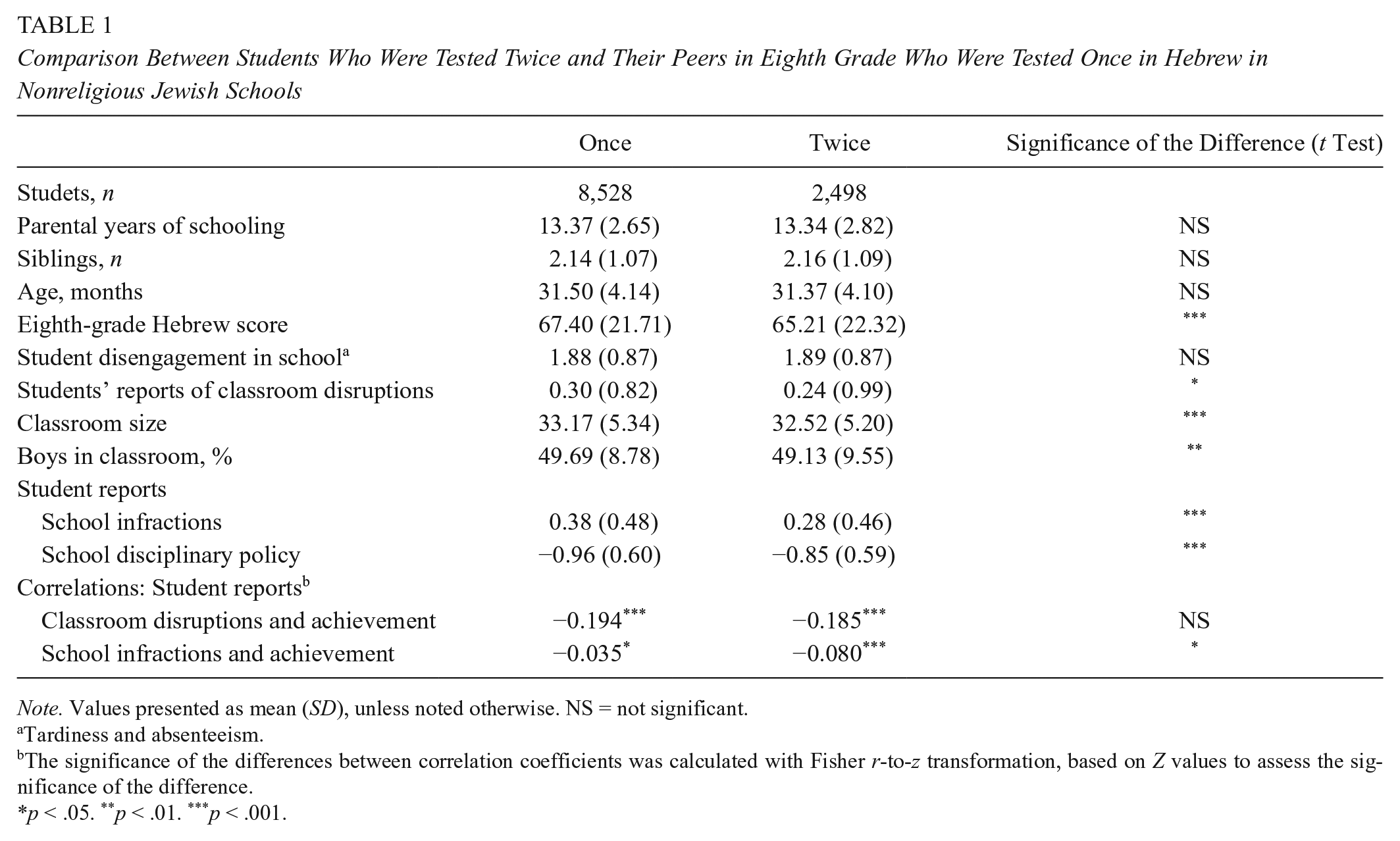
Note. Values presented as mean (SD), unless noted otherwise. NS = not significant.
Tardiness and absenteeism.
The significance of the differences between correlation coefficients was calculated with Fisher r-to-z transformation, based on Z values to assess the significance of the difference.
p < .05. **p < .01. ***p < .001.
Overall, the research sample seems to adequately represent the student population of nonreligious Jewish schools. The slight differences might suggest that our estimates will be conservative relative to the effects among all students, since the level of reported infractions in our sample is somewhat lower and the correlation between classroom disruptions and student achievement slightly weaker.
Measurement of Variables
The dependent variable in this study is student achievement, measured via the Hebrew test scores in eighth grade—mainly because classroom characteristics are available only for homeroom classes and Hebrew is the only MEITZAV subject taught in homeroom classes. 2 The Hebrew test consists of three parts: reading comprehension (55% of the exam), writing (30%), and grammar (15%).
The main independent variable is student reports of disruptive behavior in the homeroom class. 3 Students were asked to what degree, on a 5-point scale, they agreed with the following statements: “The students in my classroom treat their teachers with respect”; “Students in the classroom are often noisy and they disturb class”; “There are students in my classroom who talk back to the teachers”; “Teachers usually wait a long time at the beginning of class before the students settle down.” These items were averaged for each homeroom class (the scores of the first item were reversed) and then analyzed to produce a principal component factor. The factor loadings varied from 0.844 to 0.915, and the principal component factor explained 78% of the cumulative variance. This factor was computed across all students in all eighth-grade homeroom classes, whether they were tested in Hebrew once or twice. Since this is an aggregated variable, we also controlled for students’ individual reports, thus ensuring that the classroom-level variable did not confound individual student perceptions. The individual students’ perception is a factor of all the aforementioned statements across all students (e.g., grand mean centered). Student-level controls of aggregated variables also exist for student reports of school infractions, school disciplinary policy, and teacher unfairness.
We control for the level of violent incidents and disciplinary infractions in schools, school disciplinary policy, students’ perceptions of teachers’ unfairness, and students’ engagement levels. These variables have been shown to contribute to classroom infractions and achievements.
Student reports of disciplinary infractions in school—this variable was measured as a factor of the following variables: (a) mean student reports of classroom disruptions at the school (as detailed above); (b) student reports of the incidence of vandalism and bullying in the school, as indicated by students’ average agreement with three statements (“There are groups of students at school that act violently, harass other students and hurt them”; “In the past month, students in my school broke or tore down school equipment”; “In the past month, students in my school stole from me”); (c) school-level victimization consisting of mean student reports on the number of times in the previous month students had been punched, kicked, shoved, cursed, or mocked by other students in the school. These variables were factor analyzed across schools; their loadings varied from 0.718 to 0.742, and the principal component explained 54% of the cumulative variance. 4
Student reports of school disciplinary policy—This variable is measured as a school-level factor based on students’ mean agreement with the following statements: “The school takes many measures to prevent and deal with violence”; “During recess, there are always teachers in the yard whose job is to prevent violence”; “When violent incidents occur in school, the teachers know about them.” The results indicate that these variables load onto a single factor, with loadings varying from 0.859 to 0.915. The factor explained 78% of the cumulative variance. A higher factor score indicates stricter discipline.
Teacher unfairness—this is an aggregated average, at the classroom level, of students’ agreement with the following statements: “Some of my teachers prefer some students over others” and “Some students in my classroom are mistreated by teachers, no matter what they do.” Higher scores represented a collective perception of unfair treatment by teachers at the classroom level.
The data include two self-reported measures of students’ violations of school norms: tardiness (the number of times that the student was late for class in the previous month) and absenteeism (the number of school days that she or he missed in the previous month). These variables indicate students’ engagement in school and tend to correlate with other aspects of behavior (Finn & Rock, 1997). They have been incorporated in measurement of disciplinary infractions or problem behavior in previous studies (Anderson, 1982; DiPrete, Muller, & Shaeffer, 1981; for reviews, see Astor, Guerra, & Acker, 2010; Cornell & Mayer, 2010). We averaged these two variables to create student disengagement in school (higher values indicate lower engagement).
Classroom characteristics included in the models are average years of parental education, socioeconomic heterogeneity of the classroom (measured by the standard deviation of parents’ education in the classroom), gender composition (indicated by the percentage of boys in the classroom), and classroom size. At the school level, we controlled for school size and school socioeconomic index (a high score represents a higher mean SES level). 5
We controlled for students’ test scores in fifth grade as well as gender (boys=0), age (measured in months), parental education level (average years of schooling of mother and father), and whether the student is an immigrant or not.
Results
Analytic Strategy
We employed random intercept models in which the effects of all variables were fixed with restricted maximum likelihood estimation. The analysis was executed with SPSS Mixed Models (version 21) through remote access to a Ministry of Education virtual research site.
Descriptive Statistics
Table 2 presents descriptive statistics for student, classroom, and school characteristics. It shows that almost half the students were boys and that mean parental education was 13.33 years. Seven percent of the students were born outside Israel. The average student came late to class or skipped a school day two or three times in the previous month (1.88 on an ordinal scale of 1–5).
Descriptive Statistics of the Variables

Note. SES = socioeconomic status.
Tardiness and absenteeism.
Classrooms were fairly large, with >32 students on average, and almost half the students in the classroom were boys. Means of the factors measuring student reports of classroom and school disciplinary infractions, as well as school disciplinary policy, were nonzero because our sample represented only nonreligious Jewish schools, whereas the factor analysis was conducted in a sample that also included Arab and religious Jewish schools. The negative mean SES of schools (–0.68) suggests that the students who attended the schools in our sample (nonreligious Jewish schools) were, on average, better off socioeconomically than students in Israeli schools as a whole.
Table 3 presents Pearson’s correlations of the classroom characteristics at the classroom level and correlations among the main research variables at the student level. As expected, mean parental education level correlated positively with classroom achievements. The percentage of boys in the classroom correlated negatively and significantly with average achievement (–.205) and classroom size (–.160), possibly because boys had lower scores and were referred more often than girls to special education classrooms (Coutinho & Oswald, 2005), which tend to be smaller. In an unreported analysis, we estimated the partial correlation of percentage of boys with classroom size, controlling for mean prior achievement, and found it insignificant. Contrary to the finding of Lavy and Schlosser (2011), gender composition and classroom infractions were not correlated. The correlations of classroom size with achievements and parental education were positive (.182 and .207, respectively). This result may reflect the allocation of weaker students to small classrooms (Feniger & Shavit, 2011). Student reports of classroom disruptions correlated negatively with average parental education and average achievement (–.125 and –.293), and large classrooms tended to have more disruptions. The significant correlation between student reports of classroom infractions and teacher unfairness was quite sizable (.369), meaning that classrooms where students perceived teachers’ attitudes as unfair suffered from a greater rate of disciplinary infractions, as reported by students.
Pearson’s Correlation Coefficients of the Classroom Characteristics and the Main Control Variables

Note. SES = socioeconomic status.
p < .05. **p < .01. ***p < .001.
As seen in the second panel of the table, the correlation between student reports of infractions in classrooms and in schools was weak (r = .255), although they shared some of the same indicators. School disciplinary policy was correlated negatively with student reports of disciplinary infractions at both classrooms and schools (–.412 and –.313, respectively).
Multivariate Analysis
We now turn to our main analysis of the association between student achievement and student reports of disciplinary infractions in classrooms and schools. Classrooms with fewer than three students were removed from the sample to increase the reliability of the estimates. The multivariate analysis was ultimately based on a sample of 2,346 students in 145 classes at 52 schools. 6
First, we wish to examine what part (if any) of the variation in student achievements is among classrooms within schools. The proportion of variance in the null model, presented in Table 4, indicates that about 78% of the variance in Hebrew test scores was accounted for by students, almost 12% by schools, and the final 10% by classrooms. This means that a significant part of the difference among students in achievement was due to the unique characteristics of the classroom to which the student was assigned. The contribution of the classroom environment to Hebrew scores was almost as large as that of allocation of students among schools.
Covariance Parameter Estimates and Proportion of Variance in the Multilevel Null Model of Student Achievements

p < .01. ***p < .001.
To test if student-reported classroom disruptions relate to student achievement, we use multivariate analysis controlling for prior achievements and other student, classroom, and school characteristics. Table 5 shows three hierarchical models. 7 The first model contains only student characteristics, including fifth-grade Hebrew score. The students’ prior achievements are important to control for selective placement of students within classrooms and schools. Classroom variables including our main independent variable (student reports of classroom disruptions)—were inserted in the second model. In the third model, we added school context variables to see whether they have an additional contribution to student achievement. For each aggregated variable, we included controls at the level of the student.
Multilevel Regression Analysis of Students’ Hebrew Test Scores (Standard Errors in Parentheses)

Note. BIC = Bayesian information criterion; ICC = intraclass correlation coefficient; SES = socioeconomic status.
p < .05. **p < .01. ***p < .001.
The first model shows the well-known positive and significant effect of parental education (1.086) and the negative effect of gender (boys) and age on achievement. The negative effect of age (–0.220) probably reflects the fact that some of the older children are those who were left behind to repeat a grade and are scholastically weak. These effects remain significant in all subsequent models. In line with prior research (Finn & Rock, 1997; Fredericks, Blumenfeld, & Paris, 2004), a high level of student disengagement at school correlates negatively with Hebrew test scores and was significant in this and in all subsequent models. Also, as one would expect, the effect of students’ prior scores on current scores was very strong (0.714). Controlling for student characteristics, mainly prior scores, decreases the unexplained variance between students and schools by about a half and among classrooms by almost 40%. The reduction in unexplained variance between classrooms and schools points to a selection bias in the placement of students into schools and classrooms: Students with better scores, higher parental education, and higher levels of engagement in school are placed in better schools and in better classrooms; therefore, many of the differences in Hebrew scores among classrooms and especially schools diminish when we control for student characteristics.
Model 2 adds independent variables at the level of the classroom to test whether student reports of classrooms disruptions are significantly related to Hebrew scores. Students’ reports of their classmates’ disruptive behavior correlate negatively and significantly with Hebrew test scores (–3.357) when all other classroom and student characteristics are controlled for. Apart from classroom disruptions, none of the classroom variables have a significant effect on test scores. In additional models that we have analyzed and not presented here, the significant effects of mean parental education, percentage of boys, and classroom size on test scores disappear when we control for student prior scores. The independent effect of teachers’ unfairness toward students is insignificant as well; that is, when all other student and classroom characteristics are controlled for, the shared perception of students in the classroom regarding their teachers’ impartiality has no correlation with classroom achievement. However, as found in other studies (Arum & Velez, 2012), individual students’ perception of unfair teacher attitudes has a significant negative effect on scores throughout the models, meaning that students who perceive their teachers as unfair tend to have lower achievements.
The inclusion of classroom characteristics, mainly student reports of classroom disruptions, reduced the unexplained variance in Hebrew test scores among classrooms by 14%. In addition, it reduced the unexplained variance between schools by one-fifth. Considering that this reduction is obtained after controlling for student characteristics, including students’ prior scores, it is not negligible. Not only does this imply that a substantial part of the test score difference among classrooms is related to differences in the level of disruptions to learning, but it can also explain some of the achievement differences among schools.
Finally, we compare the association between achievement and classroom disruptions to that between achievement and disciplinary infractions in schools. School context is presented in the third model. As seen, student reports of school infractions, as well as other school characteristics, have no significant contribution to test scores independent from that of student characteristics and reported disruptions within the classroom. 8 School disciplinary policy showed no significant association with achievement once all other variables were controlled for. In an unreported supplementary model, we controlled for all student, classroom, and school characteristics but without classroom disruptions. The model shows that stricter perceived disciplinary policy exerted a positive effect on Hebrew scores, but some of this effect was mediated by student reports of classroom disruptions. This suggests that stricter enforcement can improve achievements by lowering the general level of disruptions in classrooms.
It seems that our findings support the assumption that the school-level effects presented in prior studies may be inflated due to the omission of the classroom as a separate level of analysis (Hill & Rowe, 1996; Martínez, 2012; Opdenakker & Van Damme, 2000). With student characteristics controlled for, no school- or classroom-level variable correlated with achievement significantly, except student reports of classroom disruptions.
Summary and Discussion
Policy makers have been seeking ways to improve the disciplinary climate and reduce disciplinary infractions and violent incidents in schools. Even though the learning process occurs almost entirely in classrooms and studies have revealed a multilayered relationship among student and school characteristics, classroom disruptions, and achievements, few studies have addressed the classroom as a unit of analysis. The present study was designed to investigate students’ shared views of classroom disruptions within the multilevel structure of schooling: students within classrooms within schools. We presented a simple research question: Do student reports on classroom disciplinary infractions indeed correlate negatively with achievement, even when controlling for prior achievement and other student, classroom, and school characteristics? We hypothesized that a high level of disruptions could be negatively related to student achievement, even more so than infractions at the school level.
The main finding is supportive of our hypothesis: Student reports of classmates’ disruptive behavior are negatively related to student achievement, even when controlling for student, classroom, and school characteristics, including students’ prior achievements. For example, we estimated that an average student in a relatively well-behaved classroom (one standard deviation below the average disruption level) would achieve a Hebrew score of 77.7, while the same student who studied in a classroom with a high level of perceived disruptions (one standard deviation above the mean) would score 73.6. This difference in scores is not far from that between a student with mild behavioral disengagement and a student who is engaged in school (respectively, one standard deviation below and above the average tardiness and absenteeism level)—a difference of 5.5 points. Thus, what seem to be considered “mild” infractions by some students in a classroom—talking during class and disrespect for teachers—can accumulate and harm the achievements of all the students in the classroom as much as absenteeism or tardiness of the individual student. It should be noted that we measured achievement using test scores, which correlate with disciplinary infractions much less than grades do (Myers, Milne, Baker, & Ginsburg, 1987), which might have yielded even stronger correlations.
Within the literature discussing classroom climate, several explanations have been suggested for the effect of disciplinary climate (often reported by students) on achievements. Some of the explanations focus on the mediation of students’ personal conduct, which is affected by the prevailing norms in the classroom. Others claim that disorder in the classroom reduces the achievements of all students, regardless of their individual behavior. The current study supports the latter: The contribution of student reports of classroom disruption to test scores remained significant even with controls for behavioral disengagement in school (e.g., absenteeism and tardiness). Student disengagement level represents students’ motivation and effort to learn (Birch & Ladd, 1997; Fredricks et al., 2004) and was found to relate to other kinds of disruptive behaviors (Finn, Pannozzo, & Voelkl, 1995; Finn & Rock, 1997). Therefore, our findings do not support the claim that disordered classrooms correlate with test scores mainly through the mediation of students’ motivation to learn (Fencl & Scheel, 2005; Hadre et al., 2007) or by leading the students to adopt problem behavior themselves (Osher et al., 2010; Thomas et al., 2006). In line with previously reported spillover effects of classmates’ disruptive behavior (Carrell & Hoekstra, 2010; Neidell & Waldfogel, 2010), student reports of classroom infractions negatively relate to achievements even with controls for student SES background and prior achievements.
Another explanation why achievements and disruptions are correlated focuses on the relations between students and teachers, as some scholars suggest that disruptions damage student confidence and trust in teachers (Cheema & Kitsantas, 2014) and can lead to negative teacher attitudes toward the classroom (Hastings & Bham, 2003; Ma & Klinger, 2000). The current analysis reveals that while the students’ perspective of the fairness of teachers was negatively correlated with achievements (Laufer & Har’el, 2003), the shared perception of the students in the classroom regarding their teachers’ attitude had no significant effect when controlling for other classroom and student characteristics. Although other aspects of teacher-student relations were not measured, this implies that at least some of the negative effect of student reports of classroom infractions is not a result of negative teacher attitudes. It may be that, regardless of possible long-term effects of disruptions to students’ own conduct and to teacher-student relations, which were found in other studies, disruptions in the classroom interfere with the course of the lesson and have an immediate and accumulative effect on learning and, as a result, on achievements. For example, the unruly behavior of a student may require the teacher to spend more time on discipline rather than teaching.
Creating an orderly learning environment does not appear in some meta-analyses of teaching effectiveness components from previous decades but is becoming more prominent (Seidel & Shavelson, 2007). Our findings support educators and scholars who include handling of disruptive behaviors as a key component of effective classroom management and effective teaching (Granström, 2006; Kyriakides & Creemers, 2009). A recent study by Polikoff and Porter (2014), which was a part of the MET (Measures of Effective Teaching) project, found a very weak association between pedagogical quality and value-added models, which measure teachers’ contribution to student learning. In proposing several explanations for this finding, the authors stress the importance of understanding the quality of instruction with regard to instructional time. Based on our findings, classroom infractions, as reported by students, are associated with learning taking place—when a lesson is disrupted, teachers cannot teach and students cannot learn. Research on effective schools indicates disciplinary climate conducive to teaching and learning as one of three important school climate factors that enhance student performance (DeBaryshe, Patterson, & Capaldi, 1993; Willms, 1992). Our results stress the importance of an orderly learning environment in every classroom.
Prior studies indicate that when school policy is perceived as fair and is enforced, the level of violence or disruptive behavior is lower and achievements are higher (Arum, 2003; Esposito, 1999; Khoury-Kassabri, Benbenishty, & Astor, 2005; Way, 2011). The contribution of our study is in suggesting that school policy can affect achievements by regulating the level of disruptions within classrooms. However, when controlling for the level of classroom disruptions, students do not gain (in terms of test scores) from attending schools with better disciplinary climate or clear and enforced disciplinary policy. Thus, school effectiveness depends, among other factors, on effective classroom management. These results strengthen the assumption of educators, researchers, and policy reports that a positive disciplinary climate in the classroom is a precondition for learning.
This study is not without limitations. First, our key variable was students’ perception of classroom disruptions, and these reports can be biased, depending on students’ background or their current achievements: Stronger students are more sensitive to infractions than students who do not listen to the teacher, anyway; thus, the stronger students’ reports will be inflated. In addition, cultural or social norms of the student or in a specific classroom can affect the way in which specific behavior is considered defiant; as such, the score for the same behavior can vary among classrooms and students (Vavrus & Cole, 2002). We reduced this possible bias by controlling for different background variables of the student (including prior achievements) and student-level reports on classroom infractions, as well as classroom SES and gender composition.
Another limitation is the fact that not all students tested in the MEITZAV had a prior measurement on test scores. As mentioned, we found no substantial differences between students who were tested once and twice. In addition, our main finding—the stability of the negative association between classroom infractions and test scores—recurred in an additional analysis of Jewish religious schools and Arab schools (where the dependent variable was Arabic test scores). A comparison of different sectors within the Israeli educational system will be the subject of further analysis.
It has been claimed that teacher quality affects levels of classroom infractions and student achievement (Hill & Rowe, 1996; Jennings & DiPrete, 2010; Luyten, 2003); thus, the negative correlation found between these two variables might be due to unmeasured teacher effects. Addressing this proposition would require teacher identification, which is missing from our data. One should keep in mind, however, that the dependent variable was Hebrew test scores, but students reported the level of classroom infractions typical of their homeroom class, in which other classes are taught besides Hebrew. Literature, geography, and history, for example, are also taught in the homeroom class—usually by different teachers. Therefore, unless we assume that some classrooms had only teachers of high quality while others had poor quality teachers, it is unlikely that the association can be explained entirely by teacher effects.
Finally, throughout this study we assumed that the conditions under investigation affected students equally across gender, class, and ethnic categories. Future research should relax this assumption. Testing for interactions between classroom disruptions and students’ social background can contribute to the debate on the stratifying role of discipline: Are lower-class students more susceptible to the negative effects of disciplinary infractions?
Footnotes
Acknowledgements
We thank Hanna Ayalon and Richard Arum for their helpful comments on previous versions of this article, Yasmin Elkalay for her valuable help in file management and statistical consultation, and the members of the Educational Policy Program at the Taub Center for Social Policy Studies in Israel for their comments. Thanks also to Haim Gat at the Ministry of Education remote data analysis service.
Funding
This study was supported by Grant 650/3 from the Israel Science Foundation to Shavit and by fellowships from the Taub Center (grant on behalf of Dov Lautman) and the David Horowitz Research Institute on Society and Economy to Blank.
Notes
Authors
CARMEL BLANK is a doctoral student in sociology in the Department of Sociology and Anthropology, Tel Aviv University, Tel Aviv 69978 Israel;
YOSSI SHAVIT is the Weinberg Professor of Sociology in the Department of Sociology and Anthropology, Tel Aviv University, Tel Aviv 69978 Israel;