




Abstract
The research on residential mobility and residential displacement offers insight into racial and ethnic disparities in housing quality; however, scholars would benefit from contextualizing mobility and displacement within the overall housing picture. We expand the residential attainment framework by examining whether there are racial and ethnic differences in who makes residential moves and whether a higher immobility among Black and Hispanic households helps explain housing quality disparities. Using data from the Survey of Income and Program Participation, we find that Black and Hispanic households are more likely to be immobile than White and Asian households. Among the immobile population, Black and Hispanic households have higher probabilities of living in lower quality housing than White households. However, we find when Black households make residential moves, they translate those moves into housing quality that is on par with White households. Hence, we suggest that residential immobility offers a key explanation for persistent trends in racial and ethnic housing quality disparities. Paired with a declining trend in residential mobility, our findings may signal a greater phenomenon of marginalized households becoming increasingly stuck in place.
Introduction
Racial and ethnic housing disparities remain a persistent problem of the twenty-first century. Black and Hispanic households live in older, lower quality housing units (Raymond, Wheeler, and Brown 2011) and in segregated neighborhoods with higher rates of poverty and crime (Sampson 2012) than otherwise similar White households. Scholars have investigated the role of residential mobility in either alleviating or perpetuating racial and ethnic housing disparities (Huang, South, and Spring 2017; Sampson and Sharkey 2008; South et al. 2016). However, the focus on residential mobility has caused scholars to give relatively little attention to its more prevalent counterpart, residential immobility. Patrick Sharkey (2013) uses the term stuck in place to describe the unprecedented inheritance of place among Black households. Often, when low-income and marginalized racial and ethnic households move, they churn through housing and neighborhoods of similarly disadvantaged quality over both the individual’s own lifetime and across generations (Rosen 2017; Sampson and Sharkey 2008; Sharkey 2013). Despite the intrigue of the phrase, however, relatively less attention has been given to investigating the housing outcomes among the population who is, quite literally, stuck in place, that is, households who are immobile.
The share of households who move each year in the United States has been falling since the mid-twentieth century (C. S. Fischer 2002), reaching a record low of less than 10 percent (Frey 2019). These residential mobility trends coincide with declining trends in the experience of substandard housing (Kingsley 2017). However, racial and ethnic disparities in residential mobility and housing quality remain. Compared with White households, Black and Hispanic households are less likely to move, even with the same desire and economic means to do so (Mateyka 2015; South and Deane 1993). Similarly, racial disparities in the experience of substandard housing remain large and unchanged, with Black and Hispanic households being 2.3 and 2 times more likely than White households to live in substandard housing, respectively (Raymond et al. 2011). These trends raise new questions concerning the relationship between residential immobility and racial and ethnic disparities in housing quality. Scholars would benefit from contextualizing racial and ethnic housing quality disparities within a comprehensive housing picture by considering the consequences of both moving and not moving.
The traditional residential attainment model often equates residential mobility with social mobility. Residential moves provide upward mobility through access to homeownership and greater satisfaction with one’s new residential environment (Clark et al. 2003; Lee and Hall 2009; McCabe 2018; Shapiro 2006). Traditional residential mobility models detail how, given economic constraints, households move to meet their changing preferences and needs (Rossi 1955; Speare 1974). At its core, this tradition claims that satisfied households do not move (P. A. Fischer and Malmberg 2001; Mateyka 2015). However, scholarship finds that the residential attainment model does not operate in the same way for Black and Hispanic households as it does for White households. Compared with White households of similar economic means, Black and Hispanic households are unable to access similar quality housing and neighborhoods (Crowder, Pais, and South 2012; Iceland and Wilkes 2006; Logan and Alba 1993), largely due to persistent forms of racial discrimination (Howell and Korver-Glenn 2020; Korver-Glenn 2018; Turner et al. 2014). In addition, Black and Hispanic households are more likely than White households to experience eviction, foreclosure, and displacement from natural hazards (Cookson et al. 2018; Elliott 2015; Hall, Crowder, and Spring 2015). Households that experience residential displacement typically move to lower quality housing and disadvantaged neighborhoods, further entrenching existing inequalities (Desmond, Gershenson, and Kiviat 2015; Desmond and Shollenberger 2015; Evans 2020).
Residential mobility and displacement research offers critical insight into racial and ethnic disparities; however, a relatively small percentage of households experience residential mobility and a smaller share experience displacement each year (Frey 2019; Lee and Evans 2020). Our project compliments research on forced moves and people who are precariously housed by considering whether and how immobility and mobility translate into housing quality inequality. Our study builds on the emerging work on residential immobility and its consequences (Coulter, Ham, and Findlay 2016; Coulton, Theodos, and Turner 2012; Huang et al. 2017; Shakespeare 2022; South et al. 2016; South, Huang, and Spring 2022). We suggest that racial and ethnic housing quality disparities that result from residential immobility, a key trend that the literature has thus far omitted, contributes to housing quality disparities even more than residential mobility and displacement. The emerging stuck in place phenomena calls into question the claim that settled households choose not to move, especially considering more households desire to move than realize those moves (Mateyka 2015). We argue that the declining trend in residential mobility may signal a greater phenomenon of marginalized households becoming increasingly stuck in place. Such a finding would have important implications for understanding the structural and interpersonal mechanisms preventing marginalized racial and ethnic households from moving.
We conduct our study using the 2014 Survey of Income and Program Participation (SIPP) panel. SIPP allows us to answer our research questions using a nationally representative sample of U.S. households with detailed residential histories and measures of housing quality from 2013 to 2016. We test whether there are racial and ethnic differences in residential immobility, and whether that relationship is moderated by income. We also test whether links between race/ethnicity, residential mobility, and income explain housing quality disparities. Our findings contribute to theoretical understanding of residential mobility and its consequences given that racial inequities in housing quality undergird racial disparities in health, academic achievement, and the U.S. stratification system (Jacobs 2011). Our findings also offer insight into the potential long-term, racialized consequences of declining residential mobility rates in the United States.
Background
Racial Disparities in Housing Quality
Long acknowledged as a critical component of well-being, with the Housing Act of 1949 the U.S. Congress set a national goal of decreasing the prevalence of low-quality housing (Clemmer and Simonson 1982; Kingsley 2017). Despite overall success, 10 percent of Black and 9 percent of Hispanic households live in moderate-to-severe substandard housing compared with just 4 percent of White households (Jacobs 2011). This disparity is critical for health and well-being as housing quality is a fundamental social determinant of health (Shaw 2004). There are multiple conditions under which dwelling units influence health and well-being, including the unit’s physical, chemical, biological, and social conditions (Bonnefoy 2007; Jacobs 2011). From the presence of lead, rodents, and mold to inadequate heating and plumbing facilities, or even physical dilapidation, people living in low-quality housing face not only additional health burdens from increases in the cases of asthma, lead poisoning, obesity, and accidents in the home, but also increased economic burdens from repairs and higher spending on healthcare (Caswell and Zuckerman 2018; Jacobs 2011; Shaw 2004). Housing quality is also associated with children’s academic and behavioral problems. For example, lead poisoning is associated with lower levels of academic achievement (Sorensen et al. 2019). Children in low-quality housing miss school due to additional health problems, and inadequate heating and electricity prevents them from effectively studying and completing homework (Pacheco et al. 2014; Rosenbaum 2008).
Residential Immobility within the Residential Mobility Framework
According to the residential mobility framework, households who do not move are stably housed, satisfied with their housing situation, and own their homes (Lee and Hall 2009). Middle-aged and older households are more likely to settle than younger households which may be experiencing transitions in marital status, parenthood, and careers intertwining mobility with age-specific life course patterns (Horowitz and Entwisle 2021; Rossi 1955; Speare 1970). Higher levels of educational attainment and income are also associated with settling, as these households have usually already attained their desired housing outcome (P. A. Fischer and Malmberg 2001). Considering the investment and equity tied to homeownership, homeowners are less likely to move than renters (Goodman and Mayer 2018). One consistent thread across these reasons for being immobile is that the household is satisfied with their current housing situation given their economic constraints and knowledge of other options. A higher mobility rate among lower income households fits within the traditional residential mobility model (C. S. Fischer 2002; Kull, Coley, and Lynch 2016; Phinney 2013).
The role of a homeseeker’s racial and ethnic identity in their likelihood of moving does not align with the traditional residential mobility model. Black and Hispanic households are not as stably housed as White households, being more likely to experience a residential move because of displacement from eviction (Cookson et al. 2018; Desmond 2012), foreclosure (Hall et al. 2015; Rugh 2015), natural hazards (Elliott 2015; Elliott and Howell 2017), and urban renewal programs (Goetz 2013). Yet, White households move more often than Black and Hispanic households of similar economic means (Mateyka 2015; South and Deane 1993). Among renters, White households are more likely to move than Black households (Siskar and Evans 2021). At the core of both the residential mobility and residential displacement literature is an assumption of housing stability by virtue of not moving. A key question which follows is: Is all immobility equal?
Socioeconomic status (SES) is a focal predictor of whether a household experiences residential displacement and voluntary residential mobility (Siskar and Evans 2021). Matthew Desmond and his colleagues (2015) find with their data of Milwaukee renters that those with the highest and lowest incomes are the most likely to move compared with those with middle-incomes. They argue that those with middle-incomes are immobile because they are not economically insecure enough to be at threat of eviction, but they are not economically secure enough to move into more desirable housing. While Desmond’s model is applicable to urban renters in Milwaukee, it is unclear whether there are racial differences in the likelihood of remaining immobile, or whether his model applies to households regardless of tenure, or whether it generalizes beyond Milwaukee. It may be that Black and Hispanic households disproportionately fall into the group of households who are not economically secure enough to find new housing given persistent disparities in wealth and income (Shapiro 2006). However, it may also be the case that Black and Hispanic households in similar economic positions as White and Asian households are still less likely to move due to potential information constraints on available housing (Krysan and Crowder 2017; Turner et al. 2014), hesitation to interact with the housing market to avoid the interpersonal experience of discrimination (Charles 2003), satisfaction with their current residence, or other constraints from the persistence of structural and interpersonal racism (Bonilla-Silva 2021; Omi and Winant 1988). It is unclear whether the role of income in residential mobility will operate similarly for Black and Hispanic households as it does for White and Asian households. As a result, we hypothesize:
The Residential Attainment Framework
The residential attainment framework argues that residential moves result in living in more desirable housing. Changing household needs in combination with the household’s satisfaction with their living situation and ability to finance the cost of a move all influence whether a household decides to follow through with a moving decision (Rossi 1955; Speare 1970, 1974). When this cost-benefit analysis leads families into new housing, they report higher satisfaction with their new residence than their previous residence (Clark et al. 2003; Lee and Hall 2009).
However, marginalized racial and ethnic households have not been able to buy into the same quality housing as White households (Alba and Logan 1992; Iceland and Wilkes 2006; Pais and Crowder 2012). There are two predominant perspectives that explain these disparities: spatial assimilation and place stratification. Spatial assimilation details how differences in SES and intergenerational wealth transfers shape racially divergent housing outcomes. Disparities in SES explain the disparate housing and neighborhood outcomes of White and Asian households, including racial segregation (Iceland and Wilkes 2006) and the Asian-White homeowner gap (Flippen 2010; Hall and Greenman 2013). White households purchase homes with more parental help than comparable Black households (Shapiro 2004, 2006). However, SES cannot fully explain many of the persistent housing disparities which exist between marginalized racial and ethnic and White households.
The place stratification perspective describes how racial discrimination continues to influence the housing market which prevents marginalized racial and ethnic households from attaining the same quality housing as White households. Racial discrimination occurs at every stage of the housing market (Korver-Glenn 2018). Audit studies find that Black, Hispanic, and Asian households are told about and shown fewer available units than comparable White households (Turner et al. 2014). Black and Hispanic households are also disproportionately targeted by subprime lending practices (Hall et al. 2015; Rugh 2015). Moreover, appraisers devalue properties in neighborhoods with Black households (Howell and Korver-Glenn 2020; Korver-Glenn 2018). At times, homeownership can even act as a penalty (Charles 2003), as Black homeowners live in poorer and more segregated neighborhoods than Black renters (Shapiro 2004, 2006). Overall, these findings indicate that a residential move among Black and Hispanic households does not provide the same return in housing and neighborhood quality as it does for White and Asian households, even after accounting for SES.
This leads us to our hypotheses regarding residential mobility and housing quality. According to the residential attainment model,
Contrary to the traditional residential attainment model, new residential immobility research suggests that not all immobile households are satisfied with their living situation. Claudia Coulton and colleagues (2012) find that one in five immobile households are dissatisfied stayers. Economic constraints prevent some households to move who would otherwise desire to do so (Coulter et al. 2016; Coulton et al. 2012; Hanson 2005; Shakespeare 2022). Recent research has even suggested that households make trade-offs in their housing situations, accepting low-quality housing for what they perceive as a more stable living arrangement in an otherwise unaffordable housing market (Phinney 2013; Rosen 2017; Shakespeare 2022).
Research also suggests immobility further marginalizes racial and ethnic households. Black households experience less improvement in their neighborhood attainment across their life course compared with White households (South et al. 2016). Ying Huang et al. (2017) suggest that in situ neighborhood change, that is, neighborhood change which occurs because of the changing composition of neighborhood in- and out-movers, explains racial disparities in neighborhood attainment. Black households who move, move into neighborhoods of similar quality as White households (Huang et al. 2017). Hence, residential immobility among Black households contributes to their lower neighborhood attainment relative to White households. In a similar vein, Robert J. Sampson and Patrick Sharkey (2008) find that racial disparities between neighborhoods are replicated by both movers and stayers. Thus, residential immobility is an underexplored, yet potentially key mechanism to explain racial housing disparities.
This leads to a competing set of hypotheses regarding residential mobility and housing quality.
This Study
We investigate racial/ethnic disparities in residential immobility and how residential immobility affects racial/ethnic disparities in housing quality. We also explore the varying role of income in explaining racial/ethnic residential mobility and housing quality. Our review suggests that Black and Hispanic households are more likely to be immobile and do not get the same returns on moving when they do move. However, research has not comprehensively considered immobility and mobility to explain differences in residential attainment. We argue that we cannot understand racial and ethnic disparities in housing quality without considering the role of residential mobility in either alleviating or exacerbating existing housing quality inequalities. While recent literature focuses on the negative consequences of residential displacement and the inability of Black and Hispanic households to move into quality housing, it has not attended to the growing trend of residential immobility and the ability or inability of Black and Hispanic households to move in the first place.
Data and Methods
We use 2014 SIPP panel data to conduct our study. The panel records 48 months (four years) of data from January 2013 through December 2016. SIPP is a multistage-stratified sample of the U.S. civilian non-institutionalized population and records information on 29,685 households, with an average of 2.5 members, beginning in Wave 1. In Waves 2 to 4, the survey shifts from a household survey to an individual survey because survey administrators attempt to collect information on all respondents from Wave 1 regardless of whether they still live in the same household. By the end of Wave 4, 34,918 households were surveyed. Households answer retrospective questions once per year about each month of the preceding year. Questions in the survey capture demographic characteristics, enrollment in government programs (e.g., Medicare), residential mobility, food security, and more. SIPP has two main advantages over other datasets for studying residential mobility and housing quality: (1) it provides detailed repeated measures of residential mobility and housing quality over an extended period and (2) the data are nationally representative which allows findings to address national-level concerns about residential mobility and attainment.
SIPP provides information on each person within a household, but we use the household heads’ characteristics as an indication of the entire household. We keep household heads from Wave 1 and incorporate new household heads from subsequent waves, which result from moving out of Wave 1 households. We exclude 124 households who report living outside the United States and households who only remain in the study for one wave (n = 10,020). Households who only remain for one wave cannot report on mobility patterns and housing quality pre- and post-move. Due to interpretability, small sample sizes, and related concerns about statistical power, we exclude 605 households who report race/ethnicities aside from White, Black, Hispanic, or Asian. Finally, we exclude 317 households with invalid sample weights. This results in a final sample size of 23,852 households. We provide weighted descriptive statistics overall, by race/ethnicity, and by mobility type in Table 1.
Weighted Sample Means Overall and Stratified by Race/Ethnicity and Residential Mobility.
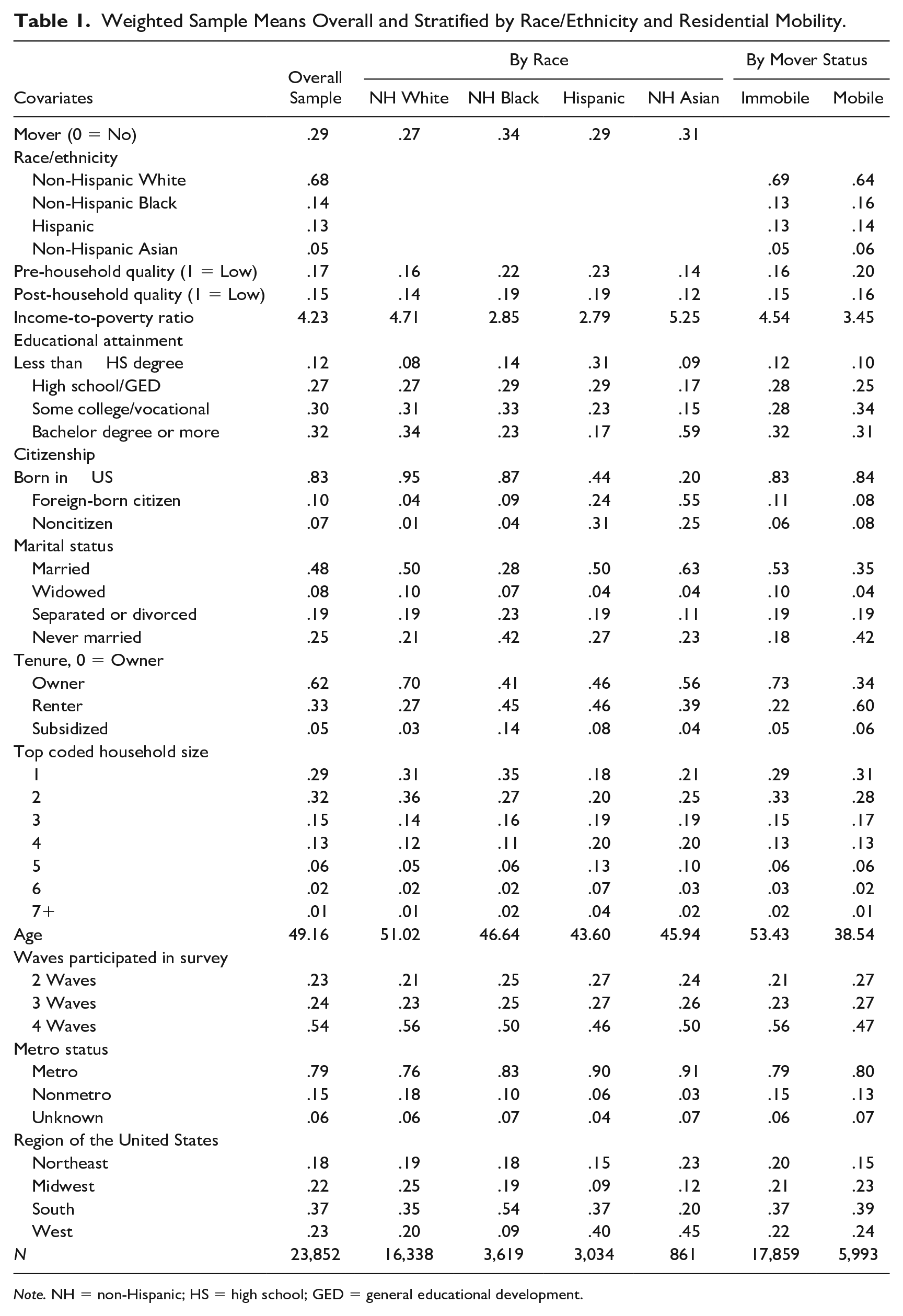
Note. NH = non-Hispanic; HS = high school; GED = general educational development.
Measures
Dependent variables
Our first dependent variable is mover type. We categorize households as immobile (reference; zero residential moves) or mobile (at least one residential move). Respondents report whether they moved for each month of study enrollment. Mobility also serves as an independent variable in subsequent analyses. For respondents who make more than one residential move (about 5 percent of the weighted sample) we use their final move. Altogether, three in ten households move during the study period.
We measure household quality pre- and post-move dichotomously in line with other research (Iceland 2021), indicating low quality if they answer yes ( = 1) to any of the following four questions “Are there cracks in the ceiling or walls?,” “Are there holes in the floor?,” “Is there a problem with pests?,” and “Are there plumbing problems?” Households report on these concerns for the longest held residence of the reference year. We measure housing quality pre-move (control variable in all but naïve models) at least six months prior to residential move (e.g., if a household makes a residential move in month 19, we use reported housing quality from the first reference year [months 1–12]). For households that do not move, we use the first reported housing quality responses. For housing quality post-move, we use the final housing quality measure reported. We include post-move housing quality as the dependent variable in our second set of analyses. Our measure of housing quality represents the experience of housing hardships and is an accepted measure among housing scholars (Iceland 2021).
Independent variables
Household mover type, their racial and ethnic identity, and income-to-poverty ratio (measured continuously where a value of one indicates income at the federal poverty level and two is twice the poverty level, etc.) serve as our key independent variables. We include the income measure for the month prior to residential move for mobile households and the first survey month for immobile households. We measure a household’s racial and ethnic identity categorically using the household head’s reported identity from the first month that the household enters the SIPP panel. Our racial and ethnic categories include White (reference), Black, Hispanic, and Asian (including Native Hawaiian/Pacific Islander).
Control variables
We account for several measures known to influence residential attainment and mobility: housing tenure, education, citizenship status, gender, age (continuous), marital status, and average household size (Lee and Hall 2009). We create our control measures using pre-move survey responses, and in the case of households who do not move, we use the first month the household enters the survey. We measure housing tenure dichotomously indicating that a household is either a homeowner (reference) or renter (including rent without pay). We also include a dichotomous indicator for whether the household reports subsidized rent. We perform analyses with and without a measure for subsidized rent and results are substantively the same (not shown). Education is measured categorically as less than a high school degree (reference), high school diploma or equivalent, some college, and a bachelor’s degree or more. We create a categorical citizenship measure including native-born (reference), foreign-born U.S. citizen, and foreign-born noncitizen. We measure the gender of the household head dichotomously where females are the reference group. We account for marital status categorically including married/cohabiting (reference), widowed, separated/divorced, or never married.
Metropolitan status is accounted for categorically as nonmetropolitan (rural [reference]), metropolitan (urban), or unknown metropolitan status. We keep unknown metro status as a separate category to maintain statistical power in our models; though we present the variable in our tables, we do not attempt to interpret these estimates. SIPP administrators code this variable as unknown for respondents who live in states with metro and nonmetro populations below 250,000 to protect the identity of respondents. We also include an indicator for region of the United States that includes Northeast, Midwest, South, and West. Finally, because we include households who participate in two to four waves of the study, we account for this with a duration variable. We also use SIPP survey weights that account for sample attrition and uneven probability of household selection into the survey in all analyses. The weights adjust for the complex survey design of SIPP and improve generalizability (Nielsen and Seay 2014).
Analytic strategy
We use logistic regression to test our research questions due to the dichotomous nature of our dependent variables (Long and Cheng 2009; Long and Freese 2006). Research highlights that statistical significance, magnitude, and direction of interaction coefficients (including odds ratios, log odds, etc.) in nonlinear models are unreliable (Ai and Norton 2003; Long and Mustillo 2018; Mize 2019; Mize, Doan, and Long 2019). Sarah A. Mustillo, Omar A. Lizardo, and Rory M. McVeigh (2018:283) note, “The case is closed: don’t use the coefficient of the interaction term to draw conclusions about statistical interaction in categorical models . . .” The nonlinear nature of logistic regression is such that variables may be statistically significant at some values and not statistically significant at others—depending on what values you test: a variable may be significant or not—a wide divergence from linear models. As such, we show key findings with predicted probabilities to simplify interpretation and focus particularly on marginal effects at representative values (MER; see Mize 2019; Williams 2012).
In the first set of analyses (Tables 2 and 3; coefficient output Table B2 Appendix B), we use logistic regression to test whether the association between residential mobility and race/ethnicity is moderated by income. We show predicted probabilities in Table 2 and marginal effects of our interaction terms in Table 3. We plot the interaction between race/ethnicity and income in Figure 1 to demonstrate our findings (following Mize 2019). These results correspond to Hypotheses 1 and 2, indicating which households are mobile and the role of race/ethnicity and income on residential mobility.
Predicted Probability of Residential Mobility by Race/Ethnicity and Income-to-Poverty Ratio.
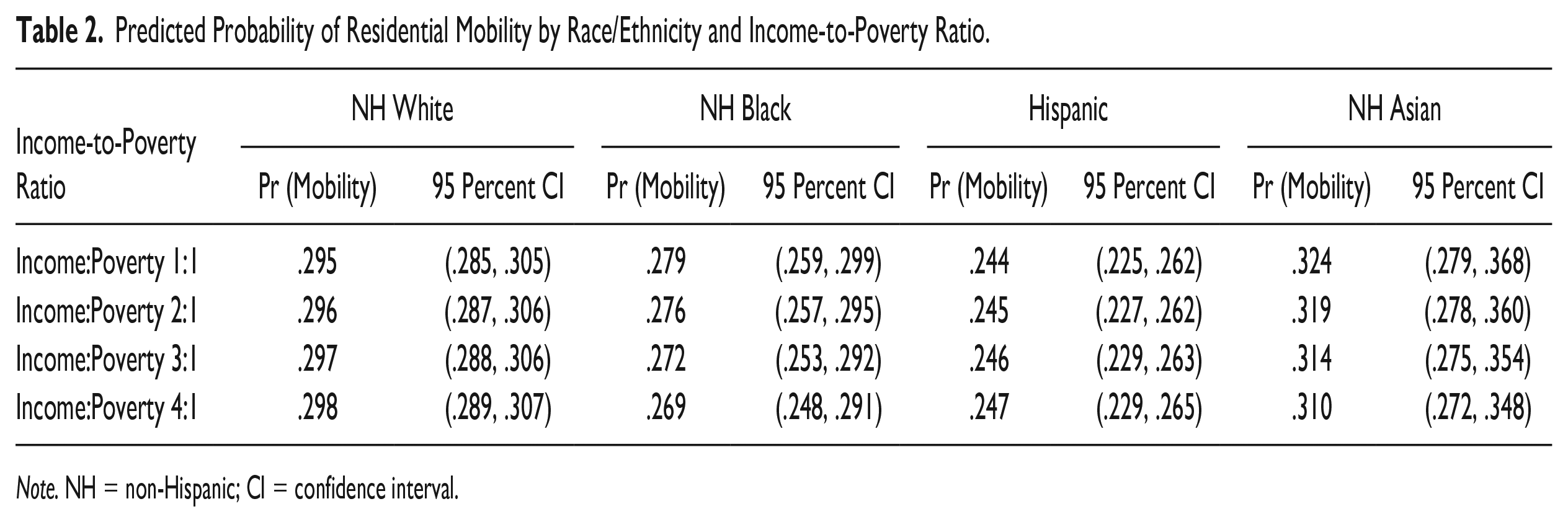
Note. NH = non-Hispanic; CI = confidence interval.
Differences in Effects of Income Across Race/Ethnicity on the Predicted Probability of Residential Mobility.
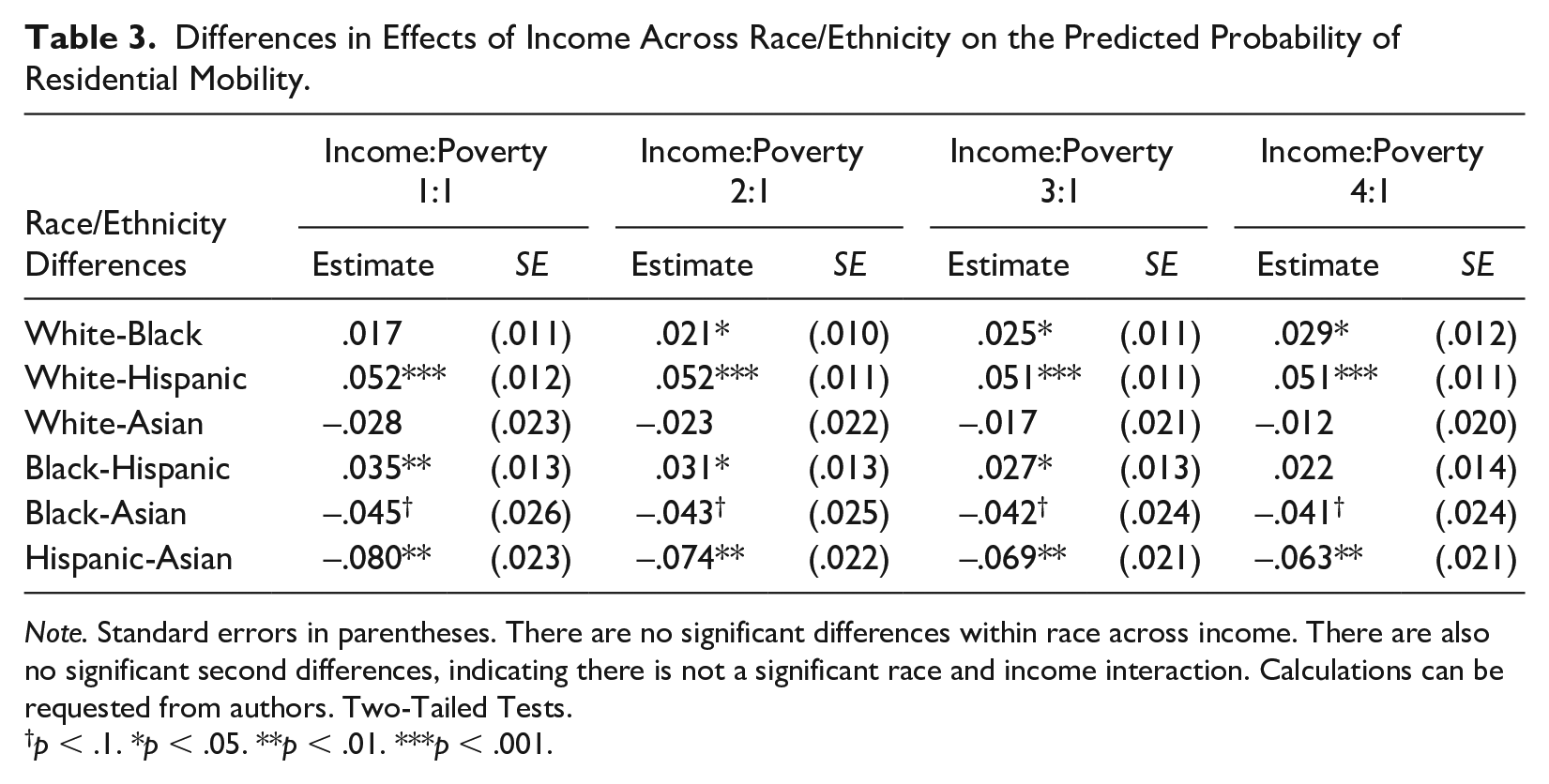
Note. Standard errors in parentheses. There are no significant differences within race across income. There are also no significant second differences, indicating there is not a significant race and income interaction. Calculations can be requested from authors. Two-Tailed Tests.
p < .1. *p < .05. **p < .01. ***p < .001.
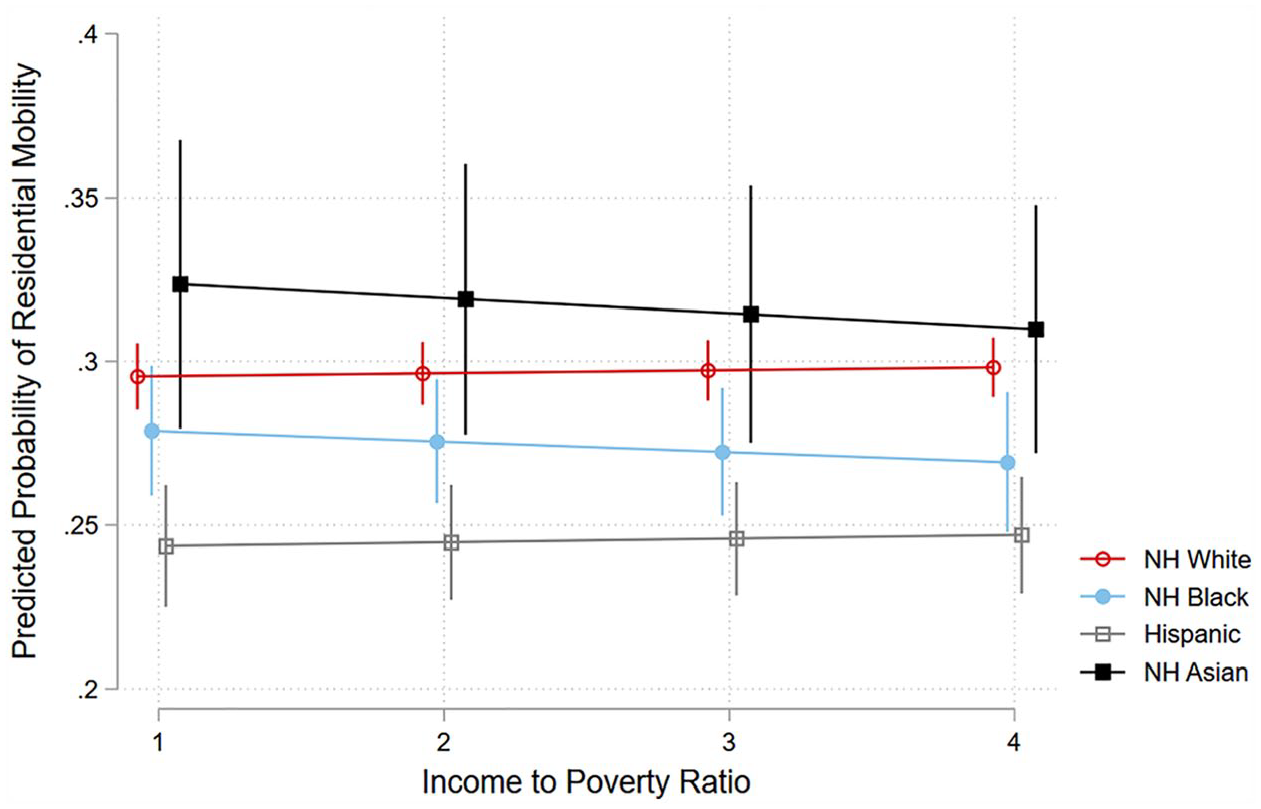
Predicted probability of moving by race/ethnicity and income-to-poverty ratio.
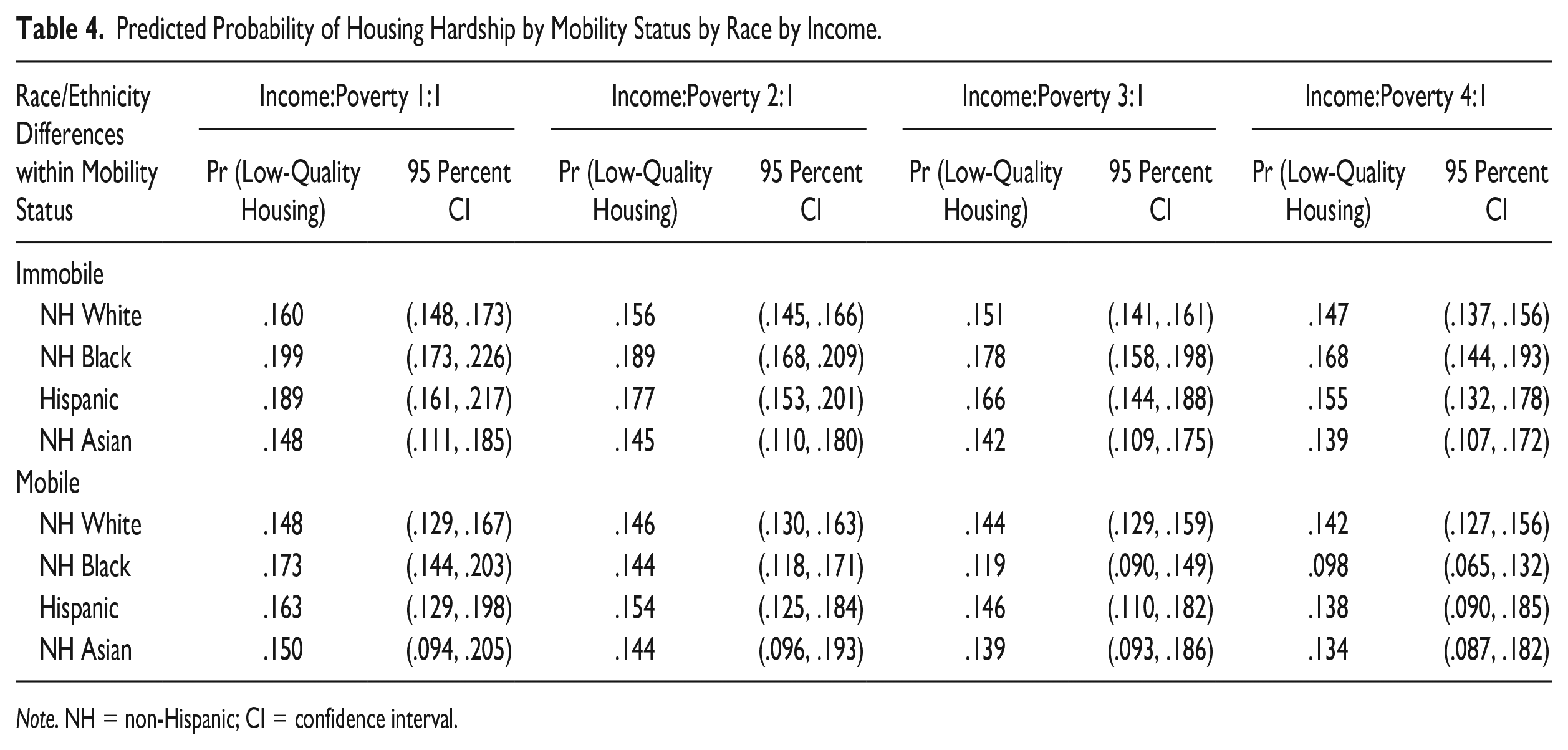
Our second set of analyses test Hypotheses 3 and 4 regarding the association between racial and ethnic groups, mover types, and income on housing quality (Tables 4 and 5; coefficient output Table B3 Appendix B). Table 4 includes predicted probabilities and Table 5 includes selected marginal effects of our interactions on housing quality. We produced Figure 2 to visualize the results from the three-way interaction.
Predicted Probability of Housing Hardship by Mobility Status by Race by Income.
Note. NH = non-Hispanic; CI = confidence interval.
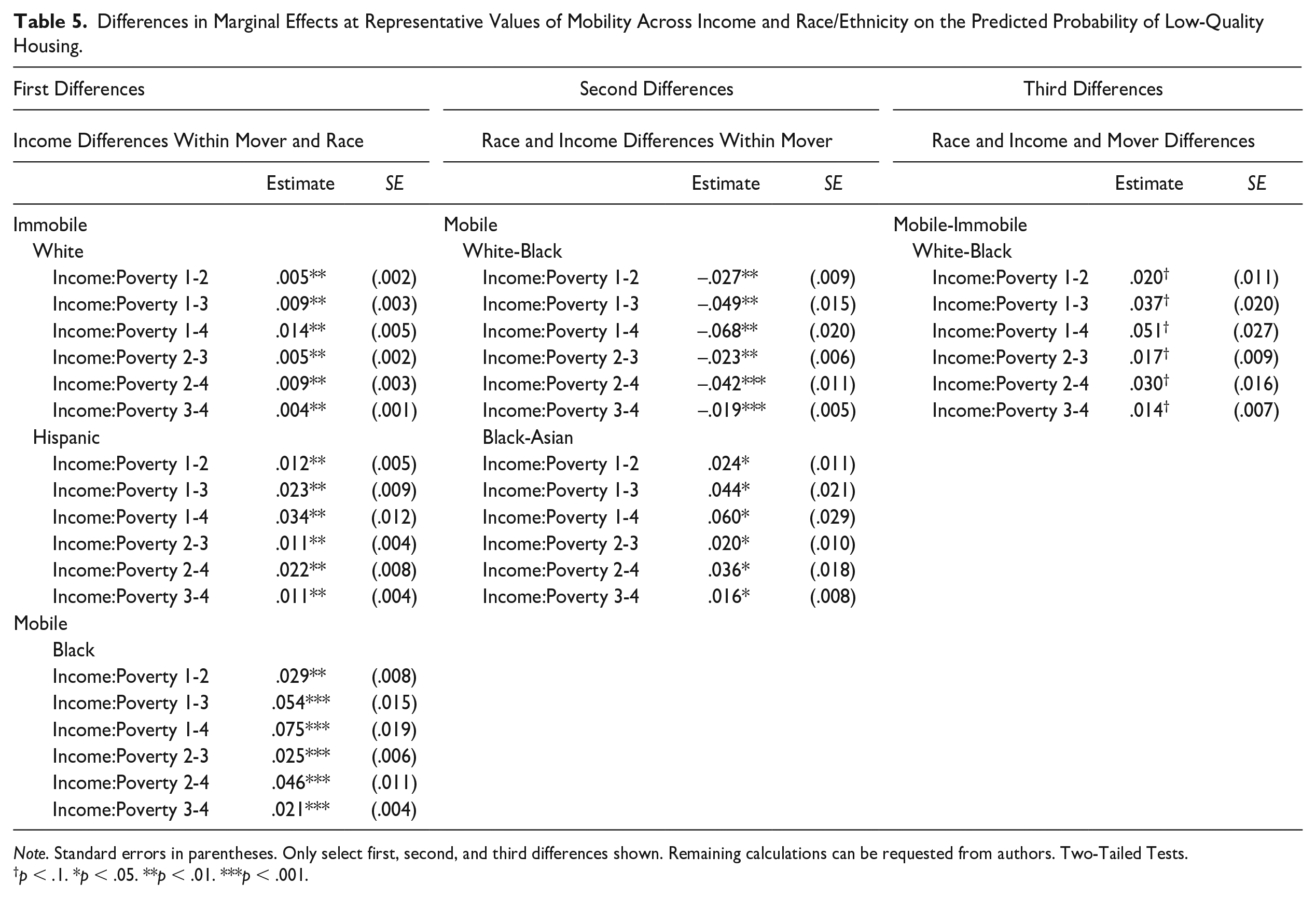
Differences in Marginal Effects at Representative Values of Mobility Across Income and Race/Ethnicity on the Predicted Probability of Low-Quality Housing.
Note. Standard errors in parentheses. Only select first, second, and third differences shown. Remaining calculations can be requested from authors. Two-Tailed Tests.
p < .1. *p < .05. **p < .01. ***p < .001.
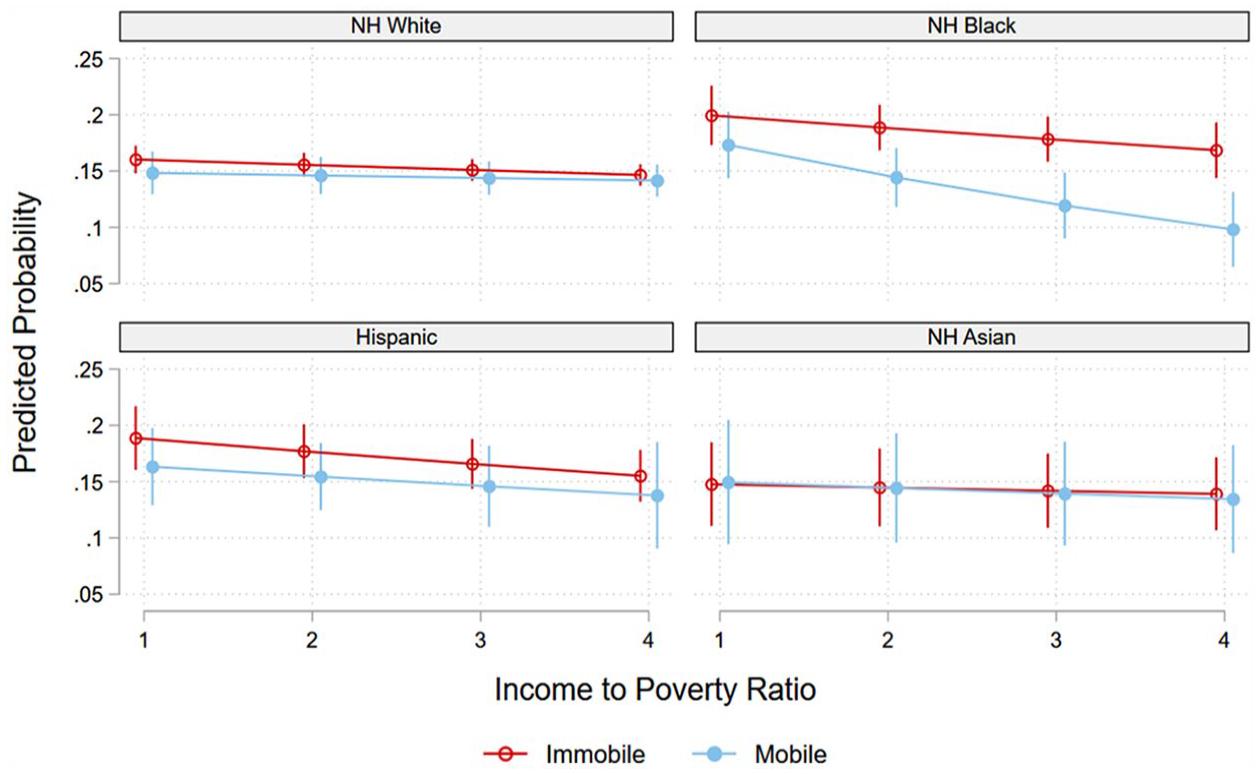
Predicted Probability of low-quality housing by race/ethnicity, income, and mobility.
Results
Table 1 shows the descriptive results of the sample overall, by mover type, and race/ethnicity. Here, we report weighted sample means, but provide unweighted sample means in Appendix A: Table A1. Overall, 69 percent of households are immobile over the four-year period. The housing picture is one where 17 percent of households report living in low-quality housing at the beginning of the study compared with 15 percent at the end. About 68 percent of households are White, 14 percent Black, 13 percent Hispanic, and five percent Asian. Post-housing quality is similar to the overall sample across mover types, though pre-housing quality is higher in the mobile population at 20 percent. For each racial and ethnic group, most households are immobile. However, there is variation across groups. Twenty-seven percent of White households are mobile compared with 34 percent of Black households, 29 percent of Hispanic households, and 31 percent of Asian households. The descriptive statistics also reveal that within each race/ethnicity that Black and Hispanic households live in low-quality housing more commonly than White and Asian households. Moreover, White and Asian households have nearly double the income of Black and Hispanic households. These descriptive results suggest a link between race/ethnicity and income with housing quality where higher income translates into better housing and marginalized groups are more commonly in low-quality housing. The association between mobility and housing quality is unclear based on these statistics.
Table 2 shows predicted probability of residential mobility interacting race/ethnicity and income at representative values. The rows include four sections, one for each race/ethnicity with four rows to include one to four times the poverty line. One column displays the predicted probability, and a second column shows the 95 percent confidence interval. We present MER first differences (hold one variable constant and change the other) and second differences (change both variables simultaneously) in Table 3. We include a row for each combination of race/ethnicity differences and four columns that correspond with one to four times the poverty level. Within each income bracket, we provide the estimate of the difference by race/ethnicity and its corresponding standard error. We use Tables 2 and 3 in addition to plotting the predicted probabilities to visualize and interpret our findings (see Mize 2019).
Figure 1 plots the predicted probabilities of residential mobility by race/ethnicity and income that are highlighted in Table 2. On the x-axis, we include the income-to-poverty ratio ranging from one to four. On the y-axis is the predicted probability of residential mobility ranging from 0.2 to 0.4. To indicate different race/ethnicity households, we use symbols: open red circles (non-Hispanic White), closed blue circles (non-Hispanic Black), open gray squares (Hispanic), and closed black squares (Asian).
Reading Figure 1 (additional Figure 1 explication in Appendix D) from left to right, White households’ predicted probability of a residential move increases by 0.3 percentage points matched by a similar rise for Hispanic households. Conversely, there is a decline of about 1.0 percentage point for Black households and 1.4 percentage points for Asian households. Table 3 demonstrates that within income groups there are significant differences across race/ethnicity, though White and Asian households never differ statistically. At the poverty level, White, Asian, and Black households have higher predicted probabilities of making residential moves than Hispanic households by 5.2 percent (p < .001), 8.0 percent (p < .01), and 3.5 percent (p < .01), respectively. These differences largely persist across the economic spectrum except for Black-Hispanic differences which are statistically significant at low-income levels but decrease and lack statistical significance by four times the poverty line. As such, this lends empirical support for Hypothesis 1 that Black and Hispanic households are less likely to make residential moves. While there are no statistically significant differences between White and Black households at the poverty line, differences are statistically significant by twice the poverty line (2.1 percentage points; p < .5) and increase to 2.9 percentage points (p < .05) at four times the poverty line. This partially supports Hypothesis 2, suggesting that income moderates residential mobility such that income increases mobility for White households relative to Black households.
Table 4 shows selected predicted probabilities of low-quality housing at representative values by race/ethnicity, mobility, and income. The rows indicate each race/ethnicity with the first four rows referring to immobile households while the second four refer to mobile households. The columns show predicted probabilities by income-to-poverty ratio and corresponding 95 percent confidence intervals. Table 5 shows first differences (holding two interaction variables constant and letting one change) on the left panel, second differences (holding one interaction variable constant and letting two others change) on the center panel, and third differences (letting all variables change simultaneously) on the right panel. Rows correspond to differences between income groups on the left panel, differences between race/ethnicity and income in the center panel, and all three variables in the right panel. Following Trenton D. Mize (2019), we use MER (Tables 4 and 5) in tandem with visualizations (Figure 2) of the predicted probabilities of our dependent variable to interpret our findings.
To test Hypotheses 3 and 4, we plot the predicted probability of living in low-quality housing by mover type, income, and race/ethnicity in Figure 2 (see Appendix D for additional detail) using estimates from Table 4 (see Appendix B: Table B3 for coefficient output). On the x-axis, we plot income ranging from one to four times the poverty line. On the y-axis, we plot the predicted probabilities with a range from 0.05 of low-quality housing to 0.25. In our description of Figure 2, we multiply this range by 100 and use the term percentage points. We use four panels, one for each race/ethnicity (top left [non-Hispanic White], top right [non-Hispanic Black], bottom left [Hispanic], bottom right [non-Hispanic Asian]), to show the unique patterns across groups. The panels share common x and y-axes scales. We use red open circles to mark immobile households and closed blue circles to mark mobile households. The tails extending from the circles indicate 95 percent confidence intervals. To consider differences across groups, we use MER and show our estimates in Table 5 (see Mize 2019; Williams 2012).
Beginning in the top left panel, immobile White households predicted probability of low-quality housing decreases from 16 to 14.7 percentage points (p < .01). Mobile White households have a sharper decline from 14.8 to 12.7 points though it is not significant. Asian households (bottom right) have a similar pattern though not statistically significant. Like Asian and White households, immobile Hispanic households (bottom left) see decreases in low-quality housing as income rises, and the magnitude is higher, decreasing 3.4 percentage points (p < .01). There appears to be a similar slope for mobile Hispanic households (decrease from 16.3 to 13.8), and the differences across income are not statistically significant. Immobile Black households (top right) show similar gains though only marginally significant. Mobile Black households, however, show large decreases from 17.3 to 9.8 as income increases (7.5 percentage points; p < .001) going from one to four times the poverty line. Black households are the only households with significant differences between mover types within income brackets. For example, mobile Black households have 5.9 percentage points (p < .01) lower probability of low-quality housing compared with immobile households when they each earn three times the poverty line. These results offer partial support to Hypothesis 3b that Black and Hispanic households experience greater housing quality improvement due to residential mobility than White and Asian households.
First differences reveal gaps between race/ethnicity where White-Black differences persist at every income level of immobile households (3.9 percentage points, 3.3 percentage points, 2.7 percentage points, 2.2 percentage points; p < .01), but at none of the income levels for mobile households. There are differences between Black and Asian households at one and two times the poverty line (5.2 percentage points, 4.4 percentage points; p < .01), but differences lose their significance at three and four times the poverty line.
Considering differences across income and race/ethnicity together within mover type also reveals significant White-Black and Asian-Black differences. Compared with White households, Black households reduce their probability of low-quality housing 6.8 percentage points (p < .001) as income rises from one to four times the poverty line. Compared with Asian households, Black households also lower their probability of low-quality housing by 6.0 percentage points (p < .05) as income rises. Testing for differences across all three variables simultaneously (third differences) reveals differences that are large in magnitude between White and Black households as they become mobile and increase income. The clearest example comparing the shift from one to four times the poverty line and becoming a mobile household represents 5.1 percentage points (p < .1) lower probability of low-quality housing for Black households relative to White households. These findings provide suggestive evidence supporting Hypothesis 4b, showing that income does more to improve housing quality among mobile Black households than comparable White households.
Limitations and Sensitivity Analyses
Selection is a concern of this study because sample attrition is associated with residential mobility—households that move between interviews are among the hardest to reach for follow-up interviews and some types of moves make households ineligible for follow-up interviews such as moves to military barracks or foreign living quarters. For detailed information on sample attrition and conditions, see the SIPP 2014 User’s Guide. However, SIPP survey weights are designed to compensate for sample attrition, which we use in all analyses. We also include a measure for households’ duration in the study which does not meaningfully change the results. In online supplementary analyses, we re-tested our models using only households who remain in the study for all four waves (Appendix C: Figures C2 and C3) to reduce sample attrition concerns. These supplementary analyses reveal substantively similar results to our primary analyses. We also test our household quality hypotheses using a probit model with sample selection (Van De Ven and Van Praag 1981), based on the Heckman selection model (Heckman 1976, 1979), to account for selection into mover status. Wald tests reveal that there is not a strong enough association to support the selection model (p < .757); however, the findings are substantively similar to our primary results (full results are available upon request). Further research should investigate selection into moving.
We use household head to represent the entire household, but some household members may be of different racial and ethnic identities and/or differ on other measures. We do not account for variation within households in our analyses. We also cannot account for household aspirations. It may be the case that housing preferences vary across racial and ethnic groups though some research suggests this is not the case (e.g., South and Deane 1993). Despite the possibility that housing preferences vary, the resulting housing quality is linked to adverse outcomes and perpetuates inequality.
Discussion
Substandard housing contributes to the reproduction of inequality, as housing quality is a core social determinant of health (Shaw 2004). Households in substandard housing face mental and physical health burdens (Leventhal and Newman 2010; Suglia, Duarte, and Sandel 2011), and increased economic burdens (Caswell and Zuckerman 2018). Hence, understanding racial and ethnic differences in living in lower quality housing adds to the nuance of racial and ethnic differences in residential outcomes. Black and Hispanic households live in lower quality housing and poorer, more segregated neighborhoods than White and Asian households (Alba and Logan 1992; Flippen 2010; Hall and Greenman 2013; Rosenbaum 1996; Shapiro 2006). While studies find that SES and acculturation explain many of the disparities which exist between White households and Asian and Hispanic households (Iceland and Scopilliti 2008; Iceland and Wilkes 2006), discrimination in the housing market still plays a prominent role in determining Black and Hispanic housing outcomes (Korver-Glenn 2018; Turner et al. 2014). Our study advances the literature on racial and ethnic disparities in housing quality by examining how differences in who enters the housing market contributes to these gaps as we explore how residential mobility predicts residential outcomes differently by race and ethnicity.
Our first set of analyses tests which racial and ethnic groups are more likely to enter the housing market and experience residential mobility and how this varies by income. In support of Hypothesis 1, we find that Black and Hispanic households are less likely to experience residential mobility than White and Asian households, with Hispanic households experiencing the lowest predicted probability of a residential move. In contrast with Hypothesis 2, income does not moderate this relationship. These results are consistent with past research finding that Black and Hispanic households of similar economic means as White and Asian households do not translate their higher status into residential mobility at the same rates (Mateyka 2015; South and Deane 1993). The results also indicate that increases in income do not offer additional benefits for any racial or ethnic group after accounting for other control measures such as education and housing tenure. Rather, the null relationship between income and residential mobility indicates that race and ethnicity is more relevant in determining whether a household makes a residential move.
While we cannot assess whether this immobility is desired, the current literature suggests it is not (Crowder 2001; Mateyka 2015; South and Deane 1993). These findings support the stuck in place hypothesis. Although Patrick Sharkey (2015) examines a sample of Black and White movers between and within U.S. counties, he finds that the latest generation of Black households have an unprecedented inheritance of place compared not only to White households but also any previous generation of Black households. Our findings compliment his work by demonstrating that both Black and Hispanic households are less likely to move than White households. Our findings suggest that racial and ethnic differences which exist in one’s neighborhood environment (Sampson 2012; Sharkey 2013) will persist as Black and Hispanic households are less likely to enter the housing market compared with White households of similar economic means. Thus, understanding the structural and interpersonal mechanisms driving racial and ethnic disparities in the likelihood of moving warrants further consideration.
After establishing who is disproportionately immobile, we test whether differences in residential mobility and income by race and ethnicity predict racial and ethnic disparities in housing quality. White and Asian households live in better-quality housing than Black and Hispanic households. Furthermore, making a residential move and having a higher income is positively associated with housing quality. However, when focusing on specific interactions, Black households have dramatic housing quality gains when making residential moves and when income increases relative to White and Asian households. These results support Hypothesis 3b. We also see marginal evidence (p < .1) of a three-way interaction in support of Hypothesis 4b. The housing quality gap between White and Black households across income and mobility narrows by 5 points as Black households make residential moves and increase in income from one to four times the poverty line.
To contextualize our findings within the national population, we examined the 2015 American Community Survey (ACS) (all data and analyses available upon request). First, we found that the ACS estimates are remarkably similar to our SIPP descriptive estimates (Table 1). Next, we used the ACS estimates to determine the number of households by race/ethnicity overall and that are immobile and mobile. We used these estimates to show how large seemingly small percentage point changes (see our results) are at the population level. ACS data show that there are 80.8 million White, 14.2 million Black, 15.1 million Hispanic, and 5.3 million Asian households in the United States. As such, even a 1 percent improvement within any of these groups is massive—particularly after accounting for average household size (2.46, 2.65, 3.49, and 3.11, respectively). For example, among mobile Black households, the 7.5-point improvement from one to four times the poverty line is massive given that nearly 2.5 million Black households were mobile in the past year per ACS. The improvement from 17.3 to 9.8 percent in low-quality housing is about 185,000 households or nearly half a million people (0.075 × 2,500,000 = 185,000; 185,000 × 2.65 = 500,000). Even smaller effect sizes of our results are meaningful. The gap between immobile Hispanic households at the poverty line versus twice the poverty line (1.2 percentage points; p < .05) translates into gains for 33,000 households or about 115,000 people.
Our findings compliment research linking involuntary moves and adverse housing outcomes (Evans 2020), explaining that residential immobility is a key driver of housing quality inequality and explains a greater share of housing quality inequality on the aggregate than involuntary moves. These findings also reinforce residential attainment research (Hall and Greenman 2013; Rosenbaum 1996) findings that residential mobility and SES improve housing outcomes among Black and Hispanic households (Iceland and Wilkes 2006; Pais and Crowder 2012; South, Crowder, and Pais 2008). Yet despite the demonstrated gains from residential mobility, Black and Hispanic households are significantly more likely than White households to be immobile. Under the residential mobility framework, we show that Black and Hispanic households do not move at similar rates to White and Asian households even after accounting for controls, likely due to numerous discriminatory practices in the housing market (Besbris 2020; Korver-Glenn 2021). Perhaps most notably, our findings suggest that given the opportunity to move, Black households would see housing quality outcomes similar to White households.
Additional research should investigate the qualitative reasons as to why Black and Hispanic households of similar economic means to White and Asian households are less likely to move. Despite experiencing more housing hardships, marginalized residents may be as satisfied with their housing as White households and have no desire to move. However, this is likely not the case, as marginalized households are unable to act on their desire equal to White households (Mateyka 2015; South and Deane 1993). Scholars highlight that information constraints due to high levels of racial segregation in residences and social networks mean that marginalized households are unaware of better-quality housing given similar economic constraints as White households (Krysan and Crowder 2017). Awareness of discrimination in the housing market may also lead households to decide that attempts at residential moves would not result in the quality of housing they desire (Korver-Glenn 2018; Krysan and Crowder 2017). Marginalized households are more likely to live closer to friends and family due to longstanding patterns of segregation which may prompt them to stay in current housing despite the knowledge and economic ability to move (Krysan and Crowder 2017; Spring et al. 2023). In addition, enduring wealth gaps leave marginalized households less able to move into better-quality housing and neighborhoods (Shapiro 2006).
Declining mobility trends may leave marginalized racial and ethnic groups stuck in low-quality housing, contributing to the persistence of racial and ethnic inequality in SES and the ability to realize social mobility. We build on Matthew Desmond et al. (2015) discussion of a precarious group of households who are not economically insecure enough to be at threat of residential displacement but not economically advantaged enough to move into better-quality housing by demonstrating the racialized nature of this hypothesis. Our results also have important implications in the discussion of movers and stayers and their implications for neighborhood change (Huang et al. 2017; Sampson and Sharkey 2008; South et al. 2022, 2016). These findings extend scholarly knowledge about racial and ethnic disparities in housing quality by mover type while also accentuating the challenges that marginalized households face in translating their resources into similar housing quality as White households. Further research should investigate the apparent stuck in place phenomena among marginalized households, especially given declining rates of residential mobility across the United States.
Supplemental Material
sj-docx-1-sre-10.1177_23326492231207603 – Supplemental material for Residential Immobility and Racial and Ethnic Disparities in Housing Quality
Supplemental material, sj-docx-1-sre-10.1177_23326492231207603 for Residential Immobility and Racial and Ethnic Disparities in Housing Quality by Megan Evans and Alexander Chapman in Sociology of Race and Ethnicity
Footnotes
Acknowledgements
The authors thank Barrett A. Lee, Scott T. Yabiku, John Iceland, Matthew Hall, and participants of DemSemX for their helpful comments on earlier drafts of this paper.
Authors’ Note
Megan Evans and Alexander Chapman have contributed equally to this work.
Funding
The author(s) disclosed receipt of the following financial support for research, authorship, and/or publication of this article: This research was supported by funding from the Eunice Kennedy Shriver National Institute of Child Health and Human Development to the Population Research Institute at The Pennsylvania State University for Population Research Infrastructure (P2CHD041025) and Family Demography Training (T-32HD007514). The content of the article is solely the responsibility of the authors and does not reflect the official views of the National Institutes of Health.

Supplemental material
Supplemental material for this article is available online.
Author Biographies
References
Supplementary Material
Please find the following supplemental material available below.
For Open Access articles published under a Creative Commons License, all supplemental material carries the same license as the article it is associated with.
For non-Open Access articles published, all supplemental material carries a non-exclusive license, and permission requests for re-use of supplemental material or any part of supplemental material shall be sent directly to the copyright owner as specified in the copyright notice associated with the article.
