




Abstract
Background
Approximately four million children undergo procedures with anesthesia yearly. For children and parents, this experience can be anxiety-provoking, with as many as 75% of children exhibiting signs of anxiety preoperatively, and many experiencing behavior changes in the weeks following. Few studies have included children's reports of pre-anesthesia anxiety, and few have explored associated parental and peri-anesthesia factors.
Purpose
The purpose of this study was to examine child and parent reports of pre-anesthesia anxiety, parent pre-anesthesia preparation, and child post-anesthesia behavior change in English and Spanish-speaking dyads (patients ages 7 through 12 years).
Methods
The Zero to Ten child anxiety scale, adult State Anxiety Scale, and Post-Hospitalization Behavior Scale for Ambulatory Surgery were used for data collection at four peri-anesthesia time points. Medical records were reviewed for anxiolytic medication and anesthesia duration.
Results
Of 102 participants, the median visit #1 child anxiety score was three, and at visit #2, five, with no correlation to parent anxiety. Spanish-speaking parents' anxiety was significantly higher than English, with lower preparedness. Behavior scores for the children revealed a median of 13 (out of a possible score range 11–44) at two weeks post hospitalization, and a median of 12 at four weeks. There was no significant correlation between anesthesia duration and behavior scores.
Conclusion
Pre-anesthesia anxiety is reported by 7 to 12-year-olds, unrelated to parental anxiety; however, there was a lack of knowledge and higher state anxiety in the Spanish-speaking parent subset. Child post-hospital behavior changes appear mild, and unrelated to anesthesia duration.
This is a visual representation of the abstract.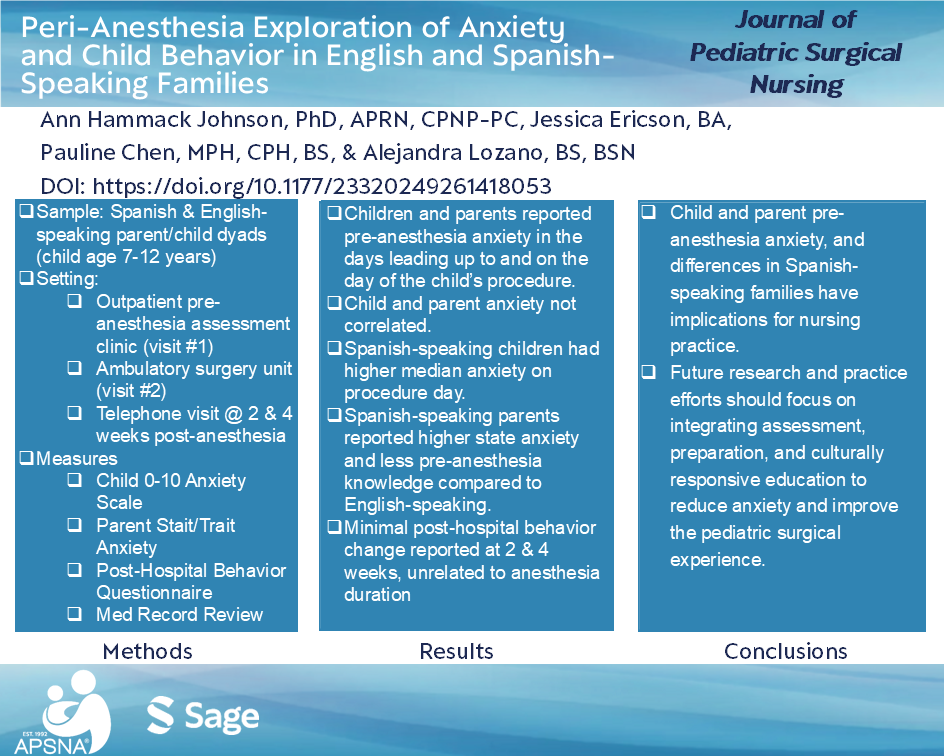
Keywords
Get full access to this article
View all access options for this article.