




Abstract
In a collaborative research project, several monaural and binaural noise reduction algorithms have been comprehensively evaluated. In this article, eight selected noise reduction algorithms were assessed using instrumental measures, with a focus on the instrumental evaluation of speech intelligibility. Four distinct, reverberant scenarios were created to reflect everyday listening situations: a stationary speech-shaped noise, a multitalker babble noise, a single interfering talker, and a realistic cafeteria noise. Three instrumental measures were employed to assess predicted speech intelligibility and predicted sound quality: the intelligibility-weighted signal-to-noise ratio, the short-time objective intelligibility measure, and the perceptual evaluation of speech quality. The results show substantial improvements in predicted speech intelligibility as well as sound quality for the proposed algorithms. The evaluated coherence-based noise reduction algorithm was able to provide improvements in predicted audio signal quality. For the tested single-channel noise reduction algorithm, improvements in intelligibility-weighted signal-to-noise ratio were observed in all but the nonstationary cafeteria ambient noise scenario. Binaural minimum variance distortionless response beamforming algorithms performed particularly well in all noise scenarios.
Introduction
Many conversations today take place in rather noisy environments. For normal-hearing (NH) listeners, this degraded speech does not pose a major challenge and is typically intelligible. Hearing aid (HA) or cochlear implant (CI) users, on the other hand, are much more impacted in their speech intelligibility by interfering noise sources (Festen & Plomp, 1990; Peters, Moore, & Baer, 1998; Qin & Oxenham, 2003; Stickney, Zeng, Litovsky, & Assmann, 2004).
Considerable effort has been made to develop and investigate single- as well as multichannel noise reduction algorithms for HAs and CIs (for comprehensive reviews, see e.g., Bentler, 2005; Doclo, Gannot, Moonen, & Spriet, 2010; Doclo, Kellermann, Makino, & Nordholm, 2015; Hamacher, Kornagel, Lotter, & Puder, 2008; Levitt, 2001; Wouters, Doclo, Koning, & Francart, 2013). Spatial filtering (typically referred to as beamforming) has become a standard in modern hearing devices. By enhancing signals originating from one direction (usually the front) and suppressing signals originating from other locations, these algorithms are able to achieve large improvements in signal-to-noise ratio (SNR). A wireless link between hearing devices on the left and right side is already available in commercial HAs. These binaural HAs also feature binaural noise reduction algorithms. With the prevalence of bilateral cochlear implantation increasing, the possibility of providing such algorithms to bilateral CI users is emerging. These multichannel, binaural algorithms use the microphone signals from both hearing devices and result in larger SNR improvements compared to monaural beamforming algorithms (Cornelis, Moonen, & Wouters, 2012; Van den Bogaert, Doclo, Wouters, & Moonen, 2009), providing improved speech intelligibility in noise. Algorithms operating on single channel signals, on the other hand, do not usually result in speech intelligibility improvements but have been shown offer improved signal quality and listening comfort (e.g., Luts et al., 2010).
The objective of signal enhancement strategies is to enhance two fundamental perceptual aspects of noisy speech signals: speech intelligibility and sound quality. However, these two objectives cannot always be achieved simultaneously. When assessing the merit of signal enhancement algorithms, both aspects should be taken into consideration, although improved speech intelligibility typically is considered to be more important. In general, there is a trade-off between noise reduction and speech distortion. An increase in speech intelligibility can, for example, be achieved at the cost of lower signal quality (e.g., due to distortions). Especially for algorithms operating on single channel signals, an improved signal quality does not necessarily entail improved speech intelligibility at the same time (Hu & Loizou, 2007a, 2007b). Multichannel noise reduction algorithms are often able to achieve both, increased speech intelligibility as well as increased signal quality.
Instrumental measures are commonly used to evaluate an algorithm's capabilities in speech intelligibility enhancement and quality improvement (e.g., Hendriks & Gerkmann, 2012). Perceptual speech intelligibility measurements in NH listeners (Fink, Furst, & Muchnik, 2012; Healy, Yoho, Wang, & Wang, 2013; Kim, Lu, Hu, & Loizou, 2009; Yousefian & Loizou, 2012) have also been used regularly to evaluate and characterize signal enhancement algorithms, often in combination with other measures. Yousefian and Loizou (2012), for example, supplemented their speech intelligibility evaluation with an instrumental evaluation of signal quality, while Healy et al. (2013) and Fink et al. (2012) additionally reported speech intelligibility improvements in hearing-impaired (HI) subjects. Large-scale evaluation studies in HI listeners (e.g., Cornelis et al., 2012; Luts et al., 2010) or CI users (e.g., Brockmeyer & Potts, 2011) have been geared toward comparing the value of different signal enhancement algorithms for the respective listener groups.
Although a large number of studies have evaluated signal enhancement schemes perceptually as well as with the help of instrumental measures, most studies focus on the evaluation of only a small number of signal processing schemes. Differences between studies in measurement design, speech and noise material, as well as subject groups in the case of perceptual evaluations, or choice of measures in the case of instrumental evaluations, limit the comparability across studies.
This article is the first in a series of three articles in this issue originating from a collaborative project of several research groups within the Cluster of Excellence “Hearing4all” in Oldenburg. The goal of this collaborative research project was to comprehensively evaluate state-of-the-art signal enhancement algorithms, with emphasis on binaural algorithms. We tested (a) different listening situations, (b) different instrumental measures, (c) subjects with a very different hearing status, and (d) a variety of different algorithms. These four aspects taken together provide an overview of the benefits obtainable by monaural and binaural signal enhancement algorithms. A coherent study design was maintained across all evaluations to ensure high comparability of the results. Several state-of-the-art noise reduction algorithms were selected, with a focus on binaural algorithms but also including two monaural algorithms as references. The selected algorithms consisted of established algorithmic building blocks, such as (fixed and adaptive) minimum variance distortionless response (MVDR) beamforming and spectral post-filtering, which were combined in innovative ways. All algorithms were implemented in real time on a common signal processing platform, namely the Master Hearing Aid (MHA; Grimm, Herzke, Berg, & Hohmann, 2006), making the setup ideal for perceptual listening evaluations.
Four different, synthetic but highly realistic scenarios were designed to reflect real-world listening situations. All scenarios included a significant amount of reverberation (
Starting from these common algorithms and test scenarios, which are described in detail in the following Methods section, we have branched out into specific studies reported in the three articles. The current article presents the common framework and the instrumental evaluation of speech intelligibility and quality. Three measures were employed: the speech intelligibility-weighted signal-to-noise ratio (iSNR; Greenberg, Peterson, & Zurek, 1993), the short-time objective intelligibility (STOI; Taal, Hendriks, Heusdens, & Jensen, 2011) measure, and the perceptual evaluation of speech quality (PESQ; ITU-T, 2001). The second article aims at evaluating the same signal enhancement strategies through perceptual evaluations in bilateral CI users (Baumgärtel et al., 2015). In a third article, perceptual evaluations in NH listeners and HI subjects, as well as an evaluation using a binaural speech intelligibility model, are presented (Völker, Warzybok, & Ernst, 2015).
Methods
Noise Reduction Algorithms
The signal enhancement strategies evaluated in this study were implemented on a common processing platform. All output files had a sampling rate of 16 kHz.
Adaptive differential microphone (ADM)
The adaptive differential microphone algorithm was implemented according to the description in Elko and Anh-Tho Nguyen (1995). The two omnidirectional microphones present in each hearing device were combined adaptively so that the sound energy from the rear hemisphere is minimized in the output of the algorithm. This is achieved by steering a spatial zero to suppress sound originating from the loudest source in the rear hemisphere. The ADM algorithm first computed front-facing and back-facing differential microphones with a spatial zero pointing to 180° and 0°, respectively. These signals were then weighted and combined, with the weight parameter determining the direction of the spatial zero. The weight parameter was adapted using a gradient-descent procedure to ensure the above energy criterion. The combination of two closely spaced omnidirectional microphones resulted in a comb-filter effect present in the output signal of the ADM. Therefore, a low-pass filter was used to counter the effect of the first minimum of the comb filter. The ADMs worked on the left and right side independently and were included here as a second reference condition alongside the unprocessed signals. 1
Coherence filter (COH)
The coherence-based noise reduction algorithm (Grimm, Hohmann, & Kollmeier, 2009; Luts et al., 2010) computes a spectral gain based on the concept of coherence to separate the desired speech signal from undesired noisy components. Coherent signal components were assumed to belong to the desired target signal, for example, a single speaker talking to the listener. Incoherent signal components are assumed to belong to the undesired noisy part.
The processing algorithm works in the short-time Fourier transform (STFT) domain, where STFT bins were grouped into 15 non-overlapping third-octave frequency bands with center frequencies ranging from 250 Hz to 8 kHz. The interaural phase difference (IPD) was used as an estimate for the coherence. The coherence C(k, l) in each frequency band k and time segment l is estimated from the vector strength of the complex IPD



The two main parameters for the algorithm are the time constant Block diagram illustrating the coherence filter setup.
Single-channel noise reduction (SCNR)
In this processing scheme, the frontal microphone signals of the left and the right hearing device were enhanced separately using an STFT-based single-channel noise reduction setup as outlined in Figure 2. For the STFT, we used a segment length of 32 ms with 50% overlap, and a square root Hanning window for analysis and overlap-add synthesis. In the STFT domain, the noise power spectral density Block diagram illustrating the single-channel noise reduction setup.
Fixed MVDR beamformer (fixed MVDR)
The binaural MVDR beamformer aimed at minimizing the overall noise output power, subject to the constraint of preserving the desired speech component in the frontal microphone signals of the left and the right hearing device. The frequency-domain binaural MVDR filters for the left and the right hearing devices


Adaptive MVDR beamformer (adapt MVDR)
Since in practice the noise field is generally not known and changes over time, fixed beamformers such as the described binaural MVDR are only able to achieve a limited amount of noise reduction. To adapt to changing noise environments, the noise coherence matrix Block diagram illustrating the adaptive binaural MVDR beamformer setup.
Combination of beamformer and postfiltering
Both the fixed and the adaptive beamformers only consider spatial characteristics of the microphone signals. To additionally exploit spectro-temporal characteristics, we also considered the combination of the beamformers described earlier with a postfiltering based on single-channel speech enhancement, as presented above. The basic block diagram, encompassing all combinations considered in this article, is illustrated in Figure 4. First, a binaural MVDR beamformer was applied as presented in the preceding paragraphs. The binaural output signals of the beamformer were then transformed into the STFT domain, followed by the same SCNR that has been outlined earlier. Based on the signals at the output of the SCNR processing, gain functions for the left and for the right ear were computed, i.e., Block diagram illustrating the combination of a binaural MVDR beamformer with single-channel postfiltering. The indices n, k, and l were omitted for the sake of clarity.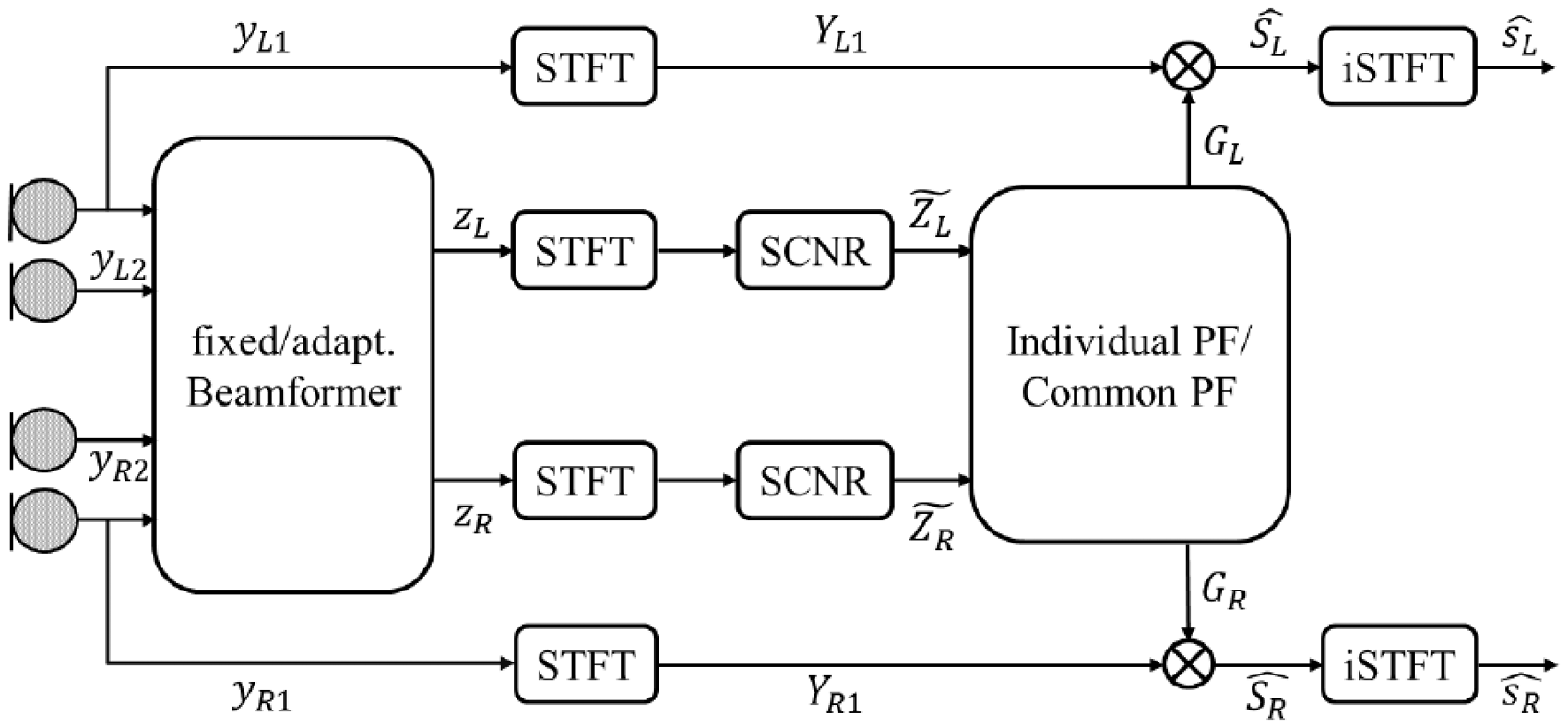
Common postfilter based on fixed binaural MVDR beamformer (com Pf (Fixed MVDR))
In this setup, the fixed MVDR beamformer was combined with a common postfilter, defined as:

Common postfilter based on adaptive MVDR beamformer (com PF (adapt MVDR))
In this setup, the adaptive MVDR beamformer was combined with the same common postfilter as introduced above.
Individual postfilter based on adaptive MVDR beamformer (ind PF (adapt MVDR))
In this setup, the adaptive binaural MVDR beamformer is combined with a different postfilter, which works individually on the left and the right hearing device. The gain functions were defined as:


Real-time implementation on the MHA platform
List of Signal Enhancement Strategies.

Note. Two algorithms marked with asterisks are established monaural strategies, which were included as reference (ADM) and because they have been used as processing blocks in some of the binaural algorithms (ADM and SCNR). MVDR = minimum variance distortionless response.
Speech and Noise Material
All scenarios were created in a highly reverberant, cafeteria-style room (see Figure 5 and Kayser et al., 2009). The reverberation time of this cafeteria of Layout of the cafeteria-type room used to create the target speech and noise signals. Position and head orientation 1 was chosen for the listener. Target speech originated from Position A, interfering talkers were located at either Position D or Positions B, C, D, E, and F. The inset (marked by red box) shows the detailed position and orientation of speakers located at Position D (a), Position E (b), and Position F (c).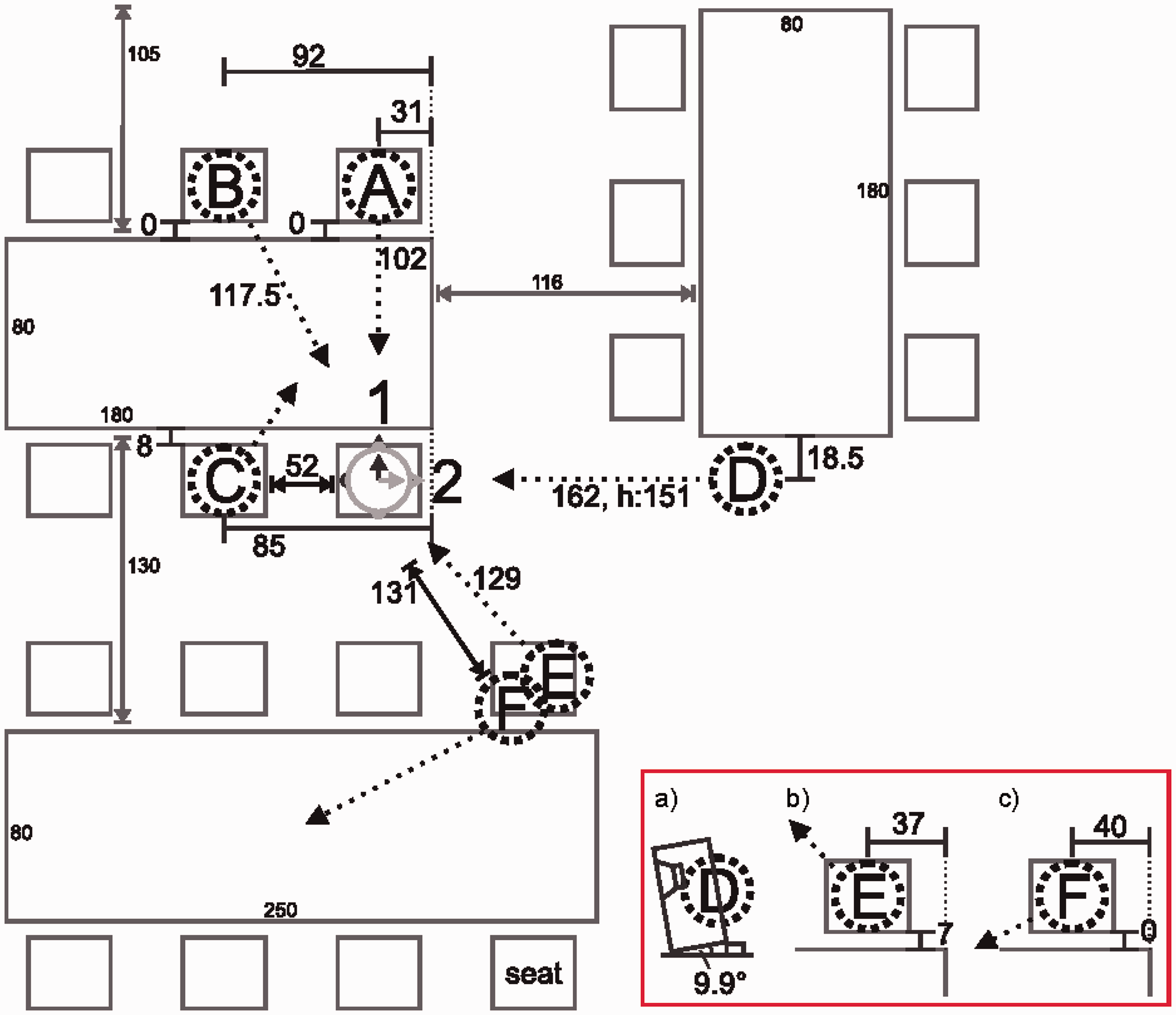
Speech material
The Oldenburg sentence test (OLSA) (Wagener, Brand, & Kollmeier, 1999) was used as speech material. The OLSA speech material shows a phoneme distribution that is equivalent to the mean phoneme distribution of the German language and is spoken at medium speed. Dry recordings of the OLSA sentences were convolved with HRIRs as described above in order to create the four-channel target input signals. The target speech source was located at 0° (front) at a distance of 102 cm in all test conditions (Position A in Figure 5). A total of 120 sentences were used in this instrumental evaluation.
Noise material
Instrumental evaluations of all algorithms were performed in four distinct acoustic scenarios described in detail below. To create interfering speech signals, speech material from the German few-talker corpus of the EUROM1 speech corpus (Chan et al., 1995) was used, where we chose only the five male talkers. To create the speech signals, 35 randomly selected passages by one talker were concatenated and the resulting signal was then cropped to ten minutes length. The four scenarios were as follows:
olnoise (OLN). To create a stationary yet spatial noise scenario, the speech-shaped noise file provided with the OLSA sentence material (olnoise) was used. A 10-minute long version of the noise file was created. Five different (uncorrelated) sections of this noise were chosen by delaying the starting point of the signal by 0, 2, 4, 6, and 8 seconds. Each noise signal was then assigned to one of five locations (positions B, C, D, E, and F, see Figure 5) in the cafeteria environment to create incoherent stationary background noise. 20-talker babble (20T). A multitalker babble noise was created by placing 20 talkers at five different locations (four talkers at each location) around the listener. Speech signals were created using the speech material taken from the EUROM1 corpus. Each of the five talkers was used four times (at four different locations). Therefore, for each of the five talkers, four different 10-minute signals were created as described above. The talkers were located to the left and right of the listener, as well as front left and back right (positions B, C, D, E, and F, see Figure 5). Single competing talker (SCT). A single, male interfering talker was placed at +90° (right-hand side, Position D in Figure 5) of the subject at a distance of 162 cm and an elevation of 40 cm above ear level (tilted to be pointed directly at the ear). The speech material was taken from the EUROM1 speech corpus as described above. Cafeteria ambient noise (CAN). As the most realistic scenario, the CAN signal was recorded alongside the HRIRs in the same cafeteria-type room (Kayser et al., 2009) during lunch hour. The noise signal includes periods of two-person conversations being carried out next to the recording dummy, periods of more diffuse talking in the background as well as typical cafeteria sounds such as dishes and cutlery being used and chairs being pushed across the floor.
Signal generation
Clean speech and noise signals were mixed at a broadband, long-term SNRs between −10 dB and +10 dB. The SNR was determined from the reverberant speech and noise signals, averaged across left and right ears, front and back microphones. Three seconds of noise-only in the beginning of each signal were provided to allow enough time for all algorithms to converge before target speech onset. For each test scenario, each of the 120 OLSA sentences used in this evaluation was mixed with one noise segment randomly cut from the longer, original noise files. The same noise segment was used for all SNRs. Signals were then processed by the signal pre-processing strategies using the MHA platform. The processed speech and noise signals were computed following the protocol introduced by Hagerman and Olofsson (2004). In short, two different signals were produced and processed by the algorithms: Speech mixed with the original noise signal (S + N) and speech mixed with a phase-inverted version of the noise signal (S – N). Under the assumption that both signals are processed equally by the algorithms, the processed speech and noise signals were calculated as follows:


Reference signals
To compute the STOI and PESQ measures (see later for measure descriptions), a clean speech reference signal is required. All algorithms aim at estimating the anechoic speech component at the BTE microphones; therefore, clean speech convolved with anechoic HRIRs (Kayser et al., 2009) rather than dry clean speech was used as a reference.
Instrumental Measures
Instrumental evaluations of the considered algorithms were performed using instrumental measures of speech intelligibility as well as speech quality. Here the STOI measure as well as the iSNR were used as the instrumental speech intelligibility measures, while PESQ was used to evaluate speech quality.
Intelligibility-weighted SNR
The iSNR (compare Greenberg et al., 1993) calculates the long-term SNR in 18 frequency bands and weighs the obtained SNRs with the band-importance function according to the SII standard (American National Standard Institute, 1997) to obtain an overall iSNR measure. Since this measure does not require a reference signal, it was computed based on the processed speech (S proc ) and noise (N proc ) signals obtained from equations (9) and (10).
Short-time objective intelligibility (STOI) measure
The STOI measure (Taal et al., 2011) determines the correlation between time-frequency segments of a clean speech reference signal and a (noisy) processed speech test signal. Both signals are divided into 25.6-ms, Hanning-windowed segments with 50% overlap. After decomposition into 15 third-octave bands with center frequencies ranging from 150 Hz to 4.3 kHz, the correlation between the clean speech reference signal and the processed signal is determined for temporal envelope segments of 384 ms length. Before calculation of the correlation coefficient, the processed signal is normalized to compensate for global level differences. Additionally, the signal is clipped, resulting in an upper bound for the sensitivity of the measure toward severely degraded time-frequency units (Taal et al., 2011). The obtained intermediate intelligibility measures are averaged across all time frames and all frequency bands to obtain one value, the STOI score. STOI scores are mapped to an absolute intelligibility prediction (Taal et al., 2011) where a score of 1 corresponds to 100% speech intelligibility. For NH listeners, the measure shows a high correlation with subjective speech intelligibility in different noise types for speech processed with different noise reduction schemes. In Hu et al. (2012), it has also been shown that STOI was able to predict speech intelligibility for noise-vocoded speech.
Perceptual evaluation of speech quality (PESQ)
The PESQ measure is more complex than the other two measures used. It was developed and introduced by Rix, Beerends, Hollier, and Hekstra (2001) and is recommended by ITU-T for speech quality assessment of telephone networks (ITU-T, 2001). PESQ compares a clean speech reference signal with a processed speech signal by means of a perceptual model. PESQ was found to be in good agreement with subjective quality measures for NH listeners (Hu & Loizou, 2008). In short, the test and reference signals are time- and level-aligned and filtered to model a standard telephone handset. Subsequently, both the reference and the test signal are passed through an auditory transform. Two parameters are calculated from differences between the two transformed signals and are aggregated in time and frequency. These differences are then mapped to a mean opinion score (MOS), covering a range from 0.5 (highly degraded test signal) to 4.5 (no difference between reference and test signal). PESQ results will be reported here in terms of MOS. For reference, a decrease in SNR from 0 dB to −5 dB in the unprocessed signal results in a reduction in MOS of 0.3. The choice of an anechoic, clean-speech reference file resulted in the evaluation of dereverberation and SNR improvements as quality improvements.
Results and Discussion
In this section, we compare the performance of the considered noise reduction schemes by means of three different instrumental measures. The same algorithms have been evaluated in the same noise conditions with bilaterally implanted CI subjects by Baumgärtel et al. (2015) and in NH and HI subjects by Völker et al. (2015). Absolute values obtained from the instrumental evaluation at an input SNR of 0 dB are presented in Figure 6.
Instrumental evaluation results at 0 dB input SNR. Top panels show the results for the iSNR measure, middle panels show the results for the STOI measure, and bottom panels show the results for the PESQ measure. Columns from left to right show results for OLN (Navy), 20T (Turquoise), CAN (Red), and SCT (Yellow) noise scenarios. Left channel results are indicated by bar graphs with solid filling, and right channel results by bar graphs with hashed filling. Error bars denote the standard deviation.
Additionally, for each measure, the improvements provided by each algorithm in each scenario were determined as
Better-channel-improvements obtained for each instrumental measure score at an input SNR of 0 dB. (a) The better channel for each algorithm condition is compared with the better channel in the corresponding no pre-processing condition. (b) The better channel for each algorithm condition is compared with the better channel in the corresponding ADM processed condition. Color codes are used for the test scenario, error bars denote the standard deviation. Better-channel-improvements for all tested algorithms are plotted at varying input SNRs between −10 dB and +10 dB. Top panels show results for iSNR, middle panels STOI, and bottom panels PESQ results. Error bars denote the standard deviation. Color codes are used for the different test scenarios.
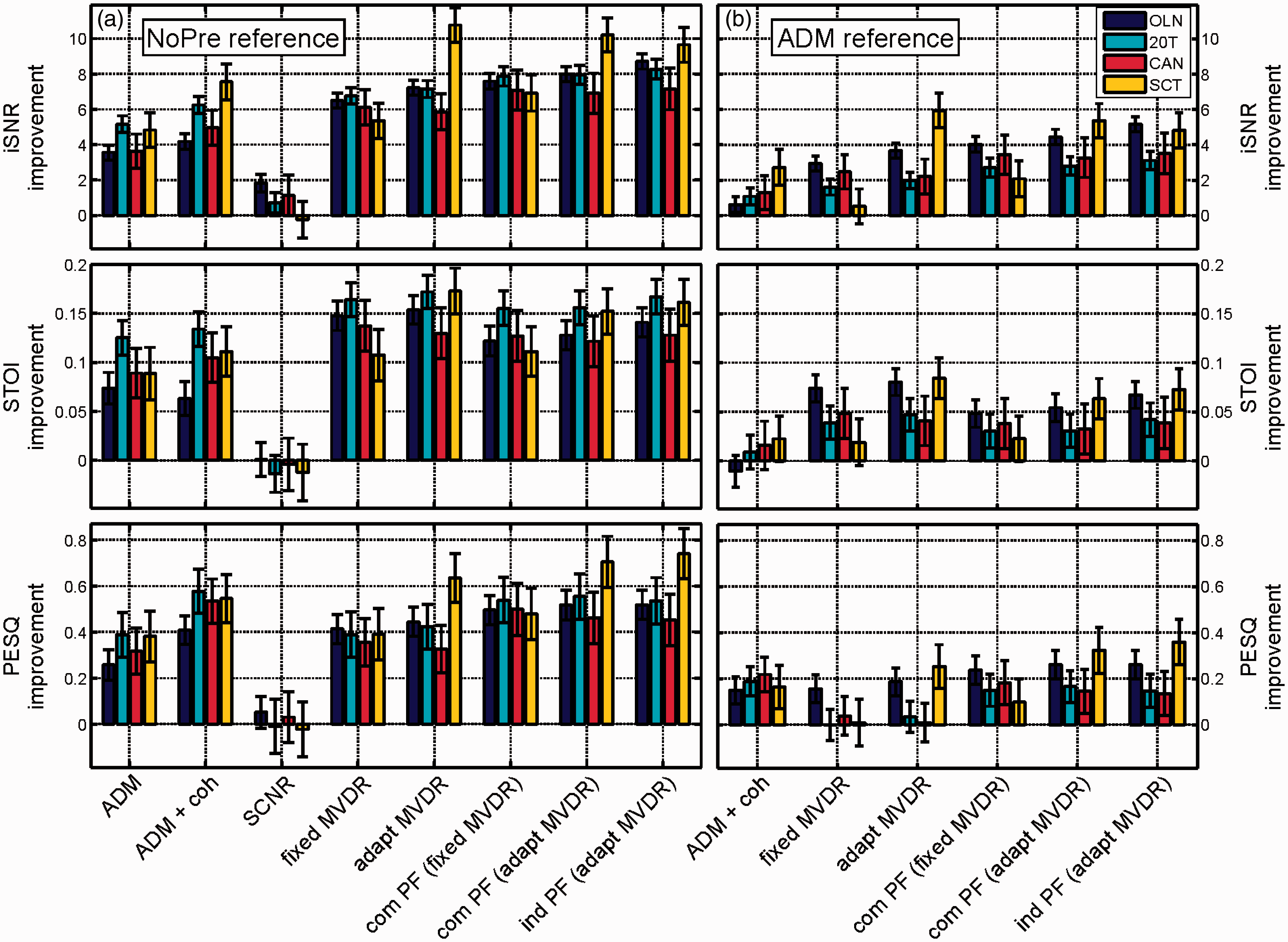

All results presented here are averaged across 120 sentences and, consequently, across 120 different noise segments for each test scenario. The error bars in Figures 6 to 8 (standard deviation) therefore provide an estimate of the variation in algorithmic performance for each algorithm in each test scenario. In the scenarios tested here, the fluctuations are rather small, suggesting all algorithms work robustly in each of the tested scenarios. The fluctuations in the highly nonstationary CAN and SCT scenarios are larger than fluctuations in the more stationary OLN and 20T babble scenarios as can be expected. For PESQ, the variation decreases with increasing input SNR. The same is true for STOI, albeit to a lesser extent. The variation seems to be caused almost exclusively by the noise characteristics; the standard deviations for all algorithms within one noise scenario are very similar.
The results from the three instrumental measures differed slightly, as each measure sheds light on certain signal characteristics (see Instrumental Measures section for details). It should be noted that the absolute mean opinion scores obtained from the PESQ evaluation are comparatively low. The full scale of the PESQ scores ranges from 0.5 to 4.5, whereas the results here only covered a range up to 2.3. The PESQ measure was originally developed to evaluate telephone transmission by comparing a clean speech signal to a transmitted (and presumably degraded in quality), yet still clean signal. Here, however, we have used PESQ as an instrumental quality measure by comparing a noisy speech signal (output of the signal enhancement algorithms) with a clean reference speech signal (compare Reference Signals section). Residual noise, not accounted for in the original model, was therefore treated as a quality impairment.
For the unprocessed reference condition (NoPre) in the SCT scenario, a large difference between the left and right channels was found (Figure 6, rightmost column), with the left channel showing better values in all measures. This finding was expected considering the highly asymmetric setup of this noise scenario: One competing talker was located to the right of the listener, while no noise sources are present to the listener's left. In the other three conditions, only small differences were observed between the left and right channels, with the right channel being evaluated as slightly better than the left. This difference could again be attributed to a slight asymmetry in the measurement scenario setup (see Figure 5 for geometric layout of the measurement environment). In the OLN and 20T scenarios, noise sources were located at positions B–F. The left side sources were located closer to the hearing devices and therefore produced higher noise power than the sources located at the right side. Additionally, the listener was seated in close proximity to a wall on the left side resulting in left-biased reflections, while the listener's right side faced an open room.
Signal processing with the ADM algorithm enhanced the differences between left and right channels, especially in the 20T condition. This is due to the ADM acting on the right microphone channels being able to steer a spatial zero toward two interfering noise sources located toward the back (positions E and F, see Figure 5), resulting in high noise suppression, while the ADM acting on the left signal channels were more influenced by the interfering noise source at a rather frontal position (B), which cannot sufficiently be suppressed due to the close proximity to the target direction (A). Better-channel-improvements obtained by processing with ADMs were seen with all measures in all scenarios. Considering that the target and interfering sound source are spatially separated in the SCT scenario, the ADMs were expected to yield the largest improvements in this scenario. None of the measures, however, matched this expectation. As a function of the input SNR, the iSNR measure shows a minimal decrease in better-channel-improvement with increasing input SNR. The reason for this behavior is that at low input SNRs, the noise sources are more prominent than the target source which allows for an efficient adaptation of the algorithm to the interfering sound. Both the STOI and PESQ measures predict the best performance at input SNRs of −5 dB or 0 dB. While the decrease in performance at higher input SNRs can be attributed to the loss in algorithm efficiency as discussed above, the decrease at lower input SNRs is likely influenced by distortions introduced by the processing algorithm which are evaluated negatively by the STOI and PESQ measures, but not by the iSNR measure.
The combination of ADMs with coherence-based postfiltering (ADM + coh) resulted in further increases in better-channel-improvements for all measures in all conditions (see Figure 7(b)), with the only exception being STOI which showed a slight decrease in performance due to the addition of the coherence-based postfilter in the stationary OLN scenario. In both, the iSNR and STOI results, the same trend is apparent: ADM + coh provides larger benefits with increasing nonstationarity of the interfering noise. We speculate that this is due to the temporal variation of the interaural coherence decreasing with increasing stationarity of the interfering noise. Since the coherence-based postfilter derives the gain from the interaural coherence, it provides less benefit with decreasing temporal variation of the interaural coherence. Unlike the iSNR measure, the STOI measure takes into account signal distortions to a certain extent. In all test scenarios but OLN, the improved SNR (as apparent from the iSNR scores) outweighs the negative impact of the distortions. In the stationary OLN, however, the reduced STOI score for ADM + coh with respect to the ADM reference is likely due to distortions introduced by the processing that could not be offset by SNR improvements. As a function of input SNR, each measure will be discussed individually. For the iSNR measure and nonstationary noises (SCT and CAN), a similar behavior as ADM alone was found but with overall larger benefits. In the stationary noises (OLN and 20T), an increase in benefit with increasing input SNR can be seen. The STOI measure shows similar behavior to the ADM algorithm alone except for two findings: in the OLN scenario, overall benefits are smaller and, in the SCT scenario, the benefits at low input SNRs are larger. Overall larger benefits than ADM alone were seen in the PESQ measure, especially in the SCT scenario at low input SNRs.
The SCNR algorithm yielded the smallest improvements (sometimes degradations) in all scenarios, using all measures. Since all other algorithms evaluated in this study are multichannel processing schemes, this finding was expected. Multichannel algorithms are well known to provide larger benefits in both speech intelligibility and signal quality than single-channel algorithms. For all measures, the best performance of the SCNR algorithm was observed, as expected, in the stationary OLN condition. The worst performance was seen in either the 20T or SCT scenarios. The SCNR scheme employed here relied on speech and noise power estimates based on the speech presence probability. For the stationary OLN, these estimates and therefore the separation of a noisy signal into speech and noise components worked quite well, giving rise to the observed improvement in all measures. For nonstationary noise scenarios, where the noise contains more speech-like signal parts (SCT being the extreme case), estimation errors occur and consequently no improvements were found. It is notable, however, that even in the extreme case of speech-on-speech masking (SCT scenario), where the SCNR scheme was expected to fail in its ability to correctly estimate speech and noise powers, only rather small degradations were observed. With respect to the iSNR and PESQ measures, the algorithm performance increased with the input signal's SNR for all interfering noise conditions. This behavior was anticipated as lower interfering noise power reduces errors in the speech probability estimates. The STOI measure, however, predicts no change in performance with input SNR or even a small decrease.
Two versions of the binaural MVDR beamformer were tested here, a fixed MVDR and an adaptive MVDR beamformer. In the OLN, 20T and CAN scenarios both beamformers performed similarly, whereas in SCT scenario, the performance of the adaptive MVDR beamformer algorithms was substantially better than the fixed MVDR beamformer. While both beamformers were designed to enhance signals originating from directly in front of the listener, the adaptive beamforming algorithm had the additional ability to selectively suppress an interfering noise source originating from a different direction. This additional noise suppression did not yield much advantage in environments containing many noise sources located at a number of locations; however, in the SCT environment, the suppression of the single noise source in combination with the enhancement of the target speech source resulted in a much more favorable SNR than the target source enhancement alone (fixed MVDR).
For the fixed binaural MVDR, the best performance determined by each of the measures was seen in one of the diffuse-like noise scenarios (iSNR: 20T, STOI: 20T, and PESQ: OLN). For the iSNR and the STOI measure, the lowest performance of the fixed MVDR was seen in the highly directional SCT scenario. Since this binaural beamforming algorithm utilizes the assumption of a diffuse noise field in the calculation of the filters
The adaptive binaural MVDR beamformer yielded the largest improvements overall for all measures in the SCT scenario. Since this scenario consists of spatially separated target and interfering sources, it is an ideal match for the adaptive MVDR algorithm. For the adaptive MVDR without postfilters, all measures revealed the largest better-channel-improvements in the SCT scenario. When regarding the iSNR and STOI measures, the adaptive MVDR in the SCT scenario also yielded the largest improvements across all algorithms and noise scenarios. For iSNR, both combinations of the adaptive MVDR with postfilters yielded the second- and third-largest overall better-channel-improvements. For STOI, however, these two algorithms achieved better results in the 20T condition. PESQ showed the highest improvements for each of the adaptive MVDR algorithms in the SCT scenario. For this measure, the overall (across all scenarios and all algorithms) best performance was achieved by the adaptive MVDR in combination with the individual postfilter in the SCT scenario. Compared to the ADM, the adaptive binaural MVDR showed the largest improvements in the stationary OLN scenario and the nonstationary SCT scenario. For the 20T and CAN scenarios, iSNR and STOI predict an improvement while the PESQ measure shows no difference to ADMs. These improvements are caused by the enhanced directivity of the adaptive MVDR beamformer compared to the ADMs. The same trend held true when comparing the common and individual postfilters based on the adaptive MVDR beamformer (with respect to the ADM baseline): The best performance was seen in the OLN and SCT scenarios. The amount of improvement provided by each of the postfilters, however, differs from measure to measure. STOI showed a decrease in all algorithm benefits cause by the addition of postfilters. The iSNR measure, on the other hand, showed increases in performance in all but the SCT scenario and PESQ revealed increases for both types of postfilters in all test scenarios. It can be assumed that the decrease in STOI score caused by the addition of postfiltering is due to the introduction of distortions, while the improvements in iSNR and PESQ are caused by an increase in SNR achieved by improved noise reduction. The decrease in iSNR in the SCT scenario can be attributed to errors in the speech-presence probability estimation of the postfilter, when confronted with two single speech sources. As a function of the input SNR, three general trends can be identified when comparing the adaptive binaural MVDR to the previously discussed ADMs: In the 20T and CAN scenarios, all measures show very a similar behavior between the ADMs and adaptive MVDR, with slightly larger improvements by the adaptive MVDR. In the OLN scenario, all measures show notably larger benefits for the adaptive MVDR than the ADM, yet the input SNR-dependence is similar. In the SCT scenario, we see drastically larger benefits across all measures provided by the adaptive MVDR that also shows a very different SNR-dependence. The benefits provided by the adaptive MVDR algorithm decrease with increasing SNR. This behavior can again be explained by the nature of the noise scenario and the algorithm itself: At low input SNRs, the speech power of the interfering talker dominates the acoustic scene and the algorithm can efficiently adapt to this interfering sound source. The direction of enhancement is set and therefore not impacted by the low speech power of the target speaker source at low SNRs. As with the common postfilter based on the fixed binaural MVDR, both postfiltering schemes based on the adaptive binaural MVDR reveal SNR-dependencies that can be understood as the sum of the SCNR algorithm and the adaptive binaural MVDR alone.
It can be observed that the individual postfilter (ind PF) performs slightly better than the common postfilter (com PF) for most scenarios and most measures. Exceptions to this finding were the iSNR in the SCT scenario, which showed a slight decrease in performance for the individual postfilter compared to the common postfilter and PESQ, which revealed the exact opposite: a slight increase in performance for the individual postfilter only for the SCT scenario and slight decreases for the three other scenarios.
The common postfilter was motivated to cause no distortions to the binaural cues (most importantly ILD) by applying the same (real-valued) gains to the left and the right channels. In contrast, for the individual postfilter, the gains were calculated for the left and right channels individually. While this approach produced distortions in the interaural level difference, the SNR improvement for each channel was maximized. NH listeners can benefit from a spatial separation between a target speech source and a noise source by exploiting the interaural cues resulting from this separation (Plomp & Mimpen, 1981). Consequently, it has previously been shown that they can benefit from a signal processing scheme preserving binaural cues (Van den Bogaert et al., 2009). In the instrumental evaluation presented here, however, no binaural instrumental measures were used. The left and the right channels were always regarded separately and such a binaural interaction benefit could not be assessed. Accordingly, the individual postfilter scheme yielded, with few exceptions, the expected better performance compared to the common postfilter scheme.
General Discussion
The SCNR scheme included here for reference performed similarly to what had previously been reported for subjective speech intelligibility measurements in noise, using (single-channel) noise reduced signals. Luts et al. (2010), in a large, multicenter study of signal enhancement algorithms, included two algorithms operating on single channel signals: noise suppression based on perceptually optimized spectral subtraction as well as Wiener filter-based noise suppression. Both of those algorithms showed no change in speech reception threshold compared to unprocessed signals, neither improving speech intelligibility in noise, nor impairing it.
The coherence-based noise reduction scheme investigated here had also previously been investigated in the aforementioned study by Luts et al. (2010). The algorithm was evaluated using speech intelligibility tests with a total of 109 subjects (NH and HI) across four countries. In all test sites, the algorithm showed no improvement in speech intelligibility, contrary to what our instrumental evaluation predicted. In a subjective preference test, however, Luts' subjects preferred the coherence-filtered signals over the unprocessed signals, rating them as slightly better. These findings are in line with the PESQ results presented here.
The instrumental evaluation performed here revealed differences between the common and the individual postfilter scheme, that despite being rather small (less than 1 dB iSNR and less than 3% predicted speech intelligibility (STOI)), were highly consistent across measures. The current instrumental evaluation suggested a benefit in speech intelligibility from using individual postfilters, providing maximal noise reduction for each channel.
Overall, all three instrumental measures considered here predicted good performance of the noise reduction algorithms with respect to speech intelligibility as well as speech quality. The optimal working point for most algorithms is around 0 dB input SNR, according to the STOI measure. Algorithms including SCNR can benefit from higher SNRs and provide more benefit in these more favorable conditions. Algorithms including the adaptive binaural MVDR yield the best performance in OLN and the SCT scenario at negative SNRs. The best results were obtained with the binaural MVDR beamforming algorithms (fixed and adaptive MVDR with and without postfilter). It should be noted, however, that these beamformers assume the direction of the target speaker to be known and would hence be unable to cope with nonfrontal talker locations or moving speech targets. For fixed sources located around 0°, however, these algorithms were able to provide improvements in all three instrumental measures.
Summary
In this article, an extensive instrumental evaluation of six binaural and two monaural signal enhancement schemes was presented. Evaluations were performed in four distinct reverberant scenarios that were designed to reflect real-world listening situations. All algorithms were implemented on a common real-time signal processing platform, making the setup ideal for perceptual evaluations.
The following findings emerged:
The adaptive differential microphones (ADMs) showed good results in the perceptual evaluation of speech quality (PESQ) evaluation. The predicted speech quality was even more improved when using a coherence-based postfilter in combination with the ADMs. The single-channel noise reduction (SCNR) algorithm tested here showed intelligibility-weighted signal-to-noise-ratio (iSNR) improvements in the stationary speech-shaped noise. The adaptive binaural minimum variance distortionless response (MVDR) beamformers showed larger improvements in predicted speech intelligibility and predicted speech quality than the fixed binaural MVDR beamformer. Processing with the binaural adaptive MVDR beamformer resulted in larger improvements than the monaural ADM in all measures. Postfiltering schemes deriving gains for the left and right channels individually resulted in larger improvements than postfiltering schemes deriving a common gain for the left and the right channels when employed based on the adaptive MVDR beamformer. The best overall performance was seen with the adaptive binaural MVDR beamformer in the single competing talker (SCT) scenario, resulting in a better-ear iSNR improvement of 10.8 dB.
These results are encouraging for perceptual listening tests to assess speech intelligibility and signal quality in NH listeners, HI listeners, and CI users. These tests have been performed and are reported in two subsequent studies in this issue (Baumgärtel et al., 2015; Völker et al., 2015).
Footnotes
Acknowledgements

Author Note
Portions of this work were presented at the 12th Congress of the European Federation of Audiology Societies (EFAS), Istanbul, Turkey, May 2015.
Declaration of conflicting interests
The authors declared no potential conflicts of interest with respect to the research, authorship and/or publication of this article.
Funding
The authors disclosed receipt of the following financial support for the research, authorship, and/or publication of this article: The research leading to these results has received funding from the European Union's Seventh Framework Programme (FP7/2007-2013) under ABCIT grant agreement no. 304912, the DFG (SFB/TRR31 “The Active Auditory System”), and DFG Cluster of Excellence “Hearing4all.”