




Abstract
Well-being outcomes for workers in the United States have worsened in recent years. However, the role that workers’ experiences with digital technologies may play in this trend is underexplored. Thus, using data from 10 focus groups (n = 67) and an original survey with workers in the United States (n = 4,898), we explore the impact of technology on workers’ self-assessments of emotional health and burnout levels. Focus groups revealed that workers perceive technology to be making their work lives more challenging, leading to frustration and burnout. In addition, workers attested that suboptimal working conditions relate to diminished confidence around their technological skills. Regarding quantitative findings, logistic regression models constructed for the survey data demonstrate that compared to salaried workers with a positive relationship to technology, both salaried workers with a negative relationship to technology and hourly paid workers (regardless of their relationship to technology) professed elevated levels of burnout at work. Taken together, we theorize that our results suggest the existence of a “digital dignity divide” in which orientation toward technology matters when it comes to whether workers feel valued and respected at work (and vice versa). In turn, feeling a lack of dignity related to digital technologies at work has an impact on overall emotional well-being.
Introduction
In light of the changes in the workplace in the last few years, scholars are finding ample evidence of diminished employee well-being at work (Chowdhury et al. 2022; Lin and Parker 2025; Pugh 2024). For instance, research from across the world has found that since the beginning of the pandemic, workers have faced increasing levels of stress, anxiety, and depression (De Kock et al. 2021). Although scholars have linked ongoing issues such as racism, classism, and sexism at work to adverse well-being outcomes (see Mooi-Reci and Risman 2021; Schieman et al. 2020; Wu, Qian, and Wilkes 2021), the last few years have demonstrated acceleration around another trend: the rapid rise and proliferation of technology in the workplace (Pugh 2024). Researchers are finding that the use of digital technologies—including automation and digitally mediated surveillance methods—have increasingly become a staple in the lives of broad categories of workers, and may relate to elevated anxiety, stress, and diminished trust in employers (Levy 2023; Mateescu 2023; Misra and Walters 2022; Nguyen 2021). Yet interestingly, employees’ perceptions of the impact of technology and their own technological skills (or lack thereof) on their emotional well-being has received less attention from sociologists.
Thus, in this article, we take a mixed-methods approach that combines original survey and focus group data to explore how U.S.-based workers’ understandings and constructions of their relationships to digital technology in a workplace context matter for their emotional well-being outcomes (in this case, burnout). Building off the idea of the traditional digital divide, which typically refers to inequities of access to technology and tech-related skillsets (Lythreatis, Singh, and El-Kassar 2022), we argue that our results provide evidence for the existence of an emerging “digital dignity divide” among workers. We posit that the digital dignity divide refers to the condition in which perceptions of one’s technological ability in the workplace relate to feelings of dignity at work, with lower confidence in ability relating to diminished dignity. This is an expansion of traditional conceptions of the “digital divide,” because it is an outcomes-based approach that explores the extent to which digital skills matter for the reproduction of social inequalities (see Helsper 2021). The digital dignity divide can also operate in such a way that diminished dignity at work relates to workers having a negative view of their own technological skills. Though inequalities of dignity are not the result of technological change, we find that workers often conceptualize technology as impacting their lives in ways that may exacerbate dignity issues. Thus, the implications of the digital dignity divide include adverse well-being outcomes.
Background
Well-Being and Dignity at Work in Contemporary Times
In the United States, researchers have found that workers’ mental and emotional well-being has been generally unfavorable and worse when compared to only a few years ago (Hayes et al. 2021; Heinemann and Heinemann 2017). For instance, burnout—an “occupational phenomenon” that causes, or is associated with, poor emotional and mental health states related explicitly to workplace conditions—is on the rise (Haar and O’Kane 2022; Lam et al. 2022). Scholars have argued that burnout levels are increasing in part due to changes happening in the workplace without employees receiving adequate financial, administrative, and emotional support to deal with those changes (Afonso et al. 2021). For example, the rapid advancements related to digital technologies in particular—including the hurried proliferation and adoption of artificial intelligence (AI) tools—are clearly causing workers to feel more stress (Lin and Parker 2025). Many workers question to what extent AI or other digital technological innovations will come to fundamentally alter or threaten their jobs.
Yet in addition to fears related to rapid technological change, scholars have generally argued that mental and emotional well-being (including burnout) levels have moved in an unfavorable direction due to the ongoing deterioration of quality of life associated with many job roles (Levy 2023; Newlands and Lutz 2024; Schaufeli and Bakker 2004). For example, issues including wage stagnation, the loss of worker benefits and protections, and erratic and inflexible work schedules are just some of the factors that have increasingly come to characterize work, especially for many blue-collar workers, essential workers, gig economy workers, and those paid by the hour (Gamboa Madeira et al. 2021; Levy 2023; Lin and Parker 2025; Litchfield, Shukla, and Greenfield 2021; Newlands and Lutz 2024; Walters and Misra 2023; Winant 2021). Though typically not to the same degree of severity, even salaried or well-paid workers have dealt with issues such as longer work hours, more uncertainty, and worsening work–life balance (De Kock et al. 2021). These characteristics all relate to a pattern of many jobs becoming a less reliable source of personal dignity for workers in the United States since the mid-twentieth century.
Separate from human dignity, the concept of dignity in the workplace is unique and refers to respect for, and a sense of self-respect among, workers (Crowley 2013; Lucas 2015). Characteristics such as autonomy and meaningfulness in work often indicate a dignified work environment, whereas issues such as coercion and micromanagement are usually found where dignity is lacking (Crowley 2013). In contemporary times, many workers struggle to achieve dignity (Lucas 2011; Thomas and Lucas 2019). The reasons for shifts in dignity are complex. However, in looking for an explanation for what has changed over time to cause these shifts, some groups of workers have rationalized that the increasing presence of digital technology at work is a major factor (Ball 2022; Misra and Walters 2022). Although technology has the potential to support dignity—for example, by allowing for more flexibility in the workplace (Lamers et al. 2022)—worker perceptions are significant; and unfortunately, many workers perceive the influence of technology to be negative. For instance, Levy’s (2023) research finds that truck drivers see increased technology (such as a shift from manual to digital tracking) as a factor in the deterioration of their experience on the job compared to the past (Levy 2023). How workers make sense of the role of technology in their work lives can tell us much about the association between dignity, technology, and well-being outcomes.
Increasing Technology in U.S. Workers’ Lives
The last 5 years have seen an acceleration of the use of digital technologies in the workplace (Lin and Parker 2025; Litchfield, Shukla, and Greenfield 2021; Newlands and Lutz 2024). “Digital technology” here refers to a wide range of digital tools used by employees—such as “AI” and videoconferencing platforms—as well as tools used by organizations, such as increased data analytics and surveillance programs. While these tools can be beneficial (e.g., by automating mundane tasks), they can also have a downside, such as through helping justify unfair productivity expectations and shifting power in the workplace away from workers and back toward those who own the means of production (Levy 2023; Mateescu 2023; Misra and Walters 2022; Nguyen 2021). For instance, the increasing presence of automation and surveillance technologies have come with more fear, frustration, and stress because many workers perceive these changes as threatening to diminish their autonomy and even replace human workers altogether (Aloisi and De Stefano 2022; Kumpikaitė-Valiūnienė et al. 2021; Levy 2023; Newlands 2021). As employers have scrambled to implement new technologies in the workplace, many workers have reported stress, frustration, and safety concerns due to inadequate training around the technologies being introduced (Kang and Fox 2022). While these trends are impacting workers in fields often constructed as lower status (such as blue collar or hourly work), the rise of AI has also put stress on white collar, creative positions once thought to be less vulnerable to automation (Lin and Parker 2025).
Some research has found that technological fluency can safeguard against adverse outcomes, including feelings of burnout (Nakagawa and Yellowlees 2020). However, in addition to feeling inadequately trained, scholars have documented that many employees are often chronically overworked, leaving them little time to engage in upskilling around technological advances (Hammonds, Kerrissey, and Tomaskovic-Devey 2020; Kang and Fox 2022; Levy 2023). This situation is reminiscent of the “digital divide,” which traditionally refers to inequities of access around technology. However, what’s described here speaks not just to access, but to other facets of digital inequalities as well (such as digital skills gaps) that can have an impact on workers’ lives. As Helsper (2021) has argued, as the digital becomes increasingly integrated into everyday life, explaining digital divides through access only is not enough. Rather, digital skills gaps are an important divide as well.
Indeed, perhaps owing to both the rapid rate of technological change and the stress related to trying to keep up, research has found that many employees have a complicated (or even negative) view of technology at work (Aloisi and De Stefano 2022; Levy 2023). Constructionist theories can explain these patterns. One significant way that individuals come to understand dignity (both inside and outside of work) is through their social interactions with others and with their social worlds (Jacobson 2009; Nygren Zotterman, Skär, and Söderberg 2022). Just like with any environment, as workers interact with others at work and the workplace environment (including new technologies), they learn about themselves and their place in the organization (Anthony and McCabe 2015; Dalessandro 2021; Schwalbe 1996). For instance, workers can take cues from their interactions with leadership, customers, coworkers, and society to understand the value placed on them as workers and on their job roles more broadly. Through this process, individuals actively give meaning to their lives and experiences (Berger and Luckmann 1967). Even though they are constructions, the meanings that workers assign to the elements of their work lives can be considered their reality—including their understandings of their experiences with, and perceptions of, new technology. If, as the research suggests, workers are increasingly making sense of and constructing technology to be negative influence on their workplace experiences, there is a need for a greater understanding into the potential implications of these trends.
The Digital Dignity Divide
Traditionally, the “digital divide” refers to disparities in access and usage around digital technologies, as well as outcomes related to access and usage disparities (Lythreatis et al. 2022; Soomro et al. 2020). For instance, scholars have observed that often the digital divide falls along race and social class lines, resulting in less-favorable outcomes for those disadvantaged by a lack of access (Bartikowski et al. 2018; Lythreatis et al. 2022). While the “digital divide” doesn’t necessarily refer to the workplace, when applied to work, one potential shortfall of the existing definition is that even in fields and professions where technology was traditionally not a part of everyday life, digital technology is increasingly present. However, rather than improve workers’ lives, research finds that many workers perceive that the introduction of new technologies can instead make work feel patronizing and less dignified (Aloisi and De Stefano 2022; Kang and Fox 2022; Levy 2023; Misra and Walters 2022). At the same time, jobs that employees perceive to be less dignified may also result in diminished feelings of competence around technological skills.
From this evidence, we theorize that workers’ understandings of their experiences with diminished dignity and increased technology at work have led to a “digital dignity divide” in which workers’ perceptions of their technological abilities relate to their feelings of dignity at work and vice versa (in other words, fears around new technologies can compromise workers’ feelings of dignity). Based on how workers conceptualize the relationship between diminished dignity and increased technology, the digital dignity divide is cyclical and thus can be challenging to break. Further, while workers occupying roles that are already at risk of being considered low-dignity (such as, e.g., blue collar and hourly wage work) may be the most vulnerable to the digital dignity divide, it is also possible that workers in historically more socially dignified positions (such as salaried, white-collar positions) are susceptible to the dignity divide depending on their understandings of their technical skills.
In the findings below, we highlight the results of our qualitative focus groups, which illustrate how workers in the United States are thinking about and constructing their experiences navigating technology in the workplace. These focus group interviews suggest both the existence of the digital dignity divide as well as the negative impact on employee well-being that relates to it. Second, we use our survey sample to explore workers’ orientations toward technology and the relationship between attitudes around technology and well-being outcomes (specifically burnout).
Methods
The data used in this article were collected as part of an annual project conducted by the authors’ research team that explores employees’ experiences at work. Pearl IRB (Indianapolis, IN, USA) reviewed and approved the research in the winter of 2022. The data analyzed here comprise two sources: an original survey of full-time employees across the United States and focus group interviews with full-time employees across six U.S. cities.
Qualitative Data and Analysis
Before running our survey in the spring of 2023, we completed our qualitative data collection between late 2022 and early 2023. The qualitative data comprised 10 focus group interviews with 67 employees total. We partnered with a participant recruitment firm to assist in recruiting diverse participants according to demographic and work roles. However, in order to offset the authors’ past qualitative research projects in which white-collar employees and employees working desk jobs were over-represented, potential participants had to attest that they had limited or sporadic access to digital tools (including email, instant messaging, and human resource systems such as payroll) in the ordinary course of their job duties. Ultimately, participants represented industries including (but not limited to): retail, healthcare, transportation, manufacturing, education, construction, sales, and food service.
To cover a wide range of regional U.S. perspectives, focus groups took place in person across several U.S. cities: Atlanta, GA; Chicago, IL; New York, NY; Nashville, TN; Minneapolis, MN; and Los Angeles, CA. We conducted 10 mixed-gender groups of approximately 5 to 9 participants each—two groups in each city, except for Atlanta and Nashville, where we conducted one group each. Ultimately, 42 women and 25 men participated in the groups. Groups were also racially diverse and represented a range of job roles across different industries. Interviews lasted 90 minutes and were led by one moderator (alternating members of the authors’ research team, including the authors). In addition, participants received incentives ranging from $125 to $185. We recorded and transcribed each interview for accuracy. Although confidentiality cannot be guaranteed in focus group settings, we took steps to protect confidentiality to the fullest extent possible. For instance, in the findings below, identifiable information has been changed (including names and specific work roles where applicable). Congruent with the research team’s broader goals for the project overall, topics covered in the interviews included various aspects of participants’ experiences as employees, including flexibility at work, education and upskilling opportunities, and experiences with pandemic-related changes at work in the last few years. We also asked groups more generally about their day-to-day experiences at work.
Although we followed interview guides covering the topics discussed above, we also took an open-ended approach that allowed participants to expand upon points arising during the conversation. In this way, we took a modified grounded theory approach to our data (Glaser and Strauss 1967; James-Hawkins, Dalessandro, and Sennott 2019). Further, since our interviews covered several topics of interest to the researchers in open-ended ways, they were largely exploratory.
In coding our interviews, we took an approach that closely follows the process of “thematic analysis” as outlined by Braun and Clarke (2006) and Naeem et al. (2023). First, we first read through transcripts for insights. Although the interviews covered multiple topics, upon noticing the significance of technology in their day-to-day experiences as employees, we decided to focus our coding for this article specifically on technology sentiments. In observing the role of technology in participants’ discussions of their work experiences, we began coding more specifically for workers’ experiences interacting with technology at work. From this coding, we identified themes including workers’ experiences with indignities at work, stress around digital technologies at work, and fears around digital technologies at work. In addition to informing our findings below, our observations from the qualitative interviews also informed the inclusion of questions surrounding technology-related attitudes in our survey (profiled below).
Quantitative Data and Analysis
The survey data in this article come from an annual study conducted by the authors’ research institute that investigates various aspects of the employee experience across the world. While the project surveyed employees in 28 countries across the world, for this analysis, we elected only responses from the United States. After also accounting for any missing answers to key variables of interest, our final sample for analysis was 4,898.
The dataset used here is the culmination of two surveys (both from the spring of 2023)—an initial survey and a follow-up survey—combined by the authors into a single dataset. We built the survey using Alchemer (formerly SurveyGizmo) and Lucid (a sample aggregator working with survey panel providers) to screen and administer the surveys. Lucid (the largest available sample aggregator for online respondents) facilitates direct-to-respondent sampling through its marketplace platform (Coppock and McClellan 2019). Using the Lucid platform, we were also able to safeguard against the same respondents receiving both the first and second surveys, ensuring unique responses for the full dataset. Panel providers handled survey respondents’ payments ($2.75 USD for the United States), which took the form of cash, gift cards, or reward points redeemable for merchandise. The sample is one of convenience, although it is still large enough to generate meaningful results.
To participate in the survey, respondents had to work full-time at organizations employing over 500 workers (since one of the goals of the larger project was to capture the experience of workers at large firms). In addition to technology attitudes, the survey covered a range of workplace issues such as worker mental health and well-being, experiences with leadership, perceptions of opportunities at work, and more since the researchers had multiple goals with the larger project. While the second follow-up survey included some different questions (to account for gaps identified between the first and second surveys), the questions used in our analysis here appeared on both surveys. On average, the surveys took respondents around 30 minutes to complete.
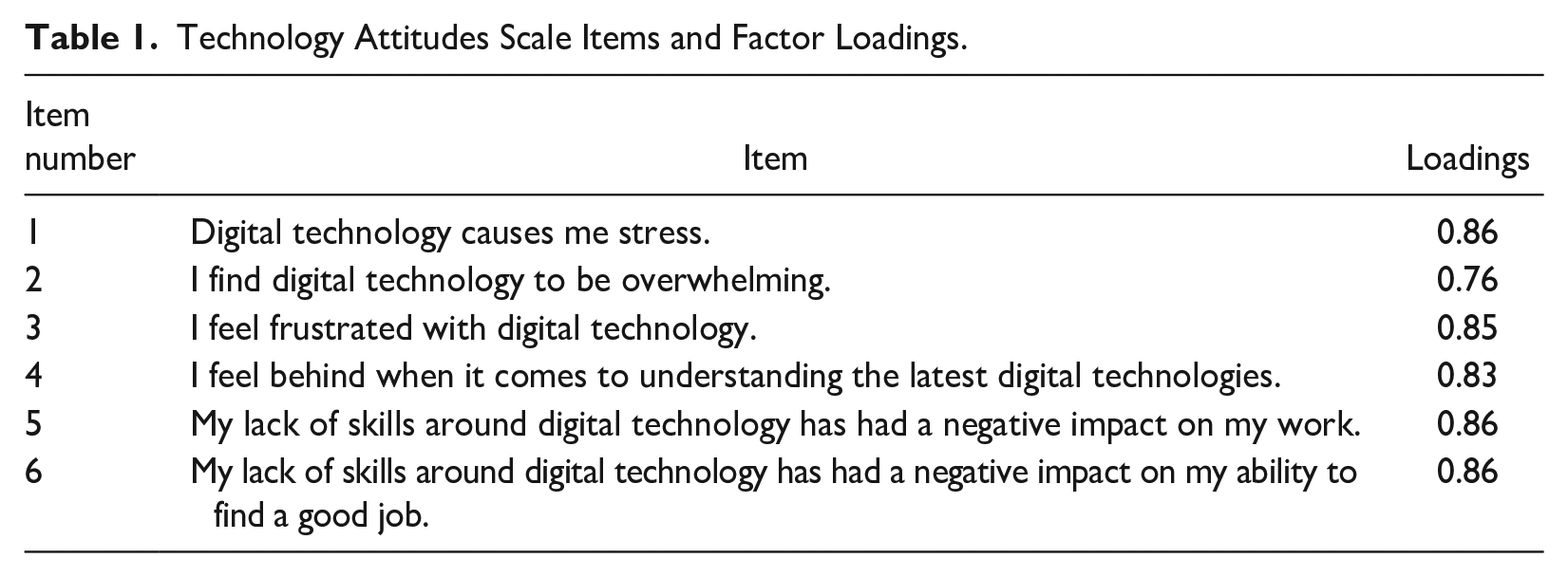
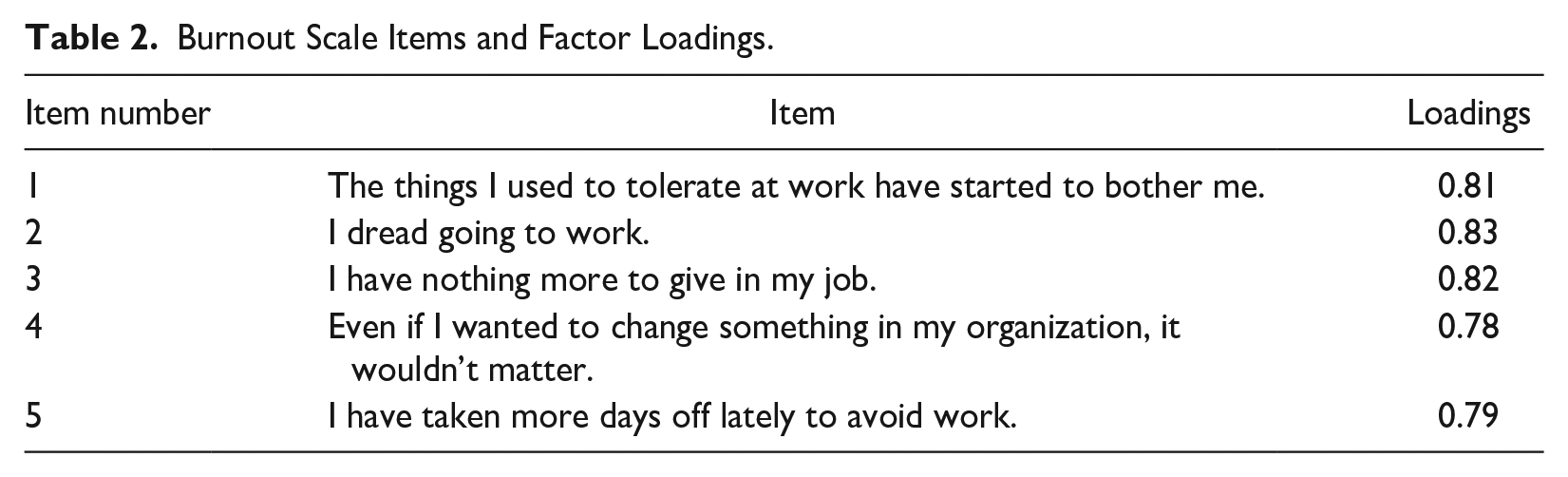
After informed consent, the survey asked respondents questions about their workplace experiences, including questions on their burnout levels and attitudes toward technology. These questions are available in Tables 1 and 2, respectively. We presented respondents with a Likert scale (1–5) and asked them to respond with their level of agreement. We also employed factor analyses for the burnout and technology attitudes questions and created dichotomous index variables based on the results of the factor analyses (factor loadings are also included in Tables 1 and 2 and discussed more in the “Findings” section). The questions of the technology attitudes scale were based largely on findings from the focus group interviews. We developed burnout questions based on previous research into how burnout at work is defined, including an employee sense of feeling emotionally exhausted at work as well as cynical and disconnected from the workplace (feelings that may also result in absence from work) (see Edú-Valsania, Laguía, and Moriano 2022; Lam et al. 2022; Lovell, Beckstrand, and Sturt 2018; Salanova and Schaufeli 2000). Although we use dichotomous outcome variables in our analyses, we asked participants to respond with a Likert scale to capture strength of agreement (general agreement vs. nonagreement) as well as neutral responses (nuance that a dichotomous yes/no option may not have been able to cover). We then created dichotomous variables from the scales dividing participants with below and above average scores on measures of burnout and technology attitudes. We elected to use dichotomous outcome variables over ordinal variables in order to best capture participants who were generally burnt out (or not) and had a generally positive relationship to technology (vs. neutral or negative).
Technology Attitudes Scale Items and Factor Loadings.
Burnout Scale Items and Factor Loadings.
After receiving satisfactory results from our factor analyses, we used StataMP 18 to fit two logistic regression models using the dichotomous burnout variable as our outcome. While our initial model examines the independent effects of technology attitudes on burnout as well as compensation type (hourly vs. salary pay), our subsequent model includes an interaction between the dichotomous technology attitudes variable (either generally favorable or unfavorable attitudes) and compensation type (hourly vs. salary pay). While not a perfect measure, we used compensation type as a proxy for dividing jobs currently constructed as low-dignity from those constructed as high-dignity, since many hourly wage jobs (e.g., retail work and other blue-collar positions) are increasingly considered low-dignity in U.S. society (Misra and Walters 2022). However, we recognize that some low-dignity workers may be paid a salary, and vice versa.
We also controlled for general access to technology (including owning a cell phone, laptop or desktop computer, and high-speed internet at home) in our model as well as respondent gender, education level, generation, industry, identification with racial or ethnic minority status, and country. We included these variables to control for demographic factors that might skew the results. Prior to performing the regressions, we also explored relationships between the variables (see Table 3, which also includes descriptive statistics). In our findings below, we first discuss the results of our qualitative analysis, followed by our quantitative findings. In both cases, we discuss how the data suggest the development of a digital dignity divide and the impact of the divide on well-being outcomes.
Sample Characteristics and Burnout (Chi-Square Analyses).
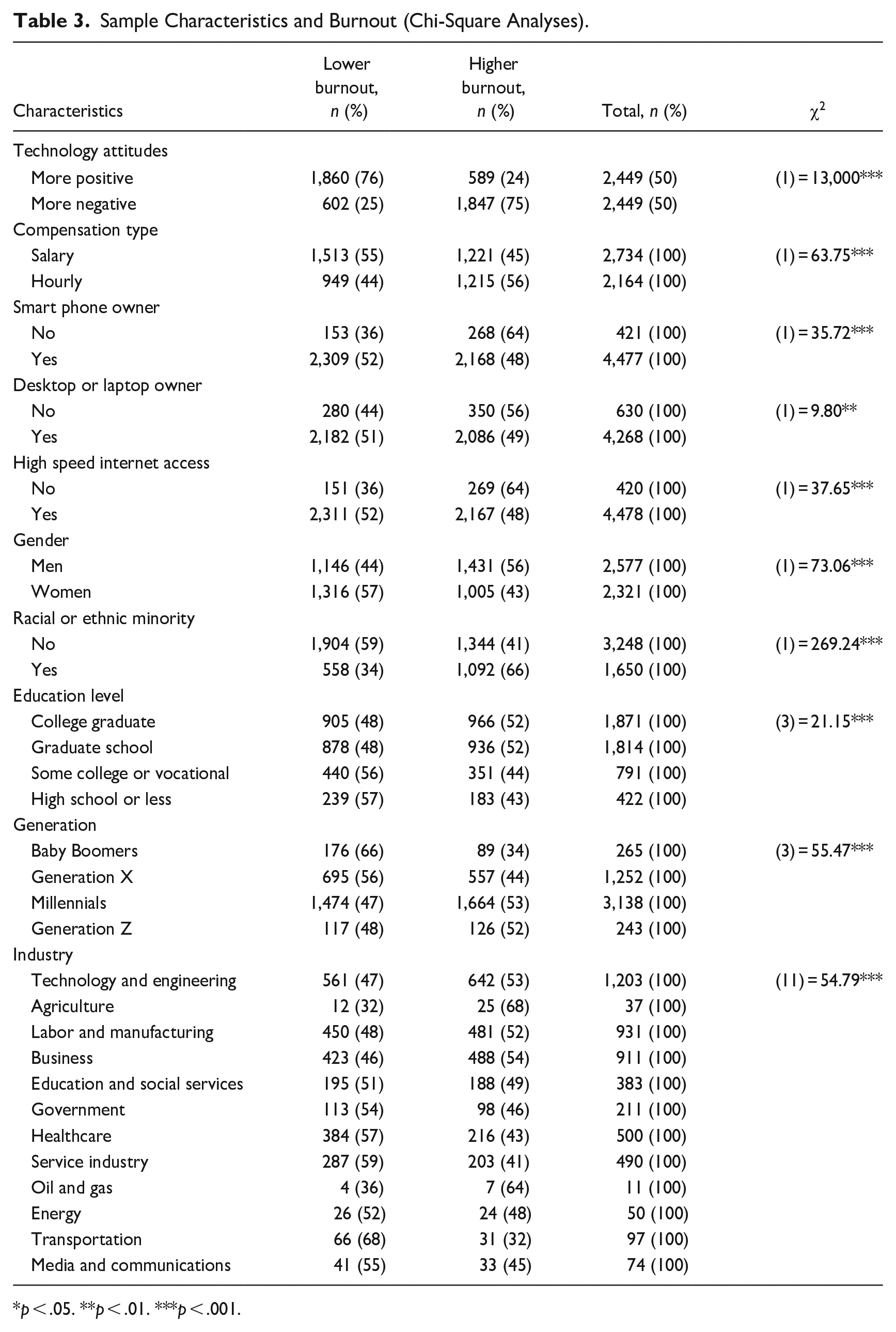
p < .05. **p < .01. ***p < .001.
Findings
Qualitative Findings: Technology at Work
Our focus groups revealed that many workers had less-than-ideal experiences on the job. For example, Rosie—a customer service representative from Los Angeles—shared how her experience at work is vastly different from what she observed people on the “corporate” side (including sales and account representatives) experience. In her account, she constructed corporate side employees as being higher status at her place of work:
Well, we’re frontline, so we’re the lowest on the [ranking] . . . And then people on the corporate side—they’re sales, they’re account representatives, so they’re getting branded clothing, they’re getting four-day trips because they were so fantastic . . . They get respect. It’s totally different [for me]. Everything that I do is timed down to the minute, micromanaged down to the second .. . .
Overall, Rosie’s experience at work lacks an element of dignity that, from her perspective, other employees at her company get to enjoy. By her own admission, her situation makes her stressed, especially because she doesn’t believe that managers can empathize with her situation. This dignity divide permeates workers’ discussions of technology as well.
Despite recruiting participants based on their status as largely removed from technology throughout their daily work, it became clear throughout focus group interviews that participants dealt with technology all the time in their work lives. However, often, these conversations took a negative turn. For instance, Cathy—who worked for a shipping company in Minneapolis—shared her frustration resulting from management changing the computer program she uses and not informing her. Instead, she said that she routinely finds out about changes while already face to face with customers:
[Managers] make changes and they don’t tell you. Of course they don’t ask you, but they don’t tell you even! I’m at work and all of a sudden my computer starts doing [something] totally different and then I’m like, standing in front of the customer and I want them to not see fear in my face . . . they think they’re doing something better for you, better for the customer [but] it’s two extra steps and it’s not better for anybody.
For Cathy, her organization’s method of instituting process changes without appropriately communicating felt patronizing and caused her stress. She also said, “I think that’s what gets frustrating is [managers] make these changes . . . and because [they] didn’t send out an email, a suggestion, something ahead of time and be proactive and talk to the people . . . I [think I] know what I’m doing, but now I don’t.” Management’s lack of communication undermined her ability to do her job. To make matters worse, Cathy felt she had no leeway to have an “off” day: “My least good day is 100 percent. I come into work every day happy . . . And then if they see that, they expect that’s your normal . . . Work is so stressful. All they want is more and more work.” Despite her admission that she is “an excellent worker,” Cathy, similar to Rosie, attested that work (including management’s approach to technology) is making her life more stressful overall. Although they don’t explicitly use the terminology of “dignity,” what Cathy and Rosie both describe is a lack of dignity at work. In Cathy’s case, diminished feelings of dignity are compounded by the issues around technology that she faces at work.
Like Cathy, participants in additional cities said that their organizations’ (and/or management’s) approaches to technology sometimes made their work more stressful. For instance, Reid—a bank teller from Chicago—shared, “Everything we do is monitored. Our phone lines are monitored for compliance . . . and they’re recorded.” In another case, Ashley (who works in manufacturing in Atlanta) detailed how management’s reliance on technology (such as email) to deliver important messages often left her coworkers in the factory and her in the dark, “Warehouse, we don’t use computers . . . [But] we find out something about benefits or a meeting coming up and [my coworkers are] like ‘How’d y’all find that out? Nobody’s told us anything!’ [We’re] clueless.” Melinda, who was also in Ashley’s focus group, responded,
When [my organization] sends out company-wide announcements, they’ll have this banner at the bottom that says, “Please distribute to those who don’t have regular access to emails.” To [Ashley’s] point, some professions are at the mercy of whoever has that access and will pass it along.
Similar to the accounts above, the quotes from Ashley and Melinda signify that in their workplaces, poor communication practices related to technological access or process changes negatively impact their workplace experiences. Workers with access to technology (such as email) for important communications are divided from workers lacking this access. At the same time, these accounts demonstrate a divide between workers with the means and power to change technological processes and procedures, and those seemingly at the mercy of those changes (often without any power to provide feedback). Between access issues and other stressful inconveniences (such as surveillance), a digital dignity divide emerges between workers for whom the digital provides a potentially amplified sense of dignity at work and those for whom a sense of dignity can be diminished. While these accounts highlight that it is often managers or leadership who deploy technology in ways that diminish dignity, focus group participants believe that the use of technology also enables companies to exclude certain groups of workers from important communications and/or to generally make their work lives more miserable while hiding behind the guise of improved efficiency.
In light of focus group participants’ experiences with technology on the job, many also expressed anxiety around, first, how advances in technology might threaten their jobs (and thus, livelihood), and second, how pursuing better working conditions through technological upskilling may backfire. Consistent with long-term projections (Levy 2023), many worried that advances in technology and AI would impact their jobs in the near future. Lawrence from Nashville shared, “Automation is—I hear that word 900 times a day. Eventually, you’ll work yourself out of a job.” Likewise, an exchange between Louis (a gig worker) and Matt (a retail customer service representative) in Los Angeles illustrates some of the fears around automation:
A lot of people I know, the company is telling them, “We’ve got to let you go,” and then they find out two months later that they had a software company create an algorithm that replaced their job. Instead of just dropping people, shocking people, they should give them a timeline so they can start getting their affairs in order if they’re the type that want to work for the rest of their life. It’s fair, instead of just shocking people out of the blue . . .
Have training programs. They’re too cheap to pay for the training programs!
. . . a lot of people don’t know, but [a well-known company], I know you guys heard they dropped a lot of people, and it’s because of what I just said. They got stuff coming on board where they don’t even need people for certain things.
As this exchange illustrates, not only is automation seen as a threat, but workers don’t trust that their employers will do the right thing (e.g., offering skills training) if automation threatens their current jobs. After years of experiencing diminished dignity, workers such as Matt and Louis have little confidence that companies will employ technology in a people-centered way. Worse yet, many fear technology is to blame for threats to their sense of dignity at work and their ability to make a living.
Relatedly, some workers worried that the nature of their jobs made it challenging to upskill or pursue additional skills that might help them transition to another line of work. Technology is thus constructed as a symptom and a cause of lost dignity in the future of work. This exchange between Kelly (a rideshare driver) and Leo (a mechanic) from Chicago is revealing:
I really feel like I got left behind in technology recently. I just feel like a dinosaur when I try to use certain things, my phone included . . . [If] it’s not social media specifically, it’s going to be computers and I am far behind in that aspect.
I feel you on that one. I’m learning from my five-year-old. I work with wrenches and screwdrivers, and he can show me things on the tablet I have never even seen before. Yes, so I feel your pain. “Come on dad, you don’t know how to do this?” No. I can build you a car though, but I don’t know what you’re doing there on your tablet, some crazy pictures you’re drawing.
For Kelly and Leo, there is palpable anxiety around not just the role of technology in the future of work but their ability to transition to that future seamlessly. Similar to what was expressed in the exchange between Louis and Matt above, there is a fear that the skills they employ in their jobs currently may not be as valuable to organizations going forward, which could threaten their livelihoods. Technology threatens their ability to be valuable (and valued) as workers, especially because they fear they will never catch up with technological innovations.
On the other hand, a few group participants did have the opportunity to build their skills around technology. However, this often did not end as well as they had hoped. For instance, Kelly, in the exchange above, had a chance to upskill, but still felt that what she learned was insufficient and that she was behind. At the same time, Daniela—a nurse from New York—had the opportunity to upskill on a new program being implemented across the hospital system where she worked. While initially excited about the opportunity, she later regretted it because she found that being an early adopter of the system put the onus of teaching it to others on her without any relief of her regular duties or a pay increase:
I didn’t know exactly what I was going to learn [in the course], but I was like, “I’ll be pretty good at this new program that they’re rolling out,” and it was kind of just a waste of time. [However, management] said I was like, a “superuser.” So what ended up happening was kind of after I mastered this program, they started giving me nursing students I had to kind of take under my wing. So, I was doing my job, teaching my coworkers because I’m a “superuser,” and then I had students following me the whole day. It was a nightmare . . . and it’s not like I was getting paid any more. It was pretty hard. And throwing COVID in the middle of that, it was a hot mess.
Daniela and a few others shared that trying to increase their value by learning new technology typically had the opposite of the intended impact—they were tasked with more and/or unwanted work and/or their experiences with training were unsatisfactory. Thus, technology again contributed to ever-decreasing dignity at work.
The participants in our focus groups often voiced the understanding that the presence of technology made their work lives more difficult on several fronts—surveillance, the threat of automation, and feelings of being left out or left behind were all concerns that participants shared. While their stories communicate that it’s often the leadership or organizations driving some technology-related issues, the existence of the technology itself is also often cited as the problem. Diminished dignity at work contributes to workers’ negative views of technology. While workers voice this, they also understand the presence of technology itself as contributing to their diminished sense of dignity. These workers reason that how technology is deployed often makes their lives harder, leading to a digital dignity divide around access, skills, and trust around technology. As demonstrated in their quotes above, workers in focus groups also explicitly express that this divide relates to poorer mental and emotional health outcomes by their admissions of increased stress, anxiety, and burnout on the job. Our quantitative data also suggests that the issues voiced above exist on a broader scale.
Quantitative Findings: Technology Attitudes, Worker Groups, and Burnout
Our quantitative analysis captures the extent to which some of the issues we observed in focus groups may be happening on a larger scale. In particular, we captured how both salaried and hourly paid workers’ views on technology matter for well-being (measured here as self-reported burnout levels). To assess the appropriateness of technology attitudes and burnout scaled data for factor analysis, we first estimated Cronbach’s alpha, Bartlett’s Test of Sphericity, and the Kaiser–Meyer–Olin (KMO) measure of sampling adequacy. We found that α = .934 for the technology attitudes items, revealing strong internal consistency among the items. From the Bartlett test, we can reject the null hypothesis (χ2 = 23,067, df = 15, p < .001), and the KMO test indicates factor analysis suitability (0.921). We conducted a principal component analysis to explore factor structure and found that the model converges into one factor (with all factor loadings greater than 0.60). Factor loadings are detailed in Table 1. For the burnout data, we found that α = .908, that we can reject the null hypothesis (χ2 = 15,290, df = 10, p < .001), and the KMO test indicates factor analysis suitability (0.893). We also found that the model converges into one factor with loadings greater than 0.60. These results can be found in Table 2.
After finding the scales suitable, we converted both into dichotomous variables for further analysis (dividing those with scores in the 50th percentile and above into one group and those below the 50th percentile into another group). Next, we conducted chi-square tests to examine relationships between the outcome variable of interest and all others (for full results, see Table 3).
In the next step of our analysis, we fit a logistic regression model exploring the impact of worker technology attitudes and compensation type on self-reported feelings of burnout. The pseudo R2 of our model was 0.23. Controlling for the demographic and technological access variables, we found that both compensation type and having negative technology attitudes independently predicted higher burnout. Full results appear in Table 4.
Logistic Regression Results Examining Higher Respondent Burnout.
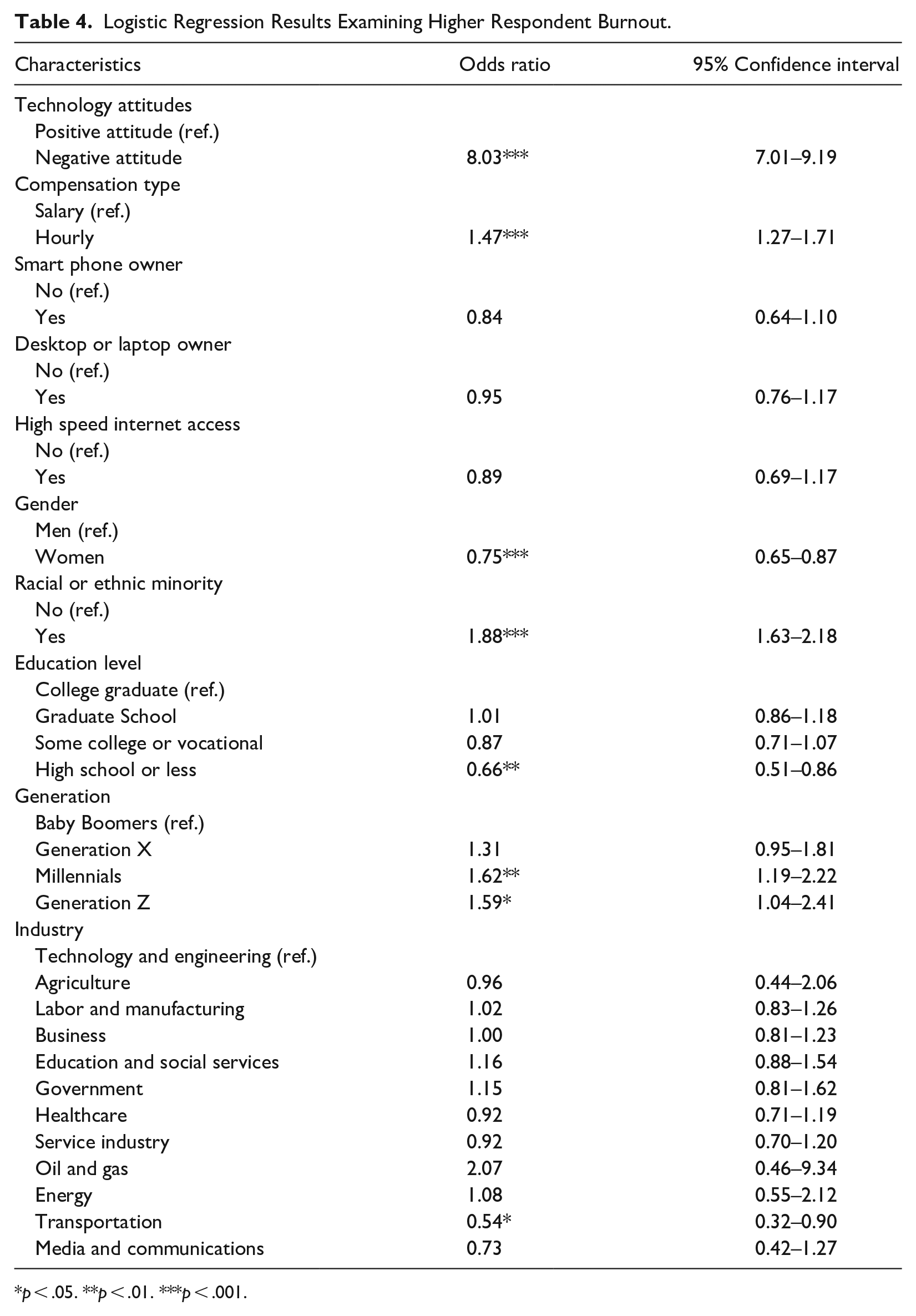
p < .05. **p < .01. ***p < .001.
In the last step of our analysis, we fit a logistic regression model primarily exploring the intersection of technology attitudes and compensation type and the impact on self-reported feelings of burnout. The pseudo R2 of our second model was 0.23. Controlling for the demographic and technological access variables outlined above and compared to salaried workers with positive personal attitudes toward their propensity for technology, salaried workers with a negative relationship to technology as well as both hourly worker groups reported greater feelings of burnout. Full results appear in Table 5.
Logistic Regression Results Examining the Interaction Between Technology Attitudes and Worker Type and the Impact on Higher Burnout.
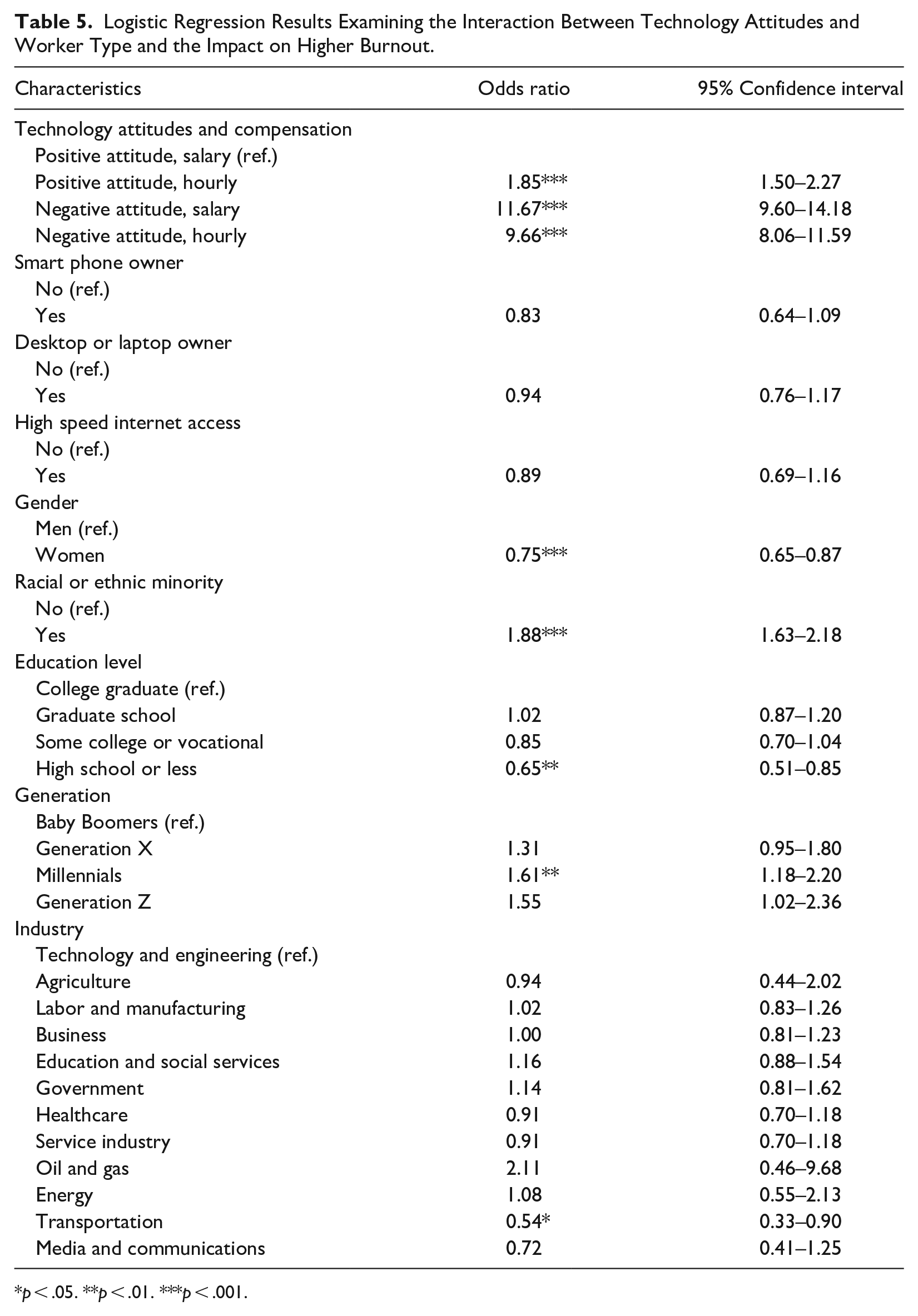
p < .05. **p < .01. ***p < .001.
Ultimately, we found that workers who reported more negative attitudes around technology in their work lives also reported more burnout. However, interestingly, our interaction also demonstrates that even hourly workers with a positive attitude toward technology still reported more burnout when compared to their salaried peers. Thus, our data suggest that workers who may have less access to dignity due to their jobs can be at an increased risk of burnout more generally and that negative attitudes toward technology (which can be fueled by experiences such as those outlined in the last section) amplify these effects. At the same time, salaried workers with a negative relationship to technology professed high levels of burnout as well, suggesting an important divide between those with confidence in their skills and those without.
Discussion
Though traditional conceptions of the digital divide have focused on access, in an increasingly digitally saturated world, recent research has argued that it may make the most sense to focus instead on outcomes (such as digital skills gaps, e.g., Helsper 2021). Thus, in this article, we took a mixed-methods approach to investigate the relationship between workers’ understandings of technology and self-reported mental and emotional health outcomes. In examining how workers make sense of technology’s role in their work experiences, we sought to explore how workers’ understandings of technology might matter for their self-reported emotional well-being (in our case, measured as burnout). In our investigation, we found evidence of the digital dignity divide. The employees in our study perceived that technology made their work lives more difficult and that this corresponded to decreased feelings of dignity (or feeling that they were valued) at work. The employees we interviewed reasoned that the ever-increasing presence of technology can highlight the indignities attached to some job roles (especially those that are blue-collar or lower paying), and that the indignities of certain job roles also exacerbated anxieties around technology. Though the causes of diminished dignity are complex, in some cases, participants made sense of technology itself as a leading cause of diminished feelings of dignity. This association of a loss of dignity with unease around technology also corresponded to unfavorable emotional health outcomes, which we saw in both our qualitative and quantitative findings.
In addition, our quantitative data suggest that the impact on workers can differ by group. Compared to salaried workers with positive technology attitudes, those paid hourly reported more burnout regardless of their relationship to technology. This likely points to the dignity issues increasingly found in hourly paid jobs (as discussed earlier in the paper). Our focus groups revealed that workers themselves see the role of technology in this way. Recent research—such as Levy’s (2023) work on truck drivers—finds that employees can find ways to resist technological advances that are unfair (such as by disabling electronic monitoring devices that may encourage truckers to meet unsafe time targets, for example). However, more broadly, those in blue-collar and hourly paid work roles may be especially at risk of the negative effects of an antagonistic relationship to technology due to the existing nature of these jobs as already at risk of being low-dignity as well as changes to the labor market in which activities meant to empower workers—such as collective organizing—are increasingly de-emphasized, leaving workers to negotiate and advocate for their own rights on an individual basis (Bullmer and Guinness 2024).
Interestingly, our quantitative research also found that salaried workers with a negative relationship to technology reported high burnout as well. In fact, the relationship between a negative relationship to technology and burnout was particularly strong for this group. This suggests that all workers with negative attitudes about, or experiences with, technology could fall victim to the digital dignity divide, and that there is something about technological anxiety itself that leads jobs to feel less dignified. While findings such as ours suggest that blue-collar workers are at risk of experiencing the digital dignity divide, white-collar workers may not be immune to its effects.
Particularly in the last few years, white-collar workers (who are often salaried) have felt less secure in the face of technological changes, especially in light of the rise of AI (Lin and Parker 2025). While blue-collar workers have had to contend with potential issues related to technology for a number of years, white-collar worker fears around AI—such as the idea that AI may replace some white-collar jobs—are arguably more recent, which may explain the uptick in feelings of burnout for this group. In addition, the white-collar workforce is already beginning to experience growing unemployment, which is in part a direct result of companies embracing AI as a strategy to make cuts (Scheiber 2025). The growing precarity around some white-collar work also contributes to diminished dignity associated with these positions, which further removes digitally savvy workers in secure, dignified jobs from everyone else. Due to these recent developments, some white-collar workers may increasingly be subject to the digital dignity divide if they feel that their technological skills do not measure up even if they possess other skills that have been historically valued in the workplace. These new developments could help explain our findings on salaried workers with high technological anxiety. Though we need more qualitative research with white-collar and salaried workers to confirm, some of the high levels of burnout we observed are likely due to newfound fears around the impact that technologies such as AI will have on white-collar work.
This research has several implications. First, although we focus on how participants make sense of the relationship between dignity and technology, examining understandings and constructions does not mean their experiences are not “reality.” Instead, participants’ understandings are rooted in their personal experiences with their perceived indignities at work. While our participants voiced frustration with the actions of people behind the technologies (such as managers or company leadership), that participants also associated and partially blamed their condition on the technology itself can have larger implications going forward. For instance, research has consistently shown that having the opportunity to embrace new technologies and upskill—rather than taking a hostile approach to technology—typically results in better outcomes for individual employees (Nakagawa and Yellowlees 2020). However, our research has shown that even when upskilling around technology happens, it can result in more stress and anxiety for some due to issues such as “quiet hiring” (or tasking employees with extra responsibilities without additional resources or pay). Going forward, the indignity associated with certain types of work (such as blue-collar and hourly paid work) may thus render employees generally critical toward technology, since their stories have shown that embracing and rejecting technology can still lead to poorer mental health outcomes compared to workers in more prestigious positions. Taken together, adverse well-being outcomes and a growing distrust of technology are two patterns that threaten to entrench inequalities among workers even further, especially as technology only becomes more ubiquitous.
Our results also suggest that researchers should continue to pay attention to how technology is deployed in workplace settings, as our research indicates that it is being used to penalize some while it may be helping others. Technology as progress does not seem to be a universal experience among employees. Employees want their work experiences to be dignified (Garofalo et al. 2023), yet unless there are structural changes that uplift dignity for workers, introducing technology into certain environments can further hostility. Our participants’ accounts suggest that preexisting workplace conditions may determine how technology affects workers’ lives more than the technology itself. When the preexisting conditions are toxic or relationships with workplace leaders and organizations are antagonistic, technology typically does little to help workers’ conditions and instead workers perceive that it only serves to make their work lives more difficult.
Our research is not without limitations. First, because our focus groups only profiled certain types of workers (favoring blue-collar and hourly jobs), we do not have a robust representation of workers in white-collar or prestigious positions. We need follow-up research with this group, which could help shed additional light on our quantitative findings. Second, our survey relied on a convenience sample and is thus not representative of all workers in the United States. Third, in our quantitative research we relied on “hourly” versus “salary” research as a proxy for dividing low- and high-dignity jobs. However, this measure is imperfect, since there are some salaried positions that might offer workers a low-dignity experience (De Kock et al. 2021). Thus, future work could do more to parse out this nuance as well as the extent to which conceptions of dignity at work relate to skills across both blue- and white-collar positions. Fourth, our survey data is cross-sectional and relies on self-reports. However, we believe the benefits of our findings ultimately outweigh the limitations and see our work as a jumping-off point for further investigations into the issues we’ve outlined, particularly those around technology and well-being inequalities in the workplace.
Conclusion
Using focus group and survey data with full-time employees working in the United States, this article explored the impact of workers’ relationships with technology on emotional health. We found that workers construct issues with technology as a conduit to low-dignity work, and vice versa (that low-dignity work can be characterized by feelings of unease around technology and technological skills). Thus, we argue for the existence of a “digital dignity divide” in which workers’ perceptions of their technological ability at work relate to their feelings of dignity at work, exacerbating a divide among workers between those who have more access to technological skills (as well as dignity) and those with less. The impact of this divide can include disparate emotional well-being outcomes, which we documented here. Going forward, sociological research should continue to explore how inequalities of digital skills are contributing to modern divisions in work and society more broadly.
Footnotes
Acknowledgements
The authors would like to thank Daniel Patterson, Chris Berry, and Nate Young for their contributions to research project ideation, data collection, and data curation that preceded the production of this manuscript.
Data Availability Statement
The data are not publicly available but are available from the authors upon request.
Declaration of Conflicting Interests
The author(s) declared the following potential conflicts of interest with respect to the research, authorship, and/or publication of this article: This research was supported by the O.C. Tanner Company (Salt Lake City, UT, USA), which is where the manuscript authors are employed. Publication may lead to the development of products licensed to O.C. Tanner, in which the authors—as employees of the O.C. Tanner Company—may have a business and/or financial interest.
Funding
The author(s) received no external funding for the research, authorship, and/or publication of this article.
