




Abstract
This study examined heterogamies based on lineage and their relationship with intimate partner violence (IPV) in Ghana. We used nationally representative cross-sectional data collected in 2017 from 1,789 women aged 18 years and older to build random-effect logit models and examine this relationship. We hypothesized that women in heterogamous unions based on lineage are more likely to experience IPV than those in homogamous unions. Our findings provided weak to no support for the hypothesis. The heterogamy hypothesis held partially for sexual, psychological, and economic violence: patrilineal women married to matrilineal partners were more likely to experience sexual, psychological, and economic violence than matrilineal women with matrilineal partners until their relationship dynamics were controlled. This means variations in IPV between homogamous and heterogamous couples were largely spurious. The biggest and most significant differences were found for homogamous couples. Unlike heterogamous couples, differences in the IPV experiences of homogamous couples persisted after accounting for their socioeconomic characteristics and relationship dynamics. Specifically, patrilineal women with patrilineal male partners were significantly more likely to experience sexual, psychological, and economic violence than matrilineal women with matrilineal male partners. We conclude there is a complex relationship between lineage, socioeconomic status, and other relationship factors in Ghanaian women’s vulnerability to IPV.
Introduction
Intimate partner violence (IPV) is a significant human rights concern in all societies and cultures. Although some women may be perpetrators (Dutton et al. 2005; Swan et al. 2008; Williams, Ghandour, and Kub 2008), they are overwhelmingly the victims (Cools and Kotsadam 2017; Mogale, Burns, and Richter 2012; Muluneh et al. 2020). More than one-third of all women experience physical and/or sexual violence in their lifetime (World Health Organization [WHO] 2017), but numbers vary for different parts of the world, with countries in sub-Saharan Africa reporting the highest IPV rates (Cools and Kotsadam 2017). Kapiga et al. (2017) discovered that about 61 percent of women in Mwanza, Tanzania, suffer physical and/or sexual violence. Percentages in Ghana are closer to the global norm (33 percent) but troubling: more than one-third of Ghanaian women experience various forms of IPV, including physical, sexual, economic, and psychological violence (Tenkorang et al. 2013).
IPV has deleterious consequences for victims. Studies in Ghana and elsewhere show that women with experiences of IPV are significantly more likely to report negative physical, psychological, and sexual reproductive health outcomes (Campbell 2002; Ruiz-Perez, Plazaole-Castano, and del Rio-Lozano 2007; Sedziafa and Tenkorang 2016; Tenkorang 2021; Tenkorang and Owusu, 2018). IPV undermines women’s household and sexual autonomy (Heise, Ellsberg, and Gottmoeller 2002; Sarkar 2009; Tenkorang 2018) and is an affront to their fundamental human rights. In 2016, as part of its sustainable development goals, the United Nations called for the elimination of IPV against women to ensure gender equity and balance, with special emphasis on sub-Saharan Africa where gender inequality and IPV are commonplace (Kusuma and Babu 2017; United Nations 2017).
In Ghana and elsewhere, women’s vulnerability to IPV has been linked to poverty and socioeconomic disadvantages, sociocultural norms that oppress and discriminate against women, entrenched gender norms that perpetuate gender inequality, and women’s lack of autonomy and self-efficacy in the domestic space (Cardoso et al. 2016; Fulu and Miedema 2015; Tenkorang et al. 2013; United Nations Women 2012). In recent years, debates surrounding women’s vulnerability to gender-based violence in African settings have expanded to include the contribution of existing indigenous structures to IPV, with some suggesting ethnic and lineage ties increase the risk (Asiedu 2016; Lowes 2018; Sedziafa et al. 2018; Sitawa et al. 2018). For instance, using data from the 2008 Ghana Demographic and Health Survey (DHS), Asiedu (2014) found significant IPV differences across lineages. Specifically, women from patrilineal societies were significantly more likely to experience physical violence than those from matrilineal societies. Using the same data source, Sedziafa and Tenkorang (2016) had similar findings among married Ghanaian women of different lineages for various types of violence. As in Asiedu’s (2014) study, married women from patrilineal societies reported higher levels of physical and sexual violence. However, women from matrilineal societies reported higher levels of emotional violence. In a follow-up study, Sedziafa et al. (2018) employed qualitative methods to explore comparative differences in the experiences of IPV among women identifying with matrilineal and patrilineal kin groups. They reported severe and continuous patterns of physical, sexual, and emotional abuse for women in patrilineal compared to matrilineal groups. Differences in IPV experiences were attributed to variations in lineage/kinship norms, access to power, and wealth.
Although evidence is scant, there appears to be consensus on the links between lineage/kinship ties and IPV among married women in Ghana. What we do not know is whether these risks are the same for women who marry partners with a similar lineage (lineage homogamy) and those who marry partners with a dissimilar lineage (lineage heterogamy). Women married to partners with similar lineage backgrounds may have a reduced risk of experiencing IPV because their partners have similar kinship values and norms, while women in heterogamous marriages may have more problems. By examining relationships between lineage heterogamy and IPV in Ghana, we sought to expand the literature on the contributions of lineage structures to gender-based violence. Our results enrich theory and knowledge of the unique conditions that create vulnerabilities for experiencing violence in a country where IPV rates are high. The study broadens abuse research from its conventional focus on modernization and westernization processes to include the role played by traditional lineage structures.
Conceptualizing Lineage Heterogamy
Over the past few decades, sociologists, demographers, and family scholars have been interested in understanding partner heterogamy and its effect on various demographic outcomes (Petts and Knoester 2007; Rogler and Procidano 1989; Wright, Rosato, and O’Reilly 2017; Yodanis, Boeckmann, and Sieber 2007). The concept of heterogamy is based on the idea that when partners are different and possess dissimilar attributes, family conflict may ensue (Curtis and Ellison 2002; Vera et al. 1985; Wright et al. 2017). The concept is rooted in sociological theory and borrows from the structural-functionalist argument that similar social norms can help maintain equilibrium and order, but differences may create conflict (see Jorgensen and Klein 1979; Merton 1975). Partners with differences in age, social class, religion, or ethnicity are likely to experience more conflicts than those who are more alike (Jorgensen and Klein 1979; McPhail 2019; Vera, Berardo, and Berardo 1985; Wright et al. 2017).
In other words, heterogamy may lead to conflict because of socioeconomic and cultural differences, while homogamy may be an asset because of partner convergence (Yodanis et al. 2007). However, tests of this hypothesis on outcomes such as marital stability and dissolution have inconsistent findings (Rogler and Procidano 1989; Wright et al. 2017). While a study on the effects of socioeconomic heterogamy on the dissolution of first marriages in the United States showed the risk of marital instability was higher for couples with heterogamous educational backgrounds (Tzeng 1992), a study that measured marital heterogamy using differences in spousal education, age, and culturally specific values did not find this risk (Rogler and Procidano 1989).
Inspired by previous literature, we introduce the concept “lineage heterogamy,” by which we mean the sociocultural differences between partners identifying with different lineages. While the concept of heterogamy has been employed elsewhere, we focus on lineage, an indigenous structure unique to Africa and other non-western contexts. Lineage is an inheritance or kin group that acknowledges descent from an ancestor or a group of ancestors (Kutsoati and Morck 2012; MacGaffey 1983). It is an important sociocultural institution around which African societies are organized (Kutsoati and Morck 2012; Moscona, Nunn, and Robinson 2017), with an effect on economic and political organization (Kutsoati and Morck 2012; Moscona et al. 2017). It can be an important source of wealth, privileges, rights, and responsibilities (Moscona et al. 2017; Sedziafa et al. 2018). In Africa, patrilineal and matrilineal kin groups are the two most dominant types (Lowes 2018; Takyi and Gyimah 2007). In Ghana, women from matrilineal kin groups inherit properties and rights from their maternal ancestors, while those from patrilineal groups are unable to inherit properties because inheritance goes through the male line (Kutsoati and Morck 2012; Sedziafa et al. 2018; Takyi and Gyimah 2007).
Preservation and continuity of the lineage are important, and marriage has become the vehicle through which the lineage perpetuates itself (Hollos and Larsen 1997). As elsewhere in Africa, marriage in Ghana requires the payment of a bride price from the family of the groom to that of the bride (Addai, Opoku-Agyeman, and Amanfu 2015). More important is the fact that lineage and kinship norms influence bride price payment and expectations placed on the union. Sedziafa et al. (2018) argued, for instance, that contrary to patrilineal norms, matrilineal customs accept a token for a bride price. Furthermore, matrilineal norms expect women to be temporarily integrated into the husband’s family, while patrilineal customs perceive women to be the “property” of their husbands, as they are permanently integrated into the family of the male partner. These expectations extend to children. In patrilineal societies, the husband’s lineage lays claim to children born into the union, while children belong to the wife in matrilineal societies. Differences in norms are also reflected in the residential arrangements across lineage groups. In patrilineal societies, residence is primarily patrilocal or virilocal—meaning couples live in the paternal house of the groom or a house provided by the groom himself (Nukunya 2003). Sometimes, residential arrangements in patrilineal societies can be duolocal (living separately), as among the Ga Adangbe people in Ghana. Although residence in matrilineal societies can be patrilocal, Nukunya (2003) noted that children may never get to live with their fathers because patrilocality runs counter to the rules of matrilineal inheritance. It is equally possible for brides to live with or near their husbands’ maternal uncles in matrilineal cultures. Takyi and Gyimah (2007) argued that the lack of integration of matrilineal women and their children into their husband’s lineage, including their residential arrangements, undermines their conjugal ties while increasing their risk of divorce.
Extreme differences in lineage norms and kin group relations, combined with an interest in preserving the lineage, have often guided partner choice and selection. In traditional African settings, arranged marriages were used to enforce differences and safeguard lineage resources. With modernization and increasing education, people have more autonomy in their choice and partner selection (Meekers 1992). In spite of the changing norms around partner choice and selection, however, marriage across lineages (lineage heterogamy), the result of which leads to heterogeneities, is still uncommon in Ghana.
Lineage Formation and Access to Resources in Ghana
There are differences between ethnic and lineage formations, but in Ghana, they intersect and conflate. For instance, Akans, 1 the largest ethnic group and likely the earliest settlers in Ghana (Gocking 2005), are considered the archetypical matrilineal culture and trace their lineage to a maternal ancestor. Other major ethnic groups, including Ewes, Ga-Adangmes, and the northern ethnic tribes, are patrilineal and trace their ancestry and lineage to paternal kin (Kutsoati and Morck 2012). In their study on family ties and inheritance in Ghana, Kutsoati and Morck (2012) estimated that patrilineal kin groups represent over 50 percent of the population. Bilateral kin groups exist in some Ghanaian communities, but they are a minority and constitute a small fraction of the population (Burns 2009; Sedziafa et al. 2018). In this study, we focused on the two dominant lineage structures: matrilineal and patrilineal kin groups. Ghana represents an important social laboratory for studying lineage identities and IPV due to the coexistence of different lineage systems (matrilineal and patrilineal), unlike other African countries that are predominantly matrilineal (e.g., Malawi) or patrilineal (e.g., Nigeria).
Women in each type of lineage structure have different power relations, social norms, access to resources, and socialization. Women are respected and have socioeconomic and cultural power in the matriliny because they are the “carriers” of the lineage and, as such, are relevant to its economic and political survival (Oppong, Okali, and Houghton 1975; Takyi and Dodoo 2005). For instance, among the matrilineal Ashantes in Ghana, the queen mother installs the king, a ceremony symbolizing the cultural capital owned by women in the political organization of the Akan state (Agorsah 1991; Stoeltje 2006). These women also have access to economic capital because they can inherit property. Sedziafa and Tenkorang (2016) argued that the political, economic, and cultural power conferred on women in matriliny may check male dominance and curb violence against women.
Women in patrilineal societies lack these important sources of power as they are not allowed to inherit property and have limited relevance in the social, economic, and political organization of the lineage (Gray and Kevane 1999; Hakansson 1994). Hakansson (1994) noted that in patrilineal societies of eastern and southern Africa, land, cattle, income, and employment are controlled by male kin members. Aluko (2015) reiterated this and argued that patrilineal cultures in Nigeria not only exclude women from property inheritance but also consider women as property. Even with increasing urbanization and modernization, the influence of the lineage has not eroded. In the specific case of Ghana, an interstate succession law (PNDC Law 111) was passed in 1985 to deal with the discriminatory customary laws in property inheritance (Woodman 1985). However, the law does not apply to lineage property, especially land and other material resources, pointing to the influence of the lineage even in contemporary times (Kutsoati and Morck 2012).
Meanwhile, a strong case can be made that marriage may be used to leverage resources across lineages. Some evidence suggests marriage outside a person’s social class or ethnic and cultural background relaxes social boundaries across generations and increases the exchange of socioeconomic and cultural capital (Schwartz et al. 2016). This means differences may not always create conflicts, especially when mobilized appropriately. At the moment, there is limited evidence on how and whether resources can be mobilized through marriage across lineage to reduce the risks of IPV. Future work in this area would represent an important addition to our findings.
Lineage Heterogamy and IPV
The literature shows a higher prevalence of IPV in patrilineal than matrilineal societies, and its manifestations are more severe; the variations have been attributed to differences in gender norms, access to socioeconomic resources, and power dynamics (Asiedu 2014; Lowes 2020; Sedziafa and Tenkorang 2016). Yet few researchers have examined lineage heterogamy and IPV. In one instance, Frias and Angel (2013) explored the effect of ethnic heterogamy on the risk of partner violence in Mexico. They found IPV was higher for heterogamous couples comprising an indigenous male partner and a nonindigenous female partner and attributed this finding to the stressors associated with exogamy and social marginalization. The risk of violence was lower in couples comprised of a nonindigenous male and an indigenous female partner than in couples with similar ethnic backgrounds. The authors concluded that while heterogamy contributes to the risks of IPV for indigenous male and nonindigenous female partners, the complex intersection of culture and socioeconomic status reduces the risks of partner violence for nonindigenous male and indigenous female partners.
Although this literature did not feature Ghana, it provided a strong basis for us to begin to ask if heterogamies based on lineage have a similar effect on IPV. To the best of our knowledge, no study has examined lineage heterogamies and IPV risks for women in Ghana and sub-Saharan Africa, making ours an important addition to the literature.
Based on our review and knowledge of previous literature, we expected the IPV risks for women in homogamous marriages would differ from those of women in heterogamous marriages. Consequently, we established four main hypotheses.
Data and Methods
To examine our hypotheses, we used nationally representative cross-sectional data collected between May and August 2017 from 2,289 married and cohabiting Ghanaian women aged 18 years and older. The data were collected as part of a larger project investigating the domestic violence experiences of Ghanaian women and their help-seeking behaviors. The study participants were asked to respond to questions on their knowledge of IPV, experiences with various types of IPV, whether and where they sought help, and their understanding of the social and gender norms on violence. Participants also provided socioeconomic and demographic information, including ethnicity, religion, age, education, and employment. They provided similar demographic information for their partners/husbands.
We employed a multistage sampling strategy to select respondents. Drawing on Ghana Statistical Service’s Gazetteer, simple random sampling was used to select two districts from each of Ghana’s 10 administrative regions, 2 making 20 districts. We then used systematic random sampling to select two communities from each district, for a total of 40 communities. To ensure fair representation, communities were stratified by rural/urban residents. Respondents were interviewed in selected households in the sample households. Only one woman was selected for an interview in each household in keeping with the WHO’s recommendation of privacy and confidentiality (WHO 2011). Although data were collected from 2,289 ever-married women, the analytic sample was limited to 1,789 women who were currently in a union for the first time. The respondents answered questions on IPV, including their socioeconomic and demographic characteristics, and relationship dynamics. Limiting the sample to women in a union for the first time was important to reduce recall bias and to ensure that women’s experience of IPV was not with different partners.
Data Collection
Before data collection, ethical clearance was received from the Interdisciplinary Committee on Ethics in Human Research (ICEHR) at Memorial University and the Ethics Committee for the Humanities (ECH) at the University of Ghana. Twenty research assistants (RAs) were recruited; each was assigned to two communities in a district. Given the sensitivity of the topic, the RAs were trained to adhere to the WHO’s recommendations for conducting research on domestic violence (WHO 2011). Participation in the survey was voluntary, and respondents were free to determine the location and reschedule their interviews. To minimize the psychological, social, and emotional risks, the RAs were trained to be sensitive to the psychological and emotional needs of the respondents. It must be noted that the RAs had prior data collection experience; this helped build rapport and expedited data collection. The survey instruments were pretested with about 5 percent of the sample and modified based on the pretest results. Information was elicited from respondents in face-to-face interviews.
Unlike other existing datasets focusing on demographic and health issues, including domestic violence (e.g., Ghana Demographic and Health Surveys), the dataset we used focuses exclusively on gender-based violence, providing rich information on respondents’ experiences with violence and potential determinants. The data also provide more recent information on gender-based violence in Ghana than the DHS.
Measures
Four dependent variables, physical, sexual, psychological, and economic violence, were employed as measures of IPV.
Physical violence was conceptualized as an act perpetrated to inflict physical harm on a partner, including but not limited to slapping, shoving, hitting, kicking, strangling, and pushing. This was derived from five questions asking women if their husbands/partners ever: pushed, shook, or threw something at them; slapped them; twisted their arm or pulled their hair; punched them with their fists; kicked, dragged, or beat them. All variables were coded “yes = 1” and “no = 0.” Respondents experienced physical violence if they answered in the affirmative to at least one of the questions; otherwise, they did not experience physical violence.
Sexual violence was conceptualized as attempts to obtain sexual favors without consent, including making unwanted sexual comments or jokes and using physical strength to gain sexual advantage. This was derived from three questions asking women if their husbands/partners ever: physically forced them to have sex when they did not want to; forced them to perform sexual acts they did not want to; or performed inappropriate sexual acts that made them feel uncomfortable. All variables were coded “yes = 1” and “no = 0.” Respondents experienced sexual violence if they answered in the affirmative to at least one of the questions; otherwise, they did not experience sexual violence.
Psychological violence was defined as any acts of abuse that cause or have the potential to cause psychological harm, including intimidation, insults, humiliation, threats of harm, and abandonment. This was derived from three questions asking women if their husbands/partners ever: said or did something to humiliate them in front of others; threatened to harm them or someone close to them; insulted them or made them feel bad about themselves. All variables were coded “yes = 1” and “no = 0.” Respondents experienced psychological violence if they answered in the affirmative to at least one of the questions; otherwise, they did not experience psychological violence.
Economic violence was understood as behaviors that deprive or threaten to deprive individuals of economic resources, causing them to be financially dependent on their partners. This was derived from eight questions asking women if their husbands/partners ever: refused to give them enough housekeeping money even though they had enough money to spend on other things; took cash or withdrew money from their bank account or other savings without permission; controlled their belongings and/or their spending decisions; destroyed or damaged property they had material interest in; prohibited them from working or forced them to quit work; forced them to work against their will; prevented them from working in a paid job; refused to give them or denied them food or other basic needs. All variables were coded “yes = 1” and “no = 0.” Respondents experienced economic violence if they answered in the affirmative to at least one of the questions; otherwise, they did not experience economic violence.
For each of the IPV measures, a summative index was created to determine if all indicators loaded on the same construct.
The focal independent variable, lineage heterogamy, was derived from respondents’ reports of their and their partners’ ethnic affiliation. As mentioned earlier, there is a strong relationship between ethnicity and lineage in Ghana. For instance, Akans are matrilineal, while members of other ethnic groups, such as Ewes, Ga-Adangbes, and most ethnic groups of northern extraction, are patrilineal. The suggested lineage groupings are consistent with the literature in Ghana (see Takyi 2001; Takyi and Gyimah 2007). These ideas informed our transformation of ethnicity into two lineage categorizations (matrilineal and patrilineal) applied to both the respondent and the partner. From these categorizations, we derived lineage heterogamy. Four categories emerged for lineage heterogamy: matrilineal women with a matrilineal partner, matrilineal women with a patrilineal partner, patrilineal women with a matrilineal partner, and patrilineal women with a patrilineal partner.
We controlled for respondents’ socioeconomic characteristics, demographic characteristics, and relationship dynamics as potential confounders. Respondents’ socioeconomic characteristics included the following: educational attainment measured with the question “What is the highest level of school you attended?” (no education = 0, primary education = 1, junior high school = 2, senior high school = 3, technical/vocational = 4, higher education = 5); occupation/employment measured with the question “Are you currently employed?” (not employed = 0 and employed = 1); household income in Ghana Cedis measured with the question “What is your monthly household income?” Demographic variables included: age of respondents measured in complete years, with respondents asked, “How old were you at your last birthday”?; religion, with respondents asked, “What is your religion”? (Christian = 0, Islam = 1, Other = 3); place of residence, with the question “What is your type of place of residence”? (urban = 0, rural = 1).
Respondents’ relationship dynamics were measured with three questions. The first asked about tensions in the relationship with the question “In general, how would you describe your relationship—a lot of tension, little tension, no tension?” (no tension = 0, little tension = 1, a lot of tension = 3). The second asked about the frequency of quarrels and conflict in the relationship with the question “In your relationship with your current partner, how often would you say that you quarreled?” with the following response categories: “Less than once per month,” “Once per month,” “2 to 3 months per month,” “Once a week,” “2 to 3 times a week,” “Almost every day,” and “Every day.” Due to analytical challenges with small cell counts, this measure was recoded into a binary variable with the first three categories collapsed into “less often = 0” and the last four “more often = 1.” The last indicator of relationship dynamics measuring the husband’s domineering attitudes was a weighted summative index derived from six questions asking women whether their husbands: were jealous or angry if they talked to other men; frequently accused them of being unfaithful; did not permit them to meet their female friends; tried to limit their contact with their family; insisted on knowing where they were at all times or frequently checked their phone calls, phone messages or emails; stalked them by calling, messaging, watching or following them to a point where they felt uncomfortable. All variables were coded “yes = 1” and “no = 0”. All variables loaded on the same construct using Principal Component Analysis. The Anderson-Rubin factor scores were extracted and used as a scalar variable. Higher (positive) values on the scale meant husbands were more domineering; lower values (negative) meant they were less domineering.
Analytical Techniques
The outcome variables were dichotomous, indicating whether respondents experienced physical, sexual, economic, and psychological violence or not. Therefore, we used binary logit models, given their suitability for dichotomous outcomes. However, standard logit models, including those employed here, are built under the assumption of independence, the violation of which could bias standard errors and affect statistical inferences. We acknowledge that the hierarchical structure of our data, whereby respondents were nested in communities and districts, posed a significant threat to this assumption because of clustering. Clustering creates dependence on observations that may violate the assumption of independence. We dealt with this methodological problem by building random effects logit models using the Generalized Linear Latent and Mixed Methods (GLLAMM) available in STATA (StataCorp LLC, Texas USA). This type of model allows the standard errors to be adjusted for clustering and unobserved heterogeneity at district and community levels, ensuring robust parameter estimates.
Previous studies on lineage and IPV suggest matrilineal kin groups may be selectively different from patrilineal kin groups on a number of covariates/characteristics (Lowe 2018; Sedziafa and Tenkorang 2016). Descriptive and preliminary analyses show that women may be selectively entering into homogamous and heterogamous relationships. This means there are some differences in observed covariates for women entering into these relationships that could lead to biased estimates, if not controlled. To deal with this selection problem, we accounted for potential confounders in a series of multivariate regression analyses. The use of a regression-based approach allowed us to deal with the impact of clustering in our data. To ensure robust findings, we performed analysis using propensity score matching (PSM) techniques. PSM is a statistical technique that can be used in observational studies to reduce selection bias based on some measured baseline covariates (Austin 2011; D’Agostino 1998; Rosenbaum and Rubin 1983). We estimated propensity scores for our exposure/predictor variable, lineage heterogamy, based on respondents’ socioeconomic characteristics and relationship dynamics, and used the scores in our regression analyses (see Austin 2021). By doing so, we could compare the outcomes of respondents who shared similar propensity scores across the various categories of lineage heterogamy. Thus, we could determine if the impact of lineage on IPV was due to heterogamy per se or to the intrinsic characteristics of the women. The use of a covariate-adjustment regression-based PSM approach allowed us to make simultaneous adjustments for clustering. We used descriptive and multivariate models to examine relationships between lineage heterogamy and IPV risks.
Results
Descriptive results are presented in Tables 1 and 2. As Table 1 shows, on average, women in the sample were about 36 years old; the majority lived in urban areas, identified as Christians, and were employed. When asked about tension and quarrels in their relationships, the majority indicated there was no tension and said they quarreled less than very often with their partners. They also reported lower domineering attitudes among their partners/husbands. When asked about IPV, they reported higher psychological and economic violence (57.7 and 50.8 percent, respectively) than physical and sexual violence (39.1 and 35.0 percent, respectively). The majority (91.7 percent) had partners/husbands with a similar lineage (lineage homogamy). About 60 percent of the sample was comprised of patrilineal women married to patrilineal men; approximately 31 percent of the sample comprised matrilineal women married to matrilineal men. Very few women reported partners with a different lineage (8.3 percent); 4.3 percent of matrilineal women had patrilineal partners, and 4.0 percent of patrilineal women had matrilineal partners.
Distribution of Selected Dependent and Independent Variables.
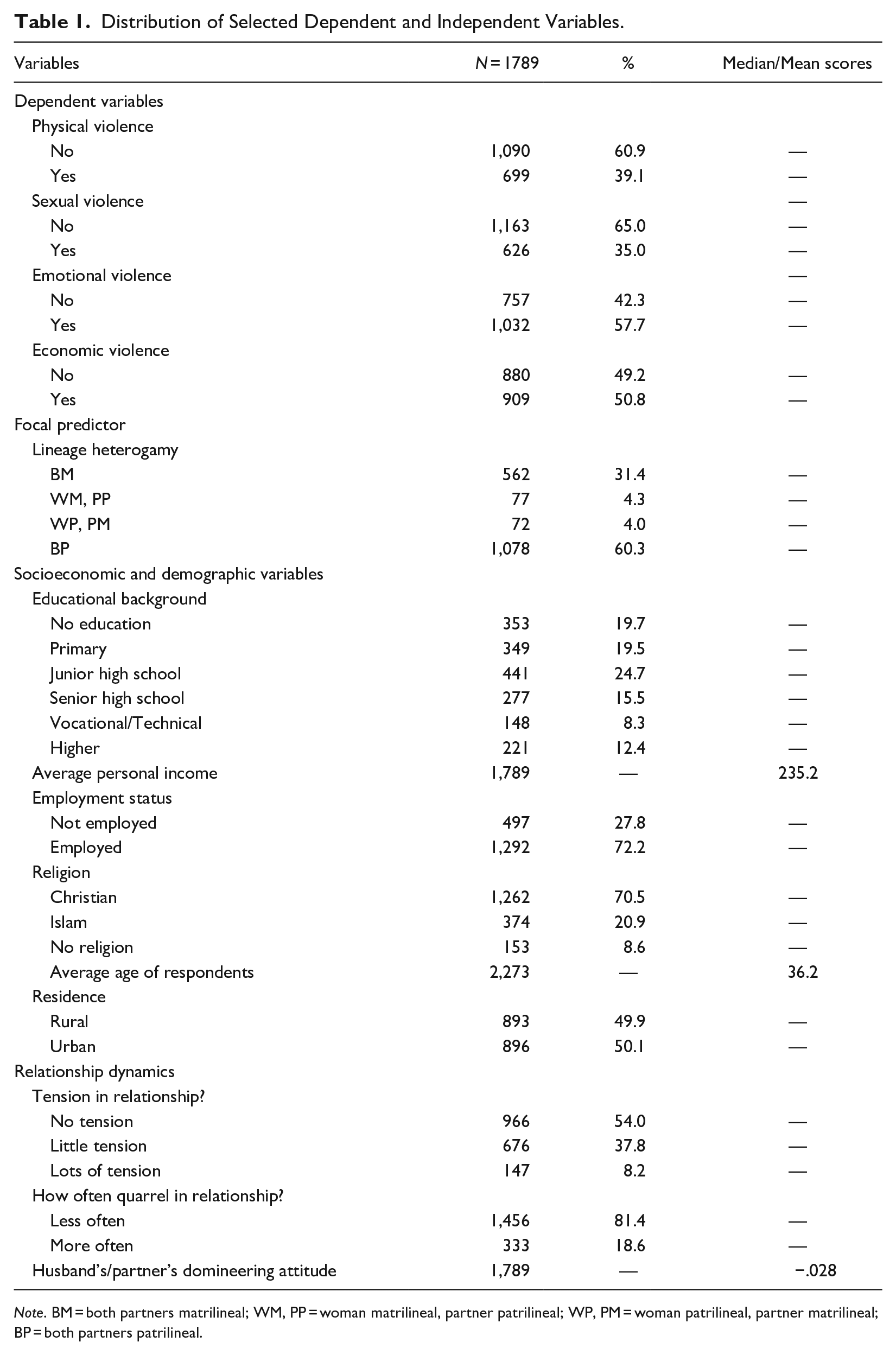
Note. BM = both partners matrilineal; WM, PP = woman matrilineal, partner patrilineal; WP, PM = woman patrilineal, partner matrilineal; BP = both partners patrilineal.
Bivariate Analysis of Lineage Heterogamy and Other Selected Variables.
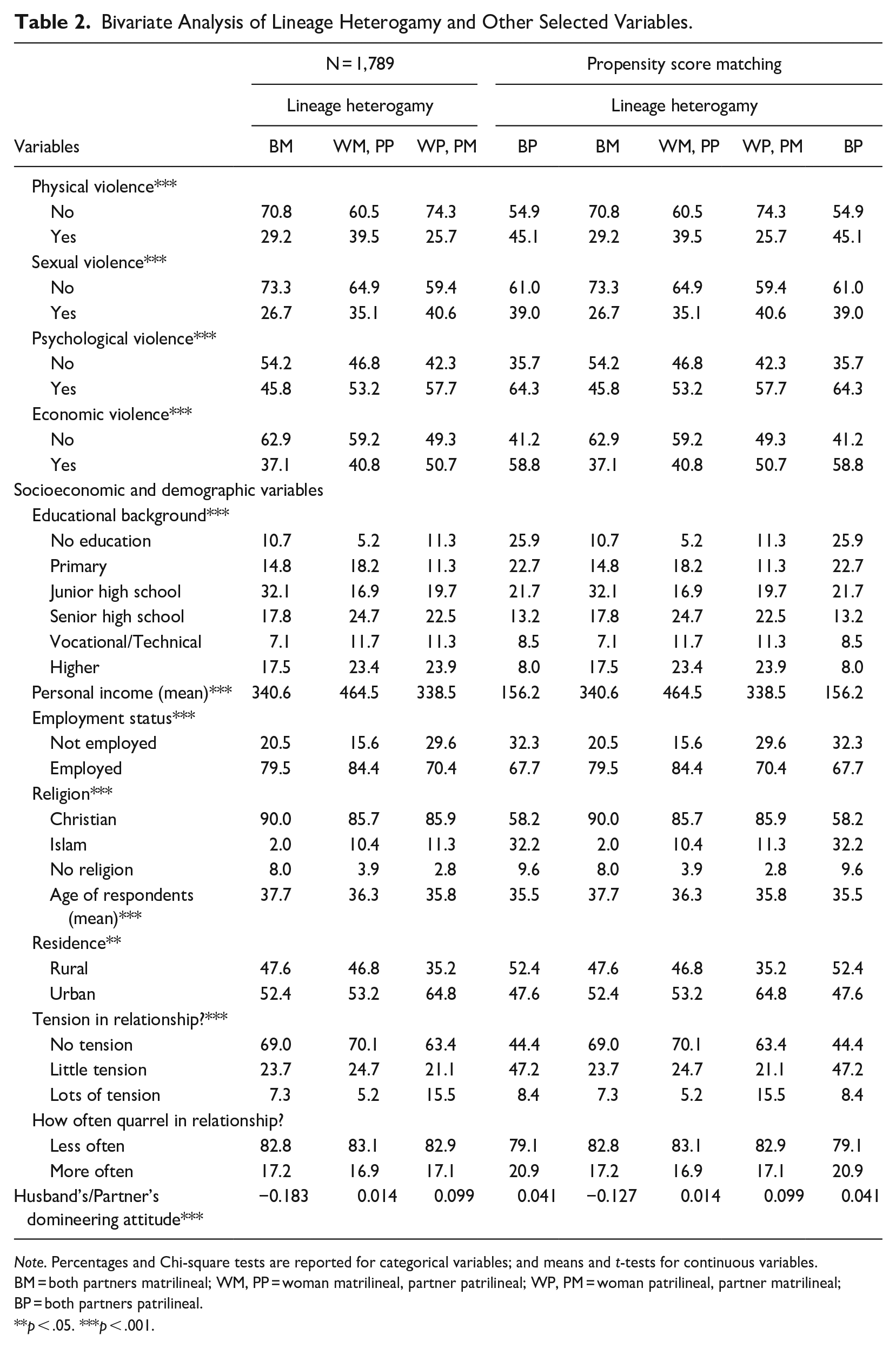
Note. Percentages and Chi-square tests are reported for categorical variables; and means and t-tests for continuous variables. BM = both partners matrilineal; WM, PP = woman matrilineal, partner patrilineal; WP, PM = woman patrilineal, partner matrilineal; BP = both partners patrilineal.
p < .05. ***p < .001.
Table 2 presents a cross-tabulation analysis and shows the bivariate associations of lineage heterogamy, IPV, and the variables introduced as potential confounders of the relationship between lineage heterogamy and IPV. Bivariate findings are shown for lineage heterogamy with and without PSM. The results were identical with the exception of scores of husband’s domineering attitudes, which were slightly lower in homogamous matrilineal couples. Overall, the bivariate results painted a complex picture, with the heterogamy hypothesis confirmed in some instances and rejected in others. For example, we observed higher rates of sexual, psychological, and economic violence in heterogamous relationships where matrilineal women had patrilineal partners or patrilineal women had matrilineal partners than in homogamous relationships where matrilineal women had matrilineal partners. However, the rates of violence were higher for patrilineal women who married patrilineal men than for the other lineage categories.
To shed more light on the findings, we explored the socioeconomic characteristics and relationship dynamics of women in homogamous and heterogamous relationships. Overall, we observed higher levels of education among women in heterogamous than homogamous relationships. Their average personal incomes were also higher, and they appeared to be more urbanized, particularly matrilineal women with patrilineal partners. A higher proportion of patrilineal women married to matrilineal partners reported more tension in their relationship than women in the other groups; scores were also higher for the partner’s domineering attitude.
Table 3 shows multivariate models for the four dependent variables. For each dependent variable, we estimated four models. The first model gave the unadjusted odds ratio (OR) for the relationship between lineage heterogamy and IPV. The second model reported the adjusted odds ratios (AORs) for lineage heterogamy after controlling for respondents’ socioeconomic and demographic characteristics. The third model estimated the AOR after adding relationship dynamics, and the fourth model (not shown) estimated the AOR after including the socioeconomic and demographic characteristics, relationship variables, and the PSM scores for lineage heterogamy. Except for some marginal and almost negligible changes in the ORs and standard errors, we did not find differences between the third model without PSM scores and the fourth model with PSM scores. We reported results from the third model for this reason. For physical violence, the results did not support the heterogamy hypothesis. Specifically, women in heterogamous relationships were not significantly different from matrilineal women with matrilineal partners. Even with the reference switched to patrilineal women with patrilineal partners, the results remained the same. However, in homogamous couples, patrilineal women with patrilineal partners were significantly more likely to experience physical violence than matrilineal women with matrilineal partners (OR = 1.99). It is important to note that the odds of patrilineal women with patrilineal partners experiencing physical violence vanished when variables on relationship dynamics were added to the model (AOR = 1.18).
Multivariate Relationship Between Lineage Heterogamy and IPV Among Ghanaian Women.
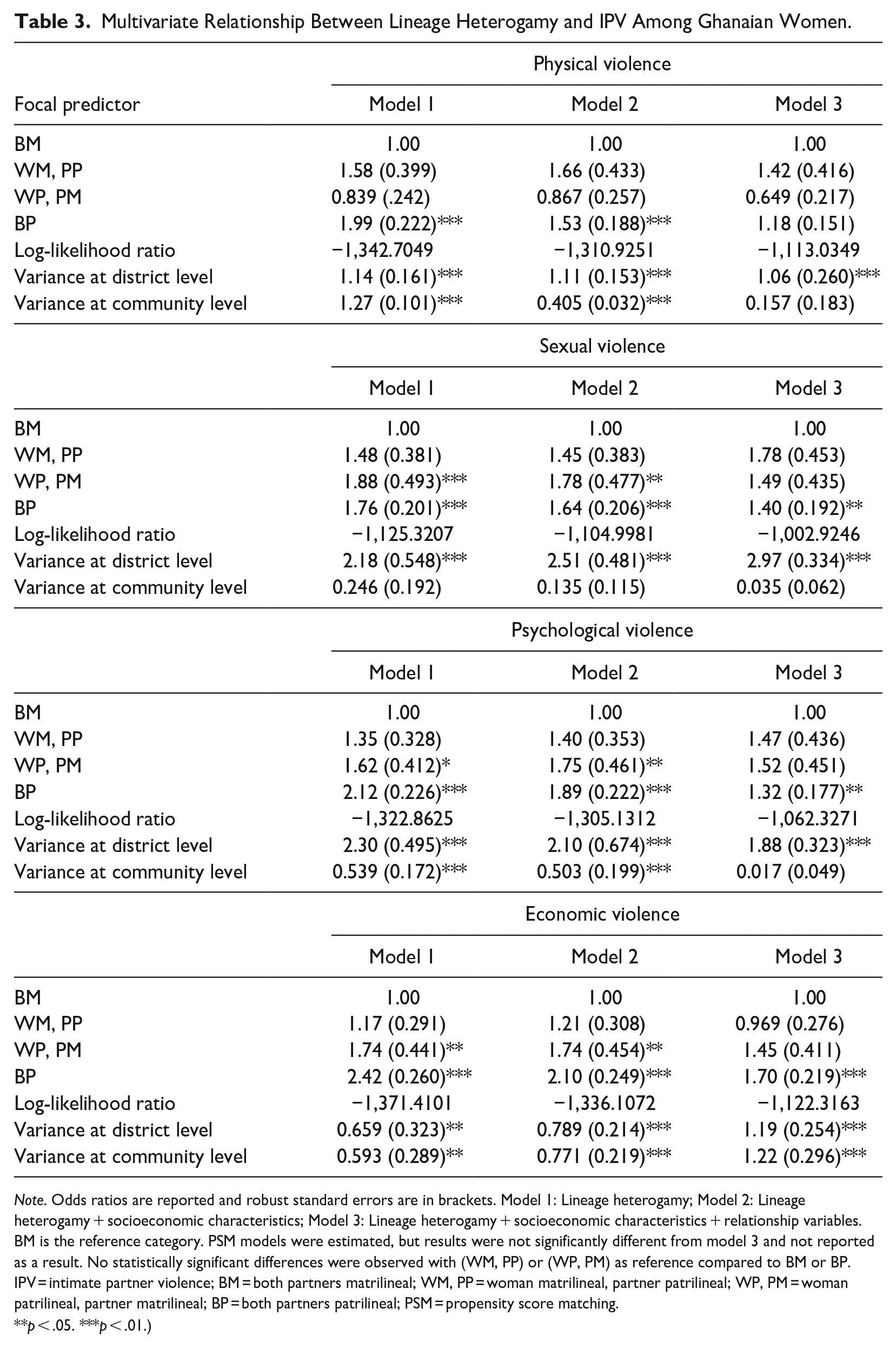
Note. Odds ratios are reported and robust standard errors are in brackets. Model 1: Lineage heterogamy; Model 2: Lineage heterogamy + socioeconomic characteristics; Model 3: Lineage heterogamy + socioeconomic characteristics + relationship variables. BM is the reference category. PSM models were estimated, but results were not significantly different from model 3 and not reported as a result. No statistically significant differences were observed with (WM, PP) or (WP, PM) as reference compared to BM or BP. IPV = intimate partner violence; BM = both partners matrilineal; WM, PP = woman matrilineal, partner patrilineal; WP, PM = woman patrilineal, partner matrilineal; BP = both partners patrilineal; PSM = propensity score matching.
p < .05. ***p < .01.)
The findings for sexual violence partially confirmed the heterogamy hypothesis until respondents’ relationship dynamics were controlled. Women in heterogamous relationships, namely, patrilineal women married to matrilineal men, had higher odds of experiencing sexual violence than those in homogamous relationships. However, patrilineal women whose husbands had the same lineage had higher odds of experiencing sexual violence (OR = 1.76) than matrilineal women with same-lineage male partners. The odds declined after controlling for women’s socioeconomic characteristics and relationship dynamics (AOR = 1.40). In addition, the odds of patrilineal women with matrilineal partners experiencing sexual violence were reduced to nonsignificance. Results did not change with the reference changed to patrilineal women with the same-lineage partner.
In the case of psychological violence, the heterogamy hypothesis was strengthened after we added the socioeconomic and demographic variables. Patrilineal women with matrilineal partners had higher odds of experiencing psychological violence than matrilineal women with same-lineage partners. But this effect vanished after the partners’ relationship dynamics were controlled. Similar trends were observed even with the reference switched to patrilineal women with same-lineage partners. Meanwhile, patrilineal women with same-lineage partners were more likely to experience psychological violence than matrilineal women with same-lineage partners (OR = 2.12). The addition of relationship variables attenuated these effects (AOR = 1.32).
Similar to sexual and psychological violence, the heterogamy hypothesis was supported for economic violence until relationship dynamics were controlled. Patrilineal women with matrilineal partners had higher odds of experiencing economic violence than matrilineal women with matrilineal partners. Patrilineal women with same-lineage partners had higher odds of suffering this type of abuse than matrilineal women with same-lineage partners (OR = 2.42). The odds of experiencing economic violence were reduced after we controlled for the socioeconomic characteristics and relationship dynamics of the respondents (AOR = 1.70), although they remained significant.
In sum, our findings showed support for hypothesis 1, given the significant differences observed among homogamous couples. Specifically, patrilineal women with same-lineage partners experienced higher levels of sexual, psychological, and economic violence compared to matrilineal women with same-lineage partners. Results were not markedly different when the reference was switched to patrilineal women with same-lineage partners. On the contrary, we failed to accept hypotheses 2 through 4 given our observation of no significant differences among homogamous and heterogamous couples.
Discussion
Previous studies in sub-Saharan Africa and Ghana underscore the relevance of ethnic, lineage, and kinship norms to women’s experiences of IPV (Lowes 2020; Sedziafa and Tenkorang 2016; Sitawa et al. 2018), but this work only considers the lineage and kinship ties of women, not their partners. We add to the literature by including information on the lineage of women and their partners. Although the idea of heterogamy has been understood on various axes, including age, ethnicity, religion, and education, our study is the first to theorize heterogamy based on lineage. It is also the first to examine and test lineage heterogamy and IPV in Ghana specifically and in sub-Saharan Africa more generally.
The findings are instructive. Marriages and conjugal relationships in Ghana are largely homogamous based on lineage. This is not surprising and may be attributed to a host of factors, including familiarity with one’s own cultural norms versus the barriers imposed by the cultural demands of marrying across lineages. African marriages are often not only between two individuals but also between their families and kin groups (Bledsoe and Cohen 1993; Meekers 1992). The family is an important stakeholder in the choice of a partner. Meekers (1992) observed, for instance, that in African societies, marriage is controlled by lineage to such an extent that in some lineages, especially patrilineal ones, partner choice is determined by families, and it is “risky” to negotiate these decisions. This does not suggest heterogamous relationships do not exist. With increasing education and urbanization, norms of conjugal unions continue to relax, and marriages outside the lineage are possible. Our data showed that approximately 8 percent of the women surveyed had married across lineages; more importantly, these women were highly educated and enjoyed a higher income than those who married within lineages. While interesting, these findings are not surprising because educated and financially empowered women may have an enhanced ability to negotiate existing norms. They also point to the idea of selection; as spousal choice becomes increasingly personalized and diversified in Ghana, women who enter heterogamous relationships with lineage in mind may be selectively different from those entering homogamous relationships. In the case of this specific research, we found women in heterogamous relationships had higher levels of formal education than those in homogamous unions. For instance, matrilineal women with patrilineal partners had the highest earning power. Meanwhile, patrilineal women with matrilineal partners reported more tension in their relationships.
An important aim of the study was to test the heterogamy hypothesis in the context of IPV in Ghana. We hypothesized that based on the divergence and convergence of lineage norms, women in heterogamous relationships would report higher levels of IPV than those in homogamous marriages. Our findings showed no support for the heterogamy hypothesis. It was clear from our data that initial differences between homogamous and heterogamous relationships were largely spurious and could be attributed to differences in the socioeconomic characteristics and relationship dynamics of the respondents. This was especially the case for patrilineal women with matrilineal partners who experienced sexual, psychological, and economic violence.
Taken together, the findings indicate that while lineage and kinship norms may be a factor in IPV, socioeconomic enactors and relationship dynamics are more important, suggesting the need to acknowledge the mechanisms that increase women’s vulnerability to IPV beyond lineage ties. Our findings for heterogamous couples suggest their heightened IPV risks were not due to lineage per se. Compared to the risks for homogamous couples, the IPV risks for heterogamous couples were attenuated by the socioeconomic characteristics of women (educational level, income, employment status), but reduced to nonsignificance after introducing variables measuring relationship dynamics (marital tension, marital conflict, and male dominance). On variables measuring socioeconomic predictors and relationship dynamics, we note that, unlike the former that precedes unions, relationship dynamics as measured in this study come after union formation, suggesting how these may be an inherent quality of heterogamous unions. The disappearance of the relationship between lineage heterogamy and IPV after introducing variables on relationship dynamics points to the possibility of a mediation process where heterogamy affects IPV through its influence on relationship dynamics.
Previous literature has established links between women’s socioeconomic status (SES) and IPV risks (Peterman et al. 2017; Ranganathan et al. 2021), but findings are mixed. While some studies report higher IPV prevalence for women with lower levels of education and SES (Hardesty and Ogolsky 2020; Vameghi et al. 2018), others find a higher prevalence for women with higher education and SES (Ackerson et al. 2008). Women with lower levels of education and SES may conform to existing gender norms and expectations, but educated women may challenge such norms. Our analyses showed women in heterogamous relationships had higher levels of education. This might have increased their ability to be assertive, disagree with partners, and challenge patriarchal norms that endangered their well-being, thus considerably increasing their vulnerability to IPV.
Based on this argument, tensions may be higher in heterogamous relationships, but few studies examine the impact of marital tension in Ghana. Using a mathematical model to explain marital interactions, Barnes et al. (2023) found that marital tensions led to divorce. Our findings showed women were more likely to experience IPV when tension was high, especially for patrilineal women with matrilineal male partners relative to matrilineal women with matrilineal male partners. For the same marital combination (patrilineal women with matrilineal male partners), male dominance was higher. The literature is conclusive on male dominance and women’s victimization in Ghana and elsewhere (Caldwell, Swan, and Woodbrown 2012; Conroy 2014; Peterman et al. 2017; Tenkorang et al. 2013). For women in heterogamous relationships, then, the levels of patriarchy and their partner’s dominance may trigger IPV. It is thus not surprising that when relationship variables were controlled, the odds of experiencing IPV for heterogamous women were reduced to nonsignificance.
We found stark and significant differences between couples married within their own lineages on several IPV measures. A comparison of the two homogamous groups revealed differences in socioeconomic characteristics and relationship dynamics. Matrilineal women with matrilineal partners had higher SES, lived in urban areas, and reported lower levels of tension and male dominance than patrilineal women with patrilineal partners. In other words, these selective socioeconomic differences had implications for the IPV experiences of women in these groups. Arguably, the vulnerability of women in patrilineal couples reflected their lower SES and relatively higher levels of male dominance and marital tension. This possibility and its implications for IPV have been documented by previous research exploring the effect of kinship and lineage ties on IPV risks among women in Ghana using qualitative interviews and demographic and health surveys (Asiedu, 2014; Sedziafa and Tenkorang 2016; Sedziafa et al. 2017). We should also note that although the IPV vulnerabilities of patrilineal couples were significantly reduced after accounting for SES and relationship variables, some differences remained, pointing to higher risks of IPV in this group. This could mean that for the two homogamous groups, lineage and kinship norms made a difference. Previous research has similarly demonstrated that patrilineal women report significant IPV risks relative to matrilineal women. This literature has shown how gender ordering within lineages can influence interpersonal relationships and gender-based violence (Manuh 1997; Sedziafa et al. 2018). For our findings, it is possible that beyond differences in socioeconomic characteristics and relationship dynamics, variations in norms specific to lineage may account for increased IPV risks among patrilineal relative to matrilineal women. It has been documented that the organization of patrilineal societies differs from that of matrilineal cultures in that the former promotes gender ordering and stratification, consigning women to “weaker” positions (8Thubauville and Gabbert 2014). The extreme gender inequalities in patrilineal societies may expose women to higher IPV rates in those societies than in matrilineal ones.
The strength and predominance of matrilineal culture for matrilineal women were clear throughout the analysis. In almost all marital combinations, the results showed no elevated risks of any type of IPV for matrilineal women with matrilineal or patrilineal partners relative to marital relationships dominated by patrilineal partners. Although this may largely be due to selection, these findings suggest that matrilineal norms may provide women some protection even if they marry a patrilineal partner, protection that benefits not only the women of matrilineal descent but also those who marry into matriliny.
Conclusion
No previous work has discussed lineage heterogamy, although some researchers have explored different types of heterogamous relationships based on education, age, religion, ethnicity, language, etc. (Jorgensen and Klein 1979; McPhail 2019; Wright et al. 2017). There is some limited but conclusive research on the links between lineage ties and IPV, but this work does not consider lineage heterogamy and IPV. This study set out to apply the lineage heterogamy hypothesis to IPV in Ghana. Based on this hypothesis, we expected matrilineal women who married male partners from the same lineage would experience less IPV than those who married into different lineages. Generally, our analyses provided no confirmation of the heterogamy hypothesis, and we found IPV differences for women who married within lineages relative to those married across lineages. More importantly, the IPV differences across lineages were spurious and an artifact of the socioeconomic characteristics and relationship dynamics of the women in these types of unions. While this may also have been true for the homogamous couples we studied, the power of patrilineal norms may have increased these women’s vulnerability.
Our findings have practical implications for research and policy. They shed light on conjugal patterns and mate selection preferences in Ghana. The norm in Ghana is to marry within social groups, and marriage outside one’s lineage is often problematized because of differences in lineage norms, but our findings suggest that in cases of heterogamous relationships based on lineage, vulnerability to IPV may be due to couples’ characteristics, not their lineage affiliation per se. In fact, IPV was high in specific homogamous relationships. Cross-lineage marriages may break down cultural stereotypes and barriers, with promise for social learning and upward social mobility, and as such, should be encouraged. For homogamous marriages, the finding that the effects of lineage on IPV were attenuated but not completely reduced to nonsignificance points to the importance of lineage and its complex relationship with socioeconomic characteristics and relationship dynamics. Lineage can be a marker of difference and an important site for understanding gender relations and IPV in Ghana. Finally, and most importantly, the findings indicate the complexity of risk factors driving IPV in Ghana. A complex relationship of lineage, socioeconomic status, and other relationship factors affects IPV. Specifically, women’s lineage affiliation and that of their partners may determine their access to socioeconomic resources and define the relationship dynamics, thereby affecting their IPV outcomes. Ghanaian policymakers must appreciate these complexities and address IPV holistically. By the same token, differences in the IPV experiences of women in homogamous relationships suggest the importance of addressing the vulnerabilities of these women differently.
We should note a few limitations. First, the data were cross-sectional, so we could not make causal connections between lineage heterogamy and IPV. Second, the data were self-reported, and concerns have been raised about the reliability of such data on sensitive topics, including gender-based violence. IPV is a highly stigmatized and private matter in Ghana, and this may affect reports of violence. Regarding self-reports, we equally note that our IPV outcomes measured if respondents “ever” experienced violence. While this is an important cumulative measure of violence, it requires respondents to revisit their past, sometimes beyond what they can recall. As a result, our IPV indicators may be subject to recall and reporting errors. However, the risks of recall bias were mitigated by limiting respondents’ experiences of IPV to a single union. Third, although we controlled for theoretically relevant variables, others, including those related to partners’ characteristics, could also have been controlled. Fourth, our operationalization of lineage was derived from ethnicity and not measured directly. Even so, measuring lineage ties from ethnicity was useful in this instance, because for Ghanaians, ethnicity may be easier to identify than lineage. Furthermore, ethnicity and lineage overlap in Ghana. We also acknowledge the smaller samples of Ghanaians marrying across marriages than of those marrying into their own lineage. While this was expected, such sample sizes may pose analytical challenges, mostly the inability to detect statistical significance due to limited power, or they may generate higher ORs because of smaller cell counts. Despite the smaller sample sizes for women in heterogamous unions, our results were robust: we still detected statistical significance for this group and did not have problems with inflated ORs.
Ultimately, as the only study to test the heterogamy hypothesis in sub-Saharan Africa in general and in Ghana specifically, our work makes a significant contribution to the literature on domestic violence in Africa. The heterogamy hypothesis has rarely been applied to IPV in sub-Saharan Africa. The findings should encourage similar studies and motivate family scholars to examine other types of heterogamies, including socioeconomic, religious, and cultural heterogamies, in the context of IPV and other potential demographic outcomes such as marital stability and divorce. Future studies can focus on the relationship dynamics in heterogamous unions and particularly on the residential arrangements of heterogamous couples, given that this may differ by lineage and can be a potential source of conflict and violence in the domestic setting.
Footnotes
Declaration of Conflicting Interests
The author declared no potential conflicts of interest with respect to the research, authorship, and/or publication of this article.
Funding
The author disclosed receipt of the following financial support for the research, authorship, and/or publication of this article: This work was supported by the Social Sciences Humanities Research Council of Canada [Grant number 211119, 2016].
Ethics Approval Statement
Ethical clearance was received from the Interdisciplinary Committee on Ethics in Human Research at Memorial University, Canada, and the Ethics Committee for Humanities, University of Ghana.
