




Abstract
This study leverages the unsettled time of the COVID-19 pandemic to explore which strategies highly educated breadwinner mothers used to share domestic labor with their husbands. I compare semistructured interviews with mothers who became breadwinners after their husband’s job loss (N = 13), and mothers who were breadwinners since before the pandemic (N = 11). These groups revealed two variants of neo-egalitarianism, which describes seeking gender equality through disparate family roles. Mothers who became breadwinners described domestic gender equality as fluctuating over the marriage. Mothers who were breadwinners since before the pandemic expected one parent to specialize in paid labor, while the other specializes in primary caregiving throughout the marriage, but suggested that a man or a woman can assume either role. The strategies mothers use to achieve gender equality have expanded as maternal earnings have gained importance in the family.
Introduction
Following the historic outbreak of the novel coronavirus (COVID-19), many schools transitioned from in-person to online learning from home, childcare became increasingly limited, and many jobs required telecommuting from home (Landivar et al. 2020; Moen, Pedtke, and Flood 2020). This unsettled time merged the public and private sphere and created new domestic tasks, prompting multiple families at once to develop new strategies of action or ways of organizing action to reach life goals (Abromaviciute and Carian 2022; Swidler 1986). Like other periods of social uncertainty (e.g., unemployment), many families delegated rising domestic demands to mothers during the pandemic, and maternal employment declined (Abromaviciute and Carian 2022; Calarco et al. 2021; Collins et al. 2020, 2021; Dunatchik et al. 2021; Lyttelton et al., 2022; Rao 2020). However, some parents reported that maternal earnings were more important to the family during the pandemic than before the pandemic, suggesting that not all families relied on strategies of organizing household labor that disadvantaged mothers’ careers (Mize, Kaufman, and Petts 2021). Yet, little is known about the domestic experiences of families that depended on maternal earnings during this unprecedented period of global history.
I ask which strategies married breadwinner mothers—mothers who earn the bulk of the income in the family—described using to share domestic labor with their husband during COVID-19. I compare semistructured interviews with mothers who became breadwinners after their husband’s job loss to those with mothers who were breadwinners since before the pandemic because mothers whose family roles shifted may feel differently about their domestic strategies and express more tension than mothers whose family roles were stable. By exploring the domestic strategies of mothers in this understudied but growing population, this article sheds light on why the gender revolution—describing dramatic rises in women’s labor force participation, completion of higher education, and more, since the 1960s—remains incomplete, or stalled, in even the most gender-progressive families (England 2010).
In this article, I identify the neo-egalitarian domestic strategy, which seeks gender equality through disparate family roles. There are two variants: (1) the couple alternates who assumes the most domestic labor over the marriage and (2) the couple assumes work–family specialization throughout the marriage, but either a man or a woman can specialize in breadwinning or primary caregiving. This contrasts with the classical definition of egalitarianism where the couple evenly divides paid and domestic labor (Hochschild 1989). Further, I find evidence that breadwinner mothers increased their cognitive domestic labor, or mental management of the home, during the pandemic, contributing to the stalled gender revolution in these families (Daminger 2019; England 2010).
The Incomplete Gender Role Reversal in Women Breadwinner Families
Breadwinning wives are a small but growing population. Data from the U.S. Current Population Survey report that the proportion of married women who are sole or primary earners tripled from 0.5 in 1972 to 0.16 in 2022 (Fry et al. 2023). Yet men partnered with higher-earning women tend not to do as much housework and childrearing as similarly situated women (Chesley and Flood 2017; Fauser 2019; Hook 2017; Latshaw and Hale 2016; Raley, Bianchi, and Wang 2012; van der Lippe, Treas, and Norbutas 2018). What explains this incomplete gender role reversal?
The gender display perspective suggests men’s housework hours increase up until women earn as much as men and then decrease once women outearn men. Brines (1994) theorizes that financially dependent men reduce their housework hours to compensate for gender deviance, but that breadwinner women are less threatened by their nonnormative family role than financially dependent men. In contrast, the deviance neutralization perspective theorizes that financially dependent husbands spend less and breadwinner wives spend more time on housework than other men and women to neutralize gender deviance (Greenstein 2000). However, these theories are contested (Gupta 2007) and only predict how different-sex couples share housework, but may not explain how they share childrearing or cognitive domestic labor.
Men’s and women’s gender ideologies, which “defines what sphere a person wants to identify with (home or work) and how much power in the marriage one wants to have (less, more, or the same amount),” may determine how different-sex couples divide domestic labor (Hochschild 1989:15). Hochschild (1989) classically defined three gender ideologies: (1) egalitarian, where men and women are expected to equally share paid and domestic labor; (2) transitional, where men and women are expected to share paid and domestic labor, but men are expected to take primary responsibility for paid labor and women are expected to take primary responsibility for domestic labor; and (3) traditional, where women are expected to specialize in domestic labor and men are expected to specialize in paid labor. Building on this research, Gerson (2010) identified neo-traditionalism, where men are expected to specialize in paid labor and women are expected to specialize in domestic labor, regardless of women’s employment status. Breadwinner women may hold gender ideologies that lead them to think they should perform some domestic labor themselves. Yet, existing gender ideologies were conceptualized for dual-earning couples, and little is known about the gender ideologies of breadwinner women.
Breadwinner women’s domestic arrangements may depend on how willing their husbands are to do domestic labor. There is evidence that men’s gender ideologies are more influential than women’s in determining domestic roles (Ferree 1991; Hochschild 1989; Shelton and John 1996). It is possible that breadwinner women expect their husbands to do all the domestic labor, but that men resist. For example, men may do—and even gatekeep, or relinquish giving up—masculine-typed household tasks, such as yardwork and car repairs, which tend to be infrequent. However, they may refuse to do feminine-typed household tasks, such as cooking, household cleaning, laundry, grocery shopping, and cognitive domestic labor, which tend to be routine (Christopher 2024; Daminger 2019; Schneider 2012; South and Spitze 1994). Some men may also perceive that their wives are naturally the best caregivers for the children (Calarco et al. 2021).
At the same time, some breadwinner women may be unwilling to relinquish control of domestic tasks to their husbands. Indeed, gender scholars posit that in doing or avoiding domestic labor, women and men are also “doing gender” (West and Zimmerman 1987), meaning their behavior is shaped by others’ expectations of how women or men are supposed to behave. For example, a vignette experiment revealed that men and women alike have higher expectations for cleanliness for women than for men (Thébaud, Kornrich, and Ruppanner 2019). Men and women may perceive that women have higher domestic skills than do men from their role as mothers (Becker 1991) and because they spent more time doing feminine-typed housework as children than did men (South and Spitze 1994). Women may also set higher standards than men for household cleanliness and/or claim higher competence in childrearing than men to retain control of these tasks because they perceive they reflect their competence as wives and mothers (Allen and Hawkins 1999).
In addition, motherhood has a moral connotation (Damaske 2013; Gerson 2002). Despite societal devaluation of primary caregiving (Ridgeway and Correll 2004), middle- and upper-class mothers tend to characterize homemaking as selfless and working as self-serving, and often express guilt for not living up to the ideals of intensive mothering, which defines good mothering as spending considerable time, money, and effort on childrearing (Blair-Loy 2009; Damaske 2013; Hays 1996). Indeed, breadwinner mothers have expressed sadness, guilt, and jealousy toward their partners because they felt less available to their children than their partners (Chesley 2011, 2017; Meisenbach 2010).
Breadwinner mothers’ accounts for how they shared domestic labor with their husbands during COVID-19 may reveal how they perceive their domestic strategies. I consider accounts as excuses or justifications for actions that are inconsistent with role expectations (Scott and Lyman 1968). Damaske (2013) argues women use accounts to claim the moral high ground amid conflicting cultural schemas in contemporary motherhood, such as intensive mothering (Hays 1996) and the ideal worker (Acker 1990), or expectation of full commitment to paid work. Interview-based studies have shown that dual-earning, different-sex couples account for gender-based inequalities by referring to individual differences in competence and preferences for certain tasks (Collins 2019; Daminger 2020; Rao 2020; van Hooff 2011), and the belief that mothers are more critical than fathers to child well-being (Calarco et al. 2021; Rao 2020; Townsend 2002).
Domestic Resources and Job Loss During COVID-19
High-earning breadwinner women’s domestic decisions likely became more conscious during the first year of the pandemic when they lost access to paid domestic workers and had to reorganize domestic roles to compensate for this lost labor. There is evidence that men and women alike spent more time on domestic labor during the pandemic than before the pandemic, which may be partially attributable to the decreased availability of paid domestic workers (Craig and Churchill 2021; Del Boca et al. 2020; Dunatchik et al. 2021; Lyttelton et al. 2022; Zamberlan, Gioachin, and Gritti 2021). Yet men partnered with higher-earning women still tended to spend less time on domestic labor than did women partnered with higher-earning men (Zamberlan et al. 2021), suggesting the incomplete gender role reversal in these households persisted.
Job loss was common during COVID-19, particularly among mothers (Collins et al. 2020, 2021). However, some fathers suffered job loss, prompting their wives to become breadwinners. Prepandemic interviews suggest that different-sex couples may not transition domestic labor from employed women to unemployed men because they perceive men’s unemployment as temporary (Rao 2020). However, men who were unemployed during the pandemic may not have spent as much time searching for a new job as they might in a favorable job market. Indeed, there is evidence that different-sex couples shared housework and childrearing more equally in the early months of the pandemic than in the fall of 2020, when fathers’ paid work hours tended to rise (Carlson and Petts 2022).
Current Study
What domestic strategies did breadwinner mothers use during COVID-19? This article is the first to address this question by comparing semistructured interviews with mothers who became breadwinners after their husband’s job loss to those with mothers who were breadwinners since before the pandemic. I contrast these two groups because mothers who recently became breadwinners may experience more tension as family roles shift than mothers whose breadwinner role was established before the pandemic. Existing literature has not explored breadwinner mothers’ domestic strategies, and this article seeks to fill that gap.
The shock of the global pandemic is a strategic research site (Merton 1987) to explore breadwinner mothers’ domestic strategies. There were widespread shifts to the public and private sphere (Abromaviciute and Carian 2022; Dunatchik et al. 2021; Sevilla and Smith 2020), which may prompt mothers to articulate meaning systems underlying domestic decisions that are implicit during settled times (Swidler 1986). I restrict my sample to mothers of young or school-aged children given school closures and limited childcare (Landivar et al. 2020; Lyttelton et al. 2022; Moen et al. 2020) made the pandemic more unsettled than it might have been for women without young or school-aged children (Swidler 1986).
Methods
Participants
The interviews analyzed here were conducted as part of a larger project for which I interviewed 167 parents between December 2020 and March 2021. I analyze a subset of 24 breadwinner mothers in different-sex marriages—13 in dual-earning couples who became sole earners after their husbands’ job loss during the pandemic, and 11 who were primary or sole earners since before the pandemic. Primary earners (4 of 11) were married to men who worked less than 10 hours per week. I did not observe differences in the interviews of sole and primary earners. In one case, a mother described her husband choosing to quit his job; this interview did not differ from those with mothers whose husbands lost their job. Given the sample size, this research is exploratory. The remaining interviews in the greater sample, not analyzed in this article, were with single parents and parents from families in which both members of the couple worked 30 or more hours per week.
I recruited participants by emailing workers at hospitals, law firms, universities, and primary and secondary schools with a solicitation for the study. This is not a random sample; however, I aimed for variability in job flexibility, essential worker status, and type of work. Roughly over one-quarter of the sample (7 of 24) were essential workers, or in jobs the government considered crucial to public infrastructure or the pandemic response. The solicitation email focused on work and family balance, avoiding language such as gender and housework to reduce the possibility that only people with strong feelings about domestic gender inequality would volunteer. I required participants to be employed, and living with a partner and one or more children aged ten or younger. I did not offer participants compensation.
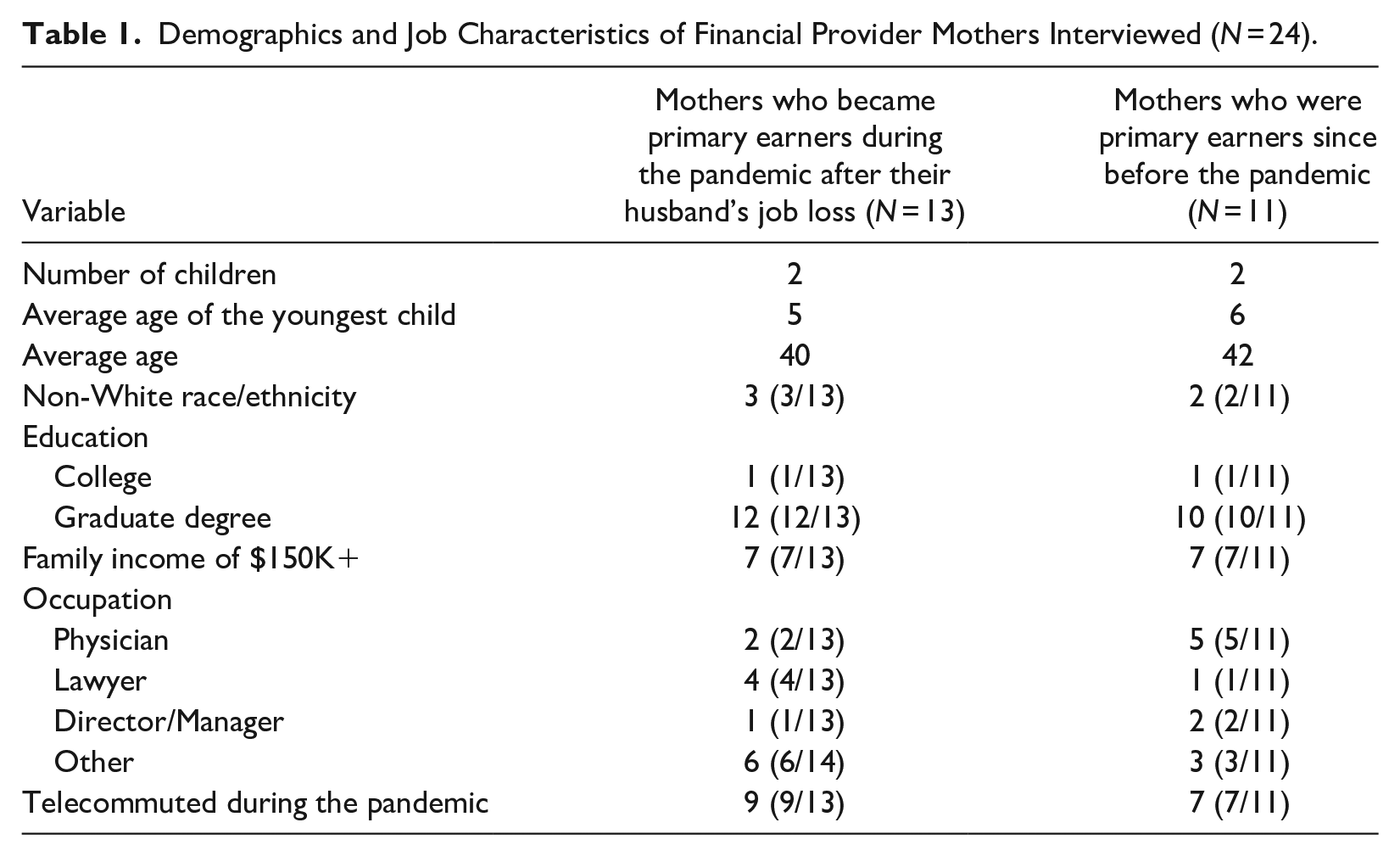
Table 1 reports the demographics and job characteristics of the sample. Participants’ ages ranged from 33 to 50 years, with an average age of 41 years. Most participants identified as non-Hispanic white (19 of 24). Participants had a college (2 of 24) or graduate degree (22 of 24), and all described their husbands as also having a college or graduate degree. On average, my participants had two children, and the youngest child in the household was five years old. Most (22 of 24) reported a family income of $150K or higher. Participants commonly worked as physicians (7 of 24), lawyers (5 of 24), and directors/managers (3 of 24). Other occupations included in the sample were professors, researchers, psychologists, and primary or secondary school teachers. Most participants telecommuted (16 of 24) during the pandemic.
Demographics and Job Characteristics of Financial Provider Mothers Interviewed (N = 24).
My sample is highly educated, high-income, and mostly non-Hispanic white. Further, the proportion of marriages with a primary earner wife is 0.10 and a sole earner wife is 0.06, and men with a college degree were less likely to lose their jobs than men without a college degree, suggesting that this is an unusual population (Aughinbaugh and Rothstein 2022; Fry et al. 2023). Despite their privileges, these mothers are still worth considering because if they can’t achieve gender equality in the family, then gender equality may be less possible for other mothers. Another reason to focus on socioeconomically privileged families is because the pandemic made outsourcing less possible, disrupting a strategy many high-earning mothers use to balance paid work with family life. Finally, there is evidence that low-income couples tend to have traditional gender ideologies even when wives are breadwinners (Deutsch and Saxon 1998; Hochschild 1989). High-earning and highly educated breadwinner mothers may have progressive domestic strategies that have not yet been identified, given high levels of education are associated with egalitarian attitudes toward gender roles (Pampel 2011).
Procedure
Participants completed a questionnaire hosted on the SelectSurvey platform with items on demographics, estimated hours spent on housework and childrearing in an average week, outsourcing, children’s school status (in-person, hybrid, or fully remote) if applicable, paid work status (remote or partially or fully in-person), job characteristics, and more. Survey items were adapted from existing questionnaires, such as the Panel Study of Income Dynamics and the American Life Panel, and drawn from validated measures, such as the Gender Role Beliefs Scale (Kerr and Holden 1996). The questionnaire prompted participants to indicate whether their circumstances changed with the pandemic. At the end of the survey, participants could provide contact information for a semistructured interview.
I contacted willing participants within one day of survey completion. Interviews were conducted on the phone, Zoom, Microsoft Teams, and Google Meet. I asked questions such as “How has your parenting role changed during the pandemic?,” “What are some of your biggest challenges during the pandemic?,” “How does your spouse or partner support your work–family balance?,” “How do you and your spouse or partner share household chores?,” “Who is responsible for the cooking?,” “Who is responsible for the cleaning?,” “Who is responsible for supervising the children (and at-home education, if applicable)?,” and more. Because the questionnaire provided extensive background information on my participants, I proceeded to the in-depth content of the interview protocol quickly. My interviews ranged from 30 to 50 minutes. I recorded all interviews with participant consent.
Data Analysis
I coded the transcripts using flexible coding, which combines inductive and deductive analytic strategies (Deterding and Waters 2021). After isolating sections of the transcript relevant to this article (indexing) and conducting a close reading, I wrote memos of themes, emphasizing how these themes either reinforced or challenged existing theory. To begin thematic coding, I applied 25 demographic codes (attributes) for each participant. Some examples of these codes include demographics, job title, telecommuting status, number of children, outsourcing, and more.
Next, I coded how mothers described their domestic strategy. For each domestic activity (childrearing, cognitive domestic labor, housework), I coded whether the mother said the man contributes more, the woman contributes more, or the man and women contribute equally. Next, I coded how mothers accounted for domestic roles. I noted whether there were domestic tasks mothers wanted to do, mothers had higher standards than men for, and/or mothers perceived men were unwilling to do.
I lightly edited interview quotes for clarity, such as removing “um,” “you know,” and “like,” and attributed quotes to pseudonyms to protect participant anonymity. The headings of the results section represent how each domestic activity (childrearing, cognitive labor, housework) was influenced by the pandemic.
Results
What strategies did mothers use to share domestic labor with their husbands during COVID-19? Despite critical differences in the duration and circumstances surrounding becoming a breadwinner, the two groups of mothers I interviewed described similar strategies for organizing rising domestic demands: fathers assumed more childrearing than mothers, mothers assumed more cognitive domestic labor than fathers, and housework was either shared or delegated to fathers. I call this domestic strategy neo-egalitarianism, which is defined as efforts to realize gender equality through disparate family roles. There are two variants. Most (80 percent) mothers who became breadwinners described domestic equality as fluctuating over the marriage (variant 1). All mothers who were breadwinners since before the pandemic described one parent specializing in paid labor, while the other specializes in primary caregiving throughout the marriage, but suggested a man or a woman could assume either role (variant 2).
COVID-19 Increased Men’s Childrearing Responsibilities
As with many families across the globe, the mothers I interviewed described their children’s schools transitioning from in-person to online instruction from home and/or losing childcare during the pandemic. Both groups of mothers described these changes as intensifying fathers’, and not mothers’, childrearing demands, suggesting the couple assumed disparate family roles.
Mothers who became breadwinners during the pandemic generally talked about their husband’s job loss—and availability to assume the rising childrearing demands—as an opportunity to replace the childcare workers they simultaneously lost. In many cases, the way these mothers talked about their domestic strategy aligned with the first variant of neo-egalitarianism. They suggested the couple achieved domestic gender equality, but perceived their husband’s unemployment as a time during the marriage when unequal domestic roles were acceptable, and expected their husbands to assume most of the childrearing. For instance, Emily, a mother of two pre-school aged children, said, “I’ve been very fortunate—fortunate, unfortunate, I don’t know—that my husband’s job was impacted by the pandemic. So, he was able to be available to look after the kids more. So, he’s been hands-on during the day.” The first word Emily used was “fortunate” when describing her husband’s job loss—an adverse life event—because he could replace the paid childcare the family lost. Emily rejected intensive parenting norms for both her husband and her, in alignment with gender egalitarianism: It’s not my natural state to be with children all day, every day. I absolutely love them, they’re amazing, but I’m not a stay-at-home mom. I’m not the best person I need to be in that moment. It’s easier for a man to say. And he says that “It’s not my natural calling to be a stay-at-home dad.” I’m like, “No, it’s not.”
However, she expected her husband to assume the rising parenting demands, while he was not working, “He was furloughed.”
Madison, a mother of two school-aged children, provides another example of the first variant of neo-egalitarianism. Madison said her husband “luckily” lost his job so that he can supervise the children while she works, “Luckily, he’s been at home. [pause] I mean, I say ‘luckily’—he’s been unemployed this past year, so he’s been home.” Similar to Emily, Madison acknowledged that referring to her husband’s job loss as fortuitous is contradictory in typical circumstances, but during the pandemic, these men’s time were reallocated from paid labor to fit a family need. Madison expressed appreciation toward her husband for being primarily responsible for the children, “It’s been great. If I need to come into the lab, he’s here at home to help the kids with school. So, it’s been very equal, and I couldn’t have done it without him.” The couple’s roles were not equal—he specialized in childrearing while she specialized in paid labor—but Madison perceived that this temporary work-family specialization during her husband’s unemployment did not contradict egalitarianism.
Other mothers echoed these sentiments. Maggie, a mother of two school-aged children, described the couple as egalitarian, “He always has been an equal partner in our relationship. There’s no I do womanly roles and he does manly roles.” When I asked if the family had childcare, she said her husband was the childcare, “My husband lost his job in September, so yes.” Maggie expressed gratitude for this temporary inequality in parenting roles, “I feel very lucky.”
Melanie asked her husband to quit his job during the pandemic to address rising childrearing demands. She appealed to the idea of fairness in the relationship when making this request: We just knew it was unsustainable for both of us to work . . . I said, “I have sacrificed for your career the whole time we’ve been together, and I need you to do it for me this time” . . . He has been the stay-at-home parent.
Melanie described being the primary caregiver before the pandemic, “It’s so different and so much better than it used to be . . . If they [the children] were sick, it was always up to me to stay home with them.” She perceived that prioritizing her career during the pandemic was a matter of equality over the course of the marriage, in alignment with the first variant of neo-egalitarianism.
Mothers who were breadwinners since before the pandemic talked about the difficulties their homemaker husbands faced as their primary caregiver role expanded. The way these mothers talked about their domestic strategy aligned with the second variant of neo-egalitarianism. They expected one parent to specialize in paid work, while the other specializes in primary caregiving throughout the marriage, but suggested a man or a woman could assume either role. This contrasts with the first variant of neo-egalitarianism, in which mothers only expected their husband to be primarily responsible for the children while unemployed.
Rachel, a mother of two preschool-aged children, provides an example of the second variant of neo-egalitarianism. She described her husband as a homemaker, “My husband was the primary caregiver prior to the pandemic and that continued.” The family lost their nanny at the beginning of the pandemic, impacting her homemaker husband more than her: That was a little bit of an adjustment for my husband because he was used to having a little bit more help . . . I see my kids more because I’m working from home but otherwise my responsibilities haven’t really changed that much.
She excused the gender deviance in the couple’s work–family specialization by asserting that their arrangement is practical: I think the pandemic is really just a stress test for a lot of people’s choices . . . We always wanted to have a parent primarily home with our kids . . . You can’t change the biological reality of people’s need for sleep and children’s need for their parents.
While gender traditionalists also favor work–home specialization, Rachel did not discuss innate maternal or paternal suitability for certain family roles. She instead accounted for her husband’s homemaker role by his enjoyment of activities at home, “He’s definitely better suited to it because he has all these hobbies that he gets to pursue, and I don’t have hobbies, and I wouldn’t have hobbies even if I did stay home. I’m just not a hobby person.”
Janine, a mother of two school-aged children, provides another example of the second variant of neo-egalitarianism. She said the pandemic impacted her homemaker husband more than her, “I’m the primary breadwinner and continued to be. So, in some ways, I would say that my world didn’t change significantly whereas his really did.” Janine’s family did not rely on childcare before or during the pandemic. However, the children’s school transitioned to virtual instruction, which she said was challenging for her homemaker husband: He went almost full-time into assisting with virtual school. As we say, he is an elementary school educational attendant . . . Occasionally, I chip in, but I would say he’s doing the lion’s share of the work . . . I think it’s been a lot for him as you can imagine with a six- and a nine-year-old.
Janine expressed gratitude that she made enough money for him to stay home with the children, “I’m exceptionally grateful for my situation that we have financial capability to do that.” She accounted for the couple’s gender deviance by her earnings, “we’ve been married almost ten years and when my nine-year-old was born he stayed at home with him early on because I made more money,” and did not discuss gender as an important determinant of family roles.
Wendy, a mother of three school-aged children, also said her family did not rely on childcare before or during the pandemic. She echoed that virtual school intensified her homemaker husband’s childrearing demands, “My youngest has . . . just regressed a lot—her reading, her at math, everything . . . My husband works with her every day.” The way Wendy talked about her domestic strategy suggested the second variant of neo-egalitarianism. Wendy said that she was “lucky” that her husband chose to stay at home so that she could specialize in paid work, “I’m lucky because my husband has chosen to stay home with our kids full-time . . . We had three in diapers at the same time and not many guys would do that. He really wanted to support me in my career.” Gender did not determine their specialized family roles.
Nina, a mother of two school-aged children, said of her family, “I’m the breadwinner. I work full-time and my husband normally stays home.” She said virtual school increased her husband’s domestic demands, “Well, my kids aren’t in school, so instead of having that chunk of the day to do kind of normal household activities, he ends up kind of managing kids all day and that includes educational content.” The couple also no longer benefited from extended family supervising the children, “We have a lot of family in town, but people have been pretty conservative with exposures at work at the hospital.” Nina talked about the adverse effect of these changes on her homemaker husband, “He had just started to have a little bit more free time when my older boy started kindergarten last year and he’s got a lot of hobbies and things that have been on hold . . . That ended up kind of being the exact opposite this past year.” When talking about family roles, Nina said she and her colleagues all “have stay-at-home husbands . . . we’re all kind of lucky in a weird way with that,” suggesting she wanted to specialize in paid work while her husband specializes in primary caregiving.
COVID-19 Increased Women’s Cognitive Domestic Labor
Despite their gender-progressive parenting arrangements and reliance on maternal earnings, both groups of mothers said that mothers, rather than fathers, were primarily responsible for the cognitive domestic labor both before and during the pandemic. In most cases, the pandemic intensified cognitive domestic demands on mothers, demonstrating the salience of gender norms during unsettled times.
The mothers who became breadwinners in my sample expressed tension toward their husbands for not assuming the cognitive domestic labor. They expected their husbands to temporarily assume most of the domestic labor during their unemployment, in alignment with the first variant of neo-egalitarianism. From Emily’s perspective, her unemployed husband expected her to plan his days with the children: Literally, literally I came on this call, and I got a text from my husband asking what time he needs to meet me at the doctors this afternoon because my youngest has got a nine-month checkup . . . He’s asked for this information so many times this week . . . I mean, that hasn’t shifted, that hasn’t changed, [but] it’s become more visible . . . The project management of it—the day-to-day. I’m like, “And this is what’s for lunch and this is for dinner, and this is what you need to prepare.”
She expressed frustration toward her husband for not assuming the cognitive domestic labor himself.
Patricia, a mother of two pre-school aged children, provides another example of the first variant of neo-egalitarianism. She said her unemployed husband interrupted her paid workday to ask questions about household management, which caused fights: Little things like, “Did you pay the gardener? Did you remember to send in the insurance check? Did you remember to do the driver’s license renewals?” . . . I have had more than one fight where I’m like, “I am the only person working in this house. Can you not interrupt me during my workday? It causes me to be more unproductive . . . I am income. Don’t fuck with the income stream.”
Patricia wanted her husband to manage the household during his unemployment: I’ve been trying to kind offload more of the home management—so paying the insurance bills or the driver’s license renewals, those kind of things. I’ve been trying to offload more of that to him. [pause] I’m still working on that.
From Patricia’s perspective, however, her unemployed husband was reluctant to assume this role.
Another mother, Madison, said her cognitive domestic demands increased during the pandemic, which she referred to as her family’s “neediness”: Between my husband and my kids—their neediness in terms of the need for me to be the one with the job and to schedule and to be the rock of the family has really grown, and so the demands that’s placed on me in terms of making sure we’ve got plans for dinner and raising discussions about figuring out all kinds of family schedules and things that need to happen, and how do we get the kids outdoors today and how are we going to balance our schedules, all of that kind of lies on me . . . All of that takes up mental space.
Madison did not express frustration toward her unemployed husband in her interview. However, she said her husband was changing his behavior, “my husband is working on being a little more confident [with planning and organizing the household],” suggesting the couple perhaps discussed having him assume the cognitive domestic labor during his unemployment, in alignment with the first variant of neo-egalitarianism.
Unlike mothers who became breadwinners, the mothers who were breadwinners since before the pandemic I interviewed generally expected to do more cognitive domestic labor than their homemaker husbands. Although they suggested that a man or a woman can specialize in either breadwinning or primary caregiving, in alignment with the second variant of neo-egalitarianism, many defaulted to traditional gender norms for cognitive domestic labor. They commonly expressed the belief that they are better at anticipating the needs of the family than their homemaker husbands, despite fathers being primary caregivers. Jenny, a mother of two school-aged children, justified doing the household management by her personality and job: I’m still managing, “Did they get their physicals? Did they get their immunizations? And is their lunch packed?” . . . That is not a COVID thing, though, I’ve always just been in charge of that probably because of my personality and just with my job—I’m better with those things.
Carrie, a mother of two school-aged children, echoed this sentiment: Some of the more organizing and executive function things, I think it’s just my brain—that sort of, “We need to do this” or “We need to do that” . . . If I asked him to do things, he’s very happy to do them, but he doesn’t always think of them.
Gillian, a mother of two school-aged children, wanted more control over planning and organizing the home, but was impeded by the pandemic because her paid work hours increased: He tries to manage their quote unquote after school activities. It’s been a bit of a source of tension because he doesn’t do it the way I would like it done. I either have to do it the way I want or let him do it the way he wants, and I have been able to release that control because I understand it is what it is.
Gillian released control of managing the children’s educational activities, but she expressed the belief that she would do a better job planning these activities than her homemaker husband.
One mother expressed mixed feelings about doing more cognitive domestic labor than her homemaker husband. Wendy avoided at-home school to encourage her husband to figure out homemaking on his own, “I picked up thirty extra shifts in this last year in our COVID unit just to get out of homeschooling . . . I’m like give me COVID over homeschooling any day! [laughs] . . . Just so he could figure things out . . . It is always easier for him to just let me do it.” From Wendy’s perspective, she had the highest domestic expertise, which was work she did not want to do, “I think it’s sort of a natural dynamic where I see the needs and I want him to see them too and then jump to it and solve the problem without me asking him.” Yet, she claimed she would not want to change the couple’s “natural” dynamic, “I wouldn’t want it any other way. I mean, sometimes it’s exhausting but I am very organized . . . I like to have things done . . . It’s so much more difficult for him—punctuality is not his gift. He’s the classic absent-minded professor.”
COVID-19 Increased Housework Demands, But Had a Mixed Effect on Housework Roles
While family roles for primary caregiving and cognitive domestic labor were distinct across interviews, how mothers said they shared rising housework demands with their husbands tended to be mixed and did not depend on when they became the family breadwinner. Some mothers retained their housekeepers, but most mothers described either sharing or delegating housework to their husband. Mothers’ housework demands often depended on whether they perceived their husband was willing to do housework, suggesting some mothers’ domestic strategies were not fully successful.
Some mothers who became breadwinners during the pandemic expressed frustration for continuing to be responsible for housework. These mothers expressed wanting domestic gender equality but expected their unemployed husband to temporarily do most of the domestic labor, in alignment with the first variant of neo-egalitarianism. When I asked Emily how she and her husband share housework, she expressed frustration, “I think we have quite annoyingly gender-stereotyped roles around that.” She explained her husband did masculine-typed chores he enjoyed while she did feminine-typed chores she did not enjoy: He would say stuff like, “I did DIY, and I gave an earthquake retrofit,” and he’s doing all these things that he says are worth it and it’s just, “You just love that. You love hammering and banging and building things. I don’t love cleaning.”
Emily complained about her husband’s household cleanliness: I would come into the [rest of the] house after he looked after the kids all day and it would be an absolute disaster zone . . . My heart would sink looking at everything now I need to clean up and tidy up to start serving dinner. I’m like, “What have you done all day? Like what?” I think about how it would be for me, alone with the kids all day—things are put away and the dishwasher is done.
Yet, from Emily’s perspective, her disapproval did not change her husband’s behavior.
Chloe, a mother of three school-aged children, also said she continued to do housework during her husband’s unemployment. Chloe said her husband cooked for the family, but that she shared household cleaning with him because she has higher standards of cleanliness than he does, “[Household cleaning is] still a balance. He does some of it and then I’ll do the rest on my days off. We have different ideas of what clean is, so I think that’s—[pause] I’m trying to say it as polite as I can.” Her standards for household cleanliness were so important to her that Chloe spent her limited time cleaning, “I’ve tried to let some of that go just because only having one day off a week—the last thing I want to be doing is cleaning.” Chloe asked her husband to do more household cleaning, suggesting she expected him to contribute, “I’ll usually say, ‘Tomorrow’s my day off, so make sure the house is really clean, so then there’s only a few things I have to do when I get home tonight.’”
Other mothers who became breadwinners said they were able to temporarily transfer the bulk of the housework to their unemployed husbands, and expressed appreciation toward their husbands for assuming an unequal share of the housework. This aligns with the first variant of neo-egalitarianism, because these mothers expected their husbands to assume most of the domestic labor during their unemployment. Tanya, a mother of two school-aged children, said her husband started doing substantially more housework than she did during his unemployment: He’s doing most of the meal preparation, doing a lot of the house cleaning maintenance, and because I have a more compromised immune system, he’s also done almost all the grocery shopping . . . He’s taken on a huge amount of the household work. I would say the breakdown is probably seventy-thirty.
Patricia retained her housekeeper during the pandemic, but bragged that her husband now cooks dinner, “He’s basically taken over dinner preparation.”
Melanie said that her husband had always been responsible for the cooking, but that she spends less time helping him cook now that he’s unemployed. “His job was the cooking or at least being responsible for feeding everybody, and that hasn’t changed . . . I did a lot more helping in the kitchen with cooking before he quit his job.” Since his unemployment, Melanie also said her husband replaced the family’s housekeeper, “We had a cleaning person before the pandemic, and now I don’t even see dirt . . . I was thinking the cleaning person was coming . . . He’s been picking up a lot of the cleaning, the more in-depth cleaning.” These mothers wanted their husbands to temporarily do most of the housework while unemployed, but only some husbands were willing in the eyes of mothers.
Many of the mothers who were breadwinners since before the pandemic described sharing housework with their homemaker husbands. Despite the couple’s work–family specializing in breadwinning and childrearing, these mothers did not express tension toward their husbands for not doing all the housework. Nina said that household cleaning was “a pretty even split” and that the couple shared cooking, “My husband and I take turns cooking dinner. So, sometimes I’ll get home and try and hurry up and make dinner or on the lucky nights when he’s already cooked, I can relax a little bit.” Although Nina described nights she did not have to cook as “lucky,” she justified sharing cooking as a way to being supportive of her homemaker husband, “I’ve been cooking way more than I like to, but I think that’s been a help to my husband.”
Lauren, a mother of one school-aged child, provides another example of how mothers who were breadwinners since before the pandemic account for doing some housework. Lauren said the pandemic increased the housework demands, but did not change the division, “My husband is a stay-at-home parent . . . We have far more chores because there’s more dishes and things like that . . . He’s still doing his [domestic] roles.” Lauren justified sharing housework with her husband by having higher standards of cleanliness than him: There’s always the balance of I want the kitchen to be clean twenty-four-seven and he’s like, “I’ll get the dishes when the sink is full” . . . I have a lot of anxiety when things are piled and cluttered. So, I mean, it’s not uncommon for me once or twice a day to have to do a toy clean up.
Lauren preferred delegating housework to her daughter, “We’re terrible at housekeeping. Both of us. So, I’m going to give my seven-year-old chores.”
The pandemic prompted Jenny’s homemaker husband to do more housework, but the couple still shared: I’m still in charge of the things that was in charge of before, like grocery shopping and cooking dinner and packing lunches in the morning and doing the laundry. My husband has gotten much better since COVID about doing some of those things. He’ll do grocery shopping, really helpful with laundry. He’ll fold laundry, he does all of the laundry now.
She said the couple’s arrangement was fortunate, “My husband and I share most of it [housework] equally . . . We tag team the best we can. I’m pretty lucky in that respect.”
Other mothers who were breadwinners since before the pandemic said their husbands did all the housework. When I asked Rachel who does the housework, she said, “he takes care of everything,” and added, “I know how to solve all problems with women in the workplace and work-life balance and it is having a stay-at-home husband.” Janine replied to the same question, “Usually, my husband handles [the housework], so I don’t have to deal with it.” Carrie echoed, “He just sort of takes care of everything.” When homemaker fathers did all the housework, mothers did not say much about these tasks, perhaps because they did not have to be aware of them.
Conclusion
In this article, I explored the domestic strategies of breadwinner mothers, which are an understudied but growing population. I introduced a novel comparison—mothers who became breadwinners after their husband’s job loss and mothers who were breadwinners since before the pandemic—during the uniquely unsettled time of COVID-19, when the public and private spheres merged and domestic demands intensified (Abromaviciute and Carian 2022; Landivar et al. 2020; Moen et al. 2020; Swidler 1986). I discovered the neo-egalitarian domestic strategy, which describes seeking gender equality through disparate family roles. Neo-egalitarianism differs from the classic definition of egalitarianism where men and women share paid and domestic labor equally (Hochschild 1989).
Neo-egalitarianism has two variants. Mothers who became breadwinners described equality fluctuating over the marriage (Becker and Moen 1999), representing the first variant. Mothers who were breadwinners since before the pandemic preferred having one parent specialize in breadwinning while the other specializes in primary caregiving, but suggested that a man or a woman can assume either role, representing the second variant. These mothers described their husbands assuming most of the childcare before the pandemic, suggesting they perceived men as capable at childrearing and were already oriented toward egalitarianism. Ultimately, my findings illustrate that how mothers attempt to achieve gender egalitarianism has expanded as maternal earnings have become increasingly important to the family (Fry et al. 2023; Mize et al. 2021).
My findings also help to explain the incomplete gender role reversal in households depending on maternal earnings (Chesley and Flood 2017; Fauser 2019; Hook 2017; Latshaw and Hale 2016; Raley et al. 2012; van der Lippe et al. 2018). Although unemployed fathers replaced childcare workers instead of looking for a new job, some mothers expressed the belief that their husbands were resistant to doing other domestic tasks. Perhaps these men wanted to maintain the illusion that their family role did not shift after their job loss (Sánchez-Mira 2021). In the eyes of mothers, men’s financial dependence on them did not alter the gender-based balance of power in negotiating domestic roles (Ferree 1991; Greenstein 1996; Hochschild 1989; Shelton and John 1996).
Some mothers who became breadwinners suggested that their husbands did some household cleaning, but that mothers largely still did this task because men had unacceptably low standards (Allen and Hawkins 1999; South and Spitze 1994). Many mothers expressed frustration toward their husbands for not meeting their standards and some described asking their husbands to do more household cleaning, suggesting that they wanted to relinquish control of this task. It is possible that these mothers perceive that household cleanliness reflects their competence in feminine family roles; however, if so, my findings suggest that how mothers evaluate their competence as wives and mothers does not fully depend on the opinions of those outside of the family because the home was not visible to others during COVID-19 (Blair-Loy 2009; Damaske 2013; Hays 1996; Thébaud et al. 2019).
The mothers who were breadwinners since before the pandemic in my sample flipped traditional gender roles for breadwinning and primary caregiving, but many defaulted to traditional gender norms for other domestic tasks. All described doing most of the cognitive domestic labor (Daminger 2019). Most claimed they were better at anticipating family needs than their husbands. This may be an example of women gatekeeping feminine tasks, which is a way men and women reproduce the gendered meaning of domestic tasks (Christopher 2024). Interview-based studies of dual-earning couples have also shown that women claim higher domestic competence than their husbands to justify domestic gender inequality (Collins 2019; Daminger 2020; van Hooff 2011). However, my findings demonstrate that some mothers claim higher domestic competence even when their husbands are homemakers who specialize in domestic life. These mothers contribute to the incomplete gender role reversal in their households because they perceive the home as a feminine domain.
Unlike mothers who became breadwinners after their husband’s job loss, mothers who were breadwinners since before the pandemic did not express frustration toward their husbands when mothers did domestic labor. This aligns with findings from previous research that many women did not report dissatisfaction with their share of domestic labor during COVID-19 (Haney and Barber 2022). This finding may also be based on the duration of the breadwinner role. It is possible that some mothers expected their homemaker husbands to do all the domestic labor earlier in the marriage, but lowered their expectations to protect the marriage (Hochschild 1989). However, further research is needed to examine how breadwinners mothers perceive domestic roles over the course of a co-residential relationship.
My study does not support the explanation for women’s behavior in the deviance neutralization perspective of housework allocation because the mothers I interviewed did not suggest they compensated for violating feminine norms (Greenstein 2000). None avoided labeling themselves as providers to protect their husband’s identities (Chesley 2017; Meisenbach 2010; Tichenor 2005). Nor did they preserve their role as primary caregivers or express guilt or jealousy toward their husbands for having more time with the children than they did, in contrast with intensive mothering (Chesley 2011, 2017; Hays 1996; Meisenbach 2010; Tichenor 2005). It is possible that my study is documenting change over time in how breadwinner mothers perceive their role in the family.
Although this article provides insight into breadwinner mothers’ domestic strategies, it has limitations. Parents’ time constraints and social distancing requirements during the pandemic made data collection challenging, explaining why I only have interviews with mothers instead of both mothers and fathers, and did not pair my interviews with ethnographic data. These limitations should be kept in mind when looking at the results. Had I interviewed fathers, I could identify whether they claimed or assumed incompetence to avoid domestic labor (Miller and Carlson 2016). I also was unable to fully examine the gender display perspective because I did not interview fathers (Brines 1994). Further, participants may provide less-biased answers if they know their partner will be interviewed. For example, participants may present a family myth, or a version of reality that obscure the truth about the fairness of the division of domestic labor (Hochschild 1989), which I am unable to corroborate with the perspective of a partner, or observe myself.
This article also cannot speak to working-class families. Mothers from working-class families may be more likely to hold traditional or transitional gender ideologies than the mothers in my sample, which may change mothers’ domestic strategies (Deutsch and Saxon 1998; Miller and Carlson 2016). My sample also lacks representation of breadwinner mothers of color. Future research should investigate the domestic strategies of breadwinner mothers and financially dependent fathers, explore class-based differences, and attend to racial/ethnic variation.
Despite these limitations, this article reveals two variants of a domestic strategy mothers used to try to achieve gender equality in the family during an exceptionally unsettled time in global history. This article also helps to explain the incomplete gender role reversal in women breadwinner households. According to the mothers I interviewed, financially dependent fathers will assume primary caregiving, but many do not participate fully in housework and/or cognitive domestic labor even when mothers express discontent. Future family policy should focus on expanding men’s cultural role in the family from breadwinning and fathering to also include mental management of the home and housework. Further, the gender revolution remains stalled in these families because despite breadwinning mothers’ progress toward gender egalitarianism, many fathers have not advanced at the same pace and some mothers perceive the home as a feminine domain.
Footnotes
Acknowledgements
I am grateful to Nelson Lim, Megan Sweeney, Wei-hsin Yu, Jessica Collett, Chaitra Hardison, and Jackie Torres for feedback and support in developing this project.
Declaration of Conflicting Interests
The author declared no potential conflicts of interest with respect to the research, authorship, and/or publication of this article.
Funding
The author received no financial support for the research, authorship, and/or publication of this article.
