



Abstract
Although recent studies have linked pandemic unemployment with poorer mental health, the mechanisms underlying this association remain understudied. In this paper, we develop a mediation model to explain why pandemic job separation might undermine mental health. Using national data from the 2021 Crime, Health, and Politics Survey (n = 1,258), we test the indirect effects of pandemic job separation on psychological distress through several mechanisms. Mediation analyses reveal compound indirect effects of pandemic job separation on psychological distress through the primary pathway of financial strain and the secondary pathways of social support, self-esteem, mastery, religious struggles, and sleep disturbance. Absent the indirect effect of pandemic job separation through financial strain, we would have failed to observe any simple indirect effects through the other proposed mechanisms. Formal moderated mediation analyses also indicate that our observed indirect effects are invariant to subgroup differences in current employment status, education, and household income. In short, our indirect effects are observed for those respondents who were able to regain employment, those with college degrees, and those with the most financial resources. Our results suggest that the temporary expansion of public assistance has been insufficient to offset widespread unemployment and financial hardship during a global pandemic.
Introduction
In April of 2020, in the midst of the COVID-19 pandemic, the U.S. unemployment rate peaked at 14.8%, the highest rate since 1948 (Falk et al. 2021). As of February of 2022, 5.4 million Americans were unemployed and looking for work, and 4.2 million were unable to work due to business closures, lost commerce during the pandemic, and vaccination status (Bureau of Labor Statistics 2022a). Since 2020, millions more workers have voluntarily quit their jobs during the so-called “Great Resignation” to find safer workplaces, positions with greater flexibility, and more rewarding careers (Leonhardt 2022; Reinicke 2021; Richter 2022). In November of 2021 alone, a record 4.5 million workers decided to quit their jobs (Bureau of Labor Statistics 2022b). Although these labor statistics are informative in a macroeconomic sense, they fail to capture the subjective experience of suffering from being unemployed during a pandemic. Brand and Burgard (2021) explain that “the next wave of health problems linked to Covid will not come directly from Covid itself, or the strain it places on health systems — but from its effect on the labor market.”
Over the past half century, numerous studies, literature reviews, and meta-analyses have linked unemployment with poorer mental health (Brand, Levy, and Gallo 2008; Brand 2015; Burgard, Brand, and House 2007; Burgard and Kalousova 2015; Crowe, Butterworth, and Leach 2016; Dooley, Catalano, and Wilson 1994; Ezzy 1993; Fenwick and Tausig 2007; Gore 1978; Kessler, House, and Turner 1987; Lennon and Limonic 2009; Liem and Liem 1978; Miller and Hoppe 1994; Milner, Page, and LaMontagne 2014; Steptoe, Emch, and Hamer 2020; Strandh et al. 2014; Warr 1987; Warr, Jackson, and Banks 1988). While the association between unemployment and mental health is clearly bidirectional, cross-sectional and longitudinal analyses from around the world and across research disciplines (e.g., economics, psychology, public health, and sociology) and different periods of instability (e.g., during recessions) have consistently shown that people who experience unemployment tend to exhibit higher rates of anxiety, depression, somatization, non-specific psychological distress, and suicidal behavior. Although this body of work has made significant contributions to our understanding of the association between unemployment and mental health, scholars have only begun to explore the immense human costs of the global unemployment crisis that was triggered by the COVID-19 pandemic (Berkowitz and Basu 2021; Blustein and Guarino 2020; Blustein et al. 2020; Wilson et al. 2020; Witteveen 2020; Witteveen and Velthorst 2020).
In January of 2021, Pew Research Center conducted a national poll to ask Americans how they have been coping with unemployment. Large percentages of unemployed adults reported feeling “more stressed than usual” (70%), suffering from “more emotional or mental health issues than usual” (56%), feeling like they had “lost a piece of their identity” (53%), and being either “somewhat pessimistic” or “very pessimistic” about “finding a job in the near future” (49%) (Parker, Igielnik, and Kochhar 2021). Quantitative and qualitative studies from South Africa, Israel, Italy, Spain, and the United States have confirmed these sentiments by linking pandemic unemployment with symptoms of depression, generalized anxiety, non-specific psychological distress, mentally unhealthy days, and suicidal behavior (Abrams, Finlay, and Kobayashi forthcoming; Achdut and Refaeli 2020; de Miquel et al. 2022; Guerin et al. 2021; Lee et al. 2021; Mazza et al. 2020; Ogueji et al. 2021; Posel, Oyenubi, and Kollamparambil 2021; Witteveen and Velthorst 2020). For example, Posel and colleagues’ (2021) impressive longitudinal study of South Africans who were employed before the pandemic revealed that becoming unemployed was associated with higher levels of depression, even with adjustments for prior mental health and a range of other background variables.
Although studies of pandemic unemployment and mental health have been consistent with pre-pandemic research, the era of pandemic unemployment is unique in the sense that it represents a complex mixture of risks, resources, and resiliencies. In terms of risks, pandemic unemployment has occurred during a global public health crisis and a worldwide economic downturn. Previous research has emphasized unemployment during economic recessions because these eras bring widespread “hardships in multiple domains of life” and “shocks to…families, networks, and communities” (Burgard and Kalousova 2015:195). We highlight pandemic unemployment for similar reasons, because the unprecedented (over the past century), pervasive (across individuals, families, and populations), and cumulative (compound and increasing) toll of the pandemic era could theoretically intensify the material and psychosocial costs of unemployment by overwhelming the resources and coping capacities of individuals and their support systems.
With respect to resources, pandemic unemployment has occurred during a significant (albeit temporary) expansion of the social safety net to alleviate the financial costs of gaps in regular employment. The added benefits, including enhanced unemployment insurance and tax credits, direct stimulus payments, rent protections, and the suspension of student loans, have contributed to material improvements over pre-pandemic unemployment programs and previous periods of economic recession. These benefits could theoretically attenuate the material and psychosocial costs of unemployment through the provision of state and federal financial assistance. With this in mind, any association between pandemic unemployment and mental health could be thought of as an indirect assessment of the impact of government policy on population health.
In the field of resilience, pandemic unemployment has occurred in ways that could facilitate adaptation through meaning-making. Before the pandemic, involuntary unemployment included a mix of termination types (e.g., layoffs, discharge, and displacement). During the pandemic, unemployment has been driven by displacement due to business closures, a factor external to the employment relationship. Although American workers often assumed personal responsibility for their unemployment before the pandemic (Miller and Hoppe 1994; Sharone 2007, 2013a), such individualistic attributions may be less common under the conditions of unforeseen and uncontrollable forces (Brand, Levy, and Gallo 2008; Brand 2015). Early in the pandemic, the sharp rise in unemployment was a direct consequence of heightened public fears of contagion and government-mandated lockdowns. Because most employers and workers thought the spell of unemployment would be temporary, many workers maintained formal claims to reemployment with furlough arrangements throughout 2020. Expectations of temporary unemployment and the alleviation of self-blame are important contingencies that could theoretically offset some of the psychological costs of any labor-market difficulties.
The recency of pandemic unemployment and the indeterminate balance of risks, resources, and resilience raise fundamental questions about the association between pandemic unemployment and mental health and the extent to which factors like financial strain might mediate this association. In this paper, we contribute to prior research by developing and testing a moderated mediation model to help explain why and under which conditions pandemic job separation, including voluntary quitting and involuntary termination (Brand 2015), might undermine mental health during a global economic crisis. Specifically, we use recently collected national survey data to test whether pandemic job separation is indirectly associated with greater psychological distress through several potential mechanism that have been more or less established in the literature, including financial strain, social support, self-esteem, mastery, religious struggles, and sleep disturbance. We also formally test whether the indirect effects of pandemic job separation vary by current employment status, education level, and household income.
While pre-pandemic studies of unemployment and mental health regularly considered the mechanisms of financial strain, self-esteem, and social support, it is unclear whether these traditional pathways would extend to pandemic job separation. The expansion of the social safety net is directly relevant to the mitigation of financial strain. Perceived responsibility and self-blame for unemployment could also shape the degree to which pandemic job separation might undermine the self-esteem (perceived worth) and mastery (perceived control) of workers. Given that the mediating roles of mastery, religious struggles, and sleep disturbance have received little to no attention in the unemployment and mental health literature, processes along these lines require additional testing. Our proposed theoretical model represents an integration of established and novel mechanisms of the association between pandemic job separation and mental health. Although we are motivated by the recent surge in unemployment to assess the viability of our proposed mechanisms during a pandemic, our intention is to propose a general model that could apply in any historical period.
Theoretical Background
Before we discuss our proposed mediation model, it is important to consider the context of previous mediation models. Most empirical mediation models (i.e., formal mediation tests) that aim to explain the association between unemployment and mental health stem from Jahoda’s (1981, 1982) latent deprivation model. According to this model, unemployment undermines mental health by depriving workers of the manifest and latent benefits of employment. Jahoda (1981:188) explains that while “earning a living is taken for granted as the manifest consequence of employment,” there also several essential “latent by-products” of being employed, including (a) “time structure on the waking day,” (b) “regularly shared experiences and contacts with people outside the nuclear family,” (c) “goals and purposes that transcend individuals,” (d) “status and identity,” and (f) general productive “activity.”
In support of the manifest functions of employment, numerous studies have shown substantial mediation of the association between unemployment and mental health through the loss of financial resources and the experience of financial strain (Bijlsma et al. 2017; Connolly and Gärling 2022; Crowe and Butterworth 2016; de Miquel et al. 2022; Frese and Mohr 1987; Kessler, House, and Turner 1987; Kessler, Turner, and House 1987, 1988; Kokko and Pulkkinen 1998; Pearlin et al. 1981; Price, Choi, and Vinokur 2002; Rhee, Barak, and Gallo 2016; Wilson et al. 2020; Selenko, Batinic, and Paul 2011; Thomas, Benzeval, and Stansfeld 2005; Zechmann and Paul 2019). Consistent with the latent functions of employment, researchers have also confirmed mechanisms related to structured activities and the routinization of life (e.g., keeping plans and appointments), social activity and social integration (e.g., social relationships and social support), collective purpose (e.g., contributing to community and society), feeling valued and respected (e.g., self-esteem), and keeping busy and avoiding boredom (Álvaro et al. 2019; Bijlsma et al. 2017; Connolly and Gärling 2022; Hoare and Machin 2010; Kokko and Pulkkinen 1998; Paul and Batinic 2010; Pearlin et al. 1981; Perreault et al. 2017; Selenko, Batinic, and Paul 2011; Zechmann and Paul 2019). There is even some evidence to suggest that unemployment might also contribute to poorer mental health by proliferating new stressful life events (e.g., foreclosures), undermining mastery (instilling a sense of powerlessness), and contributing to risky coping strategies like substance misuse (Kessler, Turner, and House 1987, 1988; Pearlin et al. 1981; Perreault et al. 2017; Price, Choi, and Vinokur 2002; Zechmann and Paul 2019).
Figure 1 presents our proposed moderated mediation model. The mediation portion of our model is inspired by Jahoda’s (1981, 1982) latent deprivation model and Pearlin’s stress process framework for understanding how socially patterned stressors might undermine mental health (Pearlin 1989; Pearlin et al. 1981, 2005; Pearlin and Skaff 1996). According to the stress process, psychosocial characteristics (e.g., self-esteem, mastery, and social support) help to mediate or explain associations between social stressors and mental health. The framework also incorporates life course principles to explain how stress processes might extend through time (Pearlin and Skaff 1996; Pearlin et al. 2005). For example, stress proliferation is said to occur when primary stressors contribute to the experience of subsequent secondary stressors. Although unemployment is a stressful life event that can directly contribute to poorer mental health, the association between unemployment and mental health is largely indirect through secondary stressors and psychosocial characteristics (Burgard and Kalousova 2015; Crowe and Butterworth 2016; Dooley, Fielding, and Levi 1996; Ezzy 1993; Frese and Mohr 1987; Kessler, House, and Turner 1987; Pearlin 1989; Price, Choi, and Vinokur 2002; Warr 1987, 1988). The first link in our model suggests that financial strain (a secondary chronic stressor) is a lynchpin mechanism that connects pandemic job separation (a primary stressful life event) with mental health through the secondary psychosocial pathways of social support, self-esteem, mastery, religious struggles, and sleep disturbance. Moderated mediation model linking pandemic job separation and psychological distress.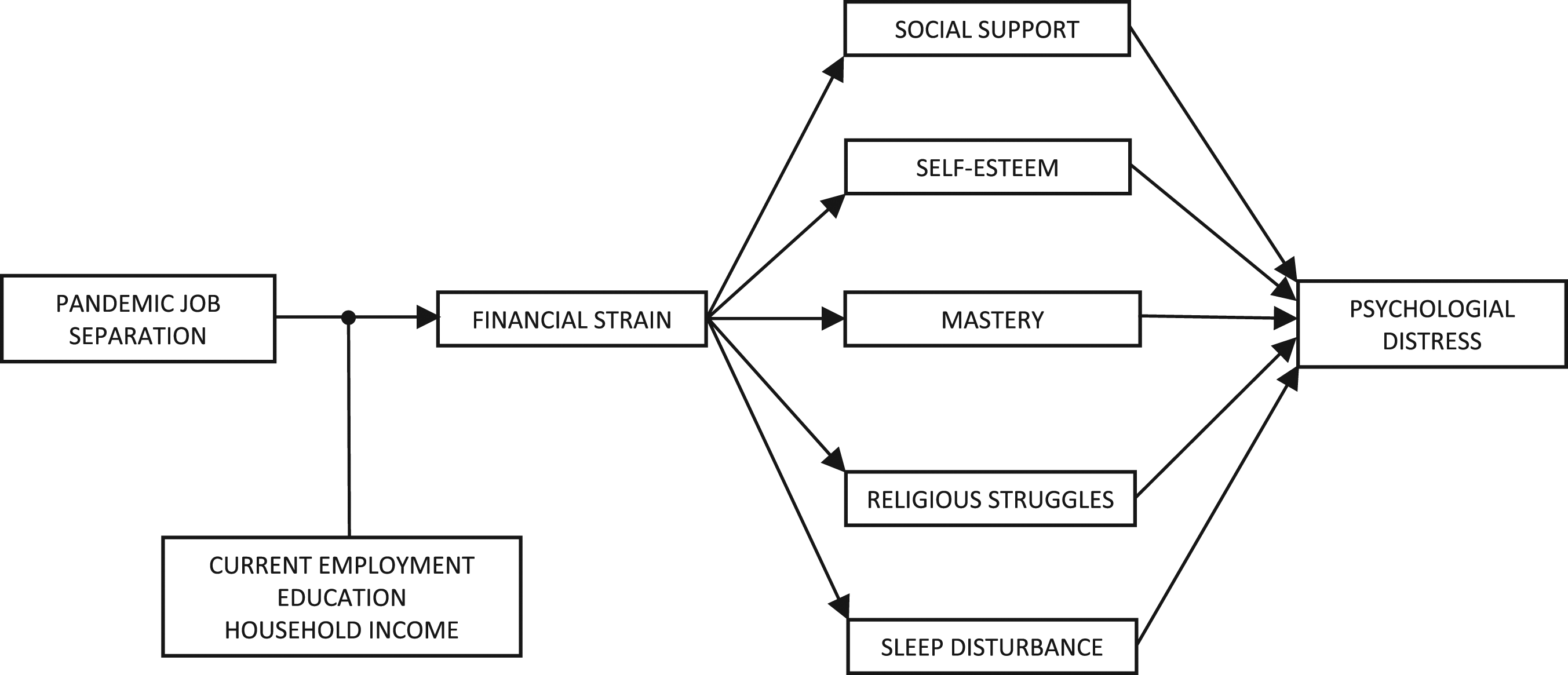
Financial Strain
Our model begins with financial strain because the loss of financial resources is generally considered to be a principal mechanism of the association between unemployment and mental health (Bijlsma et al. 2017; Blustein and Guarino 2020; Brand 2015; Burgard, Brand, and House 2007; Burgard and Kalousova 2015; Connolly and Gärling 2022; Crowe and Butterworth 2016; de Miquel et al. 2022; Dooley, Fielding, and Levi 1996; Ezzy 1993; Frese and Mohr 1987; Hoare and Machin 2010; Kessler, House, and Turner 1987; Kessler, Turner, and House 1987, 1988; Kokko and Pulkkinen 1998; Pearlin et al. 1981; Price, Choi, and Vinokur 2002; Rhee, Barak, and Gallo 2016; Selenko, Batinic, and Paul 2011; Thomas, Benzeval, and Stansfeld 2005; Warr 1987; Witteveen and Velthorst 2020; Zechmann and Paul 2019). Financial strain is the lynchpin or primary mechanism in our theoretical model because it is the most immediate and potentially destabilizing consequence of unemployment. The idea is that unemployment undermines mental health, first and foremost, by limiting financial resources (personal income from lost wages) and exposing individuals and families to financial strain or economic hardship. According to Mirowsky and Ross (2003:119): “People find it distressing to have difficulty paying bills or buying household necessities such as food, clothing, and medicine. Economic hardship threatens one’s personal security. Worse than that, it threatens the security of children, partners, and others whom one loves and sustains.” In an interview with Vox, one 36-year-old man lamented that his period of unemployment during the pandemic was “stressful financially” and “heartbreaking psychologically” (Molla and Stewart 2021). In our review of the literature, we could find only one mediation study relevant to the pandemic context. Using data collected from 2,381 Spanish workers, de Miquel and colleagues (2022) showed that financial stress mediated the association between pandemic unemployment and several indicators of mental health, including depression, generalized anxiety disorder, and suicidal behavior.
Our theoretical model then points to the secondary pathways of social support, self-esteem, mastery, religious struggles, and sleep disturbance. The idea is that these secondary pathways flow from pandemic job separation through financial strain. In other words, financial strain is essential to unlocking subsequent mechanisms. If our society was reorganized so that financial resources were not tied to employment, and unemployment was unrelated to financial strain, most (not all) of the association between unemployment and mental health would disappear. Our theoretical model builds on previous work by extending the pathways linking pandemic job separation and mental health through the lynchpin mechanism of financial strain. Our reading of the literature suggests that most previous mediation studies of unemployment and mental health are limited to simple mediation models (i.e., single mediator tests). In fact, only a few studies based on pre-pandemic data attempt to extend the primary mediating influence of financial strain through secondary mechanisms like general productive activity, social support, and mastery (Bijlsma et al. 2017; Connolly and Gärling 2022; Price, Choi, and Vinokur 2002). One reason why these models are so rare is because previous studies in the latent deprivation tradition have focused on assessing the “relative importance of financial versus social-psychological factors” to de-emphasize the manifest functions of employment (Bartley 1994:335). Instead of pitting financial mechanisms versus other mechanisms, we model what Price and colleagues (2002) refer to as “chains of adversity.” Witteveen and Velthorst (2020:27282) have recently argued that, during the COVID-19 pandemic, “using survey data to detect pathways between economic hardships and mental health is ever more important.”
Social Support
The first of the secondary pathways in our model suggests that financial strain may undermine mental health by limiting access to social support. Brand and Burgard (2021) clarify that “…job loss can be incredibly disruptive, straining people’s finances and psychology and limiting their social interactions, which reduces social support.” Indeed, financial strain is consistently associated with poorer relationship outcomes, including less social engagement, more interpersonal strains (e.g., disagreements), lower levels of social support, greater relationship instability, intimate partner violence, and marital dissolution (Brand 2015; Dew, Britt, and Huston 2012; Gudmunson et al. 2007; Hill et al. 2013; Krause, Newsom, and Rook 2008; Lim et al. 2016; Lincoln 2007; Poortman 2005; Schwab-Reese, Peek-Asa, and Parker 2016; Topor, Ljungqvist, and Strandberg 2016). There are several potential explanations for the disintegration. For example, having limited financial resources can restrict social activities with friends and potential romantic partners (Basbug and Sharone 2017; Lim et al. 2016; Topor et al. 2016). An interview excerpt from the work of Topor and colleagues (2016:340) offers a clear example of this process in one man’s life: “I can’t eat out and I can’t go to concerts, I can’t take trips, so I’m losing my friends… So, you end up outside the gang for lack of money; it’s really tough.” The shame associated with financial difficulties may also lead some people to self-isolate or personally withdraw from their social networks (Lincoln 2007; Topor, Ljungqvist, and Strandberg 2016). Lincoln (2007:443) notes that “the particularly potent influence of financial problems on the receipt of social support may be a reflection of overtaxed networks that are unable to meet the financial needs of individuals.” In the context of intimate relationships, constant quarreling over limited finances, new emotion work demands placed on partners, and changes in the division of labor within the home tends to undermine relationship quality while increasing the risk of intimate partner violence and divorce (Basbug and Sharone 2017; Dew, Britt, and Huston 2012; Gudmunson et al. 2007; Poortman 2005; Rao 2017, 2020a, 2021; Schwab-Reese, Peek-Asa, and Parker 2016). The deterioration of social relationships and the loss of supportive social ties is important because social support is among the most consistent resources for mental health and well-being (Cohen and Wills 1985; House, Umberson, and Landis 1988; Kawachi and Berkman. 2001; Song 2019; Thoits 1995).
Self-Esteem
The next secondary pathway suggests that financial strain may undermine mental health by challenging one’s self-esteem or sense of self-worth. Studies consistently show that people who experience financial strain tend to exhibit lower self-esteem or more negative self-evaluations in terms of personal worthiness and competence (Álvaro et al. 2019; Brand 2015; Kokko and Pulkkinen 1998; Krause, Jay, and Liang 1991; Lange and Byrd 1998; Mayhew and Lempers 1998; Pearlin et al. 1981; Steptoe, Emch, and Hamer 2020; Wickrama et al. 2012; Waters and Moore 2002). Wickrama and colleagues (2012) explain that financial strain tends to undermine self-esteem through processes related to reflected appraisals, social comparisons, and self-evaluations. People who are unable to afford basic necessities and struggle with worker and family roles may come to define themselves as failures and perceive that others view them as disappointments (Basbug and Sharone 2017; Sharone 2007, 2013b; Rao 2017, 2020b). These determinations are supported by widespread cultural values of “meritocratic individualism” and financial success and the prospect of unfavorable social comparisons with people who are more advantaged. The negative reflected appraisals and social comparisons that stem from chronic financial strain are eventually internalized as feelings of shame and low self-esteem. The following interview excerpt from Basbug and Sharone (2017:228) demonstrates how one woman expressed a “profound loss of self-esteem and confidence” from her unemployment: “My job was a huge part of my identity. Huge part of how people saw me. It’s hard not to feel like a throw-away.” These identity processes are important because numerous studies have recognized low self-esteem as a consistent risk factor for psychological distress (Sowislo and Orth. 2013; Thoits 1995). Consistent with our theoretical model, previous studies focusing on financial strain (not unemployment) have featured the indirect effect of financial strain on mental health though self-esteem (Krause, Jay, and Liang 1991; Lange and Byrd 1998; Pearlin et al. 1981; Wickrama et al. 2012).
Mastery
The third secondary pathway suggests that financial strain may undermine mental health by contributing to a general sense of powerlessness. There is considerable evidence linking financial strain with a lower sense of mastery or perceived lack of control over one’s life (Armstrong and Schulman 1990; Brand 2015; Chou and Chi 2000; Koltai, Bierman, and Schieman 2018; Lim et al. 2016; Mirowsky and Ross 2003; Pearlin et al. 1981; Price, Choi, and Vinokur 2002; Ross and Mirowsky 2013; Sharone 2007; Steptoe, Emch, and Hamer 2020). Pearlin and colleagues (1981:340) note that people who experience unemployment and subsequent financial strain can “become vulnerable to the erosion of mastery” when they become demoralized by persistent “evidence of their own failures—or lack of success—and with inescapable proof of their inability to alter the unwanted circumstances of their lives.” We emphasize these processes because mastery is a well-known resource for mental health (Armstrong and Schulman 1990; Chou and Chi 2000; Crowe and Butterworth 2016; Crowe, Butterworth, and Leach 2016; Koltai, Bierman, and Schieman 2018; Mirowsky and Ross 2003; Pearlin et al. 1981; Price, Choi, and Vinokur 2002; Pudrovska et al. 2005; Ross and Mirowsky 2013). Moreover, several studies have identified mastery as a significant mediator of the association between financial strain and mental health (Armstrong and Schulman 1990; Chou and Chi 2000; Koltai, Bierman, and Schieman 2018; Pearlin et al. 1981; Price, Choi, and Vinokur 2002; Pudrovska et al. 2005).
Religious Struggles
The fourth secondary pathway suggests that financial strain may undermine mental health by contributing to religious and spiritual struggles. Although empirical studies are relatively rare, quantitative and qualitative research confirm that financial strain may lead some people to struggle with their religious and spiritual beliefs, including, for example, feeling anger toward God, feeling abandoned by God, feeling as though God is punishing them, and worrying that the problems they are facing are the work of the devil or evil spirits (Gutierrez, Park, and Wright 2017; Krause, Pargament, and Ironson 2017; Nierobisz and Sawchuk 2018). Magyar-Russell and Pargament (2006:102) note that “…negative life events, loss, and trauma often shatter previously held assumptions about the benevolence, fairness, and meaningfulness of the world,” and “for many this shattering of assumptions extends to the spiritual dimension of their lives.” Krause and colleagues (2017:621) also explain that “people who experience ongoing economic problems, poor neighborhood conditions, and other related stressors may find it increasingly difficult to sustain the belief that God is benevolent and working for the best in their lives.” While many people turn to religion for guidance and comfort to cope with adversity, others turn away from their faith and deeply held religious beliefs when they can no longer make consistent or coherent religious meaning in their lives. Indeed, several studies have linked higher levels of religious struggles with a range of strains, including financial difficulties, adverse health conditions, discrimination, presidential elections, and other stressful or traumatic life events (Ai et al. 2010; Ellison and Lee 2010; Exline et al. 2011; Exline et al. forthcoming; Fitchett et al. 2004; Gall et al. 2009; Hill et al. 2017; Koenig et al. 1998; Krause and Hayward 2012; Krause, Pargament, and Ironson 2017; Pargament et al. 1998; Stauner et al. 2019; Wortmann et al. 2011). For example, an interview excerpt provided by Nierobisz and Sawchuk (2018:341) offers an especially lucid illustration of religious struggles in the life of an unemployed man: “God ain’t paying my mortgage, you know? If God’s got a plan for me, step it up pal. This has been going on too long.” Despite the limited body of research related to financial strain, numerous studies have linked religious struggles with adverse mental health outcomes (Ai et al. 2010; Ellison and Lee 2010; Exline and Rose 2013; Fenelon and Danielsen 2016; Galek et al. 2007; Hill et al. 2021; Stauner et al. 2016; Upenieks 2021; Wilt et al. 2016 Zarzycka & Zietek, 2019). There is some evidence to suggest that religious struggles may even mediate the association between financial strain and depression (Gutierrez, Park, and Wright 2017).
Sleep Disturbance
The final secondary pathway in our model suggests that financial strain may also undermine mental health by contributing to sleep disturbance. A great deal of research has established financial strain as a risk factor for adverse sleep outcomes, including objective (e.g., sleep efficiency through polysomnography) and subjective (self-reports of sleep quality) assessments (Hall et al. 2008, 2009; Hill, Burdette, and Hale 2009; Hill, Upenieks, and Ellison 2021; Hill et al. forthcoming; Lallukka et al. 2012; Kalousová, Xiao, and Burgard 2019; Steptoe et al. 2008; Steptoe, Emch, and Hamer 2020; Wright, Steptoe, and Fancourt 2021). According to Mirowsky and Ross (2003:92–93), “the chronic strain of struggling to pay bills and feed and clothe the children drains the joy from life, creating nagging worries that make sleep restless and the future seem hopeless, leaving the body fatigued and the spirit exhausted.” Although it is difficult to establish the causal order of the association between sleep quality and mental health, longitudinal studies show that sleep problems are significant risk factors for the development of anxiety and depression (Alvaro, Roberts, and Harris 2013; Ford and Kamerow, 1989; Freeman et al. 2020; Lustberg and Reynolds, 2000). Researchers explain that sleep disturbance can contribute to poor mental health by disrupting the natural circadian rhythm and increasing inflammatory dysregulation (Alvaro, Roberts, and Harris 2013; Freeman et al. 2020; Lustberg and Reynolds, 2000). When established sleep-wake schedules are compromised under the conditions of sleep deprivation, the brain restricts the release of neurotransmitters (serotonin and norepinephrine) that help to regulate mood. Increased inflammation may also disrupt mood control by limiting hippocampal neurogenesis. To our knowledge, no studies have formally tested whether the association between financial strain and psychological distress is mediated by sleep disturbance.
Subgroup Variations
Figure 1 also suggests that our proposed indirect effects could theoretically vary by current employment status, education level, and household income. Hayes (2018:467) defines the process of moderated mediation as an indirect effect that is moderated. While traditional moderation analyses assess whether the magnitude of an association between X and Y varies across levels of a third moderator variable (W), moderated mediation analyses test whether the magnitude of an indirect effect of X on Y though M varies across levels of a third moderator variable (W). In this study, the indirect effects of pandemic unemployment could be attenuated for those who were able to regain employment (current employment status), those with more education (college degrees), and those with the most financial capital (household income) at their disposal.
These potential subgroup variations are important because previous meta-analyses suggest that the mental health consequences of unemployment can depend on other indicators of socioeconomic status like occupational status or duration of unemployment (Paul and Moser 2009). Paul and Moser (2009:266) explain that “persons in high-status occupations usually have access to better financial and social resources and may possess better coping strategies than persons in low status occupations, probably cushioning the negative effects of unemployment.” More recent research by Witteveen and Velthorst (2020) has demonstrated that European workers in low prestige occupations may be especially vulnerable to the psychological consequences of job loss and financial hardship during the COVID-19 pandemic. Witteveen and Velthorst (2020:27277) explain that “macroeconomic downturns are known to exacerbate existing economic inequalities along status groups, notably, social class and occupation.”
Although we are unable to assess duration of unemployment or occupation, we are able to compare the magnitude of the indirect effects of pandemic job separation for those who are currently employment and those who are not, those who have a college degree and those who do not, and those with different household incomes. We consider whether a worker who has experienced pandemic job separation is able to regain employment as an indirect assessment of the moderating influences of unemployment duration and labor-market opportunity. We also consider a worker’s education level and household income (from all sources) as indirect indicators of the moderating influences of occupation and socioeconomic status. The expectation is that the chains of adversity in our mediation model will be most evident among those workers who remain unemployed, lack college degrees, and report lower household incomes.
Data
To test our proposed theoretical model, we use data from the 2021 Crime, Health, and Politics Survey (CHAPS). The primary purpose of CHAPS is to document the social causes and consequences of health and well-being in the United States during the coronavirus (COVID-19) pandemic. CHAPS is based on a national probability sample of 1,771 community-dwelling adults aged 18 and over living in the United States. Respondents were sampled from the National Opinion Research Center’s (NORC) AmeriSpeak© panel, which is representative of households from all 50 states and the District of Columbia (https://amerispeak.norc.org/Documents/Research/AmeriSpeak_Technical_Overview_2019_02_18.pdf). Sampled respondents were invited to complete the online survey in English between May 10, 2021 and June 1, 2021. The data collection process yielded a survey completion rate of 30.7% and a weighted cumulative response rate of 4.4%. The weighted cumulative response rate, which considers all panel recruitment and retention rates, is the overall survey response rate that accounts for survey outcomes in all response stages, including the panel recruitment rate, panel retention rate, and survey completion rate. It is weighted to account for the sample design and differential inclusion probabilities of sample members. Our cumulative response rate is within the typical range (4–5%) of high-quality general population surveys (see https://www.pew_research.org/politics/2021/05/17/scope-of-government-methodology/). The multistage probability sample resulted in a margin of error of ±3.23% and an average design effect of 1.92. Margin of error is defined as half the width of the 95% confidence interval for a proportion estimate of 50% adjusted for design effect. A figure of ±3.23% is therefore the largest margin of error possible for all estimated percentages based on the study sample. A margin of error of ±3.23% at the 95% confidence level means that if we fielded the same survey 100 times, we would expect the result to be within 3.23% of the true population value 95 times. A margin of error of 3.00 is considered very good (Cui 2002). The average design effect is the variance under the complex design divided by the variance under a simple random sampling design of the same sample size. The design effect is variable-specific and the reported value is the average design effect calculated for a set of key survey variables. Design effects account for deviations from simple random sampling with a 100% response rate. A design effect of 1.92 is very good because it means that the variance is only about twice as large as would be expected with simple random sampling (Kish 1965). The median self-administered web-based survey lasted approximately 25 min. All respondents were offered the cash equivalent of $8.00 for completing the survey, which is on the more lucrative end of the incentive spectrum for a survey of this duration. The survey was reviewed and approved by the institutional review boards at NORC and the lead author’s university. Informed consent was obtained from all participants.
Given our focus on pandemic job separation, we limited our sample to the working ages of 25 to 65. Due to listwise deletion of missing data, our analytic sample size was further reduced from a total possible sample of 1,273 to 1,258 (99% retention). Post-stratification weights were used in subsequent analyses to reduce sampling error and non-response bias. NORC developed post-stratification weights for CHAPS via iterative proportional fitting or raking to general population parameters derived from the Current Population Survey (CPS) (https://www.census.gov/programs-surveys/cps/data.html). These parameters included age, sex, race/ethnicity, education, and several interactions (age*sex, age*race, and sex*race).
We compared our weighted sample characteristics against benchmark estimates from the CPS for age, sex, race/ethnicity, education, household income, homeownership, marital status, and number of children in the household. The only notable differences were observed for the characteristics of household income and children in the household. CHAPS over-sampled people making less than $29,999 (% difference = 7.9) and $30,000 to $74,999 (% difference = 6.6) and under-sampled people making $75,000 to $124,999 (% difference = −1.2) and $125,000 or more (% difference = −13.2). CHAPS also over-sampled households without children under 18 (% difference = 15.1). There were some smaller differences with respect to education and homeownership. CHAPS over-sampled people with graduate degrees (% difference = 2.5) and under-sampled people with bachelor’s degrees (% difference = −2.4). CHAPS also over-sampled homeowners (% difference = 3.6). The weighted sample characteristics for CHAPS were comparable to CPS estimates for age, sex, race/ethnicity, and marital status.
Measures
Because our omnibus survey was designed to include many different constructs, we were mostly unable to include entire scales. The only exception is our assessment of psychological distress. For the other indices, we selected items from previous studies and surveys for clarity (wording) and high factor loadings (0.50 or higher). Items were excluded if the question wording lacked clarity or the factor loading was low.
Psychological Distress
Psychological distress is measured as the mean or average response to six items drawn from the K6 Psychological Distress Scale (Kessler et al. 2002). Respondents were asked to indicate how often in the past 30 days they felt: (a) “nervous,” (b) “restless or fidgety,” (c) “so sad nothing could cheer them up,” (d) “hopeless,” (e) “everything was an effort,” and (f) “worthless.” Response categories for these items ranged from (1) never to (5) always so that higher index scores would indicate greater psychological distress. An exploratory principal components analysis with varimax rotation produced a single component for the six items (eigenvalue = 4.52), with loadings ranging from 0.83 to 0.91. A reliability analysis also suggested excellent internal consistency for six items (α = 0.94).
Pandemic Job Separation
We assess pandemic job separation with a single item that captures voluntary quitting and involuntary termination due to the conditions of the pandemic (Brand 2015). Respondents were asked to indicate whether they had “experienced any unemployment due to the coronavirus (COVID-19) pandemic.” Response categories for this item included (1) yes and (0) no.
Job loss is a complex and multilevel social phenomenon with a wide range of conceptualizations and operationalizations (Dooley et al. 1996). Related concepts include the involuntary dismissal of workers (Gore 1978; Lee et al. 2021), the voluntary resignation of workers, the forced resignation of workers (Miller & Hoppe 1994), or a significant reduction in hours (Lee et al. 2021). Scholarship on unemployment often includes samples of people who have different types of job loss or simply consider current employment status (Alvaro et al. 2019; Bijlsma et al. 2017; Brand 2015; Dooley et al. 1996; Lee et al. 2021; Sharone 2013a). A key example of this is the job separation framework that Brand (2015) uses to indicate either voluntary or involuntary termination of employment. The current study uses a similar metric whereby respondents indicate whether they had “experienced any unemployment due to the coronavirus (COVID-19) pandemic.” The authors note that this measure captures a wide variety of job separation experiences and does not distinguish between voluntary and involuntary job loss due to the COVID-19 pandemic.
Recent studies have defined pandemic unemployment as being employed before the pandemic and then being unemployed during the pandemic (e.g., Abrams, Finlay, and Kobayashi forthcoming; Achdut and Refaeli 2020; de Miquel et al. 2022; Lee et al. 2021; Posel, Oyenubi, and Kollamparambil 2021; Witteveen and Velthorst 2020). Pandemic unemployment has been measured longitudinally (assessing employment status at different points in time) and retrospectively (asking respondents to recall periods of unemployment). Longitudinal designs can miss short periods of unemployment depending on the timing and framing of repeated observations. Studies can also assess unemployment without specifying the underlying cause (e.g., poor performance or insubordination). While previous measures typically define pandemic unemployment as specific periods of unemployment during the pandemic, we define it as any voluntary quitting or involuntary exposure to termination that is specifically due to the pandemic. Our measure is both comprehensive and context-specific because it captures “any unemployment due to the coronavirus (COVID-19) pandemic.” The measure used here is similar to the following item used by de Miquel and colleagues (2022:5): “Are you unemployed or temporarily laid off due to the coronavirus pandemic?”
Financial Strain
We measure financial strain as the mean response to three items. Respondents were asked how often their household currently has any trouble paying for (a) health care, (b) monthly bills, and (c) food. Response categories for these items ranged from (1) never to (5) all the time so that higher index scores would indicate greater financial strain. An exploratory principal components analysis with varimax rotation produced a single component for the three items (eigenvalue = 2.43), with loadings ranging from 0.84 to 0.93. A reliability analysis also suggested excellent internal consistency for three items (α = 0.89).
Social Support
Social support is measured as the mean response to four items from the Medical Outcomes Study Social Support Survey (Moser et al. 2012). Respondents were asked to indicate how often each of the following types of support are available to them when they need it: (a) “Someone to love and make you feel wanted.” (b) “Someone to turn to for suggestions about how to deal with personal problems.” (c) “Someone to help with daily chores if you were sick.” (d) “Someone to give you information to help you understand a situation.” Response categories for these items ranged from (1) never to (5) always so that higher index scores would indicate greater social support. An exploratory principal components analysis with varimax rotation produced a single component for the four items (eigenvalue = 3.08), with loadings ranging from 0.86 to 0.89. A reliability analysis also suggested excellent internal consistency for four items (α = 0.90).
Self-Esteem
Self-esteem is measured as the mean response to three items drawn from the Single-Item Self-Esteem Scale (Robins, Hendin, and Trzesniewski 2001) and the Rosenberg Self-Esteem Scale (Rosenberg 1965). Respondents were asked to indicate the extent to which they agree with the following statements: (a) “I can do things as well as most people.” (b) “I am a person of worth, at least on equal terms with others.” (c) “I have high self-esteem.” Response categories for these items ranged from (1) strongly disagree to (5) strongly agree so that higher index scores would indicate greater self-esteem. An exploratory principal components analysis with varimax rotation produced a single component for the three items (eigenvalue = 1.92), with loadings ranging from 0.74 to 0.84. A reliability analysis also suggested adequate internal consistency for three items (α = 0.71).
Mastery
Mastery or the sense of control is measured as the mean or average response to three items drawn from the Short Form Perceived Stress Scale (Warttig et al. 2013). Respondents were asked to indicate how often in the past 30 days they felt (a) “difficulties were piling up so high that they could not overcome them” (reversed coded), (b) “confident about their ability to handle their personal problems,” and (c) “they were unable to control the important things in their life” (reverse coded). Response categories for these items ranged from (1) never to (5) always so that higher index scores would indicate greater mastery. An exploratory principal components analysis with varimax rotation produced a single component for the three items (eigenvalue = 1.91), with loadings ranging from 0.64 to 0.89. A reliability analysis also suggested adequate internal consistency for three items (α = 0.71).
Religious Struggles
Religious struggles are measured as the mean or average response to three items drawn from the Religious and Spiritual Struggles Scale (Exline et al. 2014). Respondents were asked to indicate how often they (a) “have doubts about their religious or spiritual beliefs,” (b) “feel as though God has abandoned them,” and (c) “feel as though God is punishing them.” Response categories for these items ranged from (1) never to (5) always so that higher index scores would indicate more religious struggles. An exploratory principal components analysis with varimax rotation produced a single component for the three items (eigenvalue = 2.11), with loadings ranging from 0.75 to 0.90. A reliability analysis also suggested adequate internal consistency for three items (α = 0.78).
Sleep Disturbance
Sleep disturbance is measured as the mean or average response to four items drawn from previous research (Hill, Ellison, and Hale 2020). Respondents were asked to indicate how often in the past month they (a) “had trouble falling asleep,” (b) “had trouble staying asleep (including waking up too frequently or too early),” and (c) “woke up after their usual amount of sleep feeling tired and worn out.” Response categories for these items ranged from (1) never to (5) always. Respondents were also asked to rate their “overall sleep quality in the past month” (Hill, Burdette, and Hale 2009). Response categories for this item ranged from (1) excellent to (4) poor. An exploratory principal components analysis with varimax rotation produced a single component for the five items (eigenvalue = 2.61), with loadings ranging from 0.80 to 0.83. A reliability analysis also suggested excellent internal consistency for four items (α = 0.82).
Background Variables
Background variables include age (continuous years), gender (1 = female; 0 = male), race/ethnicity (dummy variables for non-Hispanic black, Latino, and other race or ethnicity, with non-Hispanic white serving as the reference), nativity status (1 = US-born; 0 = otherwise), college degree (1 = four-year college degree or higher; 0 = otherwise), current employment status (1 = employed; 0 = otherwise), annual household income (1 = < $10,000 to 9 = ≥ $150,000), marital status (1 = married; 0 = otherwise), child under 18 (1 = presence of a child under age 18; 0 = otherwise), religious affiliation (dummy variables for conservative Protestant, moderate Protestant, Catholic, other Christian, and other religion, with no religious affiliation serving as the reference), religiosity (mean or average response to four items assessing in-person and virtual religious attendance, religious importance, and frequency of prayer, α = 0.85), urbanicity (1 = residence in a large city or town; 0 = otherwise), and region (dummy variables for Northeast, Midwest, and West, with South serving as the reference).
Statistical Procedures
Weighted Descriptive Statistics for the Full Sample and by Pandemic Job Separation (CHAPS, 2021).
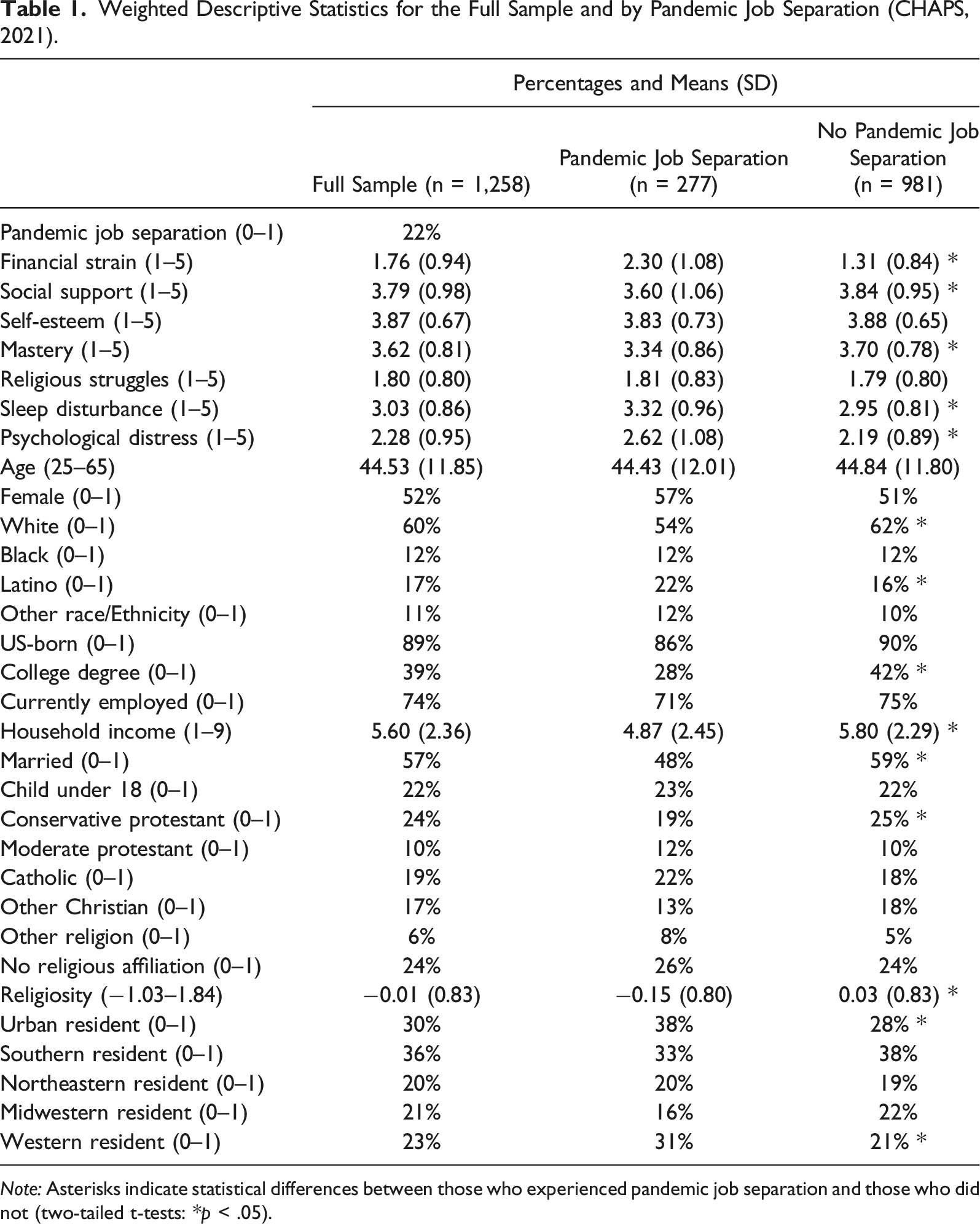
Note: Asterisks indicate statistical differences between those who experienced pandemic job separation and those who did not (two-tailed t-tests: *p < .05).
Weighted OLS Regressions of Financial Strain and Social Support (CHAPS, 2021).
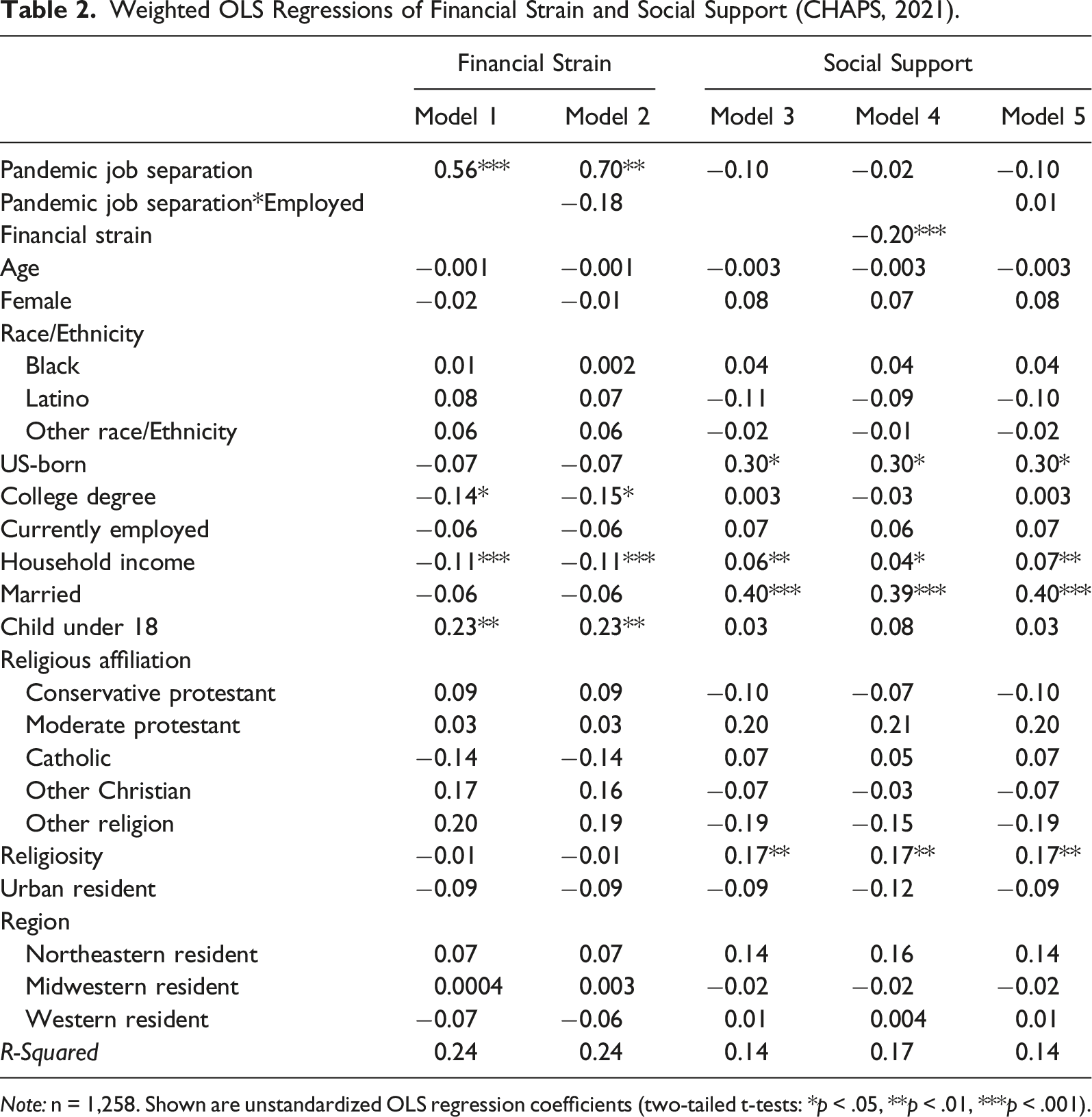
Note: n = 1,258. Shown are unstandardized OLS regression coefficients (two-tailed t-tests: *p < .05, **p < .01, ***p < .001).
Weighted OLS Regressions of Self-Esteem and Mastery (CHAPS, 2021).
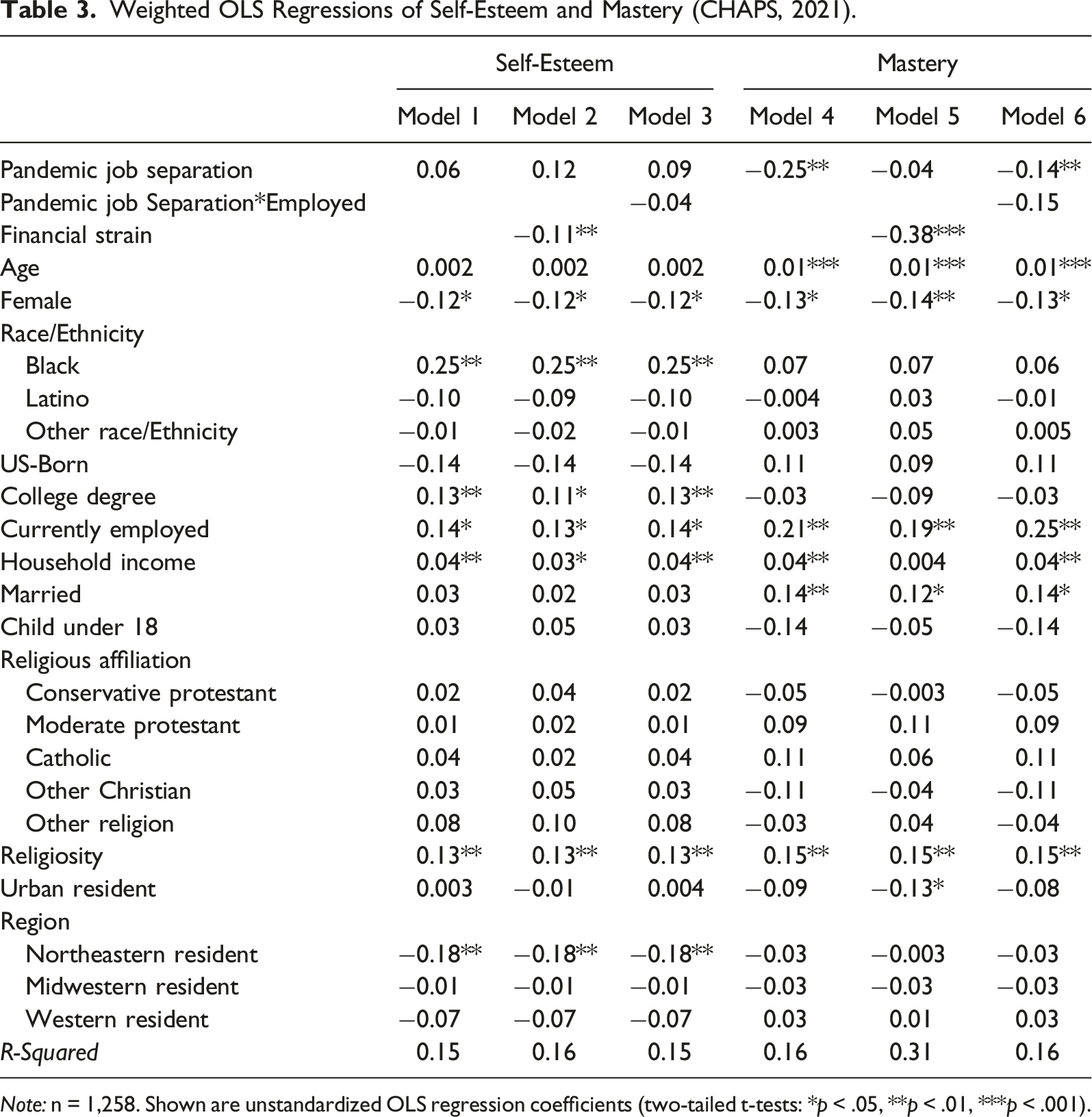
Note: n = 1,258. Shown are unstandardized OLS regression coefficients (two-tailed t-tests: *p < .05, **p < .01, ***p < .001).
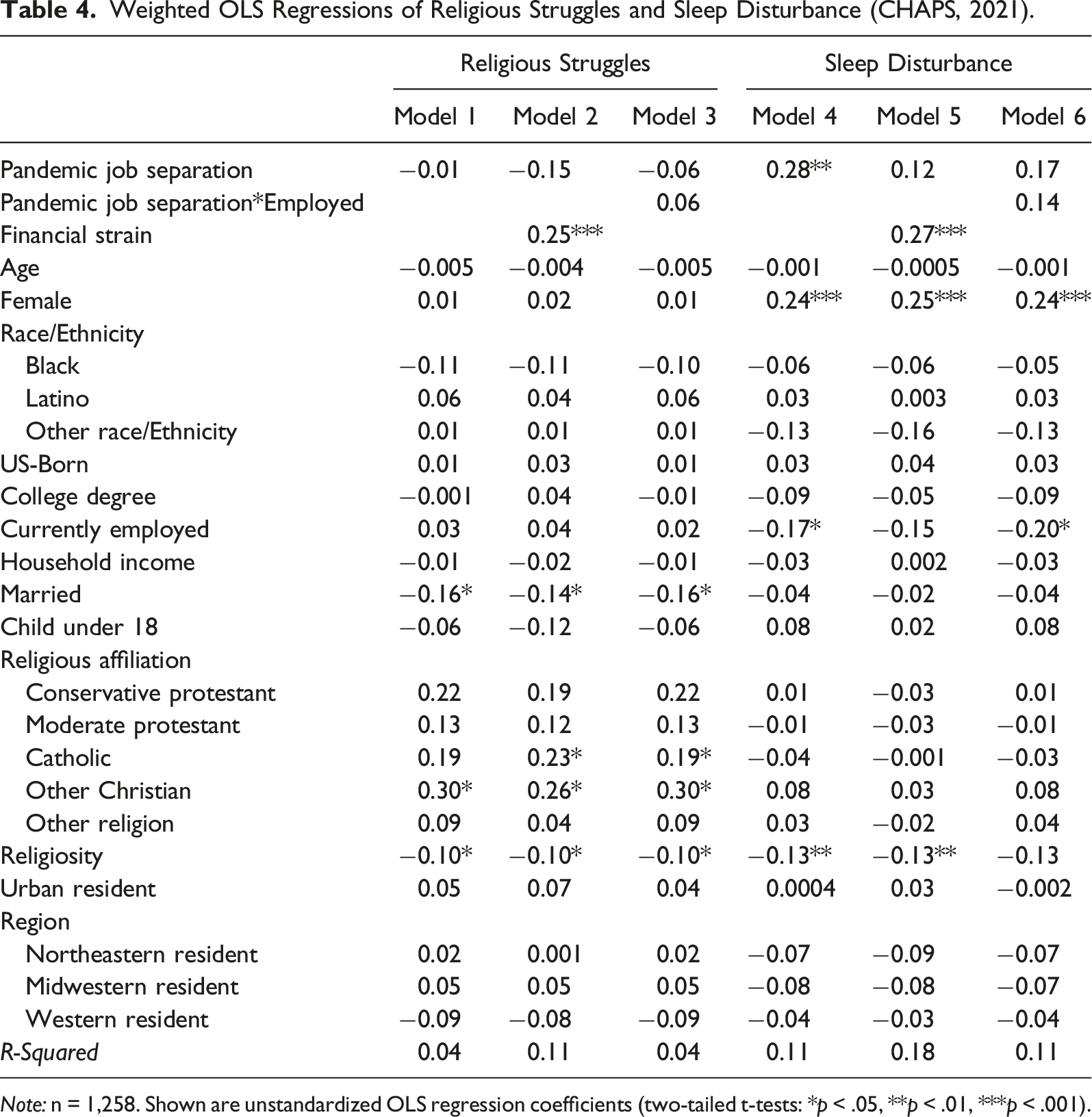
Weighted OLS Regressions of Religious Struggles and Sleep Disturbance (CHAPS, 2021).
Note: n = 1,258. Shown are unstandardized OLS regression coefficients (two-tailed t-tests: *p < .05, **p < .01, ***p < .001).
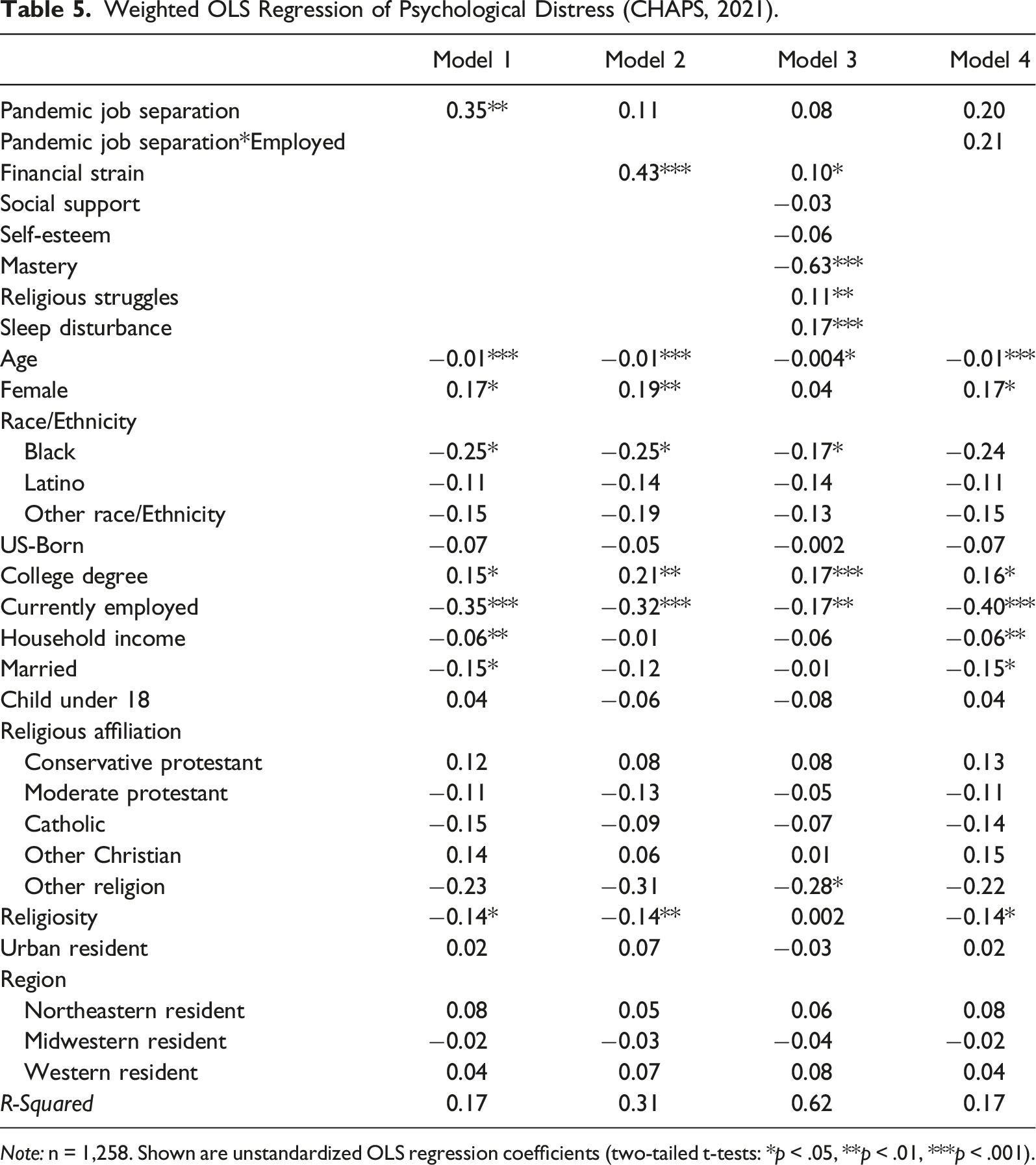
Weighted OLS Regression of Psychological Distress (CHAPS, 2021).
Note: n = 1,258. Shown are unstandardized OLS regression coefficients (two-tailed t-tests: *p < .05, **p < .01, ***p < .001).
There are two general approaches to testing mediation. The first is the “coefficient change” approach, which assesses the change in the coefficient for the focal predictor across nested models (i.e., before and after the mediator variable is added to the regression equation). The second is the “indirect effect” approach, which assesses the statistical significance of an indirect effect (i.e., the product of two coefficients, the coefficient for the effect of the focal predictor on the mediator and the coefficient for the effect of the mediator on the outcome). In this study, we use conditional process analysis to formally test our mediation model because this “indirect effect” approach is more intuitive and requires information for each link in the proposed causal process (X → M and M → Y) (Hayes 2018). It is important to note that, unlike the coefficient change approach, the indirect effect approach does not require a statistically significant direct effect of X on Y. MacKinnon (2008:68) explains that the direct effect of X on Y “is controversial because it is possible that the relation between the independent variable and the dependent variable may be nonsignificant, yet there can still be substantial mediation.” Hayes (2013:88) also notes that “mediation analysis as practiced in the 21st century no longer imposes evidence of simple association between X and Y as a precondition.”
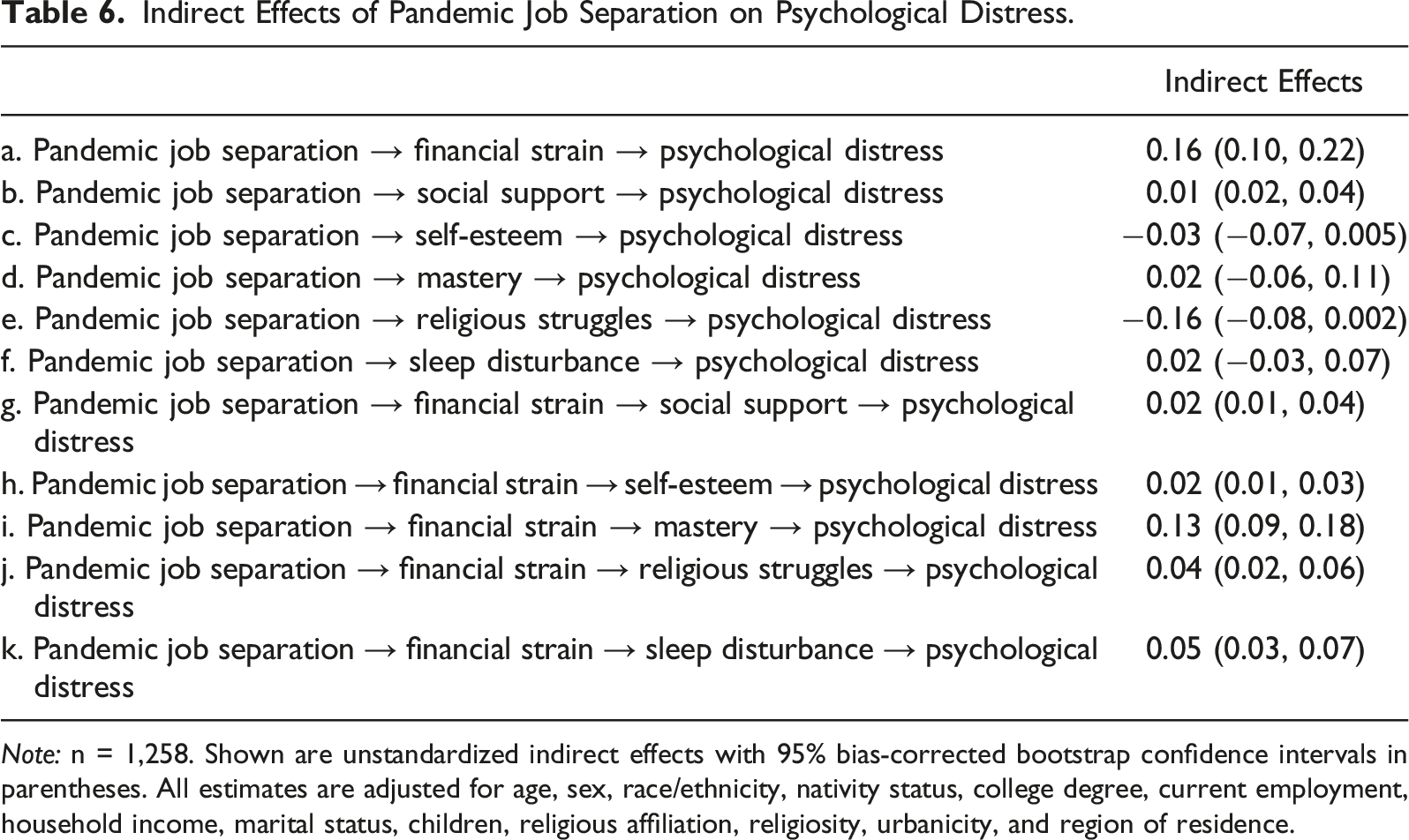
Indirect Effects of Pandemic Job Separation on Psychological Distress.
Note: n = 1,258. Shown are unstandardized indirect effects with 95% bias-corrected bootstrap confidence intervals in parentheses. All estimates are adjusted for age, sex, race/ethnicity, nativity status, college degree, current employment, household income, marital status, children, religious affiliation, religiosity, urbanicity, and region of residence.
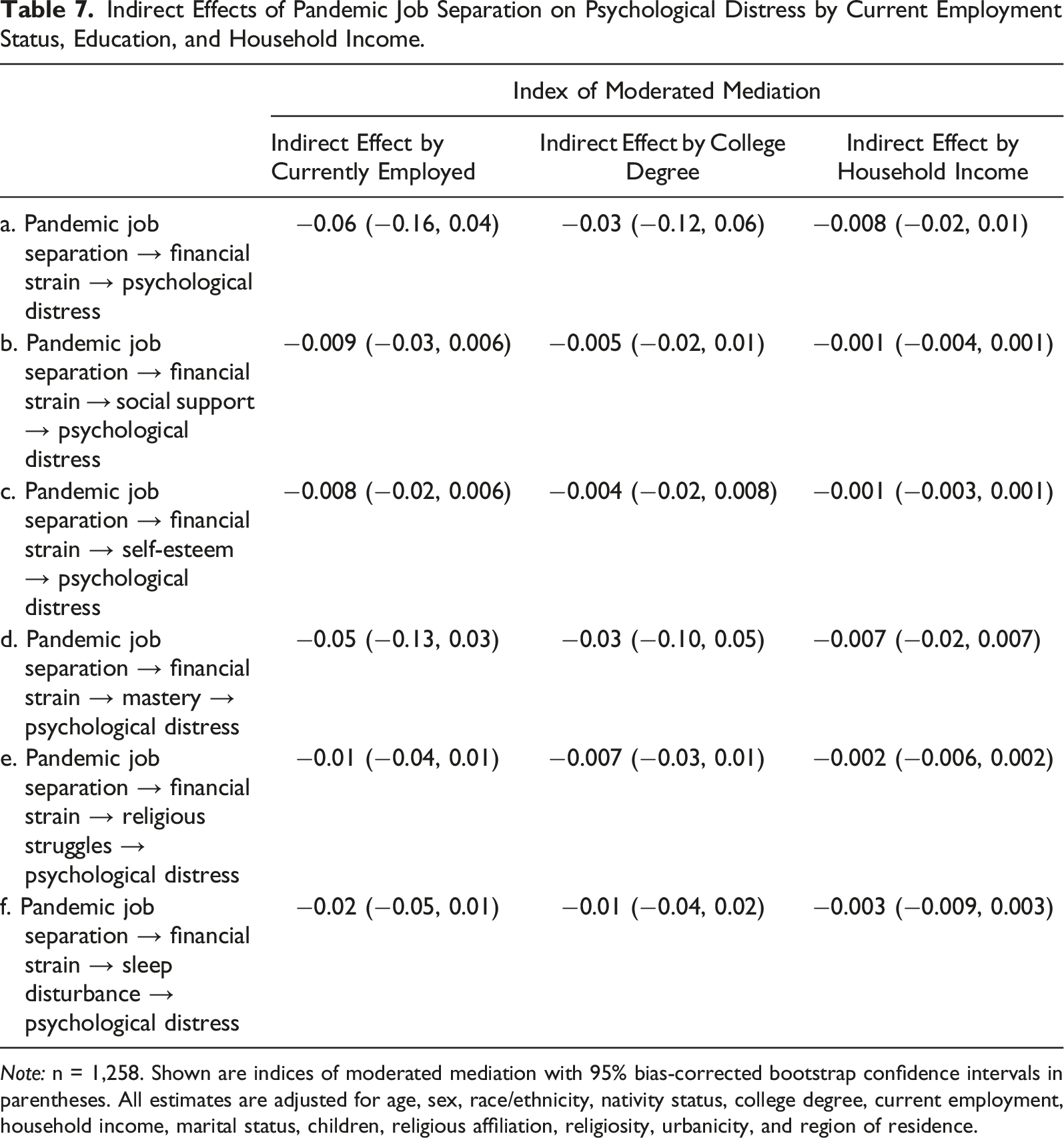
Indirect Effects of Pandemic Job Separation on Psychological Distress by Current Employment Status, Education, and Household Income.
Note: n = 1,258. Shown are indices of moderated mediation with 95% bias-corrected bootstrap confidence intervals in parentheses. All estimates are adjusted for age, sex, race/ethnicity, nativity status, college degree, current employment, household income, marital status, children, religious affiliation, religiosity, urbanicity, and region of residence.
Results
Descriptive Analyses
In the first column of Table 1, we see that 22% of respondents in the full sample experienced job separation due to the pandemic. To aid in the interpretation of subsequent moderation and moderated mediation analyses, we cross-classified pandemic job separation and current employment status (available upon request). This analysis revealed that (a) 59% of the sample was currently employed with no history of job separation due to the pandemic, (b) 20% were currently unemployed with no history of job separation due to the pandemic, (c) 15% regained employment after a period of job separation due to the pandemic, and (d) 7% reported job separation due to the pandemic and being currently unemployed. Among those who reported any job separation due to the pandemic, 71% were able regain employment by the time of the survey. This means that only 29% of those who experienced job separation due to the pandemic were still unemployed by the time of the survey.
Respondents also reported low levels of financial strain, religious struggles, and psychological distress and moderate levels of self-esteem, mastery, and sleep disturbance. The average age of the sample was approximately 45 years. The sample included non-Hispanic whites (60%), non-Hispanic blacks (12%), Latinos (17%), and respondents of other races and ethnicities (11%). Very few respondents reported being born outside of the United States (11%). Over one-third of respondents reported having a four-year college degree or higher (39%), and nearly three quarters of the sample reported being currently employed full- or part-time (74%). The average respondent also reported an annual household income between $50,000 and $74,999. In terms of family characteristics, over half of the sample reported being married (57%), and few respondents reported the presence of a child under the age of 18 (22%). The sample included conservative Protestants (24%), moderate Protestants (10%), Catholics (19%), other Christians (17%), other religions (6%), and respondents with no religious affiliation (24%). The average respondent exhibited low levels of religiosity. While nearly one-third of respondents reported living in an urban area (30%), respondents were spread across the South (36%), Northeast (20%), Midwest (21%), and West (23%).
In the second and third columns of Table 1, we have stratified the descriptive statistics by pandemic job separation. Asterisks indicate bivariate statistical differences between those who experienced job separation due to the pandemic and those who did not. Compared to respondents with no pandemic job separation, those with a history of pandemic job separation reported more financial strain, sleep disturbance, and psychological distress and less social support and mastery. In terms of race/ethnic composition, the pandemic job separation subsample had a lower percentage of non-Hispanic whites and a higher percentage of non-Hispanic blacks. Although there were no group differences in current employment status, those who reported pandemic job separation were less likely to hold a college degree and had less household income. Marriage rates, conservative Protestant affiliation, and religiosity were also lower among those who reported pandemic unemployment. Finally, the pandemic job separation subsample was more likely to reside in a large city or town and in the Western region of the country. Aside from these differences, the profile of those who reported pandemic job separation and those who did not was similar with respect to self-esteem, religious struggles, age, gender, other race/ethnic identities, nativity status, the presence of young children, other religious identities, and living in other regions of the country.
Regression of Proposed Mediators
In Table 2, we regress financial strain (Models 1 and 2) and social support (Models 3–5) on pandemic job separation and the interaction of pandemic job separation and current employment status. According to Model 1, pandemic job separation is associated with greater financial strain (b = 0.56, p < .001). In other words, respondents who experienced any job separation due to the pandemic tend to report more trouble paying for health care, monthly bills, and food. The interaction term in Model 2 indicates that the association between pandemic job separation and financial strain does not vary by current employment status (b = −0.18, p > .05). Interestingly, this finding suggests that pandemic job separation is similarly associated with financial strain for those who were able to find a job and those who remained unemployed. Although Model 3 indicates that pandemic job separation is unrelated to social support (b = −0.10, p > .05), Model 4 demonstrates that respondents who reported more financial strain also tended to exhibit lower levels of social support (b = −0.20, p < .001). Model 5 suggests that the association between pandemic job separation and social support is comparable for those who were able to find a job and those who remained unemployed (b = 0.01, p > .05).
In Table 3, we regress self-esteem (Models 1–3) and mastery (Models 4–6) on pandemic job separation and the interaction of pandemic job separation and current employment status. Model 1 shows that pandemic job separation is unrelated to self-esteem (b = 0.06, p > .05). Model 2 also indicates that respondents who reported more financial strain also tended to exhibit lower levels of self-esteem (b = −0.20, p < .001). In other words, people who have difficulties affording basic necessities in life also tend to struggle with their self-worth. In Model 3, we find that the association between pandemic job separation and self-esteem is comparable for those who were able to find a job and those who remained unemployed (b = −0.04, p > .05). Model 4 demonstrates that pandemic job separation is associated with lower levels of mastery (b = −0.25, p < .01). This suggests that people who have experienced job separation due to the pandemic tend to perceive less control over important things in life and have internalized a general sense of powerlessness. In Model 5, we see that respondents who report greater financial strain also tend to exhibit lower levels of mastery (b = −0.38, p < 0.001). Model 6 suggests that the association between pandemic job separation and mastery does not vary by current employment status (b = −0.15, p > .05).
In Table 4, we regress religious struggles and sleep disturbance on pandemic job separation and the interaction of pandemic job separation and current employment status. Although pandemic job separation is unrelated to religious struggles in Model 1 (b = −0.01, p > .05), we see that financial strain is associated with greater religious struggles in Model 2 (b = 0.25, p < .001). In other words, respondents who exhibit greater financial strain also tend to report more uncertainty about their religious beliefs and more difficulties with their divine relations. Model 3 also indicates that the association between pandemic job separation and religious struggles is comparable for those who were able to find a job and those who remained unemployed (b = −0.15, p > .05). In Models 4 and 5, respectively, pandemic job separation (b = 0.28, p < .001) and financial strain (b = 0.27, p < .001) are associated with greater sleep disturbance. This implies that respondents who experienced job separation due to the pandemic and have trouble affording basic necessities in life also tend to have more difficulties falling asleep and staying asleep. Model 6 shows that the association between pandemic job separation and sleep disturbance does not vary by current employment status (b = 0.14, p > .05).
Regression of Psychological Distress
In Table 5, we regress symptoms of psychological distress on pandemic job separation, the proposed mediators, and the interaction of pandemic job separation and current employment status. According to Model 1, pandemic job separation is associated with greater psychological distress (b = 0.35, p < .01). This suggests that people who experienced job separation due to the pandemic tended to report more symptoms of psychological distress (e.g., feeling nervous and sad). The association between pandemic job separation and psychological distress is attenuated by 69% and is no longer statistically significant when financial strain is added to the regression equation in Model 2 (b = 0.11, p > .05). In Model 2, financial strain is positively associated with psychological distress (b = 0.43, p < .001). In other words, people who have difficulties affording basic necessities in life also tend to report more symptoms of anxiety and depression. In Model 3, the association between financial strain and psychological distress is attenuated by 77% but remains statistically significant when the secondary mediators are added to the regression equation (b = 0.10, p < .05). Although social support (b = −0.03, p > .05) and self-esteem (b = −0.06, p > .05) are unrelated to psychological distress in Model 3, we see that mastery is inversely associated with distress (b = −0.63, p < .001) while religious struggles (b = 0.11, p < .01) and sleep disturbance (b = 0.17, p < .001) are positively associated with distress. We note that, in supplemental analyses (available upon request), social support (b = −0.12, p < .01) and self-esteem (b = −0.31, p < .001) are both inversely associated with psychological distress before mastery is added to the regression equation. Finally, Model 4 indicates that the association between pandemic job separation and psychological distress is comparable for those who were able to find a job and those who remained unemployed (b = 0.21, p > .05).
Mediation Analyses
In Table 6, we present unstandardized indirect effects (I.E.) and 95% bootstrap confidence intervals (C.I.). The first five indirect effects (a-e) are the simple indirect effects of pandemic job separation on psychological distress through each of the proposed mediators. Only one of these confidence intervals are different from zero (i.e., do not contain zero): the indirect effect of pandemic job separation through financial strain (I.E. = 0.16, 95% C.I. = 0.10, 0.22). This suggests that pandemic job separation is associated with greater psychological distress because it is also associated with greater financial strain. The theory is that pandemic job separation is emotionally distressing because it undermines the capacity to afford basic necessities in life. The confidence intervals for the simple indirect effects of pandemic unemployment on psychological distress through social support (I.E. = 0.01, 95% C.I. = −0.02, 0.04), self-esteem (I.E. = −0.03, 95% C.I. = −0.07, 0.005), mastery (I.E. = 0.02, 95% C.I. = −0.06, 0.11), religious struggles (I.E. = −0.16, 95% C.I. = −0.08, 0.002), and sleep disturbance (I.E. = 0.02, 95% C.I. = −0.03, 0.07) all contain zero (i.e., are not different from zero).
The remaining indirect effects (f-k) are the compound indirect effects described in our proposed theoretical model. Because none of these confidence intervals contain zero, we observe statistically significant compound indirect effects of pandemic job separation on psychological distress through financial strain/social support (I.E. = 0.02, 95% C.I. = 0.01, 0.04), financial strain/self-esteem (I.E. = 0.02, 95% C.I. = 0.01, 0.03), financial strain/mastery (I.E. = 0.13, 95% C.I. = 0.09, 0.18), financial strain/religious struggles (I.E. = 0.04, 95% C.I. = 0.02, 0.06), and financial strain/sleep disturbance (I.E. = 0.05, 95% C.I. = 0.03, 0.07). Overall, these results confirm that pandemic job separation is indirectly associated with psychological distress through the primary mechanism of financial strain and the secondary pathways of lower social support, self-esteem, and mastery and greater religious struggles and sleep disturbance. Financial strain is the lynchpin mechanism of pandemic job separation because the indirect effects of the secondary mediators are only observed through the compound primary path of financial strain.
Moderated Mediation Analyses
Table 7 provides the index of moderated mediation (I.M.M.) and 95% bootstrap confidence intervals (C.I.) to assess the extent to which each of our focal indirect effects of pandemic job separation on psychological distress varies by current employment status (whether respondents were able to find employment after experiencing pandemic unemployment), education (whether respondents have colleges degree or not), and household income (whether respondents have more or less income). These results are easily interpreted. Because all of the confidence intervals contain zero, none of the indices of moderated mediation are different from zero. In other words, our observed indirect effects of pandemic job separation on psychological distress are invariant to subgroup differences in current employment status, educational attainment, and household income. Even the simple indirect effect of pandemic job separation on psychological distress through financial strain is comparable for those who are currently employed and those who are not (I.M.M. = −0.06, 95% C.I. = −0.16, 0.04), those with college degrees and those without (I.M.M. = −0.03, 95% C.I. = −0.12, 0.06), and those with higher and lower household incomes (I.M.M. = −0.008, 95% C.I. = −0.02, 0.01). Although it is reasonable to expect the direct and indirect effects of pandemic job separation would be attenuated or buffered for those who were able to regain employment, those with the most human capital, and those with the most financial resources, we find no evidence to support any of these subgroup variations.
Supplemental Analyses
In supplemental analyses (available upon request), we estimated standardized regression coefficients for each of our outcomes to assess the relative magnitude of statistically significant predictor variables. The strongest predictors of financial strain (in order of magnitude) included household income (β = −0.28), pandemic job separation (β = 0.25), having a child under 18 (β = 0.10), and having a college degree (β = −0.07). The strongest predictors of social support included financial strain (β = −0.20), married (β = 0.20), religiosity (β = 0.14), being US-born (β = 0.09), and household income (β = 0.09). The strongest predictors of self-esteem included religiosity (β = 0.16), financial strain (β = −0.15), identifying as non-Hispanic black (β = 0.12), household income (β = 0.11), northeastern residence (β = −0.10), identifying as female (β = −0.09), being currently employed (β = 0.09), and having a college degree (β = 0.08). The strongest predictors of mastery included financial strain (β = −0.44), age (β = 0.13), identifying as female (β = −0.09), being currently employed (β = 0.11), being married (β = 0.07), religiosity (β = 0.15), and being an urban resident (β = −0.07). The strongest predictors of religious struggles included financial strain (β = 0.29), being other Christian (β = 0.12), being Catholic (β = 0.11), religiosity (β = −0.10), and being married (β = −0.09). The strongest predictors of sleep disturbance included financial strain (β = 0.30), identifying as female (β = 0.15), and religiosity (β = −0.13). Finally, the strongest predictors of psychological distress included mastery (β = −0.54), sleep disturbance (β = 0.16), religious struggles (β = 0.10), financial strain (β = 0.10), having a college degree (β = 0.09), being currently employed (β = −0.08), identifying with a non-Christian or other religion (β = −0.07), identifying as non-Hispanic black (β = −0.06), and age (β = −0.05). Across outcomes, financial strain was the most consistent predictor and among the strongest predictors.
In terms of overall model fit, R-squared values ranged from 0.11 (religious struggles), 0.16 (self-esteem), 0.17 (social support), and 0.18 (sleep disturbance) to 0.24 (financial strain), 0.31 (mastery), and 0.62 (psychological distress).
We also assessed moderated mediation by age, gender, marital status, and urban residence. We failed to observe any variations by these characteristics. This suggests that the magnitude of our proposed indirect effects is comparable for older and younger respondents, women and men, those who are married and unmarried, and those who live in urban areas and more rural areas.
Discussion
In this paper, we developed and tested a moderated mediation model to help explain how and under which conditions pandemic job separation might be associated with poorer mental health. Our core findings suggest that pandemic job separation is associated with greater psychological distress because suddenly losing sources of income contributes to chronic financial strain. The inability to afford basic necessities then calls into question access to supportive social ties, personal worth and competence, the perceived ability to effect change in one’s life, one’s religious faith and divine relations, and the capacity for restful and restorative sleep. Absent the primary indirect effects of pandemic job separation through financial strain, we would have failed to observe any meaningful indirect effects through social support, self-esteem, mastery, religious struggles, or sleep disturbance. In short, financial strain is essential to unlocking the complex indirect effects of pandemic job separation on mental health.
Our findings are important because they replicate previous research on unemployment and mental health, including studies conducted before (e.g., Burgard, Brand, and House 2007; Kessler, House, and Turner 1987; Steptoe, Emch, and Hamer 2020) and during (e.g., Achdut and Refaeli 2020; de Miquel et al. 2022; Posel, Oyenubi, and Kollamparambil 2021; Witteveen and Velthorst 2020) the pandemic. Our results also support prior work linking financial strain with lower social support (e.g., Hill et al. 2013; Krause, Newsom, and Rook 2008; Lim et al. 2016), self-esteem (e.g., Krause, Jay, and Liang 1991; Mayhew and Lempers 1998; Wickrama et al. 2012) and mastery (e.g., Armstrong and Schulman 1990; Koltai, Bierman, and Schieman 2018; Ross and Mirowsky 2013) and greater religious struggles (e.g., Gutierrez, Park, and Wright 2017; Krause, Pargament, and Ironson 2017; Nierobisz and Sawchuk 2018) and sleep disturbance (Hall et al. 2008, 2009; Kalousová, Xiao, and Burgard 2019; Steptoe et al. 2008). Although one recent study from Spain reported indirect effects of pandemic unemployment on mental health through financial strain (de Miquel et al. 2022), we are among the first to test this process in the United States and to demonstrate further or secondary indirect effects through social support, self-esteem, religious struggles, and sleep disturbance.
Consistent with Jahoda’s (1981, 1982) latent deprivation model, our mediation analyses confirm the “manifest functions” of financial resources and the “latent by-products” of social activity/social integration (social support) and feeling valued/respected (self-esteem). Building on the latent deprivation model, our analyses also point to the latent functions of perceived control (mastery), meaning-making (religious struggles), and physiological restoration (sleep disturbance). Following Pearlin’s stress process framework (Pearlin 1989; Pearlin et al. 1981, 2005; Pearlin and Skaff 1996), our mediation model moved beyond the typical comparison of manifest and latent functions to better understand how pandemic job separation might undermine mental health through processes related to stress proliferation (secondary stressors) and psychosocial adaptation (secondary pathways) (Bijlsma et al. 2017; Connolly and Gärling 2022; Price, Choi, and Vinokur 2002). Instead of focusing on the “relative importance” of manifest and latent functions, our research suggests that future research should focus more on “chains of adversity” and the complex relationships between financial and social psychological factors. Finally, our model also extends the stress process framework by incorporating pandemic strains and understudied mechanisms like religious struggles and sleep disturbance.
Consistent with recession-era research (Burgard and Kalousova 2015), our analyses suggest that the conditions of sudden and mostly involuntary pandemic job separation may contribute to “hardships in multiple domains of life” by overwhelming the material resources and coping capacities of workers. The manifest material or financial costs of pandemic unemployment are devastating in themselves and because they contribute to a range of latent psychosocial risks, including social disintegration, feelings of worthlessness and powerlessness, crises in religious meaning-making, sleeplessness, and chronic emotional distress.
Our analyses clearly indicate that pandemic job separation was among the strongest correlates of financial strain. We also observed that the association between pandemic job separation and financial strain was invariant to current employment status (whether the respondent was able to regain employment), education (whether the respondents had a college degree), and household income (access to financial resources). Because the temporary expansion of public assistance during the pandemic was insufficient in helping unemployed workers to afford basic necessities like food, monthly bills, and health care, government policy has largely failed to attenuate the psychosocial costs of pandemic job separation.
Before the pandemic, American workers often blamed themselves for their unemployment, and such individualistic attributions contributed to feelings of shame and worthlessness (Miller and Hoppe 1994; Sharone 2007, 2013b). We speculate that many workers were able to evade personal responsibility for their pandemic job separation by attributing their difficulties to unforeseen and uncontrollable economic forces (Brand, Levy, and Gallo 2008; Brand 2015). This attribution was actually embedded in our measure of pandemic job separation (“any unemployment due to the pandemic”). This could help to explain why pandemic job separation was not directly associated with social support, self-esteem, or religious struggles. Any loss of self-esteem would likely depend on the worker taking responsibility for their unemployment. The social support findings suggest that social networks were not holding workers responsible for quitting or termination. We also suspect that workers were able to avoid a crisis of religious meaning through the construction of secular structural attributions for the economic downturn.
Although pandemic job separation was not directly associated with social support, self-esteem, or religious struggles, it was indirectly associated with these outcomes through the lynchpin mechanism of financial strain. Pandemic job separation was also directly and indirectly associated with mastery, sleep disturbance, and symptoms of psychological distress. Taken together, these patterns suggest that the association between pandemic job separation and mental health is more directly explained by the loss of material financial resources than by the loss of symbolic status. While some workers may be able to use system attributions to elude personal responsibly for their job separation, they are less apt to escape the material realities. The financial strain associated with the sudden and mostly involuntary job separation during a pandemic is so important because it reveals downstream processes related to the loss of social support and self-worth, realistic interpretations of powerlessness (mastery), and an unsettling “zombie-like” experience of sleep deprivation. These downstream processes are the most proximal pathways to the hallmarks of anxiety and depression, including enduring feelings of nervousness and hopelessness.
Although our study offers some insights into the immense human costs of pandemic job separation, we must acknowledge the limitations of our cross-sectional data. Although we assume that job separation leads to psychological distress, symptoms of depression and anxiety could also precede and undermine efforts to find and to hold gainful employment. Previous longitudinal studies of unemployment and mental health may support the causal order proposed by our model, but we cannot exclude the possibility of processes related to “social drift” or mental health selection. The same general debates could be cross-applied to the causal effects of social support, self-esteem, mastery, religious struggles, and sleep disturbance on mental health. The negative cognitive biases associated with psychological distress can contribute to distorted perceptions of ourselves (lower self-esteem and mastery), our social networks (perceived availability of social support), and our spiritual lives (religious struggles). Moreover, sleep disturbance can be a cause, consequence, or indicator of mental health (e.g., depression). On the one hand, our data preclude any resolution of these issues. On the other hand, we question whether there could ever be any true resolution. Because the associations in question are fundamentally bidirectional, it is hard to imagine that any longitudinal data could ever completely call into question the logic of our proposed theoretical model. Our model, which is supported by previous theory and longitudinal research, is one of many viable models in the universe of potential models. We also note that because most of those who experienced pandemic job separation in our sample were able to regain employment, there could be less mental health selection than usual. The idea is that poor mental health may be less determinative of pandemic job separation because the individual characteristics of workers were not the overriding causes of their termination.
We also note several potential measurement issues. It would have been ideal to ask whether respondents were let go from their jobs or whether they decided to leave their jobs due to the pandemic. Formal assessments of unemployment attribution are also relevant to understanding processes related to the Great Resignation. Although we attempt to assess employment opportunity and occupation through subgroup variations by current employment status, education, and household income, we recognize that these are, at best, indirect assessments of occupation and duration of unemployment. Our proposed mediation model could still be more or less pronounced depending on the chronicity of unemployment and occupation.
Although we measure our mediators during the pandemic, it is unclear whether these characteristics have become worse since the onset of the pandemic. For example, we are unable to assess recent changes in financial strain. This limitation dovetails with the need for longitudinal data or at least retrospective accounts of intra-individual change. We note that the effect of pandemic job separation (occurring in the first year of the pandemic) on current financial strain likely reflects a true effect of recent pandemic unemployment on new financial strain. If current financial strain is at least partly attributable to a recent job separation, the robust effects of financial strain on social support, self-esteem, mastery, religious struggles, sleep disturbance, and psychological distress are meaningful because those associations are also partly driven by pandemic job separation. Nevertheless, more precise measures would allow for stronger assertions concerning the empirical support for our proposed theoretical model.
All studies on unemployment are embedded within the socio-political, historical, and economic contexts in which unemployment takes place and the generalizations of such studies are limited to those contexts. For example, whether studying the effects on unemployment on individuals within the United States (Sharone 2013b) or comparing unemployment across nations (Sharone 2013a), scholars must consider the scope of their study and the limitations to the scope (e.g., individual vs. group or nation), timing (e.g., during a pandemic or economic downturn), and socio-political conditions (e.g., the capitalist U.S. vs. others) of their findings. Likewise, the events that are occurring at a local, national, or global scale influence the ways in which individuals might experience unemployment. For example, studying economic downturns during unstable times will likely yield different patterns and effects of unemployment than in economically stable times due to varying government relief programs, and the solidarity that occurs when groups experience hardship. In short, we might see other patterns in other, less extraordinary, labor-market contexts.
The current study situates itself as a US-based nationally representative study of unemployment and health related outcomes during a global pandemic. Specifically, a pandemic that coupled economic and mortal devastation. Therefore, the findings are expressly specific to these contexts and are not representative of the patterns of covariation and mediation that may occur under different circumstances and in different contexts. This being said, the current study provides a concept-based relational approach to the many effects of unemployment on mental health and theoretically draws on many different aspects of the unemployment literature to produce a comprehensive model. The model presented in the current study, while limited in the above circumstances and context, provides a benchmark of understanding the direct and indirect effects of unemployment on mental health the parameters of which can be tested under other circumstances. Further, the implications on policy that are drawn from the study clearly justify the merits of the model as presently constituted.
Conclusion
With these limitations in mind, we are confident that pandemic job separation likely contributes to poorer mental health through processes related to financial strain and psychosocial functioning. With this in mind, we can imagine several avenues for future research. First and foremost, it will be important to explore additional mediators of the association between unemployment and mental health (e.g., mattering, meaning and purpose, substance use, and allostatic load). Second, the stress process framework also argues that psychosocial characteristics have the capacity to moderate the effects of social stressors. For example, the effects of pandemic job separation on mental health could vary depending on the psychosocial characteristics of individuals (e.g., social support, personal levels of mastery, or unemployment attributions).
No matter the direction of future studies, we call for a renewed interest in the processes underlying the effects of unemployment on mental health. There are several reasons for this. Recessions and widespread unemployment are persistent outcomes of capitalism and neoliberal economics (De Vogli and Owusu 2015; Navarro 1998). Inflation and personal debts are high (Cline 2021; Duehren and Hayashi 2022). Wages and worker morale are low (Parker, Igielnik, and Kochhar 2021; Wilmers 2018). The temporary expansion of public assistance has been insufficient to offset widespread financial hardship (Tanzi 2022). Although recent unionization efforts are promising, they have done little to reverse the past four decades of declining union membership (Johnston 2022). In this context, it is important to prioritize a new generation of research focused on understanding why and under which conditions unemployment might undermine mental health.
Footnotes
Acknowledgments
We sincerely thank Sarah Burgard for valuable comments on a previous draft; however, the authors are fully responsible for the substance of the final submission.
Declaration of Conflicting Interests
The author(s) declared no potential conflicts of interest with respect to the research, authorship, and/or publication of this article.
Funding
The author(s) received no financial support for the research, authorship, and/or publication of this article.
