




Abstract
Studies have identified formal volunteer activity as having mental health benefits. This study set out to investigate the role of formal volunteering in the context of psychological flourishing in Scandinavia. Using the European Social Survey conducted in 2006 and 2012, nationally representative cross-sectional data from 7,078 to 7,318 participants aged 15 years and older in Scandinavia were analyzed to assess associations between volunteering and flourishing. The adjusted models for 2006/2012 showed that compared with nonvolunteering, volunteering once per week was associated with twice the likelihood of flourishing—2006: odds ratios (OR) = 2.04 (95 percent confidence interval [CI] = [1.15, 3.62]); 2012: OR = 2.05 (95 percent CI = [1.30, 3.24]). This appeared to be the case across pre- and postretirement age. Volunteering is an activity that not only benefits society but is also associated with optimal mental health in the general population.
Keywords
Introduction
Mental health and well-being can be considered maximized when a person is “psychologically flourishing” (Huppert 2009a; Keyes 2002; Ryff and Singer 1998). Although aspects of subjective well-being have been studied individually with a focus on happiness or satisfaction with life (Diener 1984) and psychological (Ryff 1989) or social well-being (Keyes 1998), flourishing is a state that requires a combination of hedonic (related to positive emotional states like happiness and vitality) and eudemonic (related to positive functioning, such as purpose in life, competence, and social connections) facets of well-being (Huppert and So 2013; Keyes 2002). In the same way that clinical depression requires a combination of symptoms of anhedonia and malfunctioning, flourishing requires a combination of hedonia with functioning well in life. This combination is important because many individuals may have high levels of one component—for example, high hedonic well-being (positive feelings)—but lower levels of eudemonic well-being (e.g., low purpose in life) or vice versa. Individuals who may be quite happy with life but not functioning well have worse outcomes such as high rates of mental illness than individual who are flourishing (feeling good about life and functioning well) (Keyes and Annas 2009).
It is important to identify social and behavioral factors that may promote flourishing in populations. This study set out to investigate the role of formal volunteering in predicting the presence of flourishing in Scandinavia. We utilized two rounds (2006 and 2012) of the European Social Survey (ESS), involving nationally representative cross-sectional data from Denmark, Finland, Norway, and Sweden. Our operationalization of flourishing was based on Huppert and So’s (2013) previously validated measure. For each round, we employed logistic regression analysis to estimate the likelihood of being psychologically flourishing among those who volunteered as compared to nonvolunteering. Understanding the behavioral determinants of flourishing is essential to guide social as well as public mental health policy in international, national, and subnational contexts.
Flourishing and Mental Health
Four dominant models of flourishing exist and have been particularly influential in terms of understanding the impact of optimal mental health in human psychology and public health matters. These models have been proposed and operationalized by Keyes (2002), Huppert (2009b), Diener et al. (2010), and Seligman (2012). Some distinctions deserve mentioning. Although all four models agree on flourishing as including both hedonic and eudemonic traits, there is some disagreement as to the particular characteristics that make up states of flourishing. For example, while all models include characteristics of positive relationships, engagement, and meaning, Keyes (2002) model has a stronger focus on social well-being and characteristics of positive emotion, autonomy, and personal growth, while Huppert (2009b) has focused more on individual traits like vitality, resilience, competence, optimism, and emotional stability, as well as positive emotion. Seligman (2012) similarly focused on individual traits in line with Huppert’s model, while Diener et al. (2010) included traits pertaining to both individual and social well-being. In spite of these distinctive dimensions, there is substantial agreement between the models (for comprehensive reviews, see Hone et al. 2014; Keyes 2015).
The ability to measure mental health positively in terms of flourishing has allowed investigations of the two continua model in which mental illness and mental health belong to correlated but separate dimensions. A number of studies (see Keyes 2015) of youth and adult samples in various cultures support the two continua model. Keyes (2015) has reviewed the five implications of the two continua model, with each implication having empirical support. First, the percentage of those free of mental illness in a population does not equal the percent of individuals flourishing—that is, the absence of mental illness does not mean the presence of mental health and the presence of mental illness does not mean the absence of mental health. Second, the level of mental health influences how well individuals function with a mental illness and free of mental illness. Put differently, anything less than flourishing results in worse outcomes (e.g., greater risk of suicide) for those with a mental disorder as well as those free of a mental disorder. Third, the absence of flourishing can sometimes be as problematic as the presence of mental disorders, especially depression. Fourth, the presence and absence of good mental health may be a determinant of risk for mental illness. Several longitudinal studies have documented that losing good mental health increases the risk, while gaining good mental health decreases the risk of depression and anxiety. Fifth, lowering the risk of mental illness does not necessarily increase the likelihood of good mental health—that is, lowering the “bad” does not necessarily increase the “good.” In fact, in behavioral genetic studies of flourishing (Keyes 2015), only 10 percent of common environment causes of mental illness were shared in common with the environmental causes of flourishing. Thus, one cannot assume that variables associated with signs and diagnoses of psychopathology will also be associated with flourishing. The apparent benefits of promoting flourishing in terms of lower risk and rates of mental disorders in a population has led to greater interest in the predictors of flourishing, and particularly so in terms of behavioral factors that may promote flourishing while not demanding excessive funding from government sectors.
Volunteering and Mental Health
Formal volunteering is defined as any unpaid contribution of time to activities of organizations (Wilson and Musick 1997). Volunteering has been hailed as a win-win activity, by fostering civic engagement, providing a valuable service to the community, along with the added potential of benefiting physical and mental health, as well as longevity (European Year of Volunteering 2011; United Nations Volunteers 2011; Wilson and Musick 1999). Volunteering is particularly common in Scandinavia, with formal volunteering rates reported to be 38.7 percent for Denmark, 34.1 percent for Finland, 48 percent for Norway, and 35.5 percent in Sweden (Eurostat 2015). The value of volunteering to society is immense, and economic estimates suggest that volunteer work accounts for approximately 2 to 3 percent of gross domestic product (GDP) in the Scandinavian countries (GHK 2010). In terms of service to the community, many charitable organizations crucially depend on the work provided by volunteers, and a vast number of community services exist only because people offer their work, time, and resources free of charge (Meier and Stutzer 2008).
A substantial amount of studies has been conducted to investigate the role of volunteering in the context of mental health and well-being. Cross-sectional and prospective studies have reported volunteering to be positively associated with outcomes on life satisfaction (Kahana et al. 2013; Pilkington, Windsor, and Crisp 2012) and positive affect (Greenfield and Marks 2004; Kahana et al. 2013; Pilkington et al. 2012), mental well-being (Tabassum, Mohan, and Smith 2016), and better cognitive functioning (Griep et al. 2017; Proulx et al. 2017). Comprehensive reviews also confirm benefits to mental as well as functional health (Anderson et al. 2014; Jenkinson et al. 2013). In spite of the wealth of reports documenting associations between volunteering and mental health, no study has yet, to our knowledge, explored specifically if and how volunteering contributes to states of psychological flourishing. A related study was conducted by Nelson et al. (2016), where increases in flourishing were reported for pro-social behaviors (acts of kindness), as compared with self-focused or neutral behaviors.
A number of psychosocial mechanisms involved in volunteer work may contribute to states of flourishing, and pertain to at least three domains: (1) a sense of meaning and mattering; (2) psychological and cultural resources; and (3) social integration and opportunities for social connectedness. First, a number of studies have shown that volunteering provides a sense of meaning that benefits mental health and well-being. Piliavin and Siegl (2007) showed that mattering, that is, when people perceive themselves to be somehow significant to the world around them, mediated the link between volunteering and mental well-being. The sense of meaning provided through volunteer work is particularly important for those who lack such feelings otherwise. Greenfield and Marks (2004) reported that major role identity absences (i.e., not married, not a parent, or not employed) moderated the relationship between volunteering and mental well-being, in the sense that those who were lacking roles in major life domains benefitted considerably more from engaging in volunteer work. In addition, volunteering can mitigate the relationship between low socioeconomic position and adverse mental health outcomes. Borgonovi (2008) demonstrated that low socioeconomic position was associated with unhappy states among nonvolunteers, while volunteers were equally likely to be happy regardless of socioeconomic position. This finding was attributed to a shift in social comparison as a result of engaging in volunteer work. That is, volunteering facilitates and reinforces a more focused attention to unfavorable conditions or circumstances in society, thereby fostering satisfaction for what one has, rather than dissatisfaction for what one lacks.
Second, volunteering has been suggested to provide various psychological and cultural resources that benefit mental health. Volunteer work may, for example, provide psychological resources, such as competence or self-esteem, which contribute to both positive emotions and physiological systems that maximize stress resilience (Brown and Okun 2013; Thoits and Hewitt 2001). Indeed, volunteering has been found to buffer against stress (Mojza and Sonnentag 2010), and paradoxically at the same time make people feel like they have more time, even though they actually have less (Mogilner, Chance, and Norton 2012). Cultural resources, such as values relating to compassion, solidarity, and other-oriented action, may also be facilitated or strengthened through volunteer work, and consequently enhance mood and mental well-being (Musick and Wilson 2003; Piliavin and Siegl 2007; Plagnol and Huppert 2010).
Third, volunteering may benefit mental health by bringing about social integration and opportunities for social connection. Research conducted by Fried et al. (2004) showed considerable increases in both perceived social support and the number of social connections in the first few months after initiating volunteer work, whereas a control group declined in both of these. Other studies have shown moderation effects by social integration, where the benefits of volunteer activity in terms of reducing mortality (Musick, Herzog, and House 1999) or enhancing mental well-being (Piliavin and Siegl 2007) were greatest for those who were less socially integrated. Furthermore, recent research has shown that feelings of loneliness and self-centeredness are mutually reinforcing, suggesting that engaging in altruistic and other-oriented action may in and of itself alleviate feelings of loneliness by focusing outward rather than inward (Cacioppo, Chen, and Cacioppo 2017).
The Present Study
The aforementioned three mechanisms involved in volunteering are all related to characteristics central to the concept of flourishing, such as meaning, competence, self-esteem, positive emotion, and positive relationships. It is therefore likely that volunteering would contribute to states of optimal mental health, and studies are needed to assess if and to what extent volunteer activity increases the likelihood of flourishing in large population-based samples. Although a large amount of literature has been produced to document associations between volunteer work and mental health outcomes, such outcomes are generally linear, and the results generated have provided information regarding the direction of associations, but very little information regarding the magnitude of them. The concept of flourishing is not operationalized as a linear outcome, and it is therefore possible to estimate the extent to which volunteering is associated with the presence of optimal mental health. If volunteering can be found to promote optimal mental health, this would provide a strong incentive for governments and societies to support volunteer organizations as part of their mental health promotion strategies. Furthermore, despite Scandinavia having some of the highest volunteering rates in Europe (Eurostat 2015), studies investigating how volunteering relates to mental health specifically in Scandinavian countries are scarce. Thus, the aim of the current study was to assess the odds for states of psychological flourishing relative to volunteer status in Scandinavia (Denmark, Finland, Norway, Sweden). To achieve this aim, we conducted a cross-sectional study using nationally representative data from the well-being modules of the ESS, that is, Rounds 3 and 6 conducted in 2006 and 2012, respectively. Based on the literature reviewed, we hypothesized greater odds for flourishing among volunteers. Considering that some studies have reported mental health benefits only for high frequency volunteering (Meier and Stutzer 2008; Windsor, Anstey, and Rodgers 2008), we hypothesized greater odds for flourishing specifically for those who volunteered monthly or weekly. Considering that some studies have reported mental health benefits only for adults transitioning into older adulthood (Musick and Wilson 2003; Tabassum et al. 2016; Van Willigen 2000), we planned for our analytic approach to consider the possibility of differential benefits of volunteering before and after standard retirement age. Determining the extent to which volunteering contributes to states of psychological flourishing could be instrumental as a means to inform policymakers about volunteer activity as a strategic tool to promote optimal mental health in the general population.
Method
Study Design
Data stem from the ESS, a biennially repeated cross-sectional investigation conducted in a wide range of European countries. We used data specifically from the well-being modules (Harrison, Quick, and Abdallah 2016; Huppert et al. 2009), which was created only for the third and sixth round of the survey in 2006 and 2012, respectively. The ESS selected participants using strict probability samples of the resident national population aged 15 years or older living in private households. Data were gathered via face-to-face interviews with standardized questionnaires. Statistical data and comprehensive methodological documentation are freely available on the Web site of the ESS (see www.europeansocialsurvey.org). The ESS subscribes to the Declaration on Professional Ethics of the International Statistics Institute (ISI 2010). According to this declaration, participants must be protected against potentially harmful effects of taking part in the survey. Hence, participation was based on participants’ freely given informed consent. For this analysis, we included four of the available ESS countries at both rounds, namely, those pertaining to Scandinavia, that is, Denmark, Finland, Norway, and Sweden. The sample size for the individual countries in 2006/2012 was as follows: Denmark 1,505/1,650; Finland 1,896/2,197; Norway 1,750/1,624; Sweden 1,927/1,847. Response rates for the four countries for 2006/2012 were as follows: Denmark 50.8 percent/49.4 % Finland 64.4 percent/67.3 % Norway 65.5 percent/54.9 % Sweden 65.9 percent/52.4 percent.
Measures
Psychological flourishing
As the outcome of interest for this study, we used the psychological flourishing scale developed by Huppert and So (2013). According to their conceptualization, flourishing involves features pertaining to three domains: (1) positive characteristics (comprising emotional stability, vitality, optimism, resilience, and self-esteem), (2) positive functioning (comprising engagement, competence, meaning, and positive relationships), and (3) positive emotion (comprising happiness). Table 1 illustrates the items in the flourishing scale in Rounds 3 and 6 of the ESS. The flourishing scale has previously been validated in the ESS sample with acceptable model fit (Huppert and So 2013), and research performing cross-tabulation analysis has reported moderate agreement with other well-known flourishing operationalizations (Hone et al. 2014).
Flourishing Items in the European Social Survey Rounds 3 and 6.
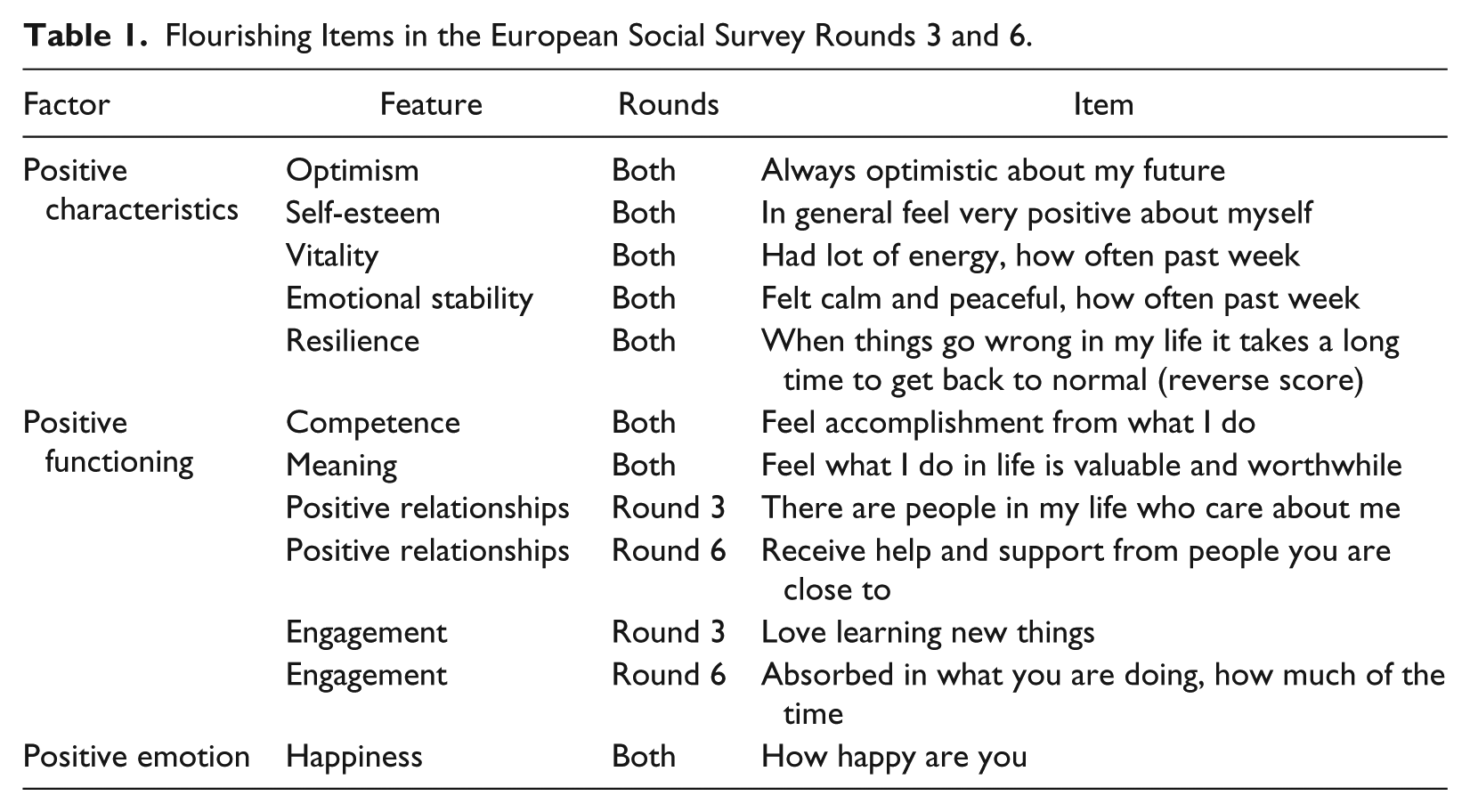
The approach offered by Huppert and So (2013) are among the more stringent flourishing operationalizations (Hone et al. 2014), which considers a person to be flourishing when the person meets the criteria of having (1) at least four out of five features pertaining to positive characteristics, (2) at least three out of four features pertaining to positive functioning, and (3) positive emotion. Given that the concept of flourishing is defined as optimal mental health at the very top end of the mental health spectrum (Hone et al. 2014; Keyes 2002, 2007), we used a more conservative approach than Huppert and So (2013) to operationalize the flourishing scale to capture specifically the most optimal levels of mental health. Thus, for the items pertaining to positive characteristics, we categorized a feature as present when the participant responded “strongly agree” on a 5-point Likert-type scale with “strongly disagree” at the opposite end (optimism, self-esteem, resilience), or responded “all or almost all of the time” on a 4-point Likert-type scale with “none or almost none of the time” at the opposite end (vitality, emotional stability). Note that the resilience item was negatively worded, and was therefore scored reversely.
For the items pertaining to positive functioning, a feature was coded as present when a participant responded “strongly agree” on a 5-point Likert-type scale with “strongly disagree” at the opposite end (competence; meaning, positive relationships, engagement). For the items pertaining to positive emotion, we categorized the feature as present when a participant rated his or her happiness 8, 9, or 10 on a 10-point Likert-type scale, with 0 being “extremely unhappy” and 10 being “extremely happy.” As a result of coding the scale according to the aforementioned operationalization, we ended up with a binary variable, that is, flourishing and not flourishing. As flourishing is considered to be a psychological state, flourishing is commonly operationalized as a binary variable (Hone et al. 2014).
Some items in the flourishing scale were changed from Rounds 3 to 6 of the ESS, and this meant that items on positive relationships and engagement were not exactly the same at both rounds (Harrison et al. 2016). To compare associations between volunteering and flourishing between rounds, we therefore constructed the scale both with and without the items on engagement and positive relationships, the latter with the purpose of conducting a sensitivity analysis. We did this for two reasons. First, we wanted to make the most use of the data available in the ESS, where findings from two rounds would be more informative and provide more robust evidence than drawing on data from only one round. However, this would entail the aforementioned minor discrepancies between the two rounds. Second, we wanted to make use of the most recent round of the ESS, where the construction of a flourishing variable was possible, but since some items differed, it required the inclusion of the original items used in the Huppert and So (2013) study (which utilized Round 3). Finally, Huppert and So (2013) used a less conservative approach than the current study to categorize flourishing, that is, an approach that also captured less optimal levels of mental health. We therefore also constructed a less conservative flourishing scale with all items, where features pertaining to positive functioning and positive characteristics were coded as present if the participant had responded with the second-best category (i.e., “most of the time” or “agree”) as well as the best category (“all or almost all of the time” or “strongly agree”). Thus, we ended up with three flourishing scales: (1) a conservative scale that captured absolute optimal levels of mental health, (2) a flourishing scale coded using the same criteria, but not including items on engagement and positive relationships, and (3) a less conservative flourishing scale, including all items, but also capturing less optimal levels of mental health, similar to the one coded in Huppert and So (2013). Cronbach’s alpha for the for the items included in the flourishing scale at each round was 0.74 (2006) and 0.74 (2012).
Formal volunteer activity
As our predictor variable, we used an item pertaining to formal volunteer activity. Participants were asked how often they had been involved in work for a voluntary or charitable organization during the 12 months preceding the survey. Responses were: never (0—ref), less than two times per year (1), two to four times per year or more (2), at least once a month (3), at least once a week (4).
Covariates
Demographic characteristics included sex, age, and marital status. Marital status was coded as a binary variable: married (including civil union), not married. Age was coded as a continuous variable. Socioeconomic position included education, employment status, and household income. Education was classified in three categories according to the International Standard Classification of Education. The low category included participants with less than upper secondary education, the middle group with upper secondary education, and the high with tertiary education. Employment status was classified in seven categories: in paid work (employee, self-employed, working in your family business), in education, unemployed, permanently sick or disabled, retired, in compulsory community or military service, doing housework, or looking after children or others. Household income was sorted into tertiles and classified into three categories: low, middle, high. Self-rated health was assessed with a single-item that asked participants to rate their own general health on a 5-point Likert-type scale from “very bad” to “very good.” Disability was assessed by asking if participants were hampered in daily activities by illness/disability/infirmity/mental problem. Responses were coded into a binary variable: any or none. Finally, country was classified into four categories: Denmark, Finland, Norway, Sweden.
Statistical analysis
The statistical analysis was done with Stata version 13.1 (Stata Corp LP, College Station, Texas). Because of the differences between Rounds 3 and 6 in terms of the items included in the flourishing scale, we did not pool the two data sets. A descriptive analysis was conducted to demonstrate the characteristics of the samples. These analyses included unweighted frequencies, and weighted proportions, means, and standard deviations. Multivariable logistic regression analyses were conducted to assess the associations between volunteer activity and psychological flourishing. In the primary model, the outcome variable was flourishing assessed by the conservatively coded scale, which included all items pertaining to positive characteristics, positive functioning, and positive emotion. In the primary sensitivity analysis, the outcome variable was flourishing using the scale coded with the same criteria, but not including the two items pertaining to engagement and positive relationships. In the secondary sensitivity analysis, the outcome variable was flourishing using the flourishing scale including all items, but coded less conservatively. Finally, to assess if age before and after the standard retirement age (65+ years) interacted with volunteering in the association to psychological flourishing, we tested for effect modification by standard retirement age (i.e., age 65+ years by volunteer activity).
With the exception of age, all variables were included in the models as categorical variables. Countries were pooled together to generate enough power to detect statistical significance. Each adjusted regression model then controlled for demographics, socioeconomic position, health, disability, and country. In all analyses, weights to adjust for different selection probabilities, sampling error, nonresponse bias, and population size were taken into account to generate nationally representative estimates using the Stata svy command. Results are expressed as odds ratio (OR) coefficients and 95 percent confidence intervals (95 percent CIs). A p value < 0.05 was considered to be statistically significant.
Results
The average age (SD) of the sample (see Table 2) was 46.6 (18.6) in Round 3 (2006) and 47 (19.1) in Round 6 (2012). The samples consisted of 51.0 percent females in both rounds. The prevalence of flourishing was 2.1 percent (2006)/3.2 percent (2012) using the conservative scale (Table 2). When the items on engagement and positive relationships were omitted from the scale, the prevalence of flourishing was 2.6 percent (2006)/4.2 percent (2012) (not shown in Table 2). The prevalence rates using the less conservative scale was 43.3 percent (2006)/47.1 percent (2012) (not shown in Table 2).
Characteristics of the Study Samples.
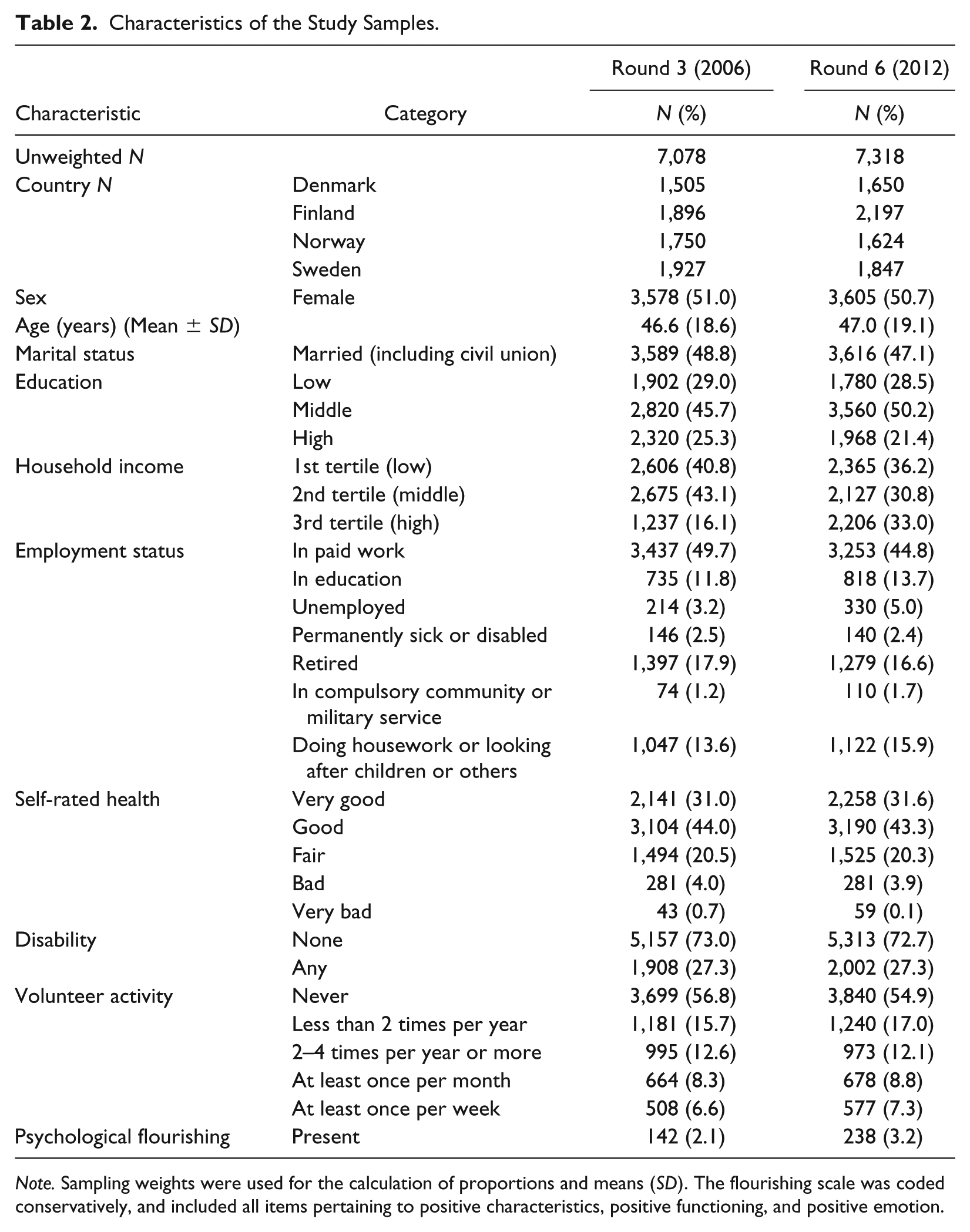
Note. Sampling weights were used for the calculation of proportions and means (SD). The flourishing scale was coded conservatively, and included all items pertaining to positive characteristics, positive functioning, and positive emotion.
Table 3 shows the association between volunteer activity and psychological flourishing estimated by multivariable logistic regression. Based on the primary model, respondents who volunteered at least once a week were more likely to be flourishing in 2006 (OR = 2.04; 95 percent CI = [1.15, 3.62]) and in 2012 (OR = 2.05; 95 percent CI = [1.30, 3.24]) compared to non-volunteers. Individuals who volunteered less frequently than weekly were no more likely to be flourishing than non-volunteers. We found the same pattern of results when the outcome omitted engagement and positive relationships. That is, the primary sensitivity analysis (shown in Table 3) shows similar, albeit slightly attenuated, ORs for weekly volunteering compared with the primary analysis.
The Association between Volunteer Activity and Psychological Flourishing in Scandinavia Estimated by Multivariable Logistic Regression.
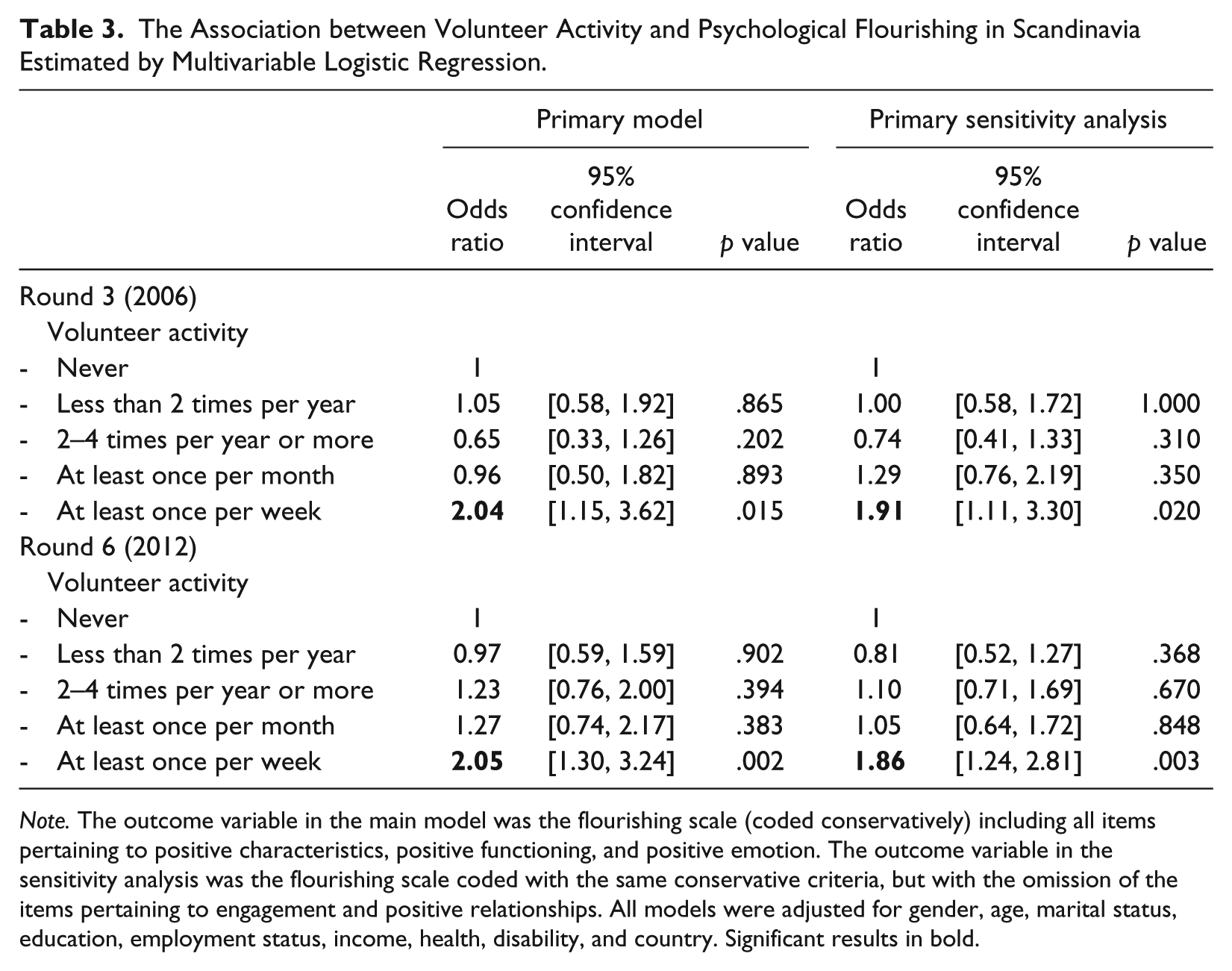
Note. The outcome variable in the main model was the flourishing scale (coded conservatively) including all items pertaining to positive characteristics, positive functioning, and positive emotion. The outcome variable in the sensitivity analysis was the flourishing scale coded with the same conservative criteria, but with the omission of the items pertaining to engagement and positive relationships. All models were adjusted for gender, age, marital status, education, employment status, income, health, disability, and country. Significant results in bold.
In our secondary sensitivity analysis, where the outcome variable was flourishing coded less conservatively (not reported in Table 3), for Round 3 (2006), the three top categories reached statistical significance: volunteering two to four times per year or more (OR = 1.47; 95 percent CI = [1.23, 1.75]), volunteering at least once a month (OR = 1.48; 95 percent CI = [1.21, 1.82]), and volunteering at least once per week (OR = 1.41; 95 percent CI = [1.10, 1.80]). For Round 6 (2012), two categories reached significance: volunteering two to four times per year or more (OR = 1.36; 95 percent CI = [1.14, 1.63]), and volunteering at least once per week (OR = 1.95; 95 percent CI = [1.55, 2.44]).
We found no interaction effect of weekly volunteering with standard retirement age. That is, whether older or younger than standard retirement age, those who volunteered weekly were more likely to be flourishing than non-volunteers. Moreover, whether older or younger than standard retirement age, volunteering less frequently than weekly was not more beneficial than not volunteering.
Discussion
The current study investigated the contribution of formal volunteer activity to psychological flourishing cross-sectionally in 2006 and 2012 among participants aged 15 years and older in Scandinavia (Denmark, Finland, Norway, Sweden). Our findings partly supported our initial hypothesis. That is, volunteering at least once per week was associated with twice the likelihood of psychological flourishing than not volunteering. However, individuals who volunteered less than weekly were no more likely to be flourishing than individuals who did not volunteer (except when flourishing was operationalized less conservatively). Our sensitivity analyses confirmed an association between weekly volunteering and flourishing (1) in the 2006 and 2012 rounds of the ESS, and (2) when using both conservative and less conservative criteria applied to the operationalization of psychological flourishing. In the latter case, the associations were attenuated. This is likely explained by the fact that a lot more people satisfied the inclusion criteria for the less conservative flourishing scale (almost 50 percent). This should be considered when interpreting the results. We did not find significant interaction effects with standard retirement age, suggesting that the associations of weekly volunteering predicting flourishing applied to individuals younger and older than this cut-point. To our knowledge, this is the first study to assess a link between volunteer activity and psychological flourishing specifically.
Strengths and Limitations
The strengths of the study include the large size of the samples, the use of nationally representative data from two comparative rounds of a multinational European survey, and a validated scale for psychological flourishing. Several limitations deserve mention before discussing the results. First, our cross-sectional design precludes the possibility to make conclusions about directions of causality. Second, these findings were based on self-reported data, which implies the possibility for self-report bias and issues pertaining to common-methods variance. Third, the relationship between volunteering and mental health could be affected by things like type of volunteering (e.g., secular or religious) or reasons for volunteering (Piliavin and Siegl 2007; Thoits and Hewitt 2001), but such information was not included in the ESS. Fourth, residual confounding may exist due to potential confounders that we could not adjust for due to lack of data. For example, the ESS Rounds 3 and 6 did not include data on medical status, and we therefore used general self-reported health as a proxy. However, more comprehensive medical information might have been preferred, given that this can have implications for both volunteer status (Wilson and Musick 1999) and mental health (Boehm and Kubzansky 2012; Prince et al. 2007).
Contextualization of Findings and Wider Implications
Our findings on the positive association between volunteer activity and psychological flourishing are in line with previous cross-sectional research documenting similar results (Greenfield and Marks 2004; Pilkington et al. 2012). Our design precludes us from making conclusions about causal directions. However, a number of well-conducted studies have shown volunteering to prospectivly predict enhanced mental health in various domains, such as life satisfaction (Kahana et al. 2013; Meier and Stutzer 2008; Thoits and Hewitt 2001; Van Willigen 2000), positive affect (Kahana et al. 2013), happiness (Thoits and Hewitt 2001), mental well-being (Piliavin and Siegl 2007; Tabassum et al. 2016; Windsor et al. 2008), as well as some related outcomes, such as self-esteem and sense of control over life (Thoits and Hewitt 2001), enhanced cognitive functioning (Griep et al. 2017; Proulx et al. 2017), and self-rated health (Piliavin and Siegl 2007; Van Willigen 2000). Some studies have convincingly suggested that the relationship appears to be bidirectional, that is, volunteering enhances positive mental health, and conversely, people with better mental health are also more likely to engage in volunteer work, to volunteer with greater frequencies, or to persist in volunteer work over longer periods of time (Meier and Stutzer 2008; Thoits and Hewitt 2001).
We did not obtain statistical significance for the “less than weekly” volunteers in our primary model and primary sensitivity analysis. This finding may suggest that the benefit to mental health appears to be contingent on a certain frequency or sustained commitment to volunteering, as some studies have concluded. Meier and Stutzer (2008) found a beneficial effect on life satisfaction for monthly volunteering, but more so for weekly volunteering, and Windsor et al. (2008) reported enhanced mental well-being for volunteering frequencies of 100 to 800 hours/year. Musick and Wilson (2003) reported increasing protective effects against depression for every increase in sustained volunteering over longer periods (i.e., several years). They argue that sustained volunteering (indicating a high level of engagement and commitment) brings about role salience, that is, volunteering becomes a matter of identity, and the volunteer internalizes the role of being someone who helps others or contributes to the community, which in turn affects mental health status. However, our secondary sensitivity analysis did not confirm a clear pattern of a threshold effect for frequency of volunteering. When flourishing was operationalized less conservatively, less frequent volunteering also became significantly associated to the outcome as compared to not volunteering. This may suggest that whether or not one engages in volunteer work regardless of frequency says more than how often one does it, that is, the lifestyle of contributing to society may be the determining factor that promotes flourishing. Furthermore, these individuals may also engage in other related types of activities or social participation that benefit mental health, which would suggest that a lifestyle associated with volunteering is more important than the frequency of it. That said, it may also be that some degree of reverse causality, as discussed above, is implicated in the lack of pattern in our results, suggesting that these individuals are unique in some way. Future studies, particularly prospective ones, are warranted to confirm our findings in Scandinavian samples, as well as to investigate the existence of a threshold effect of frequency in the association between volunteering and flourishing.
In terms of social implications, it is worth considering that volunteering may spread through social networks, and that volunteer organizations may indirectly be fostering helping behaviors in their respective societies. Plagnol and Huppert (2010) posed the question, if people who did not engage in volunteering were instead spending their time and resources on informal helping behaviors. Contrary to their expectations, they found that volunteering was positively correlated with informal helping behaviors, meaning that values and behaviors in the formal domain appear to reinforce the same values and behaviors in the informal domain and vice versa. Furthermore, a number of studies have shown that pro-social and altruistic behaviors spread through social networks (Carman 2003; Fowler and Christakis 2010; Rees et al. 2009). Volunteer organizations may play a crucial role as a means to facilitating the social network contagion of pro-social behaviors throughout society. Communities with high levels of social capital, indicated by norms of helping behaviors, trust, reciprocity, and social participation, have advantages for the mental health of individuals, and these characteristics are also indicators of the mental health and well-being of communities (Lehtinen, Sohlman, and Kovess-Masfety 2005; McKenzie and Harpham 2006; Morgan and Swann 2004). Thus, volunteering may not only promote a more helpful society in itself, but may contribute to a “herd immunity” (Blair, Stewart-Brown, and Waterston 2010; Stewart-Brown 1998), where the more people who are flourishing in a community, the more likely it will be that those with acute or long-term mental health problems can be supported.
The World Health Organization’s Global Burden of Disease Study now shows that depression is the single largest contributor to global disability across all diseases (World Health Organization 2017). The science supporting the two continua model means that the problem of depression cannot be solved solely by focusing on providing more and better modalities of treatment of depression. Indeed, treatment has been the default modality for countless decades, and yet the prevalence and burden of depression and other common mental disorders continues to grow and is projected to get worse (World Health Organization 2017). On the contrary, a growing body of evidence—much of it using longitudinal, representative studies—suggests that many cases of depression could be prevented by moving the segment of populations that are not flourishing (but are also not depressed) to the level of flourishing mental health. That is, flourishing has been associated with lower prevalence and incidence of depressive (and anxiety) disorders over one-year (Grant, Guille, and Sen 2013; Lamers et al. 2015), three-year (Schotanus-Dijkstra et al. 2016), and 10-year time spans (Keyes, Dhingra, and Simoes 2010). Thus, results support Keyes (2007) mental health promotion and protection (MHPP) hypotheses and approach to population mental health. The MHPP approach aims to elevate levels of positive mental health and protect against their loss because the risk of common mental disorders declines when levels of positive mental health increase. Thus, it is now critical to begin identifying social and behavioral determinants of flourishing. The current study investigated volunteering as one such behavioral determinant.
Conclusion
Understanding factors associated with positive mental health is a major research priority in Europe. Interest is particularly focused on modifiable factors, such as behavioral activation, social participation, and civic or community engagement. Our study supports this research agenda by exploring the contribution of formal volunteer activity to positive mental health in the Scandinavian general population. Across pre- and postretirement age, we found approximately twice the odds of optimal mental health specifically for high frequency volunteering. That is, those who volunteered at least once per week in the past year were twice as likely to be psychologically flourishing compared with nonvolunteers. Volunteer work can be considered a win-win activity that provides a valuable service to the community, fosters civic engagement, and may constitute an essential driver of flourishing. Policymakers are encouraged to consider the potential of supporting volunteer organizations as a strategy to promote optimal mental health in societies. Future prospective research is warranted to confirm our findings in Scandinavian samples, and to investigate the existence/role of a threshold effect of volunteer work frequency.
Footnotes
Authors’ Note
This study is a secondary data analysis with no human subject issues. Ai Koyanagi is now affiliated with Parc Sanitari Sant Joan de Déu, Fundació Sant Joan de Déu, Barcelona, Spain.
Declaration of Conflicting Interests
The author(s) declared no potential conflicts of interest with respect to the research, authorship, and/or publication of this article.
Funding
The author(s) received no financial support for the research, authorship, and/or publication of this article.
