




Abstract
Counterproductive meeting behaviors (CMBs) are meeting behaviors that distract members from meeting goals. Using an expectancy violations theory lens, this study explored how subtle, nonverbal CMBs were perceived by meeting members. Additionally, this study considered how apologizing for the behavior may minimize negative perceptions of CMBs. Results showed that meeting members generally viewed subtle, nonverbal CMBs more negatively than the control condition. Further, mobile communication was perceived more negatively than arriving late, and apologies did not impact perceptions of subtle, nonverbal CMBs. These findings are explained in light of expectancy violations theory and apology research.
Meetings represent a central part of organizational life where members coordinate efforts to accomplish a variety of goals and tasks; however, most employees note meetings are inefficient and a waste of time (Allen et al., 2018). Part of this frustration comes when group members behave in ways that violate expectations of appropriate meeting behavior, such as showing up late, not participating, or interrupting others (Allen et al., 2015). These behaviors are referred to as counterproductive meeting behaviors (CMBs). CMBs distract members from the meeting and negatively impact perceived and actual effectiveness of meetings (Allen et al., 2015).
Although many CMBs are verbal and disruptive, others are more subtle and nonverbal in nature. Arriving late, passing a note to a colleague, texting someone outside the meeting, monitoring a sports score on your laptop can all be performed quietly and without interruption to meeting discussion. However, since subtle, nonverbal CMBs can also be viewed poorly, members sometimes perform them in such a way as to minimize the negative impact on the meeting. They may perform them discreetly or even attempt to hide the CMB, hoping to draw minimal attention from fellow meeting members and thus minimizing any harm to the meeting.
The purpose of this project is to explore how subtle, nonverbal CMBs are viewed by meeting members, and whether there are ways of minimizing the potential negative view of such acts. To explore the impact of subtle, nonverbal CMBs on individual and meeting outcomes, we employ an expectancy violations perspective. Meeting members’ expectations of what is considered appropriate may evolve over time, especially given additions of technology to the meeting environment. Even though meeting members may attempt to minimize the harm of CMBs, they may still be noticeable to members. As a result, we also explore whether a verbal mitigation strategy, apologies, can be used to minimize harm. Thus, we examine how subtle, nonverbal CMBs influence meetings at both the individual and meeting levels and examine the effects of mitigation efforts to minimize potential negative perceptions.
Literature Review
Subtle, Nonverbal Counterproductive Meeting Behaviors
CMBs are meeting behaviors that distract members from meeting goals (Kauffeld & Lehmann-Willenbrock, 2012) and are viewed negatively by group members (DeBruin & Barber, 2022). Just observing CMBs in a meeting leads to lower ratings of coworker trust, willingness to speak up about issues (DeBruin & Barber, 2022), meeting attitudes, meeting effectiveness, and team performance (Schulte & Kauffeld, 2020). In addition, CMBs are more problematic than counterproductive work behaviors as they show a lower regard for the organization and coworkers’ time and efforts (Yoerger et al., 2017). CMBs can impact how the offending parties are viewed as well as affect perceptions of how meeting members view the overall meeting (Schulte & Kauffeld, 2020).
When originally conceptualized by scholars, CMBs consisted of absenteeism, unrelated activities, nonparticipation, dominant communication behavior, and inappropriate interpersonal behavior (Odermatt et al., 2018), though most researchers focused on verbal distractions during the meeting, including criticizing others or engaging in unrelated monologues (Lehmann-Willenbrock et al., 2016). However, as noted by the inclusion of absenteeism (e.g., lateness), not all CMBs require verbal interruptions to the meeting. Nonverbal behaviors can also interrupt meetings and distract members from the meeting goal, thereby aligning with the definition of CMBs. These nonverbal behaviors are often more discreet in nature, and if members are skillful, they may be able to minimize or eliminate any negative feelings toward them. For example, Dennis et al. (2010) highlight the benefits of invisible whispering via instant messaging can help with meeting management and information sharing. However, these behaviors can also be problematic in meetings if members are unable to manage them in ways that still demonstrate participation and interest in the meeting (Carney, 2021). To begin investigating how nonverbal CMBs impact meetings, this study explores two prevalent nonverbal, subtle behaviors in modern organizations that are problematic in meetings: arriving late (Allen et al., 2015; absenteeism in the original definition, Odermatt et al., 2018) and multicommunication via mobile phone (DeBruin & Barber, 2022). Both are common CMBs that do not involve verbal interruptions but are still associated with strong negative reactions from meeting members (e.g., Allen et al., 2018; Paskewitz & Beck, 2021). However, both CMBs differ in nature (e.g., visibility, cognitive presence) that may lead to differential impacts on meeting outcomes. Therefore, comparing these two CMBs can highlight the specific aspects of nonverbal CMBs that are problematic in meetings.
Allen et al. (2015) labelled arriving late as a CMB that has many negative impacts at both the individual (e.g., socioemotional interaction [Allen et al., 2018], employee voice, and coworker trust [Allen et al., 2015]) and meeting levels (satisfaction, effectiveness, and performance; Allen et al., 2018). Rogelberg et al.’s (2014) study found 21% of participants defined lateness as arriving after the announced start time, though some participants allowed a grace period. Previous research on meeting lateness has focused on meetings that do not start until everyone is present (Allen et al., 2018). However, missing meeting content is an important contextual factor that plays into assessments of whether lateness is problematic or not (Rogelberg et al., 2014). Therefore, this study focuses on lateness from a missing meeting content perspective.
Multicommunication is a common behavior in meetings and is often viewed negatively as it distracts meeting members from the discussion at hand (Paskewitz & Beck, 2019, 2021). Most meeting members use technology during organizational meetings to stay in contact with others or to work on other tasks (Stephens, 2012). The most common form of technology used is mobile phones, which are already associated with many negative perceptions (Piercy & Underhill, 2021). Though technology use has admitted benefits for organizations and employees (Stephens, 2012), most of the time the behavior is viewed negatively because of assumed off-task interaction (Paskewitz & Beck, 2019; Paskewitz et al., 2025). These negative perceptions of multicommunication are assigned to both the individual and the meeting on the whole, with past research showing multicommunication is associated with a lack of focus and contribution (Paskewitz & Beck, 2019, 2021), incivility (Cameron & Webster, 2011), an unwillingness to work with that person in the future (Paskewitz & Beck, 2021), and lower perceptions of meeting effectiveness and satisfaction (Paskewitz & Beck, 2019, 2021).
Comparing these two CMBs can help understand what aspects of subtle, nonverbal CMBs impact meetings outcomes. Members who are late or multicommunicate often do so in a way to minimize their visibility and cognitive presence. For example, there are a variety of approaches to entering a meeting late, from trying to be discreet to openly acknowledging the lateness in hopes to bring quick closure to the CMB (Mroz & Allen, 2020). The approach to dealing with one’s lateness may depend on how late they arrive to the meeting or the norms created over time for this specific meeting. On the other hand, multicommunication via mobile phone is often conducted under the auspice that it is partially hidden. There are two parts to this secrecy: the presence of the phone and the subject matter of the secondary conversation. Meeting members may try to hide the phone use, whether holding it in a secretive fashion or doing so when the meeting focus is drawn to another member. Blatantly using the phone, especially if the usage is for a completely different focus than the meeting topic, could be considered rude. If noticed, the member may attempt to verbally excuse their misdeed (e.g., “please forgive me”) or give another indication of its use (e.g., “this will just take a second”).
Regarding cognitive presence, individuals who are late to the meeting miss the discussion up until the point they arrive. When they do arrive, the meeting may continue in the same fashion as prior to the arrival, requiring the new member to guess the nature of past meeting talk. Other members may doubt their familiarity with the discussion given the portions that they have missed. Additionally, the lateness may also signify to others that the member is not as mentally committed to the group, or else they would have been on time. A major concern for multicommunication is that the individual is distracted, or at least not completely focused, on the current discussion. Multicommunicators may try to show their attentiveness to the flow of the meeting by participating. However, the ability of individuals to perform two communicative actions is viewed skeptically (Paskewitz & Beck, 2019; Turner & Reinsch, 2010), as members often assume the worst (Paskewitz et al., 2025).
Theoretical Framework: Expectancy Violations Theory
Expectancy violations theory (EVT) focuses on how certain communicative behaviors (verbal and nonverbal) are evaluated by others in reference to expectations of a given situation, roles, or relationships (Burgoon & Walther, 1990). For meeting interaction, context characteristics play an important role as meetings are often ascribed specific rules for communication and come with heightened expectations for behavior based on the importance of the work occurring. Expectations provide a framework for understanding how to behave in a meeting, and when those expectations are violated, individuals often have negative reactions (Burgoon & Walther, 1990; Piercy & Underhill, 2021). These negative reactions are based on evaluations of the behavior and shift our focus from the task content of the conversation to the violation and our assessment of the behavior (Burgoon, 1993).
Behaviors that are perceived as violating expectations often negatively impact our perceptions of that individual (DeBruin & Barber, 2019) as well as the meeting (Piercy & Underhill, 2021). For this study, we are interested in exploring whether subtle, nonverbal CMBs violate expectations for meeting behavior, and their impact on individual and meeting level perceptions. On the individual level, we are interested in how subtle, nonverbal CMBs impact perceptions of focus, contribution, and incivility. Focus and contribution highlight the importance of involvement in meeting discussion. Focus is defined as being engaged with the discussion topic at hand in the meeting (Rutkowski et al., 2007), and a lack of focus can show disinterest in the topic or lead to miscommunication (Reinsch et al., 2008). Similarly, contribution represents speaking up in meetings (MacGowan, 1997) and being an informed participant in the meeting (Bonito, 2000). Failing to contribute may raise questions for participants on whether all meeting members are needed for the task at hand. Showing incivility in meetings refers to showing disrespect to fellow meeting members (Cameron & Webster, 2011). Previous research shows multicommunication can initiate a spiral of incivility (Cameron & Webster, 2011), though less is known about the connection between lateness and incivility.
For the meeting-level perceptions, we are interested in meeting effectiveness and satisfaction given they capture task and relationally oriented outcomes of meetings. Meeting effectiveness is defined as whether the meeting participants accomplished their task and completed good work during the meeting (Kuhn & Poole, 2000). In contrast, meeting satisfaction represents the relational evaluation of the meeting including happiness with the progress the group is making and satisfaction with the meeting overall (Paskewitz & Beck, 2021).
CMBs are problematic in meetings as they negatively impact perceptions of individuals and the meeting overall. In essence, subtle, nonverbal CMBs likely violate member expectations for meetings as they distract members from the meeting goal. We consider two subtle, nonverbal CMBs: lateness and multicommunication. As detailed earlier, both nonverbal CMBs are common in the workplace, viewed negatively, and violate expectations for meetings (e.g., lateness, Allen et al., 2015; multicommunication, Paskewitz & Beck, 2021). However, though both CMBs are subtle and nonverbal, lateness and multicommunication may differ in how they influence meetings because of meeting expectations and characteristics of the violation (e.g., visibility and cognitive presences). Arriving late and multicommunication may be a result of external or organizational factors, such as overbooking of meetings or overlapping deadlines. Importantly, multicommunication involves technology, although lateness to virtual meetings may require navigating technology to be discreet. We explore whether CMBs can be distinguished by their influence on individual and meeting outcomes, given their differences in how members navigate visibility and cognitive presence when performing them. Therefore, the following research question is posed:
Apologies
Prior meeting research highlights the importance of apologies, as they may be used when an individual breaks social rules governing interactions and they want to express sorrow, acknowledge wrongfulness, and promote acceptance of their behavior (Mroz & Allen, 2020). Offering an apology is a way to show guilt and can range in complexity, from highly complex (seven characteristics; Bisel & Messersmith, 2012) to very simplistic versions of “I’m sorry” (Bisel & Messersmith, 2012). This study focuses on simplistic apologies that occur during a meeting given these short expressions of remorse are a common type of apology in meetings (Allen et al., 2023).
Because of CMBs’ likelihood of causing anger or frustration in other group members, individuals may feel the need to apologize for their transgression. For example, research has shown that arriving late to a meeting leads to negative feelings from the other members (Mroz & Allen, 2020). Similarly, research has shown that multicommunicating during meetings can lead to negative perceptions of the individual who is doing the multicommunication (e.g., texting or emailing; Paskewitz & Beck, 2019). Apologies may be a way for meeting members to avoid or minimize the negative evaluations associated with arriving late and multicommunication. Both CMBs have clear negative outcomes and likely violate expectations for meeting behavior. However, adding an apology may help mitigate some of the disruptive nature. Therefore, the following hypothesis and research question are posed:
Method
Participants
Participants were undergraduate students at two universities (n = 347 and n = 491 respectively) who received half of their research class credit for participating in the study. Before merging the data sets together, differences between the two samples were checked with no significant differences on the variables of interest. The data sets were merged into a single file with a total of 838 students. Participants were around 19.31 (SD = 1.80) years old, ranging from 18 to 48 years old. The majority of participants identified as female (n = 475, 56.7%; male n = 355, 42.4%; prefer not to respond n = 7, 0.8%; missing n = 1, 0.1%).
Procedure
To test our hypotheses, video manipulations were created with actors serving as meeting members. Three actors performed in every video, while two other actors, one male and one female, rotated as Sam who played the role of the member walking in late or texting on their phone. Actors were provided a script and Sam was provided with script cues to indicate when to enter the meeting, or an audible ding from a cell phone to indicate when to begin texting. The video showed the beginning of an organizational meeting where members were discussing a location change for an upcoming national workshop. The videos displayed the beginning of the meeting, with the chair stating, “Let’s start the meeting,” and ended with the chair stating, “What’s the next topic on our agenda?” The final videos were around 3 minutes 20 seconds in length.
Ten total videos were created that manipulated the two variables of interest: CMB (lateness or multicommunication), apology (presence or absence). We also manipulated the gender of the actor to control for possible differences. In the lateness videos, Sam walked in approximately 45 seconds after the meeting had started. The other members had started discussing the topic at hand with two members sharing their opinions before Sam entered, aligning this study with lateness defined as missing meeting content. For the multicommunication conditions, Sam participated in the meeting from the beginning, but participants heard an audible ding around 45 seconds into the video after which Sam picked up their phone and began texting. To manipulate the apology, two lateness videos and two multicommunication videos included an apology. In the lateness with apology video, Sam’s first speaking turn started with “Sorry I’m late.” For the multicommunication with apology video, Sam’s first statement was interrupted by the phone ding, followed by the response “Excuse me. I just need to answer this text message real quick. I’m sorry.” Finally, we also created two control videos with only a gender difference.
Upon institutional review board approval, data collection began via Qualtrics. All participants were randomly assigned to view one of the 10 videos and were asked to pay attention to members in the meeting as well as Sam. After viewing the video, participants were asked questions about their perception of Sam, the individual who either entered late or was texting, followed by questions about the overall meeting. All participants also had the opportunity to give additional details about Sam in an open-ended form.
Measures
Focus
Rutkowski et al.’s (2007) focus immersion scale was used to assess Sam’s focus. The scale items ask about Sam’s attention to the meeting task (e.g., Sam was immersed in the task the group was performing; Sam’s attention got diverted very easily [reverse coded]). Items are based on a Likert-type scale ranging from 1 to 5 (strongly disagree to strongly agree), and the scale was reliable with these data (α = .90).
Incivility
Incivility was measured using Cameron and Webster’s (2011) five-item scale. Participants indicated their agreement with each question (e.g., Sam treated the group in a polite manner; Sam was rude to the group [reverse coded]) on a 1 to 5 Likert-type scale (strongly disagree to strongly agree). Composite scores were created with a higher score indicating a higher level of incivility. Acceptable reliability was achieved: α = .92.
Contribution
Contribution was measured with MacGowan’s (1997) group engagement questionnaire. The five contribution items focus on how engaged Sam is in group discussion (e.g., Sam verbally interacted with members on topics related to the group’s purpose; Sam contributed his share of talk time) with a 5-point Likert-type scale (rarely to most of the time). The scale was reliable (α = .91).
Expectancy violations
To assess expectancy violations, Burgoon and Walther’s (1990) scale was used. Four items focus on expectedness of the behavior (e.g., Sam’s behavior is appropriate; α = .87). These items have been used in the past to measure expectancy violations in meetings reliably (Piercy & Underhill, 2021). The scale uses a 5-point Likert-type scale ranging from strongly disagree to strongly agree.
Meeting effectiveness
Meeting effectiveness was measured with five questions from Kuhn and Poole’s (2001) Group Reaction Questionnaire. The selected items focus on participants evaluating the meeting effectiveness more generally (e.g., The group did very good work during this meeting; The group accomplished a lot in this meeting). Similar to past studies with this approach, the five-question scale was reliable (α = .88). Participants ranked their agreement with each statement on a 5-point Likert-type scale (strongly disagree to strongly agree).
Meeting satisfaction
Kuhn and Poole’s (2001) quick poll was utilized to measure the participant’s satisfaction with the meeting (How satisfied would you be with the overall progress of the meeting? How satisfied would you be with that meeting?). Participants ranked their satisfaction with the meeting on a 5-point Likert-type scale ranging from poor to excellent. Reliability was satisfactory (α = .93).
Results
Table 1 includes correlations between all variables of interest. Before answering the research questions and hypotheses, a manipulation check was run to determine if the gender manipulation or any demographic variables influenced participant perceptions with no significant differences. Therefore, we collapsed the videos to focus on lateness, multicommunication, and apologies. Further tests were run to determine whether other demographic variables played a role in the results with no significant findings. As a result, demographic variables were dropped from subsequent analyses.
Correlations Between Variables.
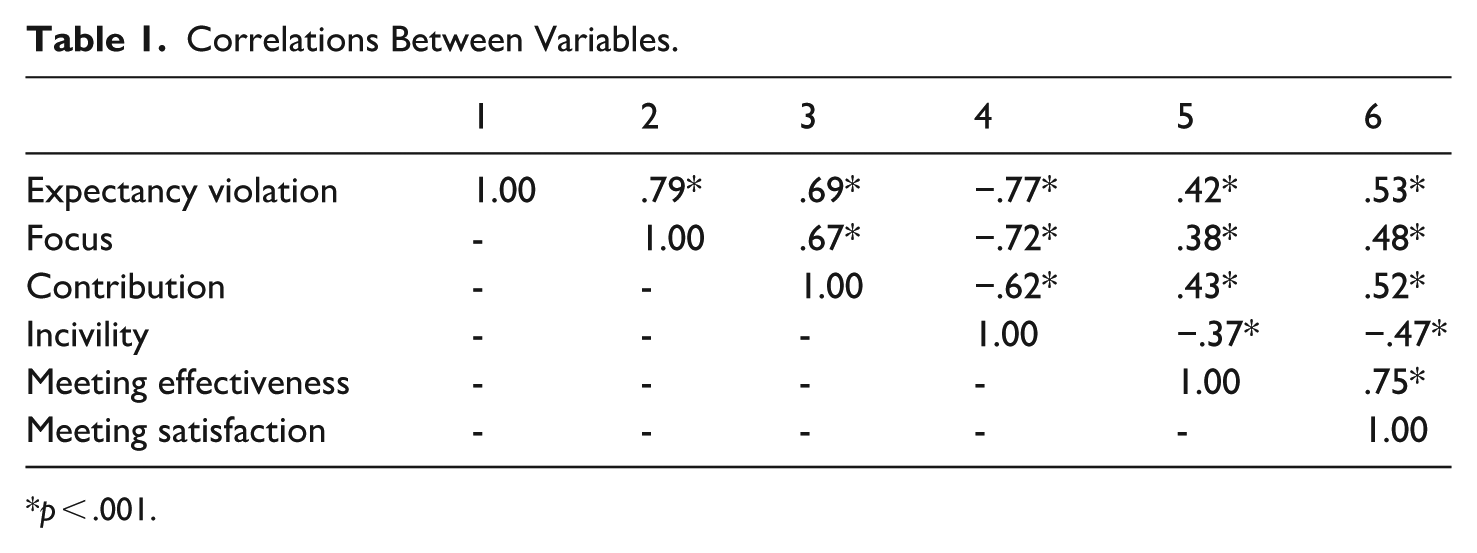
p < .001.
Research Question 1 asked if lateness or multicommunication would result in more negative perceptions of (a) expectancy violation, (b) focus, (c) contribution, (d) incivility, (e) meeting effectiveness, and (f) meeting satisfaction. A one-way analysis of variance (ANOVA) revealed significant differences for expectancy violation, F(2, 835) = 107.98, p < .001; focus, F(2, 835] = 209.18, p < .001; contribution, F(2, 835) = 37.16, p < .001; incivility, F(2, 835) = 110.95, p < .001; meeting effectiveness, F(2, 834) = 8.10, p > .001; and meeting satisfaction, F(2, 832) = 16.81, p < .001. Means and standard deviations are available in Table 2. Bonferroni post hoc analyses showed significant differences between control, lateness, and multicommunication for expectations, focus, incivility, and meeting satisfaction, with control videos having the most positive perceptions. For contribution, the control video was significantly different from multicommunication but not lateness. For meeting effectiveness, lateness and multicommunication were not significantly different from each other.
Means and Standard Deviations for Variables.
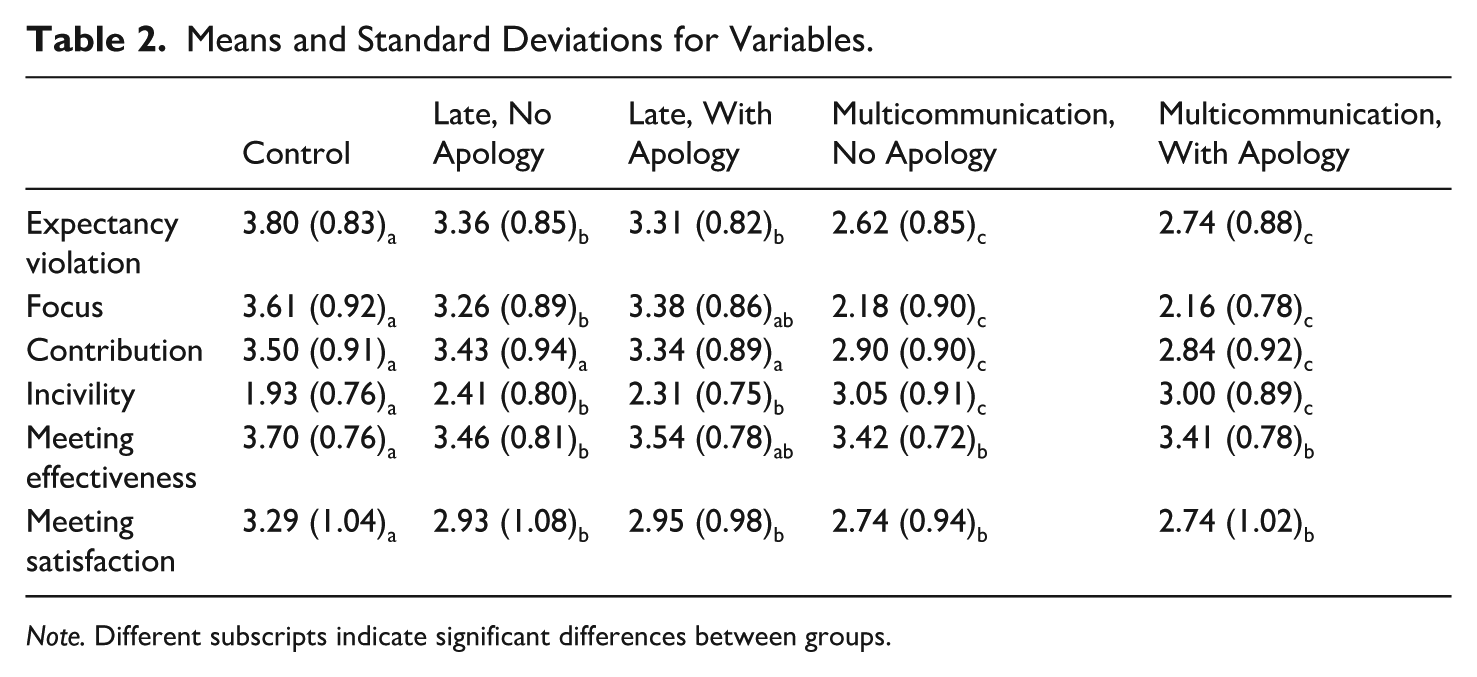
Note. Different subscripts indicate significant differences between groups.
Continuing, researchers hypothesized (Hypothesis 1) that apologizing for the CMB (arriving late or multicommunication) will lead to more positive perceptions of (a) expectancy violation, (b) focus, (c) contribution, (d) incivility, (e) meeting effectiveness, and (f) meeting satisfaction than not apologizing. Using a one-way ANOVA, significant differences were found between control and apology, and no apology. However, there were no significant differences between apology and no apology in the post hoc analyses: expectancy violations, F(2, 835) = 52.24, p < .001; focus, F(2, 835) = 47.77, p < .001; contribution, F(2, 835) = 10.38, p < .001; incivility, F(2, 835) = 51.72, p < .001; meeting effectiveness, F(2, 834) = 7.22, p < .001; and meeting satisfaction, F(2, 832) = 13.42, p < .001. Therefore, our hypothesis was not supported.
Research Question 2 asked if there is a difference between arriving late and apologizing and multicommunication and apologizing on perceptions of (a) expectancy violation, (b) focus, (c) contribution, (d) incivility, (e) meeting effectiveness, and (f) meeting satisfaction. Several one-way ANOVAs with Bonferroni or Games-Howell (incivility only) post hoc comparisons supported this research question. Significant differences were found for all outcome variables: expectancy violations, F(4, 833) = 54.49, p < .001; focus, F(4, 833) = 105.00, p < .001; contribution, F(4, 833) = 18.83, p < .05; incivility, F(4, 833) = 55.82, p < .001; meeting effectiveness, F(3, 832) = 4.28, p < .01; and meeting satisfaction, F(4, 830) = 8.39, p < .001.
Table 2 highlights the differences between conditions based on post hoc tests with some interesting trends. In general, for the individual outcomes, the control condition was significantly different from the other four conditions except for focus (control was not significantly different from late with an apology) and contribution (control was not significantly different from late with no apology and late with an apology). Late with no apology and late with an apology were significantly different from multicommunication with apology and multicommunication with no apology for all the individual-level outcomes. There were no differences within lateness or multicommunication based on the presence of an apology or not. For the meeting level outcomes, the control condition was significantly different from the other conditions except for meeting effectiveness (control was not significantly different from late with an apology). No other significant differences were found for meeting-level outcomes.
Discussion
Meetings are a required part of organizational life, with employees and managers attending an average of 3.2 meetings a week (Kauffeld & Lehmann-Willenbrock, 2012). Though these meetings serve as places of organization and coordination, most employees are disappointed with meetings because of disruptive behaviors from other members (Allen et al., 2015). This study shows that subtle, nonverbal CMBs negatively impact meetings, and have differential impacts on meeting outcomes. Adding an apology for the CMB did not impact individual- or meeting-level outcomes. These findings are discussed further below.
Impact of Subtle, Nonverbal CMBs
This study extends knowledge of subtle, nonverbal CMBs. The findings show that subtle, nonverbal CMBs violate expectations for meeting behavior. Previous CMB work has focused extensively on verbal behaviors (e.g., using sarcasm, criticizing others [Yoerger et al., 2017], complaining, blaming others [Lehmann-Willenbrock et al., 2016]). These verbal behaviors are clearly problematic in meetings; however, they reflect more overt CMBs that meeting members may readily recognize. Nonverbal CMBs are subtle; they can be hidden or concealed in their display and, as a result, meeting members may face little to no scrutiny for them. However, this study showed the opposite to be true. These subtle, nonverbal behaviors violated participant expectations for meetings and negatively impacted meeting outcomes, similar to findings with verbal CMBs (e.g., Allen et al., 2015; Lehmann-Willenbrock et al., 2016; Yoerger et al., 2017).
Second, the findings of this study demonstrate that not all CMBs are created equal; rather, different CMBs can have different impacts on the overall meeting. Prior research often treats all CMBs as equal (e.g., multiple behaviors in a single scale [Allen et al., 2015; Lehmann-Willenbrock et al., 2016; Yoerger et al., 2017]), and although the behaviors are all problematic, it may mask the influence of specific CMBs on a meeting. Expectancy violations theory highlights how individual behaviors are evaluated based on our expectations, with perceived violations negatively impacting views of individuals (DeBruin & Barber, 2019) and the meeting (Piercy & Underhill, 2021). Future research exploring the CMB type may better highlight why so many meetings are rated as problematic.
This study highlights some of the differential effects of CMBs on outcomes by showing that multicommunication is generally more problematic in meetings than lateness. There are several potential reasons for this difference. First, lateness may be more forgivable because of the nature of its performance. Lateness is a one-time interruption to the meeting, which then can be followed by participation, focus, and contribution to the meeting. In this sense, though lateness can be viewed as problematic, it allows the participant to fully engage in the discussion after arrival. In contrast, multicommunication is disconnecting from the meeting and connecting to another communication conversation. This disconnecting from the meeting midstream can communicate a lack of concern for the relationship, conversation at hand, and the overall meeting (Cameron & Webster, 2011; DeBruin & Barber, 2019; Piercy & Underhill, 2021).
Second, CMB perceptions may be driven by how much control an individual has over the behavior. Lateness is not always in the meeting members control (i.e., car accident on the highway, child illness), which may have led to the more forgiving perceptions by participants. In contrast, multicommunication is a choice to engage in a secondary conversation. By turning to mobile phones, meeting members divide their attention between two conversations and often fail as they take short cuts in interpreting and monitoring both conversations (Reinsch et al., 2008). Multicommunication may represent a more severe type of CMB that may lead to more negative perceptions of individuals and the meeting overall due to the assumption of off-task mobile phone use (Cummings & Reimer, 2021; Paskewitz & Beck, 2019). The ability to choose to engage in CMBs may impact the perception of the behaviors.
Apologies Do Not Matter
Most surprisingly in this project, results show apologies made no impact on both individual and meeting level outcomes when a CMB occurred. Though past interpersonal and organizational communication research would support complex apologies for resolving the situation, there are likely different factors at play in a meeting. First, prior research emphasizes apologies should occur before conversation begins (Bisel & Messersmith, 2012; Mroz & Allen, 2020); however, these meeting apologies occurred in the middle of meeting interaction, which was a disruption to the flow of conversation. Disrupting the flow of the conversation could direct attention toward the CMB rather than the task at hand. When interrupting a discussion with a CMB, it is very unlikely the individual will take the time to apologize with an explanation, a promise to not err again, and an offer to make it up to the other members (Bisel & Messersmith, 2012); instead, the focus would be on quickly saving face and moving on to the task at hand. The short apology used here was a way to end the CMB quickly and keep the group moving forward. Exploring the contextual requirements for apologies is an important area for future research given these findings.
Second, even though Sam apologized, a CMB still occurred. The lack of significant findings for apologies shows that members may have high expectations for behavior in meeting settings. EVT theory argues that violations occur when an individual infringes on expectations. In this case, the violation of coming in late or responding to a text message may have been a significant enough violation that an apology was not able to mitigate the negative effects. Though past research supports apologies helping improve perceptions of mobile communicators (Cameron & Webster, 2011) and late individuals (Mroz & Allen, 2020), this study demonstrates that brief apologies may not always be enough to counter the expectancy violation, similar to Piercy and Underhill’s (2021) findings.
Teaching Implications
An important takeaway from this study is that individuals generally provided a negative assessment of the two subtle, nonverbal CMBs, even if these behaviors were conducted discreetly or included a brief apology. Employees, whether senior (accustomed to past organizational norms) or junior (unaware of the norms of an organization), may need to be trained concerning meeting expectations. These discussions do not need to be top down; often awareness of norms and norm violation consequences can allow members to reorient their approach to meetings, and these discussions can be had among all employees.
It may also be helpful to elaborate that brief apologies are insufficient in alleviating the others’ negative perceptions of the act. This might be a surprise to some employees who regard subtle, nonverbal CMBs to not be important or significant. More elaborate apologies (Bisel & Messersmith, 2012) may yield different results, although their interruption to the meeting may be considered a burden as well. An awareness of the limits of apologies may persuade employees to refrain from multicommunication or show up to meetings early.
Limitations and Future Research
This project highlighted the importance of including multicommunication as a form of CMB. Past CMB research focuses on lateness and side conversations as key CMBs (Allen et al., 2015), and multicommunication highlights a new technological challenge for meeting participants. Studying multicommunication as a CMB highlights the disruptive nature of mobile phone use in meetings, and future work should consider how the benefits of multicommunication (Stephens, 2012) can be balanced in meetings. Additionally, these findings showed lateness was not significantly different from the control videos for focus, contribution, and meeting effectiveness. This raises future research questions to explore if lateness impacts relationally oriented outcomes (i.e., incivility, meeting satisfaction) more than task-oriented outcomes.
Second, the experimental nature of this study provides a foundation for future naturalistic-based research into lateness and mobile communication in meetings. Naturalistic meetings could capture the status of Sam within the group to aid in assessing the violation, as well as how meeting members feel about Sam across multiple interactions. Additionally, it would be important to explore the impact of length of meeting on CMBs. If an individual is late to a 2-hour meeting, is that more forgivable than being late to a 15-minute meeting? The same question could be asked for multicommunication: Is being on your phone for a portion of a meeting more problematic in shorter or longer meetings? Considering meeting length and other meeting characteristics is a productive way to better understand how members’ perceptions of others’ behaviors is influenced by contextual factors.
Footnotes

Funding
The authors received no financial support for the research, authorship, and/or publication of this article.
Declaration of Conflicting Interests
The authors declared no potential conflicts of interest with respect to the research, authorship, and/or publication of this article.