



Abstract
The study highlights the crucial role of professional social media and LinkedIn instruction for students seeking employment. An analysis of 20 business and technical communication textbooks identifies significant gaps between textbook guidance and real-world expectations. Some textbooks in both fields fall short in offering actionable strategies for creating and maintaining a professional social media presence. While many textbooks emphasize the importance of social media or LinkedIn, most fail to provide concrete examples or best practices, such as keyword optimization for AI, effective networking strategies, and best practices for posting content. Grounded in digital literacy theory and professional identity formation, the study provides teaching recommendations, including the identification and adoption of supplemental materials to teach professional social media usage.
Keywords
Most college students are unfamiliar with professional social media and often lack adequate instruction during their college years to master its use. While many students recognize that an online professional presence can help them find jobs and internships, they tend to be infrequent and passive LinkedIn users (Carmack & Heiss, 2018). For instance, students might have a basic profile but not actively network and feel uncomfortable doing. Many students learn about job search communication in a technical or business communication course, but not much is known about the presentation of professional social media, including in academic resources like textbooks.
For college-aged job seekers, professional social media like LinkedIn is important for job searching, hiring, networking, and general demonstrations of online professionalism. LinkedIn is the most active job search and professional social media or networking website with over 900 million users (LinkedIn, n.d.). Having a LinkedIn profile and knowing how to utilize the social network are critical for improving students’ employability, including graduate students (Dale, 2023). How users present themselves influences recruitment decisions (Chiang & Suen, 2015; Garcia et al., 2023). Being on LinkedIn can impact perceptions of career outcomes (Pena et al., 2022). Simply being on LinkedIn is not enough; profile content and data on the profile matter for job searching. Fully developed profiles, profiles with a photograph, and many connections positively related to hiring recommendations (Roulin & Levashina, 2019). Thus, students applying for jobs must understand how to use professional social networking sites like LinkedIn and traditional job search strategies and documents.
Given LinkedIn’s importance, faculty should consider how to integrate professional social media instruction into business and technical communication courses. Yet, limited research exists on how and when this content is taught. To address this gap, the present study examines how LinkedIn is framed and explained in business and technical communication textbooks. This analysis is informed by concepts from digital literacy and professional identity formation, which provide a theoretical lens for understanding how students are prepared to navigate professional online spaces. Analyzing the textbooks’ content provides insights into various perspectives on the views of professional social media and approaches to instructional content. While new technologies and non-book sources inform courses, textbooks create a core structure used by many faculty.
By examining the textbook treatment of LinkedIn, the study sheds light on teaching approaches, presentations, and inconsistencies. In doing so, the study contributes to a broader understanding of job search readiness and the communication skills emphasized in undergraduate instruction. By scrutinizing textbook content and explanations of LinkedIn, the researchers identify potential gaps in instructional approach and workforce demands. Ultimately, this article invites reflection on how instructors can better prepare students for professional social media engagement and job search success. More importantly, the study contributes to identifying the cores of business and technical communication course content and approaches to instruction. While prior research has explored what is taught in these courses, less attention has been given to how content is framed and delivered, an important gap in pedagogical scholarship.
Professional social media like LinkedIn deserve a place in business and technical communication instructional material, particularly in courses that include job searching as a topic. However, this study found that the treatment of professional social media in commonly adopted textbooks is uneven and, in some cases, insufficient. Authors often provide limited or vague advice about using LinkedIn. These findings highlight the discrepancies between what textbooks include and industry needs and expectations for job seekers. Professional social media remains important for student job searches and networking, but many textbooks do not provide concrete examples, actionable advice, or best practices for using LinkedIn effectively.
Literature Review
Social Networking and LinkedIn
LinkedIn’s continued expansion and relevance underscores its prominence in the professional social media space. While other apps and sites have attempted to break into the professional social media space, LinkedIn dominates. One of the oldest social networking sites, LinkedIn was founded in 2003, before Facebook (boyd & Ellison, 2007). The platform has consistently expanded its features since its inception. LinkedIn added LinkedIn Jobs (2005), profile photos (2007), Slideshare (2008), importing blog posts (2008), customizable URLs (2011), skills endorsement (2012), adding media (2013), and long posts or articles (2014; Turner, 2022). Most recently, the platform has added generative artificial intelligence (AI) tools for messaging and posting (Turner, 2023). As a division of Microsoft, LinkedIn does not appear to be a trend but a consistent presence with expanding importance for job seekers. To summarize, LinkedIn’s ability to adapt and innovate has helped it dominate the professional social media market.
Professional social media use has continued to expand as part of job searching (Weiner, 2016). Over 90% of recruiters have used LinkedIn to find and examine prospective hires (Ryan, 2022). Unlike Indeed, Google for Jobs, or CareerBuilder, LinkedIn enables recruiters and hiring managers to view candidates’ social media activity, professional presence, and self-branding. Recruiters assessed candidates based on social network usage, rejected candidates based on that information, and saw active users as more employable than inactive users (Aguado et al., 2019). For instance, a recruiter might examine the candidate’s comments on posts or a candidate’s writing ability and style. Additionally, recruiters increasingly have used AI on LinkedIn to find job candidates based on their profiles and résumés uploaded to the site (J. Kelly, 2023). While job seekers do not have to use LinkedIn to find a job, professional social networking online continues to expand in reach and importance, making instruction about LinkedIn crucial, particularly for first-time job seekers.
Digital Literacy and LinkedIn
From a theoretical perspective, LinkedIn instruction intersects with digital literacy development. Many students may enter college fluent in personal social media but lack the literacies required to adapt those practices to professional contexts like LinkedIn or internal company platforms. Digital literacy encompasses the ability to find, evaluate, create, and communicate information in digital environments, requiring both technical skills and critical, rhetorical awareness (Lankshear & Knobel, 2015). Digital literacy involves critical thinking, strategic communication, and an understanding of audience, purpose, and context (Lankshear & Knobel, 2015). Treating LinkedIn as an online résumé overlooks the broader literacy practices required for employability. Without guidance on keywords, analytics, or professional discourse, students cannot fully participate in the digital hiring ecosystem.
Effectively Using LinkedIn as a Professional
Researchers have found that using LinkedIn, including developing a personal profile, matters when job searching. Employers want to see complete profiles (Roulin & Levashina, 2019). Profile writing quality mattered, too. Early studies of LinkedIn profiles emphasized the need to ensure grammatical and spelling accuracy, particularly considering the benefit of LinkedIn as a platform that can be edited and fixed, unlike a submitted résumé (Zide et al., 2014). Researchers found that among hiring personnel who view a LinkedIn profile after evaluating the candidate, factors like writing quality can negatively impact their initial impression (Garcia et al., 2023). A complete, well-written profile with carefully edited content is essential for searching for jobs, and students must understand that accuracy matters and that minor errors can create a long-lasting impression.
In addition to accurate writing, LinkedIn users must consider word choice related to skills and keywords. LinkedIn allows recruiters to find candidates with various search options, including location, keywords, and skill set. As of 2017, there were over 35,000 standardized skills (Ha-Thuc et al., 2017). Other search options have included job titles and industry. LinkedIn has suggested that when recruiters search, they add keywords to narrow down the number of candidates (LinkedIn, 2023). Keywords enable recruiters to find users. If a student lacks specific job-related keywords, the student may never be found through the search feature. Students must understand the role of keywords when writing online content for job searching, including descriptions of past experiences and résumés used for online job searching.
Beyond the verbal content, nonverbal content matters for impression management. Nonverbal content includes profile pictures, text formatting, using white space or bullets, and banner images. For instance, users with a profile picture were viewed as more socially attractive and competent than non-profile picture users (Edwards et al., 2015). When users do not select a profile image, a gray icon appears as a placeholder image. Domahidi et al. (2022) found that profiles with placeholder images were associated with lower profile evaluations than high-expertise pictures, even if the profile text in the placeholder condition communicates more expertise than the photograph. Further, they found that a professional-looking profile picture signals high expertise (e.g., credibility and competence). Domahidi et al. (2022) found that an optimal profile would communicate high expertise in its text and profile image. LinkedIn echoes these points with its recommendations for profile pictures. The company has suggested that people should use good lighting, dress professionally, look like themselves, and have their faces easily visible (Abbott, 2022). They also suggested avoiding selfies and group pictures (Abbott, 2022). Researchers found that working professionals often adhere to popular sources’ recommendations (e.g., Abbott, 2022) for profile pictures (Tifferet & Vilnai-Yavetz, 2018). Job seekers must select an appropriate profile picture and often receive that advice outside of the classroom. This emphasis on professional presentation is equally crucial for students, who might bring a unique perspective to terms like “professional” or miss the application of learning about verbal and nonverbal communication to social media use.
Using LinkedIn as a Student
For students, LinkedIn provides a space where students can actively perform and negotiate their professional identities. Professional identity formation refers to the ongoing process of developing a sense of self that aligns with the norms, values, and practices of a chosen profession (Ibarra, 1999). The language, visuals, and networking moves students use shape how they are perceived by employers and peers. For example, students might observe how alumni or thought leaders present themselves on LinkedIn, and aspire to model those profiles. However, given some inequities, as discussed in this article, some students may not see their identities reflected back. For example, when women and first-generation students are less likely to list skills, share achievements, or project confidence (Domahidi et al., 2022), then students who share those attributes might be less likely to do those things as well. Professional identity formation emphasizes the need for explicit, equity-minded instruction to help all students navigate the expectations of professional self-presentation.
Research indicates that students likely need guidance about LinkedIn usage, including simple factors such as completing the profile sections. A content analysis of 340 community college students’ LinkedIn profiles found that key sections were incomplete, and coders rated 75% of the sample’s work experience sections as poor to below average (Daniels et al., 2023). Considering the LinkedIn About section helps to explain the variances in student usage. The profile’s About section has been used to express and identify skills, and user writing has been marked by differences in language that can praise performance or downplay abilities (Tobback, 2019). Undergraduates tend to provide little information on their LinkedIn profiles, including in the About section (Slone & Gaffney, 2016). The lack of skills and keywords means that students must learn that beyond completing the major sections, they must complete them effectively and appropriately for the context and expectations of recruiters and hiring agents.
While having a professional profile picture is important, most college students do not use the profile picture feature effectively (Lookadoo et al., 2024). In an analysis of 340 profiles of community college students, Daniels et al. (2023) reported that 23% did not use a photograph of a person as their profile picture (e.g., used a cartoon or avatar; had no image). Many profiles with human photos represented traditional, single-person images common on LinkedIn. However, researchers noted that some profiles were with other people, children, or animals. Researchers also reported that many used selfie photographs (Daniels et al., 2023). Students need a clear and work-appropriate headshot for LinkedIn and other online workplace applications, such as user images on Microsoft Teams, Slack, or Zoom. Some students think “professional” photograph means a photograph taken by a professional at prom or for a high school yearbook. However, not much is known about student perceptions of professionalism and photographs.
Beyond the perceptions of professional photographs, student perceptions of professional social media and networking vary. LinkedIn has been called “Facebook in a suit” (Hof, 2008), but Facebook expertise does not translate to LinkedIn expertise. Some seem surprised to learn there is an expectation for networking online professionally. Some students believe LinkedIn is for after graduation rather than part of the job search process (Florenthal, 2015). However, in a more recent study, students viewed having a LinkedIn profile as essential to improve visibility and use LinkedIn to search for jobs (Pardim et al., 2022). Generally, students have found employers’ use of LinkedIn for cyber-vetting to be less invasive of their privacy than employers’ use of Facebook or Instagram (Cook et al., 2020). Students who use LinkedIn may also experience a variety of reactions, including those related to mental health and wellness. In a study of students in China, researchers found that while social media use might spike anxiety, students had career-related benefits from professional social media use, including career exploration (M. Zhang et al., 2024). Students need the basics of profile content management and a higher level of understanding about online self-presentation and critical literacy in social media.
Networking on LinkedIn includes posting, messaging, selecting whom to connect and follow, and giving and seeking recommendations. Traditionally, interpersonal networking has been taught as a collaborative process emphasizing trust-building, which is critical for career growth (De Janasz & Forret, 2008). In a study of graduate students, Davis et al. (2020) found that students with more traditional networking skills were better at using LinkedIn. Further, students who frequently used LinkedIn had more career benefits than those with many contacts; however, the authors recommended that students focus on face-to-face networking, given its greater benefits than LinkedIn usage (Davis et al., 2020). Students should focus on creating a profile and use LinkedIn to learn about others and communicate with them (Davis et al., 2020). If global and remote workplaces expand, online networking will likely expand in importance and necessitate understanding how to use these sites proactively to connect professionally.
Demographic factors influence student usage of professional social networking. Significantly, first-generation students typically have needed instructors to explain comprehensively how to network on LinkedIn (Delgado, 2020). The perception of social class has impacted job search practices, including how LinkedIn has been used (DeOrtentiis et al., 2022). Further, researchers have found gendered differences in usage patterns, including self-presentation in specific fields, profile picture choices, and content amount; they recommended that women expand their lists of skills and profile content (Simon et al., 2023). Researchers also found that men were more likely to give and receive recommendations on LinkedIn, and women were less likely to list professional interests (Zide et al., 2014). Instruction could help address these usage and self-representation differences (Moore, 2019). Students need guidance on creating profiles and online networking to improve the equity of the job search experience. Business and technical communication faculty can potentially fill an important role in teaching professional social media.
Teaching LinkedIn
Whether or not to include LinkedIn in courses has been debated within business and technical communication. Sapkota and Vander Putten (2018) found inconsistent views among business communication faculty about whether or not to include social media in the curriculum. LinkedIn receives less comprehensive coverage than other topics in business communication courses (Moshiri & Cardon, 2020). Creating a LinkedIn assignment has been presented as a way to teach professional communication (Hood et al., 2014). Further, LinkedIn writing assignments can prepare students for workplace writing (Sharma, 2022). While students may receive general instruction on principles that support online writing, modeling appropriate professional social media use may increase students’ capacity for communicating externally online about themselves.
To understand why modeled instruction is necessary, social cognitive theory provides a useful lens. As a psychological framework, it explains how people learn behaviors by observing others, modeling actions, and developing beliefs in their own ability to succeed (Bandura, 1986, 2001). Central to the theory are concepts such as behavioral capability (the knowledge and skills required to perform a behavior) and self-efficacy (confidence in one’s ability to perform it effectively). Applied to LinkedIn instruction, the theory highlights the need for more than description; learners should be provided with modeled examples, as textbooks typically offer traditional documents like letter or memo format. Without such modeling, students might lack both the skills and the confidence to create those documents or, in this case, use LinkedIn effectively. Instruction that incorporates examples, guided practice, and feedback can help build capability and self-efficacy.
Some scholars have voiced concerns about instructors needing to update their classes to include more up-to-date technology content like using LinkedIn (e.g., Doan, 2021; Moshiri & Cardon, 2020). For example, as of 2017, most courses had not assigned LinkedIn as a formal assignment (Moore & McCrady, 2017). Researchers noted that courses might need more technology-related content to “keep up with the realities of the workplace” (Moshiri & Cardon, 2020, p. 843). Since those articles were published, sites like LinkedIn and career search practices have changed significantly. Faculty who teach job search communication may need to add professional social media and consider whether their textbook selection supports that instruction.
LinkedIn coverage in business and technical communication courses can aid students’ professional development and job searching. However, instructors may be reluctant to teach about LinkedIn or review it in depth if they are not confident or knowledgeable about the technology or its very recent changes. Moshiri and Cardon (2020) found that business communication instructors’ technological confidence levels impact their teaching of new technologies; if instructors are not confident in the topic, they cover it less. Doan (2021) emphasized that “to teach LinkedIn, instructors should be given increased training and resources” (p. 313). For example, faculty and recruiters could collaborate to improve career search readiness and LinkedIn usage (Ruparel et al., 2023). However, not all faculty have time or access to recruiters who can foster those collaborations. Faculty face significant challenges as they attempt to stay up to date on job search technologies.
Given the need for students to understand professional social media like LinkedIn and online self-presentation as part of the career-long process of online job searching and networking, this study examines how business and technical communication cover LinkedIn and advice content. While much popular advice can be found online, including on LinkedIn, textbooks act as an authoritative voice and may guide course content or illustrate course and instructional priorities. About 20% of students turn to textbooks for job-searching advice, while 65% go to teachers (Randazzo, 2016). Inappropriate LinkedIn behavior could disadvantage students with less background in professional networking. A lack of LinkedIn guidance may present a problem for women and first-generation students or students whose parents are not in corporate fields, management positions, or other similar occupations.
Understanding textbook content helps identify opportunities to improve classroom instruction and enhance student knowledge of professional LinkedIn or social networking use. Guided by digital literacy and professional identity formation, our research questions focus not only on what textbooks include about LinkedIn but also on how they frame the practices students must learn to participate professionally with professional social media. This study explores textbook content and advice using the following research questions (RQs):
RQ1: How do textbooks cover LinkedIn?
RQ2: How do textbooks explain LinkedIn and discuss its importance?
RQ3: What advice do textbooks give on LinkedIn use?
Method
Data Collection
The researchers collected a sample of 20 textbooks from business communication (10) and technical communication (10). The researchers opted to review books from two fields to explore any field-specific differences in presenting LinkedIn or professional social media. For instance, would technical communication texts have an emphasis on nonverbal accuracy or might there be more stakeholder targeting in business communication? The researchers did not expect that the books would have different amounts of content; the researchers did expect a different approach, which could lead to understanding a more ideal approach.
The criteria for inclusion were that the textbook (a) was a relatively recent publication (since 2017 through the coding process in 2023); (b) included social media, job searching, or job applications in its table of contents; and (c) was a widely published or used text, meaning not self-published or school-specific. The sample included books from various publishers (e.g., Cengage, Kendall Hunt, Macmillan, McGraw Hill, Oxford, Pearson, Routledge, and Sage). See Appendix A for the complete list of titles studied.
Several limitations existed related to this methodology. One limitation is that while researchers can identify textbook content, they cannot identify if additional readings or supplemental resources are assigned in courses. Further, some online textbook platforms may offer supplemental materials, but the researchers did not have access to those platforms. Further, the researchers lack prior studies on faculty views of textbook importance, and some faculty may not care about a lack of LinkedIn content in textbooks. Finally, popular Open Education Resource textbooks were not included because of publication date constraints.
Data Analysis
Analyzing textbooks in technical and business communication is a helpful way to identify areas of improvement in curriculum and content. For instance, Wolfe (2006) examined how 10 technical and professional communication books rarely discuss meeting minutes and do not provide effective workplace-based examples in chapters on working in teams. She urged textbook authors to stress the importance of minutes in team meetings and use the action-oriented style of minutes (more common in workplaces compared to parliamentary procedure minutes). Additionally, Wolfe’s (2009) study of 12 technical communication textbooks found that their advice had a humanities angle that conflicted with professional practice in engineering. More recently, Joswiak and Duncan (2020) analyzed 10 technical communication textbooks’ informative and persuasive communication discourse, recommending a more nuanced, rhetorical approach. Additionally, Mosco (2021) reviewed eight technical communication textbooks, finding they should explain plagiarism, authorship, copyright, and ethics, and workplace writing more clearly and in more detail, along with providing more context-specific scenarios. Lookadoo and Moore (2024) reviewed business communication, business English, and technical communication textbooks’ coverage of résumé writing and artificial intelligence (AI) applicant tracking systems (ATS). They noted the need for textbooks to explain AI ATS’s role in hiring and recruiting, emphasize the importance of keyword use and proper formatting, and provide effective examples.
The researchers conducted a summative content analysis to understand how textbooks included LinkedIn. The summative content analysis method involves examining the use of specific words and content within its context in the textbook (Hsieh & Shannon, 2005). The method occurred in two parts. First, researchers identified and measured the occurrence of keywords and content related to the topic of investigation. Second, we examined contextual meaning of the textbook’s keywords and subject area coverage (Hsieh & Shannon, 2005). Scholars have used this two-step analysis process to evaluate texts’ content focus and suggest improvements for future editions (e.g., M. M. Kelly & Michalek, 2019). The researchers’ summative content analysis focused on constructs of digital literacy (technical, rhetorical, and audience-aware skills) and professional identity formation (norms of self-presentation and networking), which informed our sampling, coding categories, and judgments of actionability.
In the first stage of summative content analysis, the researchers reviewed all tables of contents to identify how the books addressed LinkedIn (e.g., whole chapter, subsection, not listed in the table of contents) and to understand the topic coverage. Then, they generated a keyword list by reading peer-reviewed and popular business news articles about LinkedIn, compiling repeatedly used terms or topics within those texts, and including keywords in the peer-reviewed articles’ keyword lists. Sample keywords included LinkedIn, AI (related to LinkedIn), profile or online profile, social media, and social networking platforms. To confirm that no additional keywords fell into the study’s purview, the researchers thoroughly read five textbooks’ indexes, searching for additional keywords. No additional words were found. The researchers then separately quantified the use of keywords in indexes in batches of four to five books at a time. After coding each batch, the researchers discussed and reached a consensus on the findings. For books that did not contain indexes, researchers used the search function in the ebook editions to review content frequency.
Researchers then began the second analysis stage by examining LinkedIn coverage’s contextual meaning and patterns in the textbooks (Hsieh & Shannon, 2005). To achieve this, each reviewer independently made anonymized notes on each textbook, which were later combined. The researchers looked for patterns by having one initially examine the notes for differences between textbooks and fields, while the other explored general overall themes of content coverage. Subsequently, both reviewers examined the fields together, and in the final review, all the information was considered. The detailed notes of each reviewer were then summarized for the categories of the research questions. In addition, the reviewers identified the strengths and weaknesses of coverage in the various content categories.
Results
This section describes how business and technical communication textbooks cover LinkedIn (RQ1), how authors explain LinkedIn and emphasize its importance (RQ2), and the authors’ advice on building LinkedIn profiles (RQ3). The researchers did not “rank” books, particularly as several are going through the release of new editions. Therefore, they intentionally do not identify textbooks or authors. The interpretation is conducted through the lens of digital literacy and professional identity formation, assessing not only the presence of LinkedIn topics but also their capacity to model and scaffold behaviors that help students build credible online professional identities.
Research Question 1: How Textbooks Cover LinkedIn
Overall, business communication textbooks tended to dedicate more space to LinkedIn than technical communication textbooks, with 80% discussing LinkedIn in detail. In contrast, technical textbooks were less standardized in terms of the amount of content on LinkedIn. Most textbooks did include LinkedIn, and several noted that they had recently added or expanded content.
Tables of content coverage
Both business and technical communication textbook authors discussed LinkedIn. Seventeen (85%) textbook indexes included “LinkedIn.” The three textbooks that did not were technical communication texts published in 2021 or after. Despite the indexes, two of the three texts briefly mentioned LinkedIn in passing (i.e., one to two sentences) in the body of their textbooks. While LinkedIn was widely covered, it was not prominently featured in tables of contents, which publishing staff or editors may have written. Thirteen (65%) textbooks (five business communication and eight technical communication) did not list LinkedIn in their tables of contents. No book dedicated an entire chapter to the topic. Five (25%) texts listed LinkedIn as part of an employment-focused subsection (four business communication and one technical communication), and two (10%) listed it as part of a non–employment-focused section. In summary, business communication textbooks discussed LinkedIn more than technical communication textbooks. While many business and technical communication textbooks mention LinkedIn, the coverage is often superficial. The placement of the LinkedIn content and the absence of LinkedIn in tables of content highlights a lack of comprehensive guidance.
Depth of LinkedIn coverage
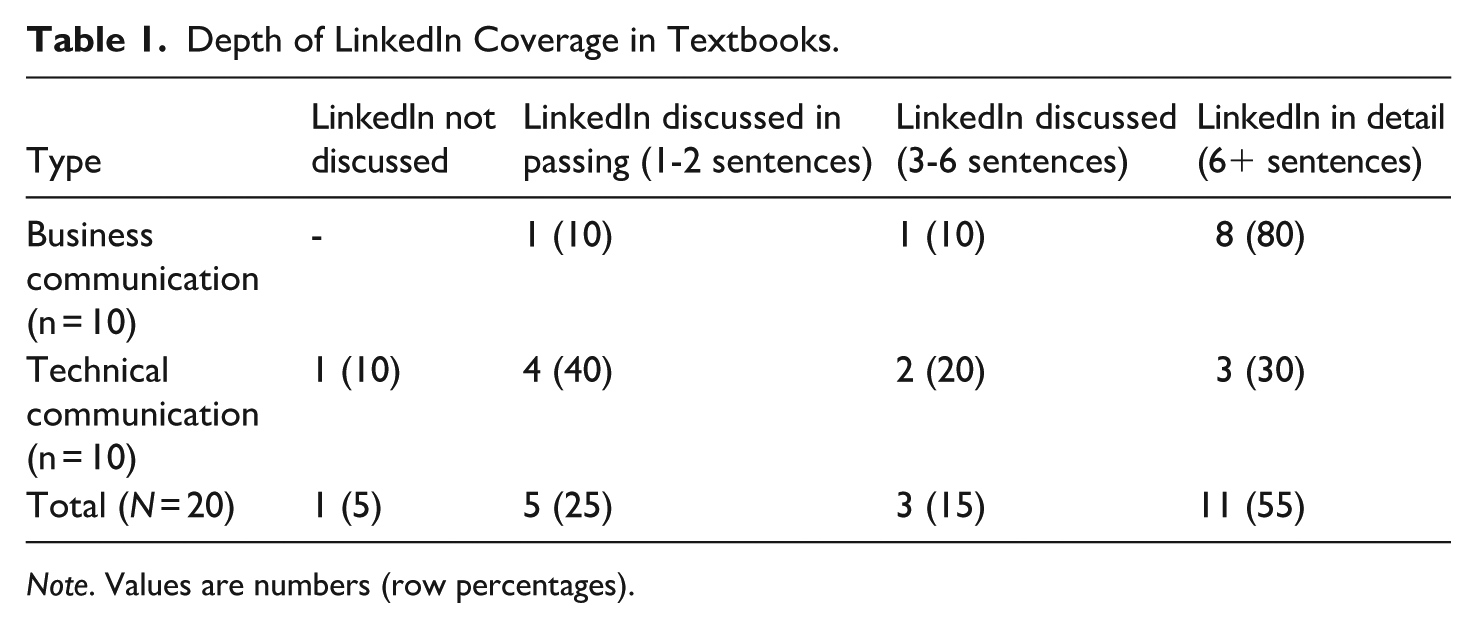
The depth of LinkedIn coverage analysis presented interesting results, as seen in Table 1. Only one (5%) book did not discuss LinkedIn, while five (25%) mentioned LinkedIn in passing (i.e., one to two sentences on the topic). Three (15%) texts discussed LinkedIn (i.e., dedicated three to six sentences to it, while the majority (11; 55%) covered LinkedIn in detail (i.e., more than 6 sentences). When comparing the coverage by field, business communication covered LinkedIn in more detail, with eight (80%) texts dedicating more than six sentences to it. Technical communication texts had more variety in terms of coverage, with three (15%) discussing LinkedIn in detail, two (20%) discussing it, four (40%) discussing it in passing, and one (10%) not covering the topic.
Depth of LinkedIn Coverage in Textbooks.
Note. Values are numbers (row percentages).
While LinkedIn is generally covered, the depth of coverage varies significantly. Business communication textbooks offer more detailed discussion; technical communication textbooks provide broader coverage.
Keyword index coverage
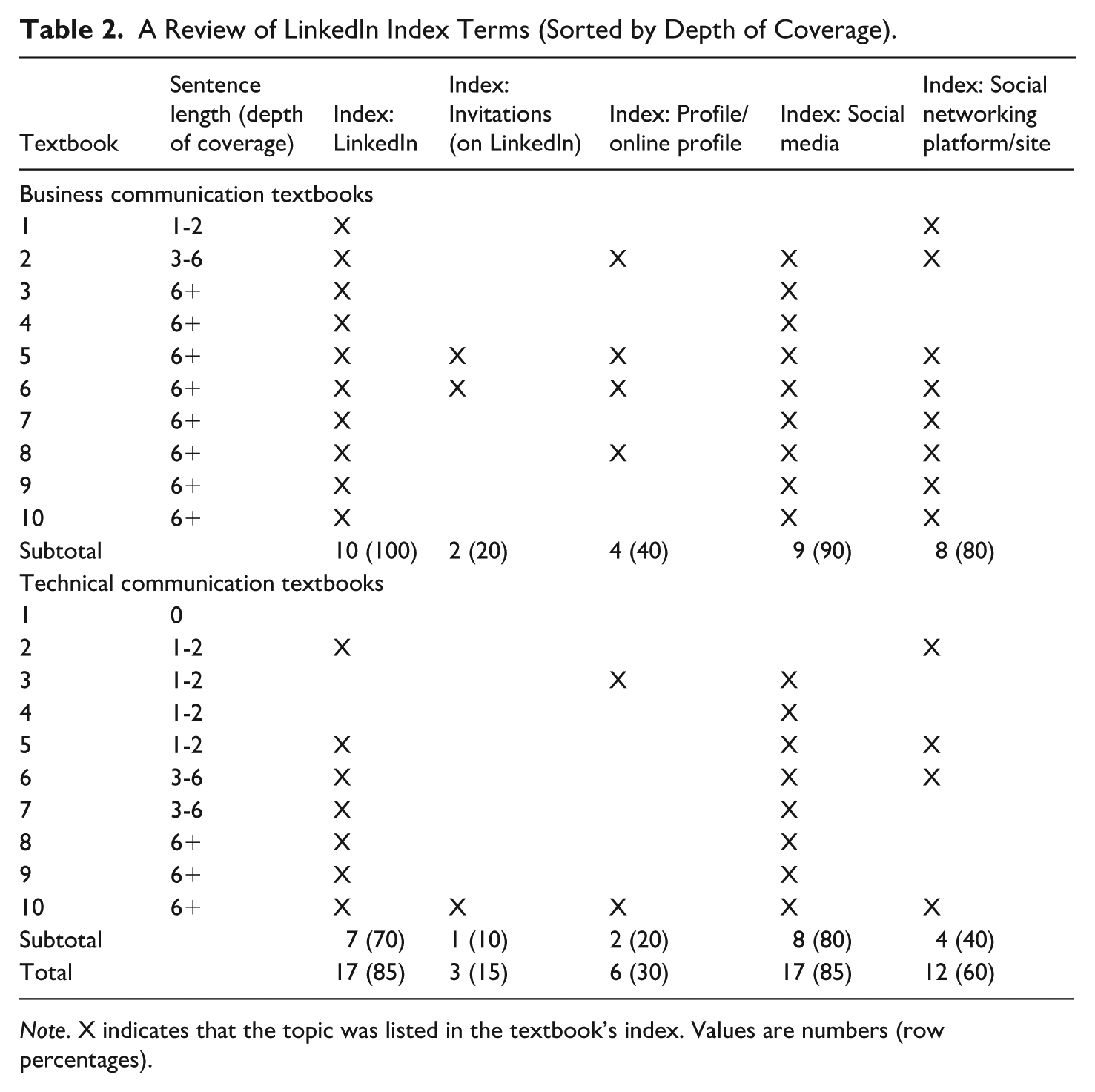
In addition to the tables of contents and depth of coverage, coders also analyzed LinkedIn-related terms in the indexes (see Table 2). As mentioned previously, 85% of texts listed LinkedIn in their indexes. LinkedIn indexes did not “drill down” into subtopics like other index listings sometimes do (e.g., résumé index listings often sublisted to categories like types, keywords, and format). Only one subtopic of “invitations” on LinkedIn was covered by three (15%) books. However, textbooks did list topics that had an overarching connection to LinkedIn. For instance, 6 (30%) indexes listed “profile” or “online profile,” 17 (85%) listed “social media,” and 12 (60%) listed “social networking platform/site.” The index distribution by textbook field was reasonably even, although business communication texts listed “social networking platform/site” twice as much as technical communication texts.
A Review of LinkedIn Index Terms (Sorted by Depth of Coverage).
Note. X indicates that the topic was listed in the textbook’s index. Values are numbers (row percentages).
Several textbooks mentioned that content that could be related to LinkedIn had been added or expanded in the most recent edition. A technical communication book added a chapter on writing for social media, but the textbook did not discuss writing for LinkedIn specifically. Two business communication books mentioned updating content on networking in their prefaces, and two said they added content on job searching. Some books did not give details on edition updates.
While the indexes include LinkedIn, the lack of detailed subtopics and specific discussions points to the gap in actionable advice. Recent editions show some progress; however, overall coverage remains inadequate for students to have comprehensive and actionable knowledge.
Research Question 2: How Textbooks Explain LinkedIn and Discuss Its Importance
The reviewed textbooks provided varying depictions of LinkedIn. Some presented LinkedIn as a career placement tool or a professional networking site, while others presented LinkedIn as an online résumé, profile, or portfolio. Some textbooks treated LinkedIn as a job advertisement search engine. Those authors encouraged students to search companies and find jobs using the website. Some textbooks went into more detail on how to find jobs or look up companies, but not on how to set up a profile with which to apply. While job advertisements are a feature of LinkedIn, exclusively focusing on the site as a job search tool devalues the importance of a complete, well-written profile and features for networking, posting, and communicating with professionals or recruiters. A few textbooks addressed LinkedIn as something organizations, rather than individuals, use. Only a minority of textbooks treated LinkedIn comprehensively as a professional social networking platform with job search tools, a professional online networking tool that needs a developed personal profile, and a site with opportunities for recruiting, advertising, and marketing by organizations or businesses.
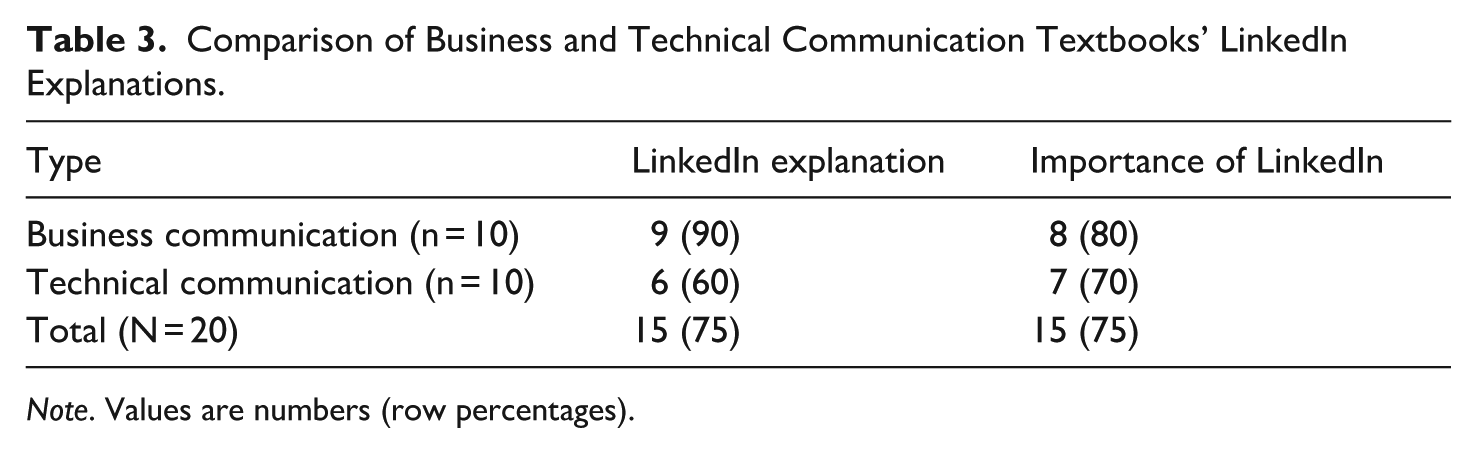
Most (75%) textbook authors explained LinkedIn and emphasized its importance. The explanations and emphasis occurred more often in business communication texts than in technical communication texts (see Table 3 for details). In both fields, textbooks described LinkedIn as social media, social networking, an online résumé, an online professional networking platform, and a job search site. For example, one book explained, “One of the most important networks is LinkedIn, which has become critical in a job search.” For comparison, LinkedIn describes itself as “the world’s largest professional network” (LinkedIn, 2023, “About LinkedIn” section). Some books gave varied, if not contradictory, descriptions. For example, one book called LinkedIn a “social networking site” like Facebook and X (formerly known as Twitter), later called LinkedIn “social media,” and finally called LinkedIn a “social media network.” Another book uniquely coined the phrase “socially networked multimedia résumé.” Most books were more consistent in the terms used. LinkedIn was almost always called LinkedIn, not LinkedIn.com.
Comparison of Business and Technical Communication Textbooks’ LinkedIn Explanations.
Note. Values are numbers (row percentages).
While most textbook authors seem to recognize and emphasize the broad importance of LinkedIn, the descriptions and terminologies vary widely. The inconsistency is notable when comparing business and technical communication textbooks. While a more standardized approach may not fix the unique approaches of the textbooks, the differences do highlight a need for a more actionable and audience-focused approach.
Descriptions of LinkedIn
The textbook authors’ initial explanations of LinkedIn seemed to influence LinkedIn descriptions. Some books explained LinkedIn more within an organizational context or as something recruiters or businesses use. For example, several technical communication books gave descriptions that emphasized the business-user side of LinkedIn. One technical communication book called LinkedIn one of the “business-centered social networking sites,” and another said LinkedIn helps “connect key business partners.” Some books explain that LinkedIn is used for multiple purposes. One business communication book introduced LinkedIn as a “social media platform” for business and later as “the world’s largest professional social networking site,” which was the most similar of all books to how LinkedIn describes itself. However, the book also said LinkedIn could be used like Facebook for recruiting. This book was not the only one to offer multiple explanations for LinkedIn. A different business communication book introduced LinkedIn as a place for professional self-presentation. Later, it explained that LinkedIn works like an online résumé. However, the book never described using LinkedIn as part of the job search process or for communicating on behalf of an organization. LinkedIn was identified for networking in this same book, and in the next paragraph, other sites were listed for job searching. Some books advised how students could use LinkedIn for their current organizations; others presented LinkedIn as a static, online product of a résumé conversion. The depictions were not consistent, but they sometimes fit the theme or intent of the textbook.
Many books introduced LinkedIn in passing in early chapters with no explanation of how LinkedIn works or what it is. This study did not review interactive or adaptive textbooks, which may offer additional features for defining key terms. Both technical and business communication textbooks introduced LinkedIn without explanation and in varying contexts. For example, one book mentioned LinkedIn in a chapter on audience and purpose and said LinkedIn could be used for someone to post jobs on their profile. This information is correct but potentially misleading for student readers, and no other explanation of LinkedIn was given in that chapter. Another book mentioned LinkedIn in its first chapter on ethics, discussing being unable to control what employees post online. The initial reference may be difficult for students with low LinkedIn awareness or understanding.
LinkedIn’s importance
Some textbooks stressed LinkedIn’s importance by emphasizing its benefits to the student or professional who needs to job search or network. Several books included LinkedIn’s potential for helping with the job search, sometimes listing LinkedIn with job search sites like Indeed. One technical communication book called LinkedIn “most popular site of its kind” in the context of “job search” “social media.” Some books emphasized LinkedIn’s importance by stressing how recruiters and others hiring use the platform. A business communication book described it as the “most popular social media site for employers.” This description downplays the student as a user while job searching, networking, or maintaining a profile. Another business communication book said LinkedIn was the “go to professional networking site.” Both fields had examples of demonstrating LinkedIn’s importance by discussing LinkedIn as an online résumé. In business communication, one book said a LinkedIn profile was “the most beneficial type of online résumé to create.” Another business communication book said, “You should approach your LinkedIn profile in the same way you approach your resume. By identifying a professional narrative of your key selling points. . . . Typically, your LinkedIn is an elaborated version of your resume.” A technical communication book said LinkedIn “allows you to create a full, résumé-like profile and link to external items, such as YouTube videos.” A different technical communication book called it the “premier site for your job search.” The author wrote that LinkedIn can be used for “housing your profile, hosting a job board, distributing helpful articles and advice, and extending your network.” Most books included the bulk of the LinkedIn content in a job search–related chapter, and that placement seemed to influence the discussion of LinkedIn’s significance. Generally, textbooks did not explain LinkedIn’s importance for multiple audiences and purposes (e.g., business marketing, distributing news content, job seeking, professional networking, recruiting, and generating B2B sales leads). However, the textbooks were also designed for introductory business or technical communication courses, and some of those topics might be nontraditional for those courses.
Further, textbook authors made varying assumptions about readers’ LinkedIn knowledge. Some business and technical communication books assume readers know about or have used LinkedIn before taking a communication course. One author presented LinkedIn as something students “probably” already had but could improve. Another business communication book introduced LinkedIn early in the book as something businesses use to connect. However, several pages later, a section about LinkedIn explained how job seekers use the site to network. LinkedIn as a business tool or a personal job search tool was sometimes explained in separate sections, and more often, the use of LinkedIn for job search purposes was placed in chapters about job searching at the end of the textbooks. One business communication book introduced LinkedIn as a social networking site for sharing information, but the introduction did not reference a job search feature. The varying assumptions about the student audiences’ knowledge and the inconsistent placement of LinkedIn content highlight a lack of cohesive and practical guidance. Students may need more structured advice.
Multiple books in both fields included LinkedIn in a list with sites like Facebook, X, Pinterest, and Indeed. For example, a business communication book introduced LinkedIn alongside Facebook and X and explained the differences in another chapter. Similarly, a technical communication book described Facebook and X as a “complement” to LinkedIn. Another business communication book included screenshots from Facebook, X, and LinkedIn with comments to explain the differences and how to use each site appropriately when on the job market. However, the book that explained differences in detail was the exception. The books that presented LinkedIn alongside Facebook could create confusion for students who engage in Facebook- or X-typical practices on LinkedIn. Similar to how digital literacy is taught, one book placed LinkedIn alongside other social networking sites with a warning about being found online: “If you post to social media sites (e.g., LinkedIn, Snapchat, Instagram, YouTube, Facebook, Twitter, TikTok, etc.), your digital presence continues to expand and, theoretically, can be found and used to define you.” Similarly, another book included, Never give out personal information online. . . . This includes social network-ing sites. You might think only your friends can access your Facebook, Twitter, Instagram, or LinkedIn pages, but it is not that difficult for some-one else to gain access to that information through one of your “friends” or contacts.
Of course, when applying for jobs, candidates would want to be found on LinkedIn. Overall, the explanations of LinkedIn varied in specificity and levels of clarity. This may lead to confusion for students who apply guidance on how to use, for example, Instagram for their posts on LinkedIn. The need for more detailed and specific guidance is evident.
Research Question 3: What advice do textbooks give on LinkedIn use?
Similar to the differences between the explanations of social media and social networking sites, the advice differed across the textbooks and the field. For example, one book said students could use LinkedIn, Facebook, or X to research and connect with professionals. However, the book did not explain how to use these sites to research or connect with unknown professionals or known industry contacts on a site like Facebook. Given that some people resist connecting on Facebook or Instagram with colleagues, the advice to add unknown contacts needed more explanation on how to do so professionally. Other books also suggested LinkedIn for research; some provided detailed advice and context for research using LinkedIn. One book advised students to watch what they post online, grouping LinkedIn, Facebook, and X. The book made no distinction between the expectations for a LinkedIn post and a personal Facebook page post. A business communication book paired LinkedIn with a lesser-used job search phone application that does not have social networking capabilities. A few books explained the differences, but half did not give advice. For books that gave advice, the advice varied wildly, with some providing minimal or unclear instructions. There is a clear need to offer more comprehensive and practical advice, including distinguishing LinkedIn from other social media platforms.
Networking
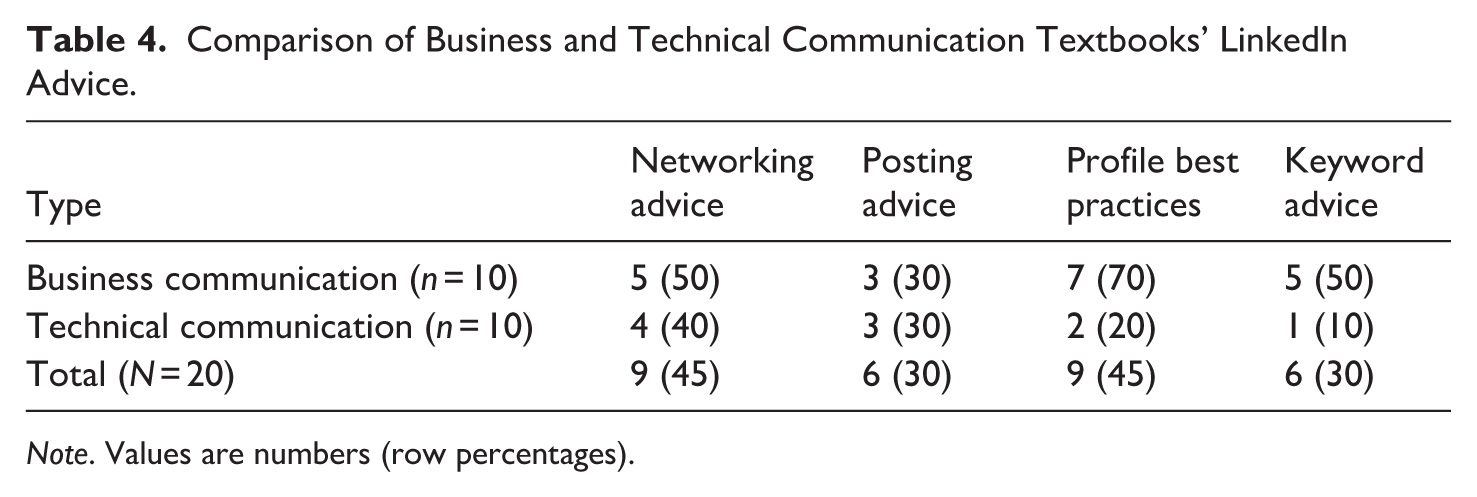
The analysis found varying levels of content about networking. Coders found that nine (45%) of the 20 textbooks provided advice on networking through LinkedIn, as seen in Table 4. Business and technical communication books were almost equal in how many talked about networking (50% and 40%, respectively). While some books emphasized the importance of networking, coders only counted books in this category that gave actionable advice on the topic. For instance, one book told readers to build their network by making connections, but did not explain how. In contrast, one book included the following clear advice for networking messages: “When connecting with someone new, craft a personal, detailed message that lets the person know who you are and why you want to connect with him or her.” In short, most books do not offer actionable LinkedIn networking advice.
Comparison of Business and Technical Communication Textbooks’ LinkedIn Advice.
Note. Values are numbers (row percentages).
The textbooks that did include actionable networking advice often stressed the importance of making connections and focusing on the quality, not quantity, of connections. Many texts clarified how to make connections by providing sample networking messages. Some books provided good and bad examples of networking messages and multiple suggested ways of personalizing messages. Other books emphasized building one’s network starting with people they know (e.g., classmates and former coworkers who are often resources for finding out about jobs) and then reaching out and networking with people they do not know. One book recommended that students email everyone in their LinkedIn network for help finding a job and making connections. While LinkedIn may allow students to mass message, the technique does not take a targeted approach, and that type of “looking for work” content would typically be more appropriate for a LinkedIn post than a mass message. However, the book did not discuss posting. One business communication book suggested that readers should start a group for networking. A technical communication book suggested being active on LinkedIn, such as commenting on posts and sharing articles. However, the quality of the advice varied. For example, one book suggested, “You can also send an e-mail to everyone in your LinkedIn network asking for help or for people they could put you in touch with.” Students need to target certain contacts, not spam everyone. As a further posting example, one book stated, “Keep in mind that potential employers will almost certainly check your online profiles and postings because it is easy to do so and because this information could offer a critical warning about your attitudes and behaviors.” Most books do not discuss networking on LinkedIn, much less how to post. While some books provided valuable advice, there is a gap in comprehensive guidance. The lack of detailed instructions on posting and professional social media strategies may disadvantage students.
Thematic networking advice
Some books presented a general theme or direction on how to engage in networking online, and a few applied a positive theme to using LinkedIn. For example, one book advised readers to adopt a “giver” mentality. This framing connects closely to the findings in the literature review that focusing on LinkedIn as a traditional, relationship-building networking can be effective. Further, in contrast to depictions of LinkedIn as a place to find jobs, the suggestion to give back emphasizes to students the collaborative nature of LinkedIn. Suggesting “giving” also sets an ethical standard for appropriate behavior and interactions. Another book pushed positive engagement across all online platforms. The book gave specific examples of types of post content that could benefit the reader and the reader’s organization. The book also clearly advised readers not to engage with “questionable” content, like jokes that could be offensive. One technical communication textbook focused on character and reputation on LinkedIn. The textbook used values-based concepts like integrity, politeness, courteousness, maturity, and courage. This textbook advised not posting humorous things, given the potential for miscommunication. Most books did not address inappropriate content in their discussion of LinkedIn, but sometimes mentioned this concept elsewhere. For example, one book mentioned avoiding political topics when microblogging; while not mentioning LinkedIn specifically, the advice could be applied. Other topics mentioned in books about social media broadly included misinformation and profanity. The textbook authors may assume that students would apply advice about using social media, blogging, or social networking to their sections on LinkedIn.
Unactionable networking advice
Some authors provided advice but needed more specificity or consistency, particularly in technical communication books. For example, one technical communication book advised “never” to give out personal information online, but then the book later tells students to post their résumés on Pinterest, Facebook, and Instagram. Similarly, another technical communication book said not to provide links to LinkedIn profiles unless doing so would be “conventional” in the field, and the authors mention the act being conventional for a computer science–related field. However, this was not true of all technical communication books. One technical communication book clarified that a public profile helped recruiters find candidates; another said having a public social media presence was essential for job searching. In contrast, one business communication book advised students to create fully public content that is searchable across multiple platforms. Most technical communication books did not explain how to use LinkedIn for job placement or professional networking, with enough advice to be actionable. Further, while many technical communication books reviewed topics like reader-centered approaches or graphics, no advice was given on creating graphics specifically for LinkedIn. Where these books could demonstrate their strengths, particularly in visual imagery, they did not tend to extend that strength to the coverage of LinkedIn.
Posting
Writing posts or posting was not a popular topic related to LinkedIn. Only 30% of textbook authors (three from business and three from technical communication) provided LinkedIn posting advice. This advice was less detailed than networking. The authors explained that posting was crucial in generating profile views and strengthening one’s online presence. One suggested making posts visible beyond connections so employers could view them. Some books suggested posting periodically, but did not give examples of what to post about and how active to be. A few authors discussed topics students could post about (e.g., upcoming events and interesting articles) and explained that posting helps generate more profile views. Two books suggested posting frequency: one business and one technical communication book recommended posting weekly. One book had a sample post, and one gave examples of how to comment on posts. One business communication book included a quote from a recent graduate who recommended LinkedIn: “you are what you post.” Often, books would give general advice that could be connected to posting or commenting, but the connection was not made clear. For example, one business communication book recommended using LinkedIn “consistently” and “staying active” but provided no details on the meaning of active other than updating a profile. One book made an explicit move to connect the book’s rhetorical themes to the activity of posting, to professional identity, and to digital literacy: “Remember, everything you post should be correct, professional, and accurate. Your online activity helps establish your ethos, your reputation as a responsible, knowledgeable person someone would like to hire.” However, generally, how to post, what to post, and when to post, comment, or share were not discussed at length in most books.
Overall, the applicability and specificity of posting advice varied depending on the treatment of LinkedIn and its purposes. One business communication book advised readers to create a LinkedIn profile but comment on “highly read” blogs with a link back to the LinkedIn profile. The types of appropriate blogs or the conventions of posting on blog posts were not explained. Further, the author did not note that the user could comment on LinkedIn posts or applicable content. Commenting on LinkedIn posts would potentially be safer in evaluating content appropriateness. Another book advised students to write blog posts for the company to share on LinkedIn, but the book did not suggest writing LinkedIn posts that might help students find jobs or promote their own careers. These two pieces of advice illustrate a contrast between books that encouraged readers to use LinkedIn at work to promote the organization versus books that treated LinkedIn as a personal job search tool.
Messaging
The study coded for networking rather than messaging, but several books included LinkedIn messaging. Messaging lets LinkedIn users connect directly to contacts, including other professionals or recruiters. Some authors may have assumed readers would apply the advice on emailing or networking to LinkedIn messaging. One business communication book gave a sample of a LinkedIn networking message, similar to an email in form and length. Few books advise on the content or format of messages. A second business communication book said to include the nature of the connection or point of the communication in a networking message. Another business communication book raised the question of how quickly to respond to LinkedIn messages. However, the book did not answer the question but referenced the message context. Uniquely, one other business communication book gave three examples of appropriate tone when messaging on LinkedIn. The samples illustrated appropriate and professional practices. While these books offered advice, most did not offer advice on messaging. For example, one technical communication book suggested that users make connections and share links, but the book never mentioned messaging or creating content. Sharing links rather than creating content may reflect when the textbook was updated as features changed in the 2010s. While some textbooks provide advice about messaging, the guidance is often limited and fairly inconsistent. Some textbooks lacked clear instructions on the content, tone, and timing of messages. Practical advice can help students understand the application of external communication, which many courses include.
Profile best practices and keyword advice
The analysis of LinkedIn profile best practices, including the use of keywords, revealed significant disparities. Less than half of the sample (nine; 45%) provided best practices for creating a LinkedIn profile. There was a clear difference in the emphasis of this topic between fields. While 70% (seven) of business communication textbooks provided actionable advice on building a LinkedIn profile, only 20% (two) of technical communication textbooks did. The disparity between the two fields may reflect a prioritization of job search communication.
Some books gave general profile, e-portfolio, or social media advice that could be applied to LinkedIn, but the authors did not make a direct connection for the student readers. For instance, a technical communication book coded as having advice for LinkedIn gave advice on presenting a positive image, sharing relevant information, and presenting an ethical character. However, the book presented general information about using social media, such as Facebook and LinkedIn. One technical communication book advised analyzing a LinkedIn profile as part of audience analysis, but did not explain how to create a profile in as much detail. This study did not code books that gave general social media advice without mentioning LinkedIn as having LinkedIn advice. This decision to introduce LinkedIn but not provide advice was not limited to technical communication books. One business communication book repeatedly emphasized needing a LinkedIn profile, but never advised about creating one. However, the lack of advice was more prominent in technical communication books.
Portfolios and e-portfolios
While the technical communication books differed in their advice, most had a common theme: e-portfolios or print portfolios. One book with little about LinkedIn also had a little about portfolios; a different book mentioned needing a portfolio in passing, with no explanation of portfolios. In contrast, another book mentioned needing a portfolio on a personal website, but never mentioned LinkedIn. The other books included portfolios, e-portfolios, or both. For example, one book set up LinkedIn as the new form of e-portfolios: “LinkedIn IS your electronic portfolio. Make sure that the resume that you would submit via e-mail matches the profile that you create on LinkedIn and other social networking sites.”
The technical communication books sometimes presented e-portfolios as a way to search for jobs. One book said to create an e-portfolio with a “résumé, letters of recommendation, transcripts and professional certifications, and reports, papers, websites, slides of oral presentations, and other types of documents.” The book said to place that portfolio link on a LinkedIn profile. A second book discussed e-portfolios for several pages but only mentioned LinkedIn in passing. A third book gave specific, actionable advice for e-portfolios and presented LinkedIn as a networking tool primarily with less advice on profile creation. Similarly, a fourth book with clear, actionable information about LinkedIn focused more on creating e-portfolios than LinkedIn. A fifth book said that LinkedIn could work as an e-portfolio; however, the book had an entire chapter dedicated to e-portfolios without mentioning using LinkedIn for the e-portfolio. Similarly, the book did not include LinkedIn in its social media chapter. The book gave the impression that the LinkedIn content was added in the most recent update; however, the topic was not fully integrated into the rest of the book. While some technical communication textbooks acknowledge the potential of using LinkedIn as an e-portfolio, the integration of LinkedIn advice was inconsistent and lacked detail.
Most business communication books did not present LinkedIn as a portfolio, and those that did also included content on LinkedIn as a social media or social networking site. One of the business communication books introduced LinkedIn within the context of creating a portfolio for career seeking. The book stated in its prologue that LinkedIn is one potential place for hosting an online portfolio. However, the book’s body content shifted to discussing LinkedIn as a social media profile rather than a portfolio. Similarly, another business communication book included e-portfolios separately from its discussion about LinkedIn. In another book, LinkedIn was presented as part of an employment portfolio. One book suggested a traditional, printed portfolio for in-person interviews. While several business communication books included the portfolio concept, the business communication books did not prioritize the portfolio as the technical communication books seemed to do. This prioritization may relate to how the authors saw their audience, as some technical communication courses have focused on students as future professionals in technical communication and potentially needing a portfolio of their communication products.
Keywords
Most textbooks in the sample did not include advice about keywords, and this was particularly true of technical communication. While 50% (five) of the business communication books included keyword advice, only 10% (one) of the technical communication books included keyword advice. Practical and ethical keyword usage is critical for AI-based scanning and manual searching. Some books gave vague advice, such as to include “specific” keywords with no explanation of keywords. For example, one included this advice that included why to use keywords, but would require students looking up appropriate keywords: “Use keywords that relate to your career or field of work, which will make your profile easier to find.” One business communication book provided detailed advice on résumé keywords and did not mention keywords and LinkedIn; however, the author said résumé advice should apply to LinkedIn. In contrast, another business communication book included a keywords table with an explanation of how the keywords were culled from a job advertisement, and the book explained explicitly that keyword advice was not only for résumés but also for LinkedIn profiles, cover letters, interviews, and thank you notes. The authors said readers should align their skills and keywords on their LinkedIn profile. Only one technical communication book said to include keywords and gave examples, including adding skills and descriptive language. The book expanded upon that advice and gave a realistic example of a LinkedIn profile only listing a job role such as “programmer” but needing to list the tools and skills used in that job. Keyword use has been an important topic since the advent of scannable résumés, but the inclusion in books was not consistent and not typically connected to LinkedIn profiles.
Profile photographs
Looking specifically at one aspect of the portfolio, the coders examined the advice given on profile photos and found that the advice varied. One technical communication book gave detailed advice on creating and editing reader-centered photographs, but did not mention photographs of oneself for social media or networking. A technical communication book that broke down a profile with specific advice said to include a photograph but gave no advice despite having detailed advice on other aspects of the profile. One business communication book gave specific advice and had a sample photo with tips like avoiding shadows and dressing appropriately for the field. In contrast, another business communication book advised selecting a “warm” and “professional” photograph without details on what “professional” means in this context.
Other books also gave vague advice, advising to include a “professional” photograph with no actionable advice or precise definition of professional. One book had one sentence stressing the importance of a profile photograph as part of a consistent brand with no additional information about how to create a brand-connected photograph. Some business communication books did include some additional specifics. One book explained that the face should take up 60% of the image, and another advised students to smile in the photograph. One book gave detailed profile photograph advice with sources backed by research on first impressions. The book uniquely gave detailed and actionable advice, including attire, cropping, and lighting. The variations present and the level of applicability of the advice for taking a profile photo did extend to other areas of advice for creating a LinkedIn profile. Some books gave detailed information that would aid a novice user; others gave broad or general advice requiring faculty explanations or seeking advice from another source on creating a compelling profile.
Advice, best practices
Some of the most actionable advice appeared in business communication textbooks that approached LinkedIn advice as “top to bottom” on the profile. For example, one book provided advice on multiple topics; in order, they were: photo, headline, summary, experience, recommendations, featured skills, education, and accomplishments. Another book provided general advice for social media profiles and a sample profile with comments in the margin of each profile section with actionable advice. However, the sample was outdated and lacked a banner image, highlighting the challenge of publishing images of websites in textbooks. Some business communication books included images of sample LinkedIn profile pages. Another book used a sample profile to illustrate clear personal branding with connections between the banner, the headline, and the summary. This book included a sample post with advice on posting and sample messages; further, the book explained how to reply to a LinkedIn comment. While publishing images in textbooks can present challenges, images of sample profiles present benefits. Especially for those teaching technical communication, faculty may want to supplement readings with up-to-date sample profiles that could be analyzed or annotated in class when teaching LinkedIn.
Discussion
Application and Advice for Textbook Authors and Publishers
The treatment of LinkedIn has significant implications for business and technical communication pedagogy. As LinkedIn continues to dominate the professional social media space, faculty must provide students with practical guidance on online networking and integrate digital branding and social media skills into core course content. However, this integration must match the intent and focus of the textbook. For example, in a product-oriented book emphasizing assisting students in job placement after graduation, the advice given about LinkedIn must be actionable in creating and improving the product. Those authors could provide clear instructions on writing a headline for a profile and give best practices for profiles or resources on how to find that information. In contrast, a process-oriented book emphasizing values or competencies could emphasize people-to-people connections, the value of professional relationships, and effective writing and design principles. The range of approaches reflects pedagogical differences and differing views of the curriculum of business and technical communication courses. No matter the approach, to be workforce-ready, students must understand online job searching as part of the job search process.
Given that LinkedIn, like other social media platforms, changes consistently, offering concrete advice that applies throughout the lifecycle of a textbook is challenging; however, some textbooks found a way to introduce the content in a timeliness way. However, the researchers note the challenges. For example, from the first draft of this article to the final draft, the company known as Twitter was renamed X, but of course, textbooks still reference Twitter. Several creative and effective responses to the publishing cycle were seen in the books. Some authors or textbook companies added LinkedIn content in a sidebox or alongside other forms of job searching, social media, or networking. Other books seemed to make deliberate choices not to include rapidly changing technologies.
In response, teaching faculty can enhance their course content if they are up to date on LinkedIn. Staying up to date presents challenges for faculty, especially those who do not specialize in social media, social networking, or job searching. However, given the expectations for student use of professional social media, faculty must learn to at least connect students to resources that identify best practices if the textbook does not do so.
Application and Advice for Instructors
Based upon this study’s findings, faculty must consider whether and how to teach the communication process when job searching, or the product of a professional social network process. Further, faculty may want to consider whether to address LinkedIn by breaking it into sections (as in Zide et al., 2014) or taking a broader approach. See Appendix B for a sample rubric for a section-based approach for a LinkedIn assignment and rubric. The assignment uses the rubric to detail professional expectations for each section. In class, faculty can then teach higher-level content such as approaches to professional social media broadly. For example, researchers proposed viewing LinkedIn as using the “Big Four” factors identified by Aguado et al. (2019): “breadth of professional experience, social capital, interest in keeping up-to-date knowledge, and breadth of non-professional information” (Andrés et al., 2023, p. 77).
Faculty may want to explain broadly appropriate discourse, self-presentation, and behavior when networking and job searching online, whether on LinkedIn or another platform. In their writing about social media, Cardon and Okoro (2010) wrote, “In all we do, we should emphasize learning that places our students as the focus of communications, not the channel they choose to use” (p. 438). This advice applies to LinkedIn; faculty—and textbooks—can broadly focus on students as effective online professionals and technical communicators to address the challenges of rapid technological change. This aligns with frameworks such as digital literacy and professional identity formation, which emphasize the development of strategic, audience-aware communication in digital environments.
Based on this study’s findings about the lack of content about using LinkedIn or the communication process related to professional social media, faculty should use supplemental materials when teaching LinkedIn. See Appendix C for sample supplemental resources. Supplemental materials can benefit students by targeting needs specific to student demographics. However, instructors should screen these materials carefully. To improve content vetting, faculty may want to review materials from textbook authors, publishers, or academic content creators, including LinkedIn Learning and Coursera courses. Many resources exist; students need help finding the right ones rather than relying on word-of-mouth or popular social media like TikTok for advice on professional social media best practices.
To account for the lack of samples in the textbooks, faculty should consider displaying or reviewing samples of profiles, posts, comments, and direct messages. While authors could include this in textbooks, given the rapid change to website appearances, faculty most likely would want to include up-to-date sample pages, posts, and messages. Further, students can benefit from additional actionable advice on profile creation, posting, and messaging. As one book demonstrated, these samples can fit within a conversation about a consistent personal brand, which should be updated continuously. Through these samples, faculty or authors can clarify what they mean by “professional profile” when students make choices such as selecting a profile picture or writing about work experiences. For example, selecting a profile picture is relevant to using LinkedIn, Microsoft Office, Zoom, and other applications. As faculty, the researchers found significant success in getting permission and displaying profiles from past students, including recent graduates, to show students how much they can accomplish, including with their social media presence, before graduation.
Broad Considerations
When considering social media pedagogy and student learning more broadly, faculty must reflect on the language used to describe sites like LinkedIn. Descriptions and definitions impact comprehension and behavior. The study found a range of terms used to describe LinkedIn, and that range reflects the shifting language seen in scholarly publications. For example, a new LinkedIn user who learns in a textbook that LinkedIn is like Pinterest or Facebook may engage in inappropriate or unprofessional behavior. Linking LinkedIn with Facebook overlooks key differences in audience, purpose, and context.
Beyond inappropriate or awkward representations of LinkedIn, some textbook authors assume students already know how to use LinkedIn, which may stem from misconceptions about student social media savviness. As demonstrated in the literature review, many students do not know how to use LinkedIn. Further, the assumption may be a major disadvantage for a first-generation student, a student new to corporate culture, or a student whose high school did not emphasize careers. Those students may have never even heard of professional social media. Further, faculty need to address the demographic gap. Usage patterns vary, and publishers or textbook authors could provide additional resources on LinkedIn for instructors teaching a population needing additional guidance. For example, if a book does not include LinkedIn, but is being used at a school with a significant population of first-generation students, the publisher or author could provide optional supplemental readings or chapters that faculty can adopt at no additional charge. These proposed initiatives could promote equity without the revision of a textbook.
Effective and professional communication online requires students to understand ethics, including those related to self-presentation and digital behavior. While some books mention ethics in connection to LinkedIn use, none addressed misuse, such as using LinkedIn for dating or stalking people, and few mentioned the danger of commenting on inappropriate materials, such as offensive jokes or divisive content. No book addressed how political engagement on LinkedIn, through posts, comments, or likes, might affect professional perception. However, some mentioned that topic in a general section on social media. Students need to be aware of the nuances of self-presentation on LinkedIn. Faculty members are responsible for explaining ethical communication practices online beyond “cleaning up” a Facebook profile; they must also explain the active and ethical use of professional social media.
In terms of ethics, students need to understand the risks and opportunities related to generative AI. Students need to understand the role of AI generators that can create a profile picture, automatically write comments, create content and images to post, or generate text for job descriptions and metrics that may not reflect a user’s experience. Given the rapid technological changes, these ethical issues may be best discussed in a classroom rather than in a textbook or reading. Faculty should be prepared to discuss the ethics of content generation and identify supplemental readings. In the future, these topics merit inclusion in textbook sections on ethics and job searching. Finally, faculty should be prepared to discuss the impression given when using AI to generate comments on posts or content that may come across as impersonal or inauthentic. Faculty members are responsible for supporting students in their practice and for helping them understand communication.
Finally, the study found striking differences between business and technical communication in terms of prioritizing LinkedIn or e-portfolios. Business communication textbooks tended to provide more detailed and actionable advice, while technical communication focused on e-portfolios, including those for job searching. For technical communication and some business communication courses, the portfolio or e-portfolio serves as the capstone assignment, showcasing a range of work samples that demonstrate practical communication skills. Some technical communication courses focus on developing multimodal portfolios, seen as critical for securing employment. Recognizing the disciplinary distinctions helps explain the varied ways students from different backgrounds approach self-presentation strategies and job searching.
In conclusion, we recommend that business and technical communication faculty consider incorporating more comprehensive and specific information about LinkedIn, particularly if their course includes job search content. The content added should match the course expectations and student skills; therefore, the content must, by necessity, differ when comparing business and technical communication courses. This study’s findings highlight gaps in textbook content and practice related to LinkedIn, including the lack of specific examples and best practices, such as keyword usage, networking, and posting on LinkedIn. However, these gaps are primarily due to rapid technological change, not deficiencies on the part of the experts who wrote the books. We suggest that instructors can enhance student performance and job search readiness by providing more guidance on effectively using LinkedIn. While many books address LinkedIn, the site is approached in different ways, with an emphasis on portfolios or e-portfolios for technical communication and on profile best practices for business communication.
Future Research
This study focused on a specific aspect of job preparedness instruction. Future researchers could consider the expectations of business communication courses and faculty by surveying or interviewing faculty and administrators to gather insights into trends in course design. For example, one textbook author’s introduction mentioned that the instructor may not cover the job search chapters, but the students could visit their university’s career center. Other faculty members may feel pressured to increase job search content because of the current job market.
Importantly, the role of textbooks and supplemental materials, including mixed modalities, is not well understood. Given changes in how people access information with AI, benchmarking the use of textbooks can help to understand and map long-term shifts in the field.
Future researchers may consider utilizing outside or free resources, including Open Educational Resources (OER) textbooks and materials. At the time of the study, we did not find an OER textbook that met the qualifications outlined in the method. Future researchers may consider new textbooks, particularly new OERs, or online modules that supplement textbooks, such as content available through library databases on LinkedIn Learning or similar databases.
Finally, future research may consider expectancy theory (Vroom, 1964), online job searching, and networking as potential areas for exploration. Some students may expect to secure a job by signing up for LinkedIn, or they may expect a job to find them if they have established a network. Other students may feel uncomfortable or unprepared to use LinkedIn. As the job market fluctuates, the job applicant experience will also fluctuate. Knowing how students view LinkedIn and networking, as well as their expectations of job placement outcomes in relation to their job search efforts, will improve career search instruction. Interviews with students and faculty would provide a broader view of how LinkedIn is perceived and utilized, as well as the influence of textbooks on social media usage and the adoption of new technologies.
Impact and Conclusion
The analysis magnifies the range and uniqueness of approaches to job search preparedness within business and technical communication instruction. The approaches of these textbooks reflect variations in the business and technical communication fields regarding what authors and faculty believe matters in the classroom, including the role of these courses in relation to job search preparedness, the role of these technologies, and the purpose of sites like LinkedIn for students.
The study revealed variation in textbook approaches across both fields. For business communication textbooks, some books explicitly aligned themselves with the National Communication Association or the Association for Business Communication. Some books treated business communication as a subfield of communication; others treated business communication as a distinct field. Especially within technical communication, some books consider the reader a future professional in a communication role, while others treat readers as those entering a noncommunication field. The analysis of LinkedIn’s treatment highlighted some differences in approaches and the range of options faculty can choose when adopting a textbook that serves both their own needs and those of their students.
This study contributes to the research on job search and career preparedness pedagogy and provides insight into how LinkedIn is understood and explained. LinkedIn has been available and prominent for 20 years, and textbooks have had ample time to include the topic. The study’s initial results reveal that textbook authors often place LinkedIn into a job search context but offer vague or limited advice. The study provides information on what faculty can expect when adopting textbooks, designing courses, or developing assignments about LinkedIn. The study’s findings highlight the need for supplemental materials to support effective LinkedIn instruction.
Moreover, treating LinkedIn like a static product or traditional portfolio may limit its instructional relevance, especially as new platforms emerge. If students learn the enduring principles of professional self-presentation and networking, including online, they would likely be better able to adapt to future technologies and platforms. This study encourages faculty to focus on transferable communication skills and digital literacy practices within the context of LinkedIn that also support long-term career success.
Supplemental Material
sj-docx-1-bcq-10.1177_23294906251405411 – Supplemental material for LinkedIn in Business and Technical Communication: A Textbook Analysis Grounded in Digital Literacy
Supplemental material, sj-docx-1-bcq-10.1177_23294906251405411 for LinkedIn in Business and Technical Communication: A Textbook Analysis Grounded in Digital Literacy by Sarah Moore and Kathryn Lookadoo in Business and Professional Communication Quarterly
Supplemental Material
sj-docx-2-bcq-10.1177_23294906251405411 – Supplemental material for LinkedIn in Business and Technical Communication: A Textbook Analysis Grounded in Digital Literacy
Supplemental material, sj-docx-2-bcq-10.1177_23294906251405411 for LinkedIn in Business and Technical Communication: A Textbook Analysis Grounded in Digital Literacy by Sarah Moore and Kathryn Lookadoo in Business and Professional Communication Quarterly
Supplemental Material
sj-docx-3-bcq-10.1177_23294906251405411 – Supplemental material for LinkedIn in Business and Technical Communication: A Textbook Analysis Grounded in Digital Literacy
Supplemental material, sj-docx-3-bcq-10.1177_23294906251405411 for LinkedIn in Business and Technical Communication: A Textbook Analysis Grounded in Digital Literacy by Sarah Moore and Kathryn Lookadoo in Business and Professional Communication Quarterly
Footnotes

Funding
The authors received no financial support for the research, authorship, and/or publication of this article.
Declaration of Conflicting Interests
The authors declared no potential conflicts of interest with respect to the research, authorship, and/or publication of this article.
Supplemental Material
Supplemental material for this article is available online.
Author Biographies
References
Supplementary Material
Please find the following supplemental material available below.
For Open Access articles published under a Creative Commons License, all supplemental material carries the same license as the article it is associated with.
For non-Open Access articles published, all supplemental material carries a non-exclusive license, and permission requests for re-use of supplemental material or any part of supplemental material shall be sent directly to the copyright owner as specified in the copyright notice associated with the article.
