



Abstract
Recent workplace transformations have heightened the importance of soft skills, yet validated instruments for measuring these competencies remain limited. This study validates a comprehensive instrument measuring contemporary business soft skills using data from 294 participants representing 38 nationalities. Factor analysis revealed a robust 10-factor structure explaining 62.4% of the variance, with reliability coefficients ranging from .775 to .877. Results indicate the integration of traditionally distinct competencies and the emergence of new factorial combinations. The validated instrument provides a reliable tool for assessing soft skills in modern workplace contexts, particularly valuable for virtual and cross-cultural environments. The findings support more precise soft skills communication between employees, employers, educators, and students.
Keywords
Introduction
The nature of workplace competencies has undergone significant transformation in recent years, with soft skills emerging as critical determinants of professional success. While technical expertise remains important, organizations increasingly recognize that soft skills—the interpersonal and self-management capabilities that enable effective workplace interaction—are essential for navigating contemporary work environments (Deepa & Seth, 2013).
Recent research indicates that soft skills have become primary differentiators in hiring and promotion decisions (Jones et al., 2016). Even sectors traditionally dominated by technical requirements now emphasize soft skills in their recruitment processes, with some industries showing up to 18–percentage point increases in soft skill requirements while technical skill demands remain stable (Lyu & Liu, 2021). This trend reflects a growing recognition that while technical competencies might secure initial employment, soft skills drive long-term career success and organizational effectiveness (Binsaeed et al., 2017).
The COVID-19 pandemic has accelerated and amplified this evolution, catalyzing unprecedented changes in work arrangements and interaction patterns. With 71% of knowledge workers transitioning to remote work (Parker et al., 2020), the demand for effective virtual collaboration and digital communication skills has intensified. This shift has highlighted the need for employees to demonstrate new combinations of soft skills, particularly those enabling effective remote relationship building and virtual team management (van Zoonen et al., 2021).
Furthermore, recent workplace phenomena such as the “Great Resignation” underscore the critical role of soft skills in organizational success. Analysis of 24 million employee departures revealed that workplace culture and interpersonal dynamics—factors heavily influenced by soft skills—were 10.4 times more influential in driving turnover than compensation (Sull et al., 2022). This finding emphasizes how soft skills contribute to individual performance with organizational cohesion and health.
There are calls for action to define soft skills more clearly to improve communication about the expectations and alignment between employers, employees, and students (Succi & Canovi 2020). Despite the growing importance of soft skills, significant gaps exist in their measurement and assessment. While Fletcher and Thornton (2023) have identified substantial changes in required soft skills over the past decade, validated instruments measuring these contemporary competencies remain limited. Existing measures often reflect traditional workplace structures and may not adequately capture the competencies needed in modern, often virtual, work environments (Wang et al., 2021). This measurement gap is particularly problematic given the increasingly diverse and global nature of contemporary workplaces, where soft skills must function effectively across cultural and virtual boundaries.
The present study addresses this gap by validating a comprehensive instrument for measuring contemporary workplace soft skills. Building on Fletcher and Thornton’s (2023) framework, we examine how these competencies organize into measurable constructs and investigate their manifestation across diverse cultural contexts. Through rigorous psychometric analysis, we aim to provide researchers and practitioners with a reliable tool for assessing and developing the soft skills essential for success in modern work environments.
Literature Review
Evolution of Workplace Soft Skills
The importance of soft skills in the workplace has undergone a significant transformation over the past decade. While hard skills have traditionally been the primary focus in professional settings, employers increasingly recognize soft skills as crucial differentiators in organizational success (Deepa & Seth, 2013). This shift is evidenced in recruitment practices, where soft skills such as positive attitude, respectfulness, and trustworthiness often outweigh traditional hard skills like technical expertise and work experience in hiring decisions (Jones et al., 2016).
Recent global changes have accelerated this evolution. The COVID-19 pandemic catalyzed unprecedented shifts in work arrangements, with 71% of workers capable of performing their duties remotely transitioning to home-based work (Parker et al., 2020). This transformation has heightened the importance of certain soft skills, particularly those related to virtual communication, self-management, and digital collaboration (van Zoonen et al., 2021). Maintaining effective professional relationships and demonstrating emotional intelligence in virtual environments has become increasingly critical (Dolamore et al., 2021).
Further emphasizing this evolution, the “Great Resignation” phenomenon revealed how workplace culture and interpersonal dynamics significantly influence employee retention. Analysis of 24 million employee departures between April and September 2021 identified toxic corporate culture as the primary driver of turnover, with its impact being 10.4 times more significant than compensation concerns (Sull et al., 2022).
The business landscape has also seen a marked increase in the demand for soft skills across industries. Even sectors traditionally focused on technical expertise, such as the energy industry, have shown an 18–percentage point increase in soft skills requirements in job postings over the past decade, while hard skill requirements remained stable (Lyu & Liu, 2021). This trend reflects a growing recognition that while technical competencies might secure initial employment, soft skills drive long-term career success and organizational effectiveness (Binsaeed et al., 2017).
While there is an apparent demand for soft skills, there is no broad academic consensus on this concept. A common thread across many perspectives is that soft skills are learnable and grounded in psychological foundations such as values, attitudes, and traits. Studies have focused on how individuals—employers, educators, students, and employees—understand soft skills and how they are rated (Matteson et al., 2016; Succi & Canovi 2020). Soft skills represent a dynamic and complex combination of cognitive, interpersonal, and practical abilities required in work and life. Soft skills enable individuals to adapt, solve problems, and interact positively with others (Succi & Canovi 2020). As soft skills are broad and intangible, identifying specific subareas is essential to ensure consistency in their discussion and development (Fletcher & Thornton 2023; Robles, 2012; Succi & Canovi 2020).
Contemporary Soft Skills Framework
Despite the challenges in defining soft skills, the conceptualization of essential workplace soft skills has evolved significantly in response to changing business environments. Fletcher and Thornton’s (2023) comprehensive analysis revealed substantial shifts in the prioritization and nature of soft skills between 2012 and 2022. Their research identified key differences in how soft skills are valued and manifested in today’s workplace, particularly noting the emergence of new competencies focused on employee initiative and inclusive processes.
Comparing their findings with those of Robles (2012), earlier work highlights significant evolutionary changes. While some traditional soft skills like integrity and communication remain important, newer competencies such as adaptability, agency, and contextual awareness have gained prominence. This shift reflects the increasing complexity of modern work environments, where employees must navigate both virtual and physical workspaces while maintaining productive relationships (Alexander et al., 2021).
Fletcher and Thornton’s (2023) framework particularly emphasizes the growing importance of skills related to self-direction and interpersonal effectiveness. Their research revealed that employees who demonstrate higher levels of autonomy (Galanti et al., 2021) and emotional resilience (George et al., 2022) show better productivity and engagement, especially in remote work settings. This finding underscores the critical nature of soft skills that enable independent decision making while maintaining solid collaborative relationships.
The framework also identifies emerging competencies not previously highlighted in soft skills research. Skills such as “engaging the mess” and “contextual awareness” reflect the increasing need for employees to navigate ambiguity and complexity in modern organizations (Tschannen-Moran, 2014). Additionally, the emphasis on “genuine care” and “partnership” indicates a shift toward more emotionally intelligent and collaborative workplace interactions (Hendarman & Cantner, 2018).
Furthermore, this framework integrates traditional and emerging soft skills to address the evolving nature of workplace relationships. As organizations increasingly operate in hybrid environments, the ability to demonstrate soft skills effectively across various communication channels has become crucial (Thomas et al., 2022). This multimodal application of soft skills represents a significant departure from traditional conceptualizations focusing on face-to-face interactions.
Theoretical Foundations of Soft Skills
The conceptualization and measurement of workplace soft skills draw from multiple theoretical traditions spanning organizational behavior, professional development, and business communication. These theoretical foundations help explain both how soft skills manifest in workplace settings and why they have become increasingly critical for organizational success.
Evolution of Soft Skills Framework
Fletcher and Thornton’s (2023) comprehensive analysis of contemporary workplace soft skills provides a crucial theoretical foundation for our study as they focused on soft skills as critical success factors at work. Their research, which built upon Robles’s (2012) seminal work, employed a two-phase methodology investigating how workplace soft skills have evolved over the past decade. In their first phase, they gathered data from 105 business professionals who identified critical soft skills contributing to thriving work environments. This yielded 942 individual soft skills that were subsequently categorized into 56 groups and refined into 14 distinct competencies. Their second phase involved 78 business professionals rating these competencies’ importance, revealing significant shifts in how soft skills are valued and manifested in today’s workplace.
Their findings indicated several key theoretical developments in soft skills conceptualization. First, they identified new emergent categories not present in previous frameworks, including curiosity, contextual awareness, and the ability to “engage the mess”—competencies reflecting the increasing complexity of modern workplaces. Second, they found that traditionally separate skills often manifested as integrated competencies, suggesting a more interconnected theoretical structure than previously recognized. Third, their research revealed that skills emphasizing employee initiative and inclusive processes had gained prominence, indicating a theoretical shift toward more proactive and collaborative conceptualizations of workplace competencies.
NACE Core Competencies Framework
The National Association of Colleges and Employers (NACE) provides an important industry-driven theoretical framework through their Career Readiness Competencies. The NACE framework identifies eight core competencies: Career & Self-Development, Communication, Critical Thinking, Equity & Inclusion, Leadership, Professionalism, Teamwork, and Technology. This framework, developed through extensive industry consultation, represents a consensus view of essential workplace competencies, particularly for emerging professionals (NACE, 2021).
The NACE competencies align with several aspects of Fletcher and Thornton’s (2023) framework while offering complementary perspectives. For instance, NACE’s emphasis on Career & Self-Development parallels Fletcher and Thornton’s identified competencies of Agency and Curiosity. Similarly, NACE’s Equity & Inclusion competency relates to Fletcher and Thornton’s Partnership and Contextual Awareness dimensions. While NACE approaches soft skills through the lens of career readiness, Fletcher and Thornton’s framework highlights soft skills from the perspective of career success and identifies additional nuanced competencies such as “Play” and “Suppress the Noise” that extend beyond NACE’s more traditional categorizations, reflecting evolving workplace dynamics.
Research on soft skills in professional contexts has established several theoretical dimensions that help explain their role and importance in workplace effectiveness. These dimensions span multiple domains, which we discuss next.
Interpersonal Effectiveness
Theories of workplace relationship development emphasize how social skills contribute to organizational success. These skills encompass communication and relationship-building capacities (Ferris et al., 2021). Research indicates that effective workplace interactions require complex competencies, including emotional intelligence (Goleman, 2020), social awareness, and collaborative capabilities (Tschannen-Moran, 2014). This theoretical perspective aligns with both Fletcher and Thornton’s (2023) emphasis on Partnership and Social Skills and NACE’s focus on Communication and Teamwork competencies.
The role of emotional intelligence in professional settings has gained particular attention, with research demonstrating its impact on team performance and organizational climate (Hess & Bacigalupo, 2011). This includes demonstrating empathy, building authentic relationships, and navigating complex social situations effectively. Recent studies highlight how these capabilities become even more critical in virtual work environments where traditional social cues may be limited (Dolamore et al., 2021).
Positive organizational behavior theory (Luthans, 2002) suggests that maintaining constructive workplace relationships includes the ability to foster psychological safety and manage interpersonal dynamics effectively. Research links these capabilities to enhanced innovation, team cohesion, and stress management (West et al., 2017).
Self-Management
Theories of proactive work behavior (Frese & Fay, 2001) and adaptive performance (Pulakos et al., 2000) highlight the importance of self-directed action in modern workplaces. This theoretical framework emphasizes how individuals navigate workplace demands through personal initiative and flexibility. Research shows that self-management capabilities become particularly crucial in dynamic work environments requiring autonomous decision making (Griffin et al., 2007). These theoretical insights support Fletcher and Thornton’s (2023) identification of Agency and Adaptability as key competencies, while also aligning with NACE’s Career & Self-Development dimension.
The concept of work engagement (Schaufeli, 2017) provides another critical theoretical perspective on self-management in professional contexts. This framework emphasizes how individual reliability and consistent performance contribute to organizational effectiveness. Studies indicate that conscientious work behaviors remain fundamental to professional success, even as workplace structures evolve (DeRue et al., 2010).
Professional Ethics and Judgment
Ethical leadership theory (M. E. Brown & Treviño, 2006) provides a framework for understanding how personal integrity manifests professionally. This perspective emphasizes the importance of consistent ethical behavior in building organizational trust and effective working relationships. Research on organizational trust development (Mayer et al., 1995) further illustrates how ethical behavior contributes to sustainable professional relationships.
Theories of situational intelligence (Goleman, 2020) and organizational dynamics (Ashkanasy & Dorris, 2017) emphasize the importance of understanding workplace contexts. This includes reading organizational culture, navigating power structures, and responding appropriately to varying professional situations. This theoretical foundation supports both Fletcher and Thornton’s (2023) emphasis on Integrity and Contextual Awareness and NACE’s focus on Professionalism and Leadership.
Learning and Growth
Learning orientation theory (Dweck, 2008) and problem-solving orientation theory (Heppner et al., 2004) provide insights into how individuals approach professional development and challenges. These theoretical perspectives emphasize the importance of maintaining curiosity and constructive approaches to complexity in professional settings. This theoretical foundation underpins Fletcher and Thornton’s (2023) identification of Curiosity and Engage the Mess as key competencies, while also supporting NACE’s Critical Thinking dimension.
This theoretical integration of academic research frameworks (Fletcher & Thornton, 2023), industry standards (NACE), and foundational theories provides a robust basis for understanding and measuring contemporary workplace soft skills. It suggests that while certain fundamental competencies remain constant, the manifestation and integration of these skills continue to evolve with changing workplace dynamics.
Measurement and Validation Considerations
Assessing soft skills in business contexts presents unique measurement challenges that require careful consideration. Researchers must address both traditional psychometric requirements and contemporary workplace demands when developing instruments for workplace competencies while ensuring cross-cultural validity.
Cross-cultural assessment of soft skills requires particular attention as expressions and interpretations of these competencies often vary across cultural contexts. Hofstede’s (2011) cultural dimensions framework highlights how different societies may prioritize and manifest professional behaviors differently. For instance, what constitutes effective communication or appropriate initiative-taking can vary significantly across cultures. These variations become increasingly relevant as organizations operate in global contexts with diverse workforces (Matsumoto & Hwang, 2013).
Psychometric requirements for business-oriented instruments demand both scientific rigor and practical utility. DeVellis (2016) emphasizes that measurement tools must demonstrate statistical validity and provide actionable insights for organizational decision making. This dual requirement necessitates carefully balancing psychometric soundness and practical application, particularly in professional development contexts.
The evolution of modern workplaces introduces additional measurement considerations. Lievens and Sackett (2012) note that assessment tools must account for how soft skills manifest in both virtual and traditional work environments. Furthermore, measurement approaches must consider the dynamic nature of contemporary work environments where job roles and required competencies continuously evolve.
Research Gap and Current Study
Despite growing recognition of soft skills’ importance in contemporary workplaces, a significant gap exists between available measurement tools and current organizational needs. While Fletcher and Thornton (2023) identified substantial changes in required soft skills over the past decade, validated instruments measuring these contemporary competencies remain limited. Existing measures often reflect traditional workplace structures and may not adequately capture the competencies needed in modern, often virtual, work environments (Bailey et al., 2021).
The rapid evolution of workplace requirements creates an urgent need for updated assessment tools. Organizations increasingly operate in hybrid environments and face unprecedented challenges like the “Great Resignation,” traditional soft skills measures may not fully capture the competencies needed for success (Sull et al., 2022). Furthermore, while research has documented the changing nature of workplace interactions, few validated instruments specifically address these emerging dynamics.
This gap becomes particularly evident in business communication. The intersection of traditional communication competencies with emerging requirements for digital collaboration, cultural awareness, and emotional intelligence demands new measurement approaches (Dolamore et al., 2021).
The need for cross-culturally applicable instruments has become increasingly critical as organizations operate globally and manage diverse workforces. Existing measures often reflect Western workplace norms and may not adequately capture how soft skills manifest across cultural contexts (Matsumoto & Hwang, 2013). This limitation becomes particularly relevant as organizations seek to assess and develop talent in increasingly diverse and international settings.
Based on these identified gaps, our study addresses the following research questions:
How do contemporary workplace soft skills organize into measurable constructs?
To what extent can a single instrument validly assess the range of soft skills needed in modern business environments?
How well does the theoretical framework proposed by Fletcher and Thornton (2023) translate into a psychometrically sound measurement tool?
Method
This study aims to evaluate how well our measurement tool captures the soft skills identified in Fletcher and Thornton’s (2023) research. To accomplish this, we followed a two-step approach commonly used in measurement validation studies. First, we examined whether the questions in our survey tool effectively grouped together to measure distinct soft skills (exploratory factor analysis). Then, we tested if these groupings held up when we applied more rigorous statistical criteria (confirmatory factor analysis). This systematic approach helps ensure that our tool accurately measures what it’s intended to measure—the soft skills that contribute to workplace success.
Participants and Procedure
Data were collected from 294 participants representing diverse backgrounds and nationalities. After accounting for missing data (less than 3% for most variables), the effective sample size ranged from 275 to 294 across analyses. The sample included 138 male (47%) and 156 female (53%) participants. The age distribution ranged from 18 to 54 years (M = 26.4 years), with the majority (45%) between 18 and 24 years. Participants represented 38 different nationalities, with the largest groups from Nepal (19%), Bangladesh (14%), Sri Lanka (13%), Finland (12%), and Vietnam (11%), providing a diverse international perspective on workplace soft skills.
Participants were recruited through courses organized in Finnish higher education institution. We visited classes where soft skills were connected to the themes of the courses. We first presented the framework of Fletcher and Thornton (2023) and explained how the framework is connected to contemporary working life. Then, we asked the students to complete an online survey containing the soft skills measurement items. The survey was administered through an online platform designed for this purpose between January and October 2024, with an average completion time of 8 minutes.
Instrument Development
The initial item pool of statements was developed based on Fletcher and Thornton’s (2023) identification of contemporary workplace soft skills. The instrument development process involved three phases: (1) item generation, (2) content validation, and (3) pilot testing.
The item generation process began by creating items reflecting the 14 soft skill domains identified in previous research. Multiple items were generated for each construct using clear, behavioral language to ensure measurability. All items were carefully reviewed for their relevance to business communication contexts, ensuring alignment with workplace applications. For example, to measure “Adaptable,” we created items that asked about being open to change, willingness to learn, and ability to adjust to new situations.
Content validation involved multiple rounds of expert review. Six business communication and five industry professionals provided detailed feedback on item content, clarity, and relevance. Through an iterative revision process, items were refined to ensure they accurately represented the intended constructs while maintaining clarity and relevance for the target population.
The pilot testing phase involved initial data collection from 42 participants, followed by cognitive interviews to assess how respondents interpreted individual items. These interviews provided valuable insights into item comprehension and relevance. Based on preliminary analysis of pilot data and interview findings, further item refinement was conducted to optimize the instrument’s performance.
The final instrument included 52 items measuring 14 soft skill constructs: Adaptability, Agency, Conscientiousness, Contextual Awareness, Create Clarity, Curiosity, Engage the Mess, Genuine Care, Integrity, Partnership, Play, Positive Energy, Social Skills, and Suppress the Noise. The instrument employed an 11-step rating scale (0-10) rather than the more commonly used 5- or 7-point scales. This decision was based on several methodological considerations. First, research suggests that scales with more response options can capture finer gradations in self-reported competencies, which is particularly important when measuring nuanced soft skills that may develop incrementally (Preston & Colman, 2000). Second, 11-step scales have demonstrated superior sensitivity to changes in measured constructs while maintaining good reliability and validity (Leung, 2011).
The 0-10 format also offers practical advantages in cross-cultural contexts, as it aligns with widely understood numerical systems and reduces potential cultural biases in scale interpretation (Weijters et al., 2010). This was particularly relevant given our diverse international sample. Additionally, research has shown that respondents can reliably discriminate between points on 11-step scales for self-assessment of competencies, leading to a better distribution of responses and reduced ceiling effects compared to scales with fewer options (Weng, 2004).
Missing Data Analysis and Treatment
Before beginning our main analysis, we examined our data set for any missing responses. Understanding patterns of missing data is crucial because they can affect our results’ accuracy. From the initial sample of 294 participants, missing data analysis revealed that most variables had less than 3% missing values. However, three items showed higher rates of missingness: AGE8 (6.5%), CRE3 (4.4%), and SUP1 (3.1%). Based on the pattern of missingness, listwise deletion was deemed appropriate for the factor analyses as the overall sample size remained adequate (n > 275 for all analyses) and missing data percentage was below the recommended threshold of 10% (Hair et al., 2010).
Analysis Strategy
We employed a comprehensive validation approach combining exploratory and confirmatory analyses (T. A. Brown, 2015; Fabrigar et al. 1999). The analysis proceeded in several phases, as shown below.
First, we examined the basic properties of our data. Preliminary analysis began with comprehensive data screening to identify missing values and outliers. The sample size of 294 participants with a 36-item instrument yielded a subject-to-item ratio of 8.2:1, exceeding the recommended minimum ratio of 5:1 for factor analysis (Tabachnick & Fidell, 2019). Additionally, this sample size surpasses the suggested minimum of 200 cases for confirmatory factor analysis (Kline, 2016). We also assessed the internal consistency of each soft skill measure using Cronbach’s alpha, which tells us how well the different questions measuring the same soft skill work together. A value above 0.70 indicates good consistency, meaning the questions reliably measure the same concept.
The exploratory factor analysis (EFA) employed principal axis factoring with oblique rotation to examine the underlying factor structure (Fabrigar et al., 1999) to explore how our survey questions naturally group together. This analysis included an initial assessment of factor structure, followed by systematic item reduction based on factor loadings and cross-loadings (Hair et al., 2010). We carefully evaluated factor interpretability throughout this process to ensure meaningful construct representation. This phase helped us identify which questions worked well together and which ones might need adjustment.
We then conducted confirmatory factor analysis (CFA) to test the measurement model derived from the EFA. Model fit was assessed using multiple indices, and modification indices were analyzed to identify potential areas for model improvement. This analysis tells us how well our theoretical model fits the actual data. This iterative process led to the refinement of the factor structure while maintaining theoretical coherence.
The final phase involved a comprehensive construct validity assessment (Campbell & Fiske, 1959). We examined convergent validity through average variance extracted (AVE) and evaluated discriminant validity by analyzing factor correlations (Fornell & Larcker, 1981) to ensure each soft skill measure is distinct from the others while still measuring what it is supposed to measure. Additionally, we conducted a composite reliability analysis and further internal consistency evaluation (Nunnally & Bernstein, 1994) to ensure the final instrument’s robust psychometric properties.
Data analysis was conducted using Jamovi (The Jamovi Project, 2022). Model fit was assessed using standard criteria: comparative fit index (CFI) > .90, Tucker-Lewis index (TLI) > .90, root mean square error of approximation (RMSEA) < .08, and standardized root mean square residual (SRMR) < .08 (Hu & Bentler, 1999).
Ethical Considerations
The study received approval from LAB University of Applied Sciences. The responses were given anonymously. The contextual data were gathered on a group level without a direct link to the respondents’ demographic details (Trimble & Fisher, 2006). This approach allowed us to display the respondents’ contextual data without compromising the respondents’ anonymity. This is especially important with such a heterogeneous group of respondents who might otherwise feel threatened due to, for example, ethnic profiling of the respondents (Lahman et al., 2011). Data were collected and stored following GDPR guidelines (van der Sloot, 2020). Participation was voluntary, and participants could withdraw at any time without penalty, adhering to standard ethical principles for educational research (Cohen et al., 2018).
Results
Descriptive Statistics
Table 1 presents descriptive statistics for the final scale items, including sample sizes, missing data percentages, factor loadings, and distribution characteristics for each item.
Factor Loadings and Descriptive Statistics.
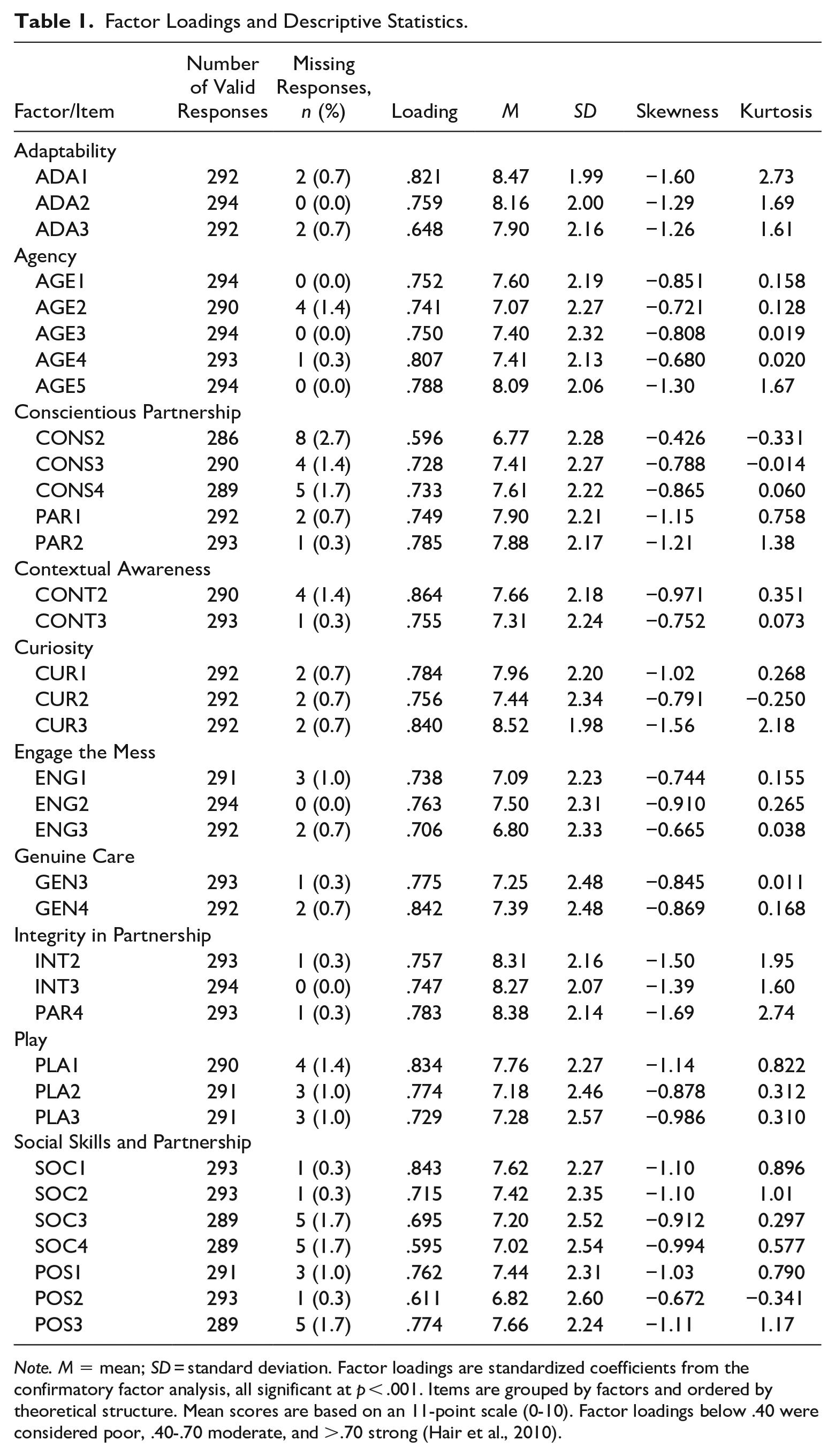
Note. M = mean; SD = standard deviation. Factor loadings are standardized coefficients from the confirmatory factor analysis, all significant at p < .001. Items are grouped by factors and ordered by theoretical structure. Mean scores are based on an 11-point scale (0-10). Factor loadings below .40 were considered poor, .40-.70 moderate, and >.70 strong (Hair et al., 2010).
Initial Scale Reliability
Preliminary reliability analyses led to the refinement of the original 14 scales. Two scales, Create Clarity (α = .683) and Suppress the Noise (α = .581), were removed because of insufficient internal consistency (Nunnally & Bernstein, 1994). The remaining scales demonstrated acceptable to excellent reliability, with Cronbach’s alpha values ranging from .775 to .877.
Factor Analysis and Scale Refinement
Initial structure exploration
The Kaiser-Meyer-Olkin measure (KMO = .945) and Bartlett’s test of sphericity (χ² = 7518, df = 990, p < .001, n = 275) confirmed the data’s suitability for factor analysis (Tabachnick & Fidell, 2019). Principal axis factoring with oblique rotation initially revealed 12 factors with eigenvalues greater than 1.0. However, examining the scree plot and parallel analysis suggested a 10-factor solution as optimal, explaining 62.4% of the total variance.
Scale refinement
Following recommendations by Hair et al. (2010), we systematically refined the instrument by removing items with factor loadings below .40 or cross-loadings above .30. The removal process was iterative, with items evaluated one at a time starting with the most problematic (lowest loadings or highest cross-loadings) to maintain construct coverage. Modification indices above 10.0 were examined as potentially meaningful (T. A. Brown, 2015), but no model modifications were implemented as the suggested cross-loadings (e.g., between Agency and Conscientious Partnership) would have compromised the theoretical distinctiveness of the constructs identified by Fletcher and Thornton (2023). This process resulted in the removal of three items (Q49_SOC5, Q12_CONS1, Q37_PAR3) because of low loadings and two items (Q9_AGE6, Q29_GEN2) because of significant cross-loadings. Additionally, two complete scales (Create Clarity and Suppress the Noise) were removed because of insufficient reliability. The refinement process reduced the instrument from 52 to 36 items while maintaining content coverage of the core constructs.
Several scales underwent iterative refinement to optimize their psychometric properties while maintaining content coverage. The Agency scale initially included eight items, but reliability analysis indicated that removing two items would improve the scale’s internal consistency. Q11_AGE8 was removed first, increasing Cronbach’s alpha from .845 to .873. Subsequently, removing Q10_AGE7 further improved reliability to .877.
In the Partnership scale, Q37_PAR3 was initially removed because of low factor loading (.375), but this removal also improved the scale’s reliability from .833 to .820. Similarly, in the Social Skills scale, Q49_SOC5 was removed not only because of its low factor loading (.287) but also because its removal improved scale reliability.
During scale refinement, several additional items were removed to improve psychometric properties. The Contextual Awareness scale was reduced to two items after removing Q16_CONT1, which improved reliability from .780 to .790. The Genuine Care scale was similarly refined to two items, removing Q28_GEN1 because of cross-loadings and lower item-total correlation (.568). The Integrity scale was strengthened by removing Q32_INT1, increasing Cronbach’s alpha from .678 to .732. In each case, decisions balanced statistical improvement with theoretical coherence, resulting in more parsimonious scales while maintaining construct coverage.
These refinements were made while ensuring that the remaining items adequately represented each construct’s theoretical domain as defined by Fletcher and Thornton (2023). The process balanced statistical optimization with content validity considerations.
Final factor structure
The final 10-factor solution comprised the following:
Agency (five items, loadings .741-.807)
Social Skills and Positive Energy (seven items, .595-.843)
Play (three items, .729-.834)
Curiosity (three items, .756-.840)
Integrity in Partnership (three items, .747-.783)
Genuine Care (two items, .775-.842)
Conscientious Partnership (five items, .596-.785)
Adaptability (three items, .648-.821)
Contextual Awareness (two items, .755-.864)
Engage the Mess (three items, .706-.763)
Confirmatory factor analysis
Based on the refined structure from EFA, we tested the 10-factor model using confirmatory factor analysis with a sample of 275 complete cases. The model demonstrated acceptable fit: χ²(549) = 1146, P < .001; CFI = .902; TLI = .888; RMSEA = .061 (90% CI: .056-.066); SRMR = .048. All items loaded significantly on their respective factors (p < .001), with standardized loadings ranging from .595 to .864 (T. A. Brown, 2015).
Model fit indices
Following modification indices analysis, we examined several model variations. The final model demonstrated a good fit across multiple indices (Hu & Bentler, 1999). Beyond the basic fit statistics reported earlier (CFI = .902; TLI = .888; RMSEA = .061; SRMR = .048), the examination of modification indices suggested potential areas for model improvement. Notable modification indices included cross-loading potentials between items (e.g., Q15_CONS4 showed a high modification index [12.32] for cross-loading on Agency; Q23_CUR2 showed a high modification index [10.19] for cross-loading on Play). However, no model modifications were implemented as they lacked theoretical justification (T. A. Brown, 2015).
Reliability Analysis
Internal consistency
The final scales demonstrated strong internal consistency reliability (Nunnally & Bernstein, 1994):
• Excellent reliability (α > .80): ○ Agency (.877) ○ Social Skills and Positive Energy (.876) ○ Conscientious Partnership (.846) ○ Curiosity (.831) ○ Play (.817) ○ Integrity in Partnership (.806)
• Good reliability (.70 < α < .80): ○ Contextual Awareness (.790) ○ Genuine Care (.790) ○ Adaptability (.778) ○ Engage the Mess (.775)
Item analysis
Item-total correlations were examined to assess the contribution of individual items to their respective scales (DeVellis, 2016). For Agency, item-rest correlations ranged from .690 to .755, indicating strong item performance. Social Skills and Positive Energy items showed correlations from .556 to .768, suggesting good item discrimination. All retained items demonstrated item-total correlations above .40, meeting standard psychometric criteria (Hair et al., 2010).
Examination of item-level statistics revealed good discrimination across the response range. Mean scores indicated appropriate use of the scale range without ceiling or floor effects. Standard deviations (ranging from 1.98 to 2.60) suggested adequate response variability. Item response distributions were generally normal, with no items showing extreme skewness (all values between −1.89 and −0.426) or kurtosis (between −0.735 and 3.66).
Interitem correlations within scales were examined to identify potential item redundancy. Correlations ranged from .30 to .70, falling within recommended ranges (Clark & Watson, 1995). This suggests items within each scale are related but capture distinct aspects of the constructs.
Construct Validity
Convergent validity
All factors demonstrated satisfactory convergent validity with AVE values exceeding .50 (Fornell & Larcker, 1981) (Table 2).
Psychometric Properties of the Final Scales.
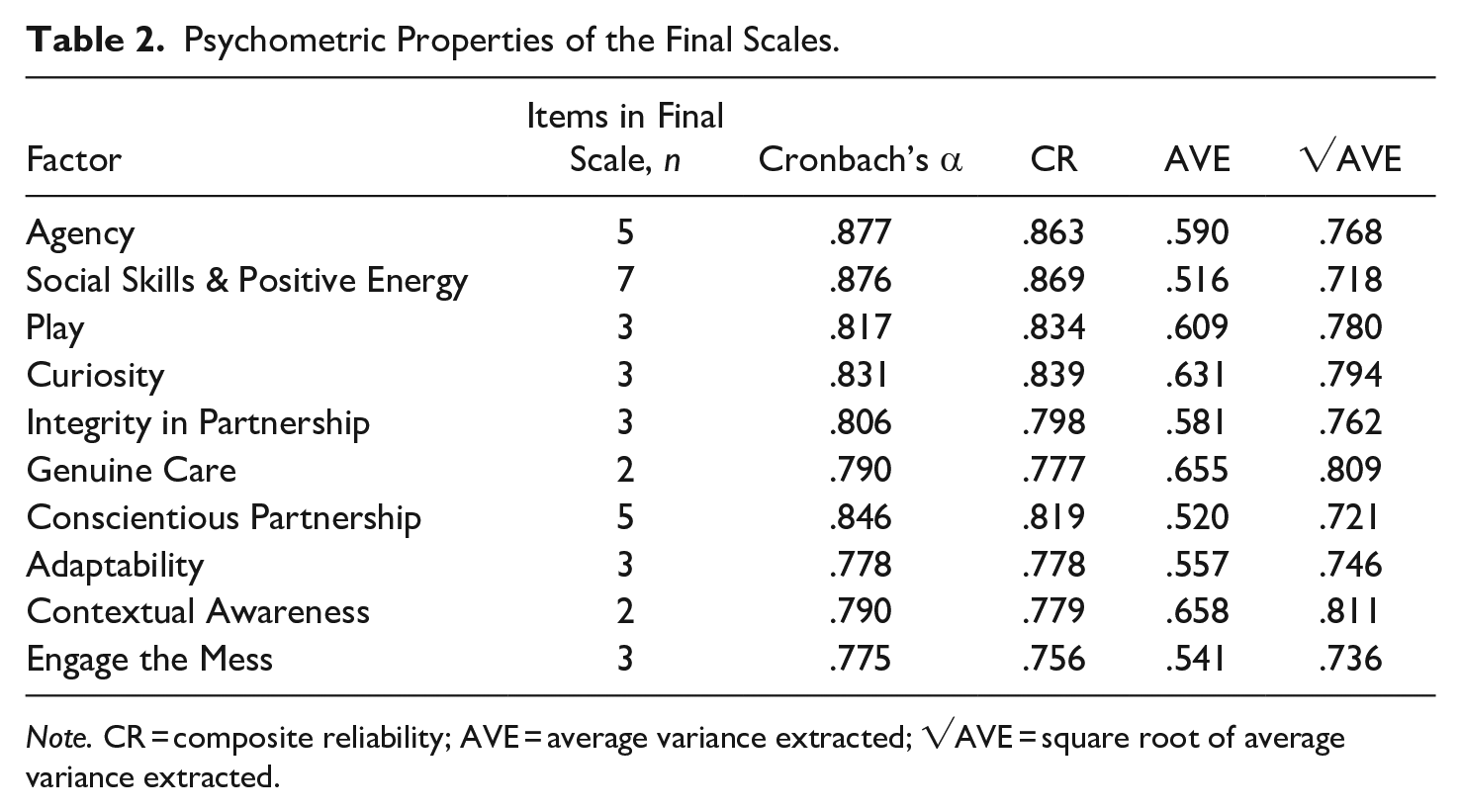
Note. CR = composite reliability; AVE = average variance extracted; √AVE = square root of average variance extracted.
Discriminant validity
The correlation between Adaptability and Agency (.791) exceeded the square root of AVE for both factors (.746 and .768, respectively), suggesting potential discriminant validity concerns. A similar concern was found between Conscientious Partnership and Social Skills & Positive Energy (.781), where the respective square roots of AVE were .721 and .718. Other notable but acceptable correlations included Social Skills & Positive Energy-Play (.770) and Engage the Mess-Curiosity (.762) (Table 3).
Factor Correlations and Discriminant Validity Assessment.
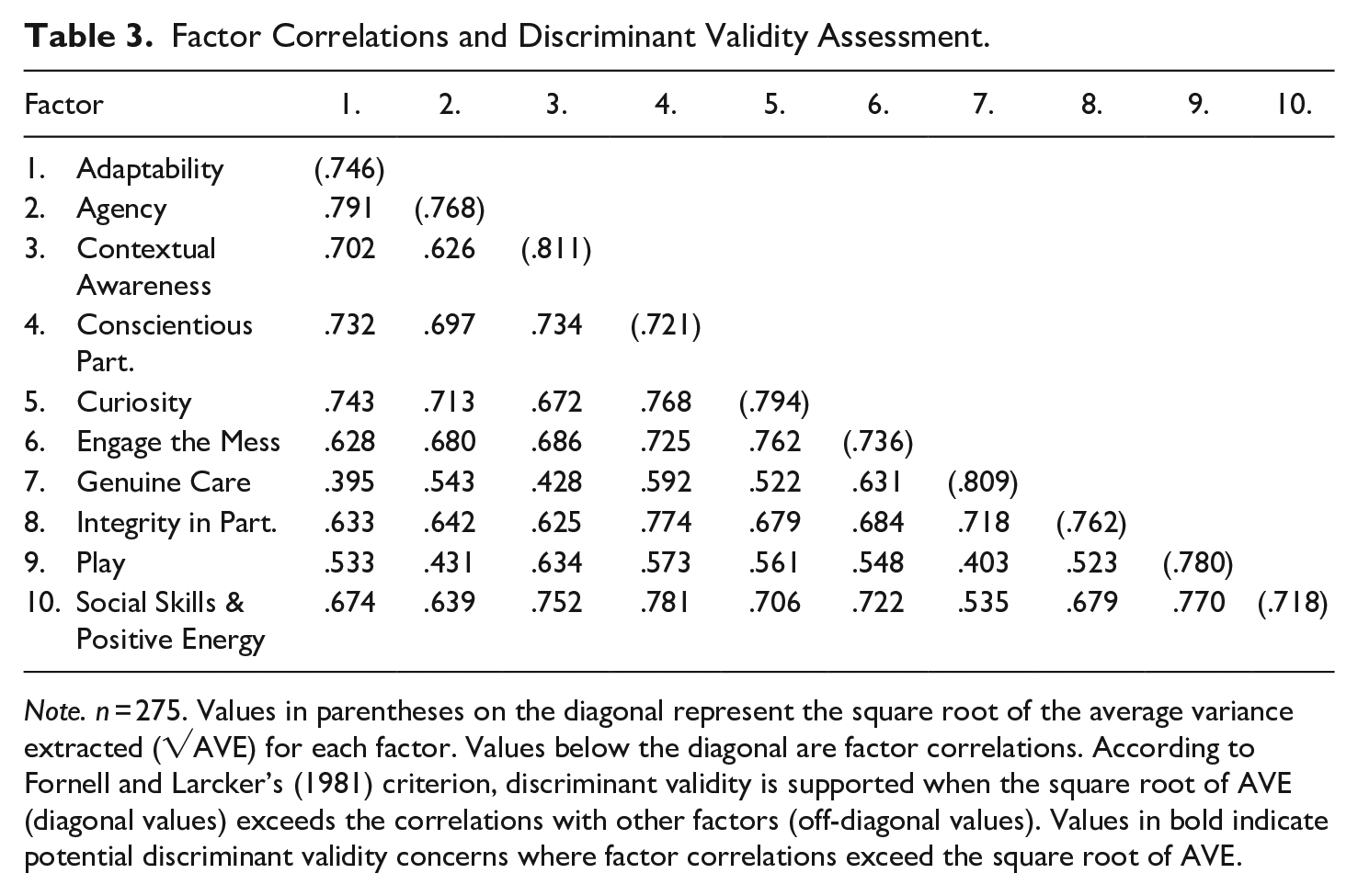
Note. n = 275. Values in parentheses on the diagonal represent the square root of the average variance extracted (√AVE) for each factor. Values below the diagonal are factor correlations. According to Fornell and Larcker’s (1981) criterion, discriminant validity is supported when the square root of AVE (diagonal values) exceeds the correlations with other factors (off-diagonal values). Values in bold indicate potential discriminant validity concerns where factor correlations exceed the square root of AVE.
Discussion
Summary of Key Findings
Our validation study of the Contemporary Business Soft Skills Instrument yielded several significant findings that advance measurement and theoretical understanding of workplace soft skills. The emergence of a clear 10-factor structure, explaining 62.4% of the total variance, provides empirical support for the multidimensional nature of contemporary workplace competencies. While related to Fletcher and Thornton’s (2023) framework, this structure reveals interesting consolidations and distinctions in how soft skills manifest in practice.
Notably unexpected was the combination of certain constructs, particularly Social Skills with Positive Energy and Integrity with Partnership, suggesting these competencies are more intrinsically linked than previously conceptualized. The removal of Create Clarity and Suppress the Noise scales, despite their theoretical importance in Fletcher and Thornton’s (2023) framework, indicates that these constructs may require different operational definitions or measurement approaches.
The strong psychometric properties of the final 36-item instrument, with reliability coefficients ranging from .775 to .877, demonstrate its utility for assessing contemporary workplace competencies. However, the high correlation between Adaptability and Agency (.791) suggests these constructs, while theoretically distinct, may be more closely interrelated in practice than previously understood. Similar concerns emerged between Conscientious Partnership and Social Skills & Positive Energy (.781), suggesting a potential overlap in how these competencies manifest in workplace settings. These findings particularly address our research question about how contemporary workplace soft skills organize into measurable constructs while also highlighting the complexity of distinctly measuring closely related competencies.
Our findings provide clear answers to our research questions. First, contemporary workplace soft skills are organized into 10 distinct but interrelated constructs, with some traditional competencies merging into integrated factors (e.g., Social Skills with Positive Energy). Second, our validated instrument demonstrates that these diverse skills can be effectively measured within a single tool, showing strong psychometric properties (α = .775-.877) across all factors. Third, while Fletcher and Thornton’s (2023) framework provided a strong foundation, our empirical results suggest some theoretical refinements, particularly in how certain competencies combine in practice (e.g., Integrity with Partnership) and how others (Create Clarity and Suppress the Noise) may require reconceptualization.
Theoretical Implications
Our findings both support and extend Fletcher and Thornton’s (2023) contemporary soft skills framework while revealing important nuances in how these competencies manifest empirically. The emergence of a 10-factor structure, rather than the original 14 competencies, suggests that some theoretically distinct soft skills may be more integrated in practice than previously conceptualized. While soft skills can be organized into measurable constructs assessed through self-assessment, the challenge lies in ensuring that these constructs accurately reflect the multifaceted nature of soft skills in real-world work environments, where context and interpersonal dynamics influence. However, self-assessment includes diverse contextual considerations to some extent. Yet, the study supports the structure and grounding in theorizing about components of soft skills through the psychometric method. The findings support the idea of a complex and dynamic interplay of soft skills (Succi & Canovi 2020), making interlinks between constructs visible.
Combining Social Skills with Positive Energy represents a particularly noteworthy theoretical refinement. While Fletcher and Thornton (2023) treated these as separate constructs, our findings suggest they function as an integrated competency in contemporary workplaces. This integration aligns with recent theoretical perspectives on workplace relationship development (Ferris et al., 2021). It may reflect how virtual work environments have made traditional social skills inseparable from collaborative capabilities (van Zoonen et al., 2021).
Similarly, the emergence of Integrity in Partnership as a unified construct suggests that ethical behavior in modern workplaces is inherently relational. This finding extends traditional conceptualizations of workplace integrity (M. E. Brown & Treviño, 2006) by emphasizing its collaborative dimension. The strong psychometric properties of this combined construct support theoretical arguments for viewing integrity through a relationship-centered lens.
The substantial overlap between Adaptability and Agency (r = .791) presents an intriguing theoretical challenge. While conceptually distinct in Fletcher and Thornton’s (2023) framework, their strong empirical relationship suggests that the ability to adapt may be inherently linked to personal initiative in contemporary workplaces. This finding aligns with theories of proactive work behavior (Frese & Fay, 2001) and adaptive performance (Pulakos et al., 2000), suggesting that effective workplace adaptation requires active agency rather than passive flexibility. A similar pattern emerges in the relationship between Conscientious Partnership and Social Skills & Positive Energy (r = .781), indicating that professional conduct may be inherently tied to social competencies in modern work environments.
It deserves attention that our validated structure aligns with established industry frameworks, including the National Association of Colleges and Employers (NACE) Core Competencies. For instance, our validated factors of Agency and Adaptability closely parallel NACE’s emphasis on Career & Self-Development and Critical Thinking. The emergence of Conscientious Partnership as a unified factor in our analysis reflects NACE’s focus on Professionalism and Teamwork, suggesting these competencies may be more intrinsically linked than previously conceptualized. Similarly, our Social Skills and Partnership factor corresponds with NACE’s Communication and Collaboration competencies, while our Contextual Awareness factor aligns with their Equity & Inclusion competency.
The failure of Create Clarity and Suppress the Noise to emerge as viable constructs warrants theoretical consideration. While important in Fletcher and Thornton’s (2023) framework, these concepts may require reconceptualization to capture their manifestation in contemporary work settings. Their inadequate psychometric performance suggests a potential gap between theoretical conceptualization and empirical measurement of these emerging competencies.
Practical Implications
The validated Contemporary Business Soft Skills Instrument offers practical applications for organizations navigating modern workplace challenges. Our findings provide actionable insights for talent development, virtual workplace assessment, cross-cultural applications, and business communication training.
For talent development professionals, the instrument’s 10-factor structure provides a comprehensive yet manageable framework for skill assessment and development. The integration of traditionally separate competencies, such as Social Skills with Positive Energy, reflects how these skills manifest in workplace settings. This insight suggests that development programs should focus on building these capabilities in tandem rather than as isolated competencies. The strong reliability of these combined constructs (α ranging from .775 to .877) provides confidence in using the instrument for assessment and development planning.
In virtual workplace contexts, the instrument’s ability to capture nuanced competencies like Contextual Awareness and Engage the Mess becomes particularly valuable. As organizations continue operating in hybrid environments (Parker et al., 2020), these validated measures can help identify and develop the competencies needed for virtual success. The clear factor structure enables organizations to assess how effectively employees navigate virtual and in-person workplace dynamics.
The instrument’s validation across a culturally diverse sample (38 nationalities) suggests its utility for cross-cultural applications. However, practitioners should note that while the factor structure held across our diverse sample, cultural variations in how these competencies manifest may require contextual interpretation. This is particularly relevant for multinational organizations developing global talent management strategies.
Our findings suggest several practical recommendations for business communication training. Training programs should integrate social skills and positive energy development rather than treating them as separate competencies. The focus should be placed on the relational aspects of integrity and trust-building, reflecting our finding that these operate as unified constructs in practice. Organizations should approach adaptability and agency as interconnected capabilities, developing them through integrated learning experiences. Additionally, contextual awareness should be addressed as a distinct competency, with specific attention to its role in virtual and in-person interactions. These insights can help organizations design more effective training programs that reflect how soft skills function in contemporary workplaces. The instrument’s validated structure provides a framework for assessing training effectiveness and tracking skill development over time.
Limitations and Future Research
While our study provides valuable insights into measuring contemporary workplace soft skills, several limitations warrant consideration and suggest directions for future research. Although our sample was diverse, it consisted primarily of higher education students. Self-evaluation of soft skills presents limitations as individuals’ self-perceptions of their soft skills are subjective. Social desirability bias may lead respondents to rate their skills highly. The relational and context-dependent nature of soft skills is complex to evaluate. Despite the limitations, self-evaluation reveals how respondents view their soft skills. Self-assessment encourages self-awareness and reflection. Self-assessment is a predominant way of researching soft skills (Matteson et al., 2016). Also, in recruitment processes, self-assessments are typical. However, future studies could capture the more multidimensional nature of soft skills by combining self-assessment with feedback from peers, educators, or supervisors. While these participants had relevant workplace experience, future research should validate the instrument with full-time professionals across different career stages and organizational levels to enhance generalizability.
Additionally, two factors in our final solution, Genuine Care and Contextual Awareness, are measured with only two items each. While both scales demonstrated acceptable reliability (α = .790 for both), having only two items per factor may limit the breadth of construct coverage (Hair et al., 2010). Future research should consider developing additional items (e.g, “I help create an environment where people feel comfortable sharing their concerns” for Genuine Care, and “I recognize how cultural differences might influence workplace behaviors” for Contextual Awareness) for these scales to capture their complete theoretical domains. This is particularly important for Contextual Awareness, given its theoretical significance in modern workplace settings where employees must navigate complex organizational environments (Tschannen-Moran, 2014).
Future research should also establish criterion-related validity by examining relationships between measured soft skills and workplace outcomes such as job performance, career advancement, and team effectiveness. Longitudinal studies would be particularly valuable in understanding how these soft skills develop over time and their predictive validity for professional success. Such research could help determine whether the observed factor structure remains stable across time and contexts, particularly the integration of traditionally distinct competencies like Social Skills and Positive Energy.
Finally, future studies should investigate the two constructs (Create Clarity and Suppress the Noise) that failed to emerge as viable factors in our analysis. Their theoretical importance in Fletcher and Thornton’s (2023) framework suggests the need for alternative measurement approaches or reconceptualization of these constructs in contemporary workplace settings.
Conclusion
This study makes several important contributions to our understanding of contemporary workplace soft skills and their measurement. By validating a comprehensive instrument based on Fletcher and Thornton’s (2023) framework, we bridge the gap between theoretical conceptualization and practical assessment of these critical competencies. Our findings reveal how workplace soft skills organize into measurable constructs that reflect the realities of modern work environments, including virtual collaboration and cross-cultural interaction.
The emergence of integrated factors, particularly the combination of traditionally distinct competencies, suggests that contemporary workplace soft skills function more interdependently than previously theorized. This insight has important implications for both research and practice in business communication. For practitioners, our validated instrument provides a reliable tool for assessing and developing the complex soft skills required in today’s workplace. The clear factor structure offers a practical framework for talent development, while the strong psychometric properties support its use in organizational decision-making.
As workplaces continue to evolve, further research will be crucial to understand how these soft skills manifest across different contexts and cultures. The foundation established by this validation study provides a springboard for investigating how soft skills contribute to workplace effectiveness, particularly in increasingly digital and culturally diverse environments. Such research will be essential for maintaining the relevance and utility of soft skills assessment in the changing landscape of business communication.
Supplemental Material
sj-docx-1-bcq-10.1177_23294906251317717 – Supplemental material for Validating the Contemporary Business Soft Skills Instrument
Supplemental material, sj-docx-1-bcq-10.1177_23294906251317717 for Validating the Contemporary Business Soft Skills Instrument by Sami Heikkinen and Heidi Myyryläinen in Business and Professional Communication Quarterly
Footnotes
Declaration of Conflicting Interests
The author(s) declared no potential conflicts of interest with respect to the research, authorship, and/or publication of this article.
Funding
The author(s) received no financial support for the research, authorship, and/or publication of this article.

Author Biographies
References
Supplementary Material
Please find the following supplemental material available below.
For Open Access articles published under a Creative Commons License, all supplemental material carries the same license as the article it is associated with.
For non-Open Access articles published, all supplemental material carries a non-exclusive license, and permission requests for re-use of supplemental material or any part of supplemental material shall be sent directly to the copyright owner as specified in the copyright notice associated with the article.
