



Abstract
Personality testing is an elementary part of recruitment. The test results are increasingly considered a necessary means of obtaining information about candidates’ personalities and suitability. This has raised questions about who has the right to define a candidate’s personality in recruitment interviews. Here, we use conversation analysis to describe two strategies through which recruiters evaluate candidates’ personalities based on the personality test results and show how these methods are linked to different interactional affordances. We recommend the candidate-driven strategy that attends to the candidates’ fundamental right to define their personality in a situation where their career is at stake.
Keywords
Personality tests have become a commonplace tool in working life, especially in relation to recruitment interviews for expert posts (see, e.g., Macabasco, 2021; Society for Human Resource Management [SHRM], 2017). However, we know very little about the ways in which the test results are used, invoked, and referred to in recruitment interviews. This may be problematic, as a recruitment interview with a personality test may have significant consequences for both the job applicant’s career and the recruiting organization’s future success (Youngman, 2017).
Debates about the meaningfulness of personality testing in recruitment interviews occur frequently in scientific publications (Keltinkangas-Järvinen, 2016; Morgeson et al., 2007a, 2007b; Ones et al., 2007; Tett & Christiansen, 2007) as well as in the media (Macabasco, 2021; Weber, 2015). Personality testing advocates perceive tests as providing objective and reliable information on the suitability of the candidate for the job available (see, e.g., Ones et al., 2007). Critics, on the other hand, refer to three problems of testing: their controversial theoretical background (Billington et al., 2017, p. 4; Pervin, 2003), the inaccuracy of conclusions drawn from personality tests (Keltinkangas-Järvinen, 2016; Morgeson et al., 2007a, 2007b), and the use of tests in analyzing individuals, which goes against the original purpose of testing groups (e.g., army; Keltinkangas-Järvinen, 2016).
Earlier research on personality tests focused mostly on testing validity. There exists ample research on socially desirable responding (Domino & Domino, 2006; Goffin & Christiansen, 2003; Kaplan & Saccuzzo, 2018; Li & Bagger, 2006; Ones et al., 1996; Rosse et al., 1998), on the correlation between personality and performance at work (Barrick & Mount, 1991; Guion & Gottier, 1965; Murphy & Dzieweczynskin, 2005; Tett et al., 1991), and on the impact of an individual’s social class on personality test results (Auld, 1952; Gough, 1946; Grossmann & Wrighter, 1948; Hoffman & Albizu-Miranda, 1955; Hoffman et al., 1958). Constructionist researchers have also taken more critical approaches to personality testing by pointing out that tests not only measure but also create social reality, for example, by offering static categories that are based on controversial theoretical backgrounds (Burman, 1994, 1996; Burman & Parker, 1993; Holzkamp, 2013; Liinamo & Peteri, 2021).
In addition to studies on the validity and usability of personality tests, there is a body of studies on recruitment interviews measuring correlations between background variables, such as candidates’ sex, race, cognitive skills, nonverbal styles, and interview scores (e.g., Huffcutt, 2011; Posthuma et al., 2002). Furthermore, an increasing amount of research is based on either candidates’ or recruiters’ interviews on experiences from the recruitment process and candidates’ evaluations (Rivera, 2011, 2012, 2015). While these studies have increased our knowledge on the ways in which common background variables may influence the end results of recruitment interviews, and how people view and evaluate the interviews in retrospect, we also need to understand what actually happens in the real-life situation. To identify so-called good practices or strategies for beneficial interview outcomes, we need methods to examine the actual activities of the participants in situ.
The method of conversation analysis provides tools to systematically analyze how participants in an encounter go about making sense of each other’s actions and taking them into account in their next actions (Heritage, 1984). The analysis was based on observations of participants’ conduct in video-recorded authentic encounters (Heritage, 1984). This method has been used in earlier research on recruitment interviews in studying alignment talk (Ragan, 1983), questions and answers (Button, 1987), humor (Van de Mieroop & Schnurr, 2018), identity (Van de Mieroop, 2019), and epistemic authority (Glenn & LeBaron, 2011). However, research on the management of personality tests in real-life recruitment settings is still minimal.
In view of the potentially strong influence of personality test results and their interpretation on the candidate’s career, it is important to examine the ways in which candidates’ personalities are produced during the recruitment interview. Understanding this process enables further discussion of recruitment interview practices and how these could be improved.
Further grounds for our interest in the use of personality tests in recruitment have to do with the existing asymmetry of power in recruitment interviews (cf. Modaff, 2003). In particular, two characteristics related to the institutional roles of the recruiter and the candidate are noteworthy: (1) asymmetries of knowledge concerning the candidate’s personality roles and (2) asymmetries related to the agenda and principles of recruitment decision making (see dimensions of institutional talk in Heritage & Clayman, 2010).
First, the recruiter has more knowledge about the situation and more authority concerning the interview results than the candidate. Both participants, the recruiter and the candidate, are usually familiar with the roles and expectations involved; in a relatively short time, they are supposed to go through the candidate’s working history, test results, feedback, and recommendations for the available position. However, as representatives of the institution, the recruiters had more detailed knowledge of and control over the agenda of the interview. The recruiters are also the ones making the decision among the candidates applying for the job. Candidates, then again, are in the competitive role of the job applicant among other potential candidates who may or may not have prior experience in recruitment interviews or testing situations (see Huffcutt et al., 2015). Their goal is to convince the recruiter of their suitability for the available job, which requires careful impression management (see Goffman, 2004).
Second, recruitment interviews raise questions about who knows, and has the right to claim knowledge, about the candidate’s personality (for discussion on “epistemic authority” and “epistemic rights,” see the section below). The starting point of the interview is that the candidates have empirical, everyday knowledge about their personality, but they are likely unable to describe it according to the structure of the personality test. But then again, the recruiters have knowledge about the latter without having much access to the candidates’ personalities. Thus, personality testing contains a particular twist regarding the right of the candidate to assess their personality within the limits of the logic of the test and the right of the recruiter to interpret the test results (for a setting with a similar twist in other types of evaluative interviews, see Simonen, 2017; Tiitinen & Lempiälä, 2022). In completing the test, the candidates had an opportunity to assess their personalities and ways of thinking in everyday situations. However, as the tests are based on predefined sets of questions, which in turn originate in applications of psychological theories, the candidates’ rights to define which aspects of their personality are recorded are limited. Candidates do not have access to the theoretical and analytical backgrounds of the test itself, and they do not know how their answers will be interpreted. This interpretability of test results becomes evident for candidates during the recruitment interview as they receive feedback from the test results.
In this study, we use qualitative research method conversation analysis to examine the ways in which the participants, the recruiter, and the candidate in the recruitment interview manage the above-described complexities in the epistemic relations between themselves and the documents containing personality test results. Drawing from a data set of real-life video recordings of Finnish recruitment interviews, we ask how the participants orient to and negotiate their access to and rights to claim knowledge about the candidate’s personality.
Epistemic Rights in Interaction
In conversation analysis, epistemic rights are seen as established in interaction in situ, turn by turn (Heritage & Raymond, 2005). Epistemic rights refer to knowledge that becomes apparent and is defended and appraised in talk, which means that people’s differentiated access to knowledge becomes visible in and through their interactional conduct. Thus, for example, the claims of epistemic rights displayed in the utterances “it is raining” and “is it raining” are very different in strength, with only the former indicating firm knowledge about raining. (Heritage, 2013). Epistemic rights have been considered omnirelevant (see, e.g., Heritage, 2013). At each turn of talk, the participants set themselves as the knowing or unknowing party, thus defining the epistemic rights of their interlocutors in relation to those of their own in the currently relevant field of knowledge. Hence, the participants establish what each participant is expected to know, how they have received the knowledge, who has the right to evaluate the matter at hand, and who can agree with whom (Drew, 1991; Heritage & Raymond, 2005; Maynard, 2003; Pomerantz, 1980; Raymond, 2018; Raymond & Heritage, 2006; Sacks, 1992).
Participants in conversation may be presumed to possess knowledge in certain domains, such as their personal lives and experiences, and they are expected to have differentiated access to information; for example, eyewitnesses of an incidence are expected to know more of what happened than those who have only heard or read about it (see Raymond & Heritage, 2006; Sacks, 1992). In different institutional settings, epistemic rights are usually predefined according to the institutional task in question (Heritage, 2013). In service encounters, epistemic rights are divided between professionals, who are supposed to possess expert knowledge concerning the institutional task at hand, and clients, who are considered to have primary rights to knowledge on their personal experiences. For example, physicians are expected to have primary access to the medical knowledge required to solve the patient’s presented health problems, while patients are expected to share their lay experiences of their felt symptoms (Heath, 1986). In different types of interview situations, such as research or media interviews, the interviewer usually assumes the role of the not-knowing participant, while the interviewee has the information that is being sought (Clayman, 2013). In classroom interactions, the purpose of teachers’ questions is often to verify students’ knowledge about a specific subject and to evaluate their learning, which is part of the teachers’ institutional duties (Gardner, 2013; Mehan, 1979).
Recruitment interviews are a prime setting to investigate through the lens of epistemic rights. This holds for personality testing, with reference to which the epistemic rights of the recruiter and the candidate are distributed asymmetrically, with the recruiter being more knowledgeable of the logic of the test and the candidate of their own characteristics. What is more, however, is the material context of the recruitment interviews, which adds a further layer of complexity to the epistemic relations in the setting—something to be discussed next.
Documents as Epistemic Authorities
Along with the epistemic rights evoked by the recruiter and the candidate, documents play an important epistemic role in recruitment interviews. Glenn and LeBaron (2011) studied recruitment interviews with documents provided by the candidate, such as resumes and professional certifications. They showed that documents are at the center of recruitment interviews and that the participants orient to them continuously by talk, touch, gestures, and gaze. Documents play a central role when participants negotiate their epistemic rights, and they are used to displaying epistemic authority (Glenn & LeBaron, 2011). By pointing out facts from the written documents, the recruiter hands over the primary epistemic right to the candidate, who in fact has authored the documents in the first place. In contrast, when the recruiter summarizes or evaluates the content of the document with respect to the job available, the primary epistemic rights stay with the recruiter. Through these different actions, recruiters not only establish their professional identity and competence but also the connection between identity and epistemics (Glenn & LeBaron, 2011).
Beyond the work of Glenn and LeBaron (2011), conversation analytic research on document use and epistemics in recruitment interviews is scarce. More studies exist on the role of written documents in a similar workplace setting, that is, in performance appraisal interviews, in which the task is to discuss and assess an employee’s performance, future training needs, and work-related plans (see, e.g., Lehtinen & Pälli, 2016; Mikkola, 2016; Van De Mieroop & Carranza, 2018). The results of these studies are mixed. As in recruitment interviews, documents used in performance appraisal interviews are also authored by the employee, who handles the information provided. In their study, Van De Mieroop and Carranza (2018) concentrated on cases in which the superior refuted the employee’s oral claims based on written documents provided by the employee. The authors observed that the superiors in the performance appraisal interviews orient to written documents as primary sources of facts, even though the employees have filled in the documents and are themselves present in the discussion. To counteract the written documents, the employees are required to present more credible facts to support their oral claims (Van De Mieroop & Carranza, 2018). Mikkola (2016) then again demonstrated that if participants in a performance appraisal interview discuss a subject matter based on a written document provided by the employee, the employee is treated as the primary epistemic authority, and they are expected to be able to explain and report matters from the documents. However, if the employee and supervisor edit written documents during the discussion, the superior has the right to propose changes to them (Mikkola, 2016).
In this study, we expand the discussion of using written documents in recruitment interviews. Our research question asks how personality tests are used as part of the overall evaluation of the candidates and how these usages have corollaries for the management of the participants’ epistemic rights. We describe two strategies for referring to the personality test, showing how they afford different possibilities for candidates to reclaim their epistemic rights in the subsequent interaction.
Data and Methods
The data for this article consist of 21 video-recorded recruitment interviews from a Finnish executive search company (ESC). ESCs are hired by organizations that have open positions. The role of an ESC is to identify, interview, and test candidates and to provide recommendations on who to hire for the organization. A usual procedure is that, after the first recruitment interview round, some of the candidates are invited to take cognitive and personality tests. These tests include standardized questionnaires, which are filled in by the candidate on a secure website. After the testing procedure, candidates are invited to the second recruitment interview round. In this round, candidates and recruiters go through the working history and experience of the candidates, and the candidates also receive feedback from the test results. Our data were recorded from this recruitment interview round.
Altogether, three different recruiters from the ESC and 21 candidates participated in the study. Recruiter A interviewed 14 candidates, Recruiter B interviewed 6 candidates, and Recruiter C interviewed 1 candidate. The interviews were conducted in 13 organizations (private companies, associations, or public administration), offering open positions for senior-level or senior manager applicants. All interviews were conducted in Finnish. All the candidates who were interviewed by the participating recruiters were introduced to the study, given the possibility of declining or participating in the research, and gave their written informed consent.
The recruitment interviews were recorded with two cameras. One of the cameras was placed at the end of a long table to record both participants (see figure in Appendix A). The other camera was placed behind the recruiter facing the candidate (see figure in Appendix A). The researchers were not present during the recordings. The data were transcribed according to conversation analytic conventions (Hepburn & Bolden, 2013; Jefferson, 2004; Schegloff, 2007). To reduce recognizability, the names and other identifiers of the participants were pseudonymized, and we refer to all recruiters with the pronouns she/her and all candidates he/his.
The data were analyzed with conversation analysis (CA) (Heritage, 1984), taking into account multimodal features (Mondada, 2019). CA is a qualitative research method, a tool to analyze systematically how participants make sense of each other’s actions. To do this, CA uses video-recorded segments of naturally occurring interaction (Stivers & Sidnell, 2013). In line with the traditional CA process (Hoey & Kendrick, 2018; Ten Haven, 2007), we first listened to the recordings to identify recurring interactional patterns, and we gathered a collection from all the sequences where participants were discussing personality (n = 136). Second, we focused on personality-related sequences and concentrated on sequences in which the recruiters first asked a question, candidates answered the question by describing their personality and actions, and thereafter, the recruiters received the candidate’s response and started to evaluate the candidate’s personality drawing upon the test results. Altogether, 18 such sequences were found in 13 of the 21 recorded recruitment interviews. The sequences were analyzed focusing on their organization (Schegloff, 2007) and the design (Drew, 2013) of the recruiters’ evaluation turns and the following turn of the candidates, also taking into account the gaze directions of the participants, as these have been found to be relevant for turn-taking (Sacks et al., 1974) and to show the main focus of interest of the interlocutors (Goodwin, 1981; Rossano, 2013; Rossano et al., 2009; Streeck, 1993). We also searched and found regularities in the ways in which participants oriented to the right to know and determine the personality of the candidate. The analysis revealed two strategies of recruiters in referring to the personality test results, with distinct orientations to epistemic rights in regards to the candidate’s personality. Each strategy resulted in a different type of response by the candidate in terms of negotiating their rights to know about their own personality characteristics.
In the next section, we present the analysis using four examples that represent regularities found in the data across the 13 video recordings relevant to our research question, which present the regularities in our data. The extracts are presented with three-line transcriptions for verbal actions: the first line presents the original in Finnish, the second line presents word-by-word translation in English, and the third line presents the idiomatic translation in English. The participants’ gaze directions and gestures are presented under the word-by-word translation line when they are focused on in the analysis (Mondada, 2019). The multimodal transcription symbols are presented in Appendix B.
This study complies with the Declaration of Helsinki and was performed according to ethical approval from the Humanities Ethics Committee of the Tampere region, Tampere University, approval number 31/2019.
Results
Below, we describe two distinct strategies by which the recruiters refer to the test: (a) by validating the candidate’s own preceding oral description as corresponding to the test results, or (b) by formulating their own interpretation of the candidate’s personality that is based on both the candidate’s preceding oral description and the test. More specifically, in the first strategy (Extracts 1 and 2), the recruiter validates the candidate’s self-description of their personality by referring to it as matching the test and by bringing new elements to their evaluative utterance. In this way, they orient the test as the main authority concerning the candidate’s personality. We demonstrate how, following this type of evaluation, the candidate acknowledges the interpretation but may show implicit resistance to it. In the second strategy (Extracts 3 and 4), the recruiter establishes their evaluation using both the test and the candidate’s preceding response as their source. Following this type of interpretation, the candidate continues discussing the evaluation, adding to it or sometimes contradicting it. Thus, our results show how these two ways of referring to the tests afford different possibilities for the candidate to define their personality. Furthermore, we demonstrate how the candidate’s orientation toward their own epistemic authority regarding their own personality compels the recruiters to reformulate their original evaluation.
The Recruiter Validates the Candidate’s Self-Description Based on the Test
The first two extracts demonstrate how the recruiters validated the candidates’ self-description as corresponding to the test results. This is achieved by integrating the result into the candidate’s self-description immediately in the evaluative turn following the candidate’s description. While validating the candidate’s personality, the recruiters do not actively invite the candidate to comment on the test results. In these cases, the candidate receives validation by acknowledging it and actively bringing up their status as knowledgeable of their own personal characteristics. Following this type of reference to the test, participants begin to negotiate or even compete about who has epistemic authority concerning the candidate’s personality.
In Extract 1, before the start of the transcript, the recruiter asked the question “How do you recognize resistance to change in yourself?” The question embodies the presupposition that the candidate feels resistance to change that needs to be recognized. Instead of confirming the presupposition, the candidate states that he tries to approach things extensively and look for different options. He further indicated that he likes problem-solving and is able to use his former work experience. The candidate finishes by stating that because of his work experience, he has more options to consider when solving problems. We join the extract when the recruiter receives the candidate’s answer with minimal feedback (line 1), writes it down, and returns to her earlier question, asking the candidate to confirm the recruiter’s suggestion concerning a personal characteristic of the candidate.
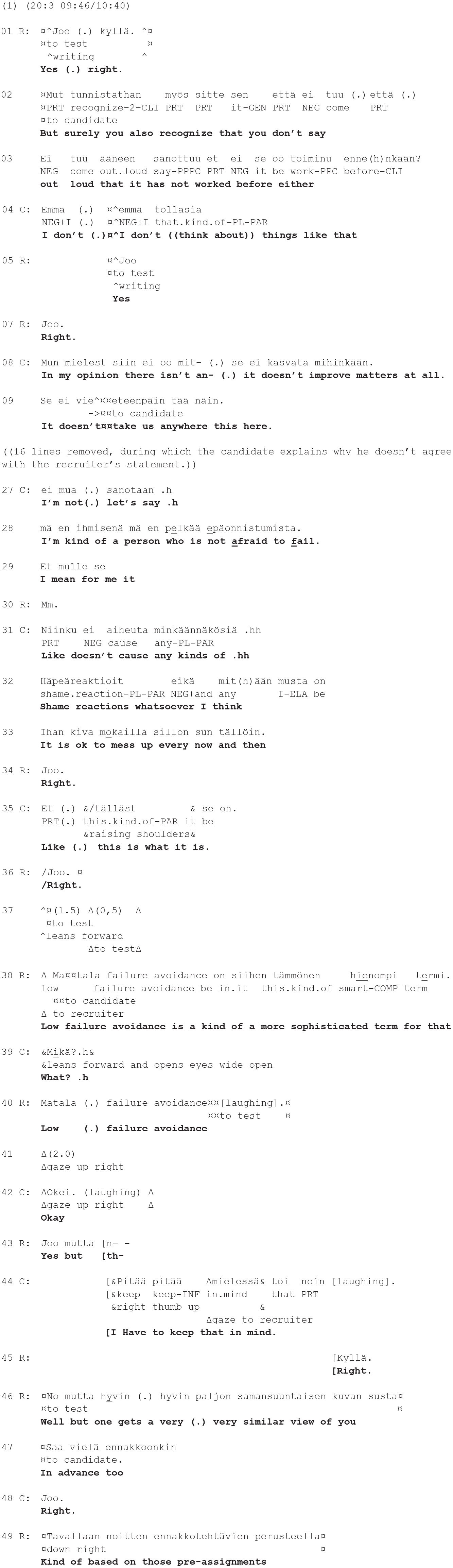
The recruiter’s turn at the beginning of the extract (Lines 2-3) refers back to the previously discussed matter—that is, how the candidate recognizes his resistance to change. The recruiter invites the candidate to recognize his potential conservative tendencies, according to which he might be inclined to “say out loud that it has not worked before, either.” As it is only the candidate who has epistemic access to his inclinations, the recruiter’s utterance calls for the candidate’s confirmation. With this request, the recruiter focuses on the candidate’s ability to remain functional in the face of changes. As the recruiter’s turn makes a claim concerning an issue of which only the candidate can have primary knowledge (i.e., his ability to recognize tendencies and inclinations in himself), the candidate is invited to respond with “a confirmation” (Heritage, 2012; Pomerantz, 1980).
Starting on Line 8, the candidate takes a strong epistemic position related to his own personality, thinking, and actions. He disconfirms the presupposition embodied in the recruiter’s request for confirmation that he would approach things in a way that “this has not worked before, either.” At the end of his turn, the candidate further emphasizes his right to define his personality (Lines 27-33) by stating in very definite and emphasized terms what he does not do, using extreme case formulations such as “I don’t feel shame whatsoever.” He concludes his description in Line 35 by confirming what he has previously stated: “So this is what it’s like.”
Our main focus is on the recruiter’s turns at Lines 36 and 38, and what happens after that. The recruiter receives the candidate’s answer with minimal feedback “right,” turns her gaze at, and leans toward the test (Line 36), indicating the shift in interaction (Rossano et al., 2009). There is a silence of 2.0 seconds during which the recruiter gazes at the test (Line 37), while the candidate gazes at the recruiter (except at the end of the pause, when he quickly glances toward the test and right after turns his gaze back to the recruiter). Thus, the candidate displays recipiency to the recruiter, who next gazes at the test and produces a description of the candidate (see Heath, 1986). With the pronoun “for that,” she refers to the candidate’s preceding statement, indicating that she is talking about a similar thing, albeit using different terminology. By gazing at the test while utilizing the professional English term “failure avoidance,” the recruiter makes it clear that her terminology is derived from the test (Goodwin, 1981). In this way, she treats the test as a knowledgeable party in describing the candidate’s personality. Furthermore, she treats herself as an authority by shifting to professional language and by interpreting it to the candidate, using a more sophisticated term to describe the features of the candidate’s personality just described. By gazing and leaning toward the test, the recruiter indicates the change in her orientation (from the candidate to the test) and a shift from one sequence of action to another (see, e.g., Robinson & Stivers, 2001; Modaff, 2003). By producing an evaluation using professional language, she orients both to the test and herself as having epistemic authority to define the candidate’s personality.
As we saw earlier, the candidate takes a strong position as an authority (Lines 04-35) to define his own actions and personality. Thus, the recruiter’s claim of epistemic rights for herself and the test may be seen as contradicting the candidate’s previous claim of epistemic authority: the candidate’s authority is replaced with the authority of the test and the professional interprets it with expert (“more sophisticated”) terms. The candidate treats the term as unfamiliar, and by making the repair initiation, may be interpreted as treating the recruiter’s mention of the term as unexpected (Line 39). The recruiter repeats the term laughingly, making light of the professional-sounding formulation, thus interpreting the candidate’s initiation as potential resistance. During the 2.0-second gap (Line 41), the candidate shifts his gaze at the recruiter, and thereafter utters with a smiley voice, “Okay. One has to keep that in mind.” It is noteworthy that the candidate keeps up the humor frame, which may be interpreted as an implication of not permitting a shift in epistemic authority in a relevant domain. The recruiter also interprets the candidate’s response to the use of the professional term as accountable, as she begins to explicate her earlier turn in lay terms (Line 46). Thus, the recruiter somewhat backs off from her claim of epistemic rights to the test.
In summary, through her nonverbal shift toward the test and through the use of the professional English term that is integrated into the candidate’s previous self-description, the recruiter indicates that both the test and herself as a professional interpreter of the test share epistemic rights to evaluate the candidate’s personality in the conversation. As such, the test becomes an epistemic authority through which the candidate’s personality features can be validated. The candidate, however, still orients to themselves having epistemic rights concerning their personality.
Extract 2 shows another case of a similar strategy. Here, we see a more active negotiation of epistemic authority between the candidate and the test. Previously, in the extract, the participants discussed the candidate’s previous job description and its benefits for the recruiting organization and whether the organization is able to appreciate and utilize his skills. At the beginning of Extract 2, the recruiter opens a new topic by asking whether anything provokes the candidate at work (Line 1) (see Heritage, 2013).
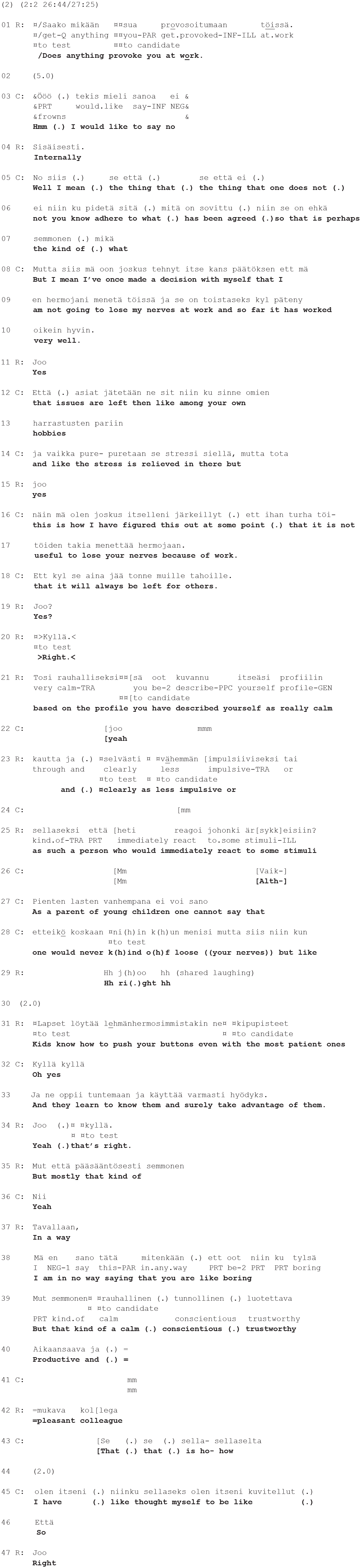
Our main focus in this extract is the recruiter’s validating turn, starting from Line 19, and what happens after that. Before going to that, let us briefly present what happened earlier in the sequence. At the beginning of the extract, the recruiter opens a new topic by asking a negative polarity question (on negative polarity in English, see Heritage, 2013): whether anything provokes the candidate at work (Line 1). Here, we see how the recruiter invites the test to be the third party in the discussion with her gaze direction (Lehtinen & Pälli, 2016): while asking the question, the recruiter first turns her gaze to the test, which she has as a printed document on the table, and then turns her gaze back to the candidate.
Our focus turn begins after the candidate’s elaborate description of his principles. The recruiter acknowledges the candidate’s description at Lines 19-20 and with her gaze shift toward the test results, she indicates her orientation to the test results. At Line 21, she starts to describe the test results as equivalent to what the candidate has stated in the interview, thus validating the candidate’s self-description. She preserves the candidate as having epistemic authority by referring to the description in the test as something that the candidate has stated. By shifting her gaze toward the test (Lines 21, 23, and 25) and reading the description therein, she orients the test as an epistemic authority. Furthermore, by confirming the candidate’s preceding description of his personality, she also presents herself as having epistemic rights concerning the candidate’s personality.
It is noteworthy that during the validation, the recruiter showed that her main focus was on the test. She refers to the candidate having made the description “through the profile” and adds a qualifier “clearly,” gazing at the test, which indicates that she is interpreting by drawing upon the test, and thereafter gazing back at the candidate in stating the characterization “less impulsive.” Whereas the candidate, in his own self-description at the beginning of the extract, mitigates his personality features, the recruiter uses extreme formulations, such as really, clearly, and immediately (Lines 23, 25). Thus, the recruiter emphasizes the personality description coming from the test and thus orients to the test as an epistemic authority. The recruiter acts as an authority by interpreting the test results and thus validating the candidate’s preceding self-descriptions. As in Extract 1, the candidate also acts here to reconstruct his own epistemic authority regarding his personality. Overlapping the recruiter’s validation (Lines 26-28), he downgrades the description of himself as the kind of person who immediately reacts to stimuli. He does this by referring to his conduct with his children—an area where he undeniably has primary epistemic rights—bringing up in a slightly humorous tone that “one cannot say that one never would” (react to stimuli). The recruiter refers to children in general to state that they find the “sore points” in anybody (Line 31), which the candidate confirms (Line 32) and continues with his own independent statement of the matter (Line 33). In Line 35, the recruiter directs the talk back to the test by looking at it while saying, “But mostly like that.” Thus, the recruiter adapts her original evaluation in such a way that the candidate’s self-description is acknowledged. Simultaneously, the recruiter specifies what she means by the “calm” feature. The candidate agrees with the evaluation and designates the ownership of the evaluation of his own personality (Lines 43-46) by saying, “That is how I have thought myself to be.”
In Extracts 1 and 2, the recruiter treats herself and the test as sharing epistemic authority: the recruiter has the authority to interpret the test results, and the test validates the candidate’s own self-description. In Extract 1, we saw how the candidate delicately resists the recruiter’s validation, whereas in Extract 2, the candidate more actively negotiates authority and takes ownership of the evaluation of his own personality back to himself several times during the conversation. The candidates’ orientation toward their own rights to act as an authority of their personality necessitates the recruiters backing off and moderating their original evaluation. At the end of both extracts, we see how the recruiters treat themselves as providing a justification, not only for their own right to act as an authority but also for the role of the personality test and the relevant test results.
The Recruiter Establishes the Interpretation Based on the Test Results and the Candidate’s Self-Description
Next, we demonstrate another way in which the recruiters may refer to the test—that is, by using both the test results and the candidates’ self-descriptions as resources when establishing an interpretation of the candidate’s personality. By doing so, the recruiters orient both to the test and to the candidate as having the authority to define the candidate’s personality and actively invite candidates to share their views on the interpretation. Thereafter, the candidates continue discussing the evaluation, adding to or resisting it. Extracts 3 and 4 are cases in point.
Prior to Extract 3, the recruiter and the candidate discussed the candidate’s current job and ongoing organizational changes. The candidate has been offered a job in wealth management by his current employer, which he is unwilling to accept.
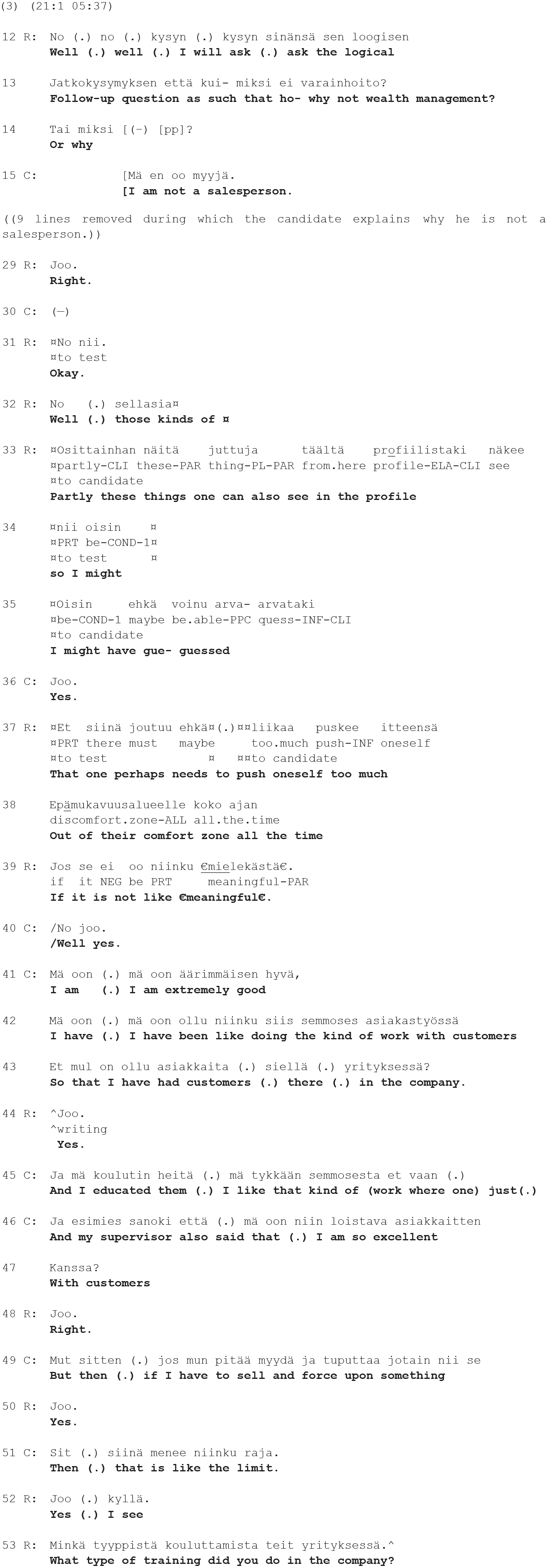
The extract begins with the recruiter’s question: “Why not wealth management?” (Lines 1-2), which establishes the candidate as accountable for explaining his decision to decline working in wealth management. The candidate explains his decision from two points of view: First, he is not a salesperson; instead, he prefers working in the background. Second, he would be willing to sell something that is close to his heart, but not something that he would be completely unfamiliar with (not shown in the transcript).
Our focus sequence begins at Line 31, where the recruiter starts a new phase by turning her gaze to the test results and uttering “right,” thus shifting the discussion toward interpretation of the candidate’s personality. The recruiter orients the test result as one possible source of information about the candidate’s personality features by stating that these characteristics can be seen in the profile (Lines 33-34). Furthermore, the recruiter establishes herself as an active interpreter of the test result and thus indicates having access to the candidate’s personality. Still, by using mitigations (partly, probably) and conditional wordings (I could probably have guessed), the recruiter establishes the test result and her interpretation of it to be indefinite and open to discussion. From Line 37 onward, the recruiter establishes her interpretation by using a zero-person formulation: “Working in sales could mean too much pushing oneself to an uncomfortable area if it is not meaningful.” By using the zero person, the recruiter treats her interpretation as universal experience that does not explicitly refer to anybody specifically (Laitinen, 1995; Hakulinen et al., 2004). By establishing the test result as one possible source of information and widely shared among people, the recruiter establishes the test result and her own interpretation available for the candidate’s further evaluation from his own point of view. Furthermore, she orients to the candidate’s right to define his own personality as relevant and authoritative.
The recruiter’s evaluation is followed by the candidate’s re-description of his behavior and personality (Line 40 forward). The candidate receives the recruiter’s interpretation with the minimal answer “no joo”, which indicates that the interpretation is somehow problematic, and that the candidate does not fully agree with it (Vepsäläinen, 2019). Thus, the candidate implies that he has epistemic authority concerning his own personal characteristics. Instead of agreeing with the recruiter’s evaluation, the candidate acknowledges it and continues by giving an independent assessment of his own skills—also changing the topic slightly. Instead of responding to the suggestion of having to push himself to do something he is not motivated to do, he starts praising himself as a salesperson. Thus, he explicitly orients himself to having epistemic authority concerning his own personal characteristics.
It is noteworthy that as the candidate expands his earlier self-description, he emphasizes his right to define his own personality. This becomes evident when he strengthens his description by giving details of his previous performance, which are known only to himself, for instance, feedback given by the supervisor (Lines 41-43 and 45-47). From Line 44 forward, the recruiter receives the candidate’s description with minimal acknowledgment and guides the discussion toward a new topic with her question (Line 53). Thus, she shows that she treats the candidate’s description as acceptable, giving no reason for further discussion.
The next extract shows a similar strategy in which the recruiter uses both the test result and the candidate’s earlier description as sources of information. The extract begins with the recruiter’s question of how the candidate would describe himself as a problem solver. Earlier in the extract, the candidate described the kind of development project in which he was interested.
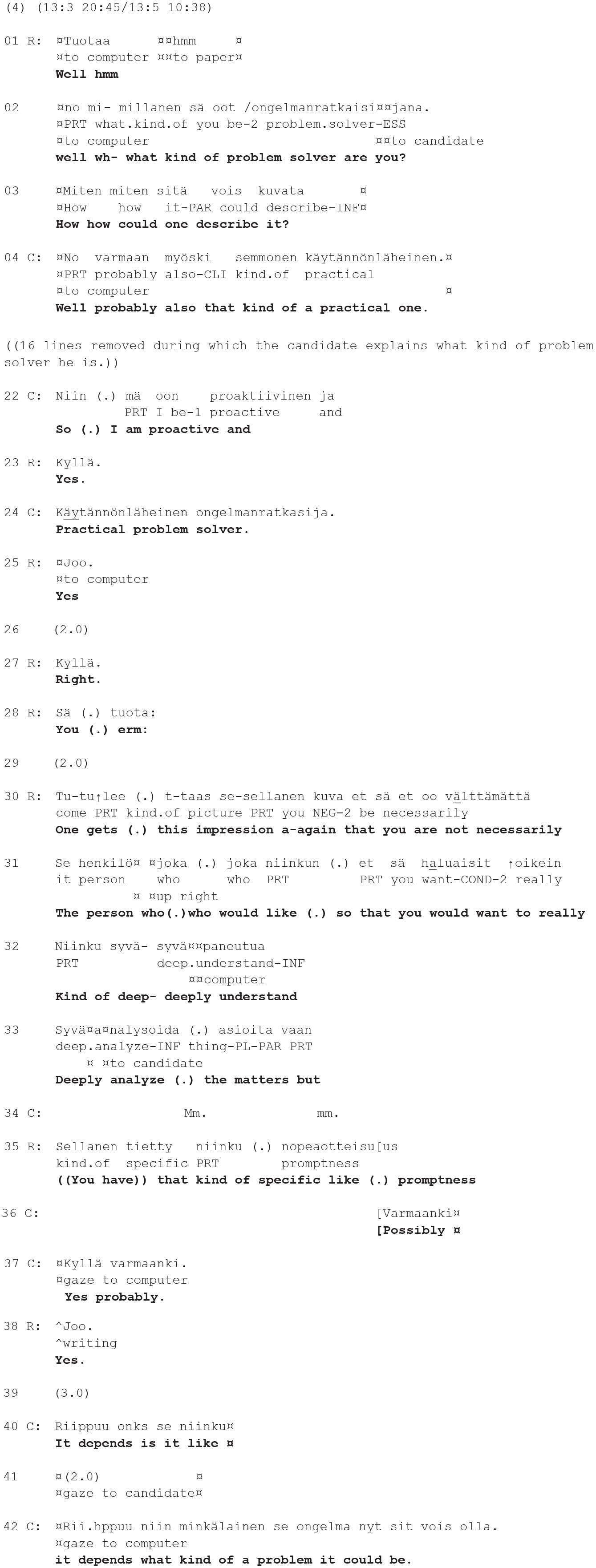
At the beginning of the extract, the recruiter’s question invites the candidate to evaluate himself (What kind of a problem solver are you? How could one describe it?; Lines 2-3). The candidate depicts himself as a practical problem solver (Line 24). Directly after this, he continues explaining what this means, and at the end (Line 22 forward), he summarizes his problem-solving style as proactive and practical.
At Line 25, the recruiter turns her gaze to the computer on which the test results are displayed, and minimally acknowledges the candidate’s answer (Line 25). Her evaluation is marked with self-corrections, delays, and long pauses (Lines 25-29) while gazing at the computer, which is interpretable as indicating her focal attention to lie in reading the test results. The recruiter’s orientation toward the candidate’s rights to know about his personality becomes visible when the recruiter begins her evaluation turn, referring to the candidate’s characteristics directly, “You erm” (Line 28), but then self-corrects to establish the evaluation as her own interpretation, “One gets the impression” (Line 30). The recruiter establishes her interpretation to be her own and independent of the candidate’s earlier self-description but also independent of the personality test results, strengthening her ownership of the interpretation with a gaze to the up right (Line 31). Furthermore, the recruiter orients toward the test by gazing at and simultaneously describing qualities that do not fit the candidate. By using mitigations in Line 30 and extreme formulation in Lines 31-33, the recruiter constructs a frame for the expression of the candidate’s personality and action. Finally, the recruiter turns her gaze to the candidate and describes a feature that fits the candidate better: “the kind of certain promptness” (Line 35).
It is noteworthy that while formulating the interpretation of the personality, the recruiter orients to three authorities: the candidate as a primary authority for his personality, the test as a source of information, and herself as a professional interpreter of the test results both verbally and by gaze direction. The interpretation itself is established as independent of the candidate’s original self-description and presented as open and uncertain; thus, the candidate’s further evaluation becomes relevant. The candidate did not directly confirm the interpretation; instead, he indicated uncertainty about it. He begins his turn in Line 36 with the adverb “possibly,” and again in Line 37 with “yes, probably.” Later, the candidate continued by describing that his behavior and actions in problem-solving situations are dependent on the problem itself (not entirely on his personality). While the candidate described his behavior, the recruiter received the candidate’s description with minimal acknowledgment (Line 38) but notes it on the computer (Line 38 forward). The recruiter’s interpretation provided an opportunity for the candidate to evaluate his personality again after receiving the recruiter’s interpretation.
In Extracts 3 and 4, we demonstrated how the recruiters established their interpretation of the candidate’s personality using both the test and the candidate’s own characterizations as possible sources of information and, as such, retained the candidates’ rights to define their personality. We saw how the recruiters invited the candidates to evaluate not only their personality but also the recruiter’s interpretation of it. The shared orientation toward the candidates’ rights also became evident as the recruiters oriented to noting the candidates’ further adjustments to their personalities and actions.
Discussion
This article has demonstrated how personality tests are used in recruitment interviews as part of the overall evaluation of the candidates and how these uses have corollaries for the management of the participants’ epistemic rights. As in Glenn and LeBaron’s (2011) study, also in our data, the recruiters oriented to their epistemic rights to know and evaluate and as such marked their professional role and identity.
Our main interest was directed to the evaluation of the candidates’ personalities and how the personalities were negotiated. With the help of four extracts, we described two main ways for recruiters to refer to personality tests. The first strategy involves an evaluation of the candidate’s oral description, whereby the test and the candidate are integrated. The candidate’s self-description was validated only to the extent to which it was aligned with the test. In so doing, the recruiters presented the personality test as possessing authoritative epistemic rights concerning the candidate’s personality (Figure 1a). The second strategy involves the formulation of an interpretation whereby the recruiters construct the test and the candidate as independent authorities, each of which provides information about the candidate’s personality, which needs to be brought together and collaboratively discussed. Crucially, these two different strategies were shown to afford different possibilities for the candidate to approve or resist the test results. In the former, we saw how the recruiter’s orientation to test results, as the primary epistemic authority, established implicit resistance toward the evaluation or even competition between the candidate and the recruiter’s interpretation of the test result. In the latter strategy, in contrast, the candidate’s self-descriptions during the interview became relevant, and the candidates were able to correct or confirm the recruiter’s interpretation of them (Figure 1b). In this way, the candidates were also given more extensive epistemic rights to define their personalities.
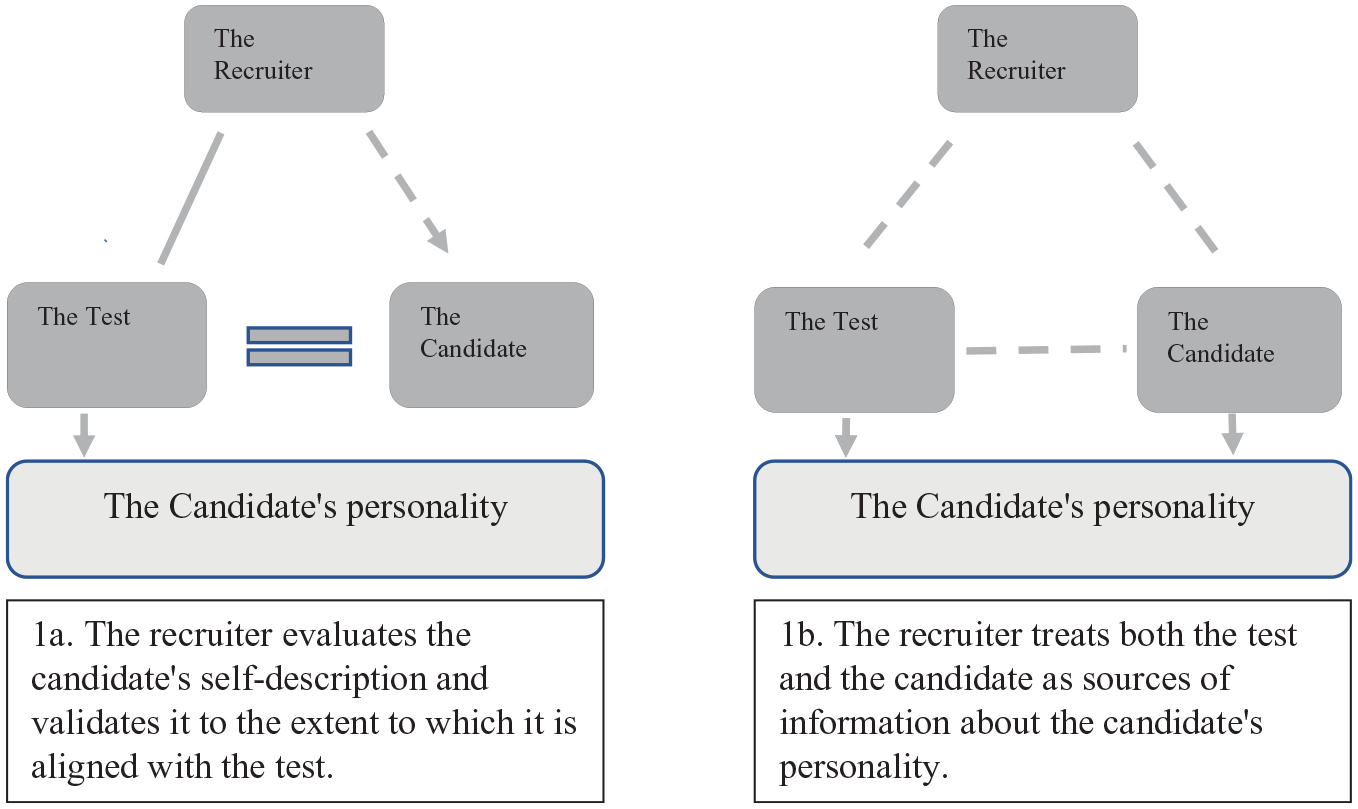
Recruiters’ two strategies to refer to candidates’ personalities: (a) the recruiter evaluates the candidate’s self-description and validates it to the extent to which it is aligned with the test and (b) the recruiter treats both the test and the candidate as sources of information about the candidate’s personality.
Our results contribute to the following three themes: (1) epistemic rights and impression management, (2) the role of documents in recruitment interviews, and (3) personality tests as part of recruitment interviews. Next, we discuss these areas of contribution one by one.
First, in light of our analysis, it seems that, in all circumstances, the candidates orient to their own rights and authority to define their personality. The candidates are willing to compete with the recruiters’ interpretations and protect their own epistemic rights in a manner that forces recruiters to dilute their evaluation of the candidate’s personality and justify the usage of personality tests as part of the recruitment process. This finding aligns with those of previous studies, which have pointed out that the right to define personal issues, such as personality, belongs to the persons themselves (Lejon et al., 2015; Peräkylä & Silverman, 1991; Raymond & Heritage, 2006). In this context, however, the authority of the personality test challenges the right to define one’s personality. The candidates may nonetheless engage in interactional work to claim back their fundamental epistemic rights, as our study showed. Their persistence in doing so may be due to impression management (Goffman, 2004), which is important in all recruitment interviews: it is essential to maintain a positive impression of oneself as having qualities that meet the requirements of the job applied (see Zhang & Li, 2014). In a recruitment interview where a personality test is used, the candidates face a task in which they need to perform their personality (or their perceived self) in an optimal manner (see Goffman, 2004) in a situation where another party (the recruiter’s interpretation of the test) may be challenging their performance.
Second, our results contribute to understanding the role of documents in recruitment interviews. Overall, in workplace encounters, participants orient to documents as reliable information, and as such, documents (here, personality test results) play a significant role in interaction. We showed that recruiters may orient to the documented results of the personality test as having more epistemic authority than the persons themselves. The recruiters marked their orientation toward the test with their gaze, pointing at and touching the test. Our observations regarding the epistemic authority of the tests are in line with Van De Mieroop and Carranza’s (2018) study, in which they demonstrated how superiors in performance appraisal interviews oriented to documents in such a way that employees had to present even more credible facts to support their oral claims, even though they had established the document themselves. Furthermore, our results demonstrate how the recruiters’ orientations toward the epistemic rights of the document may limit the candidates’ possibilities to describe their personality. Aligning primarily with their own expertise as interpreters of the test results may result in candidates having to defend their own views of their personalities. However, by aligning with the candidates’ authority, using the personality test as one possible source of information, and formulating the interpretation as separate, independent, and open for discussion, the recruiters generate possibilities for the candidates to elaborate on the impression they give regarding their personality. Hence, this results in more concrete descriptions of candidates’ ways of acting in different situations at work and, as such, in more holistic impressions of their possible match with the job applied.
Third, our results contribute to understanding the role of the personality test as part of the recruitment interviews. As personality tests are meant to increase the objectivity of the interview (Anastasi & Urbina, 1997) and, as such, identify the best fit for the available job (Komter, 1991), it becomes essential to understand how personality is negotiated during the recruitment interviews and whether the testing procedure meets the expectations set for it. We know so far that job interviews are challenging interactional situations because they contain aspects that are rarely present in interactions as a combination (see Huffcutt et al., 2015). Adding a personality testing procedure in the situation further increases the complexity, and the pressure of the candidate for impression management. Impression management becomes focal first when the candidates answer the test questions, and second, when the test results are revealed to them during the interview. While answering tens of test questions, candidates are forced to choose the most descriptive option between two opposite features. The testing procedure may not only diminish candidates’ possibilities to describe the diversity of their personality but also put aside situational variation of behavior. The candidates do not have the opportunity to correct or control the personality description that is drawn based on the test until they receive the results in the job interview. Consequently, during the actual interview, not only do the candidates need to describe their personality in the best possible light, but they also need to convince the recruiters about the consistency of their personal characteristics with regard to the test results, the recruiters’ interpretation of them, and their own self-description.
Our data offered a unique perspective and insight for the combination of two common work life practices—personality testing and recruitment interviews—and as such introduced an entirely new point of view for the epistemic authority in negotiation of personality. This aspect has not been discussed in earlier research concerning personality tests or recruitment interviews. By focusing on the epistemic rights of participants, the recruiter, and the candidate, we will get access to the functional consequences of different interactional strategies. That said, even if the database is unique, it can be considered small. Data were collected from one company, and there were three recruiters involved in the research. Because of the COVID-19 pandemic, we were forced to abort the data collection and we were not able to recruit more ESC companies for the study. Despite the limited amount of data, the interactional strategies described in the analysis are generalizable as existing and, thus, possible strategies in recruitment interviews (Peräkylä, 2004). In conversation analysis, the generalizability of research findings is established through a comparison between interactional strategies in different contexts, which allows the understanding of interactional strategies as cumulating on a case-by-case basis.
There is a clear need for deeper understanding of how interaction unravels in recruitment interviews: how recruiters evaluate the candidates and what kinds of options these evaluation methods create for candidates to act. Further research is also required on the effects of personality test results on decision making in the recruitment process, as well as on the ways in which personality is constructed by the recruiter and the candidate in the situation. We believe that the development of recruitment interview practices requires not only more microanalytical research on real-life interaction but also value discussion about the aims of the selection of candidates: Is the objective to find the right personality for the position, or to find potential talents who can be trained to meet the needs and requirements of the job? As a combination of these two, it is possible to succeed in creating more valuable strategies and practices for recruitment interviews.
Conclusion
Our research demonstrates the significance of attending to candidates’ epistemic rights while evaluating their personalities. Interactional strategies that involve attempts to challenge the candidates’ fundamental right to define their own personality in a situation where their future careers are at stake may thus not be optimal concerning the aim of the recruitment interview. We therefore recommend interactional strategies that give candidates more control in defining information about themselves. If the participants can disclose and combine their specific areas of knowledge—the candidates’ understanding of their own characteristics and the recruiters’ expert views on structuring these characteristics into comparable entities—personality tests can be helpful in generating information from candidates that is genuinely useful for making recruitment decisions.
Footnotes
Appendix A
Appendix B
Declaration of Conflicting Interests
The authors declared no potential conflicts of interest with respect to the research, authorship, and/or publication of this article.
Funding
The author(s) disclosed receipt of the following financial support for the research, authorship, and/or publication of this article: Research for this paper was funded by the Kone Foundation.
