



Abstract
Studies of the grant proposal tend to conflate academic research grant proposals with other kinds of nonprofit grant proposal genres, even though research and nonprofit grant proposals have different audiences and goals. To address this gap, this study draws on the Aristotelian concept of topoi (or typical arguments) and uses corpus analysis, interview, and coding methods to answer the question, what topoi distinguish the academic research and nonprofit grant proposal genres? Findings suggest key differences in the topoi that research and nonprofit proposals use to advocate for problems and outcomes, set goals, and establish credibility.
Introduction
The research proposal, according to Myers (1990), is “the most basic form of scientific writing: The researcher must get money in the first place if they are to publish articles” (p. 41). In keeping with this significance, scholars have investigated the rhetorical and linguistic means by which academic proposal writers persuade grant makers to award research funding (Connor, 2000; Connor & Mauranen, 1999; Myers, 1985). Scholars have also explored the social dynamics of research grant writing, investigating the research proposal as one genre within a larger system (Tardy, 2003) or field (Moeller & Christensen, 2009) and researching how students can learn how to write successful research proposals (Ding, 2008; Fazel & Shi, 2015; Flowerdew, 2016; Poe et al., 2010). More recently, Mehlenbacher (Kelly, 2016; Mehlenbacher, 2017, 2019) has studied crowdfunding in research communities and has argued that the crowdfunded research proposal is an emerging genre whose rhetorical moves and appeals deserve more scrutiny.
This kind of proposal-focused scholarship has produced useful findings about proposal writing. However, as this brief literature review suggests, studies of “the grant proposal” have tended to privilege the academic research proposal genre and have shown far less interest in nonacademic kinds of grant proposal writing. One notable exception is Connor and Upton’s (2004) study of nonprofit grant proposals. They analyzed nonprofit grant proposals included in a fundraising corpus created by Indiana University–Purdue University’s Indiana Center for Intercultural Communication (ICIC). Via move-step and multidimensional register analyses—common methods among linguists, which involve connecting a text’s lexicogrammatical features to its broader organizational patterns and communication styles (Biber, 1992)—Connor and Upton concluded that nonprofit proposals are “strongly informational, closely edited texts that use an explicit, precise and non-narrative structure to appeal to potential donors” (p. 253).
To date, however, other researchers do not seem to have followed Connor’s and Upton’s leads in exploring the nonprofit proposal as an important genre and one that is distinct from the research proposal. Other business and professional communication researchers have explored other kinds of proposal writing; for instance, Freed et al. (2011) and Johnson-Sheehan (2001) have both written books on the topic. But Freed et al.’s (2011) guidebook is designed to help budding entrepreneurs write winning business proposals, while Johnson-Sheehan’s (2001) textbook focuses largely on helping business professionals write proposals for corporate clients and devotes just two small sections in two of its 12 chapters to exploring research-related grant writing (pp. 6-7, 11-14). Neither text devotes space to exploring nonprofit proposal writing.
The fact that more research has not explored the nonprofit grant proposal genre is somewhat surprising, since government and foundation grants are important sources of nonprofit income (National Council of Nonprofits, 2019). For instance, “human services” charities—those that “feed the hungry, assist crime victims and offenders, provide job training, house the homeless . . . act as advocates for children, and offer programs to help youth mature into adults who contribute to society” (Human Services, n.d.)—are the biggest type of public charity in the United States, and they are sustained in large part by grant funding (McKeever, 2018; National Council of Nonprofits, 2019; Pratt & Aanstead, 2020).
But this gap in our field’s research is also surprising from the perspective of preparing students for potential future careers. Year after year, Deloitte’s annual Millennial and Gen Z Survey indicates that Gen Z professionals are highly socially conscious and concerned with global challenges, compared with older generations, and Deloitte's 2021 survey indicated that nearly 50% of Gen Z respondents said they have made decisions about where to work based on their socially conscious values (Deloitte, 2021). Add to this the fact that in the last 12 years, the nonprofit sector has grown by 20%, compared to a roughly 3% growth rate in the for-profit sector (Nonprofit sector growing faster than for-profit, n.d.), and, as Rigenbach (n.d.) argues in a working paper, it “would suggest that nonprofit organizations, which serve as a vital means of delivering impact services in the United States, might be attractive for recent college and university graduates” (Introduction, para. 2). While low pay and burnout have historically made it difficult for nonprofits to recruit and retain top graduates, a 2023 report from PNP Staffing Group indicates not only that more than half of nonprofits surveyed are planning to hire additional staff to meet demand in the coming year but also that these organizations are meeting recruitment challenges by raising salaries (in some cases dramatically) and upping their retention efforts, including offering more hybrid and flexible working options—all moves that seem likely to attract graduates (Nonprofit salaries and staffing trends, 2023). Together, these trends in Gen Z preferences, sector growth, and more aggressive recruiting might mean that our students are at least somewhat more likely to pursue nonprofit employment, which in turn suggests that they would benefit from learning about the rhetorical features of a foundational genre like the nonprofit grant proposal.
Even setting aside students’ potential career paths, it seems likely that those of us who teach in business and professional writing contexts might have to contend more with nonprofit-related writing instruction in the future, if we are not already. The field of nonprofit studies is growing (Ma & Konrath, 2018), and degree programs in nonprofit management are becoming increasingly popular with students (Mirabella, 2007). Perhaps because of this growing interest, many universities’ Communication programs offer concentrations or courses in nonprofit communication. For instance, Communication programs at Johns Hopkins University and the University of Texas at Austin both offer minors in nonprofit and philanthropic communication, while Communication programs at Northwestern University, the University of Southern California, and Loyola University offer courses specifically dedicated to nonprofit communication. At my own university, the English Department’s Professional Writing program offers an elective course in nonprofit message creation that, among other things, asks students to investigate messaging strategies in nonprofit grant proposals.
Those of us who work in business schools may see similar trends in our own context, thanks to the rapid growth of social entrepreneurship programs (Kickul et al., 2018; Pache & Chowdhury, 2012), which typically include both for-profit and nonprofit entrepreneurship efforts that seek to advance social good (Dees, 2011). Moreover, since interest in nonprofit startups has grown over the years (Morris et al., 2007), and since business accelerators like Y-Combinator and Fast Forward fund nonprofit startups (About Fast Forward, n.d.; Brady, n.d.), some researchers have recently begun calling on business schools to offer nonprofit education programs that, in addition to management training, would include instruction in philanthropic communication (e.g., Thomas & Van Slyke, 2019).
In short, given the importance of grant proposal writing in charitable settings, the fact that students may be increasingly drawn to nonprofit careers given sector and generational trends, and the fact that professional and business communication educators are seeing an uptick in demand for nonprofit communication courses, it is surprising that in the more than 20 years since Connor and Upton’s (2004) article was published, more research has not studied the rhetorical features of important nonprofit genres of writing, including the nonprofit grant proposal genre.
Moreover, because it seems doubtful that many of the conventions of academic writing would apply well to nonprofit grant proposals, this lack of research may highlight potential problems with our teaching practices. For instance, Porter (2007) has argued that while academic prose, with its dense information structures, expert jargon, and dispassionate tone, might be welcome in published research articles, it is a liability in grant proposals. But he also suggests that differences between academic texts and grant proposals run deeper. For example, he notes that while academic writing is past-oriented and tends to focus on theoretical concepts, grant proposal writing is future-oriented and focuses on social outcomes. These “contrasting perspectives,” as Porter calls them, suggest that there may be fundamental differences in the kinds of arguments that grant proposals and academic texts employ to solicit funding, but without additional research, instructors cannot identify and teach these arguments. It seems unlikely, for instance, that nonprofit grant proposals use familiar “creating a research space” (CARS) moves like establishing a research territory and then establishing and occupying a research gap to argue for niche, field-specific problems (Swales, 1990), but research has not established what kinds of strategies nonprofit proposals do use to make problem-related arguments. Additionally, instructors tend to see their own academic writing knowledge as more universal than it really is (Lea & Street, 1998; Russell, 2002; Thaiss & Zawacki, 2006), and so without more insight into the rhetorical strategies of nonacademic proposal writing—including nonprofit proposal writing—instructors may unproductively guide students to apply academic writing conventions in nonacademic proposal writing scenarios. In other words, additional research into a professional genre like the nonprofit grant proposal could prove useful to writing and communication instructors if only to highlight gaps in our own prior knowledge and experience and to help us better account in our teaching for the extent to which different kinds of professional activity systems require different kinds of proposal-related arguments.
This study aims to mitigate this gap in the research literature by offering a comparative analysis of the kinds of arguments that research and nonprofit proposals use. Because I was interested in argument analysis, I chose to draw on the ancient rhetorical concept of topoi and thus to analyze the topoi, or lines of argument, of both genres. Topoi are traditionally associated with the rhetorical canon of invention because they are the mental “places” where rhetors can go to find starting points for creating persuasive arguments (Aristotle, 2004). When used effectively, topoi work because they draw on an audience’s preferred modes of reasoning, connecting their commonly held but tacit warrants and premises to their shared values (Perelman & Olbrechts-Tyteca, 1969; Toulmin et al., 1979). The common, or general, topoi reflect broad inferential patterns of reasoning and can be deployed in any context, whereas special topoi work only in particular rhetorical contexts. Therefore, using special topoi as a lens for analysis can highlight a specialized audience’s values and patterns of reasoning. In the case of this study, a topoi-based approach to analysis provided a way to compare research and nonprofit foundations’ values and preferred modes of reasoning by way of examining the arguments that academic researchers and charitable organizations use in their proposals, when they appeal to these audiences for funding.
In addition to helping identify common lines of arguments in both types of proposals, this study’s topoi-based approach to analysis is similar to the approaches taken by other scholars of Writing Studies and thus situates this research in a small but useful body of pedagogical scholarship—a helpful positioning, given this study’s aim of expanding the research-based curricular resources available to instructors who teach nonacademic proposal writing. This prior topoi-focused Writing Studies scholarship has been interested in the topoi of specific academic genres such as literary criticism (Fahnestock & Secor, 1991; Wilder, 2005) and STEM writing (Carter, 2021; Walsh, 2010) as well as the common topoi of academic discourse (Birkenstein & Graff, 2018; Thonney, 2011; Wolfe et al., 2014). This scholarship has shown that topoi-based analyses are useful ways to unpack the kinds of arguments that experts tacitly expect but may not be able to identify.
In this analysis, I take a similar approach to these scholars, but I aim to compare the topoi that a familiar academic genre—the research proposal—uses to appeal for research funding against the topoi that an underresearched professional genre—the nonprofit proposal—uses to raise funding for charitable purposes. In making this comparison, I sought to answer the question, what topoi distinguish the research and nonprofit proposal genres? My aim in pursuing this answer was to identify potentially new topoi, as knowing more about these topoi could benefit students interested in nonprofit careers as well as instructors of professional writing who might generally benefit from learning about important variations in different proposal genres.
Methods
To identify key rhetorical differences, I first conducted a computer-aided analysis of two corpora (one of research proposals, and another of nonprofit proposals). This analysis involved tagging the corpora with a rhetorical corpus analysis tool and then conducting a principal components analysis (PCA) on the data. I used the PCA results to conduct a qualitative coding analysis of the corpora, which ultimately produced a coding scheme with six topoi. Finally, I interviewed two nonprofit grant writers—one with more than 20 years of grant writing experience, the other with five, and both of whom work at a network of museums in a major metro area—to further refine my codes and to provide context for my textual findings.
The Proposal Corpora
This study is based on a comparative analysis of two corpora (see Table 1), one containing research proposals (the research corpus, N=20) and the other containing nonprofit proposals (the nonprofit corpus, N=60). I have chosen to compare these two specialized corpora because scholarship suggests that comparing a less familiar genre (here, the nonprofit proposal) with a more familiar one (the research proposal) highlights rhetorical features in both that might otherwise be hard to detect (e.g., Porter, 2007; Wolfe et al., 2014).
Summary of the Research and Nonprofit Corpora Used in This Study.
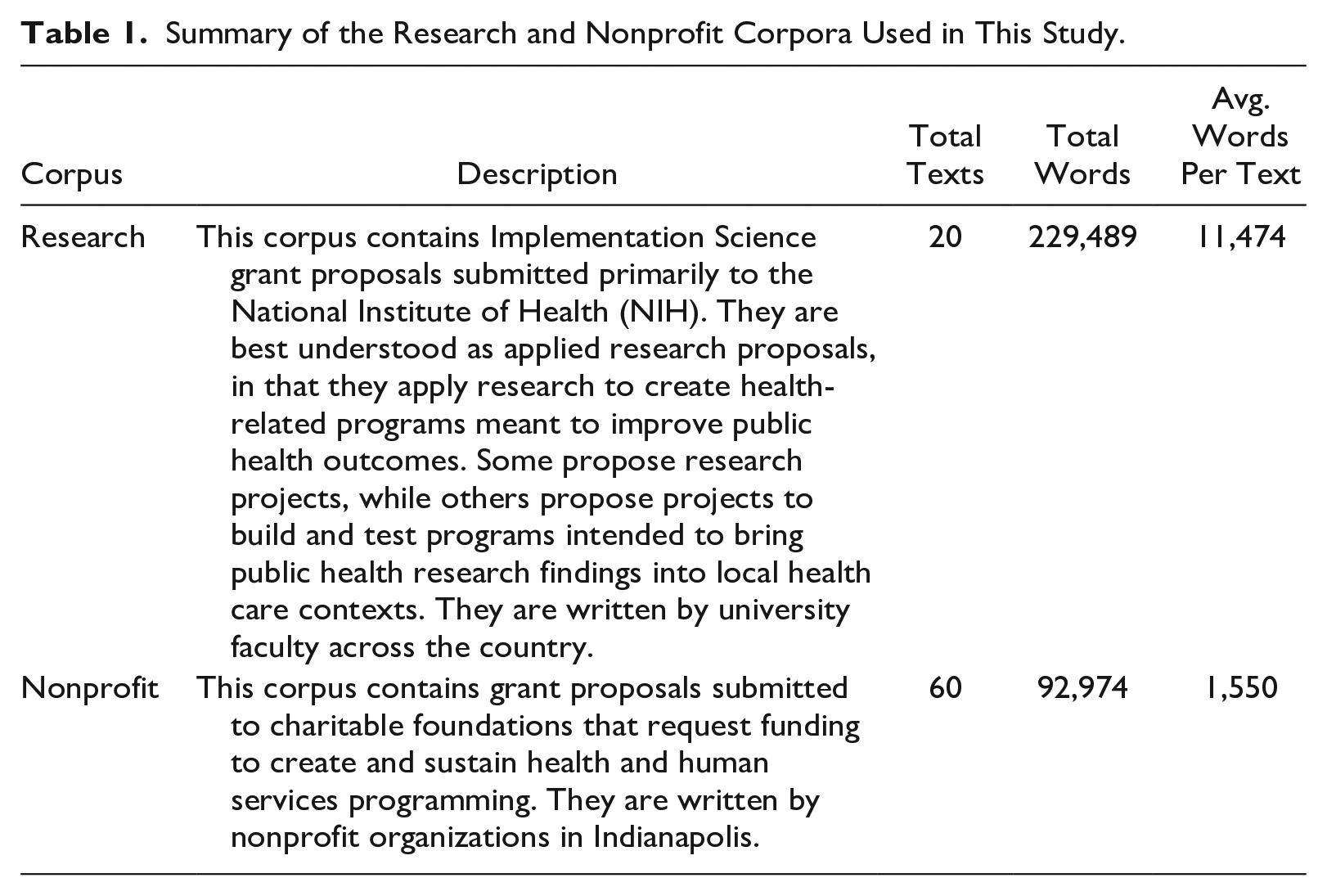
The proposals in the nonprofit corpus were taken from Connor and Upton’s (2004) ICIC fundraising corpus, a collection of fundraising documents gathered from nonprofits in the Indianapolis area. This corpus was built in the late 1990s and early 2000s as part of a two-year collaborative effort between Indiana University–Purdue University Indianapolis, a public research university, and numerous fundraising organizations in the Indianapolis area. This collaboration produced a nearly 2-million-word corpus of fundraising materials, a subset of which contains nonprofit grant proposals (Connor & Upton, 2004, pp. 237-239). While this corpus is admittedly old, to date, it remains the only corpus of fundraising texts that I have been able to access, and I was able to access it only by reaching out directly to Connor. While using a more contemporary nonprofit corpus for this study would be ideal, it is not clear that such a corpus exists or that a researcher would be able to create it, since charitable organizations’ grant proposals represent valuable proprietary information and so are not usually publicly available. Such “occluded genres,” as Swales (1996) calls them, are typically quite difficult, if not impossible, for researchers to access. Indeed, it took Connor and Upton several years of direct collaboration with charitable organizations to build the ICIC corpus.
Moreover, as abundant corpus-based scholarship has shown, a corpus’s age does not invalidate its contents. For instance, the British National Corpus (BNC), a 100-million-word reference corpus of British spoken and written English collected between 1980 and 1993, is still widely used by linguists today. Even in the realm of smaller, more specialized corpora, age does not appear to be an issue for a corpus’s relevance. For example, the Michigan Corpus of Upper-Level Student Papers (MICUSP) and the British Academic Written English corpus (BAWE)—both specialized corpora of student writing across various academic disciplines—were created in 2009 and 2004, respectively, and are still frequently used by Writing Studies scholars interested in studying patterns of student writing (e.g., Aull, 2019; Butler et al., 2020; DeJeu & Brown, 2023; Nesi & Gardner, 2018). Thus, because building a more contemporary corpus of nonprofit proposals would have been quite difficult, and because myriad studies continue to use older corpora for research purposes, I chose to draw proposals for my study’s nonprofit corpus from the grant proposal portion of Connor and Upton’s (2004) ICIC corpus. Specifically, this study’s nonprofit corpus contains what Connor and Upton categorize as health and human services grant proposals: These are proposals written by charitable organizations requesting funding to start or sustain programming that helps vulnerable people.
While nonprofit organizations that contributed proposals to this nonprofit corpus were not asked to verify the results of their proposal submissions, authors and agencies generally submitted their best and most successful applications (Connor, personal communication, January 11, 2020). This fact, as communicated to me by Connor, aligns with researchers’ and fundraisers’ original goals in collaborating on the ICIC corpus: Researchers wanted to better understand the writing-related challenges associated with fundraising, while fundraisers sought expert linguists’ help in improving their fundraising materials. Thus, fundraisers submitted what they considered their strongest work in the hopes that it would provide researchers with helpful insights into the rhetorics of fundraising that could ultimately be leveraged by the fundraisers themselves. Therefore, I treated the proposals in the nonprofit corpus as Connor and Upton (2004) did in their seminal collection Discourse in the Professions: Perspectives from Corpus Linguistics—as examples of reasonably effective nonprofit grant writing.
This study’s research corpus contains Implementation Science (IS) proposals submitted primarily to the National Institute of Health (NIH). These are successful research proposals that received the funding they requested, and copies of these proposals have been made available by the National Cancer Institute and the University of North Carolina’s Implementation Science Exchange. 1 While sample proposals drawn from the National Cancer Institute are undated, proposals drawn from the UNC’s Implementation Science Exchange were written between 2012 and 2018. I selected IS research proposals to create a justifiable corpus-based comparison. Because IS explores methods for turning research findings into public health programs that can be disseminated across community healthcare settings, they are similar to the nonprofit proposals in that they also focus on health-related programming. Therefore, while the proposals in each corpus are written in different contexts and submitted to different kinds of funding organizations, they are similar in their shared emphasis on public health–related problems and programs.
As Table 1 shows, while the research corpus is smaller than the nonprofit corpus in terms of the number of texts included, it is more than twice the size of the nonprofit corpus in terms of the total number of words those texts collectively represent, since the average research proposal is far longer than the average nonprofit proposal. Given these discrepancies in text length, I tried to build both corpora with an eye toward balance, or the range of texts included in a particular corpus (Atkins et al., 1992). First, I kept the research corpus under 250,000 words, since this is typically considered the threshold for a small corpus, and small, specialized corpora are generally considered most useful for studying genre-specific patterns of specialist writing, as I do in this study (Flowerdew, 2004; Handford, 2010). Moreover, while adding more research proposals to the research corpus would have balanced the corpora in terms of the number of texts each included, it would have created substantial imbalance in terms of the number of words in each corpus, and balanced corpora must be sensitive both to the total number of texts and the total number of words (Crawford & Csomay, 2015, p. 80). In short, the composition of the corpora shown in Table 1 reflect my efforts to leverage best practices of corpus building in a situation in which the types of proposals in each corpus vary substantially in length.
Corpus Tagging and Principal Components Analysis
To identify topoi that distinguish the corpora shown in Table 1, I began by tagging each corpus using DocuScope, a dictionary-based rhetorical corpus analysis tool that parses text across numerous rhetorical categories. 2 DocuScope links single words and multiword phrases to their hypothesized rhetorical effects (Kaufer et al., 2004; Kaufer et al., 2006). Thus, tagging the corpora with DocuScope reduced each proposal’s inherent variability and complexity into a set of general rhetorical characteristics, making comparison within and across each corpus more manageable. Ultimately, my DocuScope analysis generated normalized frequency data about each corpus’s most salient rhetorical features.
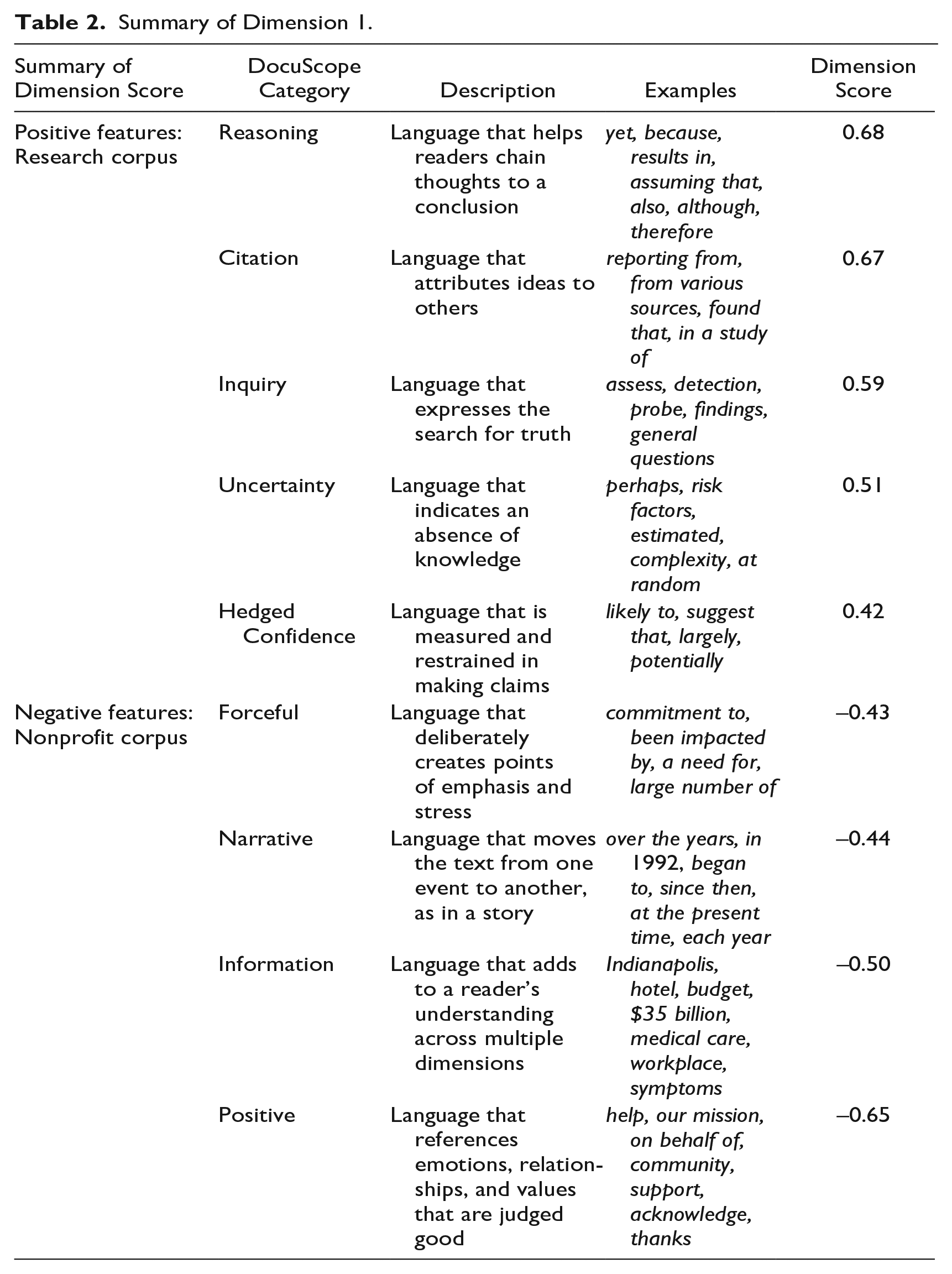
To further reduce each corpus’s complexity for purposes of interpretation, I performed a principal components analysis (PCA) on the DocuScope data. PCA is a common nonparametric technique for dimension reduction (Shlens, 2014). In the case of this analysis, PCA offered a way to distill the corpora into a small set of rhetorical variables that best characterized each corpus and distinguished the corpora from one another. PCA produces as many principal components (also called dimensions) as there are variables in the data, and it sorts these dimensions based on the percentage of variance each explains. Therefore, the first few dimensions in PCA account for the greatest amount of variance in a corpus. I focused my analysis on Dimension 1 (see Table 2), the dimension that explained the largest percentage of variance (16%) between the research proposal and nonprofit proposal corpora.
Summary of Dimension 1.
The scatter plot shown in Figure 1 illustrates how the texts within each corpus separate along the first two dimensions, with the y axis representing Dimension 1 and x axis representing Dimension 2. As Figure 1 shows, Dimension 1 distinguishes the two corpora reasonably well, with most nonprofit proposals occupying the negative side of Dimension 1 and all research proposals occupying the positive side. By contrast, Figure 1 shows that Dimension 2 is not useful for distinguishing between these two corpora, as proposals from both corpora are evenly distributed on the positive and negative sides of this dimension.
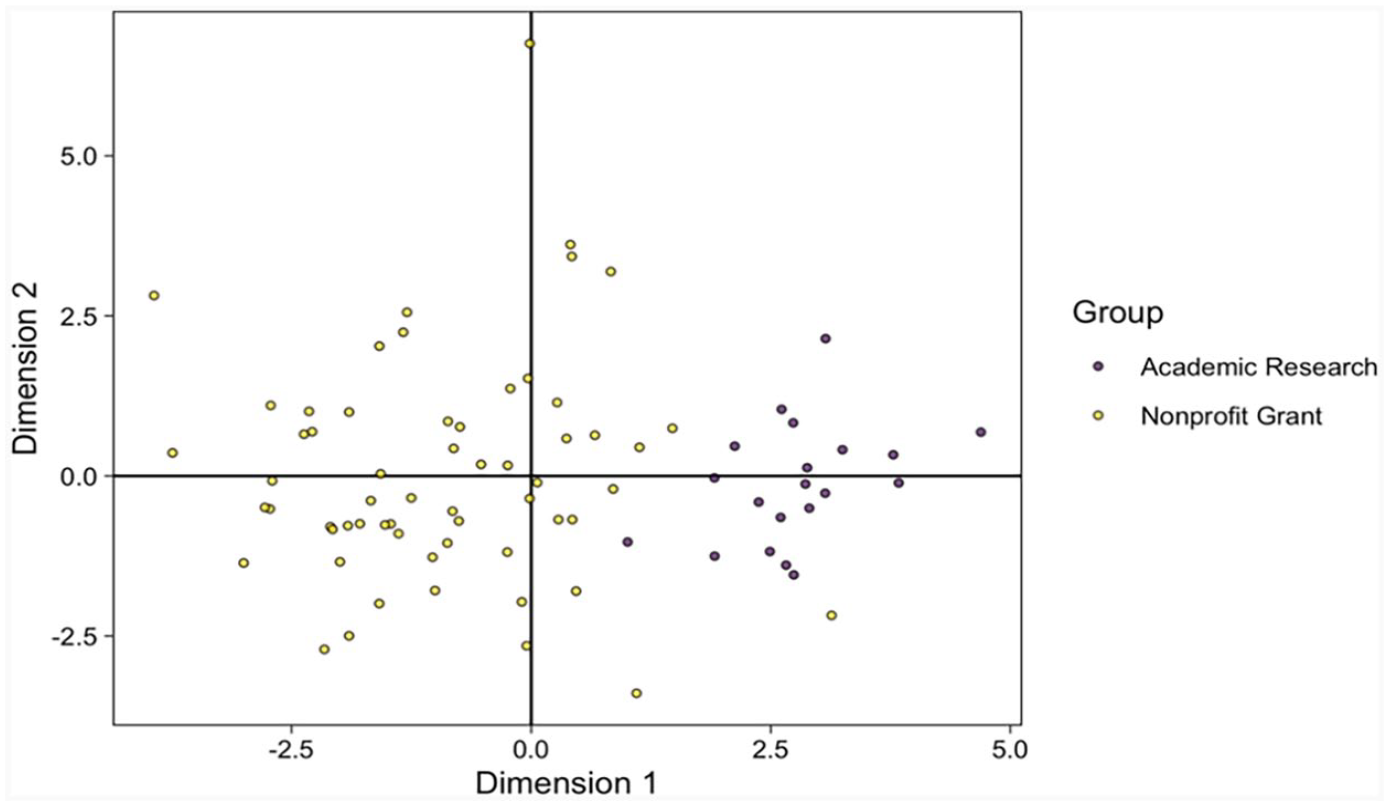
Scatter plot of the first two PCA dimensions. While Dimension 1 (y axis) separates the two corpora reasonably well, Dimension 2 (x axis) does not.
Table 2 shows the rhetorical features that make up Dimension 1, along with each feature’s dimension score. The dimension scores in Table 2, which run from −1 to 1, indicate how strongly a given rhetorical feature is associated with Dimension 1. The further from 0 a dimension score is, the more that score’s rhetorical feature characterizes the corpus in question. By contrast, dimension scores closer to 0 are weakly correlated with Dimension 1 and thus offer little insight into the corpora. Therefore, in Table 2, negative dimension scores do not indicate an absence of characterization or a lack of explanatory power; rather, they show a complementary distribution and signal corresponding presence and absence (Brezina, 2018, pp. 164, 168-169). That is, they indicate that the rhetorical characteristics of nonprofit proposals, such as the use of positive, forceful language and a reliance on character-oriented narratives, do not characterize research proposals. By extension, the features that characterize research proposals, such as inquiry-driven reasoning, citations, and uncertain language, do not characterize nonprofit proposals. We can imagine this complementary distribution plotted along a vertical cline that runs from 1 to −1, with the research corpus’s features clustering together at the positive end of the cline and the nonprofit corpus’s features clustering together at the negative end.
Next, I used the rhetorical features shown in Table 2 as a basis for close reading. I selected representative proposals from each corpus based on the extent to which they exemplified the features highlighted in Table 2. Then, I annotated these representative proposals with the features shown in Table 2. Figure 2 illustrates what a typical annotated proposal looked like. Annotating sample proposals allowed me, as I read, to see how Table 2’s rhetorical characteristics worked together across whole paragraphs and sections of the proposals. As I read, I also worked to connect these granular rhetorical characteristics to broader differences in the topoi each corpus used.
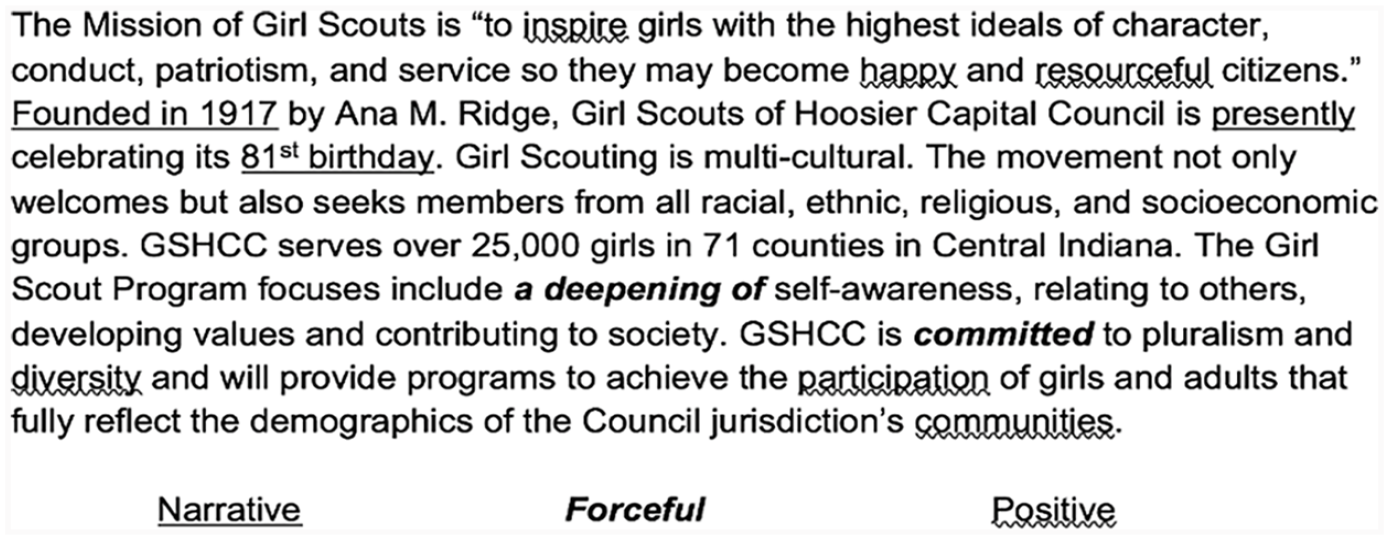
Excerpt from a sample nonprofit proposal, annotated with several of the rhetorical features shown in Table 2.
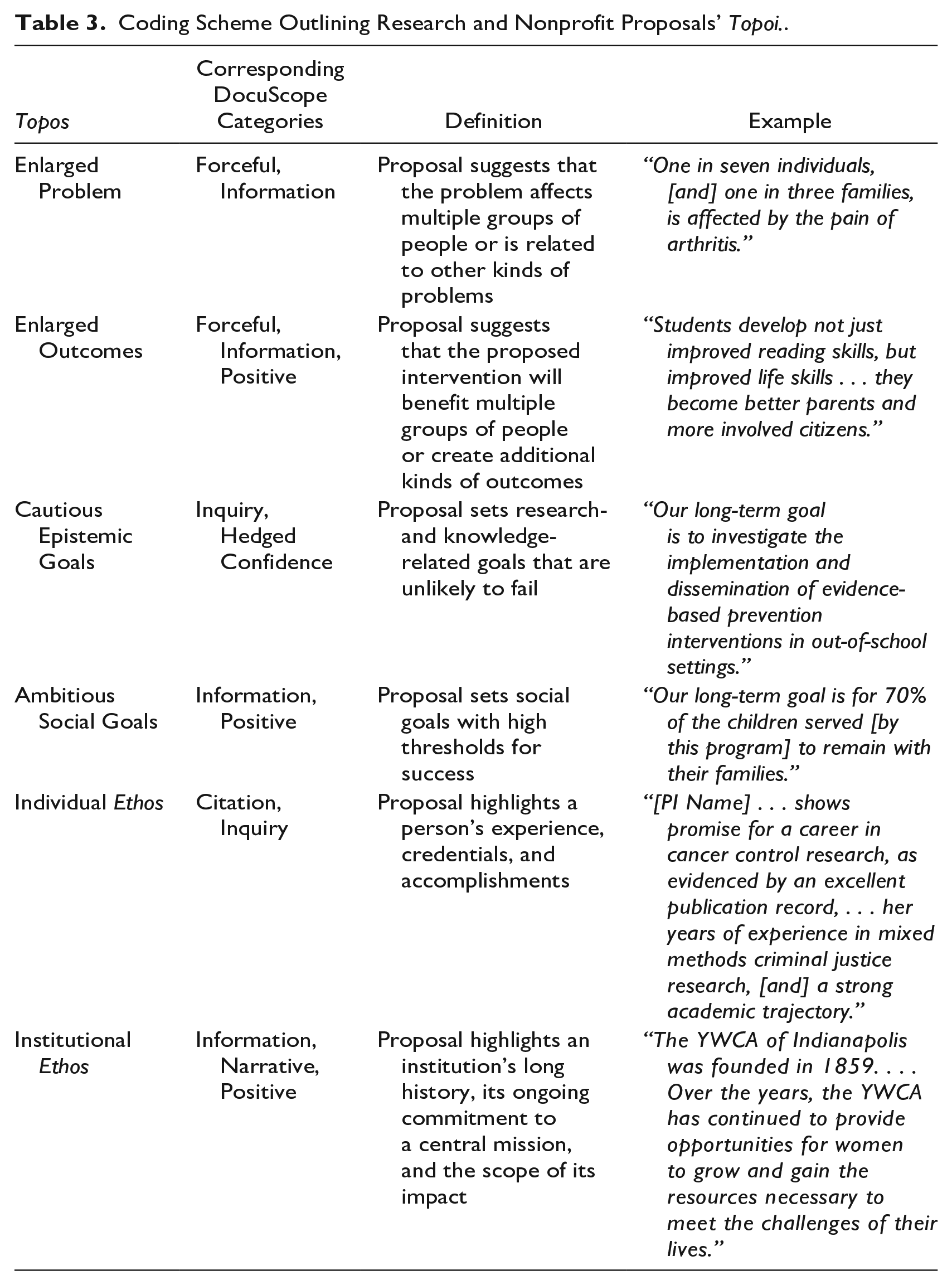
During my close reading, I noticed that, taken together, Table 2’s rhetorical features pointed to consistent differences in the topoi that research and nonprofit proposals used to establish the exigency of problems and outcomes, set goals, and establish credibility. To formalize these observations, I devised a coding scheme (Table 3) and randomly selected half of the research (n=10) and nonprofit (n=30) proposals for coding. I read proposals and coded them in their entirety. Therefore, if a proposal contained any text that used one of the topoi shown in Table 3, the proposal was assigned that code. To establish reliability, I excerpted 10% of the data, segmented it into topical chains, and entered it into Excel for a second coder to analyze (Geisler & Swarts, 2019). The second coder achieved 96% reliability with a kappa of .95.
Coding Scheme Outlining Research and Nonprofit Proposals’ Topoi..
Interviews With Nonprofit Grant Writers
Finally, to contextualize my findings, I also interviewed two nonprofit grant writers (names are pseudonyms):
Research has shown that targeted interviews with grant writers can supply rich contextual details that supplement textual findings (e.g., Connor, 2000; Myers, 1985; Tardy, 2003). While Cathleen’s and Barry’s grant writing experience stems largely from their work at a network of museums, and not in health or human services settings, I found that their insights shed helpful light on my textual analysis. My university’s IRB approved these interviews (STUDY2020_00000021).
Findings
Nonprofit Proposals Enlarge Problems and Outcomes
My analysis suggests first that nonprofit and research proposals differ in the way they size problems and outcomes. The research proposals I analyzed gradually narrowed to small, knowledge-based problems, using what Carter (2021) calls the topos of “narrowing the focus of research” (p. 8), and they rarely discussed the social outcomes of their research. The nonprofit proposals, by contrast, tended to use topoi I am calling enlarged problem and enlarged outcomes to emphasize the widespread social impact an intervention would have. They did this by making strong claims about remote social effects.
Scope of Problems
To begin, the research proposals I analyzed used established "creating a research space" (CARS) moves (Swales, 1990) to narrow their focus to small, niche problems that were typically framed as gaps in disciplinary knowledge, as illustrated in Excerpt 1. Here and throughout, I have added the bolding to textual excerpts: (1) Through application of existing knowledge, much of the cancer burden is preventable. State-level practitioners are in ideal positions to affect programs and policies related to cancer control. Yet
In Excerpt 1, the writer narrows from general cancer prevention knowledge to a much smaller target problem—how to effectively disseminate that knowledge to healthcare practitioners. Notably, this proposal frames cancer not in terms of its social impact (such as illness and death) but in terms of a knowledge gap which the proposed study aims to address.
The nonprofit proposals, by contrast, always described problems socially, in terms of the harm they cause. What is more, nonprofit proposals consistently amplified the problems they tackled, via the topos of enlarged problem. One way they did this was by arguing that a target problem had secondary effects on people beyond those who were directly impacted by it. Some proposals did this quickly and in passing. For instance, a nonprofit proposal by the Arthritis Foundation noted that “one in seven individuals, [and] (2) At the present time, close to 300 students are expelled from the Indianapolis Public School System. . . . Most of these young people have no place to go, no constructive activities to fill their time, and no adult to supervise their actions. They are essentially wasting time . . . Beyond the negative impact of being expelled on the individual student,
The proposal starts with a relatively small, isolated problem—300 students are currently expelled from the Indianapolis Public School System—but as the bolded text shows, the writer uses the topos of enlarged problem to gradually expand this problem by illustrating expulsion’s secondary effects on families and whole communities. The writer also highlights the remote, distant effects of school expulsion, like illegal activity and lost productivity, to show that this problem has a negative ripple effect that will affect the entire community over time.
Another way that the nonprofit proposals I analyzed used the topos of enlarged problem was to argue that the target problem was connected to other problems. For instance, a nonprofit proposal requesting funds for a teen pregnancy prevention program enlarged the problem of teen pregnancy by arguing that it was linked to a host of other social problems, as shown in Excerpt 3 in the bolded text: (3) Adolescent pregnancy and birth
In Excerpt 3, the writer enlarges the problem of teen pregnancy by framing it as just one node in a larger network of related problems. Some of these—like poverty—are framed as remote causes of teen pregnancy, while others—like the increased risk of disease, substance abuse, criminal activity, and dropping out of school—are framed as remote social outcomes, suggesting that teen pregnancy causes lasting and widespread harm.
Figure 3 summarizes the percentage of coded proposals that enlarged problems. As Figure 3 shows, 70% of nonprofit proposals enlarged problems, while just 30% discussed problems only in terms of those directly affected. By contrast, while all 10 of the coded research proposals used CARS moves (Swales, 1990) and to narrow from a broad research territory to a precise research gap, just 20% also enlarged problems to show that health problems like cancer and obesity affect broader groups of people beyond those who are directly afflicted. Moreover, these research proposals’ problem-enlarging arguments were quite brief, compared with the lengthier and more complex use of the topos of enlarged problem in nonprofit proposals.
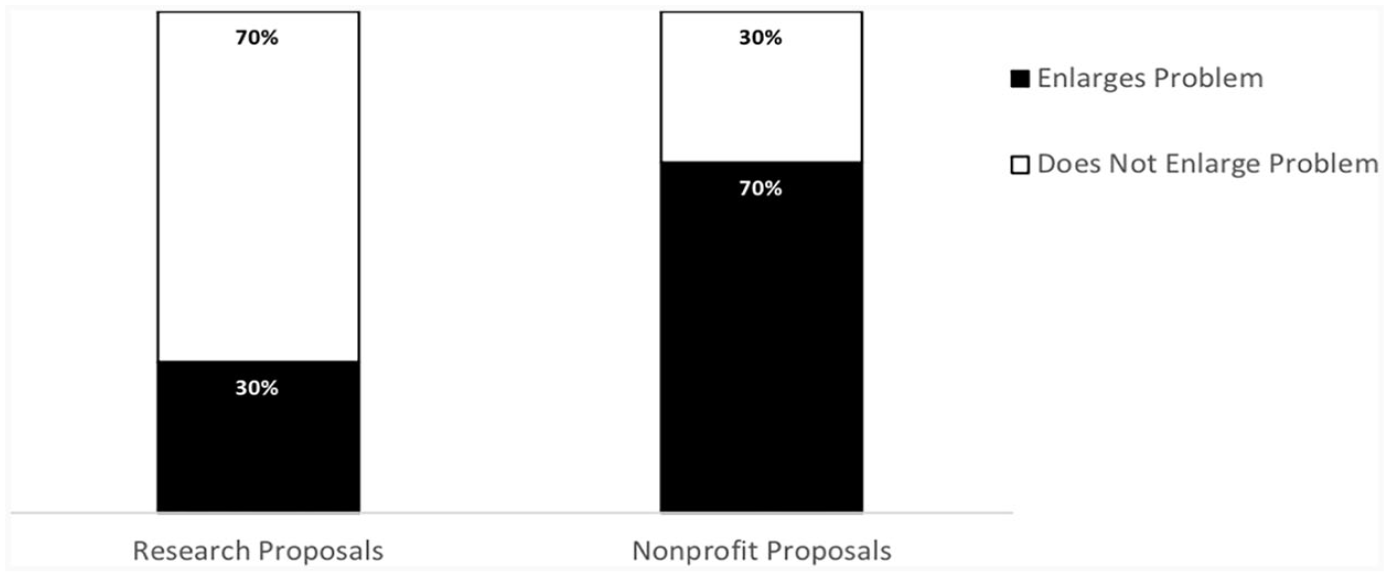
Percentage of coded research (n=10) and nonprofit (n=30) proposals that used the topos of enlarged problem.
Scope of Outcomes
In addition to enlarging problems, the nonprofit proposals also used a topos I call enlarged outcomes. To begin, they enlarged outcomes by suggesting that in addition to producing a target outcome, a proposed intervention would create many additional remote outcomes. For instance, another nonprofit proposal concerned with teen pregnancy suggested that its intervention—a club program for girls in low-income housing projects—would not only prevent pregnancy (the target outcome) but would create a host of other positive outcomes, as shown in Excerpt 4’s bolded text: (4) Participants will have increased Participants will have increased Participants will increase their Participants will increase their
Of these four outcomes, only one relates directly to preventing teen pregnancy (“understanding of sexual responsibility”). The other three suggest lasting remote effects this program will have on the girls who participate: They will make good decisions, map out productive career paths, and exercise control over their futures.
The nonprofit proposals analyzed in this study also enlarged outcomes by arguing that proposed interventions would benefit other groups of people, beyond those for whom the target intervention was intended. For instance, a nonprofit proposal requesting funds for a day care program enlarged outcomes by highlighting the remote and secondary effects that day care creates for children, their families, and their communities, as shown in Excerpt 5, in the bolded text: (5) [A study] showed that children [cared for in a safe, positive environment] showed long-term gains:
In Excerpt 5, the writer enlarges the proposal’s target outcome—keeping at-risk children in a safe and constructive environment during the day—by emphasizing remote effects not only for children (including a host of educational and citizenship benefits) but also secondary effects for their families and communities. This outcome enlarging in Excerpt 5 mirrors the problem enlarging in Excerpt 2, from the school expulsion proposal, in which the problem of expulsion was enlarged by highlighting its negative ripple effects. Here, the outcomes of daycare are enlarged by showing their positive ripple effects over time, across an entire community.
Figure 4 shows the percentage of coded proposals that used the topos of enlarged outcomes: 80% of nonprofit proposals enlarged outcomes, while just 20% described more limited, immediate outcomes. By comparison, only 20% of research proposals enlarged outcomes, arguing that their proposed health-related interventions would benefit patients’ families, friends, and communities. The remaining 80% of research proposals did not discuss the social outcomes of their proposed work. In addition, as with their problem-enlarging arguments, research proposals’ outcome-enlarging arguments were quite brief compared to those made in nonprofit proposals.
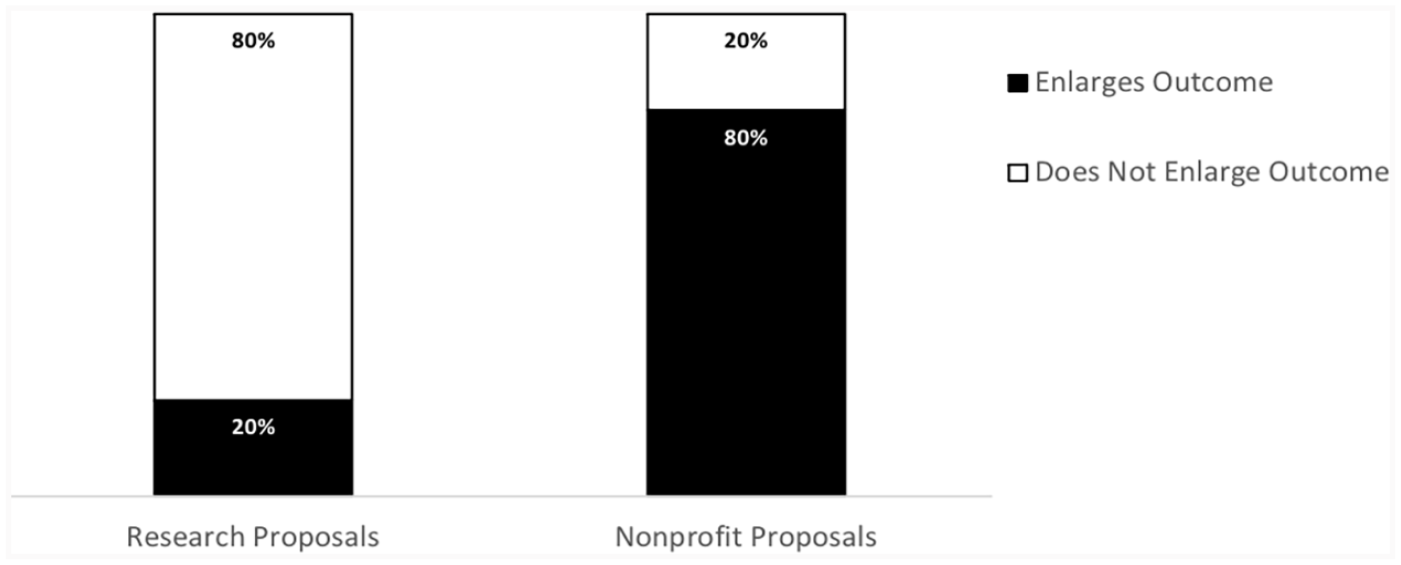
Percentage of coded research (n=10) and nonprofit (n=30) proposals that used the topos of enlarged outcomes.
Together, Figures 3 and 4 indicate that most nonprofit proposals used the topoi of enlarged problem and outcomes. The rhetorical goal of this enlarging seems to be to convince grant makers that proposed projects are meeting widespread, exigent needs and that any funding provided will create a ripple effect of positive outcomes over time, for many people. But my interview with Cathleen suggested an additional reason why grant writers might use these topoi: Enlarging problems and outcomes could be one way grant writers match a proposed program’s goals to a funder’s priorities and values.
Notably, Cathleen indicated that nonprofit staff do not typically begin with these topoi in mind. Instead, she suggested that staff often start with a specific program idea and must be coached through the process of contextualizing that program within a larger story of needs and benefits: People working on projects, they get very focused on “Here’s the thing I want to do.” And they haven’t necessarily thought about why they’re doing it, who’s going to care about it, why the donor should care about it. . .you have to [establish that] as the grant writer. . . . It’s typical, where a grant writer is having to execute a grant when the team is in the process of thinking this through.
But it is not just a matter of creating a broader narrative around the program. As Cathleen’s response suggests, it is crucial that the narrative resonates with a funder’s values and priorities. This is particularly difficult for novice grant writers, she said, and she indicated that she often has to remind them, “Look, you might care about this, but we have to come back to what this donor cares about, and we have to find a way to match our [program’s] goals with the donor’s goals.”
This study’s findings suggest that the topoi of enlarged problem and outcomes offer ways to accomplish this matching, since these topoi allow grant writers to connect small, localized problems and outcomes to funders’ broader social goals. For instance, two proposals in the nonprofit corpus requested funding from the Junior League of Indianapolis (JLI) to implement pregnancy prevention programs in particular neighborhoods. In order to match their relatively localized problems and outcomes to the JLI’s broad mission of “developing the potential of women and improving the community” and their vision to “be a catalyst for lasting change in the lives of children and their families” (Mission, Vision, and Diversity Statements, n.d.), the proposals used the topoi of enlarged problem and outcomes: They linked the problem of teen pregnancy to exigent community issues like crime and poverty (see Excerpt 3), and they linked pregnancy prevention to lasting secondary outcomes like improving girls’ self-esteem, decision-making skills, and sense of control over their futures (see Excerpt 4). In doing so, the grant writers contextualized their pregnancy prevention programs within a broader narrative of needs and benefits that aligned with the JLI’s values.
Nonprofit Proposals Set Ambitious Social Goals
Because the research and nonprofit proposals analyzed in this study sized problems and outcomes differently, with nonprofit proposals enlarging both, they also defined success differently. This is apparent in the kinds of goals that research and nonprofit proposals set. The research proposals that I analyzed framed public health problems narrowly, as gaps in knowledge, so they used a topos I am calling cautious epistemic goals to outline small, knowledge-related goals that were unlikely to fail. By contrast, the nonprofit proposals enlarged both problems and outcomes to show their remote social impacts, so they used a topos I am calling ambitious social goals to lay out objectives with high thresholds for success.
To begin, all the research proposals analyzed in this study framed their primary goals in epistemic terms, often as infinitive verbs that reflect the process of academic inquiry. Common infinitive verb phrases (shown in Excerpt 6 in bold) in the “Specific Aims” sections of research proposals included the following: (6)
This tendency to set epistemic goals that were virtually fail-proof is exemplified in the bolded text in Excerpt 7, from a research proposal requesting funds for an after-school program to combat childhood obesity: (7) Our long-term goal is
In Excerpt 7, the way these goals are defined ensures that the research team cannot fail to meet them. Simply performing the investigation outlined in the research proposal would satisfy the “investigate” goal; similarly, “establishing the effectiveness of two training models” and “understanding the influence of context on effective implementation” could be achieved no matter how effective the training models proved to be (since establishing that they are somewhat or mostly ineffective is still a way to establish their effectiveness) and regardless of how context ultimately influenced implementation. Using the topos of cautious epistemic goals, then, ensures that the proposal writers are guaranteed to secure their target outcomes, which are shown in bold in Excerpt 8: (8) We anticipate the following expected outcomes. First,
No matter what findings their research produced, these researchers would have been able to discuss the effectiveness and cost-benefit ratios of their models and describe how contextual factors influence uptake.
Notably, none of the target outcomes in this research proposal were directly linked to tangible health outcomes for overweight children, the vulnerable population this proposal aimed to help. While the proposal did suggest that the study’s results would ultimately have a positive impact on children’s health, the outcomes of interest relate to the object of study—the training models that predict how well a health-related program will work. This is typical of the research proposals I analyzed: Target outcomes were often research- and knowledge-related, while outcomes related to vulnerable populations were typically vague or absent altogether.
When the research proposals I analyzed did reference tangible social outcomes, they often used hedged language, as shown in bold in Excerpts 9 and 10 from two different research proposals: (9) This study will determine the benefits and cost of adding community health promoters to pharmacist disease management services. (10) Cancer survivors suffer from a host of longer-term adverse effects that reduce quality of life and physical functioning. . . . Gardening interventions
While Excerpt 9 uses confident and predictive terms (“will determine”) to discuss the knowledge-related outcomes of the study, it uses hedged and contingent terms when discussing if and how those findings might ultimately impact people with diabetes. Similarly, Excerpt 10 uses hedged terms in suggesting that a gardening intervention “may” be promising for cancer survivors.
By contrast, when the nonprofit proposals that I analyzed set explicit goals, they were ambitious social goals whose threshold for success was often quite high. Many of these ambitious goals created quantified standards for success. For instance, a proposal requesting funds for a program to prevent child abuse and reduce foster home placements noted that the “long term goal” of their planned program was “
In other nonprofit proposals I analyzed, ambitious social goals were implicit and framed in qualitative terms. For instance, in the school expulsion proposal, the writer listed a range of goals and objectives (shown in bold in Excerpt 11) that created a definition of success that, while ambitious, was also somewhat tacit: (11) The immediate goal is to engage young people in positive, supervised activities in a safe environment as an alternative to possible negative actions Beyond that, the goals include:
providing students with the opportunity to
helping students develop the tools they need to
providing the support and encouragement that students need to cope and thrive
encouraging
Some of the goals listed here are framed in hedged and contingent terms—for instance, reentering school is framed as a “possibility,” and attaining a high school diploma is something students “move toward,” not a guaranteed outcome. Even so, this proposal names three goals related to students re-entering school and getting a diploma; based on this, at least some of the program participants need to achieve these goals. If none do, the program has largely failed. Similarly, while “encouraging parental involvement and cooperation” is somewhat nonspecific, it does require that at least some parents participate in the designated programs. If no parents get involved, the program has not met this goal. In other words, while thresholds for success are more implicit in Excerpt 11 than in those that offer quantified standards for success, they are still ambitious.
Figure 5 illustrates the way this difference in goal setting manifests in the two corpora. As Figure 5 shows, 80% of the coded research proposals used the topos of cautious epistemic goals, while just 20% also briefly mentioned ambitious social goals. By contrast, 60% of the nonprofit proposals used the topos of ambitious social goals. Notably, 40% of coded nonprofit proposals did not set explicit goals. This is because some proposals in the nonprofit corpus requested general operating funds and so did not need to use the ambitious social goals topos because they were not proposing new programs. Others requested funds or equipment to support established programs, and those proposals often described programs without articulating clear, explicit programmatic goals.
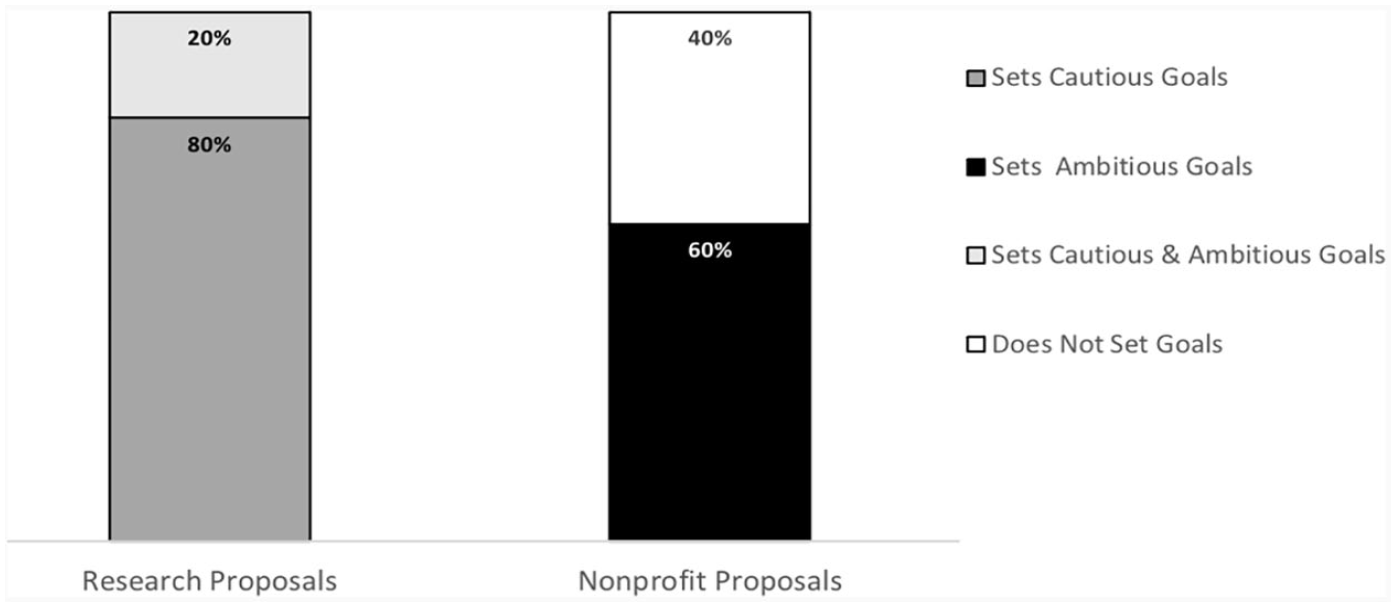
Percentage of coded research (n=10) and nonprofit (n=30) proposals that used the topoi of cautious epistemic goals and ambitious social goals.
My interviews with Cathleen and Barry shed light on why ambitious goal setting is important in nonprofit settings. First, Cathleen linked goal setting to reading clarity: “The more tangible you can be, so that people can actually get their arms around what you are proposing to do, [the better].” In other words, using the topos of ambitious social goals is one way to clarify intended outcomes and to help grant makers understand what an intervention will accomplish.
In addition, Cathleen and Barry suggested that ambitious goal setting helps those within a nonprofit build out the details of a program and may even help clarify institutional priorities. According to Barry, goal setting often happens as a program is still being built, and using the ambitious social goals topos helps program directors identify what the key features and target outcomes of a program actually are. This iterative process of goal setting often becomes the basis for creating programmatic components, structuring timelines, and determining staffing needs. Cathleen confirmed this: She noted that thinking through ambitious short-, mid-, and long-term goals not only helps a nonprofit grant writer define outcomes, but it can even help them redefine the problem they are proposing to address. Thus, goal setting shapes and potentially transforms the entire proposal narrative. In fact, Barry suggested that using the ambitious social goals topos can even help a nonprofit organization clarify its mission. He noted that depending on the size and scope of a given goal, goal setting may ultimately “move the ship” of an entire organization and help establish or redefine high-level institutional priorities. For instance, he noted that after a museum received several grants (with Barry’s help) to make exhibits more accessible for people with disabilities, the museum’s administrators gradually came to realize how important accessibility was and ultimately made it an organizational priority.
Somewhat counterintuitively, Barry also explained that setting ambitious and measurable goals can productively reign in the topos of enlarged outcomes. “I’m not always a big fan of [enlarging outcomes],” Barry explained to me. “Sometimes the claims are grandiose.” In Barry’s experience, program directors may inflate outcomes to appeal to funders. A key part of his job, therefore, is to “jump in and say, ‘Wait a minute, let’s make this practicable.’” Making it practicable involves asking program directors what outcomes they are confident they can achieve and then building goals around those. In other words, using the ambitious social goals topos can temper the impulse to overstate outcomes and overinflate benefits.
Nonprofit Proposals Establish Institutional Ethos
In addition to defining success differently, the research and nonprofit proposals analyzed for this study also established their credibility—their ethos—differently. Proving competence is a key ethos-establishing move in fundraising texts (Bhatia, 2014), and “competence claims” have been shown to take up more textual space in nonprofit grants than other kinds of rhetorical moves (Connor & Upton, 2004). However, my analysis shows that while both the research and nonprofit proposals made ethos-establishing arguments, they did so differently. Specifically, the research proposals used a topos I am calling individual ethos to highlight individual researchers’ competence to carry out the proposed research, while nonprofit proposals used what I call the topos of institutional ethos to show that an institution’s long history, its enduring commitment to a core mission, and the scope of its programming qualified it to receive funding.
The research proposals used the individual ethos topos by highlighting primary investigators’ academic expertise and credentials, past research experience, records of publication, and past awarded grants, as shown in Excerpt 12 in bold: (12) [PI Name], PHD, MPH, Assistant Professor of Preventive Medicine and Public Health . . . shows promise for a career in cancer control research, as evidenced by
Here, the PI’s experience, publication record, and past funding are explicitly used to argue for her competence to carry out the proposed study.
By contrast, the nonprofit proposals focused almost exclusively on establishing institutional ethos. For instance, in a proposal requesting funds for a cancer awareness program, the writer established the YWCA’s ethos by referencing their long history as an organization, their ongoing commitment to helping women, and the number of programs that they can successfully support, as Excerpt 13’s bolded text shows: (13) The YWCA of Indianapolis
One or more of the bolded moves shown in Excerpt 13 were present in nearly every nonprofit proposal that had a section devoted to describing the organization. In fact, in my interview with Barry, he confirmed that this is the basic formula for the institutional ethos topos: “You start with the history of the organization and then move into [describing] your ongoing commitment to public good.” He also confirmed that an exclusive emphasis on institutional, not individual, ethos is standard: “We hardly ever mention the names of specific program staff. Maybe one funder in thirty will ask for those bios, but it’s rare.”
Figure 6 illustrates how this difference in prioritizing individual versus institutional ethos manifests across the two corpora. As Figure 6 shows, 90% of coded nonprofit proposals used the topos of institutional ethos, while 80% of coded research proposals used the topos of individual ethos. A small percentage of the two corpora established both.
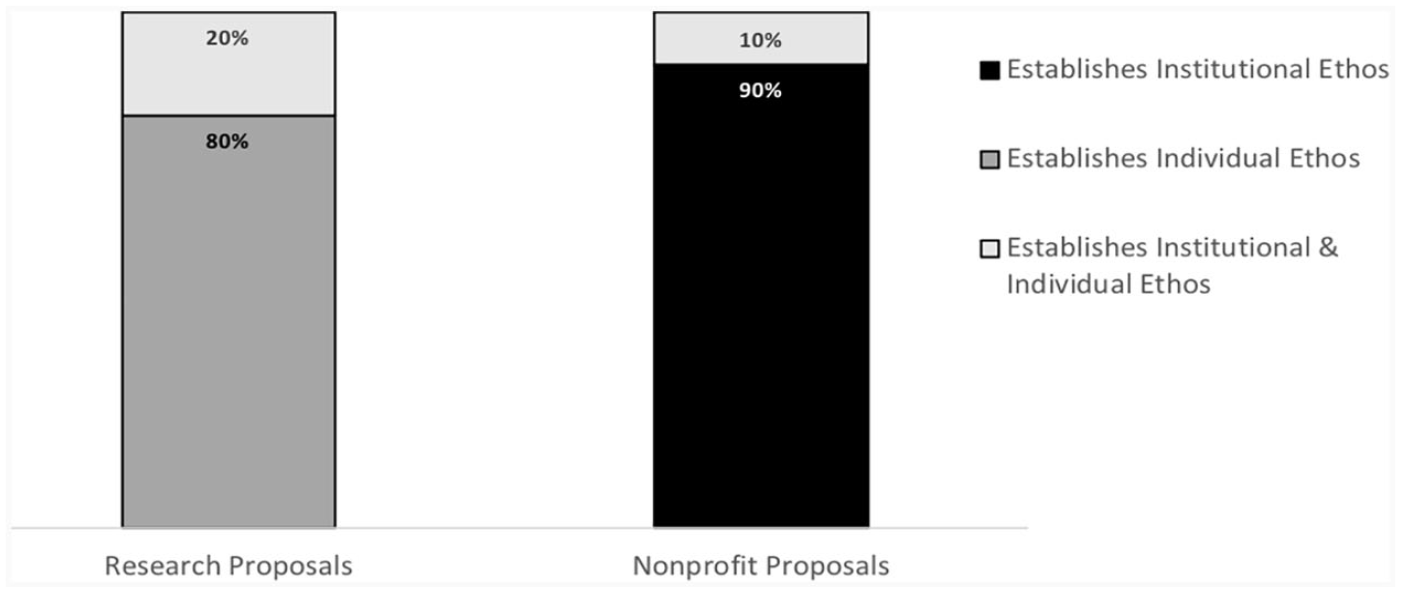
Percentage of coded research (n=10) and nonprofit (n=30) proposals that use the topoi of institutional and individual ethos.
My interview with Cathleen helped to illuminate this difference in ethos building. As she explained, this is a question of reputation: Whose matters more, the individuals involved in the grant or the organization with which they are affiliated? In her experience, nonprofit grant funders care about an institution’s reputation because it points to the institution’s capacity for carrying out the proposed work. In some ways, this is similar to a research proposal’s emphasis on a PI’s expertise—expertise is a kind of capacity. But scale also seems to be a factor here: For a nonprofit, capacity means the ability to create, deliver, and sustain programs over time. Therefore, using the topos of institutional ethos to outline the organization’s enduring history, its mission-focused commitments, and the scope of its programs is one way to prove that the organization can deliver and sustain a proposed program. This sort of sustainability bandwidth is not a factor in the research proposals, which are focused on testing and evaluating programs but not sustaining them over the long term.
Conclusion
This study has explored the topoi that distinguish the research and nonprofit proposals in this study’s corpora, with a focus on foregrounding the topoi of the understudied nonprofit proposal genre. Taken together, these findings offer several new insights about this genre. First, they suggest that nonprofit proposals tend to enlarge both problems and outcomes to prove that proposed interventions meet widespread needs and will produce an array of benefits for many people. Moreover, problem and outcome enlarging is one way that nonprofit grant writers can match small, localized problems and outcomes to the broader social issues that funders want to address. Nonprofit proposals also tend to set ambitious social goals with high thresholds for success. These goals are useful for creating reading clarity, helping establish program specifics, and reining in overinflated claims about benefits. Finally, nonprofit proposals prove competence by establishing an institution’s capacity to create and sustain beneficial programming.
In addition to presenting a collection of new topoi from which students would benefit learning, this study also suggests several broad guidelines that could prove useful for novice nonprofit proposal writers:
Admittedly, this study has several limitations. To begin, while the ICIC corpus’s age does not invalidate its use as a research corpus, it is reasonable to wonder if the topoi identified in this study may also be dated, and if the rhetorical choices that nonprofit grant writers make may have changed over the last 20 years. But when I put this question to Cathleen and Barry, they confirmed that in their experience, the topoi described in this study are still salient today. Cathleen in particular, who has several decades of grantwriting experience, confirmed that she uses these topoi regularly in her work. In many ways, this is not surprising: As Aristotle outlines in Rhetoric, the topoi are worth studying and using precisely because they represent enduring lines of argument. Contemporary scholarship seems to support this assumption. For example, Fahnestock (1999) and Walsh (2010) have shown that contemporary STEM discourse draws heavily on a number of Aristotle’s common topoi and corresponding figures of style and arrangement. Other scholarship suggests that special topoi may also prove quite durable. For instance, when Wilder (2005) revisited Fahnestock and Secor’s (1991) topoi of literary criticism, she found that while one (contempus mundi) had fallen out of use in more contemporary literary scholarship, and while she had to create another (social justice) to account for modern literary scholars’ arguments that advocated for social change, she found that the remaining topoi of literary criticism that Fahnestock and Secor identified in the late 1970s were repeatedly invoked in published scholarship more than 30 years later. It follows, then, that the special topoi outlined in this study would endure in some form as flexible, useful lines of argument on which nonprofit grant writers can draw.
According to Cathleen and Barry, what has changed, in their experience, is how these topoi are utilized in more contemporary modes of digital writing and the extent to which they are used to meet the expectations of today’s fundraisers. To start, both Cathleen and Barry indicated that today, grant proposals are usually submitted online, which can constrain (sometimes greatly) the amount of space a writer has to invoke these topoi, compared to the space they were afforded when grant proposals were submitted on paper. Moreover, Cathleen noted that fundraisers today are typically more concerned with a nonprofit program’s enduring, lasting impact on a community than they were when she first started writing grants several decades ago. Thus, in her experience at least, the topos of enlarged outcomes is increasingly important in nonprofit grant writing to show that a particular program will have both a widespread and enduring impact.
It is beyond the scope of this study to explore the ways in which new, digital modes of nonprofit grant writing might impact the use of this study’s topoi or the extent to which fundraisers’ changing priorities might mean these topoi are more or less salient in modern-day grant writing contexts. It is also outside this study’s scope to explore what topoi might be absent from this analysis. While Cathleen and Barry confirmed the relevance of and provided additional context for the topoi shown in Table 3, there are likely other topoi that nonprofit grant writers use that were not present in this study’s nonprofit corpus and thus outside the purview of this analysis. Additional research with an expanded and more contemporary corpus of nonprofit grant proposals could highlight additional topoi from which students interested in nonprofit careers would benefit learning as well as expand on the topoi presented here. While building such a corpus would be difficult, given the occluded nature of the nonprofit proposal genre and the time and labor involved in collaborating directly with nonprofit organizations (as Connor’s and Upton’s experience building the ICIC suggests), there are indications that some of our fields’ professional organizations are interested in this kind of corpus-building work. For example, the Association of Teachers of Technical Writing had plans to convene a research conclave during their 2020 conference that would have been tasked with building a reference corpus of professional documents for research purposes (2020). While this effort was ultimately stymied by the onset of the COVID-19 pandemic, this move—a professional organization using its resources and connections to build corpora of occluded professional genres—seems like a productive path forward for those of us interested in professional communication research.
An expanded and updated corpus could also shed light on the generalizability of this study’s topoi. Their generalizability might be somewhat limited, given the small size of Table 1’s corpora and the fact that they focus on health and human services–related proposals. Other kinds of research and nonprofit proposals may use additional topoi not captured here, but future research using more varied corpora could add to this study’s findings. More broadly, additional research exploring rhetorical differences between academic and nonacademic genres could help us better understand the kinds of rhetorical demands that students will face in their professional futures, which in turn could guide our teaching in productive ways.
Even with these limitations, however, I hope this study offers a look at how an ancient rhetorical concept like topoi can be leveraged for concrete pedagogical ends, as a resource that can both illuminate features of an unfamiliar genre for instructors and give students a productive starting place for writing in that genre. More specifically, I hope that it offers a starting point for conceptualizing important rhetorical differences between research and nonprofit grant writing and will serve both as a basis for ongoing comparative research and for the development of professional writing curriculum targeted toward students who are interested in nonprofit careers.
Footnotes
Declaration of Conflicting Interests
The author declared no potential conflicts of interest with respect to the research, authorship, and/or publication of this article.
Funding
The author received no financial support for the research, authorship, and/or publication of this article.
