



Abstract
Currently, the analysis of rhetorical moves is extensively applied to business genre conventions. This paper adopts a corpus-assisted genre approach to compare three major rhetorical moves in corpora of students’ and professionals’ project proposal abstracts to elicit evidence-based recommendations for the pedagogy of business communication. The findings indicate that, while overall features in the proposal abstracts written by actual business professionals and those by students of business vary quantitatively but not qualitatively, students focus more on the aim of the project, and professionals tend to evenly highlight all sides of the project and position it within the context.
Introduction
Over the past few years, the literature on academic writing has seen an increasing number of publications on the issue of “writing for the real world” (Flowerdew, 2016; Gardner & Nesi, 2013). This implies investigating complex issues of writing pedagogy for professional communication, mostly with a genre approach (Horne, 1995). However, for students, especially those in business, this may pose difficulties because of the nature of the professional genre and/or genre modifications across organizations and industries (Feng, 2002; Lagerwerf & Bossers, 2002; Ruesch, 2014). Furthermore, even though the structure of genre conventions and specific features of their realization are methodologically well-researched (Connor & Mauranen, 1999; Horne, 1995; Swales, 1990), they remain subject to variation, which complicates both the analysis and teaching implications.
To begin with, scholars debate the issue of genre in education, in all varieties of contexts (Gardner & Nesi, 2013; Getchell & Lentz, 2018; Kuiper et al., 2017; Zhu, 2004). Historically, identification of student writing genres was based on intuition or individual opinions of educators (Johns, 1997). It is difficult, however, to synthesize all of them. The result was that some genres, particularly in pedagogical contexts, were loosely named (Johns, 1997), and it was almost impossible to determine the differences between “research papers” (Johns, 1997). Synthesizing attempts developed a model where four basic purposes of composition, that is, expressive, persuasive, referential, and literary, were linked to the four components of communicative act, namely, encoder, decoder, reality, and signal, respectively (Kinneavy, 1969). Swales utilized the organizing power of this model with the reservation that “the propensity for early categorization can lead to a failure to understand particular discourses on their own terms” (Swales, 1990, p. 42). Therefore, a genre family framework became the response to the difficulty in classifying students’ writing genres. It considers both differentiating criteria and family resemblances of writing cases (Gardner & Nesi, 2013). A similar approach was employed by Bhatia (2002).
For instance, catering and marketing plans and book, building, dissertation, and business proposals form the Proposal genre family, which makes the description of large numbers of texts more manageable and comparisons across disciplines and industries possible. All texts demonstrate or develop the ability to make a case for future action. They include purpose, detailed plan, and persuasive argumentation and may correspond to professional proposals (Gardner & Nesi, 2013). In summary, proposals are promissory, that is, anticipating results arising from the project or plan, promotional, problem-oriented, and persuasive (Flowerdew, 2016).
This article examines abstracts from project proposals written by students and business professionals. The main aim is to find out if there are differences in rhetorical moves between the two types of abstracts and evaluate pedagogical implications of such differences if they are identified. The article is structured as follows. First, it overviews business project proposal genre and rhetorical moves analysis in application to proposal abstracts’ writing. Second, in the Methodology section, it presents types of rhetorical moves found in corpus analysis and procedures for data collection to compile two corpora of business proposal abstracts, one written by professionals and the other written by students of business. Third, the Results section summarizes the findings of the empirical analysis based on comparative statistical tests for the two corpora. Fourth, the Discussion and Conclusion section outlines significant results, the limitations of the study, and recommendations for business communication pedagogy.
Business Project Proposal Genre
Genres refer to abstract, socially identified ways of using language (Hyland, 2003, p. 21). The popularly known genres include business reports, news broadcasts, speeches, letters, advertisements, and so on (Kondal, 2020). For instance, in business communication, reports and proposals are central (Bhatia, 1993).
Researchers are unanimous about the multifaceted nature of the proposal genre in business and science. Englander (2014) claims that research proposals are a chain of interrelated documents, including many different kinds of documents written by scientists. Feng (2002) states that research grant proposals are a window into which we are able to observe a number of academic engagements and interactions. Concerning the business applications of the genre, Yeung (2007) indicates that even business reports show certain characteristics related to research articles and research grant proposals. A similar conclusion is derived by Lagerwerf and Bossers (2002).
Alongside business proposals, research grants are also a “high-stakes genre” determining the researcher’s competitiveness (Englander, 2014). The best description for the finance-competing proposal, either in science or business, may be the “occluded” genre (Swales, 2004), as it is often up to grant-makers whether the document is accessible or not. In particular, it is found that applying proposal genre conventions to document structure improved the readers’ selection of information, and sticking to an impersonal style increased the probability of readers’ approval (Lagerwerf & Bossers, 2002). A study with regard to civil engineering proposals also found that successful applicants employed persuasive tactics that demonstrate writers’ full understanding of the problems associated with the proposed project and working relationships with clients/consultants (Ruesch, 2014). Another study by Feng (2002) established the link between distinctive referential writing applicants’ behavior (individual self-promotion) and sticking to proposals’ genre conventions, such as following a move structure, favoring boosters over hedges, and coconstructing reader-writer relationships in the format of the grant proposal summary. Thus, business proposal summaries tend to report comparatively high use of proposers’ previous research while there is a tendency to deemphasize the methods part. These features, in the move structure, reflect coconstruction of the promotional function within the business report.
Overall, the findings underline the importance of a genre approach that concentrates on the language and discourse features of texts, as well as the context in which the text is produced. When readers can identify the purpose of a text, communication is successful (Kondal, 2020). For example, some unique features of business reports include the funnel-shaped overall structure, topical organization, a lack of emphasis on describing methods, and a heavy stress on recommendations. The micro-rhetorical moves also follow a distinctive pattern geared toward making recommendations (Yeung, 2007).
Business education places a high value on the skill of report writing. Assignments for the genre of business report, as well as business proposal and design projects, carry significant weight constituting up to 80% of a student’s course grade since they are specifically connected with the business discipline (Zhu, 2004). The business proposal assignment asks students to focus on a particular company, product, or service. In some assignments, students are expected to propose strategies for a new or existing business. In others, they are instructed to focus more on marketing issues. Students are expected to describe and analyze the business situation, identify the specific goals and objectives of the company, and present strategies to achieve the proposed goals. Business proposals might require students to integrate knowledge acquired from several business areas, such as marketing, management, finance, and so on. Some distinctive elements of knowledge integrated from several business areas found in the “business proposal” category may include (1) a summary of the proposal—this summary might include a brief description of the company and/or the product and a discussion of the key issues and recommendations; (2) a statement of the goals of the company and/or the objectives of the proposed program; (3) a description and analysis of the situation, product, or service; (4) a discussion of key strategies (“business plan”) and of the specific steps (action plans) to be taken to achieve the proposal’s objectives; (5) a projection of outcomes; and (6) a discussion of how the proposal’s success would be evaluated (Zhu, 2004).
Rhetorical Moves Analysis
There are commonalities in the move structure patterning across the genre-inspired studies of the proposal. The seminal work on the rhetorical moves in proposals by Connor and Mauranen (1999) is based on Swales’s (1990) genre analysis. Connor and Mauranen (1999) identified 10 recurrent moves in proposals, reflecting the generic affinity of grant proposals to both academic research papers (Swales, 1990) and promotional genres (Bhatia, 1993). These moves are also evident in the other analyses of grant proposals, although couched in slightly different metalanguage (Feng, 2002).
The first three identified steps, namely, establishing territory, gap, and goal replicate the original Swales model (Connor & Mauranen, 1999). The remaining seven moves, that is, means, reporting previous research, anticipated results, benefits, competence, importance, and compliance claims, reflect the promotional nature of grant proposal writing (Connor & Mauranen, 1999). Building on Connor and Mauranen’s (1999) framework, Feng and Shi (2004) analyzed the summaries of the proposals, identifying a three-move scheme (Move 1: Justifying a research need; Move 2: Describing means to meet the research need; Move 3: Claiming potential contributions), which they break down into smaller steps.
Using insights from the research studies on grant proposal summaries, especially the study by Feng and Shi (2004) related to grant proposal summaries, the purpose of this article is to compare rhetorical moves in the corpora of students’ and professionals’ proposal abstracts to elicit evidence-based recommendations for the pedagogy of business/professional communication. Novice proposal writers may find it a daunting task to be realistic in proposals (Bhatia, 1993).
Currently, the advantages of the comparative analysis of the rhetorical structure of business proposals are in its corpus-based approach, cross-linguistic research (English, Dutch, Finnish, Chinese), and multidiscipline variation (mathematics, humanities, social sciences, etc.) (Connor & Mauranen, 1999; Feng & Shi, 2004; Kuiper et al., 2017; Tardy, 2011). The corpus-based approach helps to explore the genre conventions of the proposals and the views of the reader-writer relationship in writing through the mandatory status of rhetorical moves (Tardy, 2011). Because of the specificity of the genre, both business and academic proposals are usually unavailable to people outside the institutions that solicit them. Abstracts of successful proposals, however, may be published on the websites of awarding organizations. Because such abstracts are expected to be representative of the whole proposals they summarize, they seem to be convenient and reliable samples suitable for an analysis of rhetorical moves.
Proposal abstracts analyzed in this study come from two sources: the website of a funding program for small US businesses and a repository containing project proposals submitted by final-year business informatics and software engineering undergraduate students at HSE University, Russia. Both kinds of proposals outline business projects backed by research. The nonacademic, professional proposals are the ones funded by the National Science Foundation and belong to the SBIR (Small Business Innovation Research) and STTR (Small Business Technology Transfer) programs, which intend to “enable small businesses to explore their technological potential and provide the incentive to profit from its commercialization” (National Science Foundation, 2022). Student proposals present technological solutions that could establish a new business or improve the work of an existing business or organization.
Student and professional texts considered in this study belong to the proposal genre family (Flowerdew, 2016). They are broadly comparable as they share most core situational characteristics (Biber & Conrad, 2019), such as relationships between participants (the addressors are applicants; the addressees are expert reviewers), mode and medium (written electronic communication), production/processing circumstances (the texts are revised and edited and are intended for careful reading), topics (business application of technologies), and communicative purpose (proposing a convincing project idea).
Nonetheless, there are several important differences between the student and professional proposals in our sample. First, the student proposals considered in this study are written by non-native English speakers, which suggests that the differences in rhetorical moves between the abstracts could be affected by the language proficiency of the authors. In our case, this possibility seems relatively insignificant as both business informatics and software engineering degree programs are very demanding in terms of English, and the student abstracts in our sample are written at a high level of proficiency. Another difference concerns the audience of student and professional proposals. The addressees of student proposals are academic writing instructors and advisors, and the proposal writing prompt that students received did not explicitly ask them to address a professional rather than an academic audience. By contrast, the addressees of professional proposals are not university faculty but proposal reviewers at the National Science Foundation. However, although the addressees at a university and at a governmental agency might have different priorities and expectations, they both review incoming proposals, evaluating above all how relevant and compelling they are (Connor & Mauranen, 1999; Gardner & Nesi, 2013). The last key difference is the cultural one. As the student and professional proposals in our sample are written in Russia and the USA, respectively, they can be expected to reflect distinctly different Russian and American values and attitudes. For Russian students, an explicit objective when writing a project proposal in English is to make a case for their projects in accordance with international rather than national academic and business cultural norms. Still, how successfully this goal is accomplished across student proposals might vary, which is why the possible influence of cultural differences on the variation in rhetorical moves should be considered.
With these caveats in mind, we suggest that the most impactful distinction between student and professional proposals in our sample is connected to the difference between the educational and the authentic business context where these texts exist. Thus, this study is aimed to carry out a corpus analysis of rhetorical moves and formulaic word sequences (n-grams) in two kinds of corpora: a professional corpus of abstracts from funded small business project proposals submitted to the National Science Foundation and a corpus of final-year undergraduate student project proposals. By doing this, the research seeks to answer the following questions: Does professional expertise, that is, the shift from the educational context to the professional environment, manifest itself in project proposal abstracts’ communication? If so, what are the exact shifts in rhetorical move realizations, and what are the distinguishing features in the proposal abstracts written by actual business professionals and those by students of business?
Methodology
Since project proposals are indispensable in professional business and business education, the distinguishing features of successful abstracts are worth investigating. The preferred text schema of the abstract must be “interesting” for the audience (Halleck & Connor, 2006).
Following Swales (1990), Connor and Mauranen (1999), and Feng (2002), we identify the following moves in project proposal abstracts. The first move,
With
Procedure and Data
We compiled two corpora, one containing abstracts of student project proposals (student corpus) and one containing abstracts of real business proposals funded by the National Science Foundation (expert corpus). The abstracts in both corpora are dated 2020 to 2023. For the student corpus, we used all abstracts available, written by Business Informatics and Software Engineering students (119 texts, 15,759 words, mean text length = 132.43 words). For the expert corpus, we used abstracts of SBIR/STTR Phase I proposals that were awarded funding in the given years. According to the database obtained from the program website in January 2023, the total number of such proposals was 10,509. From those, we filtered only the ones that came with complete abstracts (not cut off midsentence) comparable in length to the student abstracts (spanning 150-300 words), which left us with a much smaller selection of 905 abstracts. Out of these, we randomly selected 138 abstracts (138 texts, 29,535 words, mean text length = 210.71 words).
Following the compilation of the corpora, we used the corpus analysis application LancsBox 6.0 (Brezina et al., 2021) to identify five-word n-grams, that is, repeatedly occurring strings of five words, in each corpus separately. In contrast with shorter n-grams, five-word sequences have a higher chance of including a lexical word and signaling a rhetorical move in the abstract. At the same time, the number and frequency of occurrence of five-word n-grams are higher than that of longer units, which makes them better suited for the analysis. Moreover, a preliminary look at four-word and three-word n-grams in the sample has shown that they either overlap the five-word n-grams or cannot be said to reflect a distinct rhetorical move. To limit the analysis to the potentially most significant n-grams, we have furthermore selected only the five-word n-grams that occur three or more times in at least one of the corpora. The analysis identified 60 (combined frequency 281) and 54 (combined frequency 387) such n-grams in the student and expert corpus, respectively (see Table 1).
Top 10 Five-Word N-Grams in the Student and Professional Corpora.
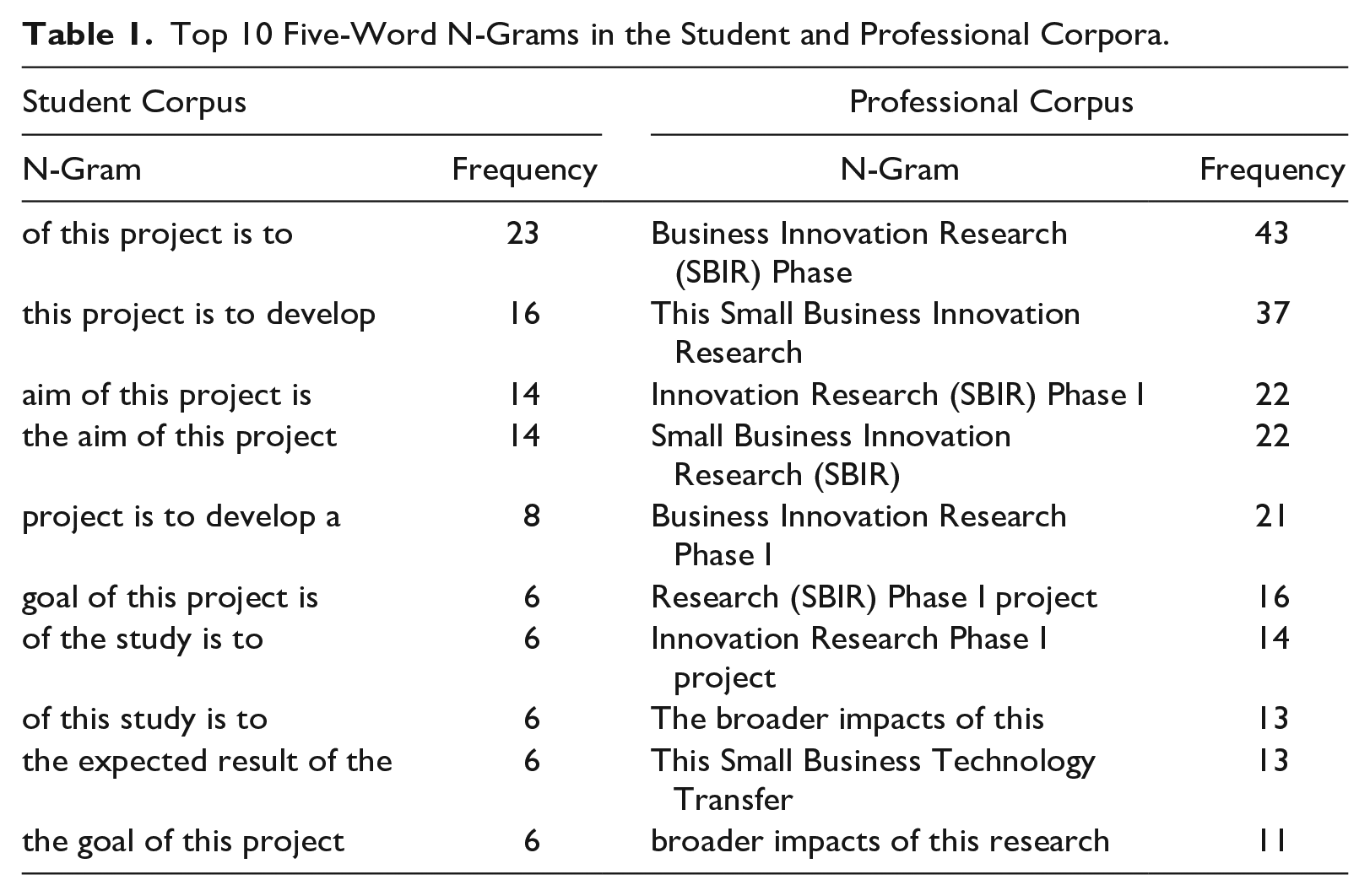
As a next step, all occurrences of the identified n-grams were manually coded using the three-move framework proposed by Feng and Shi (2004). The coding procedure prevented the duplication of values: if an abstract included two or more overlapping five-word n-grams representing one move, only one of these n-grams was coded and the other ones were not included in frequency counts. As a result, the finalized database includes two comparable subsamples, to be able to perform statistical analysis. As each proposal abstract in the database is unique, it has unique descriptive features such as tokens (words), frequencies, and moves.
In the overall sample of 257 abstracts, 119 are student texts (46%) and 138 abstracts are from professionals (54%). The tokens range from 46 to 320 (M = 174.5; SD = 58.58) words. The mean occurrences of moves in expert and student corpora were compared by a paired samples t test. Statistical analyses of the data were carried out using SPSS 27.
Results
A comparative analysis showed statistically significant differences between the texts of students and professionals. Table 2 shows mean values for the length of abstracts, mean frequencies of all five-word n-grams representing any rhetorical move (normalized per 10,000 tokens), and mean frequencies of n-grams representing each of the three rhetorical moves in abstracts.
Descriptive Statistics in the Two Corpora.
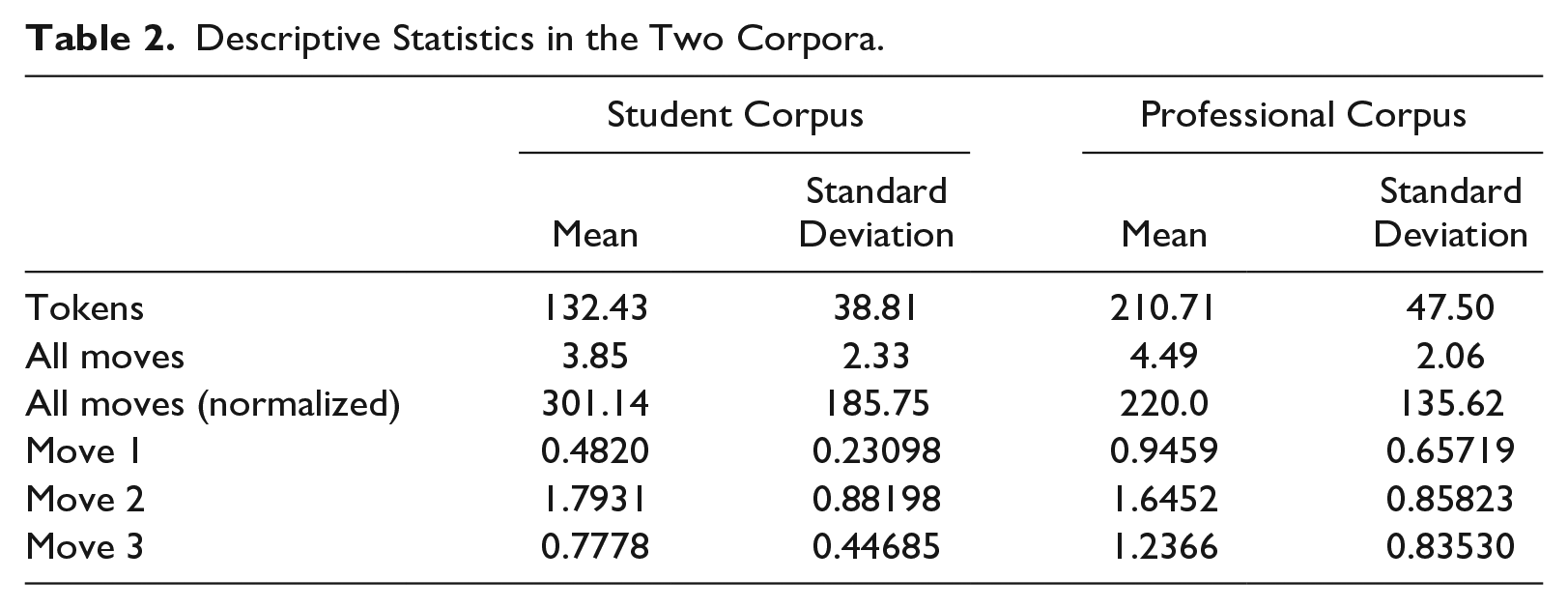
Categories “Tokens” and “All moves” differ between student and expert texts. First, professional abstracts are characterized by longer texts. The analysis shows that professional writers used more words in their proposals (M = 210.71, SD = 47.50) than students (M = 132.43, SD = 38.81), indicating a statistically significant difference between the two groups, t(255) = 14.320, p = 0.000. Second, five-word n-grams representing rhetorical moves are more frequent in student abstracts (M = 301.14, SD = 185.75) than in professional abstracts (M = 220.0, SD = 135.62). This difference was also statistically significant, t(141) = −2.973, p = 0.003.
The analysis of the cumulative categories of rhetorical moves (Move 1, Move 2, Move 3) shows that Move 1 and Move 3 are used more often by professionals, while Move 2 is equally used by both students and experts. A more detailed analysis of the move elements demonstrates the difference between students and experts in Move 2 (see Table 3).
Rhetorical Moves in Student and Expert Corpora.
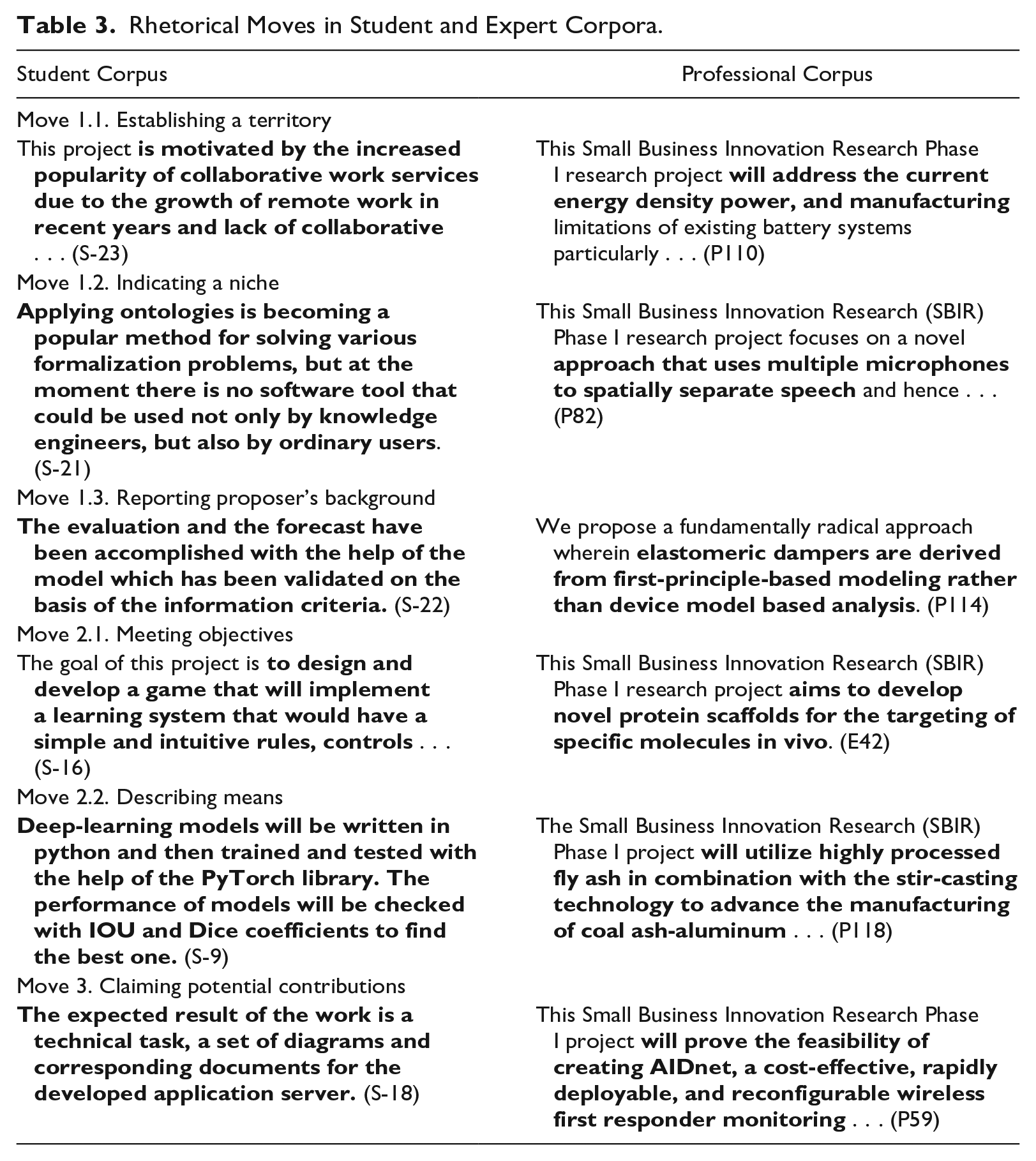
Secondly, statistical correlations show that student texts are different from the professional ones regarding the size and number of tokens (d = 0.802, p < .05). The fact that professional texts contain more tokens than those of students means that expert abstracts are less standardized and more specific in communicating the project proposal.
It should be noted that the number of occurrences of Moves 1.2 and 1.3 were only 18 and 3, respectively, which is insufficient to run a comparative statistical analysis. However, the occurrences of other moves underwent a normalcy test and the significant results suggest a deviation from normality. Next, we conducted a comparative analysis of the two independent subsamples. The results of the paired independent samples t test for the student and professional corpora are given in Table 4 and are as follows:
The use of Move 1.1, Establishing a territory, is different for the two subsamples of students and professionals. Statistically, experts communicate the area and the field of the project in the proposal abstracts more often than students do, t(34) = 2.451, p = 0.020.
Move 2.1, Meeting objectives, is more frequent in students’ proposals, t(70) = −2.045, p = 0.045.
Experts tend to use Move 2.2, Describing means, more often (d = 0.722, p < .05). There is no statistically significant preference between them because of a small sample, t(19) = 1.1916, p > 0.05.
Compared to students, experts use Move 3, Claiming potential contributions, more frequently, t(53) = 2.431, p = 0.018.
Paired Independent Samples t Test for Comparison of Student (n = 119) and Professional (n = 138) Corpora.
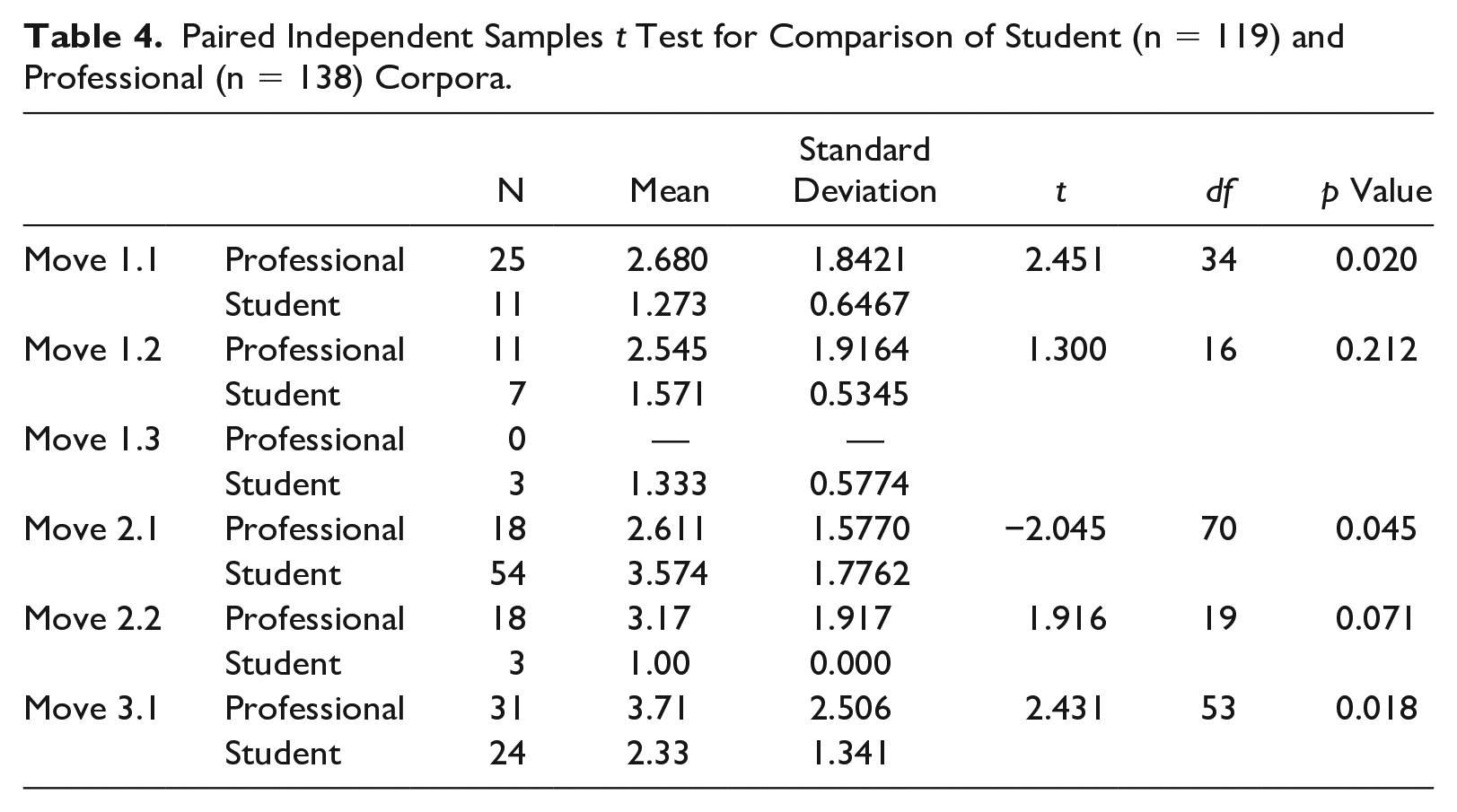
In other words, significant findings imply that in communicating a business project, students know what they plan to do, whereas professionals also underline where, how, and with what outcome they are going to carry out a set of business tasks.
Discussion and Conclusions
The results of the rhetorical moves analysis in the two corpora clearly indicate that the features in the proposal abstracts written by actual business professionals and those by students of business vary quantitatively but not qualitatively. Statistical tests indicate that professional abstracts are longer and contain more tokens than those of students, which means that expert abstracts are less standardized and more specific in communicating the project proposal.
Furthermore, each stage in the project proposal abstracts in both subsamples is distinctly present. However, professional proposal abstracts utilize rhetorical moves more densely and in a more balanced proportion between the three moves than the ones used by students (compare Move 1/Move 2/Move 3 in two corpora: experts 25/36/31 vs. students 11/57/24). To emphasize the results, students emphasize Move 2, The aim of the project, while professionals evenly highlight all sides of the project and position it in the context by outlining Move 1, Establishing a territory, and Move 3, Claiming potential contributions. The sequence of rhetorical moves in both corpora follows the same pattern and the concluding rhetorical Move 3, Contributions, that is, a strong persuasive element in appeal to the audience quantitatively surpasses Move 1, Establishing a territory.
Since the sequence of rhetorical moves in both corpora follows the same pattern, it is obvious that the concluding rhetorical Move 3, Contribution, that is, a strong persuasive element in appeal to the audience, surpasses Move 1, Establishing a territory. In experts’ proposals, the difference between Move 1 and Move 3 is less expressed. The biggest disparity in Move 1 between the two subsamples shows that students underdeveloped the project idea at a preliminary stage. The explanation for this can be of two kinds. First, students may obviously lack sufficient experience in a particular industry and/or organization, and second, these results can reflect students’ assumptions about the proposal genre as an occluded one. Students may take for granted the idea that the faculty and supervisors know the niche and the gap addressed by the proposal by default. Overall, these results may indicate a difference between students’ and experts’ attitude to the conventions of the business proposal genre. The conventions are realistic and high-stakes for professionals; therefore, each rhetorical step matters and is fully developed. Students, however, approach business proposal conventions with the purpose of demonstrating their abilities in the professional and educational domain.
This brings us to the implications of teaching business communication genres. Since genre is affected by standardization, variation, and social context (Horne, 1995), the findings of this study can help develop a better model for the explicit instruction of business/project proposal abstract. This model should combine essential elements of the moves with the socially varying, yet prescribing, context and with a certain balance between the moves. The suggested teaching strategy includes deliberate practice when writing is done in the context of a professionally relevant task domain. It means that nonconfidential workplace documents could be used for the classroom to develop the sense of the setting and the audience (Horne, 1995), and to show students how certain information or content may be a product of expertise. The transfer across different contexts is the essence of the integration of form (a variety of forms and styles), a socially interactive process (writing to peers, colleagues, executives, clients) and a product (proposals, memos, e-mails, etc.). The recommended step in business writing curriculum improvement is to deliberately practice writing for a variety of authentic contexts, which ultimately helps students develop the skill of establishing the need for a project as well as explaining its significance and the potential contribution to the audience. Explicitly specifying in the proposal prompt that the intended audience of the proposal are supposed to be business and industry experts rather than university faculty could be helpful in this regard.
The results of the study can also inform the design of writing intervention into business disciplines to promote students’ performance. The comparison of students’ proposals against the professionals’ points to the statistically significant difference and/or similarity in texts and highlights the areas of growth in communication proficiency (Kondal, 2020). Students can also be taught distinguishing features between low-rated and high-rated proposal abstracts (Faber, 1996).
In particular, business proposal abstracts are not an “occluded” genre; therefore, a genre-based approach can be implemented to the materials (cf. Flowerdew, 2016). This serves the purpose of raising students’ awareness of the genre of the proposal abstract and/or task development on brainstorming for a winning proposal, early diagnosis of pitfalls, various types of assessment such as peer and self-evaluation methods, etc.
As for the limitations, the first one relates to the sample because only 257 texts (45,000 words) were analyzed in this study. It is evident that a broader sample would yield more significant results. Secondly, with a bigger sample, the analysis could be extended by considering n-grams shorter than five words. Although five-word n-grams “are more phrasal in nature and accordingly less common” (Biber et al., 1999, p. 992) than shorter ones, which makes them best suited for a study of rhetorical moves, it is still possible that some n-grams of a different length might reflect rhetorical moves without overlapping with the five-word n-grams. In addition, shorter n-grams would allow for automated tagging in large corpora. Finally, as one of the delimitations of this study concerned potentially impactful cultural and language differences between the proposals, more research can be done in order to give these factors a fuller consideration. Such research could look into how rhetorical moves differ across student and professional proposal abstracts written in one (e.g., American or Russian) cultural context or compare how a specific cultural difference such as attitude to competition (Faber, 1996) might be reflected in proposal abstracts belonging to different cultures. Overcoming these and other limitations in further research would help better define business communication as “being sensitive to the needs of the audience, the context, and culture” (Getchell & Lentz, 2018). Students are an emerging workforce; therefore, they should be aware of what they know and need to know to transform future businesses by developing their own rhetoric and workplace communication.
Footnotes
Declaration of Conflicting Interests
The author(s) declared no potential conflicts of interest with respect to the research, authorship, and/or publication of this article.
Funding
The author(s) received no financial support for the research, authorship, and/or publication of this article.
