



Abstract
This study aims to explore to what extent engineering students’ perceptions of the role of English in the workplace are affected by their internship and field of study. Previous research revealed that employers value engineers’ English communication skills highly. However, mismatches between workplace expectations and engineers’ competencies affect engineers’ employability negatively. To explore this topic, a survey and interviews were conducted. Results suggest that neither internship experience nor field of study made any difference in engineering students’ perception of the role of English in the workplace, which led to a potential mismatch between their perceptions and workplace expectations.
Keywords
Introduction
Today, engineering graduates assume multidisciplinary roles in their profession and need to coordinate competencies in various areas of technical and nontechnical skills (Passow & Passow, 2017), with many employers placing value on professional or soft skills such as communication, teamwork, problem-solving, and leadership than technical skills in their recruitment decisions (Finch et al., 2013). A possible reason for this is that professional engineers are now more involved in operations using their managerial skills, which require them to be proficient in soft skills as well as technical skills (Kaushal, 2016). Of all the soft skills, communication skills are either the most important soft skill or in the top group of skills for employment (Lee & Chin, 2017). Communication skills for a professional engineer in the 21st century entail the ability to communicate cross-culturally, because in a world of global business where English is the medium of communication, significant improvements in employability can be observed among engineers with these skills (Çal et al., 2022; Chavez et al., 2017; Darling & Dannels, 2003; Gilleard & Gilleard, 2002; Kassim & Ali, 2010; Paretti et al., 2014).
Although evidence shows that having English communication skills for the workplace is critical for an engineer’s career, engineers’ communicative skills do not always meet workplace requirements (Clement & Murugavel, 2015; Gokuladas, 2011; Pais-Montes et al., 2019; Ramadi et al., 2016). This may potentially cause decreased employment opportunities (OECD, 2017) and job dissatisfaction among new graduates (Baird & Parayitam, 2019). For example, in their study with software engineering students and recent graduates working in the Turkish industry, Oguz and Oguz (2019) examined the skills gap between the graduates’ capabilities and the needs of the industry, and stated that the largest mismatch was in communication skills. Clokie and Fourie (2016) explored a similar case and suggested that the reason may be the lack of relevant instruction at universities. König and Ribarić (2019) asked about this potential gap to employers and the reason highlighted in their findings is that there may be a lack of understanding of workplace communication requirements by higher education institutions. Similarly, previous research underscored engineering students’ perceptions in this manner and implied that they do not always see English communication skills as a must in their careers while employers suggest otherwise (Ford & Riley, 2003; Lenard & Pintaric, 2018). For example, in their study to explore if a gap existed between the higher education engineering curriculum in India and industry requirements, Gope and Gope (2022) emphasized oral communication skills as a necessary competency for engineers in the workplace but reported that engineering students do not see these skills as important. Another example can be seen in Shatrova (2014), according to whom Turkish engineering students viewed English communication skills as something they need preparation for in academia without a clear understanding of why they would need such skills as prospective engineers. To overcome this issue, Andreea and Bucur (2020) proposed systematic instruction on communication skills in engineering education programs because it may lead to a better understanding of the role of communication skills in academia and the workplace by engineers.
Given the above discrepancies, this study aims to explore to what extent engineering students from a foundation university in Turkey are aware of workplace communication requirements in English. With the current study, we will explore how much of an understanding of workplace communication requirements engineering students develop prior to graduation. Findings will give policymakers and curriculum developers the chance to evaluate the effectiveness of the engineering curriculum in their context and make improvements where necessary.
The Role of English in an Engineer’s Career
Having good communication skills in English supports an engineer’s career in several ways, which is especially evident in contexts where English is not a first or official language (Gokuladas, 2011). Evidence from research shows that during interviews for recruitment, employers evaluate potential employees mostly on how developed their communication skills in English are (Afroze et al., 2019) and are more likely to select those with clear English communication skills (Clement & Murugavel, 2015; Gokuladas, 2011). In their analysis of job advertisements for engineers, Gerek &Efeoğlu (2015) reported that communication skills are highly sought after by employers in Turkey, with English language skills highlighted in more than half of the advertisements examined. In addition to their importance during the pre-employment stage, English communication skills also help with promotion, as employers perceive a positive influence on interpersonal skills, building rapport, and effective transfer of message while communicating (Reinsch & Gardner, 2011; Sageev & Romanowski, 2001). Finally, an engineer may need to rely on their communication skills both in their first language and in English in carrying out day-to-day tasks as business in today’s world has become increasingly globalized (Darling & Dannels, 2003).
Relevant Communication Skills for the Workplace
Details as to what workplace communication for engineers in Turkey entails are explored in detail by Çal et al. (2022) in their study with practicing Turkish engineers. First of all, Çal et al. (2022) revealed that the perceived status of English among engineers can vary depending on whether the employer is a local or international company. According to their findings, Turkish engineers viewed English to be most important for recruitment and least important in daily tasks, with a significantly higher rating of the importance of English by engineers working at international companies compared to local ones. The engineers they surveyed rated reading as the most important language skill, followed by listening, writing, and speaking, again with significantly lower importance attributed to these skills by engineers working at local companies. Regarding specific tasks that fall under each language skill, Turkish engineers expressed that reading manuals and instructions is the most frequent reading task followed by reading reports. In listening, the most common tasks were listening to presentations, attending meetings, and participating in technical trainings. In terms of writing, engineers highlighted writing presentation slides, emails, and reports as practiced most. Finally, teleconferencing, phone conversations and formal work-related discussions are the most frequent speaking tasks.
Findings from other contexts are varying in terms of the perceived importance of different skills. To begin with, some previous research highlighted speaking as the most important language skill in contexts where English is the first language (e.g., the United Kingdom, Australia) or a second/official language (e.g., India) because it is thought to facilitate employment and promotion once employed (Crosling & Ward, 2002; Kassim & Ali, 2010). On the other hand, other research suggested reading as the most important skill for engineers and listed several reasons for this. These include engineers spending less than 10% of their time on any form of formal oral communication in English and professional resources being mostly available in English. This makes reading critically important for engineers as it helps them maintain professional knowledge (Cambridge English, 2016; Rajprasit et al., 2014; Sageev & Romanowski, 2001). In their analysis of language skills in the workplace, Cambridge English (2016) showed an interesting difference between reading and speaking in that while larger organizations value reading over other skills, smaller organizations place more value on speaking skills. With respect to listening, it is valued mainly because workplace communication encompasses understanding others’ needs and responding to them appropriately (Coffelt et al., 2019). Finally, in terms of writing, engineers rely heavily on their technical writing skills, which include correspondence, reports, proposals, and procedural writing to be successful (Estrin & Elliot, 1990; Galloway, 2007). The reason for this is that they spend an average of 32% of their time on written means of communication (Sageev & Romanowski, 2001). To this end, a lack of relevant writing skills may be an important factor in the managers’ decisions of termination of employment (Reinsch & Gardner, 2011).
Variation in research findings in terms of the perceived importance of specific tasks in each language skill continues. First, giving presentations as a speaking task is regarded as highly important because it may enable one to excel in their careers and differ from others who show average performance in the same position in the United States (Reinsch & Gardner, 2011). Different from the United States, in the Malaysian context where English is a second language, teleconferencing is a very significant form of speaking among engineers according to Kassim and Ali (2010). Secondly, the most important writing tasks in the workplace reported in previous research include emails (Evans, 2010; Spence & Liu, 2013) and business proposals (Kassim & Ali, 2010). Next, despite the value placed on listening, previous research generally reported that listening as a skill is important for the workplace, but without specifying the importance of different tasks in listening. For example, Baird and Parayitam (2019) reported that in the United States, employers placed more importance on listening skills than oral communication skills as a more powerful contributor to their employment opportunities. However, no further details as to the importance of specific listening tasks are given. Finally, important tasks that fall under reading are given as reading professional resources, contracts, and manuals (Cambridge English, 2016).
Students’ Perceptions of Workplace Communication Requirements
There is a limited number of studies on how students perceive workplace communication requirements. Usually, these studies are on general employability traits including professional skills such as communication. An example comes from the Indian context in which Chitra (2013) explored engineering students’ and employers’ perceptions of employability characteristics. While engineering students listed technical competencies at the top of their list, they referred to communication skills as the most important soft skill for employability. Similarly, in Lee and Chin (2017), engineering students in Singapore ranked having workplace-relevant communication skills upon graduation as the most important graduate attribute. However, Chitra (2013) drew attention to the connection between student perceptions of the importance of English for the workplace and their prior exposure to a workplace setting and suggested that students’ understanding of workplace English requirements was affected by whether they had gained any work experience. According to their study, students with work experience develop a better understanding of why and how communication in the workplace occurs. Ford (2006) supported this view by demonstrating that engineering students gain an understanding of workplace communication through their internship experience, which exposes them to authentic tasks requiring communicative competencies. In their study, they showed students’ understanding of the importance of specific writing tasks such as memos, reports, and presentations following their internship. Supporting this finding, in their study to explore to what extent engineering students’ perceptions of the importance of technical communication skills match with those of practicing engineers, Sulcas and English (2010) suggested that senior engineering students with exposure to the workplace view technical writing and writing proposals as important writing tasks in the workplace. With respect to speaking, engineering students mentioned having good oral communication and presentation skills as the biggest contributor to the promotion of engineers to more advanced positions (Itani & Srour, 2016). In addition, students also viewed videoconferencing as a necessary communication method in their future careers (McPherson, 1998). However, to what extent these perceptions and the actual requirements of the workplace overlap still stands as a gap in the current research literature.
The Study
In light of the findings from previous research highlighting the importance of having relevant communication skills in English, and a potential lack of awareness of this fact among engineering graduates, the purpose of this study is to analyze how engineering bachelor students in their third and fourth year have an understanding of workplace communication requirements in English. The major difference between the third- and fourth-year students in this study is in their field of engineering and the workplace internship program that engineering students usually complete at the end of their third year in a bachelor program in Turkey. To explore this topic, this study is based on the following research questions:
- How do engineering students perceive the role of English communication skills in the workplace?
- To what extent are their perceptions related to their internship experience and the field of study?
We will try to answer these questions by exploring how students perceive the role of English in the engineering workplace in general, as well as specifically in terms of the four language skills, and predefined tasks in each skill.
Method
Participants
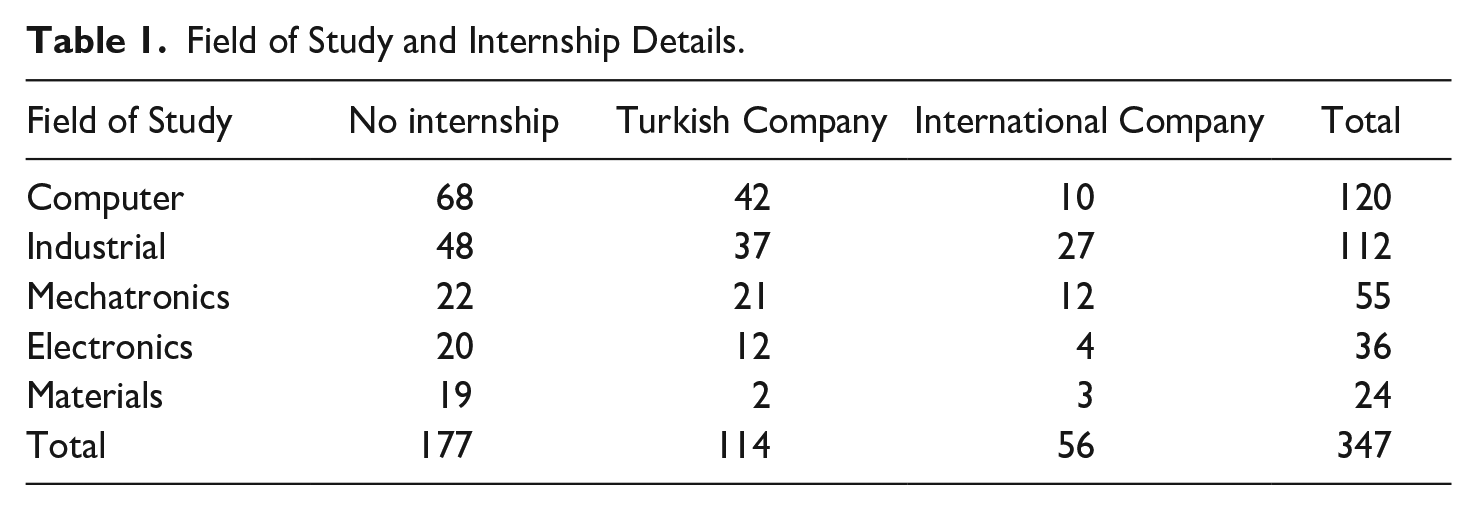
Data were collected from engineering students studying at a foundation university in Istanbul, which provided English-medium instruction (EMI). Following the ethics approval, the first author visited the engineering faculty’s classes and distributed the survey. Initially, 458 surveys were completed. As the target group of this study was only the third- and fourth-year engineering students with or without internship experience in Turkey, responses belonging to a group other than these were excluded from the analysis (e.g., 56 first- and second-year, 23 graduate, 32 with an internship abroad). The resulting sample consisted of 347 students in their third and fourth year of studies in various fields of engineering. Student responses related to internships on the surveys showed two different company types where students completed their internship. If a student completed an internship at a Turkish company, this means that the company is a domestic one. An international company in Turkey means any type of company that has a non-Turkish origin but operates in Turkey. Details related to the participants are given in Table 1.
Field of Study and Internship Details.
In addition to the survey, semistructured interviews were conducted with 20 students who volunteered during the survey phase to take part in an interview. Out of the 20 students, 13 were fourth-year and 7 were third-year students. 12 of the fourth-year students had completed an internship at the time of the interviews while the remaining 8 students had not.
Data Collection Tools
Quantitative data were collected through a paper-based survey, which was followed by semistructured interviews to provide additional, qualitative data.
Survey
The survey was adapted from Çal et al. (2022), which was originally used to explore how engineering professionals perceived the importance of having good English communication skills for the workplace. The survey consisted of two sections; section A focused on demographic information and section B on information related to engineering students’ perception of English communicative skills needed in the workplace. To make the instrument more relevant for the purposes of the current study, some adaptations were made. These include reformulating the personal information section as the original survey was targeted at practicing engineers. Additionally, students were also asked to identify their internship experience. The items aimed at exploring students’ perceptions were 5-point Likert-type scales. They consisted of ranks of importance, frequency, or quality, and higher scores denoted more applicability. The full survey is provided in Appendix A.
Interviews
The semistructured interviews were conducted online and were recorded and transcribed for analysis. Interview questions covered students’ background in English, the type of English training they received (whether academic or work-related), the importance of having English communication skills for the workplace in Turkey, and what contributed to the interviewees’ understanding of the importance of English for the workplace. The interview data were used to elaborate on quantitative data to provide deeper insights to help interpret the results of the survey. The guide used for the interview is provided in Appendix B.
Data Analysis
Survey data were analyzed using IBM SPSS 28. Mean and standard deviation (SD) were given as descriptive data. Additionally, methods of inferential statistics were used. Two-way analysis of variance (ANOVA) based on internship and the field of study was used for the variable “frequency of English in the workplace” as it has one dependent variable. For the rest of the items with two or more dependent variables, a two-way multivariate analysis of variance (MANOVA) was used based on the same factors. The effect size was measured using eta squared, following Cohen’s (1988) definition of small (η2 = 0.01), medium (η2 = 0.06), and large (η2 = 0.14) effect sizes. There was no evidence of multicollinearity in any of the groups of dependent variables, as assessed by Pearson correlation (|r2| < 0.9). Univariate and multivariate outliers were identified, and it was discovered that the number of outliers varied between zero and nine cases for each variable. As these cases were not due to any mistake in data entry and they represented real data, we decided to keep the outliers in our analysis.
All the interviews were transcribed and thematically analyzed with themes that were developed according to the dependent variables in the survey. These were the role of English in an engineer’s career, awareness of workplace expectations, internship and its contribution to understanding workplace communication, and specific tasks in each language skill important for the workplace. Students’ responses were analyzed to see if and to what extent they referred to these areas.
Results
The results of the study will be reported under three categories mentioned in the research questions of the study. Findings related to the perceived frequency of English in the workplace and the importance of English for an engineer’s career will be given under “the role of English in the workplace”; this will be followed by “the perceived importance of four language skills,” and “the perceived importance of predefined tasks in each language skill.”
The Role of English in the Workplace
Frequency of English
The first analysis related to the engineering students’ perceived importance of English in the workplace is about how frequently they think English is used. Table 2 shows the mean and SD scores for this variable.
The Perceived Frequency of English in the Workplace (1 = almost never, 5 = almost always).
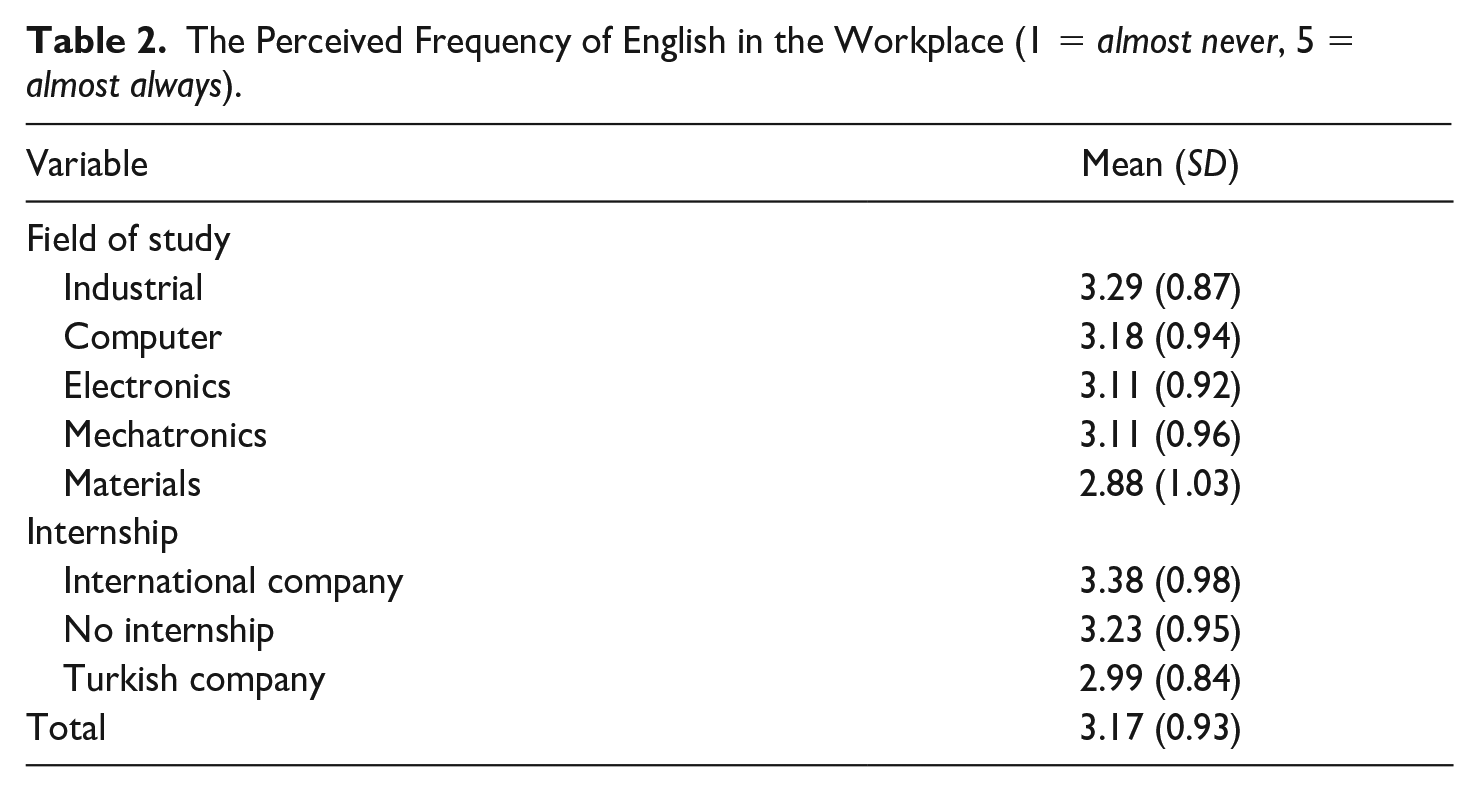
Descriptive results suggest that industrial engineering students and students with internship experience at an international company perceive English to be more frequent in the workplace than do other groups. However, the results of a two-way ANOVA with internship background and the field of study did not show a statistically significant interaction, F(8, 331) = 1.312, p = 0.237. Similarly, neither the main effect of the field of study on the perceived frequency of English in the workplace, F(4, 331) = 0.860, p = 0.488, nor the main effect of internship, F(2, 331) = 0.081, p = 0.923, was statistically significant.
Different from the quantitative findings regarding the frequency of English, students in the interviews stressed the effect of the type of internship workplace such as whether it is a national company or an international company operating in Turkey. Accordingly, almost all students interviewed agreed on a higher frequency of English in international companies compared to national ones. For example:
It has lower importance for Turkish companies but higher for international ones. Although the Turkish company where I did the internship was involved in international operations as well, the frequency of English there in a day of work was so low. On the other hand, I observed in my other internship at an international company that daily communication mostly took place in English.
(Fourth year, industrial engineering, internships at a Turkish and international company)
Supporting this point, a computer engineering student stated the following regarding their experience:
I don’t think it is a must for many engineers, maybe only for the ones involved in international operations, but not the majority.
(Fourth year, industrial engineering, internship at a Turkish company)
English in an Engineer’s Career
This part of the survey aimed to explore to what extent engineering students perceive English as important for an engineer’s career in terms of employment, promotion, and conducting daily tasks with respect to their field of study and internship background. The mean and SD scores for the three dependent variables can be seen in Table 3.
The Perceived Importance of English for an Engineer’s Career (1 = almost never, 5 = almost always).
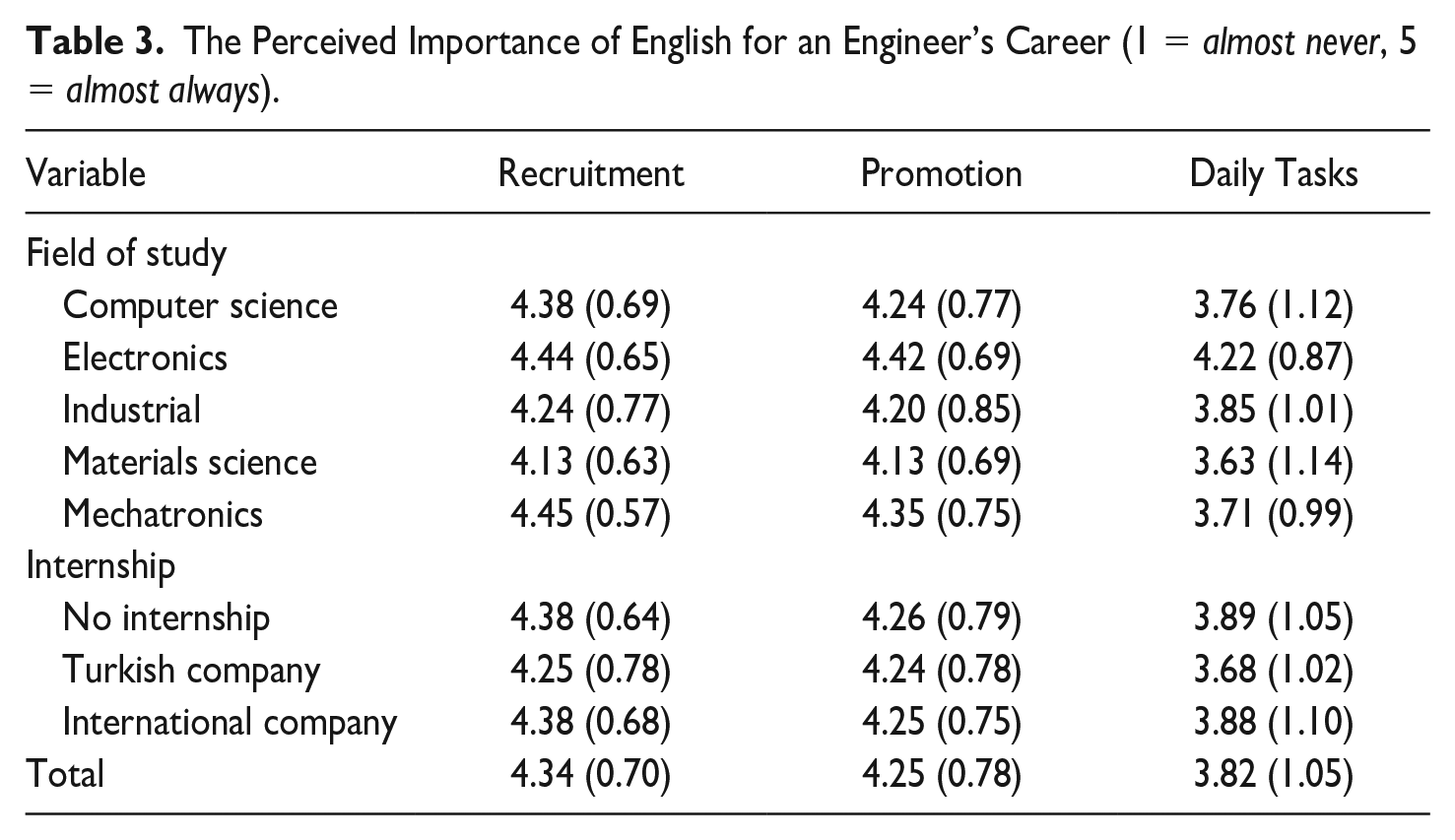
Overall analysis implies that students view the importance of English to be highest for recruitment and lowest for daily tasks. A two-way MANOVA was run, and there was not a statistically significant interaction effect between the field of study and internship on the combined dependent variables, Wilks’s Λ (4, 327) = 0.943, p = 0.727, partial η2 = 0.02. Additionally, analyses of the main effects for field of study, Wilks’s Λ (4, 327) = 0.953, p = 0.211, partial η2 = 0.016, and internship, Wilks’s Λ (2, 327) = 0.988, p = 0.701, partial η2 = 0.006, separately did not show any significant main effect.
In the interviews, students were asked to what extent they thought English was important for an engineer. They expressed that having good English communication skills was especially important for finding a job. However, students differed in their views of how English would help them in their careers. While students studying computer and electronics engineering focused more on English as being a tool to facilitate their job because of the availability of resources related to their field in English, students in industrial engineering referred to its importance in relation to the type of company. This difference can be observed between the two students below:
As far as I observed, it is not important for the workplace although everybody thinks it is. The only practical use is that all the terminology in my field of study is in English, there are not any Turkish terms used. Especially when there is a problem, all the sources we rely on are available in English. Therefore, a computer engineer cannot function without English.
(Fourth year, computer engineering, internship at an international company)
If an engineer is working in an international company, it is definitely important, it is even the top priority for many companies in the hiring process as they are involved in international operations frequently. Regarding domestic companies, its importance may differ depending on the department within the company but it is a must in international companies.
(Fourth year, industrial engineering, internship at a Turkish and international company)
Additionally, an interviewee without any internship experience but who was trying to secure one at the time of the interview expressed the role of English as:
It is important. I am making applications for internships and all the returns I have received so far request interviews in English, I just had one a couple of days ago. I am not sure to what extent it is important in the workplace, but I believe it is highly important during a job search.
(Third year, industrial engineering, no internship)
The Perceived Importance of Four Language Skills
To add to our understanding of students’ understanding of the role of English in the workplace, we examined their perceptions of the importance of four different language skills. Table 4 shows the mean and SD scores for the four dependent variables.
The Perceived Importance of Four Language Skills (1 = almost never, 5 = almost always).
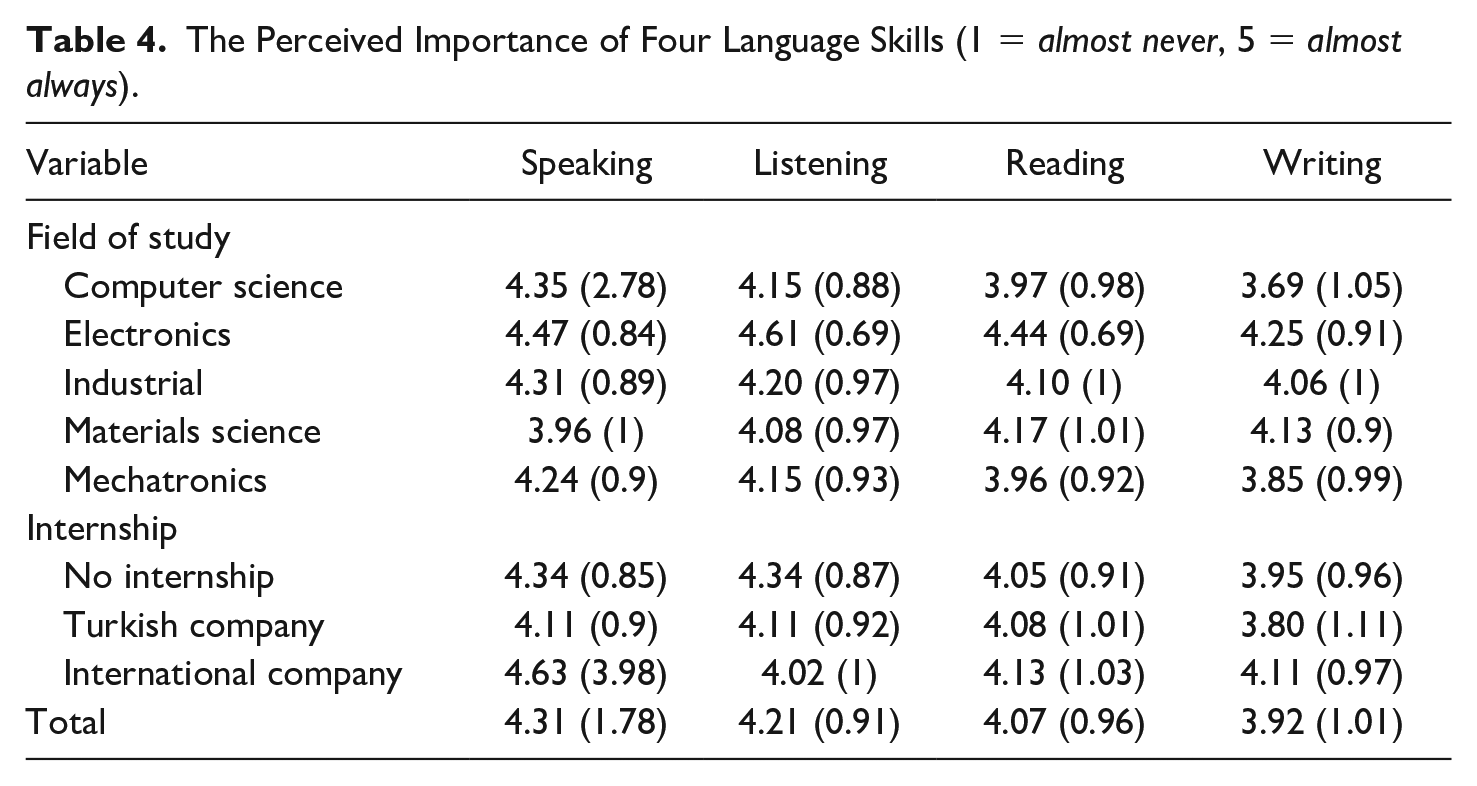
In general, overall scores highlight speaking as the most important language skill for an engineer in the workplace, followed by listening. However, according to the results of a two-way MANOVA, there was not a statistically significant interaction effect between the field of study and internship on the combined dependent variables, Wilks’s Λ (8, 331) = 0.916, p = 0.614, partial η2 = 0.022. Following the interaction effects, our analysis in determining the main effects also indicated that the main effects for field of study, Wilks’s Λ (4, 331) = 0.962, p = 0.686, partial η2 = 0.01, as well as internship, Wilks’s Λ (2, 331) = 0.965, p = 0.171, partial η2 = 0.017, did not produce any significant results.
Similar to the perceived importance of English for recruitment, promotion, and daily tasks, the students who were interviewed mentioned the effect of the type of workplace on the importance of different language skills. Almost all students agreed on the importance of reading skills for an engineer due to the predominance of English in academic and professional resources. Students studying in more technical fields of engineering such as electronics or computer engineering referred to speaking skills as having little importance and relevance for the workplace, unlike students in industrial engineering. The following comments show how these two groups differ in their views of the importance of language skills:
Everything was in Turkish. For example, I once prepared a presentation about something and delivered it in English as it is not always possible to express everything in Turkish in my field. When I started the presentation, there was an awkward moment as I was not supposed to present in English. I learned this later.
(Fourth year, computer engineering, internship at an international company)
I was able to observe this in the sales department. The sales department used English in meetings, videoconferences, and phone calls, and as the CEO was Dutch, everybody would switch to English when he was around.
(Fourth year, industrial engineering, internship at a Turkish and international company)
The Perceived Importance of Predefined Tasks in Each Language Skill
With this section, we wanted to explore to what extent engineering students perceived various predefined tasks under each language skill in the workplace important. The results will be provided as tasks under speaking, writing, listening, and reading.
Speaking Tasks
The survey listed 13 tasks under speaking, of which the mean and SD scores are given in Table 5.
The Perceived Importance of Speaking Tasks (1: not important at all, 5: very important).
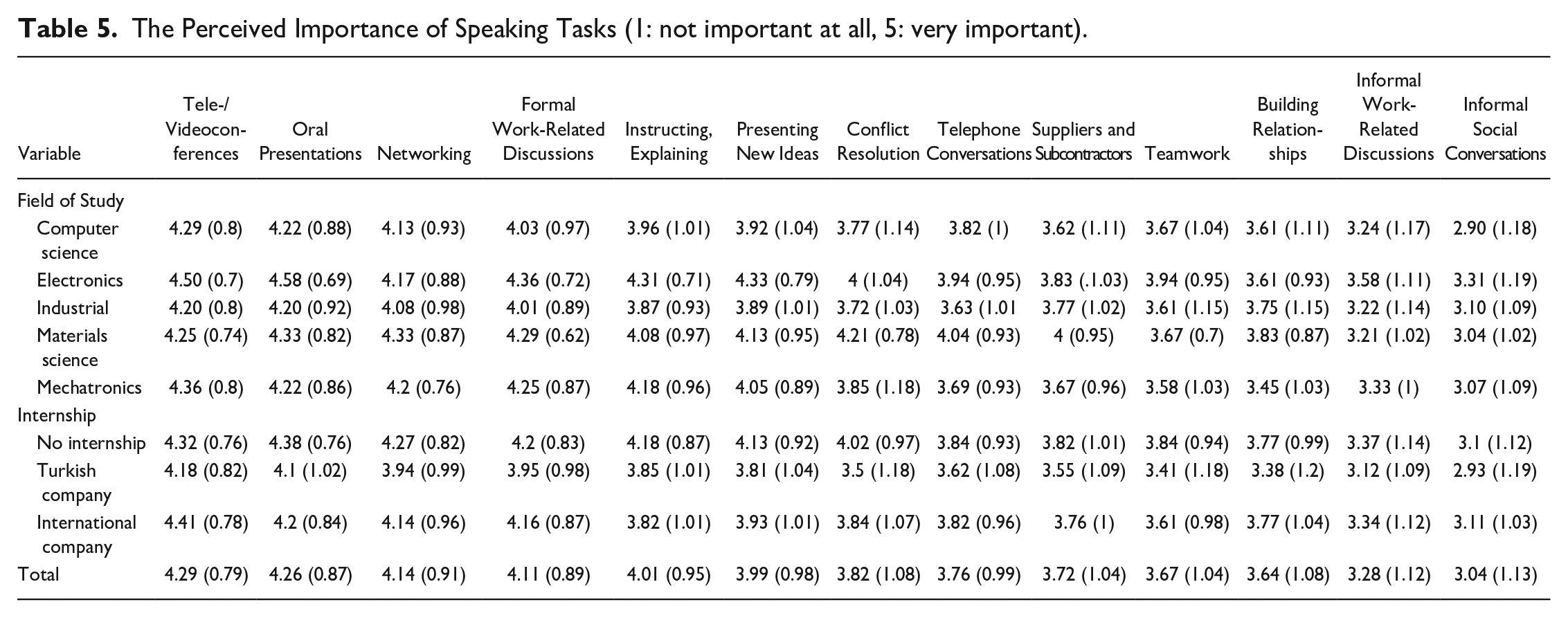
Tele-/videoconferencing received the highest mean score, followed by oral presentations. Based on the two-way MANOVA, the interaction effect between internship and field of study on the combined dependent variables was not statistically significant, Wilks’s Λ (8, 318) = 0.714, p = 0.426, partial η2 = 0.041. Accordingly, no significant main effects of field of study, Wilks’s Λ (4, 318) = 0.863, p = 0.703, partial η2 = 0.036, or internship, Wilks’s Λ (2, 318) = 0.942, p = 0.853, partial η2 = 0.029, were found.
In the interviews, some students referred to how companies delegated work based on engineers’ oral communication skills in English. An industrial engineering student with an internship at an international company mentioned:
Speaking skills are important according to which department an engineer wants to work in. Teams with good fluency in English were responsible for contracts with international customers whereas teams whose fluency in English was lower were responsible for domestic customers.
(Fourth year, industrial engineering, internship at a Turkish and international company)
Additionally, students in the interviews who studied computer or electronics engineering and completed internships in Turkish companies expressed that speaking skills in English were not important in the workplace. For example, a student underlined the importance of speaking skills in English for computer engineers for promotion by saying:
I have never heard anyone on the team speak English. There was even one engineer who had recently started learning English as an engineering graduate. However, our team leader had good speaking skills and would be involved in weekly meetings with other teams abroad. In such companies, English is a must for promotion.
(Fourth year, computer engineering, internship at a Turkish company)
Writing Tasks
Table 6 shows the mean and SD scores for the 10 writing tasks included in the survey.
The Perceived Importance of Writing Tasks (1 = not important at all, 5 = very important).
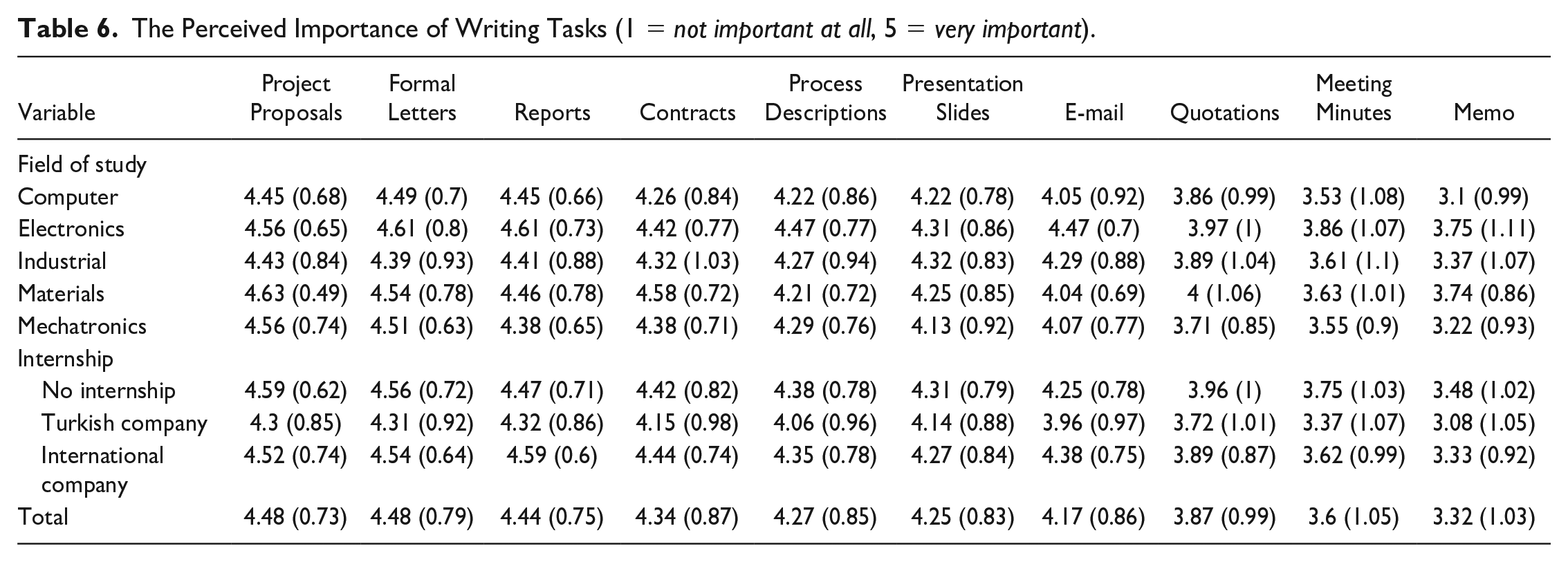
Writing project proposals and formal letters obtained the highest mean scores. The results of a two-way MANOVA did not show a statistically significant interaction effect between the field of study and internship on the combined dependent variables, Wilks’s Λ (8, 289) = 0.799, p = 0.894, partial η2 = 0.028. Our analyses to identify the main effects for field of study, Wilks’s Λ (4, 289) = 0.886, p = 0.711, partial η2 = 0.030, and internship, Wilks’s Λ (2, 289) = 0.946, p = 0.732, partial η2 = 0.027, on the perceived importance of writing tasks also did not result in any significant results.
Referring to the importance of writing tasks in the interviews, students with internship experience in international companies highlighted the importance of preparing presentations, resumé writing, writing reports, creating agenda for international meetings, writing emails, and preparing technical documents for products and services. Yet, students with internships from a Turkish company stated that they hardly ever observed writing tasks at the workplace.
Listening Tasks
Five listening tasks were listed in the survey. The mean and SD scores for the perceived importance of those tasks can be found in Table 7.
The Perceived Importance of Listening Tasks (1 = not important at all, 5 = very important).
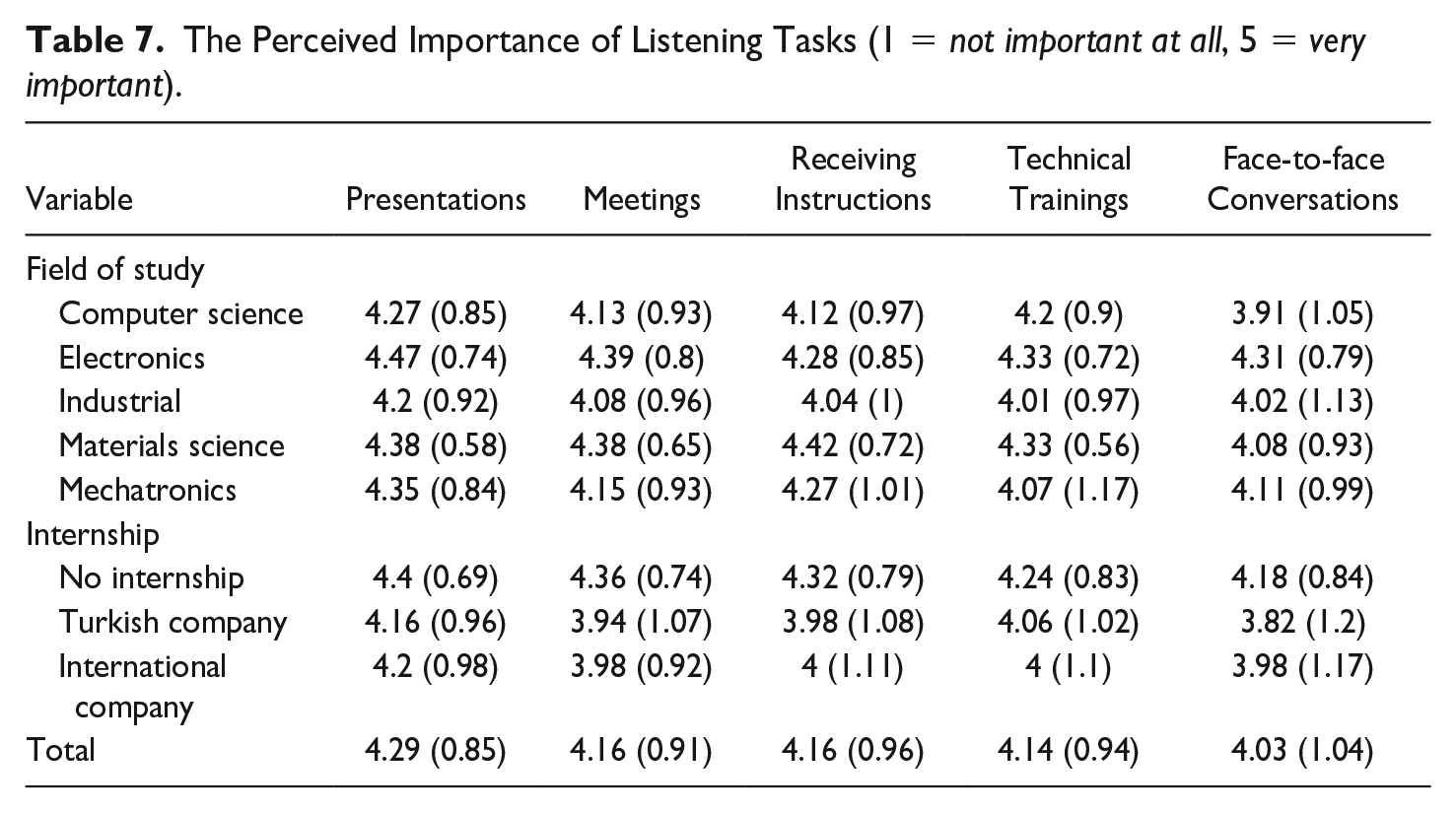
Listening during presentations received the highest mean score, followed by meetings. The interaction effect between the field of study and internship on the combined dependent variables, according to a two-way MANOVA, was not statistically significant, Wilks’s Λ (8, 331) = 0.833, p = 0.409, partial η2 = 0.025. It was also seen that the main effects for the field of study, Wilks’s Λ (4, 331) = 0.940, p = 0.430, partial η2 = 0.015, and internship, Wilks’s Λ (2, 331) = 0.980, p = 0.748, partial η2 = 0.010, were not significant.
In the interviews, students referred minimally to the importance of listening skills. The first point, which students referred to in the interviews related to listening, is that they found communicating in English with speakers from different linguistic backgrounds challenging. A student mentioned:
I especially had difficulty during phone calls due to different accents, and I did not know who would be on the other end.
(Fourth year, industrial engineering, internship at an international company)
Also, computer and electronics engineering students referred to the importance of listening skills when they needed to watch technical content related to their field on platforms such as YouTube.
Reading Tasks
Finally, students were asked to respond to four different reading tasks. Mean and SD scores are provided in Table 8.
The Perceived Importance of Reading Tasks (1 = not important at all, 5 = very important).
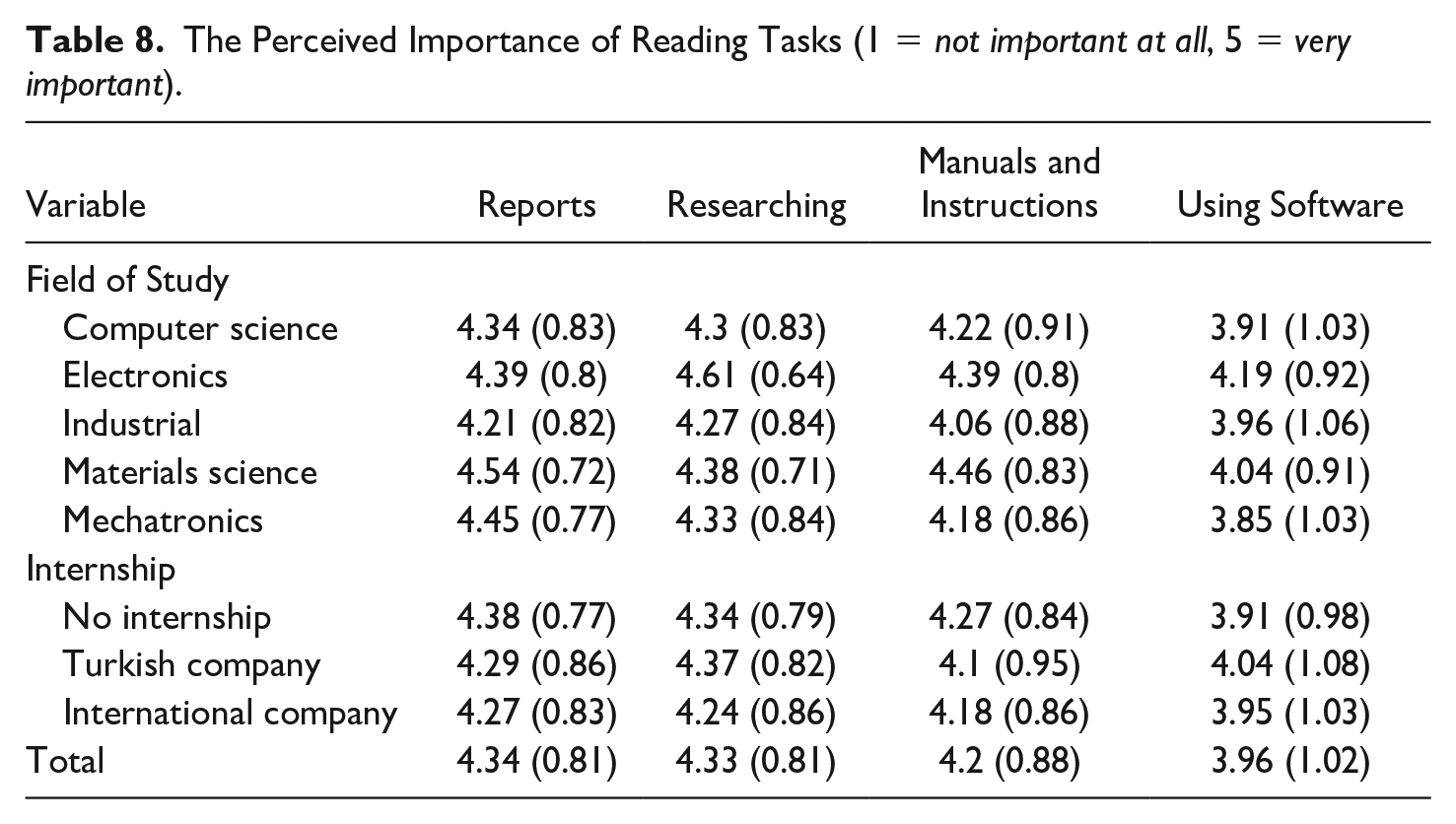
Report reading and reading for researching were highlighted as the most important reading tasks. A two-way MANOVA showed that the interaction effect between the field of study and internship on the combined dependent variables was not statistically significant, Wilks’s Λ (8, 330) = 0.937, p = 0.920, partial η2 = 0.010. Also, there was not a statistically significant main effect of field of study, Wilks’s Λ (4, 330) = 0.952, p = 0.432, partial η2 = 0.012, nor for internship, Wilks’s Λ (2, 330) = 0.994, p = 0.978, partial η2 = 0.003, on the perceived importance of reading tasks.
During the interviews, a computer engineering student with an internship from a Turkish company expressed why they needed reading skills in English as follows:
It is the most important skill, you use your English reading skills while doing research and reading technical documents as everything is available in English.
(Fourth year, computer engineering, internship at a Turkish company)
Similarly, a computer engineering student with internship experience from an international company referred to the importance of reading skills with respect to the daily operations of the company:
I believe reading is used more than other skills. There is a continuous flow of documents, all written in a specific format and all in English. You need advanced reading skills for these documents. While speaking is usually more casual, reading requires more technical skills.
(Fourth year, computer engineering, internship at a Turkish company)
Discussion and Significance of Findings
The results of our analysis did not produce any statistically significant differences in any of the variables between students based on their internship experience and field of study. The suggestion that neither the field of study nor internship experience has an effect on the understanding of the role of English in the workplace by engineering students is striking in that it contradicts findings from previous research such as Chitra (2013), Ford (2006), and Sulcas and English (2010), who found the opposite.
The survey finding that engineering students’ perceptions of the frequency of English did not show any significant difference between internship experience and the field of study may be attributed to several factors. First, engineering students involved in this study did not take any formal training in workplace communication. It is very likely that students did not know what to expect in the workplace in terms of communication requirements. Next, engineering students with internship experience may not have had prolonged exposure to the daily operations of a workplace. This might have affected them in terms of developing a limited understanding of workplace communication within the boundaries of their daily responsibilities. This finding may point to a potential lack of understanding of workplace communication and English requirements among engineering students as outlined in previous research (Clokie & Fourie, 2016; Oguz & Oguz, 2019).
Yet interview data produced contradictory results to the survey data. Students from the field of industrial engineering perceived the frequency of English to be higher than students from other engineering fields, especially in international companies. This may be because computer engineering students in this study were mostly involved in internship tasks where they used their coding skills and did not have many chances to be involved in various types of workplace communication unlike what was reported by industrial engineering students.
In terms of how students perceive the importance of English in an engineer’s career, the overall findings of our study suggest that they consider English to be most important during the recruitment process. This supports findings from Çal et al. (2022), Kassim and Ali (2010), and Zainuddin et al. (2019). On the other hand, interview data about the importance of English in an engineer’s career give contrasting results to the findings coming from survey responses. In the interviews, students with internship experience from different fields referred to the importance of English in daily tasks, while students without internship experience mostly highlighted the importance of English for recruitment. This may be due to a recency bias, which would cause students to place more emphasis on their recent experiences or the fact that non-internship students had no experience to draw on.
How Students View Different Language Skills
With respect to the importance of four language skills, the perceptions of engineering students in this study were not in line with previous research findings. Previous research highlighted reading as the most important skill for engineers in contexts where English was not an official first or second language (Çal et al., 2022; Cambridge English, 2016). However, students in the current study placed the greatest importance on speaking, followed by listening, reading, and writing. This may be due to the fact that speaking as a skill involves observable performance. Therefore, students in this study may believe that having good speaking skills means a better presentation of themselves to their potential employers. As previous studies also show (Afroze et al., 2019; Clement & Murugavel, 2015; Gokuladas, 2011), these students may secure employment or lose it based on their spoken performance during interviews conducted in English, and this might have an extended effect on how they perceive day-to-day operations of the workplace.
As to the specific tasks under each language skill, overall responses suggest a match between what students think is the most important speaking task in the workplace and what engineers suggested in Çal et al. (2022): teleconferencing and videoconferencing. Additionally, students in the current study also viewed giving oral presentations as a highly important skill for the workplace, as was also suggested by Reinsch and Gardner (2011). However, the rest of the tasks highlighted by students as highly important for the workplace and the results indicated in Çal et al. (2022) do not overlap. For example, while students in our study perceived oral presentations and networking to be highly important, engineers in Çal et al. (2022) placed more emphasis on phone conversations and formal discussions. It is possible to elaborate that practicing engineers’ responses in Çal et al. (2022) focused more on daily operations compared to students. In this respect, their academic background might have affected students, as oral presentations can be quite common during university education. As for networking, students might have perceived this as a means of finding employment and thus placed importance on it.
Like speaking tasks, engineering students’ responses for writing tasks also differed from practicing engineers’ responses. Practicing engineers placed more emphasis on writing slides and emails in the workplace (Çal et al., 2022), while engineering students in our study perceived writing project proposals and formal letters as more important. However, the findings did not shed light on why students perceived these two writing tasks as important.
Responses by students in the current study and engineers in Çal et al. (2022) match in terms of the most important listening skills for the workplace, which are listening during presentations and in meetings. It is possible that students might be developing some understanding of workplace communication with respect to listening through observing others in social settings or trainings, although this cannot be confirmed by the data. However, this did not apply to reading, as students’ responses differed from what practicing engineers suggested in Çal et al. (2022). While students rated reading reports and researching as the most important reading tasks, engineers favored reading manuals and instructions. This difference could be attributed to engineering students’ lack of work experience compared to practicing engineers.
In light of the evidence given, it is possible to assert that engineering students in this study do not develop a thorough understanding of workplace communication requirements prior to graduation through either their academic training or internship experience. This is an important finding because previous research indicated that proficiency in workplace communication may lead to more employment opportunities (Chavez et al., 2017; Clement & Murugavel, 2015; Gokuladas, 2011; Kassim & Ali, 2010; Pais-Montes et al., 2019; Paretti et al., 2014; Ramadi et al., 2016). However, an inadequate understanding of workplace communication poses a risk for these engineering students as it may prevent them from developing relevant workplace communication skills before graduation (Shatrova, 2014). Although students in the current study received engineering education in English, our findings suggest that this may not always be sufficient to prepare them for what is beyond their academic life in terms of communication skills for the workplace. This finding suggests the need for more explicit training in workplace communication requirements in engineering education to enhance the employability of engineers upon graduation. Otherwise, the employability of fresh engineering graduates may be negatively affected.
Limitations and Suggestions for Further Research
This study has some limitations, which may be dealt with by further research. The primary limitation is the background of students. Students in this study are all from the same university and an EMI setting. Further research conducted with students from non-EMI contexts with bigger sampling may produce different results and be more generalizable. Second, we could not achieve uniformity in students’ internship experiences. For example, while industrial engineering students were involved in operations that required communication in different forms with others during their internships, computer engineering students mentioned that they were rarely involved in such forms of communication. Therefore, further research focusing on one field of study and one type of company of internship may prove to be more explanatory. Third, only students’ point of view regarding workplace communication has been studied; further research can explore to what extent engineering faculty’s perceptions of workplace communication are parallel to what engineers report from the workplace. This will make it possible to understand to what extent higher education institutions’ understanding of workplace communication reflects the real status of English in the workplace.
Conclusion
This study explored engineering students’ perceptions of the status and importance of English in the workplace in Turkey and pointed to a potential gap between student perceptions and actual workplace requirements. In this respect, our results have several implications for engineering education. First, they clearly point to a need for improved cooperation between higher education institutions and the industry. The value of communication skills for an engineer is now undeniable, stressed by many in previous research. The lack of understanding of the role of English in the workplace by engineering students could suggest that internship programs could do more to expose students to real-life workplace communicative settings before graduation. Therefore, higher education institutions and the industry may benefit more from internship programs by defining the type of gains students will make in return with emphasis on soft skills such as communication as well as technical skills. This will help stakeholders to evaluate the effectiveness of such programs and make improvements as needed. Another area where our results can be useful is the engineering curriculum. Providing training for students in workplace communication skills and introducing specific language requirements as part of engineering education will add to the employability of students. To do so, learning from previous research, conducting needs analysis, and cooperation between the industry, language teachers, and the engineering faculty are critical steps in developing an engineering curriculum.
We believe that higher education institutions have an important role in creating a strong workforce through relevant education in more than just technical skills, which will eventually result in future engineers having a bigger impact on their society.
Footnotes
Appendix A
Survey
Appendix B
INTERVIEW GUIDE
Declaration of Conflicting Interests
The author(s) declared no potential conflicts of interest with respect to the research, authorship, and/or publication of this article.
Funding
The author(s) received no financial support for the research, authorship, and/or publication of this article.
