



Abstract
Recent scholarship argues for increased attention to students’ linguistic diversity and intercultural communication competence. Our study examined the experiences of 10 working engineers who had graduated from an English-medium international branch campus in the Arabian Gulf. An analysis of their interviews reveals the complex role of English as a business lingua franca (BELF) in workplace communication. Interviewees’ reflections about their university experience indicate that they had not previously understood the full rhetorical and communicative nature of BELF. We provide implications for instructors who wish to provide methods that center intercultural professional communication and decenter English as a standardized, static language.
Introduction
The authors of this study were on faculty for several years at an international branch campus in Doha, Qatar. We taught first-year writing, technical and business writing, intercultural communication, and conducted research, often with undergraduate students, at the university. During our time there, we attended a university event on women in engineering and had the pleasure of running into several former technical writing students. We particularly enjoyed catching up with one former student who had graduated with a degree in chemical engineering. Eventually the conversation turned to her work. She told us about her job and her responsibilities for the company’s exports and imports of certain chemicals. Of course, we had to ask if she thought the technical and business writing class, taught entirely in English, was helpful preparation for her work. She paused thoughtfully and said, “My entire job is conducted in Arabic.”
This experience reminded us of the underlying assumption of many technical and professional writing courses: that fluency in workplace English is the end goal for monolingual and multilingual students alike. We teach important genres in English, important teamwork skills in English, and important concepts in English. International students in the United States tell us that they will need this English when they return to work in their own country. The prevalence of this mindset has formed what Maylath (2019) calls “a cult of monolingualism” in technical and professional communication (p. xvii). But as Al Hilali and McKinley (2021) note, it is not about the specific language that students need “but how to use language in socially constructed spaces in the workplace” (p. 95).
So, what is the role of an English technical and business writing course in a multicultural workplace? Recent scholarship on English in technical workplaces argues for increased attention to students’ linguistic diversity and intercultural communication competence. We focused our study on how practicing engineers in Qatar were actually communicating in their workplaces. Our research questions was, How do our former students, now working as engineers in the Arab Gulf, perceive their use and proficiency of English as business lingua franca (BELF)?
BELF, Translingual Dispositions, and International Technical Communication Classrooms
English as a business lingua franca (BELF) is a hybrid and dynamic language variety that is influenced by each speaker’s linguistic repertoires (Kankaanranta & Lu, 2013). Business professionals have developed (and continue developing) a diverse set of language practices based on their personal and professional experiences, and these language practices constantly evolve in response to new situations and interactions. Although external forces and ideologies shape professionals’ linguistic repertoires, “it is the user that shapes, moulds, and constructs their repertoire in the social collaborative activities carried out within the multilingual ELF community” (Cogo, 2012, p. 291).
Previous research has shown that BELF users employ language strategies that prioritize collaboration and responsiveness (Cogo, 2012), frequent and responsive explanations in order to seek clarity in communication (Kaur & Birlik, 2021), and multimodal resources such as documents and objects (Räisänen, 2020). Documents written in BELF may be more informal or contain more “nonstandard” language than English academic discourse used in classrooms and, like spoken varieties of BELF, show evidence that communicators “are creating new form(s) or variety(ies) of written English through digital communication” (Rashid et al., 2022, p. 99). Users of written BELF shape their language strategies according to the business situation at hand, often using what Millot (2017) identifies as professional voice, or language features that engage and include readers in the discussion.
In multinational workplaces, professionals make complex choices about when and how to employ BELF or other languages that might be common to that particular working environment. The study by Evans (2013) in Hong Kong found that company ownership and “an array of institutional and individual factors, including a corporation’s size and field of operations and an employee’s duties and seniority” (p. 239) played roles in professionals’ choices to use BELF, Cantonese, or written Chinese. These Hong Kong workers were less likely to use BELF in spoken discourse but used it for writing, particularly where they perceived that emails might get distributed beyond their original recipient to international partner companies. Takino (2020) observed that in situations where Japanese BELF users feel disempowered by a perceived gap in their English, “they may be able to overcome this due to other favorable power-yielding factors,” such as the value of the information they possess or economic differences between participants (p. 537). These complex understandings of audience and purpose are difficult to replicate in technical communication classrooms, where the institutional and instructional context can supersede the business context.
Technical communication courses that incorporate instruction on and practice with BELF allow students the opportunity to better understand “the dexterity of professionals as they adopt creative conversational strategies, discourse conventions, and semiotic repertoires to deal with diversity in workplace” (Canagarajah, 2020, p. 557). Even if English is the medium of instruction and the lingua franca of students’ interactions, BELF classroom scenarios can help students see “English as one element in the linguistic ecology of the contemporary workplace” (Evans, 2013, p. 248). Further instruction on translation and localization (Maylath & St.Amant, 2019) can also help students understand how everyday workers in multilingual workplaces use their linguistic repertoires to get things done.
Engineers in the rich linguistic landscape of Qatar told interviewers that their ability to adapt their writing and communication strategies for different and new audiences was crucial to their early success on the job (Hodges & Seawright, 2019). This ability to listen to, become aware of, and adapt to language context is explained by Leonard’s (2014) term multilingual rhetorical attunement, or a sense for dynamic language use in context, “a common ear for difference and a shared use of negotiation” (p. 243). In her study, this term developed out of an analysis of study subjects’ lives as students in English classrooms, but also out of workplace knowledge in their other contexts, including teaching, veterinary clinics, journalism, and retail. Similar flexibility is noted in Wang’s (2010) cross-cultural study, where both Chinese and American business student writers used direct strategies in their claim letters, suggesting that local and contextual factors are more likely to determine rhetorical strategies than larger cultural norms.
Yet the linguistic nuance of these multilingual writers is not always reflected in technical and business writing courses, and often not in textbooks, as Wang (2018) observes that “Textbooks show concerns of native speakers not being understood by less literate (speakers of English) non-native speakers; not vice versa” (p. 81). Indeed, standard language ideology is an inevitable barrier to educating students about BELF and technical communication in general. From our experience, multilingual students may want to produce business writing “like a native speaker” in order to obtain jobs in transnational companies or other forms of capital in their context. Nickerson (2015) traces the shift in the field of Business English teaching from a narrowly defined language competency model to current practices in global classrooms that value intercultural and multilingual Englishes as “a negotiated form of strategic communication” (p. 239). Rather than focusing on how well students know English, her program assessment and teaching models measure how well students know language and operate in intercultural communication situations. Unpacking students’ perceptions of BELF and English itself as a standardized language is challenging but important work.
The research presented in this article was conducted in the Arabian Gulf region, where local practitioners of technical and business communication use BELF out of necessity in a highly diverse workplace. In investigating BELF users’ perception of their language use, we wanted to better understand the local linguistic landscape and consider how BELF users navigated their English-medium education and the language diversity of their transnational workplace.
Context of the Study
Education City located in Doha, Qatar, is home to Texas A&M University at Qatar (TAMUQ) and six other U.S.-based branch campus universities. The Qatar Science and Technology Park, a technology startup incubator, and a home-grown educational institution, Hamad bin Khalifa University, are also located in Education City. Qatar’s commitment to international exchange in higher education and its impact on the long-term economic growth of the country is obvious when visiting the high-tech campus and elegantly designed buildings. The small nation of Qatar spends some $400 million per year hosting and providing funding for the institutions in Education City (Havergal, 2016).
Texas A&M University at Qatar provides engineering degrees to Qataris and international students from around the region. In addition to courses in engineering, students at TAMUQ take required courses in political science, history, social sciences, and English. The faculty at TAMUQ is thus composed of instructors and professors in science, engineering, and the liberal arts. English is the medium of instruction in all courses at the university.
Similar to Annous and Nicolas (2015) in Lebanon, the faculty at TAMUQ work on building collaborations between disciplinary faculty and English faculty to meet the challenges of English-medium learning in an EFL context. A Center for Teaching and Learning was established in 2011 to connect faculty to researched, pedagogically sound methods in subject-area instruction. In addition to this center, TAMUQ has offered a foundational English language program since the inception of the campus specifically to provide Qatari students with the language skills they will need for their courses. Students take these foundational courses prior to being fully admitted to TAMUQ.
The level of English ability among students entering TAMUQ and the other U.S.-based institutions in Education City is varied. Some students are graduates of international, private schools where all courses K-12 have been taught in English. Other students have attended independent Qatari schools where their experience reading and writing in English is often dramatically different from that of students from the private schools. Part of this difference is attributable to the changing policies implemented by Qatar’s Supreme Education Council from 2002 to 2012, where Arabic and English were alternated as the language of instruction in public schools.
In 2001, the State of Qatar initiated educational reform, Education for a New Era, with the aid of the RAND Corporation. The plan replaced Arabic with English as the language of instruction for science, math, and technology in all K-12 schools in Qatar (Brewer et al., 2007). Up until this time, instruction for all subjects was conducted in Arabic. The new English language policy was implemented nearly immediately, and schools went from teaching science, math, and technology in Arabic to English seemingly overnight. Residents and citizens of Qatar had several concerns about the change. According to Mustafawi and Shaaban (2019), “Of special concern for everyone was seeing English competing with the mother tongue, especially among young people and professionals, as a tool of communication in a wide variety of domains, ranging from simple everyday conversations, to social media messages, to professional discussions and conversations in the field of business, medicine, banking, and technology” (p. 210).
After 10 years of this educational reform policy, the original concerns of many in Qatar had come to fruition. Students noted in surveys and studies that they felt they were losing their Arabic language and culture (Ahmadi, 2017; Mustafawi et al., 2021). In addition, university faculty and employers became worried about local students’ lack of skills in Arabic, which would leave them at a disadvantage in a bilingual workplace. This new concern led many campuses in Education City to set up Arabic classes and to focus on the local language (Guttenplan, 2012).
In this context, we became interested in the writing/communication connections between university and industry. Previous research has focused on perceptions of students/industry regarding rhetorical aspects of communication (Hodges & Seawright, 2019). For this study, we focused on how engineers in Qatar were actually communicating in their workplaces. Did they feel confident working in the transnational environment where BELF was the most common form of communication? We devised the following research question to investigate language use in multilingual workplaces: How do our former students, now working as engineers in the Arab Gulf, perceive their use and proficiency of English as business lingua franca (BELF)?
Methods
Given that the nature of the research question requires answers that are rich and allow for complexity, we designed a qualitative study using structured interviews as the main method for data collection. We adopted the outlook described by Agboka (2012) of culture as “a work-in-progress in which the actors involved in intercultural communication use the many mediational tools available to them to negotiate their life-worlds” (p. 174). It was important for us to investigate the tools alumni of Texas A&M University at Qatar used in their workplaces. We crafted interview questions in an effort to identify the realities of transnational workplaces in Qatar. The research was conducted with IRB approval.
Participants
Alumni were contacted through the TAMUQ alumni office and asked if they were willing to be interviewed for 30 minutes about their professional communication. These interviews were conducted at alumni job sites, and most interviews were conducted by undergraduate student researchers from TAMUQ. In total, 12 interviews were conducted with engineering professionals working in Qatar. Of those interviews, 10 were selected for analysis for this study; 2 were excluded because they were visiting Qatar on company business and did not routinely work in the Arabian Gulf. The demographics of each participant including their gender, specific degree granted by TAMUQ, and their language abilities are listed in Table 1.
Participant Demographics.
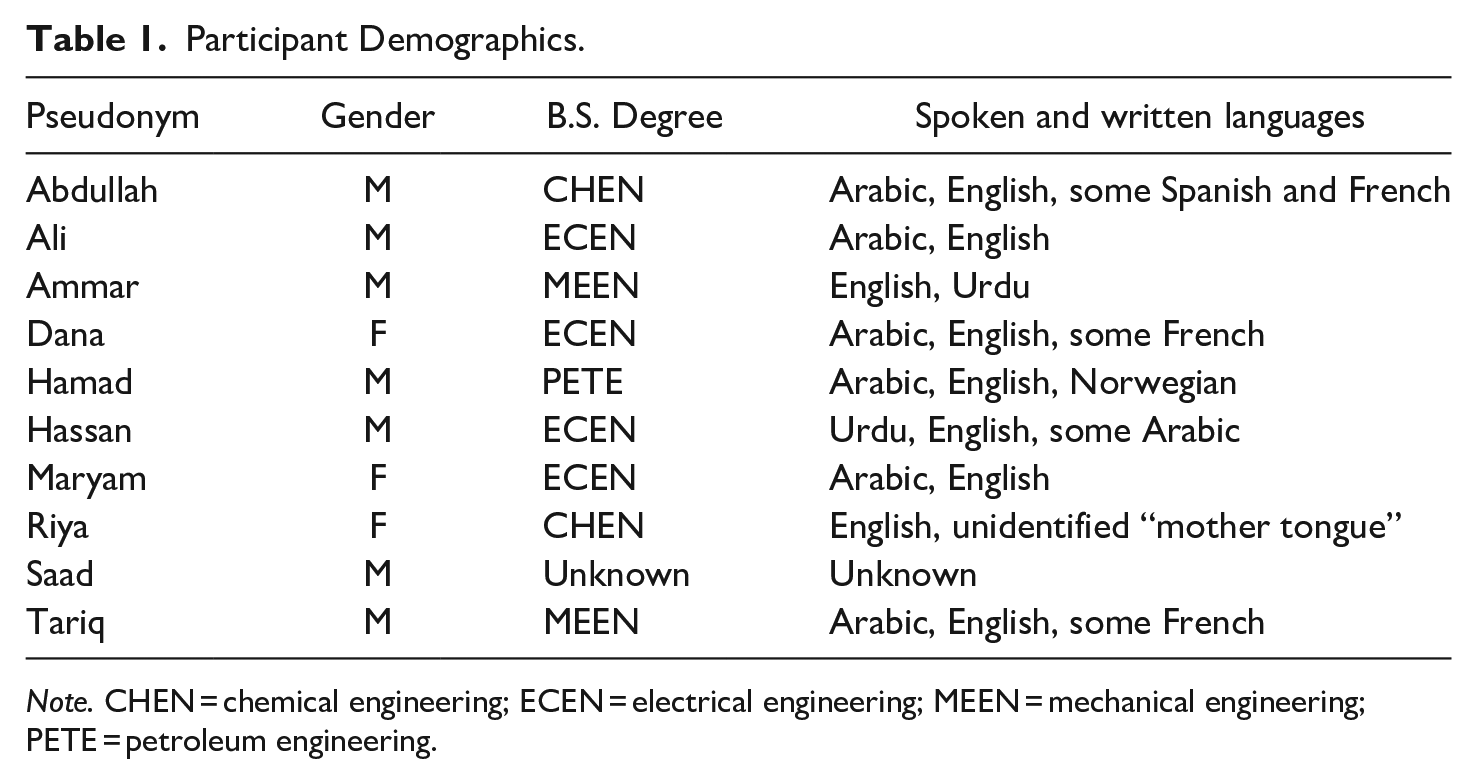
Note. CHEN = chemical engineering; ECEN = electrical engineering; MEEN = mechanical engineering; PETE = petroleum engineering.
Participants were asked questions about their current job, their daily writing and communication tasks, their language use, and their educational experiences in technical and business writing. They could respond in English or Arabic. The actual interview questions are included in the Appendix.
Data Analysis
The audio-recorded interviews were transcribed by professional transcriptionists. Responses in Arabic were translated into English. We analyzed the scripts and identified several broad categories to use for coding. The categories were as follows: training in writing; writing for work; group writing for work; thoughts on the teaching of writing; and struggles with writing. Dedoose software was used to help code the interview responses. We uploaded the transcripts and identified key phrases and words that would identify sentences related to the coding categories. The software then identified those key words and phrases in the transcribed interviews.
All coded responses were reviewed by one or more researchers so that the responses could be verified as correctly coded into the appropriate categories. In addition, we read all of the transcribed interviews and placed additional sentences into the broad categories that were not initially coded by Dedoose. We scoured these data for responses directly related to language use/preference at work, school, and home. The resulting corpus was 3565 words of interviewee responses related to the broad categories identified by researchers.
Results
Affordances of Speaking and Writing in BELF
Hamad, who worked in process engineering, attributed his strengths in English to his time in the reservoir field in the United States and Norway, where he learned to communicate in what he called “the company way.” He indicated that the number of expatriates in his multinational company was the reason he was more comfortable writing in English over Arabic, a change that only happened once he was on the job and traveling for company purposes. The undergraduate researcher asked him if that was the same case for speaking in English, and Hamad laughed, saying, “Yes. Unfortunately. Unfortunately.” He recalled teasing his university friends for using English instead of Arabic while at TAMUQ, but now he said he found himself “back in their shoes.” Hamad’s use of English is predicated by specific factors of his working environment. Similar to Evans’s (2013) study of professionals in multinational companies in Hong Kong, professional engineers in Qatar use BELF as a tool to communicate because of the multilingual nature of the workforce in this specific location of the world.
Although a number of our interviewees expressed their preference for communicating in English over Arabic, like Hamad many indicated some level of discomfort with this preference. As Takino (2020) notes, “Existing research has largely looked at BELF as a practical tool, yet [the study participants’] experiences suggest that the research needs to take into consideration more emotional aspects” (p. 527). Hamad’s joke may indicate his ambivalence about English overtaking Arabic in workplace communication and perhaps in other situations as well.
Similar experiences were expressed by Abdullah, who worked in corporate social responsibility after positions in sustainable development and renewable energy. He viewed himself as a strong writer in English but even better at verbal and visual communication, and he noted that “70 percent of your communication is not the word you choose, it’s actually the body language.” He preferred to give presentations in English, noting that translating from English to Arabic or Arabic to English in the moment caused him to stutter. He identified that this change happened after university, meaning his preferences shifted while he was working in industry.
Ali, who worked in a government position, preferred writing in English and advised his undergraduate interviewer to think about what the future might hold, stating, “I would like to stress it more: you know, the percentage of people who are writing in English is increasing every year.” Ali noted that the audience played a big role in his use of English over Arabic, as he prepared talking points for a prominent government official who would go on to discuss international affairs with others who spoke English. Even as Ali and his boss were both Arabic speakers, Ali wrote to his boss in English so that his boss did not have to translate the information to future audiences.
These three professionals’ experiences show how BELF is “emergent from the collaborative practices that take place in the context of interaction” (Cogo, 2012, p. 309). Over time, engineering alumni employed BELF to communicate with the varied audiences at their workplaces, as well as to package information in BELF to be used by others in the communication chain. In particular, interviewees’ BELF writing repertoires expanded beyond what they used as university students, and their reflections about their university experience indicated that they had not fully understood the rhetorical and communicative nature of workplace communication at that time. Their advice to undergraduate interviewers was consistent about the rhetorical and user-centered nature of communication (Hodges & Seawright, 2019).
Although many felt comfortable speaking in English on the job, the majority of the interviewees also felt it was important to use Arabic in certain work situations. “Honestly, I feel it [is] more polite to speak in Arabic if we are all Arabic speakers,” Ali observed. This perception was echoed by Dana, who said, “We speak Arabic with whoever is comfortable using Arabic only.” Others said that informal conversations at work were often in Arabic. Hassan noted that conversations in his workplace varied according to whether or not the interaction was documented: “English will be the official language, of course, if someone is comfortable speaking something else, off the record or unofficially that person will be speaking that language.” Although language hybridity was central to these transnational workplaces, particular choices in language were characterized by collaborative practices and language users’ responsiveness to their context (Cogo, 2012).
These professional engineers decided which languages to use when writing based on efficiency for both themselves and their users or audience members. They perceived that moving back and forth between languages, in either speaking or writing, was inefficient or potentially confusing for their audience, who used English as a lingua franca for business purposes. Ammar, a process safety consultant, found few opportunities to utilize his native language Urdu when he needed to document fast-paced, real-time workplace conversations in language that was composed “technically, proficiently and in proper English.” This English dominance in the workplace resulted in the multilingual engineers believing that their English writing skills surpassed their writing skills in other languages, but it also regulated their other languages to “unofficial” or informal settings at work. Dana, who worked for a multinational company headquartered in France, thought that knowing French would be an advantage in communicating with upper management, but, as all of her work was completed in English, this would likely be a social advantage used in conversation rather than written correspondence. Social conventions and politeness were key factors in using their mother tongues at work, although interviewees were careful about using a language that was not shared by others in the conversation.
The Role of Technical and Specific Terms
Interviewees identified “technical terms” as one of the key reasons they preferred writing or speaking in BELF, even in communication that would not necessarily reach their users or audience members. Ali noted that English technical terms helped him prepare himself for communicating with an English as a lingua franca audience: “If I’m going to discuss this matter with someone from a different country, then if I’m used to use the same terms, it’s easier for me to negotiate [with users] or to say it.” Saad attributed the use of BELF to technical terms as well: “The emails are always in English because all the terms or technical terms are in English, as well, so you can’t really jump between Arabic and English.”
The professional engineers in our study used English rather than Arabic because some technical terms are difficult or impossible to translate from English into other languages, a finding that aligns with Evans’s (2013) study of Hong Kong professionals. Even when participants shared a language other than BELF, specific terminology made them inclined to write in English. As Evans (2013) notes, “Since professionals acquire their disciplinary knowledge and skills in English (either locally or overseas), they are predisposed to write in English at work, particularly when the subject matter is of a highly technical nature” (p. 243). This seed of BELF preference is likely planted in university settings, where terminology is taught to students in the English language medium.
Even for terms that were possible to translate, Abdullah observed that the uses of the terms were different in each language. He noted, “If I want to, to get a point across through, through using the Arabic words, it’s difficult. Yesterday, I had a problem . . . we had our quiz about this sponsorship for empowering youth. So what’s the word “empowering” in Arabic? I don’t know. Even when you translate it in Arabic, it’s not the same level because in Arabic it’s ‘Tamkeen’. ‘Tamkeen’ is not a common word that you use in your daily use. Something that when you say it, people say, look at him, he’s trying to be Freud or Einstein. (Laughter) Because it’s like very high Arabic. While in English, ‘empowering,’ it’s easy, it’s used in, in daily English it’s used.” Abdullah demonstrates a flexibility and knowledge of how to “cross, mix, and play with (his language) resources” (Cogo, 2012, p. 308). When it makes no sense to use the Arabic word, even when speaking in Arabic, he is able to codeshift to the word in English so that his audience (and himself) understand better in the context of the situation.
Discussion
Within a complex intersection of systems in workplaces and societies, transnational technical communicators make deliberate, considered decisions about language use. Our study participants did not solely espouse standard language ideology about BELF (although these attitudes were present), nor did they wholly advocate for an Arabic-only approach to business communication. This ambivalence is characteristic of transnational subjects, who are “active agents always constructing their cultural identities—not merely passive agents acting out their national or group cultures” (Agboka, 2012, p. 174).
Although transnational technical communicators make these language choices for rhetorical, business, and social purposes, our findings align with Kankaanranta and Lu’s (2013) argument that BELF “can have some homogenizing effects on its users’ cultural identities” (p. 291). The use of BELF even among all Arabic speakers and technical communicators’ resistance to switching back and forth between languages suggests that the engineering professionals were able to inhabit a workplace identity that elided cultural difference. Kankaanranta and Lu’s (2013) participants believed that “clarity and directness contribute to the effectiveness in communication needed in business to get the work done” (p. 300), and our participants seemed to agree that clarity was a key component of BELF, as evidenced by their insistence on using the same terms across languages and by preparing communication only in one language so as to avoid potential mistranslations or “stuttering” later on. But directness did not seem to be valued as much as a key to BELF; instead, politeness was a key factor in participants’ use of BELF in a mixed language group at work.
Technical terms drove the use of English as the business lingua franca, particularly concepts related to the oil and gas industry, corporate language, and discourse around the environment and sustainability. Interviewees were acutely aware of the distinctions and use of terms in both English and their mother tongues, and they made conscious decisions about using English terms in their communication. Engineering professors noted in Hillman et al.’s (2019) study that despite being bilingual in English and Arabic, they only knew the scientific and technical terms in English. They did not know the terms in Arabic at all (p. 50).
This study extends Nickerson and Camiciottoli’s (2013) finding of a generational shift among UAE nationals who preferred English as “an appreciation of the multicultural and multilingual society that exists” in the Arabian Gulf (p. 345). In addition to appreciating the multicultural and multilingual corporations they worked in, our participants also expressed complicated views of English’s impact on their workplace in an Arab society. This complexity is a good reminder that “Because translingual dispositions are bound to a complex array of sociolinguistic issues, not all students will see language plurality and difference in the same way; many students are likely to maintain the dominant viewpoint that there is only one English, while others may already possess or later adopt translingual dispositions” (Lee & Jenks, 2016, pp. 338-339). In other words, participants’ views on BELF and language use is one moment in time amidst rapidly evolving societal and individual attitudes toward language difference.
Limitations and Future Research
The small number of university alumni in our study (10) is an obvious limitation to our findings. In addition, Texas A&M University at Qatar only offers engineering degrees, so the alumni we interviewed represented only one professional field of study, and most of them now work in the oil and gas industry. Thus, the study was limited by the number of alumni interviewed and by the scope of the engineering profession. In addition, our qualitative study looked at the findings of their interviews only. It would benefit and expand our findings to also conduct qualitative studies utilizing ethnographic research in their workplaces and by utilizing discourse analysis on various genres of writing in those environments.
It would be interesting and helpful to look at BELF in other contexts. In fact, it was articles on BELF’s use in Hong Kong (Evans, 2013), London/Europe (Cogo, 2012), Oman (Al Hilali & McKinley 2021) and others that inspired our own. As noted in our findings and others we cite, the multilingual nature of the workplace will only grow in the future. The idea that English, in all its many forms, will remain the language of business and technology is yet to be determined. As more nations and cultures demand a return to and preservation of local languages, the push/pull for English in industry and higher education offers an ever-changing and fruitful field of study and research. The story of the female engineer that begins this article is evidence that some business is conducted entirely in the native language. It is our hope that instructors situated, as we were, in multicultural and multilingual locales will choose to contribute their own unique contexts to this growing area of research.
Implications for Educators
Our findings support the need for technical and business writing instructors to train students in methods that center intercultural professional communication and decenter English as a standardized, static language. As Hillman et al. (2019) argue, “classrooms that utilize translanguaging pedagogies have the potential to develop multilingual students who are able to use their rich linguistic systems to achieve communicative and cognitive tasks” (p.58). How then do we prepare our students for BELF and their multicultural, multilingual futures?
First, instructors can provide students with a wide variety of media (written, spoken, digital, and interactive) from intercultural technical and business situations and develop assignments that require students to encounter hybrid and complex cultures other than their own, as Walwema (2018) does in her global rhetorics project. By examining a culture through nonacademic artifacts, including stories and personal experiences, students can construct a “multidimensional view of a referent culture” (Walwema, 2018, p. 342). Partnerships with local cultural organizations and multinational companies could provide students with context for the importance of intercultural knowledge. Although acquiring other languages and linguistic repertoires is helpful for students, the ability to adapt to new linguistic contexts enables them to work in the fast-paced, increasingly hybrid global economy, as Canagarajah (2020) notes: “Competence in multiple languages, registers, and media is important so that professionals can undertake different kinds of work as demanded by market changes and mobility across work sites” (p. 561). One of the authors has adopted this approach in her editing class, where one assignment asks students to edit a business document for two different cultural contexts.
In superdiverse institutions like Texas A&M University at Qatar, business and technical faculty may welcome the opportunity to focus on intercultural and multilingual communication over a narrower focus on English competence, opening up more opportunities for collaboration with writing instructors (Annous & Nicolas, 2015). Yet to do so also requires technical and business writing instructors to reflect on our own implicit beliefs about English as a standardized language and as the (only) key to professional communication across the globe, and to engage our colleagues in similar reflections when standard language ideology impacts curricula, assignments, and other institutional systems.
Second, instructors can incorporate instruction on BELF, even in classrooms like ours where English is the medium of instruction. Students may have extensive previous experience with English without knowing about BELF. We suspect that our interviewees valued their practical experience with BELF on the job as contributing more to their success than their training in standardized written English. One participant in this study, Maryam, wanted future engineers to learn to “Communicate it to the people instead of paragraphs,” signaling that standardized, coherent paragraphs could take her only so far in her job. Instructors may be able to bridge this gap by encouraging internships during the course of study or incorporating real-world classroom projects that require BELF (Millot, 2017). Projects like those in Nickerson’s (2015) Language in the Workplace course can help students see the flexibility of BELF in use. In one of the authors’ business writing courses, students map how external and internal communication flows in a business scenario, noting the different language uses by actors in the scenario.
Positioning BELF as a language variety emerging from and driving globalization, colonization, and late capitalism can “empower [students] in making rhetorical judgements to enhance their communicative acts with the Other” (Bokor, 2011, p. 135). A rhetorical approach to teaching BELF has the benefit of honoring students’ own linguistic repertoires in the classroom, for both “native speakers” and “non-native speakers.” One of the most important technologies our students use is English, and it deserves to be interrogated in the same ways that we interrogate other technologies. We echo the recent scholarship that examines how “all technical communication has the potential to be global technical communication” (Hass & Eble, 2018, p. 10).
Researchers and teachers in the Arabian Gulf region now call for both English and Arabic to be taught and used in higher education, as Reynolds (2016) emphasized: “We always talk about English or Arabic, as one or the other. But English should not develop at the expense of other languages. Speaking other languages and navigating other cultures is crucial to success now. Every day in the Gulf, people process multiple languages and integrate them into daily conversations. Why not in the educational system?”
Footnotes
Appendix: Interview Questions
Declaration of Conflicting Interests
The author(s) declared no potential conflicts of interest with respect to the research, authorship, and/or publication of this article.
Funding
The author(s) received no financial support for the research, authorship, and/or publication of this article.
