



Abstract
Employees often bemoan organizational meetings, as previous studies highlight meetings as a waste of time and resources. However, the number of meetings continues to grow, with employees expected to participate in more and more meetings every day. While managers may desire full participation in all meetings from employees, employees may choose to not fully participate for a variety of reasons. Instead, some group meeting members may try to maintain a strong impression while simultaneously conserving resources. This participation type is known as Pretend Participation. Thirty-four individuals were interviewed and the data analyzed through open and axial coding to investigate how they and their coworkers communicatively create pretending behaviors. Participants indicated a variety of verbal and nonverbal strategies to successfully pretend in meetings (e.g., pretend notetaking and kinesics), as well as behaviors that revealed when other group members were pretending (e.g., responses without specificity and repeated answers). Importantly, participants interpreted similar behaviors differently when considering their own perspective as compared to their view of others’ behaviors. Additionally, some behaviors labeled pretending by participants were described in terms of other participation types, such as On/Off Participation and Token Legitimacy. Implications are discussed in terms of multitasking, mandatory meetings, and meeting members struggling to focus.
Introduction
Group meetings are a ubiquitous part of group and organizational life (Allen et al., 2015). Since group meetings are organizationally salient events where shared experience and interaction create group identity, climate, and direction (Schwartzman, 1989), the effectiveness of group meetings is regularly lamented by leaders and attendees. Not only are these assessments often negative, but many group members dread meetings (Allen et al., 2012) and look for ways to avoid attendance. This of course is unfortunate, as individuals who participate in group meetings are on the whole more engaged employees (Yoerger et al., 2015).
When group members do attend meetings despite their desire to be elsewhere, they must decipher a complex goal framework to figure out how to participate (Beck et al., 2025). Of course, the purpose of the meeting will dictate meeting participation approaches (Reed & Allen, 2022). In addition to fulfilling role and organizational goals, Beck et al. (2025) argues that meeting members must balance individual motives, specifically impression management and resource conservation, while adjusting behavior according to meeting context. The balancing of these goals leads to a variety of participation strategies ranging between full participation to nonparticipation.
One of these participation types is pretending. Pretend Participation involves individuals who want the positive impression management rewards that come from fully participating, while simultaneously conserving energy resources (Beck et al., 2025). Pretending in meetings may be the most common and egregious form of participation, as it contains the notion of deception within the effort to appear engaged and participating. This purpose of this study is to explore Pretend Participation, both from the perspective of the person enacting the behavior as well as from the standpoint of recognizing it in others. In doing so, we hope to expand our understanding of one of the forms of participation that have hitherto been neglected by meeting science researchers (Beck et al., 2025).
Meeting Participation
Meeting participation is broadly defined as the observable behaviors and interactions that indicate an individual’s engagement during organizational meetings (Yoerger et al., 2015). People make the choice of how or whether to participate in consideration of the information they have (Bonito, 2006). Additionally, meeting participation is interdependent (Bonito, 2002), in that a member’s participation is dependent on behaviors prior to their communication and their communication influence subsequent and other members’ meeting participation.
Member participation in group discussion is central to both performance (Bonito, 2000) and socioemotional outcomes (Falcione, 1974; Zhu & Stephens, 2019). By participating in discussion, members influence conversation flow (Clifton, 2009) and provide information that may be crucial to group success as well as direct the conversation to the task at hand (Bonito, 2000). These participation choices are made based on meeting characteristics, as well as individual characteristics and predispositions regarding the meeting. For example, social loafing literature notes members may choose not to participate, even when they have information, due to no perceived rewards, or a dislike of the task, situation or other members involved (Bonito, 2001). As a result, participation is an individual-level choice based on their assessment of the meeting at hand.
Our definition of meeting participation (Yoerger, et al., 2015) encompasses both verbal contributions and nonverbal signals—such as active listening, eye contact, and body language—that together reflect the degree of cognitive and emotional involvement in the meeting process (Keyton, 2017). Researchers in the field emphasize that effective participation goes beyond merely speaking up; it includes the capacity to interpret and respond to subtle communicative cues from other members, thereby fostering a collaborative atmosphere (Bonito, 2002).
Scholars from both communication studies and organizational behavior have underscored the strategic dimensions of meeting participation (Allen et al., 2015). They argue that individuals often engage in meetings with calculated intent, tailoring their contributions to navigate complex power structures and influence group outcomes (Morrison & Milliken, 2000; Woolley et al., 2010). This strategic participation is seen as a balancing act, where individuals weigh the benefits of genuine input against the potential risks of dissent or overexposure. As a result, meeting behaviors are not only reflections of personal engagement but are also shaped by self-serving strategies aimed at gaining favor or mitigating conflict (Rogelberg, 2019).
A recent review by Beck et al. (2025) expanded the discussion of meeting participation to highlight different ways individuals strategically choose to participate in meetings. Their framework demonstrates that various influences—such as desires to manage impressions or to maintain personal resources—can prompt employees to adopt behaviors that signal engagement without substantive contribution, defined as Pretend Participation. This performative participation serves as a protective mechanism, allowing individuals to maintain a façade of involvement while avoiding the potential repercussions of genuine dissent or vulnerability. Pretend Participation differs from other participating types, such as Token Legitimacy (participating just enough to receive minimal credit) and On/Off Participation (fully participating during certain parts of the meeting, not participating during other parts), in that it desires to receive the maximum benefits due Full Participation, but without the effort necessary. In summary, Beck et al.’s (2025) review expanded the understanding of meeting participation to include variability in the motives and approaches to participation.
Pretending in Organizational Meetings
Individuals who engage in Pretend Participation may appear similar to those that are fully engaged, as they are hoping to receive the benefits of Full Participation (Beck et al., 2025). The notion that individuals try to hide their true feelings behind their outward expressions is not new (e.g.,Shanock et al., 2013; Thomas et al., 2017). For example, surface acting refers to the ability to portray a certain emotion without feeling the emotion (Hochschild, 1983), such as looking calm when feeling upset. As a type of pretending, individuals may try to portray a certain emotion during workplace meetings. However, perceptions of surface acting are negatively associated with perceptions of meeting effectiveness (Thomas et al., 2017); if others can tell someone is surface acting, then the rewards for doing so disappear.
Similarly, pretending involves more than simply conveying an emotion; the goal of Pretend Participation is to convey a desired impression to others. There are many reasons members may choose to pretend. Lack of interest, misalignment with role, lack of preparation, and fatigue may lead to pretending (Beck et al., 2025). Importantly, members will use their own naïve theories (e.g., Beck et al., 2012) to make decisions about how to pretend. Employees likely want to give off the impression that they are dynamic participants who have the group’s goal in mind. They may communicate in a way that shows engagement, such as asking questions or interjecting themselves into conversation. Members will consider how others will view them while trying to maintain a positive impression and conserving resources. However, they may not be accurate in their assessment and subsequent strategy, leading others to see through their pretend efforts. In order to pretend well, they will need to disguise their efforts to conserve resources. If other meeting members can detect that answers are superficial or lazy, then the purpose of pretending will be undermined.
Considering how one views successful pretending efforts as well as how one can assess others’ efforts to pretend is necessary to advance our understanding of this type of meeting participation. Research has shown that asking group meeting members to articulate how they decide to participate and how they think others participate provides insight into their communication strategy (Beck et al., 2015; Beck & Keyton, 2009). The ways that members adapt their messages to accomplish their participation goals is evidence that others will use to assess members’ participation.
Meeting members adapt participation approaches based on evolving impression management, resource conservation, and meeting context variables. Further, the evidence provided in support of the meeting load paradox (i.e., having more group meetings is both helpful and hurtful for employees; Romney et al., 2025) suggests that individuals may be looking for ways to maximize the positive outcomes of group meetings (e.g. decisions that support their work) while minimizing the negative outcomes of group meetings (e.g. fatigue, burnout, and other resource drains). Since Pretend Participation may be one way members try to balance these individual and meeting-level goals, the following research questions are posed:
Method
The purpose of this exploratory study was to explore the ways that members pretend in group meetings. The data for this project is part of a larger data collection investigating a variety of types of meeting participation based on Beck et al. (2025). Interviews were conducted with meeting attendees across the nation.
Participants
For this study, participants were required to work in the United States, as cultural norms for group meetings differ across countries, and to have employment that required meetings each week. Graduate research assistants at three universities recruited participants from their networks, with each graduate student completing between one and eight interviews. Thirty-four interviews were conducted between March and September 2024, with 26 females (76.47%) and eight males (23.53%). Participants were asked to describe the most recent meeting they attended as an example of a regular meeting, and meetings ranging in size from 2 to 35 members (M = 11.03, SD = 9.14). Most of these group meetings were weekly meetings (n = 14, 43.75%), followed by monthly meetings (n = 7, 21.88%) and one-off meetings (n = 6, 18.75%), and occurred primarily in-person (n = 16, 47.06%; virtual = 12, 35.29%; hybrid = 6, 17.65%). Participants were also from a variety of industries, including health care, government, manufacturing, finance, and education. Interviews lasted an average of 29:54 min (range of 8:07–49:10) and generated a total of 350 pages of transcript (M = 10.29, SD = 3.61).
Procedure and Design
The study was designed to capture participant perspectives of meeting participation. Through interviews, participants were able to share their experiences, stories, and accounts which described meeting participation in their own terminology and language (Lindlof & Taylor, 2002). As a result, our data provides insights into meeting participation as experienced and interpreted by our interview participants.
Interview questions were broken into two topic areas. First, participants were asked to describe a recent meeting they had attended. Within this section, participants recalled the purpose and nature of the meeting, the regularity of the meeting, the level of participation from all members in the meeting, and whether this participation was “normal” for these meetings. The second section transitioned and focused on questions about meeting participation broadly, and the questions were developed based on the definitions of five meeting participation types from Beck et al. (2025): Full Participation, Nonparticipation, Pretend Participation, Token Legitimacy, and On/Off Participation. The definitions and example behaviors provided in the original framework were used to develop interview questions that asked participants to discuss specific meeting behaviors they have observed in group meetings. For the purposes of this study, we focused solely on the set of questions asking about Pretend Participation. These questions were asked as part of a series of questions targeting different meeting participation types. To allow participants to interpret the questions on their own merits, interviewers did not provide definitional explanations prior to any of the questions. The Pretend Participation questions targeted whether participants have observed pretending in group meetings (Have you ever seen a meeting member pretend to be engaged in a meeting, even when they really weren’t?), what behaviors are associated with pretending (What things do people do to look like they are participating when they may not be?), and their experiences witnessing and participating in pretending (Have you ever needed to pretend to participate in a meeting? If yes, how did you pretend? Why did you feel you needed to pretend to participate? If no, then if you wanted to look good in a meeting, how would you act?).
Data Analysis
Participant responses were transcribed and checked by the graduate student interviewer before coding. To begin analysis, the three authors read through the transcripts to build familiarity with the data and participant experiences. Each author identified specific patterns or themes they noticed in the data and shared these with the other authors during their next meeting. The authors engaged in multiple iterative stages, where the authors would meet to discuss observations and trends and then would return to the data to restart the coding process. After multiple iterations of reading and discussion, the authors decided to focus on Pretend Participation and narrowed the data to the interview responses focused on pretending (75 pages of text).
For this study, the authors decided to use an open and axial coding process which allowed them to identify not only what behaviors constituted Pretend Participation, but to also explain some of the underlying reasons individuals may choose to engage in Pretend Participation (Corbin & Strauss, 1990). Open coding involves labeling distinct activities or concepts that are present in the data, eventually leading to categories that reflect similarities and differences between activities (Corbin & Strauss, 1990). This process allows researchers to compare specific behaviors that participants associate with Pretend Participation. During this open coding process (Lindlof & Taylor, 2002), the authors began by individually coding one-third of the transcripts, focusing on behaviors that constituted Pretend Participation. While coding, all three authors noticed participants also discussed motivations for Pretend Participation and made note of these throughout their coding. After completing this round of coding, the authors met and discussed the behaviors and explanations that emerged from the data. During this discussion, the authors identified areas of overlap between authors and felt prepared to move into axial coding across the transcripts.
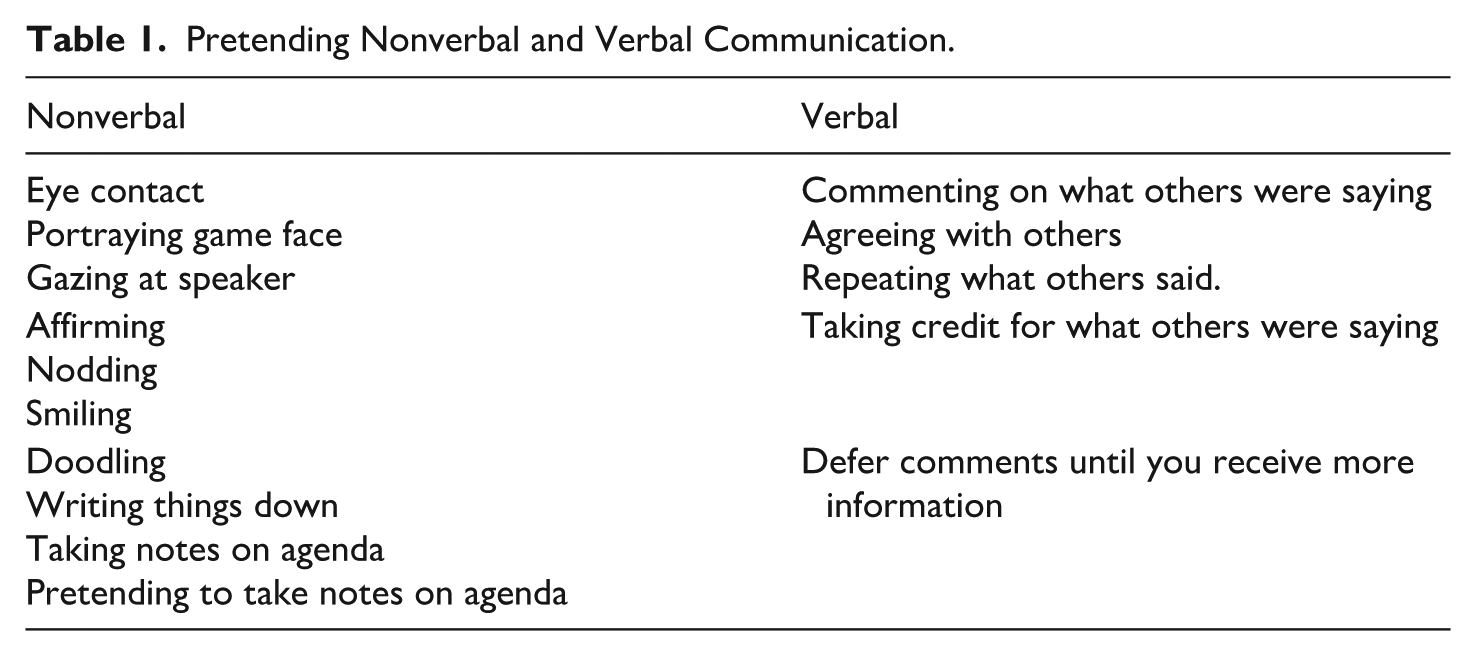
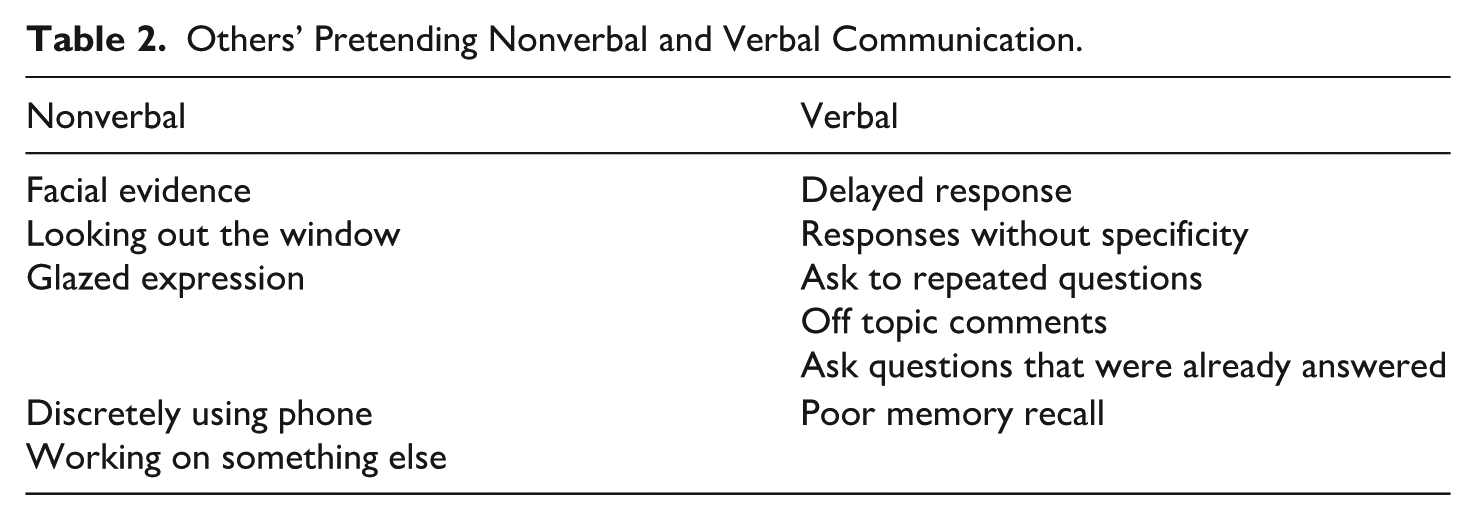
To answer the research questions about pretending, the authors transitioned to axial coding. Axial coding focuses on identifying similarities and differences between initial codes, with an emphasis on identifying broader categories of behaviors and the potential relationships between them (Corbin & Strauss, 1990). During open coding, the authors identified many specific behaviors that constituted Pretend Participation (see Tables 1 and 2). As the authors moved into axial coding, their focus shifted to the broader patterns across the ideas identified and the reasons participants had for Pretend Participation. Each author individually returned to their third of the pretending responses to develop broader categories for participants’ specific behaviors and interpretations of pretending, then discussed their observations in a group meeting. In this meeting, the authors discussed their own emergent codes and identified areas of overlap between authors. After identifying overlapping areas of interest to the authors, each author returned to the entire data set to group codes into related themes and created their own axial coding scheme. During a second meeting, authors compared their axial coding frameworks to create a final set of codes. Authors found the codes were similar during this last step and determined that thematic saturation was achieved. After finalizing the themes, the authors returned to the data to identify example quotes and stories that best exemplified the themes.
Pretending Nonverbal and Verbal Communication.
Others’ Pretending Nonverbal and Verbal Communication.
Findings
Overall, the findings that emerged from the data fell into those communicative behaviors that were consistent with Beck et al.’s (2025) original operationalization of Pretend Participation, and others that were not. In the first section, we examined how members implemented their desire to balance impression management with resource conservation (
Communication Consistent With Pretend Participation
Many participants acknowledged that they or other meeting members would pretend during group meetings. When pretending, the participants balanced the need to foster a positive impression while trying to conserve or use less effort than would be required for full participation. Sometimes pretending was very strategic and calculated, while other times it was subconscious and automatic.
Performing Pretending
There were a host of verbal and nonverbal behaviors associated with balancing impression and conservation goals. Since resource conservation is often a hidden behavior, most pretending techniques shared by participants focused on how to communicate in a way to demonstrate engagement when they were not fully engaged. These behaviors were both nonverbal and verbal (see Table 1).
Participants shared a variety of facial actions with the purpose of looking engaged in the meeting. Eye contact, portraying a “game face,” and gazing at the speaker all showed other group members that they were participating. Affirming, nodding, and smiling conveyed agreement or warmth with what others were saying. Beside facial expressions, participants also used nonverbals to show busyness or reflect engagement. Doodling, writing things down, taking notes on the agenda, or pretending to take notes on the agenda were all listed as ways to convince others that they were fully engaged even when they were not. Writing works well if others are not able to see what is being written directly. It is also an active approach to display listening, which is often considered a passive behavior.
Verbal behaviors consisted of trying to find a way to comment on what others were saying, agreeing with or taking credit for others’ ideas, or deferring comment by saying they wanted to gather more information or research first. As verbal participation increased the risk of having to display understanding or knowledge, members had to be careful not to become vulnerable with their pretend efforts to participate. “I’ll just say what someone else said in another way.” (Candidate 12). Repetition shows supports to someone else, which probably prevents follow up questions dissecting the comment. These verbal behaviors made it look like the individual was fully participating, but also it did not put them in a spot where they would need to elaborate or expose their ignorance on the interaction subject matter.
Assessing Others Who Pretend
Participants similarly referred to nonverbal and verbal behaviors when assessing whether other meeting members were pretending (see Table 2). In assessing how participants knew that others were pretending, they focused on evidence that indicated the members were not fully engaged. These behaviors differed from the nonverbal and verbal behaviors previously stated that attempted to balance impression management and resource conservation goals.
Nonverbals were often the greatest indicator as to whether someone was engaged in the meeting. Facial evidence, such as looking at their phone or out the window, could indicate that they were not really paying attention. “Yes, like sort of fake active, listening . . . nodding with eye contact. But it was one of those ‘lights are on but no one’s home’ kind of things where people are pretending to engage” (Candidate 17). Sometimes it was easy to see them doing other things (e.g., phone and work) or they had a glazed expression that was interpreted as pretending.
What individuals said in their attempts to participate would also indicate whether they were engaged in the meeting. Responses to questions by other group members were sometimes delayed and without specificity related to the meeting. Participants would sometimes ask for the question to be repeated, have off-topic answers, ask questions that were previously answered, or have poor recall. “They go there to save face . . . but they’re not adding to the meeting at all” (Candidate 3). Interestingly, the meeting members obviously hoped their communication would be interpreted as full participation, but the participants indicated otherwise.
In virtual meetings, pretend engagement was quite different. If meeting norms allowed for members to turn their camera off, then it was very easy for meeting attendees to pretend. In fact, when cameras are turned off, participants assumed that others were not engaged. They did not have any verbal or nonverbal evidence as with in person meetings, but their assumption was that a camera turned off equated with a lack of engagement. Having the camera turned off was the only available evidence, and this evidence was interpreted harshly.
Pretending: Multitasking Leading to Token Legitimacy, On/Off Participation
Several of the participants interpreted protocol questions targeting Pretend Participation quite differently than defined by Beck et al. (2025). Some responses used the term “pretending” in a functional way, as a strategy to better conduct tasks or perform their jobs. This alternative approach to “pretending” still considered impression management and resource conservation, but it did so in ways consistent with other meeting participation categories, specifically Token Legitimacy and On/Off Participation. This is consistent with language convergence theories (Dougherty et al., 2009), which shows how the same language (i.e., pretending) can be interpreted in unique ways, often associated with members’ goals (Beck & Keyton, 2009).
An example of this is multitasking. Participants would try to “pretend” at work as a way of accomplishing different goals, often work-related. They believed that certain tasks, like checking email or text messages, can be conducted in an effective manner while participating in group meetings. This type of meeting engagement is not Full Participation, as the participants were clearly acting on several simultaneous tasks, some of which were not meeting-related. However, the participants believed they were simultaneously and meaningfully contributing to the meeting.
For some group meetings, the threshold of engagement to be considered an engaged participant was very low. In group meetings with many participants, members may feel more comfortable with checking their phones or looking at other work items during the meeting. The norms of active engagement (verbal and nonverbal) may be more relaxed in those situations, especially given the lower likelihood of being called on. In this excerpt, Candidate 18 is responding to a question about how you know if someone is fully engaged.
Some people still like can half listen and scroll on their phones. But you know . . . even if they’re not participating verbally, if they’re giving me like, you know, some kind of, or giving anyone any kind of like indication that they’re listening by looking at them, or, you know, just acknowledging like, Oh, I agree, or I disagree. (Candidate 18)
Candidate 18 sees the standard for engagement to be any effort to show they are listening, which is a very minimal standard.
This relaxed expectation for engagement can be especially true for virtual meetings. Attendees could easily conduct non-work tasks (e.g., filing nails and eating breakfast) while listening to the group meetings in the background. Attendees could also be working on other work-oriented projects while listening.
I mean, I mean, for the most part, like I try to pay attention during the meetings, because it’s kind of important for me, cause this could be like one of my future jobs. But I know, like there was like one meeting a while back where I was zooming in, and I didn’t wake up on time. So I was like, they’re like pouring a bowl of milk and cereal while listening to the introduction where they’re talking about the instructions. But like for the most part, like, Yeah, I’m still engaged. I’m just multitasking like, it’s not like I’m I have it playing in the background, and I’m not listening. Cause I was doing that and eating at the same time. (Candidate 6)
These additional tasks were productive in work or non-work ways, but given the often mindless nature of those tasks, the participants believed they were still successful meeting attendees.
Much of the reasoning for multitasking revolved around the type of role the participant was fulfilling. If the participant attended for a specific type of expertise, they could reasonably work on other items unless their expertise was needed. For example, if someone was asked to attend for their budget expertise, they may not be fully engaged during the logistical strategy portion of the meeting. However, if budget questions arose, they would then become more alert and participate. This version of “pretending” may be more appropriately identified as On/Off Participation, as the individual strategically approached the meeting in terms of being accessible when needed but not constantly focused. Importantly, other meeting members may not expect them to be engaged. In this circumstance, high levels of participation are not expected.
Although research suggests that it can be challenging to accomplish multiple tasks at once, participants often claimed that they were successful at doing so during group meetings.
I think that there’s meetings that I—it’s not necessarily that I’m trying to pretend—I’m trying to multitask. Where I am trying to do multiple things at once, where I’m doing a meeting, and I’m trying to be invested. (Candidate 31)
Some referred to resource conservation as a reason for multitasking. “That’s like the most efficient way I am” (Candidate 18). Again, in this way multitasking was a way of using resources in a more productive manner, different from merely trying to reduce or conserve resource use as is associated with faking or pretending to be a full participant in meetings.
Justification for Pretending
In responding to the interview protocol, participants often felt a need to explain or justify their own use of Pretend Participation. In addition to the impression management and resource conservation arguments, two additional justifications were quite common. These two justifications demonstrate the meeting (and individual) characteristics that influence how participants balance impression management and resource conservation in meetings (Beck et al., 2025).
Struggling to Focus
Meeting members said it was difficult to stay focused during a meeting for a variety of reasons. Members struggled to stay focused when a portion of the meeting did not pertain to the member, was considered unnecessary or irrelevant, or was boring. Certainly, the struggle to stay focused is not a revolutionary finding. However, these struggles sometimes made it difficult to engage or undermined desires to manage impressions. Pretending in this circumstance was designed to hide the struggle to focus or engage in the meeting.
Certain meeting characteristics played a role in disengagement. For example, simple issues like the temperature of the room can make it challenging to participate. “The meeting room is very warm, I can’t concentrate” (Candidate 7). Zoom meetings with most members turning off their cameras made it challenging for members to want to participate. Meeting members that participate poorly can also discourage engagement by others. “They go over things that seem obvious” (Candidate 17).
Certain individual characteristics also played a role in disengagement. Having on “off day” or something negative in their personal life (e.g., grieving death) may lead members to struggle to be engaged.
I just remember that sometime after my grandmother passed away. You know, we had a meeting at work. And then so then it was harder to concentrate, because you’re still like you know, grieving her loss. So I think in those kinds of situations it’s harder if you’re unhappy about something, you know, then it’s harder to concentrate. So that’s stupid. (Candidate 4).
Members do not always attend group meetings at 100% capacity, meaning some participation techniques may not be an option.
Additionally, the amount of effort it takes to stay engaged can cause members to struggle with engagement. “I think it that it’s hard to be on all the time” (Candidate 3). This is especially true for longer group meetings or meetings that did not appear relevant. Participants shared examples and tricks they would use to try to stay focused and engaged in the meeting.
It was being led by our VP. And it was about early learning, so I suppose it could have been beneficial for me to listen, but I was really having a hard time staying focused. So, I thought if I would write on my agenda it would look like I was taking notes. (Candidate 2)
Taking notes was a technique Candidate 2 was using to try to stay focused. This technique is consistent with verbal and nonverbal Pretend Participation behaviors addressed previously in reference to
Mandatory Group Meetings
One type of meeting that stifled engagement and subsequently led individuals to minimize impression management or maximize resource conservation goals, was a mandatory meeting. Repeatedly, when a meeting was labeled as mandatory, this categorization led to disinterest and participation avoidance. Participants expressed frustration at needing to attend, and sometimes participants tried to avoid attending. In most cases, they were not at all engaged in the meeting.
Yeah, of course, attendance was mandatory. And I have to login. Yeah, I have to be there, but I had no idea. I just have to be there. . . . My attention was not there. I had no idea what we were talking about. I’d say, yeah. That’s one time I felt I needed to pretend to be there. (Candidate 10)
This certainly may be a privileged viewpoint, as more senior or higher status members may have the luxury to consider not attending.
A lot of times mandatory group meetings were virtual and larger in membership. This may have been due to the nature of the meeting, as many were trainings or communication that was primarily one-directional. With larger group meetings, the chances of all the material being equally relevant to all members decreases. Participants often said that it was easier to pretend in larger group meetings, presumably because the number of people made it easier to hide any lack of engagement.
Participants often said it was easy to pretend during virtual meetings, since you could turn your camera off. “Attendance was mandatory, so I logged in, but I wasn’t listening” (Candidate 10). The elimination of nonverbal engagement indicators (e.g., eye contact and nodding) due to the virtual norm of allowing cameras to remain off allowed participants to conserve resources regardless of their participation goals.
In this sense, participants were not truly conducting Pretend Participation, as they were not interested in maintaining a good impression. Instead, these behaviors were more in line with a different participant type, Token Legitimacy. This participation type tries to meet the minimum levels of impression management and energy use, unlike Pretend Participation. The main goal of Token Legitimacy is participation at its most simple form with a desire merely to get credit for having attended. Meetings explicitly labeled as mandatory led participants to use this approach.
Discussion
The purpose of this study was to investigate how meeting members pretend to participate in group meetings, as well as how we recognize pretending behaviors in others. In answer to
A different set of behaviors were provided in relation to
These findings support the Pretend Participation category in Beck et al.’s (2025) five-category scheme. Participants were trying to appear engaged to meet work norms for meeting participation. The focus of their comments targeted impression management more than resource conservation, although resource conservation may not need to be verbally or nonverbally demonstrated in group meetings. Participants were able to readily talk about pretending as well, as the term made sense to them in the meeting environment.
However, there were also different reasons for pretending. For instance, some participants used it in a way consistent with impression management, but not necessarily in terms of resource conservation. In fact, sometimes participants were using resources in other ways, such as the case with multitasking. In this sense, members wanted to have the appearance of engagement but also wanted to accomplish other tasks. It was not clear from the data whether they were attempting to appear fully engaged; they may have been wanting to appear as a somewhat functional member of the meeting simply. Meeting leaders may have known that other tasks were being worked on, especially in virtual meetings. But the attempt to appear somewhat engaged was not countered with a need to conserve resources. Members were instead attempting to be functional in multiple ways.
As a result of this different view of pretending, two other participation types may be a more appropriate label. On/Off Participation may be a form of multitasking, where members attend the meeting, are focused on another task, but show enough engagement to more fully participate when the subject matter falls within their area of expertise or interest. In this circumstance, the effort to conserve resources was not to decrease resource use, but to be more efficient with how they were used. Using pretending to maximize resource efficiency is an important addition to the theoretical development of meeting participation.
Token Legitimacy may also be a better label for when participant’s use of the term pretending led to goals of minimum effort and impression management. Certain meeting types, such as mandatory group meetings, have a connotation that reduces participant desire to attend or engage. The degree to which the meeting was considered mandatory is also worthy of future study. Meetings labeled as mandatory as opposed to meetings that are perceived as mandatory may lead to different impression management desires.
Theoretical Implications
In summary, this study highlights four main theoretical takeaways. First, the findings of this study show that meeting participation varies in meetings for a variety of reasons. While prior research emphasizes participation as a dichotomy (Full Participation or Nonparticipation), many meeting members strategically choose to participate in different ways based on their assessment of the meeting situation. Engaging in Pretend Participation in meetings follows a similar pattern as research on surface acting (Shanock et al., 2013; Thomas et al., 2017); that is, individuals may fake their participation in meetings to maintain a specific impression for other members, or to conserve resources when trying to accomplish other work tasks.
Second, resource conservation may be a distinguishing factor between the Pretend Participation, Token Legitimacy, and On/Off Participation. In the data, it was clear that participants were using the term “pretending” to refer to all three of these participation types. In the data, the need to conserve (or not use) resources was juxtaposed with attempts to better or more efficiently use resources. In the case of multitasking, it may be difficult to pretend to be fully participating (as with Pretend Participation), but the goal of managing a good impression within the group is balanced with using resources in another manner. A lower level of functionality may suffice if other work-related tasks are also accomplished. Though multitasking is often viewed negatively by other group members (Stephens et al., 2021), in certain meeting types, multitasking may be welcome. In On/Off Participation, it may be helpful to have individuals chime in when it involves their expertise. Additionally, it may be quite unhelpful to have individuals chime in when it is not their expertise. Meeting facilitators may prefer an On/Off Participation approach when conducting interdisciplinary group meetings, and multitasking may be quite acceptable.
Third, our point of view seems important when assessing pretending. When viewing pretending in other meeting members, participants were quite harsh. Responses focused on how others were trying to hide their distracted behaviors (e.g., phone use) or were simply lazy. However, when asked to describe their own behaviors they provided justifications about the difficulty of being focused. There is a methodological explanation for this, as we tend to see bad in others and attribute situational factors for our own actions (e.g., Sillars et al., 2004), as well as desirability bias concerns (e.g., Paulhus, 1991). There also may be a difference in how colleagues see one another’s pretending actions and how administrators view it. What is clear is that pretending can be viewed in a variety of different ways. This may a good reason to consider pretending behaviors in terms of their functionality instead of as either good or bad.
Fourth, if pretending is considered acceptable in group meetings, what does this suggest about the current state of meeting functionality? With the many negative views of meetings in the workplace, perhaps tolerance for pretend participation in group meetings is an acknowledgement that meetings are generally dysfunctional and a drudgery for those involved (Allen et al., 2012). Pretending could cause this dysfunction, or it could be an outcome of poor meeting facilitation and functionality. If meeting members are struggling to focus throughout meetings, perhaps altering meeting agendas or interaction approaches is in order.
Practical Implications
The current findings reveal several practical implications for individual employees and their managers/leaders. Interestingly, not all the implications are positive in their potential effects on the individual, group, or organization. First, individuals may learn new tactics for engaging in pretending in their work meetings by reading and implementing the strategies discussed here. This may initially benefit the individual, particularly in terms of both the impressions they could demonstrate (e.g. I am engaged in the meeting fully) while allowing them to gain resources or even replace the meeting related effort with other concurrent tasks (e.g. emailing). However, knowledge of pretending behaviors could lead to greater detection, which could result in reprimand. Of course, if members are pretending and not being held accountable, this could lead to more pretending throughout the organization.
Second, managers may use the findings to more easily identify folks who are pretending or engaging in other non-meeting-focused behaviors. This could encourage meeting techniques that could facilitate improved meeting functionality. For example, if a manager notes that many people are pretending or showing decreases in engagement, it may behoove the manager to change the agenda or conduct interactive meeting processes to foster engagement. It might also give managers an understanding of how they may unintentionally be pretending during meetings, and to avoid those behaviors and model better engagement.
Third, managers may find the results related to mandatory group meetings instructive. For instance, if they know that mandatory group meetings are met with a sort of participation backlash, they could discontinue the use of such language when calling meetings. Employee attendance could be portrayed as needed as opposed to compulsory. They can help people desire to attend and meaningfully participate without pushing people toward frustration and anger related to required attendance. In other words, a best practice from the findings may simply be to discontinue mandatory group meetings, while communicating that all meetings you are invited to should be treated as useful opportunities to engage with others.
Limitations and Future Directions
There are a few limitations worth noting when considering generalizability. First, the sample is a convenience sample of working adults. The exclusion criteria for study participants was essentially people who did not work and/or did not have group meetings. A future study could have a more robust approach that included a random sample across industries thereby improving the generalizability further. However, the sample accurately targeted the population of interest, and thus the findings are potentially useful.
Second, as with all qualitative research, the researchers’ experience and lens of understanding of communication and group meetings in general likely impacted their interpretation of the rich data contained in the interviews. This fact likely introduces some bias toward certain aspects of the data and away from other elements. Because of this, the intent is to make this data available to others who are interested in studying these phenomena and can then verify the current findings or explore new questions found in the data. Our hope is that by doing so, triangulation and new explorations of the various ways people participate in group meetings will begin to occur more broadly.
Finally, group research is clear that participation is crucial for group success as members distribute and gather information, identify errors in judgement, and determine the best way to accomplish the task (Bonito & Hollingshead, 1997). While group meetings represent one moment in a group’s life, they are a crucial moment where the trajectory of future group work is determined. Future research should explore the impact of all forms of meeting participation on group goal accomplishment. Though pretending in one meeting may not impact group goal accomplishment, pretending as a trend across meetings may negatively impact the group overall. It may also be useful for scholars to examine if meeting leaders would prefer that members pretend as opposed to other dysfunctional meeting behaviors. There may be a functional purpose for pretending in some situations. Taking a process perspective to meeting interaction may be a fruitful path for exploring the impact pretending participation can have (Mathieu et al., 2020)
Conclusion
Meeting attendees have many ways to participate in group meetings. Pretending may be a likely option when they are not prepared or ready to fully engage. This study found that pretending is commonplace in group meetings. Individuals were able to identify communicative behaviors in themselves and others that aligned with Pretend Participation. However, some of their “pretending” behaviors also aligned with two other categories of meeting participation: Token Legitimacy and On/Off Participation (Beck et al., 2025). Additionally, participants provided justifications for this own use of pretending. The struggle to focus during a meeting was a common reason for pretending. A meeting considered mandatory tended to foster passivity or minimal participation.
What is clear is that pretending behaviors can be quite strategic, and this strategy can be seen in others as well. Pretending is a common and functional way to show engagement while also conserving resources. Further research considering each of the five meeting participation categories is needed to understand how attendees strategically accomplish and balance individual goals.
Footnotes
Funding
The authors received no financial support for the research, authorship, and/or publication of this article.
Declaration of Conflicting Interests
The authors declared no potential conflicts of interest with respect to the research, authorship, and/or publication of this article.
Author Biographies
