




Abstract
Companies increasingly communicate about their corporate social responsibility (CSR) efforts, including regarding forced migration, thereby shaping public discourses and attitudes. However, these corporate discourses remain largely underexplored. This study examines how five leading multinational corporations (Google, McKinsey & Company, Airbnb, Starbucks and IKEA) represent forcibly displaced people in their Twitter and YouTube communication (2015–2022). Using Multimodal Critical Discourse Analysis, we examined their YouTube videos (n = 25), tweets (n = 65) and embedded organic content (n = 60). The findings reveal interacting liberal, CSR logic-driven discourses, with notable variations across industries, media, activities, populations and motivations. First, forcibly displaced people are mainly presented as ‘empowered’, relatable individuals, yet these strategically regulated representations may assimilate, dehumanise and establish hierarchies of deservingness. Second, they are frequently portrayed as victimised, impersonalised beneficiaries, reinforcing saviour-saved imageries. Extending the current literature, this study highlights how corporate communication reproduces stereotypical humanitarian imageries of forcibly displaced people.
Keywords
Introduction
Companies are increasingly being asked by stakeholders to ‘do good’. Societal awareness and expectations around corporate behaviour and engagement with social and environmental issues have grown significantly (Latapí Agudelo et al., 2019). Companies are, therefore, expected to consider the societal and environmental impacts of their business models, integrate societal concerns into their operations and provide leadership in addressing them (Argenti, 2013; Du et al., 2010; Edelman, 2022). This is particularly pressing as multinational corporations (MNCs) amass wealth and power, often exceeding that of governments and exacerbating inequalities (Burns, 2019). In 2017, 69 of the world’s top 100 economic entities were corporations rather than states (Global Justice Now, 2018). Alongside these expectations, regulatory pressure has increased, with the EU and national governments introducing policies requiring (large) companies to align with the United Nations’ Sustainable Development Goals (SDGs; Wang & Chaudhri, 2019).
Many companies, therefore, increasingly engage in Corporate Social Responsibility (CSR), broadly defined as international private business self-regulation that mitigates industrial harms and provides public goods (Sheehy, 2015). CSR has proven mutually beneficial, improving both societal outcomes and corporate performance (Ajayi & Mmutle, 2021). It has become a central component of the global business agenda (Du et al., 2010). Corporate social media communication thereby forms a key vehicle, enabling corporations to publicise their CSR efforts directly to their stakeholders (Chaudhri, 2016). Such organic content – that is, content created and controlled by the companies themselves – is increasingly indispensable for companies to reach broad audiences in the current mediatised society.
An increasingly important strand of CSR engagement is corporate humanitarianism, including responses to forced migration (Henriksen & Richey, 2022; Szkudlarek et al., 2022). This issue gained international prominence during the Syrian crisis in 2015 and the Ukrainian crisis in 2022 (Aldairany et al., 2023). The persistence of displacement amid ongoing conflicts highlights its urgency and is recognised within the SDGs (UNHCR, n.d.-a). MNCs have responded by addressing issues of forced migration, with CSR communication shaping public, media and policy discourses, understandings and responses of displacement (Balasubramanian et al., 2021). As this constitutes an important signifier, it is essential to examine how corporate discourses construct forcibly displaced people and whether and how humanitarian and commercial logics thereby converge.
Nevertheless, most research has focussed on representations of forcibly displaced people by news media, political actors and humanitarian organisations. News and political discourses often portray them as threats or victims (Van Leuven et al., 2018; Eberl et al., 2018; Way & Serafis, 2023), while humanitarian organisations usually represent them as victims or heroes (Ongenaert & Joye, 2019; Chouliaraki, 2012). Corporate discourses, however, remain understudied, with limited attention to tech companies only (Bergman Rosamond & Gregoratti, 2020). Existing work is typically narrow in scope, focussing on one company, industry, medium or crisis, lacking essential comparative perspectives.
Addressing these gaps, this study aims to provide a broader understanding of corporate discourses about forced migration. This study, therefore, examines the following research question: How do MNCs represent forcibly displaced people in their Twitter and YouTube communication (2015–2022)? Adopting a comparative approach, we examine five leading MNCs from different sectors: Google, McKinsey & Company, Airbnb, Starbucks and IKEA. Using Multimodal Critical Discourse Analysis (MCDA), we study their YouTube videos (n = 25) and tweets (n = 65), including additional, organic content (n = 60), all published in the key period from 2015 to 2022.
Theoretical Background
Corporate Humanitarianism Regarding Forced Migration
Socioeconomic shifts such as industrial market reforms, privatisation and globalisation have undermined, marketised and/or fragmented traditional welfare state solidarity structures, including public institutions and humanitarian organisations. As these liberal policies have increased social insecurity, there is simultaneously a growing demand for and interest in solidarity (Nikunen, 2019). With declining government and individual donations, rising resource demands, intensified humanitarian competition and tightened refugee policies, humanitarian organisations increasingly partner with companies (Pannia, 2021). In the context of forced migration, these partnerships mainly involve financial and production donations, programme collaborations (e.g., workforce integration, training and public communication) and the exchange of key expertise (Liket & Simaens, 2015; Szkudlarek et al., 2022). Such ‘corporate humanitarianism’ is frequently implemented by partner humanitarian organisations (Ditlev-Simonsen, 2017). This allows companies to socially engage without necessarily having to structurally integrate CSR into their business models, making it a relatively simple business strategy (Liket & Simaens, 2015). As such, companies can fulfil their CSR, enhance brand value and strengthen consumer loyalty (Park & Jiang, 2023; Stoianova, 2013). Corporate humanitarianism is thus mostly driven by, to varying extents, both instrumental, self-serving and altruistic, societal motivations, which can also shape the involved corporate discourses (Liket & Simaens, 2015).
Particularly, the tech industry plays a growing role in humanitarianism and forced migration by developing various new digital tools, initiatives and practices (Rejali & Heiniger, 2020). Such ‘tech philanthropy’ refers to donations of technological products, services, resources and expertise by tech companies (Henriksen & Richey, 2022; Madianou, 2019). It captures the entire migration process, from pre-departure to transit, emergency assistance, arrival and integration, involving biometric registrations, online humanitarian assistance and feedback apps. While some practices improve forcibly displaced people’s welfare, others have raised concerns over surveillance, data extraction and risks to security, privacy and dignity (Henriksen & Richey, 2022; Madianou, 2019).
More broadly, these non-profit-for-profit partnerships reflect the liberalisation, marketisation and technologisation of the international refugee regime (Geiger & Pécoud, 2010). They are embedded in broader global humanitarian-corporate complexes. These are networks of MNCs, NGOs, philanthropic foundations, private donors and international governing bodies which constitute the key actors in the coordination, financing and implementation of humanitarian assistance, as welfare safety nets erode worldwide (Johnson, 2011). Corporate humanitarianism thus usually unfolds in cross-institutional contexts (Pedersen & Pedersen, 2013), where diverse stakeholders shape each other’s discourses.
Situating CSR Communication
With rising stakeholder expectations, effective CSR communication is essential to inform and sensitise stakeholders about the company’s social actions (Argenti, 2013; Edelman, 2022). CSR communication, however, is also driven by a liberal, instrumental, business logic (Vallentin & Murillo, 2022). As Du et al. (2010, p. 9) emphasise: ‘[T]he business returns to CSR are contingent on stakeholders’ awareness of a company’s CSR activities.’ Companies thereby need to demonstrate their alignment with stakeholder demands and values (Ajayi & Mmutle, 2021). Particularly since values and beliefs are key factors that shape consumer, investment and employment decisions (Edelman, 2022). Effective CSR communication may consequently result in stronger stakeholder loyalty, market differentiation and expansion and economic performance (Ajayi & Mmutle, 2021; Argenti, 2013; Du et al., 2010).
Yet, CSR communication faces challenges. Public opinions are frequently fragmented, especially on forced migration (Park & Jiang, 2023), and stakeholder expectations often clash (Ajayi & Mmutle, 2021). Corporate humanitarianism, after all, bridges the theoretically opposing worlds of the profit-driven private sector and non-profit humanitarianism, producing tensions (Henriksen & Richey, 2022; Richey et al., 2021). While technological CSR initiatives allow companies to brand themselves as problem-solvers, they may also reinforce societal inequalities that humanitarianism seeks to reduce (Burns, 2019). Companies must, therefore, strategically balance commercial and societal motivations (Ajayi & Mmutle, 2021; Du et al., 2010). Many companies, however, operate with two separate value systems: one driving corporate identity and another shaping CSR, often without clear correspondence (Schmeltz, 2014). Furthermore, by engaging in CSR, companies also create important discourses. By undertaking social action, they construct social reality: they highlight and frame particular problems and solutions (Bergman Rosamond & Gregoratti, 2020). How the issue is seen is shaped by how it is proposed to be solved, which also shapes the representations of the involved people. Yet, these solutions often oversimplify complex societal issues and obscure power relations, producing problematic representations (Bergman Rosamond & Gregoratti, 2020). This underscores the importance of critically examining CSR communication about forcibly displaced people.
Corporate Discourses About Forced Migration
Forcibly Displaced People as ‘Empowered’ People
Challenging humanitarian victim tropes, companies frequently strategically represent forcibly displaced people as heroes, emphasising their agency, resilience and rational decision-making (Ongenaert & Soler, 2024; Plambech et al., 2021). The spotlight is commonly on female refugees whose heroism is gendered through references to violence (e.g., rape) and bravery (e.g., mothers protecting their children). Tech companies in particular construct refugees as empowered through their digital tools, positioning technology and themselves as the solution to forced migration. This casts them as adequate humanitarians, eliminating the need for further assistance. More broadly, they construct humanitarian emergencies as market deficiencies, spurring technological interventions and development (Haydon et al., 2021; Henriksen & Richey, 2022).
However, such representations risk dehumanisation (Henriksen & Richey, 2022). By presenting human suffering as technological, solvable challenges, societal issues are reduced to business opportunities and profit-oriented strategies, and forcibly displaced people are backgrounded as secondary figures. Their individuality and contexts are neglected in favour of standardised, universalised solutions (Ignatova, 2017). These narratives thus serve corporate marketing more than genuine empowerment, providing little emancipatory value (Bergman Rosamond & Gregoratti, 2020).
Forcibly Displaced People as (Future) Entrepreneurs
Another common corporate narrative represents forcibly displaced people as productive (future) entrepreneurs or potential contributors to host societies (Haydon et al., 2021). This counters public and media narratives of forcibly displaced people as threats and burdens to the social welfare system, instead highlighting economic agency. Such depictions can positively shape public opinion by showing forcibly displaced people’s capacity to benefit society.
Yet, such representations risk over-individualisation (Kohl-Arenas, 2017). By focussing narrowly on entrepreneurial potential, political, economic and cultural contexts are ignored, and collective action is sidelined. Moreover, such discourses echo humanitarian hierarchies of deservingness (Ongenaert, Joye & Machin, 2023). Refugees with entrepreneurial skills may be deemed more deserving of assistance or acceptance, while others risk exclusion (Haydon et al., 2021). More broadly, the humanitarian-corporate complex often treats marginalised groups as objects of elite benevolence, overlooking their worldviews and aspirations (Johnson, 2011).
Female refugees are especially presented as homogeneous ‘Others’ who can be ‘saved’ through labour market participation or vocational training (Bergman Rosamond & Gregoratti, 2020). Such activities are depicted as universal remedies that can activate their assumed latent, entrepreneurial skills, empower them and solve their problems. They often reproduce humanitarian saviour logics and neglect structural gender roles or the precarious realities of artisanal labour. Numerous societal problems are thus simplified to become addressable through standardised, universalised solutions, corresponding with the above-mentioned discourses. Rather than fostering independence, these narratives subordinate women to the compassion of global Northern consumers, reinforcing existing global Northern gender norms and privileges rather than achieving empowerment.
Methodology
Method
This study investigates how MNCs represent forcibly displaced people in their Twitter and YouTube communication (2015–2022). We applied MCDA as it critically analyses discourses within both textual and (audio)visual genres and particularly how visual and textual elements interact to convey meanings (Machin & Mayr, 2023). This is particularly relevant since tweets and YouTube videos are multimodal artefacts where texts and (audio)visuals co-create meaning, which is central to their respective social media logics (Van Dijck & Poell, 2013).
Sampling Strategy and Data Collection
We analysed five leading, global Northern-based MNCs – Google, McKinsey & Company, Airbnb, Starbucks and IKEA – which were selected for their global reach, influence and active engagement with forced migration. These companies span different industries (technology, professional services, hospitality, food and beverage and retail), allowing for comparative insights across sectors, which the current literature largely lacks.
The analysis focussed on organic content from the companies’ official English-language Twitter and YouTube accounts. These platforms are central to corporate communication and CSR communication (Camilleri, 2021) and often used complementarily (Liao & Mak, 2019). Our dataset confirmed this overlap – the analysed tweets contain 7 embedded YouTube videos. They are important to reach broad audiences in today’s mediatised society (Ajayi & Mmutle, 2021) and substantially shape public awareness and discourses (Balasubramanian et al., 2021). Particularly, videos form a powerful medium for CSR communication about injustices faced by disadvantaged minorities (Kesavan et al., 2013).
The research period (2015–2022) was chosen because forced migration featured prominently in public, media political and corporate debates worldwide, particularly during the Syrian and Ukrainian crises in 2015 and 2022, respectively (Aldairany et al., 2023). Globally, the number of forcibly displaced people rose in 2022 to 103 million, reaching one of the highest levels historically (UNHCR, n.d.-b). These years thus entail ‘critical discourse moments’ or periods involving socially relevant events in the historical course of forced displacement crises, ‘which may challenge the “established” discursive positions’ (Carvalho, 2008, p. 166).
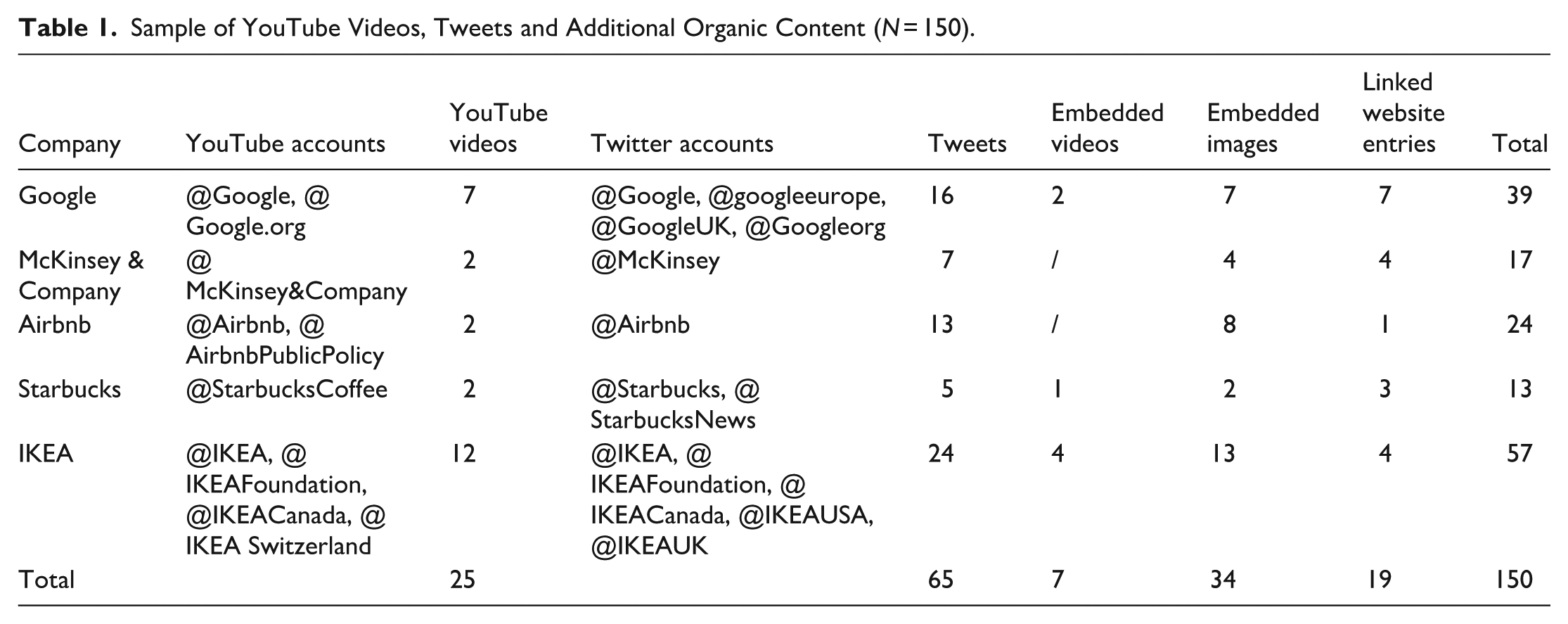
Considering the time-intensive nature of our in-depth, comparative-synchronous, historical-diachronic multimodal approach, purposive sampling was used to select relevant, information-rich posts. On Twitter, we applied the search string: ‘refugee’ OR ‘asylum’ OR ‘forcibly’ OR ‘displaced’ OR ‘Ukrainian’ OR ‘Ukraine’. The latter two terms were included to capture content about forcibly displaced Ukrainians, who were often simply described as ‘Ukrainians’. Additionally, we collected the organic content embedded or linked in the tweets, including videos, images and company website entries (e.g., press releases, stories and blog posts). Non-organic, third-party content was not included. On YouTube, we inserted each of the above-mentioned keywords separately, with videos over 10 min excluded for focus and feasibility. The final sample comprised 25 YouTube videos and 65 tweets, including 7 embedded YouTube videos, 34 images and 19 website entries (Table 1). Audience engagement metrics (e.g., comments and retweets) were not analysed.
Sample of YouTube Videos, Tweets and Additional Organic Content (N = 150).
Data Analysis
The analysis was informed by Fairclough’s (2013) three-dimensional CDA model: (1) text (linguistic and visual features), (2) discursive practice (production, distribution and consumption) and (3) social practice (broader societal context). (M)CDA is, however, a critical, interpretative state of mind, rather than an explicit, systematic, reproducible research method (Reisigl & Wodak, 2016). We, therefore, sought to ensure rigour and transparency through clear methodological choices, reflexive discussion and integration of findings with existing literature (Cena et al., 2024). Ethical approval was obtained from our research ethics committee.
We also employed an extensive set of textual and visual criteria for representing social actors and actions, informed by multiple key works (Machin & Mayr, 2023; Van Leeuwen, 2008) and the representations identified in the literature review. These included:
Individualisation versus collectivisation: Are actors represented as individuals or group members?
Specification versus generalisation: Are actors represented as specific individuals or generic categories?
Nomination versus functionalisation: Are actors represented in terms of who they are or what they do?
Suppression: What is missing from a text?
Word connotation: What kinds of words and associations are used?
Transitivity: Are actors represented as acting or passive?
Presupposition: What meanings are assumed as given?
Salience: Which features in compositions are made to stand out?
Settings: How are settings used to communicate particular ideas?
Distance: What frame sizes are used, and what do they symbolise?
Two researchers applied these criteria using Microsoft Excel, systematically coding textual and visual elements. Nevertheless, given the very limited and fragmented existing research, we also maintained an open, inductive perspective to capture new or unexpected representations. A comparative-synchronous approach was used to identify company- and industry-specific differences, while a historical-diachronic approach examined temporal changes in representations (Carvalho, 2008). For reasons of focus, relevance and feasibility, we did not analyse the audio dimension of the videos. While we did not separate Fairclough’s (2013) three dimensions in the results section, elements of discursive practice and social practice were integrated into the analysis of textual strategies to contextualise the findings.
Results
Forcibly Displaced People as ‘Empowered’, Relatable Individuals
Forcibly Displaced People as Families and Friends
Our analysis shows that the MNCs – likely driven by a liberal CSR rationale – mainly represent forcibly displaced people as ‘empowered’, relatable individuals. More specifically, they primarily present forcibly displaced people as individuals socially embedded in global Northern societies through interpersonal relationships. That is, as friends, family members and/or acquaintances. Many posts portray them as specific individuals by individualising, specifying and nominating them and their social and relational contexts, which can humanise. For example, in a YouTube video of Airbnb (2017), French hosts describe Abdoulaye, a refugee: ‘For me, there’s no difference between us and Abdoulaye. Abdoulaye is just another roommate (. . .) someone who joined our home and everything is going smoothly’ (00:00:49). Similarly, in a tweet from Google (2018, 20 September), a Google employee recalls conversations with his friend Nour, a Syrian father: ‘[W]e were just two fathers, talking about our fears and hopes for our family’s future.’ Both Abdoulaye’s and Nour’s refugee status is backgrounded; their primary roles are ‘friend’, ‘roommate’, ‘dad’ and/or ‘husband’. The adverb ‘just’ in both posts strengthens this positioning, normalising Abdoulaye’s and Nour’s presence in global Northern society.
The MNCs thus foreground the presented people’s social belonging to their host societies and background their refugee identity, likely to avoid negative public responses and foster a sense of ‘sameness’. These representations mostly connote closeness, affinity, relatedness and likeability, inviting global Northern audiences to identify with and accept forcibly displaced people. Families are particularly engaging and can counter audience scepticism and mobilise support. They are legitimised by global Northern citizens, which can foster identification and trustworthiness among global Northern audiences. However, the presented people themselves often remain voiceless and, as in Abdoulaye’s case, even invisible. This partial silencing dehumanises and sustains power imbalances and ‘us’-‘them’-dichotomies.
Forcibly Displaced People as Employees and Students
Extending previous research, the MNCs, particularly Google, Starbucks and IKEA, often present forcibly displaced people as employees and students in work and school settings. This aligns with two key forms of corporate humanitarianism regarding forced migration: workforce integration and training. Nevertheless, the degree of attributed agency varies depending on whether the focus lies on them or the MNCs and their CSR actions.
Forcibly displaced people are mostly portrayed as active actors with agency. Visually, they are mostly depicted performing tasks – usually studying or working. For instance, a female student in a McKinsey & Company video (21 September 2022, Figure 1) attends class. Just as other portrayed people, she does not look into the camera and is immersed in her task of following the lecture attentively. In combination with her big smile, this connotes that she likes education. Her testimony reinforces this active portrayal: After two years in Alsama, I can speak, I can shout, I can sing, I can do whatever I want (. . .). Now I’m here, I’m speaking English, I feel empowered and I feel like a confident, inspiring girl (. . .). I want to become a businesswoman (McKinsey & Company, 21 September 2022, 00:02:23).
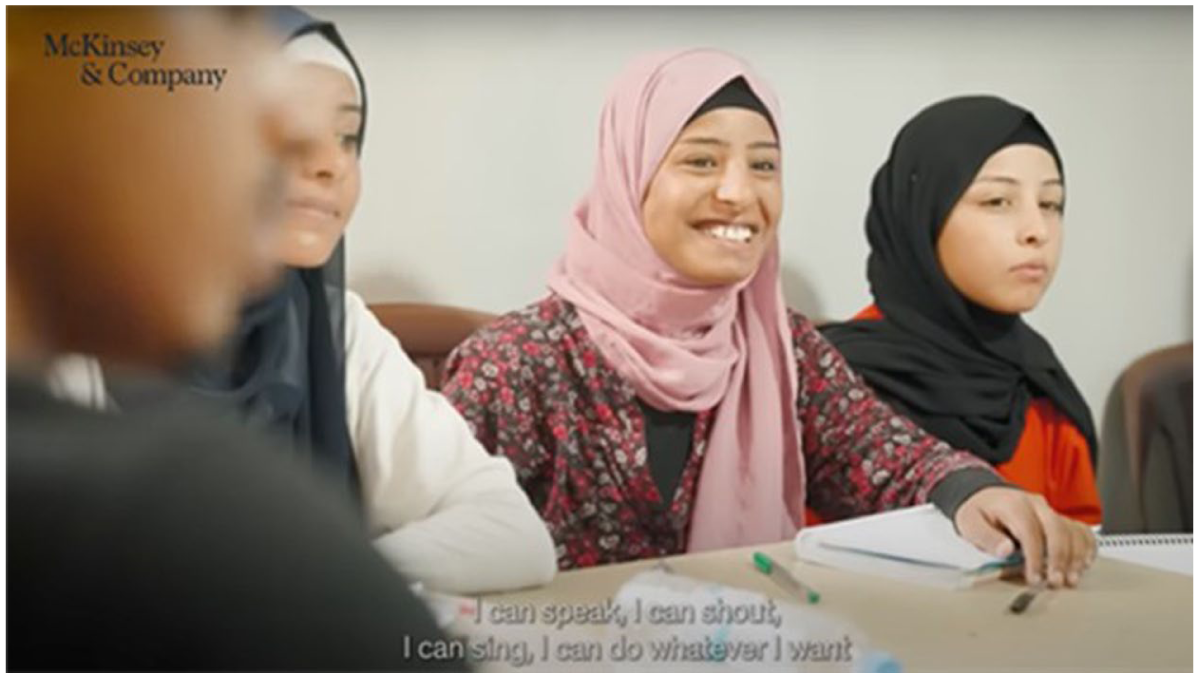
A group of students with a refugee background are taking a course from the McKinsey and Company-supported Alsama project in Beirut, Lebanon.
Her positive, active portrayal as hardworking, confident, empowered, with aspirations beyond refugeehood, is textually reinforced through action verbs (e.g., ‘speak’, ‘do’, ‘want to become’ and ‘bring’) and the school setting. Her refugee status is backgrounded. Additionally, the medium shot provides a sense of space-sharing, closeness and togetherness, which can foster identification and relatability. Similarly, other posts justify workforce integration by representing forcibly displaced people as valuable employees with important assets (e.g., ‘experience’, ‘language skills’ and ‘hardworking’). Positive vocabulary thereby connotes well-evaluated work performances (e.g., ‘stood out’ and ‘exhibited the values’).
Thus, the MNCs portray them as active, ‘empowered’, voiced individuals, willing to contribute to the country’s economy and society, mirroring humanitarian and news imageries. These discourses positively influence their perceived belonging to Western society and challenge threat images. Nevertheless, these representations are not fully empowering, as MNCs strategically regulate them, corresponding with their CSR goals. Moreover, they may marginalise those unable to study or work or who do not have an entrepreneurial mindset and create hierarchies of deservingness.
In contrast, some portrayals are more passive or impersonal. For example, Starbucks Coffee’s tweet (2017, 5 February) mentioned: ‘Refugee hiring will span 75 countries over 5 years – not only in the US.’ This tweet is rather self-serving: people are reduced to the phenomenon of ‘refugee hiring’, backgrounding them and foregrounding the corporation as an active saviour. Forcibly displaced people form suitable but invisible future employees, enforcing us-them dichotomies. The importance of highlighting MNCs’ CSR actions potentially explains why forcibly displaced people were barely presented as entrepreneurs, contrasting previous research.
Forcibly Displaced People as Inspiring, Resilient Heroes
Forcibly displaced people are also frequently presented as inspiring, resilient heroes pursuing a better future, focussing on their mental strength. For example, Maher advises in a Google video: ‘If you feel you don’t have the opportunity, never, ever give up’ (Google, 2017, 00:03:03, Figure 2). The resilience and ambition of Maher and his family are also visually reinforced, as they stand before a large neon sign of the American flag, which symbolises the American dream. Likewise, in an IKEA video (2020), Precious says: ‘Regardless of whatever comes your way, or whatever happens to you, do not give up on yourself’ (00:00:05). Using first-person narration, they directly address viewers with advice and inspiration and temporarily reverse the common humanitarian logic by speaking and advising rather than listening and receiving.
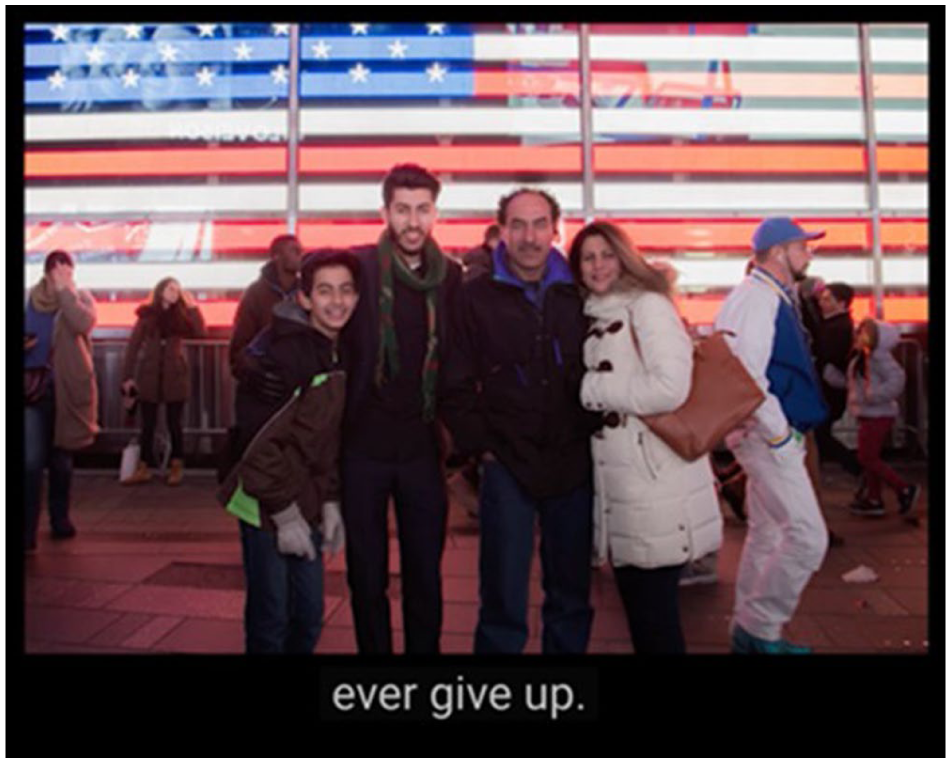
Maher Mahmoud and his family, who fled Iraq to the United States, stand in front of a neon-lit American flag.
The MNCs strategically select such testimonies to highlight values (e.g., resilience, well-being and family) and motivations (e.g., seeking a better life) relatable to global Northern audiences. This emphasises sameness, overcomes ‘us-them’ divisions and elicits empathy. However, such deliberate positive representation strategies may assimilate and dehumanise forcibly displaced people by portraying them in unrealistically empowered ways and reinforcing hierarchies of deservingness.
Forcibly Displaced People as Beneficiaries
Forcibly Displaced People as Victims Assisted by the Corporation
The MNCs repeatedly present forcibly displaced people, particularly in YouTube videos, as vulnerable, suffering, dependent victims, echoing humanitarian, news and political discourses. They are regularly portrayed as victimised beneficiaries of the MNC’s CSR actions. Google and IKEA mainly used such representations, consistent with their CSR focus on providing products rather than more self-empowering services (e.g., training and employment). This indicates that the type of industry and chosen CSR activity partially shape communication practices and representations.
The MNCs seem to use victim narratives to justify their CSR activities and foster long-term customer support. This highlights the strategic nature of their CSR communication, serving corporate interests, including obtaining donor visibility. This is particularly evident in Google’s YouTube videos about its support for refugees. These focus on Google’s and its partner organisations’ technological innovations, solutions, impact and perspectives on the conflict and forcibly displaced people.
Forcibly displaced people are thereby oftentimes portrayed as generic, unrecognisable, suffering, victimised forcibly displaced masses in need of help, which dehumanises them to some extent. In a Google video, a Greek volunteer thereby further reinforces a saviour-saved hierarchy: There were boats coming in, day or night, carrying 50, 60, 70 people each, having survived this hellish trip to face chaos. We were a handful of volunteers and some NGOs trying to provide basic stuff (. . .) and these people were totally helpless’ (Google, 20 June 2017, 00:00:56).
A victim narrative is constructed here through passive verb forms (‘having survived’, ‘were totally helpless’) and an emphasis on their continuous vulnerability (‘carried by boats’, ‘to face chaos’) and dependence on global Northern saviours.
Forcibly displaced people barely obtain an ‘own’ voice. If so, it is mainly to describe their victimhood and to confirm the positive role of the MNCs and their key messages. For instance, in a Google video, a mother praises Google’s NetHope, which provides internet access to refugees: ‘My kids and I have been in the camps for 1 year and 3 months, which is very hard, it’s hard . . . Now I use the Internet to communicate with my family abroad’ (Google, 20 June 2017, 00:02:23). Likewise, in a video by IKEA (2015), a girl who lives in a refugee camp says: ‘Nighttime is especially hard. We can’t see anything in front of us, and we’re scared. I wish there was power so we could feel safe’ (00:01:24). A camp representative then discusses IKEA and UNHCR’s joint engagements in providing light to refugee camps. Her mom later states: ‘Light is everything here. There is nothing more beautiful than light’ (IKEA Canada, 5 February 2015, 00:02:57). Such narratives, often featuring women and children, reproduce broader humanitarian, gendered, oppressive portrayals of ‘ideal victims’ and saviour-saved dichotomies. This indicates the presence of humanitarian influences on MNCs’ communication practices, particularly considering that Google and IKEA mostly perform their CSR actions in partnerships with humanitarian actors.
Interestingly, the analysis revealed some differences in the representations of forcibly displaced Ukrainians. In contrast to populations from the global South, the former are always represented as victimised, anonymous, voiceless groups of beneficiaries and mostly their nationality (‘Ukrainians’) is mentioned, without always being represented as ‘refugees’. These corporate discourses partially contrast with Western news representations of forcibly displaced Ukrainians as more resilient and legitimate victims, though they partially align with humanitarian discourses. This can most likely be partially explained by context-specific differences. The Ukrainian crisis started much heavier than other covered crises, with many people fleeing to neighbouring countries, which potentially can explain the MNCs’ large use of victimising and impersonalising discourses.
Forcibly Displaced People as Impersonalised, Invisible Objects of CSR
Various MNCs frequently represent forcibly displaced people, particularly on Twitter, as impersonalised, invisible objects of CSR. The MNCs here focus on their CSR activities, likely driven by strong self-serving, self-promotional motivations. Unlike the above-mentioned ‘victim’ narratives, forcibly displaced people are here not visually or individually represented, which impersonalises them and reinforces their invisibility. In line with their distinct victimised representations, forcibly displaced Ukrainians are never shown visually.
These impersonalising representations align with Twitter’s affordances. Twitter largely relies on (short) text-based posts rather than visuals, which likely explains the visual and, to some extent, textual underrepresentations of forcibly displaced people. Many posts lack thoughtfully chosen visuals and/or phrasings, which reinforce forcibly displaced people’s invisibility. For example, a tweet by Starbucks about its support for refugee relief organisations is merely accompanied by its logo (Figure 3). The visual is unrelated to the text and arguably used for promotional, self-serving purposes. Forcibly displaced people are generally also unmentioned. The tweet talks about Starbucks’ support for ‘refugee relief organisations’; refugees themselves are unmentioned. This phrasing style continues in the linked article, where Starbucks states that ‘the Starbucks Foundation will donate $20,000 to Aktion Deutschland Hilft, an alliance of respected aid organisations leading refugee support in Germany’ (Starbucks, 2015). Starbucks here thus visually and textually suppresses and functionalises refugees, reducing them implicitly to their roles as impersonalised, invisible objects of CSR. Instead, the benefactors (Starbucks and its humanitarian partners) are highlighted.
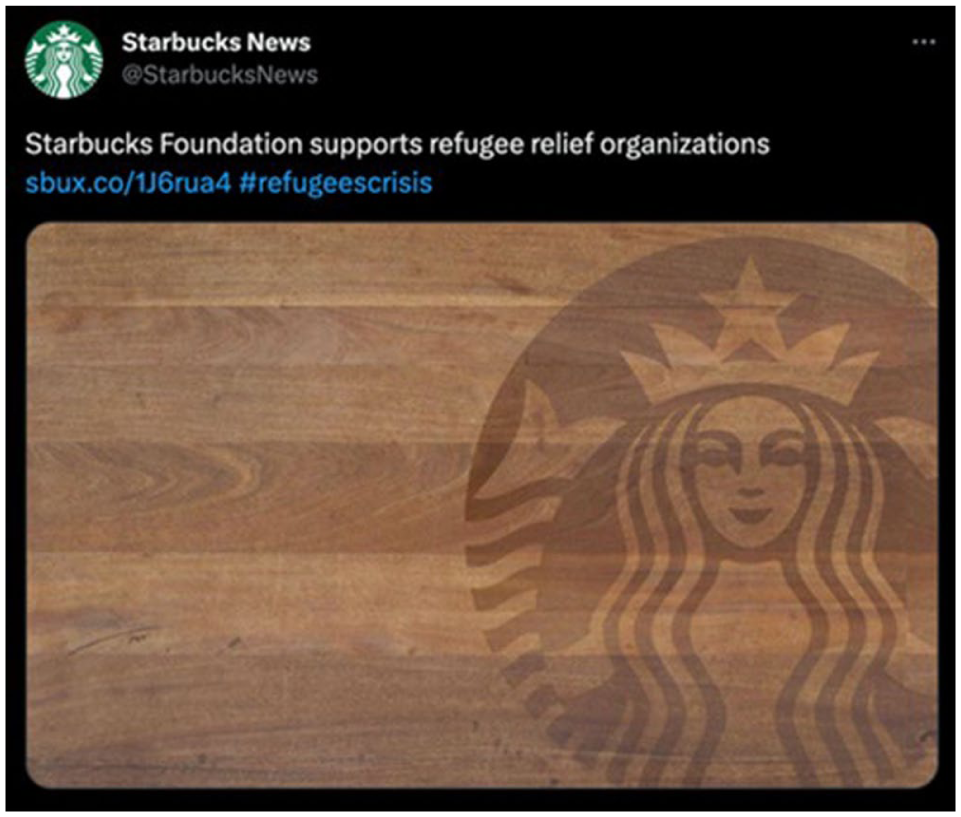
A tweet from Starbucks News mentions that Starbucks Foundation supports refugee relief organisations and displays the company’s logo.
Various MNCs thereby frequently represent forcibly displaced people as part of a ‘crisis’ through crisis discourses. They regularly use presuppositions, relying on the popularised, Eurocentric understandings of the terms ‘crisis’ and ‘refugee crisis’. These terms connote European countries’ problems with the reception of refugees, instability and danger, which reinforces existing victim and threat narratives, rather than referring to the displacement struggles perceived by refugees. The latter are deprived of any voice and agency, whereas MNCs are constructed as ‘saviours’ who assist in solving the ‘crisis’, entrenching power asymmetries.
For example, Google tweeted about its positive impact: ‘How can technology help the refugee crisis? Visit our event . . . ’ (Google Europe, 21 June 2016). Likewise, Airbnb posted: ‘Airbnb is proud to answer the @WhiteHouse call-to-action on the global refugee crisis’ (Airbnb, 20 September 2016). These tweets are centred on the MNCs, marketing their CSR actions. It presents the complex societal issue of forced migration as a challenge that at least partially can be solved through CSR actions, including cutting-edge technologies, while the underlying causes are not mentioned. Refugees are reduced to a crisis and lack any voice and agency. While, to our knowledge, crisis discourses on forced migration have not been identified in corporate communication, it supports the argument that (mediated) corporate humanitarianism is inherently embedded in the philantrocapitalist logic and extends our understanding of ways through which this logic is translated in CSR communication beyond the tech industry.
Discussion and Conclusion
Extending and refining the literature, this study demonstrates that MNCs, driven by a liberal CSR rationale, mainly deploy different, partially overlapping types of deliberate positive, ‘empowering’ representations and, to lesser extents, of victimising and impersonalising representations in their Twitter and YouTube communication. We found indications that the type of representations is related to the type of industry of the MNC, the MNCs’ primary motivations for the CSR communication, the communicated CSR action, the used medium and the forcibly displaced population in question.
The study contributes to the academic knowledge on corporate discourses about forcibly displaced people by partially confirming previous, limited findings and bringing new, extensive insights about both ‘positive’ and ‘negative’ representations. First, we found that all analysed MNCs often provide deliberate positive representations of forcibly displaced people as ‘empowered’, relatable individuals, which partially corresponds with previous research (Haydon et al., 2021; Szkudlarek et al., 2022). The MNCs frequently represent forcibly displaced people as actors in professional contexts of work and training who can contribute to host societies, while gender-specific inequalities and the precarious nature of artisanal labour mostly remain unmentioned (Bergman Rosamond & Gregoratti, 2020).
However, contrasting earlier research (Haydon et al., 2021), our analysis did not reveal a corporate focus on (future) entrepreneurs, suggesting the MNCs prefer highlighting their own CSR actions. Further, our study revealed new representational trends, which extend the academic understanding of the private sector’s empowering discourses. We found that the MNCs commonly represent forcibly displaced people as families and friends of global Northern citizens, students and inspiring, resilient heroes. These narratives, relying on identification, relatability and heroism, partially echo humanitarian discourses (Ongenaert, Joye & Machin, 2023). Altogether, these deliberate positive, ‘empowering’ representations partially counteract the influence of common victimising imageries and threat imageries of forcibly displaced people in media and politics (Van Leuven et al., 2018; Eberl et al., 2018). Still, such deliberate positive, strategically regulated representations can assimilate and dehumanise forcibly displaced people by portraying them in unrealistically empowered ways and can create hierarchies of deservingness (Chouliaraki, 2012).
Second, our study revealed that the MNCs frequently portray forcibly displaced people in victimising, impersonalising ways, involving stereotypical representations of ‘ideal victims’ and impersonalised, invisible objects of CSR. While victimising discourses are common among humanitarian organisations (Ongenaert, Joye & Machin, 2023; Chouliaraki, 2012), news media and political actors (Eberl et al., 2018; Way & Serafis, 2023), our study highlights their prevalence in corporate communication too, extending the current state of the art. However, such victimising, impersonalising discourses can reinforce dehumanising, saviour-saved imageries (Chouliaraki, 2012).
We identified that when MNCs use these discourses, they usually prioritise their strategic self-interests (e.g., highlighting the company and its CSR actions to obtain donor visibility) over rather societal motivations of CSR (e.g., highlighting forcibly displaced people; Ongenaert, Joye & Ihlen, 2023). The findings reveal that not only tech companies but also other MNCs often discursively construct humanitarian crises as technological challenges and development opportunities that MNCs can partially address. The MNCs focus rather on their CSR actions than on the societal issues in question. These findings highlight the MNCs’ self-interest-driven motivations and confirm the broader situatedness of corporate humanitarianism within the philantrocapitalistic logic (Haydon et al., 2021; Henriksen & Richey, 2022). The prevalence of these discourses can also indicate the importance of cross-sectoral (humanitarian) influences on (corporate) discourse creation. Particularly considering that the corporate and humanitarian sectors strongly collaborate (Pedersen & Pedersen, 2013) and the boundaries between for-profit and non-profit sectors increasingly blur (Henriksen & Richey, 2022; Richey et al., 2021). Furthermore, our study demonstrates the importance of the used medium and related affordances for representations. Our study shows that through YouTube videos, MNCs are more likely to portray forcibly displaced people as empowering, relatable individuals, while Twitter’s brevity lends itself more to victimising, impersonalising, text-heavy representations (Hodeghatta & Sahney, 2016).
Altogether, corporate actors need to communicate more consciously about forced migration and their CSR actions. They currently often represent forcibly displaced people in rather one-sided, decontextualised and dehistoricised ways whereby the latter’s multi-layered identities, positions, backgrounds and contexts are often simplified or even neglected. This is particularly urgent considering that their communication can shape public discourses and attitudes on forced migration (Balasubramanian et al., 2021; Du et al., 2010) and that there is growing societal awareness, attention, expectations and pressure regarding corporate behaviour and discourses on societal issues (Latapí Agudelo et al., 2019). MNCs should thus reassess their communication strategies, preferably in co-creation with forcibly displaced people themselves or people with a forced migration background, and inform their audiences more about the contexts and complexities of the engaged societal issue, corporate humanitarianism and the involved communication practices to stimulate public understanding and debate.
Finally, our study focussed on five global Northern-based MNCs and its findings can thus not be generalised to all CSR communication about forcibly displaced people. Future studies could analyse different industries, national and local companies – particularly in the global South (Bernard, 2021), communication channels (both traditional and new media), time periods and topics. Although we applied a historical-diachronic approach, we did not find any substantial temporal discursive evolutions, indicating that the companies did not substantially change their representations of forcibly displaced people during the research period. Nevertheless, future studies could explore this temporal dimension more closely. Further, with our study, we responded to common criticisms that (M)CDA lacks comparative and longitudinal analyses, spends little attention on (non-journalistic) social actors’ discursive strategies and is too text-focussed, neglecting (audio)visual content (Carvalho, 2008). Nevertheless, production research with communication officers of corporations is crucial in examining the underlying motivations of CSR communication and the production and societal contexts. Similarly, audience research with relevant audiences (e.g., customers, forcibly displaced people and other stakeholders) is key to explore their interpretations, responses and (re-)imaginations of this communication.
Footnotes
Acknowledgements
We would like to thank the anonymous reviewers and editors for their constructive feedback.

Ethical Considerations
The authors obtained ethical approval from the Erasmus School of History, Culture and Communication’s research ethics committee at Erasmus University Rotterdam (Application Reference: ETH2324-0168).
Author Contributions
David Ongenaert: Conceptualization (lead), Methodology (lead), Formal analysis (supporting), Investigation (supporting), Data curation, Visualization, Writing—review and editing, Project administration, Supervision, Resources (supporting), Writing—original draft (equal) and Anna Pstrokońska: Writing—original draft (equal), Resources (lead), Investigation (lead), Conceptualization (supporting), Methodology (supporting), Formal analysis (lead).
Funding
The authors received no financial support for the research, authorship, and/or publication of this article.
Declaration of Conflicting Interests
The authors declared no potential conflicts of interest with respect to the research, authorship, and/or publication of this article.
Data Availability Statement
This study’s analysis documents are, given the involved vulnerable population and the theme’s sensitive nature, available from the corresponding author upon reasonable request.