



Abstract
This study investigates the relationships between the use of various organizational ICTs, communication visibility, and perceived proximity to distant colleagues. In addition, this study examines the interplay between visibility and proximity, to determine whether visibility improves proximity, or vice versa. These relationships are tested in a global company using two waves of panel survey data. ESM use increases communication visibility and perceived proximity, while controlling for prior levels of visibility, proximity, and the use of other organizational ICTs. The influence of ESM on network translucence and perceived proximity is generally stronger than the impact of other technologies on these outcomes. These results highlight the importance of considering various aspects of the technological landscape conjointly, as well as distinguishing the two dimensions of communication visibility. Finally, the results indicate that perceived proximity has causal priority over communication visibility, indicating that communication visibility exists partly as an attribution of perceived proximity to distant colleagues, and is not solely inferred from the use of organizational ICTs.
Keywords
Organizational knowledge work is increasingly conducted with and through organizational information and communication technologies (ICTs; Kolb, 2013). One consequence of the growing reliance on ICTs for organizational communication is that expertise becomes dispersed among individuals, departments, geographical locations, organizations, time zones, and countries (e.g., Ellison et al., 2014; Nurmi & Hinds, 2020). As a result, much of the work of individuals, as well as the organizational members themselves, are increasingly invisible and distant. At the same time, research on communication visibility (Treem et al., 2020) has theorized on how the use of various ICTs, such as enterprise social media and collaboration tools, can affect the visibility of work and communication, for instance through message transparency and network translucence (Leclercq-Vandelannoitte et al., 2014; Leonardi, 2014; Leonardi et al., 2013; Suchman, 1995). Other studies have focused on how ICTs can alleviate (perceived) distance between organizational members (Cha et al., 2014; Wilson et al., 2008). However, much less attention has been paid to the relationship between visibility and proximity.
The aims of this study are therefore threefold. First, although benefits such as visibility and proximity are often ascribed to the unique attributes of enterprise social media platforms (ESM; Leonardi, 2014; Treem & Leonardi, 2013), research examining these ESMs has been very inclusive and flexible about what constitutes ESM. For example, diverse media including Skype (Gibbs et al., 2013), instant messaging (Cai et al., 2018), and file sharing and cloud services (Pitafi et al., 2018) have all been characterized as ESM, though none of these tools is explicitly identified as social media. Others limit their inquiry to enterprise social media platforms such as Workplace, Yammer, or Jive (Liu & Bakici, 2019). We seek to demonstrate that it matters which distinct type of technology is considered, by explicitly differentiating ESM and collaboration tools. ESM refers to a platform that allows employees to articulate their own messages to specific coworkers, or all of their colleagues; indicate their affiliations to others, including teams, or departments; and post, edit, comment, or read messages (Leonardi et al., 2013). In the context of this study, we conceptualize ESM as providing three functionalities: contributing (i.e., posting, editing, and commenting), consuming (i.e., reading, searching, and collecting), and networking (i.e., participating in online communities; see Heinz & Rice, 2009; Kügler & Smolnik, 2014; Leonardi et al., 2013). Collaboration tools are cloud-based or remote server-based technologies that facilitate productivity and collaboration across boundaries, specifically by offering a virtual environment where people can productively collaborate on projects asynchronously (i.e., file sharing, including accessing, editing, sharing, and storing of files) and communicate about those projects synchronously (i.e., teleconferencing, including video and audio conferencing and instant messaging).
Second, following prior research, we emphasize the distinction between two dimensions of communication visibility—who knows what (message transparency) and who knows whom (network translucence; Leonardi, 2014, 2015), and assess the extent to which the above types of ICTs predict these aspects of visibility as well as perceived proximity. These distinctions are important as communication visibility theory does not explicitly consider whether different ICTs may differentially affect either dimension of communication visibility (Leonardi, 2018).
Third, we extend recent theorizing on communication visibility by exploring the interplay (causal relationship) between visibility (Engelbrecht et al., 2019; Jones, 1984; Leonardi, 2014, 2015; Suchman, 1995) and perceived proximity (Korzenny, 1978; O’Leary et al., 2014; Wilson et al., 2008). This is important as both visibility and proximity can influence the effectiveness of work, especially in dispersed work contexts (Sarker & Sahay, 2004), and because their relationship via digital media has not been explicated or tested.
We will first discuss communication visibility and perceived proximity. Subsequently, we will develop a set of hypotheses about the influence of different ICTs to proximity and visibility. Next, we discuss the research design and present a formal test of our hypotheses. Finally, the theoretical and practical implications of these findings are discussed.
Literature Review
Communication Visibility and Perceived Proximity
Communication visibility
The visibility of work has been previously studied to explore whether, and how, workers and managers could see or be aware of the status of tasks and how others completed them (Jones, 1984; Suchman, 1995). Yet visibility can be difficult in a post-industrial environment where work is often fragmented into more granular task units and across time, given to workers across dispersed locations and time periods, and conducted through multiple communication channels (Treem et al., 2020). This invisibility of work is problematic for various individual, social, and organizational processes, such as collaborating and learning (Leonardi, 2014). One consequence of the nature of social media is that communication and knowledge can “leak”—that is, third parties (others not intended or known by the original communicators) may be exposed to or gain access to some of the content and relationships portrayed via social media (Leonardi, 2017, 2018; Leonardi et al., 2013).
Communication visibility comprises both information about who knows what (message transparency) and who knows whom (network translucence; Leonardi, 2015; van Zoonen & Sivunen, 2023). Message transparency is the visibility of the content of messages to third parties who are not involved in the initial interaction. Network translucence is the possibility for third parties to view coworkers’ communication networks.
ESM and collaboration tools may afford different levels of these two types of visibility in different ways. Person-to-network ESM are often by default less bounded; communication partners are all who are allowed to use the medium (whether a private group or the broad public, whether known or not), allowing communication leakage, and requiring more intention and effort to be more private (Treem & Leonardi, 2013). Typical person-to-person collaboration tools, on the other hand, are by default somewhat bounded. That is, communication partners are generally specified a priori, such as by providing access or sending material to the digital addresses of one or more known coworkers or collaborators, requiring more intention and effort to make the content and linkages public, thus reducing communication leakage.
Perceived proximity
Concerning proximity, actual distance has been found to influence the quality and frequency of communication in organizational settings (Chong et al., 2012; Nurmi & Hinds, 2020). At the same time as employees’ physical workspaces are shrinking and becoming more shared, increasing proximity (Khazanchi et al., 2018), the mediated work environment is expanding across time and physical boundaries, decreasing proximity, yet paradoxically in many cases increasing perceived proximity.
Perceived proximity reflects the perception of how close or far other organizational members seem. Perceptions of proximity have a cognitive and affective component: cognitive because it refers to a mental assessment of how distant someone else seems, and affective because it recognizes that perceptions of proximity are not purely conscious or rational assessments, but rather subject to emotions and feelings (Wilson et al., 2008).
The relationship between communication (unmediated or mediated) and perceived proximity is well established (i.e., electronic propinquity; Korzenny, 1978; Wilson et al., 2008). Studies have demonstrated that perceived proximity is a better predictor of the effects of distance on work and relationships than is physical proximity (e.g., O’Leary et al., 2014; Wilson et al., 2008), noting that “distance is in the eye of the beholder” (Kolb, 2013, p. 172). Generally, when mediated communication becomes more frequent, deeper in substance, and more interactive, physically dispersed colleagues may seem more proximate. This happens because frequent communication with distant colleagues makes them more “top-of-mind” (Wilson et al., 2008), reducing the out-of-sight out-of-mind problem typical in dispersed settings (Hinds & Bailey, 2003). Furthermore, frequent mediated communication enables better envisioning of distant colleagues’ work contexts, such as their workloads and work habits; this cognitive elaboration increases the salience of these colleagues and reduces uncertainties (Wilson et al., 2008).
Organizational ICTs and Communication Visibility
Enterprise social media
Scholars have explored aspects of social media associated with communication visibility in organizations (Leonardi, 2014; Treem et al., 2020), in terms of highlighting the possibilities for strategic invisibility (Gibbs et al., 2013), the transparency and awareness that visibility generates (Flyverbom, 2016), access to the expertise and networks of dispersed and infrequent colleagues (Ellison et al., 2014), and the benefits for organizational learning (Leonardi, 2014). Via ESM, employees can participate in relatively “public” communication spheres where information and communication traces can easily be shared with and observed or accessed by others, more or less known or unknown, more or less intentionally or unintentionally (Leonardi, 2014; i.e., communication leakage). Therefore, in today’s mediated workplace, formerly invisible and ambient communication between (dispersed) colleagues can become more visible, not only to the focal workers involved, but also to third parties. Kim et al. (2019) found that ESM use was positively related to increased task awareness, but not to availability awareness or social awareness. However, Engelbrecht et al. (2019) demonstrated that ESM use both directly, and indirectly through awareness, contributed to improved metaknowledge. As such, employees can improve meta-knowledge regarding other organizational members, their communication and activities, and their relationships—that is, construct an image of what and whom others know (Leonardi, 2015). Thus,
H1: ESM use will have a positive influence on (a) message transparency and (b) network translucence.
Collaboration tools: File sharing and teleconferencing
Employees often rely on person-to-person oriented technologies to collaborate and communicate across boundaries. However, as noted above, although these technologies may afford some degree of visibility to third parties, their communication is more bounded by default. For instance, file sharing is used primarily with pre-specified others (i.e., intended users who have been explicitly granted access and reading or editing permission), making it difficult for unintended audiences to be aware of the knowledge exchanges within such documents (Rader, 2010). Thus, file sharing affords employees ways to make their communication more or less visible depending on with whom they share those files (Treem & Leonardi, 2013).
Similarly, other types of collaboration tools, such as teleconferencing, typically require participants to be selected or invited, and discussions are limited to the direct participants and not made public to others in the organization (although they can be recorded and distributed; Treem & Leonardi, 2013). Despite the largely bounded nature of file sharing and teleconferencing, the collaborative nature of both technologies is likely to provide increased communication visibility. In the case of file sharing individuals have the opportunity to learn about the content of others’ work, and who has shared communication. Alternatively teleconferencing facilitates communication with disparate coworkers. Yet these technologies also have constraints, or material limitations, not present in the use of ESM. For example, neither technology allows users to easily make interactions visible to third-parties over time. As a result, we would expect these technologies to support less vicarious learning (Leonardi, 2015) than has been found with the use of ESM. Conversely, Fox and McEwan (2017) argue that ICTs such as texting afford less visibility than, for example, posting something on an internet page because communication through collaboration tools is shared only with specific recipients. Still, Huang and Zhang (2019) found that features of instant messaging in general enhanced employees’ visibility to their co-workers. Hence,
H2: The use of file sharing will contribute to (a) message transparency and (b) network translucence, but to a lesser extent than ESM does.
H3: The use of teleconferencing will contribute to (a) message transparency or (b) network translucence, but to a lesser extent than ESM does.
Organizational ICTs and Perceived Proximity
Recently, Waizenegger et al. (2020) argued that technological affordances enable equal opportunities of communication arguably bringing dispersed workers “socially” closer, regardless of physical proximity. Beyond more organizational communication in general predicting perceived proximity (O’Leary et al., 2014), using more synchronous and multi-modal media also seems to be associated with higher perceived proximity (rather than objective distance) and higher team cohesion than is using less synchronous media (O’Leary et al., 2014). A study conducted in a student-based virtual team context (Eisenberg et al., 2021) found that both verbal (video conferencing) and text-based (instant messaging) synchronous communication increased perceived proximity, but the effect varied depending on virtual team members’ language skills. Much of these findings are rooted in social presence theory (Short et al., 1976), media richness theory (Daft & Lengel, 1986), presence theory (Lombard & Ditton, 2006), and media synchronicity theory (Dennis et al., 2008). Each of those frameworks argues that when media provide more, or richer, opportunities for interaction it is more likely communicators will perceive proximity in a manner closer to what is possible with co-presence.
ICTs may make a person seem distant while being in close physical proximity, while another person can seem very close although actually far away in objective terms (Kolb, 2013; Wilson et al., 2008). For example, one may experience a sense of personal closeness to someone on the other end of a mobile phone call or Facebook post, while having low engagement with or even awareness of others who are physically close (Turkle, 2011). ICTs enable employees to draw from, and contribute to, a host of information shared by dispersed coworkers. Specifically, they can help to build mental salience—that is, the extent to which remote colleagues stay top of mind—and provide employees with cues that help to envision each other’s context (O’Leary et al., 2014). There is some evidence to suggest that synchronous (i.e., teleconferencing) and multi-modal communication (i.e., ESM) might be more strongly associated with perceived proximity (O’Leary et al., 2014), while file sharing and archiving (i.e., file sharing) would be less associated. However, empirical evidence for this potentially differential impact of technologies is lacking. Hence,
H4: The use of (a) ESM, (b) file sharing, and (c) teleconferencing are positively related to perceived proximity to distant colleagues.
Communication Visibility and Perceived Proximity
Concerning the relationship between visibility and proximity, there is little research. On one hand, the absence of direct visibility in mediated communication may pose problems for groups needing to make decisions, coordinate work, and establish shared mental models (Kiesler & Cummings, 2002), making collaborators and other workers seem distant. Improved communication visibility provides employees with more cues about what their dispersed colleagues know (transparency) and to whom they are connected (translucence; Leonardi, 2015). Communication visibility allows people from far-flung parts of organizations to participate vicariously in the shared experiences of others (and later even directly, as such awareness acts as a “social lubricant” making it easier to contact previously unknown others; Leonardi & Meyer, 2015). Beyond developing shared cognitions and experiences through proximity in physical contexts (Leonardi, 2018), increased communication visibility may create the opportunity to improve perceived proximity in an online environment (Korzenny, 1978). That is, visibility “causes” perceived proximity.
On the other hand, space (or distance), which affects sheer accessibility and exposure (personally, visually, and audibly; Archea, 1977), determines who and what we know (Korzenny, 1978). The increase in perceived proximity due to more frequent, deeper, and more interactive communication (Wilson et al., 2008) could increase communication visibility regarding other organizational members’ expertise and networks (Hollingshead et al., 2010). Perceived proximity may lead to increased collaboration and communication through ICTs, and a greater (assumed) understanding about what others do, and who they are connected to. Thus, arguably, any subsequent increases that perceived proximity may trigger in communication visibility may be an accurate reflection of metaknowledge. That is, perceived proximity “causes” visibility. Thus,
H5: (a) Message transparency and (b) network translucence increase perceived proximity, and perceived proximity increases (c) message transparency and (d) network translucence.
Figure 1 shows the hypothesized relationships.
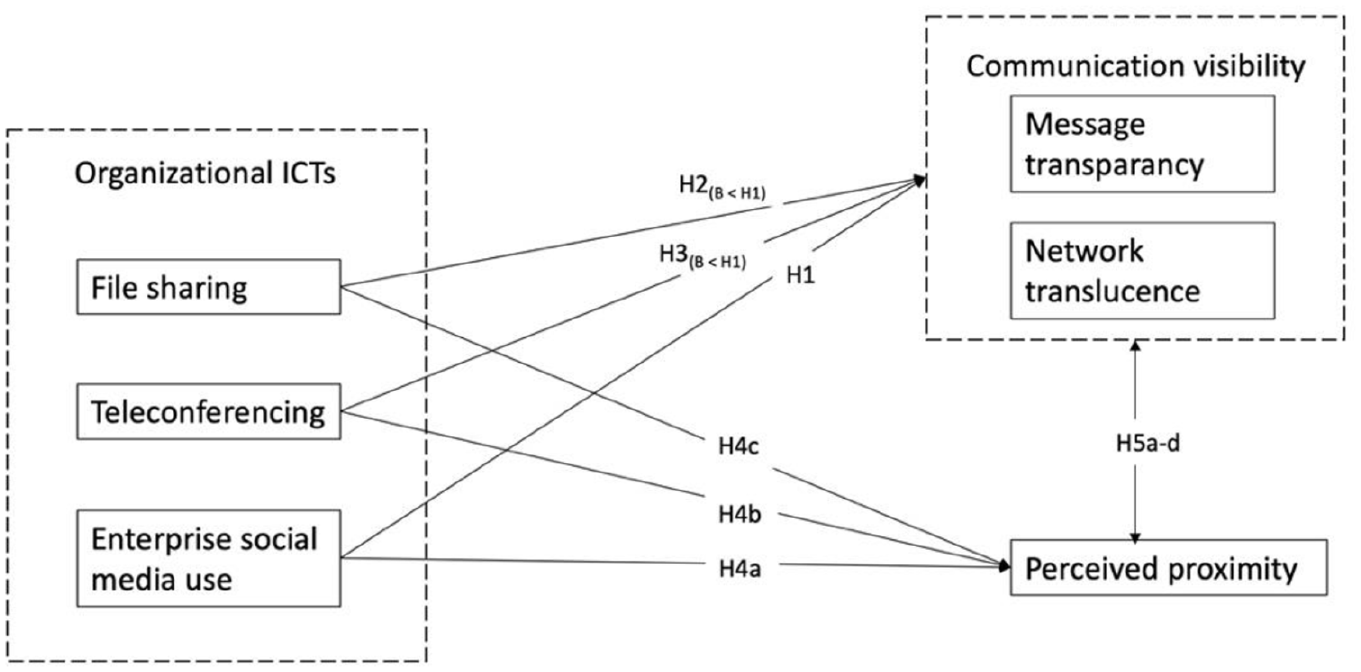
Hypothesized relationships.
Method
Sample and Procedures
The current study is situated in a large global logistics company, in which workers are dispersed across locations and time zones. The company is headquartered in one of the Nordic countries, but manages operations in over 100 countries. We conducted two surveys. The first (between February 18th 2019 and March 8th 2019) generated 973 completed responses out of 8,105 invitations (response rate of 12.0%). Shortly after the first survey (March 13th) the company implemented an ESM system to further support social network functionalities. Six months later (between September 9th and September 23rd 2019), 583 of those who completed the first survey also completed the second survey (a dropout rate of 40%). Although some suggest that implementation periods can last much longer than 6 months (e.g., Seddon et al., 2010), the managers and researchers involved believed that 6 months was sufficient for adopters to achieve a reasonable level of proficiency with the platform. Respondents who participated in both waves were on average 44.05 years old (SD = 10.24), the average organizational tenure was 7.97 years (SD = 8.51). The respondents, of which 76.3% were male (and 23.7% were female), worked on average 39.19 hours (SD = 4.16) divided over 4.6 (SD = 1.36) workdays per week.
Measures
Table 1 provides descriptive statistics, correlations, and validity and reliability statistics of the measures used in our measurement model. Table 2 lists all items with corresponding descriptive statistics, factor loadings, and standard errors.
Factor Correlation Matrix With Validity Statistics.
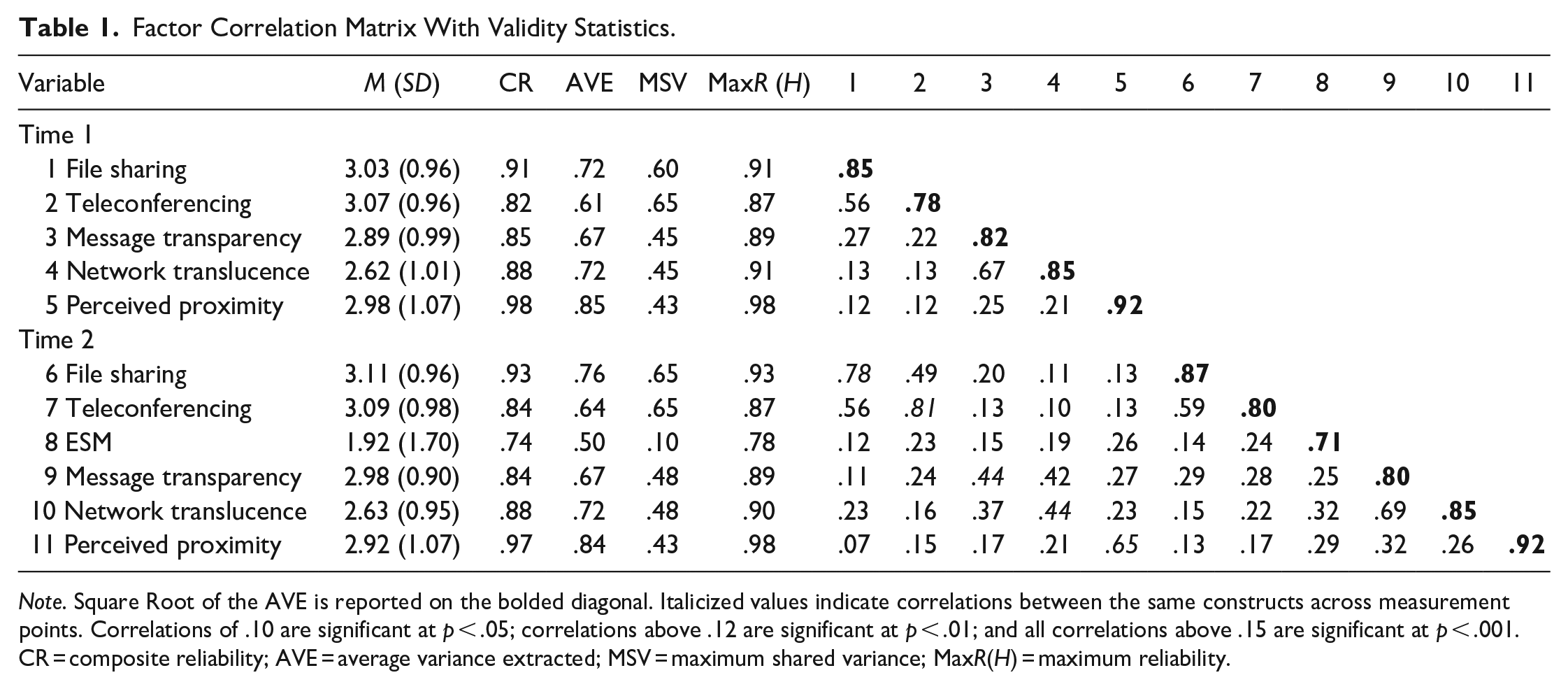
Note. Square Root of the AVE is reported on the bolded diagonal. Italicized values indicate correlations between the same constructs across measurement points. Correlations of .10 are significant at p < .05; correlations above .12 are significant at p < .01; and all correlations above .15 are significant at p < .001. CR = composite reliability; AVE = average variance extracted; MSV = maximum shared variance; MaxR(H) = maximum reliability.
Measurement Model.
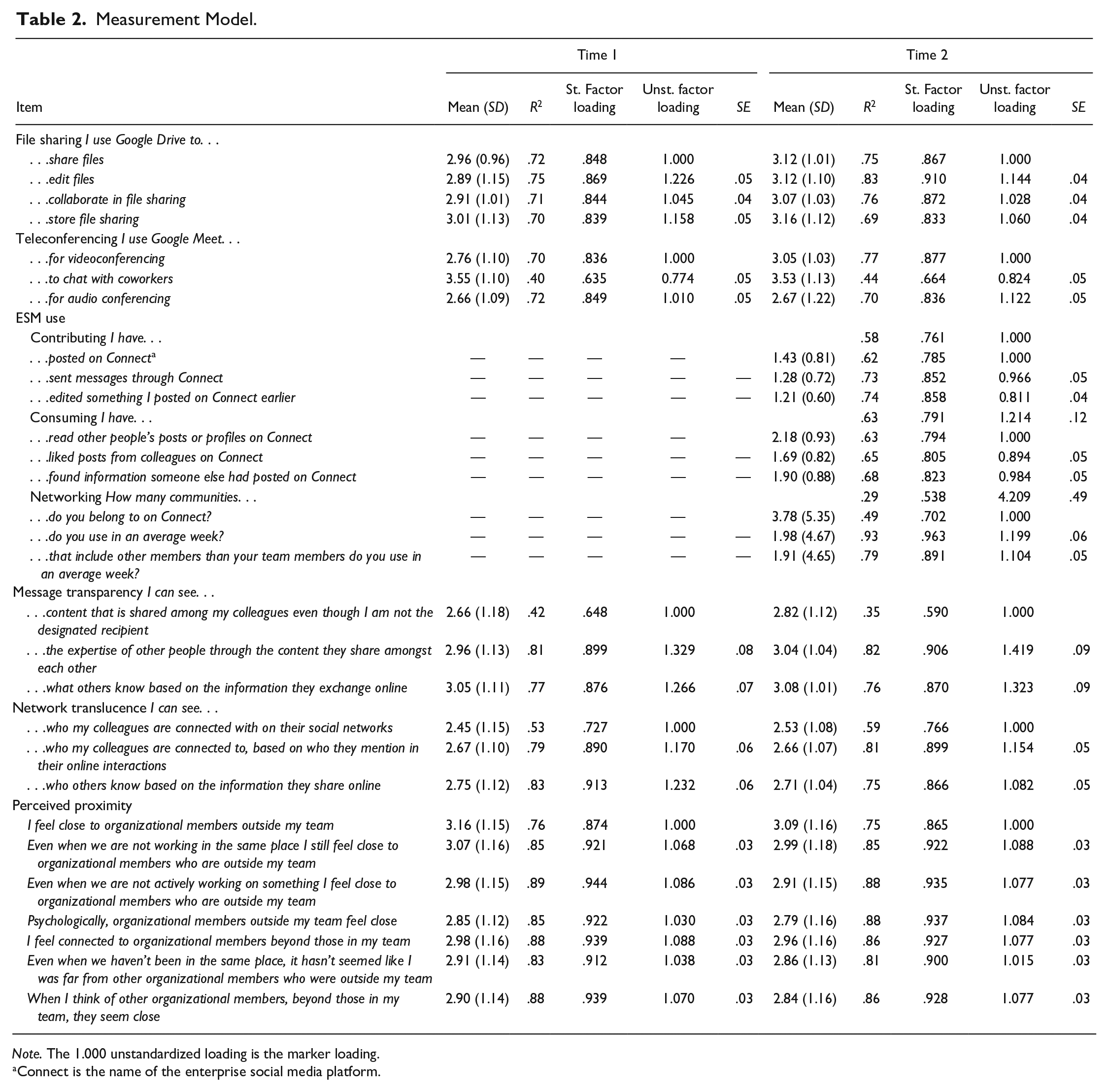
Note. The 1.000 unstandardized loading is the marker loading.
Connect is the name of the enterprise social media platform.
ICTs
At the studied company enterprise social media (T2) and collaboration tools (T1 and T2) were offered in conjunction from their (digital workstation), as is the case in many organizations. Although these technologies were offered within the same environment, they are different in their aims and affordances (Treem & Leonardi, 2013).
The ESM facilitated cross-boundary collaboration and communication by allowing push and pull content (i.e., news feeds, static information, and Intranet content), providing social directories with user profiles, and allowing users to comment, like, and post. In addition, a variety of ESM communities were devoted to interests such as teams, projects, and knowledge areas, and each included a communication feed. Much like Workplace or Yammer, this ESM offered many of the features of public social media such as Facebook. We measured three dimensions of ESM use: contributing (i.e., posting or commenting), consuming (i.e., reading posts or viewing someone’s profile; Kügler & Smolnik, 2014; see also Heinz & Rice, 2009), and networking (i.e., community membership), each with three items. Response choices for contributing and consuming frequency ranged from (1) never to (5) multiple times per day. Communities were set up so that users could join to organize collaboration around specific themes, interests, and areas of expertise (for instance, human resources or finance). As a result, employees could be members of multiple communities. We asked about the number of communities one was a member of, and the number of those communities that involved organizational members other than their team members (and thus involve content and connections that may otherwise be less visible or proximate). The three sets of measures all were significant indicators of the ESM construct.
The collaboration tools consisted of a portfolio of cloud-based services. Specifically, Google Drive was offered to collaborate, organize, and share files, while Google Meet was offered as a teleconferencing tool (audio, video, and chatting) to communicate and organize online meetings. Hence, these tools were more focused on substantive work practices such as file sharing and online meetings, rather than social networking. File sharing was represented by three items indicating use of Google Drive, used by employees to access, edit, and store file sharing at any time using their personal computers and mobile devices. Teleconferencing was represented by three items indicating use of Google Meet for video-conferencing, audio-conferencing, and chatting with coworkers. Response choices for frequency of use ranged from (1) never to (5) multiple times per day.
Visibility
Visibility was operationalized based on Leonardi’s (2014) exposition of “who knows what” and “who knows whom.” Message transparency referred to the extent to which employees perceive the messages shared by others are visible to them. Network translucence referred to the extent to which employees perceive the social network to be translucent. Each was measured using three items adopted from van Zoonen and Sivunen (2023), with response choices ranging from (1) strongly disagree to (5) strongly agree.
Perceived proximity
Perceived proximity was measured by items developed by O’Leary et al. (2014). In line with their validation studies the cognitive and affective dimension were combined into one single, seven-item measure of perceived proximity. Response choices ranged from 1 (completely disagree) to 5 (completely agree).
Analyses
First, we compared the respondents in our sample to the population (the organization’s total employment record), and assessed whether demographics and model measures differed between those who dropped out between survey 1 and 2 and those respondents in the final sample. The only statistically significant difference was that the 583 employees in our sample were slightly older than the population average (n = 7,522: Mpopulation = 41.19, SD = 10.71; Mrespondent = 44.05 SD = 10.24; t = −6.24, p < .001). There were no significant differences in any other variables for our sample when compared to the population or to the respondents who dropped out. In addition, we examined a cross-sectional multi-sample structural analysis of the relationships at T1 separately for dropouts and for respondents in the final sample. This indicated that disappearance from the sample was not likely to result from different causal dynamics. Furthermore, as assumptions related to regression analyses were met—for example, including multicollinearity, homoscedasticity, linearity of relationships, and distribution of error terms—we assume that the average regression model from the sample would be the same as the population model. In addition, cross-validation procedures by splitting the sample and comparing effect sizes and explained variances suggest the model generalizes well (Tabachnick et al., 2007). Overall, this implies that the findings could generalize to non-respondents, and possibly to other similar work settings and technological infrastructures.
The hypothesized relationships were tested with structural equation modeling (SEM) analyses using the AMOS software package. Specifically, we estimated a two-wave SEM model with autoregressive components. All latent factors (ESM use, filesharing, teleconferencing, network translucence, message transparency, and perceived proximity) were operationalized by three to seven observed indicators each, as described above (See Table 2). Model fit was assessed by examining two incremental fit indices—that is, the Tucker-Lewis Index (TLI) and the Comparative Fit Index (CFI)—and two absolute fit indices—that is, the standardized version of the root mean squared residual (SRMR) and the root mean square of approximation (RMSEA). Finally, the χ2 statistic (cmin/df) is presented. Maximum Likelihood estimation methods were used including bootstrapping (5,000 bootstrap samples) to estimate model parameters, and bias-corrected standard errors and confidence intervals.
All concepts are measured at T1 and T2, except for ESM use, as the platform was not yet implemented at T1. Briefly, the autoregressive effects describe the stability of individual differences from one occasion to the next. The larger the autoregressive coefficient, the less change of the individuals’ standings on the construct over time. The cross-lagged effects (i.e., coefficient of X1 on Y2) also depend on individual differences on the constructs; meaning that if individuals’ standings on X at T1 are related to their standings on Y at T2, there will be a significant cross-lagged effect. The fact that prior levels of the outcome construct are controlled for allows us to rule out the possibility that a cross-lagged effect is due simply to the fact that X and Y were correlated at T1.
Results
Measurement Model
The measurement model showed excellent fit: χ2(1,068) = 2,363.46; CFI = 0.95; TLI = 0.95; SRMR = 0.041; Pclose = .998, and RMSEA = 0.046 (CI: 0.044, 0.048). Convergent validity was examined by evaluating the average variance extracted (AVE), with all above the threshold of .50, ranging from .61 to .85. Discriminant validity was established by evaluating the maximum shared variance (MSV) against the square root of the AVE. All constructs demonstrate good discriminant validity as the maximum shared variance is lower than the average variance extracted, with the exception of teleconferencing (see Table 1); in this case the MSV between teleconferencing at T1 and teleconferencing at T2 is just slightly higher than the AVE. Overall, correlations between the same constructs at T1 and T2 ranged between .44 and .81. Finally, all the loadings on the intended latent constructs were significant and sizable, ranging from .59 to .96, and the measures exhibited high reliability, with maximum reliability (H) ranging between .85 and .98.
Structural Model
To test our hypotheses, we estimated a structural model that included measures of file sharing and teleconferencing use, and visibility and proximity, at T1 and T2, as well as ESM use at T2. The structural model demonstrated good model fit: χ2(1,094) = 2,585.50; CFI = 0.94; TLI = 0.93; SRMR = 0.076; Pclose = .868 and RMSEA = 0.048 (CI: 0.046, 0.051). Table 3 presents the hypotheses and standardized path estimates; the text below reports the unstandardized estimates.
Standardized Pathways Using Bootstrapping.
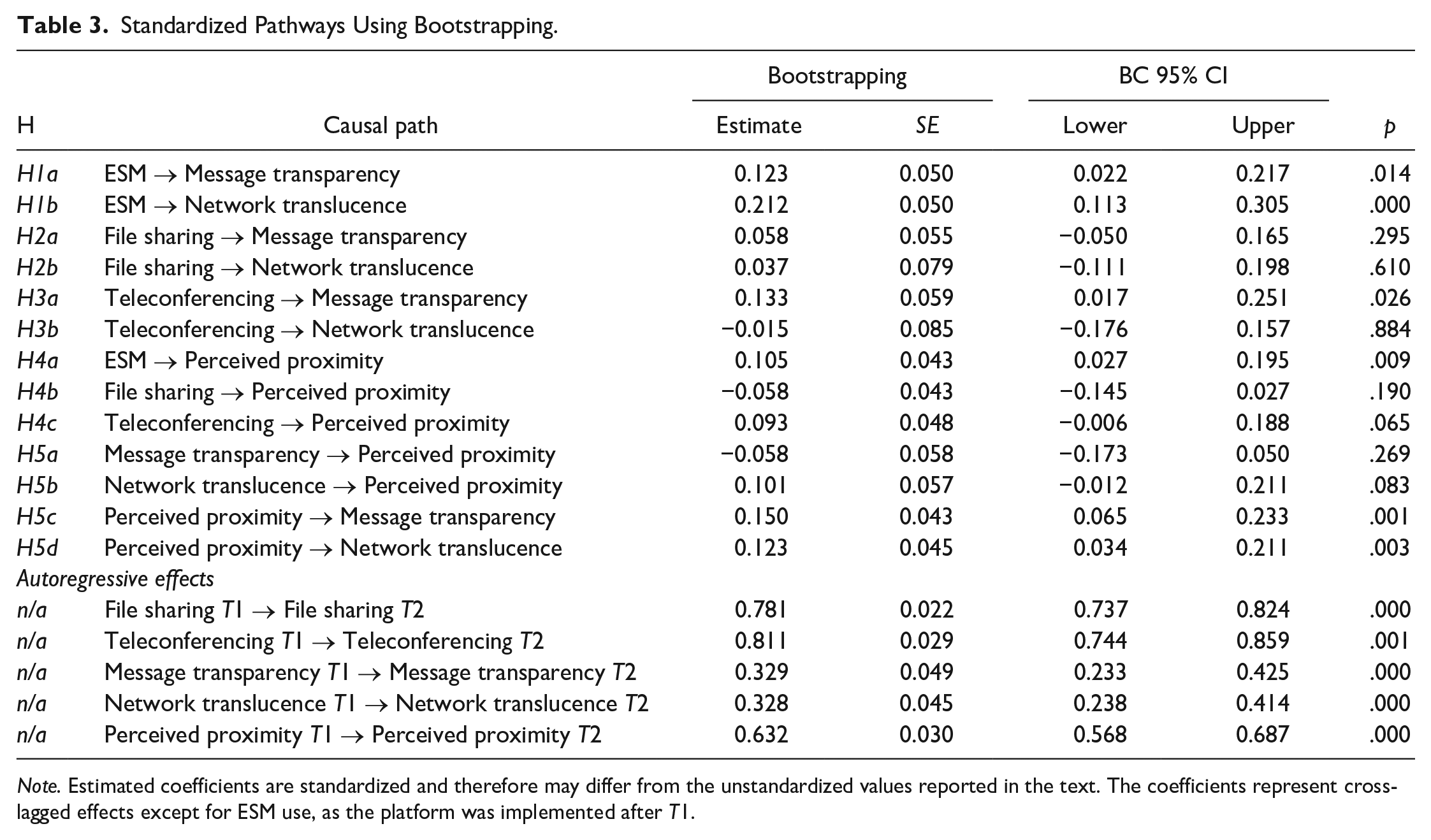
Note. Estimated coefficients are standardized and therefore may differ from the unstandardized values reported in the text. The coefficients represent cross-lagged effects except for ESM use, as the platform was implemented after T1.
Organizational ICTs and Communication Visibility
Hypothesis 1 proposes that the use of ESM increases message transparency and network translucence. The results indicate significant positive relationships between ESM use and message transparency (B = 0.157, BC95% [0.030, 0.322] p = .012) and network translucence (B = 0.337, BC95% [0.163, 0.547] p = .001), supporting both H1a and H1b.
Hypothesis 2 and Hypothesis 3 reflect the notion that collaboration tools also increase visibility, however not to the same extent as ESM does. The use of file sharing is not significantly related to message transparency (B = 0.046, BC95% [−0.039, 0.135] p = .287) or network translucence (B = −0.008, BC95% [−0.110, 0.094] p = .865). These findings are in line with the reasoning that these technologies are more bounded and therefore present fewer capabilities for “communication leakage.” The results also confirm that ESM has a significantly stronger impact on network translucence than file sharing (∆B = 0.329, BC95% [0.125, 0.556] p = .002); the impact of ESM on message transparency is also stronger, but not significantly so (∆B = 0.111, BC95% [−0.042, 0.289] p = .159). Hypothesis 2 is supported for network translucence (H2b), but not for message transparency (H2a).
Hypothesis 3 posits a similar rationale for teleconferencing: as these tools are by default more bounded, they may offer fewer opportunities to increase visibility. The results indicate a positive but not quite significant relationship between teleconferencing and network translucence (B = 0.093, BC95% [−0.007, 0.192] p = .066) and a significant positive relationship with message transparency (B = 0.094, BC95% [0.013, 0.188] p = .023). Contrasting these relationships to those of ESM use, we find that ESM use has a stronger impact on network translucence than teleconferencing (∆B = 0.244, BC95% [0.032, 0.495] p = .024), but not a significantly stronger impact on message transparency (∆B = 0.063, BC95% [−0.108, 0.258] p = .484). These findings support H3b for network translucence, but not H3a for message transparency.
Organizational ICTs and Perceived Proximity
Hypothesis 4a proposes that ESM usage is positively related to perceived proximity, supported by the results (B = 0.204, BC95% [0.046, 0.442] p = .010). However, the use of file sharing is not significantly related to proximity (B = -.070, BC95% [−0.176, 0.033] p = .190), while teleconferencing is positively but not quite significantly related to proximity (B = 0.101, BC95% [−0.008, 0.206] p = .069), not supporting H4b or H4c, respectively. We did not explicitly propose significant differences between ESM and other technologies here, as there was no theoretical basis to do so. However, we note that there are no significant differences between the strengths of the relationships of ESM use and file sharing use (∆B = 0.134, BC95% [−0.069, 0.386] p = .197) or between the strengths of ESM use and teleconferencing on perceived proximity (∆B = 0.103, BC95% [−0.103, 0.372] p = .348).
Communication Visibility and Perceived Proximity
Finally, H5 covers the possible reciprocal relationships and thus causal direction between communication visibility and perceived proximity. Message transparency (B = −0.076, BC95% [−0.225, 0.065] p = .272) and network translucence (B = 0.119, BC95% [−0.014, 0.255] p = .082) do not significantly predict perceived proximity (not supporting H5a, and narrowly rejecting H5b). Perceived proximity, however, does significantly predict message transparency (B = 0.097, BC95% [0.043, 0.157] p = .001; H5c), and network translucence (B = 0.099, BC95% [0.027, 0.174] p = .005; H5d). These results indicate that perceived proximity has causal priority over communication visibility, supporting H5c and H5d.
Discussion
This study presents two important findings, namely, that different organizational ICTs impact visibility and perceived proximity in various ways and that perceived proximity has causal priority over aspects of communication visibility. First, the findings support the notion that ESM is a significantly stronger predictor for network translucence, but not for message transparency, compared to file sharing and teleconferencing. The point is not so much to compare the effect sizes, but to demonstrate that these technologies are distinct in their implications. The findings indeed confirm the differential impact of various organizational ICTs. This highlights the importance of viewing communication visibility as a multidimensional concept (Leonardi, 2014, 2015; Treem et al., 2020) as well as the importance of considering the complexity of multiple concomitantly available ICTs in organizations. This is important as theorizing about communication visibility has typically attributed an important role specifically to enterprise social media platforms for their unique ability to influence aspects of messages (Leonardi, 2014). However, over the years the list of technologies that have been considered under this label has been expansive, including for instance teleconferencing tools (Gibbs et al., 2013). Others have drawn on samples collected from various organizations which often involves conflating different ESM platforms used by employees across organizational contexts (e.g., Engelbrecht et al., 2019; Labban & Bizzi, 2023). However, the same platforms may be used quite differently across organizations, and different platforms may be implemented across organizations. Our study aimed to provide a more ecologically valid exploration of how different ICTs are used combinatorially by employees and sought to investigate the relative influence of each of these technologies on visibility and proximity.
Second, the findings indicate that communication visibility (message transparency and network translucence) does not significantly influence perceived proximity, while proximity does influence visibility. Employees, either falsely or correctly, report having better knowledge of what and who others know when they feel psychologically close to them, while the reverse is not the case. Importantly, this suggests that communication visibility is not just a possible consequence of organizational ICTs, especially ESM, but also at least partly an attribution based on perceptions of proximity to others. These findings have several important implications for theory and practice.
Theoretical Implications
First, the findings demonstrate that contributing and consuming information and engaging in multiple communities on an ESM increase visibility, but other ICTs (file sharing and teleconferencing) do not. This is important for several reasons. First, it highlights the importance of understanding how different organizational ICTs may be used concomitantly each with distinct implications for organizational knowledge flows and communication visibility. Hence, research should more holistically consider the impact of ICTs, not necessarily with the aim to compare the relative impact, but to understand how different technologies that comprise the digital workspace affect individual and organizational outcomes. These findings also align neatly with suggestions forwarded by affordance approaches (Treem & Leonardi, 2013) and communication visibility theory (Leonardi, 2014), which suggest that ESM have unique capabilities to improve communication visibility. Finally, in considering ESM, file sharing, and teleconferencing we also highlight the importance of considering the role of observers’ (receivers, third parties) activities, as opposed to just the actor’s (sender, poster) activities (Treem et al., 2020). van Osch and Steinfield (2018) distinguish between unbounded visibility and bounded visibility, suggesting that certain platforms require audiences to be explicitly invited, such as the case when you seek to start a videoconference, or share a file in Google Drive. In contrast, audiences do not need to be specified when sharing something to your social media timeline. Hence, as the sociomaterial nature of collaboration tools typically require users to articulate or specify their audiences (such as conversation partners in online meetings), this bounded communication environment constrains the ability for third parties to take notice of communication traces (whether message or network), reducing the potential for communication leakage (with both positive and negative implications). In contrast, on ESM audiences can more easily take notice of the less bounded contents of others’ messages (transparency) and the structures of others’ communication networks (translucense) and online relationships.
Second, the causal precedence of perceived proximity over communication visibility has two important theoretical implications. First, perceptions of communication visibility are not solely based on the information that employees encounter through mediated communication but are also based on perceptions of proximity. This is important because this may lead employees to make inferences about visibility that are not accurate reflections of the visible aspects of others’ knowledge or networks, and thus inappropriately affect organizational performance and learning. Enterprise social media may operate as echo chambers potentially leading to groupthink—that is, situations where conflicting perspectives might be ignored—and reductions in knowledge flows (e.g., Leonardi et al., 2013). Similar to situations where conflicting perspectives are ignored, perceived proximity could lead employees to ignore available information as they assume they are already aware of others’ knowledge. In turn, resulting errors, misperceptions, or reliance on stereotypes in assessing group members’ knowledge can limit an organization’s ability to effective share knowledge among workers (Hollingshead et al., 2010). In addition, the finding that visibility does not predict perceived proximity is consistent with studies reporting that workers often express wariness about the possible consequences of visibility associated with the introduction of new communication technologies (Oostervink et al., 2016). Specifically, employees seek to balance the ways technologies such as ESM offer opportunities for greater visibility within a group with the desire to remain invisible and retain a certain distance from colleagues (Gibbs et al., 2013). Though the common presumption would be that the opportunity to see more information communicated by, or related to, a colleague would bring workers closer together, it is possible that knowing more about other organizational members’ opinions, expertise, and networks could potentially decrease perceived proximity. This could be the case, for instance, when visibility exposes differences rather than highlights similarities among organizational members, or creates distractions or control or status issues (Archea, 1977). As a result, efforts to make distributed workers feel closer to colleagues through increasing access to and use of multiple communication technologies may be counterproductive (Chae, 2016). Future work should examine the conditions and mixes of technology use that lead to more or less perceived proximity, whether these relationships differ based on individual or organizational attributes, and the positive and negative implications for communication visibility and performance.
Practical Implications
It would behoove managers and organizations to critically examine the type of tools or functionalities they offer to employees. Our results demonstrate that each tool (ESM or collaboration tools), and function (contributing, consuming, networking, file sharing, and teleconferencing) may or may not necessarily realize the desired outcomes of improved visibility and proximity among dispersed colleagues. Although previous studies have been flexible with the term social media (Gibbs et al., 2013), or failed to specify behaviors or specific tools (Engelbrecht et al., 2019), the relationships presented here clearly demonstrate distinct differences in the effects within and across different tools and functionalities. Hence, it may be worthwhile to consider how specific ICTs and functionalities, and their combinations, contribute to desired organizational goals.
Organizations could focus on improving the accuracy of communication visibility by offering multiple different organizational ICTs that may increase the frequency and intensity of communication and collaboration. In addition, it may still be worthwhile to find budgets for remote workers to occasionally visit each other’s workplace so they can learn more about how others work. The finding that communication visibility is predicted by perceived proximity also has important practical implications as it brings to bear the question to what extent perceptions of communication visibility are accurate, or (falsely) assumed because workers feel psychologically close to one another. If perceptions of what others know and who others know in organizations are incorrect, this may stifle organizational learning and performance.
Limitations and Future Research
Some limitations of the study need to be acknowledged. First, the study relies on a pre- post-implementation design. While this controls for auto-regressive and cross-lagged effects, and is an advance over most studies of ESM, the measures for social platform use, implemented after T1 measures, coincided with the T2 measurements of communication visibility and proximity. Ideally these would have been assessed at a separate later time point to allow stronger claims about the impact of social platforms on visibility and proximity. Second, central to this study was the role of perceived proximity. Although perceptions of proximity have been found to be more influential than objective measures of distance (Kolb, 2013; Wilson et al., 2008) the inability to control for actual distance may be a limitation of the study design. However, to the extent that co-workers in the organization had flexible worksites and engaged in telework (increasingly common in general), it would be difficult to determine what “actual” proximity is. Third, the study did not have access to any ESM or collaboration tool usage data such as log data, the content of file sharing, posts, or meetings, or online network patterns. The nature of such communication would provide a better understanding of why and how some of these active online behaviors are related, or not, to communication visibility and perceived proximity. Fourth, data were collected in one company. To further improve the robustness and transferability of our findings additional research is needed in other organizations using different work settings and technological infrastructures. Future studies may consider sampling employees from multiple organizations to randomize the organization-level effects and increase the generalizability (Labban & Bizzi, 2023). However, as we note, such studies should be explicit about the types, affordances, and functionalities of the ICTs being compared. Finally, future studies may examine potential social dynamics underlying the relationship between ESM use, communication visibility, and perceived proximity, as well as delve deeper into the mechanisms underlying the proximity-visibility relationship.
Though this study was conducted prior to the global COVID-19 pandemic, it is astonishing how such an event has contextualized the importance of visibility and perceived proximity. Workers and their knowledge have been abruptly and increasingly dispersed. Although the future is hard to predict, it seems that dispersed or work-from-home practices will prevail in some shape or form even in a post-pandemic era. This highlights the importance of improving our understanding of the ways in which visibility and proximity may be facilitated through various technologies available to workers, as well as the interplay between visibility and proximity. As a foundation for such research, this study demonstrated that ESM can offer distinct and additional benefits for communication visibility and perceived proximity compared to collaboration tool use. In addition, this study adds insights into the interplay between proximity and communication visibility, indicating that perceived proximity has causal priority over communication visibility.
Footnotes
Author Note
The manuscript is original and is not under consideration or published elsewhere.
Declaration of Conflicting Interests
The author(s) declared no potential conflicts of interest with respect to the research, authorship, and/or publication of this article.
Funding
The author(s) disclosed receipt of the following financial support for the research, authorship, and/or publication of this article: This research is supported by the Academy of Finland, grant number: 318416.
