




Abstract
Workplace meetings start late all the time for a number of reasons. When participants are kept waiting, this can be experienced as a drain of personal resources. In this article, we integrate perspectives from conservation of resources theory, individual goal setting, group problem solving, and temporal dynamics to derive predictions regarding individual attendees’ meeting experiences and behavioral group communication patterns under conditions of meeting lateness. We conducted an experiment using 32 student groups in which 16 groups started their meeting on time, while 16 started their meeting 10 minutes late. We found that late meetings were less satisfying than on time meetings. Using videotaped meeting interactions, we analyzed the group dynamics at the micro-level of conversational utterances. Controlling for meeting duration, groups in the lateness condition showed substantially less solution-focused communication overall, less idea elaboration, less in-depth problem descriptions, and fewer socioemotional support statements than groups who started on time. Furthermore, lag sequential analysis revealed distinctly different temporal communication patterns. We discuss research implications for understanding meeting experiences through a conservation of resources lens as well as practical implications for managing group communication processes in workplace meetings.
Keywords
Of the nearly 11 million meetings that take place each day in the United States alone, approximately 4.1 million start late, and of the meetings that begin late, 2.7 million start late because meeting attendees wait for at least one late arrival (Newlund, 2012; Rogelberg et al., 2014). Despite its prevalence in organizational practice and the ongoing attention to other aspects of meeting phenomena (e.g., Allen & Rogelberg, 2013; Markman, 2009; Nielson, 2013), meeting lateness is a relatively unexplored phenomenon to date. One exception, by Rogelberg et al. (2014), found that participants reported greater negative responses to an individual arriving late to a meeting (e.g., frustration, upset, passed judgment, felt disrespected, etc.) when the person arrived between 6 and 10 minutes late than when someone arrived between 1 and 5 minutes late. Additionally, these early investigations suggest that individuals identify meeting lateness based on a combination of objective, time-based criteria, and contextual factors, such as actual meeting start time. In this study, we define and operationalize meeting lateness as a meeting starting late due to waiting for a late attendee (who does not actually arrive in our research design). Although the degree of lateness is related to meeting attendee responses toward the late arrival, meeting lateness can also negatively affect the late attendee’s interpersonal relationships and opportunities for career advancement (Luksyte, Waite, Avery, & Roy, 2013; Rogelberg et al., 2014).
One theoretical perspective that explains why meeting lateness has the potential for immediate and lasting effects on meeting participants is conservation of resources (CoR) theory. CoR theory posits that individuals experience stress in conditions that present an actual or threatened loss of resources, or no resource gain despite an individual investment of resources (Hobfoll, 1988). Assuming a core hedonistic motivation in humans, CoR theory posits that individuals are motivated to gain, maintain, and protect personal resources such as physical and emotional energy and—importantly—time. However, time has rarely been considered, despite falling under the definition of personal resources (Halbesleben, Neveu, Paustian-Underdahl, & Westman, 2014). Notably, CoR theory is just one theoretical perspective that suggests negative effects of meeting lateness on individual attendees. In addition to CoR theory, several other theoretical perspectives support the notion of meeting lateness as a draining experience for those individuals who are on time. In particular, we draw from goal-setting theory (Locke & Latham, 1990) and yield shift theory (e.g., Briggs, Reinig, & De Vreede, 2014) to derive expectations on the ways in which meeting lateness affects individual reactions to meeting lateness.
In considering a collective such as a small group sharing the experience of meeting lateness, we can examine both individual reactions to meeting lateness (in terms of participants’ satisfaction with the meeting) as well as the ways in which meeting lateness affects group processes within the meeting. Time delays due to meeting lateness can lead to pacing issues that hurt group performance (Labianca, Moon, & Wat, 2005). Moreover, real or perceived time pressure to address the meeting agenda, as a result of meeting lateness, may give rise to decision-making biases such as group think, false consensus, and incomplete information processing more broadly (e.g., Janis, 1972; Jones & Roelofsma, 2000). This is a particular concern given the relevance of decision making as a core component of organizational meetings (Baraldi, 2013). To examine how meeting lateness affects group processes, we adopt a fine-grained perspective of group communication processes within meetings. Specifically, we look at group processes and behaviors inside the meetings themselves (Meinecke & Lehmann-Willenbrock, 2015) and compare these behavioral patterns in late versus on-time meetings.
Previous research on workplace meetings suggests that specific problem-solving behaviors such as idea generation and elaboration, as well as in-depth problem analysis, are important components that characterize a satisfying meeting and a productive team (Kauffeld & Lehmann-Willenbrock, 2012). Moreover, the communication literature has highlighted the value of positive relational messages (e.g., telling a joke or sharing laughter; see Kangasharju & Nikko, 2009) that provide socioemotional support, create and maintain relationships, and facilitate successful group processes (Keyton, 1999; Keyton & Beck, 2009; Keyton et al., 2013). However, when group members are preoccupied or even frustrated by the lateness experience, these positive group dynamics will likely suffer. Importantly, to understand the group process imprint of meeting lateness, we need to account for temporal dynamics and the temporal sequences of behavior that characterize group interactions (Chiu & Lehmann-Willenbrock, 2016; Herndon & Lewis, 2015).
Theoretical Background
Organizational leaders have long considered lateness as a problem that necessitates monitoring and control (Adler & Golan, 1981; Blau, 2002; Koslowsky, Krausz, & Aizer, 1997; Motley, 1926). Lateness can be costly to organizations as a whole, considering that time is not only a personal resource of individual employees but time spent waiting rather than working also wastes organizational resources (e.g., Imai, 2012). Thinking more specifically about meeting lateness, when others are late and individual attendees are kept waiting for a meeting to start, individual participants begin to lose time resources in a form of “time theft.”
Several theoretical perspectives suggest negative effects of meeting lateness on the affective experience of individuals. First, according to CoR theory (e.g., Hobfoll, 1988, 2001), the loss of resources due to lateness, creates the experience of resource drain. Again, there are several conceivable reasons why others’ lateness can be stressful. For instance, when people are sitting in a room waiting, they tend to engage in other tasks (e.g., e-mail) that may serve to distract or drain available resources especially if needed materials are available back in the office and/or the setting is not conducive to set activity. More specifically, answering e-mail may be productive to some extent, but the energy and effort put into that activity is no longer available for the meeting. Moreover, sitting in a meeting room without actually having a meeting typically means that other substantive work tasks cannot be accomplished. Thus, the ensuing frustration with waiting drains individual resources that otherwise would be available in the meeting itself. Ultimately, it may change the behavior of individuals inside the meeting and therefore, the outcomes of the meeting.
Second, goal-setting theory (e.g., Locke & Latham, 1990, 2004) suggests that meeting lateness can be a frustrating experience for those individuals who show up on time. When a meeting starts late, this creates obstacles for individual goal attainment pertaining to the meeting, which in turn challenges individual performance and satisfaction outcomes. In particular, when attendees are kept waiting due to meeting lateness, their perceptions of goal proximity (i.e., when will the meeting goals as intended earlier actually be attained) may decrease, which is a demotivating experience (Locke & Latham, 1990). Steel and König (2006) extended the arguments from goal-setting theory in their temporal motivational theory, in which they highlight the critical role of time for individual motivation. Their emphasis on time as a motivational factor in and of itself is important to our investigation as it encompasses meeting lateness and the associated temporal shifts.
Third, in terms of the satisfaction outcomes of meeting lateness, yield shift theory (e.g., Briggs, Reinig, & de Vreede, 2008) suggests that changes—or shifts—in the overall yield for a set of active goals trigger affective responses. This argument has important implications for the context of meeting lateness, given that a late start to a meeting affects the likelihood of attaining the previously planned meeting goals. Empirical findings by Briggs et al. (2014) have offered support for the core tenets of yield shift theory, showing that shifts in the likelihood of goal attainment affect individual satisfaction with work processes and outcomes.
Importantly, in addition to the negative individual experiences related to meeting lateness, there may also be social implications, in terms of the communicative behaviors that individuals show during meetings that started late. For example, Rogelberg et al. (2014) point out that punctual attendees may feel resentment toward those who are late. In particular, meeting attendees may engage in the fundamental attribution error with the late attendee as the target (i.e., a tendency to attribute others’ behavior to stable dispositions rather than situational characteristics; Ross, 1977). In organizational practice, late attendees rarely get the opportunity to explain their lateness to the meeting. The resulting resentment can linger and trigger behavioral change and attitudinal change regarding the meeting, the late individual, and perhaps the job/organization at large. For example, attributions of others’ lateness may include rudeness and impoliteness, which indicates deteriorating interpersonal relationships as a result of meeting lateness (Rogelberg et al., 2014). We expect these deteriorating interpersonal relationships will manifest in changes in behavior during the meeting by the meeting attendees regardless of whether the late person arrives, in terms of willingness to share ideas or provide input on potential solutions to problems. In other words, meeting attendees are so busy being upset and complaining and misattributing the late attendee that they are less effective within the meeting interaction.
Late Meetings and Meeting Satisfaction
Meetings can have a profound impact on employee attitudes and well-being. Previous research showed that the amount of meetings employees have in a given day relates to their job satisfaction and their intentions to quit (Rogelberg, Leach, Warr, & Burnfield, 2006). Others have shown that how managers use meetings can affect the engagement levels of their employees (Allen & Rogelberg, 2013). Meeting satisfaction, in terms of the experience of one’s meetings being pleasant, enjoyable, or stimulating, is a distinct facet of job satisfaction (Rogelberg, Allen, Shanock, Scott, & Shuffler, 2010).
Meeting lateness is a characteristic of many meetings that may have a lasting negative effect on meeting attendees (Rogelberg et al., 2014). Building on the forgoing theoretical arguments, meeting lateness can result in less available time for the meeting at hand, which can negatively affect the collective ability to achieve meeting results. Not reaching or frustrating the accomplishment of the goals of the meeting can have a dramatic and negative affect on an attendee’s perception of effectiveness of the meeting (Rogelberg et al., 2006). Focusing on time, the perceived time deficits precipitated by meeting lateness make for less time for constructive discussion, be they geared toward problem solving, relationship building, or any number of other group goal-oriented domains. Moreover, previous process-analytical research shows that not only meeting satisfaction but also employees’ evaluations of meeting effectiveness are substantially lower when a meeting contains dysfunctional or disruptive meeting behaviors such as running off topic, criticizing others, or complaining (Kauffeld & Lehmann-Willenbrock, 2012). According to a recent study, meeting lateness is one of a number of disruptive meeting behaviors that negatively relates to meeting outcomes (i.e., satisfaction and effectiveness; Lehmann-Willenbrock, Allen, & Belyeu, 2016). Furthermore, the complaining that likely occurs when others are late to meetings or perhaps even when they finally arrive can derail the meeting flow, from which recovery may not fully be achievable. In essence, meetings that start late have the potential to be particularly unsatisfying. Thus, we hypothesize the following:
Late Meetings and Problem-Solving Communication
Although CoR theory clearly establishes the forgoing arguments for why meeting satisfaction would be detrimentally affected by meeting lateness, the within-meeting processes that substantiate the effect still remain unstudied. Specifically, once lateness occurs, we expect changes in the behavior of individuals and groups inside the meeting. In particular, we examine the role of meeting lateness for problem-solving communication during meetings. Most group collaborative settings require some form of problem solving (Hinsz, Tindale, & Vollrath, 1997; McGrath, 1984). Problem solving can be defined as “identifying and diagnosing task-related problems, carefully using a team’s combined expertise to analyze problems, and arriving at effective solutions” (Hiller, Day, & Vance, 2006). As such, problem solving is of essence in the context of workplace meetings, many of which are scheduled with the aim to find solutions to often complex problems (Allen, Beck, Scott, & Rogelberg, 2014).
To understand how meeting lateness may affect group problem-solving processes, we first focus on solution communication. The amount of solution-focused communication in a group, and in particular, the number of ideas generated in a group, is critical to successful group problem solving. Groups that create more new solutions to a problem are more likely to solve a problem correctly (Chiu, 2008), a phenomenon that has also been labeled as micro-creativity. In the context of group discussions, micro-creativity refers to ideas or solutions that are novel to group members. In previous process-analytical research, the amount of such novel idea statements has been linked to improved team-meeting outcomes and team productivity (Kauffeld & Lehmann-Willenbrock, 2012).
When a meeting starts late, group members may be less likely to engage in solution-focused communication for several reasons. First of all, compared with simply attending and observing a meeting, generating ideas, and discussing solutions requires considerable cognitive effort (for an overview, see Shalley & Gilson, 2004). Attendees who are kept waiting may not be willing to actively contribute such efforts. This could take place either willfully, in terms of retaliation for lost temporal resources or in terms of preventing exposure to others’ anticipated social loafing—a phenomenon that has been termed the “sucker effect.” The sucker effect has been described as a specific form of social loafing that is triggered by perceptions that others intend to withhold, or are actively withholding effort. In response to this perception, individuals reduce their own effort and contribute less in order to avoid ending up as a “sucker” (e.g., Kerr, 1983; Schnake, 1991). Alternatively, reduced contributions following meeting lateness could be a mere side effect of attendees’ preoccupation resulting from the waiting period, rather than willful reductions of effort.
Second, previous research shows that employees are less likely to show innovative work behavior when they feel that their work is not met with adequate rewards (Janssen, 2001), and more likely to be creative when they experience fair treatment (e.g., Khazanchi & Masterson, 2011). Although these previous studies did not focus on lateness and workplace meetings, they may have implications in this context. Specifically, when a meeting starts late, attendees may be less willing to fully engage in the meeting and reluctant to contribute solutions because they feel their efforts are not rewarded appropriately.
Third, when a meeting starts late, this can be an affectively (i.e., emotionally) charged experience. Being kept waiting might trigger feelings of frustration or even anger, which in turn present an obstacle for idea generation and problem solving. Indeed, meta-analytic findings in the literature on group affect show that negative affect undermines social integration and impairs group performance when the source of the negative affect stems from within the group (rather than an exogenous source; Knight & Eisenkraft, 2015). Furthermore, idea generation research showed that negative mood of group members impairs idea generation, particularly creativity of such ideas (Baas, De Dreu, & Nijstad, 2008). In the case of meeting lateness, as the late individual is part of the group and therefore the source of the negative affect is endogenous to the group and may impair group functioning and productivity. Taken together, we anticipate that meeting attendees will engage in fewer solution-focused communication behaviors when their meetings start late. Importantly, we expect this pattern to emerge even when controlling for meeting duration, and hypothesize the following:
Problem Analysis and Idea Elaboration When Meetings Start Late
In addition to solution-focused communication, we expect meetings that start late will also contain less in-depth idea generation and less elaborate problem analysis. Successful problem solving typically requires a thorough problem definition and analysis (e.g., Wittenbaum et al., 2004), and groups that do not engage in sufficient problem analysis tend to fail (Mitroff & Featheringham, 1974). An in-depth problem analysis is especially important for complex problems, which may be resolved in several possible ways (Dörner, 1996; Funke, 2010). Exploring such alternative paths to solutions requires a thorough understanding of the problem and its underlying reasons as well as consequences, and groups need to shift the focus from problems to solutions (and sometimes, back to problems) in order to move ahead in their interactions (Lehmann-Willenbrock, Chiu, Lei, & Kauffeld, 2016).
When meetings start late, in-depth problem-solving activities within the meeting may be impaired. First, consistent with CoR theory (Hobfoll, 1989, 2001), once resources such as time are used up, they are not easily replenished. Taking the assumption that time and other resources are used during the late period, the remaining resources are reduced, which may present an obstacle to in-depth problem analysis and idea generation. Specifically, meeting lateness introduces a (perceived) time pressure component that can produce performance anxiety that is not easily overcome. For example, many adults struggle in a high-stakes testing environment, not because they do not know the information but because they feel pressured to perform well (Ordonez & Benson, 1997). The same is likely true for the typical meeting where individuals want to do well, but they recognize a new pressure which is a reduction of a necessary resource, time. This may be exacerbated when individuals do not have the knowledge or skill needed for the task or if they are not particularly well-suited for the task itself. More specifically, in the context of problem solving, this might mean that individuals will not be able to think through problems as well as solutions as deeply or thoroughly as they otherwise would when there is no perceived time pressure. In other words, the lack of time may create an anxiety provoking stimulus that reduces the likelihood of in-depth problem analysis and detailed solution generation, both of which are necessary for a successful meeting (Kauffeld & Lehmann-Willenbrock, 2012; Kauffeld & Meyers, 2009).
Third, meeting lateness may be harmful for problem and idea elaboration from a team cognition perspective (e.g., Reiter-Palmon, Herman, & Yammarino, 2008). Careful problem identification and construction has been described as a precursor to successful problem solving (e.g., Mumford, Reiter-Palmon, & Redmond, 1994), and detailed idea elaboration is a critical component of coordinated group efforts in problem solving (Barron, 2000). Meeting lateness may inhibit problem construction and idea generation because attendees are not as engaged in the meeting under conditions of meeting lateness (cf. Reiter-Palmon & Robinson, 2009). Alternatively, attendees may be preoccupied with thoughts stemming from the lateness period, which in turn reduces their cognitive capacity available for in-depth problem solving (Sweller, 1988). In sum, the foregoing arguments suggest the following:
Late Meetings and Socioemotional Communication
Socioemotional or relational communication encompasses verbal behaviors such as providing support for others’ contributions, offering praise, or active listening (e.g., Kauffeld & Lehmann-Willenbrock, 2012; Keyton & Beck, 2009). Previous group process research suggests that these behaviors serve an important function during group problem solving because they can encourage the pursuit of new ideas and solutions (Kauffeld & Meyers, 2009). Extant work on communication dynamics also provides evidence for the important function of socioemotional communication and shows that relational messages create a supportive communication climate where individuals feel that their participation is valued (Gibb, 1961; Keyton, 1999; Keyton & Beck, 2009).
Under the situation of a late meeting, individuals may produce fewer relational statements for a variety of reasons. First, meeting attendees may be upset by the late meeting start and may engage in self-monitoring or impression management behaviors required of colleagues in a professional environment (for an overview, see Bolino, Long, & Turnley, 2016). Such effort may thereby reduce resources for stating relational statement, or more likely, they may simply not feel like being supportive in an anxiety provoking meeting. Second, perceptions of time pressure may create a demand on meeting attendees to be more selective in their comments. Unfortunately, this might mean meeting attendees simplify their communication behaviors and dispense with the niceties (i.e., courteous socioemotional or supportive statements). They may feel that they do not have time to provide support and therefore, just seek to find a solution as fast as they are able within the group context. Thus, the following is hypothesized:
Emergent Communication Patterns
The final goal of this study is to investigate to what extent the hypothesized differences of communicative behaviors in group meetings that start late versus meetings that start on time are substantiated in terms of temporal communication patterns within the meeting. An insight into the fine-grained behavioral dynamics that distinguish on time versus late meetings requires a temporal perspective of group communication. Such an approach aligns with calls to account for temporal dynamics in the study of group and team interactions (e.g., Cronin, Weingart, & Todorova, 2011; Waller, Okhuysen, & Saghafian, 2016). In the context of communication processes during group meetings, a temporal perspective of group behavior implies that we need to consider the context of sequential behaviors that surround each specific communicative act. We now turn our attention to behavioral linkages, or emergent patterns, among group members conversing in meetings that start on time or meetings that start late.
To identify such patterns, we rely on lag sequential analysis, an innovative approach that is particularly suitable for capturing dynamic group processes (Herndon & Lewis, 2015). Sequential analysis allows us to quantify meaningful behavioral transitions or sequences. For instance, we can examine to what extent a specific behavior, such as a solution statement, is met with support by other group members. The level of analysis is the behavioral event level, that is, sequences of particular statements temporally nested in the group interaction flow (for an overview, see Bakeman & Quera, 2011; e.g., of lag sequential analysis in the context of group meetings, see Lehmann-Willenbrock, Allen, & Kauffeld, 2013).
Previous research that has applied lag sequential analysis to the study of group meeting processes highlights the role of supporting statements in the context of problem solving and idea generation. In particular, a study by Kauffeld and Meyers (2009) of 33 organizational team meetings showed that supportive statements are at the core of solution patterns. Using lag sequential analysis, they identified so-called solution cycles consisting of a solution statement, followed by a support statement (by another team member), which in turn triggered more solution communication. These earlier findings highlight the value of supportive statements, or relational communication more broadly (e.g., Keyton & Beck, 2009) not only for group communications overall but also at the behavioral event level within the group interaction flow.
Because we expect less relational communication overall under conditions of meeting lateness (see earlier arguments regarding Hypothesis 4), we also anticipate differences in terms of the emergent patterns at the communicative event level in late versus on-time meetings. In fact, at the behavioral event level within the group interaction flow, fewer supportive statements under conditions of meeting lateness may substantiate the overall differences in communication compared with meetings that start on time. Particularly with regard to solution communication, a lack of supportive statements or arguments supporting a previously offered idea or solution may critically change the group interaction process under conditions of meeting lateness.
When meetings start late, group members may be preoccupied or less motivated to engage in the discussion process (cf. Hobfoll, 2001; Reiter-Palmon & Robinson, 2009). As a result, they may be less likely to engage in in-depth problem analysis and propose solutions themselves on the one hand, as hypothesized earlier. Moreover, they may be less sensitive to others’ problem analysis as well as solution suggestions. Whereas supportive statements may follow problem analysis and solution suggestions more naturally under regular meeting conditions, we expect a lack of such solution-support patterns under conditions of meeting lateness. Support following a problem analysis statement would mean a relational message (providing support) triggered by a previous problem analysis statement at a given time point within the group interaction flow. Support in the context of an earlier solution statement could come in the form of a simple relational message (providing support), or it could come in the form of a more elaborate argument in favor of the proposed solution (arguing for solutions; Kauffeld & Lehmann-Willenbrock, 2012; Meinecke & Lehmann-Willenbrock, 2015). In sum, we hypothesize the following sequential patterns to emerge:
Method
Sample and Procedure
We collected data from groups of undergraduate students attending a Midwestern U.S. university. The majority of the students were early career undergraduate students making their knowledge and skill-level relative to the task comparable (i.e., lacking variability). Before beginning the experiment, we received approval from our respective institutional review boards. The sample consisted of 182 participants (66.5% female). Their age ranged from 18 to 38 years, with an average age of 19.3 years. Participants classified themselves as Caucasian/White (78.6%), Asian (9.3%), Hispanic (4.9%), African American (2.2%), Pacific Islander (0.5%), or as another ethnicity (2.7%). We randomly assigned participants to either the control condition (n = 90) or the lateness condition (n = 92). Each group consisted of five or six participants depending on participant availability. In total, 32 groups completed the experiment, 16 per condition. Due to poor video quality, we could not use three groups for the video coding and interaction analysis (one late condition group and two control condition groups). We used the full sample for all other analyses.
Participants signed up for the study sessions using an online interface. We capped sessions at six participants and we only included sessions that had four or more participants in the study. We randomly assigned participants to one of the two conditions. On entering the meeting conference room, the proctor greeted participants, who then introduced the subject of discussion. The proctor told the participants that the meeting was a competition for the best ideas and suggestions for improving the university’s general education curriculum. They informed the participants that the meeting would not begin until everyone had arrived. In the control condition, the meeting began on time. In the late condition, the meeting began after participants waited for 10 minutes for a (fictional) late person that never showed up. After this 10-minute interval, the proctor entered the meeting room to let participants know that unfortunately, the missing person would not be able to make it after all and that they could go ahead and start the meeting.
In terms of the meeting agenda, the proctor informed the participants that the college planned to revise the general education requirements and they sought recommendations from current students through these small group discussion meetings. The actual duration of each meeting depended on the condition. Participants in the control started on time and had 30 minutes, and participants in the 10 minutes late group started 10 minutes late and had the remaining 20 minutes. We corrected for these different time frames later (see analysis section).
Survey Measures
After the meeting ended, participants completed a survey that assessed their experience with the meeting that they had just attended. We measured overall satisfaction with the meeting process and outcome with eight items originally developed by Briggs, Reinig, and de Vreede (2006). Sample items include “I feel good about today’s meeting process” and “I feel satisfied with the things we achieved in today’s meeting.” Participants responded on a 7-point Likert-type scale, ranging from 1 (strongly disagree) to 7 (strongly agree). The scale showed high internal consistency (Cronbach’s α = .97). We also asked for participants’ demographic information (age, gender, and study year) in the survey.
Interaction Coding
We coded entire meeting interaction for both conditions using the act4teams coding scheme, a validated coding procedure extensively used in previous research on meeting interactions (e.g., Kauffeld & Lehmann-Willenbrock, 2012; Lehmann-Willenbrock & Allen, 2014; Lehmann-Willenbrock, Meinecke, Rowold, & Kauffeld, 2015). The coding categories are mutually exclusive, thus, every observed behavior fits one and only one category. Table 1 shows an excerpt of the coding scheme along with sample statements to illustrate each type of verbal behavior, focusing on those behavioral codes that were relevant for our research context (for details on the entire act4teams scheme and a general overview of the interaction coding procedure, see Meinecke & Lehmann-Willenbrock, 2015). We implemented event cutting and coding using INTERACT software (Mangold, 2010). A pool of four extensively trained coders used the coding scheme and software. We observed good overall interrater agreement among the coders (κ = .89).
Act4teams Coding Scheme (Excerpt) and Sample Statements.
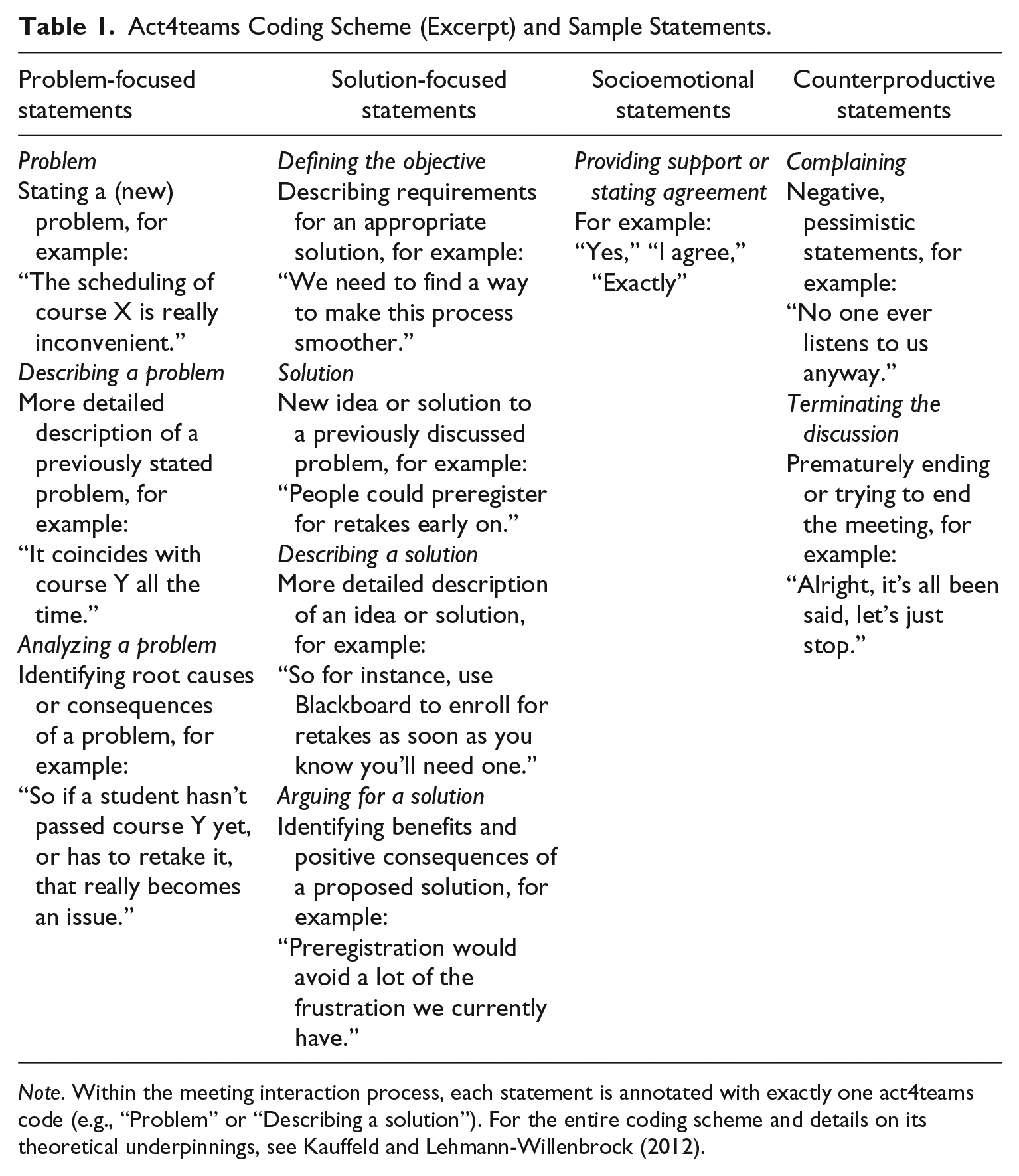
Note. Within the meeting interaction process, each statement is annotated with exactly one act4teams code (e.g., “Problem” or “Describing a solution”). For the entire coding scheme and details on its theoretical underpinnings, see Kauffeld and Lehmann-Willenbrock (2012).
Results
Table 2 shows the descriptives and intercorrelations of all individual-level variables (demographics and meeting satisfaction survey). None of the demographic variables (age, gender, or school year) were meaningfully related to the individual meeting outcomes. Similarly, group size (five or six members) was unrelated to the different types of verbal behavior at the group level. To test our first two hypotheses, we conducted independent samples t tests at the individual level, comparing participants in the meeting lateness condition to those in the control condition. To test Hypothesis 3 to Hypothesis 6, we conducted analyses at the group level.
Descriptives and Intercorrelations of Individual Demographics and Meeting Survey.
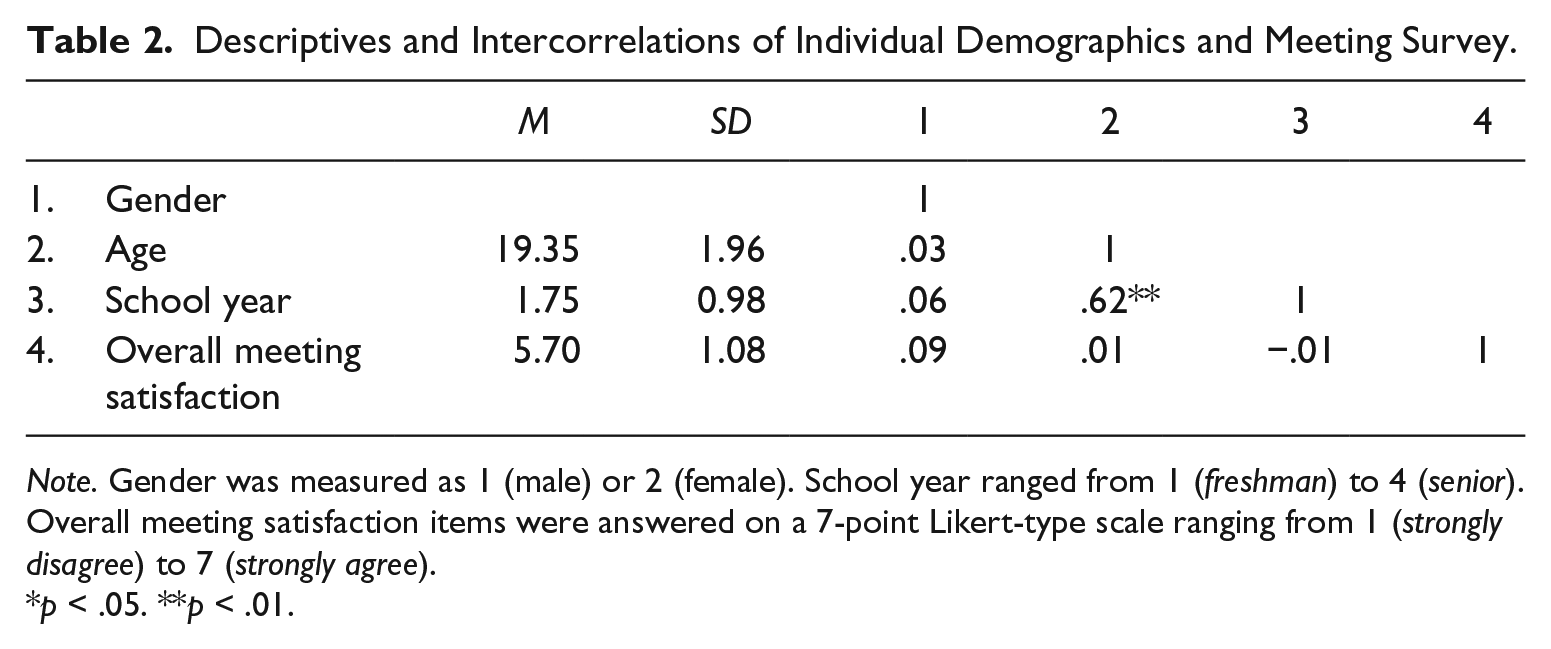
Note. Gender was measured as 1 (male) or 2 (female). School year ranged from 1 (freshman) to 4 (senior). Overall meeting satisfaction items were answered on a 7-point Likert-type scale ranging from 1 (strongly disagree) to 7 (strongly agree).
p < .05. **p < .01.
Individual Meeting Satisfaction
To examine differences in participant reactions to the meeting, we ran an independent samples t test comparing individual participants’ satisfaction with the overall meeting process and outcome in the lateness condition versus the control condition. Results of the t tests showed that participants in meetings that started 10 minutes late were significantly less satisfied with the overall meeting process and outcome (Mlate = 5.40, SD = 1.08; Mcontrol = 6.02, SD = .88; t[180] = 4.22, p = .00). This finding supports Hypothesis 1.
Group Problem-Solving Processes
To compare differences in problem-solving communication, based on our experimental design, we needed to account for different discussion lengths. Not all groups spent exactly the allocated 30 minutes (in the control condition) or 20 minutes (in the lateness condition) working on the meeting task. In both conditions, there were groups that needed the full allocated time, as well as groups that did not. In the control condition, groups used 89.7% of the allocated time to complete their task on average. In comparison, in the lateness condition groups used 91% of the allocated time on average. The difference between these averages was not statistically meaningful.
To control for meeting duration, we related all of the observed frequencies of specific communication behaviors (e.g., number of problem statements) to a 20-minute period by dividing the absolute frequency of each behavior by the time on task and multiplying by 20. For example, when we observed 15 solution behaviors in a group meeting where time on task lasted 23 minutes, this frequency was standardized as 15/23 * 20 = 13.04 solution behaviors. For a similar procedure, see Kauffeld and Lehmann-Willenbrock (2012).
To examine differences in communication processes across the two conditions, we calculated independent samples t tests comparing relative frequencies (adjusted for meeting duration) of each observed behavior, coded with the act4teams coding scheme. All of the following comparisons of behavioral frequencies across the two conditions (on time vs. late start of the meeting) are based on these relative frequencies and thus control for meeting duration. Table 3 shows all means and standard deviations along with the t-test results for these comparisons.
Independent Samples t Tests Comparing Frequencies of Specific Verbal Behaviors in Meetings That Started Late Versus Meetings That Started on Time.
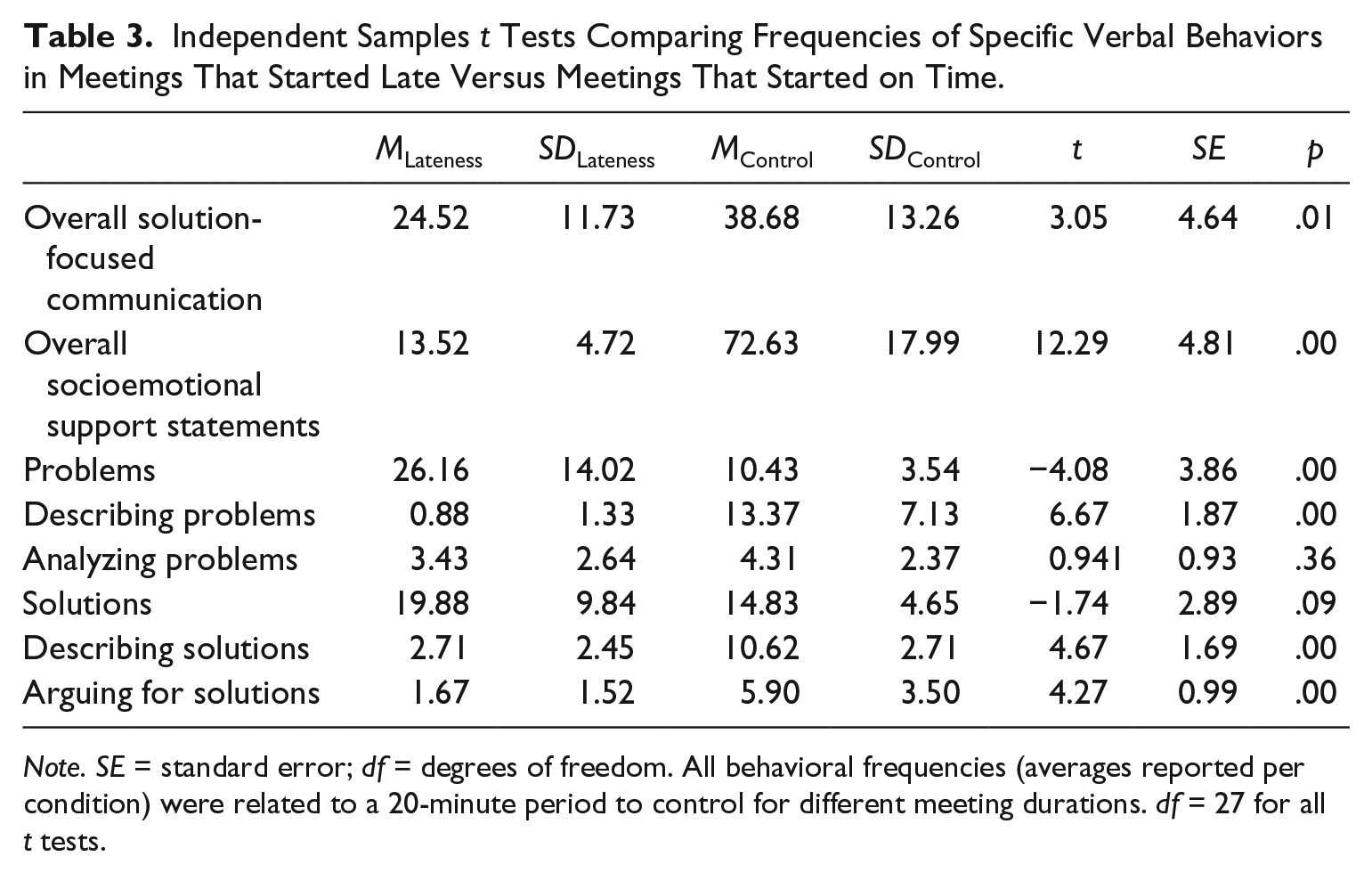
Note. SE = standard error; df = degrees of freedom. All behavioral frequencies (averages reported per condition) were related to a 20-minute period to control for different meeting durations. df = 27 for all t tests.
First, we observed considerably less solution-focused communication (see Table 1 for constituent behavioral categories) in the lateness condition, with only 25 statements solution-focused statements per group meeting on average, compared with the control condition that started on time and produced 39 solution-focused statements per average group meeting. This difference was statistically significant (t[27] = −4.08, p = .00; see Table 3), which supports Hypothesis 2. To compare the elaboration of problem analysis in late versus punctual meetings, we considered differences concerning the frequency of new problems (“problem”), detailed descriptions of problems (“describing a problem”), and in-depth analyses of causes and effects (“analyzing a problem”; see Table 1). Interestingly, the meeting lateness groups produced more problem statements (t[27] = −4.08, p = .00; see Table 3) than the control group. Yet, they spent considerably less time on understanding these problem in detail, as indicated by significantly fewer problem descriptions (t[27] = 6.67, p = .00; see Table 3) compared with the control group. This finding lends some support to Hypothesis 3a. Yet the frequency of problem analysis statements did not significantly differ across conditions (t[27] = .94, p = .36; see Table 3).
To examine the depth of idea elaboration across conditions, we considered differences concerning the frequency of new ideas (“solution,” see Table 1) as well as more detailed descriptions of ideas (“describing a solution”) and arguments for an idea (“arguing for solution”). Interestingly, the meeting lateness groups produced more solution statements than the control group, although this finding was only marginally significant (t[27] = −1.74, p = .09; see Table 3). Yet, they spent substantially less time on elaborating these ideas than the control condition, in terms of describing solutions (t[27] = 4.67, p = .00; see Table 3) and arguing for solutions (t[27] = 4.27, p = .00; see Table 3). These findings support Hypothesis 3b.
Finally, we also observed significantly fewer socioemotional support statements in the lateness condition, with only 14 statements on average in meetings that started late compared with 73 support statements on average in the control condition (t[27] = 12.29, p = .00; see Table 3), again controlling for meeting duration. This finding supports Hypothesis 4.
Lag Sequential Analysis: Emergent Communication Patterns
To examine emergent interaction patterns and explore how differences in overall communication frequencies were substantiated within the discussion process, we performed a lag sequential analysis (Bakeman & Quera, 2011) for each of the two experimental conditions. Lag sequential analysis is a quantitative procedure that identifies whether observed behavioral patterns are statistically meaningful. We focused on so-called Lag 1 transitions in our analysis (i.e., from one statement to the immediate next statement observed throughout a group’s interaction stream). Based on the observed transition frequencies at Lag 1, we computed transition probabilities. As transition probabilities are often confounded with the base rates of the events that follow, a high-transition probability is not per se an indication of a meaningful behavioral pattern. To address this problem, we computed z values for each behavioral transition in order to examine whether each transition probability differed from the unconditional probability for the event that followed. In the following, any z value larger than 1.96 indicates that an observed Lag 1 sequence occurred above chance.
Reactions to Problems and Problem Elaborations
In the lateness condition, where problem statements were more frequent overall, we observed significant self-sustaining patterns of problem statements followed by another problem (z = 2.89), which were not significant in the control condition (z = −1.50, n.s.). Interestingly, we also observed significant patterns of problems followed by complaining in the lateness condition (z = 2.65), but not in the control condition (z = −.47, n.s.). Explorations of problem root causes and consequences (“analyzing a problem,” see Table 1) triggered different communication patterns across the two conditions however. When meetings started on time, problem analysis statements were followed by support statements from other group members (z = 6.89). However, when meetings started late, problem analyses did not elicit support (z = −.24).
Reactions to Idea/Solution Statements
In the control condition where meetings started on time, support for solution contributions was evident in terms of patterns of solutions triggering subsequent support statements (z = 10.99). Moreover, suggested solutions were followed by statements arguing for a solution (z = 6.89) when meetings started on time. In comparison, when meeting started late, suggested solutions did not tend to elicit support (z = 1.01, n.s.). Moreover, suggested solutions were not significantly followed by positive arguments for these solutions in the lateness condition (solution—arguing for solution: z = 1.69, n.s.). Similarly, descriptions of solutions were also not followed by arguing for solutions (z = −.40, n.s.) in the lateness condition. Instead, we found significant patterns of suggested solutions followed by statements aimed at terminating the discussion (z = 2.92) in the lateness condition.
Taken together, our lag sequential findings revealed substantially different communication patterns for meeting group processes that started late versus meetings that started on time. Regarding problem analysis, when meetings started late, problem analysis statements were rarely supported, which lends support to Hypothesis 5. Regarding solution communication, we found that support for others’ solution contributions was more likely to follow in the control condition, compared with conditions of meeting lateness. This finding supports Hypothesis 6a. Moreover, solutions did not trigger positive arguments for solutions under conditions of meeting lateness (whereas in the control condition, we did finding solution—arguing for solution patterns). This finding supports Hypothesis 6b. Finally, in the lateness condition, we also observed patterns of problems followed by complaining as well as patterns of solutions followed by attempts to terminate the discussion. Although we did not have any a priori expectations regarding the latter two findings, they further underscore the potential derailing effects of meeting lateness on the group discussion dynamics.
Discussion
This study sought to demonstrate how meeting lateness on both meeting perceptions and within-meeting group interaction dynamics. Consistent with CoR theory, we found that meetings starting late made participants less satisfied in general. We then adopted a micro-level perspective of the group interaction process in punctual versus late group meetings. Late groups showed less solution communication overall, as well as less in-depth problem analysis and idea elaboration. Moreover, late groups showed significantly fewer positive socioemotional statements. Lag sequential analysis revealed that these differences in overall communication patterns were substantiated at the communicative event level. These findings have several implications that can advance our understanding of groups, group processes, and the challenge that meeting lateness presents to teams and organizations.
Theoretical Implications
First, our finding that late groups were less satisfied with the meeting process and outcome overall is consistent with our theoretical arguments derived from CoR theory (Hobfoll, 1989, 2001), goal-setting theory (Locke & Latham, 1990), and yield shifts (Briggs et al., 2008), which suggests that time can and should be considered a resource that individuals value and groups need in order to accomplish their tasks in meetings. The combination of reduced meeting satisfaction under conditions of meeting lateness, as argued based on these theoretical perspectives and as supported by our empirical findings, and the identified deficits in desired group problem-solving behavior under conditions of meeting lateness supports our arguments that meeting lateness has negative consequences for both the individual (in terms of affective experiences) and the group as a whole (in terms of observable communication behavior).
Second, our fine-grained analysis of communication dynamics revealed just how different late groups appear to be, in terms of their interaction processes, to those that start on time. The pattern of results is consistent with the literature on idea generation and creativity in groups and teams by suggesting that group members in late meetings engage less in identifying and analyzing problems, generating ideas, and elaborating those ideas in detail (Chiu, 2008; Mumford et al., 1994; Reiter-Palmon & Robinson, 2009). These findings underscore the detrimental effects of lateness not only for group member attitudes but also for behaviors that are essential for successful group problem solving and productivity (Kauffeld & Lehmann-Willenbrock, 2012). Importantly, because we controlled for meeting duration in all of these analyses, the substantial differences in group communication between late and on-time meetings are not due to the actual time at hand. Rather, meeting lateness appears to create a difficult situational context and a psychological boundary condition that derails group problem solving as well as socioemotional communication processes.
Third, our lag sequential findings show how the differences in communication patterns in late versus punctual meetings are substantiated at the level of behavioral sequences within the group interaction process. This approach addresses calls to account for the temporal dynamics inherent in group processes (Cronin et al., 2011; Herndon & Lewis, 2015). Our finding that solution statements were not meet with socioemotional support or arguing for a given solution in late meetings suggests that the niceties and courteous behaviors that facilitate group consensus and decision making appear to be lacking in late versus on-time group interactions. These results are especially alarming when considering the importance of supportive statements for successful problem-solving processes in groups (Kauffeld & Meyers, 2009). Moreover, our finding that problem analysis statements, which are critical to successful group problem solving and meeting effectiveness (Kauffeld & Lehmann-Willenbrock, 2012), did not trigger support statements in the lateness condition hints at different social evaluations of problem cause explorations in meetings that start late versus those that start on time. Similarly, our finding that solutions did not trigger support or positive arguments in the lateness condition suggests that contributing solutions is not a particularly encouraging experience under conditions of meeting lateness.
Finally, our ancillary finding that problems tended to trigger complaining statements in the lateness condition (but not in the control condition) hints at the possibility that problems are discussed with a different frame of reference when meetings start late, namely, in a less constructive manner. This might also explain why groups in the lateness condition were less apt at analyzing root causes of problems than groups who started on time. According to previous research, once groups enter a complaining mode, they move away from a constructive problem-solving process, with substantial negative consequences for the discussion progress, group affective climate, and meeting outcomes (Kauffeld & Meyers, 2009; Lehmann-Willenbrock, Meyers, Kauffeld, Neininger, & Henschel, 2011; Schulte, Lehmann-Willenbrock, & Kauffeld, 2015).
Practical Implications
The current study also provides several implications for groups and teams in organizations. First, meetings should start on time. Although this may sound straightforward and simple enough, starting on time is often harder than it looks. Helping meeting leaders be aware of the negative effects of meeting lateness on both meeting processes and meeting outcomes may help provide the added motivation to start on time.
Second, meeting leaders and team members should recognize the behavioral change when meetings start late and work to change it. Our interaction analytical findings show that people simply behave differently when a meeting starts late. Although this study cannot speak to how to change that within the situation, an awareness of it may help meeting leaders begin to consider the implications, perhaps change their own behavior in terms of meetings that start late, and again, provide increasing incentive to simply start on time.
Third, meeting leaders and attendees should consider what can be done to avoid meeting lateness in the first place. Meeting leaders and attendees both have a stake in ensuring the meeting starts on time, and are equally guilty of being the late person from time to time. The key to avoiding lateness is acknowledging the situations that are avoidable and those that are not. Sometimes people are late for reasons that are completely unavoidable (e.g., accidents happen). However, sometimes people are late for reasons that are entirely avoidable. That last e-mail can certainly wait until after the meeting. Meeting leaders should highlight and sanction those who are late when the reasons are avoidable and perhaps empathize when lateness is unavoidable.
Limitations and Future Directions
Several limitations provide opportunities for future inquiry. First, our student sample limits the generalizability of our findings, and future research should verify them in employee teams in a work organization. Given our study aim, our design was adequate for manipulating lateness and studying its effect on group processes. However, the results might look somewhat different in bona fide groups with a shared history and future as well as expectations about punctuality or the lack thereof may. Additionally, future research can examine meeting lateness in different cultures, which might affect the link between lateness and meeting satisfaction as well as within-meeting communication patterns (cf. Lehmann-Willenbrock, Allen, & Meinecke, 2014).
Second, the artificiality of experimental designs limits the implications of the study, but provides opportunities for future researchers. Choosing to do an experiment versus a correlational or even quasi-experimental design always comes with the trade-off between understanding the causal nature of a phenomenon versus acknowledging the realism and complexity of nonlab situations (Webster & Sell, 2007). Because the forgoing experiment was in a lab, we can confidently say that late meetings are less satisfying than on-time meetings for our sample. However, many of the traditional team dynamic processes previously mentioned (see earlier limitation) are controlled by the experimental context making the application to noncontrolled environments questionable. As such, our hope is that this study provides a launching point for correlational designs OR quasi-experimental designs in organizations where context can be integrated into the model and allow for greater generalizability. Thus, the experiment presented here provides a necessary step to justify further inquiry inside teams in organizations.
Third, we chose to end meetings in both conditions after the same period of time, regardless of their timely versus delayed start. This choice reflects the organizational reality that meetings are typically scheduled for a specific time slot in the work day and have a set end time, regardless of their actual start time. Thus, when a meeting starts late, it typically still ends when it is scheduled to end (cf. Tropman, 2003). However, we cannot rule out the possibility that the observed differences in the group processes between meetings that started late versus meetings that started on time may have been due to perceived time pressure rather than lateness. In other words, the problems experienced by the groups in the late condition may have resulted from the fact that they simply had less time (20 rather than 30 minutes on average) for discussion and problem solving, although our findings regarding the actual time used, out of the allocated time, did not differ across conditions. Yet in an effort to mitigate this concern, we controlled for meeting duration in all analyses across the two conditions. Moreover, groups assigned to the 10 minutes late condition were not aware that there were other groups who started on time and had 20 minutes. We also did not observe any verbal statements hinting at the possibility that groups in the lateness condition were concerned about the lack of time due to their later start of the meeting. Nevertheless, future research could address this concern by examining the effects of meeting lateness in meetings of equal length, compared with meetings that begin on time.
Fourth, we manipulated meeting lateness by keeping groups waiting for a fictional additional group member, who in the end did not show up. In organizational practice, however, meetings will often start late because a member is vital to the meeting, and the meeting simply cannot start without him or her. Or, a good meeting leader may proceed to initiate the meeting without the late person and attempt to cover items that do not require this individual. Yet our choice to not include the (fictional) latecomer in the actual meeting discussion in our experimental design had three reasons. First, we decided against using a confederate showing up late, as this person invariably would have affected the group discussion process by his or her own behavior. Second, we decided against asking one of the participants in the lateness condition to wait and then show up late for the meeting due to the social pressure this manipulation would have likely put on this participant. Third, our interest in this particular study was not on the cause of the meeting lateness, or the meeting starting late, but rather the outcomes of the lateness in terms of interactive processes. Nevertheless, this choice in our experimental design implies limitations concerning the generalizability of our findings. Future research can address this concern by studying late-starting meetings in the field.
Finally, our finding that desirable group problem-solving behaviors were impaired under conditions of meeting lateness opens the door to the possibility that CoR theory (Hobfoll, 2001) may explain other meeting outcome changes due to resource changes in the meeting. For example, future research may consider attentional deficits caused by distractions in the meeting such as use of personal technology devices. When distracted by the latest Twitter line or Facebook post that flashes on a meeting attendee’s phone or computer screen, they are unable to attend to the conversation in the room or across the teleconference. Observational, experimental, and even correlational studies are needed to further investigate how these attentional shifts affect meeting process dynamics and outcomes.
Conclusion
In sum, this article has made the following contributions. First, we have contributed to the ongoing conversation in the literature on lateness in general and target meetings as a particularly relevant workplace context in which lateness occurs frequently and regularly. Second, whereas previous work on the effects of lateness has predominantly considered individuals or organizations, we provided a novel perspective by highlighting the effects of lateness on group processes and outcomes. Such a study focus is important given the high prevalence of teamwork in contemporary organizations (e.g., Kozlowski & Ilgen, 2006). Third, we adopted a micro-level perspective of group dynamics in an experimental design that manipulates punctuality versus lateness of group meetings. Using video coding and lag sequential analysis, we showed distinct differences regarding communication processes and emergent group interaction patterns in group meetings that started late versus those that started on time. Finally, we discussed both theoretical implications for the burgeoning field of meeting science (for an overview, see Allen, Lehmann-Willenbrock, & Rogelberg, 2015) as well as implications for organizational practice.
Footnotes
Declaration of Conflicting Interests
The author(s) declared no potential conflicts of interest with respect to the research, authorship, and/or publication of this article.
Funding
The author(s) received no financial support for the research, authorship, and/or publication of this article.