




Abstract
Background:
In kitesurfing, acute and overuse injuries are caused by high-impact loads, acceleration loads, and tensile loads, primarily affecting the lower extremities.
Purpose:
To determine the specific differences in jump and landing loads on the lower extremities within the 2 kitesurfing subdisciplines “Big Air” and “Freestyle.”
Study Design:
Descriptive laboratory study.
Methods:
Six Big Air kitesurfers (mean ± SD age, 24 ± 1.7 years) and 6 Freestyle kitesurfers (24.5 ± 3.6 years) were recruited. Jump height, airtime, landing acceleration, and maximal vertical ground-reaction force on both feet soles during take-off and landing were determined using sensor insoles (Moticon ReGo AG) and an altitude and acceleration sensor (WOO Sports). The performed jumps were divided into 2 further subgroups based on their maneuver characteristics. Freestyle was divided into “moderate” and “aggressive”, while Big Air was divided into “kiteloop successful” and “kiteloop failed.”P values < .05 were considered significant. Either a one-way ANOVA or a Kruskal–Wallis test was used, followed by Holm–Sidak or Dunn's post hoc analysis.
Results:
In Freestyle (n = 6), the moderate subgroup compared with the aggressive subgroup achieved a significantly higher mean jump height (1.9 ± 0.5 m vs 1.6 ± 0.3 m; P = .02), while the aggressive subgroup achieved a significantly greater mean landing acceleration (5.3 ± 1.1 g vs 4.5 ± 1.2 g; P = .01). In Big Air (n = 6), the kiteloop successful subgroup achieved significantly higher mean jump height values than kiteloop failed (5.6 ± 2.4 m vs 4.2 ± 0.8 m; P = .009) and significantly lower landing mean load (front, 17.92 ± 9.39 N vs 30.97 ± 8.49 N, P < .001; rear, 21.76 ± 10.43 N vs 34.20 ± 9.64 N; P < .001). The 2 disciplines differed significantly between the aggressive and kiteloop successful subgroups, with the landing acceleration being lower in the latter subgroup (5.3 ± 1.1 g vs 4.2 ± 1.3 g; P = .008). On the other hand, the landing acceleration was significantly higher in the kiteloop failed subgroup than in the moderate subgroup (5.5 ± 1.7 g vs 4.5 ± 1.2 g; P = .045). The kiteloop successful subgroup showed highly significant lower loads on both feet during landing than both subgroups of the freestyle discipline (kiteloop successful vs moderate: front, 17.92 ± 9.39 N vs 28.84 ± 18.22 N, P = .003; rear, 21.76 ± 10.43 N vs 32.30 ± 13.90 N, P < .001) (kiteloop successful vs aggressive: front, 17.92 ± 9.39 N vs 31.99 ± 18.25 N, P < .001; rear, 21.76 ± 10.43 N vs 35.15 ± 13.27 N, P < .001).
Conclusion:
Our study demonstrated that particularly during aggressive Freestyle jumps and failed kiteloop Big Air jumps, significant mechanical loading of the lower extremities was observed. In the Big Air subdiscipline, this mainly results from a missing parachute effect of the kite, which normally guarantees a protective role in high jumps with successful kiteloops.
Clinical Relevance:
High mechanical loading during kitesurfing, especially with the aggressive freestyle riding style and failed kiteloop maneuvers, may be the cause of acute and overuse sports injuries and need to be considered in the future development of prevention concepts.
Kitesurfing is a wind-dependent water sport that first emerged in the late 1970s and developed into a trend sport from 1999 onward. 4 Athletes can use the kite's wind propulsion to jump and perform various maneuvers in the air. The most common professional disciplines in competition are Big Air and Freestyle. In the discipline Big Air, jump heights of up to 30 m can be achieved with a flight time of several seconds, typically combined with accelerating kiteloop maneuvers (maneuvers in which the rider steers the kite in a full loop during flight, causing it to rapidly generate power and speed). Freestyle jumps are characterized by their similarity to wakeboarding: they are performed at a lower jump height with an extremely high load intensity. In recent literature, injury rates of 10.5 to 18.5 per 1000 hours have been reported for the sport.3,32 Acute injuries occur more frequently than overuse injuries when kitesurfing. 26 Thereby, the lower extremity is most frequently affected, with 32% to 70% of all injuries occurring in this region.3,13-15,23,31 The foot and ankle are injured most frequently (31.8%), followed by the knee (14.1%), which is similar to other surfing sports.32,34 Athletes are particularly exposed to a high risk when practicing new jumping maneuvers. 33 Accordingly, between 20% and 49% of all injuries occur while performing tricks.3,15,32 Silva et al 30 specified the time point of injury during the trick, with most injuries occurring during the landing (29.9%). Although the sport of kitesurfing has existed in its current form since the 1990s, there are still few to no data available on mechanical loads that occur during the practice of the sport.
As there is currently a rapid progression in the disciplines of Big Air and Freestyle (particularly in view of the Summer Olympics 2024 in Paris, where kitesurfing was an Olympic sport for the first time) with increasing professionalization of top-class sport, more data on mechanical loading in the respective disciplines needs to be collected so that effective prevention and training concepts can be developed.
In a previous work by our research group, load measurements were performed, focusing on the comparison of amateur wakeboarding and kitesurfing. 29 In this study, it was shown that high loads acted on the front and rear foot during landing and take-off and that boots and straps affected the forces acting on the lower extremity. 29 Therefore, we now aimed to determine the in vivo load (plantar pressure, vertical ground-reaction force, and landing acceleration) during take-off and landing in professional kitesurfing, with special emphasis on the subdisciplines Big Air and Freestyle. We hypothesized that both subdisciplines vary regarding loads on the lower extremity. Furthermore, we hypothesized that a more aggressive style may lead to insufficient landing accuracy due to technical errors and thus cause an increase in loading on the feet.
Methods
Only kitesurfers practicing the sport at least semiprofessionally in the disciplines Freestyle and Big Air were selected for this study. We defined semiprofessional as athletes who were either competing in national competitions or who were being sponsored by kitesurfing brands on a national level because of their riding abilities. The loads and strains that occurred during various Freestyle and Big Air maneuvers were measured and afterward compared with one another. For this study, 6 athletes per discipline (Freestyle, n = 6; Big Air, n = 6; all male) were examined with an in vivo cohort study design (Table 1). Only athletes who rode with fixed bindings, in which the measuring insoles could be inserted, were included. Therefore, only athletes with shoe size 44/45 (EU) (11/12 US) were included to ensure an optimal fit for the measuring soles.
Demographic Characteristics of Big Air and Freestyle Groups (n = 6 participants each) a

Data are presented as mean ± SD (range). BMI, body mass index.
Subgroups were formed for the jumps measured in the Freestyle discipline based on the riding style in the moderate and aggressive subgroup, depending on whether the athlete performed so-called handle passes (aggressive) or not (moderate). Jumps with handle pass and handle pass preliminary stages were considered highly challenging maneuvers in the sport because of the body rotation and transfer of the bar behind the back from one hand to the other during airtime. Furthermore, for the Big Air discipline a subgroup analysis was performed, and the jumps attempted were divided into “kiteloop successful” and “kiteloop failed” subgroups based on subgroup characteristics and landing accuracy. During a kiteloop maneuver, the athlete steered the kite in a circular path in front of him during the jump, which accelerated the athlete horizontally. If the maneuver was initiated correctly, the kite was directly above the rider after the kiteloop, which caused the kite to generate lift again, so the rider was being slowed down effectively and was able to land smoothly (kiteloop successful). If the rider did not manage to steer the kite directly above him again in time, he would not be slowed down sufficiently on landing and thus would have to anticipate a harder impact (kiteloop failed). It should be noted that every athlete attempted to perform a kiteloop maneuver, but not everyone was successful. The data collected were categorized according to whether the jump was successful or not. The athletes’ individual data were collected anonymously and recorded at the measurement site. Written informed consent was given by all participants. The protocols for this investigation were approved by the ethics committee of Rostock University Medical Center.
Study Protocol
The study protocol was based on a previous study of our working group. 29 The vertical ground-reaction force and plantar pressure distribution were recorded with the OpenGo Insole 3 sensor insoles from Moticon GmbH (Moticon ReGo AG). With the Moticon SCIENCE Mobile application, recording duration of 15 minutes per measurement was determined. At the end of the 15 minutes, the recording on the soles ended automatically and the measurement data were saved on the insoles. Data were evaluated with software Moticon SCIENCE Desktop. 18 All measurements were recorded at a frequency of 100 Hz, with all 16 pressure load sensors of the insoles activated, each capable of capturing forces ranging from 0 to 50 N with a resolution of 0.25 N·cm–2 in the Z direction. 19 Moticon sensor soles were shrink-wrapped in a waterproof film before the measurements. As the chosen film was very thin, wrapping of the insoles did not affect their sensitivity, especially as it was recalibrated for each participant. Several studies have demonstrated a high reliability of the sensor sole system.5,6,24 For example, a high level of validity was achieved for the gait parameters. 5 More recent studies have also found a high level of agreement between the vertical ground-reaction force measured with the Moticon insoles and the plate force measurement system.5,6 The height, airtime, and landing acceleration of the jumps were recorded using the third-generation WOO sensor (WOO Sports). The WOO sensor was attached to the center of the kiteboard using a special mounting. Athletes were filmed using a camera from the manufacturer GoPro (GoPro Inc), enabling the later assignment of the recorded data to various maneuvers during analysis. All measurements were conducted in the coastal water lagoons at the Baltic Sea near Rostock, Germany, specifically chosen to ensure consistent measurement conditions with minimal wave activity. Freestyle measurements were recorded within a wind speed range suitable for the discipline, ranging from 15 to 20 knots, whereas Big Air measurements were collected within a wind speed range appropriate for the discipline, ranging from 20 to 35 knots. The athletes were not influenced by the measurement equipment. For each jump performed, height, airtime, landing acceleration, and maximal vertical ground-reaction force of the front and rear foot during take-off and landing were recorded.
Statistical Analysis
The data processing involved the utilization of the Moticon SCIENCE desktop software, the WOO Sports app, and video recordings. The mean, standard deviation, minimum, and maximum were calculated using Microsoft Excel (Version 2204 Build 16.0.15128.20240; Microsoft). The data analysis program SigmaPlot (Version 13.0; Systat Software) and IBM SPSS Statistics (Version 27; SPSS Software; IBM) were used for further statistical analysis of the collected data. Results with a P value <.05 were considered statistically significant. The normal distribution was checked using the Shapiro-Wilk test. Depending on the result, either the 1-way analysis of variance or Kruskal-Wallis test was used to determine the P value. The post hoc analysis was carried out using the Holm-Sidak test or the Dunn test. To compare the force loads at take-off and landing, the force per kilogram of body weight was used to account for the different weights of the participants.
Results
Freestyle
Figure 1 shows the systematic analysis of the recorded data. In the Freestyle group, the 6 participants each performed a mean 11.2 ± 2.7 (8-14) unhooked jumps. On average, a jump height of 1.8 ± 0.4 m with a mean airtime of 1.3 ± 0.2 seconds was achieved. The mean landing acceleration was 4.8 ± 1.2 g. The highest jump measured in the discipline Freestyle reached a height of 3.0 m. Almost every participant was exposed to forces of ≥20 N/kg on both feet during landing, mainly in the heel region, while higher mean values were registered on the back foot. The detailed measurement results of the individual participants in the freestyle group are shown in Supplemental Table S1.

Systematic procedure during data recording and analysis of a jump in the Freestyle discipline. (A) Determination of the maximal forces during take-off and landing. The jump is divided into 3 phases: (B) take-off, (C) flight phase, and (D) landing. Brown graph, right foot. Blue graph, left foot.
The detailed analysis of the subgroup results in the freestyle discipline are shown in Table 2. All 6 participants performed jumps without handle pass maneuvers (“moderate” style), while only 5 athletes completed jumps with handle pass (“aggressive” style). The moderate subgroup achieved a significantly higher mean jump height, whereas the aggressive subgroup achieved a significantly greater mean landing acceleration.
Participant Measurement Results Divided Into 2 Freestyle Subgroups a

Data presented as mean ± SD (range). WOO sensor, altitude sensor and acceleration sensor.
Big Air
In the Big Air group, the 6 participants each performed 6 to 13 jumps; detailed individual results are shown in Supplemental Table S2. A mean jump height of 5.1 ± 2.1 m with a mean airtime of 3.1 ± 1.2 seconds was recorded. The mean acceleration upon landing was 4.6 ± 1.5 g. The highest jump in the Big Air measurement achieved 11.5 m. Compared with the Freestyle discipline, fewer participants were exposed to forces >20 N/kg on both feet during landing.
The results of the subgroup analysis in the Big Air discipline are presented in Table 3. All 6 participants tried to perform the kiteloop maneuver; however, only 4 of them did it successfully, being efficiently caught and slowed down (kiteloop successful). The kiteloop successful subgroup (5.6 ± 2.4 m) achieved significantly higher mean jump height values than kiteloop failed (4.2 ± 0.8 m) with a highly significantly longer (P < .001) mean jump airtime (3.5 ± 1.3 s).
Participant Measurement Results Divided Into 2 Big Air Subgroups a

Data are presented as mean ± SD (minimum-maximum). WOO sensor, altitude sensor and acceleration sensor.
Comparison of the Disciplines
All 4 subgroups were examined for statistical differences in landing acceleration and landing force load. Because the majority of injuries in kitesurfing are attributed to landing, a statistical comparison of take-off force load was omitted. 30 The statistical comparison of landing acceleration is presented in Table 4. The 2 disciplines differ significantly between the aggressive and kiteloop successful subgroups (P < .05), with landing acceleration being lower for the latter subgroup. Conversely, in the moderate subgroup, the situation was reversed: a significantly higher acceleration was found with the kiteloop failed subgroup compared with the moderate.
Results of the ANOVA for Comparing Landing Acceleration in the Subgroups of the Freestyle and Big Air Disciplines a

ANOVA, analysis of variance.
P values < .05.
When comparing the measured landing force loads, the kiteloop successful subgroup achieved highly significantly lower values than the 2 subgroups of the Freestyle discipline. Table 5 shows these statistical results.
Results of the ANOVA and Kruskal-Wallis Test for Comparing Landing Load on the Front and Rear Foot in the Subgroups of the Freestyle and Big Air Disciplines a
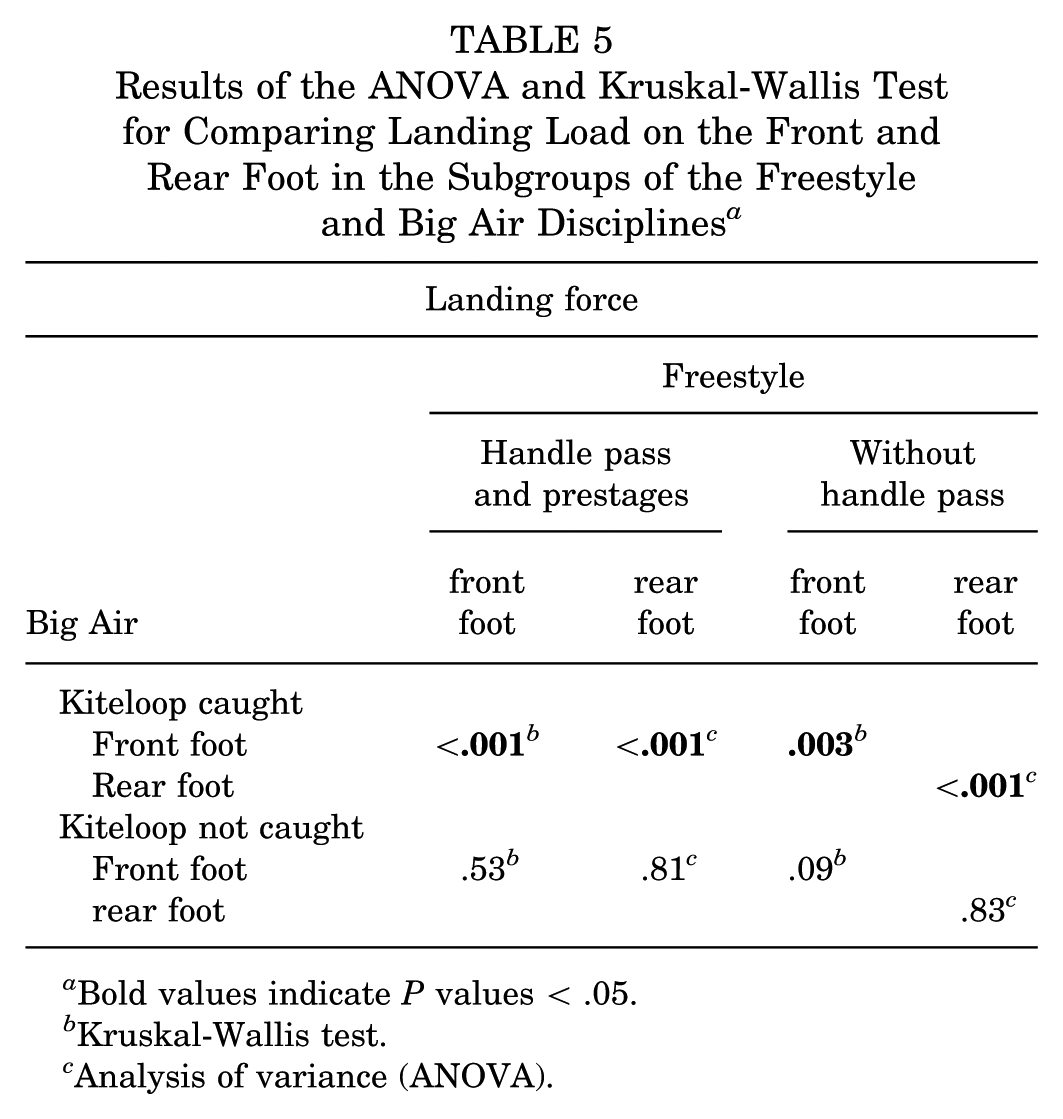
Bold values indicate P values < .05.
Kruskal-Wallis test.
Analysis of variance (ANOVA).
Discussion
The major findings of our work demonstrated that during aggressive Freestyle jumps (35.15 ± 13.27 N) and failed kiteloop Big Air jumps (34.20 ± 9.64 N), significant mechanical loading of the lower extremities occur. In the Big Air subdiscipline, this mainly results from a missing parachute effect of the kite, which is normally guaranteed with reaching a high jump height. This relationship was also oberserved in our study, where sucessful kiteloops reached significant higher jumps than failed kiteloops (4.2 ± 0.8 m vs 5.6 ± 2.4 m; P = .009).
High force values on the front and rear foot during landing were observed in the Freestyle discipline and within the kiteloop failed subgroup of the Big Air discipline. The kite position during landing and its associated parachute effect seem to be crucial for minimizing landing acceleration and force loads. If the kite generates a sufficient parachute effect, as after the kiteloop move in the Big Air discipline, a significantly lower landing load is expected compared with freestyle maneuvers, where the kite is usually positioned lower, providing less catching effect. The significantly higher jump height in the subgroup kiteloop successful compared with the subgroup kiteloop failed might suggest that with greater height during the kiteloop maneuver, the kite has more time to generate sufficient parachute effect to safely catch the athlete, thereby minimizing landing load.
The moderate subgroup in the Freestyle discipline achieved a significantly higher jump height and significantly lower landing acceleration than the aggressive subgroup. Furthermore, the mean maximal landing loads were also lower for both feet in this subgroup, aligning with the trend in landing acceleration. It should be mentioned at this point that while attempting a handle pass (as in the aggressive subgroup), it is important to keep the kite as low as possible to minimize shoulder joint stress. Otherwise, the risk of shoulder joint injury may increase. 13 To avoid shoulder strain, athletes direct the kite downward before initiating the handle pass, reducing the kite's position above the athlete during landing and thus potentially decreasing parachute effect. In Freestyle, therefore, it might not be the jump height, but rather the kite position itself, that is relevant to the resulting loads comparing the 2 subgroups. This was also evident when comparing with the Big Air discipline. With a mean jump height of 5.6 ± 2.4 m, the resulting landing loads within the kiteloop successful subgroup were significantly lower than in the Freestyle discipline. However, when the athlete was not caught by the kite after the kiteloop maneuver, the landing loads were comparable with the aggressive Freestyle subgroup, with no significant differences in landing acceleration or foot force load, despite significantly higher jump height. According to these studies findings, semiprofessional and professional Freestyle athletes appear to be regularly subjected to higher lower-extremity loads, increasing their long-term physical strain. This could also affect lower extremity injury rates in both disciplines. However, it should be noted that with greater jump heights reached in Big Air, the risk of injury due to technical errors appears to be very high. Unfortunately, there is still a lack of studies on injury rates in the professional Freestyle and Big Air to fully support these data.
The jumping techniques in Freestyle are very similar to the invert jumps in wakeboarding and originally developed from these, which is also reflected in the results of the previous studies of our working group. 29 In this work, it has been shown that the loads on both the front and the back foot during invert tricks equaled several times the body weight and were thus only slightly lower than the loads in Freestyle kitesurfing. One possible explanation for the lower values for wakeboarding, despite the similarity of the jumps to Freestyle, could be the water conditions: wakeboarding is usually practiced in windless conditions with mirror-smooth water, whereas kitesurfing usually creates a wind wave even on flat water spots. This creates an uneven landing surface and could therefore be responsible for a higher landing load.
Usually, landings in kitesurfing occur with high horizontal acceleration. Consequently, technical errors that result in improper board placement during landing with high accelerations could increase landing loads and be a cause of injury. In various publications on injury patterns in wakeboarding, the board catching an edge has already been proposed as a trauma mechanism, possibly even leading to a femoral shaft fracture. 2 For another athlete, the dipping of the board's leading edge caused a fracture of the lateral process of the talus. 21 However, these cases show the technical landing errors rather than the high landing load as a possible injury mechanism. What is already known from the literature is that acute injuries occur more frequently than overuse injuries, 26 with the lower extremities and especially the foot and ankle being most affected3,13-15,23,32; and that almost 30% of all trick-related injuries occur during landing. 30 This may allow us to assume a possible link with the high landing load. However, there are little to no data on the epidemiology of injuries in professional kitesurfers that would allow a full clinical translation of our study.
Our study shows that semiprofessional and professional kitesurfers are exposed to high landing loads, especially during aggressive freestyle or failed kiteloop maneuvers in Big Air. As injury rates in professional kitesurfing are rising and athletes suffer more severe injuries than athletes at a beginner level of the sport, there is an urgent need to develop and implement injury prevention concepts.3,15,33 Injuries occur mainly in flat water accompanied by strong wind conditions >28 knots and strong gusts.13,32 In addition to wind conditions, a duration of sports activity exceeding 2 hours has also been identified as a risk factor for injuries. 3 Athletes should therefore ensure proper time management during training sessions. Because warm-up exercises such as neuromuscular training have a direct effect on joint biomechanics and reduce the risk of injury, they should be performed before kitesurfing, as already shown by Lundgren et al. 15 Furthermore, appropriately warmed-up muscles can enhance performance, especially in cold conditions. 28
A stiffer landing technique is specifically considered a risk factor for the development of acute and overuse injuries. 1 This could also be caused by the use of fixed boot bindings, as discussed in our previous study. 29 They allow more stability and control over the board, possibly leading to higher force generation and limiting lower limb flexibility. Furthermore, during landing, active flexion of the knee joint is important to reduce vertical ground-reaction forces and absorb the force load. 7 An axis-aligned flexion of the knee joint is crucial because a valgus position may increase the risk of anterior cruciate ligament (ACL) rupture. 25 Since in this study the athletes used fixed bindings, thereby fixing the foot position, correct alignment of the leg axis during flexion was assured. It is crucial that the bindings be aligned to correspond to the natural foot angle in the squat position, as the bindings mounted with excessive external rotation can evoke increased knee abduction and tibial external rotation, thus promoting a dynamic valgus position of the knee 9 (Figure 2). Knee abduction moment was a significant predictor for future ACL injury risk with 73% sensitivity and 78% specificity in a prospective study of young female athletes. 10 Besides improving individual landing techniques, athletes should also perform balance and muscle training of the lower extremities, as they can help to effectively absorb loads on the lower extremity. 8 However, there are little to no data on ACL injury rates and mechanisms in professional kitesurfing. Thus, potential parallels and conclusions need to be derived from studies in similar populations.
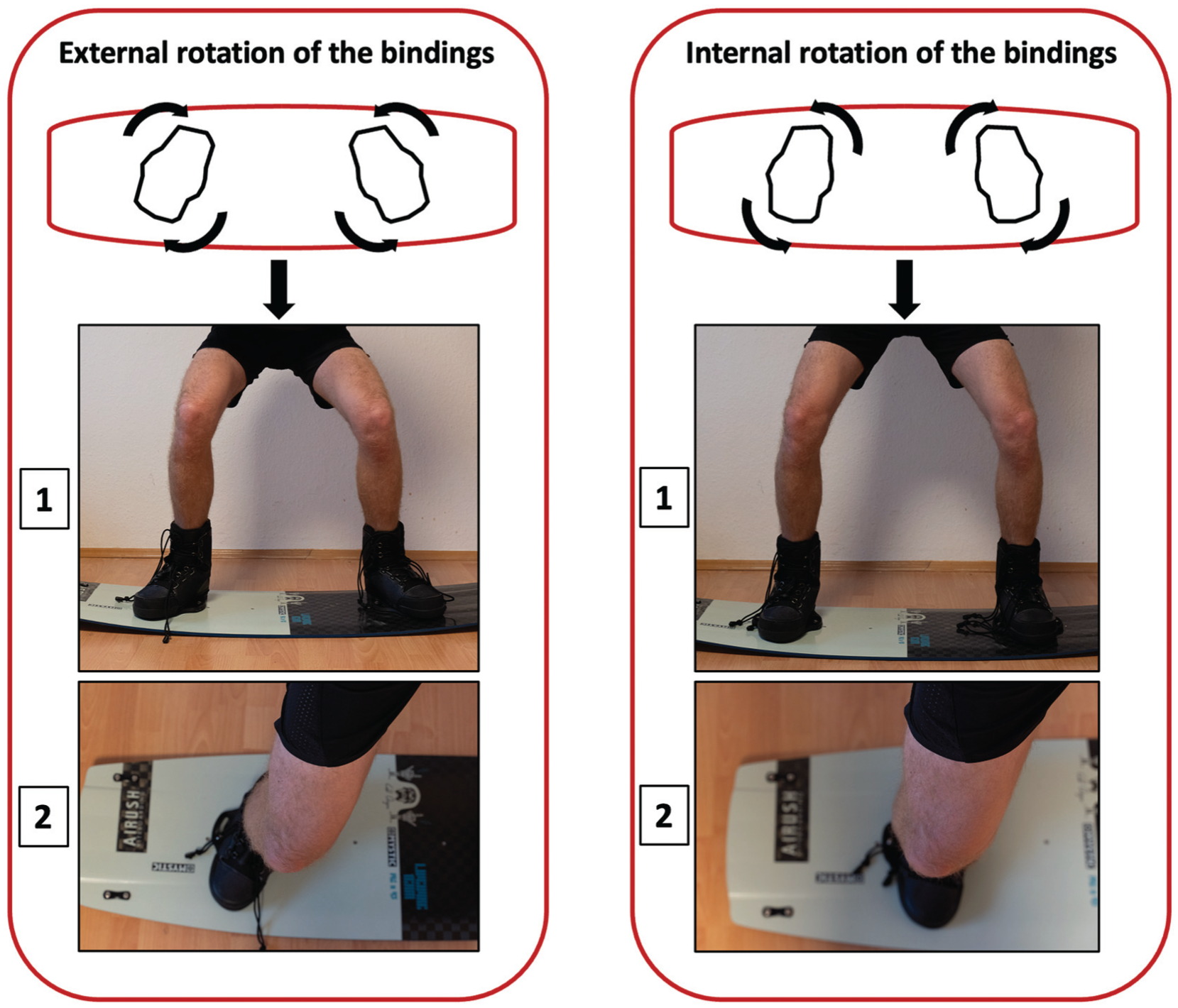
Mounting of the boots. The boots can be mounted on the board with a different orientation. The aim is to mount them in position of the natural foot angle in squat position. In the left panel, the bindings are being mounted with a significant amount of external rotation. In the right panel, bindings are being mounted with a significant amount of internal rotation. In both panels, leg alignment is from the front during knee flexion (1), whereas leg alignment is from above during knee flexion (2).
Limitations
Our study is not without limitations. Only 1 pair of sensor insoles was available during the study, severely limiting the participant pool. Consequently, due to the sole size available, only male riders could be included for this study. However, previous studies suggest that there are only minimal differences between men and women concerning vertical ground-reaction force during running 27 and plantar pressure during walking, 20 indicating that our study results might as well be considered when treating female athletes. Because each athlete attempted several maneuvers and the grouping of the evaluated jumps was based on their success, it was impossible to determine the number of jumps in advance. Furthermore, as the number of available professional kitesurfers was an important limiting factor in the composition of the study groups, no power analysis was performed. The WOO3 sensor utilized in this study tended to overestimate the measured jump height. 16 As such, jump height was overestimated in up to 90% of jumps verified through videogrammetry, with jumps exceeding 5 m potentially having measured heights 15% to 20% higher than the actual height. 16 Several studies have demonstrated high reliability of the Moticon sensor insole system across various applications such as walking, jogging, and running, with correlation coefficients ranging from 0.90 to 0.97 compared with the gold standard stationary force plates.5,6,24 The limitation of this in-shoe system is that the ground-reaction force has to be calculated based on the pressure values measured. It may lead to discrepancies between the calculated force and the vertical ground-reaction force, particularly during movements with significant shear forces.11,12,17 Given that high shear forces cannot be ruled out during landings in kitesurfing, this must be considered when interpreting the presented data. Validation studies showed that the force peaks of the vertical ground-reaction force were underestimated with Moticon insoles when compared with stationary force plates.22,31 Nevertheless, the newer insole model, used in this study, appears to measure more accurately. 6 Another major limitation of the study is the lack of data on the association between impact forces or other factors, such as binding position, and the injuries sustained. This makes the clinical translation of our results more challenging and requires further epidemiologic studies, especially in professional athletes.
Conclusion
Our study shows that during take-off and landing in professional kitesurfing, high loads are generated in the front and rear foot in the disciplines Big Air and Freestyle. When kiteloops are successful, the parachute is used to reduce landing loads, which are much higher in failed kiteloops. Also, aggressive freestyle generates more loads than moderate freestyle kiting. The data derived from our study could lead to potential modification of training as well as targeted medical care for athletes with a positive history of aggressive kitesurfing or failed Big Air maneuvers. This is of particular interest for semiprofessional and professional athletes who complete significantly higher training volumes. However, there is still limited knowledge in the literature about the exact mechanisms of acute injuries in kitesurfing and which role high landing loads have, highlighting an urgent need to interpret the collected data in a targeted manner and derive prevention concepts from it.
Supplemental Material
sj-pdf-1-ojs-10.1177_23259671251369017 – Supplemental material for Load Analysis of Kitesurfing Jumps: Is Kite Position Rather Than Jump Height More Crucial for Landing Impact Protection?
Supplemental material, sj-pdf-1-ojs-10.1177_23259671251369017 for Load Analysis of Kitesurfing Jumps: Is Kite Position Rather Than Jump Height More Crucial for Landing Impact Protection? by Sjard Simons, Sina Gräber, Xiping Ren, Rainer Bader, Parisa Pourostad, Frank Sander, Thomas Tischer, Christoph Lutter and Andrzej Jasina in Orthopaedic Journal of Sports Medicine
Footnotes
Final revision submitted May 12, 2025; accepted June 4, 2025.
The authors declared that there are no conflicts of interest in the authorship and publication of this contribution. AOSSM checks author disclosures against the Open Payments Database (OPD). AOSSM has not conducted an independent investigation on the OPD and disclaims any liability or responsibility relating thereto.
Ethical approval for this study was obtained from Rostock University Medical Center (No. A 2019-0169).

References
Supplementary Material
Please find the following supplemental material available below.
For Open Access articles published under a Creative Commons License, all supplemental material carries the same license as the article it is associated with.
For non-Open Access articles published, all supplemental material carries a non-exclusive license, and permission requests for re-use of supplemental material or any part of supplemental material shall be sent directly to the copyright owner as specified in the copyright notice associated with the article.
