




Abstract
Background:
While sport participation among older adults is increasing, there is a paucity of research on the injury profile for this population.
Purpose:
To quantify and characterize orthopaedic injuries in older adults across various popular sports that are noncontact and limited contact.
Study Design:
Descriptive epidemiology study
Methods:
The National Electronic Injury Surveillance System database was queried for orthopaedic injuries in adults aged 55 years from 12 popular sports between 2014 and 2023. Demographics, injury characteristics, and hospital dispositions were analyzed. Weighted national estimates were calculated. Incidence rates per 100,000 individuals were computed using US Census data. Multivariable logistic regression models, adjusted for age, sex, body part, and sport type were used to calculate odds ratios (ORs) for hospitalization, fracture, sprain/strain, and dislocation.
Results:
A total of 5561 cases (national estimate: 287,255) were identified. Golf (22.8%), pickleball (17.0%), tennis (13.4%), and weight lifting (12.9%) accounted for most injuries. While sprain/strain was most common overall (56.9%), fractures predominated in pickleball, tennis, baseball, soccer, and tennis. Fracture risk increased with age (85+ vs 55-59: OR, 2.6; 95% CI, 2.52-2.77), while sprain/strain risk decreased. Female patients had higher fracture odds (OR, 2.7; 95% CI, 2.64-2.73). Basketball (OR, 1.76; 95% CI, 1.62-1.93), tennis (OR, 1.59; 95% CI, 1.46-1.72), and pickleball (OR, 1.44; 95% CI, 1.33-1.56) had the highest hospitalization odds. Pickleball injuries increased 925% since 2014, surpassing golf as the sport with the highest injury incidence in recent years.
Conclusion:
Our review demonstrates that noncontact and limited-contact sports resulted in more fractures and increased odds of hospitalization outcomes for older adults. Women had higher odds of fracture than men when playing sports. Although limitations in our study should be noted, age-related changes in injury patterns, particularly the increased fracture risk and hospitalization rates seen in our study, suggest a need for specialized orthopaedic care and prevention strategies for this growing demographic of athletes.
Keywords
Sports for older adults have seen a sharp rise in popularity in recent years, with sports such as pickleball gaining traction among ages 55 years. With 52% of the core participants of pickleball being older adults, it is no surprise it is one of the fastest growing sports in the United States. 1
Physical activity is crucial for the health of older adults, as it has been shown to mitigate the risks of chronic conditions such as obesity, diabetes, cancer, and heart disease. While traditional sports such as golf, basketball, and baseball remain popular among adults in the Americas, preferences vary widely based on geographical, socioeconomic, and cultural factors.10,14 Age is an important consideration for sport participation, with older adults gravitating toward sports for their mental and physical benefits; for being in a social, supportive community; and for relationships fostered as a result of being a part of a team. Older adults also tend to engage in less physically demanding sports such as golf and swimming. 22
However, the increased participation in sports among older adults comes with a heightened risk of injuries, particularly orthopaedic injuries. Sprains, strains, and fractures are the most common orthopaedic injuries, especially in the lower extremity, often resulting from ground-level falls due to age-related degeneration of musculoskeletal, neurological, and visual systems. 12
Musculoskeletal injuries can lead to significant time lost from daily activities and work. Requa et al 20 reported a rate of time-loss injuries of 5.92 per 1000 hours of sport activity, and they noted that 11.4% of adults had to alter their daily activities and 64.9% of adults had to cease sport participation entirely during the injury period. More severe musculoskeletal injuries lead to increased chance of hospitalization and requirement of specialized care. Contact sports classically suffer from a higher risk compared with their noncontact counterparts because of the more violent nature of these sports. 5
Despite the changing landscape of increased sport participation among older adults, there is a notable lack of comprehensive studies examining sports that offer the advantage of health benefits while maintaining relative musculoskeletal safety for older adults. The purpose of our study is to address this gap by quantifying and characterizing the sports with lower rates and magnitude of injury for older adults.
Methods
Data Collection
A retrospective, cross-sectional analysis was performed using data from the National Electronic Injury Surveillance System (NEISS) database for the period between 2014 and 2023. The US Consumer Product Safety Commission operates the database to monitor and collect data on patients with product-related injuries who present to US hospital emergency departments (EDs). The data were gathered from EDs of approximately 100 hospitals stratified by type (adults’ or children’s), size, and location (rural or urban), selected as a probability sample of all 6,000+ US hospitals with 24-hour EDs. Data were collected by a NEISS hospital coordinator who reviewed records made by ED staff. This information was then transcribed into a coded form, reviewed by US Consumer Product Safety Commission software, and entered into their database. Institutional review board approval was not required for this study.
Study Variables
The NEISS database was queried for older adult patients who presented to the ED for the following orthopaedic injuries: dislocation, sprain/strain, fracture, and avulsion.13,21 Patients were selected as 55 and older based on the ages presented in current literature on physical activity for older adults. This query was completed across the 12 most popular sports for older adults in the United States: pickleball, golf, basketball, baseball, softball, soccer, football, tennis, swimming, volleyball, bowling, and weight lifting. 14 These sports were classified as noncontact or limited-contact sports based on frequency and intention of collision as defined by the American Academy of Pediatrics. 18 Pickleball, golf, tennis, swimming, and bowling were established as noncontact sports. Basketball, baseball, softball, soccer, volleyball, football, and weight lifting were established as limited-contact sports. Cycling was a popular sport but excluded from the study because there was no differentiation between cycling for sport and cycling for transportation/commuting.
Data were collected on patient age, sex, hospital disposition, injured body part, injury diagnosis, and weight. These data were assigned based on hospital strata. Age was stratified into 5-year groups based on evidence in the literature that there were sharp changes in injury rates every 5 years for older adults. 12 Body part injured was grouped by upper extremity (shoulder, elbow, lower arm, wrist, upper arm, hand, and finger), lower extremity (knee, upper leg, lower leg, ankle, foot, and toe), head/neck (face and neck), and trunk (upper trunk and lower trunk).
Statistical Analysis
Descriptive statistics were computed for demographic variables and injury characteristics. Frequencies and percentages were calculated for categorical variables, and means and standard deviations were calculated for continuous variables. Weighted national estimates (WNEs) were calculated by assigning each case a statistical weight reflecting the hospital's selection probability. This weight, based on the total number of US hospitals versus those sampled, was adjusted for nonresponse and poststratification to represent all national emergency visits. This ensured that smaller hospitals with fewer patients did not disproportionately influence the analysis.25,26,27 This produced national injury estimates that included stratification and clustering. Incidence rates were calculated for each sport per 100,000 individuals using data from the US Census, and significant differences were determined through 1-way analysis of variance. 24
Multivariable logistic regression models were constructed to calculate odds ratios (ORs) with 95% CIs for hospitalization, fracture, sprain/strain, and dislocation. Models were adjusted for age, sex, sport type, and injured body part. Chi-square tests of independence were used to assess associations between categorical variables.
Statistical significance was set at P≤ .05. Analyses were conducted using IBM SPSS Statistics Version 29.0.1.0 and Microsoft Excel Version 2405. This study was exempt from institutional review board approval due to the use of publicly available, deidentified data.
Results
A total of 5561 cases accounted for a WNE of 287,255 orthopaedic injuries from the 12 most popular older adult sports during the study period. Six of the most popular sports are characterized below (Table 1). Noncontact sports accounted for 3192 patients from 5 sports (WNE, 180,846): golf (n = 1116), pickleball (n = 814), tennis (n = 715), swimming (n = 190), and bowling (n = 357). Limited-contact sports accounted for 2369 patients from 7 sports (WNE, 99,267): soccer (n = 206), baseball (n = 253), softball (n = 241), weight lifting (n = 828), volleyball (n = 155), basketball (n = 516), and football (n = 170). The mean age of injured patients across all sports was 67.3 years (SD, 8.6 years), with volleyball participants having the lowest mean age at 60.1 years (SD, 6.4 years) and golf participants having the highest mean age at 71.2 years (SD, 9.9 years). In 9 out of 12 sports, male participants experienced the highest injury rate, whereas bowling, pickleball, and swimming had a higher proportion of female injuries.
Quantity of Orthopaedic Injuries of Various Sports Based on Age, Sex, Diagnosis, Disposition, and Body Part a
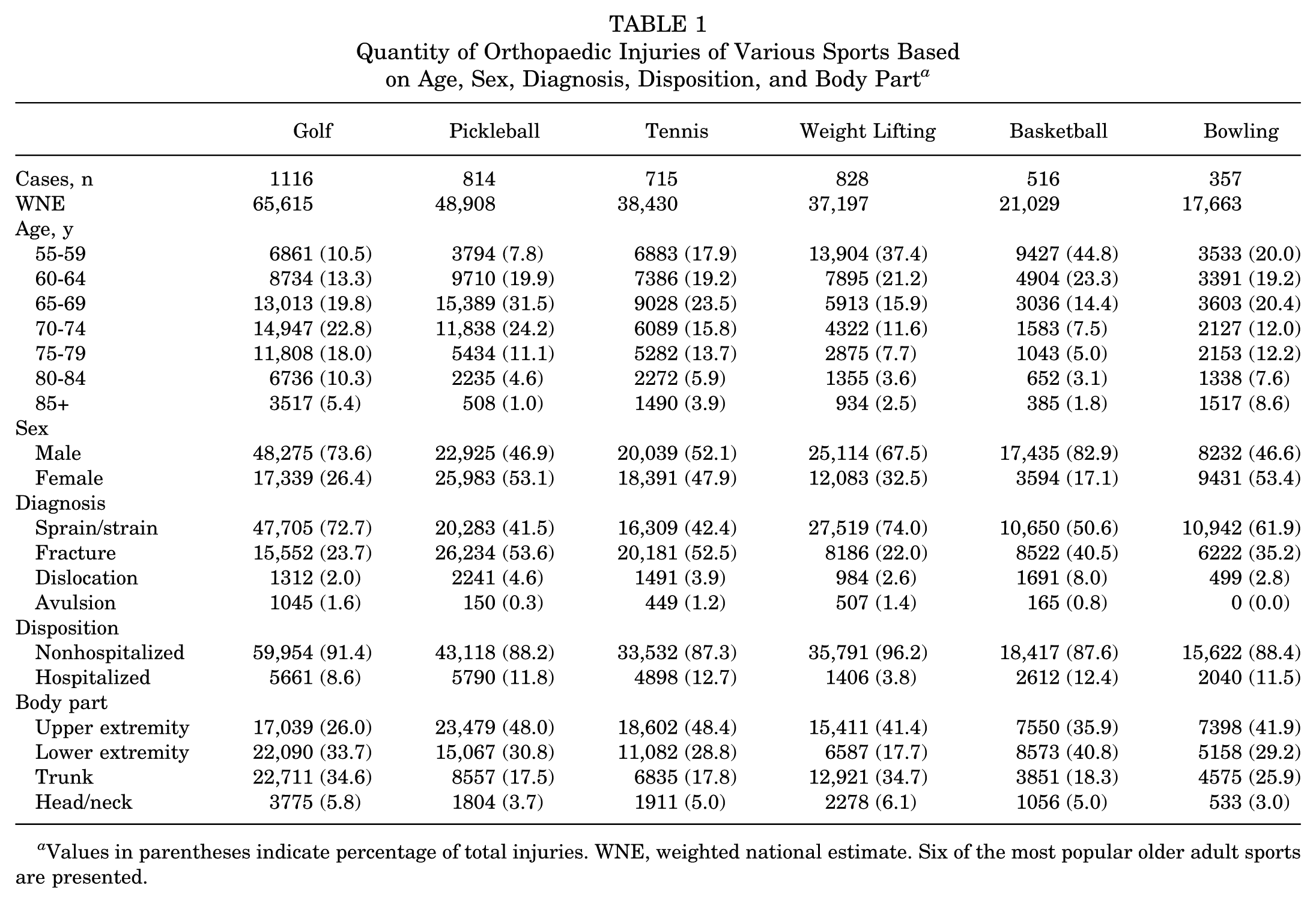
Values in parentheses indicate percentage of total injuries. WNE, weighted national estimate. Six of the most popular older adult sports are presented.
Golf (22.8%), pickleball (17.0%), tennis (13.4%), and weight lifting (12.9%) accounted for most injuries. The most common injuries for these sports were fracture (pickleball and tennis) and sprain/strain (golf and weight lifting). The mean incidence rates across the study period varied significantly across sports (P < .001), ranging from 0.822 per 100,000 for soccer to 7.05 per 100,000 for golf among adults aged 55 years (Figure 1). Notably, pickleball injuries increased by 925% since 2014, with the incidence rate rising from 0.920 to 8.52 per 100,000 in 2023, surpassing golf as the sport with the highest injury incidence in recent years. Most sports showed stable incidence rates across the study period with a slight decrease during the COVID-19 pandemic, except for basketball and softball.

Incidence rates and count of orthopaedic injuries for 12 popular older adult sports from 2014 to 2023.
Injury Patterns
Sprain/strain was the most common injury overall (56.9%; WNE, 163,344), followed by fracture (37.7%; WNE, 108,168), dislocation (4.5%), and avulsion (1%). Even with sprains/strains being the most common injury, fractures were the predominant injury in pickleball, tennis, baseball, and soccer. The upper extremity (40%) and lower extremity (30%) were the most frequently injured body regions, with trunk injury notable in golf, swimming, and weight lifting (24% of all injuries). Head/neck injuries were least common (5.9%) in this population (Figure 2).

Most prevalent locations of injury for an older adult playing sports.
The odds of fracture increased significantly with age, with individuals aged 85+ having the highest odds and 2.6 times higher odds compared with those aged 55 to 59 (Table 2). Conversely, the odds of sprain/strain decreased with age, with those aged 55 to 59 having the highest odds and 4.5 times higher odds compared with those 85+ (Table 3). Female patients had higher odds of fracture, while their male counterparts had higher odds of sprain/strain and dislocation (Table 4).
Odds Ratio for Fracture Based on Various Factors

Odds Ratio for Sprain/Strain Based on Various Factors

Odds Ratio for Dislocation Based on Various Factors a
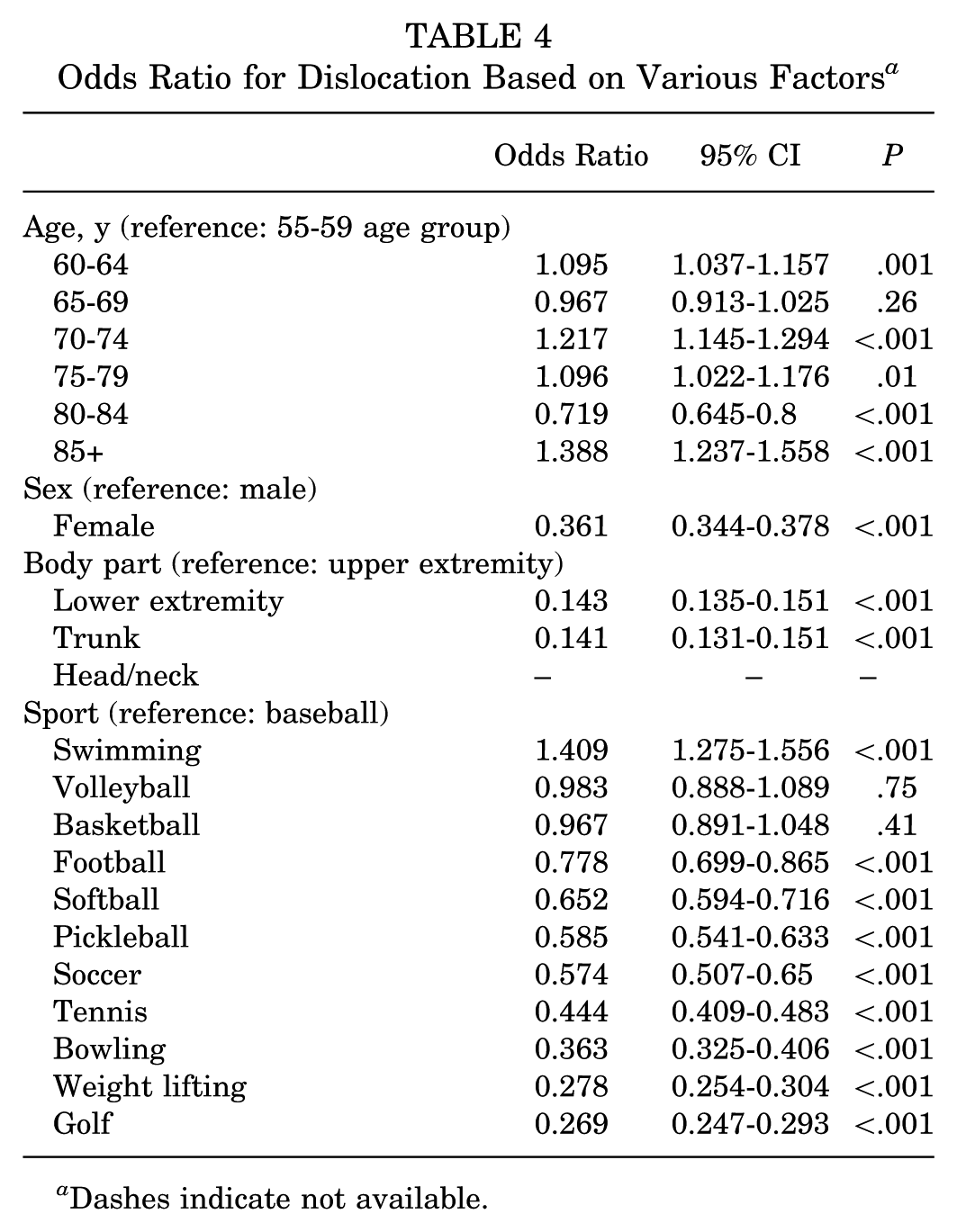
Dashes indicate not available.
Soccer had the highest odds of fracture, followed by baseball, softball, pickleball, and tennis. Weight lifting carried the highest odds of sprain/strain, nearly 5.8 times greater odds than baseball, with golf and swimming having the next highest odds. Swimming had the highest odds of dislocation, followed by baseball and volleyball, with rates >1.4 times higher than baseball and 5.2 times higher than golf, which had the lowest odds.
Injury Disposition
Of all injuries, 9.2% (WNE, 26,510) resulted in hospitalization. The odds of hospitalization increased with age, with those 85+ having 5.1 times higher odds compared with those aged 55 to 59 (Table 5). Female patients had significantly higher odds of hospitalization than their male counterparts. Trunk injuries had the highest odds of hospitalization. Among injury types, fracture had the highest odds of hospitalization. Pickleball, tennis, and basketball had the highest odds of hospitalization among all sports studied.
Odds Ratio for Hospitalization Based on Various Factors

Discussion
The major findings of our analysis revealed golf (22.8%), pickleball (17.0%), tennis (13.4%), and weight lifting (12.9%) accounted for most injuries in this age demographic. While sprain/strain was most common overall (56.9%), fractures predominated in pickleball, tennis, baseball, soccer, and tennis. Fracture risk increased with age (85+ vs 55-59: OR, 2.6; 95% CI, 2.52-2.77), while sprain/strain risk decreased. Female patients had higher fracture odds (OR, 2.7; 95% CI, 2.64-2.73). Basketball (OR, 1.76; 95% CI, 1.62-1.93), tennis (OR, 1.59; 95% CI, 1.46-1.72), and pickleball (OR, 1.44; 95% CI, 1.33-1.56) had the highest hospitalization odds. Pickleball injuries increased 925% since 2014, surpassing golf as the sport with the highest injury incidence in recent years.
Our analysis of sports-related orthopaedic injuries in older adults revealed several key findings that challenge existing assumptions about injury risk in this population. Contrary to expectations, limited-contact and noncontact sports such as pickleball and tennis were associated with increased odds of hospital disposition and more severe orthopaedic injuries in the form of fracture. As the age of athletes increased, the odds of hospitalization and fracture increased significantly, with those 85 and older having 5.1 times higher odds of hospitalization and 2.6 times higher odds of fracture compared with those aged 55 to 59. Females demonstrated particularly high odds of fracture.
Most studies examining injury patterns in sports have been focused on the youth, high school, and collegiate populations, with few examining the older adult population.3,6,7,12,23 Our study on the orthopaedic injuries associated with older adult sports highlights some notable differences and similarities compared with injuries with younger athletes. Swenson et al 23 reported that the highest number of fractures for younger athletes occurred to the upper extremity and lower extremity. This pattern is mirrored closely in our data of older adults, which demonstrated the most injuries in the upper and lower extremities. However, there was a higher relative risk of fracture for high school athletes participating in soccer, football, and basketball. In contrast, our study found lower odds of fracture in basketball and football for older adults. This discrepancy likely reflects differences in how older adults engage in these sports. Older individuals may modify their play by engaging in walking football or walking basketball. 15
Noncontact sports have a lower injury rate than contact sports for a younger population. 28 Studies have shown that for the younger population, boys’ football and girls’ soccer have the highest injury rates 17 and collision-contact sports have higher risk of fracture, dislocation, and hospitalization. 5 Although this may be the case, our study demonstrated that this trend was different for older adults playing sports. Sports that were commonly thought of as having low risk for injury and unfavorable disposition had the highest risk of fracture and hospitalization. Examples of this include pickleball and tennis. This may occur for a variety of reasons including a lack of conditioning and warming up for these sports in this demographic and the perception that noncontact sports are less aggressive, even though some noncontact sports still involve fast changes in direction and heavy strain on muscles. 16
Our study aligns with the work of Jones and Turner 11 who determined the relatively high rate of fracture of older women in exercise. In their analysis, they reported that one in three women seen in the emergency room for exercise-related injuries had fractures, dislocations, or crushing injuries. This mirrors our study results that showed 2.7 times higher odds of fracture for women than men. Osteoporosis and sarcopenia commonly affect older adults, and especially women.2,19 This may be a reason why we also recorded higher odds of fracture and hospitalization from sports as an individual got older. Given the high fracture risk in the elderly, especially women, we urge the integration of bone health assessments and strengthening programs into preparticipation evaluations for older athletes.
A previous study by DeFroda et al 8 characterized shoulder dislocations that occur as a result of microtrauma from overhead sports. Although collisions may be a cause of dislocation, this study found that repetitive overuse that pushes the glenohumeral joint past its physiologic limits can cause instability, eventually leading to dislocation. This closely mirrors the results from our current study, which found that repetitive overhead sports such as swimming, baseball, and volleyball caused the highest odds of shoulder dislocation. For the older adult age group, repetitive movements may be the most prevalent cause of dislocation in the shoulder because of many years of overuse and less frequent collisions with other athletes or equipment while playing sports as compared with younger demographics. Care will need to be given to mitigate repetitive microtraumas in these sports for the older adult.
The decrease in orthopaedic injury from sports during COVID-19 has been noted by several other studies. 4 Our study found that the incidence of injuries for basketball and softball stayed relatively constant during COVID-19. This may indicate that there are sports that can be played at home or without organized equipment that can still put older adults at risk for orthopaedic injury.
Although noncontact and limited-contact sports resulted in fracture and hospitalization, we are not attempting to dissuade older adults from participating in sports.
Limitations
Our study presents valuable insights into the orthopaedic injuries that result from older adult sports, but has a few limitations. The study data were limited to patient presentation to EDs in the United States. This may self-select injury cases that were more severe than cases that would have been presented to primary care, urgent care, or sports medicine clinics. The true rates of injury may be underestimated because not all sports injuries will result in patient presentation to the ED. Because of the lack of data regarding total people engaged in a sport, we were unable to calculate hazard ratios or injury incidence per number of players of the sport, which would have been a valuable addition. The NEISS database used in this study did not provide stratifications on the level of play in sports, so it was not possible to distinguish injuries that resulted from low-level recreational play from high-level competitive play. Another limitation is that the NEISS database does not provide data on treatment protocols and long-term outcomes. The NEISS database also relies on accurate coding by hospital staff to describe each injury case. This may lead to human error and inconsistency, though this should be few, as NEISS data collection has been reported to have between 89% and 98% accuracy. 9 Future work should be carried to counteract these limitations and obtain more granular insights into orthopaedic injuries at specific levels of play in sports for older adults throughout the full continuum of care.
Conclusion
Our review demonstrates that noncontact and limited-contact sports resulted in more fractures and increased odds of hospitalization outcomes for older adults. Women had higher odds of fracture than men when playing sports. Although limitations in our study should be noted, age-related changes in injury patterns, particularly the increased fracture risk and hospitalization rates seen in our study, suggest a need for specialized orthopaedic care and prevention strategies for this growing demographic of athletes.
Footnotes
Final revision submitted April 6, 2025; accepted April 30, 2025.
The authors declared that there are no conflicts of interest in the authorship and publication of this contribution. AOSSM checks author disclosures against the Open Payments Database (OPD). AOSSM has not conducted an independent investigation on the OPD and disclaims any liability or responsibility relating thereto.
Ethical approval was not sought for the present study.
