



Abstract
Background:
Sports-related concussions are a public health crisis of serious concern among youth athletes. Loss of consciousness (LOC) is a particularly concerning sequela of concussions, causing detrimental long-term effects.
Purpose:
To utilize National Electronic Injury Surveillance System (NEISS) data from 2014 to 2023 to track the incidence of LOC and concussions in youth athletes ages 4 to 13 years in the United States.
Study Design:
Descriptive epidemiology study.
Methods:
NEISS search criteria were entered filtering all concussions and LOC in children ages 4 to 13 years from the years 2014 to 2023 who were filed under the sport tags of football, basketball, baseball, softball, soccer, gymnastics, hockey, wrestling, and lacrosse. Linear regression, analysis of variance (ANOVA), and proportion tests were utilized.
Results:
In total, 554 (6.30% of 8828) concussions resulted in LOC in the entire 2014-2023 cohort (excluding 2020-2021). The frequency of players experiencing LOC from 2014 to 2023 showed an overall downward trend, with a trendline R value of 0.9114. Football, basketball, soccer, and baseball were the top 4 LOC-producing sports (n = 9) from 2014 to 2023. ANOVA single-factor analysis produced a P value of .0069 between the sports. Wrestling reported the highest overall rate of LOC per concussion from 2014 to 2023, with 24 reported incidences of LOC compared with 216 reported concussions (11.11%). Proportion test analysis of wrestling indicated a statistically significant difference from the mean of the other sports (6.0%) through the years 2014-2023 with a P value of .0059.
Conclusion:
The results of this study show a decrease in the overall level of LOC incidence in US youth athletes ages 4 to 13 years from 2014 to 2023 across 8 sports. The data delineate from previous studies that show an exponential increase in LOC incidence; however, the underlying reasons are still unclear and warrant further investigation. Further investigation into the reasoning behind these epidemiological trends could help build an understanding of these findings and reduce the injury burden on youth athletes.
Sports-related concussions are a public health crisis of serious concern among youth athletes. 9 Some studies estimate as high as 1 in 5 young athletes experience a sports-related concussion while participating in organized sports. 11 Buzas et al 3 published a study in 2014 utilizing the National Electronic Injury Surveillance System (NEISS) database that depicted exponentially increasing trends of concussions and loss of consciousness (LOC) from 2002 to 2012.
There are conflicting data regarding the effect of LOC on patient outcomes, and sequelae vary from individual to individual.10,12,14,16 However, the primary concerns revolve around long-term changes in brain development in youth and changes in the brain structure.12,13 Of note, retrograde amnesia, another sequela of concussions, could be confused with an LOC by the athlete, thus confounding the diagnostic strength of concussion sequelae. 10 Additionally, some studies indicate a positive correlation between postconcussive LOC and posttraumatic amnesia as concurrent sequelae. 20 Because of these emerging data, tracking and evaluating the incidence and prevalence of LOC in youth athletes is crucial.
Research and educational efforts have been made to increase awareness and prevention of concussions to try to mitigate the incidence and sequelae of sports-related concussions.1,15 While the individual management of sideline concussions has varied over the years, criteria for sending an athlete to the emergency department typically have included declining mental status, seizures, accelerated worsening of headache or athlete reporting the worst headache they have ever had, neurological phenomena, photophobia, 3 or 4 incidences of emesis, and LOC.5,6,19 Although there are numerous guidelines available, many patients with pediatric concussions who experience LOC are taken to the emergency department.2,5,6,19
Football, combat sports, girls’ soccer, and boys’ hockey are the most studied as the sports with the highest rates of concussions and LOC in youth.4,21 Given the importance of protecting this vulnerable population, updated statistics are essential in helping increase our understanding of this concerning sequela. Therefore, nationally accessible databases like the NEISS are potential tools for further understanding these trends and should be utilized. This study focuses on the LOC incidence reported in the NEISS database from 2014 to 2023 as data >10 years are not publicly accessible.
The objective of this study was to utilize NEISS data from 2014 to 2023 to track the incidence of LOC and concussions in youth athletes ages 4 to 13 years in the United States. We hypothesized that the incidence of LOC and concussions in youth ages 4 to 13 in the United States would reflect previously published data showing an increasing rate of occurrences nationwide.
Methods
A retrospective search of the NEISS was performed from 2014 to 2023. The NEISS is a government entity under the US Consumer Product Safety Commission intended for both the government and the public to monitor injury rates and case information across the country. 18 The database is based on a statistically sound sample size of patient encounters from emergency departments nationwide. 18 NEISS data are deidentified, which can limit the breadth of information per case.17,18 Despite the database not having every piece of patient information available, these well-cited systems have ushered in more informed policy-making, organizational strategies, and individual decision-making regarding consumer data and injuries for >50 years.17,18
The University of Florida Institutional Review Board did not require approval for this study, given that the NEISS is a public, deidentified database and qualifies as nonhuman subject research. Data pulled for this study are found on the NEISS. Modeled after the study by Buzas et al 3 in 2014, search criteria were entered filtering all concussions and subsequent LOC in children ages 4 to 13 years who were filed under the tags of football, basketball, baseball, softball, soccer, gymnastics, hockey, wrestling, and lacrosse. All available data under the stated criteria were pulled from all entries over the last 10 years (2014-2023). The NEISS database could not provide entries for 2024 or entries before 2014. For trendline data, the years 2020 and 2021 were excluded from the data analysis due to the confounding effects of the coronavirus 2019 (COVID-19) pandemic. Analysis of variance (ANOVA) and proportion test analysis calculations were conducted in R (R Foundation for Statistical Computing), and graphs with regression lines were constructed in Excel (Microsoft Corp). Linear regression trendline significance is declared at an R value >0.90. Proportion test analysis and ANOVA significance were declared at a P value <.05.
Results
In total, 554 (6.30% of 8828) concussions resulted in LOC in the entire 2014-2023 cohort (excluding 2020-2021) (Figure 1). The frequency of players experiencing LOC decreased by 35.29% from 2014 to 2023, showing an overall downward trend with a trendline R value of 0.9114 (Figure 1).

Reported cases of loss of consciousness, 2014-2023.
Football, basketball, soccer, and baseball were the top 4 LOC-producing sports from 2014 to 2023 (Figure 2).

Loss of consciousness reported per sport per year.
No individual sport had an independent trend of LOC per concussion per sport via linear regression from year to year (all R2 < 0.9) (Table 1). ANOVA single-factor analysis produced a P value of .0069 between the sports. Wrestling reported the highest overall rate of LOC per concussion from 2014 to 2023, with 24 reported incidences of LOC compared with 216 reported concussions (11.11%) (Table 1). In comparison, the 8 sports combined over the same time frame recorded 618 incidences of LOC and 10,026 concussions (6.16%). Proportion test analysis of wrestling indicated a statistically significant difference from the mean of the other sports (6.0%) through the years 2014-2023 with a P value of .0059.
Proportion of Loss of Consciousness per Concussions per Sport per Year, 2014-2023 (Including 2020-2021) a

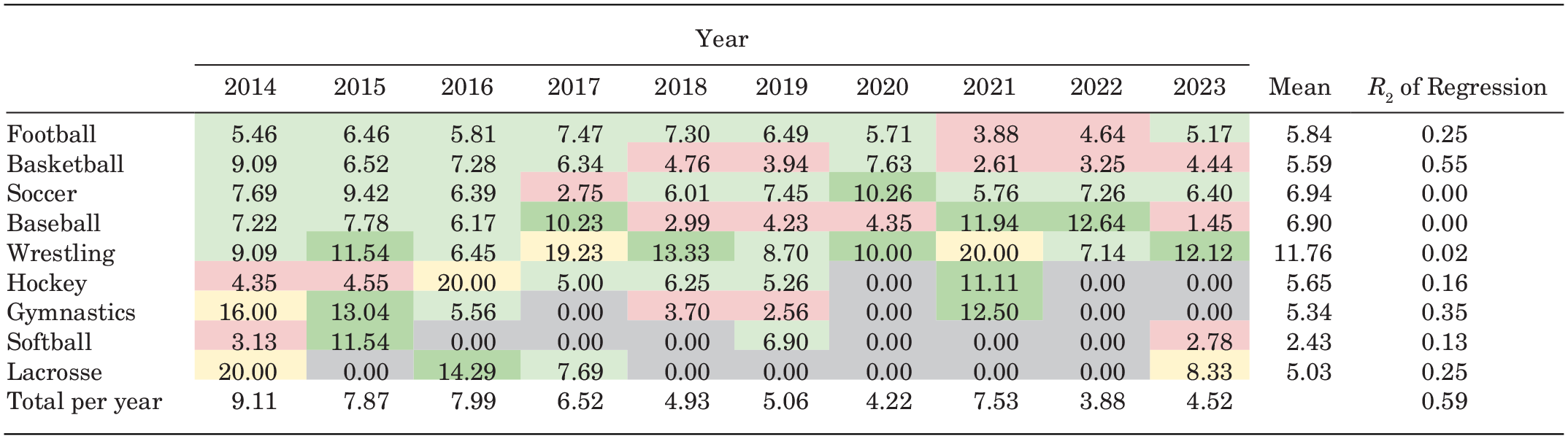
Values are given as percentage unless otherwise indicated. Yellow indicates % ≥ 15.00; Dark Green indicates % is 10.00 – 14.99; Light Green indicates % is 5.00 – 9.99; Red indicates % 0.02 - 4.99; Grey indicates % ≤0.01.
Discussion
The present results indicate that there has been an overall decreasing trend of >35% (R = 0.9114) in LOC from 2014 to 2023 among young children participating in athletics in the United States. Football (43%), basketball (21%), and soccer (18%) were the sports with the highest rates of LOC for youth ages 4 to 13 years.
Buzas et al 3 found an increasing trend of LOC from 2002 to 2012 in US youth athletes utilizing the same search criteria in the NEISS database. The contrast between the findings of the present study and the trends in the study by Buzas et al 3 sparks key discussion as to the underlying reasons behind these changes. Several underlying factors could explain this trend, including the public's increasing awareness of concussions due to extensive research efforts, educational initiatives, and public figures’ experience with concussions and their sequelae. One argument could suggest that increased awareness would prompt higher rates of sending an athlete to the emergency department when experiencing a concussion with LOC, given the dramatic nature of the event. Alternatively, the results of public awareness could have espoused successful results in mitigating risk and incidence of concussions with LOC. The findings of this study may explain why the overall awareness of LOC and preventative measures could be the driving force behind these trends, despite the expected increase in cases resulting from more vigilant public surveillance.
As previously mentioned, football, basketball, and soccer had the highest rates of LOC, which could be explained by higher participation rates nationwide. 4 Sport-specific LOC rates do not demonstrate any trends that could be explained by changes in league rules, policy, equipment utilization, or otherwise.
Wrestling was separate from other sports, with a higher proportion of LOC to concussion rates. The higher proportion of LOC per concussion in wrestling compared with other sports (11.76%), such as football (5.84%), suggests that combat sports could provoke more intense concussions with concerning sequelae in athletes who experience concussions. Many combat sports are addressed in the literature as if they are compositionally the same as other sports despite foundationally different risk factors for head trauma. 8 Increased risk factors in combat sports such as wrestling include throws that can result in violent contact between the head and the ground and continuous incidental contact to the head with various body parts throughout competition without the use of protective headgear. 7 The alarming difference in LOC found in this study strengthens the importance of further research into combat sports and their increased risk of head trauma.
Limitations
This study is not without limitations. Reporting bias should be considered because the NEISS database relies on accurate reporting data from clinicians in emergency departments nationwide. Another limitation includes the variability of sideline management of concussions throughout the years and through different athletic settings. The information in the NEISS database does not indicate whether the LOC event was witnessed or what criteria were used to determine the patient needed to go to the emergency department, leaving a bias due to the subjective assessment of the emergency department encounter. However, LOC is part of many guideline criteria for emergency department admission, hopefully limiting this confounder. Of note, posttraumatic amnesia could also confound an athlete's reliability to self-report LOC, thus clouding the accurate identification of concussion sequelae, and must be accounted for in these data. Ideally, given the consistent documentation of patient history from patient encounters from 2014 to 2023, this confounder would apply equally across all years and would, in theory, not influence the overall trend of the data discussed. Lastly, the identification, prevention, and overall management of concussions has evolved since 2014. These changes can point to the significance of these data but also provide inherent multifactorial confounders that are difficult to quantify.
Even though we excluded 2020 and 2021 from trended data to remove confounders due to the COVID-19 pandemic, the years 2022 and 2023 could also have unquantified effects from the pandemic.
Conclusion
The results of this study show a decrease in the overall level of LOC incidence in US youth athletes ages 4 to 13 years from 2014 to 2023 across 8 sports. The data deviates from the results of previous studies that show an exponential increase in LOC incidence; however, the underlying reasons are still unclear and warrant further investigation.
LOC incidence per sport is highest among football, basketball, and soccer athletes, with the highest proportion of LOC per concussion found in wrestlers. Further investigation into the reasoning behind these epidemiological trends could help build an understanding of these findings and reduce the injury burden on youth athletes.
Footnotes
Acknowledgements
The authors thank Dr. Jay Clugston for his insights and feedback, which helped us to articulate and expound on the findings of these data.
Final revision submitted February 24, 2025; accepted March 17, 2025.
The authors declared that they have no conflicts of interest in the authorship and publication of this contribution. AOSSM checks author disclosures against the Open Payments Database (OPD). AOSSM has not conducted an independent investigation on the OPD and disclaims any liability or responsibility relating thereto.
Ethical approval was not sought for the present study.
