



Abstract
Background:
Anterior shoulder dislocation is often complicated by recurrent instability, with reported rates being as high as 70% in young patients. Bony lesions, young age, and contact sports have been correlated with higher rates of recurrent instability. The optimal surgical modality remains debatable, with the majority of surgeons preferring the arthroscopic Bankart procedure as the primary repair for recurrent instability.
Purpose:
To compare the outcomes of the Latarjet procedure performed as a primary procedure versus the Latarjet procedure in the setting of a previously failed Bankart repair.
Study Design:
Cohort study; Level of evidence 3.
Methods:
A retrospective comparative study was conducted of patients with traumatic anterior shoulder instability who underwent an open Latarjet as primary or revision surgery between 2012 and 2019. Outcomes were assessed using the Rowe score, Oxford Shoulder Instability (OSI) score, visual analog scale (VAS) score, and rate of recurrent instability. All patients had at least 4 years of follow-up. Radiographs were analyzed using the Samilson and Pietro classification.
Results:
In total, 43 and 17 patients were included in the primary and revision groups, respectively. Mean follow-up was 7.7 years for the primary group and 7.9 years for the revision group. Postoperatively, Rowe and VAS scores were not significantly different between groups, but OSI scores were significantly worse for the revision group versus the primary group (40.6 ± 1.3 vs 42.1 ± 1.4, respectively). The difference in OSI scores was less than the minimal clinically important difference (8.6), indicating limited clinical relevance. Return to daily activities, including sports activities, was comparable between the 2 groups. One patient from each group had recurrent instability (P = .34). No major complication was recorded in either group during the follow-up. Seven (16%) patients from the primary group and 4 (23%) patients from the revision group showed preoperatively radiographic signs of mild (grade I) osteoarthritis.
Conclusion:
The Latarjet procedure effectively prevented chronic anterior shoulder instability and was associated with high patient satisfaction as both a primary and a revision procedure. OSI scores were marginally lower in patients with previous failed Bankart repair compared with primary Latarjet. Similar outcomes were observed for shoulder stability and arthritis development, although these findings are limited to midterm follow-up. These findings support the use of primary arthroscopic Bankart repair with revision Latarjet as a realistic surgical option for previous surgical failure.
Anterior shoulder dislocation is frequently complicated by recurrent instability, functional deterioration, and posttraumatic mid- to long-term degeneration of the glenohumeral joint. Currently, the 2 most common surgical treatments are arthroscopic Bankart repair (ABR) and the Latarjet procedure. 7 The optimal surgical modality remains debatable; with minor exceptions, the majority of surgeons worldwide prefer the Bankart procedure as the primary repair for recurrent instability. 4 The Instability Severity Index Score, proposed by Balg and Boileau, 2 is a tool to guide the surgeon in deciding between these procedures but does not have universal acceptance. 12 The decision typically depends on the surgeon's experience and expertise, with high-volume surgeons generally reporting fewer complications, alongside the need for an individualized approach.
Although minimally invasive techniques are the current trend, it has been reported that the redislocation rate after ABR is higher than that after a Latarjet procedure (28.4% vs 3%, respectively). 29 However, the so-called augmented Bankart repair (including remplissage of the Hill-Sachs defect, subscapularis augmentation, and dynamic anterior stabilization using the long head of the biceps tendon) has been introduced in recent years to reduce the redislocation rate.21,24 Nonetheless, excluding cases of recurrent dislocations, Bankart repairs are generally linked to a significantly low rate of complications. Considering the reduced occurrence of complications, several surgeons suggest carrying out an ABR for patients experiencing recurrent shoulder instability with noncritical bone loss, regardless of the Instability Severity Index Score, because the ABR can be easily revised to a Latarjet repair if unsuccessful. Few studies provide a distinction between the Latarjet procedure when used as a primary or a revision procedure after a failed ABR. Thus, a dilemma remains within the orthopaedic community regarding the use of the Latarjet procedure, particularly in cases of failed ABR, and whether a previous Bankart procedure compromises the outcomes of a subsequent Latarjet procedure. 27
This study aimed to examine the mid- to long-term functional outcomes of patients who had been treated with the Latarjet procedure as a primary or revision stabilization procedure for recurrent anterior shoulder instability. Secondary objectives were to compare the rates of complications and postoperative arthritis between primary and revision cases. Our hypothesis was that there would be no significant difference in clinical outcomes between patients undergoing the Latarjet procedure as a primary or a revision procedure. This hypothesis is based on the assumption that the Latarjet procedure effectively restores anterior glenohumeral stability by addressing both bony and soft tissue defects.
Methods
A retrospective study was conducted, and the institutional review board of the hospital waived ethics permission. A comparative case-cohort analysis was performed for all patients who underwent a primary Latarjet procedure or a Latarjet procedure after a failed ABR for recurrent anterior shoulder instability in our institution between 2012 and 2019. Inclusion criteria were age ≥18 years at the time of surgery and a minimum follow-up of 2 years. The main indications for a primary Latarjet procedure were a glenoid defect >15% or an Instability Severity Score >6. Patients were excluded if they had additional shoulder pathology at the time of surgery, pathological involvement of the long head of the biceps requiring tenotomy or tenodesis, rotator cuff tear, or symptomatic acromioclavicular joint arthritis or if they had not undergone radiographic evaluation. Three authors (E.K., T.M., A.K.) independently identified the patients eligible for the study through a computerized database of all patients undergoing surgery for shoulder instability at our department, and the medical records were reviewed to collect all applicable data such as patient demographic characteristics, number of episodes of dislocation before surgery, the time between the first dislocation and surgery, arm dominance, hyperlaxity (Beighton score ≥5 or passive external rotation > 85° in the contralateral uninjured shoulder), level of sport participation, and Instability Severity Index Score. Sports involvement was categorized as “competitive,”“recreational,” or “none,” based on the level of participation. Competitive sports involved organized events with structured training, whereas recreational sports were activities for leisure or fitness without formal competition. Sports types were further classified as “contact/collision” or “other.”
Clinical examination and radiologic evaluation of patients were performed to diagnose recurrent traumatic anterior glenohumeral instability (recurrent episodes of anterior dislocation or subluxation). The preoperative radiologic protocol involved plain radiographs and computed tomography (CT) or magnetic resonance imaging (MRI). Clinical and functional outcomes were assessed using the Rowe score, Oxford Shoulder Instability (OSI) score, and visual analog scale (VAS) score preoperatively and at the latest follow-up. A true anteroposterior view and lateral radiograph of the shoulders was performed to evaluate possible arthritic changes in the shoulder according to the Samilson and Pietro 22 classification. All patients had a minimum follow-up of 2 years.
All surgical procedures were performed by 2 fellowship-trained surgeons (S.V., M.H.) using a mini-open technique. A coracoid block transfer was carried out with fixation using two 4-mm cannulated cancellous screws (partially threaded malleolar screws) through a deltopectoral approach, with horizontal separation of the subscapularis muscle fibers at the junction of the middle and inferior thirds. This was accompanied by a 1- to 2-cm vertical capsulotomy. The coracoacromial ligament was completely transected 1 cm lateral to its coracoid insertion, and the pectoralis minor tendon along with the coracohumeral ligament was identified and detached from the coracoid insertion. A microsagittal saw was used to decorticate the deep surface of the coracoid process, and two 3.2-mm holes were drilled perpendicular to its long axis, centrally in relation to its width. A key aspect of the procedure was the excision of the labrum and periosteum using a rongeur to roughen the anterior scapular bone and enhance the healing potential of the coracoid. The coracoid process was then stabilized on the scapula at approximately the 5-o’clock position on the shoulder and 5 to 7 mm medial to the glenoid articular border. Finally, the capsule and inferior glenohumeral ligament were sutured to the stump of the coracoacromial ligament using a No. 0 absorbable braided suture.
All patients underwent the same postoperative protocol; they wore a sling with the upper limb in internal or neutral rotation for 2 weeks before beginning passive range of motion exercises under the guidance of physical therapists and then proceeding to active elevation and external rotation. Patients were allowed to return to full activity at 4 months postoperatively.
Statistical Analysis
Statistical analysis of study data was conducted using SPSS software Version 26 for Windows. Data, including the VAS score, OSI score, and Rowe score for shoulder instability, were recorded preoperatively and postoperatively. All data exhibited a normal distribution, confirmed by Shapiro-Wilk and Kolmogorov-Smirnov normality plot tests; mean values of functional scores for each group were compared using an independent-samples t test. The return to preinjury activity level was recorded for each group and compared using the chi-square test. A significance level of ≤.05 was considered for each statistical test.
Results
A total of 74 patients were eligible for the study; 14 patients (18.9%) did not answer the request to participate or were unwilling to have a new radiographic evaluation. Thus, 60 patients were included in the study, with 43 patients undergoing the primary Latarjet procedure (primary group) and 17 patients treated with the revision Latarjet procedure (revision group) (Figure 1).

Flowchart illustrating the inclusion and exclusion process. OSI, Oxford Shoulder Instability; PROMs, patient-reported outcome measures; VAS, visual analog scale.
Revision Latarjet was typically performed after failed arthroscopic Bankart procedure, with a mean time from the index procedure of 21 months (range, 11-38 months). Preoperative factors associated with recurrent instability, such as glenoid bone loss and off-track Hill-Sachs lesions, were evaluated with MRI or CT. According to our scan results, the mean glenoid bone loss was 19.6% (range, 15.1%-24.1%) for the primary Latarjet group and 15.4% (range, 12.1%-19.7%) for the revision Latarjet group (P = .6). Off-track Hill-Sachs lesions were noted, without significant statistical difference (P = .77), in the primary Latarjet group at 51% (22/43) compared with the revision group at 47% (8/17). The mean age was 29.8 for the primary group and 27.2 for the revision group, and the majority of patients were male (Table 1).
Demographic Data of the Patients a

Values are presented as mean ± SD or n (%). Boldface indicates statistical significance (P < .05).
Before the operation, the most common issue leading to surgical intervention was recurrent dislocation (Figure 2), followed by a subjective feeling of instability during daily activities and objective instability (positive apprehension test). We found no significant difference between the 2 groups in preoperative VAS and Rowe scores; however, the primary group showed slightly higher values for the OSI score (P = .002). The mean follow-up was 7.7 years (range, 2.1-9.6 years) for the primary group and 7.9 years (range, 2.6-11.2 years) for the revision group.
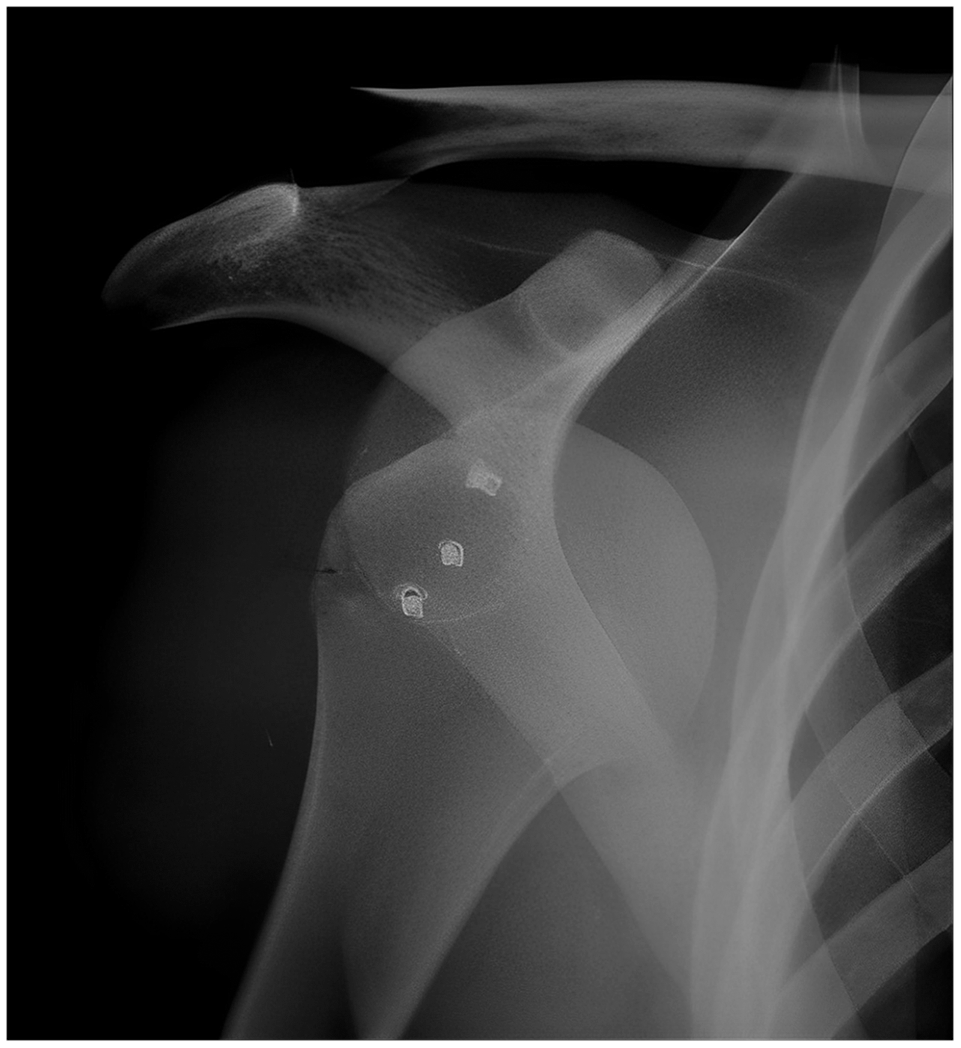
Radiograph of a 25-year-old man who had recurrent instability after Bankart repair.
Postoperatively, the majority of patients in both groups demonstrated excellent results, without statistically significant difference between groups (P = .82), regarding their return to daily and sports activities at the preinjury level. Concerning postoperative functional scores, the Rowe score was lower in the revision group, but the difference was not statistically significant. The VAS score was 1 point higher in the revision group, which could be considered clinically relevant although not statistically significant. Patients undergoing a primary Latarjet procedure showed better results for the OSI score (P = .007).
Although no major complications were noted in any patient, 2 patients (1 from each group) returned to our outpatient clinic with redislocation after traumatic events (car accident and contact sports injury). Subjective instability was reported in 4 patients (9.3%) in the primary Latarjet group and 2 patients (11.7%) in the revision Latarjet group, with no statistically significant difference between the groups (P = .77).
Outcomes of the patients are summarized in the Table 2.
Outcomes of the Patients a
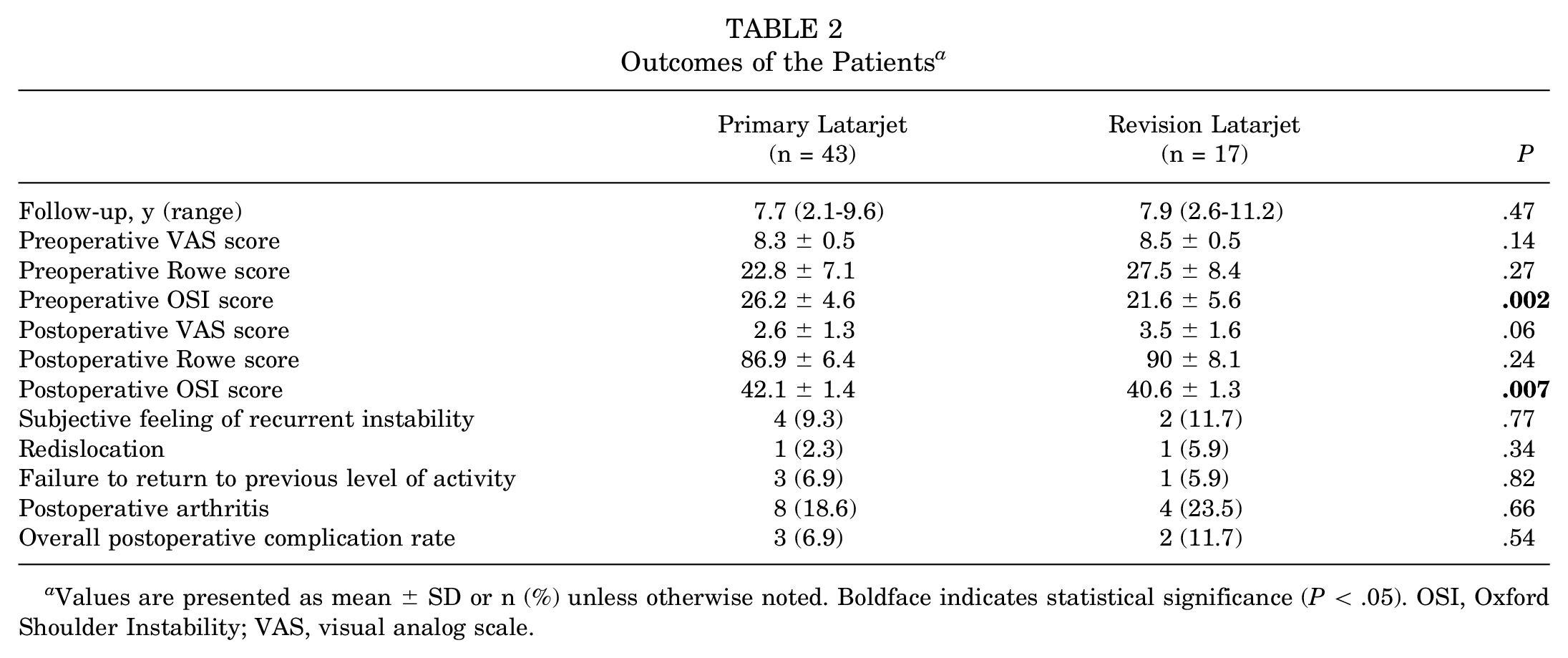
Values are presented as mean ± SD or n (%) unless otherwise noted. Boldface indicates statistical significance (P < .05). OSI, Oxford Shoulder Instability; VAS, visual analog scale.
Postoperatively, glenohumeral arthritis (grade I) was noted 8 patients (18.6%) in the primary Latarjet group and 4 patients (23.5%) in the revision group; however, this difference was not statistically significant (P = .66). Notably, none of the patients in our series were recorded to have arthritis grade II or III (Figure 3).

Radiograph of a 29-year-old man 10 years after revision Latarjet procedure; Samilson-Prieto classification grade 0.
Discussion
The study confirms that the Latarjet procedure effectively manages anterior glenohumeral instability in the setting of either a primary stabilization operation or a revision procedure after a failed ABR. Our findings revealed no statistically significant differences in the Rowe and VAS scores, rate of recurrence, rate of midterm postoperative arthritis, and complication rates between the primary and revision Latarjet groups. Regarding the statistically significant, worse postoperative instability status in the revision group, as expressed through the OSI score, this difference appears to be influenced by the markedly lower preoperative scores in this group compared with the primary Latarjet group. However, the difference in postoperative OSI scores between the 2 groups was 1.5 points, which is below the minimal clinically important difference (MCID) of 8.6 for the OSI, 9 indicating that the difference may not be clinically important. The aforementioned findings adequately support the assumption that a failed Bankart repair can be revised by a Latarjet procedure with a similar result to a primary Latarjet, in relation to postoperative pain and functional outcomes. The preference of many surgeons for ABR in patients with subcritical bone loss as the primary approach in indicated cases remains well-supported in the literature,2,20 given the satisfactory functional outcomes and low complication rates of ABR. Our findings suggest that in cases where the ABR fails, the Latarjet procedure serves as an effective revision option with favorable outcomes. Managing a failed ABR with the Latarjet procedure is widely accepted, whereas a failed Latarjet procedure remains significantly more challenging, with poor functional outcomes and relatively high recurrence rates.10,17
Some studies support that a revision Bankart repair may be used and can provide satisfactory postoperative outcomes. A systematic review by Yon et al 28 demonstrated that the mean rate of recurrent instability after revision ABR was 15.3%, and an additional re-revision procedure was needed only in 6.5% of the cases. Nevertheless, the overwhelming majority of the literature indicates the contrary. Blackman et al 5 detected a 17% failure rate among adolescent athletes who underwent the Bankart procedure in the revision setting. Moreover, a recent study by Slaven et al 25 presented a failure rate of 44% after revision ABR in a young, active military population. Haskel et al 11 conducted a systematic review of 14 studies and reported that the mean postoperative Rowe score at a mean follow-up of 36 months was satisfactory (84.2%), the rate of recurrent instability was high (26.2%), and the rate of return to preinjury sports level was low (47.5%).
The superior reliability of the open Latarjet procedure regarding shoulder stability over time compared with the arthroscopic Bankart procedure was well established in a study by Bessière et al. 4 Patients who underwent open Latarjet had less recurrent instability than those who underwent arthroscopic Bankart (10% vs 22%, respectively; P = .026) and had better Rowe scores over a mean 6-year follow-up (78 vs 68, respectively; P = .018). Further evidence of the superiority of the Latarjet procedure even against enhanced Bankart techniques was provided by Zimmermann et al. 29 According to their study, ABR was inferior to open Latarjet for repair of recurrent anterior shoulder dislocation, and the difference between the procedures regarding the quality of outcomes significantly increased with follow-up time. 29
Our findings align with those of a recent systematic review by Karavan et al 15 in relation to rates of redislocation and return to play. The most significant outcome of our study, which is that patients’ functional outcomes after revision Latarjet versus primary Latarjet did not differ significantly, was not included in Karavan's comparative parameters. In contrast to our findings, Karavan et al concluded that patients who underwent a Latarjet procedure as primary surgery had a significantly lower rate of recurrent instability and complications. However, a recent study evaluating the outcomes of arthroscopic Latarjet after failed Bankart repair demonstrated that the revision Latarjet may achieve favorable clinical outcomes and a low recurrence rate. 6
Some studies have indicated that performing a Latarjet procedure as a revision surgery after ABR can have detrimental effects on outcomes. Schmid et al 23 found that the Latarjet procedure effectively restored stability after a failed ABR but was linked to poorer functional outcomes and persistent pain. Similarly, Flinkkilä et al 8 reported worse patient-reported outcome measures, showing that a previous ABR was a significant risk factor for inferior outcomes. However, no difference was observed regarding recurrent dislocation, major complications, and the necessity for revision surgery. Werthel et al 26 found significantly inferior functional outcome scores and increased postoperative pain among patients undergoing Latarjet as revision surgery, suggesting that surgeons should consider these inferior results when determining the optimal surgical management for recurrent instability. Although the cause of potential inferior functional outcomes is unknown, the leading hypothesis is the presence of scar tissue in the operating field, a defective subscapularis tendon, and an inferiorly positioned graft in the setting of altered anatomic characteristics. 15 In our study, in contrast, the majority of functional outcome scores (VAS, Rowe) and rates of postoperative pain were similar without statistically significant deviations in patients undergoing a Latarjet procedure after a failed ABR when compared with patients undergoing primary Latarjet.
The literature has reported very high rates (up to 59.4%) of glenohumeral arthritis after ABR at long-term follow-up of at least 10 years14,19; however, in our cohort, with a comparatively shorter follow-up period, the rate of degenerative arthritis in the revision group was relatively low. Studies have demonstrated a correlation between the number of instability episodes and the risk of arthritis. 1 Patients left untreated for recurrent instability demonstrate a higher incidence of severe arthropathy compared with those managed with surgery 13 ; therefore, we attribute the low incidence of arthritis to the brief interval between failed primary ABR and revision Latarjet and/or the medium-term follow-up period of our study. Consistent with our findings, Bauer et al 3 reviewed the literature and concluded that there is no evidence of differences in osteoarthritis rates between Bankart repair and the Latarjet procedure, as long as there are no technical errors, and, moreover, that Latarjet procedures do not seem to increase the risk of osteoarthritis if the bone block is not lateralized. Interestingly, we found no correlation between the severity of arthritis and patients’ functionality or their ability to resume daily and sports activities.
Increasing evidence from mid- and long-term studies indicates that in patients with risk factors, the primary Latarjet may be a preferable option for anterior shoulder instability.3,18 Patients at the highest risk of failure are young patients and those with bone loss with a continuing decrease in its threshold among the latest studies. Although the literature strongly suggests that revision Latarjet after failed Bankart repair is inferior to primary Latarjet in terms of clinical scores, complication rates, and recurrent instability, our findings indicate that attempting a primary ABR, with the option to perform a revision Latarjet if needed, remains a reasonable and realistic surgical strategy.15,16,26 Prerequisites for this strategy are the discrimination of patients who have an absolute indication for primary Latarjet and state-of-the-art performance during ABR.
Limitations
This study has certain limitations. It was conducted as a retrospective cohort study, where the clinical findings pre- and postoperatively were obtained in this manner. Selection bias is present in this study because patients were selected for the primary Latarjet operation based on their radiographic examination rather than through randomization.
The relatively short minimum follow-up of several cases in our study, particularly for evaluating osteoarthritis, is a limitation. Although we included all eligible patients in order to preserve statistical power, the broad range of follow-up durations (2-11 years) may have affected the assessment of long-term outcomes. Future studies with a longer minimum follow-up and detailed time-to-event analysis are necessary to validate these findings.
All patients in the revision group underwent ABR in another surgical center, except for 3 cases. Several drawbacks arise from this, including possible performance bias in surgical technique by low-volume surgeons, lack of complete clinical and radiologic findings before ABR when patients presented to our department, and whether there were strong indications for performing an ABR as the primary intervention.
The majority of patients did not undergo CT postoperatively. Thus, we could not evaluate and compare several significant findings between the 2 groups, such as graft osteolysis or graft positioning. Moreover, given the limited number of patients undergoing the Latarjet procedure, particularly as a revision after failed ABR, the cohort size in our study was relatively small. This may have reduced the statistical power to detect differences in certain outcomes. Finally, the absence of a formal power analysis is a limitation of this study.
Conclusion
The Latarjet procedure, performed either as a primary or a revision procedure after failed ABR, prevents chronic anterior shoulder instability and is associated with high levels of patient satisfaction. Although functional outcome scores, postoperative pain, and recurrence rates showed no significant differences between the 2 groups, OSI scores were marginally lower in patients undergoing revision Latarjet compared with primary Latarjet, although the difference was less than the MCID. Our findings suggest that a primary ABR, with revision Latarjet surgery for failures, is a realistic surgical option.
Footnotes
Final revision submitted January 31, 2025; accepted February 27, 2025.
The authors have declared that there are no conflicts of interest in the authorship and publication of this contribution. AOSSM checks author disclosures against the Open Payments Database (OPD). AOSSM has not conducted an independent investigation on the OPD and disclaims any liability or responsibility relating thereto.
Ethical approval for this study was waived by University General Hospital of Larissa.
