




Abstract
Background:
Anterior cruciate ligament (ACL) injuries can pose significant challenges for athletes, leading to significant morbidity, loss of playing time, and impaired performance. Neuromuscular training programs, such as the FIFA 11+, have shown promise in reducing the risk of lower extremity injuries in this high-risk population.
Purpose/Hypothesis:
The purpose of this study was to evaluate the effect of the FIFA 11+ program on lower extremity biomechanics during a drop vertical jump (DVJ) and to determine whether it modifies the athlete's risk of an ACL injury. It was hypothesized that the FIFA 11+ program would positively affect lower limb biomechanics during a DVJ in varsity athletes by decreasing initial coronal (IC) and peak coronal (PC) knee abduction angles while increasing peak sagittal (PS) knee flexion angles.
Study Design:
Cohort study; Level of evidence, 2.
Methods:
A total of 36 collegiate varsity athletes (72 knees) were recruited for this investigation. The intervention group included female and male soccer players who incorporated the FIFA 11+ program into their pregame warm-up. The control group consisted of female hockey players who participated in a “standard” warm-up. The FIFA 11+ program was conducted twice weekly over 10 weeks. Biomechanical data before and after the intervention during DVJs, captured using a motion sensor, were compared between the intervention and control groups.
Results:
The intervention group showed a significant reduction in PC angles from high risk to low risk and a significant decrease in PS angles, while IC angles remained unchanged. Conversely, the control group showed a significant increase in IC angles from low risk to high risk, with no notable changes in PC and PS angles.
Conclusion:
This study demonstrated that the FIFA 11+ program effectively reduced PC knee abduction angles, with a decrease in this parameter indicating an overall shift from high- to low-risk biomechanics in the intervention group. Additionally, worsening postseason knee biomechanics in the control group highlighted that the injury risk increased throughout the season when a targeted neuromuscular training program was not incorporated into pregame warm-ups. This suggests that the FIFA 11+ program mitigates key biomechanical risk factors for noncontact ACL injuries.
Keywords
Anterior cruciate ligament (ACL) injuries represent a major concern within the realm of sports, especially for competitive athletes. Epidemiological research has highlighted a 4-year incidence rate exceeding 3% for ACL injuries among university-level athletes, pinpointing soccer and gymnastics as higher risk sports. 15
More importantly, ACL tears lead to a significant loss of playing time for high-level athletes, in addition to imparting a significant financial burden on health care systems. 20 A recently published study found that elite soccer players demonstrated inferior performance for 2 seasons when returning from their injury, with a 12% risk of second ipsilateral or contralateral ACL tears. 7 Thus, the adoption of efficacious prevention strategies to help mitigate the risk of ACL injuries is desired.
One such strategy is the FIFA 11+ neuromuscular training program. Initially developed for soccer, it has demonstrated efficacy across various sports. 14 Evidence suggests that it markedly reduces lower extremity injuries, with a meta-analysis reporting a 43% reduction in the injury incidence compared with controls. 8 Comprising exercises aimed at bolstering neuromuscular control, functional balance, and the strength of lower extremity and core muscles, the program effectively counters multiple ACL injury risk factors, such as adjacent muscle strength and core stability. 3 However, despite strong support for its effectiveness, there is a paucity of research investigating the biomechanical underpinnings of the clinical success of this program.
The purpose of this investigation was to provide a deeper understanding of how the FIFA 11+ program mitigates the risk of ACL injuries by examining its influence on the biomechanics of the drop vertical jump (DVJ). Increased initial coronal (IC) and peak coronal (PC) abduction and decreased peak sagittal (PS) flexion during a DVJ have been shown to be associated with an increased risk of ACL injuries.4,10 We hypothesized that the FIFA 11+ program would positively affect lower limb biomechanics during a DVJ in varsity athletes by decreasing IC and PC knee abduction angles while increasing PS knee flexion angles compared with controls.
Methods
Ethical approval was received from the Research Ethics Office of the Faculty of Medicine and Health Sciences before the start of this investigation. Informed consent was obtained from all participants in this study. The enrollment period lasted from July to November 2023.
Participant Enrollment
Collegiate male and female varsity athletes were prospectively enrolled in the study from 1 university. Male and female soccer players who started the FIFA 11+ program as a part of their mandatory in-season pregame warm-up were selected as the intervention group. No other varsity teams implemented this neuromuscular training program, thus limiting the size of the intervention group. The control group consisted of female ice hockey players who underwent their regular nonstructured warm-up before practices and games. Scheduling conflicts and lack of participation limited other varsity teams from joining the control group. Participants were excluded from data collection if they were aged <18 years, were currently concussed, were experiencing knee pain, or had a performance-limiting lower limb injury at the time of consent. Data collection included demographic characteristics, type of sport played, self-reported injuries, and kinematic jump data.
Implementation of FIFA 11+ Intervention
Participants in the intervention group began the FIFA 11+ program the week after their preintervention DVJ, and the postintervention DVJ was performed the week after completion of the program. The athletes performed all 3 parts of the program (part 1: running exercises; part 2: strength, plyometric, and balance exercises; part 3: running exercises), totaling 15 exercises twice per week for 10 weeks (Table 1). These sessions were supervised by the team strength and conditioning coach or the athletic therapist to ensure the proper technique and execution of exercises. All athletes began at level 1 of the program, progressing to the following level every 4 weeks.
Exercises in FIFA 11+ Program 12
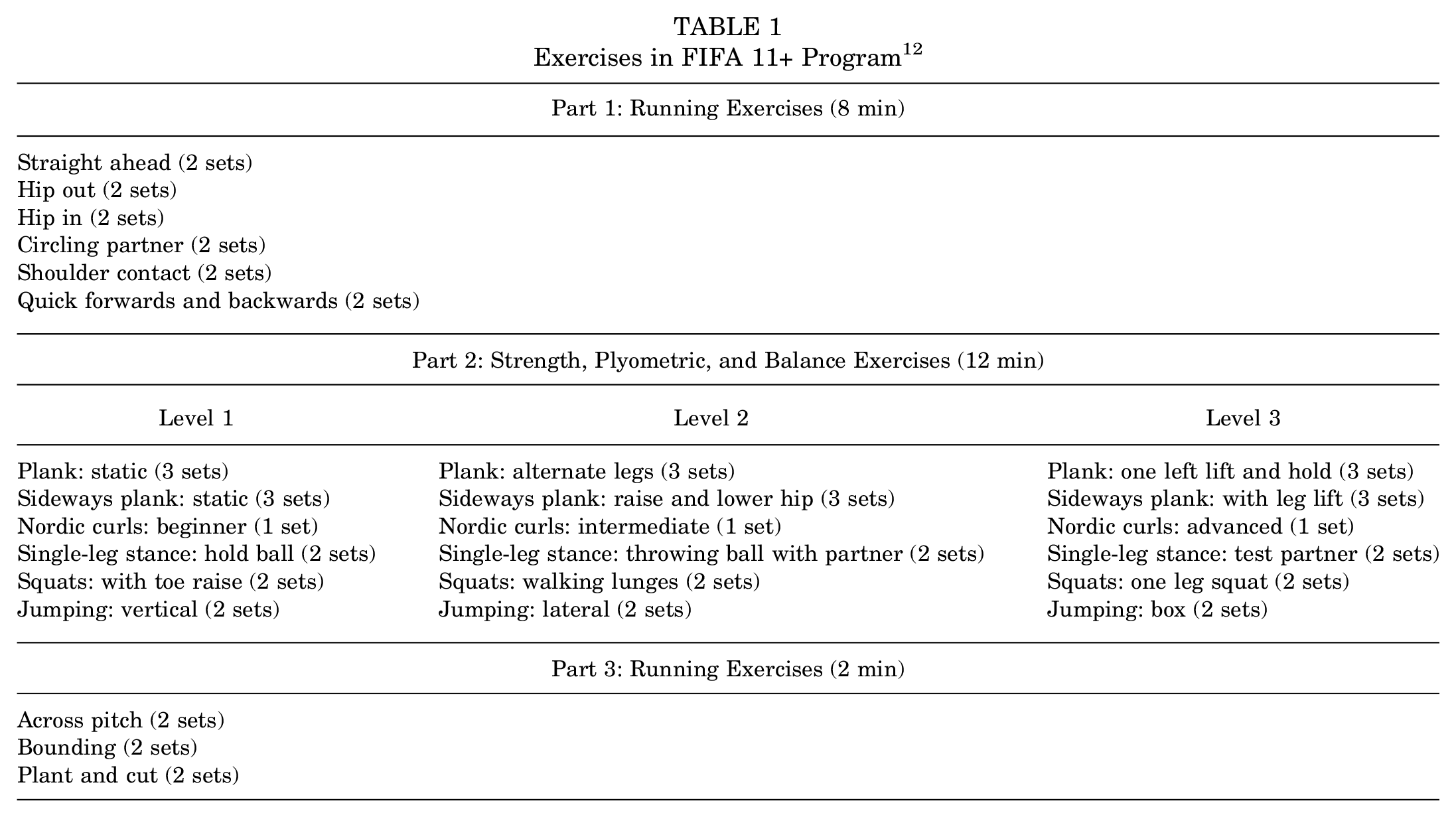
Attendance was tracked throughout the course of the study. Participants were excluded from data analysis if they were unable to perform the preintervention or postintervention DVJ because of an injury or absence at the data collection sessions, if they were absent for ≥3 consecutive training sessions, or if they missed >5 training sessions throughout the implementation of the FIFA 11+ program, regardless of the reason. In the case of missing data, those sets of jumps were not included in statistical analysis. To diminish confounding factors and bias, the control group underwent its non–sport-specific warm-up off ice. Preintervention and postintervention DVJs were performed 10 weeks apart in both groups.
Data Capture
Testing was conducted during the athletes’ practice sessions before and after the intervention. Participants performed a DVJ in front of a Kinect sensor (Version 2; Microsoft), connected to a personal computer running custom software, which used Kinect's skeleton tracking to capture and store the positions of 25 joints over a recorded period. The sensor was mounted onto a tripod 2.5 m away from the athletes, who were instructed to perform 3 consecutive DVJs from a 31-cm box, following the instructions used by Corban et al. 4 The Kinect system has been shown to have excellent agreement with the gold-standard Vicon system for analysis of knee coronal and sagittal angles during a DVJ. 11 This popular plyometric exercise is thought to increase coordination and explosive power in athletes, which is not only beneficial for injury prevention but could also be a tool to highlight athletes’ weaknesses that could lead to a lower limb injury, such as an ACL tear.
Each DVJ was recorded separately, and precise bilateral knee coronal and sagittal angles were calculated using the following formulas:


For all jumps, we looked at IC angles, defined as initial contact with the floor; PC angles, defined as peak knee abduction after initial contact and before toe-off; and PS angles, defined as peak knee flexion after initial contact and before toe-off. These key angles were automatically extracted using an algorithm based on kinematic triggers, such as the ankle velocity nearing zero upon first contact with the floor and the moment when the distance between the hips and ankles was the smallest to achieve peak flexion. The joint positions of the lower limbs were passed through an unconstrained Kalman filter based on the one used by Musunuri and Kwon. 16
Statistical Analysis
The Shapiro-Wilk test was used to determine the normality of each DVJ parameter. Baseline parameters were compared between the intervention and control groups using the independent-samples t test and the Mann-Whitney U test for parametric and nonparametric parameters, respectively. The paired-samples t test was used to compare parameters between preseason and postseason. The change in DVJ parameters was compared between study groups with the independent-samples t test. Knee angles were classified as high risk based on published cutoffs by Corban et al 4 : IC angle >2.96°, PC angle >6.16°, and PS angle <93.82°. Any athlete with knee angles outside of these values was considered to have a low risk for ACL injury. The McNemar test was used to compare the proportion of knees displaying high-risk angles between preseason and postseason for both study groups. Statistical analyses were performed using SPSS software (Version 27; IBM).
A priori power analysis using G*Power (Version 3.1.9.7) indicated that the required sample size to achieve 80% power with an alpha of .05 and an effect size of 0.5 was 34 for the paired-samples t test and 64 for the independent-samples t test. The required sample size to achieve 80% power with an alpha of .05, odds ratio of 5, and proportion of discordant pairs of 0.3 was 57 for the McNemar test.
Results
Participant Characteristics
Participant characteristics are reported in Table 2, and participant eligibility is described in Figure 1. A total of 11 female and 4 male university-level soccer athletes completed the FIFA 11+ program over the season, amounting to 30 individual knees for the intervention group. Also, 21 female university-level hockey athletes completed the season with standard warm-up activities, amounting to 42 individual knees for the control group. There were no reported ACL injuries in either of the groups. Additionally, an intervention subgroup was formed consisting of the female athletes in the intervention group (male participants excluded).
Participant Characteristics a

Data are presented as mean ± SD or n (%).

STROBE (Strengthening the Reporting of Observational Studies in Epidemiology) flow chart. DVJ, drop vertical jump.
Baseline DVJ Parameters and Risk Status
In the intervention group at preseason, mean IC and PC angles were in the high-risk range, while mean PS angles were in the low-risk range. In the control group, the mean IC, PC, and PS angles were all in the low-risk range. The mean PC angle (7.61°± 3.04° vs 5.78°± 2.68°, respectively; P = .004) and PS angle (105.05°± 14.91° vs 100.26°± 11.70°, respectively; P = .047) were significantly greater in the intervention group compared with the control group at baseline.
DVJ Parameters Between Preseason and Postseason
In the intervention group, there was no significant difference in the mean IC angle between preseason and postseason. There was a significant decrease in the mean PC angle from the high-risk range to the low-risk range (from 7.61°± 3.04° to 5.18°± 1.99°; P < .001) and a statistically significant reduction in the mean PS angle within the low-risk range (from 105.05°± 14.91° to 96.05°± 15.56°; P < .001) (Table 3).
DVJ Parameters Between Preseason and Postseason a
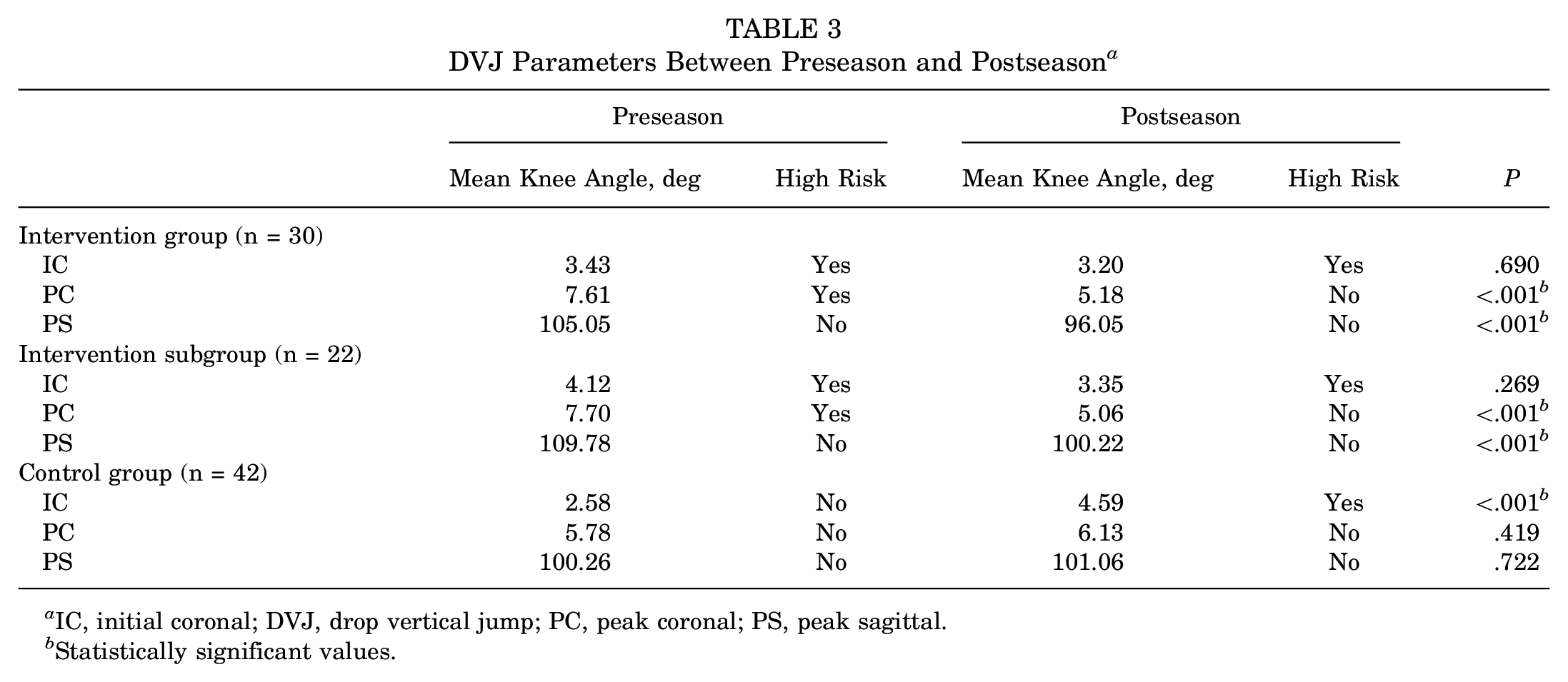
IC, initial coronal; DVJ, drop vertical jump; PC, peak coronal; PS, peak sagittal.
Statistically significant values.
In the control group, there was a statistically significant increase in the mean IC angle from the low-risk range to the high-risk range (from 2.58°± 2.77° to 4.59°± 2.86°; P < .001). There was no significant difference in mean PC and PS angles between preseason and postseason (Table 3). Subgroup analysis comparing the female athletes of the intervention group and the control group followed a similar trend between preseason and postseason as reported for the overall intervention group. There was a statistically significant reduction in the mean PC angle (from 7.70°± 3.32° to 5.06°± 1.98°; P < .001), taking the athletes from high risk at preseason to low risk at postseason. There was also a significant reduction in the mean PS angle within the low-risk range (from 109.78°± 10.20° to 100.22°± 14.43°; P < .001), indicating that both the intervention group and intervention subgroup had a slightly increased risk at postseason.
Change in DVJ Parameters Between Intervention and Control Groups
There was a statistically significant difference in the mean change in IC angles (–0.23°± 3.10° vs +2.01°± 2.94°, respectively; P = .003), PC angles (–2.43°± 2.90° vs +0.35°± 2.77°, respectively; P < .001), and PS angles (–9.00°± 9.49° vs +0.80°± 14.42°, respectively; P = .002) between the intervention group and control group (Table 4). Additionally, there was a statistically significant difference in the mean change in IC angles (–0.76°± 3.16° vs +2.01°± 2.94°, respectively; P < .001), PC angles (–2.64°± 3.24° vs +0.35°± 2.77°, respectively; P < .001), and PS angles (–9.56°± 10.13° vs +0.80°± 14.42°, respectively; P = .004) between the intervention subgroup and control group (Table 5). The mean change in IC and PC angles was in the direction of decreasing risk in the intervention group and intervention subgroup but in the direction of increasing risk in the control group, while the mean change in PS angles was in the direction of increasing risk in the intervention group and minimally decreasing risk in the control group.
Change in DVJ Parameters Between Intervention and Control Groups a

IC, initial coronal; DVJ, drop vertical jump; PC, peak coronal; PS, peak sagittal.
Statistically significant values.
Change in DVJ Parameters Between Intervention Subgroup and Control Group a

IC, initial coronal; DVJ, drop vertical jump; PC, peak coronal; PS, peak sagittal.
Statistically significant values.
High-Risk Knees Between Preseason and Postseason
In the intervention group and intervention subgroup, there was no significant change in the proportion of knees exhibiting high-risk IC angles between preseason and postseason. There was a significant reduction in the proportion of knees exhibiting high-risk PC angles between preseason and postseason in the intervention group (20 [67%] vs 9 [30%], respectively; P = .003) and the intervention subgroup (14 [64%] vs 6 [27%], respectively; P = .021).
In the control group, significantly more knees exhibited high-risk IC angles at postseason compared with preseason (30 [71%] vs 19 [45%], respectively; P = .007). There was a nonsignificant increase in the proportion of knees exhibiting high-risk PC angles at postseason compared with preseason (18 [43%] vs 17 [40%], respectively; P > .999) (Table 6). There was no significant difference in the proportion of knees exhibiting high-risk PS angles between preseason and postseason for both groups.
High-Risk Knees Between Preseason and Postseason a
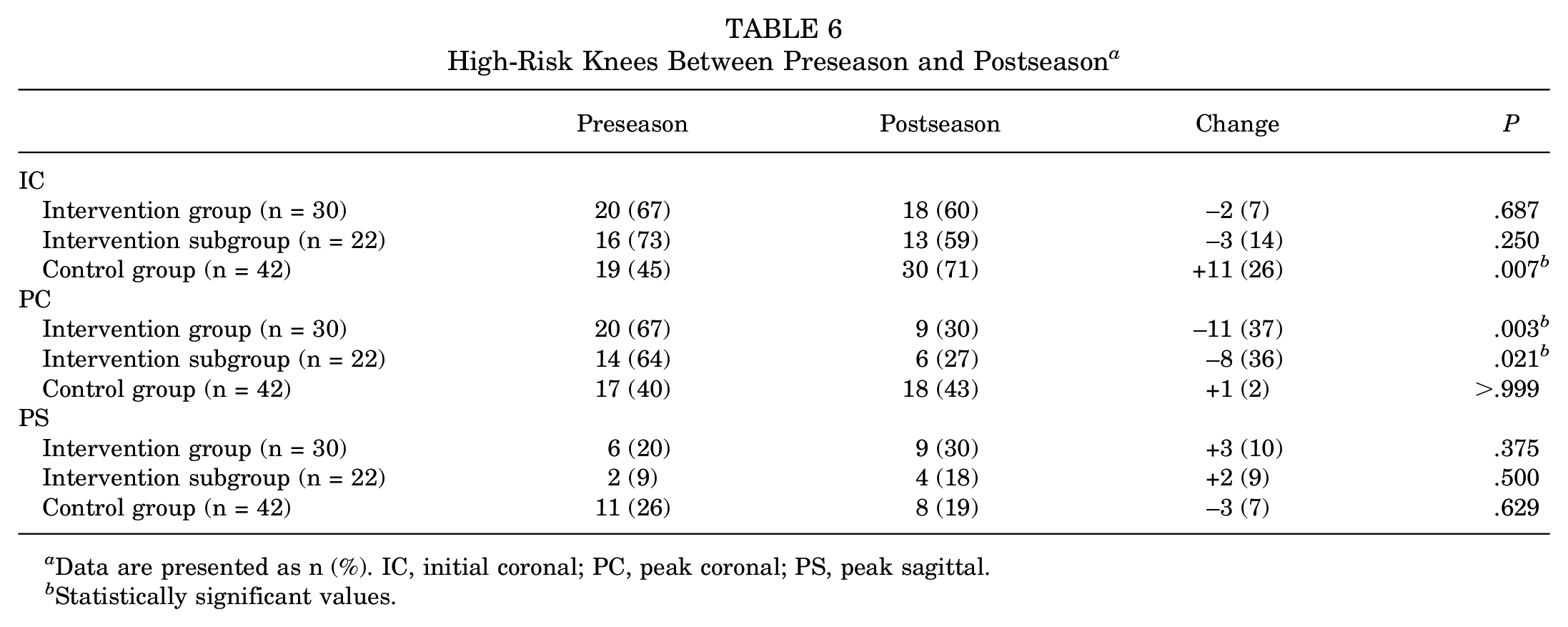
Data are presented as n (%). IC, initial coronal; PC, peak coronal; PS, peak sagittal.
Statistically significant values.
Discussion
The most important findings of this study were that the FIFA 11+ program was able to improve peak knee abduction angles during a DVJ, which decreased the risk of ACL injuries, whereas athletes who did not undergo neuromuscular training had worsening initial knee abduction angles and an increased risk of injuries at postseason. To the best of our knowledge, this is the first study to examine the effect of the FIFA 11+ program on knee biomechanics with associated risk stratification. Previous investigations have noted an association between high IC and PC angles and low PS angles and the risk of ACL injuries. 4 Our findings revealed that the FIFA 11+ program was associated with a reduction in PC angles, which is noteworthy because they identify a possible biomechanical target through which the program mitigates clinical factors. 10 Interestingly, the program was also associated with the recalibration of certain angles from high to lower risk angles within the intervention group in this study. Specifically, the decrease in PC angles resulted in a change from high to low risk for those in the intervention group and intervention subgroup, as defined by Corban et al. 4 Conversely, the control group demonstrated an increase in this parameter, indicating an elevated injury risk in athletes who did not perform neuromuscular training on a regular basis compared with their baseline. The comparable findings between the subgroup analysis with male participants excluded and the main analysis suggest that the trends of a decreased ACL injury risk with the implementation of the FIFA 11+ can be applicable to both female and male athletes. Although contrary to our initial hypothesis, the PS angle decreased in the intervention group, which suggests a heightened risk; however, it still did not surpass the “high-risk” threshold.
Upon comparison with the current literature, our findings diverge in the context of knee abduction and flexion angles in which evidence remains mixed. For instance, Arundale et al 2 reported no significant changes in PS flexion angles during a DVJ after the implementation of the FIFA 11+, in contrast to our observations suggesting an increased risk for athletes when using this parameter. As for IC and PC abduction angles, only 1 of 3 previous studies demonstrated results similar to those presented in our investigation, with one finding a positive effect on the abduction angle, 21 another finding no significant effect, 6 and the third finding a significant increase in the abduction angle. 2
The outcomes observed in this study may be explained by focusing on the specific muscle targets of the training program. The FIFA 11+ enhances the strength of the quadriceps and hamstring, which, according to a meta-analysis by Cronström et al, 5 are factors associated with a decreased knee abduction angle. Furthermore, an investigation by Nakase et al 17 revealed heightened activation in the hip abductor muscles among athletes participating in the FIFA 11+ program, which was later found to be associated with a reduction in the knee valgus angle. 1
As discussed above, our study found a decrease in PS angles within the intervention group, although this decline did not change the athletes’ risk classification. We hypothesize that this can be attributed to in-season fatigue, as athletes will land on a stiffer leg to avoid excessive loading and eccentric contraction of the hamstring muscle, which increases the ACL injury risk. 4 This is supported by the study of Santamaria and Webster, 19 which showed evidence of greater PS angles of the knee on testing before fatigue versus after fatigue. This could explain the worsening PS angles at postseason, despite improvements in IC and PC angles in the intervention group. In the control group, there was a slight reduction in the proportion of high-risk knees when evaluating PS angles that was not statistically significant. Although both the intervention and control groups completed their own respective warm-up for 10 weeks, we attribute some of the observed differences in outcomes to both the sport and the time of the athletic season at which the data were collected. The intervention group consisted of soccer players, and the 10 weeks of the program occurred at the time of their playoffs when they were playing multiple games per week. On the other hand, the control group of hockey players was also examined in-season; however, their weekly game frequency was lower because their season had recently begun.
Previous research by Walsh et al 22 found an inverse association between the quadriceps-to-hamstring activation ratio and knee flexion at initial contact, highlighting the significance of enhancing hamstring strength for injury prevention. Exercises such as Nordic curls, integral to the FIFA 11+ program, are recommended for this purpose. However, the outcomes of our study suggest quadriceps dominance among the soccer athletes that could explain the unforeseen finding of decreased PS angles. This result underlines a critical area for further investigation into the FIFA 11+ program's effect, suggesting that some athletes may need more targeted hamstring strengthening than the program currently offers.
The findings of the current study demonstrated the importance of implementing the FIFA 11+ program across the athletic spectrum and not limiting its use to those identified as high risk. Our analysis revealed a concerning trend among athletes not participating in the FIFA 11+ program: their biomechanics progressively aligned with patterns known to elevate the lower extremity injury risk, potentially due to fatigue over the course of the season, 19 with IC and PC angles both increasing over the course of the study. This dichotomy compared with the intervention group highlights the preventive value of the FIFA 11+ program, regardless of an athlete's initial risk categorization, while underscoring the necessity of preemptive measures to safeguard athletes from evolving to high-risk profiles over time.
Moreover, the importance of the FIFA 11+ for athletes with a history of ACL injuries cannot be overstated. Given the dramatically increased risk of subsequent injuries in this population—30 to 40 times higher than that of uninjured peers 23 —the program's importance is magnified. It serves as a critical mode of secondary prevention for these patients.
Beyond the necessity of the program, the practicality of integrating the FIFA 11+ into university-level sports routines warrants consideration of its feasibility, cost-effectiveness, and accessibility. A systematic review evaluating the program's cost benefits revealed an average savings of €462 per athlete each season, 9 presenting a compelling case for its adoption from a financial standpoint. Furthermore, a randomized controlled trial highlighted the effect of in-person coach education on enhancing adherence to neuromuscular training programs, which also led to an improvement in the athletes’ execution of these regimens. 13 These data underscore the dual benefits of such educational initiatives in promoting both program fidelity and athlete safety.
Limitations
It is important to note that this study is not without limitations. Primarily, the study's design was nonrandomized, leading to a potential introduction of bias in the outcomes. Specifically, the intervention group comprised soccer players of both sexes, whereas the control group consisted solely of female ice hockey players. This distinction in group composition is notable because female patients have been widely recognized as being at a higher risk of ACL injuries compared with male patients. 18 Also, the inherent risk of ACL injuries varies from sport to sport, with a higher risk among athletes participating in cutting sports such as soccer, 18 further complicating the direct comparison and generalization of the findings. An additional limitation of our study was the slight reduced statistical power in the intervention group (n = 30 knees), resulting from substantial participant exclusion and dropout (see Figure 1). There is a significant challenge working with student-athletes, given their busy schedules that involve both heavy academic and athletic obligations as well as limitations in participation because of previous injuries and short varsity preseason preparation. This highlights the considerable obstacle of implementing injury prevention programs for the highest risk athletes, who, despite their need for such interventions, often face scheduling conflicts that hinder team participation. This suggests a growing need for enhanced educational efforts that emphasize the benefits of prioritizing the quality over quantity of training for varsity athletes. Additionally, improved collaboration between universities and their athletic departments is crucial to support student-athletes in achieving a sustainable balance between their academic, athletic, and personal lives. These limitations should be considered when interpreting the outcomes of this study.
Conclusion
To conclude, our study demonstrated that the FIFA 11+ program effectively reduced PC knee abduction angles, with mean decreases in this parameter being significantly greater than the control group and indicating an overall shift from high- to low-risk biomechanics in the intervention group. Additionally, the increase in postseason IC angles in the control group highlighted that in the absence of a targeted neuromuscular intervention, knee biomechanics deteriorated throughout the course of a season. Moreover, this study supports that postseason fatigue can lead to a decrease in PS knee flexion angles.
Footnotes
Final revision submitted November 14, 2024; accepted December 30, 2024.
One or more of the authors has declared the following potential conflict of interest or source of funding: Donations were received from the Montreal General Hospital Foundation, Emovi, and MEDTEQ+. AOSSM checks author disclosures against the Open Payments Database (OPD). AOSSM has not conducted an independent investigation on the OPD and disclaims any liability or responsibility relating thereto.
Ethical approval for this study was obtained from Concordia University (No. 30016828) and McGill University (No. A02-M35-17A).
