




Abstract
Background:
Burnout has been associated with decreased quality of patient care and results in an estimated cost of roughly $5 billion per year. With a growing awareness of burnout prevalence in high-level athletes, the physicians working with the athletic departments of the National Collegiate Athletic Association (NCAA) institutions can be forgotten.
Purpose:
To assess the prevalence of burnout among physicians of the NCAA teams and assess predictors that may lead to burnout.
Study Design:
Cross-sectional study.
Methods:
A cross-sectional survey using the Professional Fulfillment Index scale with demographic data was sent to multiple Division I NCAA conferences. Eligible participants included any physicians who care directly for Division I NCAA teams. Each item was assessed on a 5-point Likert scale, and comparisons were made between those who did and did not achieve burnout. Linear and logistic regression models were used to assess predictors of burnout score and achievement of burnout, respectively.
Results:
Of the 89 completed responses, 79 (79/89; 89%) participants qualified as having achieved burnout. No significant differences were identified in burnout achievement based on patient demographics. Specifically, there was no difference in burnout achievement based on specialty (P = .16), taking call (P = .05), or years in practice (P = .12). A linear regression model showed that the only significant predictor of burnout score was specialty, with family medicine–sports medicine and Other both associated with greater burnout scores (P < .001 and P = .002, respectively) compared with orthopaedics.
Conclusion:
The prevalence of burnout in NCAA physicians is extremely high, even compared with the rate of other physicians, and the lack of predictive factors shows this issue to be multifactorial. Further studies need to be conducted with larger sample sizes, as well as isolating historical factors of burnout, to better improve the health of this unique physician population.
Burnout is a growing problem in the medical community that has been present for decades but was further brought to the forefront with the COVID-19 pandemic. This issue is shown to be higher in physicians compared with the general population, with studies showing physician burnout as high as 63%.22,25,28 Most definitions of burnout stem from Maslach and Jackson, 19 who described burnout as a combination of emotional exhaustion, depersonalization, and low personal accomplishment caused by the chronic stress of medical practice. Such an issue affects not only the physician but has also been associated with increased patient safety incidents, patient dissatisfaction, and decreased quality of patient care and has resulted in an estimated cost of $5 billion per year related to clinical productivity and increased physician turnover.10,11,30
The discussion of burnout is on the rise in high-level athletics, specifically at the National Collegiate Athletic Association (NCAA) Division I level. Previous studies have shown that stress and coaches’ pressure to medically clear athletes were predictors of burnout ratings in college athletic trainers. 16 Similar factors could be affecting NCAA physicians, who also share the responsibility to medically clear athletes before they may return to play. Additionally, perceived stress in college coaches was positively associated with burnout and negatively associated with well-being. 32 Therefore, it is fair to say that burnout associated with athletics at such a high level can create unique factors and circumstances that make generalized physician burnout findings difficult to apply to NCAA physicians due to the high-stakes and unique platform created by NCAA athletics.
There is a recent push to bring mental health awareness and sports psychology to the forefront of athletics. A changing attitude about the topic has shown recent studies addressing burnout in collegiate coaches, athletes, and athletic trainers.2,8,16,32 However, there are limited data assessing the prevalence or severity of burnout in physicians working for the athletic departments of NCAA institutions. Therefore, the purpose of this study is to assess the prevalence of burnout among physicians employed at institutions working for the NCAA teams and assess for any predictors that may lead to burnout. Hypotheses include the following: (1) NCAA physicians will have burnout rates greater than the general rate of physicians (~63% in 2021), 28 (2) physicians working increased weekends or increased call shifts will have increased rates of burnout, and (3) younger physicians who are in their first 5 years of working with NCAA athletics will have higher rates of burnout compared with those >5 years into their careers.
Methods
A cross-sectional survey was distributed among NCAA institutions and their respective physicians via email to all known eligible contacts. The authors sent the survey link only to colleagues who were known to work with NCAA athletes and institutions. Due to concerns of reporting bias, the survey was distributed only to known eligible participants, with these participants encouraged to send it to other eligible participants as well. Institutional review board approval was obtained from the primary institution. Eligible participants included any physicians who worked directly with the Division I NCAA teams, either through direct employment by the institution’s health system, partnership with the physician’s practice, or on a volunteer basis. Participants were excluded if they were not actively working with NCAA at eligible institutions (Division I level of competition), were employed by universities but did not work with the respective NCAA teams, or if they did not graduate from an accredited MD or DO program. There was no limit on study size due to unreliable data regarding the true number of eligible participants (ie, physicians working with NCAA athletics).
Survey/Questionnaire
The initial 4-item instrument is to obtain consent of all participants, outlining the instructions, benefits, risks, and confidentiality that the survey entailed, as seen in the Supplemental Material, available separately (Table A1). This was the method used to obtain consent for all participants. This was followed by a 17-item demographic data form as seen in Supplemental Table A2. After completion of the consent form and the demographic data form, the Professional Fulfillment Index (PFI) survey was completed, as seen in Supplemental Table A3.
The PFI survey is a 16-item instrument that can be used to assess physicians’ self-fulfillment and burnout with 3 main components: professional fulfillment, work exhaustion, and interpersonal disengagement scales. 31 PFI was chosen over the Maslach Burnout Inventory (MBI) for an increased evaluation of intrinsic fulfillment factors not captured by the MBI.19,31 These items are on a 5-point Likert scale (0-4) using a frequency scale of not true to completely true, respectively, or not at all to extremely, respectively. 3 For this study, a burnout score of ≥1.33 was considered to be indicative of achieving burnout in accordance with data previously published by Trockel et al 31 showing a sensitivity of 0.72, 0.72, and 0.85 and a specificity of 0.84, 0.77, and 0.76 across 3 separate receiver operating characteristic analyses, respectively.
Participant sex, age range, medical specialty, years in practice, years working with NCAA-sponsored athletic programs, and call/weekend commitment of their role were assessed based on presence or no presence of burnout. Primary outcomes included participant demographics, burnout score, and achievement of the benchmark burnout score of 1.33. 31
Statistical Analysis
Descriptive analyses included counts and percentages of categorical data. Comparisons of categorical outcomes between physicians who did or did not achieve burnout were done using chi-square or Fisher exact tests as appropriate. Continuous outcomes between physicians who did or did not achieve burnout were first assessed for normality using Shapiro-Wilk tests and then compared using independent t tests or Wilcoxon ranked-sum tests as appropriate.
A multiple linear regression model for continuous burnout score was created with predictors including sex, age, years in practice, specialty, taking call, and number of call weekends per year. Analysis of variance (ANOVA) was used to evaluate the significance of the linear regression model and partial eta-squared was calculated to assess amount of burnout score variable described for each predictor. Logistic regression models for achieving burnout (score > 1.33) were created for each significant predictor of burnout score from the linear regression model. Statistical analyses were done in R (R Foundation for Statistical Computing Version 4.2.1) with significance set at α = .05.
Results
The survey was distributed to 97 eligible physicians, and of those, 89 were completed (91.8%) while 8 (8.2%) surveys were not completed entirely and were subsequently removed from analysis. These physicians provided care to athletes at NCAA institutions that competed in the Big 12, Big 10, and Atlantic Coast Conferences. No responses were received from Southeastern Conference or Pacific Coast Conference physicians. Of the 89 physicians who completed the survey, 79 (79/89; 89%) participants qualified as having achieved burnout while only 10 (11%) participants qualified as having not achieved burnout. 31
Demographics
Table 1 summarizes physician demographics. There were no significant differences in burnout group comparison with participant demographics, including sex, age, specialty, and call schedules.
Summary of NCAA Physician Demographics and Comparisons Between Those Who Did and Did Not Achieve a PFI Burnout Score of ≥1.33 a

EMSM, emergency medicine–sports medicine; FMSM, family medicine–sports medicine; NCAA, National Collegiate Athletic Association; Orthop, orthopaedic; PFI, Professional Fulfillment Index; PMRSM, physical medicine and rehabilitation–sports medicine.
Percentages listed under “Total” column indicate comparison between participant demographic answers, while percentages listed under “Burnout” columns indicate comparison between participants listed in the respective row.
No significant differences in participant demographics were seen between those who achieved burnout and those who did not. Specifically, there was no difference in burnout achievement based on specialty (P = .16), taking call (P = .05), or years in practice (P = .12). There was also no significant difference in burnout between those physicians within the first 5 years of practice compared with those of >5 years (P = .99).
Predictors of Burnout
The summary of the linear regression model for physician burnout score is provided in Table 2, and the corresponding ANOVA for the model is provided in Table 3.
Summary of the Multiple Linear Regression Model for NCAA Physician Burnout Score a
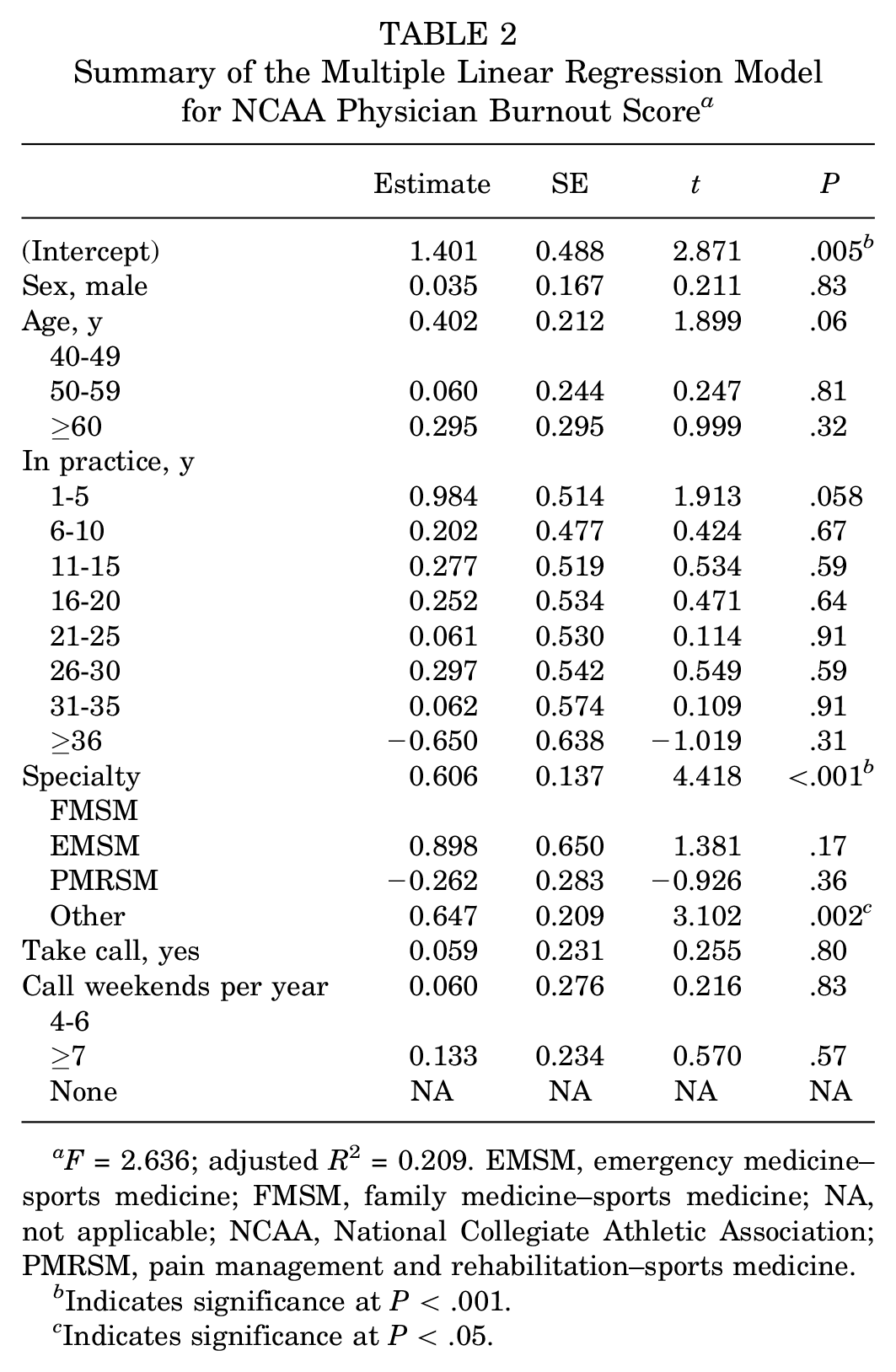
F = 2.636; adjusted R 2 = 0.209. EMSM, emergency medicine–sports medicine; FMSM, family medicine–sports medicine; NA, not applicable; NCAA, National Collegiate Athletic Association; PMRSM, pain management and rehabilitation–sports medicine.
Indicates significance at P < .001.
Indicates significance at P < .05.
Summary of ANOVA of Linear Regression Model for NCAA Physician Burnout Score a

ANOVA, analysis of variance; DoF, degrees of freedom; NA, not applicable; NCAA, National Collegiate Athletic Association.
Indicates significance at P < .001.
The only significant predictor of burnout score was specialty, with family medicine–sports medicine (FMSM) (P < .001) and Other (P = .002) both being associated with a greater burnout score compared with orthopaedics. The ANOVA summary of the linear model additionally confirmed significance of the effect of specialty (P < .001), which accounted for 21.5% of the variability seen in physician burnout scores. Figure 1 illustrates the distribution of burnout scores by specialty.

Summary of physician burnout score by practice specialty. Dots indicate individual data points, bold center line of each box indicates median, box top and bottom indicate 75th and 25th percentiles, respectively, and vertical lines indicate range. The analysis of variance (ANOVA) P value indicates a significant (<.001) effect of specialty on burnout score. EMSM, emergency medicine–sports medicine; FMSM, family medicine–sports medicine; Orthop, orthopaedics; PMRSM, pain management and rehabilitation–sports medicine.
Given the significant effect that NCAA physician specialty had on burnout score, a secondary logistic regression model was created to assess whether specialty had a significant association with achieving burnout. The results of the logistic regression are summarized in Table 4.
Summary of Logistic Regression Analysis of Physician Specialty on Burnout a

FMSM, family medicine–sports medicine; EMSM, emergency medicine–sport medicine; PMRSM, physical medicine and rehabilitation–sports medicine.
Indicates significance at P < .001.
No specialty was found to be a significant predictor for categorical burnout achievement, even though specialty was found to be a significant predictor of increased burnout score.
Discussion
The results of this cross-sectional survey supported our primary hypothesis that NCAA physicians would have higher rates of burnout (89%) than the rest of the physician population (63%). 28 This finding was not corroborated by our secondary hypotheses, such as increased burnout achievement in the first 5 years in practice compared with >5 years in practice (88% vs 89% respectively; P ≥ .99), as no major predictors or demographic associations of burnout were found. While not statistically significant (P = .053), there was a larger proportion of individuals who took call and reached burnout (49/52; 94%) compared with those who did not take call but did reach burnout (30/37; 81%). This number may or may not reach significance with a larger sample size. However, multiple linear regression showed FMSM and other specialties to be a significant predictor of increased burnout score, even though it was not associated with achievement of burnout. The literature shows the highest rates of burnout are seen in front-line physicians, such as family medicine, emergency medicine, and general internal medicine. 26 Additionally, Shanafelt et al 28 showed that family medicine, along with emergency medicine and general pediatrics, had an increased risk of burnout compared with other specialties after adjustment for other personal and professional characteristics. Our study supports this body of evidence in the literature, as the primary care specialties had a positive association with increased burnout score.
NCAA physicians indicated a burnout rate of 89%, which is 26% higher than other physicians previously reported in the literature. 28 Although this is a small data pool to draw conclusions from, this is an alarming level of burnout for any population, especially considering these individuals are making medical decisions for extremely high-level athletes. Physician burnout has been shown to worsen medical decision making and outcomes, so it is possible that this high burnout rate is causing a diminished quality of health care than what these physicians are capable of.5,24
One aspect somewhat unique to NCAA physicians is the financial stake that rests on their medical decision making. According to the NCAA, Division I institutions reported total revenue of $17.5 billion from athletics in 2022. 21 However, this number will likely continue to increase due to the rapid growth of student-athletes profiting from their Name, Image, and Likeness. 12 The financial implications that are at stake with these athletes’ medical decisions could be a huge stressor that many of these physicians face, because it is their decisions that can drastically change the athlete’s and the school’s financial status.
Additional stressors can coincide with finances, such as external pressure from coaches, athletic administration, and fan bases to return an athlete to play sooner than indicated, as well as a greater concern from the public media regarding the medical care provided for many of these athletes. 13 Although taking call was not associated with statistically significantly higher burnout rates than the NCAA physicians not taking call in this survey, the additional time commitment required in working with high-level athletics (traveling for games and tournaments, weekends, practice attendance, etc.) likely contributes to the high rate of burnout achievement. This variable was trending toward significance, and a larger sample size could demonstrate significance. Furthermore, this study focuses on the “Autonomous/Power Five” conferences, which have increased demand and responsibility for physicians and which includes increased travel time and day-to-day involvement. Taking this commitment into account, planning around an athletic calendar can result in missed family time, social events, clinic/operating room time, and time off of work. Much of the freedom these physicians have has now become based on availability and convenience relative to their athletic calendars.
The current study did not show any significant differences in burnout achievement between numerous demographic groups, including sex, age, or years in practice. This does not align with various historical factors that have been found to be related. For example, there is long-standing evidence that there is higher risk of burnout, suicide rate, and work-life conflict in women compared with men, with children at home and work-life integration commonly being identified as contributors.6,9 Additionally, younger physicians seem to be associated with higher rates of burnout.1,15 Dyrbe et al 7 found that physicians aged <55 had a 200% increased risk of burnout compared with physicians aged >55. The likely explanation for the lack of burnout associations in this study is the limited data set present, but there is a possibility that certain unique factors are contributing to burnout in this subset of NCAA physicians that are yet to be studied.
There are studies assessing burnout in NCAA athletes, coaches, and trainers. Athlete burnout is different than profession burnout with its being defined as a syndrome of emotional and physical exhaustion, a reduced sense of accomplishment, and sport devaluation. 23 Studies have shown increased rates of burnout for female athletes compared with male athletes, as well as an earlier age of sport specialization being associated with higher risk of burnout and injury.14,17 Although this study was not assessing athlete burnout specifically, there was no difference in burnout achievement between male and female physician participants within this study. Another study by Wright et al 32 found that perceived stress and workplace stress were significant contributors to their measured burnout subscales of disengagement and exhaustion for collegiate coaches.
This extends into medical staff as well, as a study by Kania et al 16 that found only a 32% rate of burnout in NCAA-employed athletics trainers with stress level and coaches’ pressure to medically clear athletes predicting ratings on all 3 subscales of burnout (emotional exhaustion, depersonalization, personal accomplishment). Both of these studies mirror the discussion above regarding the financial stakes and external pressures of NCAA physicians’ medical management and possible contribution to increased burnout. Another study of graduate assistant athletics trainers worked significantly longer hours in NCAA Division I competition compared with lower divisions, which positively correlated with higher levels of burnout. 20 Although none of these studies have physicians in their sample populations, they examine similar issues faced by medical professionals in this athletic community. This further emphasizes the importance of continued focused research into NCAA physicians.
Although not directly studied, the COVID-19 pandemic has led to significant increases in physicians in terms of burnout, anxiety, and depression.1,4 NCAA physicians at this time were responsible for implementing rigorous testing and quarantine rules to continue safe athletic competition at this time, but there were major discrepancies with the handling of positive cases and quarantine requirements. 29 This added responsibility and moral stress yield another unique stressor for NCAA physicians that could be a contributing cause to burnout.
Limitations
To our knowledge, this is the first study specifically addressing burnout in NCAA physicians working with their institutions’ athletic programs. However, one of the major limitations of this study is the limited sample size. One study showed there were 383 head team physician positions in NCAA Division I, but it is uncertain the total physician participation in Division I athletics. 18 However, it is worth noting that this study focused specifically on the Autonomous/Power Five conferences, which encompasses only 69 schools. Although it is uncertain the number of physicians employed at each institution, a total of 89 responses (1.29 per institution) is substantial for this population. However, this small sample size limits the ability to draw major conclusions of the data. Further studies with larger sample sizes will improve power in understanding burnout relationships.
As with all surveys, one of the limitations of this study is recall bias. Another consideration for this survey was the timing of administration of the survey and assessment of what specific sports each physician may cover. The time commitment and workload changes throughout the year for these physicians based on what sport is in season, timing of the particular season (regular season vs postseason), off-season, and so forth. This presents a challenge, as this can have various positive and negative effects on the attitudes and responses of these physicians depending on when they took the survey in relationship to their duties.
Many studies have mentioned the importance of acknowledging social desirability and survival bias as well affecting participant responses, which is likely present in this study as well. Sports have historically utilized a so-called old school approach to burnout/mental health, as it is pressed upon athletes to “find a way to fix it” and “not show emotion.” Studying these physicians’ burnout and their attitudes longitudinally might provide ideas on mitigating the unique stressors of this physician subset.
Future Research
Further studies looking into the factors historically associated with burnout in the general physician population would likely improve our understanding of burnout in NCAA physicians. Additionally, further studies assessing the different roles and responsibilities of NCAA physicians based on subspecialty or title can also allow improved understanding. Different sports carry different time commitments, challenges, and external pressures. Studies assessing the difference in NCAA physician duties, obligations, and burnout in higher-profile college sports (eg, football, men’s basketball) compared with other sports would be beneficial as well. Finally, as we improve our understanding of the causes of burnout in these physicians, programs and implemented strategies to reduce or alleviate burnout should be studied to determine the most effective method for combatting this problem. 27
Conclusion
The prevalence of burnout in NCAA physicians is extremely high even compared with the rate of other physicians, and the lack of predictive factors shows this issue to be multifactorial. Further studies need to be conducted with larger sample sizes, with historical factors of burnout isolated to better improve the health of this unique physician population.
Supplemental Material
sj-pdf-1-ojs-10.1177_23259671251327684 – Supplemental material for Burnout in National Collegiate Athletic Association Physicians: A Cross-Sectional Study
Supplemental material, sj-pdf-1-ojs-10.1177_23259671251327684 for Burnout in National Collegiate Athletic Association Physicians: A Cross-Sectional Study by Cooper Root, Levi Aldag, Nick Giusti, Damon Mar, Christopher D. Bernard, Luis Salazar, Erik Henkelman, Bryan Vopat and Jeffrey Randall in Orthopaedic Journal of Sports Medicine
Footnotes
Final revision submitted October 13, 2024; accepted November 20, 2024.
One or more of the authors has declared the following potential conflict of interest or source of funding: B.V. holds stock or stock options in Altior, Carbon 22, and Spinal Simplicity and has received hospitality payments from Stryker, a gift from Novastep, consulting fees from International Life Sciences and DePuy Synthes Products, and education payments from Titan Surgical Group. D.M. holds stock options and is an unpaid consultant for Agada Medical and has received consulting fees from Texas Back Institute. E.H. holds stock or stock options in Johnson & Johnson and has received hospitality payments from Arthrex, Titan Surgical Group, and Stryker; education payments from Arthrex and Titan Surgical Group; and a grant from Arthrex. L.S. has received support for education from Titan Surgical Group. AOSSM checks author disclosures against the Open Payments Database (OPD). AOSSM has not conducted an independent investigation on the OPD and disclaims any liability or responsibility relating thereto.
Ethical approval for this study was obtained from the University of Kansas Medical Center (No. STUDY00150629).

References
Supplementary Material
Please find the following supplemental material available below.
For Open Access articles published under a Creative Commons License, all supplemental material carries the same license as the article it is associated with.
For non-Open Access articles published, all supplemental material carries a non-exclusive license, and permission requests for re-use of supplemental material or any part of supplemental material shall be sent directly to the copyright owner as specified in the copyright notice associated with the article.
