




Abstract
Background:
Substantial developments in physeal-sparing surgical techniques for anterior cruciate ligament (ACL) reconstruction (ACLR) have demonstrated safety and efficacy in treating skeletally immature patients. However, outcomes using all–soft tissue quadriceps tendon (QT) autograft in this population are unknown.
Purpose:
To evaluate outcomes including return to sport (RTS) and reinjury risk in skeletally immature patients ≥2 years after undergoing hybrid transepiphyseal ACLR using QT autograft.
Study Design:
Case series; Level of evidence, 4.
Methods:
A consecutive series of skeletally immature patients who underwent primary QT autograft ACLR using a hybrid transepiphyseal technique with ≥2 years of follow-up were retrospectively analyzed. Outcomes included RTS (primary), ability to return to preinjury level of competition, and subsequent ipsilateral/contralateral knee injury (secondary).
Results:
A total of 50 patients were identified and contacted, of which 40 (80.0%) (35 male; mean age, 12.6 years [range, 9.4-16.0 years]) completed the survey at 5.7 ± 2.8 years (range, 2.0-11.5 years) postoperation. Of those, 26 (65.0%) were competitive middle/high school athletes and 18 (45.0%) competed in ≥2 sports. At a mean of 10.6 ± 2.3 months (range, 6-17 months) postoperatively, 37 patients (92.5%) returned to unrestricted sports participation, and 35 patients (87.5%) resumed competition at their preinjury level. Five patients required subsequent ipsilateral knee surgery for ACL revision (n = 2; 5.0%), meniscal injury (n = 2; 5.0%), or symptomatic hardware (n = 1; 2.5%) after a mean of 4.4 ± 1.7 years (range, 2.8-7.1 years). Three patients (7.5%) sustained a subsequent contralateral ACL injury, and 1 patient sustained a contralateral posterior cruciate ligament sprain.
Conclusion:
Findings of this study suggest that midterm outcomes of patients treated with hybrid transepiphyseal ACLR using QT autograft are promising, with a high and expedited RTS and relatively low graft tear risk.
Keywords
Anterior cruciate ligament (ACL) injuries in skeletally immature athletes are increasingly common due to higher rates of participation and competition in sports, sports specialization, and year-round participation.4,23,24 Driven by the relatively high sport dropout rate 30 and historically poor outcomes of nonoperative management of ACL injuries in the skeletally immature population,3,10 substantial advancements in diagnostic modalities and innovative treatment techniques have contributed to a remarkable surge in the number of ACL reconstructions (ACLRs) performed in recent years.5,14,28 Unlike in adult ACLR, femoral transphyseal tunnel creation and transphyseal screw fixation in skeletally immature individuals confers an elevated risk of physeal damage, resulting in growth disturbance including limb-length discrepancy and angular deformity.11,39,48
Although these risks are primarily derived from animal models7,19 and are currently hardly quantifiable, several novel techniques can minimize physeal violation. Originally described by MacIntosh and Darby 27 in 1976, extra-articular reconstruction using iliotibial band autograft was later modified by Micheli et al 32 to include combined extra-articular and intra-articular reconstruction as a physeal-sparing technique in skeletally immature patients. To ameliorate the drawbacks of nonanatomic reconstruction, several all-epiphyseal ACLR techniques have been described, each with unique tunnel drilling and fixation techniques, in efforts to restore the anatomic femoral ACL footprint to improve knee kinematics.2,25,31 However, limited evidence suggests that all-epiphyseal techniques have risks, including femoral growth disturbance21,26,43 and high graft failure risk. 9 To allow for a more accurate anatomic femoral tunnel position, novel techniques include transepiphyseal femoral drilling to avoid injury to the femoral physis,15,33,47 that can be combined with a transphyseal tibial tunnel, allowing a more central location and vertical orientation that negligibly limits the volumetric diameter of physeal disruption.19,20 This technique theoretically causes less insult to the growth plates without jeopardizing principles of anatomic ACLR. Yet there is a paucity of mid- and long-term clinical outcome data pertaining to this hybrid transepiphyseal ACLR technique (femoral physeal sparing and transphyseal tibial tunnel), with current studies utilizing mostly hamstring tendon autograft.6,13,33,37,45
Similarly, there are little published data on clinical outcomes of different graft types across physeal-sparing techniques, precluding determination of a superior graft type for skeletally immature athletes. 42 Quadriceps tendon (QT) autograft has demonstrated reproducible success with regard to failure risk in adults, likely driven by its favorable biomechanical and histologic properties.40,46 In pediatric patients (≤18 years old), QT autograft is reported to have a failure risk ranging from 8% to as low as 2.5%. 49 However, the diverse portfolio of ACLR techniques in skeletally immature patients renders graft comparison challenging and requires more published data for meaningful extrapolation.
We are aware of no clinical reports on hybrid transepiphyseal ACLR using QT autograft. 42 Thus, the purpose of this study was to evaluate clinical outcomes beyond 2 years of follow-up, including return to sport (RTS) and reinjury risk in skeletally immature athletes who underwent hybrid transepiphyseal ACLR using all–soft tissue QT autograft. We hypothesize that this graft demonstrates favorable outcomes, more specifically reinjury risk and RTS, when used in the pediatric patient treated with a physeal-sparing technique.
Methods
Study Cohort
Upon institutional review board approval (STUDY00003512), we retrieved all surgical records of primary hybrid transepiphyseal ACLRs using QT autograft performed by the senior authors (J.W.X., K.E.H.) in the period from 2010 to 2021. We reviewed a consecutive series of skeletally immature patients with ≥2 years of follow-up data. Patients undergoing surgery were indicated for primary hybrid transepiphyseal ACLR with QT autograft for acute ACL ruptures. A thorough history was taken, and a complete physical examination was performed on each patient. Preoperative radiographs and magnetic resonance imaging (MRI) of the knee, along with an anteroposterior radiograph of the hand, were obtained to determine bone age. Using the clinical and radiographic information, the Tanner stage and bone age were determined. While this technique can be utilized in any skeletally immature patient, it was specifically considered for patients in Tanner stage 3 or lower. At the authors’ institution, the QT autograft was the preferred graft during the study period. Demographic information, associated diagnoses, surgical details, and outcome measures for each patient were collected.
Surgical Technique
The same surgical technique for hybrid transepiphyseal ACLR with QT autograft was used by the treating surgeons.15,47 In brief, this technique involved precise preoperative planning, including MRI and radiographic assessments to determine bone age and tunnel measurements. The patient was positioned under anesthesia with specific anatomic landmarks marked for accurate portal placement. The procedure included creating femoral and tibial tunnels after preserving footprints of the femoral origin and tibial insertion while using retrograde drilling oriented by key landmarks of the lateral epicondyle and popliteal sulcus to avoid physeal damage. The tibial tunnel was drilled centrally to avoid physeal disturbances and ensure proper graft placement, and the graft was secured with Arthrex ACL TightRope RT for optimal tendon-bone healing. This technique reliably produced femoral tunnels that were of adequate length and anatomic graft positioning while safely avoiding the femoral physis without time-consuming surgical methods or substantial use of fluoroscopy. All patients received an ipsilateral QT autograft procured with a minimally invasive harvesting technique. 41 In brief, the QT was harvested using a double-bladed knife to incise the tendon longitudinally, guided by markings made with the assistance of an arthroscope. The distal portion of the tendon was dissected off the patella, and the tendon was tapered slightly to facilitate graft preparation. A partial-thickness graft was preferred and was carefully dissected to avoid violating the capsule. The graft was then secured using a whipstitch, and further dissection was carried out proximally until the desired graft length was achieved. This method consistently produced grafts of 9 to 10 mm in width, 6 to 7 mm in depth, and 7 to 8 cm in length, suitable for various reconstruction techniques while minimizing morbidity and complications associated with larger incisions.
Postoperative Management
All patients underwent an identical standardized postoperative rehabilitation protocol in a phased approach. Immediate quadriceps sets and active range of motion were encouraged with preoperative written and video education. Full weightbearing as tolerated with crutches was started on postoperative day 4. Guided physical therapy was started on postoperative day 7, and open chain exercises were introduced to the protocol at week 4. Patients were generally cleared for running at 3 to 4 months and cleared for return to full-contact practice/sport at 9 to 12 months postoperatively.
Outcome Measures
Outcome variables, including preinjury activity level, type of sport, and time to return to full activity, were collected via email questionnaires at ≥2-year follow-up. Subsequent ipsilateral and contralateral injury, as well as subsequent surgical procedures, were recorded. The duration of follow-up was determined by considering both the date of the last clinic visit and the completion date of the patient-reported outcomes. Study data were collected and managed using REDCap electronic data capture tools hosted at the Emory University Department of Orthopaedics.16,17
Statistical Analysis
Descriptive statistical analyses were conducted using standard methods, presenting continuous variables as mean and standard deviation and discrete variables as frequencies and percentages. The Statistical Package for Social Sciences (SPSS) Version 22.0 (IBM Corp) was used for statistical analyses.
Results
Of the 50 eligible patients treated during the study period, 40 (80.0%) elected to participate and were included in the study. The mean age of participants at time of ACLR was 12.6 ± 1.6 years (range, 9.4-16.0 years). There were 35 (87.5%) male patients, with a mean age of 12.6 ± 1.7 years (range, 9.4-16.0 years) and 5 female patients, with mean age of 12.5 ± 1.1 years (range, 11.6-14.0 years). The mean age at follow-up was 17.9 ± 2.9 years (range, 12.1-24.9 years). Of the total participants, 65.0% were competitive middle or high school athletes before ACL injury and 18 (45.0%) competed in ≥2 sports. The most common organized sporting activities were football, basketball, soccer, and baseball. The mean follow-up time was 5.7 ± 2.8 years (range, 2-11.5 years). Baseline characteristics are summarized in Table 1.
Demographic Characteristics

At a mean of 10.6 ± 2.3 months (range, 6-17 months) postoperatively, 37 patients (92.5%) returned to unrestricted sports participation, and 35 patients (87.5%) resumed competition at their preinjury level.
Five patients required subsequent ipsilateral knee surgery: 2 patients underwent ACL revision surgery for graft retear (5.0%), 2 underwent meniscal repair (5.0%), and 1 patient underwent symptomatic interference screw removal (2.5%). The mean time to revision surgery was 4.4 ± 1.7 years (range, 2.8-7.1 years). Three patients (7.5%) sustained a subsequent contralateral ACL injury, and 1 patient sustained a contralateral posterior cruciate ligament sprain. Overall outcome data and age at revision surgery are summarized in Table 2.
Outcome Data
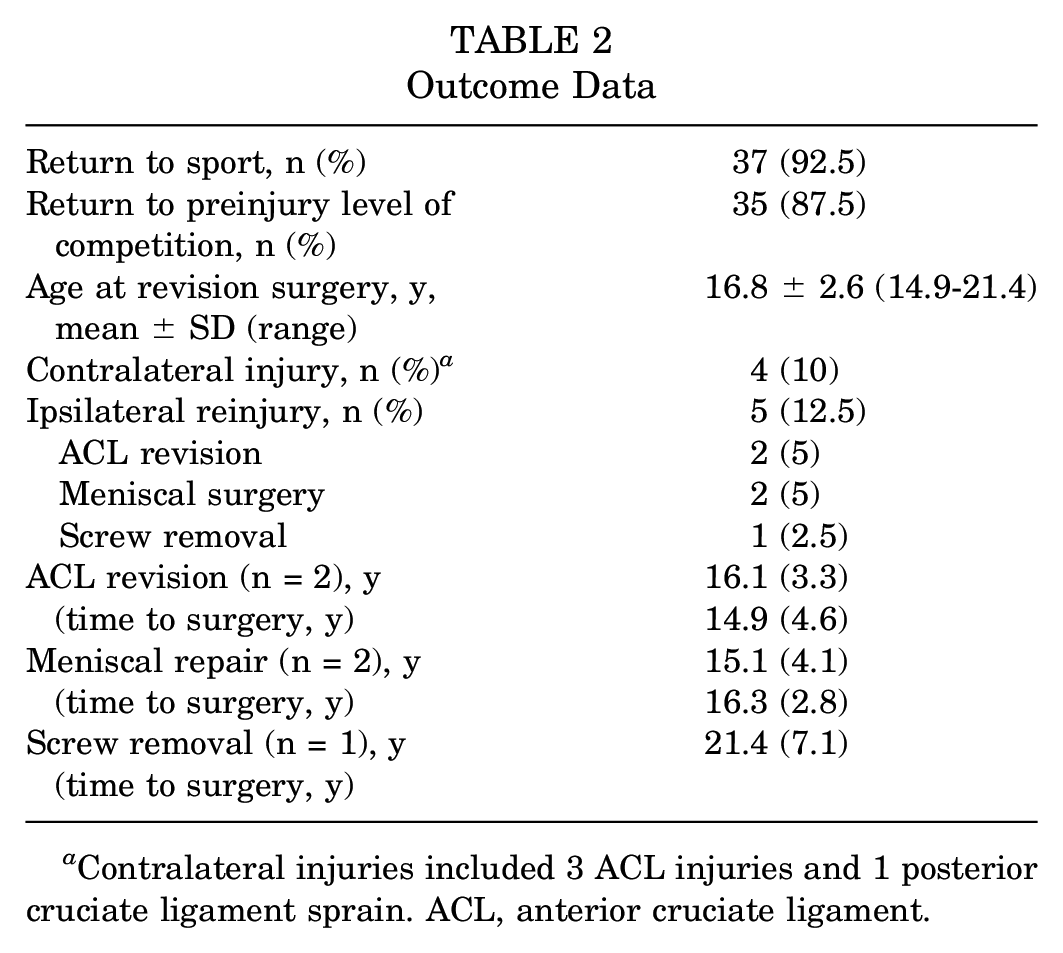
Contralateral injuries included 3 ACL injuries and 1 posterior cruciate ligament sprain. ACL, anterior cruciate ligament.
Discussion
The most important finding of our study was the high rate of athletes who returned to sports (92.5%) and the notably low incidence of graft retears (5%). Collectively, our results indicate that hybrid transepiphyseal ACLR with QT autograft is a secure approach to accelerated RTS yielding favorable midterm clinical outcomes, especially within the high-risk demographic of skeletally immature athletes.
Only a few currently published studies evaluate the use of QT autograft in pediatric patients. Kohl et al 22 prospectively analyzed 15 pediatric patients (mean age, 12.8 ± 2.6 years) who underwent transphyseal ACLR with ipsilateral QT autograft and found no retears at a mean of 4.1 years postoperative with satisfactory patient-reported outcomes. Pennock et al 35 found a lower retear risk in transphyseal ACLR using QT autograft (4%) compared with hamstring tendon autograft (21%) at a mean of 2.8 ± 0.9 years postoperative (P = .037). Mauch et al 29 reported a revision rate of 10.2% at ≥5 years due to repeat acute ACL rupture in a sample of 49 patients undergoing transphyseal ACLR using QT-bone autograft, and Gebhard et al 12 noted a rerupture rate of 25% (3/12) in patients treated with transphyseal ACLR using QT autograft with a femoral bone block. Most recent results found by Perea et al 36 reported a low failure rate of skeletally immature patients treated with all-epiphyseal or complete transphyseal ACLR using all–soft tissue QT autograft. With a minimum follow-up of 2 years in their study, zero patients experienced graft failure and 90% of patients returned to sports.
To our knowledge, our study is the first report to document midterm clinical outcomes associated with all–soft tissue QT autograft, specifically when using the hybrid transepiphyseal technique in skeletally immature patients. Although our sample is fairly limited in size compared with larger study group data, our recorded retear risk of 5% is comparatively low with the combined 9.2% retear risk reported by the MOON knee group for hamstring tendon and bone–patellar tendon–bone autografts on 770 patients with a median age of 17 years at 6 years postoperation. 34 Hence, there is a state of clinical equipoise that warrants further examination of the effect of QT autograft and surgical technique on postoperative outcomes in young athletes with remaining physeal growth.
While retear risk is influenced by a multitude of factors in skeletally immature patients, including high activity level, early RTS, young age, psychological and physiologic readiness, family history of ACL, and increased tibial slope, 8 the influence of surgical technique should not be marginalized. Hence, we believe that the anatomic graft position established through our hybrid transepiphyseal technique, using soft tissue ACL remnants at both the femoral and the tibial footprint for tunnel placement to help recreate anatomic alignment, may contribute to the observed low retear risk. Additionally, many studies report reinjury rates but not RTS or performance after hybrid physeal-sparing ACLR. The clinical implications of a high RTS rate coupled with a low rerupture rate are important, as patients who undergo ACLR but do not RTS would be expected to have low retear rates given the decreased at-risk activity.
The effects of an ipsilateral graft harvest for ACL reconstruction on contralateral knee kinematics are poorly understood but normalize over time. 18 Many of the nonmodifiable risk factors (ie, ligamentous laxity, notch size, knee valgus, etc) that contribute to the primary ACL tear event likely contribute most significantly to the contralateral risk of retear. Thus, we believe that contralateral risk of retear serves to some degree as an internal control, especially when combined with high RTS rates. In our series, 4 patients sustained contralateral knee injuries, 3 (7.5%) of which were ACL tears. This aligns with a reported mean of 4.8% in pediatric patients treated with QT autografts 49 and is consistent with similar rates reported in bone–patellar tendon–bone and hamstring tendon autografts. 34 Ultimately, more research is needed to elicit the relationships between graft types and RTS as well as both ipsilateral and contralateral injury risk.
Previous studies indicate that the QT may have a superior rate of graft incorporation and synovialization compared with hamstring tendon autograft as measured by decreasing graft signal intensity on MRI at 6 to 12 months postoperatively, which correlates with increased tensile strength, load to failure, and graft vascularity.1,44 Our current results indicate that 92.5% of participants returned to full unrestricted activity at a mean of at 10.6 ± 2.3 months (range, 6-17 months), which coincides with graft maturation intervals previously observed by Aitchson et al 1 and Weiler et al. 44 While our current study did not investigate the mode of failure in ipsilateral ACL ruptures, it could be argued that they were likely due to repeat traumatic events rather than premature RTS, as both reruptures in our study occurred well beyond the expected completion of graft maturation (3.3 and 4.6 years). Overall, RTS in pediatric patients (≤18 years old) undergoing ACLR with QT autograft has proven favorable, ranging from 88.9% to 91.7%. 49
Limitations
The current investigation has inherent limitations. Due to its retrospective observational design, this study is reliant on patient willingness to engage in follow-ups. While attempts were made to reach all patients either through telephone or via email, only 40 (80.0%) responded to the questionnaire, introducing potential response and selection bias. Furthermore, this study did not include a comparison group. In addition, although this study evaluated clinical outcomes of a physeal-sparing technique, we did not perform postoperative radiographic assessment of limb length and alignment or potential angular deformity. However, postoperative deformity has been addressed in previous studies and exceeds the scope and focus of this study.20,38 Similarly, this study does not include patient-reported outcome measures. However, the intent and scope of this study were not designed to address that aspect. The primary objective was to assess RTS and the level of return to competition, with a secondary focus on evaluating the risk profile for subsequent injuries within this cohort. Furthermore, this study did not include an objective assessment of joint laxity. While acknowledging the importance of patient-reported outcome measures and objective joint laxity in assessing the success of surgical interventions and recovery, the hard endpoints of rerupture and return to competition, as reported in this study, are considered meaningful and valuable insights. In this case series, female patients were underrepresented, making up only 12.5% of included participants; therefore, disaggregation of data by sex/gender was not possible. Readers should be cautioned when extrapolating our findings to the general population, as epidemiologic data in the age group of skeletally immature patients are currently limited. Although female sex is associated with higher incidence of ACL injury, further epidemiologic and gender-related incidence studies are required to democratize trends. Last, the surgeries were conducted by highly experienced orthopaedic surgeons (J.W.X., K.E.H.) in tertiary care centers. As a result, our findings may not be generalizable to different practice environments or could be influenced by surgeon experience and varying levels of expertise. Nevertheless, the surgical techniques for hybrid transepiphyseal ACLR and minimally invasive QT autograft harvest have been published by the senior authors in efforts to democratize our outcomes in treating this high-risk population.
Conclusion
Findings of this study suggest that midterm outcomes of patients treated with hybrid transepiphyseal ACLR using QT autograft are promising, with a high and expedited RTS and relatively low graft tear risk.
Footnotes
Final revision submitted September 5, 2024; accepted October 18, 2024.
One or more of the authors has declared the following potential conflict of interest or source of funding: K.E.H. has received nonconsulting fees from Arthrex. H.S.S. has received consulting fees from Arthrex, nonconsulting fees from Arthrex, and education payments from Evolution Surgical and Peerless Surgical. J.W.X. has received nonconsulting fees from Arthrex, consulting fees from Arthrex and Trice Medical, royalties from Arthrex, and education payments from United Orthopedics. AOSSM checks author disclosures against the Open Payments Database (OPD). AOSSM has not conducted an independent investigation on the OPD and disclaims any liability or responsibility relating thereto.
Ethical approval for this study was obtained from Emory University (STUDY00003512).
