




Abstract
Background:
Posttraumatic osteoarthritis (PTOA) after anterior cruciate ligament injury and reconstruction (ACLR) is a prevalent cause of long-term disability. Few studies have compared the effect of ACLR timing on the development of PTOA.
Purpose/Hypothesis:
The purpose of this study was to compare the rate of PTOA at a long-term follow-up between patients who underwent early ACLR (<21 days after injury) versus delayed ACLR (>6 weeks after injury). The authors hypothesized that patients who underwent early ACLR would have lower rates of PTOA compared with the delayed ACLR cohort.
Study Design:
Cohort study; Level of evidence, 2.
Methods:
The authors contacted patients from a previous prospective randomized controlled trial who were randomized to undergo either early (<21 days) or delayed (>6 weeks) ACLR with hamstring tendon autografts. Weightbearing radiographs were obtained at a minimum 15-year follow-up, and radiographic PTOA was evaluated using the Kellgren-Lawrence (K-L) classification system. The prevalence of pathologies was compared between the early and delayed groups using appropriate testing, and logistic regression was used to evaluate for associations with failure—a K-L grade of ≥2 or conversion to total knee arthroplasty (TKA).
Results:
At a mean follow-up of 15.6 years, radiographs were obtained for 58 (28 early, 30 delayed) of the original 69 (84.1%) patients. High rates of PTOA (K-L grade ≥2) were observed in the early (82.1%) and delayed (86.7%) cohorts (P = .634). Two (7.1%) patients in the early cohort converted to TKA compared with 4 (13.3%) patients in the delayed cohort (P = .44). Surgical timing did not affect arthritis severity (P≥ .4), and no factors predicted developing radiographic PTOA in either cohort (P > .2). Increased time from injury decreased the odds of failure in the early ACLR cohort (odds ratio, 0.79; P = .041).
Conclusion:
In this study, >80% of patients who underwent ACLR with hamstring tendon autografts had radiographic evidence of PTOA at a mean 15.6-year follow-up, with no difference in the prevalence or severity of PTOA between the early and delayed groups. In addition, 11% of patients had converted to TKA by the time of the final follow-up, and the conversion rate did not differ according to the timing of ACLR.
Posttraumatic osteoarthritis (PTOA) of the knee is a devastating consequence after injury to the cartilage, menisci, or ligaments of the knee, 1 and it accounts for up to US$3 billion in health care costs per year. 7 Anterior cruciate ligament (ACL) injury is the leading cause of knee PTOA, and recent literature has suggested that 50% to 80% of reconstructed knees demonstrate PTOA at long-term follow-ups.15,18,20,22,29,31 ACL injuries typically occur in patients 15 to 25 years old, with symptomatic PTOA developing within 5 to 15 years after an ACL injury. 29 Therefore, pain and dysfunction associated with PTOA can occur during years when patients are highly active. 29 Of note, rates of ACL injury have shown to be higher in active military populations compared with civilian populations,38,46 likely leading to higher rates of PTOA and early military discharge.8,42
The development of PTOA is multifactorial, involving disruptions to normal knee biomechanics and articular cartilage homeostasis.18,20,27,30,39 ACL injuries can cause direct cartilage damage resulting in biomechanical changes to knee function. 39 These changes include rotational instability, loss of range of motion, and meniscal injury leading to increased contact pressures.1,15,18,31,36 ACL reconstruction (ACLR) can restore near-normal knee biomechanics; however, high rates of PTOA continue to develop. 22
There is a growing body of literature analyzing synovial fluid suggesting that inflammatory cytokines present after injury may contribute to PTOA.4,10,19,25-27,36 Recent studies have demonstrated significant changes in the synovial fluid cytokine profile in the first month after ACL injury, 27 and that the concentrations of cytokines may affect functional outcomes after arthroscopic knee surgery. 26 Although these findings may elucidate potential interventions in the future to optimize postoperative outcomes, interventions to date demonstrate variable results.13,21,29,30,36
While the understanding of the effect of biomechanical alterations and articular cartilage homeostasis evolves, there is still a lack of consensus regarding the optimal timing of surgical intervention for early ACL tears. Systematic reviews and meta-analyses comparing early to delayed ACLR have failed to identify a superior approach.28,30,44,45 Importantly, there remains much heterogeneity regarding the follow-up time, outcomes measured, and patients included. To date, there is a paucity of literature regarding the effect of early versus delayed ACLR on the development of PTOA at a long-term follow-up.
As such, this study aimed to compare the rate of PTOA between patients who underwent early ACLR (within 21 days of injury) versus delayed ACLR (>6 weeks after injury). We hypothesized that patients who underwent early ACLR would have lower rates of PTOA compared with the delayed ACLR cohort. By understanding the effect of surgical timing on the incidence of PTOA, we sought to gain valuable insight to further optimize the care and long-term joint health of patients with ACL injury.
Methods
Study Design and Setting
This was a retrospective review of a previous prospectively randomized controlled clinical trial in which patients at least 18 years old with an acute ACL tear were randomized to undergo either early (<21 days) or delayed (>6 weeks) ACLR using hamstring tendon autografts. 6 The index study was approved by an institutional review board, and all participants consented to randomization of surgical technique. The present long-term follow-up study with a retrospective review of radiographs was considered exempt from institutional review board approval.
In the original study, 6 the exclusion criteria were any previous ligamentous surgery on the index knee or a concomitant posterior cruciate, fibular collateral, or posterolateral corner ligamentous knee injury. A magnetic resonance imaging was obtained on all knees to confirm the diagnosis and provide additional information regarding meniscal and concomitant ligamentous injuries. Once an acute ACL tear was diagnosed, the patient was randomized to either the early or the delayed ACLR group. Randomization was performed via study design using sealed envelopes that identified the timing of surgery to be employed. The patients randomized to early ACLR were scheduled for surgery at the earliest possible date. No exceptions were made for swelling, limitations in range of motion, or pain. Patients in the delayed ACLR group were enrolled in a physical therapy program where they began a supervised rehabilitation protocol that emphasized quadriceps muscle strengthening and restoration of full range of motion. The delayed ACLR surgeries were scheduled at a minimum of 6 weeks from the date of injury.
Operative Technique
All knees were reconstructed using a quadrupled hamstring tendon autograft as described by the senior author (C.R.B.). 5 Chondral injuries were graded according to the modified Outerbridge classification. 9 Any loose chondral flaps were debrided. Meniscal tears were repaired or debrided based on residual rim width and configuration of the tear. Meniscal debridement was performed only when repair was not feasible.
Postoperative Rehabilitation and Follow-up
In the original study, all patients were evaluated, at a minimum, 3 days, 2 weeks, and then monthly during the first 6 months postoperatively. At the 6-month postoperative visit, a maximum manual side-to-side KT-1000 arthrometer (MEDmetric) assessment was performed to quantify and compare anterior translation/laxity in the injured knee to that of the contralateral knee. Passive range of motion knee measurements were recorded using a goniometer and compared with the uninjured contralateral knee. A physical therapist who was not part of the surgical team performed all range of motion and stability measurements. Allowing gravity as the only force, the passive extension was recorded while the patient was in a prone position. 6
Postoperatively, patients from both the early and delayed groups followed the same closely supervised rehabilitation protocol. The protocol emphasized early mobilization and maintenance of extension. Slight modifications by the therapists were permitted based on each patient's progress. For patients with meniscal repair or microfracture, partial weightbearing with crutches for 4 weeks was mandated. A hinged knee brace was used for 4 to 6 weeks until good quadriceps control was restored.
Radiographic Follow-up
At a minimum of 15 years postoperatively, patients were contacted via telephone to be scheduled for bilateral weightbearing radiographs and complete the Knee injury and Osteoarthritis Outcome Score (KOOS). Furthermore, patients were asked if they had undergone total knee arthroplasty (TKA) on their injured knee. Subsequently, 4-view bilateral weightbearing radiographs were obtained in a standardized fashion. The radiographs were evaluated by an experienced fellowship-trained musculoskeletal radiologist who was blinded to the treatment group. Radiographs were evaluated according to the Kellgren-Lawrence (K-L) classification. 24 Radiographic PTOA was defined as a K-L grade of ≥2.
Statistical Analysis
After radiographic interpretation, the early and delayed ACLR cohorts were compared. Unpaired 2-tailed t tests were used to compare continuous demographic variables and KOOS scores. Chi-square tests were used to compare categorical demographic and outcome variables. Next, univariate logistic regression was used to evaluate potential predictors of failure, defined as a K-L grade of ≥2 or conversion to TKA. Unpaired t tests and chi-square tests were performed using GraphPad Prism 8 (GraphPad Software). The logistic regression models were developed using RStudio (RStudio Inc).
A power analysis was conducted with the incidence of PTOA as the variable of interest. Based on an effect size of 0.75 and an alpha value of .8, a minimum of 29 patients per study group (total = 58) was required to achieve a power of 0.9.
Results
At a mean follow-up of 15.6 years, 58 patients (28 early and 30 delayed) of the original 69 (84.1%) patients were included in the analysis. In the early ACLR cohort, the mean time from injury to surgery was 9.2 ± 4.9 days (range, 2-20 days) compared with 84.6 ± 37.5 days (range, 42-192 days) in the delayed ACLR group (Table 1).
Characteristics of the Early and Delayed ACLR Cohorts a
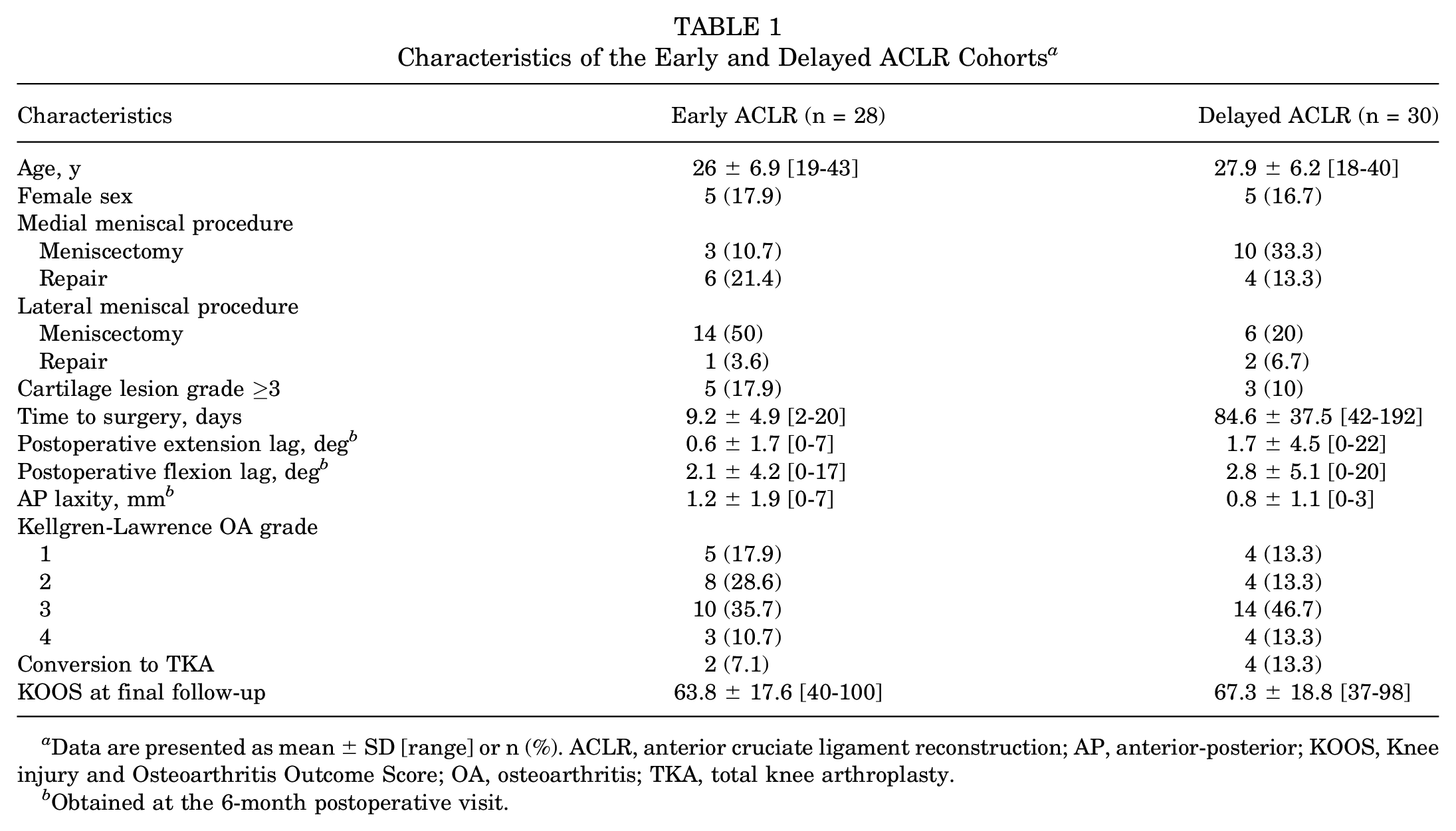
Data are presented as mean ± SD [range] or n (%). ACLR, anterior cruciate ligament reconstruction; AP, anterior-posterior; KOOS, Knee injury and Osteoarthritis Outcome Score; OA, osteoarthritis; TKA, total knee arthroplasty.
Obtained at the 6-month postoperative visit.
Arthritis Severity
At the final follow-up, 23 (82.1%) patients in the early ACLR group had PTOA (K-L grade ≥2) or conversion to TKA compared with 26 (86.7%) patients in the delayed cohort (P = .634). Two (7.1%) patients in the early ACLR cohort had undergone ipsilateral TKA at the long-term follow-up compared with 4 (13.3%) patients in the delayed cohort (P = .44). No group differences were found in KOOS outcomes at the final follow-up (P = .47).
Ten (35.7%) patients in the early ACLR cohort had a K-L grade of 3 at the long-term follow-up compared with 14 (46.7%) patients in the delayed cohort (P = .40). In addition, 3 (10.7%) patients in the early ACLR cohort were found to have a K-L grade of 4 compared with 4 (13.3%) patients in the delayed cohort (P = .76).
Effect of Meniscectomy
In the early ACLR cohort, 15 of the 16 patients (93.8%) who underwent meniscectomy developed PTOA (K-L grade ≥2) or converted to TKA at the final follow-up compared with 8 patients (66.7%) not undergoing meniscectomy (P = .06). In the delayed ACLR cohort, 12 of the 13 patients (92.3%) undergoing meniscectomy developed PTOA or converted to TKA at the final follow-up compared with 14 patients (82.4%) not undergoing meniscectomy (P = .43).
Functional Scores
For patients with a K-L grade of 1, the early ACLR cohort had a mean KOOS score of 80.6% ± 23.9% compared with 77.9% ± 19.3% in the delayed cohort (P = .80). For patients with PTOA, the early ACLR cohort had a mean KOOS score of 61.7% ± 21.4% compared with 56.8% ± 27.8% in the delayed cohort (P = .70). In total, the patients without PTOA (K-L grade 1) had a mean KOOS score of 79.1 ± 20.1 compared with 59.1 ± 24.9 in those with PTOA (P = .027).
Covariate Analysis
In univariate logistic regression models for the early and delayed cohorts, only the number of days until surgery in the early ACLR cohort was associated with decreased odds of PTOA or conversion to TKA at the long-term follow-up (odds ratio, 0.79; P = .041) (Table 2). This finding was not observed in the delayed ACLR group (P = .7). Age, sex, the presence of cartilage lesions, meniscal intervention, postoperative extension or flexion lag, postoperative anterior-posterior laxity, and days until surgery were not significantly associated with the development of radiographic OA (K-L grade ≥2) or conversion to TKA in either cohort (P > .1).
Predictors of PTOA (K-L Grade ≥2) or Conversion to TKA at Long-term Follow-up a

The Bold P value indicates statistical significance (P < .05). ACLR, anterior cruciate ligament reconstruction; AP, anterior-posterior; NA, not applicable; OR, odds ratio; Postop, postoperative; PTOA, posttraumatic osteoarthritis.
Insufficient data to calculate OR.
Discussion
To our knowledge, this is the first study to compare rates of long-term osteoarthritis in a previous prospectively randomized cohort comparing early versus delayed ACLR. The primary finding in the present study was that high rates of PTOA (K-L grade ≥2) were observed in both the early ACLR (82.1%) and delayed ACLR (86.7%) cohorts. Moreover, no differences were observed between the 2 cohorts in symptomatic (K-L grade 3 or 4) PTOA or conversion to TKA. Finally, there were no demographic or perioperative factors predictive of developing radiographic PTOA in either cohort. Interestingly, increased duration from the time of injury to surgery was associated with decreased odds of PTOA or conversion to TKA only in the early ACLR cohort.
PTOA rates at the long-term follow-up ranging between 41% and 83% have been reported in the literature.3,32,33,35,47 The rates of PTOA in the present study fall within the higher end of rates reported in the literature; however, it is important to consider the heterogeneity of these studies. In general, most studies define PTOA as a K-L grade of ≥2; however, others have used discrete measurements. 35 Additionally, there is variability in the graft choices in studies assessing PTOA at long-term follow-ups. Some studies, 3 including the present study, used hamstring tendon autografts. However, most studies report findings using bone-patellar tendon-bone autografts,3,33,47 with 1 group electing for bone-patellar tendon-bone allografts. 35 Graft choice has been shown to affect knee kinematics and joint-loading patterns, 11 making comparisons of long-term outcome rates particularly difficult. Additionally, there was variation in the concomitant procedures performed at the time of surgery. Most studies have included patients who underwent concomitant meniscal operations, with varying proportions of meniscectomies compared with meniscal repairs. Importantly, meniscectomy is a well-described risk factor for the development of osteoarthritis 40 as early as 12 months postoperatively. 43 Finally, differences in study populations make comparison of incidence rates particularly difficult, as the present study population was predominantly active duty military, a unique population known to have increased rates of early PTOA.8,42 Future, prospective studies assessing the effect of graft type, preoperative knee laxity, concomitant injury, and postoperative activity level would benefit the field and provide insight into relevant factors contributing to long-term disability in patients after ACLR.
The findings of the present study suggest that the timing of ACLR may not be associated with the development of PTOA at the long-term follow-up. A 2022 systematic review by Shen et al 44 comparing early versus late ACLR found no differences in retear rates, infection rates, postoperative range of motion, or knee laxity and found mixed results regarding patient-reported outcome measures. Of note, the 11 included studies varied markedly regarding their definitions of timing, with cutoffs ranging from 8 days to 10 weeks used to separate cohorts. Importantly, multiple studies have suggested that delays in the surgical management of early ACL injuries increase the likelihood of concomitant medial meniscal pathology at the time of surgery.12,14,17,34 While there is a growing body of evidence to suggest that delays in surgical management lead to greater intra-articular pathology observed during ACLR, it is unclear whether this pathology increases the incidence of PTOA at a long-term follow-up. The present study suggests the contrary and a subgroup analysis comparing patients who underwent meniscectomy with those who underwent repair or no meniscal procedures did not show increased rates of PTOA or conversion to TKA.
Early alterations to the synovial fluid profile in the setting of ACL injury are often cited as a potential contributor to PTOA. Early chondral injury associated with an ACL rupture leads to an inflammatory cascade.1,22,23,30 Intuitively, an arthroscopic ACLR to stabilize the knee as well as provide a lavage in the early setting could serve to remove the responsible proinflammatory mediators. Intra-articular biomarkers of osteoarthritis have been shown to increase by 250% within the first 5 weeks and do decrease with an early corticosteroid injection. 29 Similarly, intra-articular steroid injections have been shown to reduce synovitis and chondrodegeneration after ACL injury in animal models. 21 However, these interventions have not been shown to decrease the incidence of PTOA in humans at long-term follow-ups. Importantly, operative intervention has been shown to improve radiographic outcomes at up to 20-year follow-ups.3,33 However, the present study suggests that operative intervention within 3 weeks of injury may not significantly decrease the incidence of PTOA. It is possible that the initial disruption to the subchondral bone and hyaline cartilage, present in up to 90% of patients with an early ACL injury, 37 leads to alterations at a molecular or cellular level that is not reversible by early arthroscopic stabilization of the joint. The surgery itself may also cause a “second-hit” or additional insult to the cartilage that may negate the theoretical benefit of an early lavage. Finally, the high rates of PTOA in both cohorts may be due to an alteration of knee kinematics not alleviated with ACLR. An early injury to the native ACL leads to chronic changes in the static and dynamic loading of the knee,1,2 and although ACLR can improve knee stability in ACL-deficient knees, it does not restore normal knee kinematics.16,41
Strengths and Limitations
There are multiple strengths within the present study. The primary strength is the randomized controlled study design, with a follow-up rate of >84% at roughly 15 years after their index ACLR. Standardized operative techniques helped to minimize procedure-related variability and allowed the images to be classified in a blinded fashion.
This study is not without limitations. This is a retrospective review of a previously prospective randomized controlled clinical trial, and therefore, inherent bias exists. Additionally, several patients were lost to follow-up in both cohorts, making selection bias possible. Next, the study cohorts were predominantly active duty, otherwise healthy male athletes who may not be generalizable to the greater population. Moreover, all ACLRs in this study cohort were done using a quadrupled hamstring tendon autograft with a transtibial technique, which was the standard of care at the time. Patients were allowed to return to activity/duty around 4 to 6 months postoperatively, also the standard at the time, which may not reflect current practice patterns. Additionally, there was no data on the incidence of OA in the contralateral knees of these patients. Other data—including body mass index, reinjury and graft laxity, subsequent surgeries, and other validated patient-reported outcomes were also not available for analysis. These factors, while outside of the scope of the present study, are of interest for future analyses.
Conclusion
In this study, >80% of patients who underwent ACLR with hamstring tendon autografts had radiographic evidence of PTOA at a mean follow-up of 15.6 years. Surgical timing did not affect the prevalence or severity of PTOA; however, it increased the time from injury to surgery and decreased the odds of developing PTOA or converting to TKA in the early ACLR cohort.
Footnotes
Final revision submitted September 27, 2024; accepted October 10, 2024.
One or more of the authors has declared the following potential conflict of interest or source of funding: C.A.C. has received grant support from Arthrex. C.R.B. has received education payments from Elevate Surgical; nonconsulting fees from Arthrex; and honoraria from Musculoskeletal Transplant Foundation and Flexion Therapeutics. AOSSM checks author disclosures against the Open Payments Database (OPD). AOSSM has not conducted an independent investigation on the OPD and disclaims any liability or responsibility relating thereto. Ethical approval for this study was waived by Tripler Army Medical Center (reference No. 20R03).
